ACID-BASE BALANCE
Introduction to Acid –Base balance
• The hydrogen ion concentration of body fluids is
maintained within a narrow range for purposes of
regulating normal metabolic and enzymatic
processes and critical functions such as
fertilization, growth, cell volume regulation, and
protein synthesis.
• Since the [H + ] is in nanomolar concentrations,
compared to bicarbonate in millimolar amounts, it
is clear that the [H + ] is involved in many
reactions.
• most cells in the body are electronegative to
the extracellular space, the equilibrium pH
within cells is lower than the external fluid.
• Though intracellular pH is more acidic than
extracellular, most cells have available
mechanisms to prevent pH from excessive
increases or decreases.
• It is interesting that the same transporters,
available to all cells to control their own pH,
are used by the kidney tubules to eliminate
acid into the urine. The extracellular pH is
normally in the range of 7.35–7.45.
• The two acid-base buffer systems in the human
body are the metabolic system (kidneys) and
the respiratory system (lungs).
• To classify the type of disturbance, a blood gas
(preferably arterial) and basic metabolic panel
must be obtained.
• The normal pH of human blood is 7.40 (7.35-
7.45). This number is tightly regulated by the
two buffer systems mentioned above
• The lungs contain carbonic anhydrase which is
capable of converting carbonic acid to water
and CO2.
• The respiratory response results in an
alteration to ventilation which allows acid to be
retained or expelled as CO2.
• Therefore, bradypnea will result in respiratory
acidosis while tachypnea will result in
respiratory alkalosis.
• The respiratory buffer system is fast acting,
resulting in respiratory compensation within
30 minutes and taking approximately 12 to 24
hours to reach equilibrium.
• The renal metabolic response results in
alterations in bicarbonate excretion. This
system is more time consuming and can
typically takes at least three to five days to
reach equilibrium.
• Five primary classifications of acid-base
imbalance:
1. Metabolic acidosis
2. Metabolic alkalosis
3. Respiratory acidosis
4. Respiratory alkalosis
5. Mixed acid-base disturbance
A primary respiratory acid-base imbalance:
• is a result of over- or under-ventilation
• if minute-ventilation is decreased there will be
an increase in CO2 and acid in the blood,
resulting in respiratory acidosis.
• This is a common problem in the surgical
patient as a result of opioids, anxiolytics and
anesthetics which cause sedation and
decrease the respiratory drive
• Conversely, post- operative pain or anxiety can
result in increased minute-ventilation,
resulting in decreased CO2, and subsequent
respiratory alkalosis.
• Patients who are mechanically ventilated
• can develop disturbances from inappropriate
sedation or ventilator settings.
Primary Metabolic acid base imbalance:
• A primary metabolic acid-base imbalance is a
result of changes in bicarbonate excretion by
the kidneys.
• In the surgical patient, the most common is
metabolic acidosis which has a broad
differential diagnosis and is further sub-
divided by the presence or absence of an
abnormal anion gap.
• The differential diagnosis for anion-gap metabolic
acidosis (AGMA) is easily remembered with the
mnemonic “MUDPILES”:
• M Methanol toxicity
• U Uremia
• D Diabetic ketoacidosis
• P Paraldehyde
• I Isoniazid or Iron toxicity
• L Lactic acidosis
• E Ethylene glycol toxicity
• S Salicylate toxicity
• Lactic acidosis is the most common cause of AGMA in
the surgical patient and is a result of inadequate end-
organ perfusion and resultant anaerobic metabolism
producing lactate and other anions as byproducts.
• The causes of non-anion gap metabolic acidosis
(NAGMA) can be remembered with the
• mnemonic “HARDUP”:
• H Hyperalimentation
• A Acetazolamide
• R Renal tubular acidosis
• D Diarrhea
• U Ureterosigmoid fistula
• P Pancreatic fistula
• Metabolic alkalosis is another disturbance
commonly seen by the surgeon
• the most common causes in the surgical
patient are gastrointestinal loss of
• Hydrochloric acid (vomiting) and volume
contraction (dehydration, excessive diuretic
use).
Mixed acid-base disturbance
• As stated, multiple disturbances can occur
simultaneously. This increases the diagnostic
challenge of determining the primary
disturbance.
• Further, the body will attempt to compensate
with either the metabolic or respiratory
system if the other is out of balance
Suggested method to approach diagnosis of
acid-base pathology:
1. “emia” - Check the arterial pH
a. pH < 7.4 = Acidemia
b. pH > 7.4 = Alkalemia
2. osis” - Look at the pattern in PCO2 & [HCO3]
• If both PCO2 & [HCO3] are low
Suggests presence of metabolic acidosis or
respiratory alkalosis
• If both PCO2 & [HCO3] are high
Suggests presents of metabolic alkalosis or
respiratory acidosis
• If PCO2 & [HCO3] move in opposite directions
Mixed disturbance
• If high anion gap is present
Strongly suggests metabolic acidosis
• If there is a base deficit**
Metabolic acidosis
Can also be a result of compensation
• If there is a base excess
Metabolic alkalosis
The Brain and Acid-Base Balance
• Brain pH as reflected by the cerebral spinal
fluid is critically important for central nervous
system (CNS) function and differs from
peripheral pH regulation in that it is more
precisely controlled within a narrow range by
unique cellular mechanisms.
• Brain to compensate back to near-normal pH in
each of the primary disturbances: metabolic
acidosis and alkalosis, and respiratory acidosis
and alkalosis.
• Acidification of the brain interstitial fluid
results in increased ventilation, whereas
medullary interstitial fluid alkalization results
in decreased ventilation.
• In addition to this perm abilities of the blood
brain barrier for carbon dioxide, hydrogen ion,
and bicarbonate, movement of these species
into the CNS.
• One example of the disequilibrium between
peripheral and brain pH occurs when sodium
bicarbonate is given to a patient to correct
metabolic acidosis.
• There may be a paradoxical acidification of the
brain, as carbon dioxide formed from the
infused bicarbonate ,as a result of this brain
interstitial fluid will lead to hyperventilation,
causing systemic respiratory alkalosis
Roles of the Normal Lung and Kidney in Acid-
Base Disturbances
• The accepted wisdom that the lungs
compensate for metabolic disturbances and
that the kidney compensates for pulmonary
disturbances
• In that signals to the lung modulate control of
ventilation in respiratory disorders and
metabolic disorders require renal responses.
The Diagnostic Approach to Identifying Acid-
Base Disorders
• Complete history and physical examination.
• history include: understanding the quantity,
contents, and source of fluid losses or gains
• From the body; ingested substances and certain
diseases known to be associated with acid-base
disorders.
• For example: vomiting (metabolic alkalosis),
diarrhea (metabolic acidosis), chronic
obstructive pulmonary disease (respiratory
acidosis),
pneumonia (respiratory alkalosis),
• Laboratory tests: basic metabolic profile with
electrolytes: sodium, potassium, chloride,
bicarbonate, blood urea nitrogen, and
creatinine and serum bicarbonate and H +
concenration , Arterial blood gas analysis etc
Management
• The most important principle in the management
of a major acid-base disturbance is to treat the
cause (not the effect).
• Here are supportive measures that can employed
to temporarily treat acid-base disturbances
• If a patient has severe acidemia and is
hemodynamically unstable, alkaline medications
such as sodium bicarbonate may be infused
intravenously
•
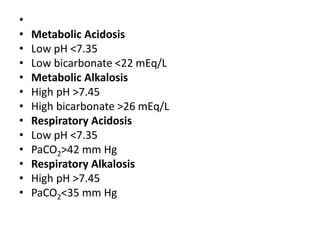
• Metabolic Acidosis
• Low pH <7.35
• Low bicarbonate <22 mEq/L
• Metabolic Alkalosis
• High pH >7.45
• High bicarbonate >26 mEq/L
• Respiratory Acidosis
• Low pH <7.35
• PaCO2>42 mm Hg
• Respiratory Alkalosis
• High pH >7.45
• PaCO2<35 mm Hg

ACID-BASE BALANCE.pptx

  • 1.
  • 2.
    Introduction to Acid–Base balance • The hydrogen ion concentration of body fluids is maintained within a narrow range for purposes of regulating normal metabolic and enzymatic processes and critical functions such as fertilization, growth, cell volume regulation, and protein synthesis. • Since the [H + ] is in nanomolar concentrations, compared to bicarbonate in millimolar amounts, it is clear that the [H + ] is involved in many reactions.
  • 3.
    • most cellsin the body are electronegative to the extracellular space, the equilibrium pH within cells is lower than the external fluid. • Though intracellular pH is more acidic than extracellular, most cells have available mechanisms to prevent pH from excessive increases or decreases.
  • 4.
    • It isinteresting that the same transporters, available to all cells to control their own pH, are used by the kidney tubules to eliminate acid into the urine. The extracellular pH is normally in the range of 7.35–7.45.
  • 5.
    • The twoacid-base buffer systems in the human body are the metabolic system (kidneys) and the respiratory system (lungs). • To classify the type of disturbance, a blood gas (preferably arterial) and basic metabolic panel must be obtained. • The normal pH of human blood is 7.40 (7.35- 7.45). This number is tightly regulated by the two buffer systems mentioned above
  • 6.
    • The lungscontain carbonic anhydrase which is capable of converting carbonic acid to water and CO2. • The respiratory response results in an alteration to ventilation which allows acid to be retained or expelled as CO2. • Therefore, bradypnea will result in respiratory acidosis while tachypnea will result in respiratory alkalosis.
  • 7.
    • The respiratorybuffer system is fast acting, resulting in respiratory compensation within 30 minutes and taking approximately 12 to 24 hours to reach equilibrium. • The renal metabolic response results in alterations in bicarbonate excretion. This system is more time consuming and can typically takes at least three to five days to reach equilibrium.
  • 8.
    • Five primaryclassifications of acid-base imbalance: 1. Metabolic acidosis 2. Metabolic alkalosis 3. Respiratory acidosis 4. Respiratory alkalosis 5. Mixed acid-base disturbance
  • 9.
    A primary respiratoryacid-base imbalance: • is a result of over- or under-ventilation • if minute-ventilation is decreased there will be an increase in CO2 and acid in the blood, resulting in respiratory acidosis. • This is a common problem in the surgical patient as a result of opioids, anxiolytics and anesthetics which cause sedation and decrease the respiratory drive
  • 10.
    • Conversely, post-operative pain or anxiety can result in increased minute-ventilation, resulting in decreased CO2, and subsequent respiratory alkalosis. • Patients who are mechanically ventilated • can develop disturbances from inappropriate sedation or ventilator settings.
  • 11.
    Primary Metabolic acidbase imbalance: • A primary metabolic acid-base imbalance is a result of changes in bicarbonate excretion by the kidneys. • In the surgical patient, the most common is metabolic acidosis which has a broad differential diagnosis and is further sub- divided by the presence or absence of an abnormal anion gap.
  • 12.
    • The differentialdiagnosis for anion-gap metabolic acidosis (AGMA) is easily remembered with the mnemonic “MUDPILES”: • M Methanol toxicity • U Uremia • D Diabetic ketoacidosis • P Paraldehyde • I Isoniazid or Iron toxicity • L Lactic acidosis • E Ethylene glycol toxicity • S Salicylate toxicity
  • 13.
    • Lactic acidosisis the most common cause of AGMA in the surgical patient and is a result of inadequate end- organ perfusion and resultant anaerobic metabolism producing lactate and other anions as byproducts. • The causes of non-anion gap metabolic acidosis (NAGMA) can be remembered with the • mnemonic “HARDUP”: • H Hyperalimentation • A Acetazolamide • R Renal tubular acidosis • D Diarrhea • U Ureterosigmoid fistula • P Pancreatic fistula
  • 14.
    • Metabolic alkalosisis another disturbance commonly seen by the surgeon • the most common causes in the surgical patient are gastrointestinal loss of • Hydrochloric acid (vomiting) and volume contraction (dehydration, excessive diuretic use).
  • 15.
    Mixed acid-base disturbance •As stated, multiple disturbances can occur simultaneously. This increases the diagnostic challenge of determining the primary disturbance. • Further, the body will attempt to compensate with either the metabolic or respiratory system if the other is out of balance
  • 16.
    Suggested method toapproach diagnosis of acid-base pathology: 1. “emia” - Check the arterial pH a. pH < 7.4 = Acidemia b. pH > 7.4 = Alkalemia 2. osis” - Look at the pattern in PCO2 & [HCO3] • If both PCO2 & [HCO3] are low Suggests presence of metabolic acidosis or respiratory alkalosis
  • 17.
    • If bothPCO2 & [HCO3] are high Suggests presents of metabolic alkalosis or respiratory acidosis • If PCO2 & [HCO3] move in opposite directions Mixed disturbance • If high anion gap is present Strongly suggests metabolic acidosis • If there is a base deficit** Metabolic acidosis Can also be a result of compensation
  • 18.
    • If thereis a base excess Metabolic alkalosis
  • 19.
    The Brain andAcid-Base Balance • Brain pH as reflected by the cerebral spinal fluid is critically important for central nervous system (CNS) function and differs from peripheral pH regulation in that it is more precisely controlled within a narrow range by unique cellular mechanisms. • Brain to compensate back to near-normal pH in each of the primary disturbances: metabolic acidosis and alkalosis, and respiratory acidosis and alkalosis.
  • 20.
    • Acidification ofthe brain interstitial fluid results in increased ventilation, whereas medullary interstitial fluid alkalization results in decreased ventilation. • In addition to this perm abilities of the blood brain barrier for carbon dioxide, hydrogen ion, and bicarbonate, movement of these species into the CNS.
  • 21.
    • One exampleof the disequilibrium between peripheral and brain pH occurs when sodium bicarbonate is given to a patient to correct metabolic acidosis. • There may be a paradoxical acidification of the brain, as carbon dioxide formed from the infused bicarbonate ,as a result of this brain interstitial fluid will lead to hyperventilation, causing systemic respiratory alkalosis
  • 22.
    Roles of theNormal Lung and Kidney in Acid- Base Disturbances • The accepted wisdom that the lungs compensate for metabolic disturbances and that the kidney compensates for pulmonary disturbances • In that signals to the lung modulate control of ventilation in respiratory disorders and metabolic disorders require renal responses.
  • 23.
    The Diagnostic Approachto Identifying Acid- Base Disorders • Complete history and physical examination. • history include: understanding the quantity, contents, and source of fluid losses or gains • From the body; ingested substances and certain diseases known to be associated with acid-base disorders. • For example: vomiting (metabolic alkalosis), diarrhea (metabolic acidosis), chronic obstructive pulmonary disease (respiratory acidosis),
  • 24.
    pneumonia (respiratory alkalosis), •Laboratory tests: basic metabolic profile with electrolytes: sodium, potassium, chloride, bicarbonate, blood urea nitrogen, and creatinine and serum bicarbonate and H + concenration , Arterial blood gas analysis etc
  • 25.
    Management • The mostimportant principle in the management of a major acid-base disturbance is to treat the cause (not the effect). • Here are supportive measures that can employed to temporarily treat acid-base disturbances • If a patient has severe acidemia and is hemodynamically unstable, alkaline medications such as sodium bicarbonate may be infused intravenously
  • 26.
    • • Metabolic Acidosis •Low pH <7.35 • Low bicarbonate <22 mEq/L • Metabolic Alkalosis • High pH >7.45 • High bicarbonate >26 mEq/L • Respiratory Acidosis • Low pH <7.35 • PaCO2>42 mm Hg • Respiratory Alkalosis • High pH >7.45 • PaCO2<35 mm Hg