MedicationandFluidTherapy
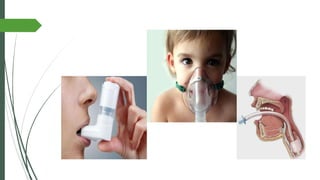
NEBULIZER
• A nebulizer is a device that uses a small compressor to convert
liquid medication into tiny droplets of mist that can be inhaled
directly into the lungs.
• Since the medication goes straight to the lungs, onset of the
medication’s action often takes place rapidly.
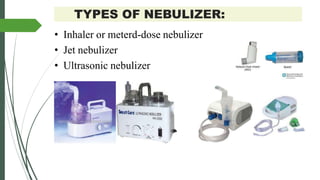
TYPES OF NEBULIZER:
• Inhaler or meterd-dose nebulizer
• Jet nebulizer
• Ultrasonic nebulizer
AdministeringNebulizedMedications
is used commonly in medical conditions of airflow obstruction,
such as bronchospasm and airway hyperresponsiveness.
is extremely effective in the administration of medication in
children younger than 5 years.
Aerosol inhalation may be used as long-term therapy
PURPOSES
To relieve respiratory insufficiency due to broncho spasm.
To correct the underlying respiratory disorders responsible
for broncho spasm.
To liquefy and remove retained thick secretions.
To reduce inflammatory and allergic responses of the
upper respiratory tract.
Cont.….
• When a person has a acute asthma attack.
• When a person is in respiratory distress.
• If a person is unable to use a inhaler.
• If a person has stridor.
• Respiratory congestions
• Pneumonia
• Atelectasis
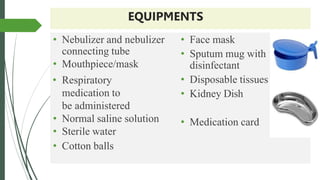
EQUIPMENTS
• Nebulizer and nebulizer
connecting tube
• Mouthpiece/mask
• Respiratory
medication to
be administered
• Normal saline solution
• Sterile water
• Cotton balls
• Face mask
• Sputum mug with
disinfectant
• Disposable tissues
• Kidney Dish
• Medication card
PROCEDURE
Explain the procedure to the patient by his native language.
Wash your hand if your client agree with you.
Collect necessary equipment listed under equipment
Take vital sign before any intervention to know the status of patient.
Place the patient in comfortable sitting or Semi fowler position.
Add the prescribed amount of medications to the medicine chamber of
the tubing. Connect the tube to the compressor. A fine mist from the
device should be visible.
Cont.…
Place the mask on patient’s face to cover his mouth and nose and
instruct him to inhale deeply and slowly through mouth, hold
breath and then exhale several times.
Observe expansion of chest to ascertain that patient is taking
deep breaths.
Instruct the pt to breath slowly and deeply until all the
medications is nebulized.
Cont.…
 On completion of the treatment encourage the patient to cough after several
deep breaths.
 Observe the pt for any adverse reaction to the treatments.
 Take Vital Sign if necessary
 Proper cleaning, sterilization and storage of equipment’s prevents organisms
from entering the lungs.
 Wash your hand
 Document the procedure and the description of the secretions
expectorated.
PARENTERAL MEDICATION
ADMINISTERATION
Parenteral drug administration refers to drugs given by routes
other than the digestive tract.
 The term parenteral is usually used for drugs given by injection
or infusion.
The enteral route usually refers to taking drugs by mouth.
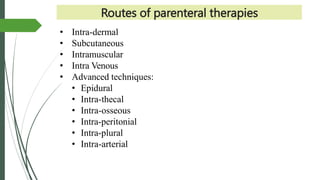
Routes of parenteral therapies
• Intra-dermal
• Subcutaneous
• Intramuscular
• Intra Venous
• Advanced techniques:
• Epidural
• Intra-thecal
• Intra-osseous
• Intra-peritonial
• Intra-plural
• Intra-arterial
Cont.…..
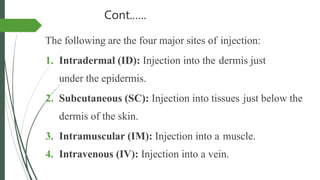
The following are the four major sites of injection:
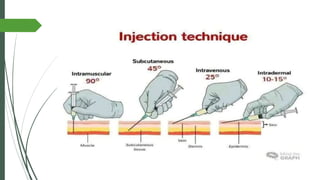
1. Intradermal (ID): Injection into the dermis just
under the epidermis.
2. Subcutaneous (SC): Injection into tissues just below the
dermis of the skin.
3. Intramuscular (IM): Injection into a muscle.
4. Intravenous (IV): Injection into a vein.
Cont.….
Some medications are administered into body cavities. These additional routes include
 Epidural: Epidural medications are administered in the epidural space.
 Intrathecal: Administration of medications into subarachnoid space or one of the
ventricles of the brain.
 Intraosseous: Administration of medication directly into the bone marrow.
 Intraperitoneal:Medicationsadministered into the peritoneal cavity
 Intrapleural: Administration of medications directly into the pleural space.
 Intraarterial: Intraarterial medications are administered directly into the arteries.
Safety In Administering Medications
 The safe and accurate administration of medication is one of the major
responsibility of a nurse.
 Read the physician’s orders of the drug.
 If the order is not clear consult the physician.
 Consider the age and weight of the patient.
 The nurse must have thorough knowledge of drugs that is administered by her.
 Look for the color, odor and consistency of the drug before administration.
 Follow 10 rights and 3 checks in drug administration.
Cont.…
Calculate the drug dosage accurately.
Identify the patient correctly.
Observe for the symptoms of over dosage of the drugs before it
is administered.
Give the drugs one by one
Stay with the patient until he has taken the medicine completely.
Do not leave the medicine with the patient.
Cont.…
• The nurse should always assess a client’s health status and obtain
a medication history prior to giving any medication.
• The medication history includes information about the drugs the
client is taking currently or has taken recently and the history of
drug allergies.
• The nurse should clarify with the client any side effects, adverse
reactions, or allergic responses due to medications.
Cont.….
• The nurse has to identify any problems the client may have in
self-administering a medication.
• For example, a client with poor eyesight, may require
special labels for the medication container.
• The nurse needs to consider socioeconomic factors for all
clients.
• Medication errors must be reported according to the
policy of the hospital.
MEDICATIONERROR
Medication errors are unintended mistakes in the
prescribing, dispensing and administration of a medicine
that could cause harm to a patient.
• Medication errors can occur at all stages of the
medication administration process.
• The four main types of medication errors that occur with
hospitalized clients:
Cont..
1. Prescription errors (e.g. Wrong drug or dose)
2. Transcription/ interpretation error (e.g. Misinterpretation of
abbreviations)
3. Preparation errors (e.g. Calculation error)
4. Administration errors (e.g. Wrong dose, wrong time,
omission, or additional dose).
Most medication errors occur during the administration stage.
Cont.…
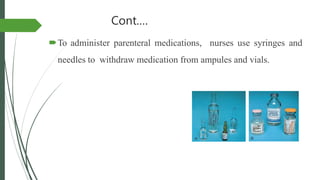
To administer parenteral medications, nurses use syringes and
needles to withdraw medication from ampules and vials.
Cont.….
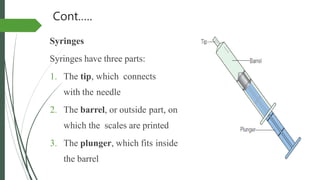
Syringes
Syringes have three parts:
1. The tip, which connects
with the needle
2. The barrel, or outside part, on
which the scales are printed
3. The plunger, which fits inside
the barrel
Cont.…
Several kinds of syringes are available in differing sizes, shapes,
and materials. Syringes range in sizes from 1 to 60 mL.
Insulin syringes are available in sizes that hold 0.3 to 1 mL and
are calibrated in units.
The tuberculin syringe has a capacity of 1 mL.
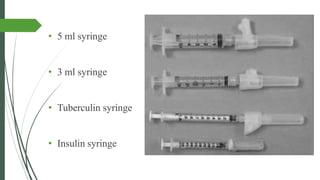
• 5 ml syringe
• 3 ml syringe
• Tuberculin syringe
• Insulin syringe
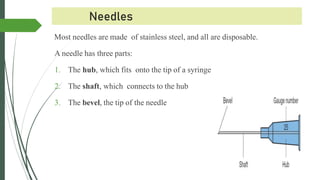
Needles
Most needles are made of stainless steel, and all are disposable.
A needle has three parts:
1. The hub, which fits onto the tip of a syringe
2. The shaft, which connects to the hub
3. The bevel, the tip of the needle
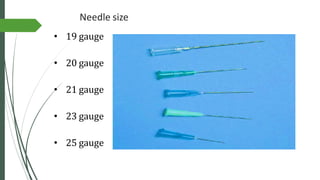
Needle size
• 19 gauge
• 20 gauge
• 21 gauge
• 23 gauge
• 25 gauge
Cont.…
The gauge varies from 18 to 30.
Use longer needles for IM injections and a shorter needle
for subcutaneous injections.
Preventing needle stick injuries
One of the most potentially hazardous procedures that health
care personnel face is using and disposing of needles and
sharps.
Needlestick injuries present a major risk for infection with
hepatitis B virus, human immunodeficiency virus (HIV), and
many other pathogens.
Use appropriate puncture-proof disposal containers to dispose of
uncapped needles and sharps.
Never throw sharps in wastebaskets.
Never recap used needles
Cont.…
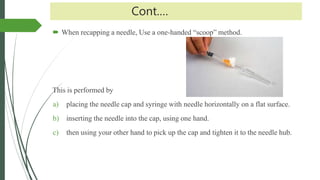
 When recapping a needle, Use a one-handed “scoop” method.
This is performed by
a) placing the needle cap and syringe with needle horizontally on a flat surface.
b) inserting the needle into the cap, using one hand.
c) then using your other hand to pick up the cap and tighten it to the needle hub.
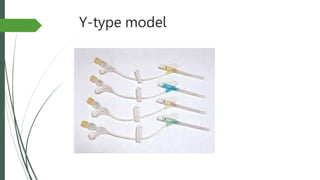
CANNULA
 A cannula is a flexible tube that can be inserted into the body.
 A venous cannula is inserted into a vein, for the administration of
intravenous fluids, for obtaining blood samples and for administering medicines.
 Types of cannula are
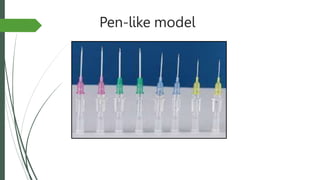
• IV cannula pen-like model.
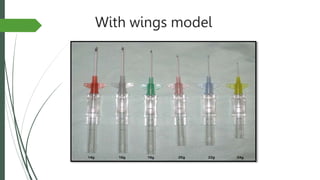
• IV cannula with wings model.
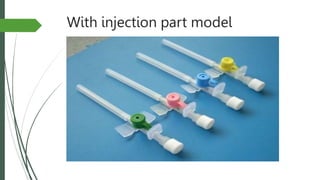
• IV cannula with injection part model.
• IV cannula y-type model.
Pen-like model
With wings model
With injection part model
Y-type model
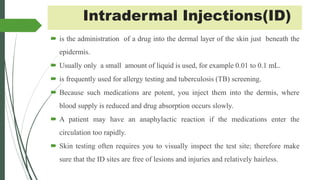
Intradermal Injections(ID)
 is the administration of a drug into the dermal layer of the skin just beneath the
epidermis.
 Usually only a small amount of liquid is used, for example 0.01 to 0.1 mL.
 is frequently used for allergy testing and tuberculosis (TB) screening.
 Because such medications are potent, you inject them into the dermis, where
blood supply is reduced and drug absorption occurs slowly.
 A patient may have an anaphylactic reaction if the medications enter the
circulation too rapidly.
 Skin testing often requires you to visually inspect the test site; therefore make
sure that the ID sites are free of lesions and injuries and relatively hairless.
Cont.…
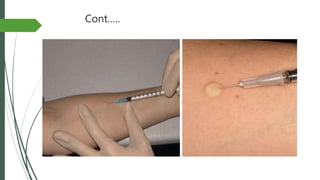
The inner forearm and upper back are ideal locations.
 To administer an ID injection, use a tuberculin (TB) or small syringe
with a short ( 3 /8 to 5 /8 inch), fine-gauge (25 to 27) needle.
 The angle of insertion for an intradermal injection is 10 to 15 degrees.
Inject only small amounts of medication (0.01 to 0.1 mL) intradermally.
After injecting the medication, a small bleb resembling a mosquito
bite appears on the surface of the skin.
Cont.….
PURPOSE
For diagnostic
For therapeutic
INJECTION SITE
Inner for arm
Upper chest
scapula
Equipment
Medication administration
record
Vial with medication
Alcohol swab
syringe with needle
Dilutant if necessary
Medication card and
prescription
File
Glove
Dry cotton
Marked pen
Vital sign equipment
Safety box
Receiver
PROCEDURE
Explain the procedure to the patient
Wash your hand
Collect necessary equipment
Prepare only for one patient at a time.
Take ordered medication from cabinet by checking with pt
identification.
Calculate correct drug dosage
Cont.…
 Take vital sign
 Dilute the medication if necessary
 Inject air into the vial which is equal to ordered medication
 Withdraw medication from the vial
 Expel air from the syringe
 Recap the needle without contaminating the tip of needle, if so change
the needle.
 Select injection site
Cont.…
Clean the site with alcohol swab or distill water depending on
characteristic of medication
Hold the syringe with dominant hand
Inject slowly within 3 to 5 seconds.
Not massage the site
Dispose needle in safety box.
Document the procedure.
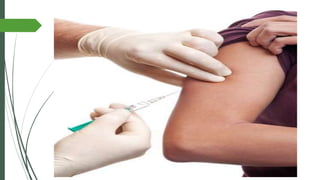
SUBCUTANEOUS INJECTIONS
delivers a drug into the adipose (fatty) tissue beneath the skin.
allows the drug to move into the bloodstream more rapidly than
when given by mouth because it’s absorbed mainly through
capillaries.
When compared with IM injection, subcutaneous injection
provides slower, more sustained drug delivery; minimizes tissue
trauma; and carries little risk of striking large blood vessels and
nerves.
Cont.…
Drugs recommended for subcutaneous injection include
nonirritating aqueous solutions and suspensions contained in 0.5
to 2 mL of fluid.
 Heparin and insulin, for example, are usually administered
subcutaneously.
Some diabetic patients may benefit from an insulin infusion
pump.
Cont.…
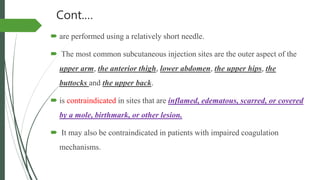
 are performed using a relatively short needle.
 The most common subcutaneous injection sites are the outer aspect of the
upper arm, the anterior thigh, lower abdomen, the upper hips, the
buttocks and the upper back.
 is contraindicated in sites that are inflamed, edematous, scarred, or covered
by a mole, birthmark, or other lesion.
 It may also be contraindicated in patients with impaired coagulation
mechanisms.
Equipment
 Tray
 Medication administration record
 Vial with medication or Ampoule
 Alcohol swab
 syringe with needle(2)
 Dilutant if necessary
 Medication card and prescription
 File
 Glove
 Dry cotton
 Marked pen
 Vital sign equipment
 Safety box
 Receiver
Kinds of drugs commonly administered Sc:
1. vaccines
2. preoperative medications
3. narcotics
4. insulin
5. heparin
• Only small volumes (0.5 to
1.5 mL) of medications are given
subcutaneously.
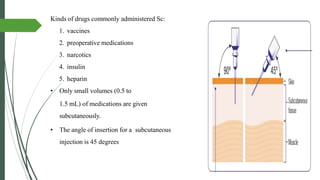
• The angle of insertion for a subcutaneous
injection is 45 degrees
PROCEDURE
Explain the procedure to the patient
Wash your hand
Collect necessary equipment
Prepare only for one patient at a time.
Take ordered medication from cabinet by checking with pt
identification.
Calculate correct drug dosage
Cont.….
 Take vital sign
 Dilute the medication if necessary
 Inject air into the vial which is equal to ordered medication
 Withdraw medication from the vial
 Expel air from the syringe
 Recap the needle without contaminating the tip of needle, if so change
the needle.
 Select injection site
Cont.…
 Clean the site (usually it is in upper arms, thighs or abdomen)
 Grasp the area between your thumb & forefinger to tense it.
 Insert the needle elevate about 450 - 600 angle.
 Pierce the skin quickly & advance the needle
 Aspirate to determine that the needle has not entered a blood vessel
 Inject the drug slowly.
 After injecting withdraw the needle and massage the area with alcohol
swab.
Cont.…
 Chart the amount and time of administration immediately.
 Take care of the equipment- wash, sterilize and return to its place
 Watch for undesired reaction (side effect of the drug) etc.
Note;-If repeated injections are given, the nurse should rotate the
site of injection so that each succeeding injection is about 5 cm
away from the previous one.
Intramuscular Injections
 It is an introduction of a drug into a body's system via the muscles.
 The angle of insertion for an IM injection is 90 degrees.
 2 to 5 ml of medication can be administered into a larger muscle for an adult.
 Sites for IM injections are;
• Ventrogluteal
• Dorsogluteal
• Vastus Lateralis
• Deltoid
• Rectus Femoris
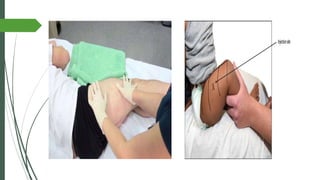
Ventrogluteal site
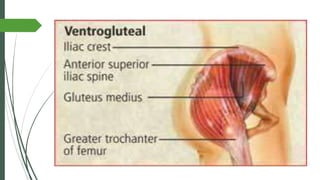
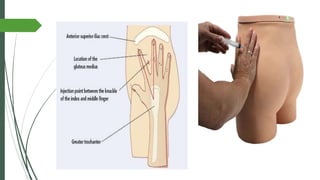
Injection is given to gluteus Medius muscle.
Position client in prone or side lying position with the knee bent
and raised slightly toward the chest.
The nurse places the heel of the hand on the client’s greater
trochanter, with the fingers pointing towards the client head.
Cont.…
Point the thumb toward the patient’s groin and the index finger
toward the anterior superior iliac spine; extend the middle finger
back along the iliac crest toward the buttock.
 The index finger, the middle finger, and the iliac crest form a V-
shaped triangle; the injection site is the center of the triangle.
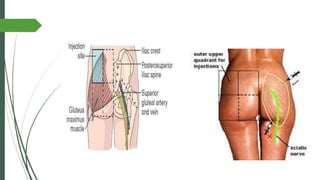
DORSOGLUTEAL SITE
Injection is given to the gluteus maximus muscle.
Position the client in prone position.
 Draw an imaginary line to divide the buttocks into 4 equal
quadrants.
The injection site is upper outer quadrant.
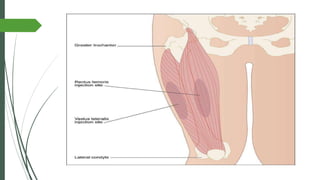
VASTUS LATERALIS
 The muscle is located on the anterior lateral aspect of the
thigh.
 The land- mark is established by dividing the area between
the greater trochanter of the femur & the lateral femoral into
thirds & selecting the middle third.
Cont.…
The land- mark is established by dividing the area between the
greater trochanter of the femur & the lateral femoral into thirds
& selecting the middle third.
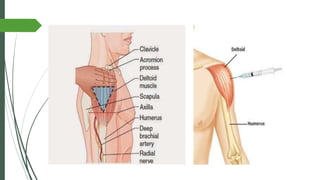
DELTOID SITE
Found on the lateral aspect of the upper arm.
Locate the site by placing four fingers across the deltoid muscle,
with the top finger along the acromion process.
The injection site is then three finger widths below the acromion
process.
RECTUS FEMORIS
 it is used occasionally for IM injections. Situated on the anterior aspect of
the thigh.
Z-Track Method in Intramuscular Injections
 When administering IM injections, the Z-track method be used to
minimize local skin irritation by sealing the medication in muscle tissue.
 The Z-track method has been found to be a less painful technique, and it
decreases leakage of irritating medications into the subcutaneous tissue.
Cont.…
For administering in Z-track method pull the overlying skin
and subcutaneous tissues approximately 2.5 to 3.5 cm
laterally or downward.
Hold the skin in this position until you administer the
injection.
With the needle at a 90-degree angle to the site administer
the medicine.
PURPOSE
To relieve symptoms of illness
To promote and prevent from disease
To treat the disease accordingly
CONTRAINDICATION
IM injections may be contraindicated in clients with;
 Impaired coagulation mechanisms
 Occlusive peripheral vascular disease
 Edema
 Shock
 After thrombolytic therapy
 during myocardial infarction (Rationale: These conditions impair
peripheral absorption)
EQUIPMENT
 Tray
 Medication administration record
 Vial with medication or Ampoule
 Alcohol swab
 syringe with needle(2)
 Dilutant if necessary
 Medication card and prescription
 File
 Glove
 Dry cotton
 Marked pen
 Vital sign equipment
 Safety box
 Receiver
PROCEDURE
Explain the procedure to the patient
Wash your hand
Collect necessary equipment
Prepare only for one patient at a time.
Take ordered medication from cabinet by checking with pt
identification.
Calculate correct drug dosage
Cont.…
 Take vital sign
 Dilute the medication if necessary
 Inject air into the vial which is equal to ordered medication
 Withdraw medication from the vial
 Expel air from the syringe
 Recap the needle without contaminating the tip of needle, if so change the
needle.
 Select injection site
Cont.…
 Using the iliac crest as the upper boundary divided the buttock into four.
 Clean the upper outer quadrant with alcohol swab:
 Stretch the skin and inject the medicine
 Draw back the piston (plunger) to check whether or not you are in the blood vessel ( if blood
returns, withdraw and get a new needle & reinject in a different spot)
 Push the drug slowly into the muscle
 When completed, withdraw the needle and massage the area with swab gently to and
absorption.
 Place the patient comfortably
Cont.…
Take care of the equipment you have used & return to their
places
Chart the amount, time route and type of the medicine
Check the patient's reaction
INTRAVENOUS ADMINISTRATION
• Needle is injected into the vein. Direct IV or IV push, IV
infusion.
• This is the most rapid route of absorption of medications.
• Angle of insertion is 25 degree.
I.V. INJECTIONS
Definition: It is the introduction of a drug in solution form
into a vein. Often the amount is not more than 10.ml. at a
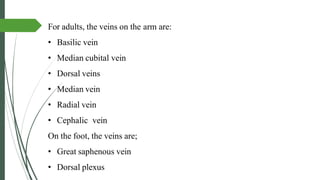
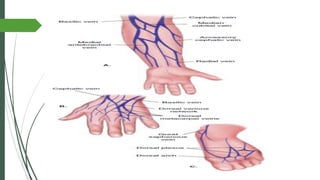
For adults, the veins on the arm are:
• Basilic vein
• Median cubital vein
• Dorsal veins
• Median vein
• Radial vein
• Cephalic vein
On the foot, the veins are;
• Great saphenous vein
• Dorsal plexus
PURPOSE
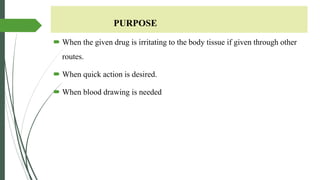
 When the given drug is irritating to the body tissue if given through other
routes.
 When quick action is desired.
 When blood drawing is needed
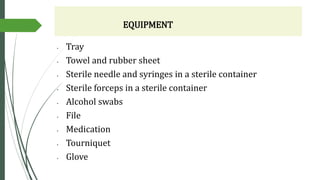
EQUIPMENT
• Tray
• Towel and rubber sheet
• Sterile needle and syringes in a sterile container
• Sterile forceps in a sterile container
• Alcohol swabs
• File
• Medication
• Tourniquet
• Glove
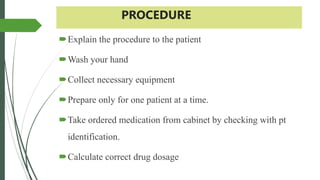
PROCEDURE
Explain the procedure to the patient
Wash your hand
Collect necessary equipment
Prepare only for one patient at a time.
Take ordered medication from cabinet by checking with pt
identification.
Calculate correct drug dosage
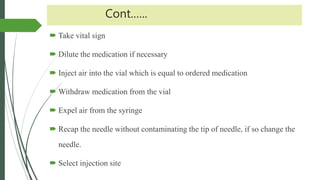
Cont.…..
 Take vital sign
 Dilute the medication if necessary
 Inject air into the vial which is equal to ordered medication
 Withdraw medication from the vial
 Expel air from the syringe
 Recap the needle without contaminating the tip of needle, if so change the
needle.
 Select injection site
Cont.…
Position the patient properly
Place rubber and towel under his arm(to protect the bed linen)
Expose the arm and apply tourniquet
Ask pt. To open and close his fist
Palpate the vein and clean with alcohol swab the site of the
injection (Which is mainly the mid cubital vein of the arm)
Cont.….
Clean with a circular motion; proceed from center of the site
outward.
Hold the needle at about 45 angles in line with the veins.
Puncture the vein and draw back to check whether you are in the
vein or not(Blood return should be seen if you are in the vein).
Once you know that you are in the vein, release the tourniquet and
gently lower the angle of the needle
Cont.…
When it is nearly paralleled to the vein and instills the medications.
Give very slowly unless there is an order to give it fast (Normally 40-
60 drops is given in 1 minute).
Check the pt's pulse in between. Any complaint from the patient
should not be ignored.
Apply pressure over the site after removing the needle to prevent
bleeding. Tell patient to flex his elbow.
Watch the patient for few minutes before leaving him.
Remove your equipment
Cont.…
Put the pt. In a comfortable position
Wash, sterilize and place the equipment in order.
Chart the medication given the amount, time & the reaction of
the pt.
Note:
 Have a bowl of water to rinse the needle used immediate
 Make yourself as well as the pt. Comfortable before giving injection.
 It is the fastest way of drug administration
 Never recap a used needle
INTRAVENOUS THERAPY
Definition: It is the administration of a large amount of fluid into
the system through a vein.
Purpose
• To maintain fluid & electrolyte balance
• To introduce medication particularly antibiotics.
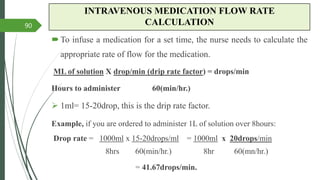
INTRAVENOUS MEDICATION FLOW RATE
CALCULATION
To infuse a medication for a set time, the nurse needs to calculate the
appropriate rate of flow for the medication.
ML of solution X drop/min (drip rate factor) = drops/min
Hours to administer 60(min/hr.)
 1ml= 15-20drop, this is the drip rate factor.
Example, if you are ordered to administer 1L of solution over 8hours:
Drop rate = 1000ml x 15-20drops/ml = 1000ml x 20drops/min
8hrs 60(min/hr.) 8hr 60(mn/hr.)
= 41.67drops/min.
90
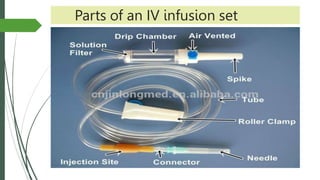
Parts of an IV infusion set
EQUIPMENT
IV fluid as ordered
Sterile syringe & needle
Rubber & towel
Receiver
Alcohol swabs
Arm board
Bandage & scissors
Tourniquet
I.V pole
Adhesive tape
Medication chart
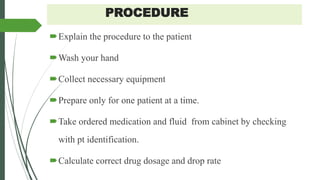
PROCEDURE
Explain the procedure to the patient
Wash your hand
Collect necessary equipment
Prepare only for one patient at a time.
Take ordered medication and fluid from cabinet by checking
with pt identification.
Calculate correct drug dosage and drop rate
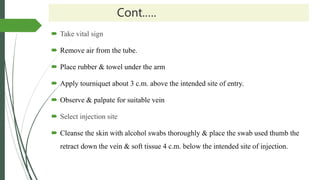
Cont.….
 Take vital sign
 Remove air from the tube.
 Place rubber & towel under the arm
 Apply tourniquet about 3 c.m. above the intended site of entry.
 Observe & palpate for suitable vein
 Select injection site
 Cleanse the skin with alcohol swabs thoroughly & place the swab used thumb the
retract down the vein & soft tissue 4 c.m. below the intended site of injection.
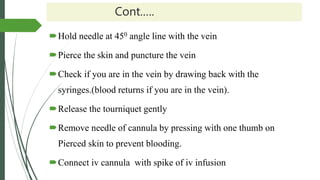
Cont.….
Hold needle at 450 angle line with the vein
Pierce the skin and puncture the vein
Check if you are in the vein by drawing back with the
syringes.(blood returns if you are in the vein).
Release the tourniquet gently
Remove needle of cannula by pressing with one thumb on
Pierced skin to prevent blooding.
Connect iv cannula with spike of iv infusion
Cont.…
Start the flow of solution by opening the clamp.
Support cannula with sterile gauze or sterile cotton balls If necessary
to keep it in proper position in the vein
Anchor the I.V. tubing with the adhesive tape to prevent pull on the
needle.
Place arm board or splint under the arm and bandage around
Adjust the rate of flow
Rate of flow is regulated by the above formula.
Document the procedure
Note
1. The arm board should be long enough to extend beyond the wrist and elbow joint.
2. Board should be padded
3. Infusion bottle should be labeled with the date, time infusion is started, drops per
minute, and any added medications. If more than one bottle as used in 24 hrs., it
should be labeled as bag 1, 2,3, and so on.
4. Extend the arm in the most comfortable position.
5. Usual areas used for intravenous infusion are:
The median basilic vein on the inner surface of the arm.
A vein on top of the foot
In an infant the jugular vein and the scalp vein
Blood Transfusions
It is the giving of blood to a patient through a vein
Is the infusion of whole blood or blood component (plasma, RBCs,
platelets,) from the healthy person (Donor) to the recipient vein.
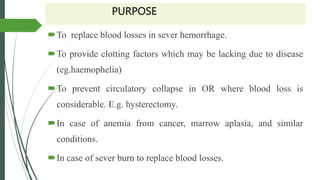
PURPOSE
To replace blood losses in sever hemorrhage.
To provide clotting factors which may be lacking due to disease
(eg.haemophelia)
To prevent circulatory collapse in OR where blood loss is
considerable. E.g. hysterectomy.
In case of anemia from cancer, marrow aplasia, and similar
conditions.
In case of sever burn to replace blood losses.
EQUIPMENT
Blood unit labeled with name,
blood group, expiry date.
Blood administration set (Y-
administration set tubing with
in-line filter)
V/s equipment
 Bags of normal saline
Adhesive tape
Tourniquet
Glove
Regular administration set
Alcohol swabs and tape
 Receiver
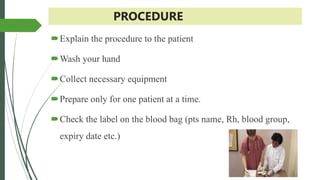
PROCEDURE
Explain the procedure to the patient
Wash your hand
Collect necessary equipment
Prepare only for one patient at a time.
Check the label on the blood bag (pts name, Rh, blood group,
expiry date etc.)
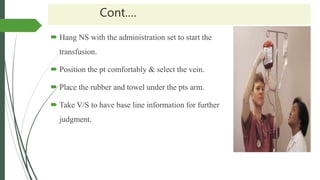
Cont.…
 Hang NS with the administration set to start the
transfusion.
 Position the pt comfortably & select the vein.
 Place the rubber and towel under the pts arm.
 Take V/S to have base line information for further
judgment.
Cont.…
 CHOOSE THE VEIN:- Apply tourniquet 10 – 12 cm above the selected
site.
 Clean the site with alcohol swab
 Hold the needle 450 with the vein & insert it
 Draw back the needle to check if you are in the blood. Release the
tourniquet
 Connect tubing to the canula & start flow. Anchor the tubing with plaster
Cont.…
Adjust flow rate.
Replace equipment's. Splint the site if needed.
Wash your hand.
Record the procedure. Observe the pt and monitor the flow.
Precaution
 Blood should not be taken from a donor with :-Hepatitis (B, C) in the last 6
month
 Blood transfusion in the last 6 month (except serum albumin)
 Malaria, syphilis, possible exposure to HIV
 Recent immunization (may transmit live organisms e.g. 1 year for rabies, 1
month for rubella, 2 weeks for live attenuated vaccines, Cancer
 No medication should be added to blood product. Flow rate is 5-10 gtt /min.
 Do not heat but put on pt chest to bring its T0 to room temperature.
Thank you

Medication and fluid therapy.pptx

  • 1.
  • 2.
    NEBULIZER • A nebulizeris a device that uses a small compressor to convert liquid medication into tiny droplets of mist that can be inhaled directly into the lungs. • Since the medication goes straight to the lungs, onset of the medication’s action often takes place rapidly.
  • 3.
    TYPES OF NEBULIZER: •Inhaler or meterd-dose nebulizer • Jet nebulizer • Ultrasonic nebulizer
  • 5.
    AdministeringNebulizedMedications is used commonlyin medical conditions of airflow obstruction, such as bronchospasm and airway hyperresponsiveness. is extremely effective in the administration of medication in children younger than 5 years. Aerosol inhalation may be used as long-term therapy
  • 6.
    PURPOSES To relieve respiratoryinsufficiency due to broncho spasm. To correct the underlying respiratory disorders responsible for broncho spasm. To liquefy and remove retained thick secretions. To reduce inflammatory and allergic responses of the upper respiratory tract.
  • 7.
    Cont.…. • When aperson has a acute asthma attack. • When a person is in respiratory distress. • If a person is unable to use a inhaler. • If a person has stridor. • Respiratory congestions • Pneumonia • Atelectasis
  • 8.
    EQUIPMENTS • Nebulizer andnebulizer connecting tube • Mouthpiece/mask • Respiratory medication to be administered • Normal saline solution • Sterile water • Cotton balls • Face mask • Sputum mug with disinfectant • Disposable tissues • Kidney Dish • Medication card
  • 9.
    PROCEDURE Explain the procedureto the patient by his native language. Wash your hand if your client agree with you. Collect necessary equipment listed under equipment Take vital sign before any intervention to know the status of patient. Place the patient in comfortable sitting or Semi fowler position. Add the prescribed amount of medications to the medicine chamber of the tubing. Connect the tube to the compressor. A fine mist from the device should be visible.
  • 10.
    Cont.… Place the maskon patient’s face to cover his mouth and nose and instruct him to inhale deeply and slowly through mouth, hold breath and then exhale several times. Observe expansion of chest to ascertain that patient is taking deep breaths. Instruct the pt to breath slowly and deeply until all the medications is nebulized.
  • 11.
    Cont.…  On completionof the treatment encourage the patient to cough after several deep breaths.  Observe the pt for any adverse reaction to the treatments.  Take Vital Sign if necessary  Proper cleaning, sterilization and storage of equipment’s prevents organisms from entering the lungs.  Wash your hand  Document the procedure and the description of the secretions expectorated.
  • 12.
    PARENTERAL MEDICATION ADMINISTERATION Parenteral drugadministration refers to drugs given by routes other than the digestive tract.  The term parenteral is usually used for drugs given by injection or infusion. The enteral route usually refers to taking drugs by mouth.
  • 13.
    Routes of parenteraltherapies • Intra-dermal • Subcutaneous • Intramuscular • Intra Venous • Advanced techniques: • Epidural • Intra-thecal • Intra-osseous • Intra-peritonial • Intra-plural • Intra-arterial
  • 14.
    Cont.….. The following arethe four major sites of injection: 1. Intradermal (ID): Injection into the dermis just under the epidermis. 2. Subcutaneous (SC): Injection into tissues just below the dermis of the skin. 3. Intramuscular (IM): Injection into a muscle. 4. Intravenous (IV): Injection into a vein.
  • 16.
    Cont.…. Some medications areadministered into body cavities. These additional routes include  Epidural: Epidural medications are administered in the epidural space.  Intrathecal: Administration of medications into subarachnoid space or one of the ventricles of the brain.  Intraosseous: Administration of medication directly into the bone marrow.  Intraperitoneal:Medicationsadministered into the peritoneal cavity  Intrapleural: Administration of medications directly into the pleural space.  Intraarterial: Intraarterial medications are administered directly into the arteries.
  • 17.
    Safety In AdministeringMedications  The safe and accurate administration of medication is one of the major responsibility of a nurse.  Read the physician’s orders of the drug.  If the order is not clear consult the physician.  Consider the age and weight of the patient.  The nurse must have thorough knowledge of drugs that is administered by her.  Look for the color, odor and consistency of the drug before administration.  Follow 10 rights and 3 checks in drug administration.
  • 18.
    Cont.… Calculate the drugdosage accurately. Identify the patient correctly. Observe for the symptoms of over dosage of the drugs before it is administered. Give the drugs one by one Stay with the patient until he has taken the medicine completely. Do not leave the medicine with the patient.
  • 19.
    Cont.… • The nurseshould always assess a client’s health status and obtain a medication history prior to giving any medication. • The medication history includes information about the drugs the client is taking currently or has taken recently and the history of drug allergies. • The nurse should clarify with the client any side effects, adverse reactions, or allergic responses due to medications.
  • 20.
    Cont.…. • The nursehas to identify any problems the client may have in self-administering a medication. • For example, a client with poor eyesight, may require special labels for the medication container. • The nurse needs to consider socioeconomic factors for all clients. • Medication errors must be reported according to the policy of the hospital.
  • 21.
    MEDICATIONERROR Medication errors areunintended mistakes in the prescribing, dispensing and administration of a medicine that could cause harm to a patient. • Medication errors can occur at all stages of the medication administration process. • The four main types of medication errors that occur with hospitalized clients:
  • 22.
    Cont.. 1. Prescription errors(e.g. Wrong drug or dose) 2. Transcription/ interpretation error (e.g. Misinterpretation of abbreviations) 3. Preparation errors (e.g. Calculation error) 4. Administration errors (e.g. Wrong dose, wrong time, omission, or additional dose). Most medication errors occur during the administration stage.
  • 23.
    Cont.… To administer parenteralmedications, nurses use syringes and needles to withdraw medication from ampules and vials.
  • 24.
    Cont.…. Syringes Syringes have threeparts: 1. The tip, which connects with the needle 2. The barrel, or outside part, on which the scales are printed 3. The plunger, which fits inside the barrel
  • 25.
    Cont.… Several kinds ofsyringes are available in differing sizes, shapes, and materials. Syringes range in sizes from 1 to 60 mL. Insulin syringes are available in sizes that hold 0.3 to 1 mL and are calibrated in units. The tuberculin syringe has a capacity of 1 mL.
  • 26.
    • 5 mlsyringe • 3 ml syringe • Tuberculin syringe • Insulin syringe
  • 27.
    Needles Most needles aremade of stainless steel, and all are disposable. A needle has three parts: 1. The hub, which fits onto the tip of a syringe 2. The shaft, which connects to the hub 3. The bevel, the tip of the needle
  • 28.
    Needle size • 19gauge • 20 gauge • 21 gauge • 23 gauge • 25 gauge
  • 29.
    Cont.… The gauge variesfrom 18 to 30. Use longer needles for IM injections and a shorter needle for subcutaneous injections.
  • 30.
    Preventing needle stickinjuries One of the most potentially hazardous procedures that health care personnel face is using and disposing of needles and sharps. Needlestick injuries present a major risk for infection with hepatitis B virus, human immunodeficiency virus (HIV), and many other pathogens. Use appropriate puncture-proof disposal containers to dispose of uncapped needles and sharps. Never throw sharps in wastebaskets. Never recap used needles
  • 31.
    Cont.…  When recappinga needle, Use a one-handed “scoop” method. This is performed by a) placing the needle cap and syringe with needle horizontally on a flat surface. b) inserting the needle into the cap, using one hand. c) then using your other hand to pick up the cap and tighten it to the needle hub.
  • 32.
    CANNULA  A cannulais a flexible tube that can be inserted into the body.  A venous cannula is inserted into a vein, for the administration of intravenous fluids, for obtaining blood samples and for administering medicines.  Types of cannula are • IV cannula pen-like model. • IV cannula with wings model. • IV cannula with injection part model. • IV cannula y-type model.
  • 33.
  • 34.
  • 35.
  • 36.
  • 37.
    Intradermal Injections(ID)  isthe administration of a drug into the dermal layer of the skin just beneath the epidermis.  Usually only a small amount of liquid is used, for example 0.01 to 0.1 mL.  is frequently used for allergy testing and tuberculosis (TB) screening.  Because such medications are potent, you inject them into the dermis, where blood supply is reduced and drug absorption occurs slowly.  A patient may have an anaphylactic reaction if the medications enter the circulation too rapidly.  Skin testing often requires you to visually inspect the test site; therefore make sure that the ID sites are free of lesions and injuries and relatively hairless.
  • 38.
    Cont.… The inner forearmand upper back are ideal locations.  To administer an ID injection, use a tuberculin (TB) or small syringe with a short ( 3 /8 to 5 /8 inch), fine-gauge (25 to 27) needle.  The angle of insertion for an intradermal injection is 10 to 15 degrees. Inject only small amounts of medication (0.01 to 0.1 mL) intradermally. After injecting the medication, a small bleb resembling a mosquito bite appears on the surface of the skin.
  • 39.
  • 40.
    PURPOSE For diagnostic For therapeutic INJECTIONSITE Inner for arm Upper chest scapula
  • 41.
    Equipment Medication administration record Vial withmedication Alcohol swab syringe with needle Dilutant if necessary Medication card and prescription File Glove Dry cotton Marked pen Vital sign equipment Safety box Receiver
  • 42.
    PROCEDURE Explain the procedureto the patient Wash your hand Collect necessary equipment Prepare only for one patient at a time. Take ordered medication from cabinet by checking with pt identification. Calculate correct drug dosage
  • 43.
    Cont.…  Take vitalsign  Dilute the medication if necessary  Inject air into the vial which is equal to ordered medication  Withdraw medication from the vial  Expel air from the syringe  Recap the needle without contaminating the tip of needle, if so change the needle.  Select injection site
  • 44.
    Cont.… Clean the sitewith alcohol swab or distill water depending on characteristic of medication Hold the syringe with dominant hand Inject slowly within 3 to 5 seconds. Not massage the site Dispose needle in safety box. Document the procedure.
  • 45.
    SUBCUTANEOUS INJECTIONS delivers adrug into the adipose (fatty) tissue beneath the skin. allows the drug to move into the bloodstream more rapidly than when given by mouth because it’s absorbed mainly through capillaries. When compared with IM injection, subcutaneous injection provides slower, more sustained drug delivery; minimizes tissue trauma; and carries little risk of striking large blood vessels and nerves.
  • 46.
    Cont.… Drugs recommended forsubcutaneous injection include nonirritating aqueous solutions and suspensions contained in 0.5 to 2 mL of fluid.  Heparin and insulin, for example, are usually administered subcutaneously. Some diabetic patients may benefit from an insulin infusion pump.
  • 47.
    Cont.…  are performedusing a relatively short needle.  The most common subcutaneous injection sites are the outer aspect of the upper arm, the anterior thigh, lower abdomen, the upper hips, the buttocks and the upper back.  is contraindicated in sites that are inflamed, edematous, scarred, or covered by a mole, birthmark, or other lesion.  It may also be contraindicated in patients with impaired coagulation mechanisms.
  • 49.
    Equipment  Tray  Medicationadministration record  Vial with medication or Ampoule  Alcohol swab  syringe with needle(2)  Dilutant if necessary  Medication card and prescription  File  Glove  Dry cotton  Marked pen  Vital sign equipment  Safety box  Receiver
  • 50.
    Kinds of drugscommonly administered Sc: 1. vaccines 2. preoperative medications 3. narcotics 4. insulin 5. heparin • Only small volumes (0.5 to 1.5 mL) of medications are given subcutaneously. • The angle of insertion for a subcutaneous injection is 45 degrees
  • 51.
    PROCEDURE Explain the procedureto the patient Wash your hand Collect necessary equipment Prepare only for one patient at a time. Take ordered medication from cabinet by checking with pt identification. Calculate correct drug dosage
  • 52.
    Cont.….  Take vitalsign  Dilute the medication if necessary  Inject air into the vial which is equal to ordered medication  Withdraw medication from the vial  Expel air from the syringe  Recap the needle without contaminating the tip of needle, if so change the needle.  Select injection site
  • 53.
    Cont.…  Clean thesite (usually it is in upper arms, thighs or abdomen)  Grasp the area between your thumb & forefinger to tense it.  Insert the needle elevate about 450 - 600 angle.  Pierce the skin quickly & advance the needle  Aspirate to determine that the needle has not entered a blood vessel  Inject the drug slowly.  After injecting withdraw the needle and massage the area with alcohol swab.
  • 54.
    Cont.…  Chart theamount and time of administration immediately.  Take care of the equipment- wash, sterilize and return to its place  Watch for undesired reaction (side effect of the drug) etc. Note;-If repeated injections are given, the nurse should rotate the site of injection so that each succeeding injection is about 5 cm away from the previous one.
  • 55.
    Intramuscular Injections  Itis an introduction of a drug into a body's system via the muscles.  The angle of insertion for an IM injection is 90 degrees.  2 to 5 ml of medication can be administered into a larger muscle for an adult.  Sites for IM injections are; • Ventrogluteal • Dorsogluteal • Vastus Lateralis • Deltoid • Rectus Femoris
  • 56.
    Ventrogluteal site Injection isgiven to gluteus Medius muscle. Position client in prone or side lying position with the knee bent and raised slightly toward the chest. The nurse places the heel of the hand on the client’s greater trochanter, with the fingers pointing towards the client head.
  • 57.
    Cont.… Point the thumbtoward the patient’s groin and the index finger toward the anterior superior iliac spine; extend the middle finger back along the iliac crest toward the buttock.  The index finger, the middle finger, and the iliac crest form a V- shaped triangle; the injection site is the center of the triangle.
  • 60.
    DORSOGLUTEAL SITE Injection isgiven to the gluteus maximus muscle. Position the client in prone position.  Draw an imaginary line to divide the buttocks into 4 equal quadrants. The injection site is upper outer quadrant.
  • 62.
    VASTUS LATERALIS  Themuscle is located on the anterior lateral aspect of the thigh.  The land- mark is established by dividing the area between the greater trochanter of the femur & the lateral femoral into thirds & selecting the middle third.
  • 64.
    Cont.… The land- markis established by dividing the area between the greater trochanter of the femur & the lateral femoral into thirds & selecting the middle third.
  • 66.
    DELTOID SITE Found onthe lateral aspect of the upper arm. Locate the site by placing four fingers across the deltoid muscle, with the top finger along the acromion process. The injection site is then three finger widths below the acromion process.
  • 68.
    RECTUS FEMORIS  itis used occasionally for IM injections. Situated on the anterior aspect of the thigh. Z-Track Method in Intramuscular Injections  When administering IM injections, the Z-track method be used to minimize local skin irritation by sealing the medication in muscle tissue.  The Z-track method has been found to be a less painful technique, and it decreases leakage of irritating medications into the subcutaneous tissue.
  • 69.
    Cont.… For administering inZ-track method pull the overlying skin and subcutaneous tissues approximately 2.5 to 3.5 cm laterally or downward. Hold the skin in this position until you administer the injection. With the needle at a 90-degree angle to the site administer the medicine.
  • 70.
    PURPOSE To relieve symptomsof illness To promote and prevent from disease To treat the disease accordingly
  • 71.
    CONTRAINDICATION IM injections maybe contraindicated in clients with;  Impaired coagulation mechanisms  Occlusive peripheral vascular disease  Edema  Shock  After thrombolytic therapy  during myocardial infarction (Rationale: These conditions impair peripheral absorption)
  • 72.
    EQUIPMENT  Tray  Medicationadministration record  Vial with medication or Ampoule  Alcohol swab  syringe with needle(2)  Dilutant if necessary  Medication card and prescription  File  Glove  Dry cotton  Marked pen  Vital sign equipment  Safety box  Receiver
  • 73.
    PROCEDURE Explain the procedureto the patient Wash your hand Collect necessary equipment Prepare only for one patient at a time. Take ordered medication from cabinet by checking with pt identification. Calculate correct drug dosage
  • 74.
    Cont.…  Take vitalsign  Dilute the medication if necessary  Inject air into the vial which is equal to ordered medication  Withdraw medication from the vial  Expel air from the syringe  Recap the needle without contaminating the tip of needle, if so change the needle.  Select injection site
  • 75.
    Cont.…  Using theiliac crest as the upper boundary divided the buttock into four.  Clean the upper outer quadrant with alcohol swab:  Stretch the skin and inject the medicine  Draw back the piston (plunger) to check whether or not you are in the blood vessel ( if blood returns, withdraw and get a new needle & reinject in a different spot)  Push the drug slowly into the muscle  When completed, withdraw the needle and massage the area with swab gently to and absorption.  Place the patient comfortably
  • 76.
    Cont.… Take care ofthe equipment you have used & return to their places Chart the amount, time route and type of the medicine Check the patient's reaction
  • 77.
    INTRAVENOUS ADMINISTRATION • Needleis injected into the vein. Direct IV or IV push, IV infusion. • This is the most rapid route of absorption of medications. • Angle of insertion is 25 degree.
  • 78.
    I.V. INJECTIONS Definition: Itis the introduction of a drug in solution form into a vein. Often the amount is not more than 10.ml. at a
  • 79.
    For adults, theveins on the arm are: • Basilic vein • Median cubital vein • Dorsal veins • Median vein • Radial vein • Cephalic vein On the foot, the veins are; • Great saphenous vein • Dorsal plexus
  • 81.
    PURPOSE  When thegiven drug is irritating to the body tissue if given through other routes.  When quick action is desired.  When blood drawing is needed
  • 82.
    EQUIPMENT • Tray • Toweland rubber sheet • Sterile needle and syringes in a sterile container • Sterile forceps in a sterile container • Alcohol swabs • File • Medication • Tourniquet • Glove
  • 83.
    PROCEDURE Explain the procedureto the patient Wash your hand Collect necessary equipment Prepare only for one patient at a time. Take ordered medication from cabinet by checking with pt identification. Calculate correct drug dosage
  • 84.
    Cont.…..  Take vitalsign  Dilute the medication if necessary  Inject air into the vial which is equal to ordered medication  Withdraw medication from the vial  Expel air from the syringe  Recap the needle without contaminating the tip of needle, if so change the needle.  Select injection site
  • 85.
    Cont.… Position the patientproperly Place rubber and towel under his arm(to protect the bed linen) Expose the arm and apply tourniquet Ask pt. To open and close his fist Palpate the vein and clean with alcohol swab the site of the injection (Which is mainly the mid cubital vein of the arm)
  • 86.
    Cont.…. Clean with acircular motion; proceed from center of the site outward. Hold the needle at about 45 angles in line with the veins. Puncture the vein and draw back to check whether you are in the vein or not(Blood return should be seen if you are in the vein). Once you know that you are in the vein, release the tourniquet and gently lower the angle of the needle
  • 87.
    Cont.… When it isnearly paralleled to the vein and instills the medications. Give very slowly unless there is an order to give it fast (Normally 40- 60 drops is given in 1 minute). Check the pt's pulse in between. Any complaint from the patient should not be ignored. Apply pressure over the site after removing the needle to prevent bleeding. Tell patient to flex his elbow. Watch the patient for few minutes before leaving him. Remove your equipment
  • 88.
    Cont.… Put the pt.In a comfortable position Wash, sterilize and place the equipment in order. Chart the medication given the amount, time & the reaction of the pt. Note:  Have a bowl of water to rinse the needle used immediate  Make yourself as well as the pt. Comfortable before giving injection.  It is the fastest way of drug administration  Never recap a used needle
  • 89.
    INTRAVENOUS THERAPY Definition: Itis the administration of a large amount of fluid into the system through a vein. Purpose • To maintain fluid & electrolyte balance • To introduce medication particularly antibiotics.
  • 90.
    INTRAVENOUS MEDICATION FLOWRATE CALCULATION To infuse a medication for a set time, the nurse needs to calculate the appropriate rate of flow for the medication. ML of solution X drop/min (drip rate factor) = drops/min Hours to administer 60(min/hr.)  1ml= 15-20drop, this is the drip rate factor. Example, if you are ordered to administer 1L of solution over 8hours: Drop rate = 1000ml x 15-20drops/ml = 1000ml x 20drops/min 8hrs 60(min/hr.) 8hr 60(mn/hr.) = 41.67drops/min. 90
  • 91.
    Parts of anIV infusion set
  • 92.
    EQUIPMENT IV fluid asordered Sterile syringe & needle Rubber & towel Receiver Alcohol swabs Arm board Bandage & scissors Tourniquet I.V pole Adhesive tape Medication chart
  • 93.
    PROCEDURE Explain the procedureto the patient Wash your hand Collect necessary equipment Prepare only for one patient at a time. Take ordered medication and fluid from cabinet by checking with pt identification. Calculate correct drug dosage and drop rate
  • 94.
    Cont.….  Take vitalsign  Remove air from the tube.  Place rubber & towel under the arm  Apply tourniquet about 3 c.m. above the intended site of entry.  Observe & palpate for suitable vein  Select injection site  Cleanse the skin with alcohol swabs thoroughly & place the swab used thumb the retract down the vein & soft tissue 4 c.m. below the intended site of injection.
  • 95.
    Cont.…. Hold needle at450 angle line with the vein Pierce the skin and puncture the vein Check if you are in the vein by drawing back with the syringes.(blood returns if you are in the vein). Release the tourniquet gently Remove needle of cannula by pressing with one thumb on Pierced skin to prevent blooding. Connect iv cannula with spike of iv infusion
  • 96.
    Cont.… Start the flowof solution by opening the clamp. Support cannula with sterile gauze or sterile cotton balls If necessary to keep it in proper position in the vein Anchor the I.V. tubing with the adhesive tape to prevent pull on the needle. Place arm board or splint under the arm and bandage around Adjust the rate of flow Rate of flow is regulated by the above formula. Document the procedure
  • 97.
    Note 1. The armboard should be long enough to extend beyond the wrist and elbow joint. 2. Board should be padded 3. Infusion bottle should be labeled with the date, time infusion is started, drops per minute, and any added medications. If more than one bottle as used in 24 hrs., it should be labeled as bag 1, 2,3, and so on. 4. Extend the arm in the most comfortable position. 5. Usual areas used for intravenous infusion are: The median basilic vein on the inner surface of the arm. A vein on top of the foot In an infant the jugular vein and the scalp vein
  • 98.
    Blood Transfusions It isthe giving of blood to a patient through a vein Is the infusion of whole blood or blood component (plasma, RBCs, platelets,) from the healthy person (Donor) to the recipient vein.
  • 99.
    PURPOSE To replace bloodlosses in sever hemorrhage. To provide clotting factors which may be lacking due to disease (eg.haemophelia) To prevent circulatory collapse in OR where blood loss is considerable. E.g. hysterectomy. In case of anemia from cancer, marrow aplasia, and similar conditions. In case of sever burn to replace blood losses.
  • 100.
    EQUIPMENT Blood unit labeledwith name, blood group, expiry date. Blood administration set (Y- administration set tubing with in-line filter) V/s equipment  Bags of normal saline Adhesive tape Tourniquet Glove Regular administration set Alcohol swabs and tape  Receiver
  • 101.
    PROCEDURE Explain the procedureto the patient Wash your hand Collect necessary equipment Prepare only for one patient at a time. Check the label on the blood bag (pts name, Rh, blood group, expiry date etc.)
  • 102.
    Cont.…  Hang NSwith the administration set to start the transfusion.  Position the pt comfortably & select the vein.  Place the rubber and towel under the pts arm.  Take V/S to have base line information for further judgment.
  • 103.
    Cont.…  CHOOSE THEVEIN:- Apply tourniquet 10 – 12 cm above the selected site.  Clean the site with alcohol swab  Hold the needle 450 with the vein & insert it  Draw back the needle to check if you are in the blood. Release the tourniquet  Connect tubing to the canula & start flow. Anchor the tubing with plaster
  • 104.
    Cont.… Adjust flow rate. Replaceequipment's. Splint the site if needed. Wash your hand. Record the procedure. Observe the pt and monitor the flow.
  • 105.
    Precaution  Blood shouldnot be taken from a donor with :-Hepatitis (B, C) in the last 6 month  Blood transfusion in the last 6 month (except serum albumin)  Malaria, syphilis, possible exposure to HIV  Recent immunization (may transmit live organisms e.g. 1 year for rabies, 1 month for rubella, 2 weeks for live attenuated vaccines, Cancer  No medication should be added to blood product. Flow rate is 5-10 gtt /min.  Do not heat but put on pt chest to bring its T0 to room temperature.
  • 106.