GUILLAIN-BARRÉ
SYNDROME
BY
DR PULLA UMA MAHESWARI
DEPARTMENT OF PAEDIATRICS
PG PART - II
2/14/2023 2
• DEFINE GBS
• EXPAIN THE PATHOPHYSIOLOGY OF GBS
• LIST THE TYPES OF GBS
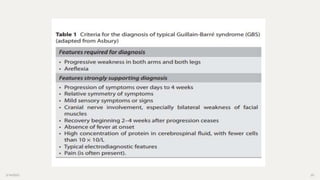
• LIST THE CLINICAL FEATURES OF GBS
• DESCRIBE THE INVESTIGATIONS OF GBS
• EXPLAIN THE MNAGEMENT AND PROGNOSIS OF GBS
• EXPAIN THE HOMOEOPATHY MANAGEMENT
OBJECTIVES
2/14/2023 3
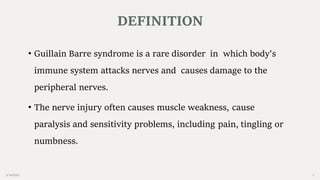
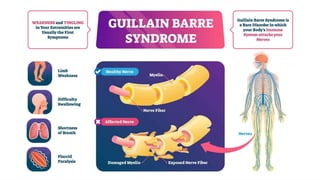
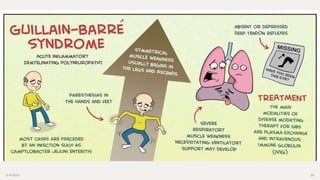
• Guillain Barre syndrome is a rare disorder in which body's
immune system attacks nerves and causes damage to the
peripheral nerves.
• The nerve injury often causes muscle weakness, cause
paralysis and sensitivity problems, including pain, tingling or
numbness.
DEFINITION
2/14/2023 4
• Acute idiopathic polyradiculoneuritis,
• Acute idiopathic polyneuritis,
• French polio,
• Landry's ascending paralysis
• Landry Guillain Barré syndrome
OTHER NAMES
2/14/2023 5
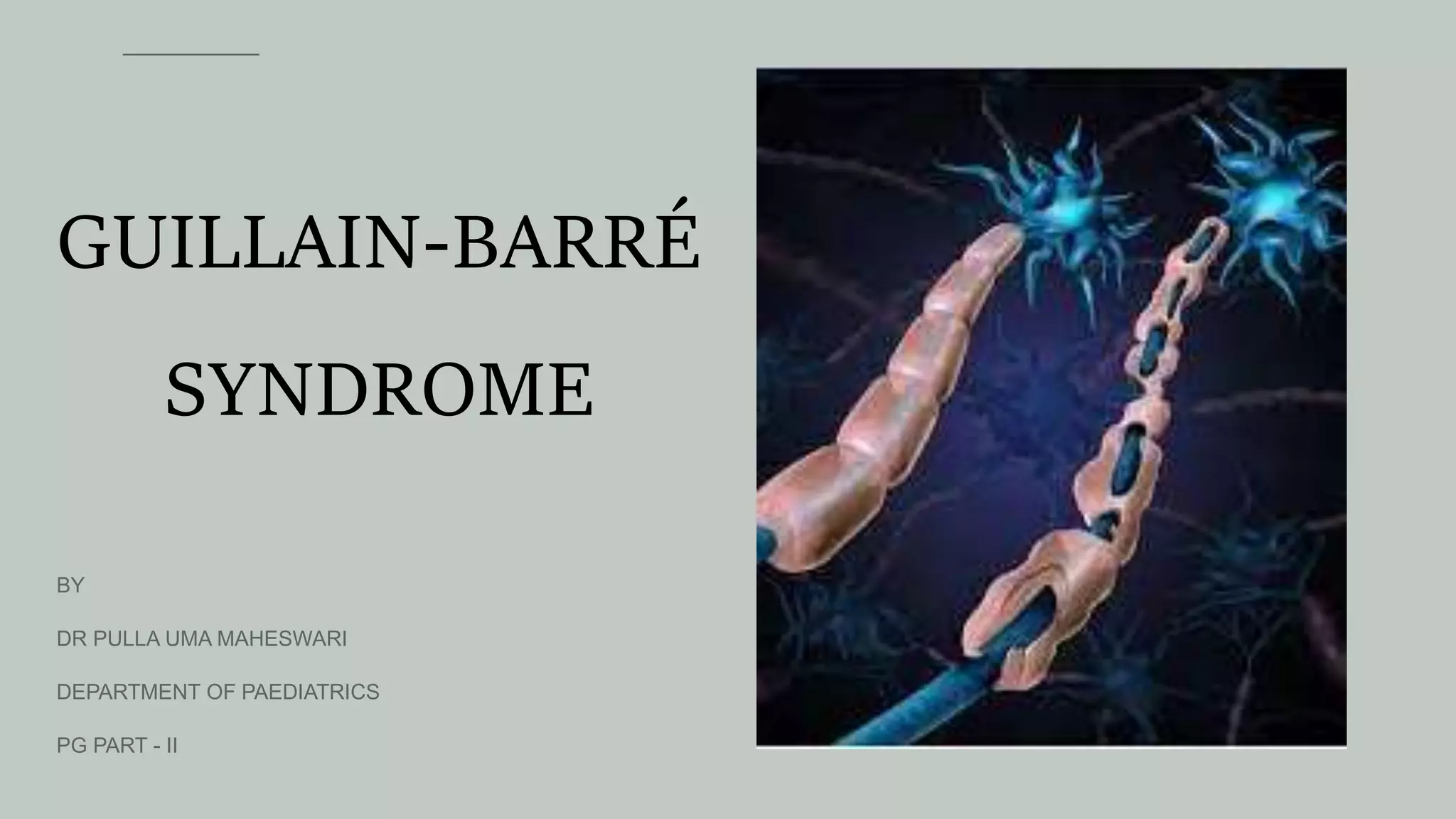
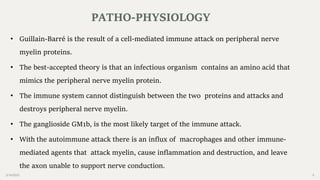
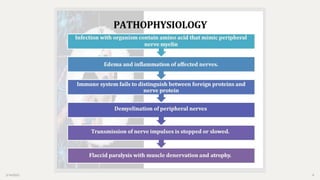
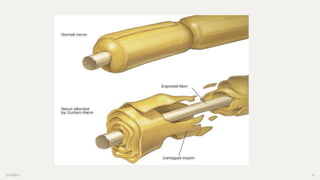
• Guillain-Barré is the result of a cell-mediated immune attack on peripheral nerve
myelin proteins.
• The best-accepted theory is that an infectious organism contains an amino acid that
mimics the peripheral nerve myelin protein.
• The immune system cannot distinguish between the two proteins and attacks and
destroys peripheral nerve myelin.
• The ganglioside GM1b, is the most likely target of the immune attack.
• With the autoimmune attack there is an influx of macrophages and other immune-
mediated agents that attack myelin, cause inflammation and destruction, and leave
the axon unable to support nerve conduction.
PATHO-PHYSIOLOGY
2/14/2023 6
2/14/2023 7
2/14/2023 8
2/14/2023 9
2/14/2023 10
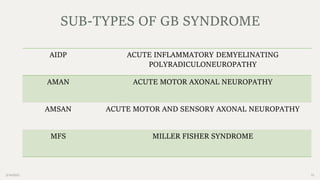
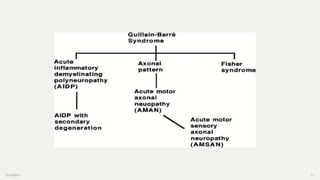
AIDP ACUTE INFLAMMATORY DEMYELINATING
POLYRADICULONEUROPATHY
AMAN ACUTE MOTOR AXONAL NEUROPATHY
AMSAN ACUTE MOTOR AND SENSORY AXONAL NEUROPATHY
MFS MILLER FISHER SYNDROME
SUB-TYPES OF GB SYNDROME
2/14/2023 11
2/14/2023 12
• It is the most common form and accounts for around 85– 90% of cases.
• The clinical features are of symmetrical ascending motor weakness with
hypo- or areflexia.
• The underlying pathological process involves inflammation and
destruction of the myelin sheaths surrounding peripheral nerve
axons by activated macrophages.
• This leads to slowing and blockage of conduction within peripheral nerves
causing muscle weakness.
• Severe cases may develop secondary axonal damage
AIDP
2/14/2023 13
• It is more common in Japan and China, amongst young people and in the
summer months.
• It has an association with precedent infection with Campylobacter jejuni.
• Clinical features are similar to AIDP but tendon reflexes may be preserved.
• Electrophysiological testing may distinguish from other variants as selective motor
nerve and axonal involvement is demonstrated.
• In AMAN the pathological process involves binding of antibodies to ganglioside
antigens on the axon cell membrane, macrophage invasion, inflammation and
axonal damage
AMAN
2/14/2023
14
• It is a variant of GBS in which both motor and sensory fibres are involved
and which can be demonstrated on electrophysiological studies.
• It is more severe and associated with prolonged or even partial recovery.
• Clinical features are similar to AMAN but also involve sensory
symptoms.
• The underlying pathological process is similar to that for AMAN (i.e.
antibody mediated axonal damage).
AMSAN
2/14/2023 15
• presents with ataxia, areflexia and ophthalmoplegia. 25% of patients may
develop limb weakness.
•Electrophysiological studies show primarily sensory conduction failure.
•Antiganglioside antibodies to GQ1b are found in 90% of patients and are
associated with ophthalmoplegia .
• There have been limited pathological studies in MFS but demyelination of
nerve roots has been demonstrated.
MFS
2/14/2023 16
• Hyporeflexia and weakness progress and may result in quadriplegia.
• Neuromuscular respiratory failure - demyelination of the nerves that innervate the
diaphragm and inter costal muscles results.
• Cranial Nerve deficit in (III- VII, IX- XII) with facial palsy.
• Ptosis, diplopia, facial weakness, dysarthria, dysphagia with pooling of secretions.
• Sensory dysfunction with abnormal proprioception, sensory ataxia can also occur.
• Difficult to speaking, chewing and swallowing, various muscles required to form
speech are weakened.
CLINICAL FEATURES OF GBS
2/14/2023 17
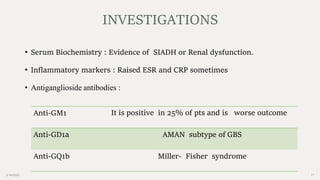
• Serum Biochemistry : Evidence of SIADH or Renal dysfunction.
• Inflammatory markers : Raised ESR and CRP sometimes
• Antiganglioside antibodies :
INVESTIGATIONS
Anti-GM1 It is positive in 25% of pts and is worse outcome
Anti-GD1a AMAN subtype of GBS
Anti-GQ1b Miller- Fisher syndrome
2/14/2023 18
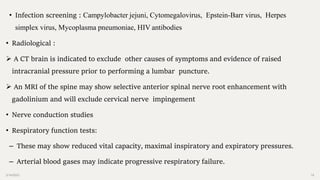
• Infection screening : Campylobacter jejuni, Cytomegalovirus, Epstein-Barr virus, Herpes
simplex virus, Mycoplasma pneumoniae, HIV antibodies
• Radiological :
 A CT brain is indicated to exclude other causes of symptoms and evidence of raised
intracranial pressure prior to performing a lumbar puncture.
 An MRI of the spine may show selective anterior spinal nerve root enhancement with
gadolinium and will exclude cervical nerve impingement
• Nerve conduction studies
• Respiratory function tests:
– These may show reduced vital capacity, maximal inspiratory and expiratory pressures.
– Arterial blood gases may indicate progressive respiratory failure.
2/14/2023 19
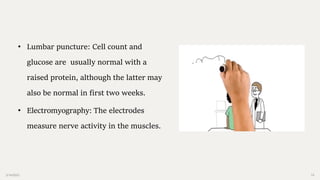
• Lumbar puncture: Cell count and
glucose are usually normal with a
raised protein, although the latter may
also be normal in first two weeks.
• Electromyography: The electrodes
measure nerve activity in the muscles.
2/14/2023 20
2/14/2023 21
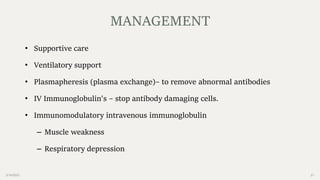
• Supportive care
• Ventilatory support
• Plasmapheresis (plasma exchange)– to remove abnormal antibodies
• IV Immunoglobulin's – stop antibody damaging cells.
• Immunomodulatory intravenous immunoglobulin
– Muscle weakness
– Respiratory depression
MANAGEMENT
2/14/2023 22
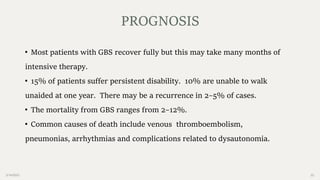
• Most patients with GBS recover fully but this may take many months of
intensive therapy.
• 15% of patients suffer persistent disability. 10% are unable to walk
unaided at one year. There may be a recurrence in 2–5% of cases.
• The mortality from GBS ranges from 2–12%.
• Common causes of death include venous thromboembolism,
pneumonias, arrhythmias and complications related to dysautonomia.
PROGNOSIS
2/14/2023 23
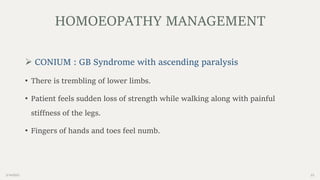
 CONIUM : GB Syndrome with ascending paralysis
• There is trembling of lower limbs.
• Patient feels sudden loss of strength while walking along with painful
stiffness of the legs.
• Fingers of hands and toes feel numb.
HOMOEOPATHY MANAGEMENT
2/14/2023 24
 CAUSTICUM : GB Syndrome with gradually appearing paralysis
• There is progressive loss of muscular strength.
• Patient feels restlessness at night and sinking of strength.
• Muscles of forearm and hands remain unsteady.
• Numbness and loss of sensation are common.
2/14/2023 25
 LATHYRUS : GBS with rigidity of legs
• There is paralysis of the lower limbs.
• Spastic paralysis is common.
• Knees knock against each other while walking.
• The patient cannot extend or cross legs while sitting.
• Calf muscles remain tense.
• The toes do not leave the floor while the heel does not touch the floor.
2/14/2023 26
 VIPERA : GBS with increased reflexes
• This medicine is made from the poison of the viper snake and causes
paralysis similar to that of GBS.
• The patient feels obliged to keep his lower limbs raised.
• There is unbearable pain on letting the limbs hang down.
2/14/2023 27
 NATRUM MUR : GBS after fever
• The patient is anaemic, usually thin and withered.
• There is numbness and tingling in fingers and lower limbs.
• Hamstrings contract and cause pain.
• Heat and warmth aggravate the patient.
• There is increased thirst along with dryness of mouth.
2/14/2023 28
2/14/2023 29

GUILLAIN-BARRÉ SYNDROME PPT.pptx

  • 1.
    GUILLAIN-BARRÉ SYNDROME BY DR PULLA UMAMAHESWARI DEPARTMENT OF PAEDIATRICS PG PART - II
  • 2.
    2/14/2023 2 • DEFINEGBS • EXPAIN THE PATHOPHYSIOLOGY OF GBS • LIST THE TYPES OF GBS • LIST THE CLINICAL FEATURES OF GBS • DESCRIBE THE INVESTIGATIONS OF GBS • EXPLAIN THE MNAGEMENT AND PROGNOSIS OF GBS • EXPAIN THE HOMOEOPATHY MANAGEMENT OBJECTIVES
  • 3.
    2/14/2023 3 • GuillainBarre syndrome is a rare disorder in which body's immune system attacks nerves and causes damage to the peripheral nerves. • The nerve injury often causes muscle weakness, cause paralysis and sensitivity problems, including pain, tingling or numbness. DEFINITION
  • 4.
    2/14/2023 4 • Acuteidiopathic polyradiculoneuritis, • Acute idiopathic polyneuritis, • French polio, • Landry's ascending paralysis • Landry Guillain Barré syndrome OTHER NAMES
  • 5.
    2/14/2023 5 • Guillain-Barréis the result of a cell-mediated immune attack on peripheral nerve myelin proteins. • The best-accepted theory is that an infectious organism contains an amino acid that mimics the peripheral nerve myelin protein. • The immune system cannot distinguish between the two proteins and attacks and destroys peripheral nerve myelin. • The ganglioside GM1b, is the most likely target of the immune attack. • With the autoimmune attack there is an influx of macrophages and other immune- mediated agents that attack myelin, cause inflammation and destruction, and leave the axon unable to support nerve conduction. PATHO-PHYSIOLOGY
  • 6.
  • 7.
  • 8.
  • 9.
  • 10.
    2/14/2023 10 AIDP ACUTEINFLAMMATORY DEMYELINATING POLYRADICULONEUROPATHY AMAN ACUTE MOTOR AXONAL NEUROPATHY AMSAN ACUTE MOTOR AND SENSORY AXONAL NEUROPATHY MFS MILLER FISHER SYNDROME SUB-TYPES OF GB SYNDROME
  • 11.
  • 12.
    2/14/2023 12 • Itis the most common form and accounts for around 85– 90% of cases. • The clinical features are of symmetrical ascending motor weakness with hypo- or areflexia. • The underlying pathological process involves inflammation and destruction of the myelin sheaths surrounding peripheral nerve axons by activated macrophages. • This leads to slowing and blockage of conduction within peripheral nerves causing muscle weakness. • Severe cases may develop secondary axonal damage AIDP
  • 13.
    2/14/2023 13 • Itis more common in Japan and China, amongst young people and in the summer months. • It has an association with precedent infection with Campylobacter jejuni. • Clinical features are similar to AIDP but tendon reflexes may be preserved. • Electrophysiological testing may distinguish from other variants as selective motor nerve and axonal involvement is demonstrated. • In AMAN the pathological process involves binding of antibodies to ganglioside antigens on the axon cell membrane, macrophage invasion, inflammation and axonal damage AMAN
  • 14.
    2/14/2023 14 • It isa variant of GBS in which both motor and sensory fibres are involved and which can be demonstrated on electrophysiological studies. • It is more severe and associated with prolonged or even partial recovery. • Clinical features are similar to AMAN but also involve sensory symptoms. • The underlying pathological process is similar to that for AMAN (i.e. antibody mediated axonal damage). AMSAN
  • 15.
    2/14/2023 15 • presentswith ataxia, areflexia and ophthalmoplegia. 25% of patients may develop limb weakness. •Electrophysiological studies show primarily sensory conduction failure. •Antiganglioside antibodies to GQ1b are found in 90% of patients and are associated with ophthalmoplegia . • There have been limited pathological studies in MFS but demyelination of nerve roots has been demonstrated. MFS
  • 16.
    2/14/2023 16 • Hyporeflexiaand weakness progress and may result in quadriplegia. • Neuromuscular respiratory failure - demyelination of the nerves that innervate the diaphragm and inter costal muscles results. • Cranial Nerve deficit in (III- VII, IX- XII) with facial palsy. • Ptosis, diplopia, facial weakness, dysarthria, dysphagia with pooling of secretions. • Sensory dysfunction with abnormal proprioception, sensory ataxia can also occur. • Difficult to speaking, chewing and swallowing, various muscles required to form speech are weakened. CLINICAL FEATURES OF GBS
  • 17.
    2/14/2023 17 • SerumBiochemistry : Evidence of SIADH or Renal dysfunction. • Inflammatory markers : Raised ESR and CRP sometimes • Antiganglioside antibodies : INVESTIGATIONS Anti-GM1 It is positive in 25% of pts and is worse outcome Anti-GD1a AMAN subtype of GBS Anti-GQ1b Miller- Fisher syndrome
  • 18.
    2/14/2023 18 • Infectionscreening : Campylobacter jejuni, Cytomegalovirus, Epstein-Barr virus, Herpes simplex virus, Mycoplasma pneumoniae, HIV antibodies • Radiological :  A CT brain is indicated to exclude other causes of symptoms and evidence of raised intracranial pressure prior to performing a lumbar puncture.  An MRI of the spine may show selective anterior spinal nerve root enhancement with gadolinium and will exclude cervical nerve impingement • Nerve conduction studies • Respiratory function tests: – These may show reduced vital capacity, maximal inspiratory and expiratory pressures. – Arterial blood gases may indicate progressive respiratory failure.
  • 19.
    2/14/2023 19 • Lumbarpuncture: Cell count and glucose are usually normal with a raised protein, although the latter may also be normal in first two weeks. • Electromyography: The electrodes measure nerve activity in the muscles.
  • 20.
  • 21.
    2/14/2023 21 • Supportivecare • Ventilatory support • Plasmapheresis (plasma exchange)– to remove abnormal antibodies • IV Immunoglobulin's – stop antibody damaging cells. • Immunomodulatory intravenous immunoglobulin – Muscle weakness – Respiratory depression MANAGEMENT
  • 22.
    2/14/2023 22 • Mostpatients with GBS recover fully but this may take many months of intensive therapy. • 15% of patients suffer persistent disability. 10% are unable to walk unaided at one year. There may be a recurrence in 2–5% of cases. • The mortality from GBS ranges from 2–12%. • Common causes of death include venous thromboembolism, pneumonias, arrhythmias and complications related to dysautonomia. PROGNOSIS
  • 23.
    2/14/2023 23  CONIUM: GB Syndrome with ascending paralysis • There is trembling of lower limbs. • Patient feels sudden loss of strength while walking along with painful stiffness of the legs. • Fingers of hands and toes feel numb. HOMOEOPATHY MANAGEMENT
  • 24.
    2/14/2023 24  CAUSTICUM: GB Syndrome with gradually appearing paralysis • There is progressive loss of muscular strength. • Patient feels restlessness at night and sinking of strength. • Muscles of forearm and hands remain unsteady. • Numbness and loss of sensation are common.
  • 25.
    2/14/2023 25  LATHYRUS: GBS with rigidity of legs • There is paralysis of the lower limbs. • Spastic paralysis is common. • Knees knock against each other while walking. • The patient cannot extend or cross legs while sitting. • Calf muscles remain tense. • The toes do not leave the floor while the heel does not touch the floor.
  • 26.
    2/14/2023 26  VIPERA: GBS with increased reflexes • This medicine is made from the poison of the viper snake and causes paralysis similar to that of GBS. • The patient feels obliged to keep his lower limbs raised. • There is unbearable pain on letting the limbs hang down.
  • 27.
    2/14/2023 27  NATRUMMUR : GBS after fever • The patient is anaemic, usually thin and withered. • There is numbness and tingling in fingers and lower limbs. • Hamstrings contract and cause pain. • Heat and warmth aggravate the patient. • There is increased thirst along with dryness of mouth.
  • 28.
  • 29.

Editor's Notes

  • #2 Line spacing + Page numbers