Introduction to Pathology
By: - Dr. Addisu Alemu (MD, Assistant professor of pathology)
Learning Objective
• To use pathology to facilitate medical
education
• Understanding mechanisms, in a way which is
more of logic than of a memory.
• To leave students with a lasting knowledge of
pathology
• To use pathology as the scientific basis of the
“art” of medicine
Definitions
• Pathology is
– Latin word: - Patho = disease or suffering;
logy = study
– The study of disease by scientific methods or pathology is
the study of disordered function.
• Disease
– Dis-ease = lack of ease
– Abnormal variation in structure or function of part of the
body which often originate from alteration of a survival
mechanism or respond adequately
• WHO defines health as
– as a state of complete physical, mental, and social well-
being and not merely the absence of disease or infirmity.
Terms
• Symptoms
• sign
• Prognosis
– Prediction of the out come of a disease. That you may
need to discuss with the patient or relatives in
planning management and follow up works.
– Syndrome
– A group of symptoms, signs, laboratory findings, and physiological
disturbances that are linked by a common anatomical, biochemical, or
pathological history. E.g. AIDS
• Lesions
– A circumscribed area of pathologically altered tissue.
Introduction
• Pathology gives explanations of a disease by
studying
1. Etiology
2. Pathogenesis
3. Morphologic changes and
4. Functional derangement and clinical
manifestation
Etiology
• The study of cause of the disease
– Primary etiology – known cause
– Idiopathic – unknown cause
• Benefits of knowing the etiology
–
–
• Major etiologic factors
– Genetic
– Acquired
Pathogenesis
• It is the mechanism through which the
etiology produce the pathological and clinical
manifestation
• E.g. pathogenesis of CHF
• Pathogenesis leads to morphologic changes
Morphologic changes
• Structural alterations in cells or tissues which
can be seen
– Naked eye – gross morphologic changes
– Or microscope – microscopic changes
• Morphologic changes are used
– To diagnose a disease
• Can lead to functional alteration and to the
clinical sign and symptoms
Functional derangement and clinical
significance.
• The morphologic changes in the organ
influence the normal function of the organ
• Determine the
– clinical features
– Course
– Prognosis of the disease
• In summary, pathology studies:-
• Etiology  Pathogenesis  Morphologic
changes  Clinical features & Prognosis of all
diseases.
Diagnostic techniques
• Most are based on Morphologic change
1. Histopathology
2. Cytopathology
3. Hematopathology
4. Immunohistochemistry
5. Microbiological examination
6. Biochemical examination
7. Cytogenetic
8. autopsy
Sources of sample
• Biopsy: - taken from a living person to identify
the disease
• FNAC/fine needle aspiration cytology/: -
cellular samples are taken through aspiration
by a fine(small bore) needle from a living
person.
• Autopsy:- is examination of the dead body
sample to identify the cause of death for
forensic or clinical purpose.
Tissue fixation
• Sample tissue like biopsy should be immediately
fixed by putting it into adequate amount of 10%
formaldehyde to
1. Prevent autolysis and bacterial decomposition and
putrefaction
2. To coagulate the tissue to prevent loss of easily
diffusible substances
3. To fortfy the tissue against the deleterious effect of
the various stages in preparation of sections and
tissue processing
4. To leave the tissues in a condition which facilitates
differential staining with dyes and other reagents
Environmental causes of disease
• Are classified into
1. Physical agents:- like trauma, radiation, extremes
of temp., electrical power
2. Chemicals :- cyanide, acids, bases, bleaches, CO,
3. Nutritional deficiencies and excesses :-
4. Infections & infestations
5. Immunological factors
6. Psychogenic factors
Genetic causes of disease
• Hereditary
• Sporadic
• Acquired
Course of disease
• The course of a disease in the absence of any intervention
is called natural history of the disease.
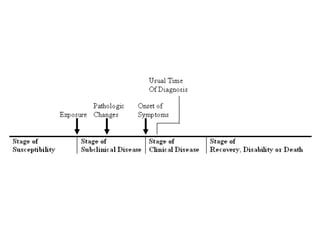
• Stages of natural history of a disease
1. Exposure :- to various etiologic agents
2. latency :- period between exposure and biological onset of
disease
3. Biological onset of disease :- marks the initiation of the
disease process without any sign or symptom. It may remain
asymptomatic or subclinical.
4. Incubation (induction) period :- time from exposure to the
first clinical sign or symptom
5. Clinical onset:- when clinical sings and symptoms became
apparent
• Natural recovery can occur at any stage in the progression
of disease
• Following clinical onset, disease may follow
– Resolution without no sequelae
– Resolution with sequelae / permanent damage
– Death
Reference
• Mesele Bezabeh et. al, Lecture note, General
pathology for health science students,
University of Gondar,2005
• Robbins and Cotran, Basic.Pathology.8th.Ed
• Tim D. Spector, John S. Axford; An introduction
to General pathology, 4th Ed., 1999

Introduction to Pathology.pptx

  • 1.
    Introduction to Pathology By:- Dr. Addisu Alemu (MD, Assistant professor of pathology)
  • 2.
    Learning Objective • Touse pathology to facilitate medical education • Understanding mechanisms, in a way which is more of logic than of a memory. • To leave students with a lasting knowledge of pathology • To use pathology as the scientific basis of the “art” of medicine
  • 3.
    Definitions • Pathology is –Latin word: - Patho = disease or suffering; logy = study – The study of disease by scientific methods or pathology is the study of disordered function. • Disease – Dis-ease = lack of ease – Abnormal variation in structure or function of part of the body which often originate from alteration of a survival mechanism or respond adequately • WHO defines health as – as a state of complete physical, mental, and social well- being and not merely the absence of disease or infirmity.
  • 4.
    Terms • Symptoms • sign •Prognosis – Prediction of the out come of a disease. That you may need to discuss with the patient or relatives in planning management and follow up works. – Syndrome – A group of symptoms, signs, laboratory findings, and physiological disturbances that are linked by a common anatomical, biochemical, or pathological history. E.g. AIDS • Lesions – A circumscribed area of pathologically altered tissue.
  • 5.
    Introduction • Pathology givesexplanations of a disease by studying 1. Etiology 2. Pathogenesis 3. Morphologic changes and 4. Functional derangement and clinical manifestation
  • 6.
    Etiology • The studyof cause of the disease – Primary etiology – known cause – Idiopathic – unknown cause • Benefits of knowing the etiology – – • Major etiologic factors – Genetic – Acquired
  • 7.
    Pathogenesis • It isthe mechanism through which the etiology produce the pathological and clinical manifestation • E.g. pathogenesis of CHF • Pathogenesis leads to morphologic changes
  • 8.
    Morphologic changes • Structuralalterations in cells or tissues which can be seen – Naked eye – gross morphologic changes – Or microscope – microscopic changes • Morphologic changes are used – To diagnose a disease • Can lead to functional alteration and to the clinical sign and symptoms
  • 9.
    Functional derangement andclinical significance. • The morphologic changes in the organ influence the normal function of the organ • Determine the – clinical features – Course – Prognosis of the disease
  • 10.
    • In summary,pathology studies:- • Etiology  Pathogenesis  Morphologic changes  Clinical features & Prognosis of all diseases.
  • 11.
    Diagnostic techniques • Mostare based on Morphologic change 1. Histopathology 2. Cytopathology 3. Hematopathology 4. Immunohistochemistry 5. Microbiological examination 6. Biochemical examination 7. Cytogenetic 8. autopsy
  • 12.
    Sources of sample •Biopsy: - taken from a living person to identify the disease • FNAC/fine needle aspiration cytology/: - cellular samples are taken through aspiration by a fine(small bore) needle from a living person. • Autopsy:- is examination of the dead body sample to identify the cause of death for forensic or clinical purpose.
  • 13.
    Tissue fixation • Sampletissue like biopsy should be immediately fixed by putting it into adequate amount of 10% formaldehyde to 1. Prevent autolysis and bacterial decomposition and putrefaction 2. To coagulate the tissue to prevent loss of easily diffusible substances 3. To fortfy the tissue against the deleterious effect of the various stages in preparation of sections and tissue processing 4. To leave the tissues in a condition which facilitates differential staining with dyes and other reagents
  • 14.
    Environmental causes ofdisease • Are classified into 1. Physical agents:- like trauma, radiation, extremes of temp., electrical power 2. Chemicals :- cyanide, acids, bases, bleaches, CO, 3. Nutritional deficiencies and excesses :- 4. Infections & infestations 5. Immunological factors 6. Psychogenic factors
  • 15.
    Genetic causes ofdisease • Hereditary • Sporadic • Acquired
  • 16.
    Course of disease •The course of a disease in the absence of any intervention is called natural history of the disease. • Stages of natural history of a disease 1. Exposure :- to various etiologic agents 2. latency :- period between exposure and biological onset of disease 3. Biological onset of disease :- marks the initiation of the disease process without any sign or symptom. It may remain asymptomatic or subclinical. 4. Incubation (induction) period :- time from exposure to the first clinical sign or symptom 5. Clinical onset:- when clinical sings and symptoms became apparent • Natural recovery can occur at any stage in the progression of disease
  • 18.
    • Following clinicalonset, disease may follow – Resolution without no sequelae – Resolution with sequelae / permanent damage – Death
  • 19.
    Reference • Mesele Bezabehet. al, Lecture note, General pathology for health science students, University of Gondar,2005 • Robbins and Cotran, Basic.Pathology.8th.Ed • Tim D. Spector, John S. Axford; An introduction to General pathology, 4th Ed., 1999