WHAT IS IT?
INTERPERSONALCOMMUNICATION deals with
the way we communicate and the feedback that we can
get out of it. We use this in many ways like introducing
ourselves to others, dealing with businesses, talking to our
loved ones, buying kinds of stuff, consultations, etc. We
make use of it every single day of our life.
Theoretical
4.
Examples of InterpersonalCommunication:
01. MEETINGS
02. PHONE CALLS
03. PRESENTATIONS
04. PANEL DISCUSSION
05. EMAIL AND TEXTING
06.DEBATE
07. INTERVIEW
5.
Interpersonal communication isnot just about
the voice that comes out
in your mouth but it is a collection of cues that come
from body language,
facial expressions, gestures and behavior.
6.
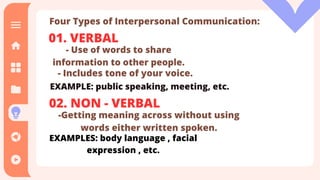
Four Types ofInterpersonal Communication:
01. VERBAL
- Use of words to share
information to other people.
- Includes tone of your voice.
EXAMPLE: public speaking, meeting, etc.
02. NON - VERBAL
-Getting meaning across without using
words either written spoken.
EXAMPLES: body language , facial
expression , etc.
7.
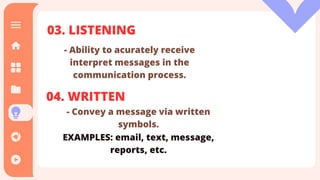
03. LISTENING
- Abilityto acurately receive
interpret messages in the
communication process.
04. WRITTEN
-Getting meaning across without us.
EXAMPLES: body language , facial
expression , etc.
03. LISTENING
- Ability to acurately receive
interpret messages in the
communication process.
04. WRITTEN
- Convey a message via written
symbols.
EXAMPLES: email, text, message,
reports, etc.
8.
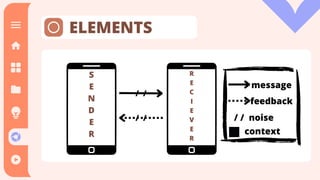
In communication, thereare essential factors that you need to take
into consideration and these are the elements involved in the process
of interpersonal communication. It should have a message that should
be sent by the sender and to be received by the receiver
In communication, there are essential factors that
you need to take into consideration and this are the
ELEMENTS involved in the process of interpersonal
communication
The person who
receivesthe message.
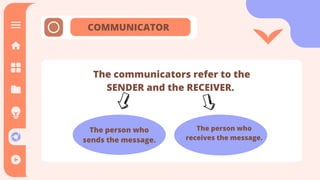
COMMUNICATOR
The communicators refer to the
SENDER and the RECEIVER.
The person who
sends the message.
The person who
receives the message.
11.
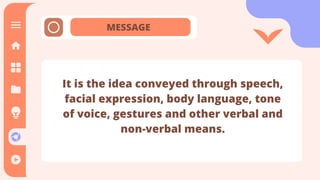
MESSAGE
It is theidea conveyed through speech,
facial expression, body language, tone
of voice, gestures and other verbal and
non-verbal means.
12.
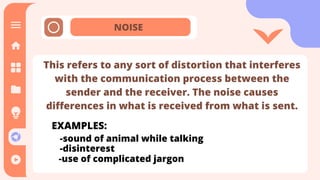
NOISE
This refers toany sort of distortion that interferes
with the communication process between the
sender and the receiver. The noise causes
differences in what is received from what is sent.
EXAMPLES:
-sound of animal while talking
-disinterest
-use of complicated jargon
13.
FEEDBACK
It is theresponse of the receiver; it
comprises the message he/she sends
back. It can be in the form of a gesture.
14.
CONTEXT
How the messageis being interpreted is
mostly depend on the context he receives.
The process of communication is influenced
by the context it occurs. The emotional
climate and expectations of the people,
the place of occurrence, and social,
political cultural and environmental
conditions comprise context
How the message is being interpreted is
mostly depend on the context he receives.
The process of communication is influenced
by the context it occurs. The emotional
climate and expectations of the people,
the place of occurrence, and social,
political cultural and environmental
conditions comprise context
15.
CHANNEL
It is themeans through which
communication happens. The message
is sent and received through the
channel. It is also referred as the
medium through which message
transmitted.
EXAMPLES:
Mobile Phone, speaker, cable , telephone
16.
Tips!
It is themeans through which
communication happens. The message
is sent and received through the
channel. It is also referred as the
medium through which message
transmitted.
01. Dont Show Negative Body language
If your body language is sending negative
signals to the other person,
the communication will probably break
down in the process.
17.
Tips!
It is themeans through which
communication happens. The message
is sent and received through the
channel. It is also referred as the
medium through which message
transmitted.
02. Do Not Interrupt the Other Person
It is very rude to interrupt a person
while they are speaking.
Nobody likes to be interrupted
because it hampers the
thought process and it is
disrespectful.
18.
Tips!
It is themeans through which
communication happens. The message
is sent and received through the
channel. It is also referred as the
medium through which message
transmitted.
03.Think Before You Speak
You should think how your words are going
to affect the person with
whom you are communicating before
making any comments.
19.
Tips!
It is themeans through which
communication happens. The message
is sent and received through the
channel. It is also referred as the
medium through which message
transmitted.
04.Listen Well
If you have good listening skills, you
will be able to
understand that person’s words
more clearly and react in
a positive manner.
20.
Tips!
It is themeans through which
communication happens. The message
is sent and received through the
channel. It is also referred as the
medium through which message
transmitted.
05.Dont Be Defensive
Be neutral and transparent so that you
can understand what is actually
being discussed. Always maintain the
balance in the conversation so
that everyone involved in the discussion
has a fair part in it.
21.
Tips!
It is themeans through which
communication happens. The message
is sent and received through the
channel. It is also referred as the
medium through which message
transmitted.
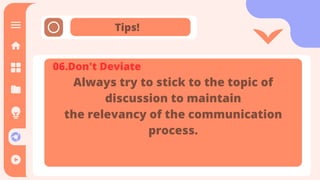
06.Don't Deviate
Always try to stick to the topic of
discussion to maintain
the relevancy of the communication
process.
22.
Tips!
It is themeans through which
communication happens. The message
is sent and received through the
channel. It is also referred as the
medium through which message
transmitted.
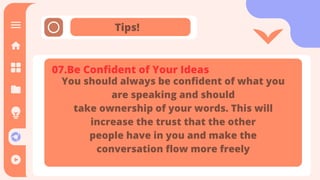
07.Be Confident of Your Ideas
You should always be confident of what you
are speaking and should
take ownership of your words. This will
increase the trust that the other
people have in you and make the
conversation flow more freely
23.
Tips!
It is themeans through which
communication happens. The message
is sent and received through the
channel. It is also referred as the
medium through which message
transmitted.
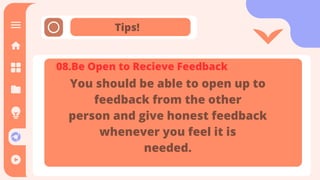
08.Be Open to Recieve Feedback
You should be able to open up to
feedback from the other
person and give honest feedback
whenever you feel it is
needed.
24.
Tips!
It is themeans through which
communication happens. The message
is sent and received through the
channel. It is also referred as the
medium through which message
transmitted.
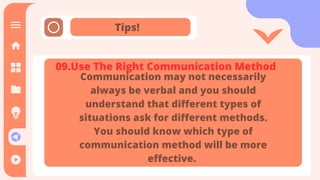
09.Use The Right Communication Method
Communication may not necessarily
always be verbal and you should
understand that different types of
situations ask for different methods.
You should know which type of
communication method will be more
effective.
25.
Tips!
It is themeans through which
communication happens. The message
is sent and received through the
channel. It is also referred as the
medium through which message
transmitted.
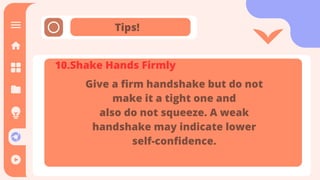
10.Shake Hands Firmly
Give a firm handshake but do not
make it a tight one and
also do not squeeze. A weak
handshake may indicate lower
self-confidence.
26.
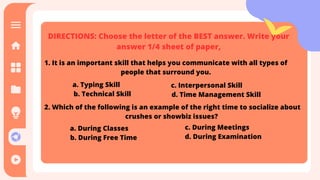
DIRECTIONS: Choose theletter of the BEST answer. Write your
answer 1/4 sheet of paper,
1. It is an important skill that helps you communicate with all types of
people that surround you.
a. Typing Skill
b. Technical Skill
c. Interpersonal Skill
d. Time Management Skill
2. Which of the following is an example of the right time to socialize about
crushes or showbiz issues?
a. During Classes
b. During Free Time
c. During Meetings
d. During Examination
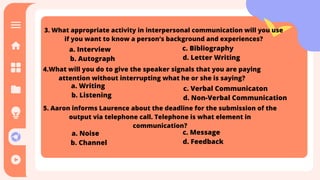
27.
a. Interview
b. Autograph
c.Bibliography
d. Letter Writing
3. What appropriate activity in interpersonal communication will you use
if you want to know a person’s background and experiences?
4.What will you do to give the speaker signals that you are paying
attention without interrupting what he or she is saying?
a. Writing
b. Listening
c. Verbal Communicaton
d. Non-Verbal Communication
5. Aaron informs Laurence about the deadline for the submission of the
output via telephone call. Telephone is what element in
communication?
a. Noise
b. Channel
c. Message
d. Feedback