1. Intrapersonal Communication
-communication that takes place
within a person.
self- directed
it occurs when you think or talk to yourself
you are both the sender and the receiver
6.
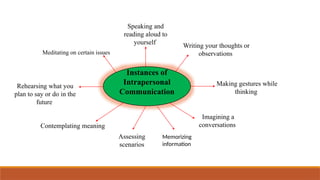
Instances of
Intrapersonal
Communication
Speaking and
readingaloud to
yourself Writing your thoughts or
observations
Making gestures while
thinking
Imagining a
conversations
Assessing
scenarios
Contemplating meaning
Rehearsing what you
plan to say or do in the
future
Meditating on certain issues
Memorizing
information
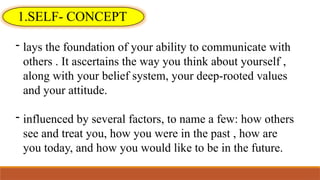
1.SELF- CONCEPT
- laysthe foundation of your ability to communicate with
others . It ascertains the way you think about yourself ,
along with your belief system, your deep-rooted values
and your attitude.
- influenced by several factors, to name a few: how others
see and treat you, how you were in the past , how are
you today, and how you would like to be in the future.
9.
2. PERCEPTION
- Isthe process in which the mind receives and grasps data
from the outside world. Since you are unique, your
perception is not precisely similar to that of others.
3. EXPECTATION
- Refers to the future projections.
11.
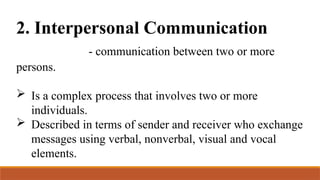
2. Interpersonal Communication
-communication between two or more
persons.
Is a complex process that involves two or more
individuals.
Described in terms of sender and receiver who exchange
messages using verbal, nonverbal, visual and vocal
elements.
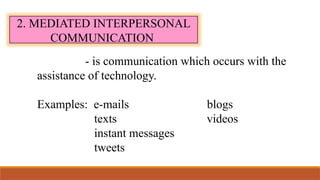
2. MEDIATED INTERPERSONAL
COMMUNICATION
-is communication which occurs with the
assistance of technology.
Examples: e-mails blogs
texts videos
instant messages
tweets
16.
3. INDIRECT INTERPERSONAL
COMMUNICATION
-involves the exchange of thoughts and ideas
through subconscious tools, like body language,
gestures and double entendres. This implies that
messages are not readily apparent.
17.
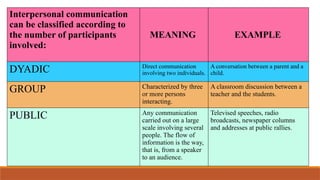
Interpersonal communication
can beclassified according to
the number of participants
involved:
MEANING EXAMPLE
DYADIC Direct communication
involving two individuals.
A conversation between a parent and a
child.
GROUP Characterized by three
or more persons
interacting.
A classroom discussion between a
teacher and the students.
PUBLIC Any communication
carried out on a large
scale involving several
people. The flow of
information is the way,
that is, from a speaker
to an audience.
Televised speeches, radio
broadcasts, newspaper columns
and addresses at public rallies.