Internet Protocol
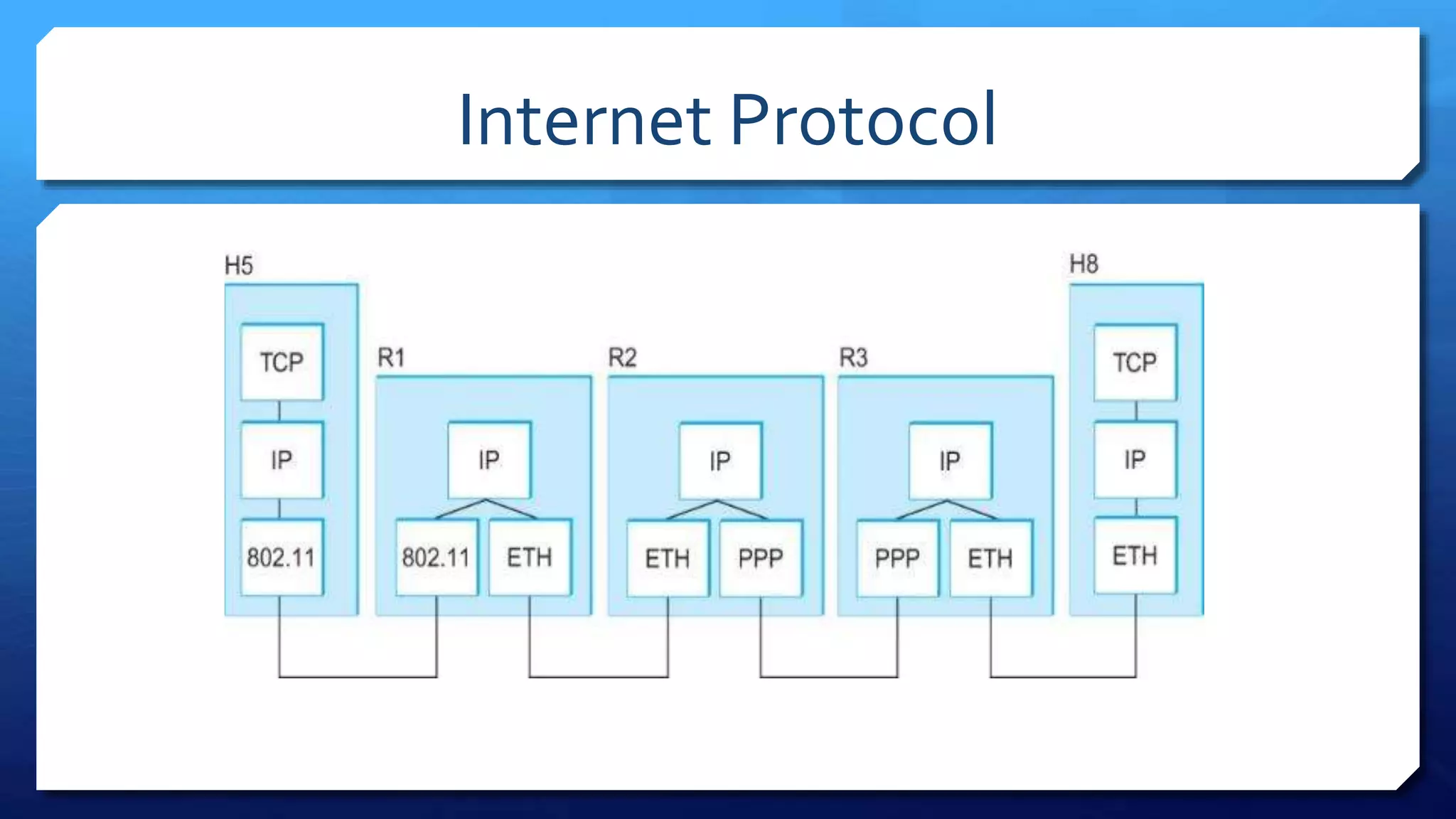
Internetwork
- Logical network built out of a collection of physical
networks to provide some host to host packet delivery
service.
Router – the node that interconnects the network.
Router is also called as gateway.
Internet Protocol
• Key tool used to build scalable, heterogeneous internetworks.
• Also called as Kahn – Cerf protocol.
Service model,
o Provide host to host services.
o Two parts,
- Addressing Scheme – to identify all the hosts in the internetwork.
- Datagram Model – for data delivery
Internet Protocol
Internet Protocol
 Also called as best effort model.
Best effort model,
 It makes no guarantee for datagram delivery.
 If packets gets lost, corrupted, misdelivered or it fails to reach
intended destination, it does nothing.
 Unreliable service.
Internet Protocol
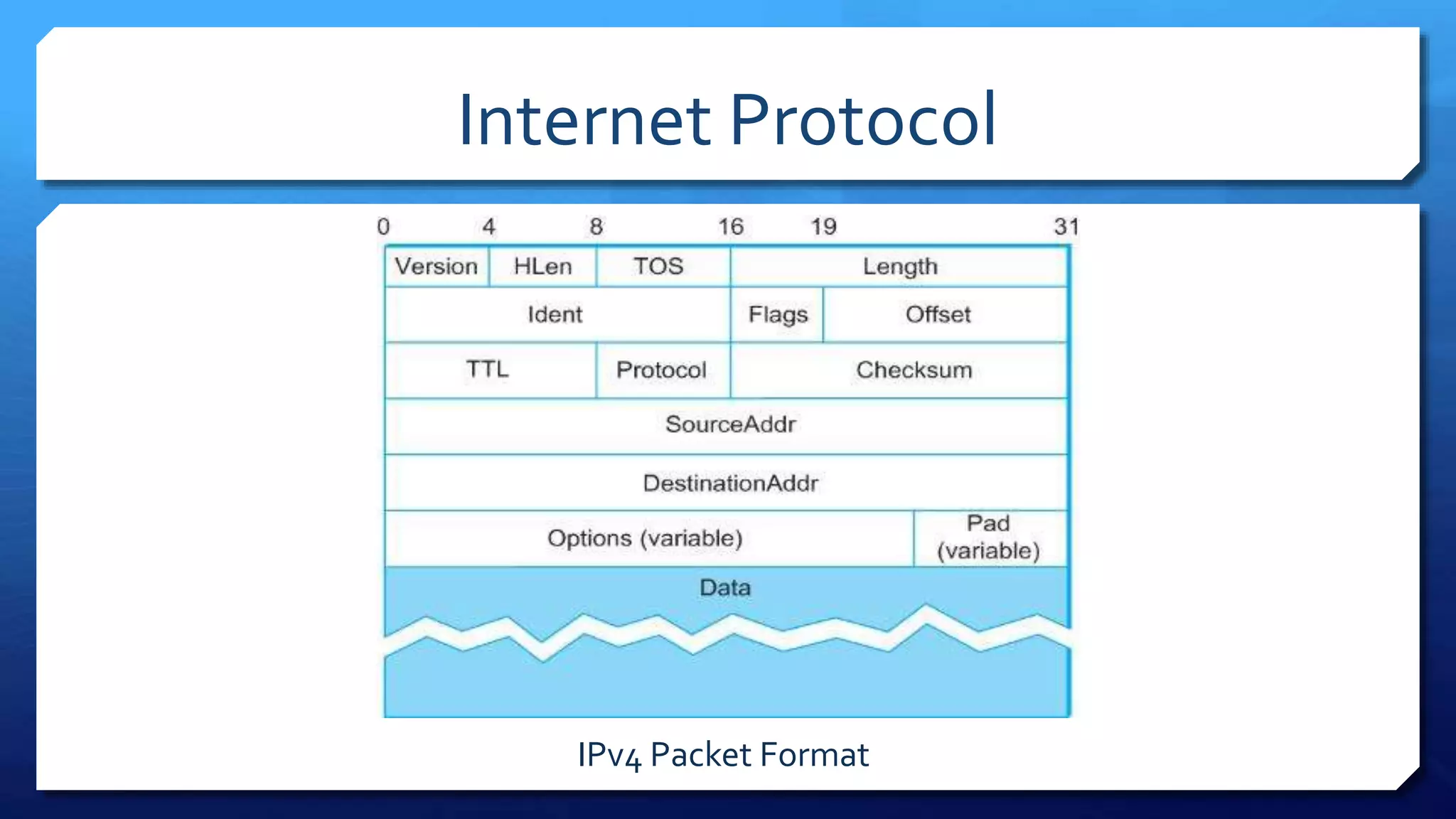
IPv4 Packet Format
Internet Protocol
• Version (4 bit) – Version - version of the Internet Protocol.
• HLen (4 bit) – Header Length – specifies the length of the header in 32 bit
words. (Normally it contains value 5 i.e., 5 words – 20 Bytes).
• TOS (8 bit) – Type of Service–defines type of service that allows packets to be
treated differently based on the application need. (i.e., priority to packets)
• Length (8 bit) –length of the datagram including the header in bytes.
(Maximum value is 65,525 bytes).
Internet Protocol
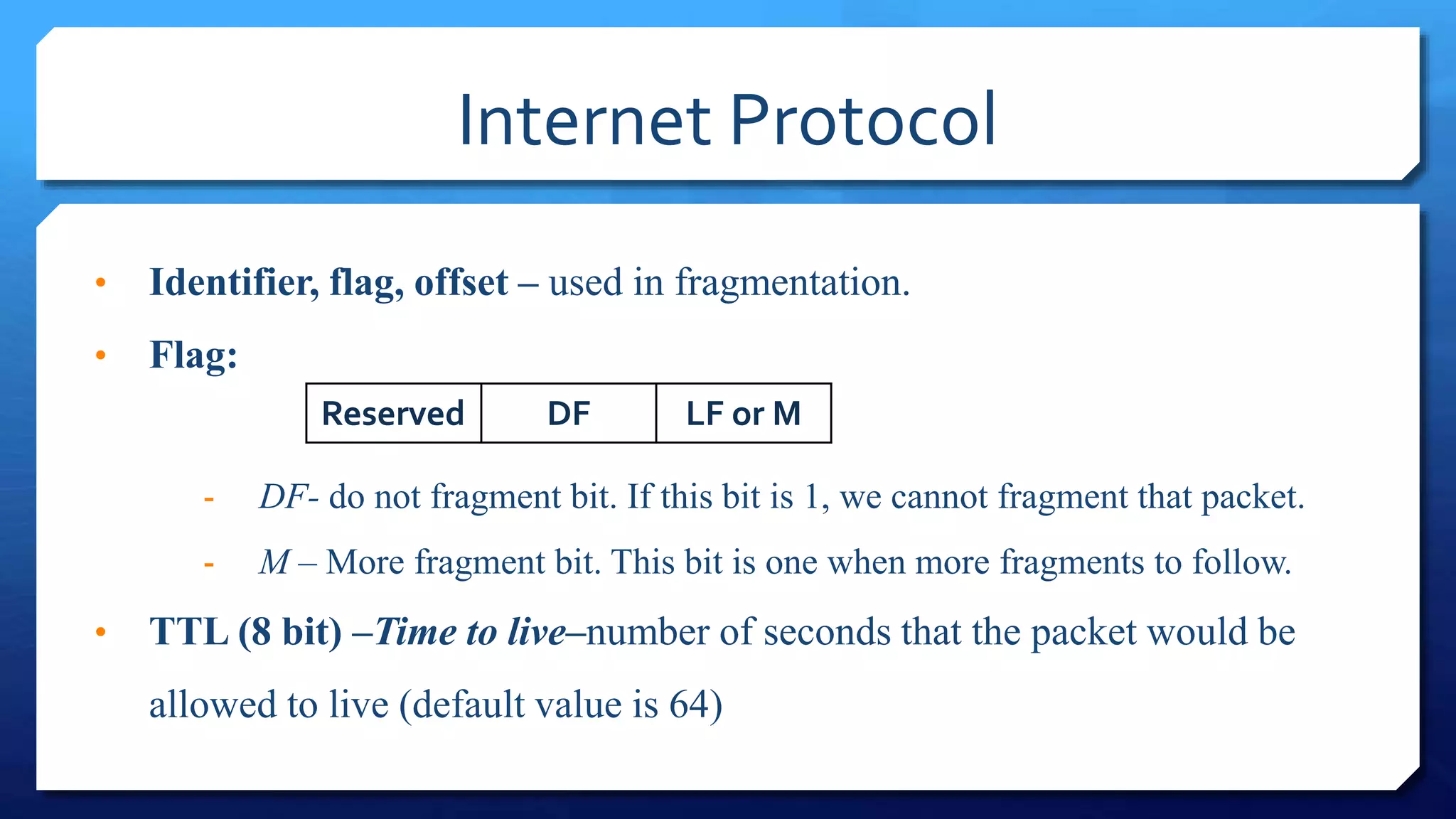
• Identifier, flag, offset – used in fragmentation.
• Flag:
- DF- do not fragment bit. If this bit is 1, we cannot fragment that packet.
- M – More fragment bit. This bit is one when more fragments to follow.
• TTL (8 bit) –Time to live–number of seconds that the packet would be
allowed to live (default value is 64)
Reserved DF LF or M
Internet Protocol
• Protocol (8 bit) –demultiplexing key for higher level layer protocols.
• TCP – 6
• UDP – 17
• Checksum (16 bit) – used to detect errors in header.
- Checksum is calculated by considering the entire header as a sequence of 16 bit
words, adding them and taking the ones compliment of the result
• SourceAddr, DestAddr (32 bit each)–IP address of the source and destination
host.
Internet Protocol – Fragmentation and
Reassembly
Fragmentation and Reassembly,
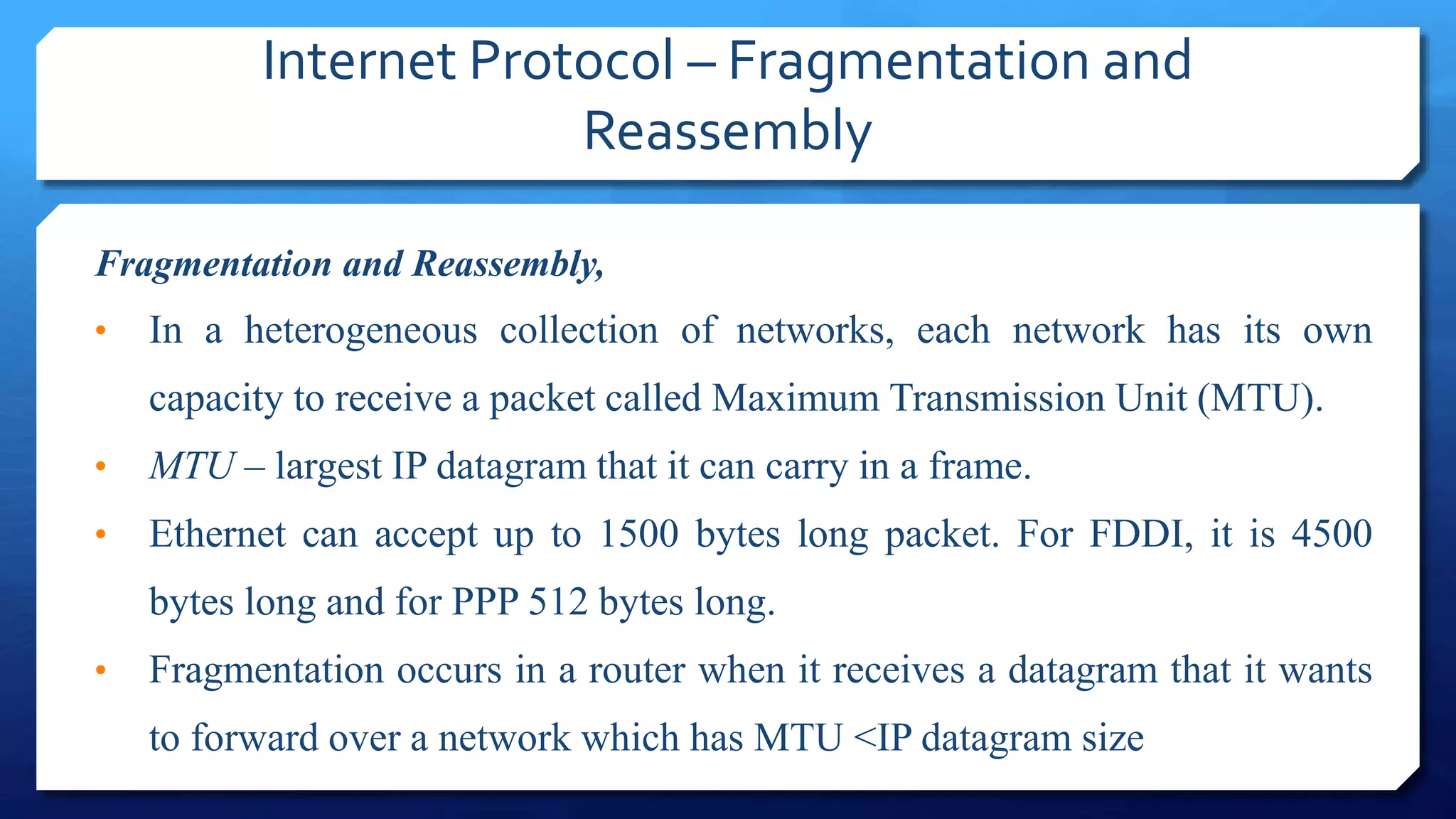
• In a heterogeneous collection of networks, each network has its own
capacity to receive a packet called Maximum Transmission Unit (MTU).
• MTU – largest IP datagram that it can carry in a frame.
• Ethernet can accept up to 1500 bytes long packet. For FDDI, it is 4500
bytes long and for PPP 512 bytes long.
• Fragmentation occurs in a router when it receives a datagram that it wants
to forward over a network which has MTU <IP datagram size
Internet Protocol – Fragmentation and
Reassembly
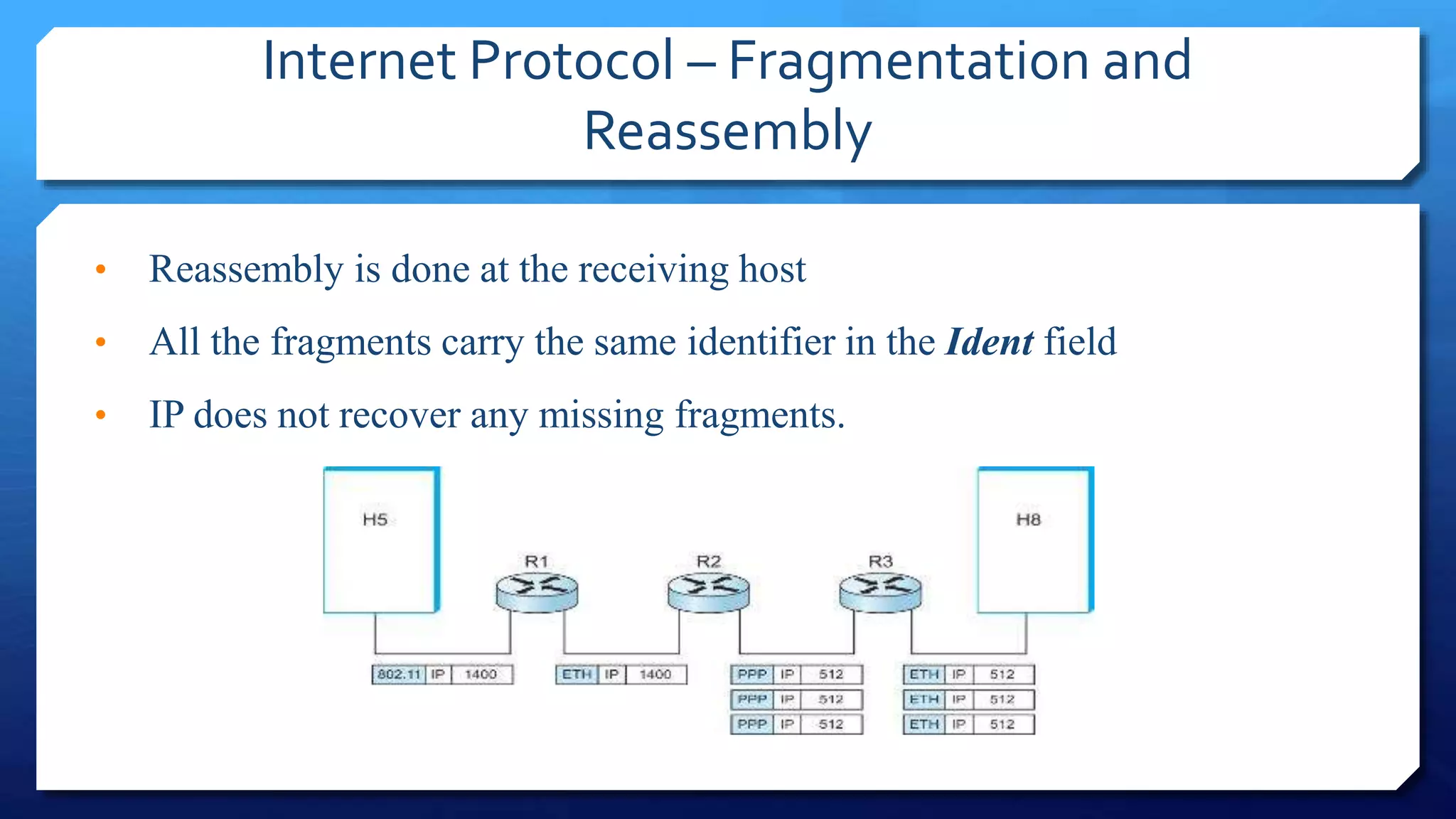
• Reassembly is done at the receiving host
• All the fragments carry the same identifier in the Ident field
• IP does not recover any missing fragments.
Internet Protocol – Fragmentation and
Reassembly
Two important points,
• Each fragment is itself a self-contained IP datagram that is transmitted over
a sequence of physical networks, independent of other fragments.
• Each IP datagram is re-encapsulated for each physical network over which
it travels.
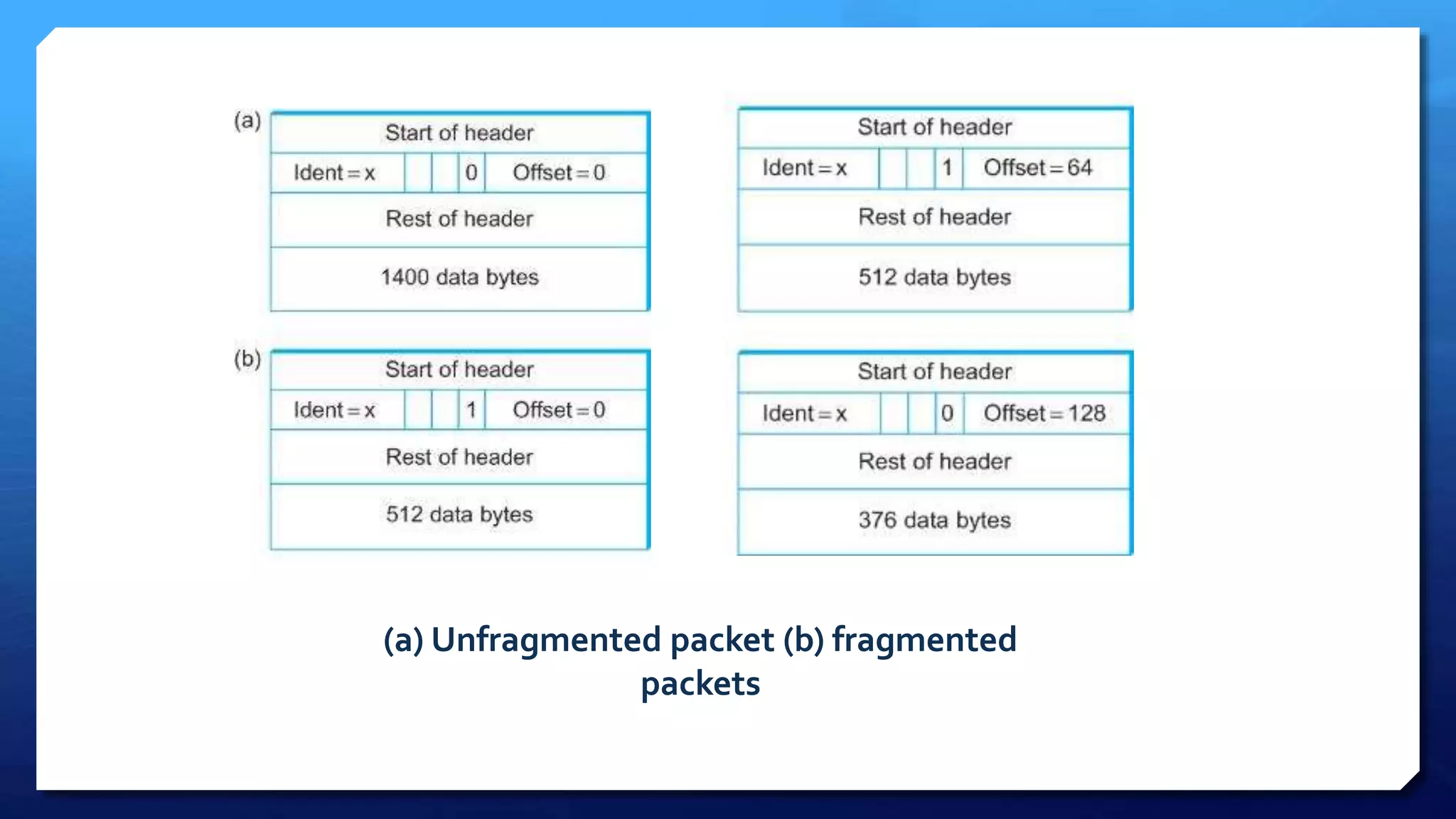
(a) Unfragmented packet (b) fragmented
packets
Internet Protocol – Fragmentation and
Reassembly
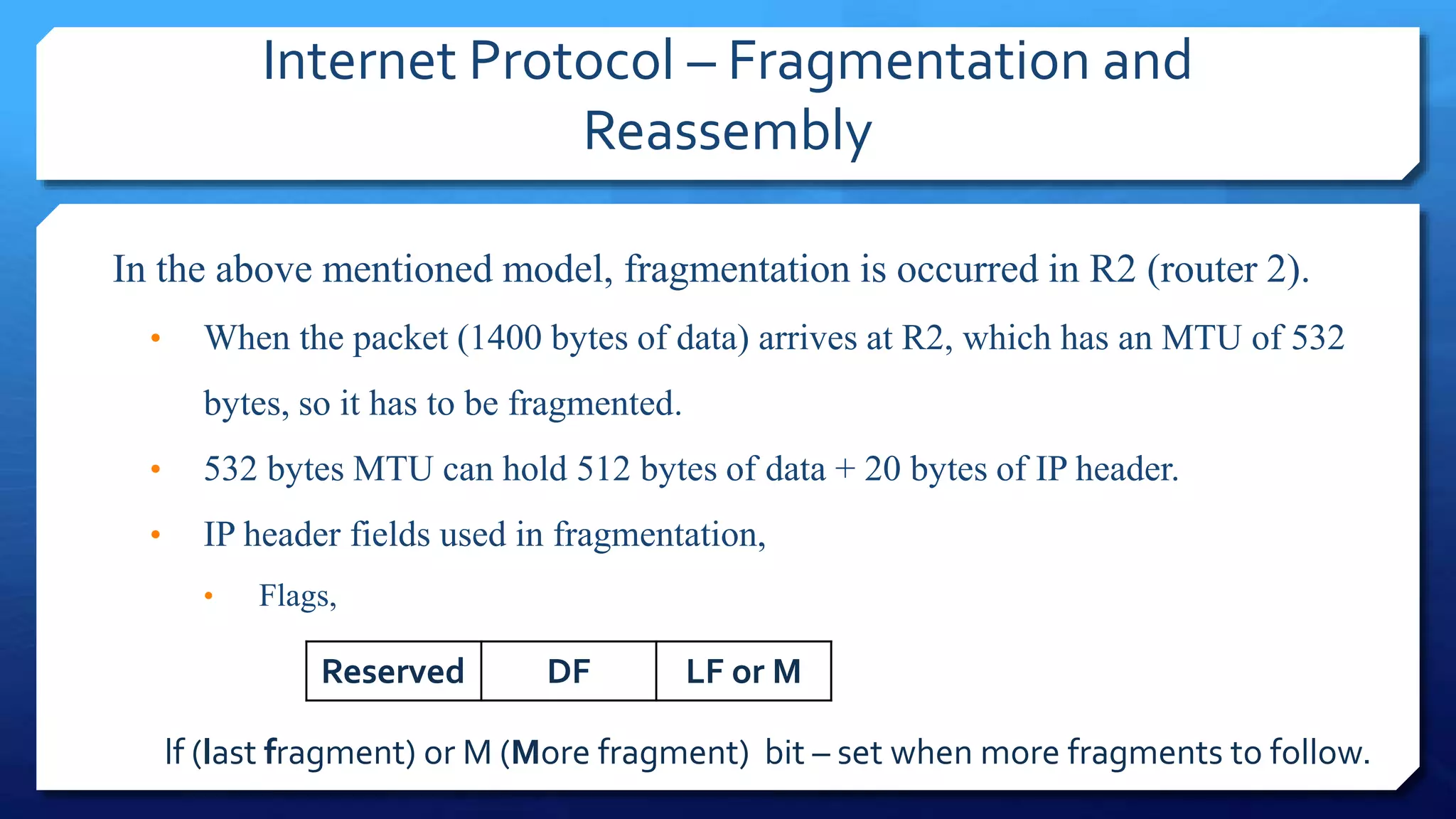
In the above mentioned model, fragmentation is occurred in R2 (router 2).
• When the packet (1400 bytes of data) arrives at R2, which has an MTU of 532
bytes, so it has to be fragmented.
• 532 bytes MTU can hold 512 bytes of data + 20 bytes of IP header.
• IP header fields used in fragmentation,
• Flags,
Reserved DF LF or M
lf (last fragment) or M (More fragment) bit – set when more fragments to follow.
Internet Protocol – Fragmentation and
Reassembly
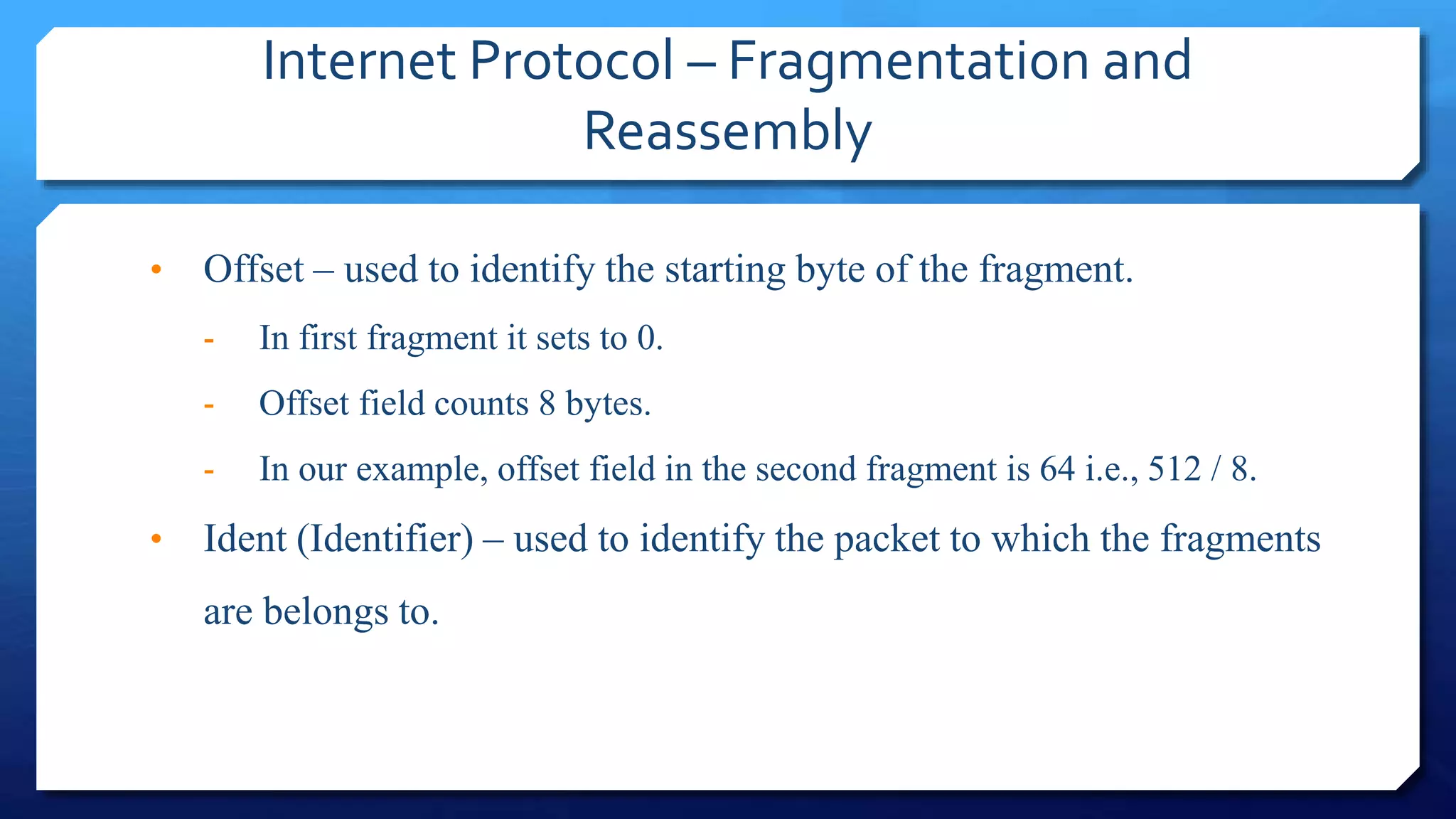
• Offset – used to identify the starting byte of the fragment.
- In first fragment it sets to 0.
- Offset field counts 8 bytes.
- In our example, offset field in the second fragment is 64 i.e., 512 / 8.
• Ident (Identifier) – used to identify the packet to which the fragments
are belongs to.

Internetworking - IP

  • 1.
  • 2.
    Internetwork - Logical networkbuilt out of a collection of physical networks to provide some host to host packet delivery service. Router – the node that interconnects the network. Router is also called as gateway.
  • 4.
    Internet Protocol • Keytool used to build scalable, heterogeneous internetworks. • Also called as Kahn – Cerf protocol. Service model, o Provide host to host services. o Two parts, - Addressing Scheme – to identify all the hosts in the internetwork. - Datagram Model – for data delivery
  • 5.
  • 6.
    Internet Protocol  Alsocalled as best effort model. Best effort model,  It makes no guarantee for datagram delivery.  If packets gets lost, corrupted, misdelivered or it fails to reach intended destination, it does nothing.  Unreliable service.
  • 7.
  • 8.
    Internet Protocol • Version(4 bit) – Version - version of the Internet Protocol. • HLen (4 bit) – Header Length – specifies the length of the header in 32 bit words. (Normally it contains value 5 i.e., 5 words – 20 Bytes). • TOS (8 bit) – Type of Service–defines type of service that allows packets to be treated differently based on the application need. (i.e., priority to packets) • Length (8 bit) –length of the datagram including the header in bytes. (Maximum value is 65,525 bytes).
  • 9.
    Internet Protocol • Identifier,flag, offset – used in fragmentation. • Flag: - DF- do not fragment bit. If this bit is 1, we cannot fragment that packet. - M – More fragment bit. This bit is one when more fragments to follow. • TTL (8 bit) –Time to live–number of seconds that the packet would be allowed to live (default value is 64) Reserved DF LF or M
  • 10.
    Internet Protocol • Protocol(8 bit) –demultiplexing key for higher level layer protocols. • TCP – 6 • UDP – 17 • Checksum (16 bit) – used to detect errors in header. - Checksum is calculated by considering the entire header as a sequence of 16 bit words, adding them and taking the ones compliment of the result • SourceAddr, DestAddr (32 bit each)–IP address of the source and destination host.
  • 11.
    Internet Protocol –Fragmentation and Reassembly Fragmentation and Reassembly, • In a heterogeneous collection of networks, each network has its own capacity to receive a packet called Maximum Transmission Unit (MTU). • MTU – largest IP datagram that it can carry in a frame. • Ethernet can accept up to 1500 bytes long packet. For FDDI, it is 4500 bytes long and for PPP 512 bytes long. • Fragmentation occurs in a router when it receives a datagram that it wants to forward over a network which has MTU <IP datagram size
  • 12.
    Internet Protocol –Fragmentation and Reassembly • Reassembly is done at the receiving host • All the fragments carry the same identifier in the Ident field • IP does not recover any missing fragments.
  • 13.
    Internet Protocol –Fragmentation and Reassembly Two important points, • Each fragment is itself a self-contained IP datagram that is transmitted over a sequence of physical networks, independent of other fragments. • Each IP datagram is re-encapsulated for each physical network over which it travels.
  • 14.
    (a) Unfragmented packet(b) fragmented packets
  • 15.
    Internet Protocol –Fragmentation and Reassembly In the above mentioned model, fragmentation is occurred in R2 (router 2). • When the packet (1400 bytes of data) arrives at R2, which has an MTU of 532 bytes, so it has to be fragmented. • 532 bytes MTU can hold 512 bytes of data + 20 bytes of IP header. • IP header fields used in fragmentation, • Flags, Reserved DF LF or M lf (last fragment) or M (More fragment) bit – set when more fragments to follow.
  • 16.
    Internet Protocol –Fragmentation and Reassembly • Offset – used to identify the starting byte of the fragment. - In first fragment it sets to 0. - Offset field counts 8 bytes. - In our example, offset field in the second fragment is 64 i.e., 512 / 8. • Ident (Identifier) – used to identify the packet to which the fragments are belongs to.