
LAN - WAN
ARCHITECTURE

1
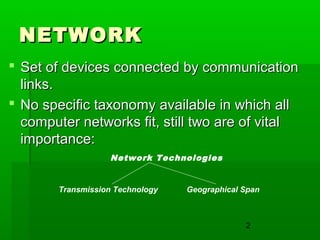
NETWORK
 Set of devices connected by communication
links.
 No specific taxonomy available in which all
computer networks fit, still two are of vital
importance:
Network Technologies

Transmission Technology

Geographical Span

2
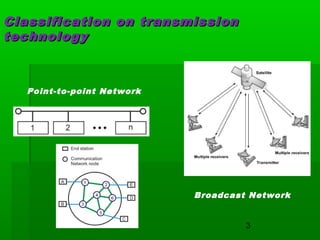
Classification on transmission
technology

Point-to-point Network

Broadcast Network
3
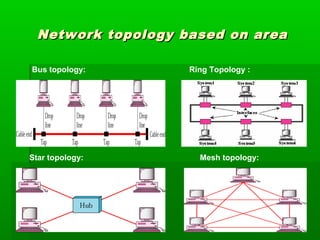
Network topology based on area
Bus topology:

Star topology:

Ring Topology :

Mesh topology:

4
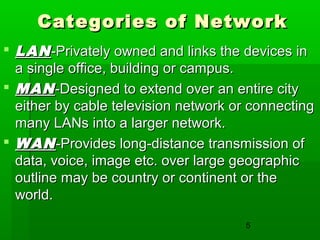
Categories of Network
 LAN -Privately owned and links the devices in
a single office, building or campus.
 MAN -Designed to extend over an entire city
either by cable television network or connecting
many LANs into a larger network.
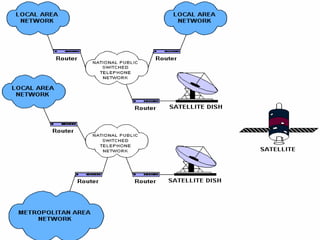
 WAN -Provides long-distance transmission of
data, voice, image etc. over large geographic
outline may be country or continent or the
world.
5
6
Components of LAN
 A Local Area Network, LAN is a combination of
hardware and software.
 The physical component of the network system
is hardware. The invisible part, that is programs
enabling the network to function properly is the
software.
 Ethernet is the most dominant LAN in the
market.
7
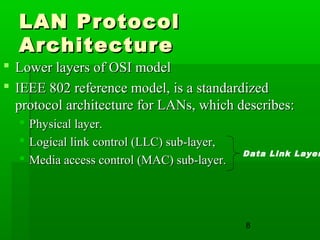
LAN Protocol
Architecture
 Lower layers of OSI model
 IEEE 802 reference model, is a standardized
protocol architecture for LANs, which describes:




Physical layer.
Logical link control (LLC) sub-layer,
Media access control (MAC) sub-layer.

Data Link Layer

8
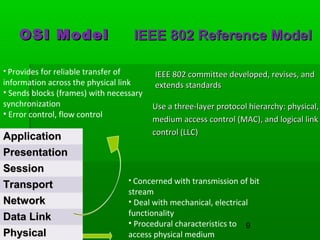
OSI Model
• Provides for reliable transfer of

IEEE 802 Reference Model

information across the physical link
• Sends blocks (frames) with necessary
synchronization
• Error control, flow control

Application
Presentation
Session
Transport
Network
Data Link
Physical

IEEE 802 committee developed, revises, and
extends standards
Use a three-layer protocol hierarchy: physical,
medium access control (MAC), and logical link
control (LLC)

• Concerned with transmission of bit

stream
• Deal with mechanical, electrical
functionality
• Procedural characteristics to 9
access physical medium
ETHERNET
 Most widely used data communication standard
 Physical Medium – Carry signal between
computers.
 MAC rules embedded in each interface that
allow multiple computers to access shared
channel.
 Ethernet frame of standardized set of bits used
to carry data over the system.
 Uses Star topology and 1-persistent CSMA/CD
10
access method.
Logical Link Control
 Acts as interface between MAC and upper
layer.
 Accountable for flow control.
 Manages error control and error detection.
 Independent of topology and medium.
 Specifies method of addressing whether
unicast multicast or broadcast.
11
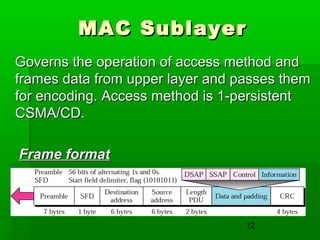
MAC Sublayer
Governs the operation of access method and
frames data from upper layer and passes them
for encoding. Access method is 1-persistent
CSMA/CD.
Frame format

12
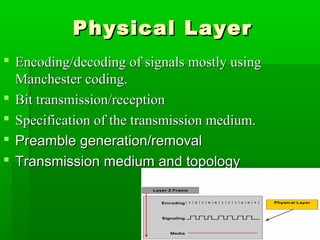
Physical Layer
 Encoding/decoding of signals mostly using
Manchester coding.
 Bit transmission/reception
 Specification of the transmission medium.
 Preamble generation/removal
 Transmission medium and topology

13
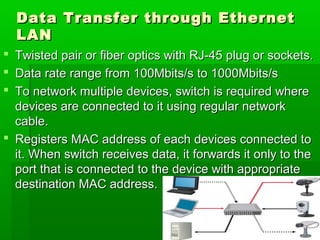
Data Transfer through Ethernet
LAN
Twisted pair or fiber optics with RJ-45 plug or sockets.
Data rate range from 100Mbits/s to 1000Mbits/s
To network multiple devices, switch is required where
devices are connected to it using regular network
cable.
 Registers MAC address of each devices connected to
it. When switch receives data, it forwards it only to the
port that is connected to the device with appropriate
destination MAC address.




14
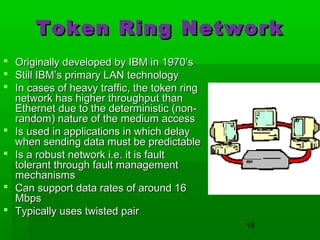
Token Ring Network









Originally developed by IBM in 1970’s
Still IBM’s primary LAN technology
In cases of heavy traffic, the token ring
network has higher throughput than
Ethernet due to the deterministic (nonrandom) nature of the medium access
Is used in applications in which delay
when sending data must be predictable
Is a robust network i.e. it is fault
tolerant through fault management
mechanisms
Can support data rates of around 16
Mbps
Typically uses twisted pair
15
FDDI (Fiber Distributed Data
Interface)
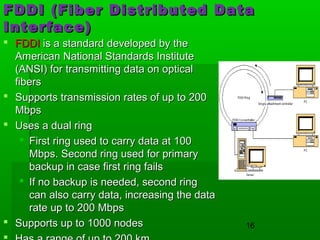
 FDDI is a standard developed by the
American National Standards Institute
(ANSI) for transmitting data on optical
fibers
 Supports transmission rates of up to 200
Mbps
 Uses a dual ring
 First ring used to carry data at 100
Mbps. Second ring used for primary
backup in case first ring fails
 If no backup is needed, second ring
can also carry data, increasing the data
rate up to 200 Mbps
 Supports up to 1000 nodes

16
Wide Area Network
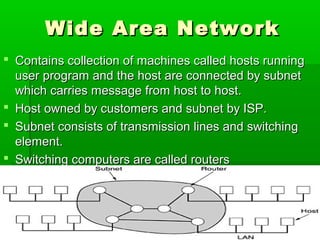
 Contains collection of machines called hosts running
user program and the host are connected by subnet
which carries message from host to host.
 Host owned by customers and subnet by ISP.
 Subnet consists of transmission lines and switching
element.
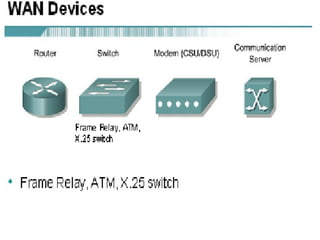
 Switching computers are called routers

17
Wide Area Network
(Contd.)

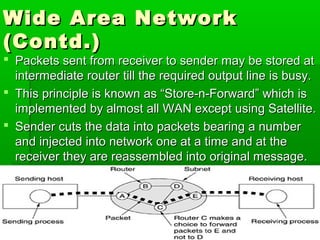
 Packets sent from receiver to sender may be stored at
intermediate router till the required output line is busy.
 This principle is known as “Store-n-Forward” which is
implemented by almost all WAN except using Satellite.
 Sender cuts the data into packets bearing a number
and injected into network one at a time and at the
receiver they are reassembled into original message.

18
WAN TECHNOLOGY
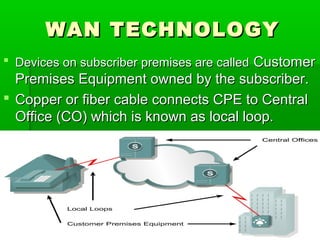
 Devices on subscriber premises are called Customer

Premises Equipment owned by the subscriber.
 Copper or fiber cable connects CPE to Central
Office (CO) which is known as local loop.

19
20
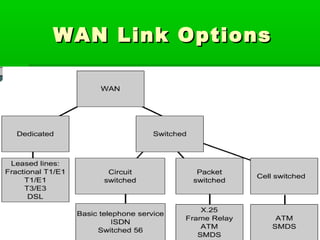
WAN Link Options

21
Circuit Switched
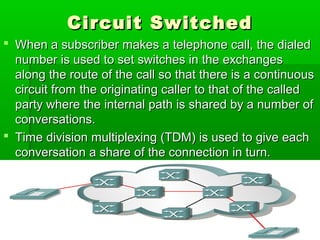
 When a subscriber makes a telephone call, the dialed
number is used to set switches in the exchanges
along the route of the call so that there is a continuous
circuit from the originating caller to that of the called
party where the internal path is shared by a number of
conversations.
 Time division multiplexing (TDM) is used to give each
conversation a share of the connection in turn.

22
PACKET SWITCHING
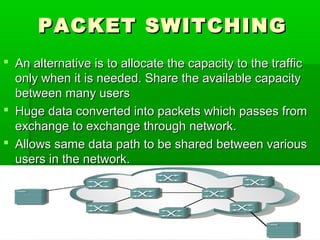
 An alternative is to allocate the capacity to the traffic
only when it is needed. Share the available capacity
between many users
 Huge data converted into packets which passes from
exchange to exchange through network.
 Allows same data path to be shared between various
users in the network.

23
Leased Lines
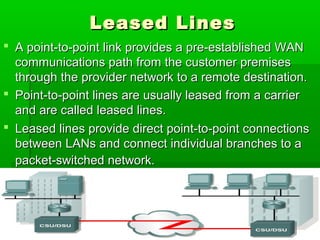
 A point-to-point link provides a pre-established WAN
communications path from the customer premises
through the provider network to a remote destination.
 Point-to-point lines are usually leased from a carrier
and are called leased lines.
 Leased lines provide direct point-to-point connections
between LANs and connect individual branches to a
packet-switched network.

24
WAN Considerations
 Many WANs are connected to the Internet to provide
alternative for inter-branch connections.
 Since the Internet probably exists everywhere that the
enterprise has LANs, there are two principal ways that
this traffic can be carried.
 Each LAN can have a connection to its local ISP, or
there can be a single connection from one of the core
routers to an ISP.
 The advantage is that traffic is carried on the Internet
rather than on the enterprise network, possibly leading
to smaller WAN links.
25
Thank You!!
26

Lan wan

  • 1.
  • 2.
    NETWORK  Set ofdevices connected by communication links.  No specific taxonomy available in which all computer networks fit, still two are of vital importance: Network Technologies Transmission Technology Geographical Span 2
  • 3.
  • 4.
    Network topology basedon area Bus topology: Star topology: Ring Topology : Mesh topology: 4
  • 5.
    Categories of Network LAN -Privately owned and links the devices in a single office, building or campus.  MAN -Designed to extend over an entire city either by cable television network or connecting many LANs into a larger network.  WAN -Provides long-distance transmission of data, voice, image etc. over large geographic outline may be country or continent or the world. 5
  • 6.
  • 7.
    Components of LAN A Local Area Network, LAN is a combination of hardware and software.  The physical component of the network system is hardware. The invisible part, that is programs enabling the network to function properly is the software.  Ethernet is the most dominant LAN in the market. 7
  • 8.
    LAN Protocol Architecture  Lowerlayers of OSI model  IEEE 802 reference model, is a standardized protocol architecture for LANs, which describes:    Physical layer. Logical link control (LLC) sub-layer, Media access control (MAC) sub-layer. Data Link Layer 8
  • 9.
    OSI Model • Providesfor reliable transfer of IEEE 802 Reference Model information across the physical link • Sends blocks (frames) with necessary synchronization • Error control, flow control Application Presentation Session Transport Network Data Link Physical IEEE 802 committee developed, revises, and extends standards Use a three-layer protocol hierarchy: physical, medium access control (MAC), and logical link control (LLC) • Concerned with transmission of bit stream • Deal with mechanical, electrical functionality • Procedural characteristics to 9 access physical medium
  • 10.
    ETHERNET  Most widelyused data communication standard  Physical Medium – Carry signal between computers.  MAC rules embedded in each interface that allow multiple computers to access shared channel.  Ethernet frame of standardized set of bits used to carry data over the system.  Uses Star topology and 1-persistent CSMA/CD 10 access method.
  • 11.
    Logical Link Control Acts as interface between MAC and upper layer.  Accountable for flow control.  Manages error control and error detection.  Independent of topology and medium.  Specifies method of addressing whether unicast multicast or broadcast. 11
  • 12.
    MAC Sublayer Governs theoperation of access method and frames data from upper layer and passes them for encoding. Access method is 1-persistent CSMA/CD. Frame format 12
  • 13.
    Physical Layer  Encoding/decodingof signals mostly using Manchester coding.  Bit transmission/reception  Specification of the transmission medium.  Preamble generation/removal  Transmission medium and topology 13
  • 14.
    Data Transfer throughEthernet LAN Twisted pair or fiber optics with RJ-45 plug or sockets. Data rate range from 100Mbits/s to 1000Mbits/s To network multiple devices, switch is required where devices are connected to it using regular network cable.  Registers MAC address of each devices connected to it. When switch receives data, it forwards it only to the port that is connected to the device with appropriate destination MAC address.    14
  • 15.
    Token Ring Network        Originallydeveloped by IBM in 1970’s Still IBM’s primary LAN technology In cases of heavy traffic, the token ring network has higher throughput than Ethernet due to the deterministic (nonrandom) nature of the medium access Is used in applications in which delay when sending data must be predictable Is a robust network i.e. it is fault tolerant through fault management mechanisms Can support data rates of around 16 Mbps Typically uses twisted pair 15
  • 16.
    FDDI (Fiber DistributedData Interface)  FDDI is a standard developed by the American National Standards Institute (ANSI) for transmitting data on optical fibers  Supports transmission rates of up to 200 Mbps  Uses a dual ring  First ring used to carry data at 100 Mbps. Second ring used for primary backup in case first ring fails  If no backup is needed, second ring can also carry data, increasing the data rate up to 200 Mbps  Supports up to 1000 nodes 16
  • 17.
    Wide Area Network Contains collection of machines called hosts running user program and the host are connected by subnet which carries message from host to host.  Host owned by customers and subnet by ISP.  Subnet consists of transmission lines and switching element.  Switching computers are called routers 17
  • 18.
    Wide Area Network (Contd.) Packets sent from receiver to sender may be stored at intermediate router till the required output line is busy.  This principle is known as “Store-n-Forward” which is implemented by almost all WAN except using Satellite.  Sender cuts the data into packets bearing a number and injected into network one at a time and at the receiver they are reassembled into original message. 18
  • 19.
    WAN TECHNOLOGY  Deviceson subscriber premises are called Customer Premises Equipment owned by the subscriber.  Copper or fiber cable connects CPE to Central Office (CO) which is known as local loop. 19
  • 20.
  • 21.
  • 22.
    Circuit Switched  Whena subscriber makes a telephone call, the dialed number is used to set switches in the exchanges along the route of the call so that there is a continuous circuit from the originating caller to that of the called party where the internal path is shared by a number of conversations.  Time division multiplexing (TDM) is used to give each conversation a share of the connection in turn. 22
  • 23.
    PACKET SWITCHING  Analternative is to allocate the capacity to the traffic only when it is needed. Share the available capacity between many users  Huge data converted into packets which passes from exchange to exchange through network.  Allows same data path to be shared between various users in the network. 23
  • 24.
    Leased Lines  Apoint-to-point link provides a pre-established WAN communications path from the customer premises through the provider network to a remote destination.  Point-to-point lines are usually leased from a carrier and are called leased lines.  Leased lines provide direct point-to-point connections between LANs and connect individual branches to a packet-switched network. 24
  • 25.
    WAN Considerations  ManyWANs are connected to the Internet to provide alternative for inter-branch connections.  Since the Internet probably exists everywhere that the enterprise has LANs, there are two principal ways that this traffic can be carried.  Each LAN can have a connection to its local ISP, or there can be a single connection from one of the core routers to an ISP.  The advantage is that traffic is carried on the Internet rather than on the enterprise network, possibly leading to smaller WAN links. 25
  • 26.