TYPES OF COMPUTER
NETWORKS


           Amit Kumar Shaw
           DRTC, ISI - BC
What is Network?
• A network consists of two or more computers that are linked in
  order to share resources exchange files, or allow electronic
  communications.


• The computers on a network may be linked through
  cables, telephone lines, radio waves, satellites, or infrared light
  beams.
Different Types of Networks
Depending upon the geographical area covered by a network, it
is classified as:

 Local Area Network (LAN)

 Metropolitan Area Network (MAN)

 Wide Area Network (WAN)

 Personal Area Network (PAN)
Local Area Network (LAN)
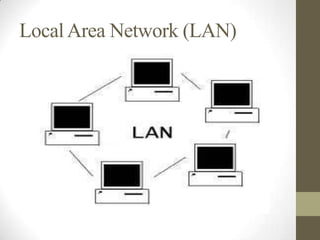
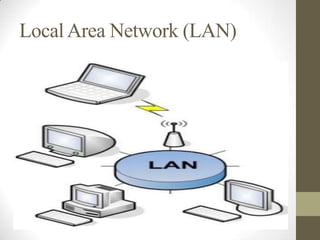
• A LAN is a network that is used for communicating among
  computer devices, usually within an office building or home.

• LAN’s enable the sharing of resources such as files or hardware
  devices that may be needed by multiple users.

• Is limited in size, typically spanning a few hundred meters, and
  no more than a mile.

• Is fast, with speeds from 10 Mbps to 10 Gbps.

• Requires little wiring, typically a single cable connecting to
  each device.
Local Area Network (LAN)
• LAN’s can be either wired or wireless. Twisted pair, coax or
  fiber optic cable can be used in wired LAN’s.

• Every LAN uses a protocol – a set of rules that governs how
  packets are configured and transmitted.

• Has lower cost compared to MAN’s or WAN’s

• Nodes in a LAN are linked together with a certain topology.
  These topologies include: Bus, Ring, Star.

• Requires little wiring, typically a single cable connecting to
  each device.
Local Area Network (LAN)
Types of LANs
The three most common types of LAN are:

• Cable based LAN

• Private Branch Exchange (PBX)

• Hierarchical networks
Cable base LAN
In the cable based LAN all the node are connected by cable
media and signals transmitted through the cables. Any type of
cable are used in LAN such as coaxial, twisted-pair and fiber
optical cable.


• Private Branch Exchange
In the private branch exchange many branches of a companies
connected by telephone lines.


• Hierarchical Network
In this network use of connecting media both cable and
telephone line.
LAN Standards
In February 1980 the IEEE formed a project called project
802 to help define certain standards. The 802 specifications
fall into 12 categories that are identified by the 802 numbers;

• 802.1 Internetworking and Management

• 802.2 Logical Link Control

• 802.3 Carrier Sense with Multiple Access and Collision
  Detection (CSMA/CD)
• 802.4 Token bus LAN

• 802.5 Token Ring LAN

• 802.6 Metropolitan Area Network

• 802.7 Broadband Technical Advisory Group

• 802.8 Fiber-Optical Technical Advisory Group
• 802.9 Integrated Voice/Data

• 802.10 Networks Network Security

• 802.11 Wireless Network

• 802.12 Demand Priority Access LAN
LAN Transmission Methods
Commonly three LAN data transmissions methods are:

• Unicast
• Multicast
• Broadcast

Unicast transmission a single packet is sent from the source
to a destination on a network.
• Multicast transmission consists of a single data packet that is
  copied and sent to the specific subset of nodes on the network.


• Broadcast transmission consists of a single data packets that is
  copied and sent to all nodes on the network.
Types of LAN Models: Peer to peer
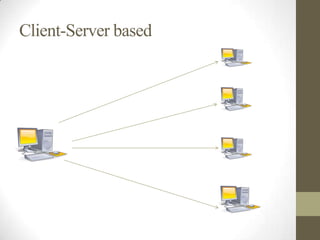
Client-Server based
Advantages of LAN
• Speed

• Cost

• Security

• E-mail

• Resource Sharing
Disadvantages of LAN
• Expensive To Install

• Requires Administrative Time

• File Server May Fail

• Cables May Break
Metropolitan Area Network (MAN)
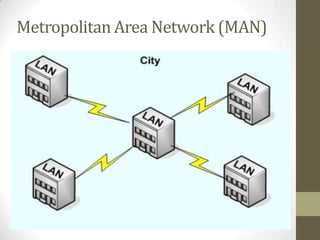
 • A metropolitan area network (MAN) is a large computer
   network that usually spans a city or a large campus.

 • A MAN is optimized for a larger geographical area than a
   LAN, ranging from several blocks of buildings to entire cities.

 • A MAN might be owned and operated by a single
   organization, but it usually will be used by many individuals
   and organizations.
Metropolitan Area Network(MAN)
• A MAN often acts as a high speed network to allow sharing of
  regional resources.

• A MAN typically covers an area of between 5 and 50 km
  diameter.

• Examples of MAN: Telephone company network that provides a
  high speed DSL to customers and cable TV network.
Metropolitan Area Network (MAN)
Wide Area Network (WAN)
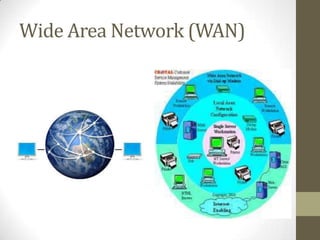
• WAN covers a large geographic area such as country, continent
  or even whole of the world.

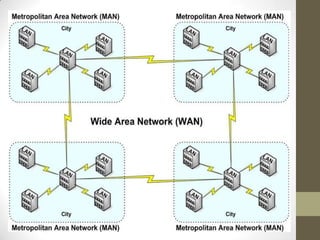
• A WAN is two or more LANs connected together. The LANs
  can be many miles apart.

• To cover great distances, WANs may transmit data over leased
  high-speed phone lines or wireless links such as satellites.
Wide Area Network (WAN)
• Multiple LANs can be connected together using devices
  such as bridges, routers, or gateways, which enable them
  to share data.

• The world's most popular WAN is the Internet.
Wide Area Network (WAN)
Personal Area Network (PAN)
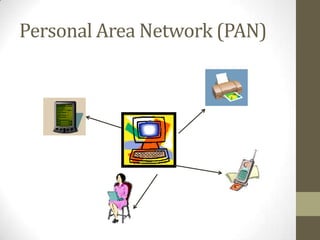
 • A PAN is a network that is used for communicating among
   computers and computer devices (including telephones) in
   close proximity of around a few meters within a room.

• It can be used for communicating between the devices
  themselves, or for connecting to a larger network such as the
  internet.

• PAN’s can be wired or wireless.
Personal Area Network (PAN)
• A personal area network (PAN) is a computer network used for
  communication among computer devices, including telephones
  and personal digital assistants, in proximity to an individual's
  body.

• The devices may or may not belong to the person in question.
  The reach of a PAN is typically a few meters.
Types of computer network

Types of computer network

  • 1.
    TYPES OF COMPUTER NETWORKS Amit Kumar Shaw DRTC, ISI - BC
  • 2.
    What is Network? •A network consists of two or more computers that are linked in order to share resources exchange files, or allow electronic communications. • The computers on a network may be linked through cables, telephone lines, radio waves, satellites, or infrared light beams.
  • 3.
    Different Types ofNetworks Depending upon the geographical area covered by a network, it is classified as: Local Area Network (LAN) Metropolitan Area Network (MAN) Wide Area Network (WAN) Personal Area Network (PAN)
  • 4.
    Local Area Network(LAN) • A LAN is a network that is used for communicating among computer devices, usually within an office building or home. • LAN’s enable the sharing of resources such as files or hardware devices that may be needed by multiple users. • Is limited in size, typically spanning a few hundred meters, and no more than a mile. • Is fast, with speeds from 10 Mbps to 10 Gbps. • Requires little wiring, typically a single cable connecting to each device.
  • 5.
    Local Area Network(LAN) • LAN’s can be either wired or wireless. Twisted pair, coax or fiber optic cable can be used in wired LAN’s. • Every LAN uses a protocol – a set of rules that governs how packets are configured and transmitted. • Has lower cost compared to MAN’s or WAN’s • Nodes in a LAN are linked together with a certain topology. These topologies include: Bus, Ring, Star. • Requires little wiring, typically a single cable connecting to each device.
  • 6.
  • 7.
  • 8.
    Types of LANs Thethree most common types of LAN are: • Cable based LAN • Private Branch Exchange (PBX) • Hierarchical networks
  • 9.
    Cable base LAN Inthe cable based LAN all the node are connected by cable media and signals transmitted through the cables. Any type of cable are used in LAN such as coaxial, twisted-pair and fiber optical cable. • Private Branch Exchange In the private branch exchange many branches of a companies connected by telephone lines. • Hierarchical Network In this network use of connecting media both cable and telephone line.
  • 10.
    LAN Standards In February1980 the IEEE formed a project called project 802 to help define certain standards. The 802 specifications fall into 12 categories that are identified by the 802 numbers; • 802.1 Internetworking and Management • 802.2 Logical Link Control • 802.3 Carrier Sense with Multiple Access and Collision Detection (CSMA/CD)
  • 11.
    • 802.4 Tokenbus LAN • 802.5 Token Ring LAN • 802.6 Metropolitan Area Network • 802.7 Broadband Technical Advisory Group • 802.8 Fiber-Optical Technical Advisory Group
  • 12.
    • 802.9 IntegratedVoice/Data • 802.10 Networks Network Security • 802.11 Wireless Network • 802.12 Demand Priority Access LAN
  • 13.
    LAN Transmission Methods Commonlythree LAN data transmissions methods are: • Unicast • Multicast • Broadcast Unicast transmission a single packet is sent from the source to a destination on a network.
  • 14.
    • Multicast transmissionconsists of a single data packet that is copied and sent to the specific subset of nodes on the network. • Broadcast transmission consists of a single data packets that is copied and sent to all nodes on the network.
  • 15.
    Types of LANModels: Peer to peer
  • 16.
  • 17.
    Advantages of LAN •Speed • Cost • Security • E-mail • Resource Sharing
  • 18.
    Disadvantages of LAN •Expensive To Install • Requires Administrative Time • File Server May Fail • Cables May Break
  • 19.
    Metropolitan Area Network(MAN) • A metropolitan area network (MAN) is a large computer network that usually spans a city or a large campus. • A MAN is optimized for a larger geographical area than a LAN, ranging from several blocks of buildings to entire cities. • A MAN might be owned and operated by a single organization, but it usually will be used by many individuals and organizations.
  • 20.
    Metropolitan Area Network(MAN) •A MAN often acts as a high speed network to allow sharing of regional resources. • A MAN typically covers an area of between 5 and 50 km diameter. • Examples of MAN: Telephone company network that provides a high speed DSL to customers and cable TV network.
  • 21.
  • 22.
    Wide Area Network(WAN) • WAN covers a large geographic area such as country, continent or even whole of the world. • A WAN is two or more LANs connected together. The LANs can be many miles apart. • To cover great distances, WANs may transmit data over leased high-speed phone lines or wireless links such as satellites.
  • 23.
    Wide Area Network(WAN) • Multiple LANs can be connected together using devices such as bridges, routers, or gateways, which enable them to share data. • The world's most popular WAN is the Internet.
  • 25.
  • 26.
    Personal Area Network(PAN) • A PAN is a network that is used for communicating among computers and computer devices (including telephones) in close proximity of around a few meters within a room. • It can be used for communicating between the devices themselves, or for connecting to a larger network such as the internet. • PAN’s can be wired or wireless.
  • 27.
  • 28.
    Personal Area Network(PAN) • A personal area network (PAN) is a computer network used for communication among computer devices, including telephones and personal digital assistants, in proximity to an individual's body. • The devices may or may not belong to the person in question. The reach of a PAN is typically a few meters.