VALIDITY OF DATA
PRESENTED BY:
RITIKA RANA
MSC NSG
NEUROSCIENCES
INTRODUCTION
 Validity is the main extent to which a concept, conclusion or measurement is
well-founded and likely corresponds accurately to the real world.
 The word "valid" is derived from the Latin Validus, meaning strong.
DEFINITION
 Validity is the extent to which a test measures what it claims to measure. It is
vital for a test to be valid in order for the results to be accurately applied and
interpreted.
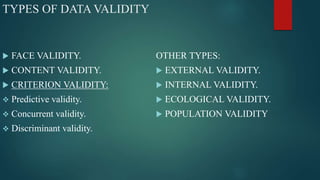
TYPES OF DATA VALIDITY
 FACE VALIDITY.
 CONTENT VALIDITY.
 CRITERION VALIDITY:
 Predictive validity.
 Concurrent validity.
 Discriminant validity.
OTHER TYPES:
 EXTERNAL VALIDITY.
 INTERNAL VALIDITY.
 ECOLOGICAL VALIDITY.
 POPULATION VALIDITY
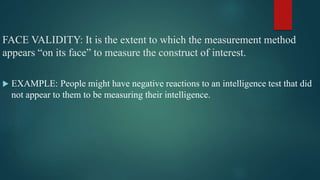
FACE VALIDITY: It is the extent to which the measurement method
appears “on its face” to measure the construct of interest.
 EXAMPLE: People might have negative reactions to an intelligence test that did
not appear to them to be measuring their intelligence.
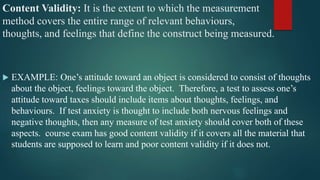
Content Validity: It is the extent to which the measurement
method covers the entire range of relevant behaviours,
thoughts, and feelings that define the construct being measured.
 EXAMPLE: One’s attitude toward an object is considered to consist of thoughts
about the object, feelings toward the object. Therefore, a test to assess one’s
attitude toward taxes should include items about thoughts, feelings, and
behaviours. If test anxiety is thought to include both nervous feelings and
negative thoughts, then any measure of test anxiety should cover both of these
aspects. course exam has good content validity if it covers all the material that
students are supposed to learn and poor content validity if it does not.
Criterion Validity: It is the extent to which people’s scores are
correlated with other variables or criteria that reflect the same construct.
 Example: An IQ test should correlate positively with school performance. An
occupational aptitude test should correlate positively with work performance.
TYPES OF CRITERION VALIDITY:
 Predictive Validity: A new measure of self-esteem should correlate positively
with an old established measure. When the criterion is something that will happen
or be assessed in the future, this is called predictive validity.
 Concurrent Validity: When the criterion is something that is happening or being
assessed at the same time as the construct of interest, it is called concurrent
validity.
Discriminant Validity: It is the extent to which people’s scores are not
correlated with other variables that reflect distinct constructs.
 Example: Imagine, that a researcher with a new measure of self-esteem claims
that self-esteem is independent of mood; a person with high self-esteem can be in
either a good mood or a bad mood (and a person with low self-esteem can too).
Then this researcher should be able to show that his self-esteem measure is not
correlated (or only weakly correlated) with a valid measure of mood. If these two
measures were highly correlated, then we would wonder whether his new
measure really reflected self-esteem as opposed to mood.
OTHER TYPES
External Validity: It is the extent to which the results of a research study can be
generalized to different situations, different groups of people, different settings,
different conditions, etc.
Internal Validity: It is basically the extent to which a study is free from flaws and
that any differences in a measurement are due to an independent variable and
nothing else.
CONT……
 Population Validity: It refers to the extent to which the findings can be
generalized to other populations of people.
 Ecological Validity: It refers to the extent to which the findings can be
generalized beyond the present situation.
MEASURMENT OF DATA
 First, this process requires empirical evidence. A
measurement method cannot be declared valid
or invalid before it has ever been used and the
resulting scores have been thoroughly analysed.
 Second, it is an ongoing process. The
conclusion that a measurement method is valid
generally depends on the results of many studies
done over a period of years.
CONT…..
 Third, validity is not an all-or-none property of a measurement method. It is
possible for a measurement method to judged "somewhat valid" or for one
measure to be considered "more valid" than another.
FACTORS AFFECTING DATA VALIDITY
1. History: - events that occur besides the treatment (events in the environment).
2. Maturation: - physical or psychological changes in the participants.
3. Testing: -effect of experience with the pre-test become testwise.
4. Instrumentation: - learning gain might be observed from pre to post-test simply
due to nature of the instrument. Particularly a problem in observation studies when
observers more likely to give ratings based on expectations (conscious or
subconscious).
CONT……….
5. Statistical Regression: -Tendency for participants whose scores fall at either
extreme on a variable to score nearer the mean when measured a second time.
6. Differential Selection: -Effect of treatment confounded with other factors because
of differential selection of participants, problem in non-random samples
7. Experimental Mortality: -participants lost from the study, attrition.
8. Selection-maturation Interaction: - similar to differential selection, except
maturation is the confounding variable.
9. Experimental Treatment Diffusion: - Treatment is perceived as highly desirable
and members of control group seek access.
10. Compensatory Rivalry by Control Group: - (John Henry Effect) - control group
performs beyond expectations because they perceive they are in competition with
experimental group.
11. Compensatory Equalization of Treatments: - occurs when experimental group
received goods or services perceived as desirable and control group is given similar
goods and services on compensate. Not comparing treatment with no treatment but
one treatment with another.
12. Resentful Demoralization of Control Group: - Control group becomes
discouraged because they perceive experimental group is receiving a desirable
treatment that is being withheld from them.
VALIDITY OF DATA.pptx

VALIDITY OF DATA.pptx

  • 1.
    VALIDITY OF DATA PRESENTEDBY: RITIKA RANA MSC NSG NEUROSCIENCES
  • 3.
    INTRODUCTION  Validity isthe main extent to which a concept, conclusion or measurement is well-founded and likely corresponds accurately to the real world.  The word "valid" is derived from the Latin Validus, meaning strong.
  • 4.
    DEFINITION  Validity isthe extent to which a test measures what it claims to measure. It is vital for a test to be valid in order for the results to be accurately applied and interpreted.
  • 5.
    TYPES OF DATAVALIDITY  FACE VALIDITY.  CONTENT VALIDITY.  CRITERION VALIDITY:  Predictive validity.  Concurrent validity.  Discriminant validity. OTHER TYPES:  EXTERNAL VALIDITY.  INTERNAL VALIDITY.  ECOLOGICAL VALIDITY.  POPULATION VALIDITY
  • 6.
    FACE VALIDITY: Itis the extent to which the measurement method appears “on its face” to measure the construct of interest.  EXAMPLE: People might have negative reactions to an intelligence test that did not appear to them to be measuring their intelligence.
  • 7.
    Content Validity: Itis the extent to which the measurement method covers the entire range of relevant behaviours, thoughts, and feelings that define the construct being measured.  EXAMPLE: One’s attitude toward an object is considered to consist of thoughts about the object, feelings toward the object. Therefore, a test to assess one’s attitude toward taxes should include items about thoughts, feelings, and behaviours. If test anxiety is thought to include both nervous feelings and negative thoughts, then any measure of test anxiety should cover both of these aspects. course exam has good content validity if it covers all the material that students are supposed to learn and poor content validity if it does not.
  • 8.
    Criterion Validity: Itis the extent to which people’s scores are correlated with other variables or criteria that reflect the same construct.  Example: An IQ test should correlate positively with school performance. An occupational aptitude test should correlate positively with work performance.
  • 9.
    TYPES OF CRITERIONVALIDITY:  Predictive Validity: A new measure of self-esteem should correlate positively with an old established measure. When the criterion is something that will happen or be assessed in the future, this is called predictive validity.  Concurrent Validity: When the criterion is something that is happening or being assessed at the same time as the construct of interest, it is called concurrent validity.
  • 10.
    Discriminant Validity: Itis the extent to which people’s scores are not correlated with other variables that reflect distinct constructs.  Example: Imagine, that a researcher with a new measure of self-esteem claims that self-esteem is independent of mood; a person with high self-esteem can be in either a good mood or a bad mood (and a person with low self-esteem can too). Then this researcher should be able to show that his self-esteem measure is not correlated (or only weakly correlated) with a valid measure of mood. If these two measures were highly correlated, then we would wonder whether his new measure really reflected self-esteem as opposed to mood.
  • 11.
    OTHER TYPES External Validity:It is the extent to which the results of a research study can be generalized to different situations, different groups of people, different settings, different conditions, etc. Internal Validity: It is basically the extent to which a study is free from flaws and that any differences in a measurement are due to an independent variable and nothing else.
  • 12.
    CONT……  Population Validity:It refers to the extent to which the findings can be generalized to other populations of people.  Ecological Validity: It refers to the extent to which the findings can be generalized beyond the present situation.
  • 13.
    MEASURMENT OF DATA First, this process requires empirical evidence. A measurement method cannot be declared valid or invalid before it has ever been used and the resulting scores have been thoroughly analysed.  Second, it is an ongoing process. The conclusion that a measurement method is valid generally depends on the results of many studies done over a period of years.
  • 14.
    CONT…..  Third, validityis not an all-or-none property of a measurement method. It is possible for a measurement method to judged "somewhat valid" or for one measure to be considered "more valid" than another.
  • 15.
    FACTORS AFFECTING DATAVALIDITY 1. History: - events that occur besides the treatment (events in the environment). 2. Maturation: - physical or psychological changes in the participants. 3. Testing: -effect of experience with the pre-test become testwise. 4. Instrumentation: - learning gain might be observed from pre to post-test simply due to nature of the instrument. Particularly a problem in observation studies when observers more likely to give ratings based on expectations (conscious or subconscious).
  • 16.
    CONT………. 5. Statistical Regression:-Tendency for participants whose scores fall at either extreme on a variable to score nearer the mean when measured a second time. 6. Differential Selection: -Effect of treatment confounded with other factors because of differential selection of participants, problem in non-random samples
  • 17.
    7. Experimental Mortality:-participants lost from the study, attrition. 8. Selection-maturation Interaction: - similar to differential selection, except maturation is the confounding variable. 9. Experimental Treatment Diffusion: - Treatment is perceived as highly desirable and members of control group seek access. 10. Compensatory Rivalry by Control Group: - (John Henry Effect) - control group performs beyond expectations because they perceive they are in competition with experimental group.
  • 18.
    11. Compensatory Equalizationof Treatments: - occurs when experimental group received goods or services perceived as desirable and control group is given similar goods and services on compensate. Not comparing treatment with no treatment but one treatment with another. 12. Resentful Demoralization of Control Group: - Control group becomes discouraged because they perceive experimental group is receiving a desirable treatment that is being withheld from them.