Exotropia
Pediatric Ophthalmology
LSU Medical Center in Shreveport
Cause of Exotropia
• In most cases cause is unknown
• Theories
– Excess divergence
– Deficient convergence
– Anatomic factors
• Familial tendency present
• Refractive errors
– Average for age unless sensory due to marked anisometropia
Classification According to Fusion
Status
• Exophoria: X
• Intermittent Exotropia: X (T)
• Exotropia: XT
Classification According to AC/A
Deviation AC/A Example
Convergence
Insufficiency
Low X= 0, X’= 12, or
X(T)= 20, XT’=40
Basic Normal XT= XT’= 20
Divergence
Excess
High XT= 35, XT’=10
Exotropia: Clinical Types
1. Congenital
2. Sensory
3. Typical Childhood, or intermittent exotropia
4. Convergence Insufficiency
5. Consecutive
Secondary Exotropia
• Confusing term but still used at times
• May mean occurs following surgery for ET, or
• May mean sensory exotropia due to an
underlying condition, e.g., anisometropic
amblyopia, retinoblastoma, cataract
• Better to use either consecutive or sensory
rather than secondary to describe exotropia
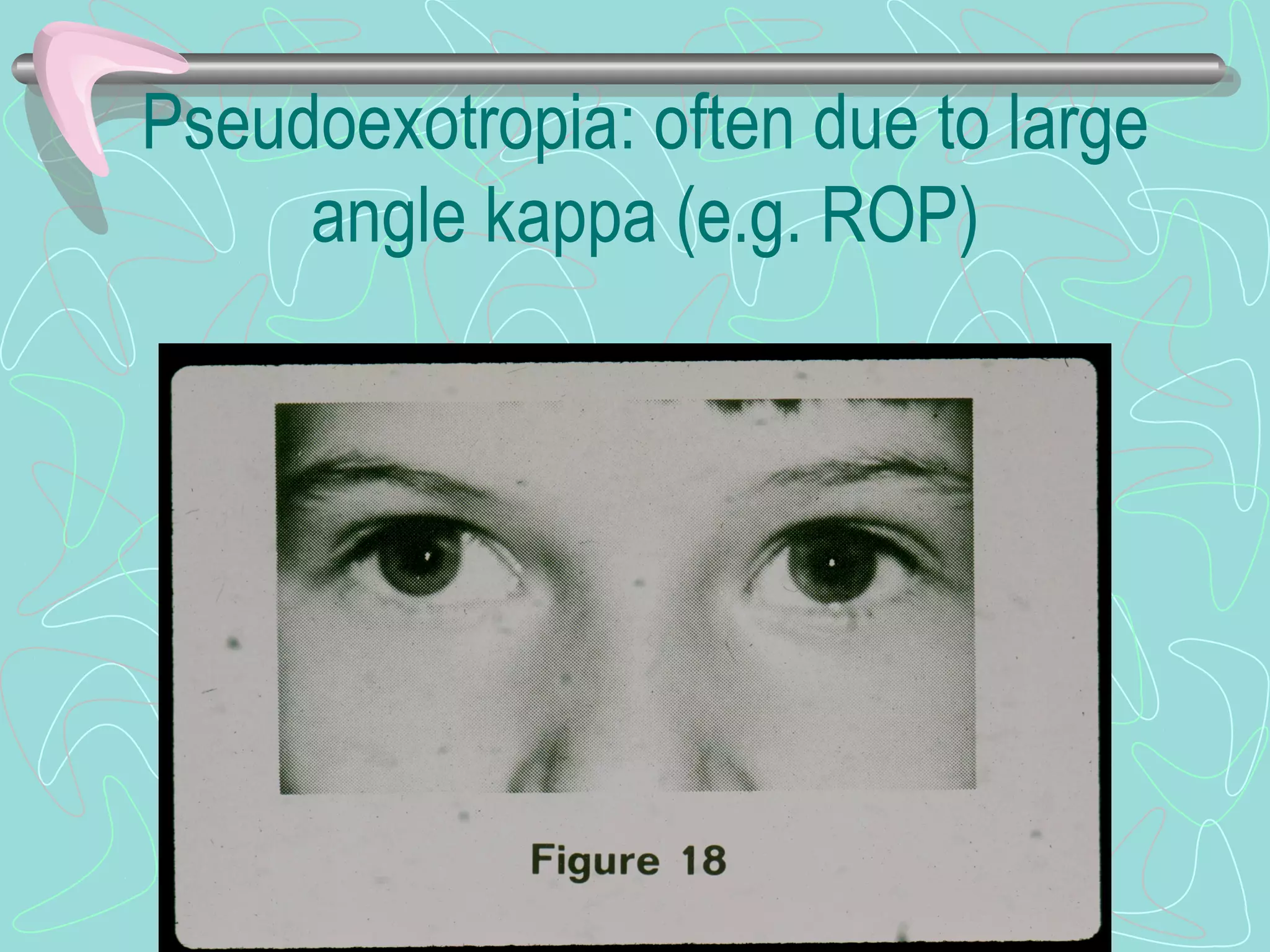
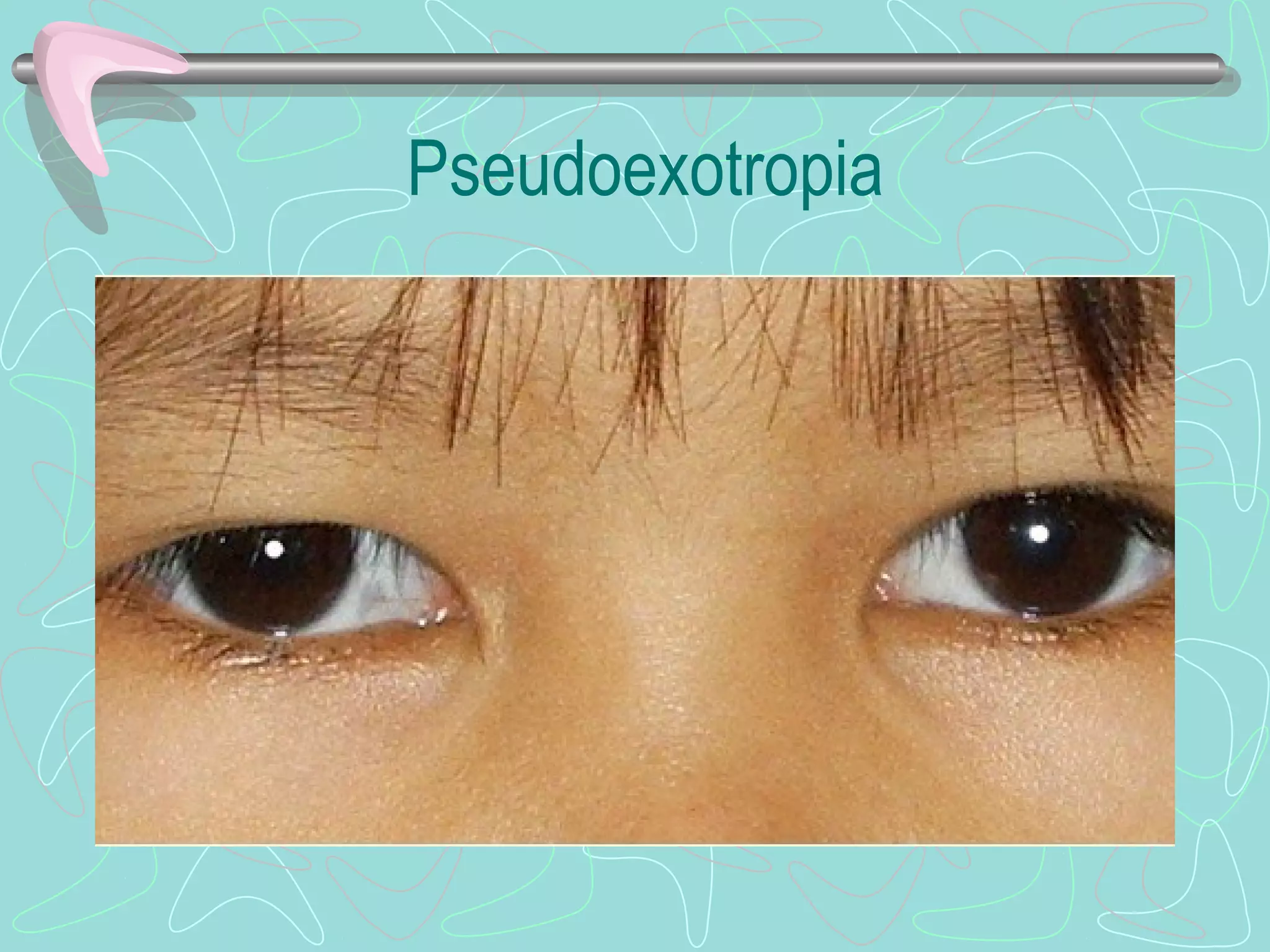
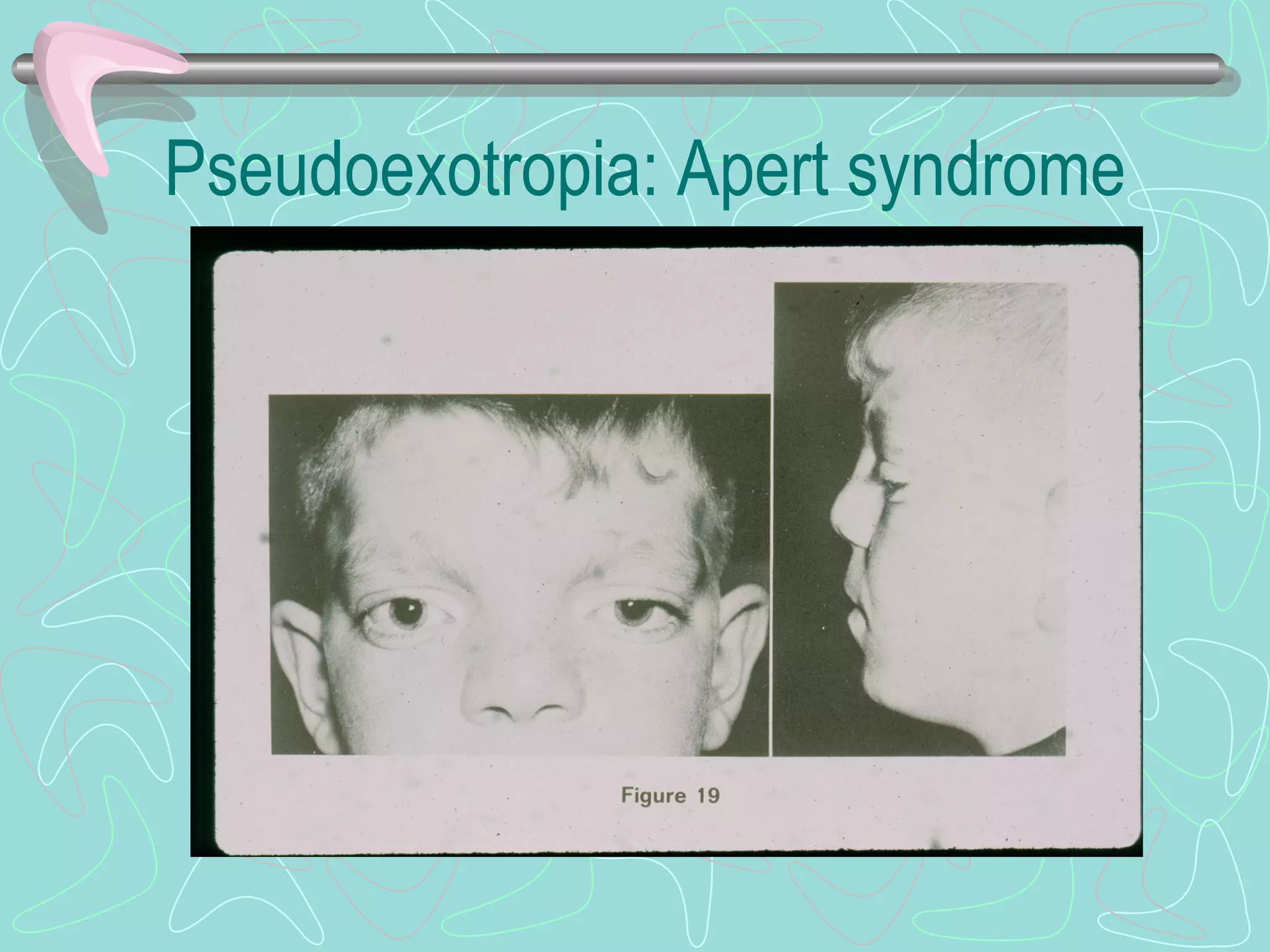
Pseudoexotropia: often due to large
angle kappa (e.g. ROP)
Pseudoexotropia
Pseudoexotropia
Pseudoexotropia: Apert syndrome
Congenital Exotropia
• Rare
• Constant Exotropia
• Large angle
• Often associated with other neurologic defects
• Only treatment is surgical
Sensory Exotropia
• Poor vision in one eye leads to exotropia
• Sensory esotropia or exotropia may occur
• Causes
– Marked anisometropia
• E.g., unilateral high myopia
• Retinoblastoma (22% present with strabismus)
• Unilateral cataract
Sensory Exotropia: Treatment
1. Treat underlying cause if possible
• E.g. remove cataract, treat amblyopia
1. Surgery for exotropia
• Fusional outlook variable
• Small XT often best left alone
Convergence Insufficiency: Two
Subtypes
1. Ex= 0, Exophoria or Exotropia at near
• Low AC/A ratio
• Remote NPC
• Poor fusional convergence amplitudes
• Usually responds to convergence exercises
• Website: “ Computer Orthoptics (HTS)” exercises online
or in office vision therapy combined with home therapy
• May treat with base in prism
• Usually do poorly with surgery
Convergence Insufficiency: Second
Subtype
• XT at distance, larger XT at near
– Deficient accommodative convergence
– Very low AC/A ratio
– Poor response to convergence exercises
– Often undercorrected with recess LR OU
– Treatment: unilateral recess/resect or recess/tuck
Typical Childhood Exotropia
or Intermittent Exotropia
• Onset 6 months to 6 years of age
• Average refractive errors
• Deviation usually noted first with distance vision
• Often normal sensory pattern when eyes aligned
• Many progress through different phases
• Some remain stable and do not progress
Progression of Exotropia
• Phoria→ Tropia
• Distance deviation> Near deviation
• Progression more rapid under age 6, but
progression in adulthood common also(may
present with diplopia)
Typical Childhood Exotropia
Phase 0
• X but no XT and no X (T)
• Usually no symptoms
• No suppression
Typical Childhood Exotropia
Phase 1
• X (T) present, Ex’ = 0
• Mostly controlled
• Symptoms often present
– Diplopia: may close one eye
– Noted by peers
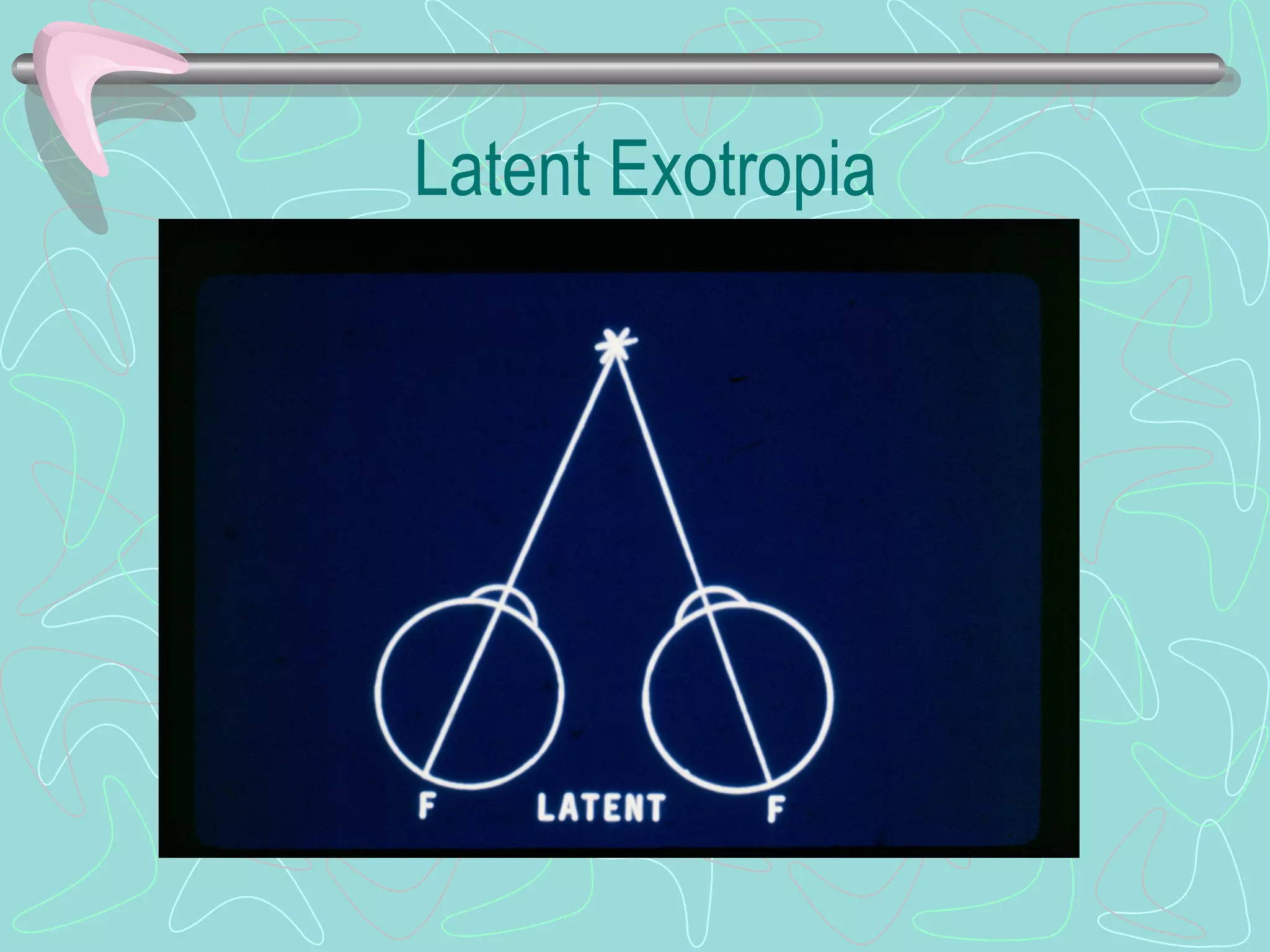
Latent Exotropia
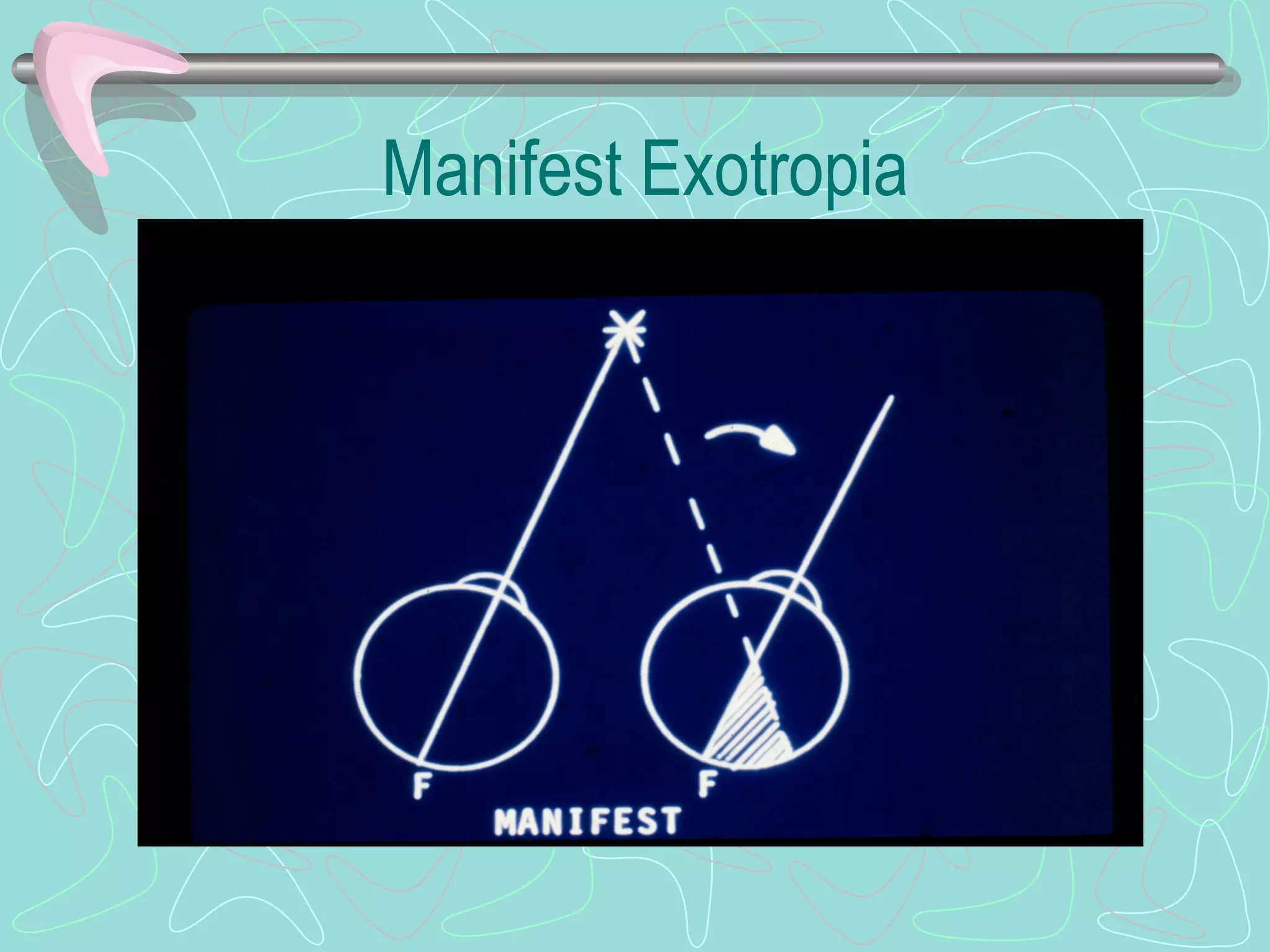
Manifest Exotropia
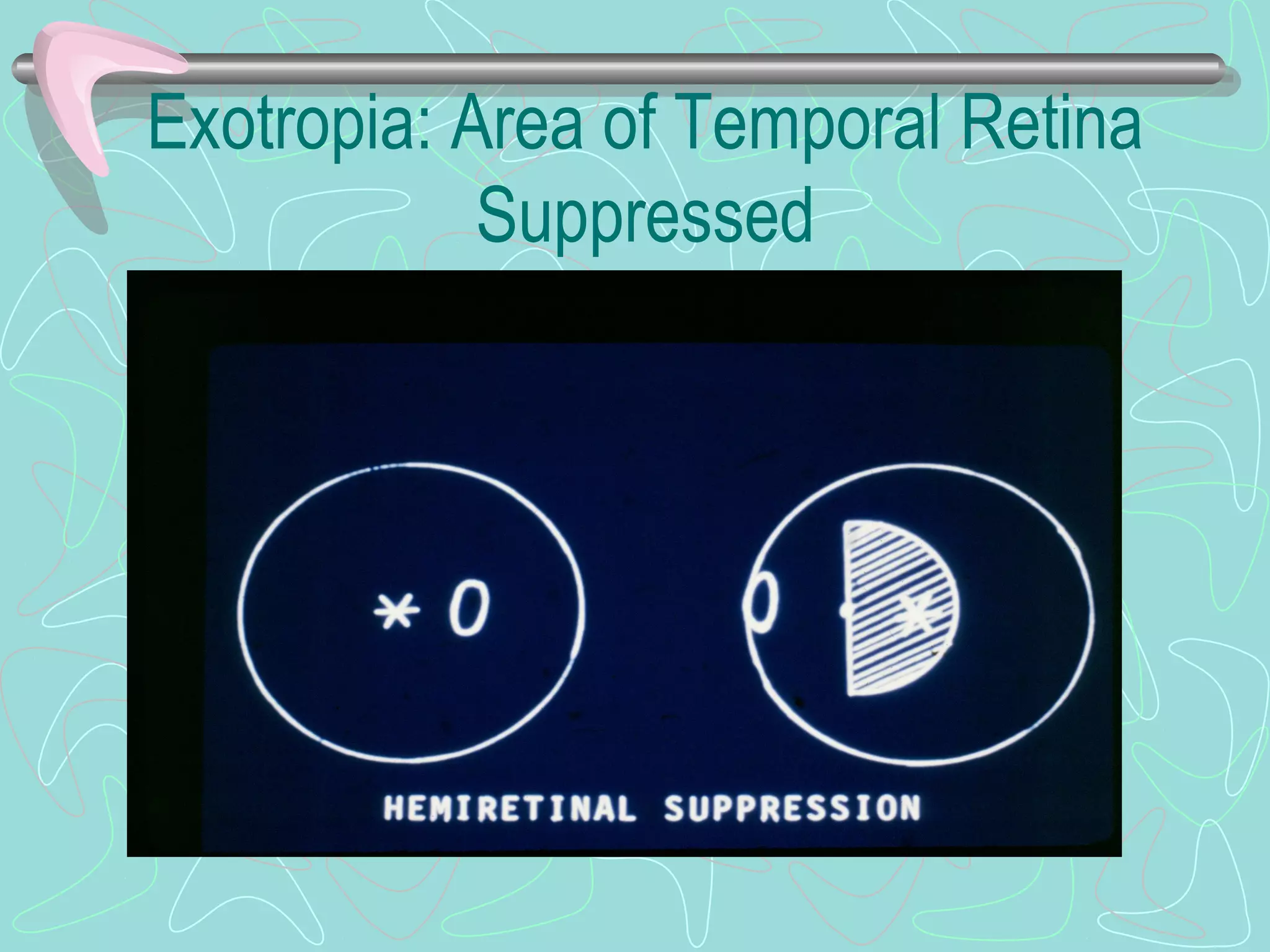
Exotropia: Area of Temporal Retina
Suppressed
Binocular Perimetry In Exotropia:
Nasal Scotoma
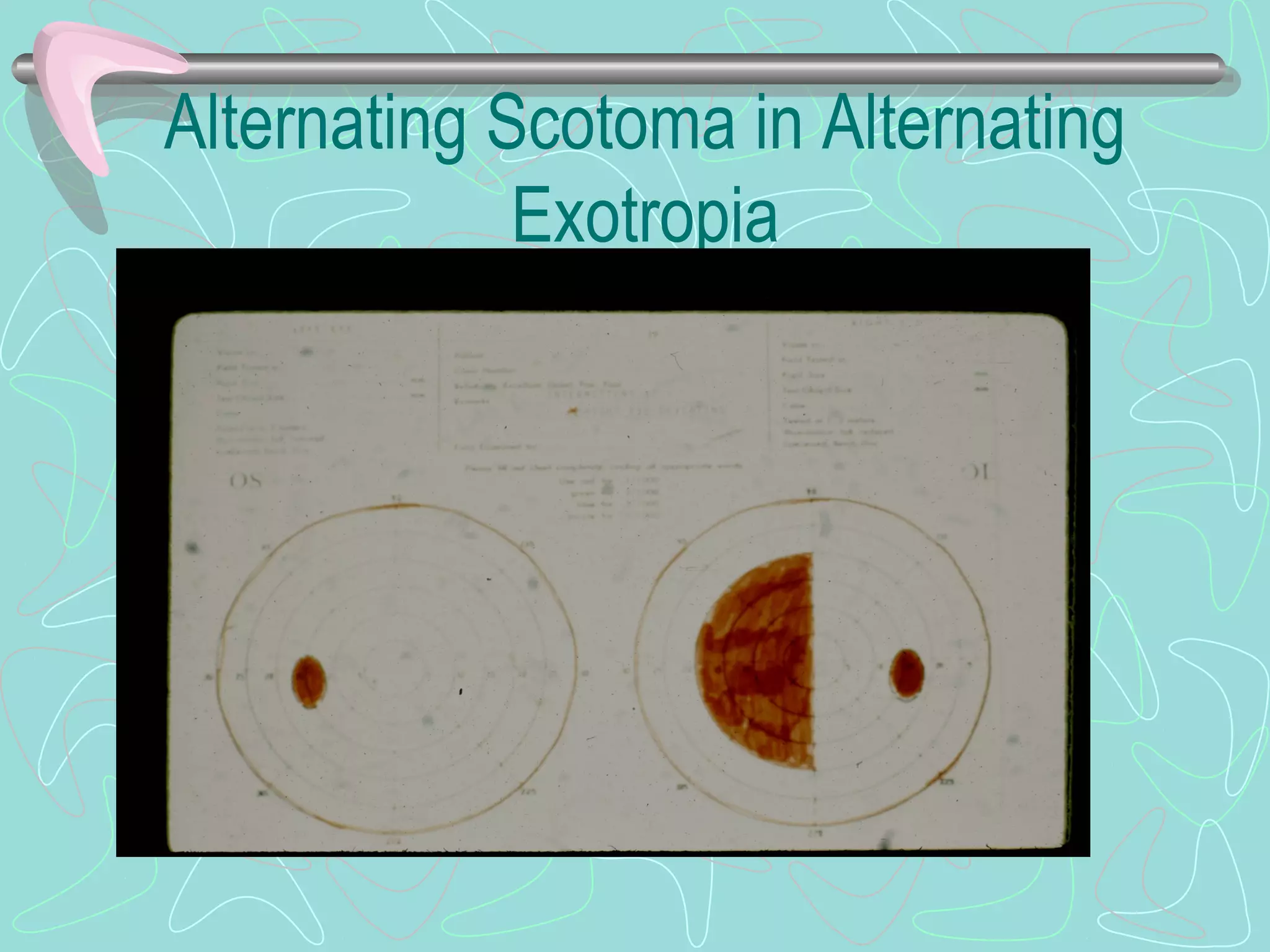
Alternating Scotoma in Alternating
Exotropia
Typical Childhood Exotropia
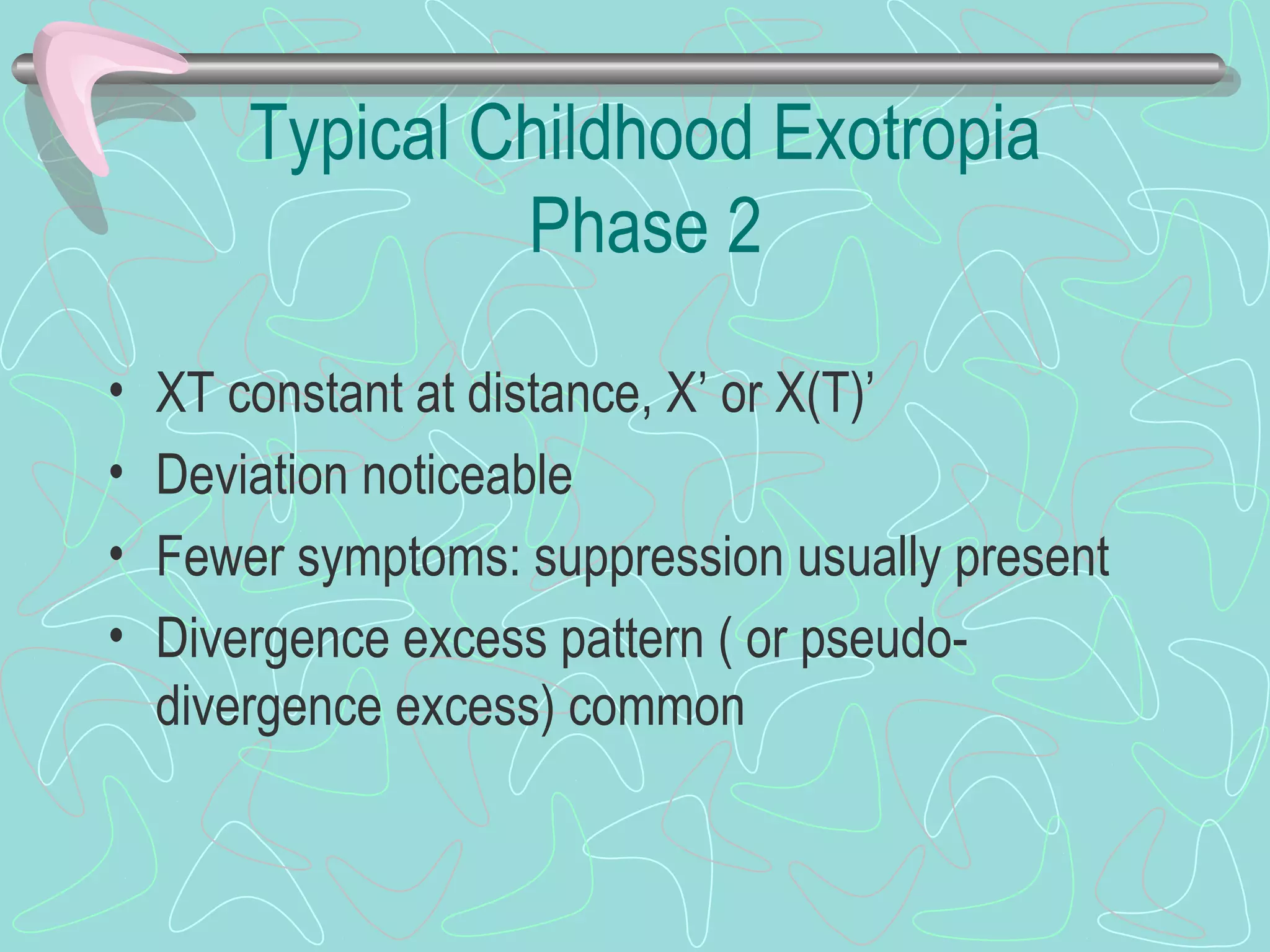
Phase 2
• XT constant at distance, X’ or X(T)’
• Deviation noticeable
• Fewer symptoms: suppression usually present
• Divergence excess pattern ( or pseudo-
divergence excess) common
Typical Childhood Exotropia
Phase 3
• XT constant at distance and near
• Noticeable
• Usually no diplopia present
• Amblyopia may be present
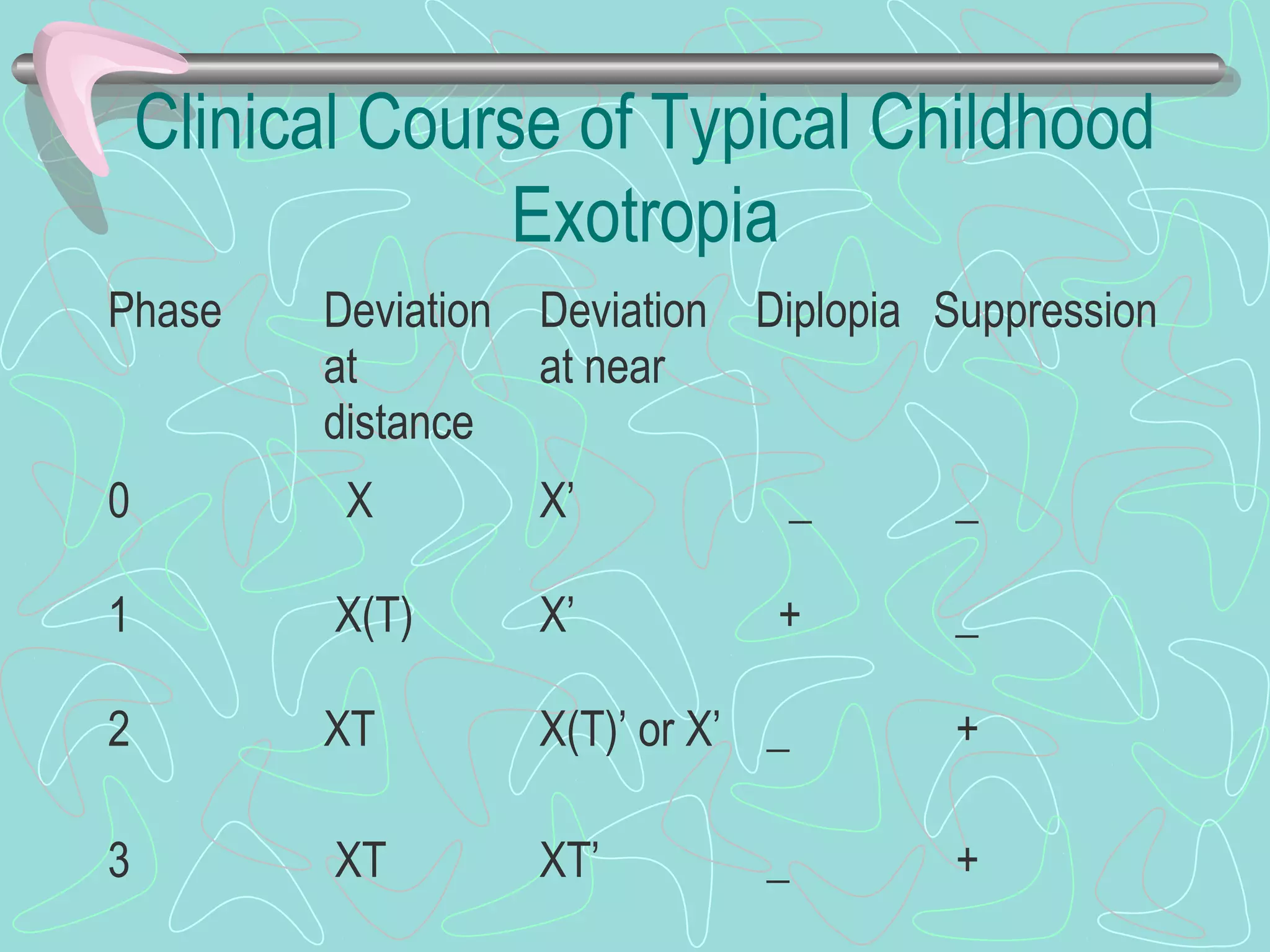
Clinical Course of Typical Childhood
Exotropia
Phase Deviation
at
distance
Deviation
at near
Diplopia Suppression
0 X X’ _ _
1 X(T) X’ + _
2 XT X(T)’ or X’ _ +
3 XT XT’ _ +
Kushner’s Classification of
Exotropia
Type Description Percent
Basic XT=XT’ 37
Tenacious Proximal fusion XT>XT’, but after 60
minutes occlusion,
XT=XT’
40
High AC/A Ratio XT>XT’ and hi AC/A with
minus lenses
5
True Divergence Excess XT>XT’ even after 60
minutes occlusion, but
AC/A normal
4
Convergence Insufficiency Ex= 0, X’or XT< XT’ 4
Pseudo convergence
insufficiency
XT<XT’, but after 1 hour
occlusion, XT=XT’
<1
Non Surgical Treatment of Exotropia
1. Maximize vision
– Glasses especially for myopia
– Treat amblyopia
1. Minus lenses
2. Base in prism with or without minus lenses
3. Orthoptics
• Mainly useful for convergence insufficiency with
Ex=0, X’ or X(T)’
5. Part time patching: may improve control
Prisms for Exotropia
• Base In Prisms useful in
– Small angle exotropia
– For reading with convergence insufficiency
• Base out Prisms:
– Temporary treatment of esotropia after exotropia
surgery
Non Surgical Treatment of XT
• 7 y/o: VA OD 20/80, OS 20/80
• X (T) = 30
• Refraction: OD –1.50 20/20
• OS –1.50 20/20
• Rx: glasses
• Six weeks later Ex=0 with glasses
Surgical Treatment of Exotropia
• Rarely if ever improves (4% in one study)
• Natural course
– Neonatal exotropia often improves spontaneously
– Some infantile exotropia remains intermittent
– Other cases become constant exotropia
– Most progress to some degree
Surgical Treatment of Exotropia
• Maximize vision first
• Phase 0: X, no XT
– No treatment needed
Surgical Treatment of Exotropia
• Phase 1: X(T), Ex’=0
• Watch if:
– Infrequent deviation
– No symptoms: peers or patient
• Operate if:
– Deviation frequent
– Progressive deviation
– Symptomatic
Surgical Treatment of Exotropia
• Phase 2: XT at distance, X’ or X(T)’ near
– Surgery recommended without delay
– Patient in danger of losing binocular vision
• Phase 3: XT far, XT’ near
– Surgery for social reasons if desired
– Small chance of improving binocularity
Surgery for Exotropia
• Children under age 5
– 18 diopters or less: can recess one lateral rectus
– Over 20 diopters: recess LR OU but use 2/3 amount
of adult “numbers”
– High chance of overcorrection with recession LR OU
if use regular adult numbers for surgery in young
children
Surgery for Exotropia
• Usually recess LR OU as initial operation
• Convergence insufficiency with XT distance less
than XT at near:
– Recess one LR, Resect one MR
• Poor vision in one eye
– Recess LR, Resect/Tuck MR of eye with reduced
vision
Surgery for Exotropia
• Beware of surgery for high AC/A ratio
– Surgery for distance deviation likely to cause esotropia and
diplopia at near
• If prolonged cover testing reveals no deviation at near:
patch one eye 60 minutes
– If XT or X appears at near less than XT at distance: recess
LR OU
– If no deviation at near after patching: measure AC/A ratio at
distance with minus lenses
• If high AC/A ratio: prescribe minus lenses
• Can do recession LR OU with posterior fixation MR OU
Exotropia: Clinical Examples
1. 2 y/o X(T) = 30, X’=18
2. 6 month old XT=XT’=55
3. 6 y/o VA OD 20/20, OS 20/200
• CR: OD + 0.25, OS –6.00
• LXT = 25
Exotropia: Clinical Examples
4. 12 y/o XT= 30. Surgery for ET age 3
5. 23 y/o medical student
– Eyes tired with reading
– Ex=0, X(T)= 15
Surgical Treatment of Exotropia
• Basic Exotropia XT=XT’
– May be treated with Recess LR OU or
recess one LR, resect/tuck one MR
– Various studies show different results, some
advocate one operation over the other
– Most surgeons currently use recess LR OU
Surgical Treatment of Exotropia
• Desired position of eyes one week post op is:
– LR recession OU over age 5: ET 4-10 diopters
– Eyes become more exo in the weeks following
surgery
– High recurrence rate if XT undercorrected at age one
week
– With Recession one LR, desire smaller E after
surgery (2-6 diopters)

13 exotropia

  • 1.
  • 2.
    Cause of Exotropia •In most cases cause is unknown • Theories – Excess divergence – Deficient convergence – Anatomic factors • Familial tendency present • Refractive errors – Average for age unless sensory due to marked anisometropia
  • 3.
    Classification According toFusion Status • Exophoria: X • Intermittent Exotropia: X (T) • Exotropia: XT
  • 4.
    Classification According toAC/A Deviation AC/A Example Convergence Insufficiency Low X= 0, X’= 12, or X(T)= 20, XT’=40 Basic Normal XT= XT’= 20 Divergence Excess High XT= 35, XT’=10
  • 5.
    Exotropia: Clinical Types 1.Congenital 2. Sensory 3. Typical Childhood, or intermittent exotropia 4. Convergence Insufficiency 5. Consecutive
  • 6.
    Secondary Exotropia • Confusingterm but still used at times • May mean occurs following surgery for ET, or • May mean sensory exotropia due to an underlying condition, e.g., anisometropic amblyopia, retinoblastoma, cataract • Better to use either consecutive or sensory rather than secondary to describe exotropia
  • 7.
    Pseudoexotropia: often dueto large angle kappa (e.g. ROP)
  • 8.
  • 9.
  • 10.
  • 11.
    Congenital Exotropia • Rare •Constant Exotropia • Large angle • Often associated with other neurologic defects • Only treatment is surgical
  • 12.
    Sensory Exotropia • Poorvision in one eye leads to exotropia • Sensory esotropia or exotropia may occur • Causes – Marked anisometropia • E.g., unilateral high myopia • Retinoblastoma (22% present with strabismus) • Unilateral cataract
  • 13.
    Sensory Exotropia: Treatment 1.Treat underlying cause if possible • E.g. remove cataract, treat amblyopia 1. Surgery for exotropia • Fusional outlook variable • Small XT often best left alone
  • 14.
    Convergence Insufficiency: Two Subtypes 1.Ex= 0, Exophoria or Exotropia at near • Low AC/A ratio • Remote NPC • Poor fusional convergence amplitudes • Usually responds to convergence exercises • Website: “ Computer Orthoptics (HTS)” exercises online or in office vision therapy combined with home therapy • May treat with base in prism • Usually do poorly with surgery
  • 15.
    Convergence Insufficiency: Second Subtype •XT at distance, larger XT at near – Deficient accommodative convergence – Very low AC/A ratio – Poor response to convergence exercises – Often undercorrected with recess LR OU – Treatment: unilateral recess/resect or recess/tuck
  • 16.
    Typical Childhood Exotropia orIntermittent Exotropia • Onset 6 months to 6 years of age • Average refractive errors • Deviation usually noted first with distance vision • Often normal sensory pattern when eyes aligned • Many progress through different phases • Some remain stable and do not progress
  • 17.
    Progression of Exotropia •Phoria→ Tropia • Distance deviation> Near deviation • Progression more rapid under age 6, but progression in adulthood common also(may present with diplopia)
  • 18.
    Typical Childhood Exotropia Phase0 • X but no XT and no X (T) • Usually no symptoms • No suppression
  • 19.
    Typical Childhood Exotropia Phase1 • X (T) present, Ex’ = 0 • Mostly controlled • Symptoms often present – Diplopia: may close one eye – Noted by peers
  • 20.
  • 21.
  • 22.
    Exotropia: Area ofTemporal Retina Suppressed
  • 23.
    Binocular Perimetry InExotropia: Nasal Scotoma
  • 24.
    Alternating Scotoma inAlternating Exotropia
  • 25.
    Typical Childhood Exotropia Phase2 • XT constant at distance, X’ or X(T)’ • Deviation noticeable • Fewer symptoms: suppression usually present • Divergence excess pattern ( or pseudo- divergence excess) common
  • 26.
    Typical Childhood Exotropia Phase3 • XT constant at distance and near • Noticeable • Usually no diplopia present • Amblyopia may be present
  • 27.
    Clinical Course ofTypical Childhood Exotropia Phase Deviation at distance Deviation at near Diplopia Suppression 0 X X’ _ _ 1 X(T) X’ + _ 2 XT X(T)’ or X’ _ + 3 XT XT’ _ +
  • 28.
    Kushner’s Classification of Exotropia TypeDescription Percent Basic XT=XT’ 37 Tenacious Proximal fusion XT>XT’, but after 60 minutes occlusion, XT=XT’ 40 High AC/A Ratio XT>XT’ and hi AC/A with minus lenses 5 True Divergence Excess XT>XT’ even after 60 minutes occlusion, but AC/A normal 4 Convergence Insufficiency Ex= 0, X’or XT< XT’ 4 Pseudo convergence insufficiency XT<XT’, but after 1 hour occlusion, XT=XT’ <1
  • 29.
    Non Surgical Treatmentof Exotropia 1. Maximize vision – Glasses especially for myopia – Treat amblyopia 1. Minus lenses 2. Base in prism with or without minus lenses 3. Orthoptics • Mainly useful for convergence insufficiency with Ex=0, X’ or X(T)’ 5. Part time patching: may improve control
  • 30.
    Prisms for Exotropia •Base In Prisms useful in – Small angle exotropia – For reading with convergence insufficiency • Base out Prisms: – Temporary treatment of esotropia after exotropia surgery
  • 31.
    Non Surgical Treatmentof XT • 7 y/o: VA OD 20/80, OS 20/80 • X (T) = 30 • Refraction: OD –1.50 20/20 • OS –1.50 20/20 • Rx: glasses • Six weeks later Ex=0 with glasses
  • 32.
    Surgical Treatment ofExotropia • Rarely if ever improves (4% in one study) • Natural course – Neonatal exotropia often improves spontaneously – Some infantile exotropia remains intermittent – Other cases become constant exotropia – Most progress to some degree
  • 33.
    Surgical Treatment ofExotropia • Maximize vision first • Phase 0: X, no XT – No treatment needed
  • 34.
    Surgical Treatment ofExotropia • Phase 1: X(T), Ex’=0 • Watch if: – Infrequent deviation – No symptoms: peers or patient • Operate if: – Deviation frequent – Progressive deviation – Symptomatic
  • 35.
    Surgical Treatment ofExotropia • Phase 2: XT at distance, X’ or X(T)’ near – Surgery recommended without delay – Patient in danger of losing binocular vision • Phase 3: XT far, XT’ near – Surgery for social reasons if desired – Small chance of improving binocularity
  • 36.
    Surgery for Exotropia •Children under age 5 – 18 diopters or less: can recess one lateral rectus – Over 20 diopters: recess LR OU but use 2/3 amount of adult “numbers” – High chance of overcorrection with recession LR OU if use regular adult numbers for surgery in young children
  • 37.
    Surgery for Exotropia •Usually recess LR OU as initial operation • Convergence insufficiency with XT distance less than XT at near: – Recess one LR, Resect one MR • Poor vision in one eye – Recess LR, Resect/Tuck MR of eye with reduced vision
  • 38.
    Surgery for Exotropia •Beware of surgery for high AC/A ratio – Surgery for distance deviation likely to cause esotropia and diplopia at near • If prolonged cover testing reveals no deviation at near: patch one eye 60 minutes – If XT or X appears at near less than XT at distance: recess LR OU – If no deviation at near after patching: measure AC/A ratio at distance with minus lenses • If high AC/A ratio: prescribe minus lenses • Can do recession LR OU with posterior fixation MR OU
  • 39.
    Exotropia: Clinical Examples 1.2 y/o X(T) = 30, X’=18 2. 6 month old XT=XT’=55 3. 6 y/o VA OD 20/20, OS 20/200 • CR: OD + 0.25, OS –6.00 • LXT = 25
  • 40.
    Exotropia: Clinical Examples 4.12 y/o XT= 30. Surgery for ET age 3 5. 23 y/o medical student – Eyes tired with reading – Ex=0, X(T)= 15
  • 41.
    Surgical Treatment ofExotropia • Basic Exotropia XT=XT’ – May be treated with Recess LR OU or recess one LR, resect/tuck one MR – Various studies show different results, some advocate one operation over the other – Most surgeons currently use recess LR OU
  • 42.
    Surgical Treatment ofExotropia • Desired position of eyes one week post op is: – LR recession OU over age 5: ET 4-10 diopters – Eyes become more exo in the weeks following surgery – High recurrence rate if XT undercorrected at age one week – With Recession one LR, desire smaller E after surgery (2-6 diopters)