Chapter 2 Culture and Organizational Behavior
Case 1:  A cultural clash in the entertainment industry Can any nation protect its cultural characteristics and uniqueness? In a world of instant communications via the Internet? World wide distribution of movies? World wide transmission of television? World wide travel?  What is the potential of subsidies, trade restrictions, quotas, and governmental control of sustaining a unique national culture?
Case 6—A & B Ellen Moore-Living/working in Bahrain Culture in Bahrain & Saudi Arabia Role of professional women Adjustments to stereotypes  When to adjust & when to challenge?
Cases Case 6:  “Ellen Moore:  Did Ellen compromise her values (too much) in accepting the Customer Service position? How useful are her tips for women in becoming successful in management? Meeting fellow employees or others? Obtaining recognition? Adjusting to stereotype female roles (when required)? Finding and using a mentor? Adjusting to the culture? Negotiating with her husband on relative roles?
Defining Culture:  An unbounded definition A way of life of a group of people That complex whole which includes knowledge, belief, art, morals, law, custom, and any other capabilities and habits acquired by man as a member of society Everything that people have, think, and do as members of society
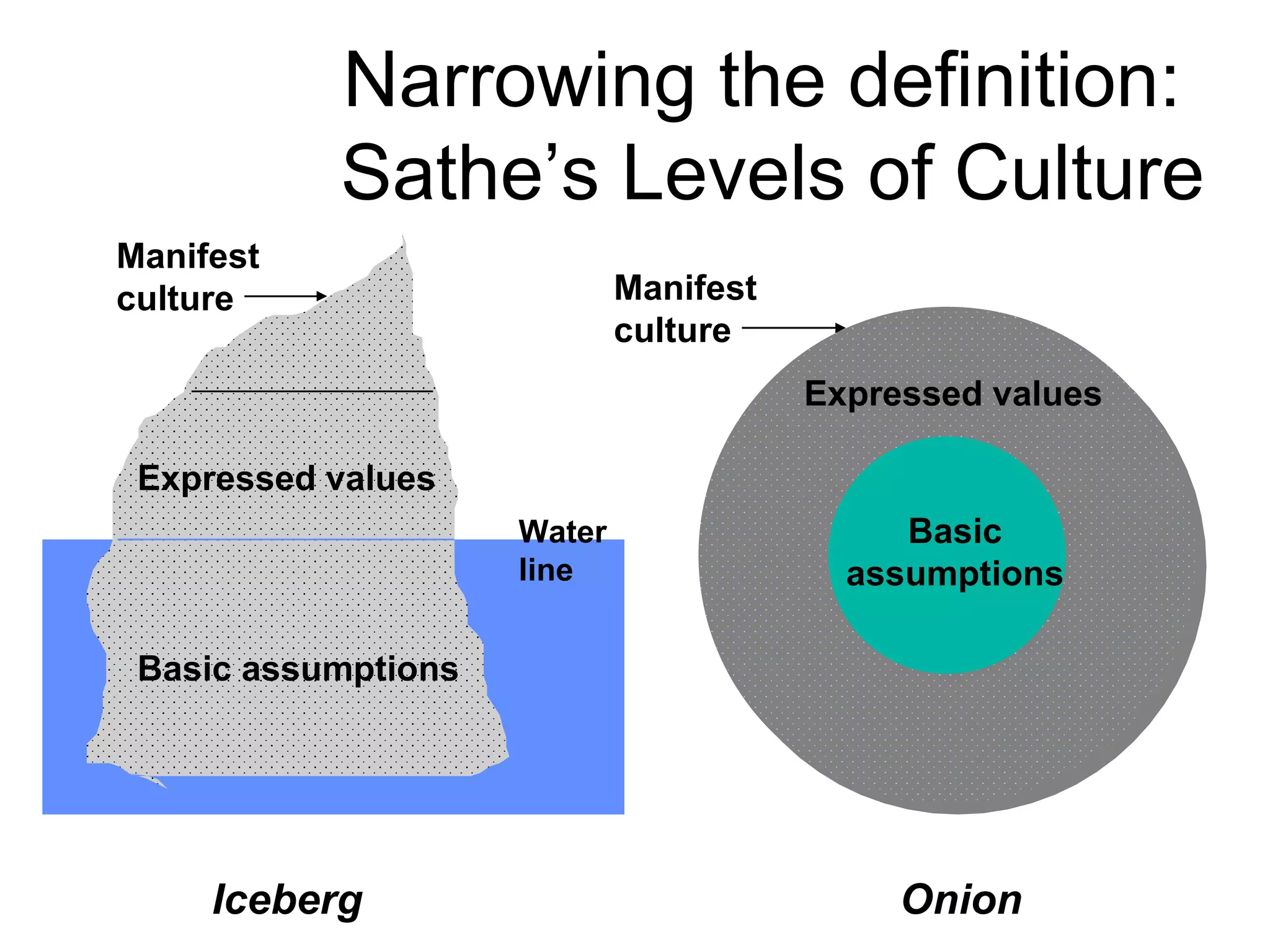
Narrowing the definition:  Sathe’s Levels of Culture Water line Basic assumptions Expressed values Manifest culture Basic assumptions Expressed   values Manifest culture Iceberg Onion
How is Culture Learned? Enculturation Non-intentional process that includes all of the learning available as the result of what is in an environment to be learned   Primary Socialization more intentional learning process that occurs in the family and local community   Subcultures Develop because a group has an ethnic background, language, or religion that is different from the majority population   Secondary Socialization Occurs after primary socialization and usually equips people with the knowledge, skills, and behavior to enact adult roles successfully
Classifications of culture Broad classifications:  Hall’s High-Context and Low-Context Cultural Framework Detailed classifications: Tonnies and Loomis’s amplification  Kluckhohn and Strodtbeck’s Variations in Values Orientations Hofstede’s  definition of culture & Bond’s addition Schwartz's classification Trompenaars’ 7 Dimensions of Culture
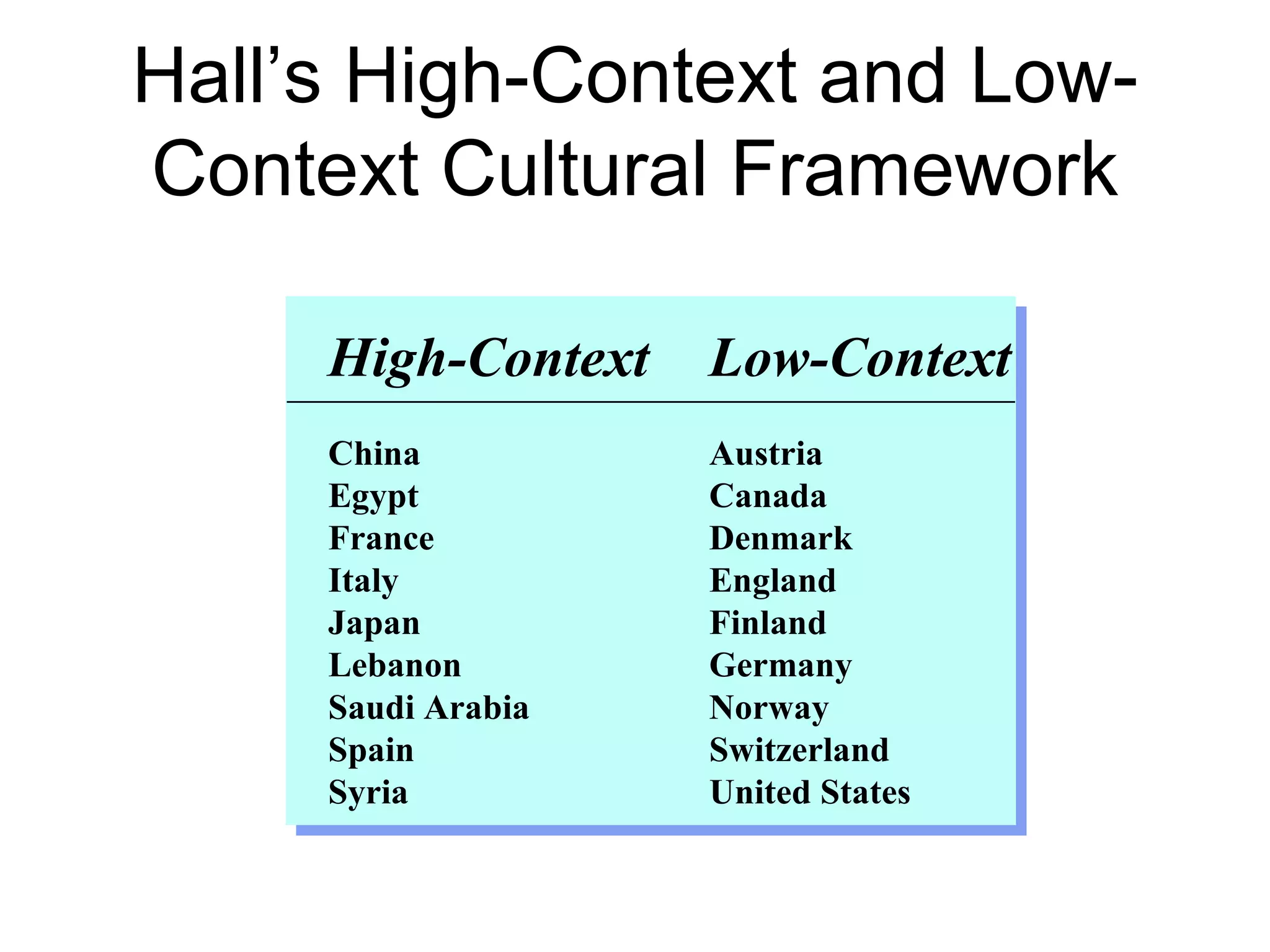
Hall’s High-Context and Low-Context Cultural Framework High-Context Low-Context China Austria Egypt Canada France Denmark Italy England Japan Finland Lebanon Germany Saudi Arabia Norway Spain Switzerland Syria United States
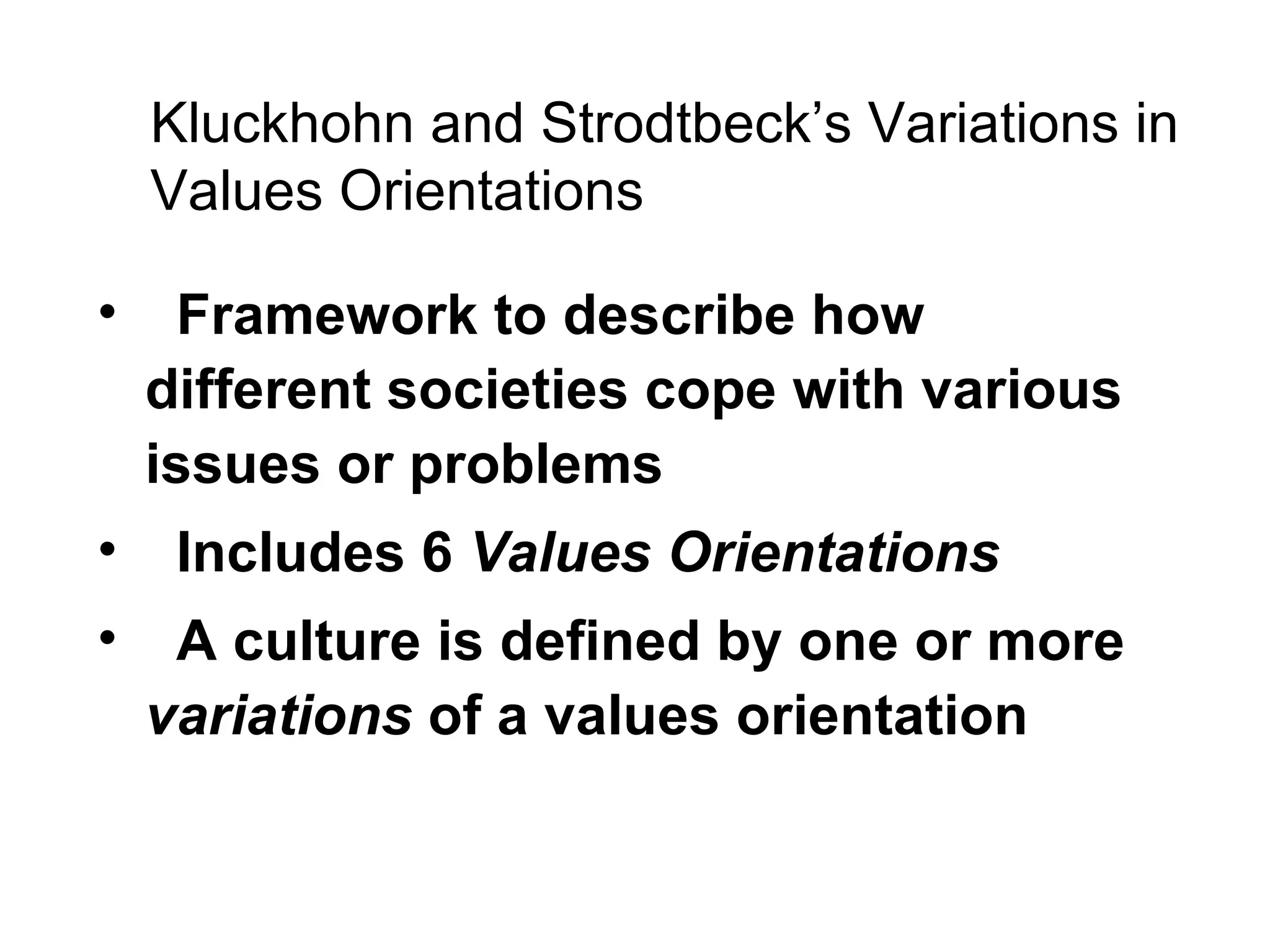
Kluckhohn and Strodtbeck’s Variations in Values Orientations Framework to describe how different societies cope with various issues or problems Includes 6  Values Orientations A culture is defined by one or more  variations  of a values orientation
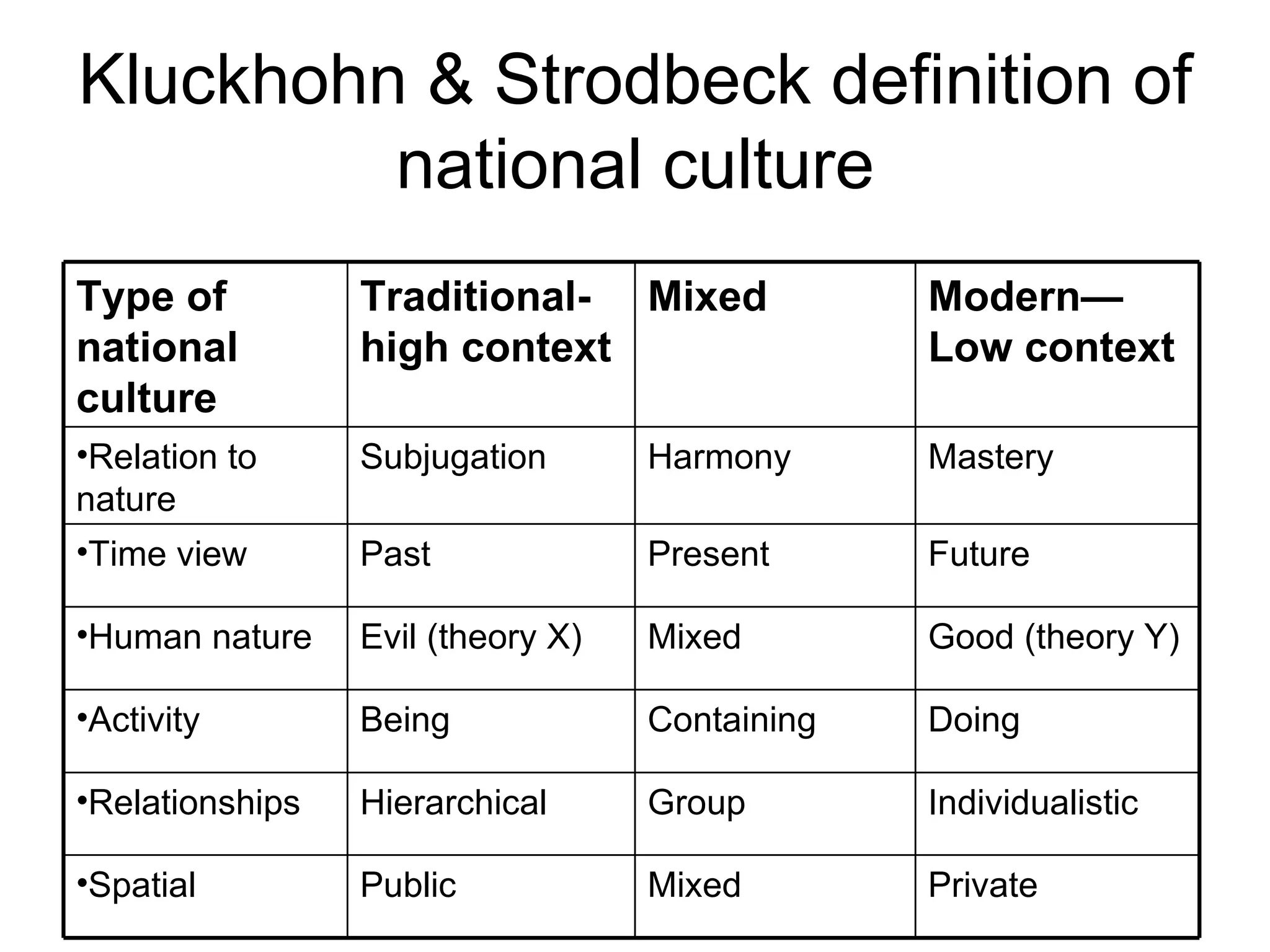
Kluckhohn & Strodbeck definition of national culture Type of national culture Traditional-high context Mixed Modern—Low context Relation to nature Subjugation Harmony Mastery Time view Past Present Future Human nature Evil (theory X) Mixed Good (theory Y) Activity Being Containing Doing Relationships Hierarchical Group Individualistic Spatial Public Mixed Private
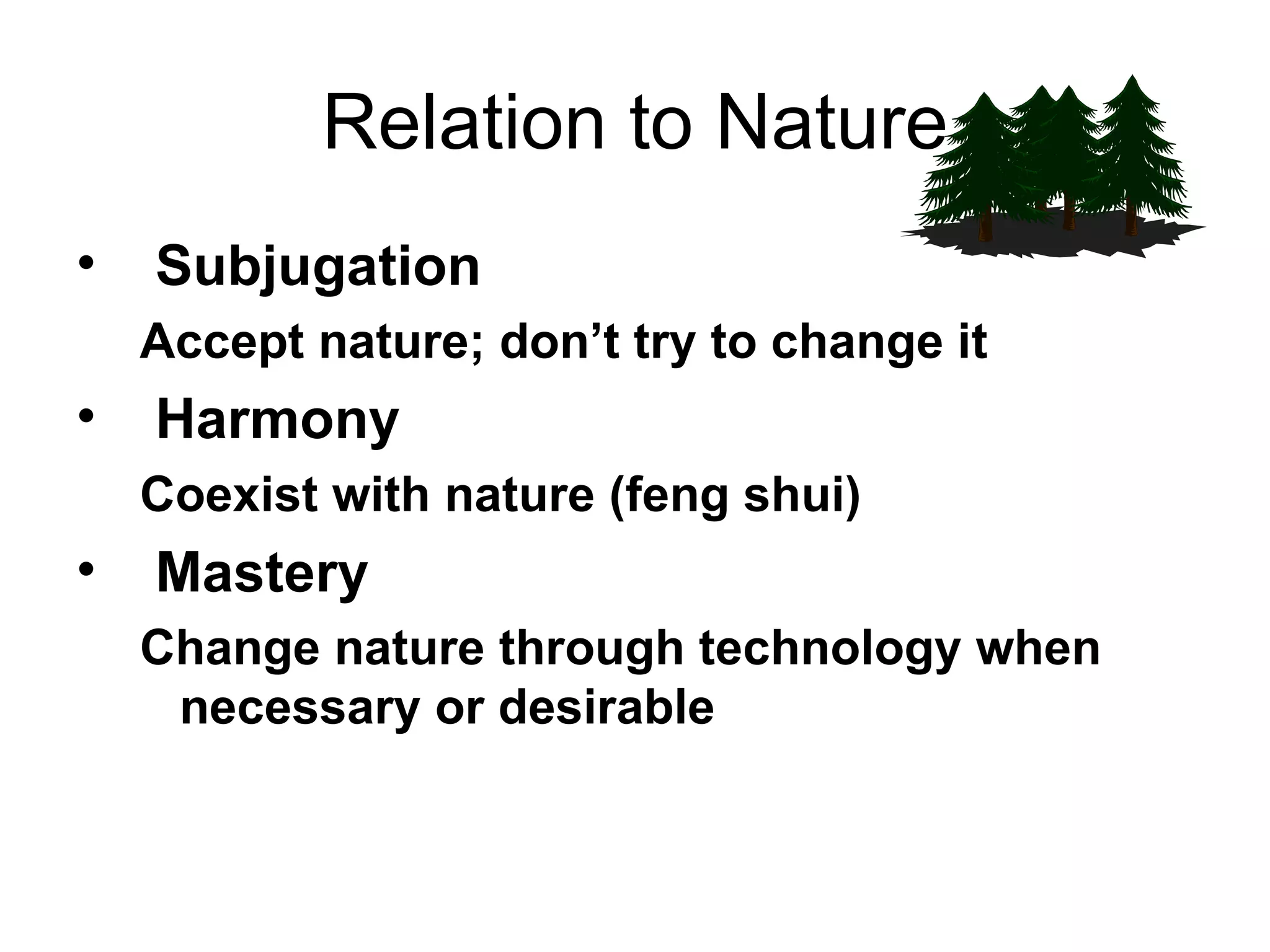
Relation to Nature Subjugation Accept nature; don’t try to change it Harmony Coexist with nature (feng shui) Mastery Change nature through technology when necessary or desirable
Time Orientation Past Emphasizes tradition Present Focuses on short-term Future Emphasizes long-term
Basic Human Nature Good People trust each other Mixed-Neutral Generally trusting but need to be cautious and protect self Evil Lack of trust
Activity Orientation Doing Emphasis on action, achievement, learning Containing/Controlling Emphasis on rationality and logic Being Emphasis on enjoying life and working for the moment
Relationships  among People Individualistic People define themselves through personal characteristics and achievement Group-oriented People relate to and take responsibility for members of the family, network, or community Hierarchical People value group relationships but also within the society emphasize relative ranking of groups
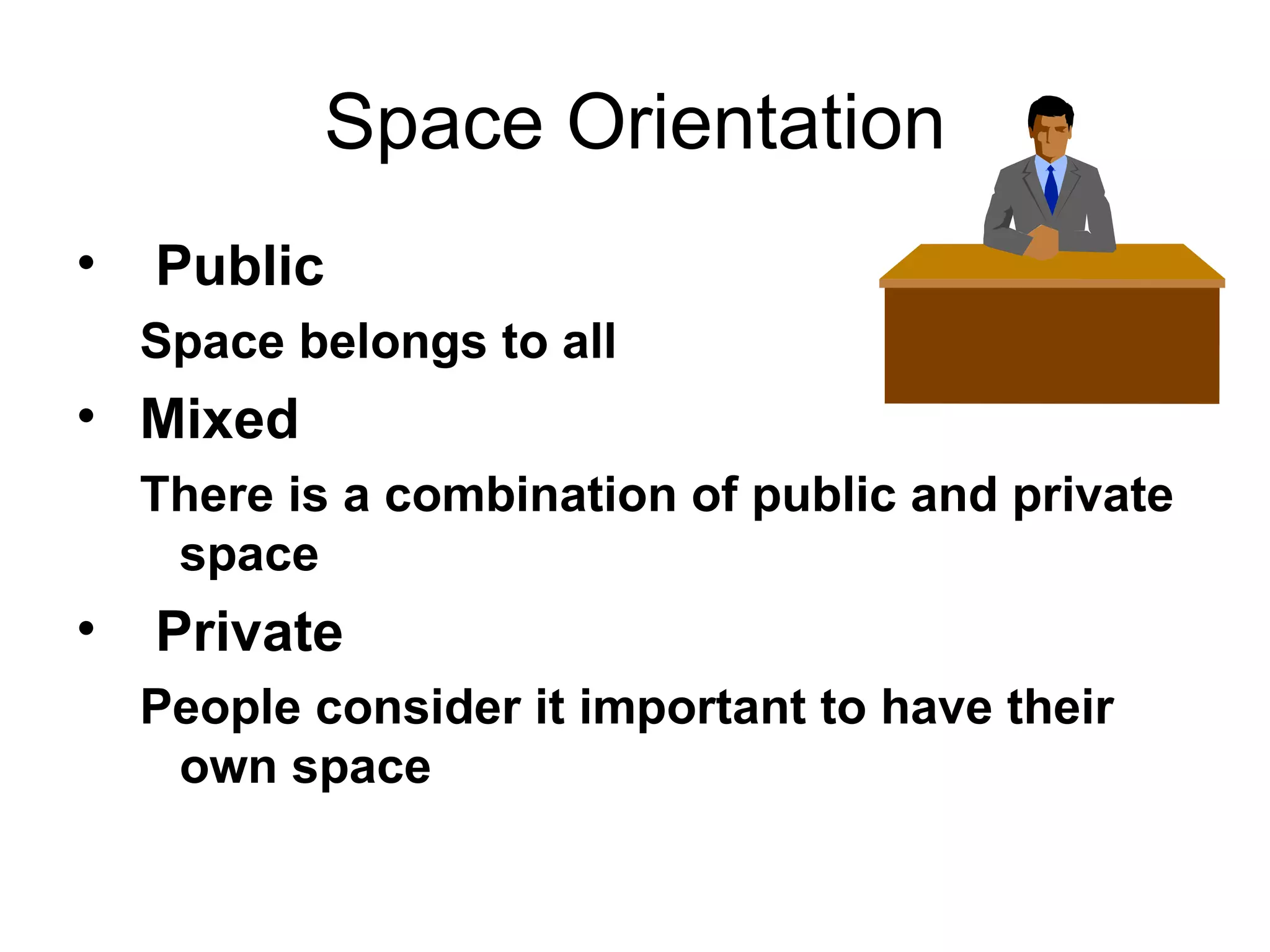
Space Orientation Public Space belongs to all Mixed There is a combination of public and private space Private People consider it important to have their own space
Hofstede’s Dimensions of Cultural Values Focuses specifically on work-related values Developed in 1980 with data over 116,000 employees in 72 countries Average scores for each country used to develop national profiles to explain differences in work behaviors
Hofstede’s  definition of culture & Bond’s addition individualism-collectivism uncertainty avoidance power distance masculinity/femininity Confucian work dynamism (time orientation)
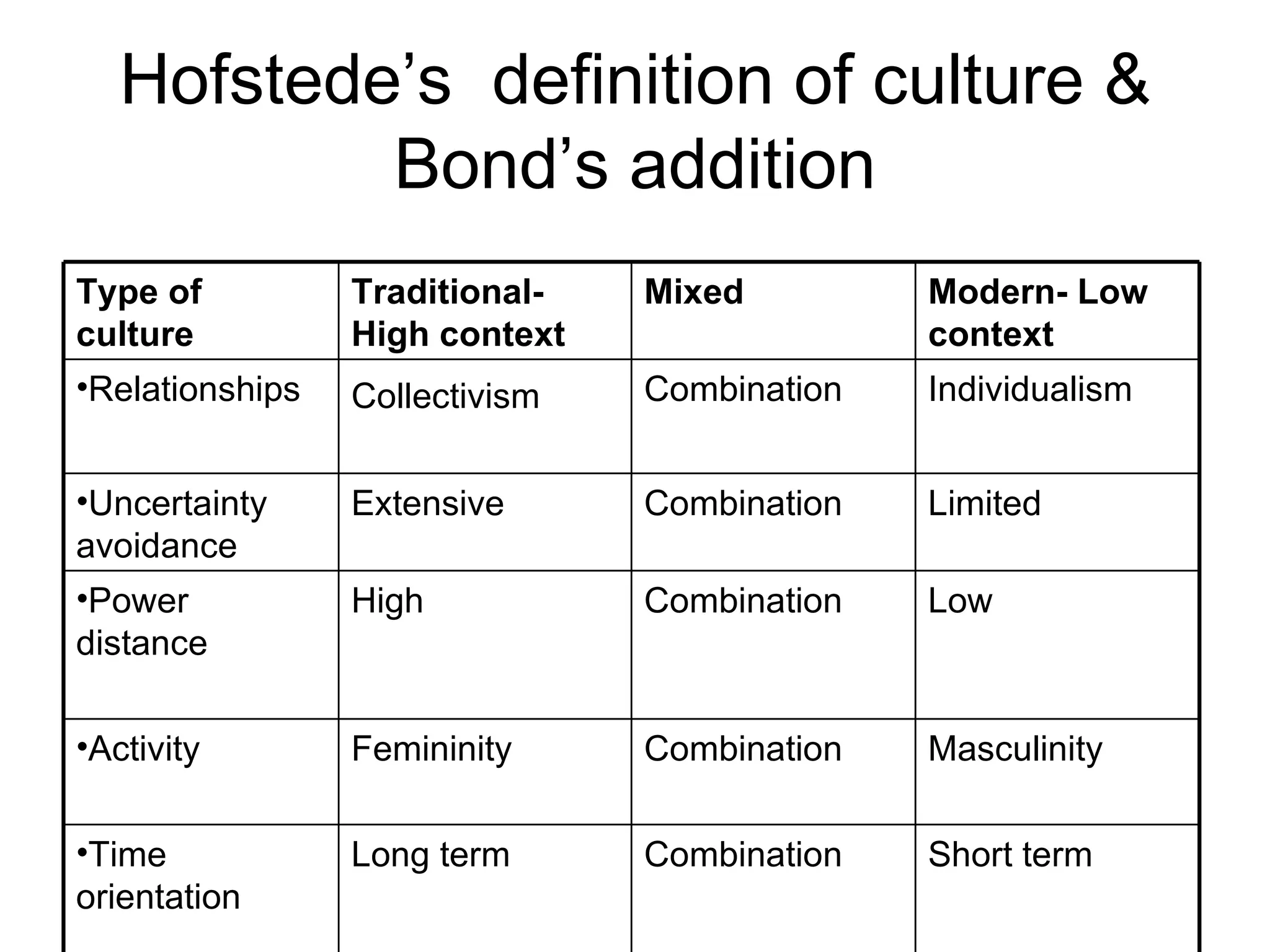
Hofstede’s  definition of culture & Bond’s addition Type of culture Traditional-High context Mixed Modern- Low context Relationships Collectivism   Combination Individualism Uncertainty avoidance Extensive Combination Limited Power distance High Combination Low Activity Femininity Combination Masculinity Time orientation Long term Combination Short term
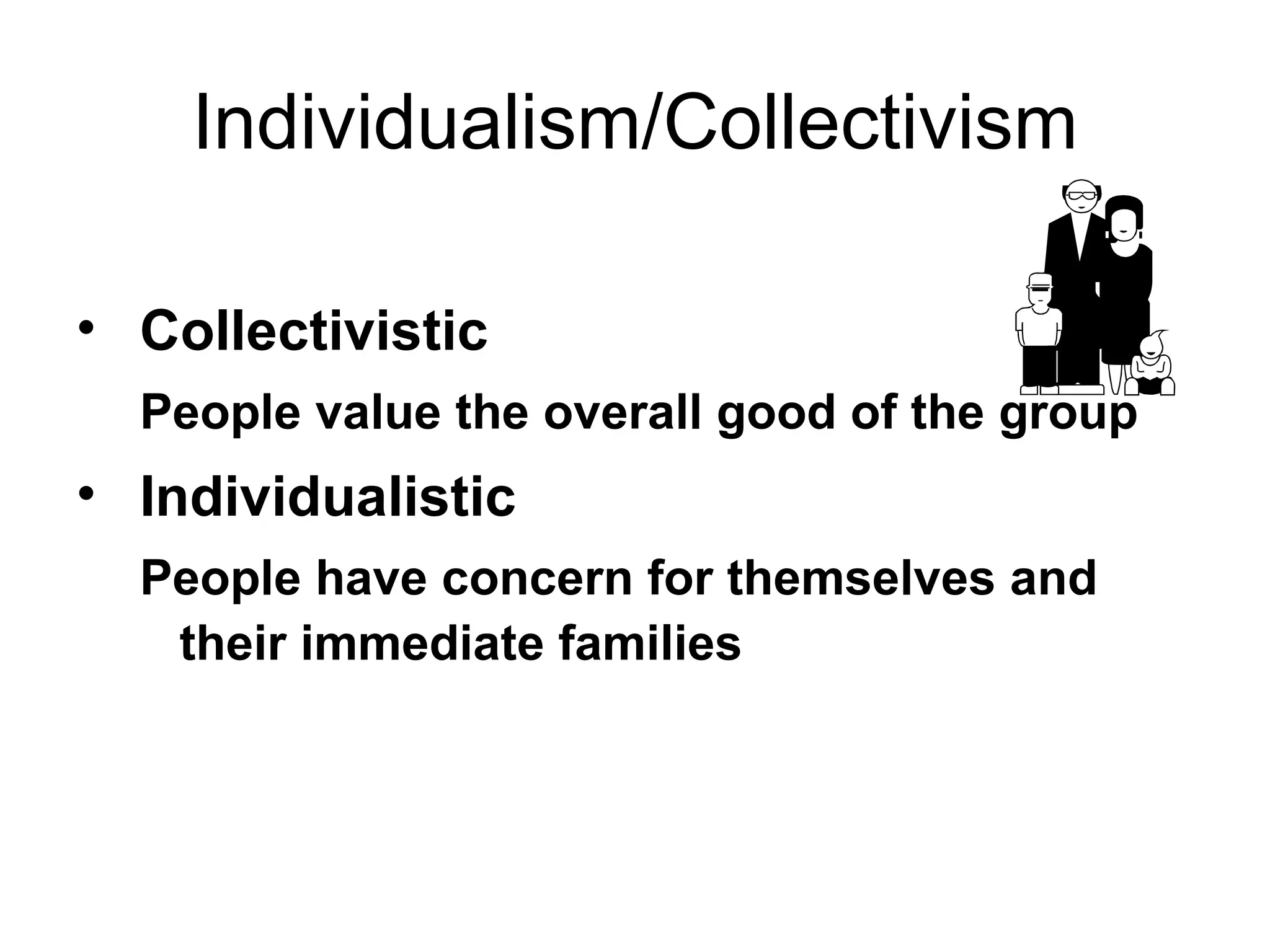
Individualism/Collectivism Collectivistic People value the overall good of the group Individualistic People have concern for themselves and their immediate families
Power Distance The extent to which less powerful members of organizations accept that power is unequally distributed  Large Differences among people with different ranks are acceptable Small Less comfortable with power differences
Uncertainty Avoidance Indicates preferred amount of structure  Weak People prefer unstructured situations Strong People prefer more structure
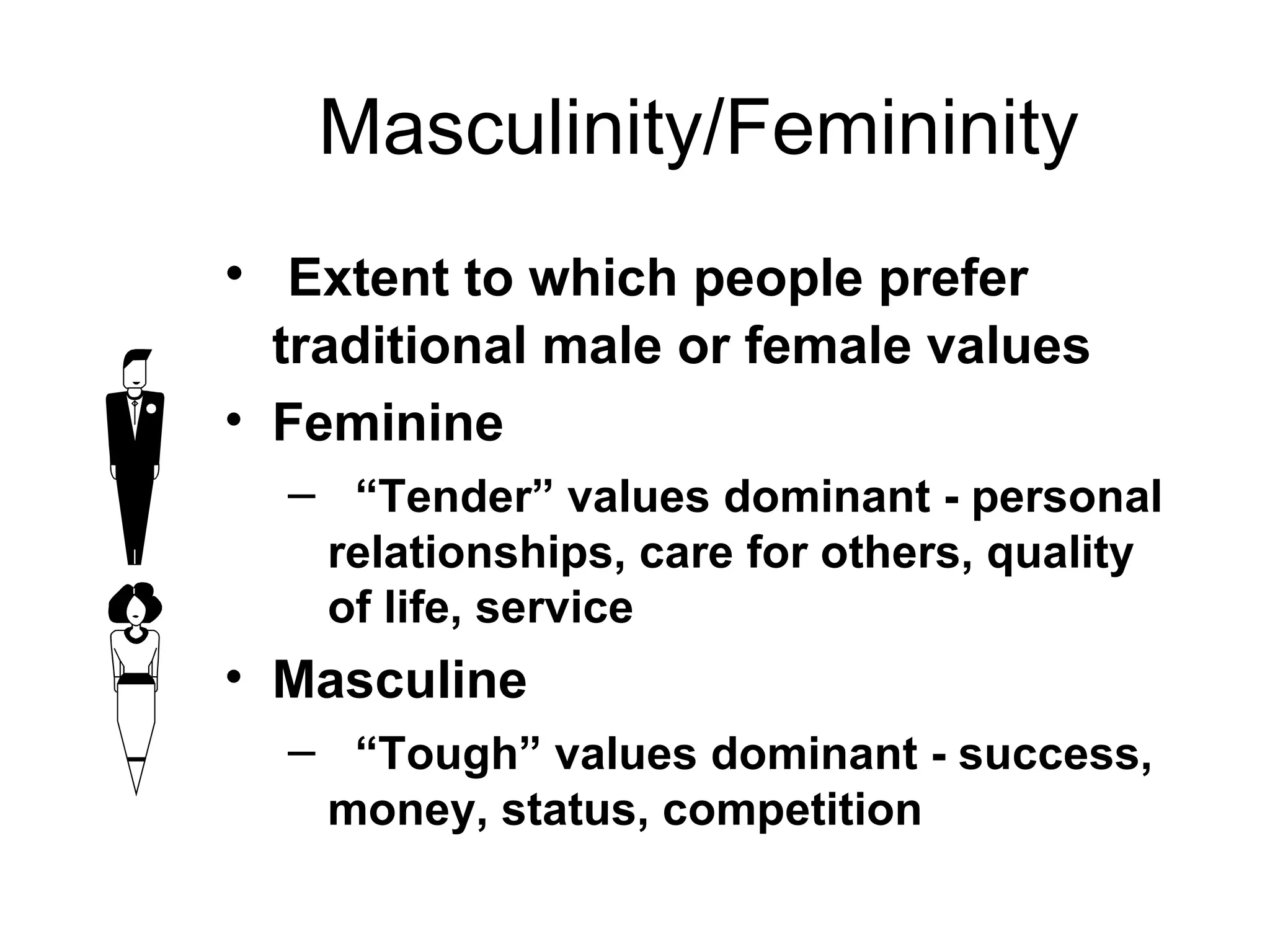
Masculinity/Femininity Extent to which people prefer  traditional male or female values   Feminine “ Tender” values dominant - personal relationships, care for others, quality of life, service Masculine “ Tough” values dominant - success, money, status, competition
The Chinese Value Survey Reaction to the Hofstede study Developed in Chinese based on traditional Chinese values Translated and administered to students in 23 countries 4 dimensions, 3 match Hofstede (PD, I/C, and M/F) plus Confucian Work Dynamism
Long-term/Short-term Orientation High Confucian work dynamism/Long-term oriented Concern with future, value thrift and persistence Low Confucian work dynamism/Short-term oriented Oriented toward past and present, respect for tradition but here and now is most important
Schwartz's classification Focuses on universal aspects of individual value content and structure   Based on issues that confront all societies  The nature of boundaries between the individual and the group. How to support responsible behavior. How to regulate the relation of people to the social and natural world.
Embeddedness Versus Autonomy   Embeddedness   People view others as inherently part of collectives.  Meaning in life comes from social relationships & shared way of life & goals. Autonomy Individuals seen as autonomous, bounded entities who find meaning in their own uniqueness Intellectual autonomy - people follow their own ideas and value curiosity, creativity, and open-mindedness Affective autonomy  -  individuals independently pursue positive experiences that make them feel good
Hierarchy Versus Egalitarianism Hierarchy The social system has clearly defined roles to identify obligations & rules of behavior  Egalitarianism Think of each other as  equals sharing basic human interests that values equality, justice, honesty & responsbility
Mastery Versus Harmony  Harmony Emphasizes understanding and fitting in with the environment, rather than trying to change it  Mastery  Encourages people to master, change, and exploit the natural and social environment for personal or group goals
Trompenaars’ Dimensions of Culture Dimensions represent how societies develop approaches to managing problems and difficult situations   Over a 14 year period, data collected from over 46,000 managers representing more than 40 national cultures
Trompenaars’ 7 Dimensions of Culture Particularism vs. Universalism Collectivism  vs. Individualism  Affective  vs. Neutral  Relationships Diffuse  vs. Specific  Relationships Ascription  vs. Achievement Relationship to Time Relationship to Nature
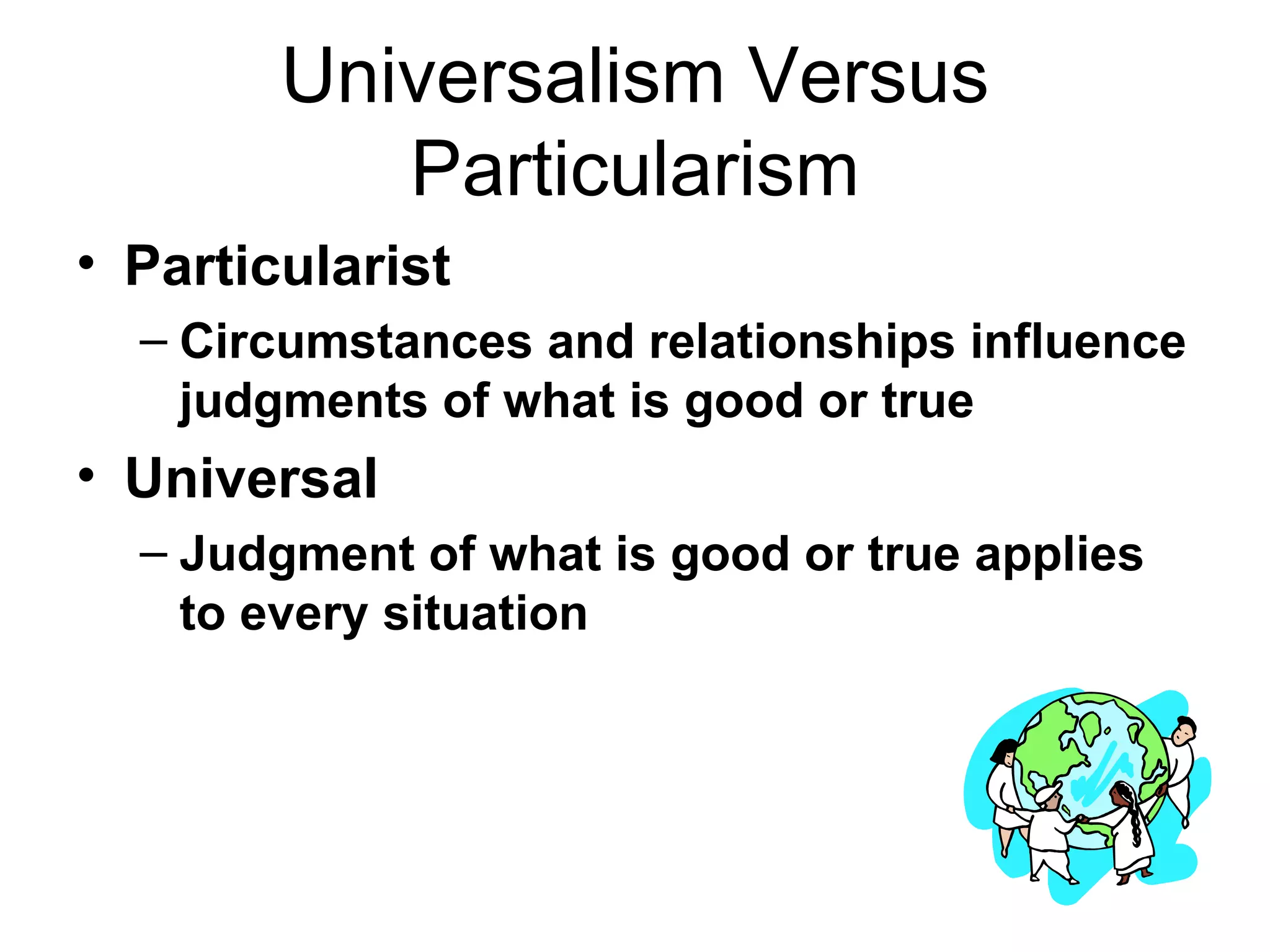
Universalism Versus Particularism Particularist Circumstances and relationships influence judgments of what is good or true Universal Judgment of what is good or true applies to every situation
Individualism Versus Communitarianism  Communitarian Emphasizes group membership, social responsibility, harmonious relationships, and cooperation  Individualist Focus on self, personal freedom, and competitiveness
Specificity Versus Diffusion Level of particularity or wholeness used by the culture to define different constructs Diffuse Focus on conceptual wholeness and relationships of all kinds are valued Small public spaces and larger private spaces Specific Objective, break things down into small parts Large public spaces and smaller private spaces
Achieved Status Versus Ascribed Status  Ascription Believe people are born into influence, and who you are, your potential, and your connections are all important   Achievement Emphasize attainment of position and influence through a demonstration of expertise
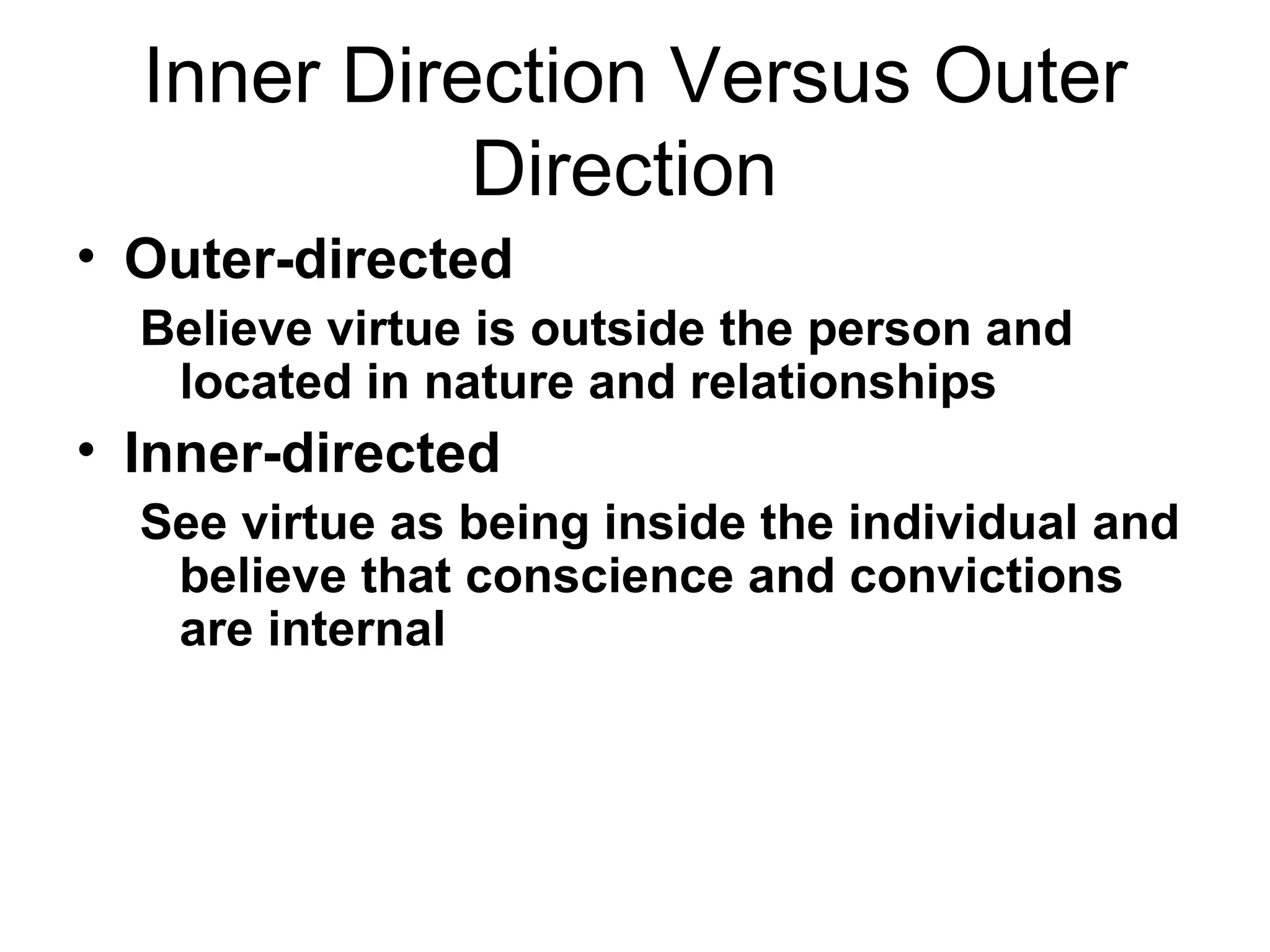
Inner Direction Versus Outer Direction  Outer-directed Believe virtue is outside the person and located in nature and relationships  Inner-directed See virtue as being inside the individual and believe that conscience and convictions are internal
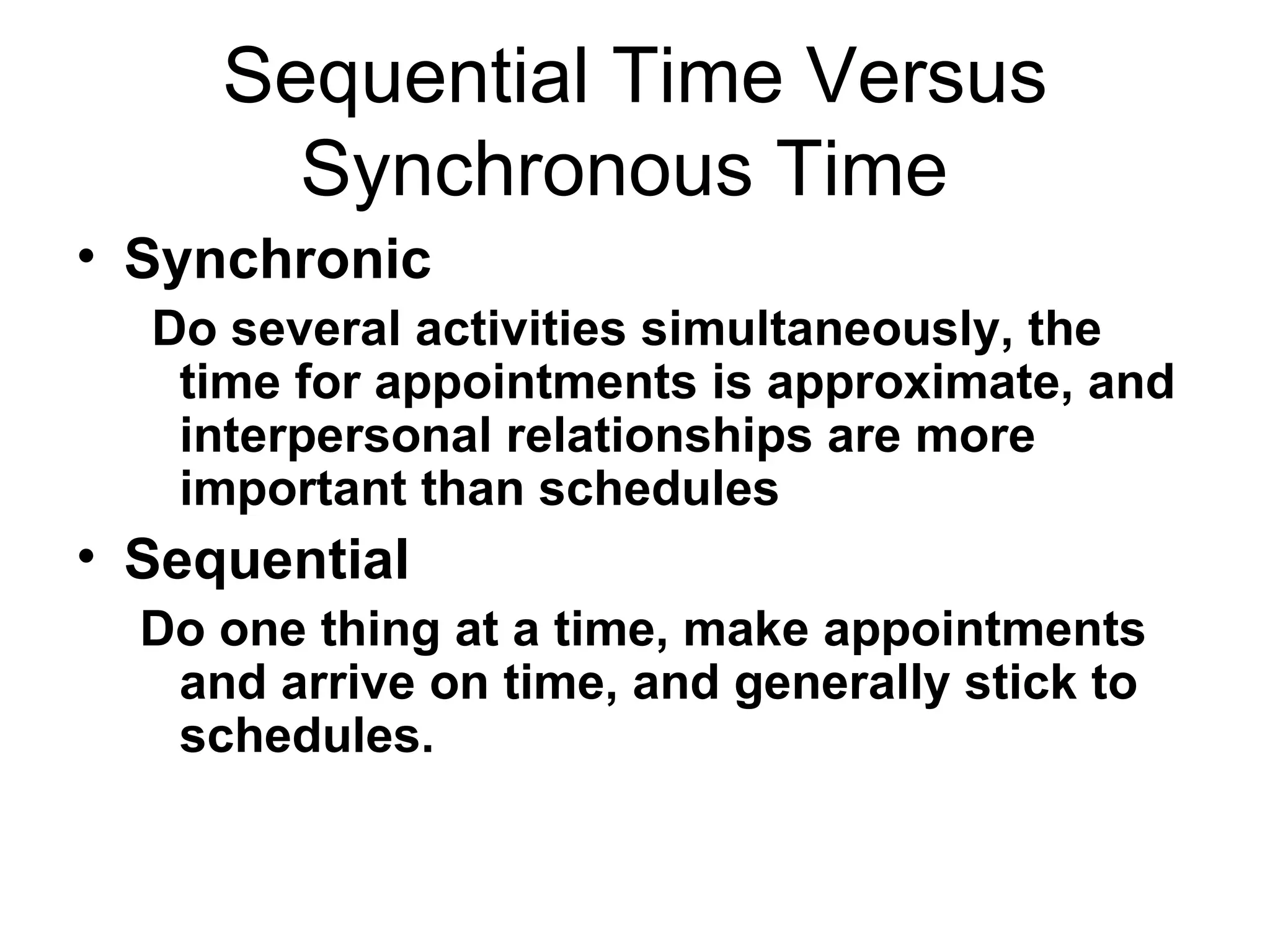
Sequential Time Versus Synchronous Time  Synchronic Do several activities simultaneously, the time for appointments is approximate, and interpersonal relationships are more important than schedules  Sequential Do one thing at a time, make appointments and arrive on time, and generally stick to schedules.
The World Values Survey  Study of sociocultural and political change Collected data from more than 65 societies  Four waves of data collection: 1981, 1990-1991, 1995-1996, and 1999-2001
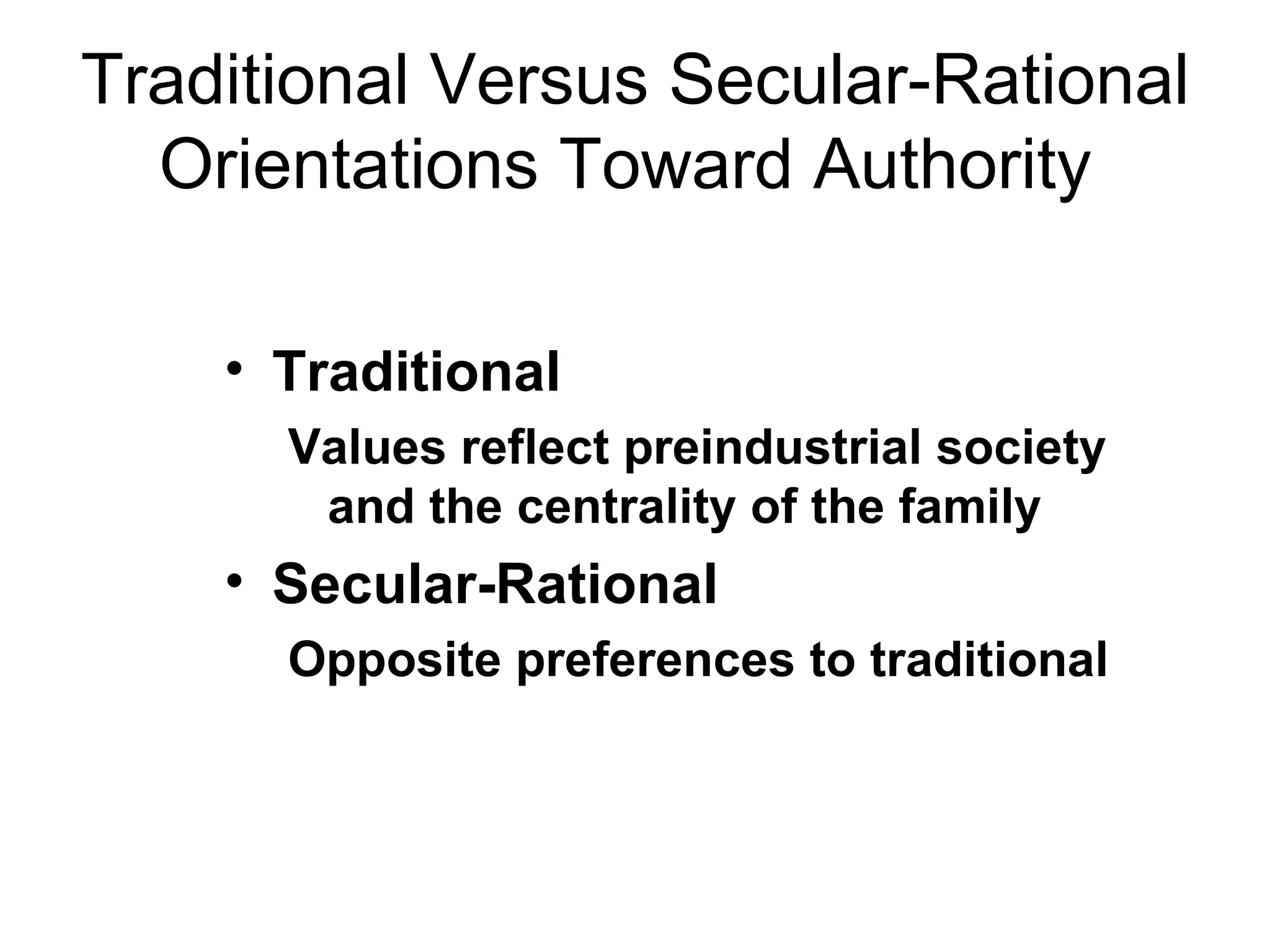
Traditional Versus Secular-Rational Orientations Toward Authority  Traditional Values reflect preindustrial society and the centrality of the family  Secular-Rational Opposite preferences to traditional
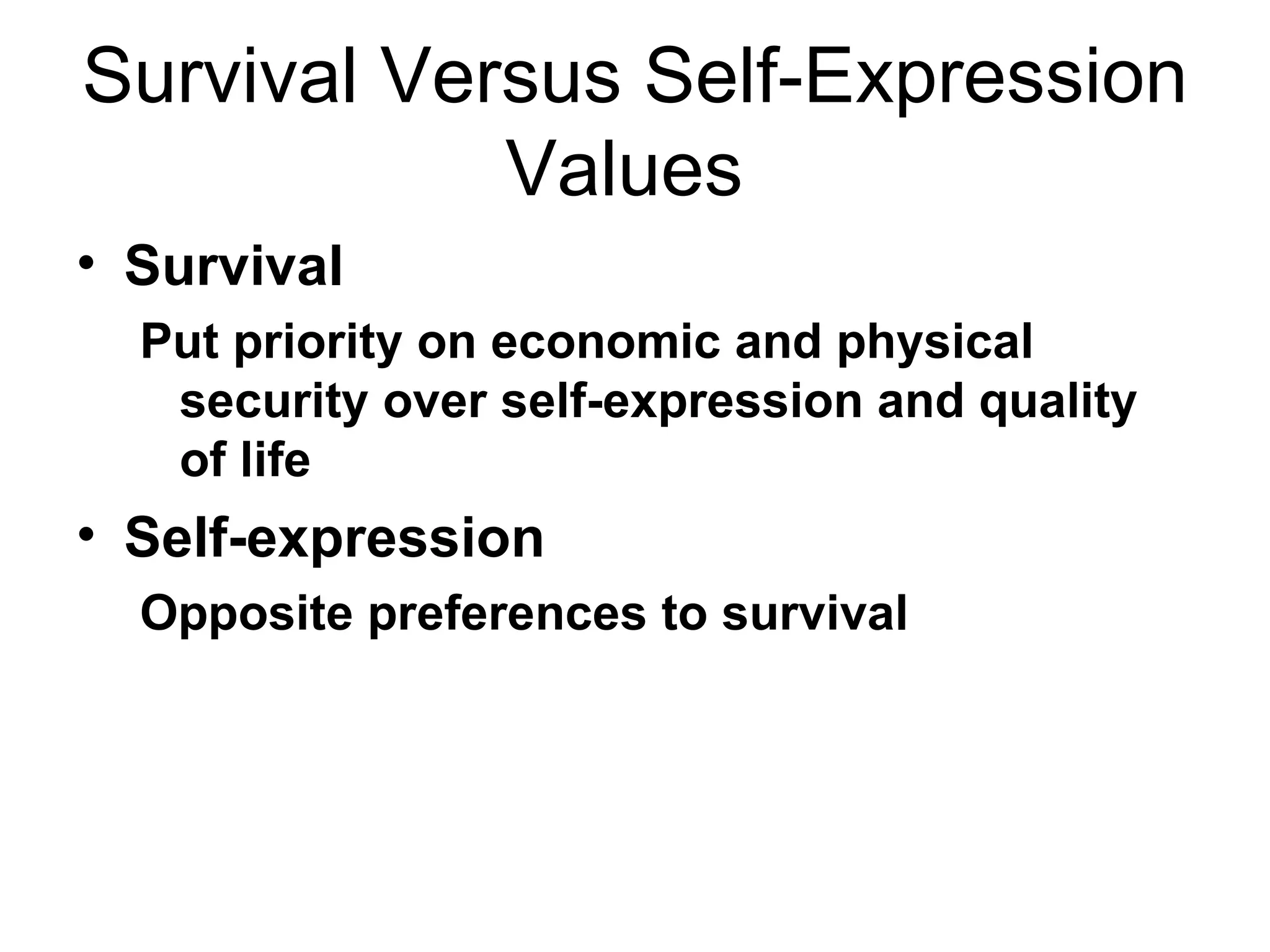
Survival Versus Self-Expression Values  Survival Put priority on economic and physical security over self-expression and quality of life  Self-expression Opposite preferences to survival
Do the Frameworks Explain Differences? Represent average behavior within a culture Countries classified similarly may still be very different Reliability may vary Range of differences on any dimension exists within the population of a single country   Can explain differences in individual   people’s behavior within the same country
Convergence or  Divergence? Closer communication and trade links Worldwide markets and products Different cultural interpretations Need to maintain cultural identity
Implications for Managers Understanding culture important even in home country Organization’s stakeholders could be from another culture Need to look for underlying cultural meanings

Chap2 culture

  • 1.
    Chapter 2 Cultureand Organizational Behavior
  • 2.
    Case 1: A cultural clash in the entertainment industry Can any nation protect its cultural characteristics and uniqueness? In a world of instant communications via the Internet? World wide distribution of movies? World wide transmission of television? World wide travel? What is the potential of subsidies, trade restrictions, quotas, and governmental control of sustaining a unique national culture?
  • 3.
    Case 6—A &B Ellen Moore-Living/working in Bahrain Culture in Bahrain & Saudi Arabia Role of professional women Adjustments to stereotypes When to adjust & when to challenge?
  • 4.
    Cases Case 6: “Ellen Moore: Did Ellen compromise her values (too much) in accepting the Customer Service position? How useful are her tips for women in becoming successful in management? Meeting fellow employees or others? Obtaining recognition? Adjusting to stereotype female roles (when required)? Finding and using a mentor? Adjusting to the culture? Negotiating with her husband on relative roles?
  • 5.
    Defining Culture: An unbounded definition A way of life of a group of people That complex whole which includes knowledge, belief, art, morals, law, custom, and any other capabilities and habits acquired by man as a member of society Everything that people have, think, and do as members of society
  • 6.
    Narrowing the definition: Sathe’s Levels of Culture Water line Basic assumptions Expressed values Manifest culture Basic assumptions Expressed values Manifest culture Iceberg Onion
  • 7.
    How is CultureLearned? Enculturation Non-intentional process that includes all of the learning available as the result of what is in an environment to be learned Primary Socialization more intentional learning process that occurs in the family and local community Subcultures Develop because a group has an ethnic background, language, or religion that is different from the majority population Secondary Socialization Occurs after primary socialization and usually equips people with the knowledge, skills, and behavior to enact adult roles successfully
  • 8.
    Classifications of cultureBroad classifications: Hall’s High-Context and Low-Context Cultural Framework Detailed classifications: Tonnies and Loomis’s amplification Kluckhohn and Strodtbeck’s Variations in Values Orientations Hofstede’s definition of culture & Bond’s addition Schwartz's classification Trompenaars’ 7 Dimensions of Culture
  • 9.
    Hall’s High-Context andLow-Context Cultural Framework High-Context Low-Context China Austria Egypt Canada France Denmark Italy England Japan Finland Lebanon Germany Saudi Arabia Norway Spain Switzerland Syria United States
  • 10.
    Kluckhohn and Strodtbeck’sVariations in Values Orientations Framework to describe how different societies cope with various issues or problems Includes 6 Values Orientations A culture is defined by one or more variations of a values orientation
  • 11.
    Kluckhohn & Strodbeckdefinition of national culture Type of national culture Traditional-high context Mixed Modern—Low context Relation to nature Subjugation Harmony Mastery Time view Past Present Future Human nature Evil (theory X) Mixed Good (theory Y) Activity Being Containing Doing Relationships Hierarchical Group Individualistic Spatial Public Mixed Private
  • 12.
    Relation to NatureSubjugation Accept nature; don’t try to change it Harmony Coexist with nature (feng shui) Mastery Change nature through technology when necessary or desirable
  • 13.
    Time Orientation PastEmphasizes tradition Present Focuses on short-term Future Emphasizes long-term
  • 14.
    Basic Human NatureGood People trust each other Mixed-Neutral Generally trusting but need to be cautious and protect self Evil Lack of trust
  • 15.
    Activity Orientation DoingEmphasis on action, achievement, learning Containing/Controlling Emphasis on rationality and logic Being Emphasis on enjoying life and working for the moment
  • 16.
    Relationships amongPeople Individualistic People define themselves through personal characteristics and achievement Group-oriented People relate to and take responsibility for members of the family, network, or community Hierarchical People value group relationships but also within the society emphasize relative ranking of groups
  • 17.
    Space Orientation PublicSpace belongs to all Mixed There is a combination of public and private space Private People consider it important to have their own space
  • 18.
    Hofstede’s Dimensions ofCultural Values Focuses specifically on work-related values Developed in 1980 with data over 116,000 employees in 72 countries Average scores for each country used to develop national profiles to explain differences in work behaviors
  • 19.
    Hofstede’s definitionof culture & Bond’s addition individualism-collectivism uncertainty avoidance power distance masculinity/femininity Confucian work dynamism (time orientation)
  • 20.
    Hofstede’s definitionof culture & Bond’s addition Type of culture Traditional-High context Mixed Modern- Low context Relationships Collectivism Combination Individualism Uncertainty avoidance Extensive Combination Limited Power distance High Combination Low Activity Femininity Combination Masculinity Time orientation Long term Combination Short term
  • 21.
    Individualism/Collectivism Collectivistic Peoplevalue the overall good of the group Individualistic People have concern for themselves and their immediate families
  • 22.
    Power Distance Theextent to which less powerful members of organizations accept that power is unequally distributed Large Differences among people with different ranks are acceptable Small Less comfortable with power differences
  • 23.
    Uncertainty Avoidance Indicatespreferred amount of structure Weak People prefer unstructured situations Strong People prefer more structure
  • 24.
    Masculinity/Femininity Extent towhich people prefer traditional male or female values Feminine “ Tender” values dominant - personal relationships, care for others, quality of life, service Masculine “ Tough” values dominant - success, money, status, competition
  • 25.
    The Chinese ValueSurvey Reaction to the Hofstede study Developed in Chinese based on traditional Chinese values Translated and administered to students in 23 countries 4 dimensions, 3 match Hofstede (PD, I/C, and M/F) plus Confucian Work Dynamism
  • 26.
    Long-term/Short-term Orientation HighConfucian work dynamism/Long-term oriented Concern with future, value thrift and persistence Low Confucian work dynamism/Short-term oriented Oriented toward past and present, respect for tradition but here and now is most important
  • 27.
    Schwartz's classification Focuseson universal aspects of individual value content and structure Based on issues that confront all societies The nature of boundaries between the individual and the group. How to support responsible behavior. How to regulate the relation of people to the social and natural world.
  • 28.
    Embeddedness Versus Autonomy Embeddedness People view others as inherently part of collectives. Meaning in life comes from social relationships & shared way of life & goals. Autonomy Individuals seen as autonomous, bounded entities who find meaning in their own uniqueness Intellectual autonomy - people follow their own ideas and value curiosity, creativity, and open-mindedness Affective autonomy - individuals independently pursue positive experiences that make them feel good
  • 29.
    Hierarchy Versus EgalitarianismHierarchy The social system has clearly defined roles to identify obligations & rules of behavior Egalitarianism Think of each other as equals sharing basic human interests that values equality, justice, honesty & responsbility
  • 30.
    Mastery Versus Harmony Harmony Emphasizes understanding and fitting in with the environment, rather than trying to change it Mastery Encourages people to master, change, and exploit the natural and social environment for personal or group goals
  • 31.
    Trompenaars’ Dimensions ofCulture Dimensions represent how societies develop approaches to managing problems and difficult situations Over a 14 year period, data collected from over 46,000 managers representing more than 40 national cultures
  • 32.
    Trompenaars’ 7 Dimensionsof Culture Particularism vs. Universalism Collectivism vs. Individualism Affective vs. Neutral Relationships Diffuse vs. Specific Relationships Ascription vs. Achievement Relationship to Time Relationship to Nature
  • 33.
    Universalism Versus ParticularismParticularist Circumstances and relationships influence judgments of what is good or true Universal Judgment of what is good or true applies to every situation
  • 34.
    Individualism Versus Communitarianism Communitarian Emphasizes group membership, social responsibility, harmonious relationships, and cooperation Individualist Focus on self, personal freedom, and competitiveness
  • 35.
    Specificity Versus DiffusionLevel of particularity or wholeness used by the culture to define different constructs Diffuse Focus on conceptual wholeness and relationships of all kinds are valued Small public spaces and larger private spaces Specific Objective, break things down into small parts Large public spaces and smaller private spaces
  • 36.
    Achieved Status VersusAscribed Status Ascription Believe people are born into influence, and who you are, your potential, and your connections are all important Achievement Emphasize attainment of position and influence through a demonstration of expertise
  • 37.
    Inner Direction VersusOuter Direction Outer-directed Believe virtue is outside the person and located in nature and relationships Inner-directed See virtue as being inside the individual and believe that conscience and convictions are internal
  • 38.
    Sequential Time VersusSynchronous Time Synchronic Do several activities simultaneously, the time for appointments is approximate, and interpersonal relationships are more important than schedules Sequential Do one thing at a time, make appointments and arrive on time, and generally stick to schedules.
  • 39.
    The World ValuesSurvey Study of sociocultural and political change Collected data from more than 65 societies Four waves of data collection: 1981, 1990-1991, 1995-1996, and 1999-2001
  • 40.
    Traditional Versus Secular-RationalOrientations Toward Authority Traditional Values reflect preindustrial society and the centrality of the family Secular-Rational Opposite preferences to traditional
  • 41.
    Survival Versus Self-ExpressionValues Survival Put priority on economic and physical security over self-expression and quality of life Self-expression Opposite preferences to survival
  • 42.
    Do the FrameworksExplain Differences? Represent average behavior within a culture Countries classified similarly may still be very different Reliability may vary Range of differences on any dimension exists within the population of a single country Can explain differences in individual people’s behavior within the same country
  • 43.
    Convergence or Divergence? Closer communication and trade links Worldwide markets and products Different cultural interpretations Need to maintain cultural identity
  • 44.
    Implications for ManagersUnderstanding culture important even in home country Organization’s stakeholders could be from another culture Need to look for underlying cultural meanings