


SHM1023
 Intercultural
Communication

G l o b a l i s i n g t o d a y ’s t e a c h i n g p r o f e s s i o n a l s
Week 2:
Forms and
 Models
    of
   ICC
Approaches to IC
    Communication
 Approach 1
©“model” of communication
© a visual representation of
  a process
Approaches to IC
    Communication
  Approach 2
© a framework of concepts
© understand a communication
  episode
Why Models
• Descriptive function
  – visual representation
• Summarizing research in an area
• Troubleshooting function
  - communication breakdown
    /analysis
I. Baldwin’s Model of ICC
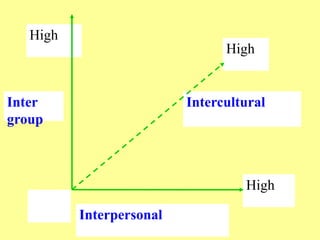
High
                                High


Inter                     Intercultural
group


                                   High

          Interpersonal
Interpersonal dimension

©Communicating with people
based on our personal
understanding of them.
Interpersonal dimension

© According to Miller and
 Steinberg:
    demographic predictions
       sociological predictions
          personal predictions
Intergroup dimension
© The degree to which we see
  people in terms of groups.
© Social identity theory
    We see ourselves and others
 in terms of the groups which
 we belong to.
Intergroup dimension

© This dimension is related not
 only to group perception, but
 also to stereotypes and
 prejudices.
Intercultural dimension

©  Real cultural differences which
 can range from minimal to very
 great.
© Perception of difference is 2nd
 dimension; but real differences are
 the 3rd dimension.
Strength
© Distinguish between
 group belonging and real
 cultural differences.
Strength
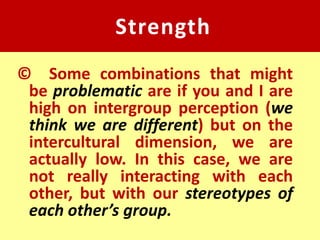
© Some combinations that might
 be problematic are if you and I are
 high on intergroup perception (we
 think we are different) but on the
 intercultural dimension, we are
 actually low. In this case, we are
 not really interacting with each
 other, but with our stereotypes of
 each other’s group.
Strength
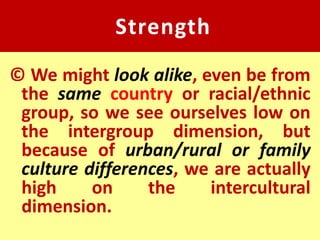
© We might look alike, even be from
 the same country or racial/ethnic
 group, so we see ourselves low on
 the intergroup dimension, but
 because of urban/rural or family
 culture differences, we are actually
 high     on     the    intercultural
 dimension.
Strength

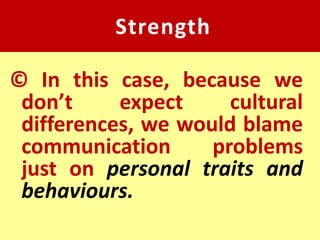
© In this case, because we
 don’t     expect     cultural
 differences, we would blame
 communication      problems
 just on personal traits and
 behaviours.
Limitation

•A   limitation of this
definition is that it does
not include context
(see, Gudykunst & Kim
model, below).
Gudykunst’s Approach
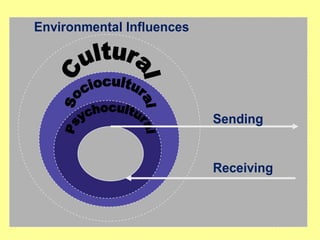
Environmental Influences


       •
                           Sending


                           Receiving
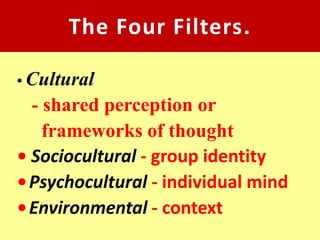
The Four Filters.

• Cultural
  - shared perception or
    frameworks of thought
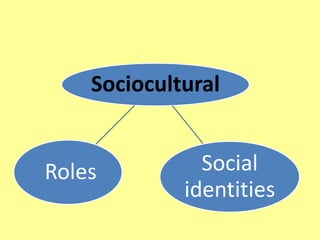
• Sociocultural - group identity
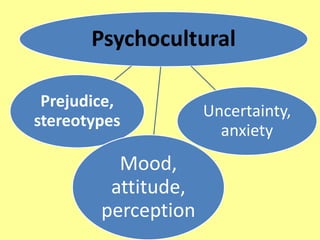
• Psychocultural - individual mind
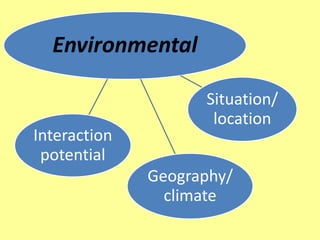
• Environmental - context
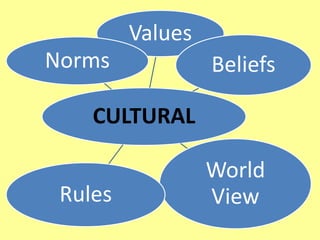
Values
Norms             Beliefs

    CULTURAL

                  World
 Rules            View
Sociocultural


Roles          Social
             identities
Psychocultural

 Prejudice,
                     Uncertainty,
stereotypes
                       anxiety
          Mood,
         attitude,
        perception
Environmental

                    Situation/
                     location
Interaction
 potential
              Geography/
                climate
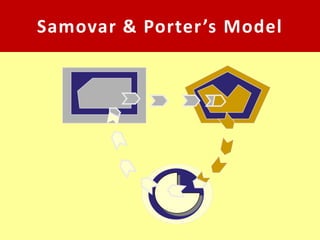
Samovar & Porter ’s Model
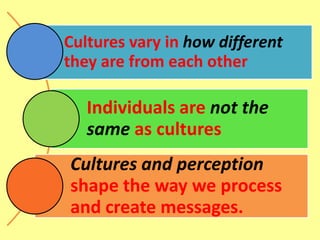
Cultures vary in how different
they are from each other

   Individuals are not the
   same as cultures
Cultures and perception
shape the way we process
and create messages.
3 Points

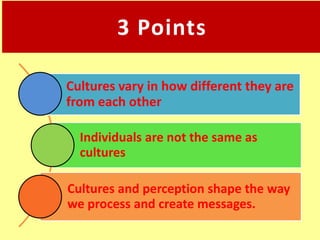
Cultures vary in how different they are
from each other

  Individuals are not the same as
  cultures

Cultures and perception shape the way
we process and create messages.
3 Points

Cultures vary in how different they are
from each other

  Individuals are not the same as
  cultures

Cultures and perception shape the way
we process and create messages.
Thank
                                   you.

    Good communication is as stimulating
as black coffee, and just as hard to sleep after.
              ~ Anne Morrow Lindbergh

Intercultural Communication week 2

  • 1.
    SHM1023 Intercultural Communication G lo b a l i s i n g t o d a y ’s t e a c h i n g p r o f e s s i o n a l s
  • 2.
    Week 2: Forms and Models of ICC
  • 3.
    Approaches to IC Communication Approach 1 ©“model” of communication © a visual representation of a process
  • 4.
    Approaches to IC Communication Approach 2 © a framework of concepts © understand a communication episode
  • 5.
    Why Models • Descriptivefunction – visual representation • Summarizing research in an area • Troubleshooting function - communication breakdown /analysis
  • 6.
  • 7.
    High High Inter Intercultural group High Interpersonal
  • 8.
    Interpersonal dimension ©Communicating withpeople based on our personal understanding of them.
  • 9.
    Interpersonal dimension © Accordingto Miller and Steinberg: demographic predictions sociological predictions personal predictions
  • 10.
    Intergroup dimension © Thedegree to which we see people in terms of groups. © Social identity theory We see ourselves and others in terms of the groups which we belong to.
  • 11.
    Intergroup dimension © Thisdimension is related not only to group perception, but also to stereotypes and prejudices.
  • 12.
    Intercultural dimension © Real cultural differences which can range from minimal to very great. © Perception of difference is 2nd dimension; but real differences are the 3rd dimension.
  • 13.
    Strength © Distinguish between group belonging and real cultural differences.
  • 14.
    Strength © Some combinationsthat might be problematic are if you and I are high on intergroup perception (we think we are different) but on the intercultural dimension, we are actually low. In this case, we are not really interacting with each other, but with our stereotypes of each other’s group.
  • 15.
    Strength © We mightlook alike, even be from the same country or racial/ethnic group, so we see ourselves low on the intergroup dimension, but because of urban/rural or family culture differences, we are actually high on the intercultural dimension.
  • 16.
    Strength © In thiscase, because we don’t expect cultural differences, we would blame communication problems just on personal traits and behaviours.
  • 17.
    Limitation •A limitation of this definition is that it does not include context (see, Gudykunst & Kim model, below).
  • 18.
  • 19.
    Environmental Influences • Sending Receiving
  • 20.
    The Four Filters. •Cultural - shared perception or frameworks of thought • Sociocultural - group identity • Psychocultural - individual mind • Environmental - context
  • 21.
    Values Norms Beliefs CULTURAL World Rules View
  • 22.
    Sociocultural Roles Social identities
  • 23.
    Psychocultural Prejudice, Uncertainty, stereotypes anxiety Mood, attitude, perception
  • 24.
    Environmental Situation/ location Interaction potential Geography/ climate
  • 25.
    Samovar & Porter’s Model
  • 26.
    Cultures vary inhow different they are from each other Individuals are not the same as cultures Cultures and perception shape the way we process and create messages.
  • 27.
    3 Points Cultures varyin how different they are from each other Individuals are not the same as cultures Cultures and perception shape the way we process and create messages.
  • 28.
    3 Points Cultures varyin how different they are from each other Individuals are not the same as cultures Cultures and perception shape the way we process and create messages.
  • 29.
    Thank you. Good communication is as stimulating as black coffee, and just as hard to sleep after. ~ Anne Morrow Lindbergh

Editor's Notes

  • #30 Anne Morrow Lindbergh (née Anne Spencer Morrow; June 22, 1906 – February 7, 2001) was an American author, aviator, and the spouse of fellow aviator Charles Lindbergh.She was an acclaimed author whose books and articles spanned the genres of poetry to non-fiction, touching upon topics as diverse as youth and age; love and marriage; peace, solitude and contentment, as well as the role of women in the 20th Century. Lindbergh's Gift from the Sea stands as a seminal work in feminist literature.From Wikipedia (http://en.wikipedia.org/wiki/Anne_Morrow_Lindbergh)