SOCIAL MOBILITY AND TYPES
Submitted to : Ma’am Sadia
Submitted by : Group 3rd
Subject : Intro to Sociology
Department : English
Class : BS-3rd
Dated : 24th November,2019
WOMEN UNIVERSITY MARDAN
1
GROUP 3rd MEMBERS
 Nabia Naz (ENG-103)
 Sundus Syed (ENG-84)
 Laila Saba (ENG-69)
 Gorgora Aftab (ENG-102)
Minahil Khan (ENG-85)
2
3
PRESENTATION TOPIC
 SOCIAL MOBILITY
TYPES OF SOCIAL
MOBILITY
4
CONTENT LIST
 Social mobility definition (Laila Saba)
 Horizontal mobility (Sundus Syed)
 Vertical mobility (Minahil Khan)
 Territorial mobility (Gorgora Aftab)
 Relative mobility (Nabia Naz)
5
OBJECTIVES
To understand:
 Social Mobility
 Classification of Social mobility
 Vertical Mobility
 Horizontal Mobility
 Territorial Mobility
 Relative Mobility
6
INTRODUCTION
o Social mobility is an important feature of modern
society.
o It refers to the movement of a person from one social
role to another.
o Modern class system cannot system without social
mobility. Is is because class system is based upon
achieved social roles and status.
o Some people change their status from lower to higher
while others may lose their higher status to lower
7
DEFINITION
FAIRCHILD :
Social mobility is a movement from
one condition to another.
BREDEMEYER and STEPHENSON :
Social
mobility is moving of an individual or group of
people from one status to another.
M. IQBAL CHAUDHRY :
The movement of
individuals with in social structure is called social
mobility.
8
Definition continue
HORTON and HUNT :
Social mobility may be
defined as the act of moving from one social
class to another.
OR
Social mobility is movement up and down in
the social status and usually income and may
be experienced by individuals or by entire
group.
9
10
TYPES / FORMS OF SOCIAL MOBILITY
Social mobility is of different types. Some
of them are given below:
1) Horizantal Mobility
2) Vertical Mobility
3) Territorial Mobility
4) Relative Mobility
11
HORIZONTAL MOBILITY CONTINUE
So what do we mean by horizontal mobility?
Before we can define horizontal mobility, we
must first discuss what we mean when we
use the term social status, since the two
terms are related. Our social status refers to
our rank in the social hierarchy and is based
on several factors, including our Occupation,
Wealth, Achievements, Education, Race and
ethnicity Marital status
12
HORIZONTAL MOBILITY
DEFINITION:
 Horizontal mobility refers to
switching from one position to another
without a change in social status.
In order words, it's when we change our
positions within our same level of social
status, and we do not move up or down the
social hierarchy.
13
HORIZONTAL MOBILITY
Horizontal mobility refers to switching
from one position to another, but not
changing your social status.
EXAMPLE:
 Learn about horizontal mobility from
examples, how it differs from vertical
mobility, and more.
14
15
EXAMPLE CONTINUE
Susie is a third-grade teacher at Wilheim Elementary
School in a small suburban city. After two years of
working at Wilheim Elementary, Susie decides that
she no longer wants to live in a small town and
would rather live in a major city. Susie interviews for
jobs in Chicago, Atlanta, and Louisville in hopes of
relocating to one of these cities. After three months
of looking, Susie is offered a new position as a first-
grade teacher at an urban school in Atlanta. Susie
switching jobs is an example of horizontal mobility.
16
EXAMPLE #2
If a clerk is transferred from one
department to another with same status
i-e with the same pay scale,the mobility
in this case will be called horizontal
mobility.
 A factory worker who finds a new job as
a construction worker.
17
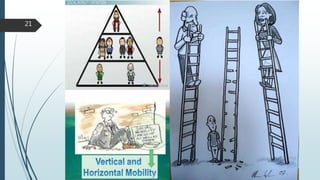
VERTICAL MOBILITY
DEFINITION:
 The movement of individuals or
groups to positions in society that involve a
change in class, status, and power.
EXPLANATION:
 It is a Type of social movement
in which a person or group moves up or down
in status. Vertical mobility can also apply
outside of social situations to any type of
movement that goes up or down a hierarchy of
some type.
18
VERTICAL MOBILITY TYPES
TYPES:
1: Upward Mobility
 2: Downward Mobility
UPWARD MOBILITY:
 Upwards involves an individual moving from a
group in a lower stratum to a higher one or the
creation of a similar group with a higher societal
position, instead of side by side with its existing
group
 Those who gain are called upward mobile.
19
VERTICAL MOBILITY CONTINUE
EXAMPLE:
 When a person born to poor parents becomes
a well-educated, wealthy businessperson, this is
an example of upward vertical social mobility.

 DOWNWARD MOBILITY:
.The movement of an individual from one social
level to a lower one is called downward
mobility.
 Those who move in opposite direction are
called downwordly mobile.
20
21
EXAMPLE:
 Downward mobility occurs for example
when a businessman incurs losses in his
business and is forced to declare
bankruptcy, resulting in a move to a
lower stratum of society
22
TERRITORIAL MOBILITY
DEFINITION:
 The change in locality, territory or
resistance when an individual move from
one place to another place is
called territorial mobility.
The trend of territorial mobility is
common in urban areas as compared to
rural areas.
23
24
TERRITORIAL MOBILITY CONTINUE
 In rural areas people dislike to leave their
places but in urban areas the people leave
one place and gent another on rent and
leave on city and migrate to another.
EXAMPLE:
 Migration of rural people to urban is a
common example of territorial mobility.
25
RELATIVE MOBILITY
 DEFINITION:
A measure of a person’s upward or
downward movement in the social hierarchy
compared to the movement of other
members of their inherited social class.
Relative mobility refers to the fluidity of a
society where if one person moves up in
relative terms another by definition must
have moved down i.e it is zero sum
proposition
26
RELATIVE MOBILITY
Relative mobility looks at the mobility of a
person in comparison to the mobility of
others in the same cohort or their parent. In
more advanced economies and OECD
( Organisation for Economic Co-operation and
Development) countries there is more space for
relative mobility.This is because developed
countries or advance economies have a
baseline for the conditions in which people
live that is better than it was years ago
27
RELATIVE MOBILITY EXAMPLE
The expectation that children's status
would exceed parents is an example of
relative mobility.
 The opportunities presented to a
middle class child born in a particular
area of the United States, who might be
predicted to attain a college level
education and a maximum income of
$80,000.
28
Conclusion
From the above mentioned discussion we
conclude that:
 The individual with in the society need to
move in order to improve their status and
social structure.
Social mobility is importatnt for the stability of
modern society.However too much social
mobility can lead instability in the social
structure.
29
QUESTIONS
 What do you understasnd by social
mobility?
 How horizontal mobility differs from
vertical mobility?
 What do you know about territorial
mobility?
 what is relative mobility?
30
REFERENCES
Principles of Sociology by “DR. Anwar Alam’’.
 www.dictionary.com
 www.study.com
 www.boundless.com
 studylecturenotes.com › social-mobility-
definition-types-of-social-mobility
www.sociologyguide.com/social-
mobility/types-of-mobility.php
31
REFERENCES
https://courses.lumenlearning.com/boun
dless-sociology/chapter/social-mobility/
 Introduction to Sociology lecturenotes
by “Zerihun Doda”(June 2005).
32
THANK YOU33

Social mobility

  • 1.
    SOCIAL MOBILITY ANDTYPES Submitted to : Ma’am Sadia Submitted by : Group 3rd Subject : Intro to Sociology Department : English Class : BS-3rd Dated : 24th November,2019 WOMEN UNIVERSITY MARDAN 1
  • 2.
    GROUP 3rd MEMBERS Nabia Naz (ENG-103)  Sundus Syed (ENG-84)  Laila Saba (ENG-69)  Gorgora Aftab (ENG-102) Minahil Khan (ENG-85) 2
  • 3.
  • 4.
    PRESENTATION TOPIC  SOCIALMOBILITY TYPES OF SOCIAL MOBILITY 4
  • 5.
    CONTENT LIST  Socialmobility definition (Laila Saba)  Horizontal mobility (Sundus Syed)  Vertical mobility (Minahil Khan)  Territorial mobility (Gorgora Aftab)  Relative mobility (Nabia Naz) 5
  • 6.
    OBJECTIVES To understand:  SocialMobility  Classification of Social mobility  Vertical Mobility  Horizontal Mobility  Territorial Mobility  Relative Mobility 6
  • 7.
    INTRODUCTION o Social mobilityis an important feature of modern society. o It refers to the movement of a person from one social role to another. o Modern class system cannot system without social mobility. Is is because class system is based upon achieved social roles and status. o Some people change their status from lower to higher while others may lose their higher status to lower 7
  • 8.
    DEFINITION FAIRCHILD : Social mobilityis a movement from one condition to another. BREDEMEYER and STEPHENSON : Social mobility is moving of an individual or group of people from one status to another. M. IQBAL CHAUDHRY : The movement of individuals with in social structure is called social mobility. 8
  • 9.
    Definition continue HORTON andHUNT : Social mobility may be defined as the act of moving from one social class to another. OR Social mobility is movement up and down in the social status and usually income and may be experienced by individuals or by entire group. 9
  • 10.
  • 11.
    TYPES / FORMSOF SOCIAL MOBILITY Social mobility is of different types. Some of them are given below: 1) Horizantal Mobility 2) Vertical Mobility 3) Territorial Mobility 4) Relative Mobility 11
  • 12.
    HORIZONTAL MOBILITY CONTINUE Sowhat do we mean by horizontal mobility? Before we can define horizontal mobility, we must first discuss what we mean when we use the term social status, since the two terms are related. Our social status refers to our rank in the social hierarchy and is based on several factors, including our Occupation, Wealth, Achievements, Education, Race and ethnicity Marital status 12
  • 13.
    HORIZONTAL MOBILITY DEFINITION:  Horizontalmobility refers to switching from one position to another without a change in social status. In order words, it's when we change our positions within our same level of social status, and we do not move up or down the social hierarchy. 13
  • 14.
    HORIZONTAL MOBILITY Horizontal mobilityrefers to switching from one position to another, but not changing your social status. EXAMPLE:  Learn about horizontal mobility from examples, how it differs from vertical mobility, and more. 14
  • 15.
  • 16.
    EXAMPLE CONTINUE Susie isa third-grade teacher at Wilheim Elementary School in a small suburban city. After two years of working at Wilheim Elementary, Susie decides that she no longer wants to live in a small town and would rather live in a major city. Susie interviews for jobs in Chicago, Atlanta, and Louisville in hopes of relocating to one of these cities. After three months of looking, Susie is offered a new position as a first- grade teacher at an urban school in Atlanta. Susie switching jobs is an example of horizontal mobility. 16
  • 17.
    EXAMPLE #2 If aclerk is transferred from one department to another with same status i-e with the same pay scale,the mobility in this case will be called horizontal mobility.  A factory worker who finds a new job as a construction worker. 17
  • 18.
    VERTICAL MOBILITY DEFINITION:  Themovement of individuals or groups to positions in society that involve a change in class, status, and power. EXPLANATION:  It is a Type of social movement in which a person or group moves up or down in status. Vertical mobility can also apply outside of social situations to any type of movement that goes up or down a hierarchy of some type. 18
  • 19.
    VERTICAL MOBILITY TYPES TYPES: 1:Upward Mobility  2: Downward Mobility UPWARD MOBILITY:  Upwards involves an individual moving from a group in a lower stratum to a higher one or the creation of a similar group with a higher societal position, instead of side by side with its existing group  Those who gain are called upward mobile. 19
  • 20.
    VERTICAL MOBILITY CONTINUE EXAMPLE: When a person born to poor parents becomes a well-educated, wealthy businessperson, this is an example of upward vertical social mobility.  DOWNWARD MOBILITY: .The movement of an individual from one social level to a lower one is called downward mobility.  Those who move in opposite direction are called downwordly mobile. 20
  • 21.
  • 22.
    EXAMPLE:  Downward mobilityoccurs for example when a businessman incurs losses in his business and is forced to declare bankruptcy, resulting in a move to a lower stratum of society 22
  • 23.
    TERRITORIAL MOBILITY DEFINITION:  Thechange in locality, territory or resistance when an individual move from one place to another place is called territorial mobility. The trend of territorial mobility is common in urban areas as compared to rural areas. 23
  • 24.
  • 25.
    TERRITORIAL MOBILITY CONTINUE In rural areas people dislike to leave their places but in urban areas the people leave one place and gent another on rent and leave on city and migrate to another. EXAMPLE:  Migration of rural people to urban is a common example of territorial mobility. 25

  • 26.
    RELATIVE MOBILITY  DEFINITION: Ameasure of a person’s upward or downward movement in the social hierarchy compared to the movement of other members of their inherited social class. Relative mobility refers to the fluidity of a society where if one person moves up in relative terms another by definition must have moved down i.e it is zero sum proposition 26
  • 27.
    RELATIVE MOBILITY Relative mobilitylooks at the mobility of a person in comparison to the mobility of others in the same cohort or their parent. In more advanced economies and OECD ( Organisation for Economic Co-operation and Development) countries there is more space for relative mobility.This is because developed countries or advance economies have a baseline for the conditions in which people live that is better than it was years ago 27
  • 28.
    RELATIVE MOBILITY EXAMPLE Theexpectation that children's status would exceed parents is an example of relative mobility.  The opportunities presented to a middle class child born in a particular area of the United States, who might be predicted to attain a college level education and a maximum income of $80,000. 28

  • 29.
    Conclusion From the abovementioned discussion we conclude that:  The individual with in the society need to move in order to improve their status and social structure. Social mobility is importatnt for the stability of modern society.However too much social mobility can lead instability in the social structure. 29
  • 30.
    QUESTIONS  What doyou understasnd by social mobility?  How horizontal mobility differs from vertical mobility?  What do you know about territorial mobility?  what is relative mobility? 30
  • 31.
    REFERENCES Principles of Sociologyby “DR. Anwar Alam’’.  www.dictionary.com  www.study.com  www.boundless.com  studylecturenotes.com › social-mobility- definition-types-of-social-mobility www.sociologyguide.com/social- mobility/types-of-mobility.php 31
  • 32.
  • 33.