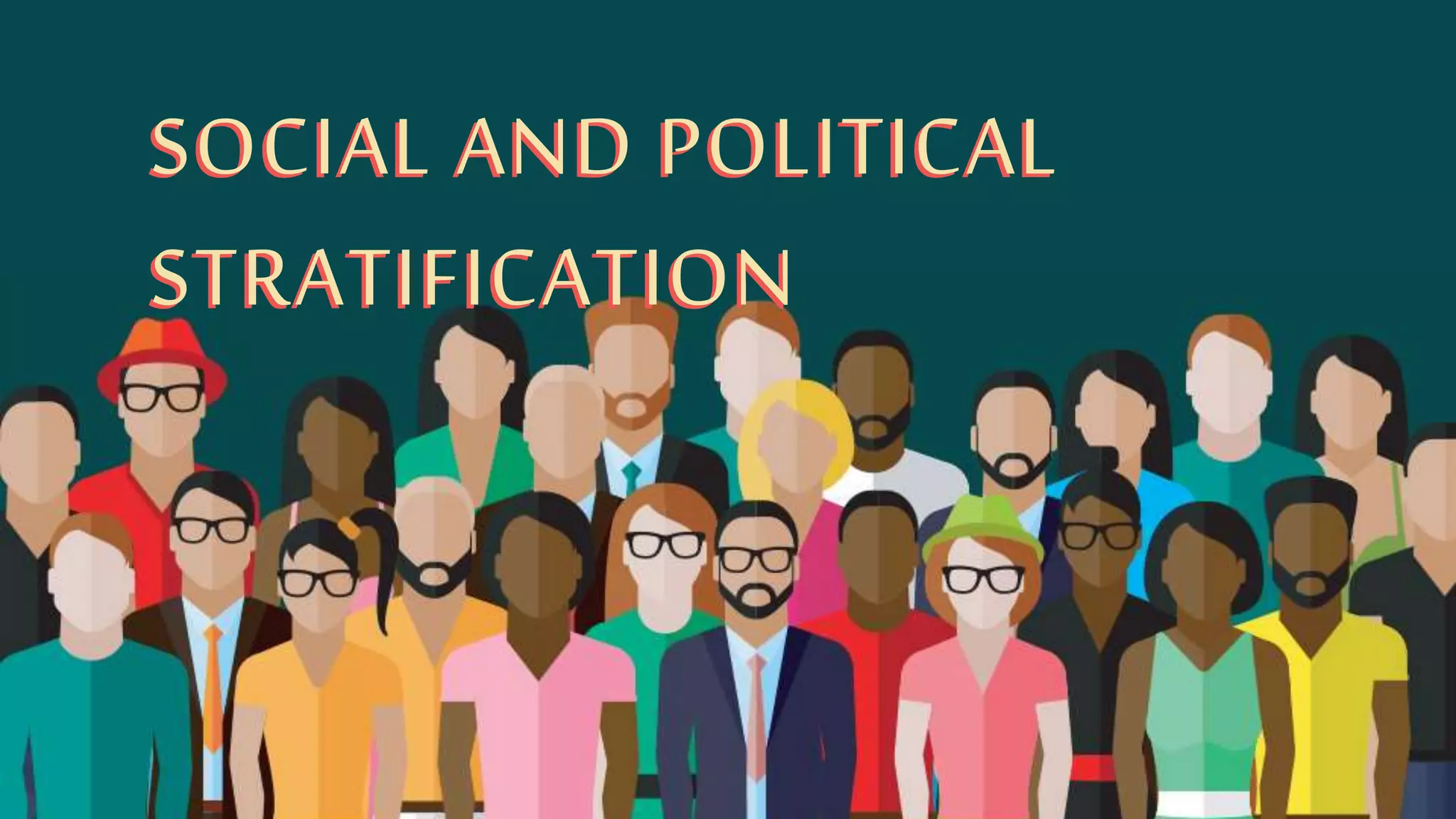
SOCIAL AND POLITICAL
STRATIFICATION
SOCIAL AND POLITICAL
STRATIFICATION
The Concept of Social Stratification
Social Stratification
refers to the division of large social groups into smaller groups
based on categories determined by economics. Members of society
are arranged in hierarchy based on their access to or control over
basic economic resources.
GIVES RISE TO
INEQUALITY“SOCIAL STANDING”
The Concept of Social Stratification
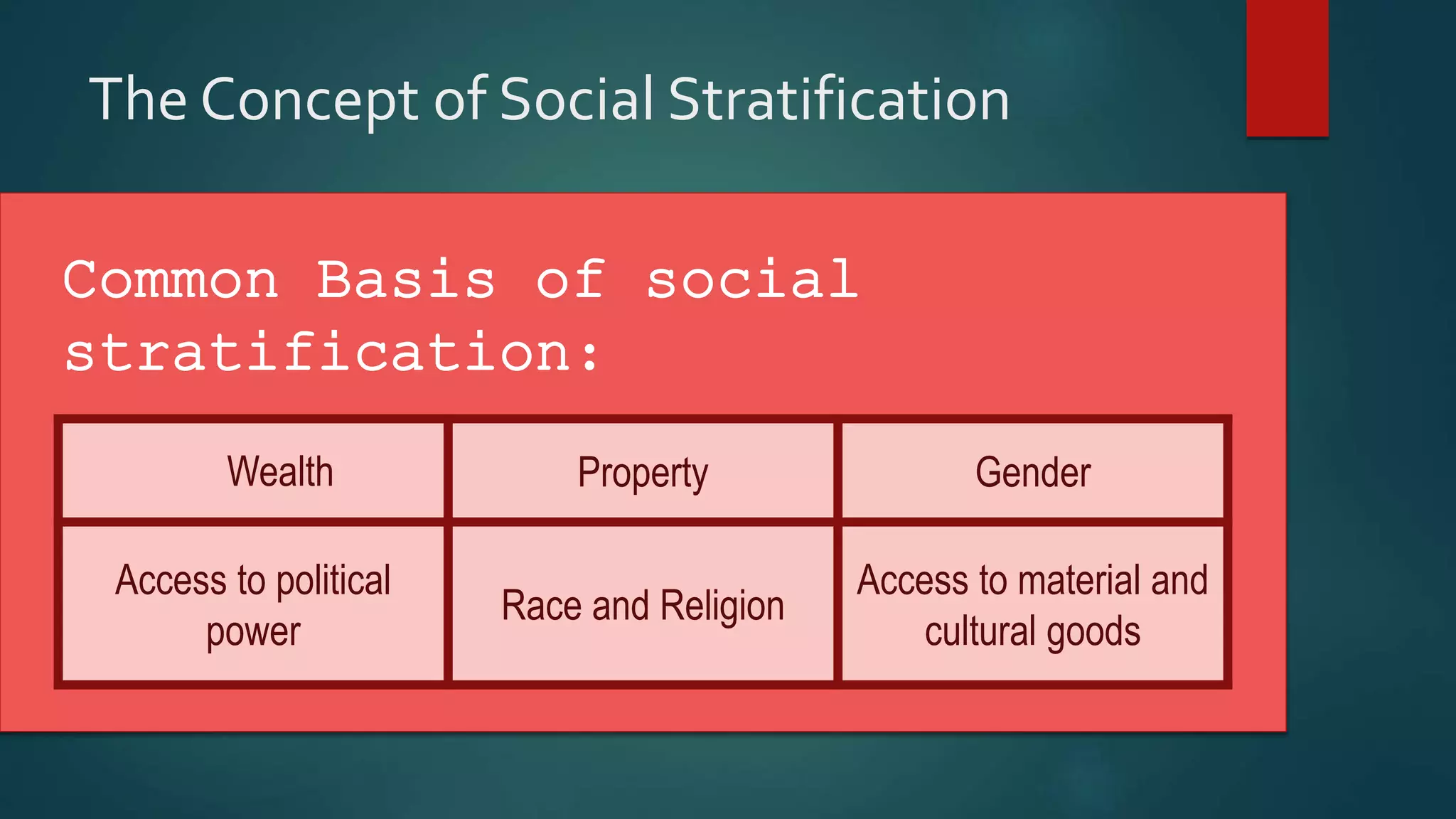
Common Basis of social
stratification:
Wealth Property Gender
Access to political
power
Race and Religion
Access to material and
cultural goods
The Concept of Social Stratification
SOCIAL
EXCLUSION
Process by which individuals are cut off from full
involvement in the wider circles of society. May
be due to poor housing, lack of employment,
inferior schools, or limited transportations. Leads
to lack of opportunities for self-improvement.
SYSTEMS OF STRATIFICATION
 Closed
• Impose rigid boundaries between social groups
• Limit interactions between members who belong to different social groups or
occupy different levels in social hierarchy.
• Resistant to change in social roles
 Open
• Mainly based on achievement, allowing more flexibility in social roles, increased
social mobility, and better interaction
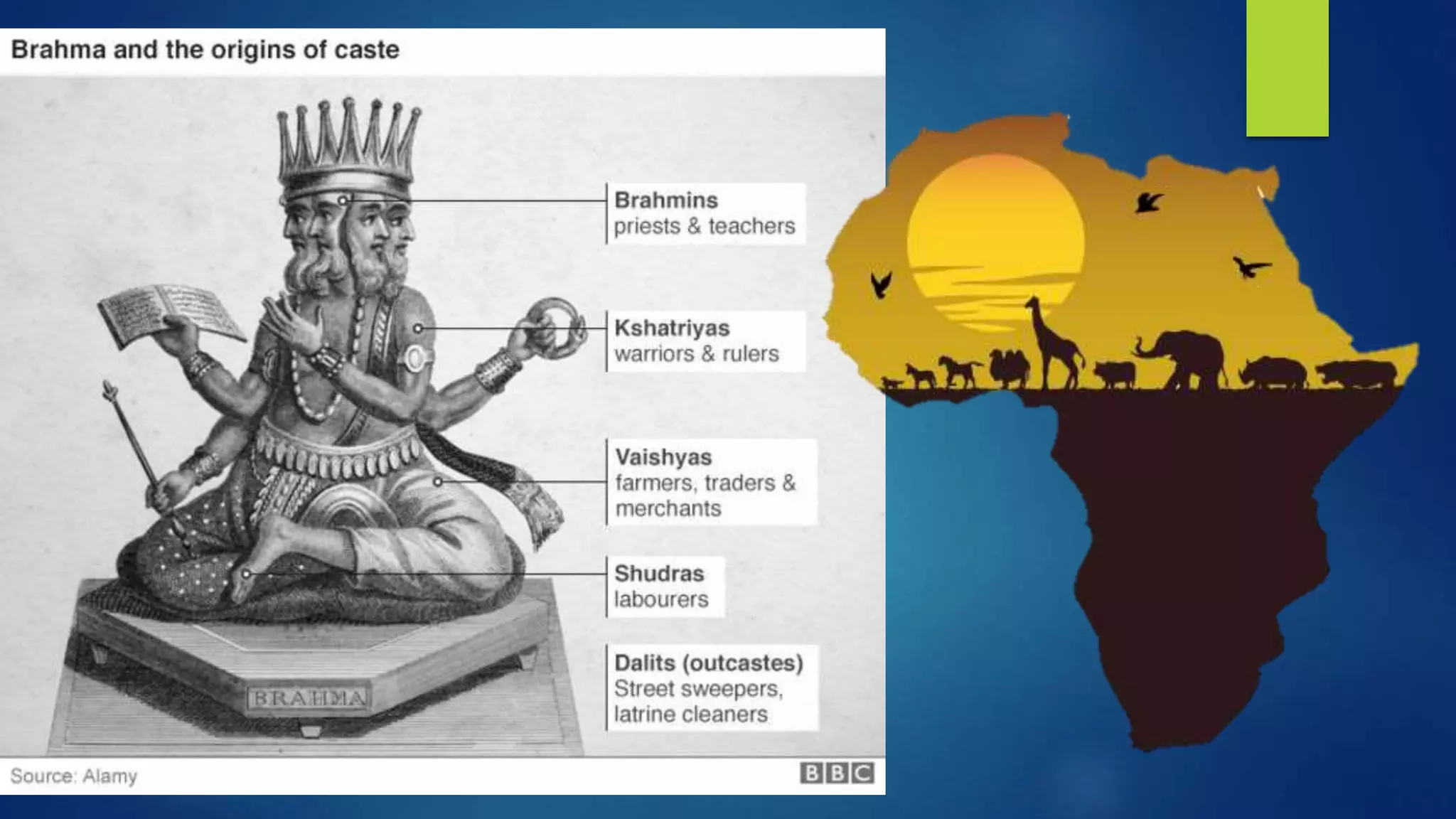
Caste Systems
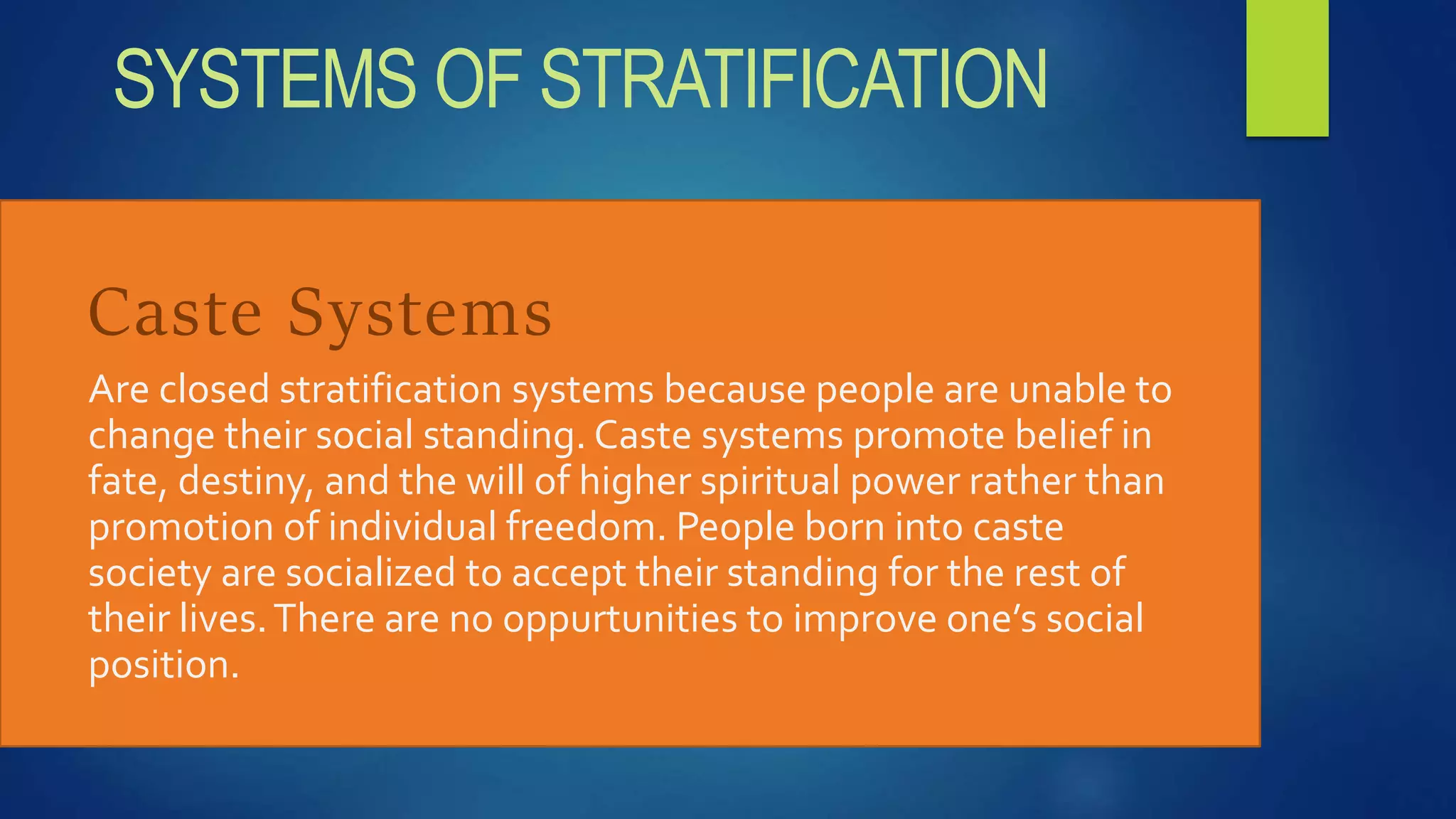
Are closed stratification systems because people are unable to
change their social standing. Caste systems promote belief in
fate, destiny, and the will of higher spiritual power rather than
promotion of individual freedom. People born into caste
society are socialized to accept their standing for the rest of
their lives.There are no oppurtunities to improve one’s social
position.
SYSTEMS OF STRATIFICATION
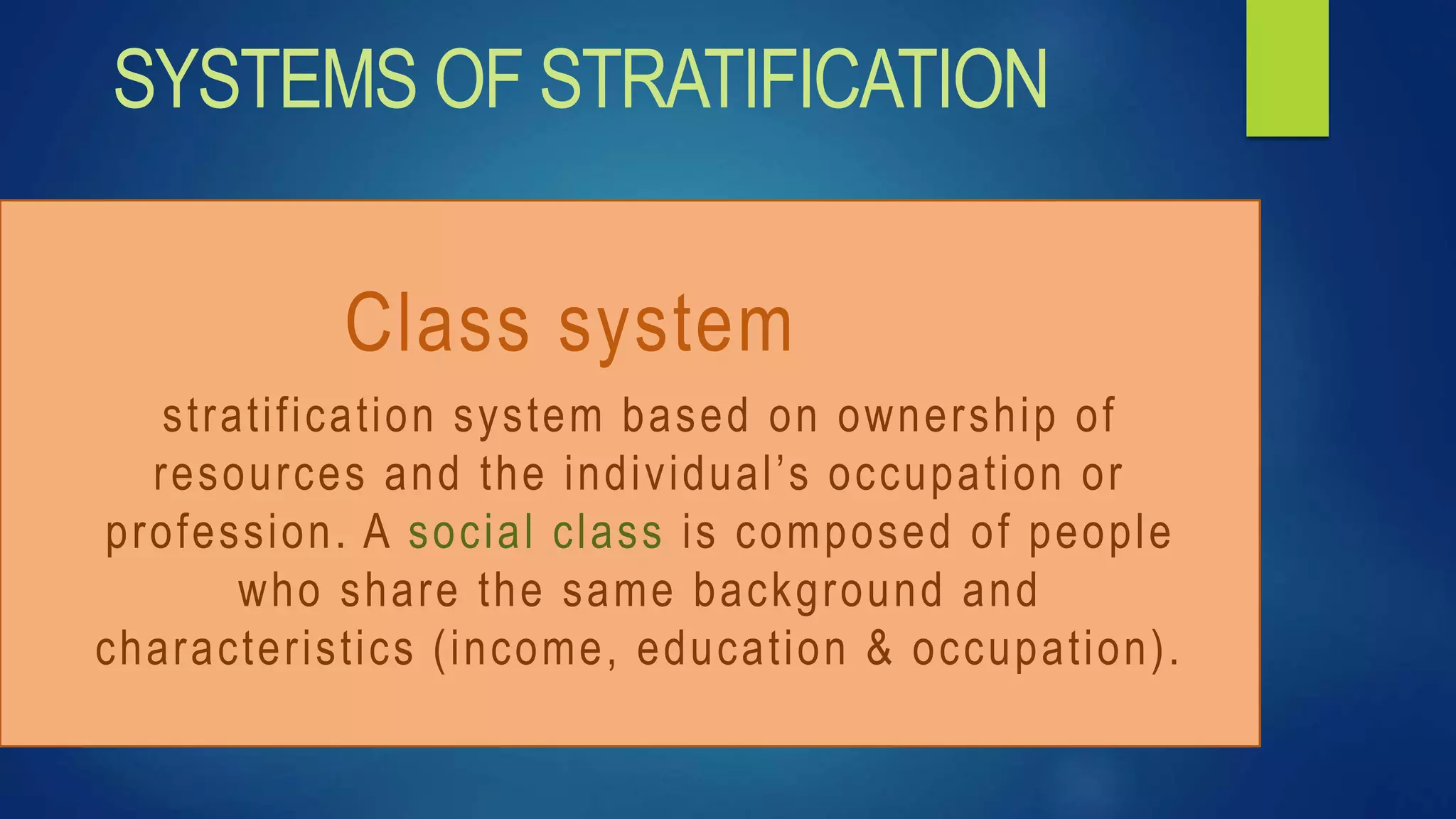
Class system
stratification system based on ownership of
resources and the individual’s occupation or
profession. A social class is composed of people
who share the same background and
characteristics (income, education & occupation).
SYSTEMS OF STRATIFICATION
Class system
People are free to move from one social
class to another and achieve higher status in
life through education and employment.
Openness in class systems results in
prevalence of exogamous marriages.
SYSTEMS OF STRATIFICATION
exogamous marriages
Marriages between people from different social
classes
endogamous marriages
Marriages between people from same social class
SYSTEMS OF STRATIFICATION
MERITOCRACY
System of stratification that is determined by
personal effort and merit. Social standing
advancements are determined by how well a
person performs his or her social role.
However it remains an ideal and is only
implemented in business or industry.
SYSTEMS OF STRATIFICATION
SOCIETY IN GENERAL,
STILL REMAINS STRONGLY
INFLUENCED BY OTHER
FACTORS SUCH AS
INHERITANCE AND
PRESSURE TO CONFORM.
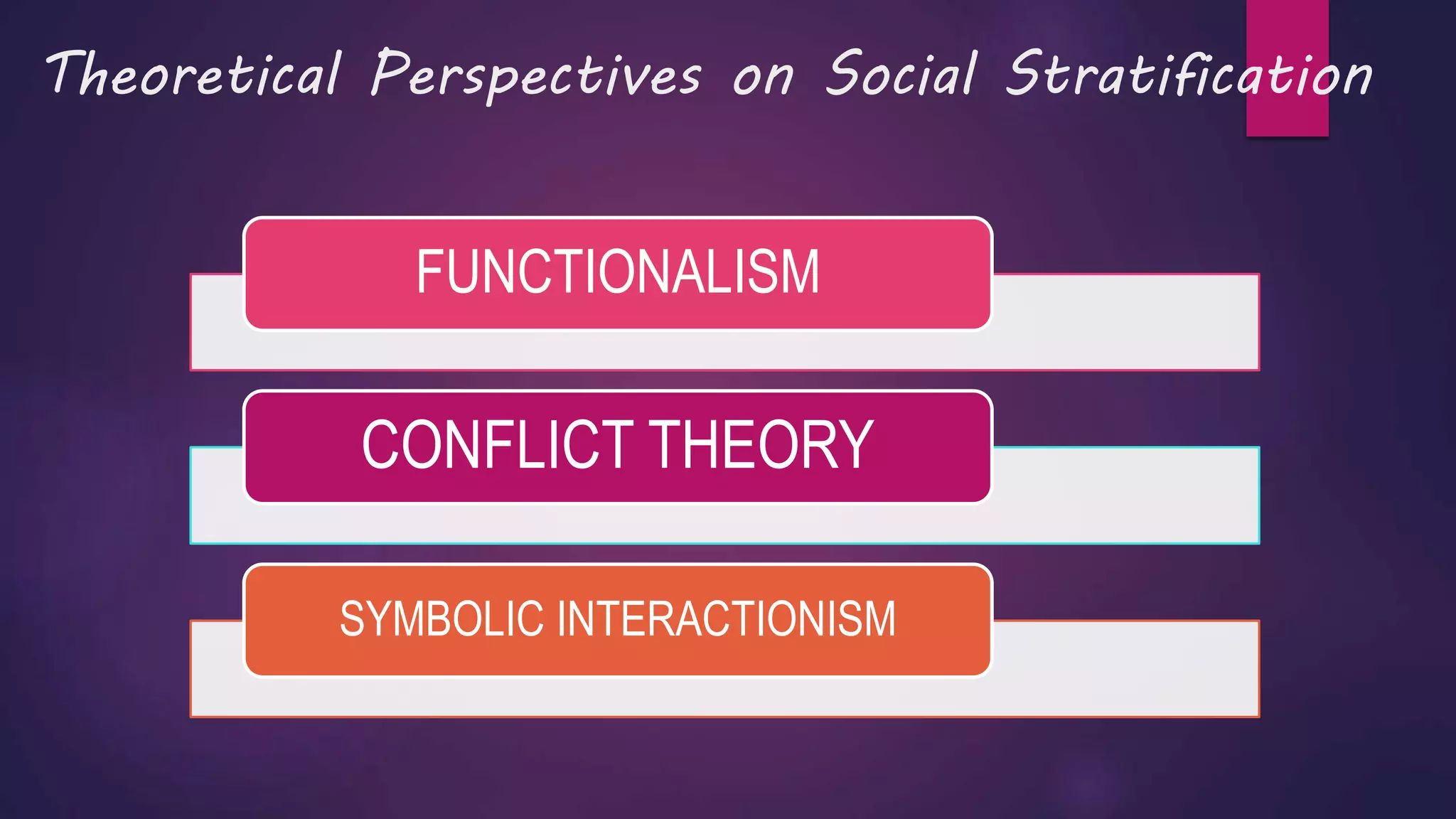
Theoretical Perspectives on Social Stratification
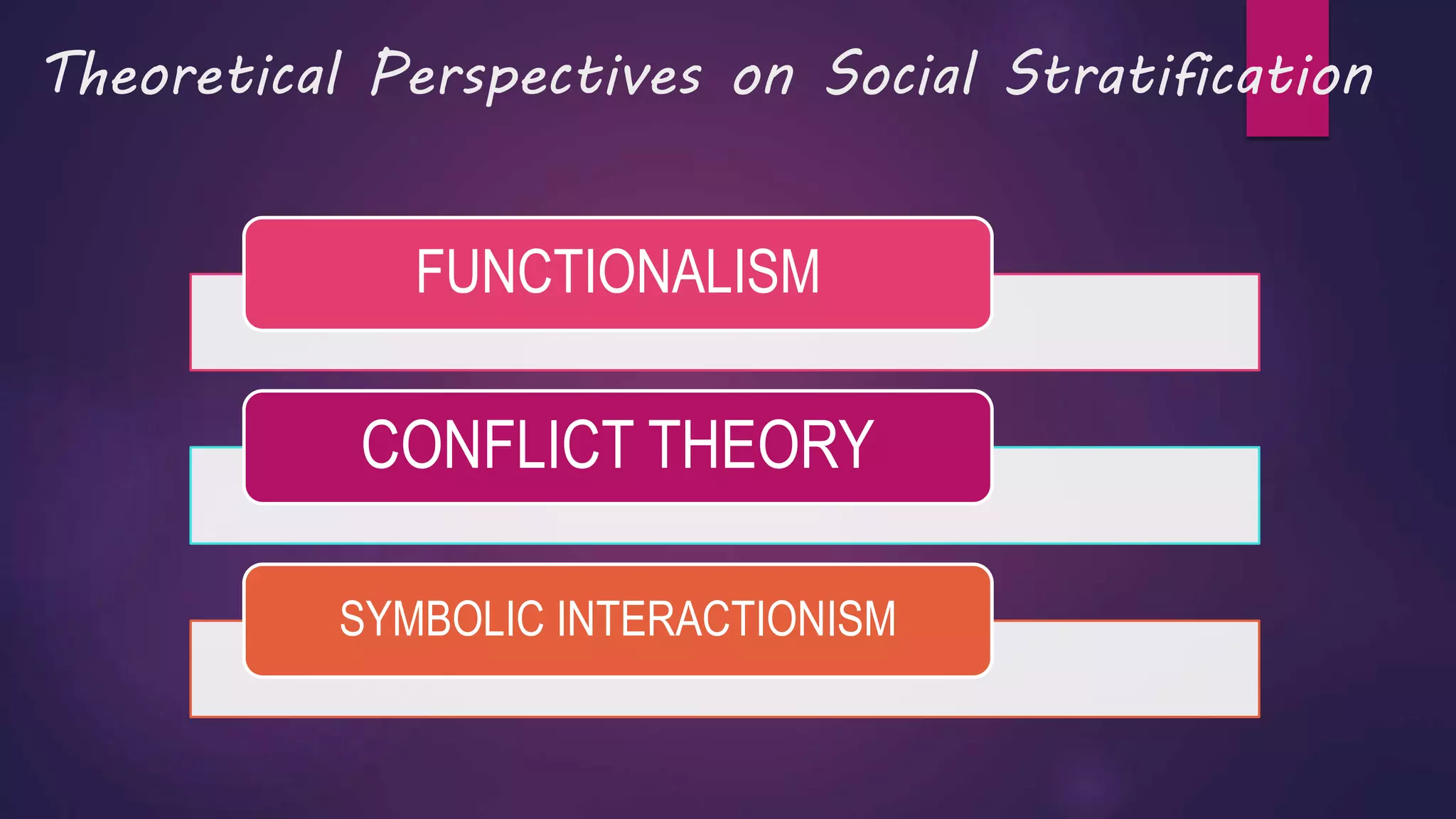
FUNCTIONALISM
CONFLICT THEORY
SYMBOLIC INTERACTIONISM
Theoretical Perspectives on Social Stratification
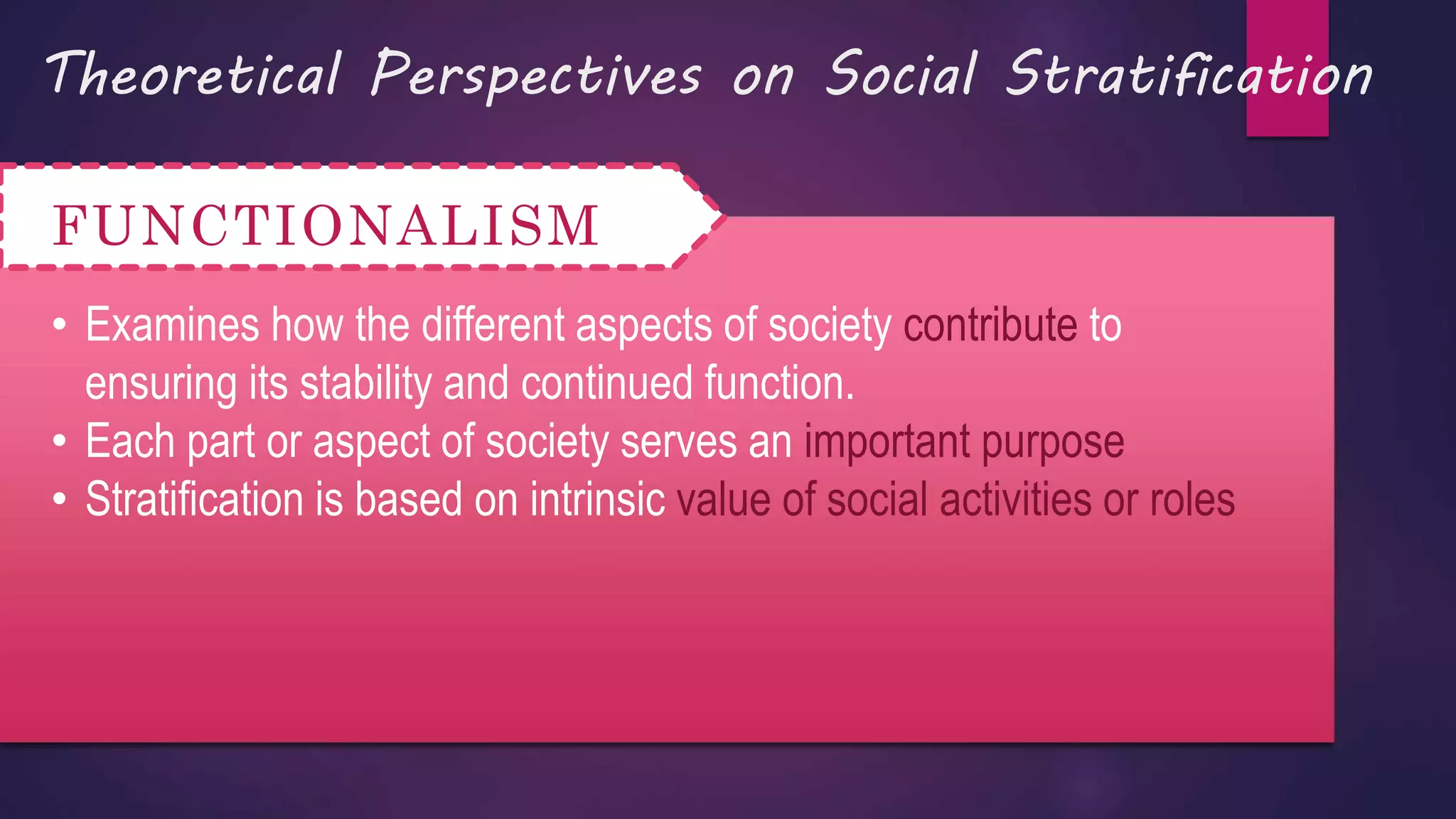
FUNCTIONALISM
• Examines how the different aspects of society contribute to
ensuring its stability and continued function.
• Each part or aspect of society serves an important purpose
• Stratification is based on intrinsic value of social activities or roles
Theoretical Perspectives on Social Stratification
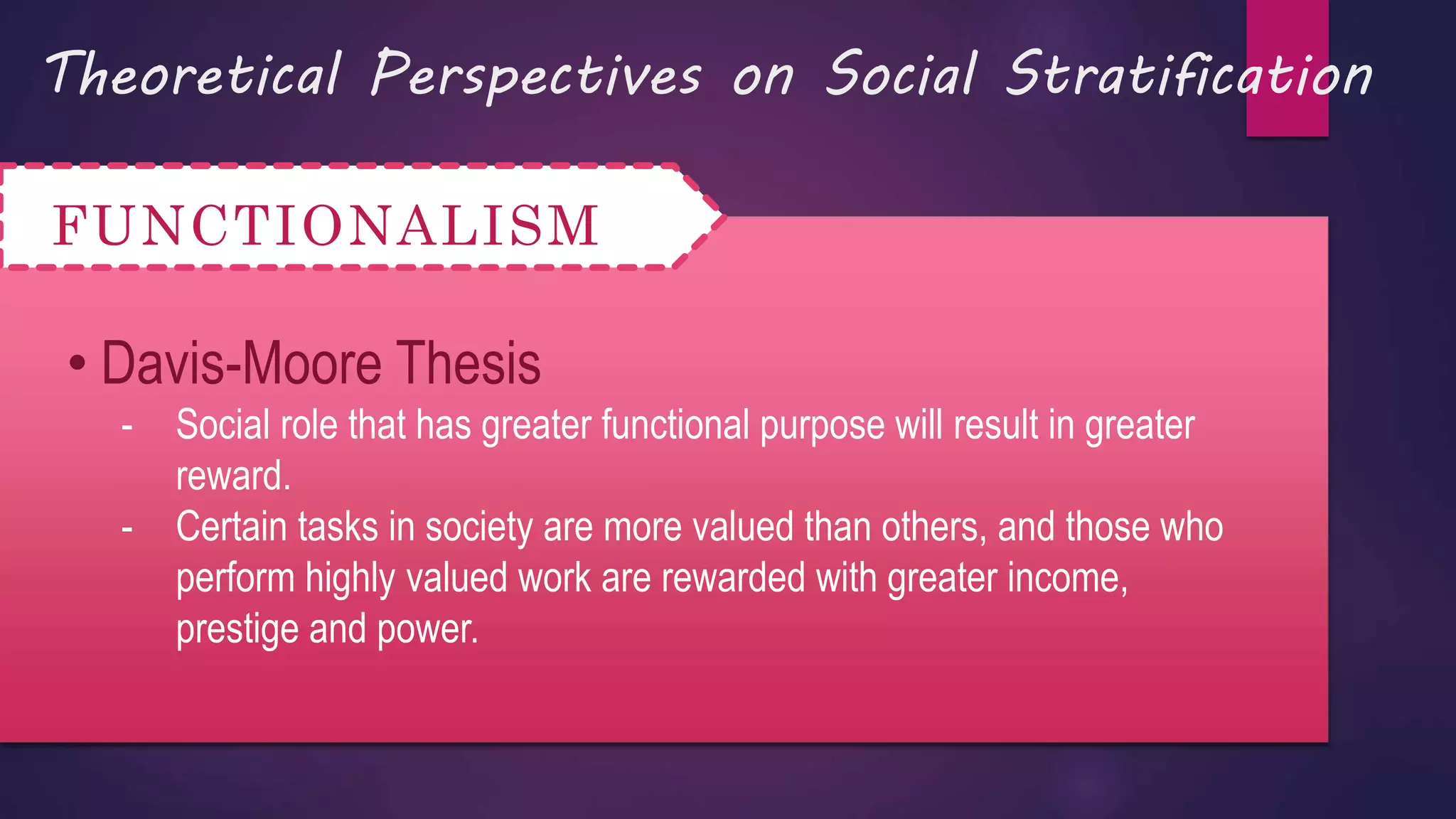
FUNCTIONALISM
• Davis-Moore Thesis
- Social role that has greater functional purpose will result in greater
reward.
- Certain tasks in society are more valued than others, and those who
perform highly valued work are rewarded with greater income,
prestige and power.
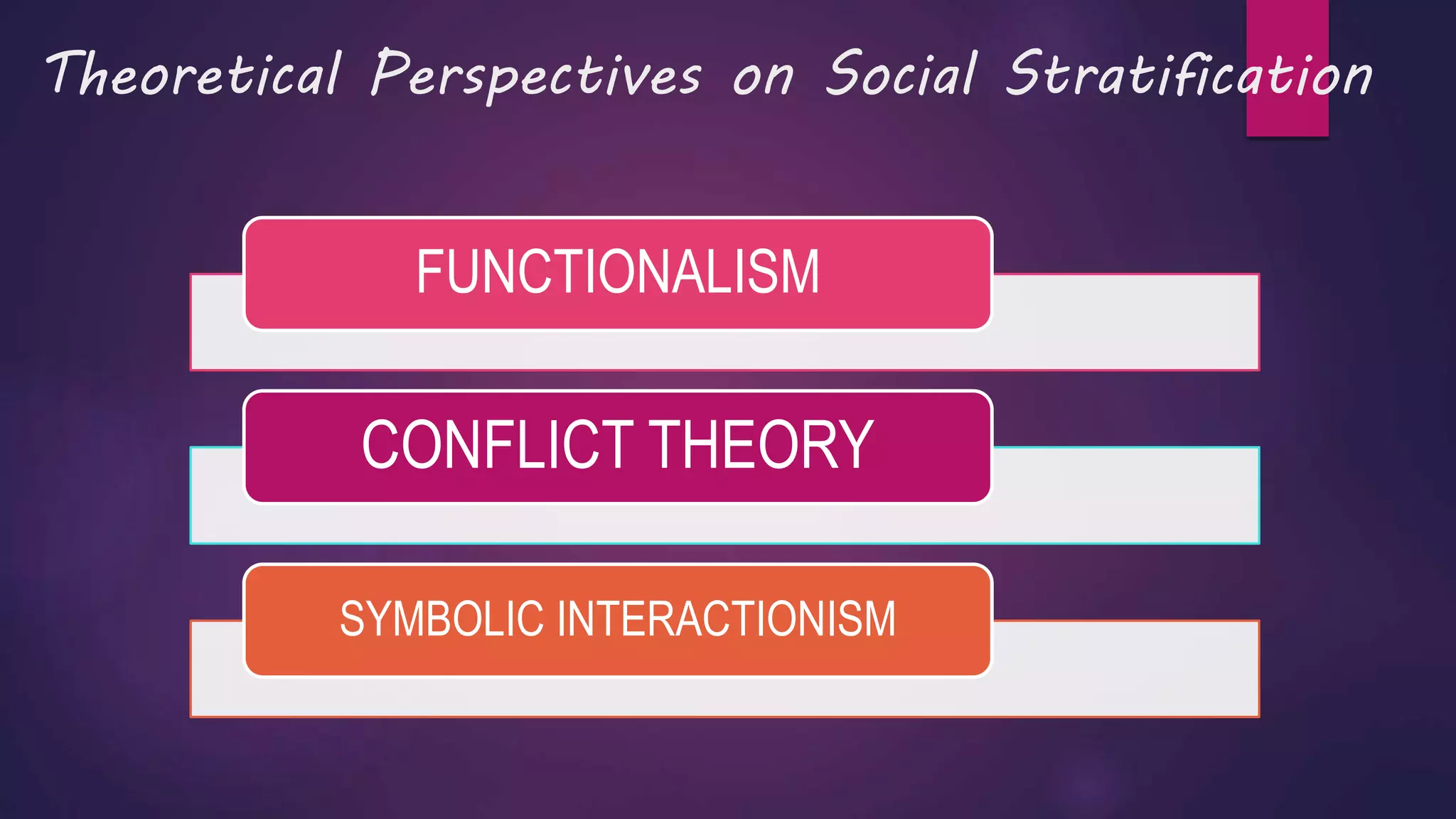
Theoretical Perspectives on Social Stratification
FUNCTIONALISM
CONFLICT THEORY
SYMBOLIC INTERACTIONISM
Theoretical Perspectives on Social Stratification
CONFLICT THEORY
• Takes critical view of social stratification
• Considers society as benefitting only a small segment
• Stratification causes inequality
• Drawn from ideas of Karl Marx
Theoretical Perspectives on Social Stratification
CONFLICT THEORY
• Karl Marx
- social stratification is influences by economic forces and relationships in society
are defined by factors of production.
- Two groups:
• Bourgeois (capitalists) – own factors of production ( land, resources,
business and ploretariat ); UPPERCLASS
• Ploretariat – workers who provide manual labor; LOWERCLASS
Theoretical Perspectives on Social Stratification
CONFLICT THEORY
• Karl Marx
- INEQUALITY CAUSES WORKERS TO
EXPERIENCE ALIENATION, ISOLATION, AND
GREAT MISERY DUE TO POWERLESS STATUS.
THIS LEADS TO CLASS CONFLICT.
Theoretical Perspectives on Social Stratification
FUNCTIONALISM
CONFLICT THEORY
SYMBOLIC INTERACTIONISM
Theoretical Perspectives on Social Stratification
SYMBOLIC INTERACTIONISM
• Microlevel perspective
• Attempts to explain how people’s social standing affects their
everyday interactions
• Leads to interaction within the same class.
• Stratification becomes a System that GROUPS people
(interests, background, way of life)
Theoretical Perspectives on Social Stratification
SYMBOLIC INTERACTIONISM
• People’s appearance reflects their perceived social
standing
• Theory of Conspicuous Consumption
- Buying certain products to make a social statement about a
status
Social MobilitySocial Mobility
• Ability of individuals or groups to change their
positions within a social stratification system
• How individuals progress from a lower to a higher
class, or how they lose their status and occupy much
lower position in society
• Major factor: Economic status (accumulation of wealth)
Social MobilitySocial Mobility
• TWO MAIN TYPES:
a) Upward Mobility – upward movement in social class.
May be through education, employment or marriage.
a) Downward Mobility – lowering of social class. Brought
by economic setbacks, unemployment, illness and
dropping out of school.
Social MobilitySocial Mobility
• Classification based on GENERATION:
a) Intragenerational
- focuses on experiences of people who belong to same
generation.
- changes in mobility throughout the person’s lifetime
a) Downward Mobility
- Changes in individuals belonging to different
generations
Social MobilitySocial Mobility
• STRUCTURAL MOBILITY
- large-scale changes resulting in
improvement or decline of the conditions
and status of a large group of people.
- Main example: Industrial Age
Social Inequality
Societies are usually characterized by
divisions that reflect unequal distribution
of status, wealth, and power within
society.
SOCIAL INEQUALITY AND POVERTY

Ucsp presentation

  • 1.
    SOCIAL AND POLITICAL STRATIFICATION SOCIALAND POLITICAL STRATIFICATION
  • 2.
    The Concept ofSocial Stratification Social Stratification refers to the division of large social groups into smaller groups based on categories determined by economics. Members of society are arranged in hierarchy based on their access to or control over basic economic resources. GIVES RISE TO INEQUALITY“SOCIAL STANDING”
  • 3.
    The Concept ofSocial Stratification Common Basis of social stratification: Wealth Property Gender Access to political power Race and Religion Access to material and cultural goods
  • 4.
    The Concept ofSocial Stratification SOCIAL EXCLUSION Process by which individuals are cut off from full involvement in the wider circles of society. May be due to poor housing, lack of employment, inferior schools, or limited transportations. Leads to lack of opportunities for self-improvement.
  • 5.
    SYSTEMS OF STRATIFICATION Closed • Impose rigid boundaries between social groups • Limit interactions between members who belong to different social groups or occupy different levels in social hierarchy. • Resistant to change in social roles  Open • Mainly based on achievement, allowing more flexibility in social roles, increased social mobility, and better interaction
  • 6.
    Caste Systems Are closedstratification systems because people are unable to change their social standing. Caste systems promote belief in fate, destiny, and the will of higher spiritual power rather than promotion of individual freedom. People born into caste society are socialized to accept their standing for the rest of their lives.There are no oppurtunities to improve one’s social position. SYSTEMS OF STRATIFICATION
  • 8.
    Class system stratification systembased on ownership of resources and the individual’s occupation or profession. A social class is composed of people who share the same background and characteristics (income, education & occupation). SYSTEMS OF STRATIFICATION
  • 9.
    Class system People arefree to move from one social class to another and achieve higher status in life through education and employment. Openness in class systems results in prevalence of exogamous marriages. SYSTEMS OF STRATIFICATION
  • 10.
    exogamous marriages Marriages betweenpeople from different social classes endogamous marriages Marriages between people from same social class SYSTEMS OF STRATIFICATION
  • 11.
    SYSTEMS OF STRATIFICATION MERITOCRACY Systemof stratification that is determined by personal effort and merit. Social standing advancements are determined by how well a person performs his or her social role. However it remains an ideal and is only implemented in business or industry.
  • 12.
    SYSTEMS OF STRATIFICATION SOCIETYIN GENERAL, STILL REMAINS STRONGLY INFLUENCED BY OTHER FACTORS SUCH AS INHERITANCE AND PRESSURE TO CONFORM.
  • 13.
    Theoretical Perspectives onSocial Stratification FUNCTIONALISM CONFLICT THEORY SYMBOLIC INTERACTIONISM
  • 14.
    Theoretical Perspectives onSocial Stratification FUNCTIONALISM • Examines how the different aspects of society contribute to ensuring its stability and continued function. • Each part or aspect of society serves an important purpose • Stratification is based on intrinsic value of social activities or roles
  • 15.
    Theoretical Perspectives onSocial Stratification FUNCTIONALISM • Davis-Moore Thesis - Social role that has greater functional purpose will result in greater reward. - Certain tasks in society are more valued than others, and those who perform highly valued work are rewarded with greater income, prestige and power.
  • 16.
    Theoretical Perspectives onSocial Stratification FUNCTIONALISM CONFLICT THEORY SYMBOLIC INTERACTIONISM
  • 17.
    Theoretical Perspectives onSocial Stratification CONFLICT THEORY • Takes critical view of social stratification • Considers society as benefitting only a small segment • Stratification causes inequality • Drawn from ideas of Karl Marx
  • 18.
    Theoretical Perspectives onSocial Stratification CONFLICT THEORY • Karl Marx - social stratification is influences by economic forces and relationships in society are defined by factors of production. - Two groups: • Bourgeois (capitalists) – own factors of production ( land, resources, business and ploretariat ); UPPERCLASS • Ploretariat – workers who provide manual labor; LOWERCLASS
  • 19.
    Theoretical Perspectives onSocial Stratification CONFLICT THEORY • Karl Marx - INEQUALITY CAUSES WORKERS TO EXPERIENCE ALIENATION, ISOLATION, AND GREAT MISERY DUE TO POWERLESS STATUS. THIS LEADS TO CLASS CONFLICT.
  • 20.
    Theoretical Perspectives onSocial Stratification FUNCTIONALISM CONFLICT THEORY SYMBOLIC INTERACTIONISM
  • 21.
    Theoretical Perspectives onSocial Stratification SYMBOLIC INTERACTIONISM • Microlevel perspective • Attempts to explain how people’s social standing affects their everyday interactions • Leads to interaction within the same class. • Stratification becomes a System that GROUPS people (interests, background, way of life)
  • 22.
    Theoretical Perspectives onSocial Stratification SYMBOLIC INTERACTIONISM • People’s appearance reflects their perceived social standing • Theory of Conspicuous Consumption - Buying certain products to make a social statement about a status
  • 23.
    Social MobilitySocial Mobility •Ability of individuals or groups to change their positions within a social stratification system • How individuals progress from a lower to a higher class, or how they lose their status and occupy much lower position in society • Major factor: Economic status (accumulation of wealth)
  • 24.
    Social MobilitySocial Mobility •TWO MAIN TYPES: a) Upward Mobility – upward movement in social class. May be through education, employment or marriage. a) Downward Mobility – lowering of social class. Brought by economic setbacks, unemployment, illness and dropping out of school.
  • 25.
    Social MobilitySocial Mobility •Classification based on GENERATION: a) Intragenerational - focuses on experiences of people who belong to same generation. - changes in mobility throughout the person’s lifetime a) Downward Mobility - Changes in individuals belonging to different generations
  • 26.
    Social MobilitySocial Mobility •STRUCTURAL MOBILITY - large-scale changes resulting in improvement or decline of the conditions and status of a large group of people. - Main example: Industrial Age
  • 27.
    Social Inequality Societies areusually characterized by divisions that reflect unequal distribution of status, wealth, and power within society. SOCIAL INEQUALITY AND POVERTY