Some Basic Concepts
Shyamasree Saha
Ph.D. Scholar
NIT Agartala
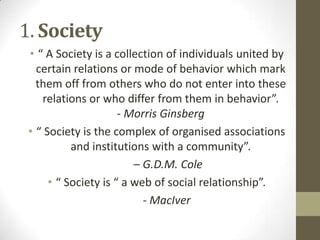
1. Society
• “ A Society is a collection of individuals united by
certain relations or mode of behavior which mark
them off from others who do not enter into these
relations or who differ from them in behavior”.
- Morris Ginsberg
• “ Society is the complex of organised associations
and institutions with a community”.
– G.D.M. Cole
• “ Society is “ a web of social relationship”.
- MacIver
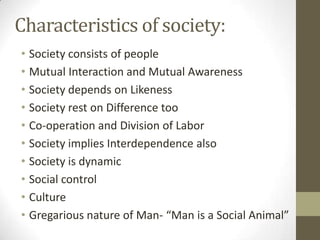
Characteristics of society:
• Society consists of people
• Mutual Interaction and Mutual Awareness
• Society depends on Likeness
• Society rest on Difference too
• Co-operation and Division of Labor
• Society implies Interdependence also
• Society is dynamic
• Social control
• Culture
• Gregarious nature of Man- “Man is a Social Animal”
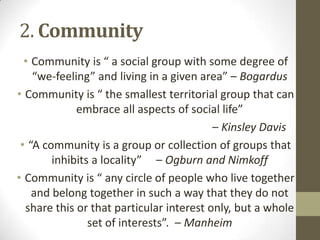
2. Community
• Community is “ a social group with some degree of
“we-feeling” and living in a given area” – Bogardus
• Community is “ the smallest territorial group that can
embrace all aspects of social life”
– Kinsley Davis
• “A community is a group or collection of groups that
inhibits a locality” – Ogburn and Nimkoff
• Community is “ any circle of people who live together
and belong together in such a way that they do not
share this or that particular interest only, but a whole
set of interests”. – Manheim
Main Elements of Community:
The main bases of community are:
• Locality: A community is a territorial
group. It occupies some geographical area.
Locality is the physical basis of community.
Living together facilitates people to
develop social contacts, give protection,
safety and security. Further, the very
physical conditions may influence social
life to a great extent.
Contd.
• Community Sentiment: It means a feeling
of belonging together. The members must
be aware of their staying together and
sharing common interest. The members
develop a sense of “we-feeling”. It means
a kind of identification with the group.
Without a sense of identification, a sense
of awareness, a sense of living and
sharing some common interest in life ,
there can not be any community.
Other Aspects of Community:
• Stability
• Naturalness
• Size of community
• Regulation of Relations
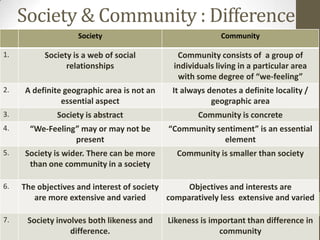
Society & Community : Difference
Society Community
1. Society is a web of social
relationships
Community consists of a group of
individuals living in a particular area
with some degree of “we-feeling”
2. A definite geographic area is not an
essential aspect
It always denotes a definite locality /
geographic area
3. Society is abstract Community is concrete
4. “We-Feeling” may or may not be
present
“Community sentiment” is an essential
element
5. Society is wider. There can be more
than one community in a society
Community is smaller than society
6. The objectives and interest of society
are more extensive and varied
Objectives and interests are
comparatively less extensive and varied
7. Society involves both likeness and
difference.
Likeness is important than difference in
community
3. Association
• An Association is “ an organization deliberately
formed for the collective pursuit of some interests,
or a set of interests, which its members share”.
– R.M.MacIver
• An Association is “ a group of social beings related
to one another by the fact that they possess or
have instituted in common an organization with a
view to securing a specific end or specific ends”.
– Morris Ginsberg
Characteristics of Association:
• Association- a Human Group
• Common Interest or Interests
• Co-operative Spirit
• Organization
• Regulation of Relations
• Association as Agencies
• Durability of Association
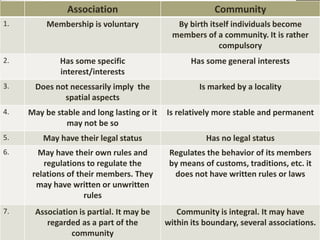
Association Community
1. Membership is voluntary By birth itself individuals become
members of a community. It is rather
compulsory
2. Has some specific
interest/interests
Has some general interests
3. Does not necessarily imply the
spatial aspects
Is marked by a locality
4. May be stable and long lasting or it
may not be so
Is relatively more stable and permanent
5. May have their legal status Has no legal status
6. May have their own rules and
regulations to regulate the
relations of their members. They
may have written or unwritten
rules
Regulates the behavior of its members
by means of customs, traditions, etc. it
does not have written rules or laws
7. Association is partial. It may be
regarded as a part of the
community
Community is integral. It may have
within its boundary, several associations.
4. Institution:
• Institutions “may be described as
recognized and established usages
governing the relations between
individuals and groups”. – Ginsberg
• Institutions represent “ the social structure
and the machinery through which human
society organizes, directs and executes the
multifarious activities required to satisfy
human needs”. – H.E. Barnes
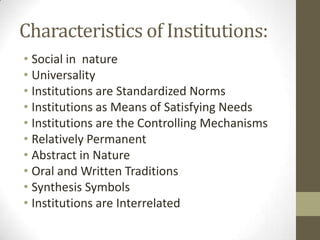
Characteristics of Institutions:
• Social in nature
• Universality
• Institutions are Standardized Norms
• Institutions as Means of Satisfying Needs
• Institutions are the Controlling Mechanisms
• Relatively Permanent
• Abstract in Nature
• Oral and Written Traditions
• Synthesis Symbols
• Institutions are Interrelated
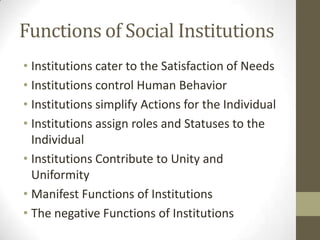
Functions of Social Institutions
• Institutions cater to the Satisfaction of Needs
• Institutions control Human Behavior
• Institutions simplify Actions for the Individual
• Institutions assign roles and Statuses to the
Individual
• Institutions Contribute to Unity and
Uniformity
• Manifest Functions of Institutions
• The negative Functions of Institutions
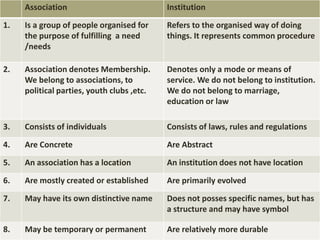
Association Institution
1. Is a group of people organised for
the purpose of fulfilling a need
/needs
Refers to the organised way of doing
things. It represents common procedure
2. Association denotes Membership.
We belong to associations, to
political parties, youth clubs ,etc.
Denotes only a mode or means of
service. We do not belong to institution.
We do not belong to marriage,
education or law
3. Consists of individuals Consists of laws, rules and regulations
4. Are Concrete Are Abstract
5. An association has a location An institution does not have location
6. Are mostly created or established Are primarily evolved
7. May have its own distinctive name Does not posses specific names, but has
a structure and may have symbol
8. May be temporary or permanent Are relatively more durable
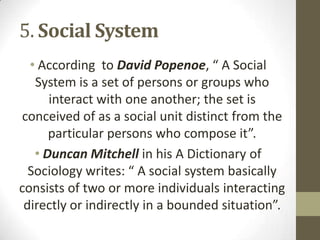
5. Social System
• According to David Popenoe, “ A Social
System is a set of persons or groups who
interact with one another; the set is
conceived of as a social unit distinct from the
particular persons who compose it”.
• Duncan Mitchell in his A Dictionary of
Sociology writes: “ A social system basically
consists of two or more individuals interacting
directly or indirectly in a bounded situation”.
Characteristics of Social System:
• Social system consists of two or more individuals
among whom we find an established pattern of
interaction.
• Individuals in their actions take account of how the
others are likely to act or behave
• Individuals in the system behave in accordance with
their shared cultural norms and values.
• Individuals in the system act together in pursuit of
common goals or rewards.
• “Social System” as a concepts may represent entire
society or a no. of subsystem such as political system,
judicial system, etc.
• A social system has its own boundary with the help of
which it can be distinguished from other social
systems.
Elements of Social System
• The Social Act – is a process in the social system that
motivates the individual/ individuals in the case of a group.
The orientation of action has a close relation with the
attainment of satisfaction of the actor
• The Actor- it is he who holds the status and performs the
role. A social system must have a sufficient proportion of
actors. Those actors must be sufficiently motivated to act
according to the requirements of its role system
• The Role & Status – the social system involves participation
of actor in the process of interactive relationship. The Role
denotes the functional significance of the actor for the social
system. Status denotes the place of the actor in the social
system

Some basic concepts of sociology

  • 1.
    Some Basic Concepts ShyamasreeSaha Ph.D. Scholar NIT Agartala
  • 2.
    1. Society • “A Society is a collection of individuals united by certain relations or mode of behavior which mark them off from others who do not enter into these relations or who differ from them in behavior”. - Morris Ginsberg • “ Society is the complex of organised associations and institutions with a community”. – G.D.M. Cole • “ Society is “ a web of social relationship”. - MacIver
  • 3.
    Characteristics of society: •Society consists of people • Mutual Interaction and Mutual Awareness • Society depends on Likeness • Society rest on Difference too • Co-operation and Division of Labor • Society implies Interdependence also • Society is dynamic • Social control • Culture • Gregarious nature of Man- “Man is a Social Animal”
  • 4.
    2. Community • Communityis “ a social group with some degree of “we-feeling” and living in a given area” – Bogardus • Community is “ the smallest territorial group that can embrace all aspects of social life” – Kinsley Davis • “A community is a group or collection of groups that inhibits a locality” – Ogburn and Nimkoff • Community is “ any circle of people who live together and belong together in such a way that they do not share this or that particular interest only, but a whole set of interests”. – Manheim
  • 5.
    Main Elements ofCommunity: The main bases of community are: • Locality: A community is a territorial group. It occupies some geographical area. Locality is the physical basis of community. Living together facilitates people to develop social contacts, give protection, safety and security. Further, the very physical conditions may influence social life to a great extent.
  • 6.
    Contd. • Community Sentiment:It means a feeling of belonging together. The members must be aware of their staying together and sharing common interest. The members develop a sense of “we-feeling”. It means a kind of identification with the group. Without a sense of identification, a sense of awareness, a sense of living and sharing some common interest in life , there can not be any community.
  • 7.
    Other Aspects ofCommunity: • Stability • Naturalness • Size of community • Regulation of Relations
  • 8.
    Society & Community: Difference Society Community 1. Society is a web of social relationships Community consists of a group of individuals living in a particular area with some degree of “we-feeling” 2. A definite geographic area is not an essential aspect It always denotes a definite locality / geographic area 3. Society is abstract Community is concrete 4. “We-Feeling” may or may not be present “Community sentiment” is an essential element 5. Society is wider. There can be more than one community in a society Community is smaller than society 6. The objectives and interest of society are more extensive and varied Objectives and interests are comparatively less extensive and varied 7. Society involves both likeness and difference. Likeness is important than difference in community
  • 9.
    3. Association • AnAssociation is “ an organization deliberately formed for the collective pursuit of some interests, or a set of interests, which its members share”. – R.M.MacIver • An Association is “ a group of social beings related to one another by the fact that they possess or have instituted in common an organization with a view to securing a specific end or specific ends”. – Morris Ginsberg
  • 10.
    Characteristics of Association: •Association- a Human Group • Common Interest or Interests • Co-operative Spirit • Organization • Regulation of Relations • Association as Agencies • Durability of Association
  • 11.
    Association Community 1. Membershipis voluntary By birth itself individuals become members of a community. It is rather compulsory 2. Has some specific interest/interests Has some general interests 3. Does not necessarily imply the spatial aspects Is marked by a locality 4. May be stable and long lasting or it may not be so Is relatively more stable and permanent 5. May have their legal status Has no legal status 6. May have their own rules and regulations to regulate the relations of their members. They may have written or unwritten rules Regulates the behavior of its members by means of customs, traditions, etc. it does not have written rules or laws 7. Association is partial. It may be regarded as a part of the community Community is integral. It may have within its boundary, several associations.
  • 12.
    4. Institution: • Institutions“may be described as recognized and established usages governing the relations between individuals and groups”. – Ginsberg • Institutions represent “ the social structure and the machinery through which human society organizes, directs and executes the multifarious activities required to satisfy human needs”. – H.E. Barnes
  • 13.
    Characteristics of Institutions: •Social in nature • Universality • Institutions are Standardized Norms • Institutions as Means of Satisfying Needs • Institutions are the Controlling Mechanisms • Relatively Permanent • Abstract in Nature • Oral and Written Traditions • Synthesis Symbols • Institutions are Interrelated
  • 14.
    Functions of SocialInstitutions • Institutions cater to the Satisfaction of Needs • Institutions control Human Behavior • Institutions simplify Actions for the Individual • Institutions assign roles and Statuses to the Individual • Institutions Contribute to Unity and Uniformity • Manifest Functions of Institutions • The negative Functions of Institutions
  • 15.
    Association Institution 1. Isa group of people organised for the purpose of fulfilling a need /needs Refers to the organised way of doing things. It represents common procedure 2. Association denotes Membership. We belong to associations, to political parties, youth clubs ,etc. Denotes only a mode or means of service. We do not belong to institution. We do not belong to marriage, education or law 3. Consists of individuals Consists of laws, rules and regulations 4. Are Concrete Are Abstract 5. An association has a location An institution does not have location 6. Are mostly created or established Are primarily evolved 7. May have its own distinctive name Does not posses specific names, but has a structure and may have symbol 8. May be temporary or permanent Are relatively more durable
  • 16.
    5. Social System •According to David Popenoe, “ A Social System is a set of persons or groups who interact with one another; the set is conceived of as a social unit distinct from the particular persons who compose it”. • Duncan Mitchell in his A Dictionary of Sociology writes: “ A social system basically consists of two or more individuals interacting directly or indirectly in a bounded situation”.
  • 17.
    Characteristics of SocialSystem: • Social system consists of two or more individuals among whom we find an established pattern of interaction. • Individuals in their actions take account of how the others are likely to act or behave • Individuals in the system behave in accordance with their shared cultural norms and values. • Individuals in the system act together in pursuit of common goals or rewards. • “Social System” as a concepts may represent entire society or a no. of subsystem such as political system, judicial system, etc. • A social system has its own boundary with the help of which it can be distinguished from other social systems.
  • 18.
    Elements of SocialSystem • The Social Act – is a process in the social system that motivates the individual/ individuals in the case of a group. The orientation of action has a close relation with the attainment of satisfaction of the actor • The Actor- it is he who holds the status and performs the role. A social system must have a sufficient proportion of actors. Those actors must be sufficiently motivated to act according to the requirements of its role system • The Role & Status – the social system involves participation of actor in the process of interactive relationship. The Role denotes the functional significance of the actor for the social system. Status denotes the place of the actor in the social system