Culture and Management
What is Culture?
 When we use the word culture, we usually mean one or more
of the following:
 High Culture
 Traditional Culture
 Popular Culture
 Folk Culture
 Corporate Culture
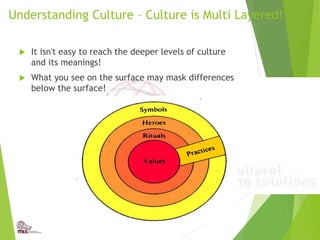
Understanding Culture – Culture is Multi Layered!
 It isn't easy to reach the deeper levels of culture
and its meanings!
 What you see on the surface may mask differences
below the surface!
Understanding Culture – Culture is Multi Layered!
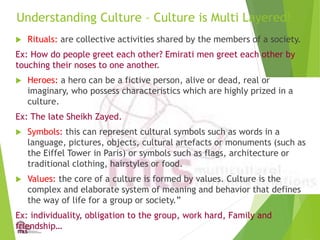
 Rituals: are collective activities shared by the members of a society.
Ex: How do people greet each other? Emirati men greet each other by
touching their noses to one another.
 Heroes: a hero can be a fictive person, alive or dead, real or
imaginary, who possess characteristics which are highly prized in a
culture.
Ex: The late Sheikh Zayed.
 Symbols: this can represent cultural symbols such as words in a
language, pictures, objects, cultural artefacts or monuments (such as
the Eiffel Tower in Paris) or symbols such as flags, architecture or
traditional clothing, hairstyles or food.
 Values: the core of a culture is formed by values. Culture is the
complex and elaborate system of meaning and behavior that defines
the way of life for a group or society.”
Ex: individuality, obligation to the group, work hard, Family and
friendship…
Understanding Culture = The Iceberg Theory
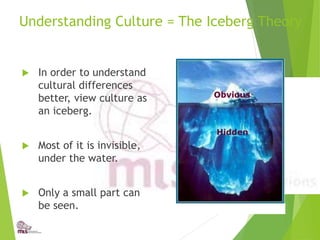
 In order to understand
cultural differences
better, view culture as
an iceberg.
 Most of it is invisible,
under the water.
 Only a small part can
be seen.
Obvious
Hidden
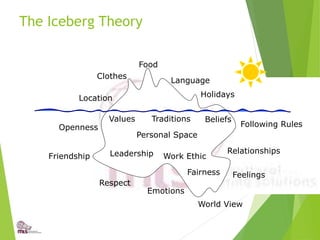
The Iceberg Theory
Clothes
Language
Location Holidays
Food
Values
Work Ethic
Leadership
Fairness
Traditions
Personal Space
World View
Beliefs
Respect
Openness
Friendship
Emotions
Feelings
Relationships
Following Rules
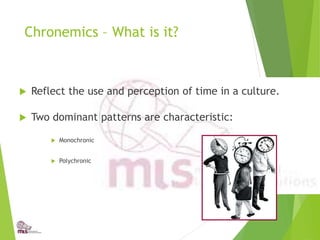
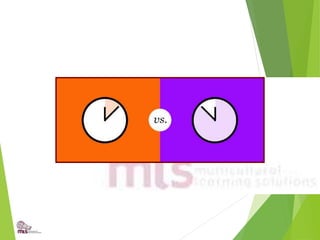
Chronemics – What is it?
 Reflect the use and perception of time in a culture.
 Two dominant patterns are characteristic:
 Monochronic
 Polychronic
Monochronic
 Things are done in a linear fashion.
 One activity at a time.
 Time schedules and plans are important.
 An appointment is treated seriously.
Monochronic
 Emphasize promptness
 Concentrate on the job
 Are accustomed to short-term relationships
 Are low-context and need information
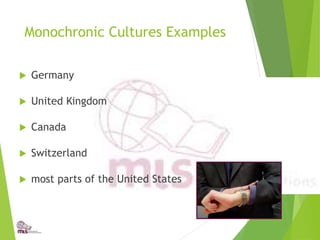
Monochronic Cultures Examples
 Germany
 United Kingdom
 Canada
 Switzerland
 most parts of the United States
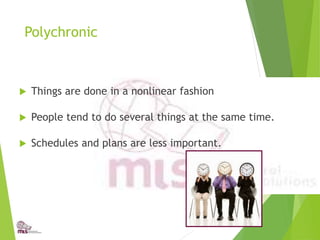
Polychronic
 Things are done in a nonlinear fashion
 People tend to do several things at the same time.
 Schedules and plans are less important.
Polychronic
 Are highly distractible and subject to interruptions
 Are committed to people and human relationships
 Have strong tendency to build lifetime relationships
 Are high-context and already have information
Polychronic Cultures Examples
 Middle East
 China
 Mexico
 Pakistan
 India
 Africa countries
Dimensions of Culture
"Culture is more often a source of conflict than of synergy.
Cultural differences are a nuisance at best
and often a disaster." –
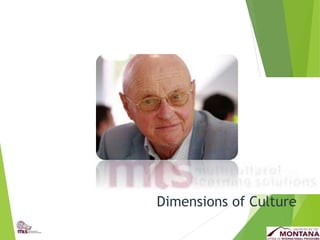
Dr. Geert Hofstede
What did he do?
 He conducted one of the early
empirical studies of cultural traits.
 Two surveys: 1968 and 1972
 He collected data on the values and attitudes of
116,000 employees at IBM subsidiaries.

 In 64 different countries around the world.
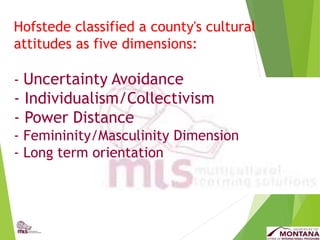
Hofstede classified a county's cultural
attitudes as five dimensions:
- Uncertainty Avoidance
- Individualism/Collectivism
- Power Distance
- Femininity/Masculinity Dimension
- Long term orientation
The Power Distance Dimension:
Power Distance
 Shows the difference between
people in a society.
 Difference in authority, power,
influence.
 It also determines how formal
and informal people in a culture
are and how they interact.
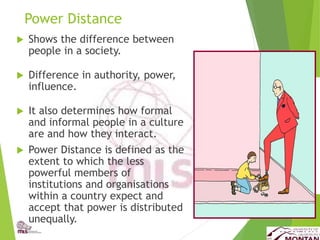
 Power Distance is defined as the
extent to which the less
powerful members of
institutions and organisations
within a country expect and
accept that power is distributed
unequally.
Power Distance in Comparison
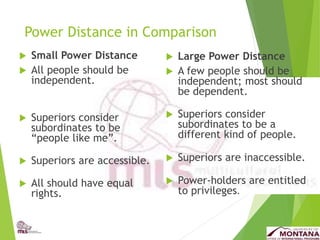
 Small Power Distance
 All people should be
independent.
 Superiors consider
subordinates to be
“people like me”.
 Superiors are accessible.
 All should have equal
rights.
 Large Power Distance
 A few people should be
independent; most should
be dependent.
 Superiors consider
subordinates to be a
different kind of people.
 Superiors are inaccessible.
 Power-holders are entitled
to privileges.

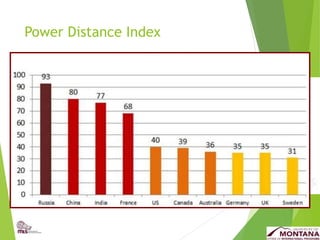
Power Distance Index
The Individualism/Collectivism Dimension
Definition
 Individualism
 People are interested in their own achievement.
 Make decisions for themselves.
 Value is placed on “I”
 Collectivism
 People are group oriented and are interested in group achievement.
 The prefer to make decisions involving others.
 Value is placed on “We”
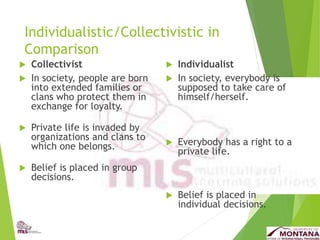
Individualistic/Collectivistic in
Comparison
 Collectivist
 In society, people are born
into extended families or
clans who protect them in
exchange for loyalty.
 Private life is invaded by
organizations and clans to
which one belongs.
 Belief is placed in group
decisions.
 Individualist
 In society, everybody is
supposed to take care of
himself/herself.
 Everybody has a right to a
private life.
 Belief is placed in
individual decisions.
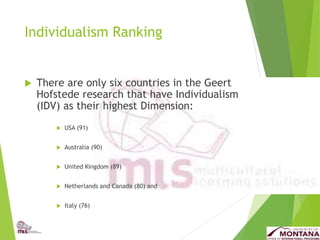
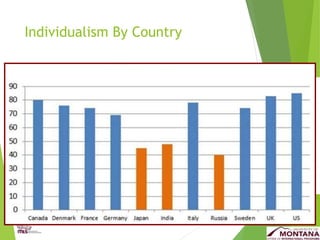
Individualism Ranking
 There are only six countries in the Geert
Hofstede research that have Individualism
(IDV) as their highest Dimension:
 USA (91)
 Australia (90)
 United Kingdom (89)
 Netherlands and Canada (80) and
 Italy (76)
Individualism By Country
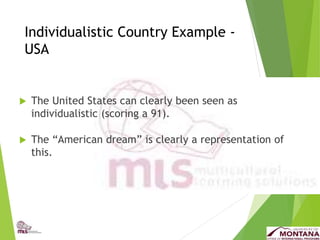
Individualistic Country Example -
USA
 The United States can clearly been seen as
individualistic (scoring a 91).
 The “American dream” is clearly a representation of
this.
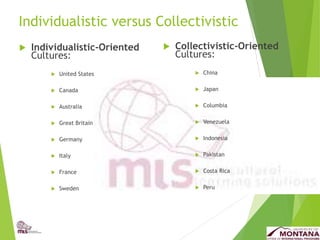
Individualistic versus Collectivistic
 Individualistic-Oriented
Cultures:
 United States
 Canada
 Australia
 Great Britain
 Germany
 Italy
 France
 Sweden
 Collectivistic-Oriented
Cultures:
 China
 Japan
 Columbia
 Venezuela
 Indonesia
 Pakistan
 Costa Rica
 Peru
The Femininity/Masculinity Dimension
Definitions
 Masculinity A
culture in which the dominant values in society are achievement,
heroism, assertiveness, money and material rewards for success.
 Femininity A
culture in which the dominant values in society are cooperation,
modesty, caring for the weak and quality of life.
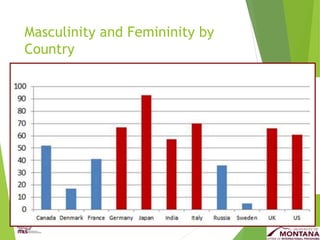
Masculinity and Femininity by
Country
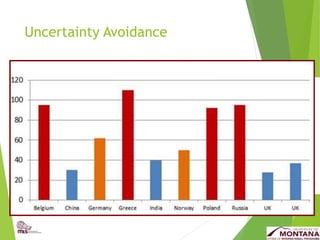
The Uncertainty Avoidance Dimension
Definition
 The extend to which people feel threatened by
ambiguous situations, tolerate uncertainty and have
created beliefs and institutions that try to avoid these.
Uncertainty Avoidance in Comparison
 Weak Uncertainty
The uncertainty
inherent in life is
more easily accepted
and each day is taken
as it comes.
 Time is free.
 There is more
willingness to take
risks in life.
 There should be as
few rules as possible.
 Strong Uncertainty
The uncertainty
inherent in life is felt
as a continuous threat
that must be fought.
 Time is money.
 There is great concern
with security in life.
 There is a need for
written rules and
regulations.
Uncertainty Avoidance
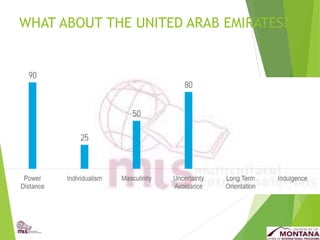
WHAT ABOUT THE UNITED ARAB EMIRATES?
Long-Term Orientation
Long-Term Orientation/Short-Term Orientation
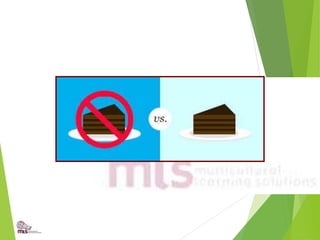
 Long-term orientation is when you are focused on the
future. You are willing to delay short-term material or
social success or even short-term emotional
gratification in order to prepare for the future. If you
have this cultural perspective, you value persistence,
perseverance, saving and being able to adapt.
 Short-term orientation is when you are focused on the
present or past and consider them more important than
the future. If you have a short-term orientation, you
value tradition, the current social hierarchy and
fulfilling your social obligations. You care more about
immediate gratification than long-term fulfillment.

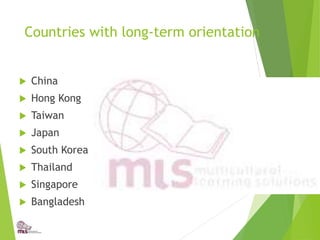
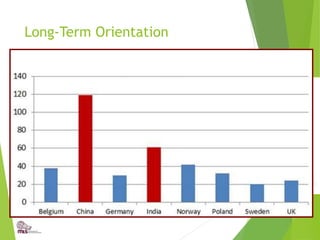
Countries with long-term orientation
 China
 Hong Kong
 Taiwan
 Japan
 South Korea
 Thailand
 Singapore
 Bangladesh
Long-Term Orientation
Indulgence versus Restraint
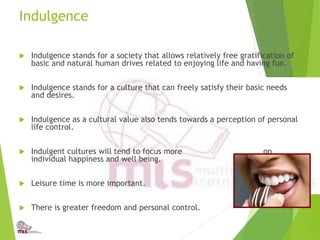
Indulgence
 Indulgence stands for a society that allows relatively free gratification of
basic and natural human drives related to enjoying life and having fun.
 Indulgence stands for a culture that can freely satisfy their basic needs
and desires.
 Indulgence as a cultural value also tends towards a perception of personal
life control.
 Indulgent cultures will tend to focus more on
individual happiness and well being.
 Leisure time is more important.
 There is greater freedom and personal control.
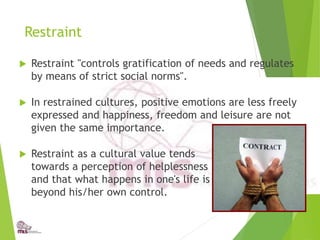
Restraint
 Restraint "controls gratification of needs and regulates
by means of strict social norms".
 In restrained cultures, positive emotions are less freely
expressed and happiness, freedom and leisure are not
given the same importance.
 Restraint as a cultural value tends
towards a perception of helplessness
and that what happens in one's life is
beyond his/her own control.
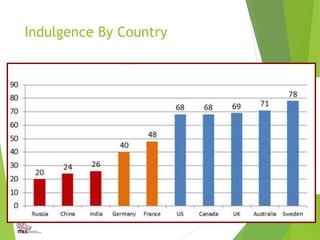
Indulgence By Country

3 culture and management

  • 1.
  • 2.
    What is Culture? When we use the word culture, we usually mean one or more of the following:  High Culture  Traditional Culture  Popular Culture  Folk Culture  Corporate Culture
  • 3.
    Understanding Culture –Culture is Multi Layered!  It isn't easy to reach the deeper levels of culture and its meanings!  What you see on the surface may mask differences below the surface!
  • 4.
    Understanding Culture –Culture is Multi Layered!  Rituals: are collective activities shared by the members of a society. Ex: How do people greet each other? Emirati men greet each other by touching their noses to one another.  Heroes: a hero can be a fictive person, alive or dead, real or imaginary, who possess characteristics which are highly prized in a culture. Ex: The late Sheikh Zayed.  Symbols: this can represent cultural symbols such as words in a language, pictures, objects, cultural artefacts or monuments (such as the Eiffel Tower in Paris) or symbols such as flags, architecture or traditional clothing, hairstyles or food.  Values: the core of a culture is formed by values. Culture is the complex and elaborate system of meaning and behavior that defines the way of life for a group or society.” Ex: individuality, obligation to the group, work hard, Family and friendship…
  • 5.
    Understanding Culture =The Iceberg Theory  In order to understand cultural differences better, view culture as an iceberg.  Most of it is invisible, under the water.  Only a small part can be seen. Obvious Hidden
  • 6.
    The Iceberg Theory Clothes Language LocationHolidays Food Values Work Ethic Leadership Fairness Traditions Personal Space World View Beliefs Respect Openness Friendship Emotions Feelings Relationships Following Rules
  • 7.
    Chronemics – Whatis it?  Reflect the use and perception of time in a culture.  Two dominant patterns are characteristic:  Monochronic  Polychronic
  • 8.
    Monochronic  Things aredone in a linear fashion.  One activity at a time.  Time schedules and plans are important.  An appointment is treated seriously.
  • 9.
    Monochronic  Emphasize promptness Concentrate on the job  Are accustomed to short-term relationships  Are low-context and need information
  • 10.
    Monochronic Cultures Examples Germany  United Kingdom  Canada  Switzerland  most parts of the United States
  • 11.
    Polychronic  Things aredone in a nonlinear fashion  People tend to do several things at the same time.  Schedules and plans are less important.
  • 12.
    Polychronic  Are highlydistractible and subject to interruptions  Are committed to people and human relationships  Have strong tendency to build lifetime relationships  Are high-context and already have information
  • 13.
    Polychronic Cultures Examples Middle East  China  Mexico  Pakistan  India  Africa countries
  • 14.
  • 15.
  • 16.
    "Culture is moreoften a source of conflict than of synergy. Cultural differences are a nuisance at best and often a disaster." – Dr. Geert Hofstede
  • 17.
    What did hedo?  He conducted one of the early empirical studies of cultural traits.  Two surveys: 1968 and 1972  He collected data on the values and attitudes of 116,000 employees at IBM subsidiaries.  In 64 different countries around the world.
  • 18.
    Hofstede classified acounty's cultural attitudes as five dimensions: - Uncertainty Avoidance - Individualism/Collectivism - Power Distance - Femininity/Masculinity Dimension - Long term orientation
  • 20.
  • 21.
    Power Distance  Showsthe difference between people in a society.  Difference in authority, power, influence.  It also determines how formal and informal people in a culture are and how they interact.  Power Distance is defined as the extent to which the less powerful members of institutions and organisations within a country expect and accept that power is distributed unequally.
  • 22.
    Power Distance inComparison  Small Power Distance  All people should be independent.  Superiors consider subordinates to be “people like me”.  Superiors are accessible.  All should have equal rights.  Large Power Distance  A few people should be independent; most should be dependent.  Superiors consider subordinates to be a different kind of people.  Superiors are inaccessible.  Power-holders are entitled to privileges.
  • 23.
  • 24.
  • 25.
    Definition  Individualism  Peopleare interested in their own achievement.  Make decisions for themselves.  Value is placed on “I”  Collectivism  People are group oriented and are interested in group achievement.  The prefer to make decisions involving others.  Value is placed on “We”
  • 26.
    Individualistic/Collectivistic in Comparison  Collectivist In society, people are born into extended families or clans who protect them in exchange for loyalty.  Private life is invaded by organizations and clans to which one belongs.  Belief is placed in group decisions.  Individualist  In society, everybody is supposed to take care of himself/herself.  Everybody has a right to a private life.  Belief is placed in individual decisions.
  • 27.
    Individualism Ranking  Thereare only six countries in the Geert Hofstede research that have Individualism (IDV) as their highest Dimension:  USA (91)  Australia (90)  United Kingdom (89)  Netherlands and Canada (80) and  Italy (76)
  • 28.
  • 29.
    Individualistic Country Example- USA  The United States can clearly been seen as individualistic (scoring a 91).  The “American dream” is clearly a representation of this.
  • 30.
    Individualistic versus Collectivistic Individualistic-Oriented Cultures:  United States  Canada  Australia  Great Britain  Germany  Italy  France  Sweden  Collectivistic-Oriented Cultures:  China  Japan  Columbia  Venezuela  Indonesia  Pakistan  Costa Rica  Peru
  • 32.
  • 33.
    Definitions  Masculinity A culturein which the dominant values in society are achievement, heroism, assertiveness, money and material rewards for success.  Femininity A culture in which the dominant values in society are cooperation, modesty, caring for the weak and quality of life.
  • 34.
  • 36.
  • 37.
    Definition  The extendto which people feel threatened by ambiguous situations, tolerate uncertainty and have created beliefs and institutions that try to avoid these.
  • 38.
    Uncertainty Avoidance inComparison  Weak Uncertainty The uncertainty inherent in life is more easily accepted and each day is taken as it comes.  Time is free.  There is more willingness to take risks in life.  There should be as few rules as possible.  Strong Uncertainty The uncertainty inherent in life is felt as a continuous threat that must be fought.  Time is money.  There is great concern with security in life.  There is a need for written rules and regulations.
  • 39.
  • 40.
    WHAT ABOUT THEUNITED ARAB EMIRATES?
  • 42.
  • 43.
    Long-Term Orientation/Short-Term Orientation Long-term orientation is when you are focused on the future. You are willing to delay short-term material or social success or even short-term emotional gratification in order to prepare for the future. If you have this cultural perspective, you value persistence, perseverance, saving and being able to adapt.  Short-term orientation is when you are focused on the present or past and consider them more important than the future. If you have a short-term orientation, you value tradition, the current social hierarchy and fulfilling your social obligations. You care more about immediate gratification than long-term fulfillment. 
  • 44.
    Countries with long-termorientation  China  Hong Kong  Taiwan  Japan  South Korea  Thailand  Singapore  Bangladesh
  • 45.
  • 47.
  • 48.
    Indulgence  Indulgence standsfor a society that allows relatively free gratification of basic and natural human drives related to enjoying life and having fun.  Indulgence stands for a culture that can freely satisfy their basic needs and desires.  Indulgence as a cultural value also tends towards a perception of personal life control.  Indulgent cultures will tend to focus more on individual happiness and well being.  Leisure time is more important.  There is greater freedom and personal control.
  • 49.
    Restraint  Restraint "controlsgratification of needs and regulates by means of strict social norms".  In restrained cultures, positive emotions are less freely expressed and happiness, freedom and leisure are not given the same importance.  Restraint as a cultural value tends towards a perception of helplessness and that what happens in one's life is beyond his/her own control.
  • 50.