Modes of Transportation
considering Indian and Global
Perspective
-KRUTI DESAI
Need of Transportation
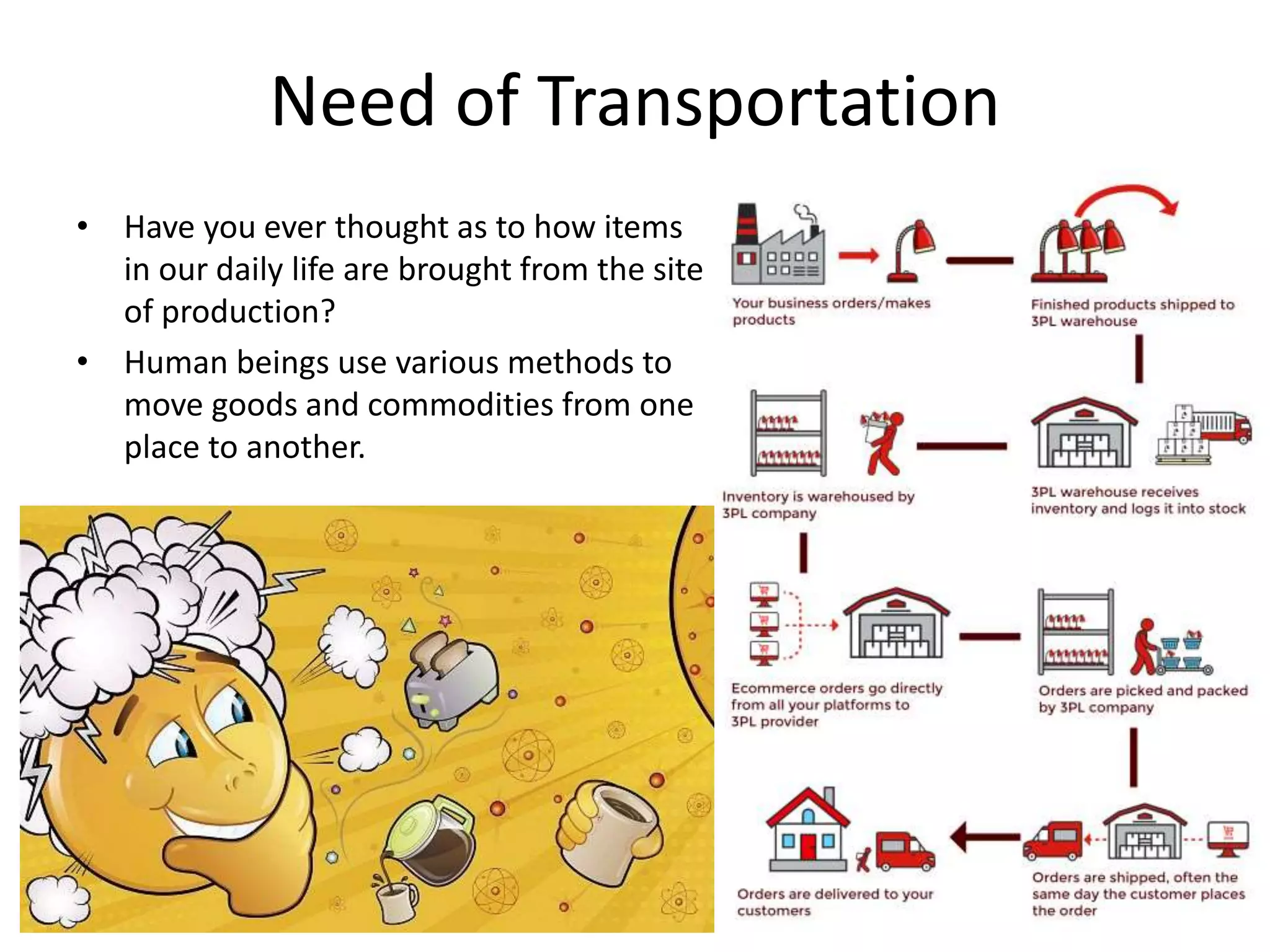
• Have you ever thought as to how items
in our daily life are brought from the site
of production?
• Human beings use various methods to
move goods and commodities from one
place to another.
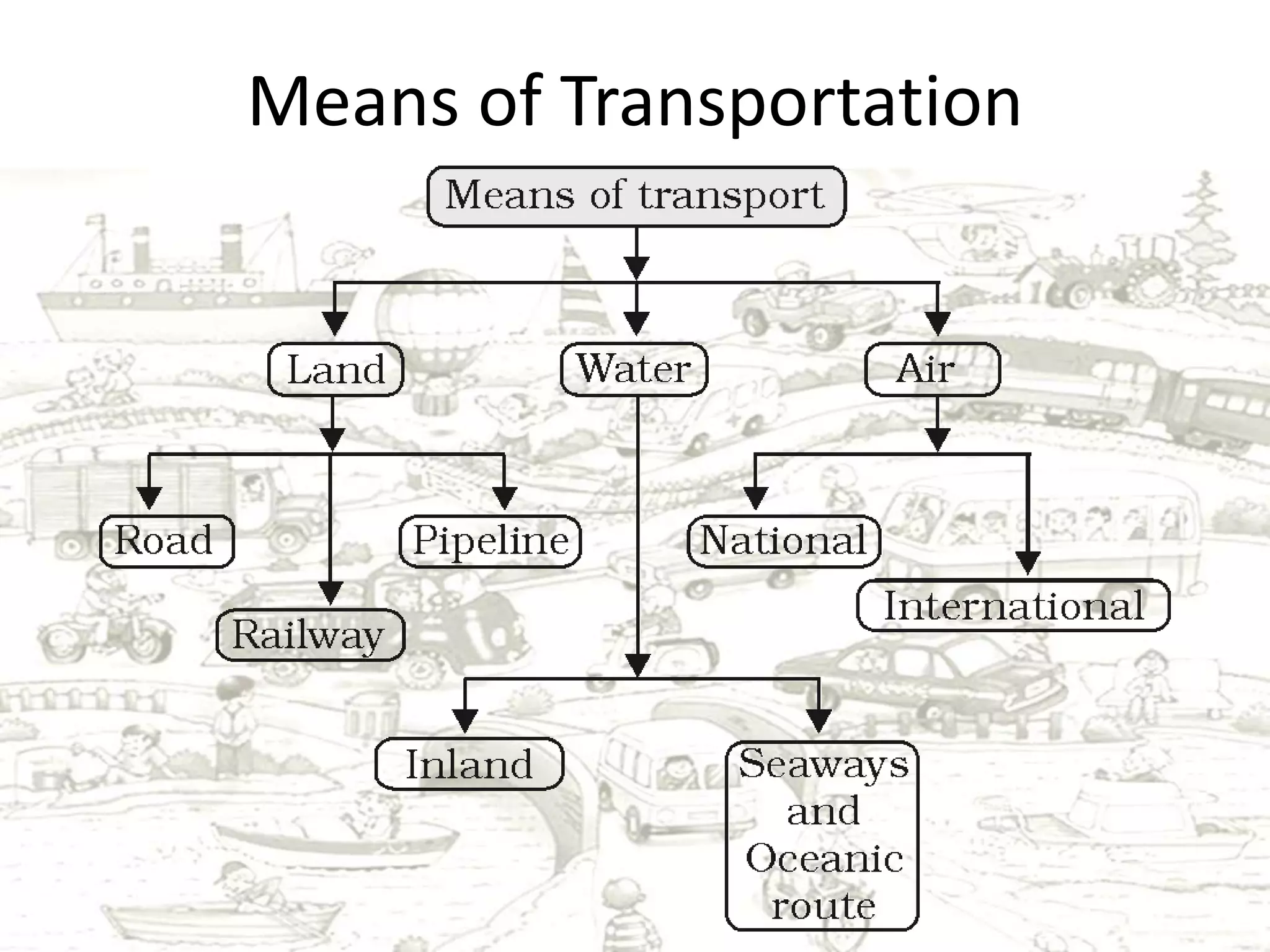
Means of Transportation
Land Transport
• Urban
Expressway: Expressways are divided highways for through traffic with
full or partial control of access
• Arterial road:
They carry the largest volumes of traffic and longest trips in a city.
• Sub Arterial:
Road: This category of road follows all the functions of an Arterial Urb
an road and is characterized by mobility, and caters to through traffic
with restricted access from carriageway to the side.
• Distributor/Collector Roads:
these are connector roads, which distribute the traffic from access str
eets to arterial and sub arterial roads and contains moderate traffic.
• Local Street:
These are intended for neighbourhood (or local) use on which through traf
fic is to be discouraged.
• Access
Street: These are used for access functions to adjoining properties and are
as. A majority of trips in urban areas usually originate or terminate o
n these streets.
Basic Terminologies
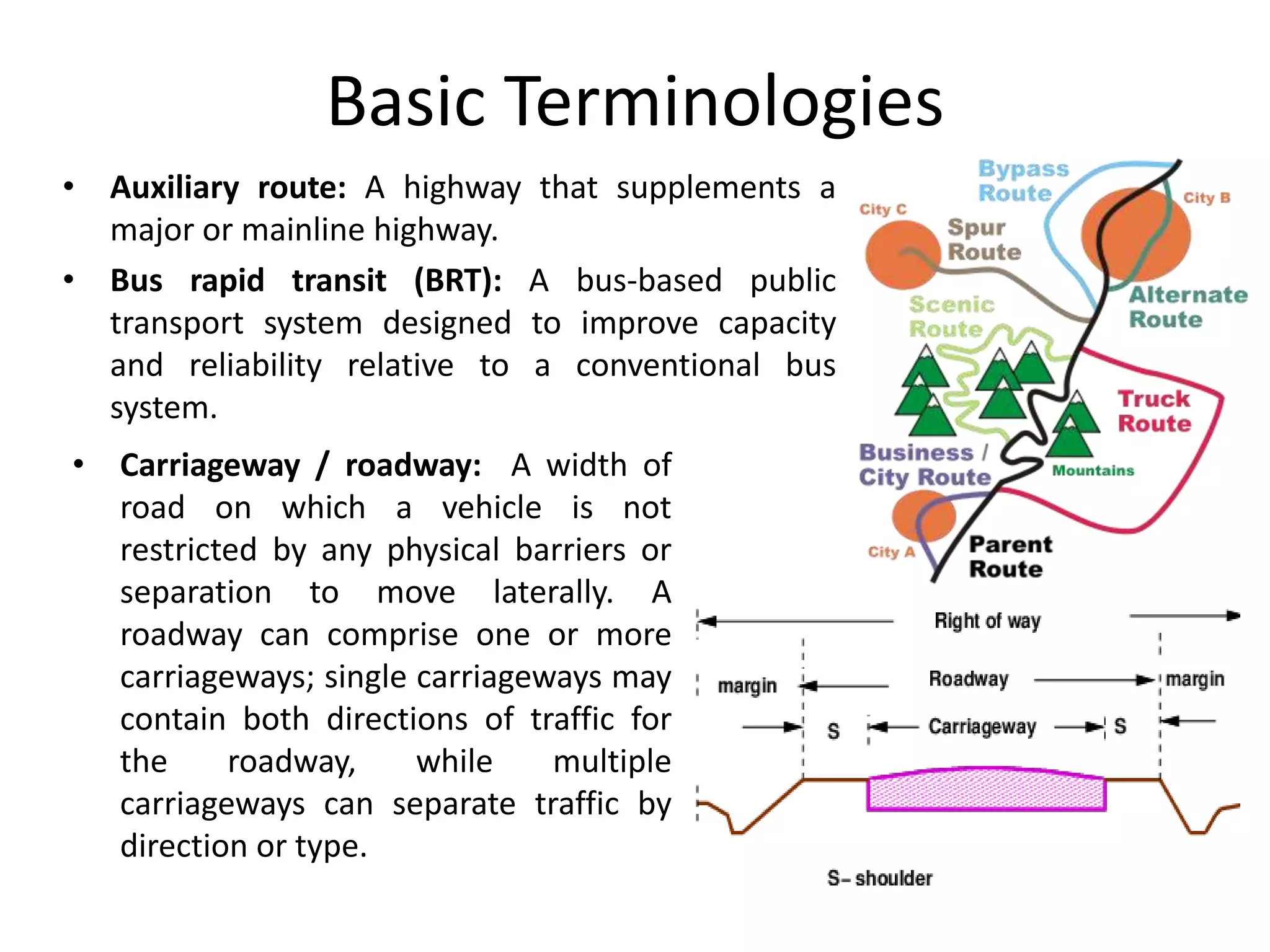
• Auxiliary route: A highway that supplements a
major or mainline highway.
• Bus rapid transit (BRT): A bus-based public
transport system designed to improve capacity
and reliability relative to a conventional bus
system.
• Carriageway / roadway: A width of
road on which a vehicle is not
restricted by any physical barriers or
separation to move laterally. A
roadway can comprise one or more
carriageways; single carriageways may
contain both directions of traffic for
the roadway, while multiple
carriageways can separate traffic by
direction or type.
Basic Terminologies
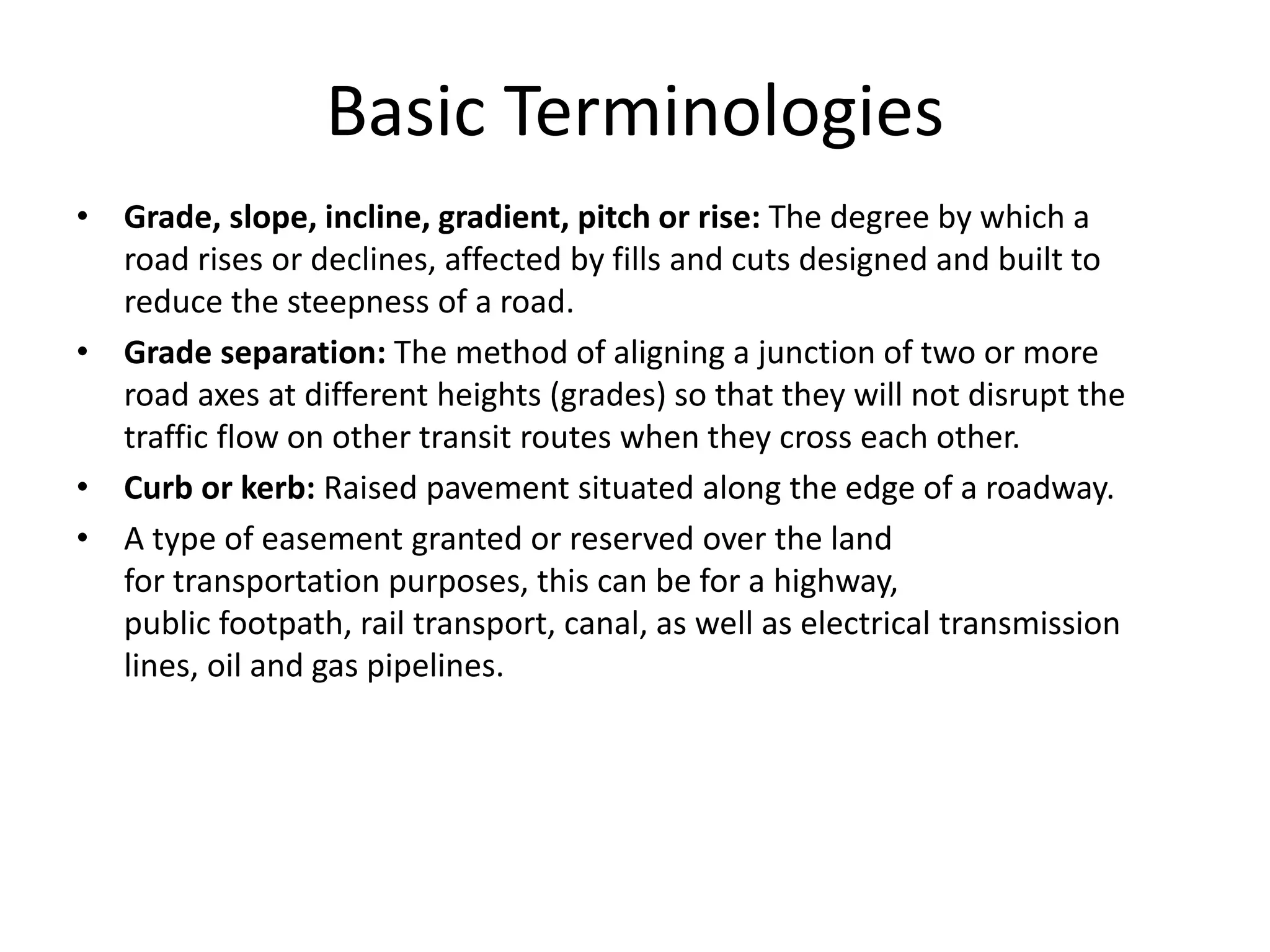
• Grade, slope, incline, gradient, pitch or rise: The degree by which a
road rises or declines, affected by fills and cuts designed and built to
reduce the steepness of a road.
• Grade separation: The method of aligning a junction of two or more
road axes at different heights (grades) so that they will not disrupt the
traffic flow on other transit routes when they cross each other.
• Curb or kerb: Raised pavement situated along the edge of a roadway.
• A type of easement granted or reserved over the land
for transportation purposes, this can be for a highway,
public footpath, rail transport, canal, as well as electrical transmission
lines, oil and gas pipelines.
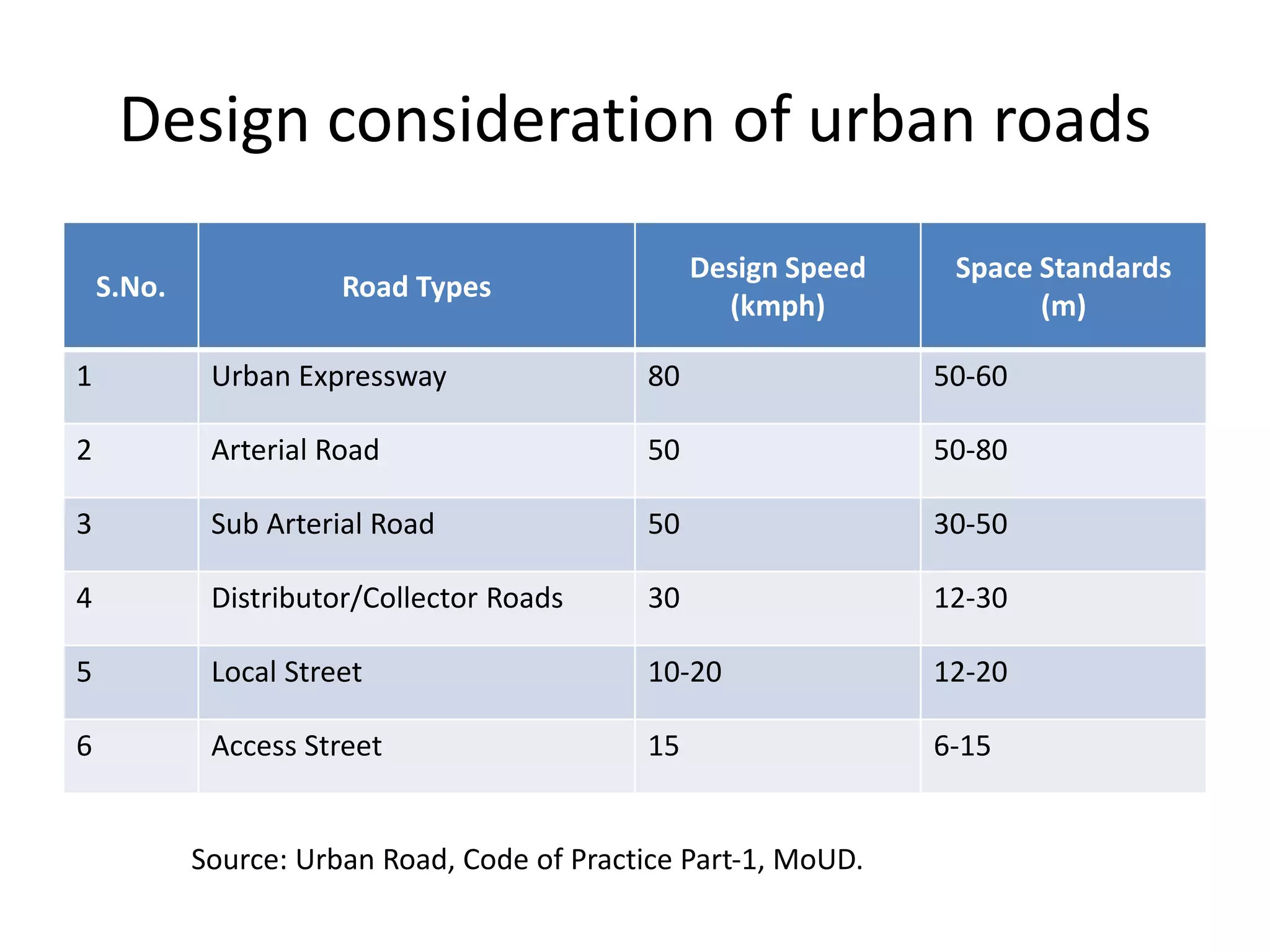
Design consideration of urban roads
S.No. Road Types
Design Speed
(kmph)
Space Standards
(m)
1 Urban Expressway 80 50-60
2 Arterial Road 50 50-80
3 Sub Arterial Road 50 30-50
4 Distributor/Collector Roads 30 12-30
5 Local Street 10-20 12-20
6 Access Street 15 6-15
Source: Urban Road, Code of Practice Part‐1, MoUD.
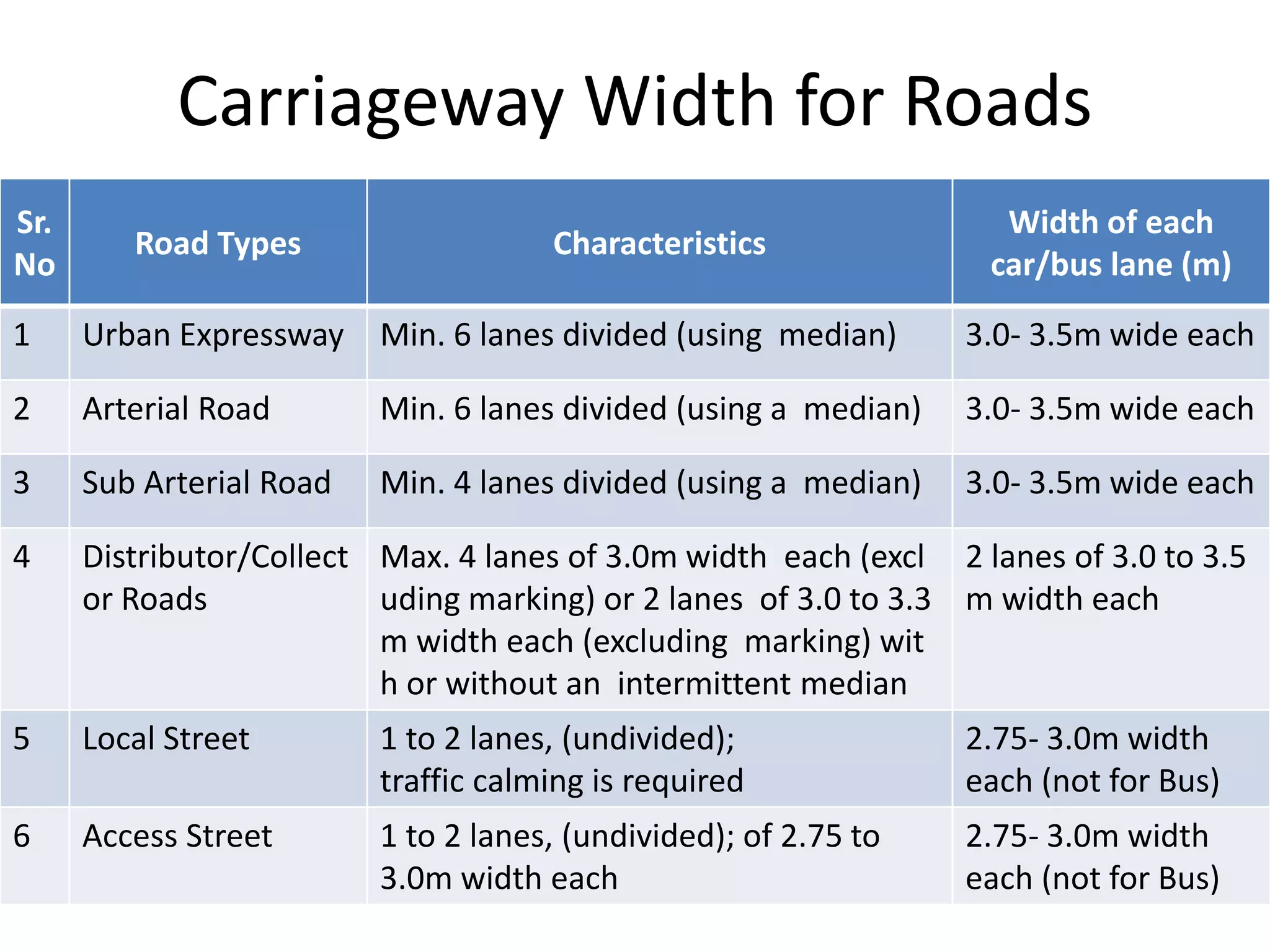
Carriageway Width for Roads
Sr.
No
Road Types Characteristics
Width of each
car/bus lane (m)
1 Urban Expressway Min. 6 lanes divided (using median) 3.0- 3.5m wide each
2 Arterial Road Min. 6 lanes divided (using a median) 3.0- 3.5m wide each
3 Sub Arterial Road Min. 4 lanes divided (using a median) 3.0- 3.5m wide each
4 Distributor/Collect
or Roads
Max. 4 lanes of 3.0m width each (excl
uding marking) or 2 lanes of 3.0 to 3.3
m width each (excluding marking) wit
h or without an intermittent median
2 lanes of 3.0 to 3.5
m width each
5 Local Street 1 to 2 lanes, (undivided);
traffic calming is required
2.75- 3.0m width
each (not for Bus)
6 Access Street 1 to 2 lanes, (undivided); of 2.75 to
3.0m width each
2.75- 3.0m width
each (not for Bus)
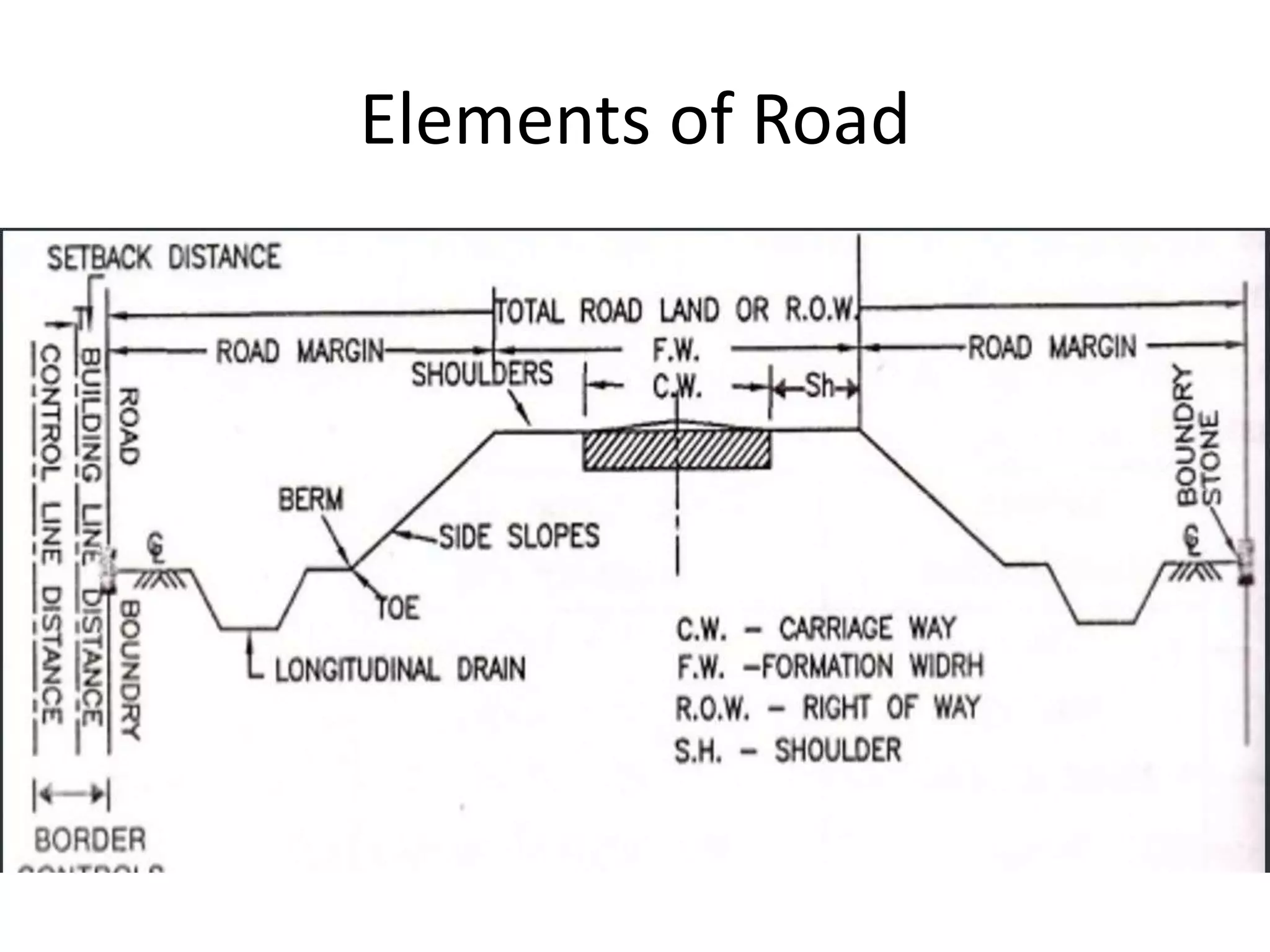
Elements of Road
Types of junctions
• Cross Roads:
• Straight ahead or turning left:
• Straight ahead or turning left
• Courtesy at the crossroads
• T-Junction: A T-junction has three arms of which one arm is a main road whereas the other one is
usually a minor road connecting the main road.
• Y-Junction: A Y-junction has three arms of which all the three roads are of equal sizes. It is generally
seen at places of heavy traffic. It is pretty useful in the distribution of traffic.
• Acute Angle Junction: Generally Acute Angle Junctions are not preferably used. They create lot of
chaos in heavy traffic. The turning for heavy and bigger vehicles becomes a problem. This creates
chaos and traffic.
• Staggered Junction: A staggered junction is a place where several roads meet a main road at a
slight distance apart thus they do not all come together at the same point.
• Multiple Junction: When multiple roads meet at a same point, the junction is termed as “Multiple
Junction”.
Grade separation method
• Grade separation is a method developed to avoid the disruption of traffic
flow at intersections. Grade separation is adopted at junctions where two
or more surface transport axes cross with each other.
Types of Grade Separation
• Grade separation can be achieved by two types of intersections and they
are :
– Overpass
– Underpass
Overpass, Underpass and
Interchanges
• Overpass: When the vertical profile of one highway is raised with the help
of embankments and over-bridge arrangement to eliminate intersection
with another highway on ground level, then it is said to be overpass.
• Underpass: Similarly, when the vertical profile of one highway is lowered
with respect to ground level in the form of tunnel to avoid intersection
with another highway then it is said to be underpass.
• Interchanges: Grade separation eliminates intersection of traffic flow at
junctions but it is incomplete without provision for interchanges.
Interchanges facilitates the change of direction of traffic from one highway
to another highway at intersections. Interchange ramps at grade
separations can be provided in three different types and they are :
– Direct interchange
– Semi-direct interchange
– Indirect interchange
Types of Interchanges
• Different types of interchanges at grade
separated intersections are as follows :
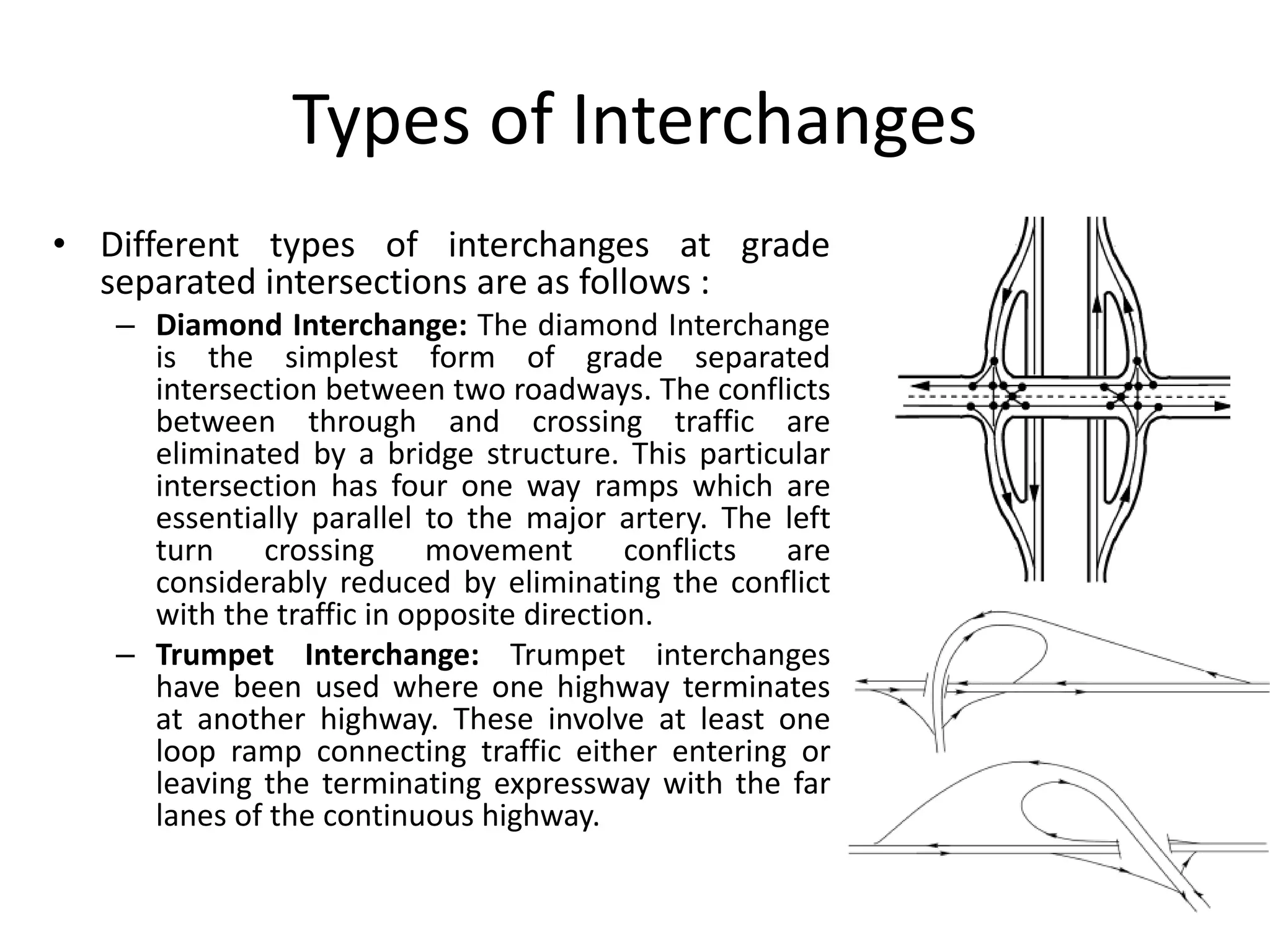
– Diamond Interchange: The diamond Interchange
is the simplest form of grade separated
intersection between two roadways. The conflicts
between through and crossing traffic are
eliminated by a bridge structure. This particular
intersection has four one way ramps which are
essentially parallel to the major artery. The left
turn crossing movement conflicts are
considerably reduced by eliminating the conflict
with the traffic in opposite direction.
– Trumpet Interchange: Trumpet interchanges
have been used where one highway terminates
at another highway. These involve at least one
loop ramp connecting traffic either entering or
leaving the terminating expressway with the far
lanes of the continuous highway.
Types of Interchanges
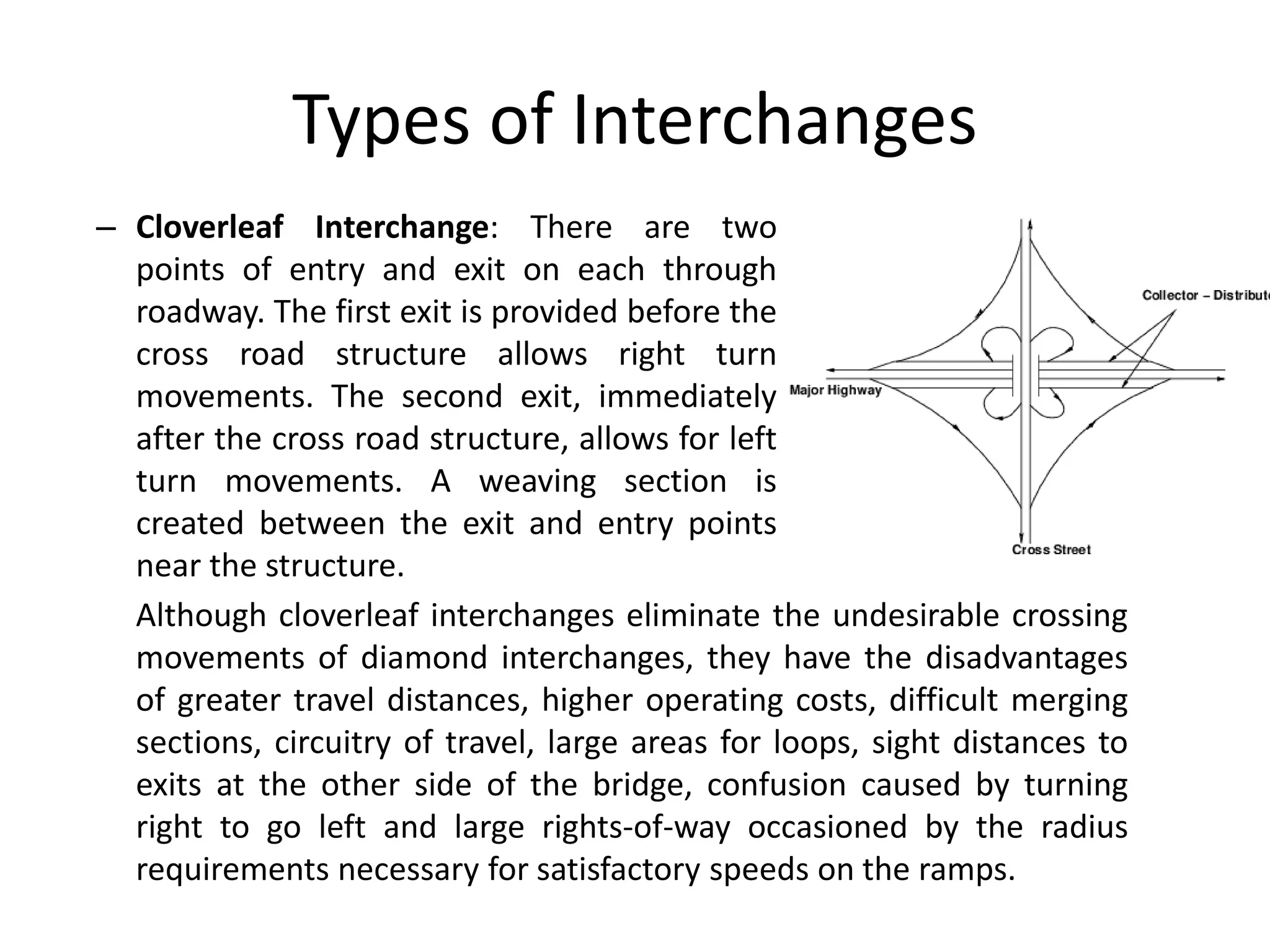
– Cloverleaf Interchange: There are two
points of entry and exit on each through
roadway. The first exit is provided before the
cross road structure allows right turn
movements. The second exit, immediately
after the cross road structure, allows for left
turn movements. A weaving section is
created between the exit and entry points
near the structure.
Although cloverleaf interchanges eliminate the undesirable crossing
movements of diamond interchanges, they have the disadvantages
of greater travel distances, higher operating costs, difficult merging
sections, circuitry of travel, large areas for loops, sight distances to
exits at the other side of the bridge, confusion caused by turning
right to go left and large rights-of-way occasioned by the radius
requirements necessary for satisfactory speeds on the ramps.
Types of Interchanges
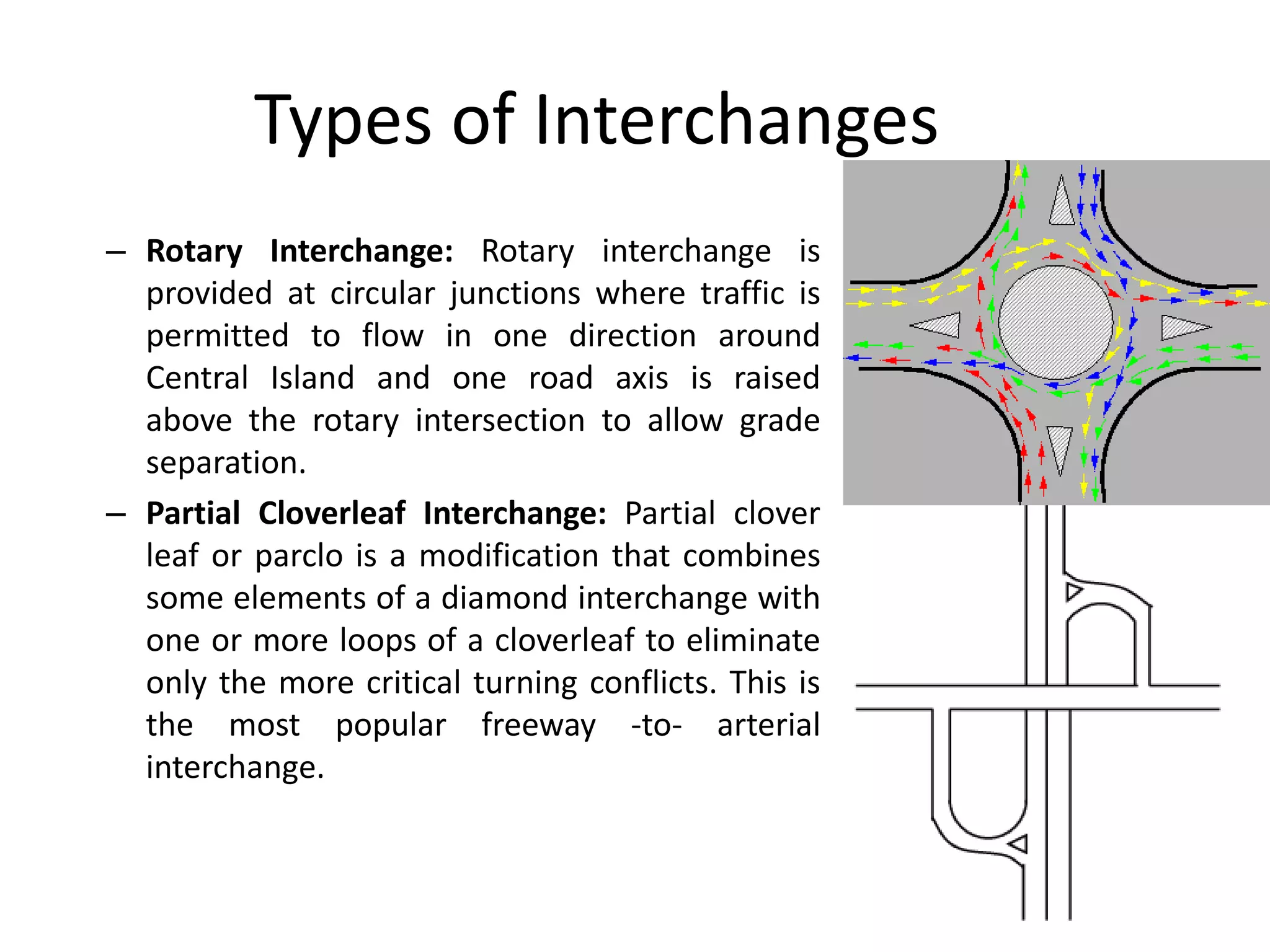
– Rotary Interchange: Rotary interchange is
provided at circular junctions where traffic is
permitted to flow in one direction around
Central Island and one road axis is raised
above the rotary intersection to allow grade
separation.
– Partial Cloverleaf Interchange: Partial clover
leaf or parclo is a modification that combines
some elements of a diamond interchange with
one or more loops of a cloverleaf to eliminate
only the more critical turning conflicts. This is
the most popular freeway -to- arterial
interchange.

Modes of transportation considering indian and global perspective

  • 1.
    Modes of Transportation consideringIndian and Global Perspective -KRUTI DESAI
  • 2.
    Need of Transportation •Have you ever thought as to how items in our daily life are brought from the site of production? • Human beings use various methods to move goods and commodities from one place to another.
  • 3.
  • 4.
    Land Transport • Urban Expressway:Expressways are divided highways for through traffic with full or partial control of access • Arterial road: They carry the largest volumes of traffic and longest trips in a city. • Sub Arterial: Road: This category of road follows all the functions of an Arterial Urb an road and is characterized by mobility, and caters to through traffic with restricted access from carriageway to the side. • Distributor/Collector Roads: these are connector roads, which distribute the traffic from access str eets to arterial and sub arterial roads and contains moderate traffic. • Local Street: These are intended for neighbourhood (or local) use on which through traf fic is to be discouraged. • Access Street: These are used for access functions to adjoining properties and are as. A majority of trips in urban areas usually originate or terminate o n these streets.
  • 5.
    Basic Terminologies • Auxiliaryroute: A highway that supplements a major or mainline highway. • Bus rapid transit (BRT): A bus-based public transport system designed to improve capacity and reliability relative to a conventional bus system. • Carriageway / roadway: A width of road on which a vehicle is not restricted by any physical barriers or separation to move laterally. A roadway can comprise one or more carriageways; single carriageways may contain both directions of traffic for the roadway, while multiple carriageways can separate traffic by direction or type.
  • 6.
    Basic Terminologies • Grade,slope, incline, gradient, pitch or rise: The degree by which a road rises or declines, affected by fills and cuts designed and built to reduce the steepness of a road. • Grade separation: The method of aligning a junction of two or more road axes at different heights (grades) so that they will not disrupt the traffic flow on other transit routes when they cross each other. • Curb or kerb: Raised pavement situated along the edge of a roadway. • A type of easement granted or reserved over the land for transportation purposes, this can be for a highway, public footpath, rail transport, canal, as well as electrical transmission lines, oil and gas pipelines.
  • 7.
    Design consideration ofurban roads S.No. Road Types Design Speed (kmph) Space Standards (m) 1 Urban Expressway 80 50-60 2 Arterial Road 50 50-80 3 Sub Arterial Road 50 30-50 4 Distributor/Collector Roads 30 12-30 5 Local Street 10-20 12-20 6 Access Street 15 6-15 Source: Urban Road, Code of Practice Part‐1, MoUD.
  • 8.
    Carriageway Width forRoads Sr. No Road Types Characteristics Width of each car/bus lane (m) 1 Urban Expressway Min. 6 lanes divided (using median) 3.0- 3.5m wide each 2 Arterial Road Min. 6 lanes divided (using a median) 3.0- 3.5m wide each 3 Sub Arterial Road Min. 4 lanes divided (using a median) 3.0- 3.5m wide each 4 Distributor/Collect or Roads Max. 4 lanes of 3.0m width each (excl uding marking) or 2 lanes of 3.0 to 3.3 m width each (excluding marking) wit h or without an intermittent median 2 lanes of 3.0 to 3.5 m width each 5 Local Street 1 to 2 lanes, (undivided); traffic calming is required 2.75- 3.0m width each (not for Bus) 6 Access Street 1 to 2 lanes, (undivided); of 2.75 to 3.0m width each 2.75- 3.0m width each (not for Bus)
  • 9.
  • 10.
    Types of junctions •Cross Roads: • Straight ahead or turning left: • Straight ahead or turning left • Courtesy at the crossroads • T-Junction: A T-junction has three arms of which one arm is a main road whereas the other one is usually a minor road connecting the main road. • Y-Junction: A Y-junction has three arms of which all the three roads are of equal sizes. It is generally seen at places of heavy traffic. It is pretty useful in the distribution of traffic. • Acute Angle Junction: Generally Acute Angle Junctions are not preferably used. They create lot of chaos in heavy traffic. The turning for heavy and bigger vehicles becomes a problem. This creates chaos and traffic. • Staggered Junction: A staggered junction is a place where several roads meet a main road at a slight distance apart thus they do not all come together at the same point. • Multiple Junction: When multiple roads meet at a same point, the junction is termed as “Multiple Junction”.
  • 11.
    Grade separation method •Grade separation is a method developed to avoid the disruption of traffic flow at intersections. Grade separation is adopted at junctions where two or more surface transport axes cross with each other. Types of Grade Separation • Grade separation can be achieved by two types of intersections and they are : – Overpass – Underpass
  • 12.
    Overpass, Underpass and Interchanges •Overpass: When the vertical profile of one highway is raised with the help of embankments and over-bridge arrangement to eliminate intersection with another highway on ground level, then it is said to be overpass. • Underpass: Similarly, when the vertical profile of one highway is lowered with respect to ground level in the form of tunnel to avoid intersection with another highway then it is said to be underpass. • Interchanges: Grade separation eliminates intersection of traffic flow at junctions but it is incomplete without provision for interchanges. Interchanges facilitates the change of direction of traffic from one highway to another highway at intersections. Interchange ramps at grade separations can be provided in three different types and they are : – Direct interchange – Semi-direct interchange – Indirect interchange
  • 13.
    Types of Interchanges •Different types of interchanges at grade separated intersections are as follows : – Diamond Interchange: The diamond Interchange is the simplest form of grade separated intersection between two roadways. The conflicts between through and crossing traffic are eliminated by a bridge structure. This particular intersection has four one way ramps which are essentially parallel to the major artery. The left turn crossing movement conflicts are considerably reduced by eliminating the conflict with the traffic in opposite direction. – Trumpet Interchange: Trumpet interchanges have been used where one highway terminates at another highway. These involve at least one loop ramp connecting traffic either entering or leaving the terminating expressway with the far lanes of the continuous highway.
  • 14.
    Types of Interchanges –Cloverleaf Interchange: There are two points of entry and exit on each through roadway. The first exit is provided before the cross road structure allows right turn movements. The second exit, immediately after the cross road structure, allows for left turn movements. A weaving section is created between the exit and entry points near the structure. Although cloverleaf interchanges eliminate the undesirable crossing movements of diamond interchanges, they have the disadvantages of greater travel distances, higher operating costs, difficult merging sections, circuitry of travel, large areas for loops, sight distances to exits at the other side of the bridge, confusion caused by turning right to go left and large rights-of-way occasioned by the radius requirements necessary for satisfactory speeds on the ramps.
  • 15.
    Types of Interchanges –Rotary Interchange: Rotary interchange is provided at circular junctions where traffic is permitted to flow in one direction around Central Island and one road axis is raised above the rotary intersection to allow grade separation. – Partial Cloverleaf Interchange: Partial clover leaf or parclo is a modification that combines some elements of a diamond interchange with one or more loops of a cloverleaf to eliminate only the more critical turning conflicts. This is the most popular freeway -to- arterial interchange.