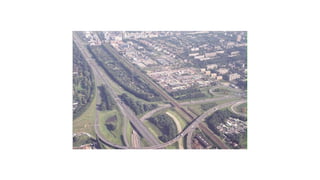
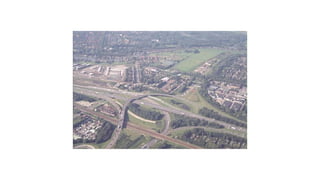
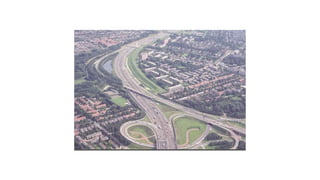
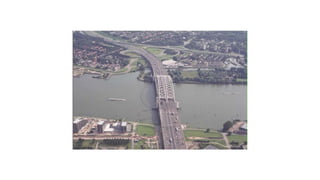
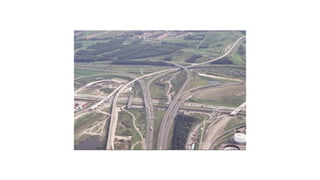
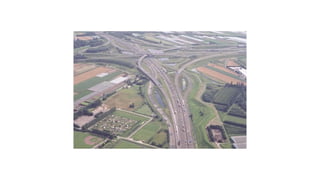
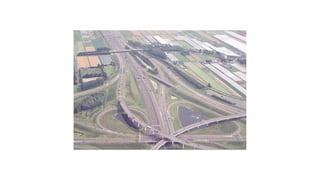
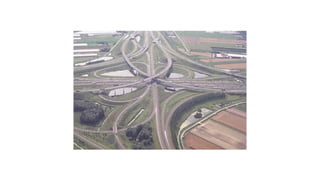
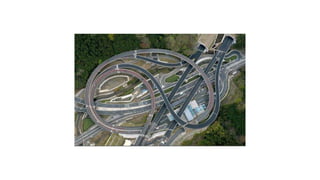
GRADE SEPARTED INTERSECTIONS
Grade Seperated Intersections
• Grade- separated intersections are provided to separate traffic
in the vertical grade
• Traffic need not be those pertaining to road only
• Different types of grade separators are flyovers and interchange
• Flyovers itself are subdivided into overpass underpass.When
two roads cross at a point, if the road having major traffic is
elevated to higher grade for further movement of traffic, then
such structures are called overpass
Grade Seperated Intersections
• If the major road is depressed to a lower level to cross another
by means of under bridge or tunnel, it is called under-pass.
• Interchage is a system where traffic between two or more
roadways flows at different levels in the grade seperated
junctions
Grade Separated Intersections
• A bridge that eliminates crossing conflicts at intersections by
vertical separation of roadways in space.
• Known as interchanges.
• Cause less hazard and delay than grade intersections.
• Route transfer at grade separation is accompanied by
interchange facilities consisting ramps.
• Interchange ramps are Direct, Semi-Direct and Indirect.
• Interchange configurations are designed in such a way to
accommodate economically the traffic requirements of flow,
operation on the crossing facilities, physical requirements of the
topography, adjoining land use, type of controls, right–of–way
and direction of movements.
• Ultimate objective is to eliminate all grade crossing conflicts and
to accommodate other intersecting maneuvers by merging,
diverging and weaving at low relative speed.
• Benefit of providing for low relative speed is twofold:
• events unfold more slowly allowing more judgment time
• incase of an impact the total relative energy to be absorbed
are less and hence, the damage is less.
• When relative speed is low, the average motorist will accept a
smaller time gap between successive vehicles to complete his
move. This condition increases roadway capacity.
Classifications of Grade Separated
Intersections
• Directional and the non-directional interchange .
• Direct interchanges are those having ramps that tend to follow
the natural direction of movement.
• Non directional interchanges require a change in the natural
path of traffic flow.
Design of Interchanges in Urban
Ares
IRC:92-1985
GRADE SEPARATED INTERSECTION
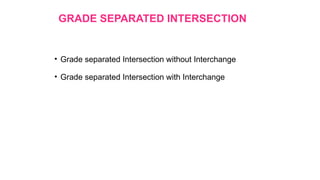
• Grade separated Intersection without Interchange
• Grade separated Intersection with Interchange
GRADE SEPARATED INTERSECTION
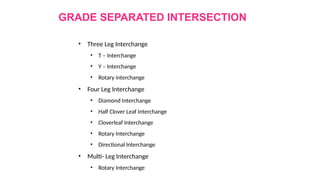
• Three Leg Interchange
• T – Interchange
• Y – Interchange
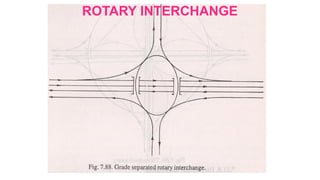
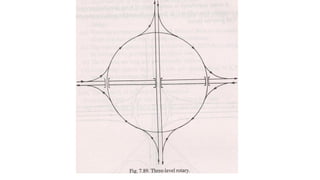
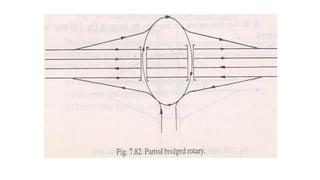
• Rotary interchange
• Four Leg Interchange
• Diamond Interchange
• Half Clover Leaf Interchange
• Cloverleaf Interchange
• Rotary Interchange
• Directional Interchange
• Multi- Leg Interchange
• Rotary Interchange
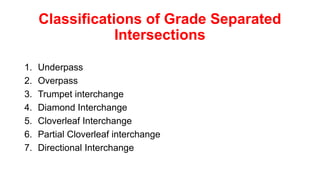
1. Underpass
2. Overpass
3. Trumpet interchange
4. Diamond Interchange
5. Cloverleaf Interchange
6. Partial Cloverleaf interchange
7. Directional Interchange
Classifications of Grade Separated
Intersections
Underpass
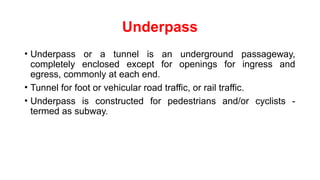
• Underpass or a tunnel is an underground passageway,
completely enclosed except for openings for ingress and
egress, commonly at each end.
• Tunnel for foot or vehicular road traffic, or rail traffic.
• Underpass is constructed for pedestrians and/or cyclists -
termed as subway.
Overpass
• Also known as a flyover, is a bridge, road, railway or similar
structure that crosses over another road or railway.
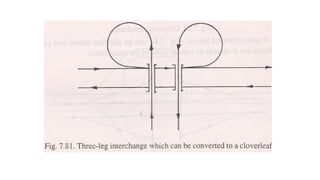
Trumpet Interchange
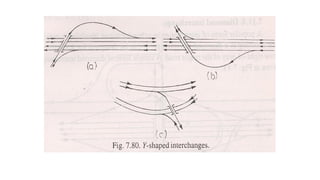
• A full Y-interchange(directional T interchange) is typically used
when a three-way interchange is required for two or three
highways interchanging in semi-parallel/perpendicular directions
• Where one highway terminates at another highway.
• Involve at least one loop ramp connecting traffic either entering
or leaving the terminating expressway with the far lanes of the
continuous highway.
• Suitable at the locations where the side road exists on only one
side of the freeway, and traffic is relatively low.
Trumpet Interchange
• Each entrance and exit consists of acceleration or deceleration
lanes at each end.
• It requires only one bridge and is the most traditional way of
grade separating a three way junction.
• Advantages are low construction cost and are useful for
highways as well as toll roads .
• Limitations in employing trumpet interchanges are it leaves a
redundant patch of the land within the loop. Disorienting to
navigate for those driving in the direction that uses the loop.
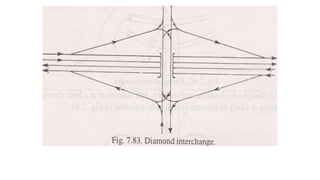
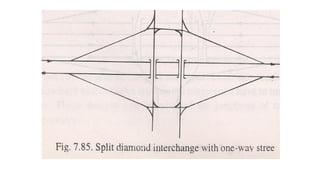
Diamond Interchange
• Simplest form of grade separated intersection between two
roadways.
• Conflicts between through and crossing traffic are eliminated by
a bridge structure.
• This particular intersection has four one way ramps which are
essentially parallel to the major artery.
• Requires a minimum amount of land
• Economical to construct.
• Generally requires less out-of-the way travel and vehicle
operating costs are less than those on most other types of
interchanges.
• The single point of exit from the major roadway
• Requires the least of right-of-way.
• Ideal solution to an intersection problem.
• There might be chances of occurrence of conflicts at the
locations where ramps meet the grade separated cross street
are to be considered for high ramp volumes.
• Improper design of signal timings at cross may result in the
inadequacy of capacity for certain flows.
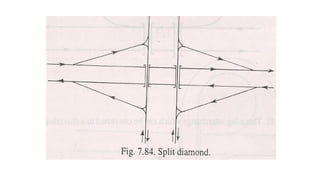
Diamond Interchange
• Popular form of four-leg interchange found in the urban
locations where major and minor roads crosses
• It can be designed even if the major road is relatively narrow
• These ramps at the non-freeway can be controlled through stop
signs, traffic signals, or turn ramps
• Economical in use of materials and land than other interchange
designs, does not normally require more than one bridge to be
constructed
• Capacity is lower than other interchanges and when traffic
volumes are high they can easily become congested.
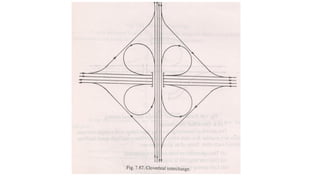
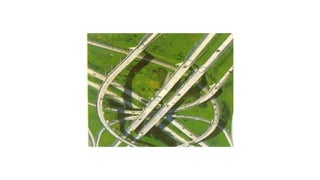
Clover leaf interchange
• Used when two highways of high volume speed intersect each
other with considerable turning movements
• The main advantage of cloverleaf intersection is that it provides
complete separation of traffic.
• High speed at intersections can be achieved
• Disadvantage is that large area of land is required - provided
mainly in rural areas
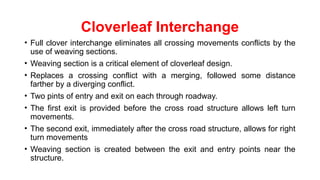
Cloverleaf Interchange
• Full clover interchange eliminates all crossing movements conflicts by the
use of weaving sections.
• Weaving section is a critical element of cloverleaf design.
• Replaces a crossing conflict with a merging, followed some distance
farther by a diverging conflict.
• Two pints of entry and exit on each through roadway.
• The first exit is provided before the cross road structure allows left turn
movements.
• The second exit, immediately after the cross road structure, allows for right
turn movements
• Weaving section is created between the exit and entry points near the
structure.
• Design requires only one bridge
• It is the cheapest form providing for elimination of all crossing
maneuvers at grade.
• Full cloverleaf interchanges eliminate the undesirable crossing
movements of diamond interchanges, they have the
disadvantages of greater travel distances, higher operating
costs, difficult merging sections, circuity of travel, large areas for
loops, sight distances to exists at the other side of the bridge,
confusion caused by turning right to go left and large rights – of
– way occasioned by the radius requirements necessary for
satisfactory speeds on the ramps.
Advantages
• Through traffic on both roads is unimpeded
• Only one structure is required
• Left turning traffic has a straight path
• Simple to use and does not confuse drivers
Disadvantages
• Large area is needed
• Carriageway width required is also higher than a Rotary
• Weaving manoeuvres are involved - capacity is limited to
1200 PCU/ hr
• U- turns are long and operationally difficult
• Right turning traffic has to travel extra distance
• Capacity of loop is also restricted
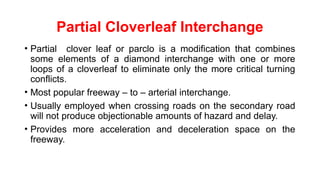
Partial Cloverleaf Interchange
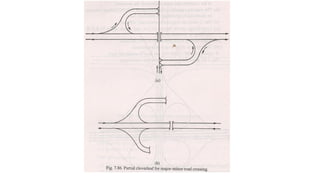
• Partial clover leaf or parclo is a modification that combines
some elements of a diamond interchange with one or more
loops of a cloverleaf to eliminate only the more critical turning
conflicts.
• Most popular freeway – to – arterial interchange.
• Usually employed when crossing roads on the secondary road
will not produce objectionable amounts of hazard and delay.
• Provides more acceleration and deceleration space on the
freeway.
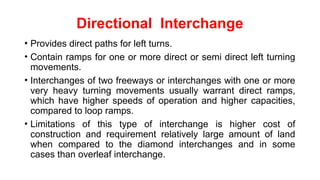
Directional Interchange
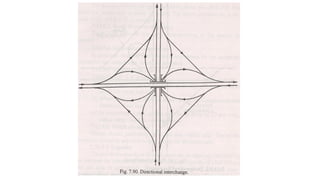
• Provides direct paths for left turns.
• Contain ramps for one or more direct or semi direct left turning
movements.
• Interchanges of two freeways or interchanges with one or more
very heavy turning movements usually warrant direct ramps,
which have higher speeds of operation and higher capacities,
compared to loop ramps.
• Limitations of this type of interchange is higher cost of
construction and requirement relatively large amount of land
when compared to the diamond interchanges and in some
cases than overleaf interchange.
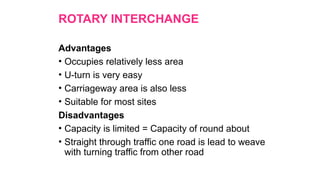
ROTARY INTERCHANGE
ROTARY INTERCHANGE
Advantages
• Occupies relatively less area
• U-turn is very easy
• Carriageway area is also less
• Suitable for most sites
Disadvantages
• Capacity is limited = Capacity of round about
• Straight through traffic one road is lead to weave
with turning traffic from other road
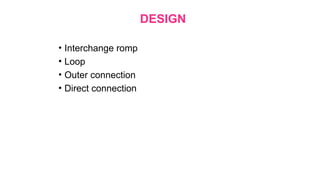
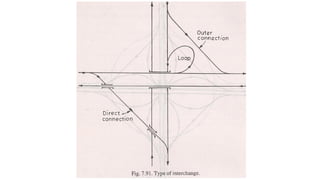
DESIGN
• Interchange romp
• Loop
• Outer connection
• Direct connection
Acceleration lane
• An acceleration lane is defined as extra pavement, of constant
or variables width, placed parallel or nearly so, to a merging
maneuver area to encourage merging at low relative speed.
• Acceleration lanes are determined by two factors:
1) Time required for drivers to accelerate to the speed of the
preferential flow from the speed of entry into the acceleration
lane and
2) Maneuvering time required as a supplement to the sight
distance which is provided in advance of the acceleration
lane.
Deceleration Lanes
• Deceleration lanes are defined as extra pavement of constant
or variable width, placed parallel or nearly so, to a diverging
maneuver area to encourage diverging at low relative speed.
• The lengths of deceleration lanes are based on the difference in
the speed of traffic of the combined flow (in advance of the
collision area) and the speed at which drives negotiate the
critical diverging channel curve, as well as the deceleration
practices of drivers.
Grade separated intersections in transportation engineering

Grade separated intersections in transportation engineering

  • 1.
  • 2.
    Grade Seperated Intersections •Grade- separated intersections are provided to separate traffic in the vertical grade • Traffic need not be those pertaining to road only • Different types of grade separators are flyovers and interchange • Flyovers itself are subdivided into overpass underpass.When two roads cross at a point, if the road having major traffic is elevated to higher grade for further movement of traffic, then such structures are called overpass
  • 3.
    Grade Seperated Intersections •If the major road is depressed to a lower level to cross another by means of under bridge or tunnel, it is called under-pass. • Interchage is a system where traffic between two or more roadways flows at different levels in the grade seperated junctions
  • 4.
    Grade Separated Intersections •A bridge that eliminates crossing conflicts at intersections by vertical separation of roadways in space. • Known as interchanges. • Cause less hazard and delay than grade intersections. • Route transfer at grade separation is accompanied by interchange facilities consisting ramps. • Interchange ramps are Direct, Semi-Direct and Indirect.
  • 5.
    • Interchange configurationsare designed in such a way to accommodate economically the traffic requirements of flow, operation on the crossing facilities, physical requirements of the topography, adjoining land use, type of controls, right–of–way and direction of movements. • Ultimate objective is to eliminate all grade crossing conflicts and to accommodate other intersecting maneuvers by merging, diverging and weaving at low relative speed.
  • 6.
    • Benefit ofproviding for low relative speed is twofold: • events unfold more slowly allowing more judgment time • incase of an impact the total relative energy to be absorbed are less and hence, the damage is less. • When relative speed is low, the average motorist will accept a smaller time gap between successive vehicles to complete his move. This condition increases roadway capacity.
  • 7.
    Classifications of GradeSeparated Intersections • Directional and the non-directional interchange . • Direct interchanges are those having ramps that tend to follow the natural direction of movement. • Non directional interchanges require a change in the natural path of traffic flow.
  • 8.
    Design of Interchangesin Urban Ares IRC:92-1985
  • 9.
    GRADE SEPARATED INTERSECTION •Grade separated Intersection without Interchange • Grade separated Intersection with Interchange
  • 10.
    GRADE SEPARATED INTERSECTION •Three Leg Interchange • T – Interchange • Y – Interchange • Rotary interchange • Four Leg Interchange • Diamond Interchange • Half Clover Leaf Interchange • Cloverleaf Interchange • Rotary Interchange • Directional Interchange • Multi- Leg Interchange • Rotary Interchange
  • 11.
    1. Underpass 2. Overpass 3.Trumpet interchange 4. Diamond Interchange 5. Cloverleaf Interchange 6. Partial Cloverleaf interchange 7. Directional Interchange Classifications of Grade Separated Intersections
  • 12.
    Underpass • Underpass ora tunnel is an underground passageway, completely enclosed except for openings for ingress and egress, commonly at each end. • Tunnel for foot or vehicular road traffic, or rail traffic. • Underpass is constructed for pedestrians and/or cyclists - termed as subway.
  • 13.
    Overpass • Also knownas a flyover, is a bridge, road, railway or similar structure that crosses over another road or railway.
  • 14.
    Trumpet Interchange • Afull Y-interchange(directional T interchange) is typically used when a three-way interchange is required for two or three highways interchanging in semi-parallel/perpendicular directions • Where one highway terminates at another highway. • Involve at least one loop ramp connecting traffic either entering or leaving the terminating expressway with the far lanes of the continuous highway. • Suitable at the locations where the side road exists on only one side of the freeway, and traffic is relatively low.
  • 15.
    Trumpet Interchange • Eachentrance and exit consists of acceleration or deceleration lanes at each end. • It requires only one bridge and is the most traditional way of grade separating a three way junction. • Advantages are low construction cost and are useful for highways as well as toll roads . • Limitations in employing trumpet interchanges are it leaves a redundant patch of the land within the loop. Disorienting to navigate for those driving in the direction that uses the loop.
  • 18.
    Diamond Interchange • Simplestform of grade separated intersection between two roadways. • Conflicts between through and crossing traffic are eliminated by a bridge structure. • This particular intersection has four one way ramps which are essentially parallel to the major artery. • Requires a minimum amount of land • Economical to construct.
  • 22.
    • Generally requiresless out-of-the way travel and vehicle operating costs are less than those on most other types of interchanges. • The single point of exit from the major roadway • Requires the least of right-of-way. • Ideal solution to an intersection problem. • There might be chances of occurrence of conflicts at the locations where ramps meet the grade separated cross street are to be considered for high ramp volumes. • Improper design of signal timings at cross may result in the inadequacy of capacity for certain flows.
  • 23.
    Diamond Interchange • Popularform of four-leg interchange found in the urban locations where major and minor roads crosses • It can be designed even if the major road is relatively narrow • These ramps at the non-freeway can be controlled through stop signs, traffic signals, or turn ramps • Economical in use of materials and land than other interchange designs, does not normally require more than one bridge to be constructed • Capacity is lower than other interchanges and when traffic volumes are high they can easily become congested.
  • 24.
    Clover leaf interchange •Used when two highways of high volume speed intersect each other with considerable turning movements • The main advantage of cloverleaf intersection is that it provides complete separation of traffic. • High speed at intersections can be achieved • Disadvantage is that large area of land is required - provided mainly in rural areas
  • 26.
    Cloverleaf Interchange • Fullclover interchange eliminates all crossing movements conflicts by the use of weaving sections. • Weaving section is a critical element of cloverleaf design. • Replaces a crossing conflict with a merging, followed some distance farther by a diverging conflict. • Two pints of entry and exit on each through roadway. • The first exit is provided before the cross road structure allows left turn movements. • The second exit, immediately after the cross road structure, allows for right turn movements • Weaving section is created between the exit and entry points near the structure.
  • 27.
    • Design requiresonly one bridge • It is the cheapest form providing for elimination of all crossing maneuvers at grade. • Full cloverleaf interchanges eliminate the undesirable crossing movements of diamond interchanges, they have the disadvantages of greater travel distances, higher operating costs, difficult merging sections, circuity of travel, large areas for loops, sight distances to exists at the other side of the bridge, confusion caused by turning right to go left and large rights – of – way occasioned by the radius requirements necessary for satisfactory speeds on the ramps.
  • 28.
    Advantages • Through trafficon both roads is unimpeded • Only one structure is required • Left turning traffic has a straight path • Simple to use and does not confuse drivers Disadvantages • Large area is needed • Carriageway width required is also higher than a Rotary • Weaving manoeuvres are involved - capacity is limited to 1200 PCU/ hr • U- turns are long and operationally difficult • Right turning traffic has to travel extra distance • Capacity of loop is also restricted
  • 29.
    Partial Cloverleaf Interchange •Partial clover leaf or parclo is a modification that combines some elements of a diamond interchange with one or more loops of a cloverleaf to eliminate only the more critical turning conflicts. • Most popular freeway – to – arterial interchange. • Usually employed when crossing roads on the secondary road will not produce objectionable amounts of hazard and delay. • Provides more acceleration and deceleration space on the freeway.
  • 31.
    Directional Interchange • Providesdirect paths for left turns. • Contain ramps for one or more direct or semi direct left turning movements. • Interchanges of two freeways or interchanges with one or more very heavy turning movements usually warrant direct ramps, which have higher speeds of operation and higher capacities, compared to loop ramps. • Limitations of this type of interchange is higher cost of construction and requirement relatively large amount of land when compared to the diamond interchanges and in some cases than overleaf interchange.
  • 33.
  • 36.
    ROTARY INTERCHANGE Advantages • Occupiesrelatively less area • U-turn is very easy • Carriageway area is also less • Suitable for most sites Disadvantages • Capacity is limited = Capacity of round about • Straight through traffic one road is lead to weave with turning traffic from other road
  • 37.
    DESIGN • Interchange romp •Loop • Outer connection • Direct connection
  • 39.
    Acceleration lane • Anacceleration lane is defined as extra pavement, of constant or variables width, placed parallel or nearly so, to a merging maneuver area to encourage merging at low relative speed. • Acceleration lanes are determined by two factors: 1) Time required for drivers to accelerate to the speed of the preferential flow from the speed of entry into the acceleration lane and 2) Maneuvering time required as a supplement to the sight distance which is provided in advance of the acceleration lane.
  • 40.
    Deceleration Lanes • Decelerationlanes are defined as extra pavement of constant or variable width, placed parallel or nearly so, to a diverging maneuver area to encourage diverging at low relative speed. • The lengths of deceleration lanes are based on the difference in the speed of traffic of the combined flow (in advance of the collision area) and the speed at which drives negotiate the critical diverging channel curve, as well as the deceleration practices of drivers.