CHAPTER 3.0
JUNCTION DESIGN
CC503 – TRAFFIC ENGINEERING
JUNCTION
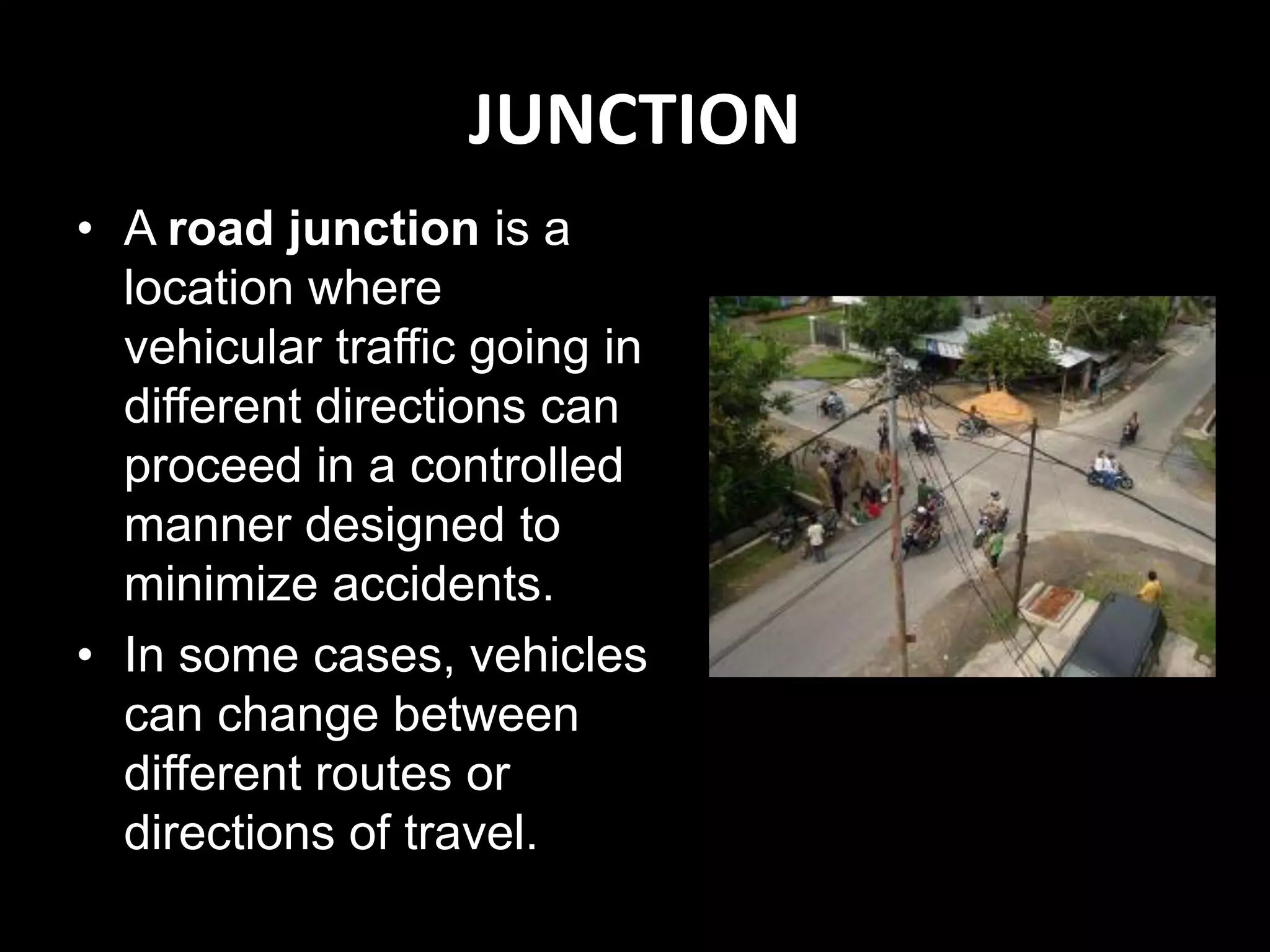
• A road junction is a
location where
vehicular traffic going in
different directions can
proceed in a controlled
manner designed to
minimize accidents.
• In some cases, vehicles
can change between
different routes or
directions of travel.
INTERSECTION
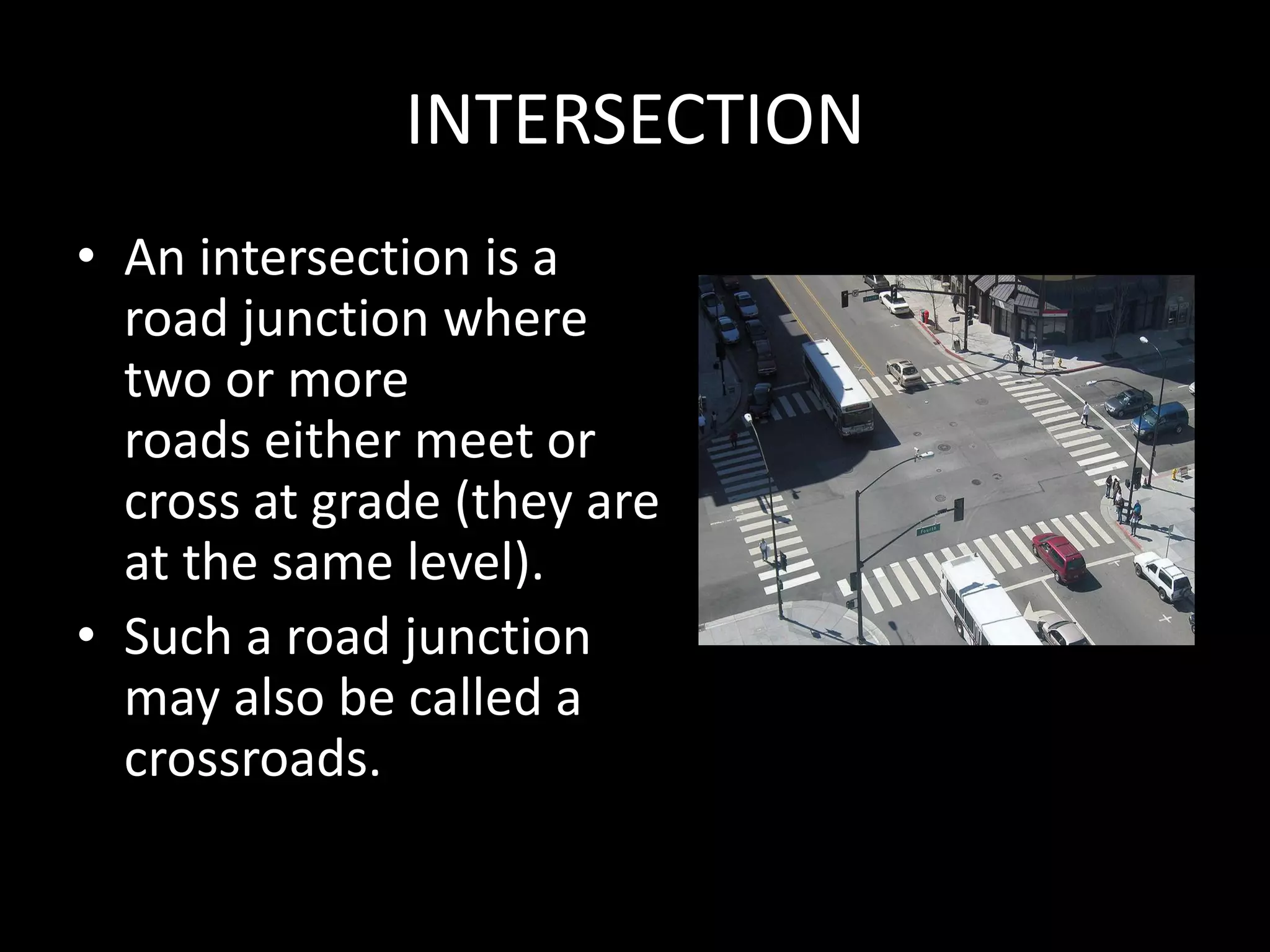
• An intersection is a
road junction where
two or more
roads either meet or
cross at grade (they are
at the same level).
• Such a road junction
may also be called a
crossroads.
FACTORS THAT AFFECT JUNCTION
LOAD.
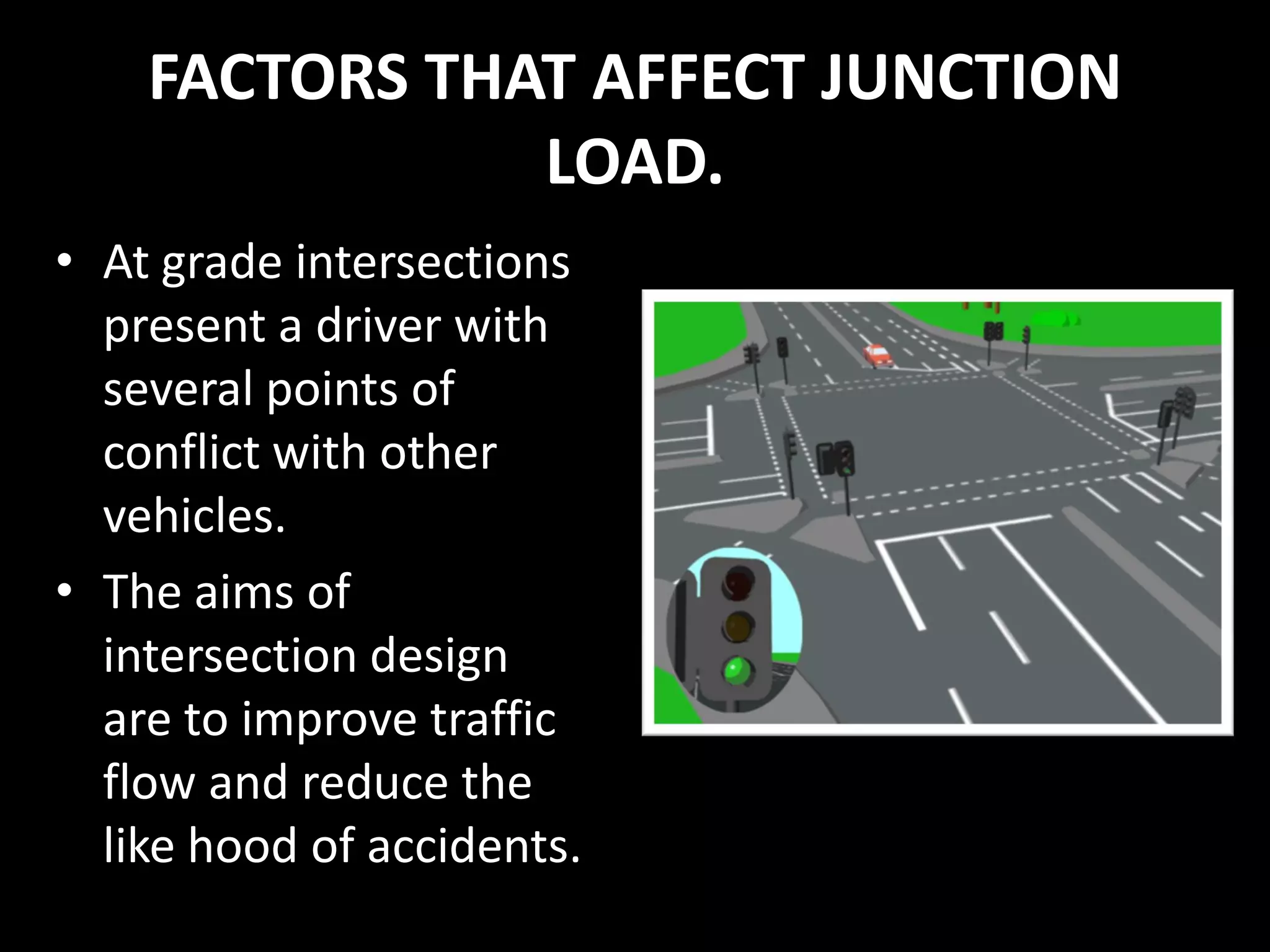
• At grade intersections
present a driver with
several points of
conflict with other
vehicles.
• The aims of
intersection design
are to improve traffic
flow and reduce the
like hood of accidents.
FACTORS THAT AFFECT JUNCTION
LOAD.
• Factors that affect junction load are:-
i. Geometrical design and traffic control devices
ii. Total or length wide
iii. Distribution design
iv. Turning radius
v. Traffic volume and characteristic
TYPE OF JUNCTION
AT GRADE JUNCTION
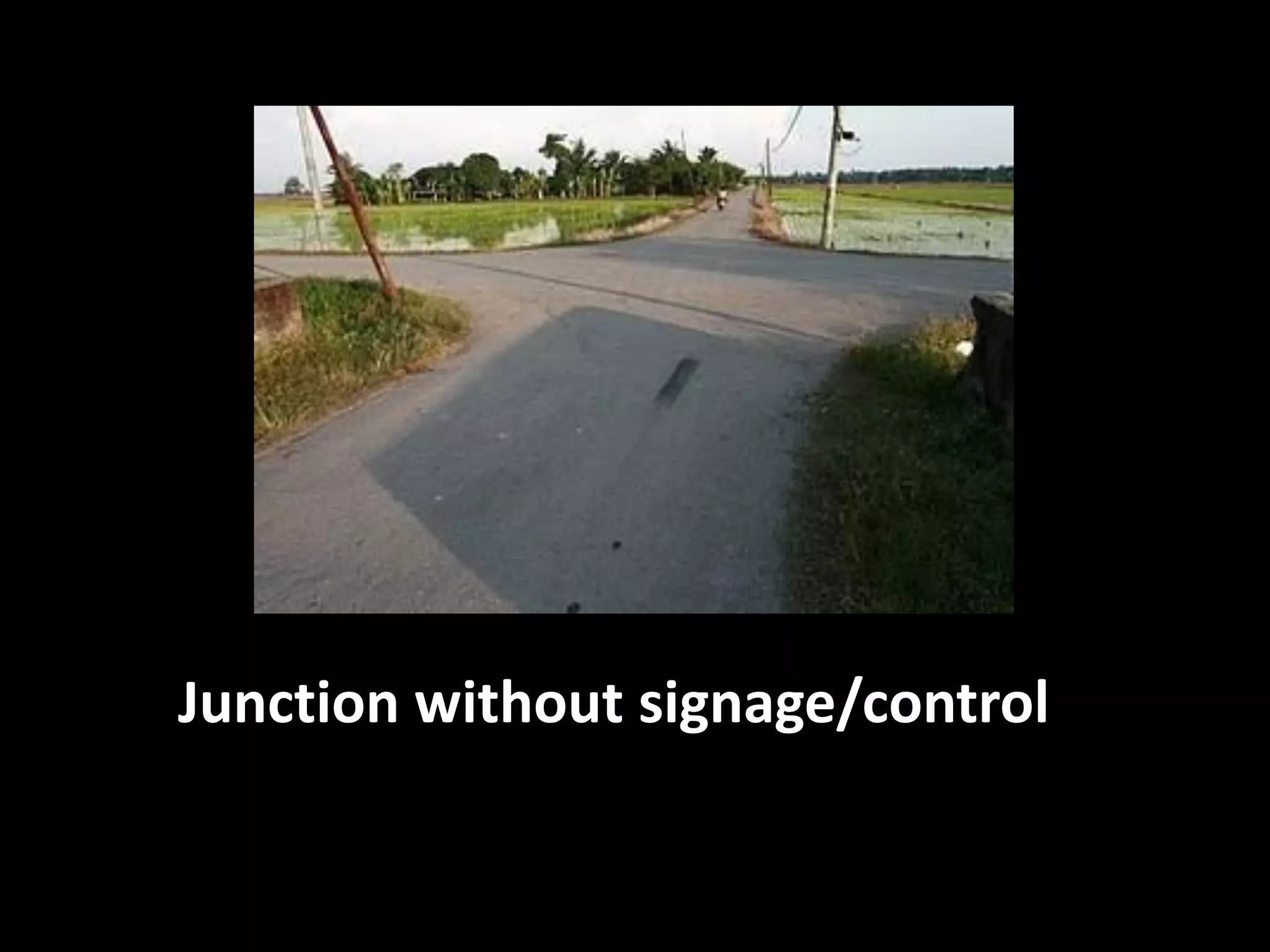
• Junction without signage/control
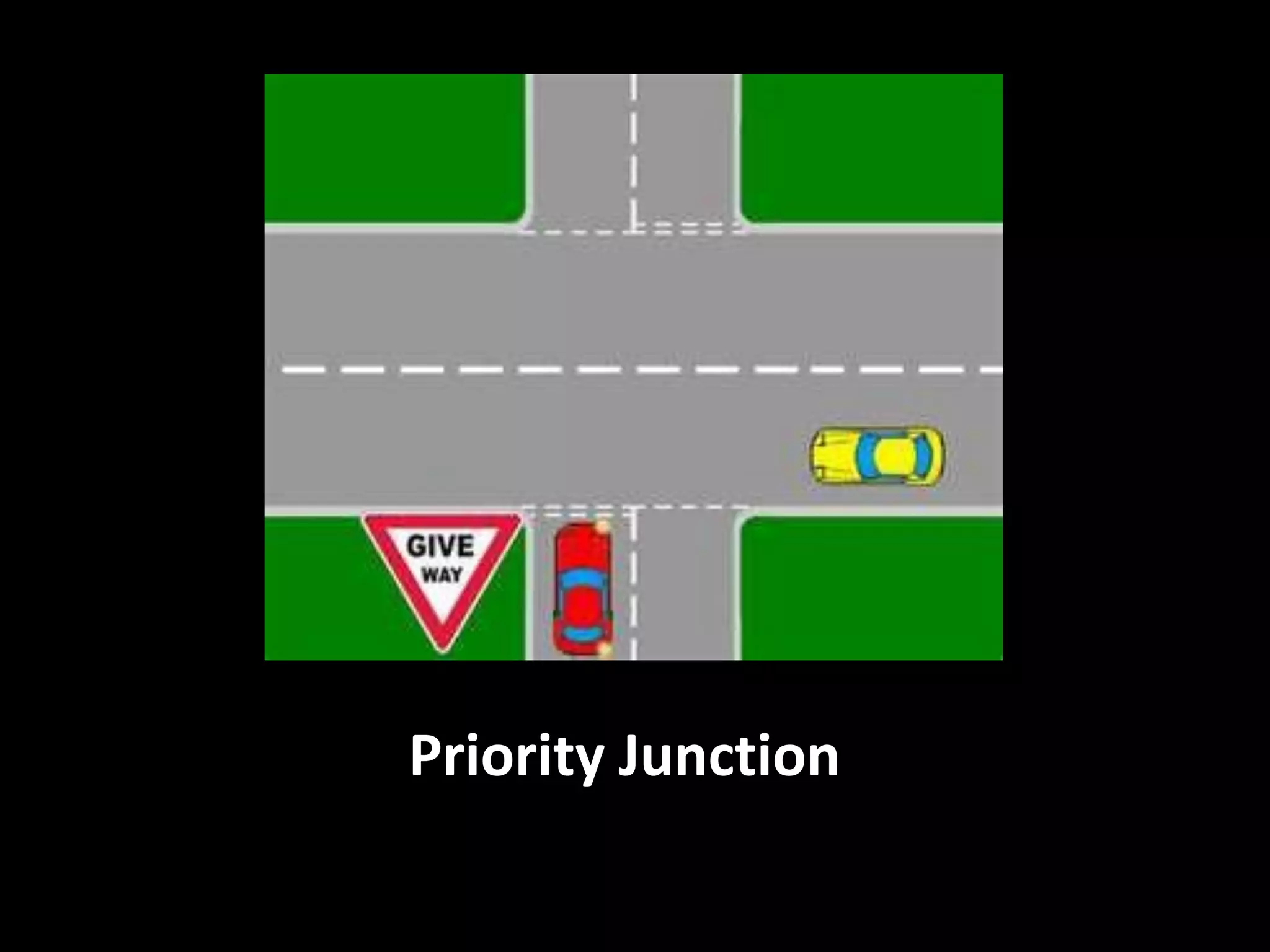
• Priority Junction
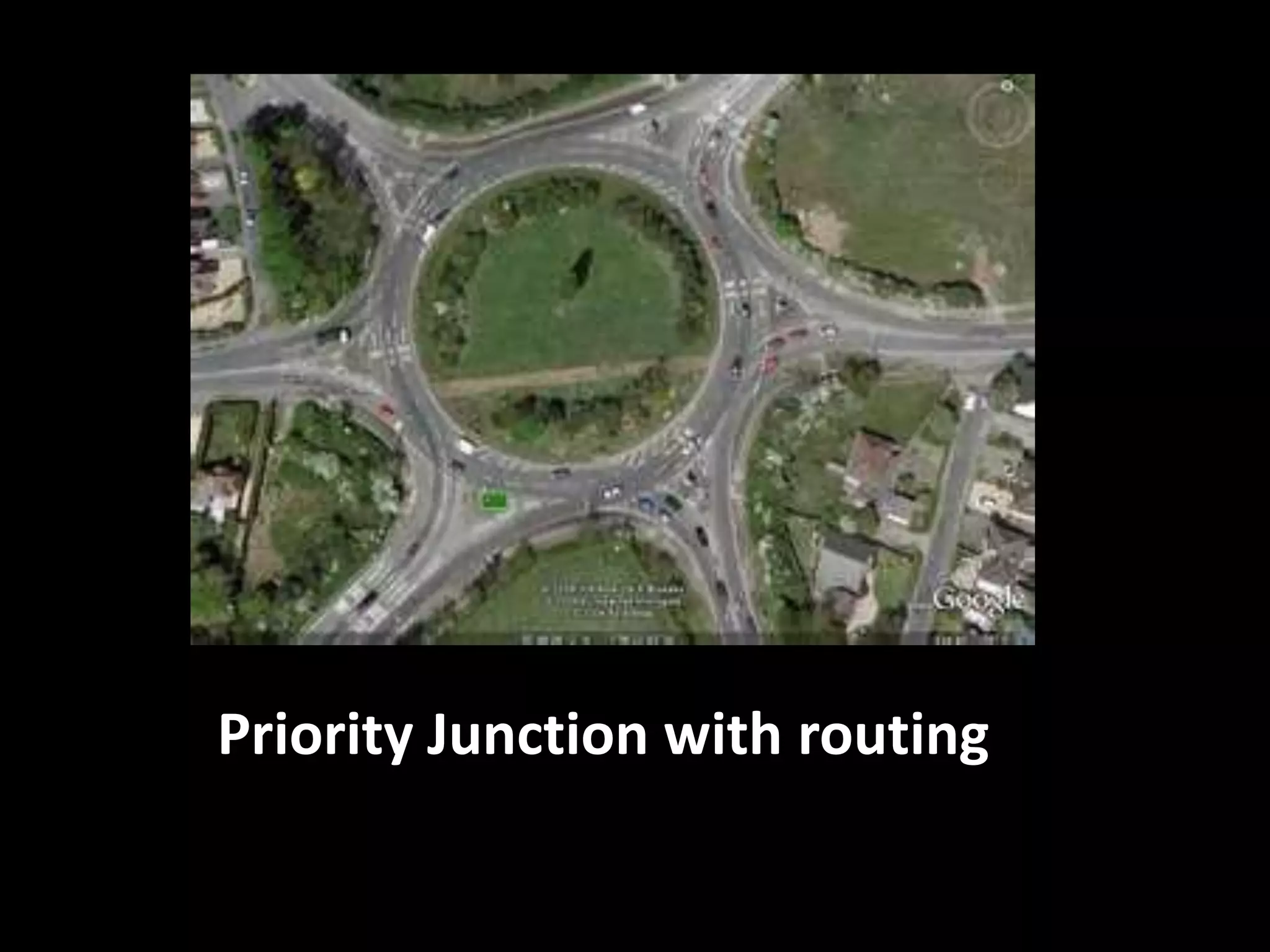
• Priority Junction with routing
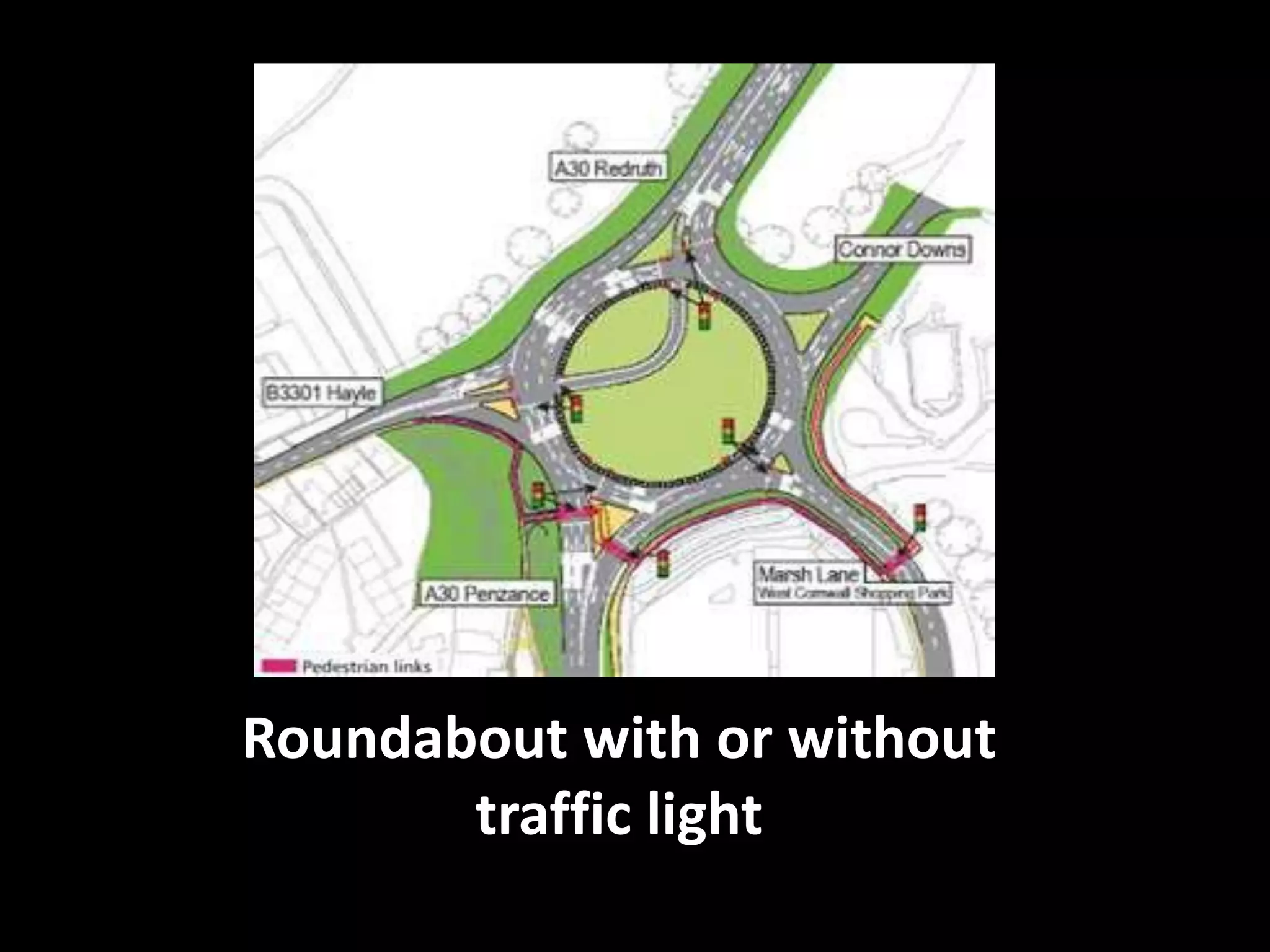
• Roundabout with or without traffic light
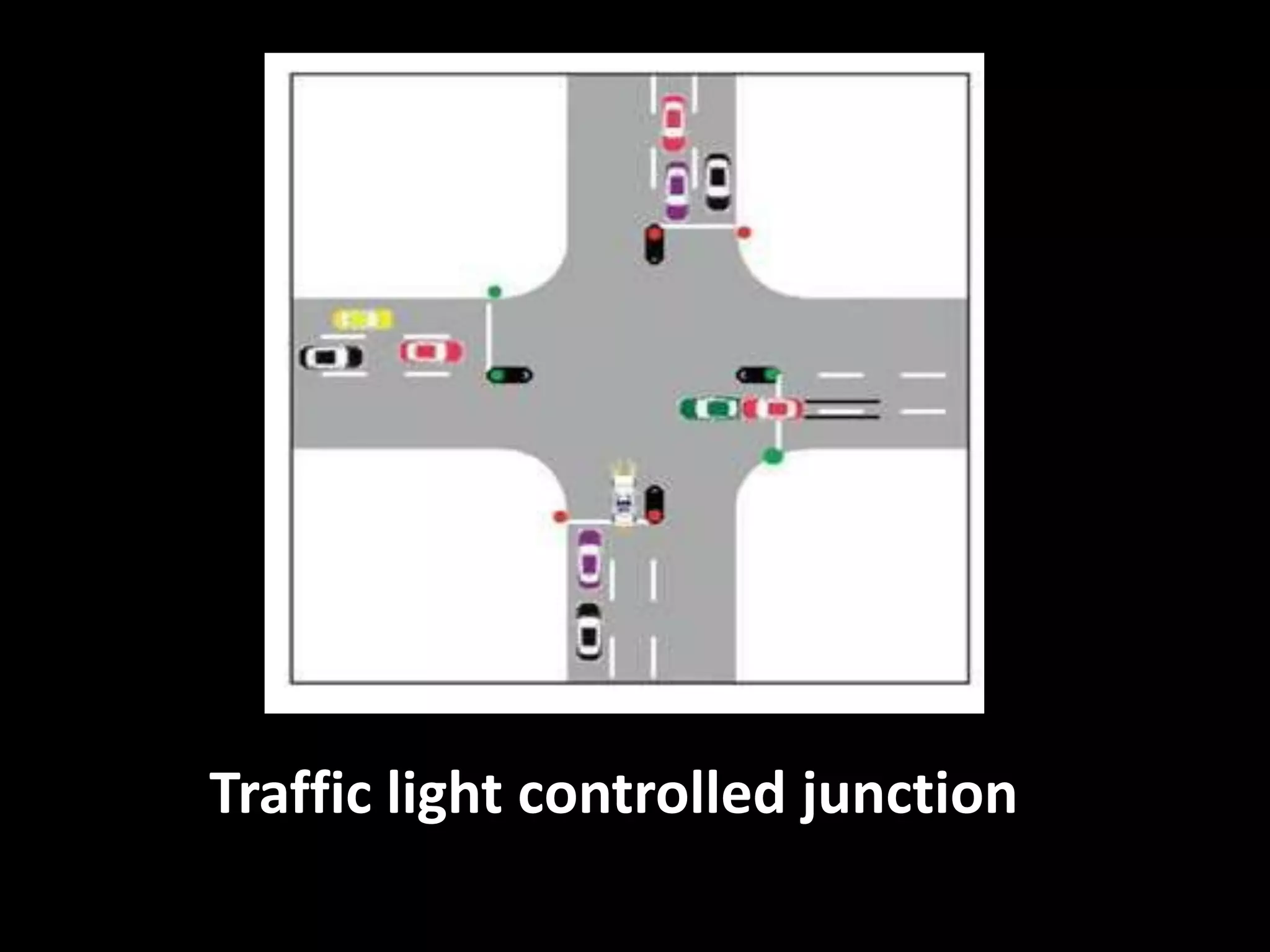
• Traffic light controlled junction
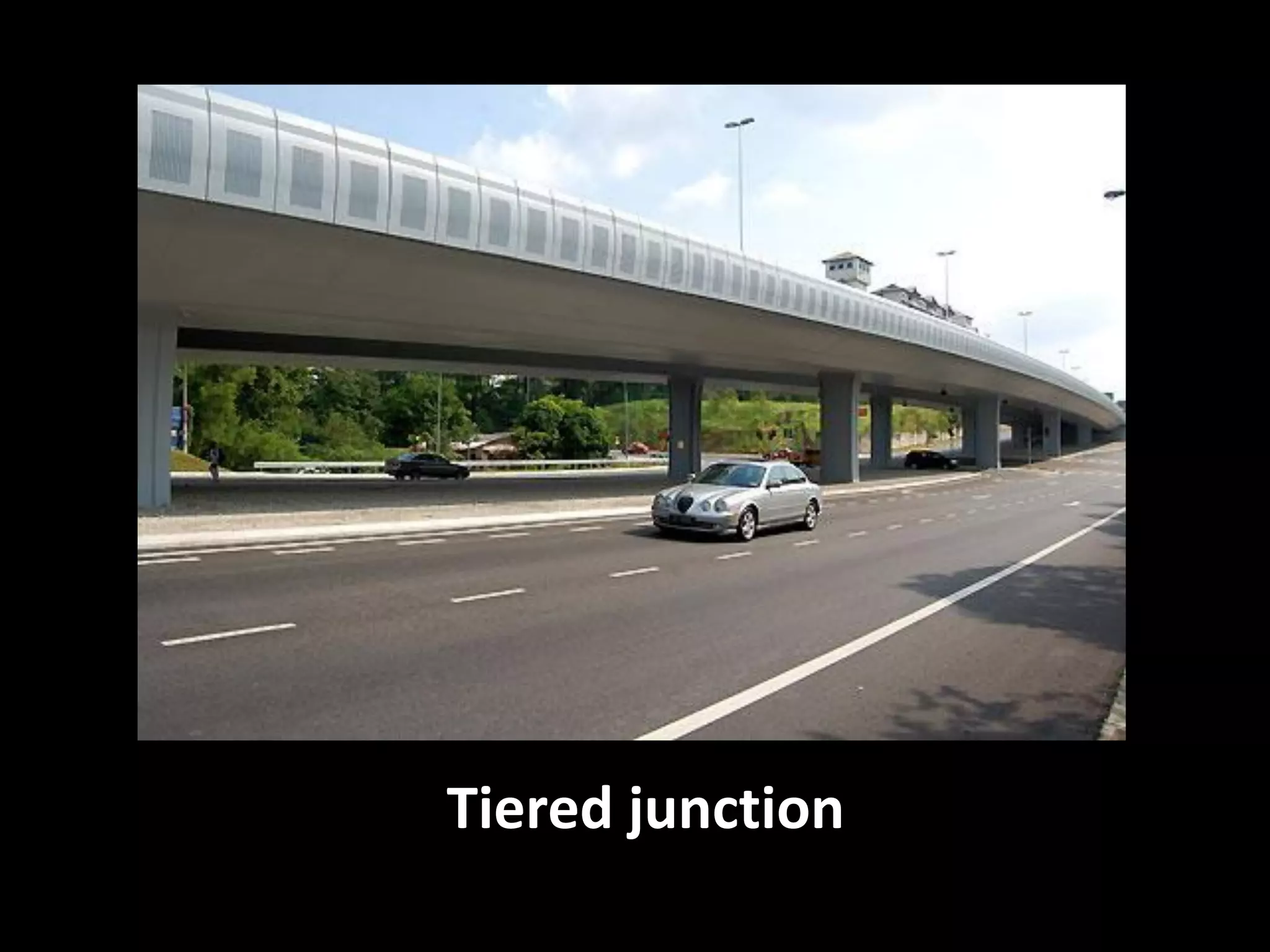
• Tiered junction
GRADE SEPARATED OR INTERCHANGED
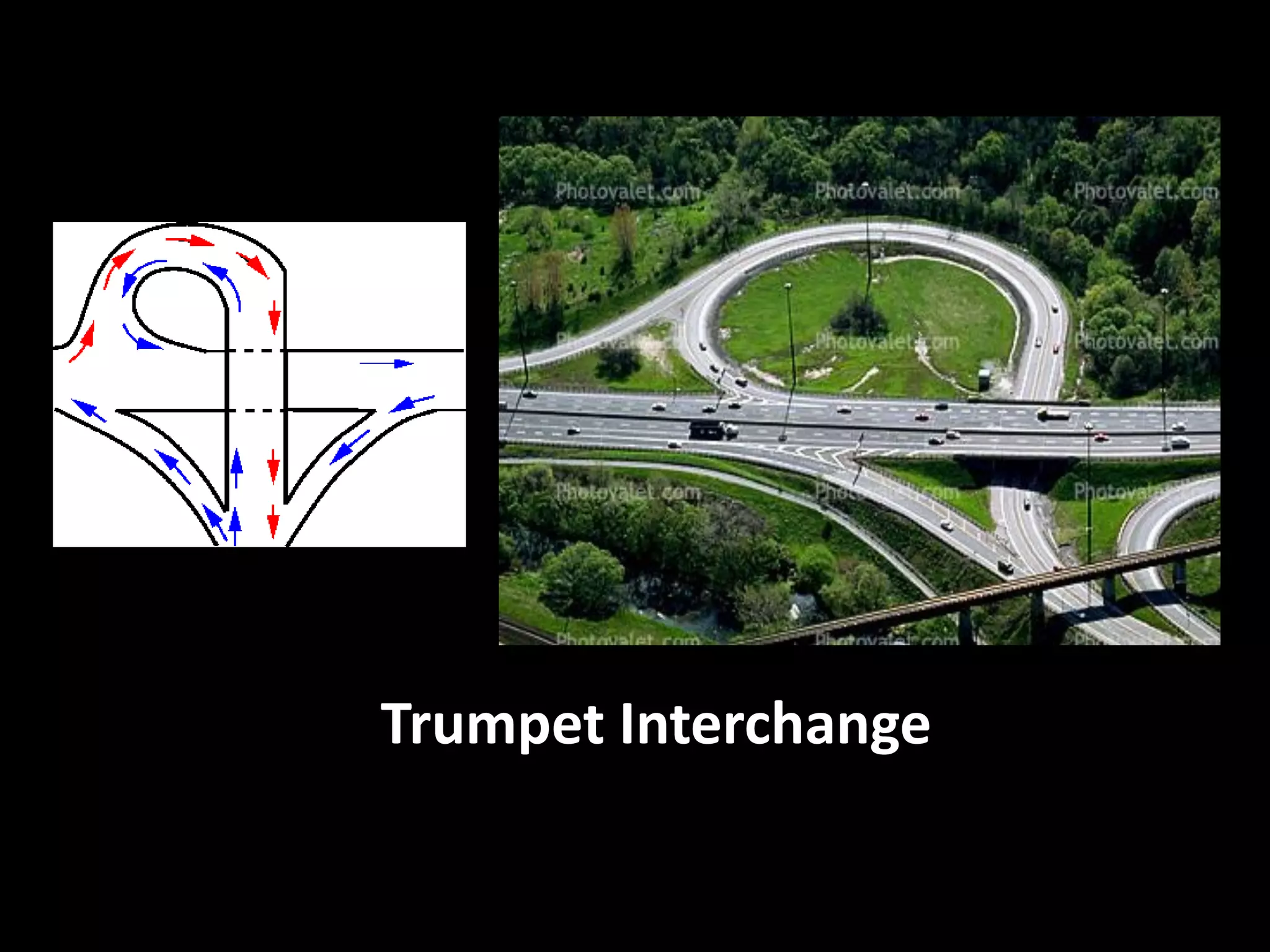
• Trumpet interchange:
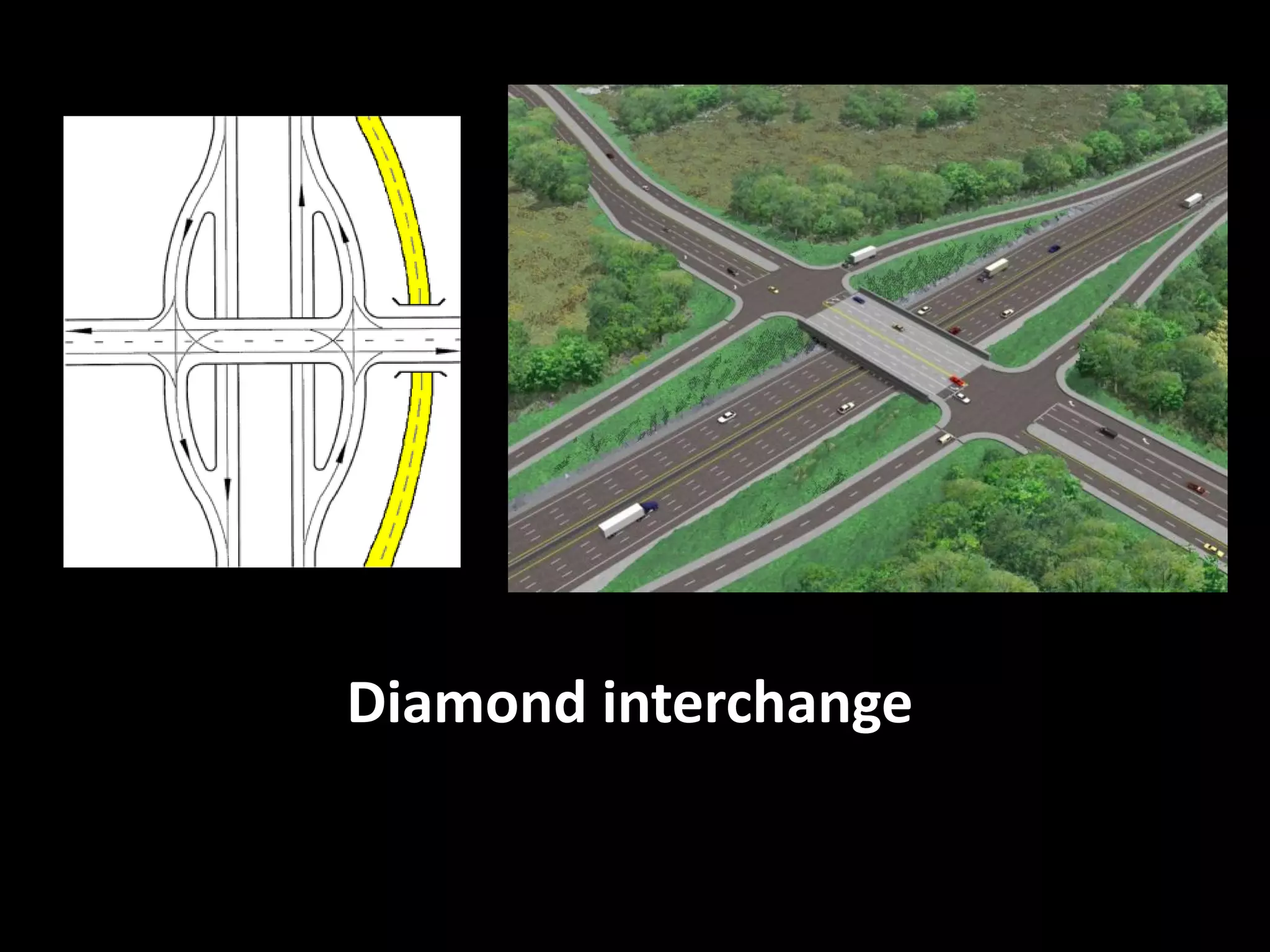
• Diamond interchange:
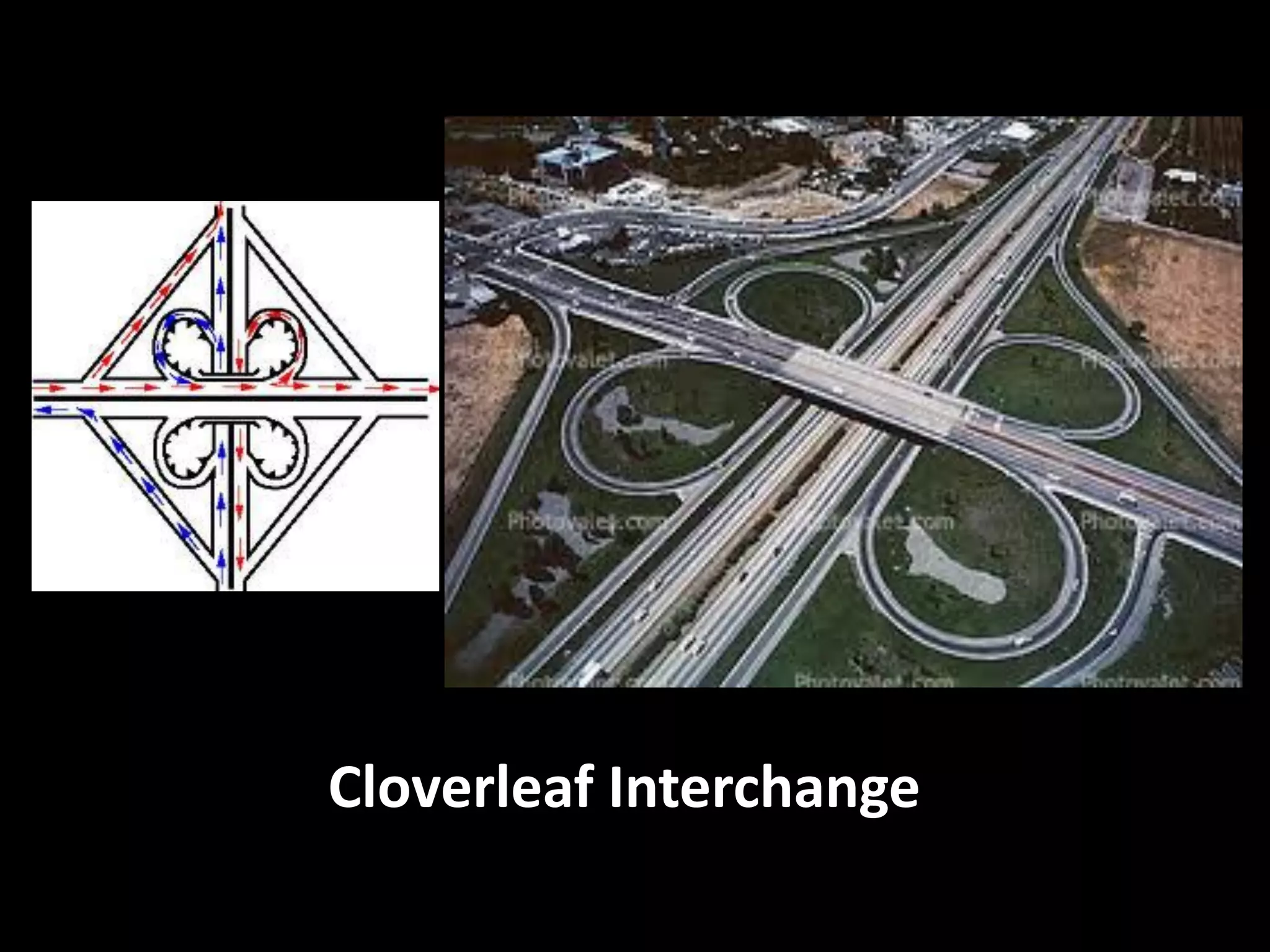
• Clover leaf interchange
Junction without signage/control
Priority Junction
Priority Junction with routing
Roundabout with or without
traffic light
Traffic light controlled junction
Tiered junction
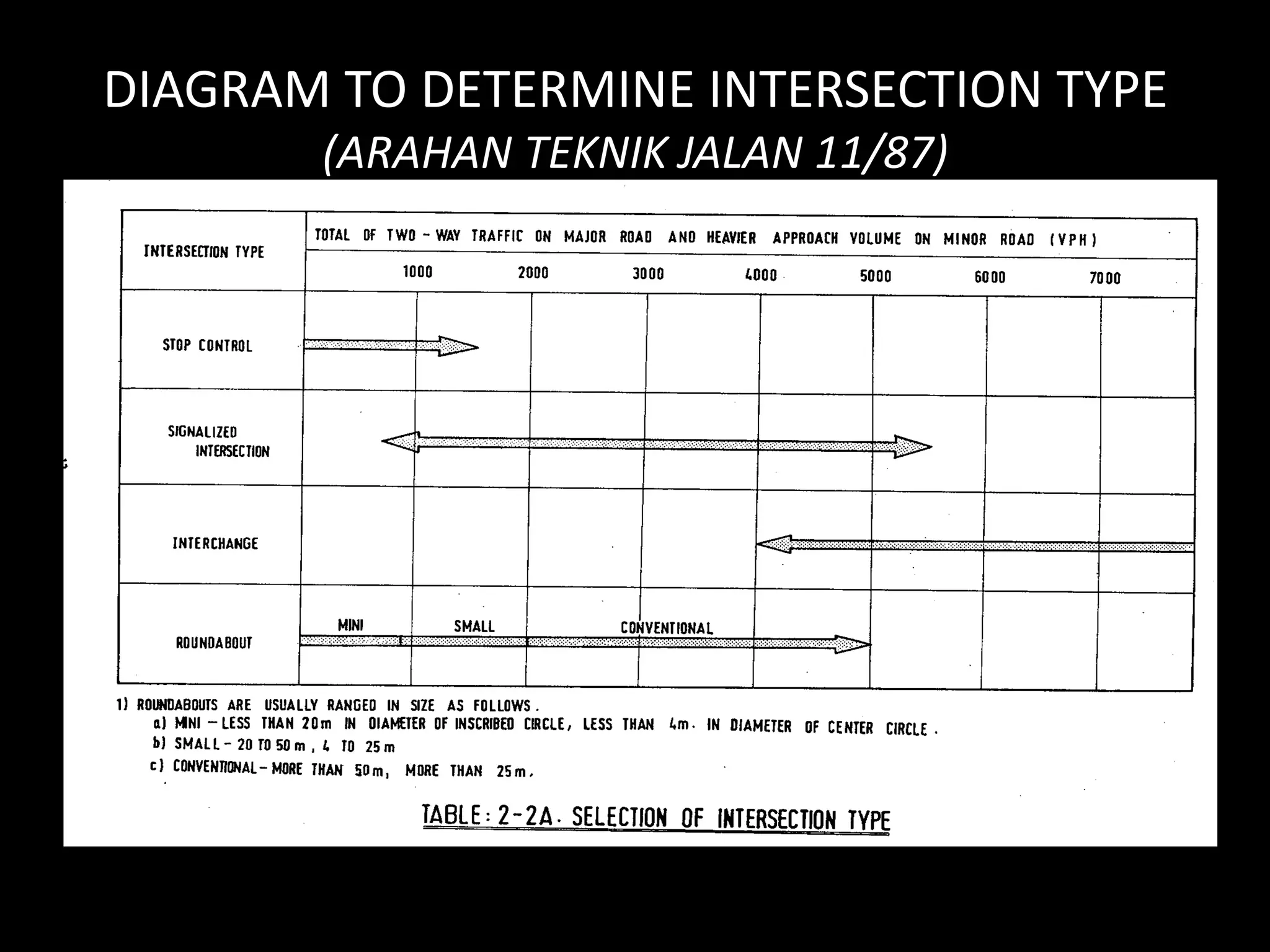
DIAGRAM TO DETERMINE INTERSECTION TYPE
(ARAHAN TEKNIK JALAN 11/87)
Trumpet Interchange
Diamond interchange
Cloverleaf Interchange
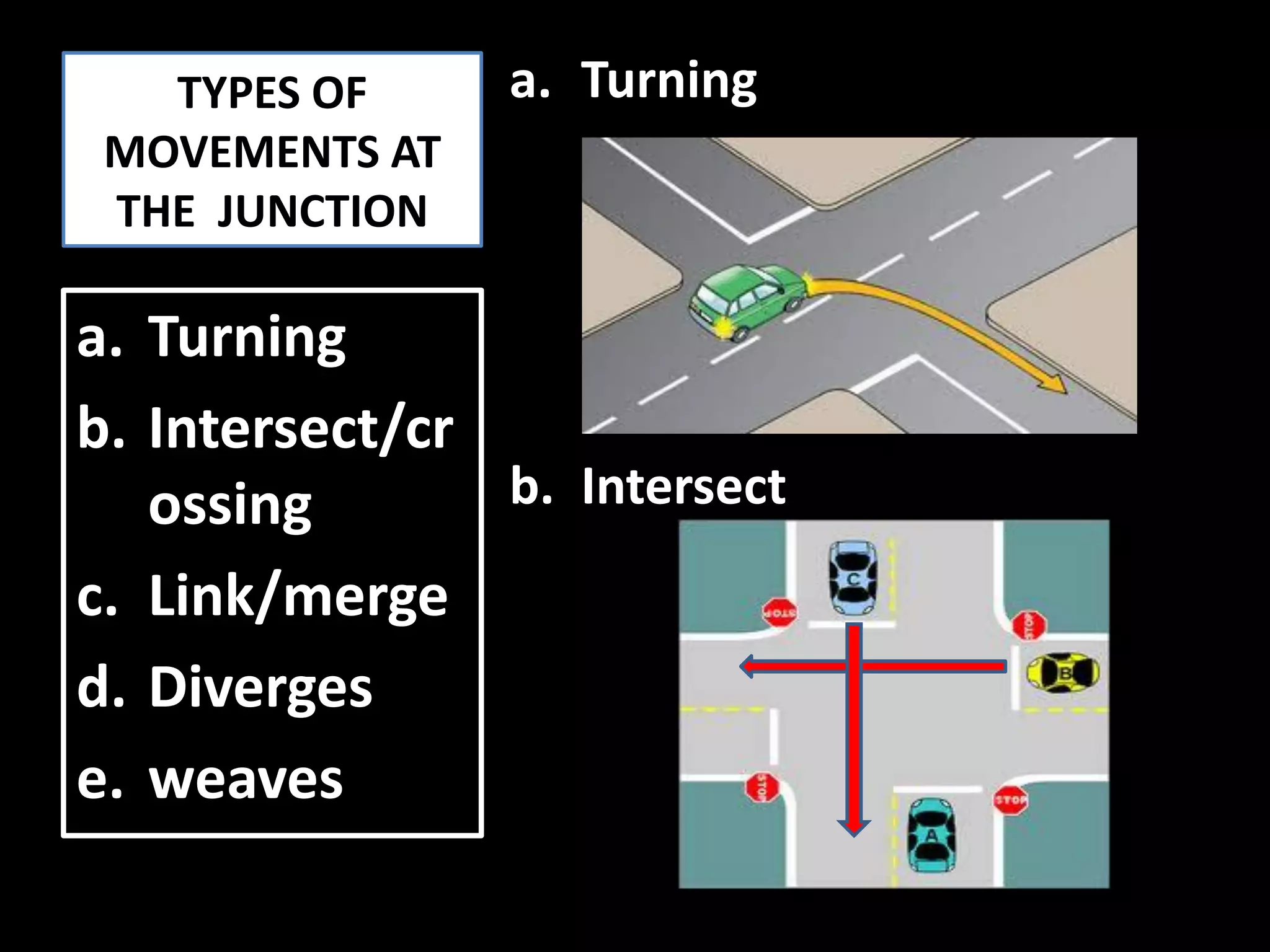
TYPES OF
MOVEMENTS AT
THE JUNCTION
a. Turning
b. Intersect
a. Turning
b. Intersect/cr
ossing
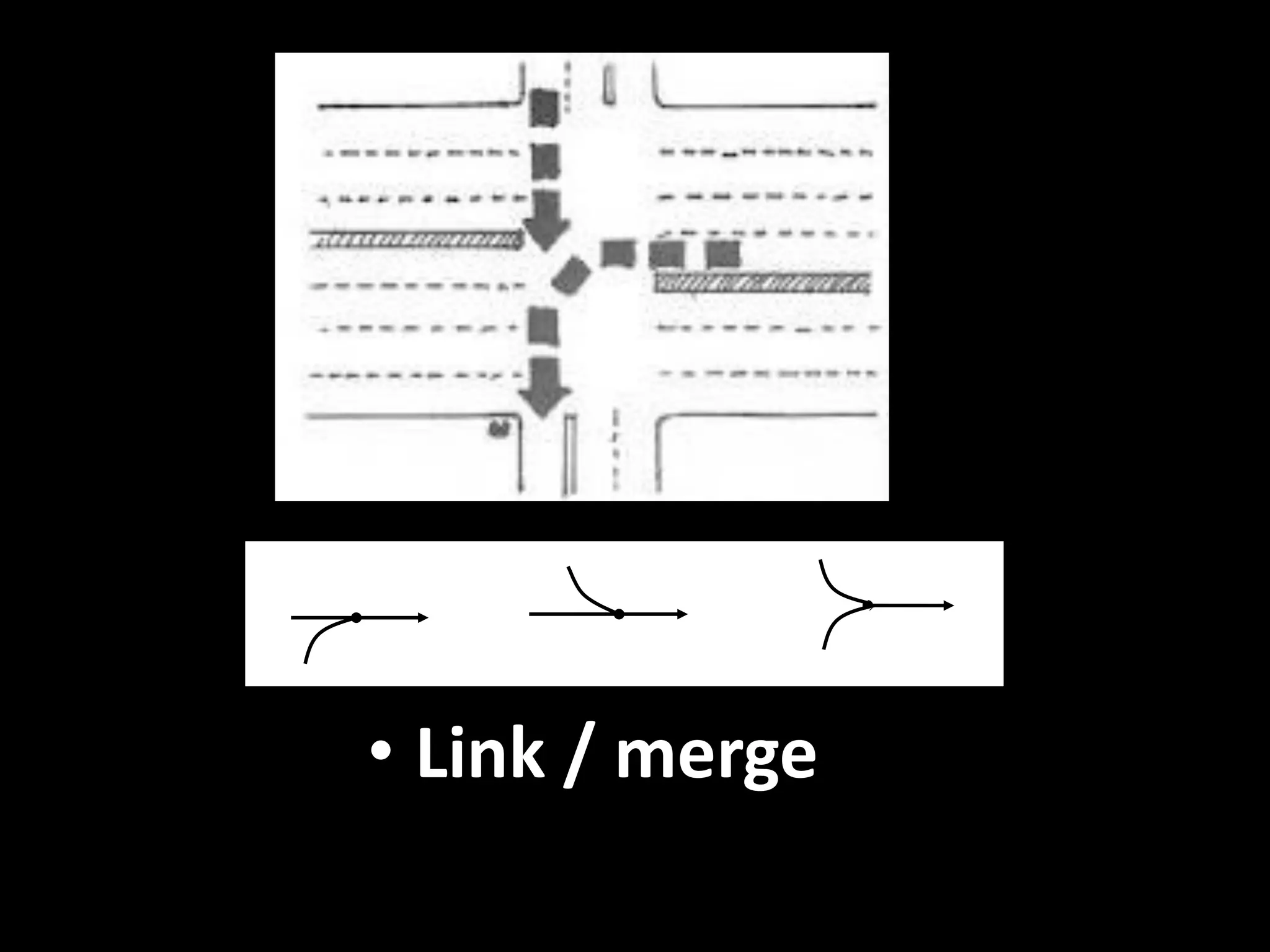
c. Link/merge
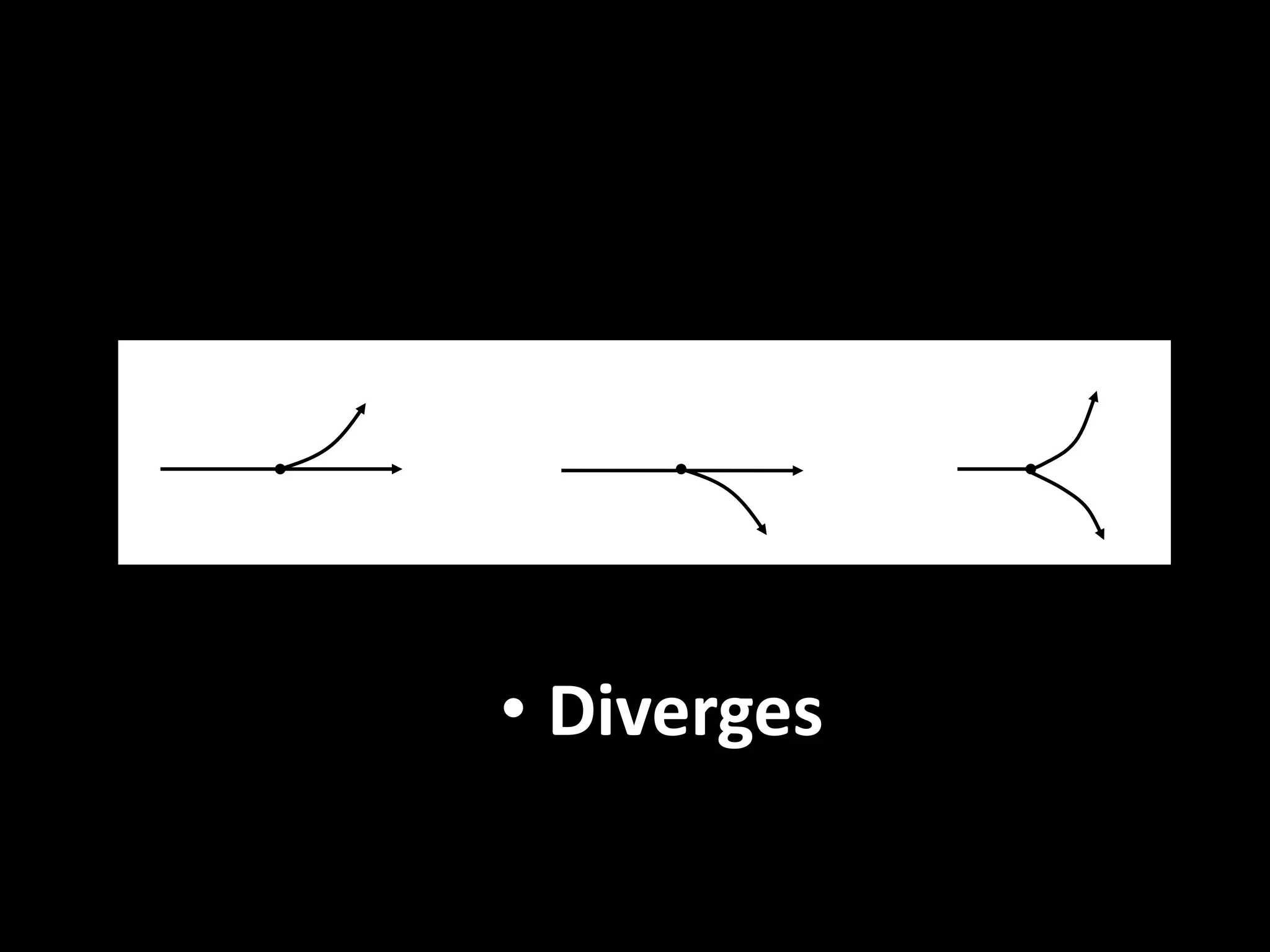
d. Diverges
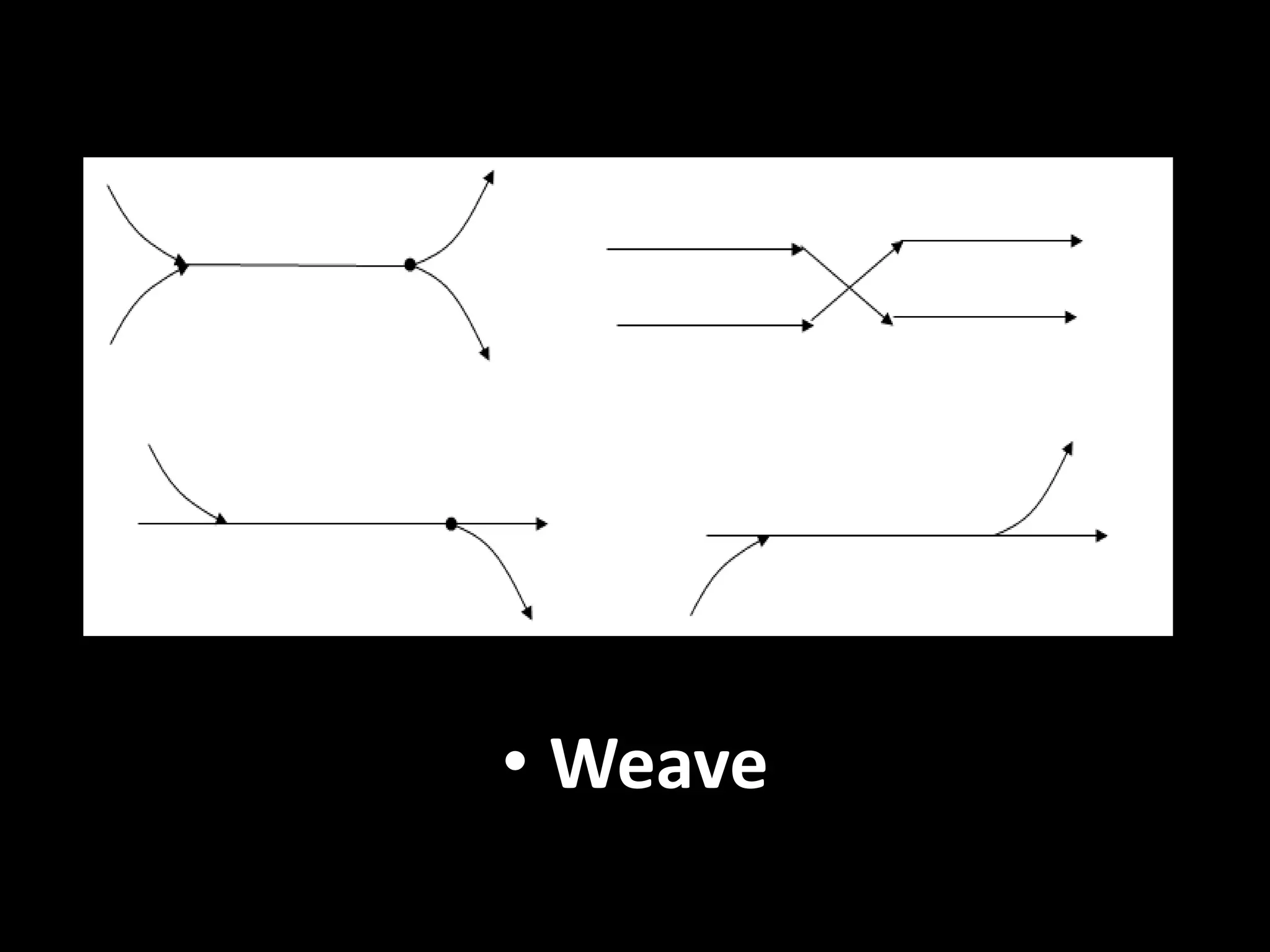
e. weaves
• Link / merge
• Diverges
• Weave
CONFLICT POINT AND CONFLICT AREA
AT AN INTERSECTION
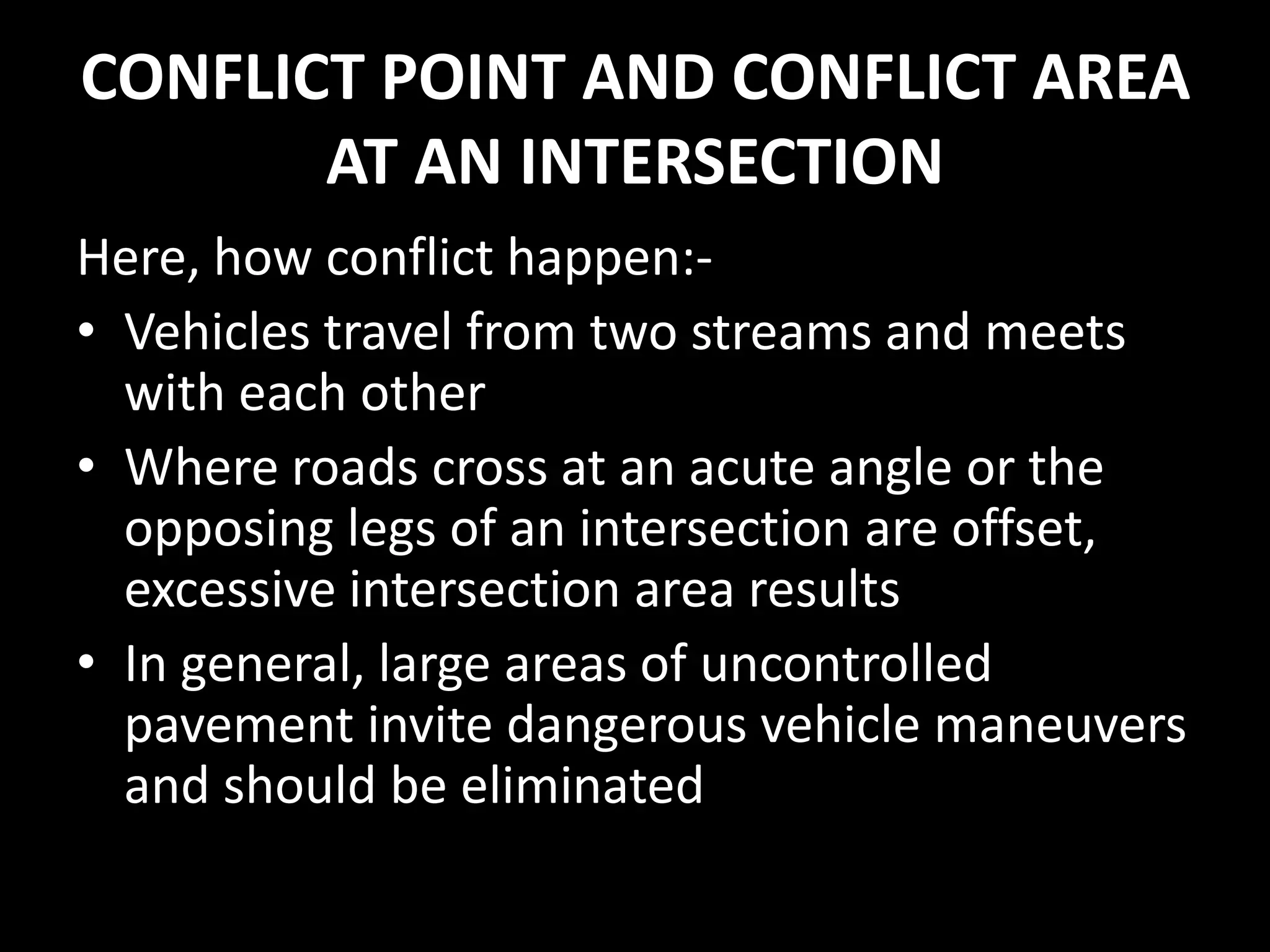
• Conflict points are commonly used to explain the
accident potential of a roadway.
• Access management strategies are typically
designed to reduce the number and density of
conflict points.
• A conflict point is the point at which a highway
user crossing, merging with, or diverging from a
road or driveway conflicts with another highway
user using the same road or driveway
CONFLICT POINT AND CONFLICT AREA
AT AN INTERSECTION
Here, how conflict happen:-
• Vehicles travel from two streams and meets
with each other
• Where roads cross at an acute angle or the
opposing legs of an intersection are offset,
excessive intersection area results
• In general, large areas of uncontrolled
pavement invite dangerous vehicle maneuvers
and should be eliminated
CONFLICT POINT AND CONFLICT AREA
AT AN INTERSECTION
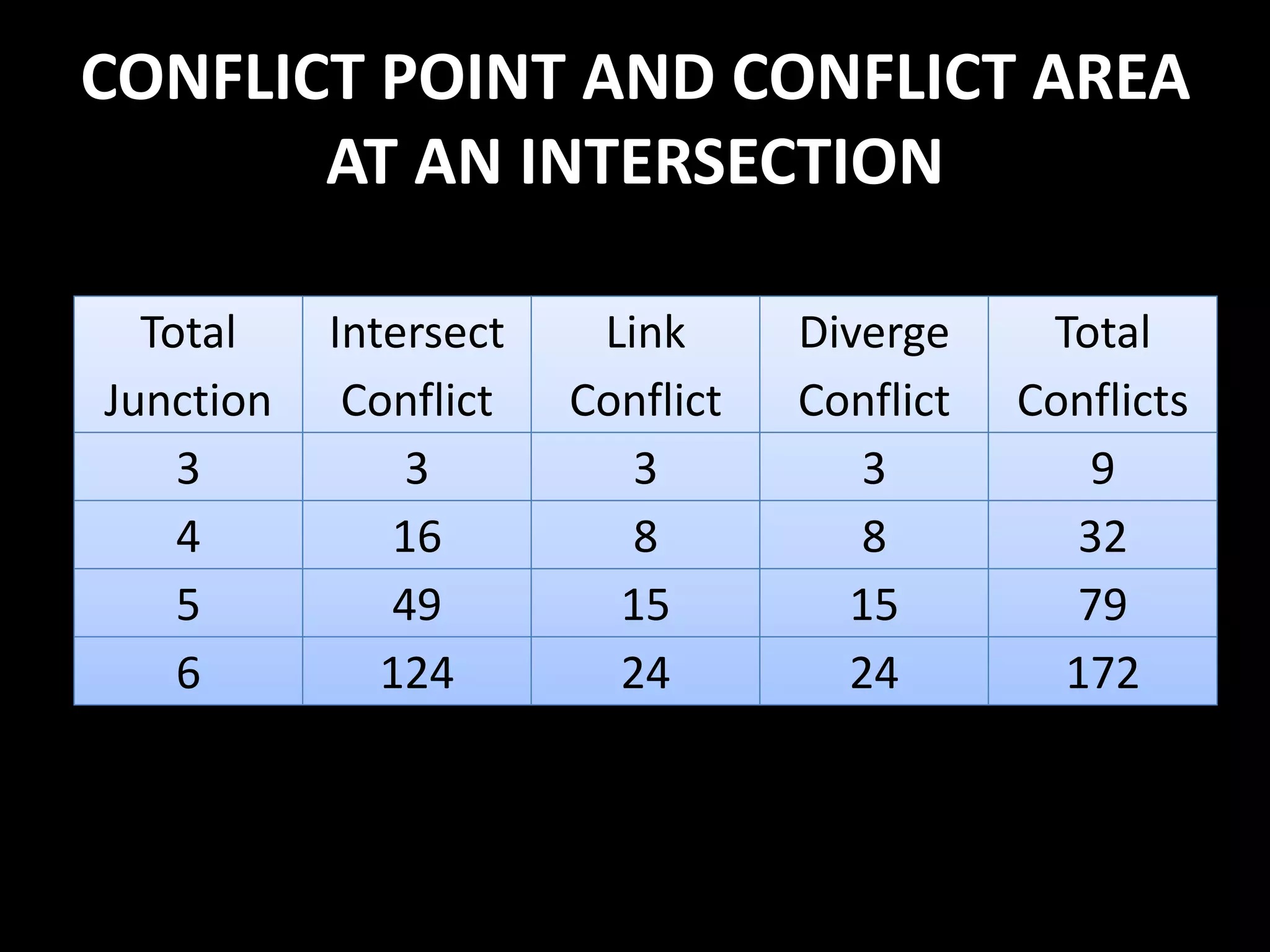
Total
Junction
Intersect
Conflict
Link
Conflict
Diverge
Conflict
Total
Conflicts
3 3 3 3 9
4 16 8 8 32
5 49 15 15 79
6 124 24 24 172
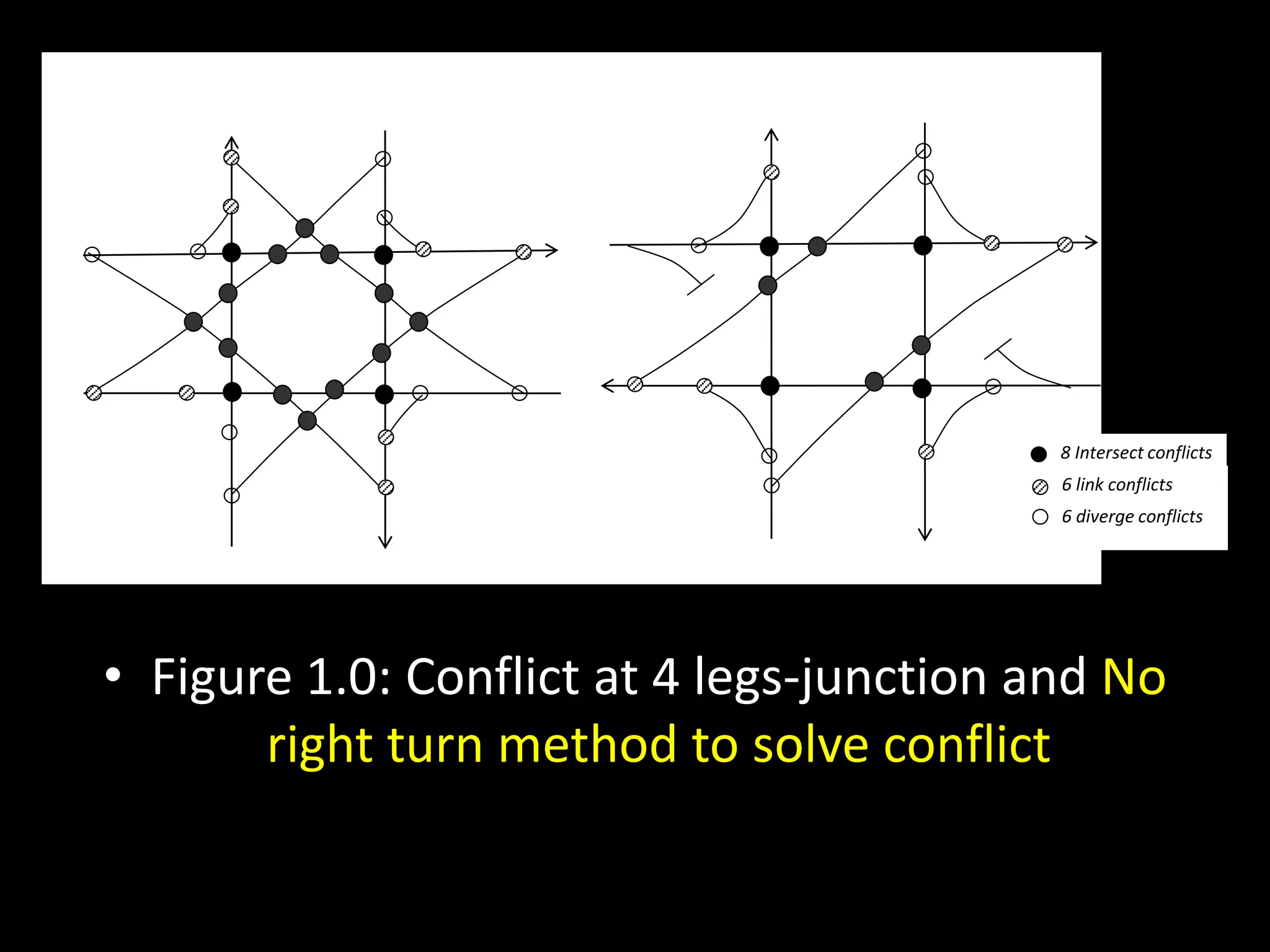
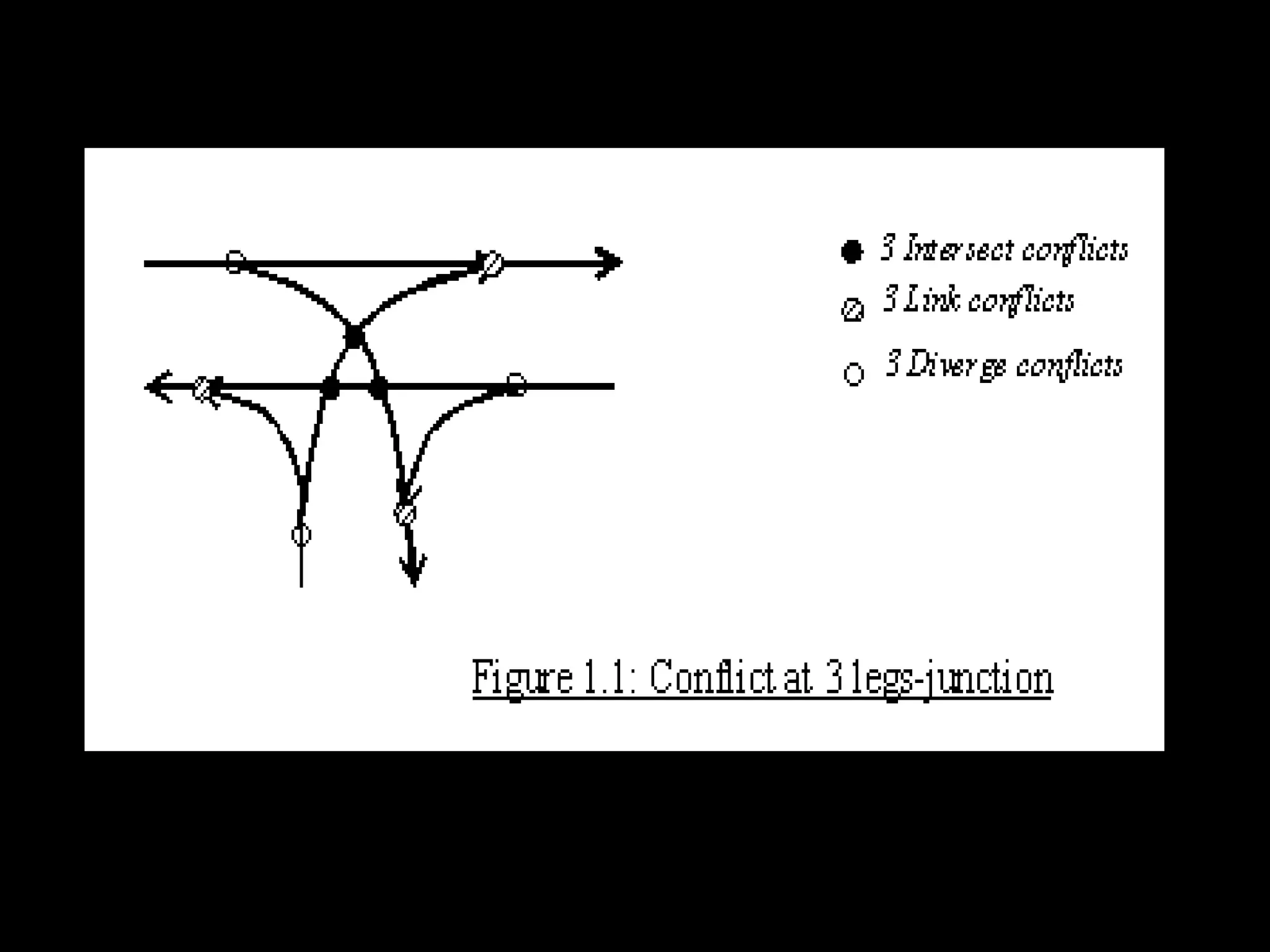
• Figure 1.0: Conflict at 4 legs-junction and No
right turn method to solve conflict
6 link conflicts
8 Intersect conflicts
6 diverge conflicts
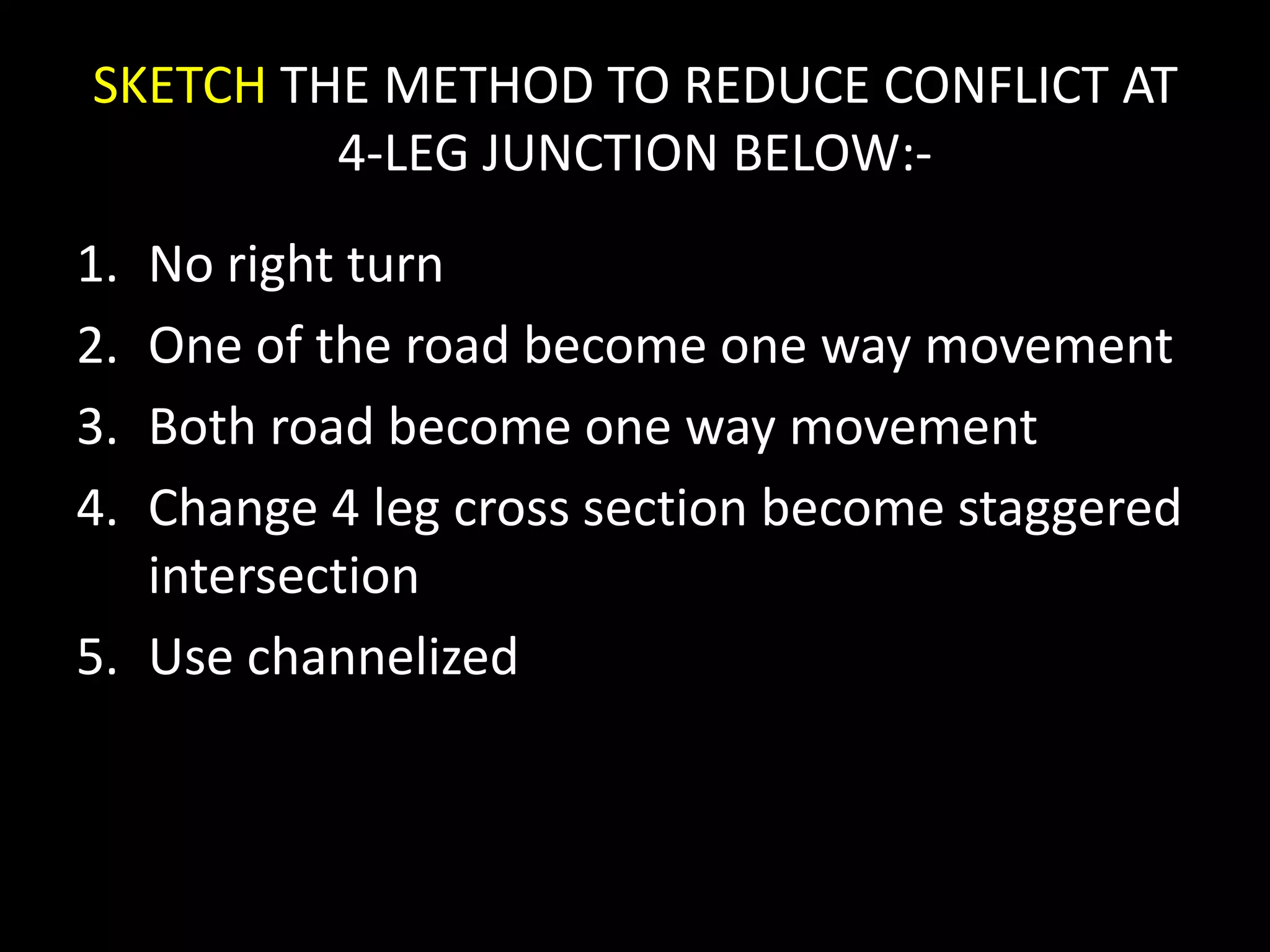
SKETCH THE METHOD TO REDUCE CONFLICT AT
4-LEG JUNCTION BELOW:-
1. No right turn
2. One of the road become one way movement
3. Both road become one way movement
4. Change 4 leg cross section become staggered
intersection
5. Use channelized
ANSWER OF METHOD TO
REDUCE CONFLICT AT JUNCTION
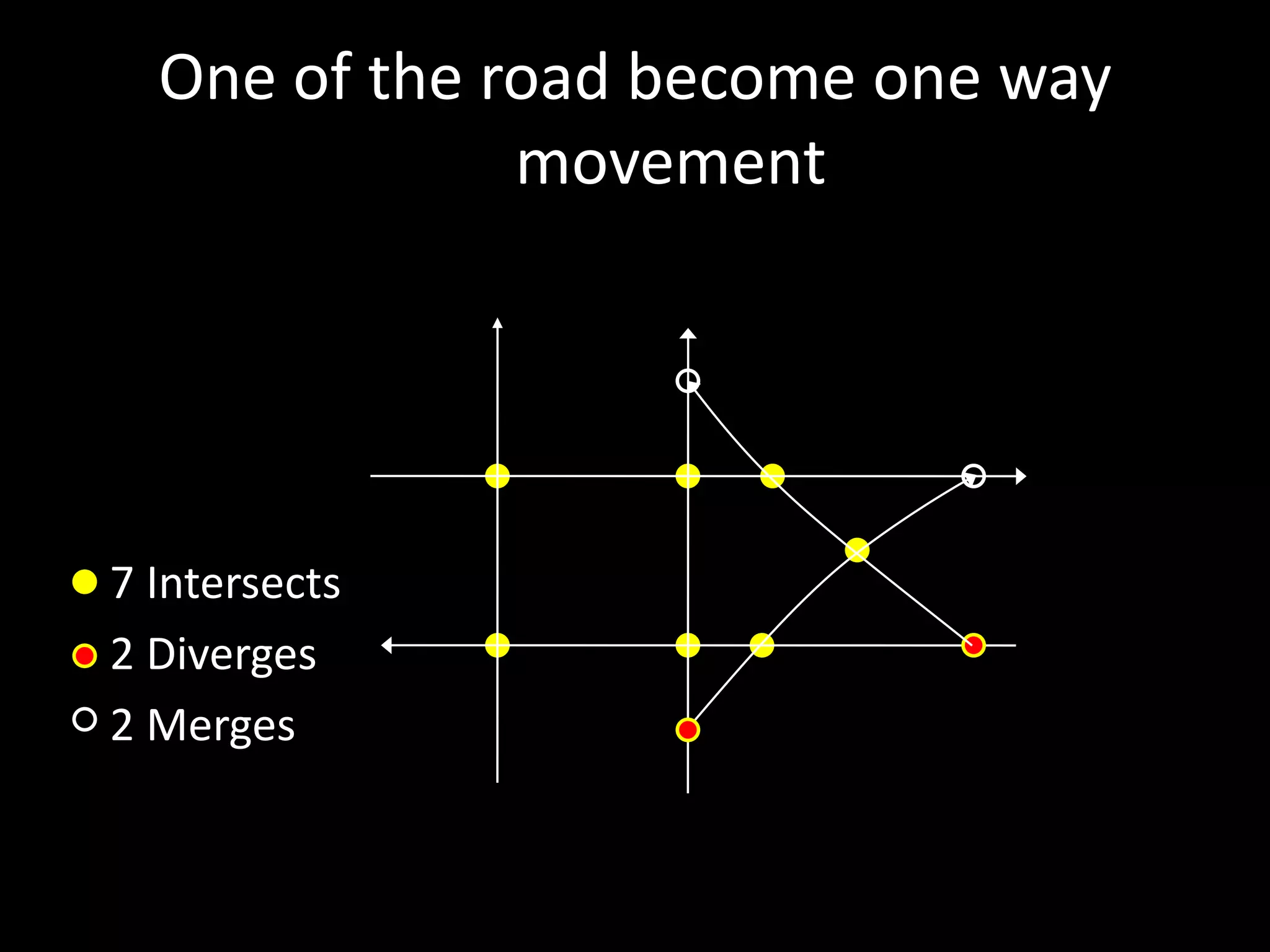
One of the road become one way
movement
7 Intersects
2 Diverges
2 Merges
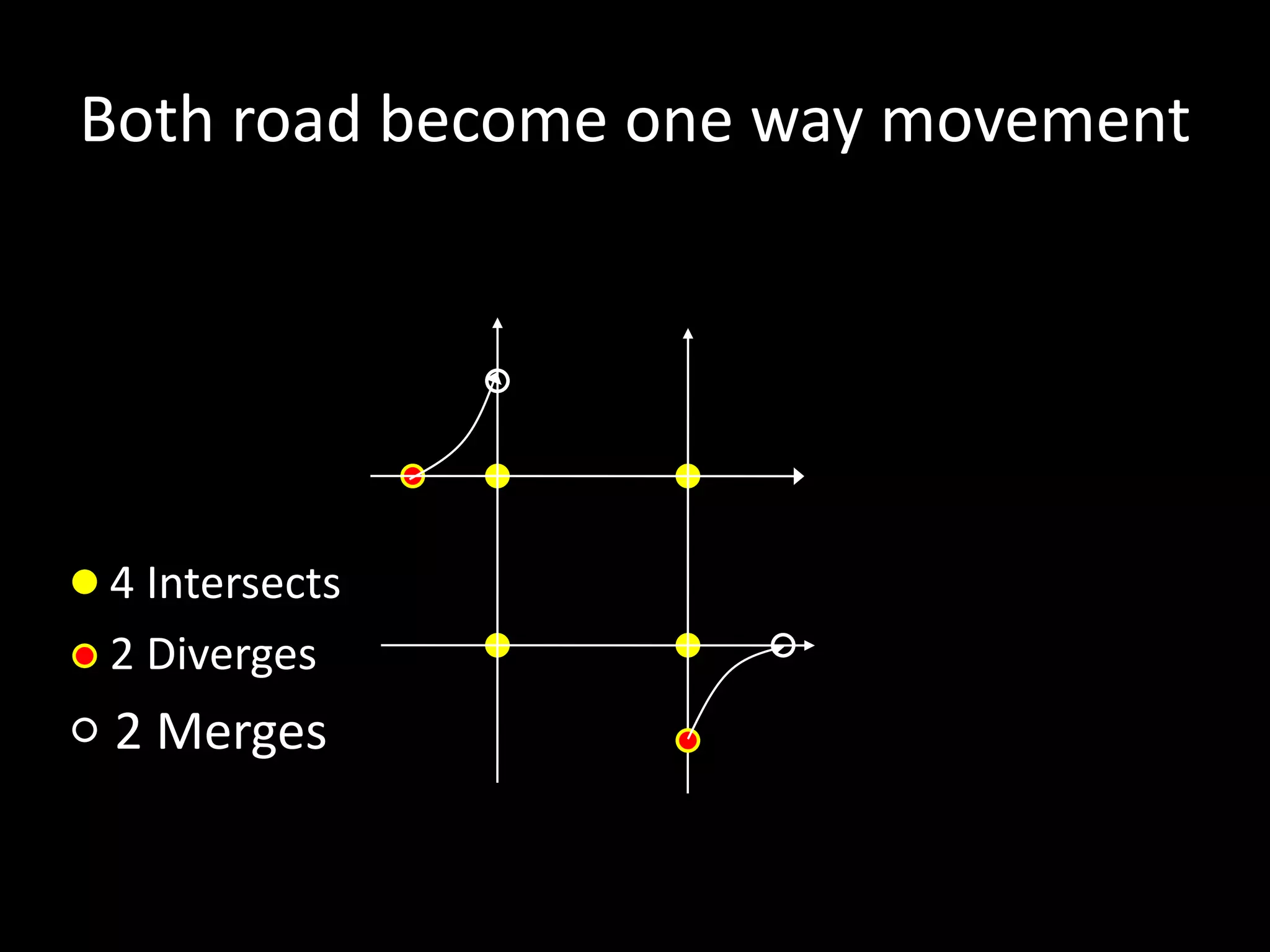
Both road become one way movement
4 Intersects
2 Diverges
2 Merges
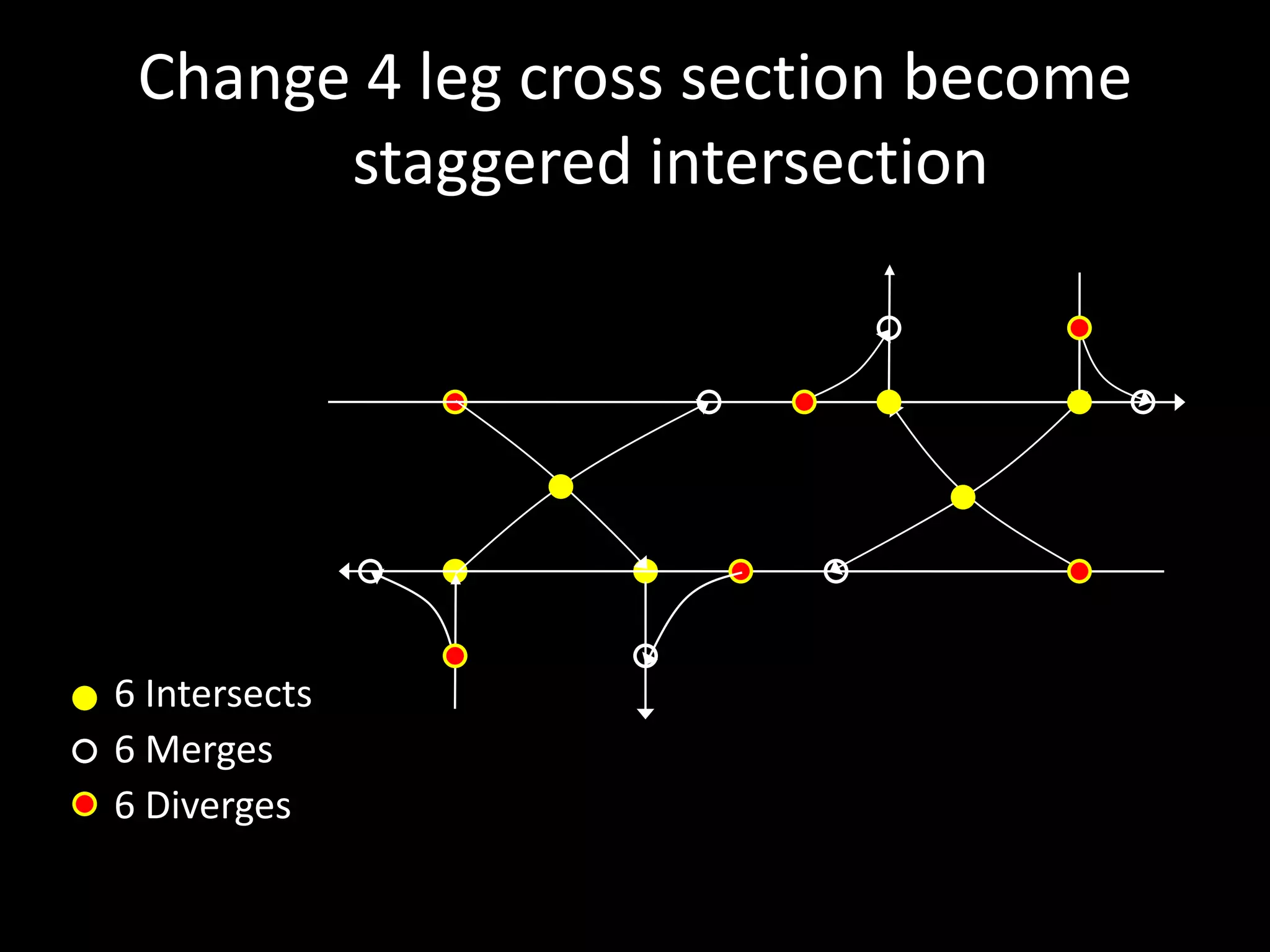
Change 4 leg cross section become
staggered intersection
6 Intersects
6 Merges
6 Diverges
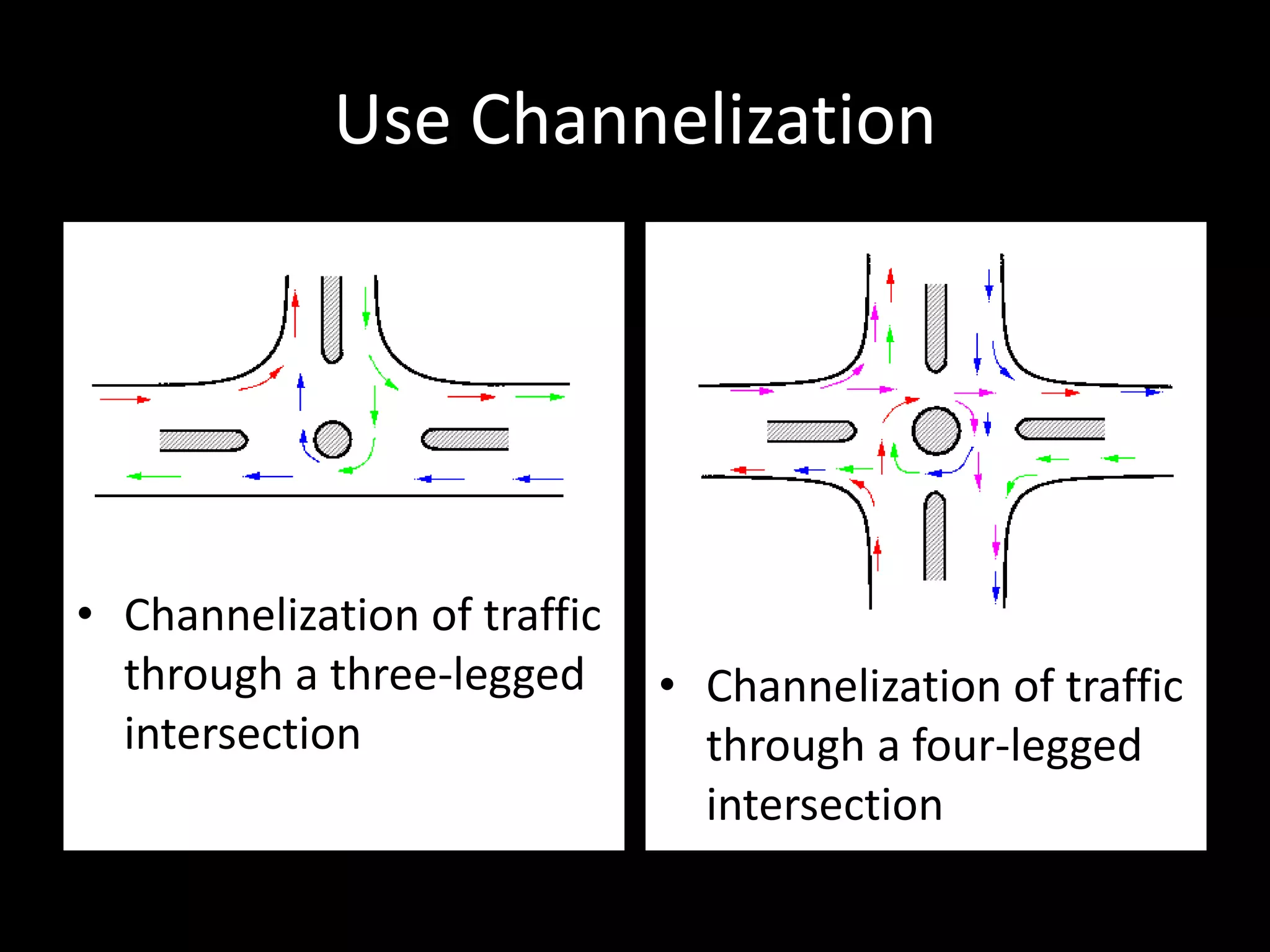
Use Channelization
• Channelization of traffic
through a three-legged
intersection
• Channelization of traffic
through a four-legged
intersection
SELECTION FACTORS OF JUNCTION
TYPE:-
i. Volume, composition and speed of traffic in each
stream
ii. Hierarchy of roads that intersect with each other
iii. Clarity of vision in different weather condition
iv. Type and rate of control of traffic entering
v. Area and the cost of land use
vi. Total conflict at intersection
vii. Construction and maintenance cost
viii. Accident data (to be used for intersection’s planning)
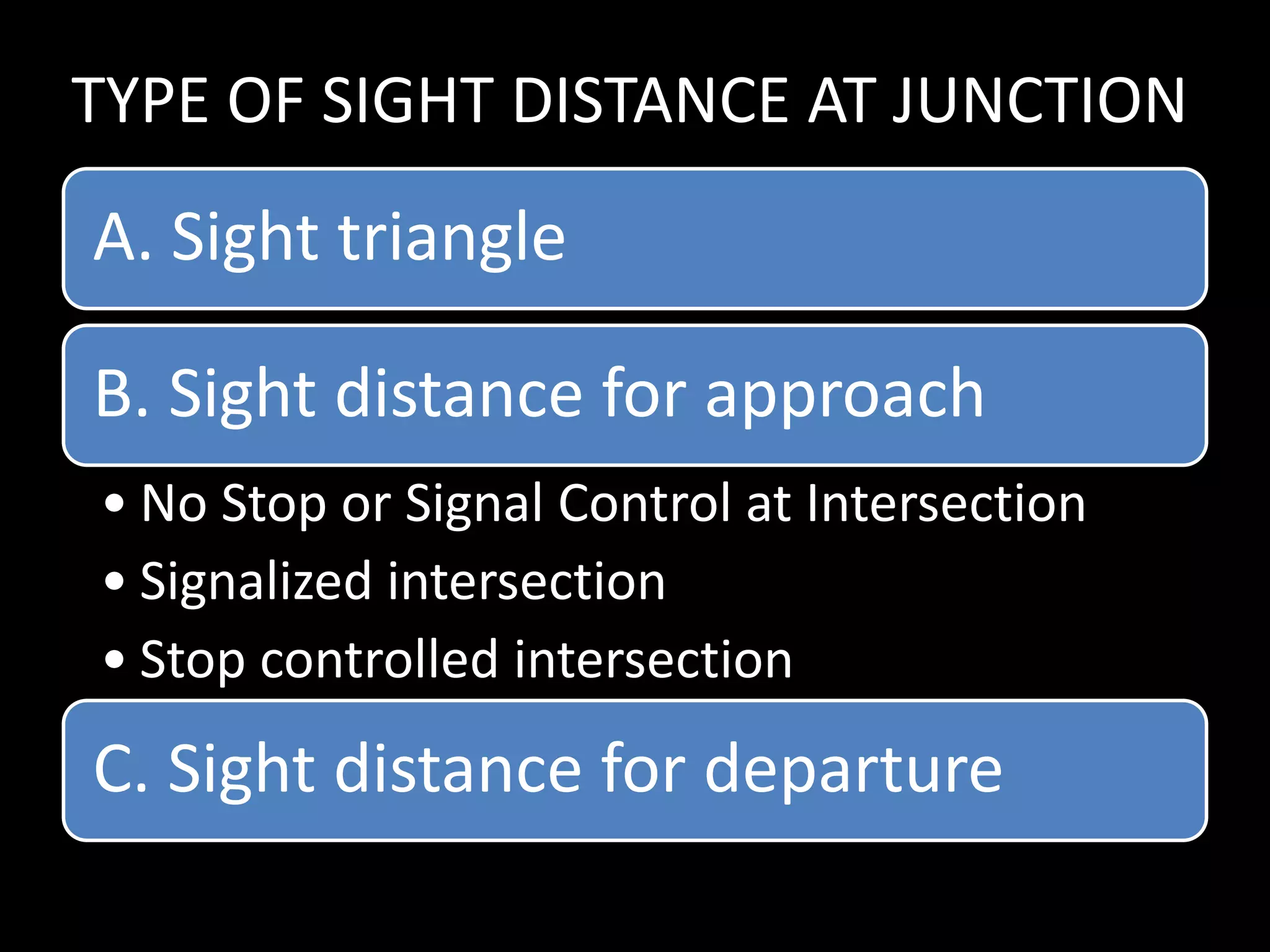
TYPE OF SIGHT DISTANCE AT JUNCTION
A. Sight triangle
B. Sight distance for approach
• No Stop or Signal Control at Intersection
• Signalized intersection
• Stop controlled intersection
C. Sight distance for departure
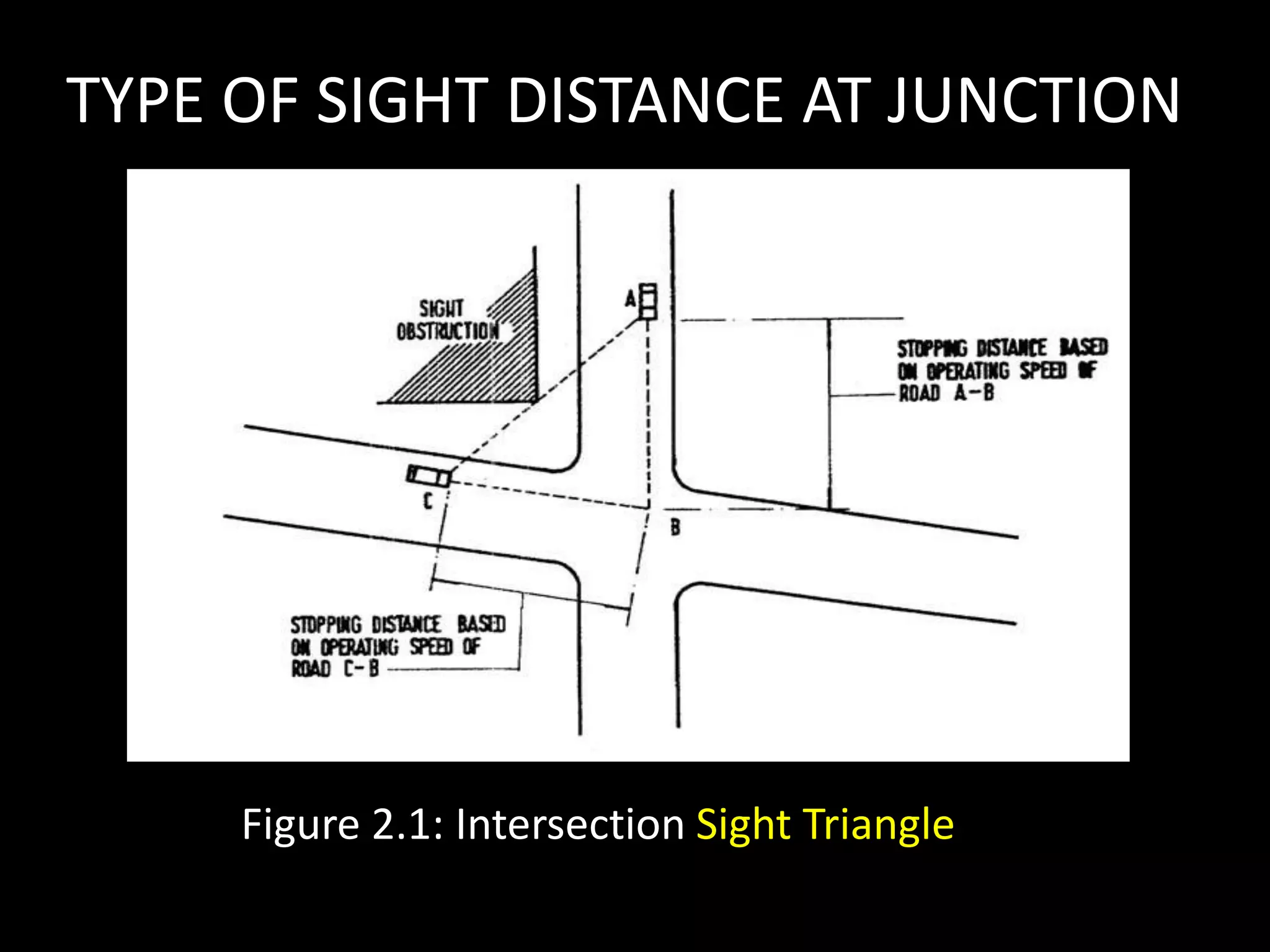
TYPE OF SIGHT DISTANCE AT JUNCTION
Figure 2.1: Intersection Sight Triangle
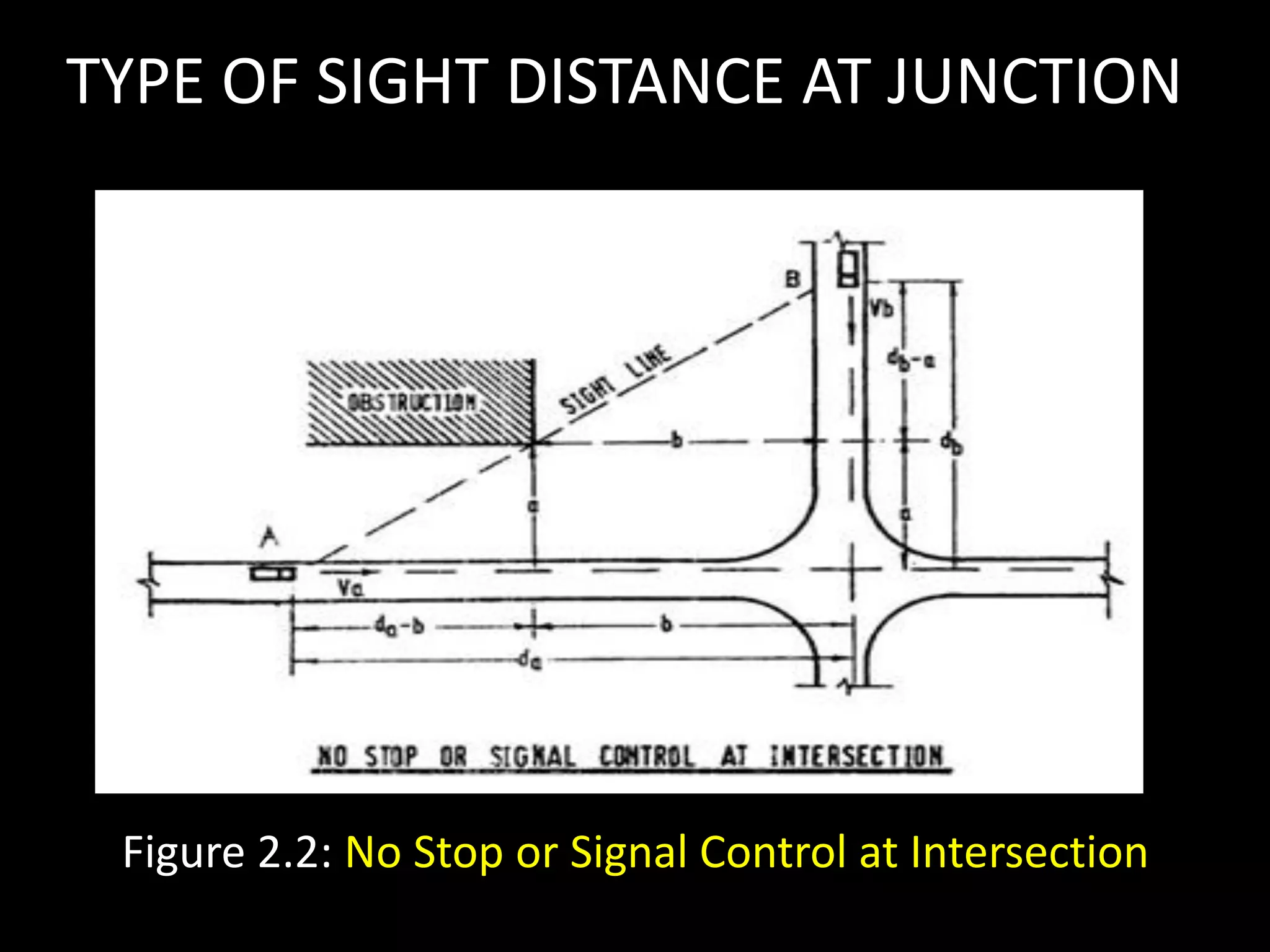
TYPE OF SIGHT DISTANCE AT JUNCTION
Figure 2.2: No Stop or Signal Control at Intersection
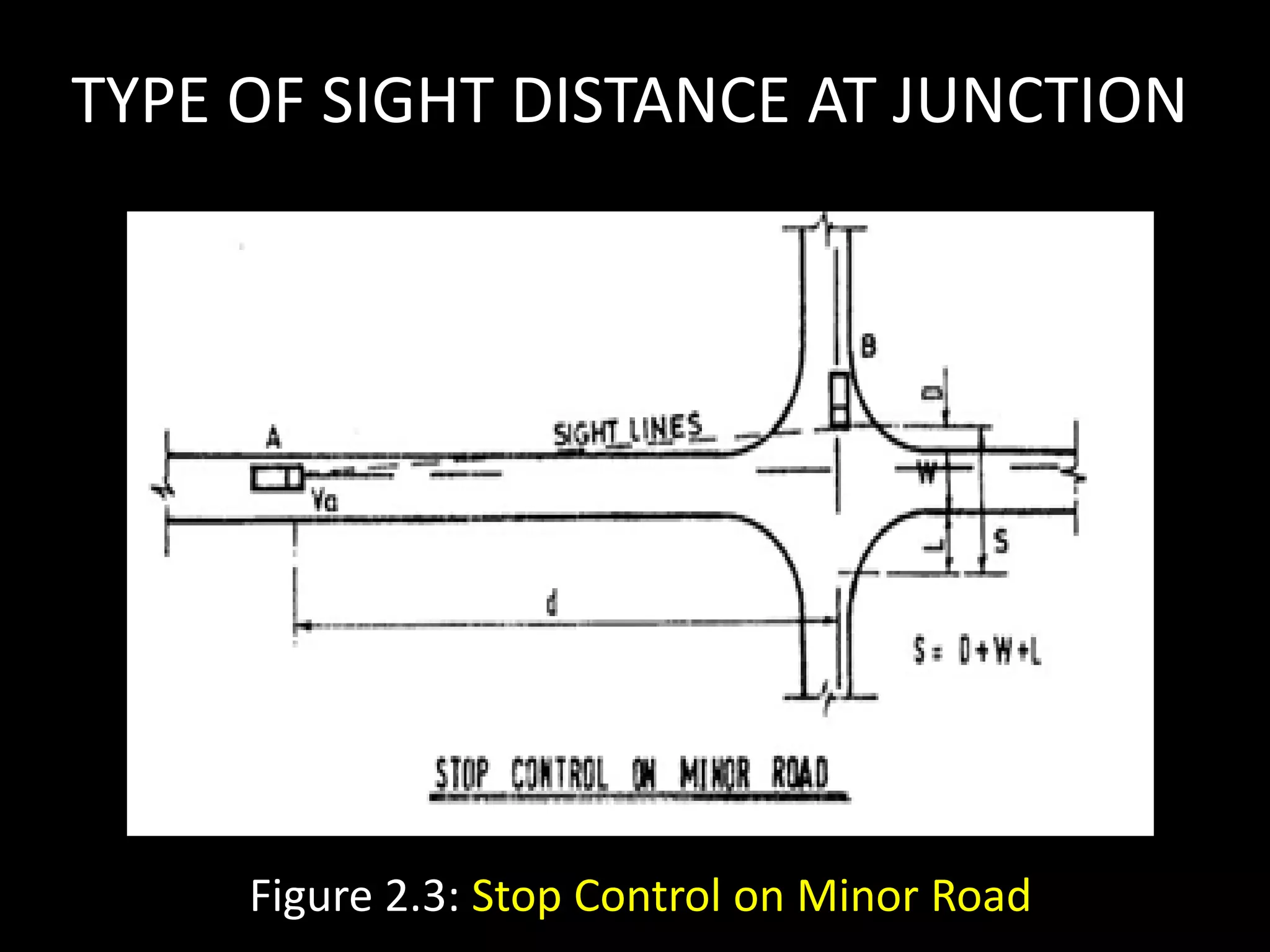
TYPE OF SIGHT DISTANCE AT JUNCTION
Figure 2.3: Stop Control on Minor Road
SIGNALIZED INTERSECTION
• The sight distance is the sum of a distance travelled
during the total reaction time which is the interval
between the instant that the driver recognizes the
traffic signals of the intersection ahead and the instant
that the driver actually applies the brakes, and a
distance to stop the vehicle at the stop line with
applying brake.
S = (Vt/3.6) + [ (1/2)*(V/3.6)2 ]
Where, t = 10 sec. (rural), t = 6 sec (urban),
 = 0.2 x g = 0.2 x 9.8 = 1.96 m/sec2
STOP CONTROLLED INTERSECTION
• In this case, time for decision making as in
signalized intersection is not necessary
because every driver must stop.
S = (Vt/3.6) + [ (1/2)*(V/3.6)2 ]
Where, V= speed (km/h), t = 2 sec,
 = 1.96 m/sec2
SIGHT DISTANCE FOR DEPARTURE
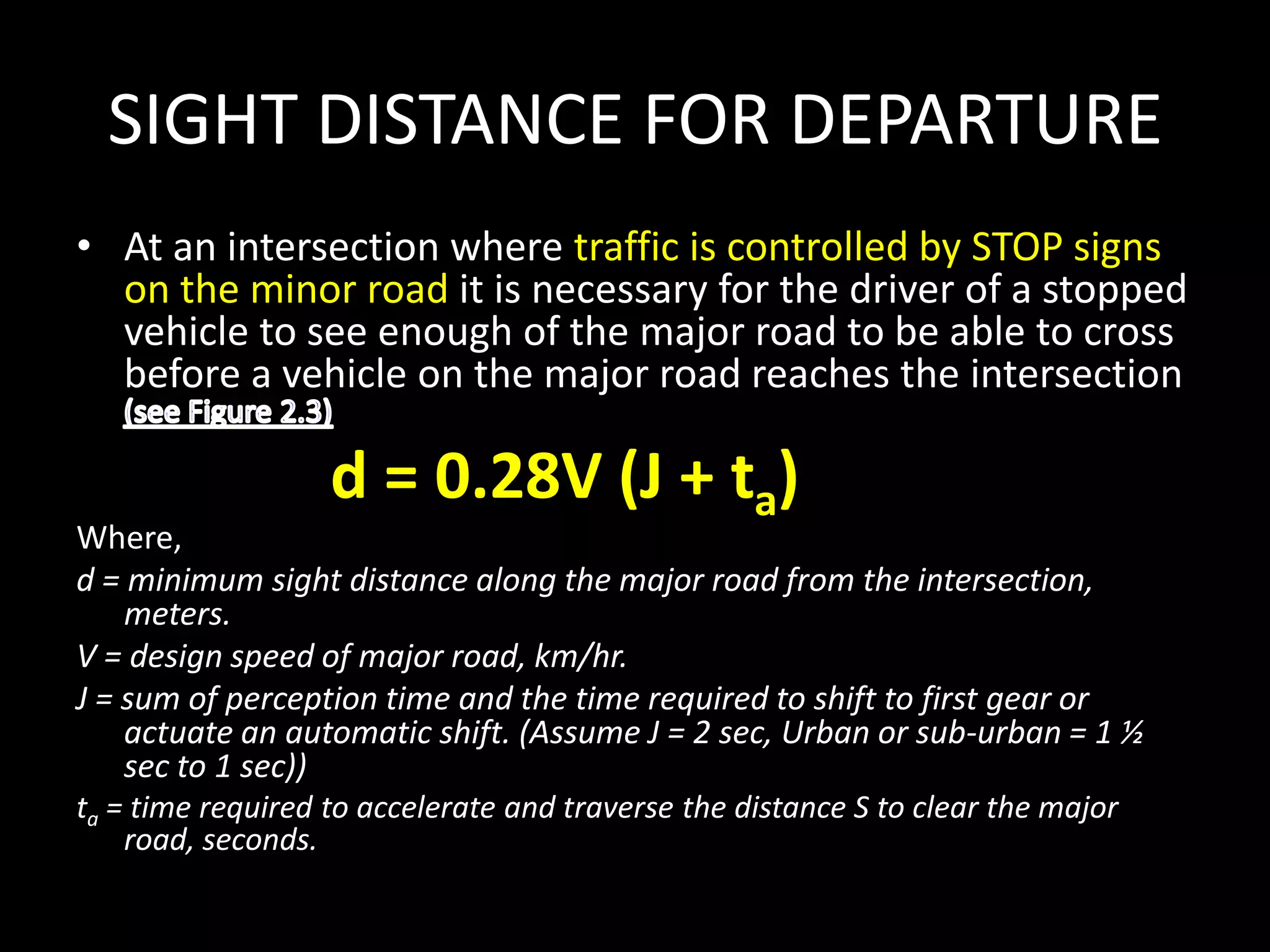
• At an intersection where traffic is controlled by STOP signs
on the minor road it is necessary for the driver of a stopped
vehicle to see enough of the major road to be able to cross
before a vehicle on the major road reaches the intersection
d = 0.28V (J + ta)
Where,
d = minimum sight distance along the major road from the intersection,
meters.
V = design speed of major road, km/hr.
J = sum of perception time and the time required to shift to first gear or
actuate an automatic shift. (Assume J = 2 sec, Urban or sub-urban = 1 ½
sec to 1 sec))
ta = time required to accelerate and traverse the distance S to clear the major
road, seconds.
SIGHT DISTANCE FOR DEPARTURE
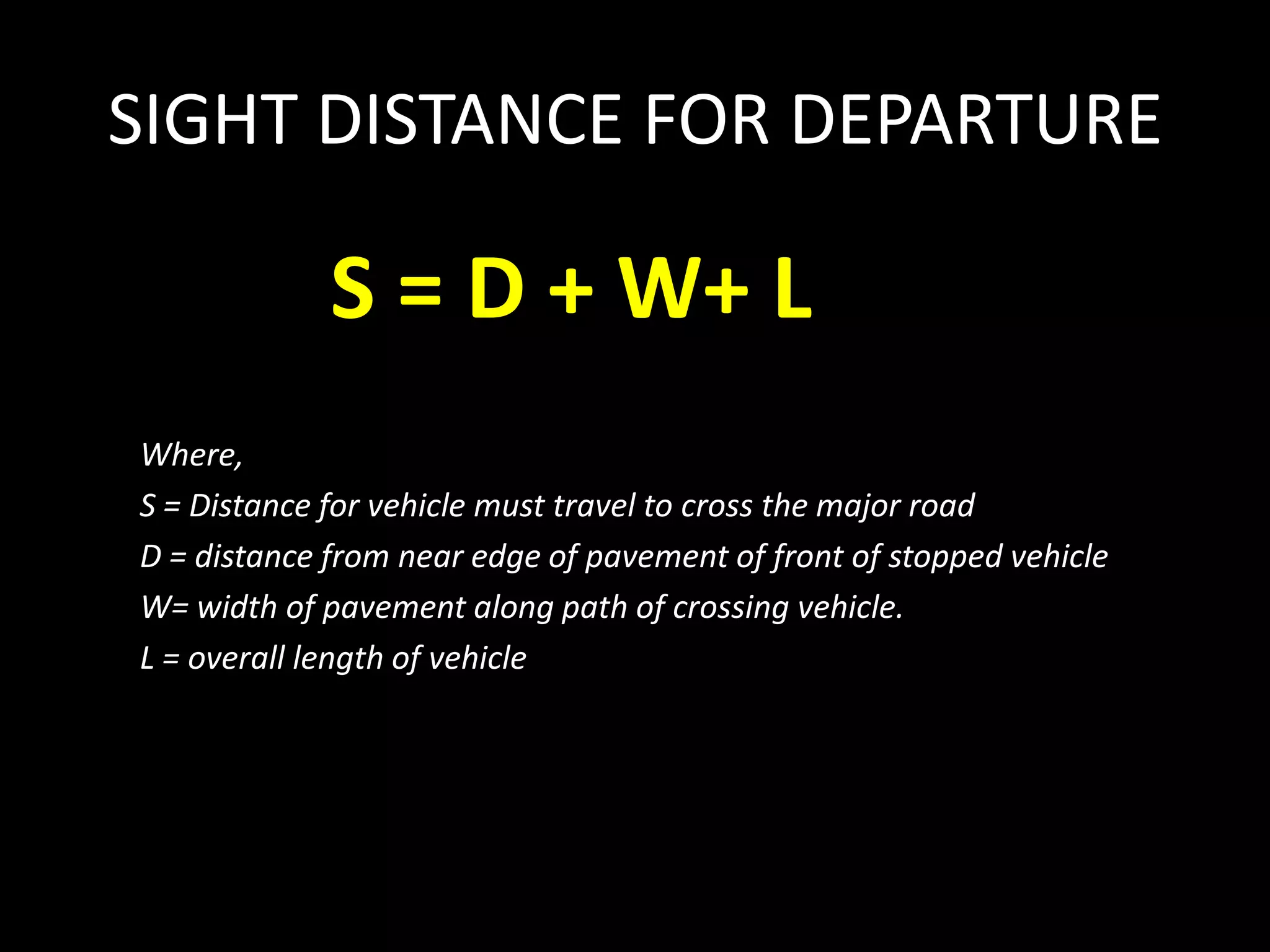
S = D + W+ L
Where,
S = Distance for vehicle must travel to cross the major road
D = distance from near edge of pavement of front of stopped vehicle
W= width of pavement along path of crossing vehicle.
L = overall length of vehicle
Example
• A vehicle travel before hit to collision point has 2
sec of reaction time to stop, deceleration of
vehicle is 1.96 m/s2 and the speed of vehicle is
100 km/hr. Determine the sight distance for a
vehicle before it hit the collision point.
Solution
S = (Vt/3.6) + [ (1/2)*(V/3.6)2 ]
= (100 x 2)/3.6 + [(1/2 x 1.96) x (100/3.6)2]
= 252.4 m
TRAFFIC LIGHT DESIGN AND PHASES
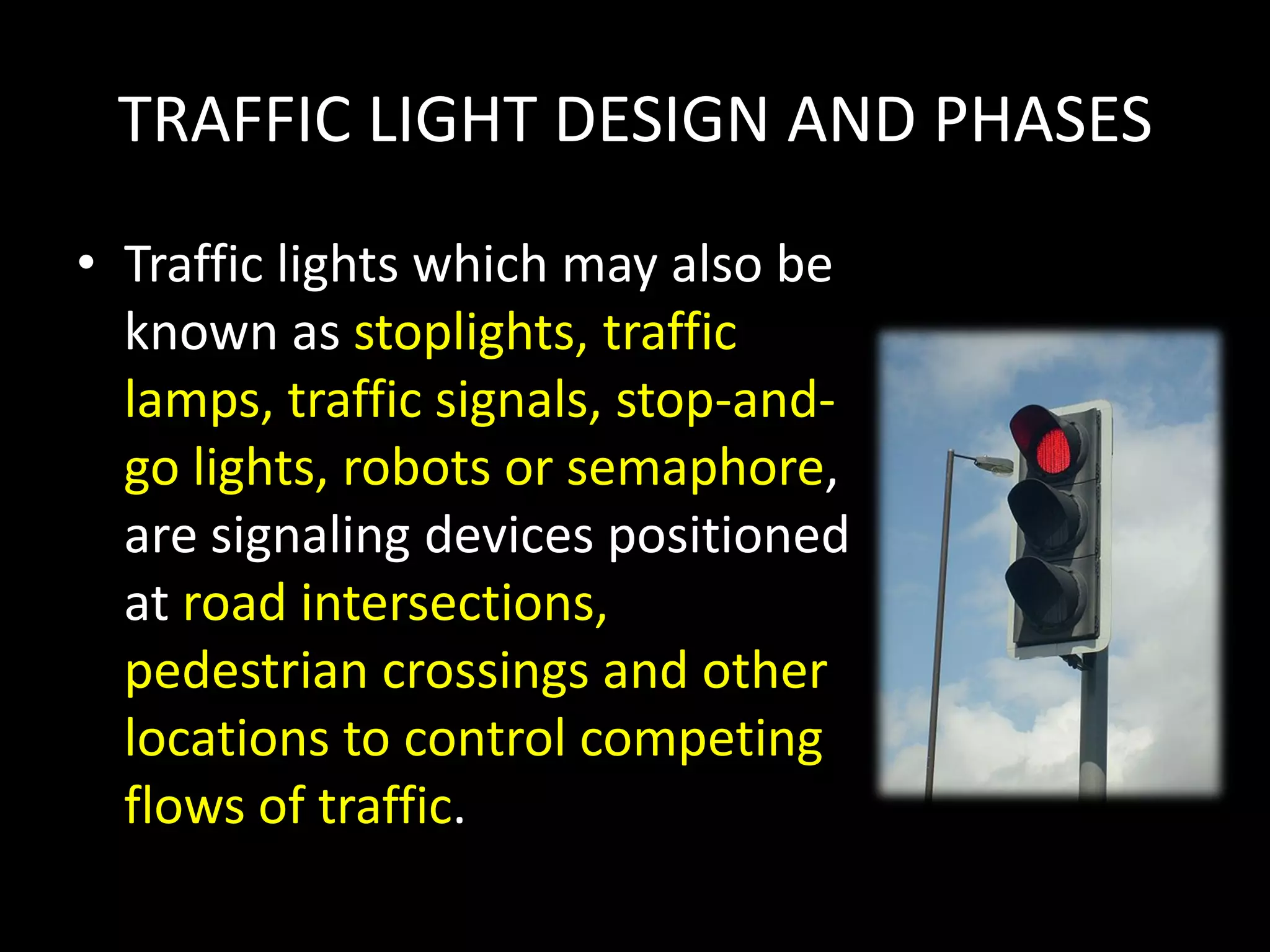
• Traffic lights which may also be
known as stoplights, traffic
lamps, traffic signals, stop-and-
go lights, robots or semaphore,
are signaling devices positioned
at road intersections,
pedestrian crossings and other
locations to control competing
flows of traffic.
ADVANTAGES & DISADVANTAGES TRAFFIC LIGHT
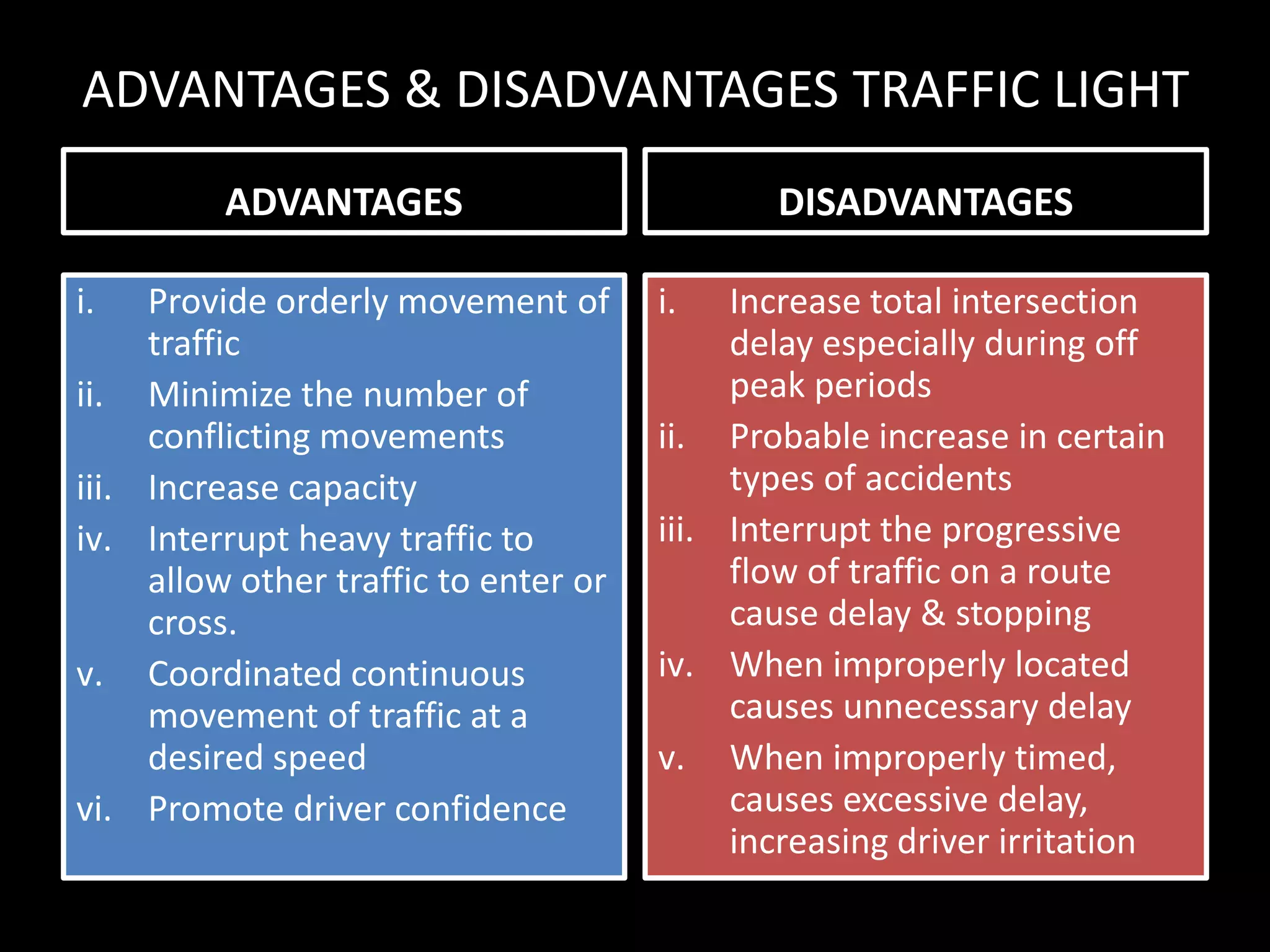
ADVANTAGES
i. Provide orderly movement of
traffic
ii. Minimize the number of
conflicting movements
iii. Increase capacity
iv. Interrupt heavy traffic to
allow other traffic to enter or
cross.
v. Coordinated continuous
movement of traffic at a
desired speed
vi. Promote driver confidence
DISADVANTAGES
i. Increase total intersection
delay especially during off
peak periods
ii. Probable increase in certain
types of accidents
iii. Interrupt the progressive
flow of traffic on a route
cause delay & stopping
iv. When improperly located
causes unnecessary delay
v. When improperly timed,
causes excessive delay,
increasing driver irritation
REQUIREMENT OF TRAFFIC
INSTRALLATION
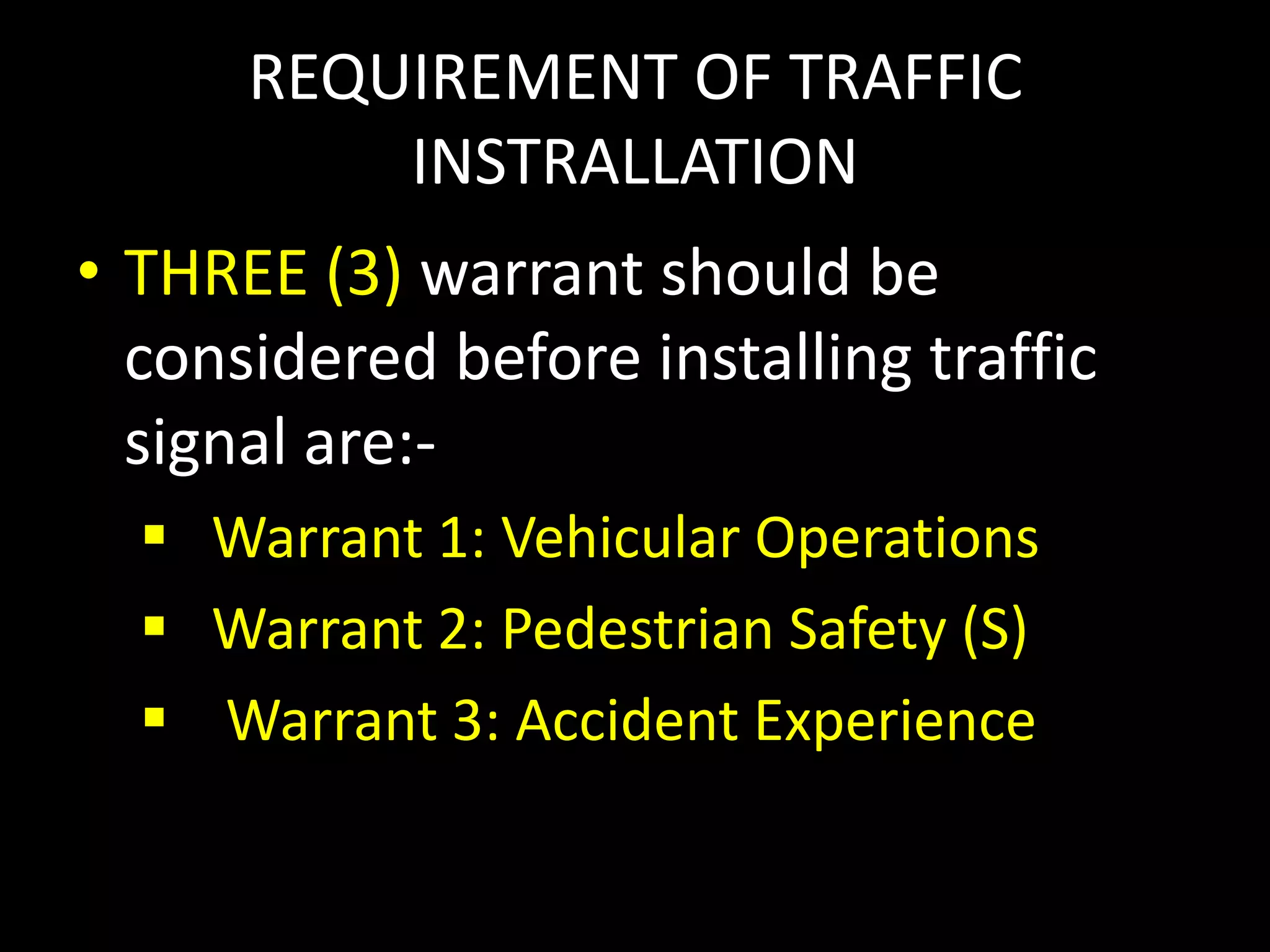
• THREE (3) warrant should be
considered before installing traffic
signal are:-
 Warrant 1: Vehicular Operations
 Warrant 2: Pedestrian Safety (S)
 Warrant 3: Accident Experience
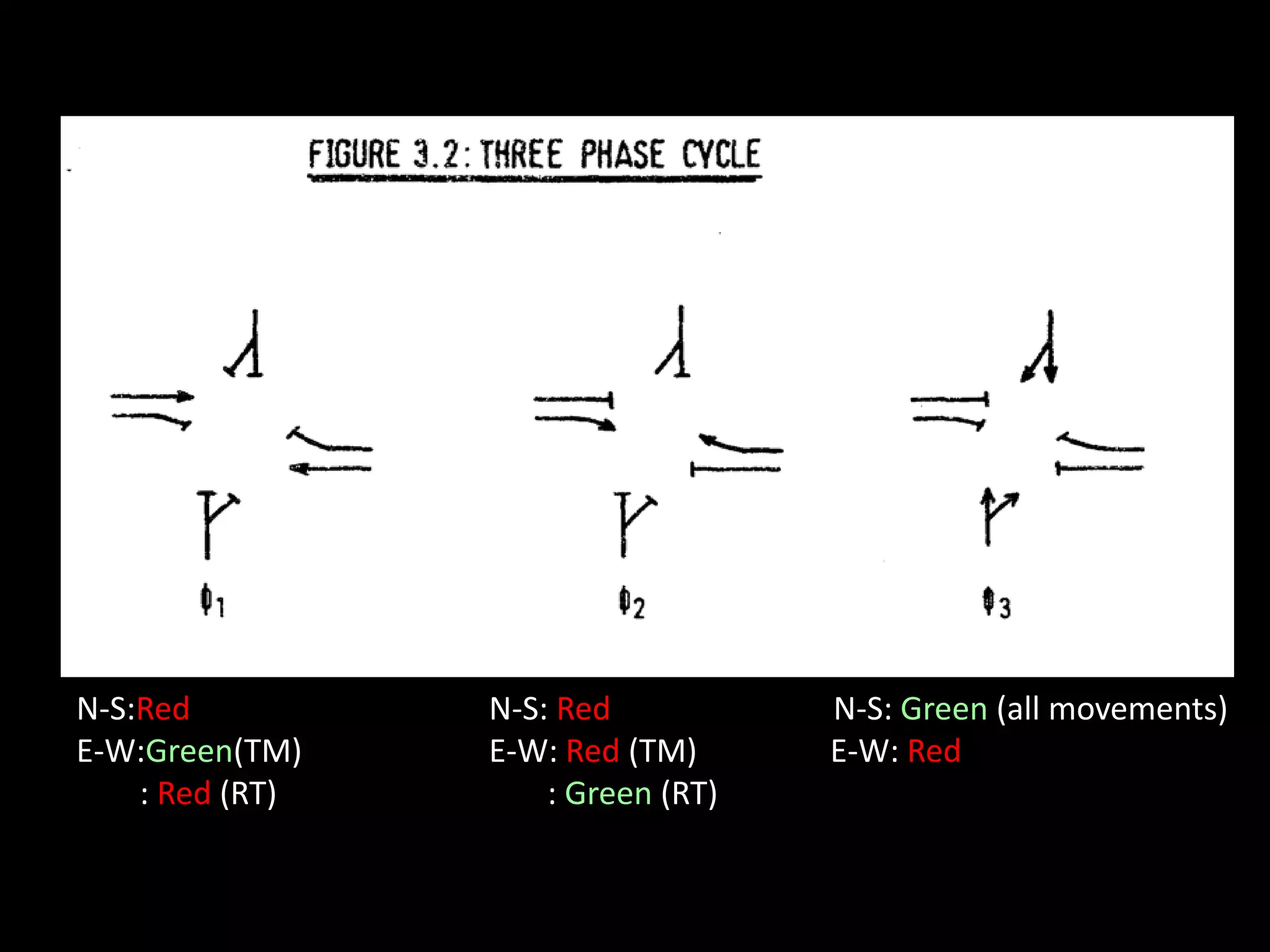
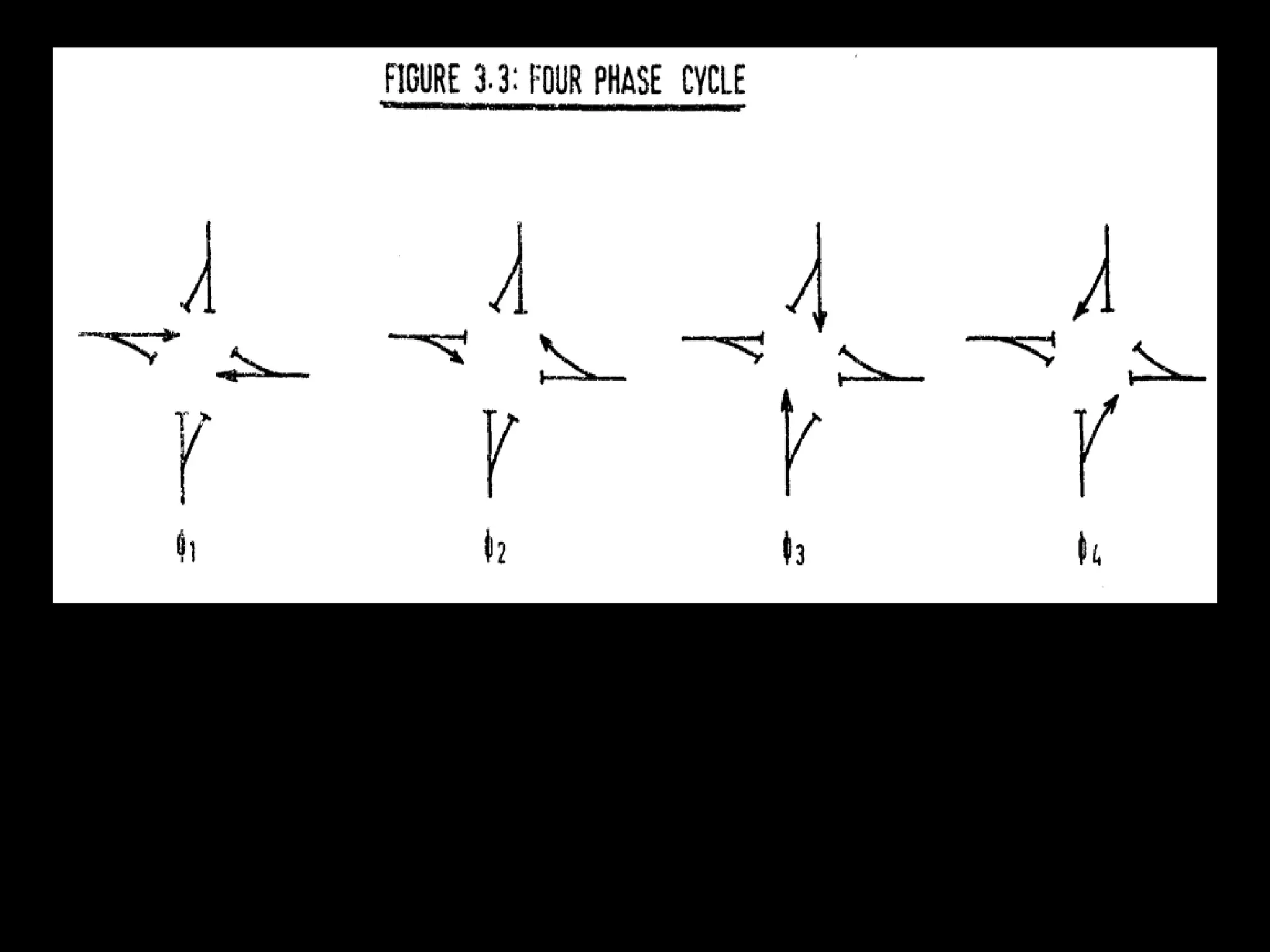
PHASING ELEMENTS
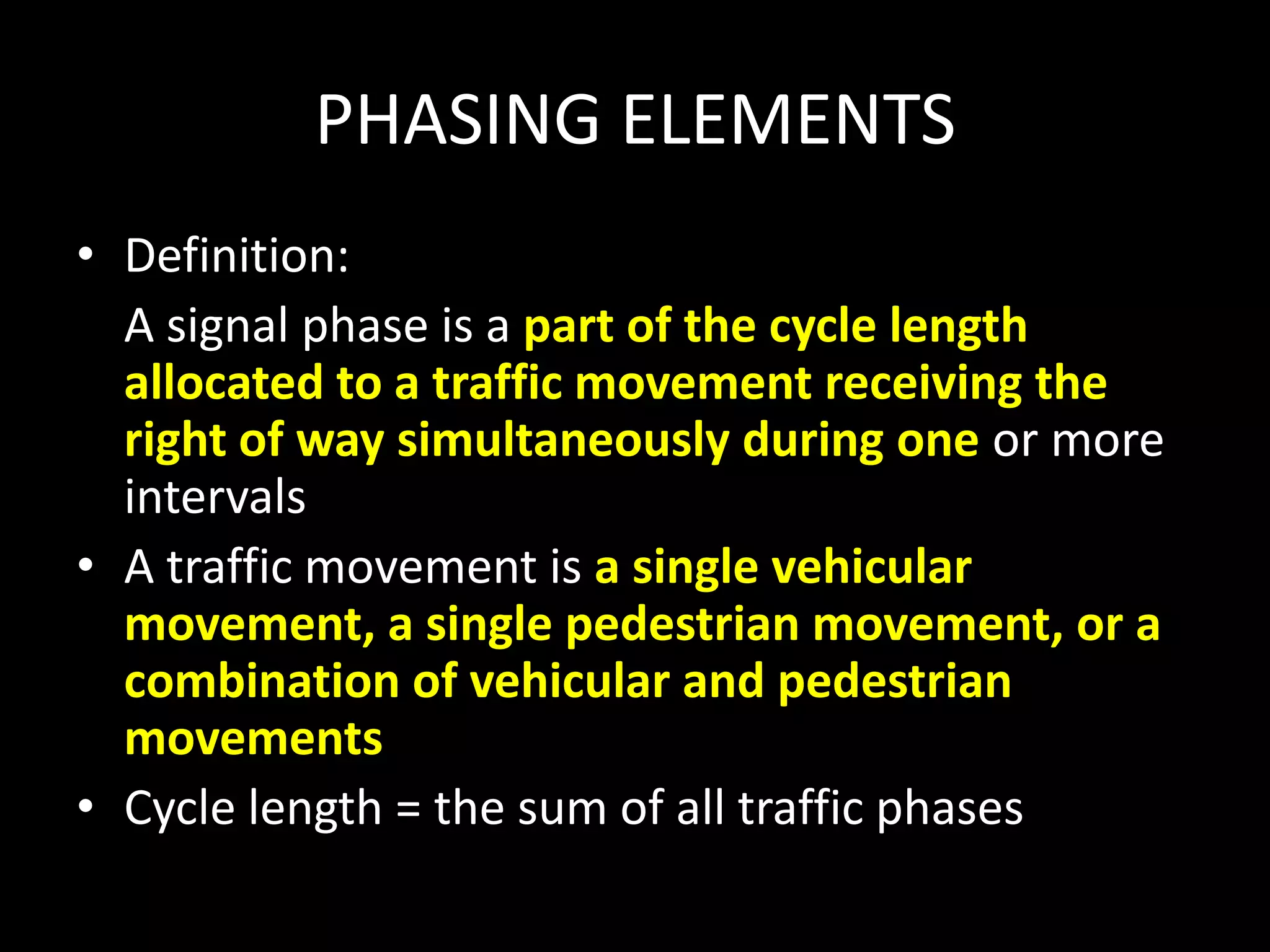
• Definition:
A signal phase is a part of the cycle length
allocated to a traffic movement receiving the
right of way simultaneously during one or more
intervals
• A traffic movement is a single vehicular
movement, a single pedestrian movement, or a
combination of vehicular and pedestrian
movements
• Cycle length = the sum of all traffic phases
TYPE OF PHASING
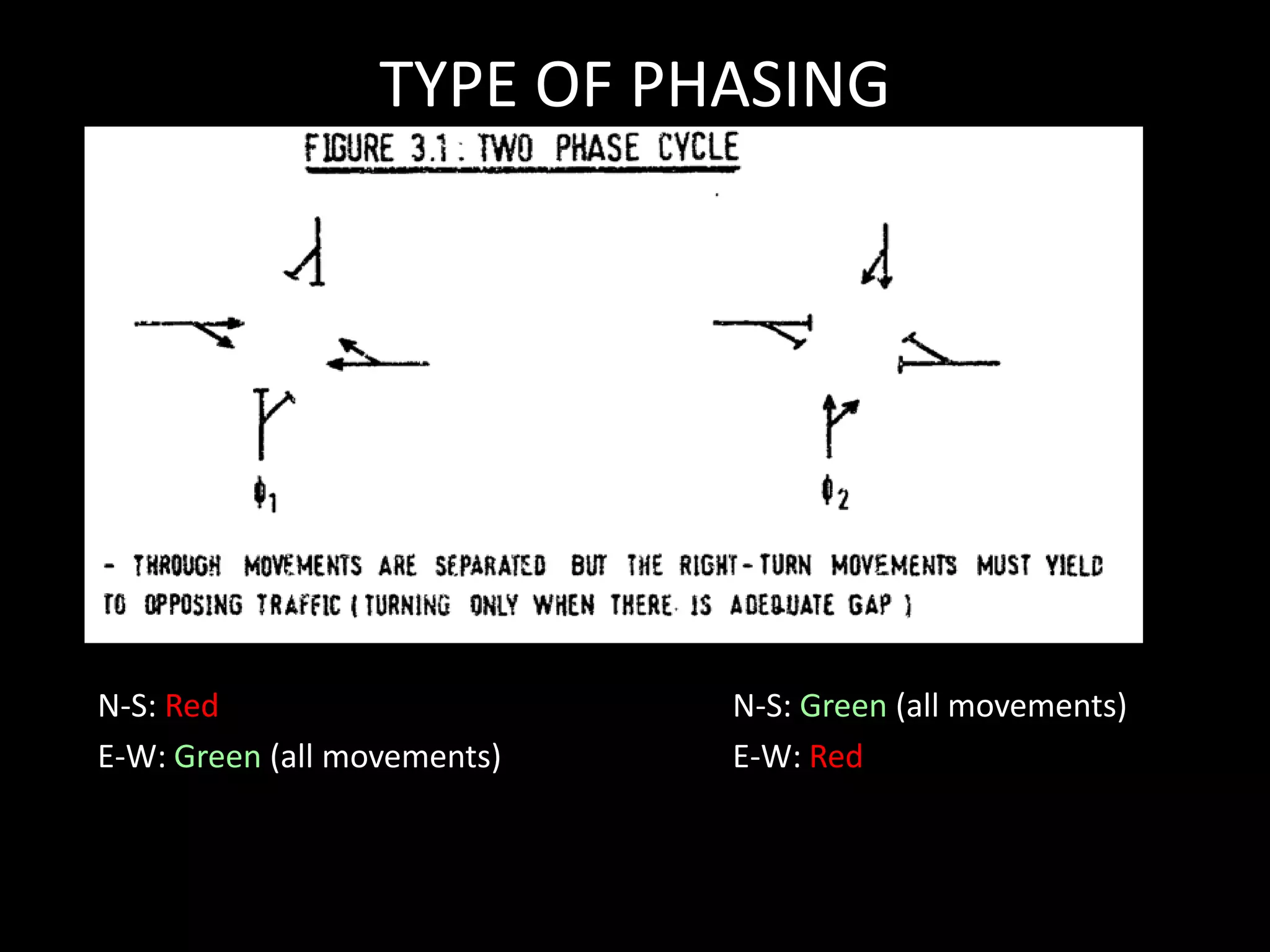
N-S: Red N-S: Green (all movements)
E-W: Green (all movements) E-W: Red
N-S:Red N-S: Red N-S: Green (all movements)
E-W:Green(TM) E-W: Red (TM) E-W: Red
: Red (RT) : Green (RT)
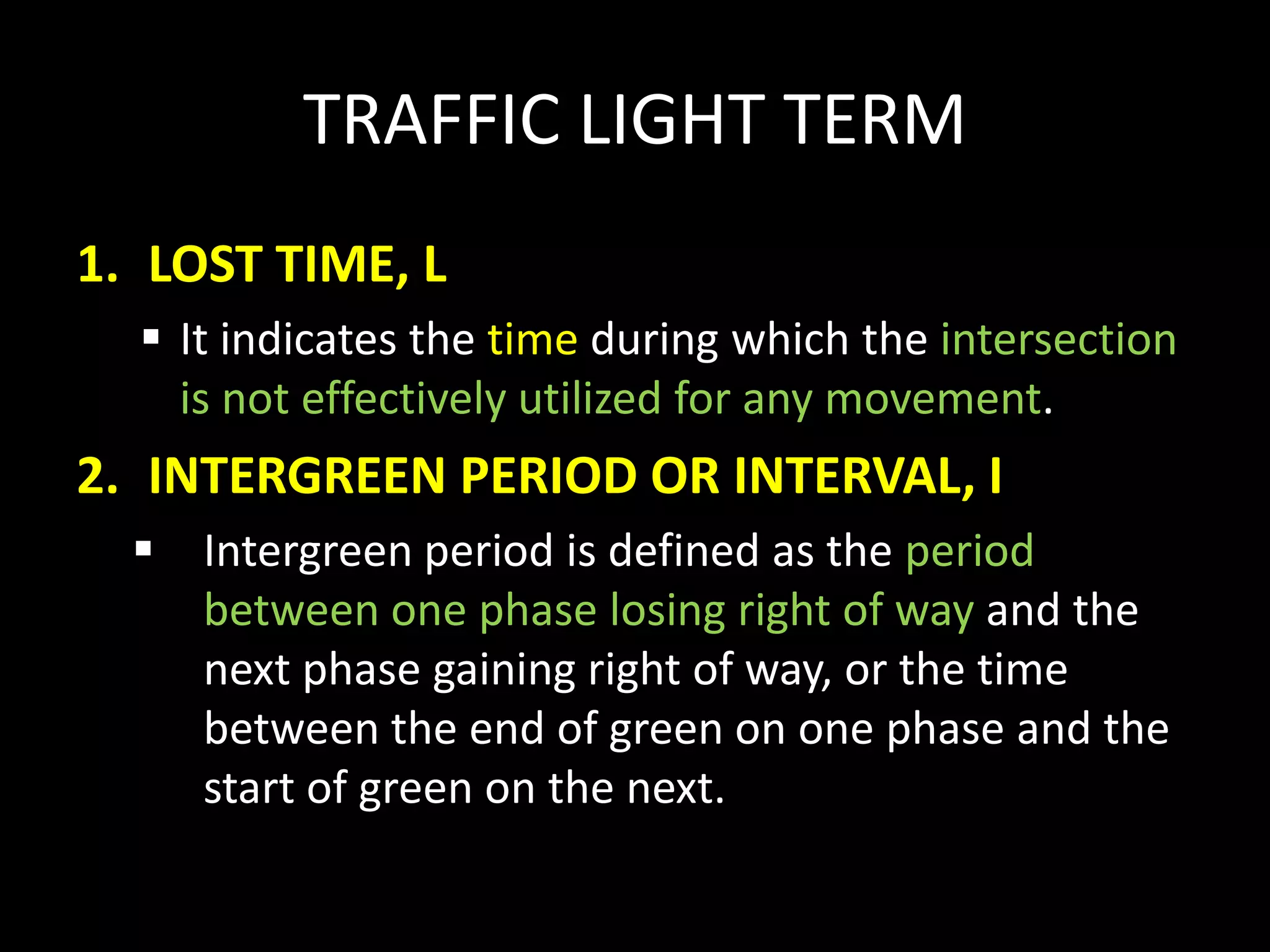
TRAFFIC LIGHT TERM
1. LOST TIME, L
 It indicates the time during which the intersection
is not effectively utilized for any movement.
2. INTERGREEN PERIOD OR INTERVAL, I
 Intergreen period is defined as the period
between one phase losing right of way and the
next phase gaining right of way, or the time
between the end of green on one phase and the
start of green on the next.
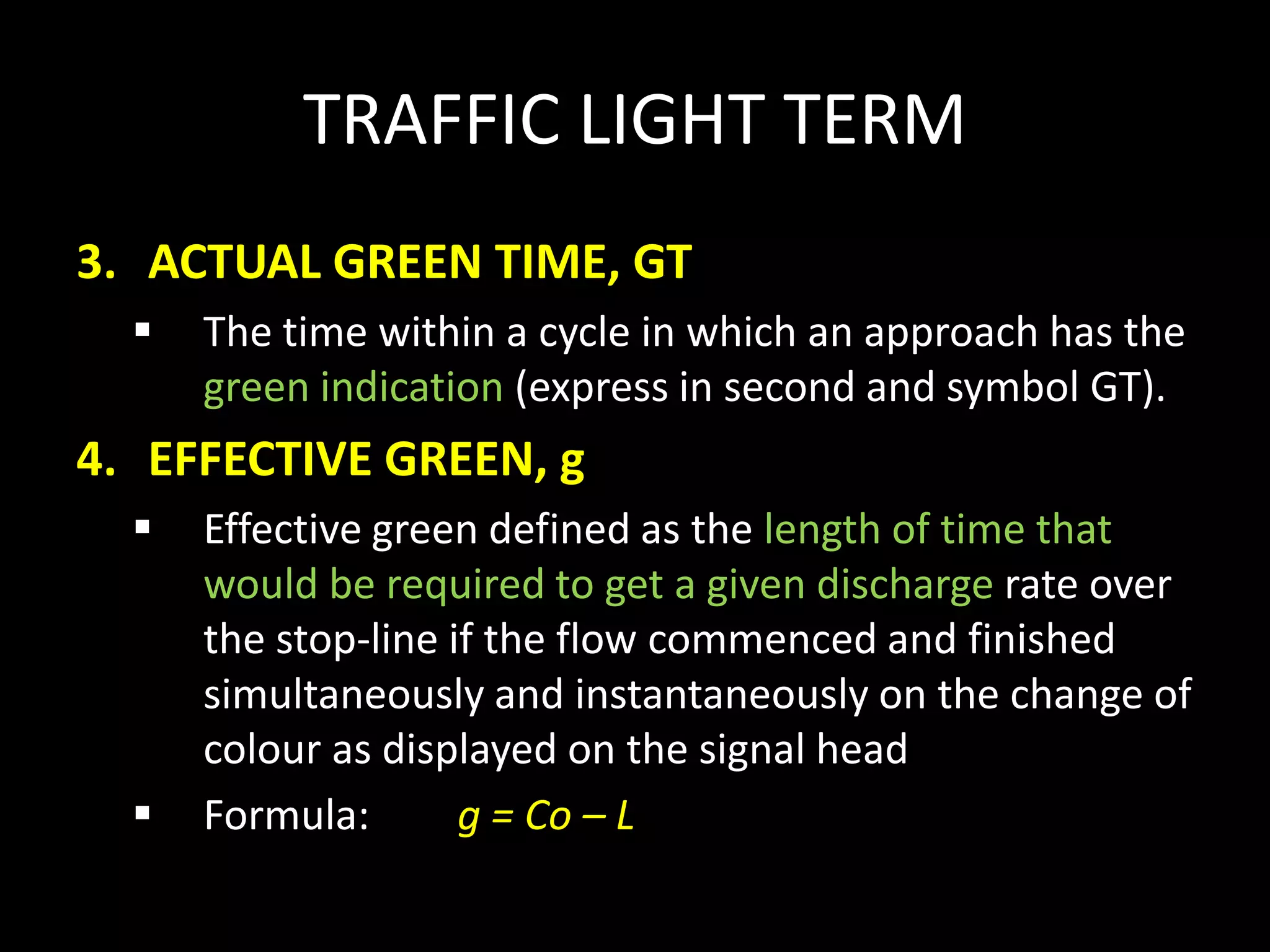
TRAFFIC LIGHT TERM
3. ACTUAL GREEN TIME, GT
 The time within a cycle in which an approach has the
green indication (express in second and symbol GT).
4. EFFECTIVE GREEN, g
 Effective green defined as the length of time that
would be required to get a given discharge rate over
the stop-line if the flow commenced and finished
simultaneously and instantaneously on the change of
colour as displayed on the signal head
 Formula: g = Co – L
TRAFFIC LIGHT TERM
5. RED TIME, RT
 The time within a cycle in which an approach has
the red indication (express in second and symbol
RT).
6. AMBER OR YELLOW TIME, a
 The time within a cycle in which an approach has
the yellow indication (express in second and
symbol a)
TRAFFIC LIGHT TERM
7. CYCLE LENGTH, C
 One complete sequence ( for all approaches of
signal indications [green, yellow, red] ).
 Cycle time maximum (Cm) is 120 second (2
minutes) is considered as good practice.
Normally, the cycle time will lie within the range
of 30 – 90 s.

Chapter 3 junction design

  • 1.
    CHAPTER 3.0 JUNCTION DESIGN CC503– TRAFFIC ENGINEERING
  • 2.
    JUNCTION • A roadjunction is a location where vehicular traffic going in different directions can proceed in a controlled manner designed to minimize accidents. • In some cases, vehicles can change between different routes or directions of travel.
  • 3.
    INTERSECTION • An intersectionis a road junction where two or more roads either meet or cross at grade (they are at the same level). • Such a road junction may also be called a crossroads.
  • 4.
    FACTORS THAT AFFECTJUNCTION LOAD. • At grade intersections present a driver with several points of conflict with other vehicles. • The aims of intersection design are to improve traffic flow and reduce the like hood of accidents.
  • 5.
    FACTORS THAT AFFECTJUNCTION LOAD. • Factors that affect junction load are:- i. Geometrical design and traffic control devices ii. Total or length wide iii. Distribution design iv. Turning radius v. Traffic volume and characteristic
  • 6.
    TYPE OF JUNCTION ATGRADE JUNCTION • Junction without signage/control • Priority Junction • Priority Junction with routing • Roundabout with or without traffic light • Traffic light controlled junction • Tiered junction GRADE SEPARATED OR INTERCHANGED • Trumpet interchange: • Diamond interchange: • Clover leaf interchange
  • 7.
  • 8.
  • 9.
  • 10.
    Roundabout with orwithout traffic light
  • 11.
  • 12.
  • 13.
    DIAGRAM TO DETERMINEINTERSECTION TYPE (ARAHAN TEKNIK JALAN 11/87)
  • 14.
  • 15.
  • 16.
  • 17.
    TYPES OF MOVEMENTS AT THEJUNCTION a. Turning b. Intersect a. Turning b. Intersect/cr ossing c. Link/merge d. Diverges e. weaves
  • 18.
  • 19.
  • 20.
  • 21.
    CONFLICT POINT ANDCONFLICT AREA AT AN INTERSECTION • Conflict points are commonly used to explain the accident potential of a roadway. • Access management strategies are typically designed to reduce the number and density of conflict points. • A conflict point is the point at which a highway user crossing, merging with, or diverging from a road or driveway conflicts with another highway user using the same road or driveway
  • 22.
    CONFLICT POINT ANDCONFLICT AREA AT AN INTERSECTION Here, how conflict happen:- • Vehicles travel from two streams and meets with each other • Where roads cross at an acute angle or the opposing legs of an intersection are offset, excessive intersection area results • In general, large areas of uncontrolled pavement invite dangerous vehicle maneuvers and should be eliminated
  • 23.
    CONFLICT POINT ANDCONFLICT AREA AT AN INTERSECTION Total Junction Intersect Conflict Link Conflict Diverge Conflict Total Conflicts 3 3 3 3 9 4 16 8 8 32 5 49 15 15 79 6 124 24 24 172
  • 24.
    • Figure 1.0:Conflict at 4 legs-junction and No right turn method to solve conflict 6 link conflicts 8 Intersect conflicts 6 diverge conflicts
  • 26.
    SKETCH THE METHODTO REDUCE CONFLICT AT 4-LEG JUNCTION BELOW:- 1. No right turn 2. One of the road become one way movement 3. Both road become one way movement 4. Change 4 leg cross section become staggered intersection 5. Use channelized
  • 27.
    ANSWER OF METHODTO REDUCE CONFLICT AT JUNCTION
  • 28.
    One of theroad become one way movement 7 Intersects 2 Diverges 2 Merges
  • 29.
    Both road becomeone way movement 4 Intersects 2 Diverges 2 Merges
  • 30.
    Change 4 legcross section become staggered intersection 6 Intersects 6 Merges 6 Diverges
  • 31.
    Use Channelization • Channelizationof traffic through a three-legged intersection • Channelization of traffic through a four-legged intersection
  • 32.
    SELECTION FACTORS OFJUNCTION TYPE:- i. Volume, composition and speed of traffic in each stream ii. Hierarchy of roads that intersect with each other iii. Clarity of vision in different weather condition iv. Type and rate of control of traffic entering v. Area and the cost of land use vi. Total conflict at intersection vii. Construction and maintenance cost viii. Accident data (to be used for intersection’s planning)
  • 33.
    TYPE OF SIGHTDISTANCE AT JUNCTION A. Sight triangle B. Sight distance for approach • No Stop or Signal Control at Intersection • Signalized intersection • Stop controlled intersection C. Sight distance for departure
  • 34.
    TYPE OF SIGHTDISTANCE AT JUNCTION Figure 2.1: Intersection Sight Triangle
  • 35.
    TYPE OF SIGHTDISTANCE AT JUNCTION Figure 2.2: No Stop or Signal Control at Intersection
  • 36.
    TYPE OF SIGHTDISTANCE AT JUNCTION Figure 2.3: Stop Control on Minor Road
  • 37.
    SIGNALIZED INTERSECTION • Thesight distance is the sum of a distance travelled during the total reaction time which is the interval between the instant that the driver recognizes the traffic signals of the intersection ahead and the instant that the driver actually applies the brakes, and a distance to stop the vehicle at the stop line with applying brake. S = (Vt/3.6) + [ (1/2)*(V/3.6)2 ] Where, t = 10 sec. (rural), t = 6 sec (urban),  = 0.2 x g = 0.2 x 9.8 = 1.96 m/sec2
  • 38.
    STOP CONTROLLED INTERSECTION •In this case, time for decision making as in signalized intersection is not necessary because every driver must stop. S = (Vt/3.6) + [ (1/2)*(V/3.6)2 ] Where, V= speed (km/h), t = 2 sec,  = 1.96 m/sec2
  • 39.
    SIGHT DISTANCE FORDEPARTURE • At an intersection where traffic is controlled by STOP signs on the minor road it is necessary for the driver of a stopped vehicle to see enough of the major road to be able to cross before a vehicle on the major road reaches the intersection d = 0.28V (J + ta) Where, d = minimum sight distance along the major road from the intersection, meters. V = design speed of major road, km/hr. J = sum of perception time and the time required to shift to first gear or actuate an automatic shift. (Assume J = 2 sec, Urban or sub-urban = 1 ½ sec to 1 sec)) ta = time required to accelerate and traverse the distance S to clear the major road, seconds.
  • 40.
    SIGHT DISTANCE FORDEPARTURE S = D + W+ L Where, S = Distance for vehicle must travel to cross the major road D = distance from near edge of pavement of front of stopped vehicle W= width of pavement along path of crossing vehicle. L = overall length of vehicle
  • 41.
    Example • A vehicletravel before hit to collision point has 2 sec of reaction time to stop, deceleration of vehicle is 1.96 m/s2 and the speed of vehicle is 100 km/hr. Determine the sight distance for a vehicle before it hit the collision point. Solution S = (Vt/3.6) + [ (1/2)*(V/3.6)2 ] = (100 x 2)/3.6 + [(1/2 x 1.96) x (100/3.6)2] = 252.4 m
  • 43.
    TRAFFIC LIGHT DESIGNAND PHASES • Traffic lights which may also be known as stoplights, traffic lamps, traffic signals, stop-and- go lights, robots or semaphore, are signaling devices positioned at road intersections, pedestrian crossings and other locations to control competing flows of traffic.
  • 44.
    ADVANTAGES & DISADVANTAGESTRAFFIC LIGHT ADVANTAGES i. Provide orderly movement of traffic ii. Minimize the number of conflicting movements iii. Increase capacity iv. Interrupt heavy traffic to allow other traffic to enter or cross. v. Coordinated continuous movement of traffic at a desired speed vi. Promote driver confidence DISADVANTAGES i. Increase total intersection delay especially during off peak periods ii. Probable increase in certain types of accidents iii. Interrupt the progressive flow of traffic on a route cause delay & stopping iv. When improperly located causes unnecessary delay v. When improperly timed, causes excessive delay, increasing driver irritation
  • 45.
    REQUIREMENT OF TRAFFIC INSTRALLATION •THREE (3) warrant should be considered before installing traffic signal are:-  Warrant 1: Vehicular Operations  Warrant 2: Pedestrian Safety (S)  Warrant 3: Accident Experience
  • 46.
    PHASING ELEMENTS • Definition: Asignal phase is a part of the cycle length allocated to a traffic movement receiving the right of way simultaneously during one or more intervals • A traffic movement is a single vehicular movement, a single pedestrian movement, or a combination of vehicular and pedestrian movements • Cycle length = the sum of all traffic phases
  • 47.
    TYPE OF PHASING N-S:Red N-S: Green (all movements) E-W: Green (all movements) E-W: Red
  • 48.
    N-S:Red N-S: RedN-S: Green (all movements) E-W:Green(TM) E-W: Red (TM) E-W: Red : Red (RT) : Green (RT)
  • 50.
    TRAFFIC LIGHT TERM 1.LOST TIME, L  It indicates the time during which the intersection is not effectively utilized for any movement. 2. INTERGREEN PERIOD OR INTERVAL, I  Intergreen period is defined as the period between one phase losing right of way and the next phase gaining right of way, or the time between the end of green on one phase and the start of green on the next.
  • 51.
    TRAFFIC LIGHT TERM 3.ACTUAL GREEN TIME, GT  The time within a cycle in which an approach has the green indication (express in second and symbol GT). 4. EFFECTIVE GREEN, g  Effective green defined as the length of time that would be required to get a given discharge rate over the stop-line if the flow commenced and finished simultaneously and instantaneously on the change of colour as displayed on the signal head  Formula: g = Co – L
  • 52.
    TRAFFIC LIGHT TERM 5.RED TIME, RT  The time within a cycle in which an approach has the red indication (express in second and symbol RT). 6. AMBER OR YELLOW TIME, a  The time within a cycle in which an approach has the yellow indication (express in second and symbol a)
  • 53.
    TRAFFIC LIGHT TERM 7.CYCLE LENGTH, C  One complete sequence ( for all approaches of signal indications [green, yellow, red] ).  Cycle time maximum (Cm) is 120 second (2 minutes) is considered as good practice. Normally, the cycle time will lie within the range of 30 – 90 s.