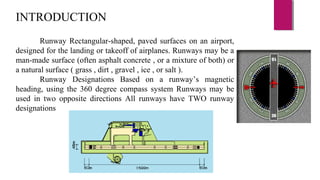
Runway Rectangular-shaped, paved surfaces on an airport,
designed for the landing or takeoff of airplanes. Runways may be a
man-made surface (often asphalt concrete , or a mixture of both) or
a natural surface ( grass , dirt , gravel , ice , or salt ).
Runway Designations Based on a runway’s magnetic
heading, using the 360 degree compass system Runways may be
used in two opposite directions All runways have TWO runway
designations
INTRODUCTION
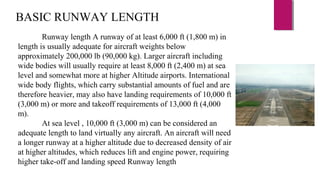
Runway length A runway of at least 6,000 ft (1,800 m) in
length is usually adequate for aircraft weights below
approximately 200,000 lb (90,000 kg). Larger aircraft including
wide bodies will usually require at least 8,000 ft (2,400 m) at sea
level and somewhat more at higher Altitude airports. International
wide body flights, which carry substantial amounts of fuel and are
therefore heavier, may also have landing requirements of 10,000 ft
(3,000 m) or more and takeoff requirements of 13,000 ft (4,000
m).
At sea level , 10,000 ft (3,000 m) can be considered an
adequate length to land virtually any aircraft. An aircraft will need
a longer runway at a higher altitude due to decreased density of air
at higher altitudes, which reduces lift and engine power, requiring
higher take-off and landing speed Runway length
BASIC RUNWAY LENGTH
BASIC RUNWAY LENGTH, THE LENGTH IS CALCULATED
UNDER THE FOLLOWING CONDITIONS
• No wind blowing on the runway.
• Aircraft is loaded with full loading capacity.
• Airport is provided at the sea level
• No wind is blowing on the way to the destination
• The runway is levelled and it is provided with zero effective
gradient.
• The standard temperature is 15 degrees centigrade at the airport.
FACTOR AFFECTING BASIC RUNWAY LENGTH
1. Aircraft Performance Characteristics.
2. Landing & Take–Off Gross Weights of the Aircraft.
3. Airport Elevation.
4. Maximum Temperature.
5. Runway Gradient.
6. Runway Surface Condition.
The very first thing which is going to create an effect is the power and the
prolusion system. Now, as we have seen that in the case of an aircraft which is
landing or which is taking off, the power is one of the important aspects which create
its effect or the propulsion system which is being provided is the one which finally
gets transformed into the power. So, here what we are understanding is that if the
power is more, then the aircraft requires a longer length so as to stop, because it has,
there is a certain rate of de-acceleration and with that rate of de-acceleration, the
vehicle or the aircraft will be going to stop.
AIRCRAFT CHARACTERISTICS
These gross take-off or gross landing weight of the aircraft has its effect at the time
when the aircraft is taking off or it is landing, respectively. Now, in this case what happens
is that, if there is a heavy take-off load, then obviously the aircraft will require more of the
power and so as to get more of this power, it has to run more distance and by running that
particular more distance.
It will be reaching that velocity at which there will be a possibility of attaining the
lift or the lift becomes more than the weight, which is otherwise acting in the downward
direction. So, if that condition is achieved, then only the aircraft will be going into air. So,
that is the effect of the take-off load for the aircraft and in case of runway length, there will
be more length required if there is a higher take-off gross weight.
LANDING & TAKE–OFF GROSS WEIGHTS OF THE
AIRCRAFT
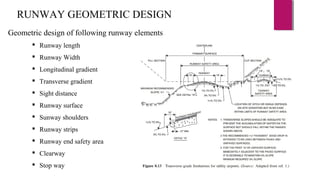
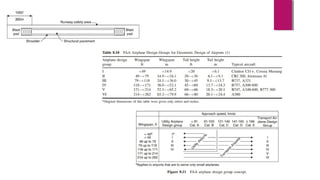
RUNWAY GEOMETRIC DESIGN
Geometric design of following runway elements
 Runway length
 Runway Width
 Longitudinal gradient
 Transverse gradient
 Sight distance
 Runway surface
 Sunway shoulders
 Runway strips
 Runway end safety area
 Clearway
 Stop way
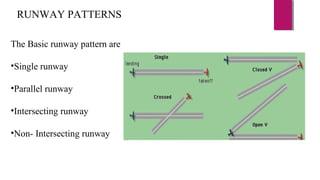
RUNWAY PATTERNS
The Basic runway pattern are
•Single runway
•Parallel runway
•Intersecting runway
•Non- Intersecting runway
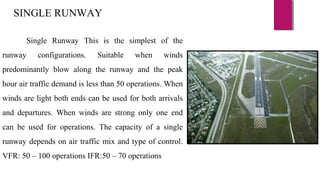
Single Runway This is the simplest of the
runway configurations. Suitable when winds
predominantly blow along the runway and the peak
hour air traffic demand is less than 50 operations. When
winds are light both ends can be used for both arrivals
and departures. When winds are strong only one end
can be used for operations. The capacity of a single
runway depends on air traffic mix and type of control.
VFR: 50 – 100 operations IFR:50 – 70 operations
SINGLE RUNWAY
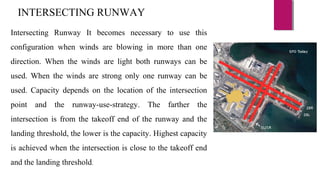
INTERSECTING RUNWAY
Intersecting Runway It becomes necessary to use this
configuration when winds are blowing in more than one
direction. When the winds are light both runways can be
used. When the winds are strong only one runway can be
used. Capacity depends on the location of the intersection
point and the runway-use-strategy. The farther the
intersection is from the takeoff end of the runway and the
landing threshold, the lower is the capacity. Highest capacity
is achieved when the intersection is close to the takeoff end
and the landing threshold.
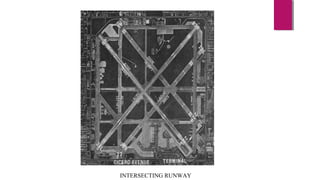
INTERSECTING RUNWAY
Basic runway length

Basic runway length

  • 2.
    Runway Rectangular-shaped, pavedsurfaces on an airport, designed for the landing or takeoff of airplanes. Runways may be a man-made surface (often asphalt concrete , or a mixture of both) or a natural surface ( grass , dirt , gravel , ice , or salt ). Runway Designations Based on a runway’s magnetic heading, using the 360 degree compass system Runways may be used in two opposite directions All runways have TWO runway designations INTRODUCTION
  • 3.
    Runway length Arunway of at least 6,000 ft (1,800 m) in length is usually adequate for aircraft weights below approximately 200,000 lb (90,000 kg). Larger aircraft including wide bodies will usually require at least 8,000 ft (2,400 m) at sea level and somewhat more at higher Altitude airports. International wide body flights, which carry substantial amounts of fuel and are therefore heavier, may also have landing requirements of 10,000 ft (3,000 m) or more and takeoff requirements of 13,000 ft (4,000 m). At sea level , 10,000 ft (3,000 m) can be considered an adequate length to land virtually any aircraft. An aircraft will need a longer runway at a higher altitude due to decreased density of air at higher altitudes, which reduces lift and engine power, requiring higher take-off and landing speed Runway length BASIC RUNWAY LENGTH
  • 5.
    BASIC RUNWAY LENGTH,THE LENGTH IS CALCULATED UNDER THE FOLLOWING CONDITIONS • No wind blowing on the runway. • Aircraft is loaded with full loading capacity. • Airport is provided at the sea level • No wind is blowing on the way to the destination • The runway is levelled and it is provided with zero effective gradient. • The standard temperature is 15 degrees centigrade at the airport.
  • 6.
    FACTOR AFFECTING BASICRUNWAY LENGTH 1. Aircraft Performance Characteristics. 2. Landing & Take–Off Gross Weights of the Aircraft. 3. Airport Elevation. 4. Maximum Temperature. 5. Runway Gradient. 6. Runway Surface Condition.
  • 7.
    The very firstthing which is going to create an effect is the power and the prolusion system. Now, as we have seen that in the case of an aircraft which is landing or which is taking off, the power is one of the important aspects which create its effect or the propulsion system which is being provided is the one which finally gets transformed into the power. So, here what we are understanding is that if the power is more, then the aircraft requires a longer length so as to stop, because it has, there is a certain rate of de-acceleration and with that rate of de-acceleration, the vehicle or the aircraft will be going to stop. AIRCRAFT CHARACTERISTICS
  • 8.
    These gross take-offor gross landing weight of the aircraft has its effect at the time when the aircraft is taking off or it is landing, respectively. Now, in this case what happens is that, if there is a heavy take-off load, then obviously the aircraft will require more of the power and so as to get more of this power, it has to run more distance and by running that particular more distance. It will be reaching that velocity at which there will be a possibility of attaining the lift or the lift becomes more than the weight, which is otherwise acting in the downward direction. So, if that condition is achieved, then only the aircraft will be going into air. So, that is the effect of the take-off load for the aircraft and in case of runway length, there will be more length required if there is a higher take-off gross weight. LANDING & TAKE–OFF GROSS WEIGHTS OF THE AIRCRAFT
  • 9.
    RUNWAY GEOMETRIC DESIGN Geometricdesign of following runway elements  Runway length  Runway Width  Longitudinal gradient  Transverse gradient  Sight distance  Runway surface  Sunway shoulders  Runway strips  Runway end safety area  Clearway  Stop way
  • 11.
    RUNWAY PATTERNS The Basicrunway pattern are •Single runway •Parallel runway •Intersecting runway •Non- Intersecting runway
  • 12.
    Single Runway Thisis the simplest of the runway configurations. Suitable when winds predominantly blow along the runway and the peak hour air traffic demand is less than 50 operations. When winds are light both ends can be used for both arrivals and departures. When winds are strong only one end can be used for operations. The capacity of a single runway depends on air traffic mix and type of control. VFR: 50 – 100 operations IFR:50 – 70 operations SINGLE RUNWAY
  • 13.
    INTERSECTING RUNWAY Intersecting RunwayIt becomes necessary to use this configuration when winds are blowing in more than one direction. When the winds are light both runways can be used. When the winds are strong only one runway can be used. Capacity depends on the location of the intersection point and the runway-use-strategy. The farther the intersection is from the takeoff end of the runway and the landing threshold, the lower is the capacity. Highest capacity is achieved when the intersection is close to the takeoff end and the landing threshold.
  • 14.