INTRODUCTION
 Of all the social interactions between cells in
multicellular organism, the most
fundamental are those that hold the cells
together.
 Many cells in tissues are linked to one
another & to Extracellular Matrix at
specialized contact sites called “CELL
JUNCTIONS.”
Classification of Cell Junctions
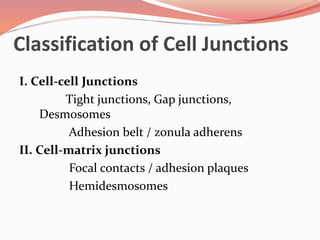
I. Cell-cell Junctions
Tight junctions, Gap junctions,
Desmosomes
Adhesion belt / zonula adherens
II. Cell-matrix junctions
Focal contacts / adhesion plaques
Hemidesmosomes
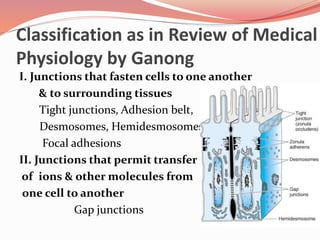
Classification as in Review of Medical
Physiology by Ganong
I. Junctions that fasten cells to one another
& to surrounding tissues
Tight junctions, Adhesion belt,
Desmosomes, Hemidesmosomes
Focal adhesions
II. Junctions that permit transfer
of ions & other molecules from
one cell to another
Gap junctions
Classification as in Alberts
Molecular Biology of Cell
Cell Junctions can be divided into 3 functional groups
I. Occluding Junctions :
Tight Junctions
II. Anchoring Junctions :
Desmosomes, Hemidesmosomes, Focal adhesions
& Zonula adherens
III. Communicating Junctions :
Gap Junctions
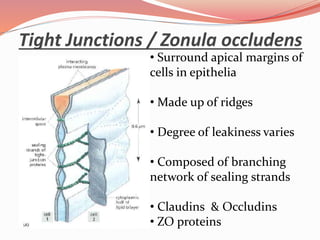
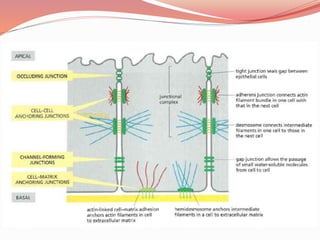
Tight Junctions / Zonula occludens
• Surround apical margins of
cells in epithelia
• Made up of ridges
• Degree of leakiness varies
• Composed of branching
network of sealing strands
• Claudins & Occludins
• ZO proteins
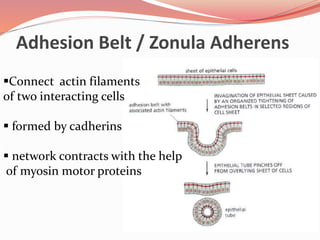
Adhesion Belt / Zonula Adherens
Connect actin filaments
of two interacting cells
 formed by cadherins
 network contracts with the help
of myosin motor proteins
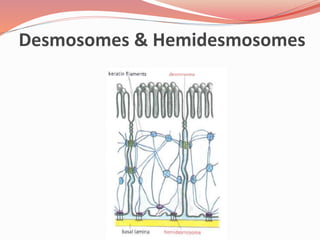
Desmosomes & Hemidesmosomes
Gap Junctions
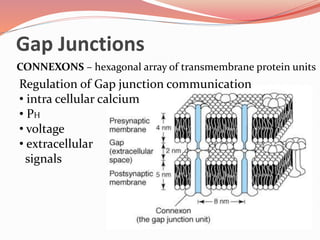
CONNEXONS – hexagonal array of transmembrane protein units
Regulation of Gap junction communication
• intra cellular calcium
• PH
• voltage
• extracellular
signals
Functions of Gap Junctions
1. In tissues containing electrically excitable
cells, coupling via gap junctions is very
usefull
2. Role in non-excitable tissues
3. Normal development of ovarian follicles
4. Role in Embryogenesis
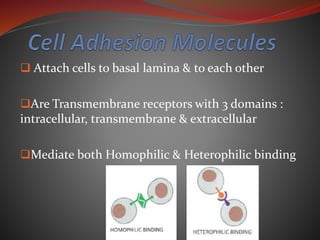
 Attach cells to basal lamina & to each other
Are Transmembrane receptors with 3 domains :
intracellular, transmembrane & extracellular
Mediate both Homophilic & Heterophilic binding
CAMs can be divided into 4 major families
1. Cadherin superfamiliy
2. Selectins
3. Integrins
4. Immunoglobulin superfamily
Other way of classifying CAMs is,
I. Calcium-dependent
Cadherins
Selectins
Integrins
II. Calcium-independent
Ig superfamily
CADHERINS
 Mediate homophilic binding
 Structure contains a short transmembrane domain & a
relatively long exrecellular domain wit 4 cadherin
repeats (EC1 to EC4) each with a calcium binding
sequence.
 Interact with Catenins
Types :
N-cadherin
P-cadherin
E-cadherin
SELECTINS
 Calcium dependent carbohydrate binding proteins
 Mediate initial attachment of leukocytes to the
endothelium on the blood vessel wall during rolling
step of Phagocytosis
 Structure includes a NH2-terminal C-type Calcium
binding lectin domain, a membrane spanning domain
& a short cytoplasmic domain
 Mediate heterophilic binding
Types:
L-selectin
P-selectin
E-selectin
INTEGRINS Are principally involved in cell-matrix adhesion
 Also act as regulatory receptors that can initiate
intracellular signal pathways
 Composed of hetero dimers consisting of 2 non-
covalently associated subunits α and β
 Both subunits are membrane glycoproteins with a
large extracellular domain, a single transmembrane
domain & a short cytoplasmic domain
Types :
β 1 integrins – VLA proteins
β 2 integrins – Leu CAMs
β 3 integrins – cytoadhesions
β 4 integrins
IMMUNOGLOBULIN SUPERFAMILY
 Mediate many different functions including acting as
receptors for growth factors & mediating cell-cell &
cell-matrix interactions
 Structure is characterised by repeated domains similar
to those found in immunoglobulins.
 Mediate both heterophilic & homophilic binding
Types :
ICAMs – Intracellular CAMs
VCAMs – Vascular CAMs
PECAMs – Platelet Endothelial CAMs
NCAMs – Neural CAMs
ICAMs
• ICAM-1 (CD54), ICAM-2 (CD102) are counter receptors for
leukocyte β2 integrins
• ICAM-1 is expressed on leukocytes, fibroblasts, epithelial
cells & endothelial cells
• ICAM-2 has similar distribution but is not regulated by
cytokines as ICAM-1
VCAMs
• VCAM-1 (CD106) is expressed on surface of activated
endothelium, dendritic cells, tissue macrophages & bone
marrow fibroblasts
• It interacts with leukocyte integrin α4 β1 on eosinophils,
monocytes & with α4 β7 on activated peripheral T-cells
PECAMs
• PECAM-1 (CD31 or endoCAM) is found on endothelial
cells, on platelets, some monocytes & neutrophils
• Is involved in homophilic adhesion
NCAMs
• Is expressed on most of the nerve cells
• Play an important role in fine tuning of adhesive
interactions during development & regeneration
“Although cadherins & Ig family members are frequently
expressed on the same cells, the adhesions mediated by
cadherins are much stronger & are responsible for holding
cells together, segregating cell collections into discrete
tissues & maintaining tissue integrity”
 PEMPHIGUS
Role of Gap Junctions in Embryogenesis
E-cadherin & Prostate cancer
ICAM-1 & Melanoma
VCAM-1 & Tumour Metastases
REFERENCES
 Review of Medical Physiology by William F.Ganong,
21st ed; 2003 by The McGraw-Hill Companies, Inc.
 Alberts Molecular Biology of Cell 5th edition
 Cell Junctions- Molecular Biology of Cell –NCBI
Bookshelf
 Cell Junctions- Biology Encyclopedia,
www.biologyreference.com/celljunctions.html#b
 en.wikipedia.org/wiki/Cell _adhesion_molecule
 Cellular Adhesion and Adhesion Molecules, Review
Article by Zerrin Seller ; Turk Journal of Biology
25(2001)1-15
Inter cellular junctions

Inter cellular junctions

  • 2.
    INTRODUCTION  Of allthe social interactions between cells in multicellular organism, the most fundamental are those that hold the cells together.  Many cells in tissues are linked to one another & to Extracellular Matrix at specialized contact sites called “CELL JUNCTIONS.”
  • 3.
    Classification of CellJunctions I. Cell-cell Junctions Tight junctions, Gap junctions, Desmosomes Adhesion belt / zonula adherens II. Cell-matrix junctions Focal contacts / adhesion plaques Hemidesmosomes
  • 4.
    Classification as inReview of Medical Physiology by Ganong I. Junctions that fasten cells to one another & to surrounding tissues Tight junctions, Adhesion belt, Desmosomes, Hemidesmosomes Focal adhesions II. Junctions that permit transfer of ions & other molecules from one cell to another Gap junctions
  • 5.
    Classification as inAlberts Molecular Biology of Cell Cell Junctions can be divided into 3 functional groups I. Occluding Junctions : Tight Junctions II. Anchoring Junctions : Desmosomes, Hemidesmosomes, Focal adhesions & Zonula adherens III. Communicating Junctions : Gap Junctions
  • 6.
    Tight Junctions /Zonula occludens • Surround apical margins of cells in epithelia • Made up of ridges • Degree of leakiness varies • Composed of branching network of sealing strands • Claudins & Occludins • ZO proteins
  • 7.
    Adhesion Belt /Zonula Adherens Connect actin filaments of two interacting cells  formed by cadherins  network contracts with the help of myosin motor proteins
  • 8.
  • 9.
    Gap Junctions CONNEXONS –hexagonal array of transmembrane protein units Regulation of Gap junction communication • intra cellular calcium • PH • voltage • extracellular signals
  • 10.
    Functions of GapJunctions 1. In tissues containing electrically excitable cells, coupling via gap junctions is very usefull 2. Role in non-excitable tissues 3. Normal development of ovarian follicles 4. Role in Embryogenesis
  • 12.
     Attach cellsto basal lamina & to each other Are Transmembrane receptors with 3 domains : intracellular, transmembrane & extracellular Mediate both Homophilic & Heterophilic binding
  • 13.
    CAMs can bedivided into 4 major families 1. Cadherin superfamiliy 2. Selectins 3. Integrins 4. Immunoglobulin superfamily Other way of classifying CAMs is, I. Calcium-dependent Cadherins Selectins Integrins II. Calcium-independent Ig superfamily
  • 14.
    CADHERINS  Mediate homophilicbinding  Structure contains a short transmembrane domain & a relatively long exrecellular domain wit 4 cadherin repeats (EC1 to EC4) each with a calcium binding sequence.  Interact with Catenins Types : N-cadherin P-cadherin E-cadherin
  • 15.
    SELECTINS  Calcium dependentcarbohydrate binding proteins  Mediate initial attachment of leukocytes to the endothelium on the blood vessel wall during rolling step of Phagocytosis  Structure includes a NH2-terminal C-type Calcium binding lectin domain, a membrane spanning domain & a short cytoplasmic domain  Mediate heterophilic binding Types: L-selectin P-selectin E-selectin
  • 16.
    INTEGRINS Are principallyinvolved in cell-matrix adhesion  Also act as regulatory receptors that can initiate intracellular signal pathways  Composed of hetero dimers consisting of 2 non- covalently associated subunits α and β  Both subunits are membrane glycoproteins with a large extracellular domain, a single transmembrane domain & a short cytoplasmic domain Types : β 1 integrins – VLA proteins β 2 integrins – Leu CAMs β 3 integrins – cytoadhesions β 4 integrins
  • 17.
    IMMUNOGLOBULIN SUPERFAMILY  Mediatemany different functions including acting as receptors for growth factors & mediating cell-cell & cell-matrix interactions  Structure is characterised by repeated domains similar to those found in immunoglobulins.  Mediate both heterophilic & homophilic binding Types : ICAMs – Intracellular CAMs VCAMs – Vascular CAMs PECAMs – Platelet Endothelial CAMs NCAMs – Neural CAMs
  • 18.
    ICAMs • ICAM-1 (CD54),ICAM-2 (CD102) are counter receptors for leukocyte β2 integrins • ICAM-1 is expressed on leukocytes, fibroblasts, epithelial cells & endothelial cells • ICAM-2 has similar distribution but is not regulated by cytokines as ICAM-1 VCAMs • VCAM-1 (CD106) is expressed on surface of activated endothelium, dendritic cells, tissue macrophages & bone marrow fibroblasts • It interacts with leukocyte integrin α4 β1 on eosinophils, monocytes & with α4 β7 on activated peripheral T-cells
  • 19.
    PECAMs • PECAM-1 (CD31or endoCAM) is found on endothelial cells, on platelets, some monocytes & neutrophils • Is involved in homophilic adhesion NCAMs • Is expressed on most of the nerve cells • Play an important role in fine tuning of adhesive interactions during development & regeneration “Although cadherins & Ig family members are frequently expressed on the same cells, the adhesions mediated by cadherins are much stronger & are responsible for holding cells together, segregating cell collections into discrete tissues & maintaining tissue integrity”
  • 20.
     PEMPHIGUS Role ofGap Junctions in Embryogenesis E-cadherin & Prostate cancer ICAM-1 & Melanoma VCAM-1 & Tumour Metastases
  • 21.
    REFERENCES  Review ofMedical Physiology by William F.Ganong, 21st ed; 2003 by The McGraw-Hill Companies, Inc.  Alberts Molecular Biology of Cell 5th edition  Cell Junctions- Molecular Biology of Cell –NCBI Bookshelf  Cell Junctions- Biology Encyclopedia, www.biologyreference.com/celljunctions.html#b  en.wikipedia.org/wiki/Cell _adhesion_molecule  Cellular Adhesion and Adhesion Molecules, Review Article by Zerrin Seller ; Turk Journal of Biology 25(2001)1-15