Cell Connections & Junctions
by Dr. Vani Gupta
Definition and Classification of cell junction
 Cell junction is the connection between the neighbouring cells
or the contact between the cell and extracellular matrix.
 It is also called membrane junction.
Cell junction are classified into three types
a-Occluding junction
b-Communicating junction
c-Anchoring junction.
Cell Adhesion Molecules (CAMs)
 Important cell surface proteins molecules promoting
cell–cell and cell–matrix interactions.
 Important for many normal biological processes -
embryonic cell migration, immune system functions,
wound healing.
 Involved in intracellular signaling pathways (primarily
for cell death/survival, secretion etc.)
Cell Adhesion Molecules (CAMs)
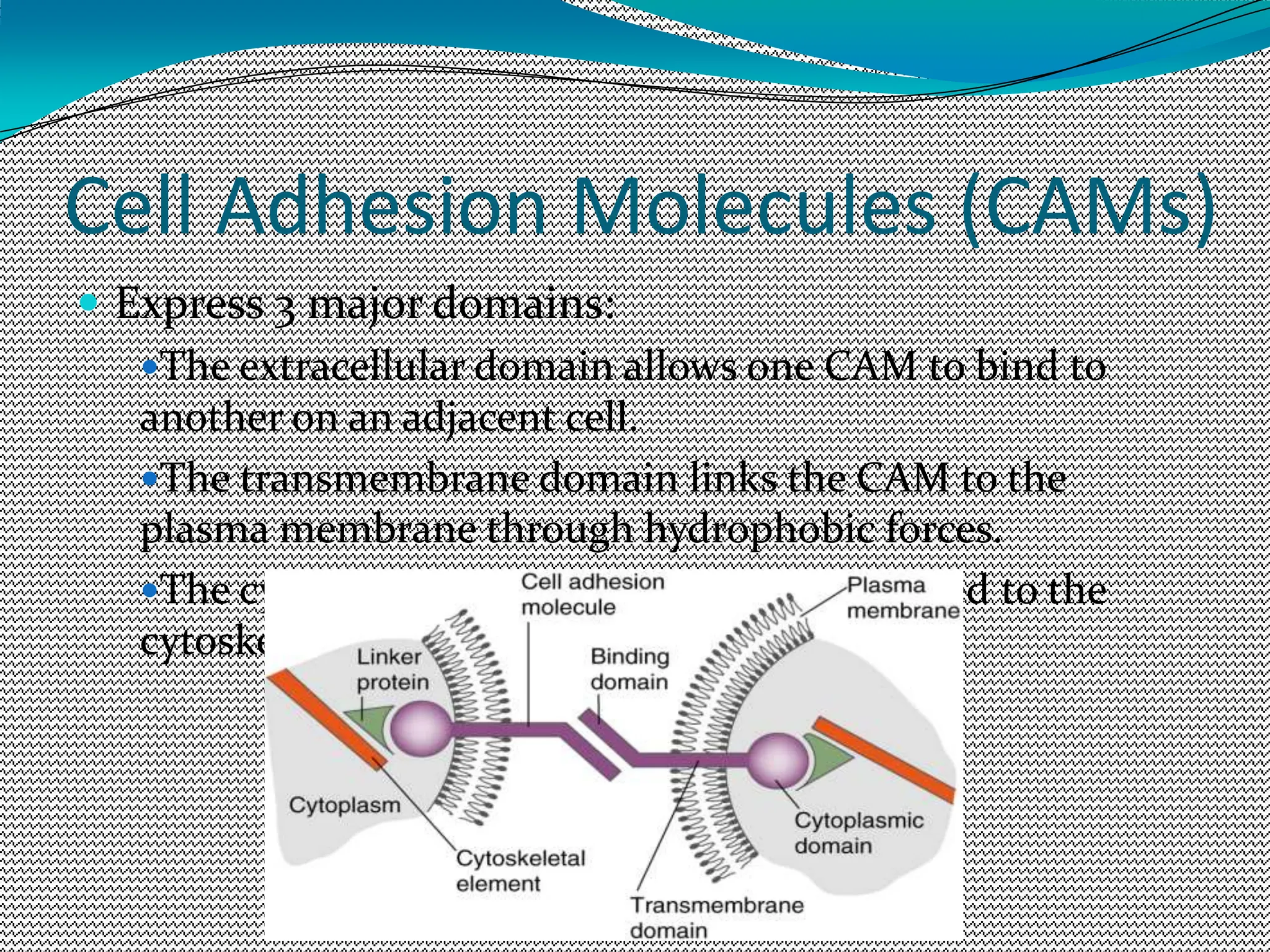
 Express 3 major domains:
The extracellular domain allows one CAM to bind to
another on an adjacent cell.
The transmembrane domain links the CAM to the
plasma membrane through hydrophobic forces.
The cytoplasmic domain is directly connected to the
cytoskeleton by linker proteins.
Cell Adhesion Molecules (CAMs)
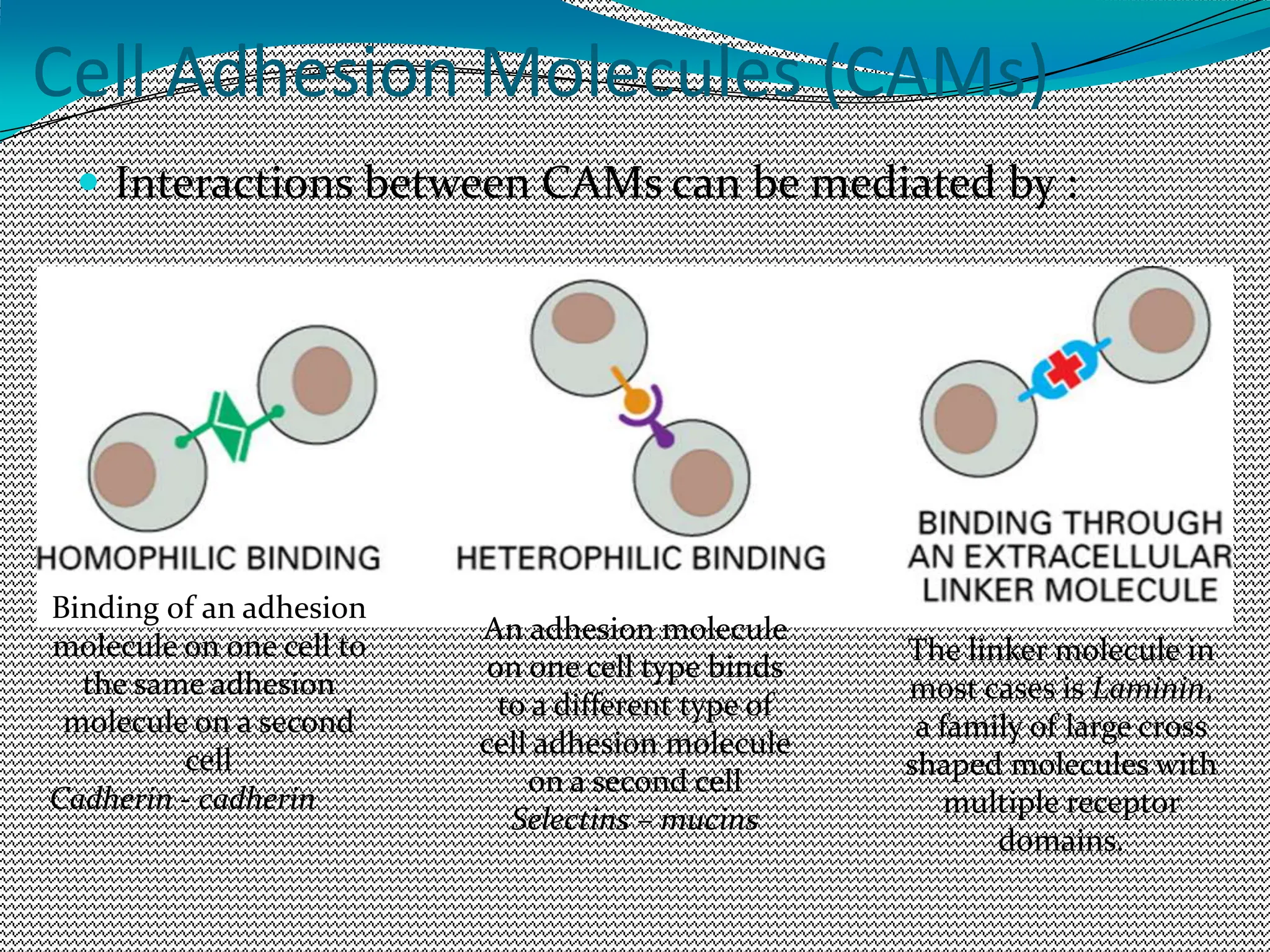
 Interactions between CAMs can be mediated by :
Binding of an adhesion
molecule on one cell to
the same adhesion
molecule on a second
cell
Cadherin - cadherin
An adhesion molecule
on one cell type binds
to a different type of
cell adhesion molecule
on a second cell
Selectins – mucins
The linker molecule in
most cases is Laminin,
a family of large cross
shaped molecules with
multiple receptor
domains.
 These cell adhesion molecules can be divided into 4
major families
 The cadherin superfamily
 The selectins
 The immunoglobulin superfamily and
 The integrins
The Cadherin superfamily
 Cadherins are the most prevalent CAMs in
vertebrates.
 125 kD transmembrane glycoproteins - mediate
intercellular adhesion in epithelial and endothelial
cells by Ca2+ dependent homophilic adhesion.
 Primarily link epithelial and muscle cells to their
neighbors
 Form desmosomes and adherens junctions
 Play critical role during development (cell sorting).
 Do not interact with extracellular matrix.
The Cadherin superfamily
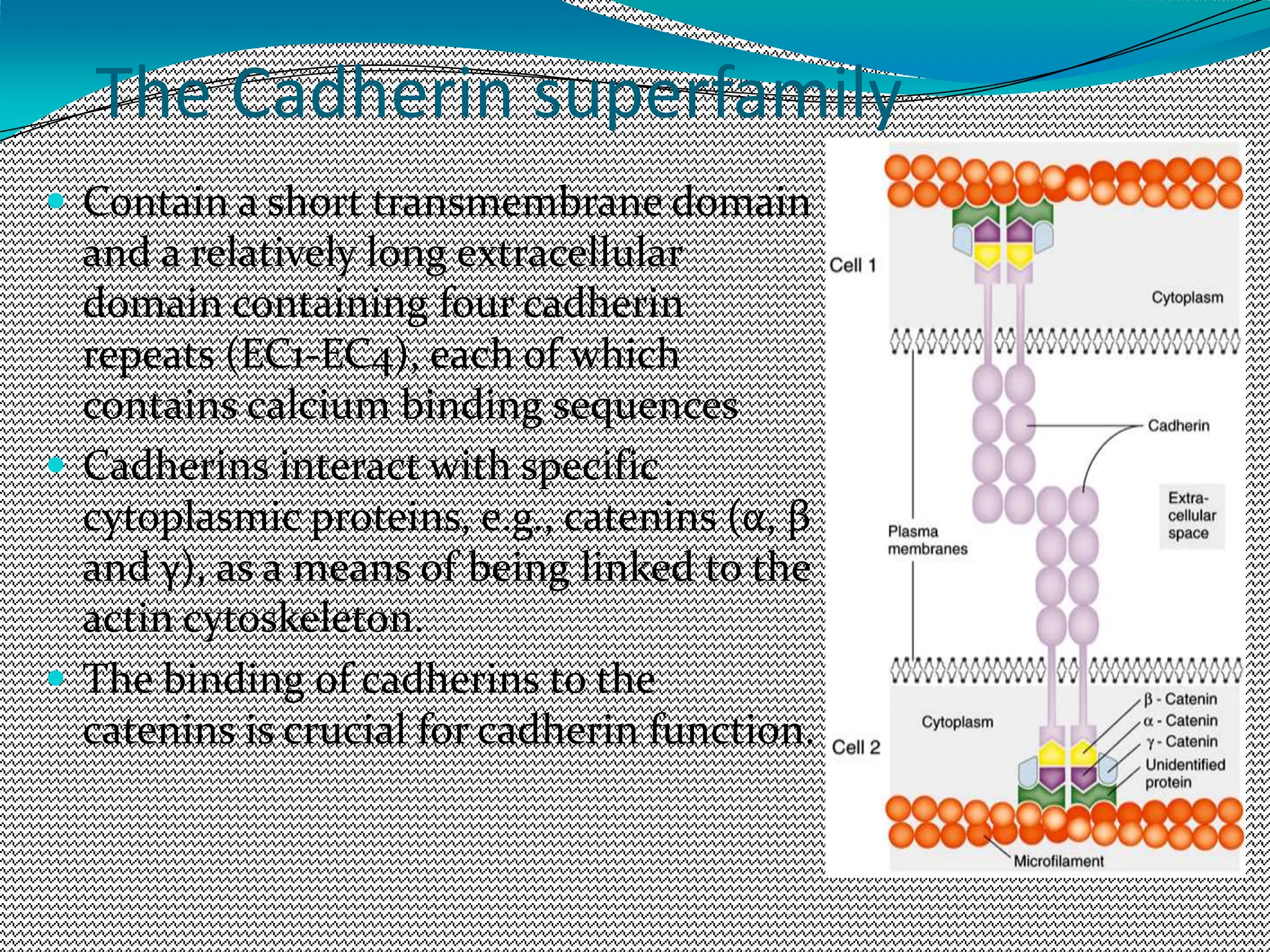
 Contain a short transmembrane domain
and a relatively long extracellular
domain containing four cadherin
repeats (EC1-EC4), each of which
contains calcium binding sequences
 Cadherins interact with specific
cytoplasmic proteins, e.g., catenins (α, β
and γ), as a means of being linked to the
actin cytoskeleton.
 The binding of cadherins to the
catenins is crucial for cadherin function.
The Selectins
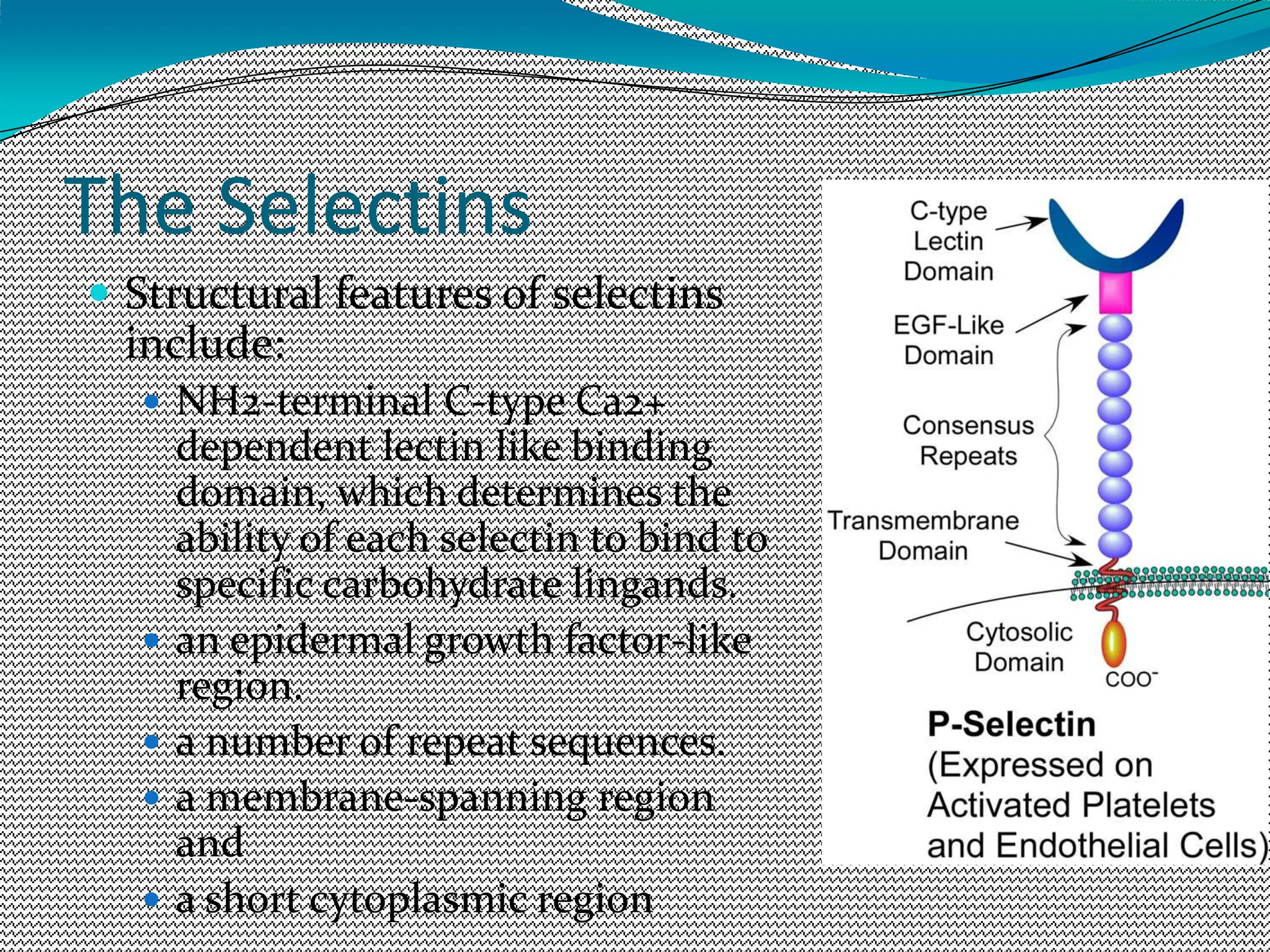
 Structural features of selectins
include:
 NH2-terminal C-type Ca2+
dependent lectin like binding
domain, which determines the
ability of each selectin to bind to
specific carbohydrate lingands.
 an epidermal growth factor-like
region.
 a number of repeat sequences.
 a membrane-spanning region
and
 a short cytoplasmic region
Immunoglobulin Superfamily
Molecules
 Consists of more than 25 molecules.
 Important ones being:
 Intracellular adhesion molecule 1(ICAM1; CD54)
 Intercellular adhesion molecule 2 (ICAM2),
 Vascular cell adhesion molecule1 (VCAM1; CD106),
 Platelet endothelial cell adhesion molecule 1 (PECAM 1;
CD31) and
 the mucosal addressin cell adhesion molecule 1
(MAdCAM1).
The integrins
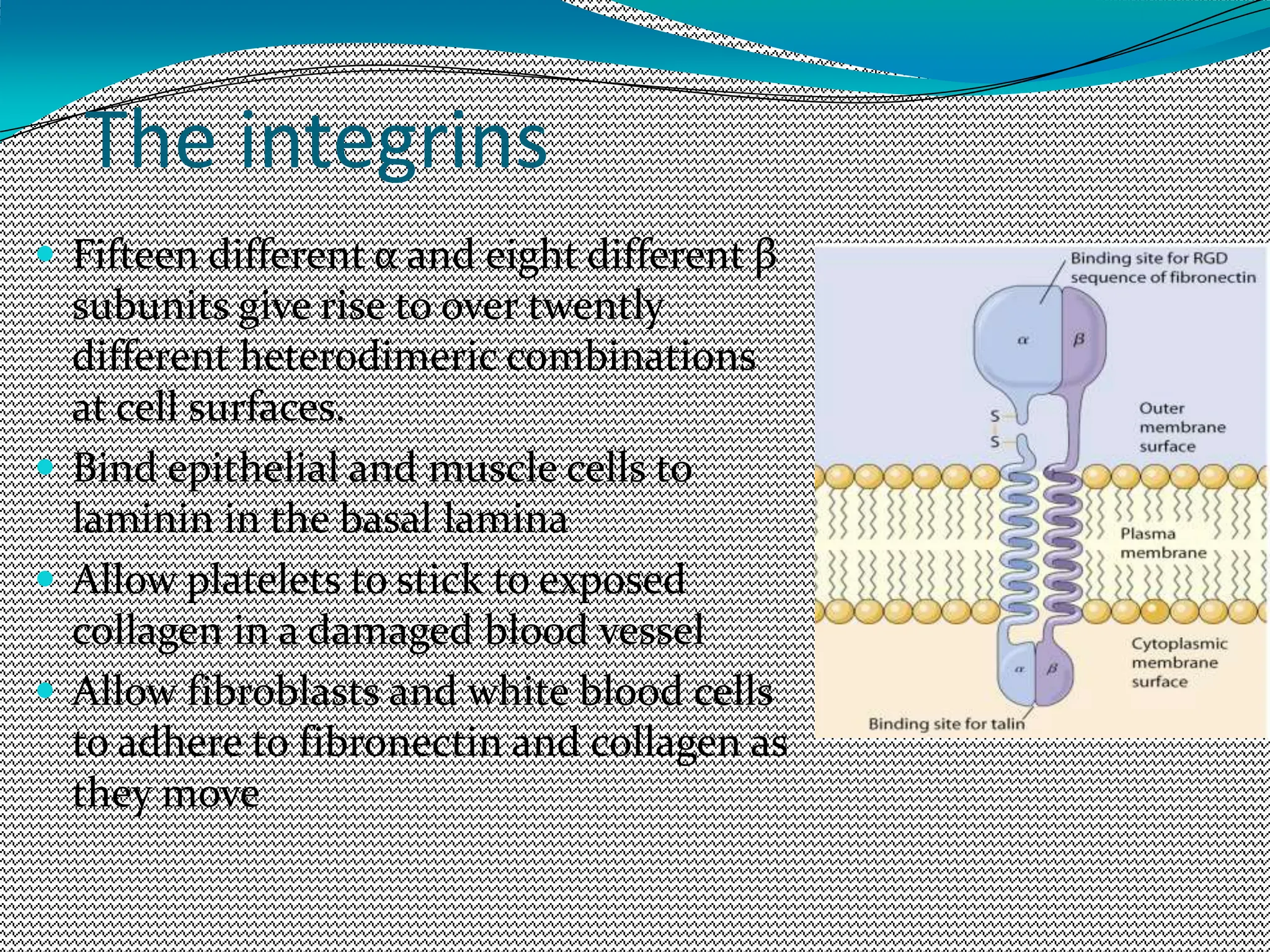
 Fifteen different α and eight different β
subunits give rise to over twently
different heterodimeric combinations
at cell surfaces.
 Bind epithelial and muscle cells to
laminin in the basal lamina
 Allow platelets to stick to exposed
collagen in a damaged blood vessel
 Allow fibroblasts and white blood cells
to adhere to fibronectin and collagen as
they move
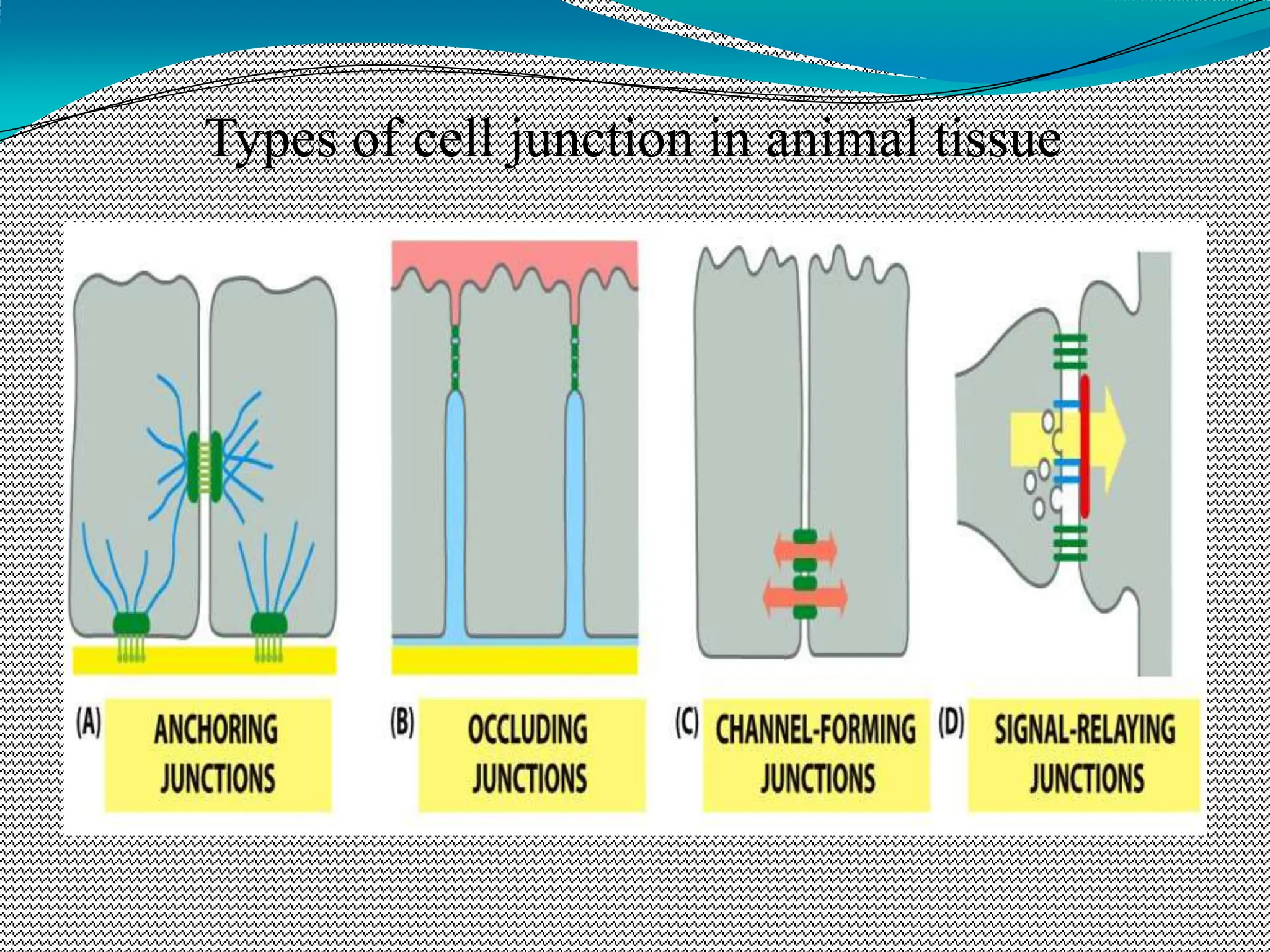
Types of cell junction in animal tissue
Occluding Junction
 A cell-cell junction that seals cells together in an epithelium in a way that
prevents even small molecules from leaking from one side of the sheet to
the other.
 Tight Junction
Tight Junction- occluding junctions / zonulae occludens - zonula
occludens), are the closely associated areas of two cells whose
membranes join together forming a virtually impermeable barrier to fluid.
 A type of junctional complex present only in vertebrates.
 Consist of linear array of several integral proteins.
 Junctional proteins occludins and claudins & members of IG suprfamily
are transmembrane proteins.
Function of Tight Junction
 Strength and stability
 Selective permeable for ions.
 Fencing function
 Maintance of cell polarity
 Blood-brain barrier
 Cludin -16 in Thick Junctions of Ascending Loop of
henle.
 Cludin- 15 Permability of cations / anions.
Adhering Junctions
 Desmosome- Connects intermediate filament of one
cell with other cells.
 Claudin
 Hemidesmosome
 Desmoplakin is essential for normal desmosomal
adhesion.
Communicating Junction
Cell junction which permit the
intercellular exchange of substance are
called communicating junction, these
junction permit the movement of ions and
molecules from one cell to another cell.
a- Gap junction
b- Chemical synapse
Gap Junction
 Gap junctions are clusters of intercellular channels
that allow direct diffusion of ions and small molecules
between adjacent cells.
 At gap junctions, the intercellular space narrows from
25 nm to 3 nm.
 gap junctions were first discovered in myocardium and
nerve because of their properties of electrical
transmission between adjacent cells (Weidmann 1952;
Furshpan and Potter 1957).
• Low resistance intercellular junction that allows
passage of ions and smaller molecules between the
cells.
 It present in heart, basal part of epithelial cell of
intestinal mucosa, etc
 Junctional unit-Connexons- 6 connexins
 Connexon of one cell have allignment with connexon
of other cells.
Gap Junction
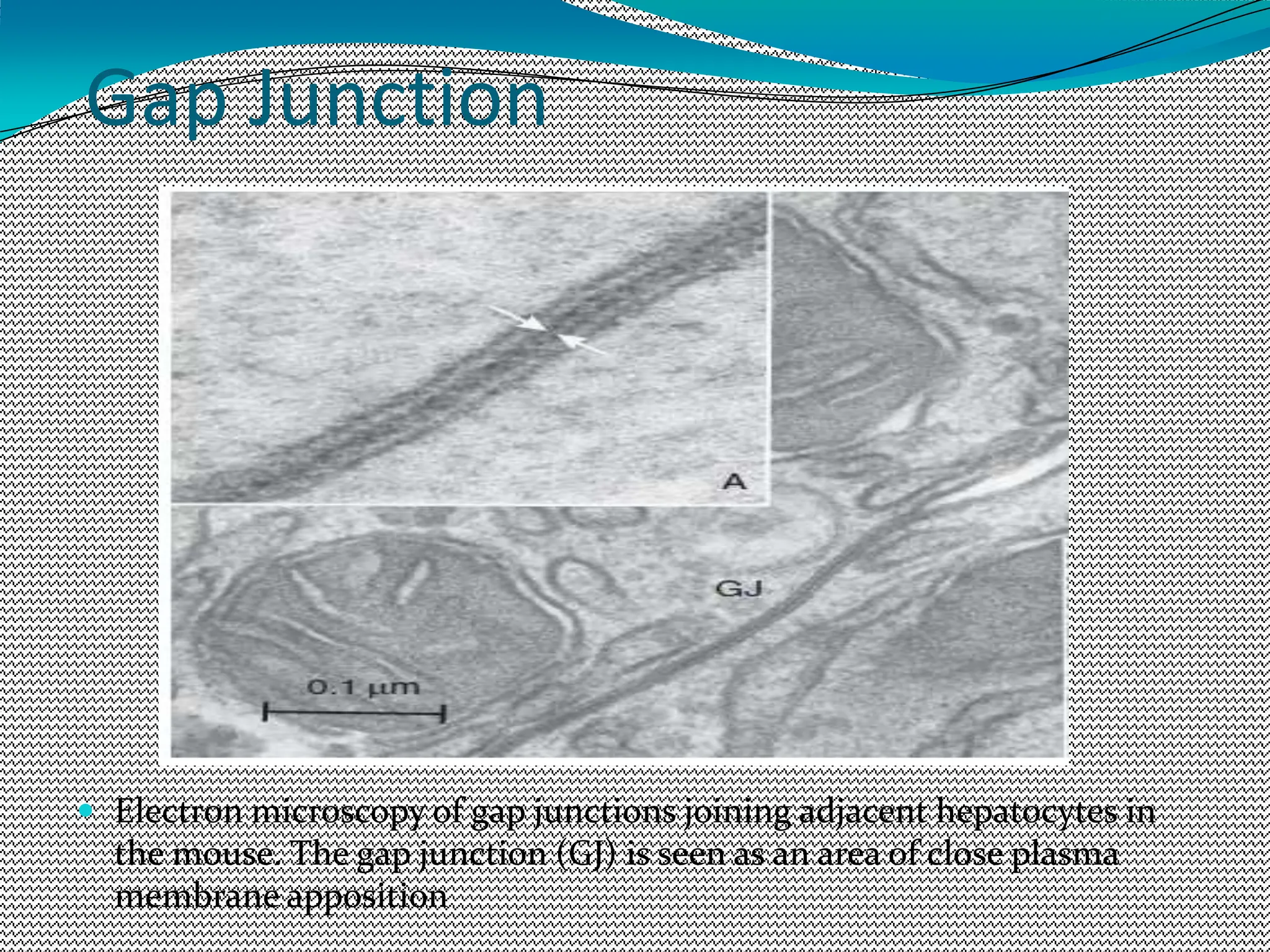
 Electron microscopy of gap junctions joining adjacent hepatocytes in
the mouse. The gap junction (GJ) is seen as an area of close plasma
membrane apposition
Function of gap junction-
 channel passage the substance have molecular
weight less than 1000.
 Exchange of chemical messenger between cells
 Rapid propagation of action potential from one cell
to another cell.
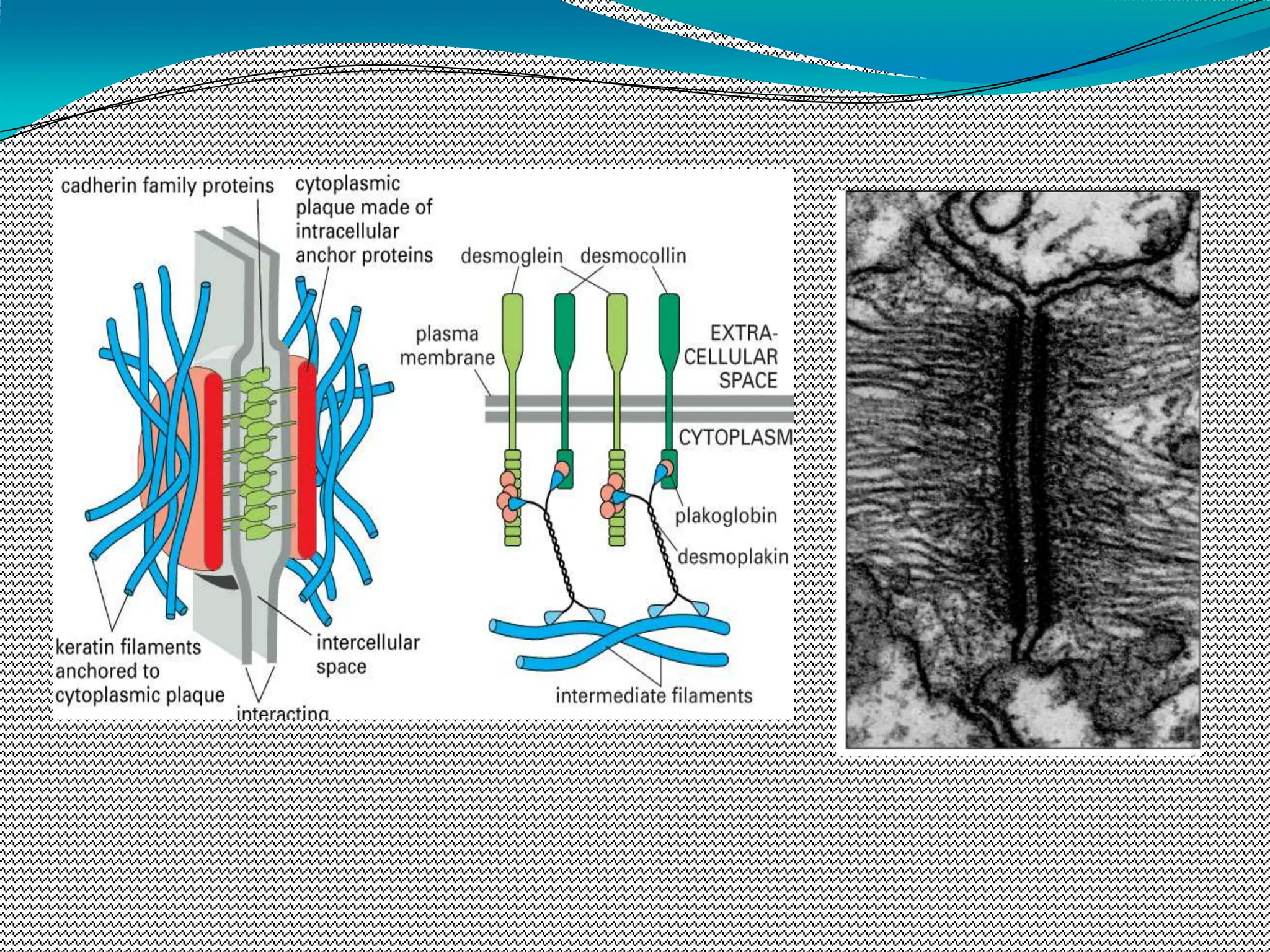
Desmosomes
 Also known as macula adherens is a cell structure specialized
for cell-to-cell adhesion.
 Are molecular complexes of cell adhesion proteins and
linking proteins that attach the cell surface adhesion proteins
to intracellular keratin cytoskeletal filaments.
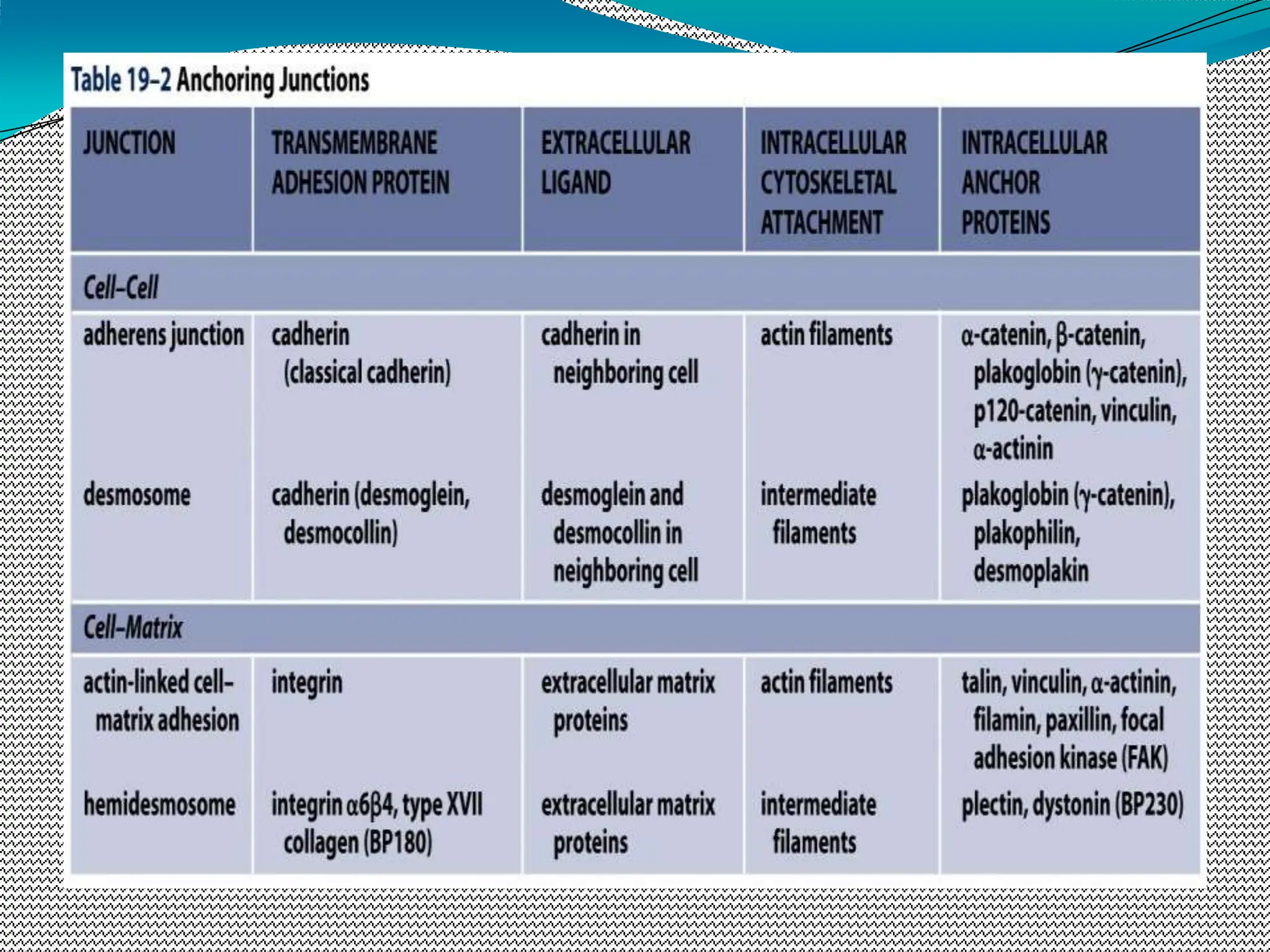
 The cell adhesion proteins of the desmosome, desmoglein
and desmocollin, are members of the cadherin family.
 On the cytoplasmic side of the plasma membrane, there are
two dense structures called the Outer Dense Plaque (ODP)
and the Inner Dense Plaque (IDP).
 The Outer Dense Plaque is where the cytoplasmic domains of the
cadherins attach to desmoplakin via plakoglobin and plakophillin.
 The Inner Dense Plaque is where desmoplakin attaches to the
intermediate filaments of the cell.
Desmosomes
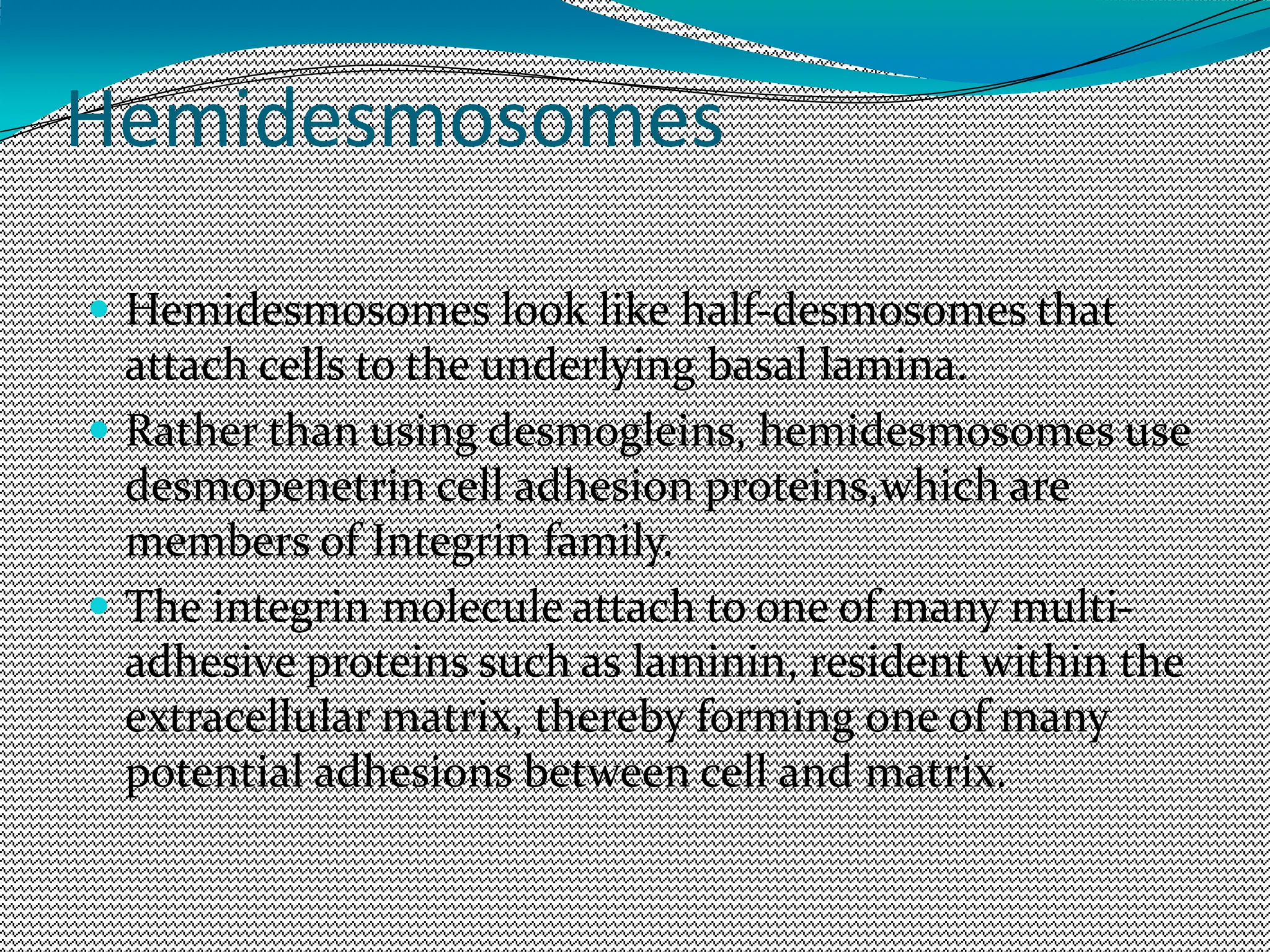
Hemidesmosomes
 Hemidesmosomes look like half-desmosomes that
attach cells to the underlying basal lamina.
 Rather than using desmogleins, hemidesmosomes use
desmopenetrin cell adhesion proteins,which are
members of Integrin family.
 The integrin molecule attach to one of many multi-
adhesive proteins such as laminin, resident within the
extracellular matrix, thereby forming one of many
potential adhesions between cell and matrix.
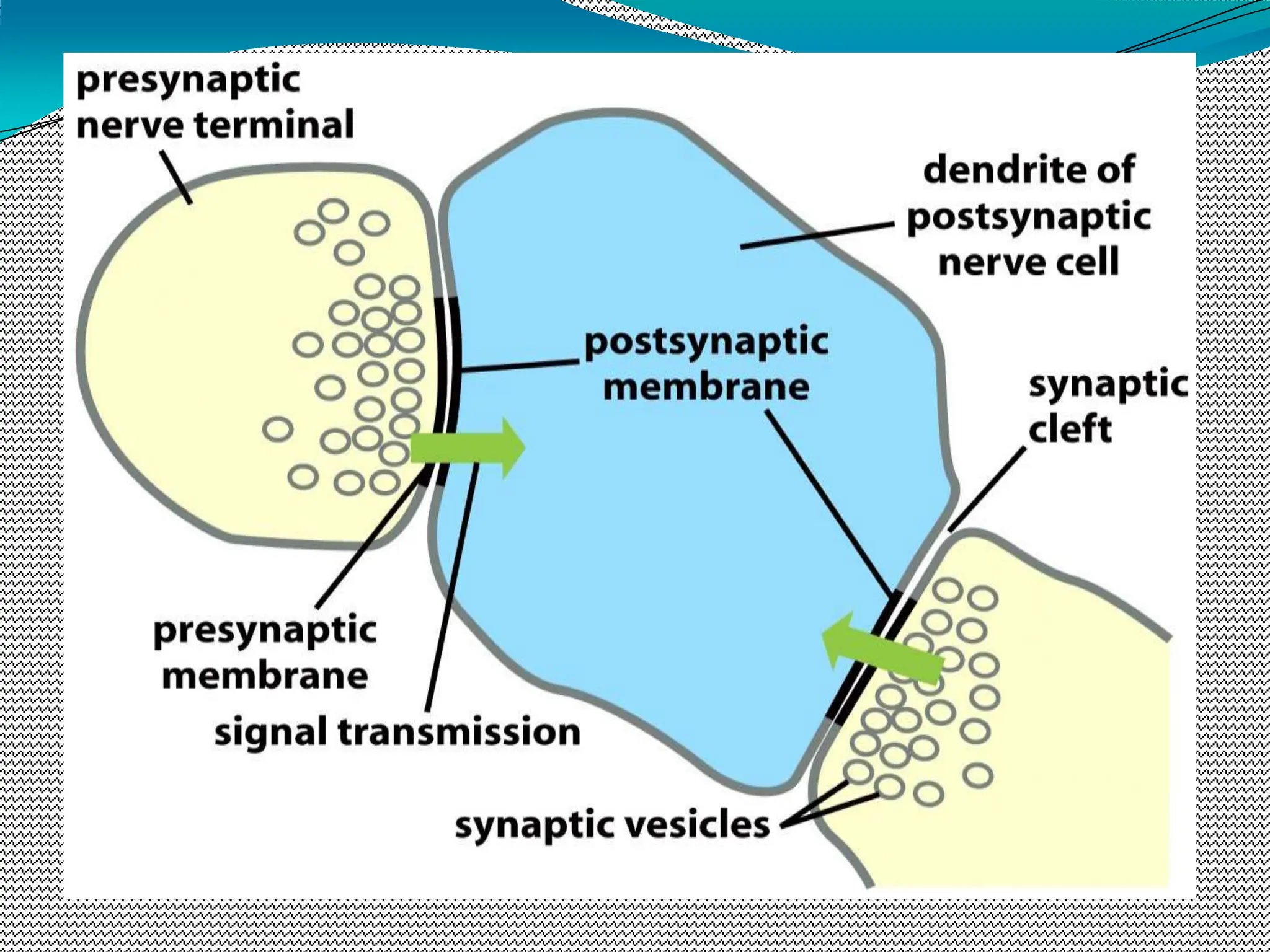
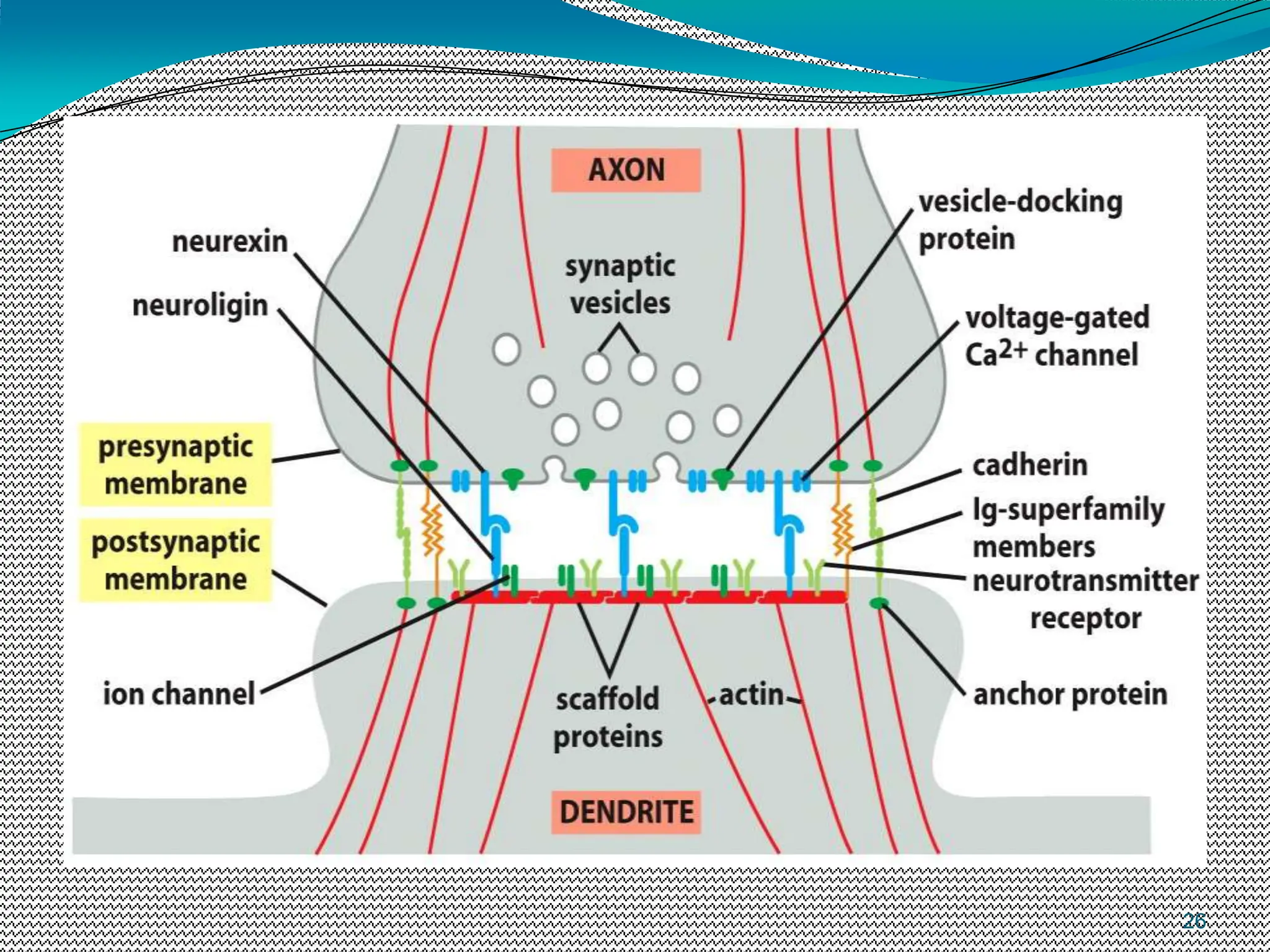
Chemical synapse
 Chemical synapse is the junction between a nerve fibre and a
muscle fiber or between two nerve fibre ,through which signals
transmitted by the release of chemical transmitter.
26
Anchoring junction.
 Anchoring junction are the junction ,which provides strength to
the cell by acting like mechanical attachment.
 These junction provide firm structural attachment between two
cells or between a cell and extracellular matrix
 Anchoring junction are responsible for structural integrity of
the tissue.
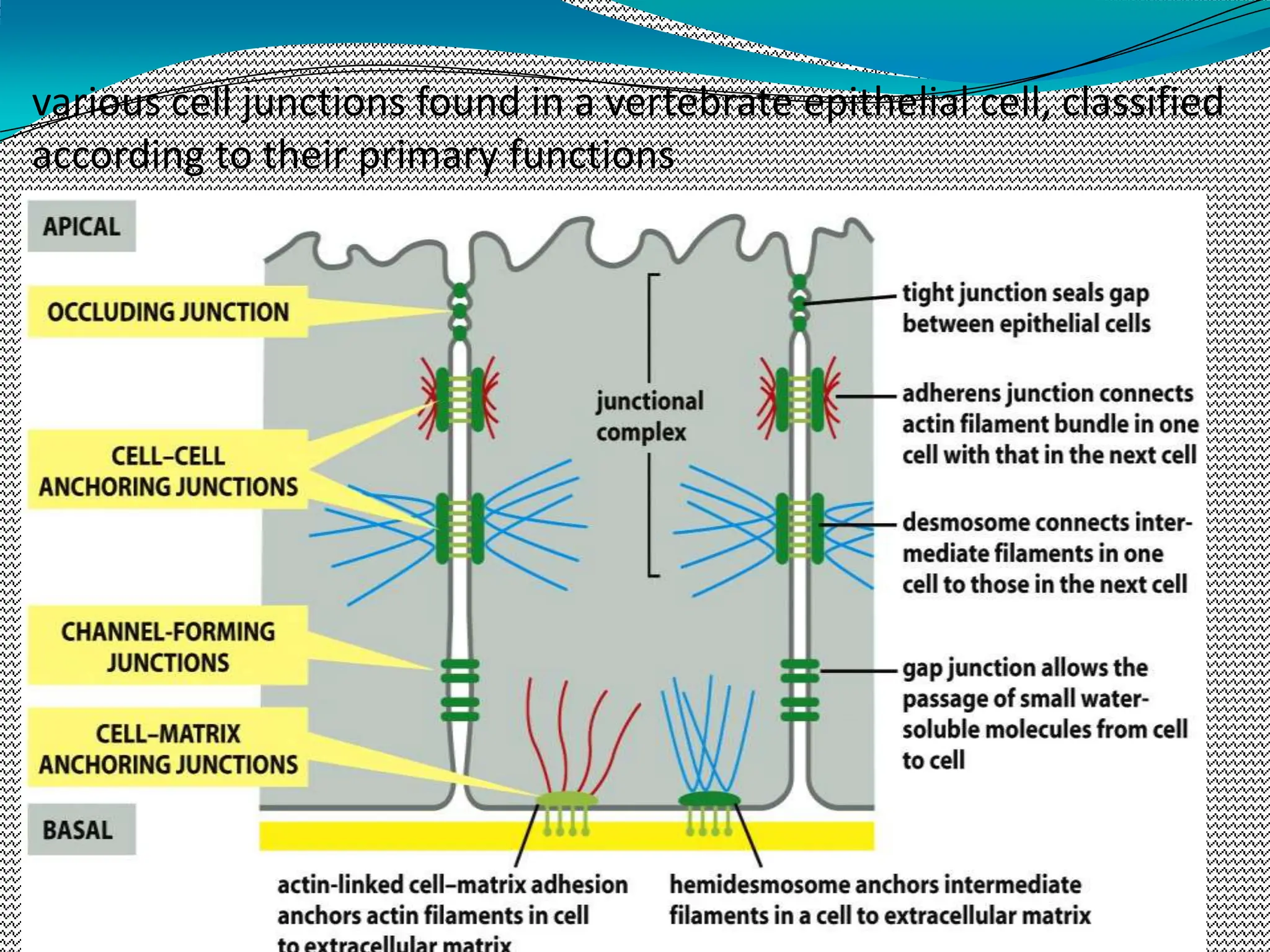
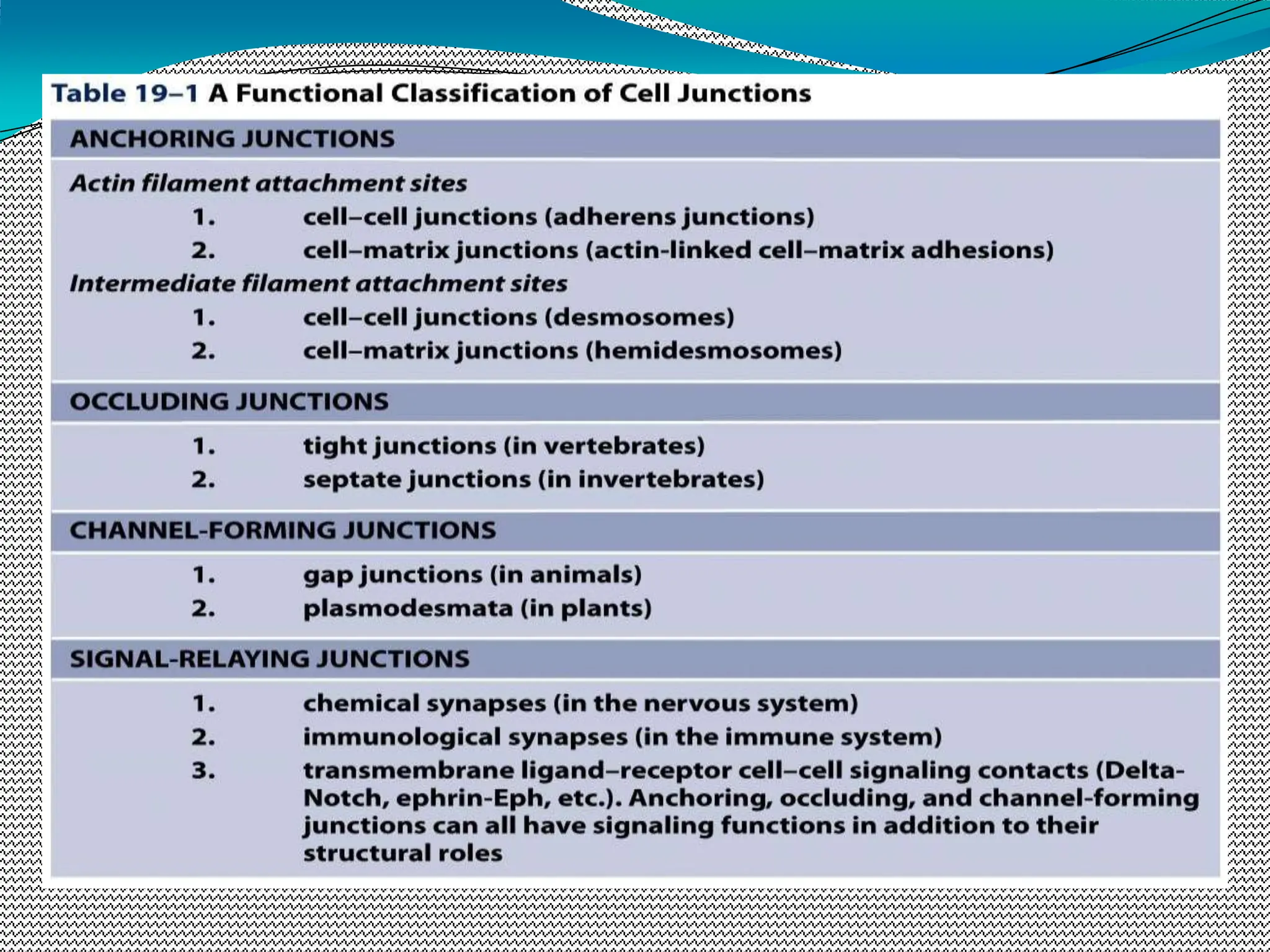
various cell junctions found in a vertebrate epithelial cell, classified
according to their primary functions
 Q1-which of the following is a cell adhesion
molecule
 a-integrin
 b-lysin
 c-myosin
 d-keratin
32
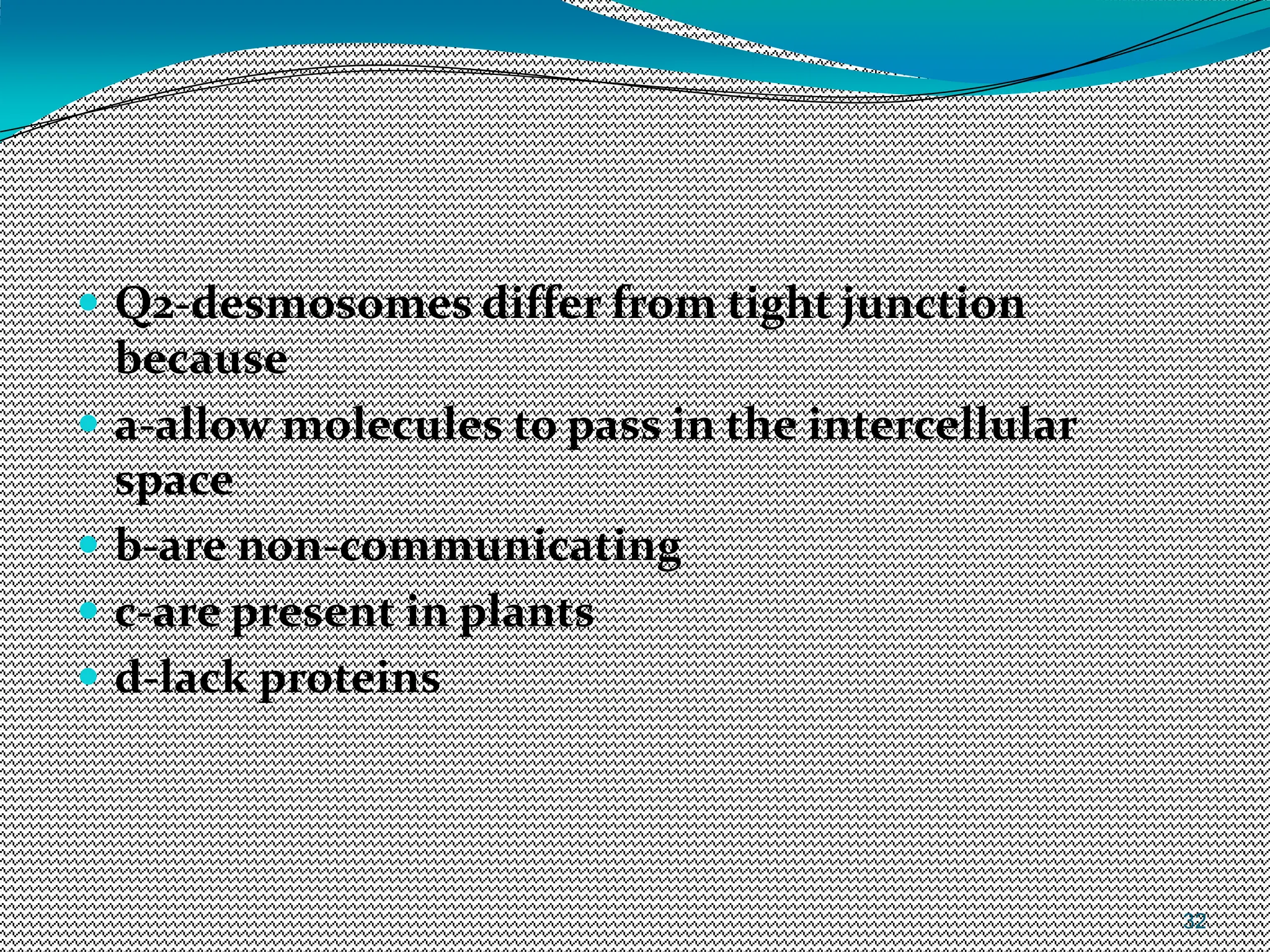
 Q2-desmosomes differ from tight junction
because
 a-allow molecules to pass in the intercellular
space
 b-are non-communicating
 c-are present in plants
 d-lack proteins
33
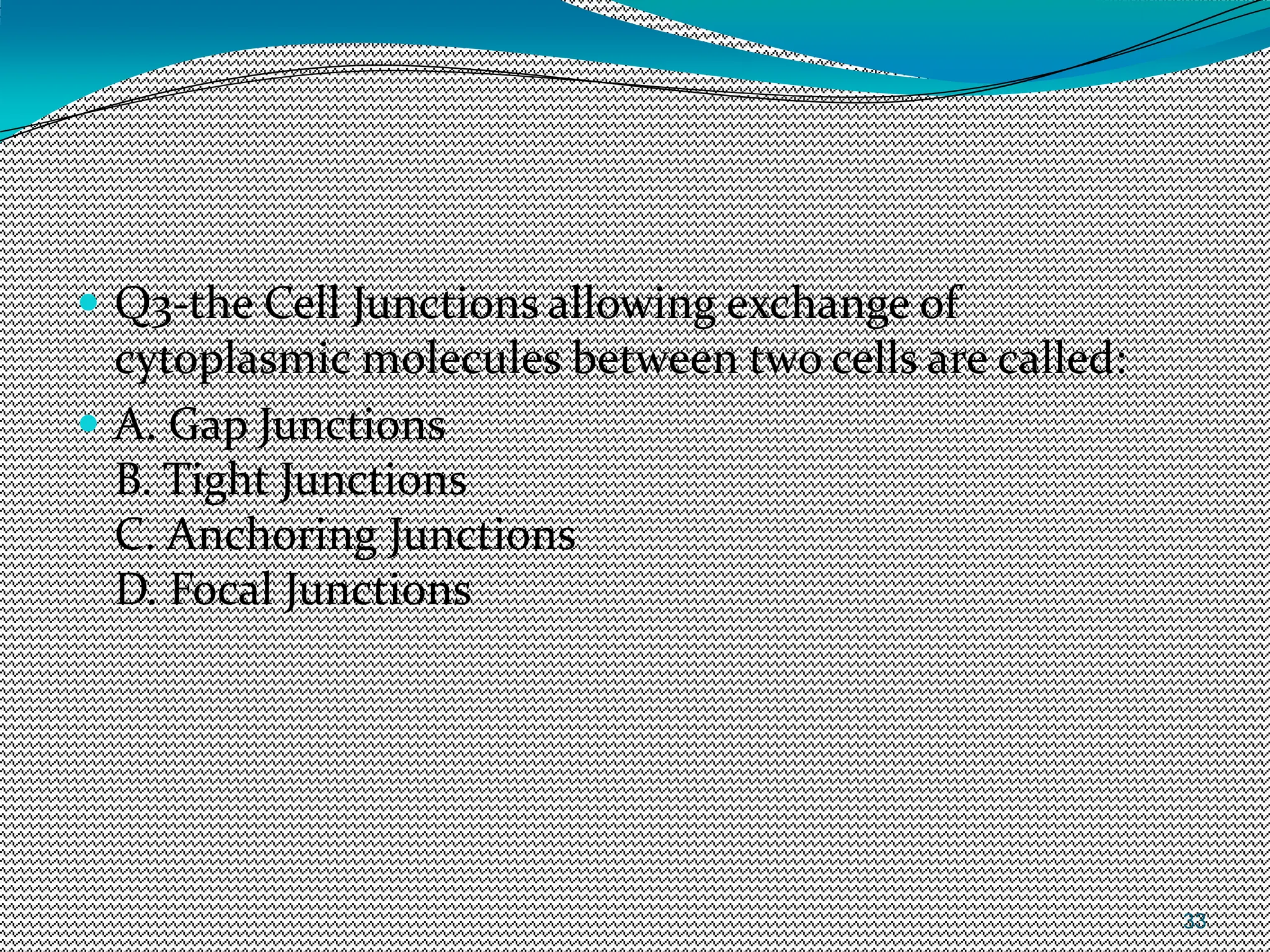
 Q3-the Cell Junctions allowing exchange of
cytoplasmic molecules between two cells are called:
 A. Gap Junctions
B. Tight Junctions
C. Anchoring Junctions
D. Focal Junctions
34
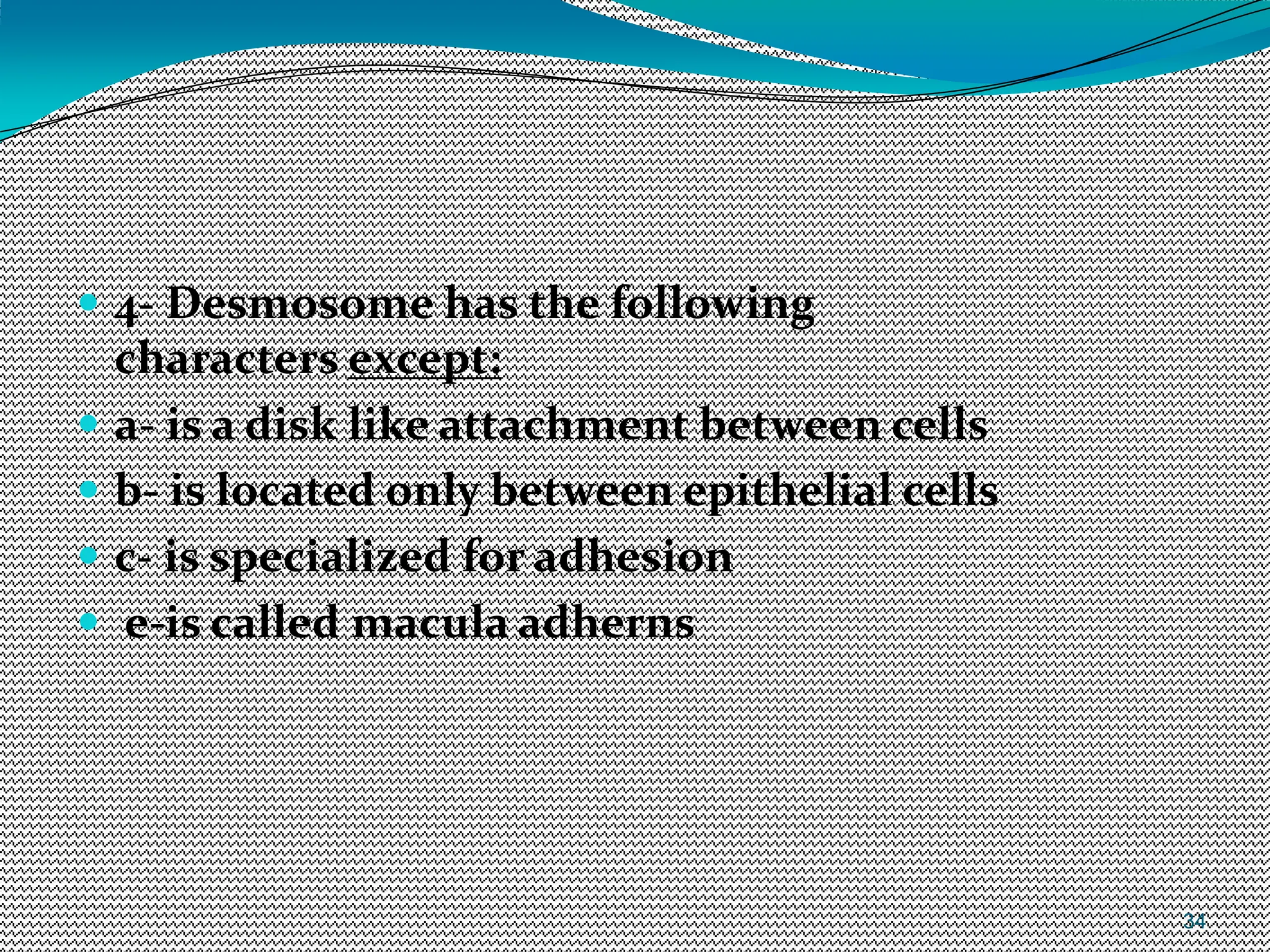
 4- Desmosome has the following
characters except:
 a- is a disk like attachment between cells
 b- is located only between epithelial cells
 c- is specialized for adhesion
 e-is called macula adherns
35
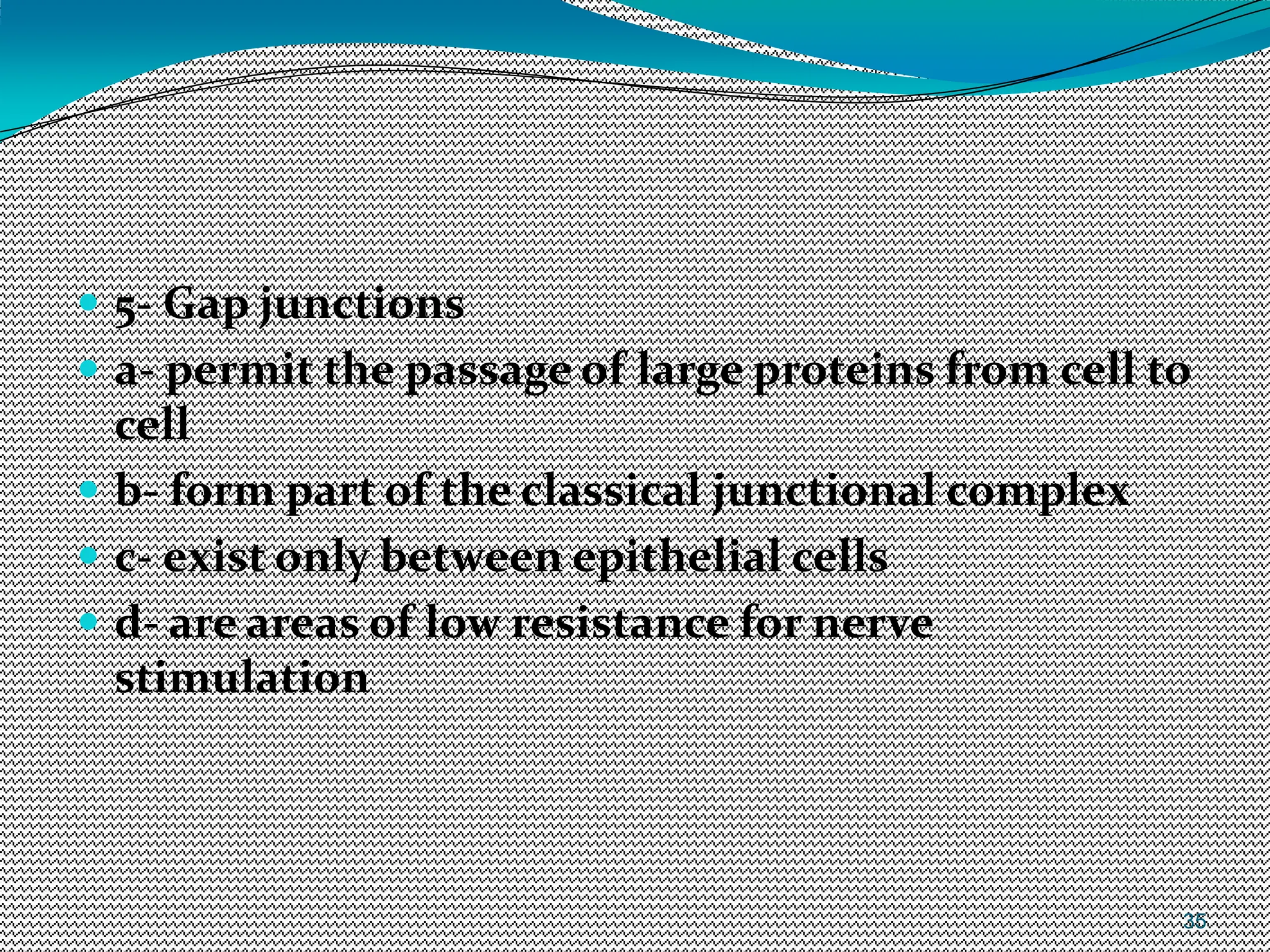
 5- Gap junctions
 a- permit the passage of large proteins from cell to
cell
 b- form part of the classical junctional complex
 c- exist only between epithelial cells
 d- are areas of low resistance for nerve
stimulation
36
Q-6 Which of the following apply to intercellular
junctions?
 a) The three major adhesive junctions of animal cells
are adherens junctions, desmosomes and
hemidesmosomes.
 b) Desmosomes and hemidesmosomes connect
epithelial cells to their basement membrane and
adjacent cells respectively.
 c) Gap junctions and plasmodesmata are homologous
structures.
 d) The junctional complexes of gastrointestinal
37
 Q-7 tight junction
 a-are essential for metabolic coupling
 b-dont occur in vertebrates
 c-have the closest approach of two plasma membranes
of any junction
 d-surround connexions
38
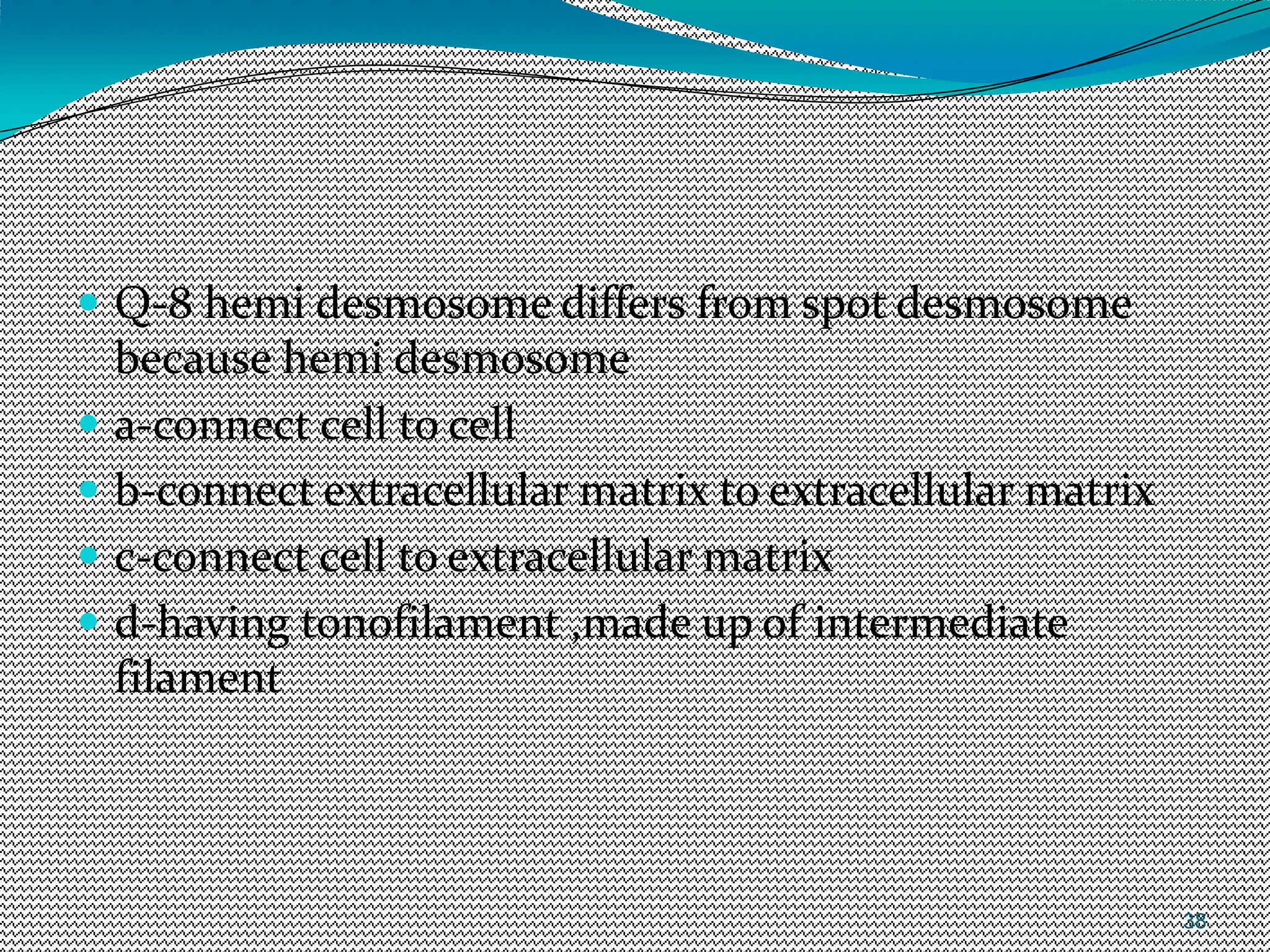
 Q-8 hemi desmosome differs from spot desmosome
because hemi desmosome
 a-connect cell to cell
 b-connect extracellular matrix to extracellular matrix
 c-connect cell to extracellular matrix
 d-having tonofilament ,made up of intermediate
filament
39
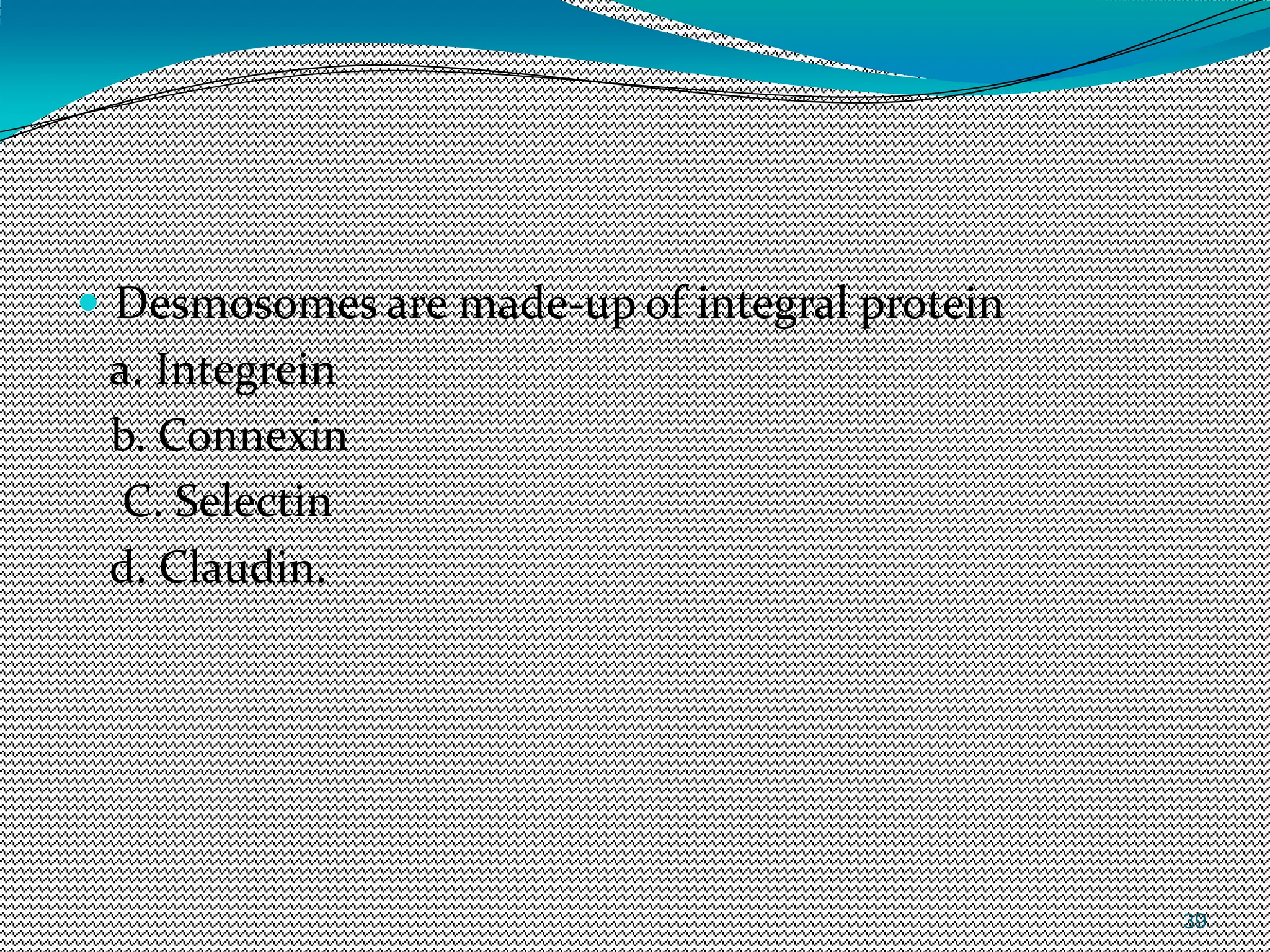
 Desmosomes are made-up of integral protein
a. Integrein
b. Connexin
C. Selectin
d. Claudin.
40
 Hemidesmosomes are connections between
a. Cell to cell
b. Cell to internal organ
c. Cell to matrix
d. Cell to cell memberane

Cell_Junctions epithelium 2024- febr.ppt

  • 1.
    Cell Connections &Junctions by Dr. Vani Gupta
  • 2.
    Definition and Classificationof cell junction  Cell junction is the connection between the neighbouring cells or the contact between the cell and extracellular matrix.  It is also called membrane junction. Cell junction are classified into three types a-Occluding junction b-Communicating junction c-Anchoring junction.
  • 3.
    Cell Adhesion Molecules(CAMs)  Important cell surface proteins molecules promoting cell–cell and cell–matrix interactions.  Important for many normal biological processes - embryonic cell migration, immune system functions, wound healing.  Involved in intracellular signaling pathways (primarily for cell death/survival, secretion etc.)
  • 4.
    Cell Adhesion Molecules(CAMs)  Express 3 major domains: The extracellular domain allows one CAM to bind to another on an adjacent cell. The transmembrane domain links the CAM to the plasma membrane through hydrophobic forces. The cytoplasmic domain is directly connected to the cytoskeleton by linker proteins.
  • 5.
    Cell Adhesion Molecules(CAMs)  Interactions between CAMs can be mediated by : Binding of an adhesion molecule on one cell to the same adhesion molecule on a second cell Cadherin - cadherin An adhesion molecule on one cell type binds to a different type of cell adhesion molecule on a second cell Selectins – mucins The linker molecule in most cases is Laminin, a family of large cross shaped molecules with multiple receptor domains.
  • 6.
     These celladhesion molecules can be divided into 4 major families  The cadherin superfamily  The selectins  The immunoglobulin superfamily and  The integrins
  • 7.
    The Cadherin superfamily Cadherins are the most prevalent CAMs in vertebrates.  125 kD transmembrane glycoproteins - mediate intercellular adhesion in epithelial and endothelial cells by Ca2+ dependent homophilic adhesion.  Primarily link epithelial and muscle cells to their neighbors  Form desmosomes and adherens junctions  Play critical role during development (cell sorting).  Do not interact with extracellular matrix.
  • 8.
    The Cadherin superfamily Contain a short transmembrane domain and a relatively long extracellular domain containing four cadherin repeats (EC1-EC4), each of which contains calcium binding sequences  Cadherins interact with specific cytoplasmic proteins, e.g., catenins (α, β and γ), as a means of being linked to the actin cytoskeleton.  The binding of cadherins to the catenins is crucial for cadherin function.
  • 9.
    The Selectins  Structuralfeatures of selectins include:  NH2-terminal C-type Ca2+ dependent lectin like binding domain, which determines the ability of each selectin to bind to specific carbohydrate lingands.  an epidermal growth factor-like region.  a number of repeat sequences.  a membrane-spanning region and  a short cytoplasmic region
  • 10.
    Immunoglobulin Superfamily Molecules  Consistsof more than 25 molecules.  Important ones being:  Intracellular adhesion molecule 1(ICAM1; CD54)  Intercellular adhesion molecule 2 (ICAM2),  Vascular cell adhesion molecule1 (VCAM1; CD106),  Platelet endothelial cell adhesion molecule 1 (PECAM 1; CD31) and  the mucosal addressin cell adhesion molecule 1 (MAdCAM1).
  • 11.
    The integrins  Fifteendifferent α and eight different β subunits give rise to over twently different heterodimeric combinations at cell surfaces.  Bind epithelial and muscle cells to laminin in the basal lamina  Allow platelets to stick to exposed collagen in a damaged blood vessel  Allow fibroblasts and white blood cells to adhere to fibronectin and collagen as they move
  • 12.
    Types of celljunction in animal tissue
  • 13.
    Occluding Junction  Acell-cell junction that seals cells together in an epithelium in a way that prevents even small molecules from leaking from one side of the sheet to the other.  Tight Junction Tight Junction- occluding junctions / zonulae occludens - zonula occludens), are the closely associated areas of two cells whose membranes join together forming a virtually impermeable barrier to fluid.  A type of junctional complex present only in vertebrates.  Consist of linear array of several integral proteins.  Junctional proteins occludins and claudins & members of IG suprfamily are transmembrane proteins.
  • 14.
    Function of TightJunction  Strength and stability  Selective permeable for ions.  Fencing function  Maintance of cell polarity  Blood-brain barrier  Cludin -16 in Thick Junctions of Ascending Loop of henle.  Cludin- 15 Permability of cations / anions.
  • 15.
    Adhering Junctions  Desmosome-Connects intermediate filament of one cell with other cells.  Claudin  Hemidesmosome  Desmoplakin is essential for normal desmosomal adhesion.
  • 16.
    Communicating Junction Cell junctionwhich permit the intercellular exchange of substance are called communicating junction, these junction permit the movement of ions and molecules from one cell to another cell. a- Gap junction b- Chemical synapse
  • 17.
    Gap Junction  Gapjunctions are clusters of intercellular channels that allow direct diffusion of ions and small molecules between adjacent cells.  At gap junctions, the intercellular space narrows from 25 nm to 3 nm.  gap junctions were first discovered in myocardium and nerve because of their properties of electrical transmission between adjacent cells (Weidmann 1952; Furshpan and Potter 1957).
  • 18.
    • Low resistanceintercellular junction that allows passage of ions and smaller molecules between the cells.  It present in heart, basal part of epithelial cell of intestinal mucosa, etc  Junctional unit-Connexons- 6 connexins  Connexon of one cell have allignment with connexon of other cells.
  • 19.
    Gap Junction  Electronmicroscopy of gap junctions joining adjacent hepatocytes in the mouse. The gap junction (GJ) is seen as an area of close plasma membrane apposition
  • 20.
    Function of gapjunction-  channel passage the substance have molecular weight less than 1000.  Exchange of chemical messenger between cells  Rapid propagation of action potential from one cell to another cell.
  • 21.
    Desmosomes  Also knownas macula adherens is a cell structure specialized for cell-to-cell adhesion.  Are molecular complexes of cell adhesion proteins and linking proteins that attach the cell surface adhesion proteins to intracellular keratin cytoskeletal filaments.  The cell adhesion proteins of the desmosome, desmoglein and desmocollin, are members of the cadherin family.  On the cytoplasmic side of the plasma membrane, there are two dense structures called the Outer Dense Plaque (ODP) and the Inner Dense Plaque (IDP).  The Outer Dense Plaque is where the cytoplasmic domains of the cadherins attach to desmoplakin via plakoglobin and plakophillin.  The Inner Dense Plaque is where desmoplakin attaches to the intermediate filaments of the cell.
  • 22.
  • 23.
    Hemidesmosomes  Hemidesmosomes looklike half-desmosomes that attach cells to the underlying basal lamina.  Rather than using desmogleins, hemidesmosomes use desmopenetrin cell adhesion proteins,which are members of Integrin family.  The integrin molecule attach to one of many multi- adhesive proteins such as laminin, resident within the extracellular matrix, thereby forming one of many potential adhesions between cell and matrix.
  • 24.
    Chemical synapse  Chemicalsynapse is the junction between a nerve fibre and a muscle fiber or between two nerve fibre ,through which signals transmitted by the release of chemical transmitter.
  • 26.
  • 27.
    Anchoring junction.  Anchoringjunction are the junction ,which provides strength to the cell by acting like mechanical attachment.  These junction provide firm structural attachment between two cells or between a cell and extracellular matrix  Anchoring junction are responsible for structural integrity of the tissue.
  • 28.
    various cell junctionsfound in a vertebrate epithelial cell, classified according to their primary functions
  • 31.
     Q1-which ofthe following is a cell adhesion molecule  a-integrin  b-lysin  c-myosin  d-keratin
  • 32.
    32  Q2-desmosomes differfrom tight junction because  a-allow molecules to pass in the intercellular space  b-are non-communicating  c-are present in plants  d-lack proteins
  • 33.
    33  Q3-the CellJunctions allowing exchange of cytoplasmic molecules between two cells are called:  A. Gap Junctions B. Tight Junctions C. Anchoring Junctions D. Focal Junctions
  • 34.
    34  4- Desmosomehas the following characters except:  a- is a disk like attachment between cells  b- is located only between epithelial cells  c- is specialized for adhesion  e-is called macula adherns
  • 35.
    35  5- Gapjunctions  a- permit the passage of large proteins from cell to cell  b- form part of the classical junctional complex  c- exist only between epithelial cells  d- are areas of low resistance for nerve stimulation
  • 36.
    36 Q-6 Which ofthe following apply to intercellular junctions?  a) The three major adhesive junctions of animal cells are adherens junctions, desmosomes and hemidesmosomes.  b) Desmosomes and hemidesmosomes connect epithelial cells to their basement membrane and adjacent cells respectively.  c) Gap junctions and plasmodesmata are homologous structures.  d) The junctional complexes of gastrointestinal
  • 37.
    37  Q-7 tightjunction  a-are essential for metabolic coupling  b-dont occur in vertebrates  c-have the closest approach of two plasma membranes of any junction  d-surround connexions
  • 38.
    38  Q-8 hemidesmosome differs from spot desmosome because hemi desmosome  a-connect cell to cell  b-connect extracellular matrix to extracellular matrix  c-connect cell to extracellular matrix  d-having tonofilament ,made up of intermediate filament
  • 39.
    39  Desmosomes aremade-up of integral protein a. Integrein b. Connexin C. Selectin d. Claudin.
  • 40.
    40  Hemidesmosomes areconnections between a. Cell to cell b. Cell to internal organ c. Cell to matrix d. Cell to cell memberane

Editor's Notes

  • #32 Ans-a Difficulty Index- Pre Lecture- 19 % Post Lecture- 78%
  • #33 Ans- a Difficulty Index- Pre Lecture- 27 % Post Lecture- 87%
  • #34 Ans- a Difficulty Index- Pre Lecture- 27 % Post Lecture- 98%
  • #35 Ans- b Difficulty Index- Pre Lecture- 24 % Post Lecture- 95%
  • #36 Ans- d Difficulty Index- Pre Lecture- 39 % Post Lecture- 92%
  • #37 Ans- a Difficulty Index- Pre Lecture- 34 % Post Lecture- 87%
  • #38 Ans- C Difficulty Index- Pre Lecture- 46 % Post Lecture- 93%
  • #39 Ans- C Difficulty Index- Pre Lecture- 42 % Post Lecture- 97%
  • #40 Ans- a Difficulty Index- Pre Lecture- 23 % Post Lecture- 82%
  • #41 Ans- C Difficulty Index- Pre Lecture- 19 % Post Lecture- 100%