CELLADHESIONMOLECULES
SUBMITTED BY:
PAKEEZA NAQVI
G1F17BSZL0053
“Celladhesionmolecules(CAMs)areasubsetofcelladhesionproteinslocatedon
thecellsurfaceinvolvedinbindingwithothercellsorwiththeextracellularmatrix
(ECM)intheprocesscalledcelladhesion.Inessence,celladhesionmoleculeshelp
cellssticktoeachotherandtotheirsurroundings.”
DEFINITION
INTRODUCTION
o Cell adhesion molecules mediate, through their
extracellular domains, adhesive interactions between
cells of the same type (homotypic adhesion) or
between cells of different types (heterotypic adhesion).
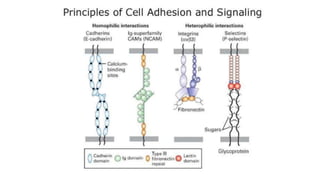
o A CAM on one cell can directly bind to the same kind
of CAM on an adjacent cell (homophilic binding) or to a
different class of CAM or ECM (heterophilic binding).
o Cell-cell adhesions can be tight and long lasting or
relatively weak and transient.
CAM’s
o CAMs are proteins located on the cell surface
involved in binding with other cells or with the
ECM in the process called cell adhesion.
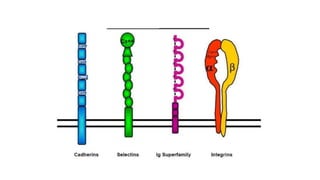
o Can be classified into four families
 CADHERINS
 INTEGRINS
 IMMUNOGLOBULIN SUPERFAMILY(IgSF)
 SELECTINS
CAM’sdomain
Cams are typically transmembrane receptors And are composed
of three domains:
INTRACELLULAR DOMAIN- interacts with
cytoskeleton and intracellular signaling
molecules.
TRANSMEMBRANE DOMAIN
EXTRACELLULAR DOMAIN- interacts with
other CAMs or ECM.
CAMplayrole
in:
 Cell-cell interactions.
• Embryogenesis.
• Immunity(migration of immune cells to the inflamation
center).
• Cell-tissue-organ development.
• wound healing.
• Cancer metastasis.
Cadherin
The primary CAMs in adherens junctions and
desmosomes belong to the cadherin family.
The role of cadherins is not limited to mechanical
adhesion between cells. Rather, cadherin function
extends to multiple aspects of:
 tissue morphogenesis,including cell recognition and
sorting,
 boundary formation and maintenance
 coordinated cell movements and the induction
 maintenance of structural and functional cell and
tissue polarity.
CONTI…
 Cadherins have been implicated in the formation and
maintenance of diverse tissues and organs ranging from
polarization of simple epithelia to mechanically linking
hair cells in the cochlea to providing an adhesion code for
neural circuit formation during wiring of the brain.
 The diversity of cadherins arises from the presence of
multiple cadherin genes and alternative RNA splicing.
DEVELOPMENT
ALROLESOF
CADHERINS
E-cadherin is the first cadherin expressed during
mammalian development. It helps to cause compaction,
an important morphological change that occurs at the
eight-cell stage of embryo development.
• Differential expression of cadherins (either by
modulating subtype or expression level) induces sorting
out of mixed cell populations.
• Cadherin subtype switching occurs during coordinated
cell movements such as neurulation,where the
invaginating neural plate expresses N-cadherin, while
the overlying ectoderm expresses E-cadherin.
INTEGRINS
 Integrins are a large family of type I
transmembrane heterodimeric glycoprotein
receptors that function as the major metazoan
receptors for cell adhesion and connect the
intracellular and extracellular environments.
 Integrins can bind to extracellular matrix (ECM)
glycoproteins including collagens, fibronectins,
laminins,and cellular receptors such as vascular cell
adhesion molecule-1 (VCAM-1) and the intercellular
cell adhesion molecule (ICAM) family.
CONTI…
• Integrins also play key roles in the assembly of the
actin cytoskeleton as well as in modulating signal
transduction pathways that control biological and
cellular functions including cell adhesion, migration,
proliferation, cell differentiation,and apoptosis.
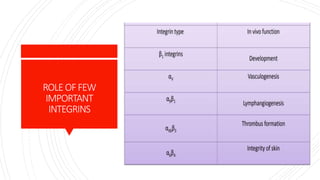
ROLEOFFEW
IMPORTANT
INTEGRINS
ROLEOF
INTEGRINS
 Attachment of cell to ECM
 Signal transduction from ECM to cell have
relation to-
-cell growth
-cell division
-cell survival
-cellular differentiation
-apoptosis
-cell migration during embryogenesis ,
thrombosis, haemostasis,wound healing etc.
IMMUNOGLOBUL
INSUPERFAMILY
CAM
(IgSF-CAM)
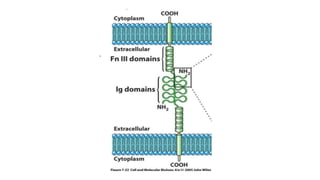
IgSF cell adhesion molecules are calcium-independent
transmembrane glycoproteins.
 Each IgSF CAM has an extracellular domain, which
contains several Ig- like intra-chain disulfide-bonded
loops with conserved cysteine residues, a
transmembrane domain, and an intracellular domain
that interacts with the cytoskeleton.
 They are either homophilic or heterophilic and bind
integrins or different IgSF CAMs.
SELECTINS
 Selectins are a unique family of 3 adhesion molecules
that are expressed and function only on cells in the
vasculature.
 The term selectin was originally proposed to highlight
the presence of the lectin domain, as well as to
emphasize the selective nature of the expression and
function of these molecules.
 Selectins mediate the first step required for emigration
of leukocytes from the bloodstream, tethering of a
leukocyte in flow.
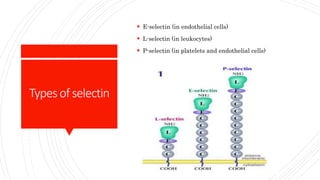
Typesof selectin
 E-selectin (in endothelial cells)
 L-selectin (in leukocytes)
 P-selectin (in platelets and endothelial cells)
Conclusion
 Cell adhesion and adhesion molecules have been shown to
contribute to the pathogenesis of a large number of
common human disorders and tumor cell metastasis in
cancer.
 Recent studies have demostrated that CAM are involved
in signal transduction pathways.
 These molecules transmit signals from the extracellular
matrix to the cell interior (outside-in) and from the inside
of the cell to the outside (inside-out) similar to those
transduced by growth factors, hormones and cytokines.
 These results are extremely significant in metastatic
spread and the treatment of a large number of human
disorders.
Cell adhesion molecules

Cell adhesion molecules

  • 1.
  • 2.
  • 3.
    INTRODUCTION o Cell adhesionmolecules mediate, through their extracellular domains, adhesive interactions between cells of the same type (homotypic adhesion) or between cells of different types (heterotypic adhesion). o A CAM on one cell can directly bind to the same kind of CAM on an adjacent cell (homophilic binding) or to a different class of CAM or ECM (heterophilic binding). o Cell-cell adhesions can be tight and long lasting or relatively weak and transient.
  • 4.
    CAM’s o CAMs areproteins located on the cell surface involved in binding with other cells or with the ECM in the process called cell adhesion. o Can be classified into four families  CADHERINS  INTEGRINS  IMMUNOGLOBULIN SUPERFAMILY(IgSF)  SELECTINS
  • 6.
    CAM’sdomain Cams are typicallytransmembrane receptors And are composed of three domains: INTRACELLULAR DOMAIN- interacts with cytoskeleton and intracellular signaling molecules. TRANSMEMBRANE DOMAIN EXTRACELLULAR DOMAIN- interacts with other CAMs or ECM.
  • 8.
    CAMplayrole in:  Cell-cell interactions. •Embryogenesis. • Immunity(migration of immune cells to the inflamation center). • Cell-tissue-organ development. • wound healing. • Cancer metastasis.
  • 9.
    Cadherin The primary CAMsin adherens junctions and desmosomes belong to the cadherin family. The role of cadherins is not limited to mechanical adhesion between cells. Rather, cadherin function extends to multiple aspects of:  tissue morphogenesis,including cell recognition and sorting,  boundary formation and maintenance  coordinated cell movements and the induction  maintenance of structural and functional cell and tissue polarity.
  • 10.
    CONTI…  Cadherins havebeen implicated in the formation and maintenance of diverse tissues and organs ranging from polarization of simple epithelia to mechanically linking hair cells in the cochlea to providing an adhesion code for neural circuit formation during wiring of the brain.  The diversity of cadherins arises from the presence of multiple cadherin genes and alternative RNA splicing.
  • 12.
    DEVELOPMENT ALROLESOF CADHERINS E-cadherin is thefirst cadherin expressed during mammalian development. It helps to cause compaction, an important morphological change that occurs at the eight-cell stage of embryo development. • Differential expression of cadherins (either by modulating subtype or expression level) induces sorting out of mixed cell populations. • Cadherin subtype switching occurs during coordinated cell movements such as neurulation,where the invaginating neural plate expresses N-cadherin, while the overlying ectoderm expresses E-cadherin.
  • 14.
    INTEGRINS  Integrins area large family of type I transmembrane heterodimeric glycoprotein receptors that function as the major metazoan receptors for cell adhesion and connect the intracellular and extracellular environments.  Integrins can bind to extracellular matrix (ECM) glycoproteins including collagens, fibronectins, laminins,and cellular receptors such as vascular cell adhesion molecule-1 (VCAM-1) and the intercellular cell adhesion molecule (ICAM) family.
  • 15.
    CONTI… • Integrins alsoplay key roles in the assembly of the actin cytoskeleton as well as in modulating signal transduction pathways that control biological and cellular functions including cell adhesion, migration, proliferation, cell differentiation,and apoptosis.
  • 16.
  • 17.
    ROLEOF INTEGRINS  Attachment ofcell to ECM  Signal transduction from ECM to cell have relation to- -cell growth -cell division -cell survival -cellular differentiation -apoptosis -cell migration during embryogenesis , thrombosis, haemostasis,wound healing etc.
  • 18.
    IMMUNOGLOBUL INSUPERFAMILY CAM (IgSF-CAM) IgSF cell adhesionmolecules are calcium-independent transmembrane glycoproteins.  Each IgSF CAM has an extracellular domain, which contains several Ig- like intra-chain disulfide-bonded loops with conserved cysteine residues, a transmembrane domain, and an intracellular domain that interacts with the cytoskeleton.  They are either homophilic or heterophilic and bind integrins or different IgSF CAMs.
  • 20.
    SELECTINS  Selectins area unique family of 3 adhesion molecules that are expressed and function only on cells in the vasculature.  The term selectin was originally proposed to highlight the presence of the lectin domain, as well as to emphasize the selective nature of the expression and function of these molecules.  Selectins mediate the first step required for emigration of leukocytes from the bloodstream, tethering of a leukocyte in flow.
  • 21.
    Typesof selectin  E-selectin(in endothelial cells)  L-selectin (in leukocytes)  P-selectin (in platelets and endothelial cells)
  • 22.
    Conclusion  Cell adhesionand adhesion molecules have been shown to contribute to the pathogenesis of a large number of common human disorders and tumor cell metastasis in cancer.  Recent studies have demostrated that CAM are involved in signal transduction pathways.  These molecules transmit signals from the extracellular matrix to the cell interior (outside-in) and from the inside of the cell to the outside (inside-out) similar to those transduced by growth factors, hormones and cytokines.  These results are extremely significant in metastatic spread and the treatment of a large number of human disorders.