Integrated IT Service Management: From 
Strategy to Implementing to User Adoption 
Michael Christiansen 
ICT15S #CAWorld 
Intermountain Healthcare 
Sr. Application Systems Technical Analyst 
ca Intellicenter
2 
Abstract 
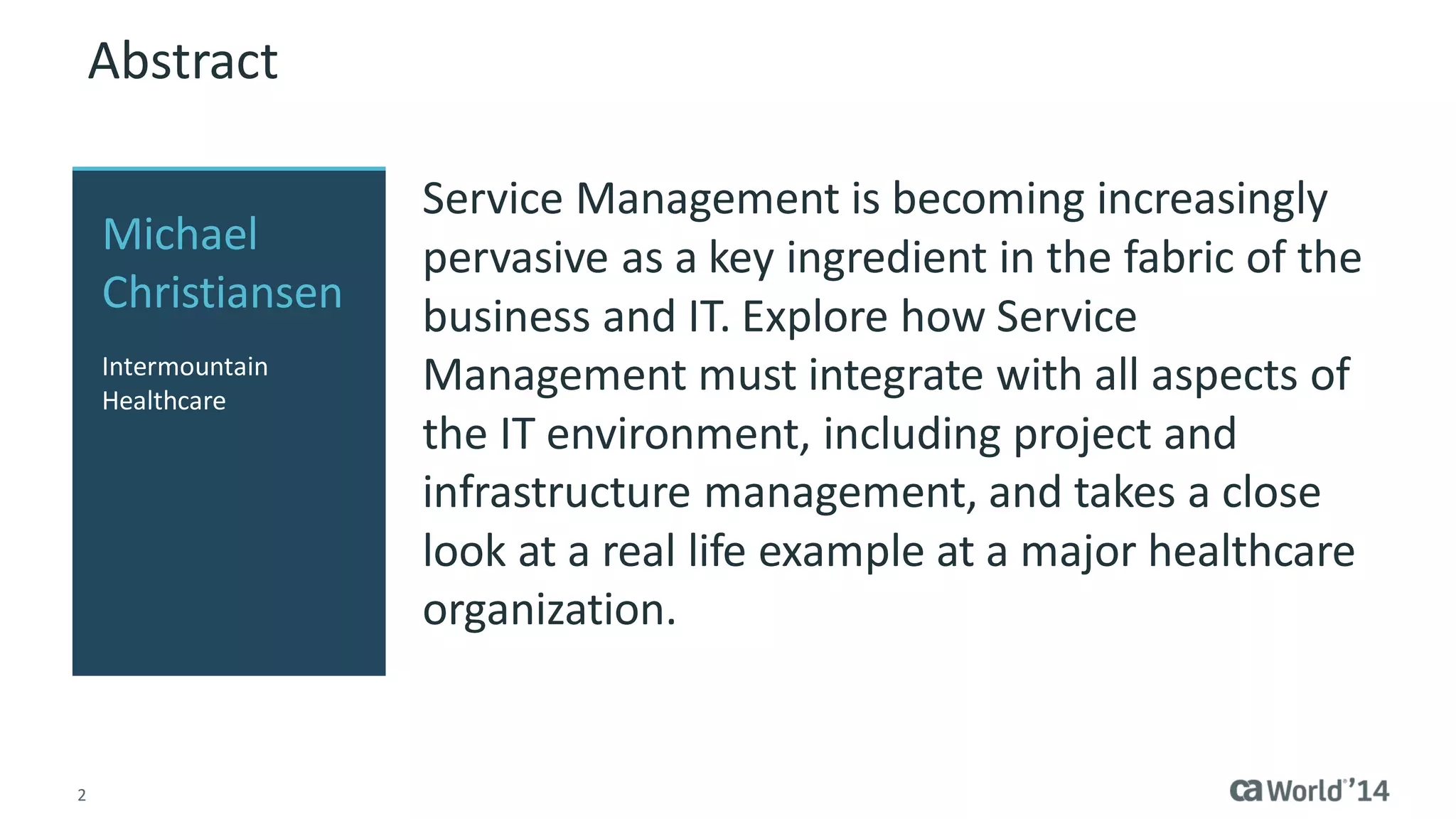
Service Management is becoming increasingly pervasive as a key ingredient in the fabric of the business and IT. This session explores how Service Management must integrate with all aspects of the IT environment, including project and infrastructure management, and takes a close look at a real life example at a major healthcare organization. 
Michael Christiansen 
Intermountain Healthcare
3 
Agenda 
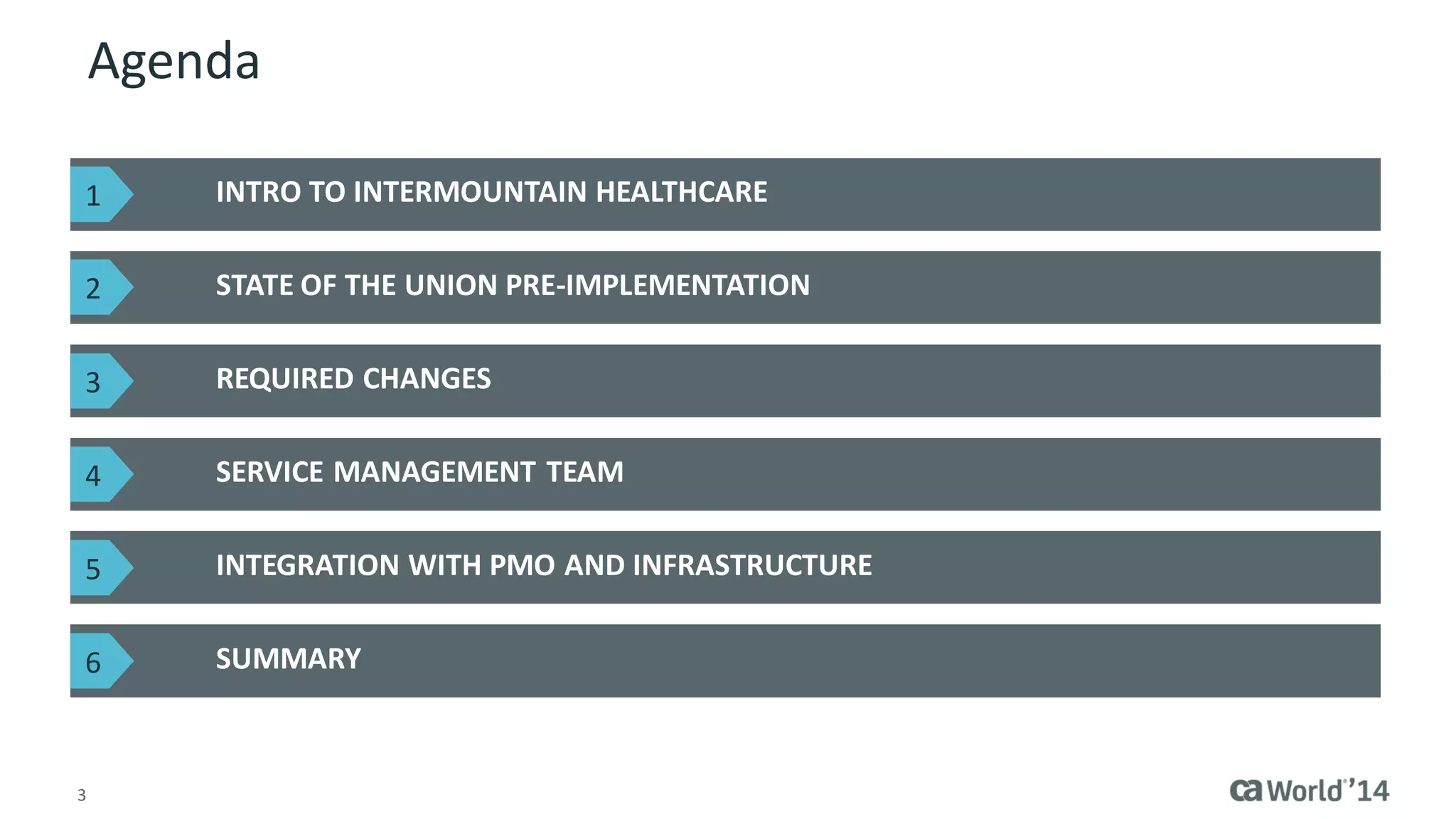
INTRO TO INTERMOUNTAIN HEALTHCARE 
STATE OF THE UNION PRE-IMPLEMENTATION 
SUMMARY 
REQUIRED CHANGES 
SERVICE MANAGEMENT TEAM 
INTEGRATION WITH PMO AND INFRASTRUCTURE 
1 
2 
3 
4 
5 
6
4 
State of the Union 
Pre-Implementation 
Executive Support 
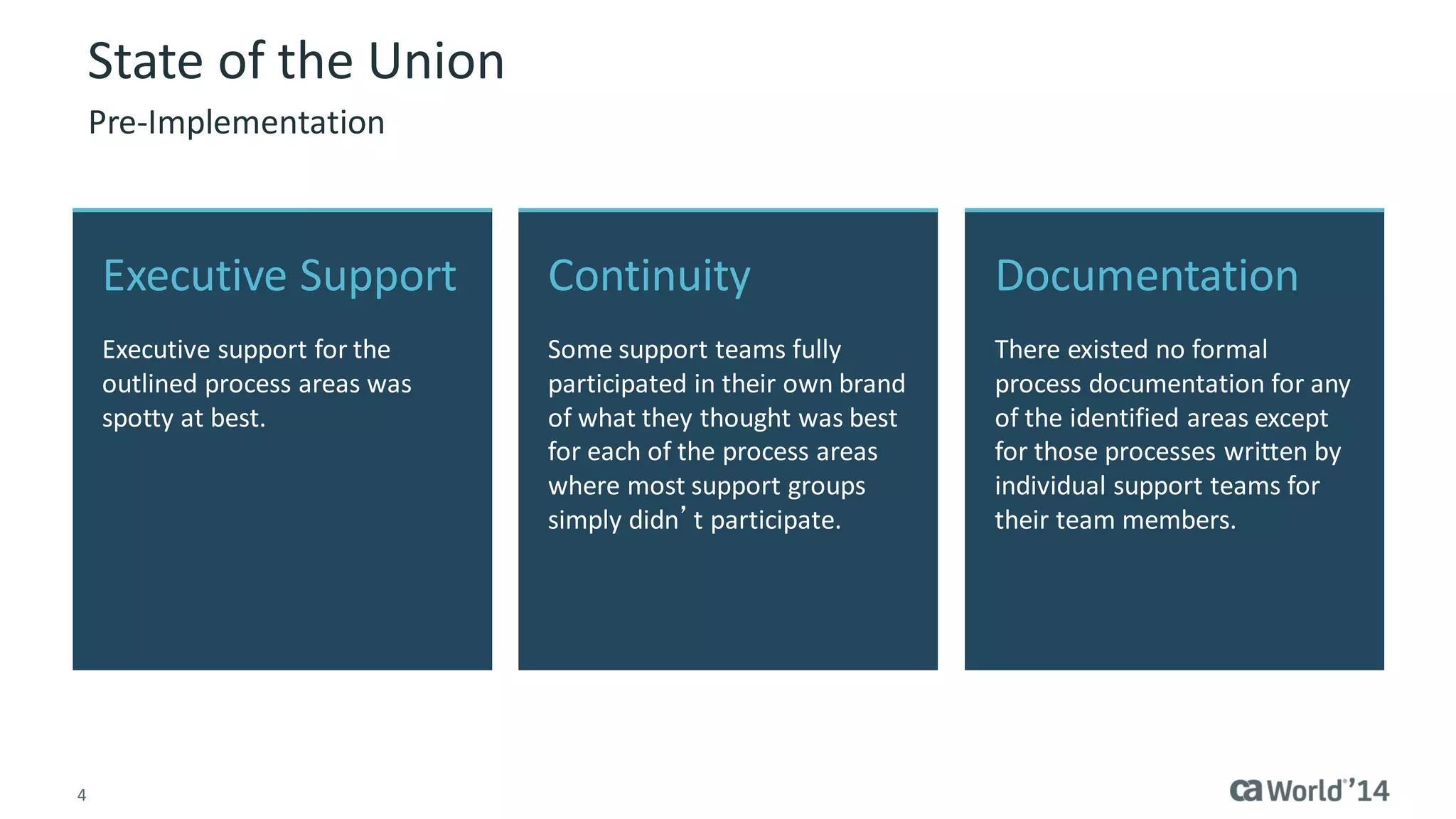
Executive support for the outlined process areas was spotty at best. 
Continuity 
Some support teams fully participated in their own brand of what they thought was best for each of the process areas where most support groups simply didn’t participate. 
Documentation 
There existed no formal process documentation for any of the identified areas except for those processes written by individual support teams for their team members.
5 
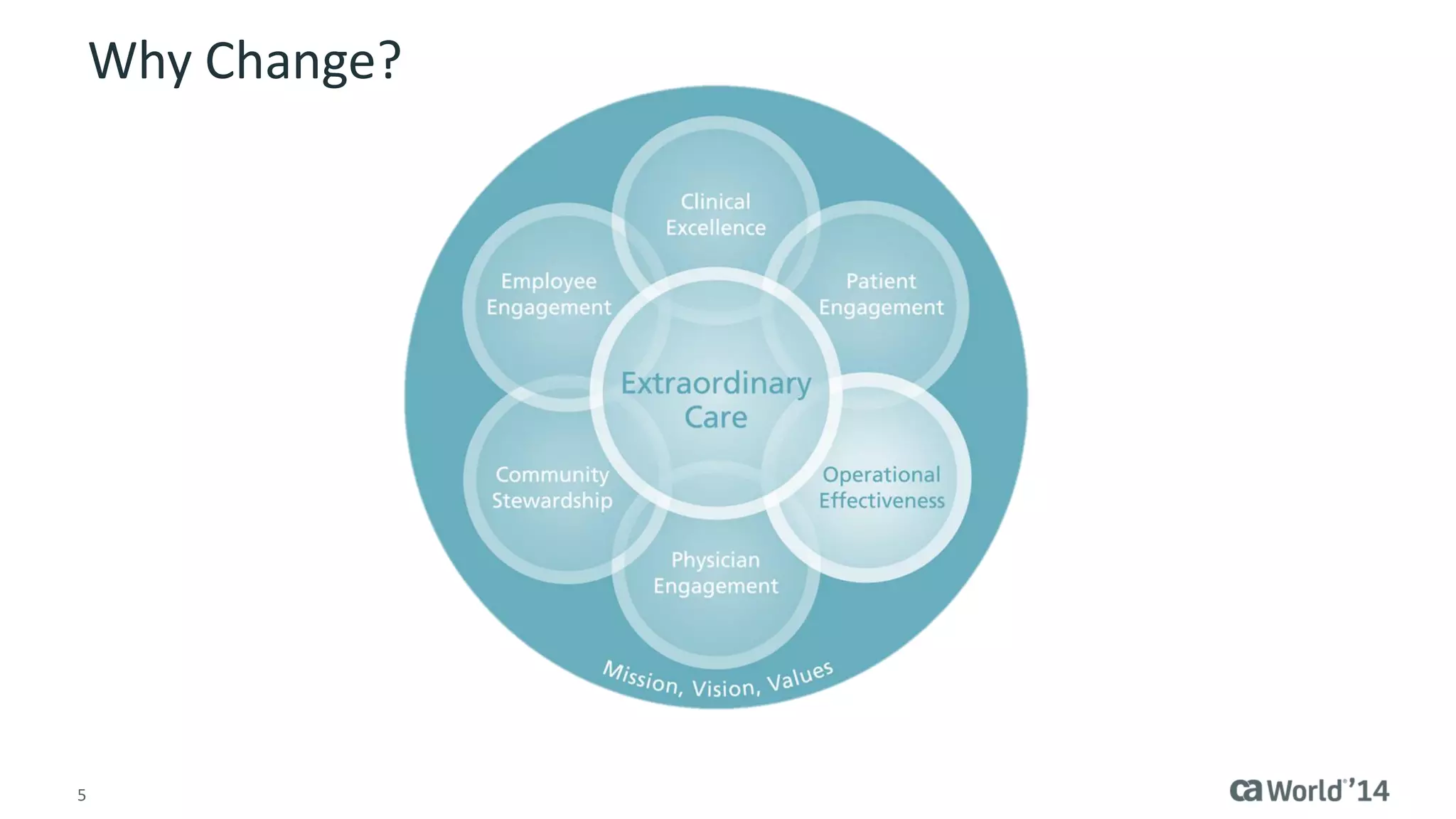
Why Change?
6 
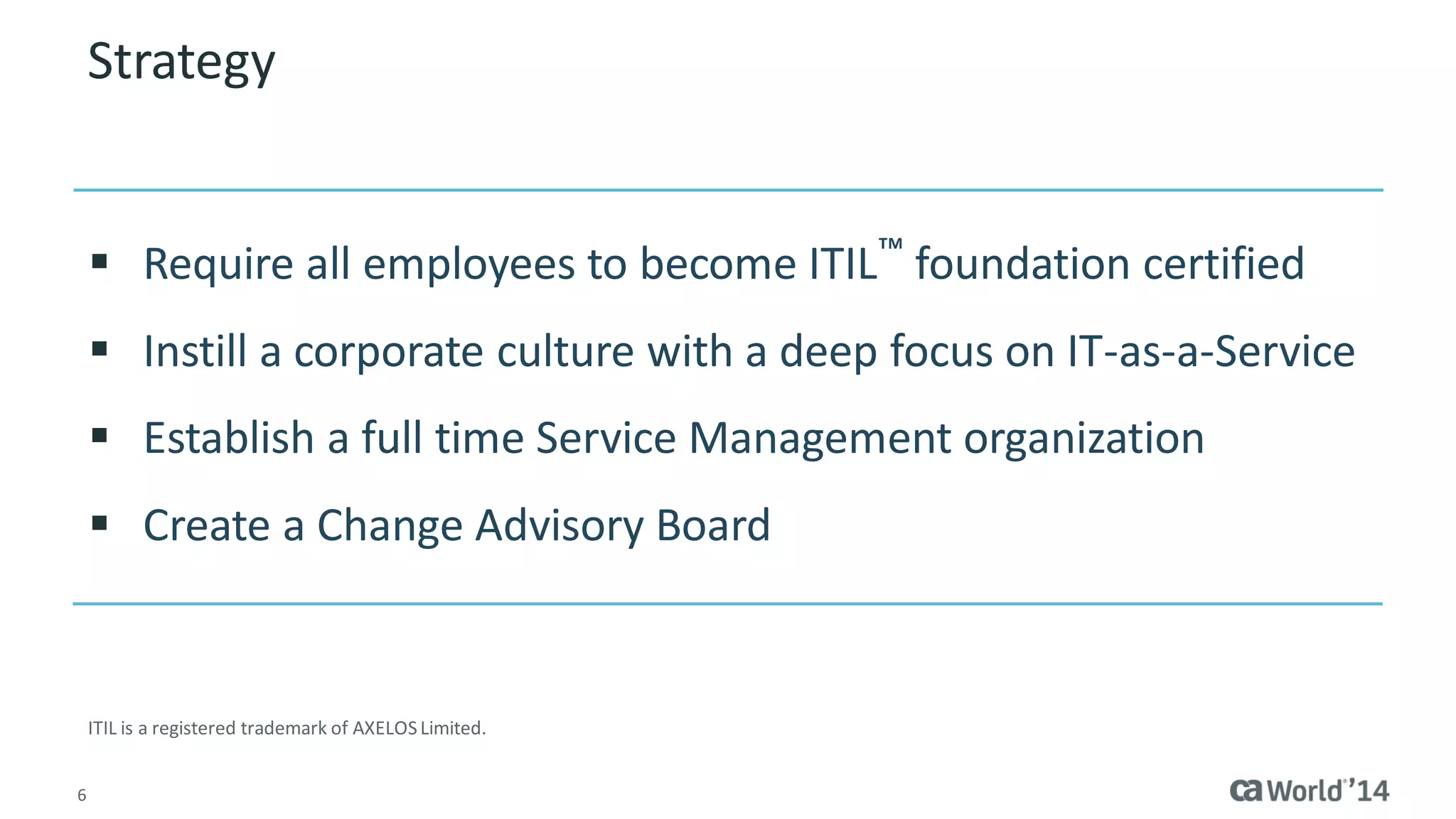
Strategy 
ITIL is a registered trademark of AXELOS Limited. 
Require all employees to become ITIL™ foundation certified 
Instill a corporate culture with a deep focus on IT-as-a-Service 
Establish a full time Service Management organization 
Create a Change Advisory Board
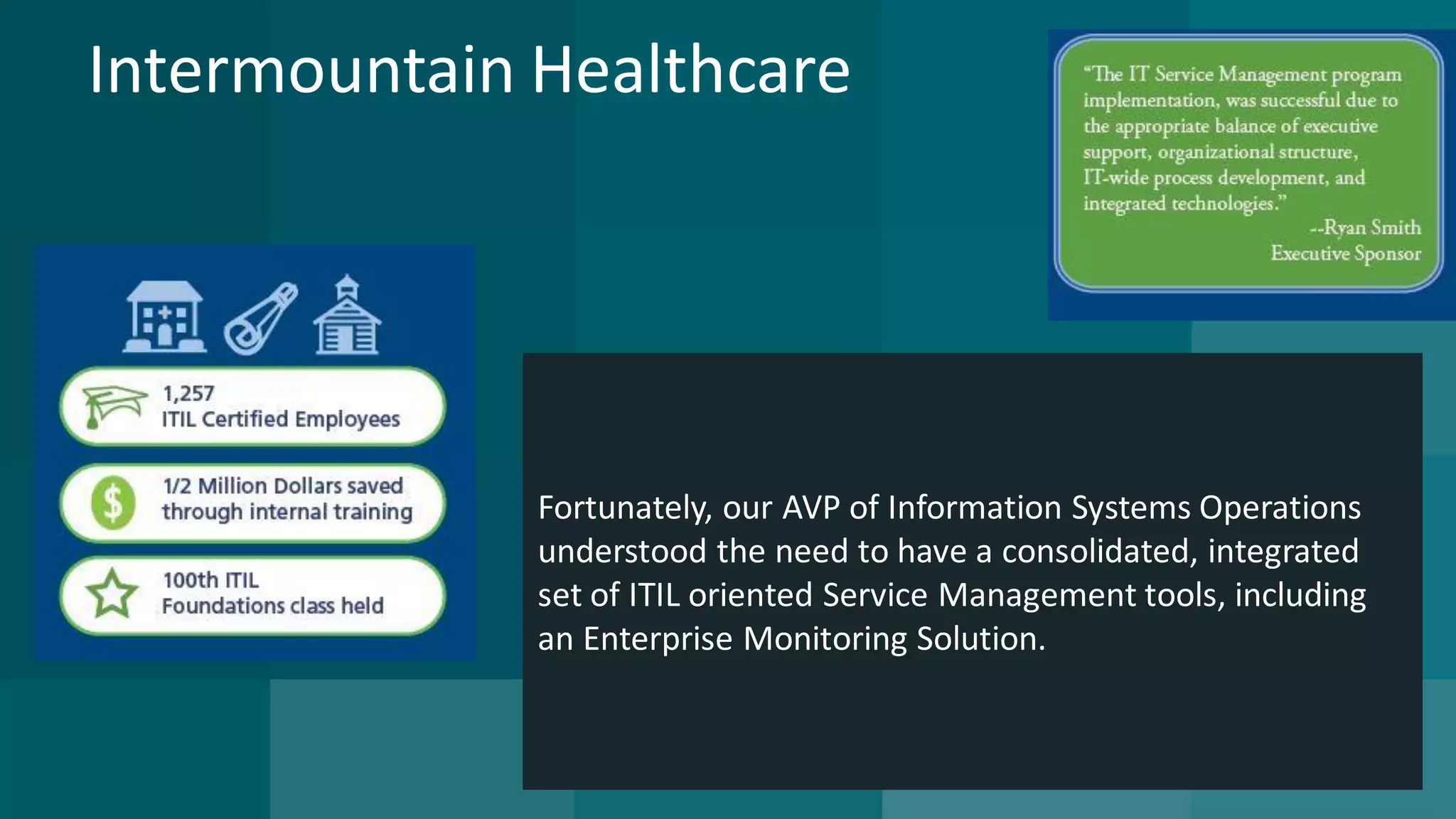
Intermountain Healthcare 
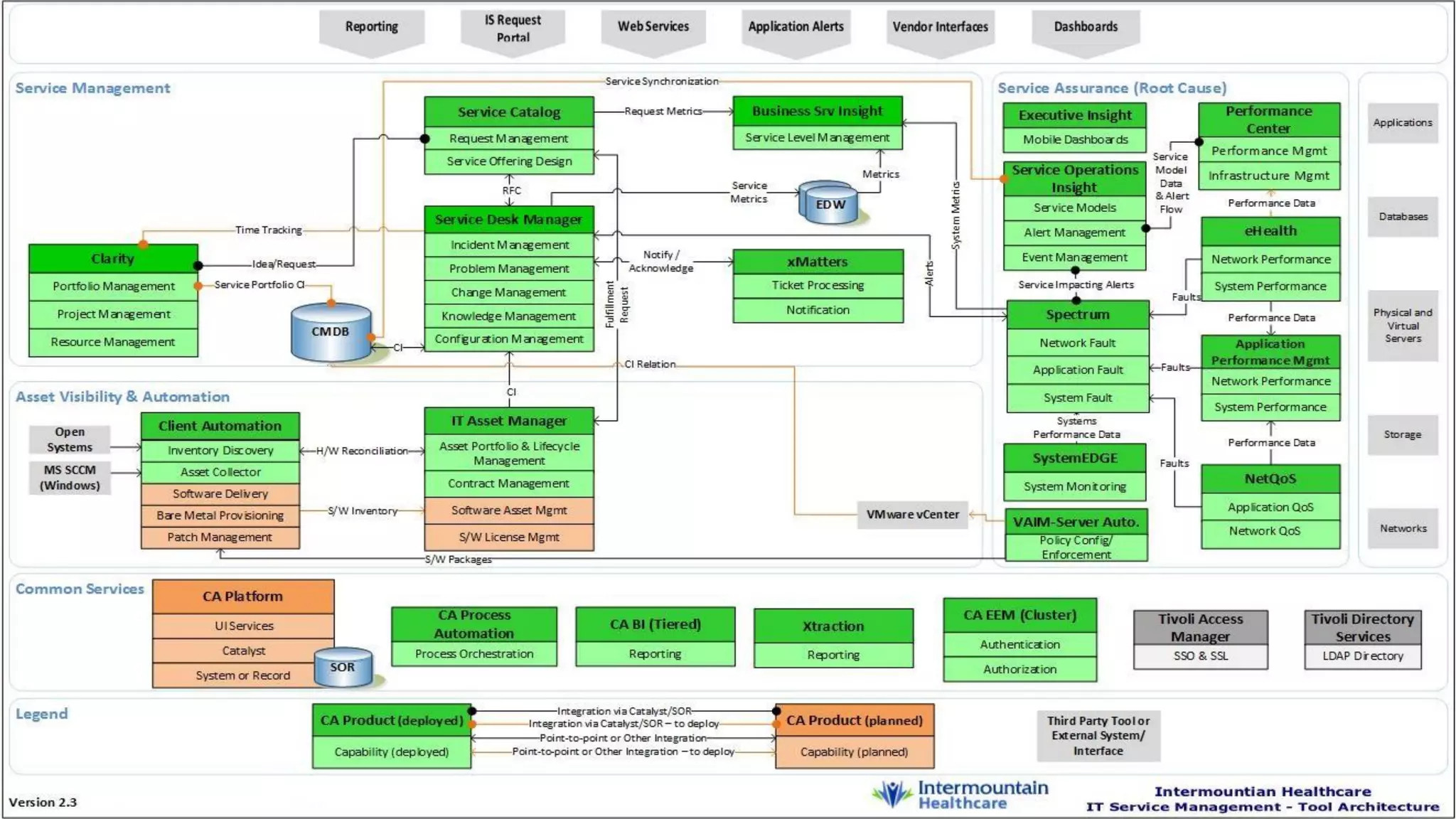
Fortunately, our AVP of Information Systems Operations understood the need to have a consolidated, integrated set of ITIL oriented Service Management tools, including 
an Enterprise Monitoring Solution.
8 
ITIL Education 
Unanimous executive decision to implement ITIL framework 
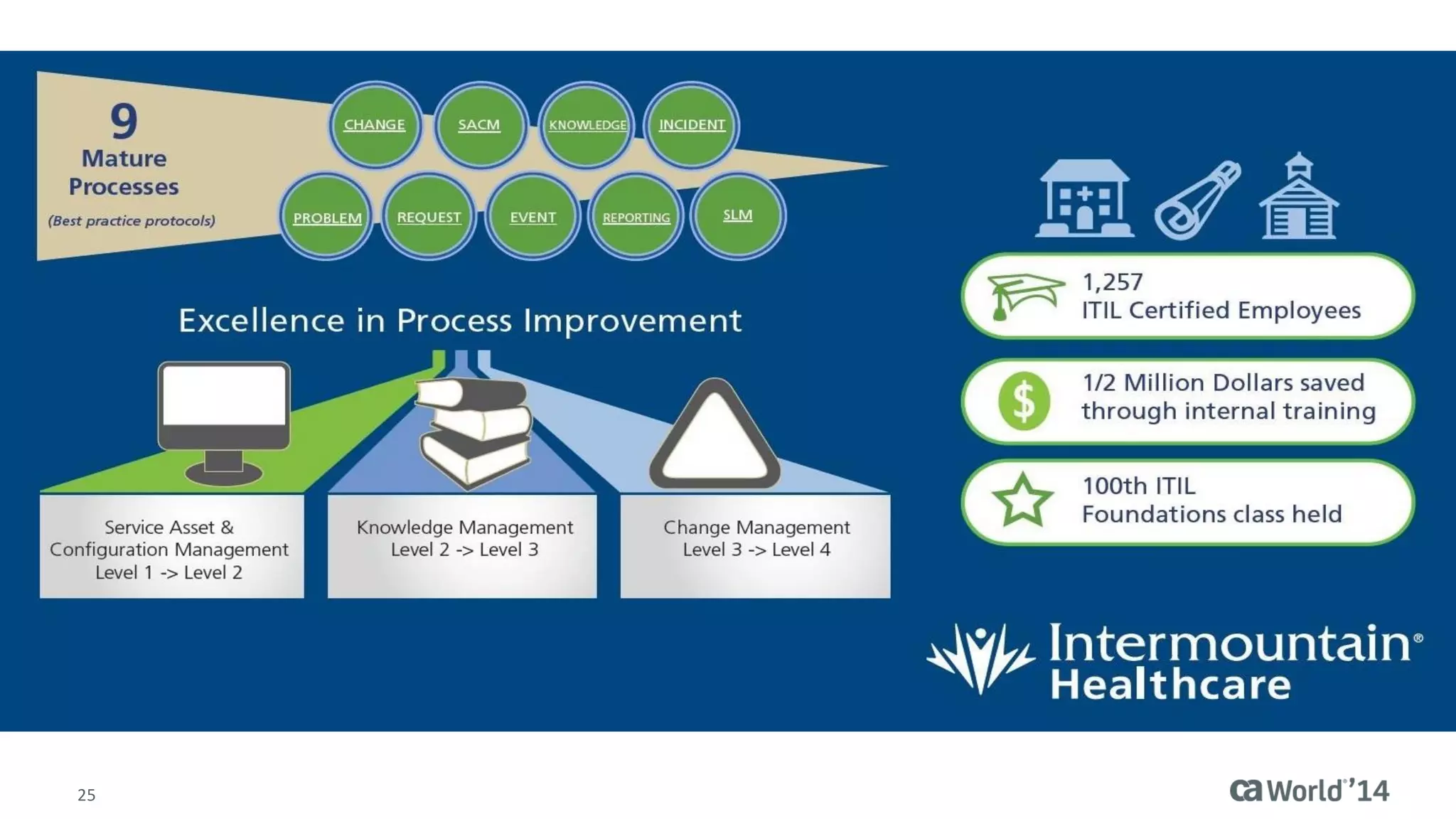
Certify 1,200 people 
Certify 2 trainers in house 
This allowed the combination of the training and vision 
In May, 2014 we had our 100th Foundation Class 
We have trained 90% of our staff - approximately 1200 people 
In Oct, 2013 we expanded the training to include Intermediate classes
9 
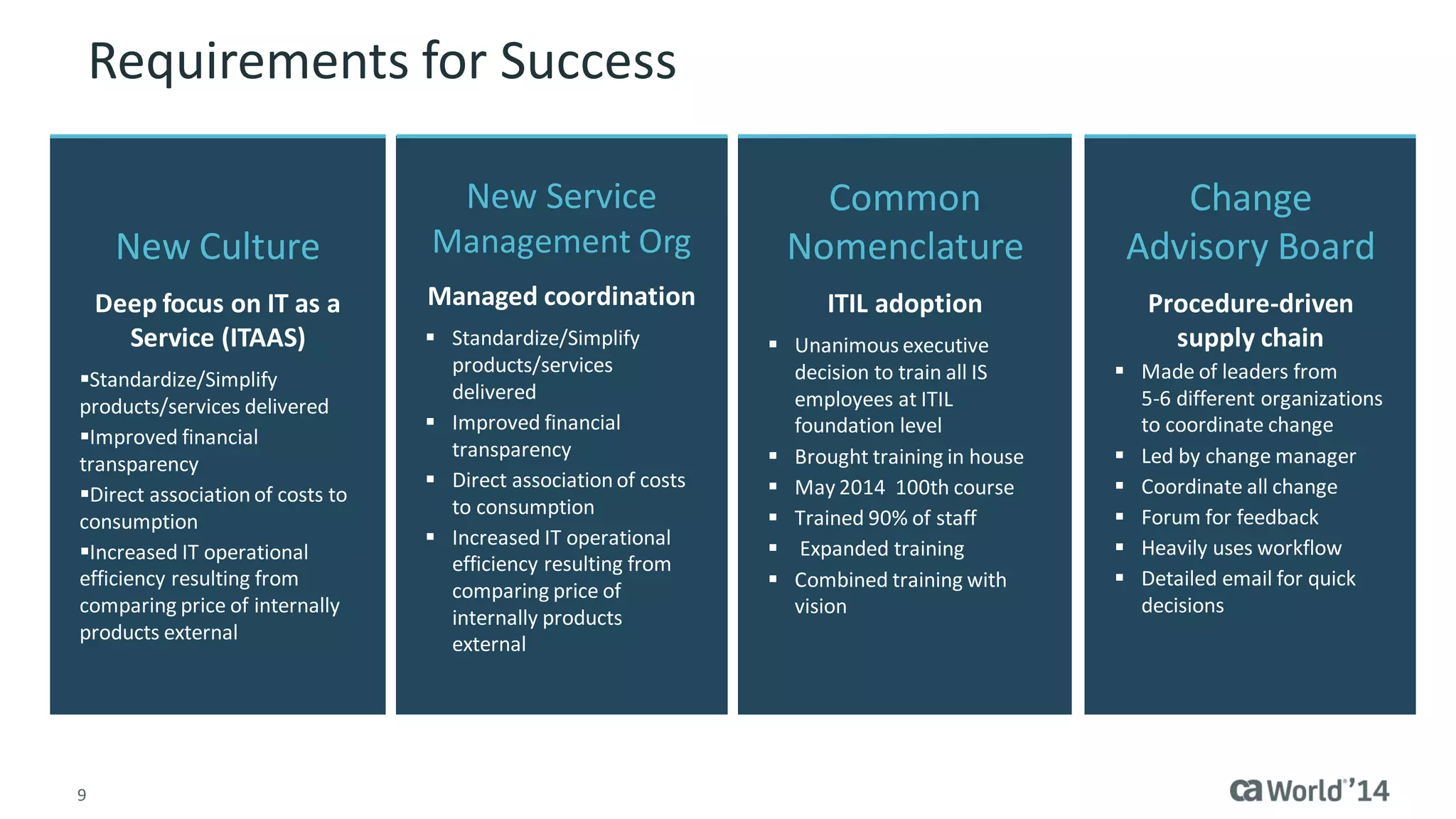
Requirements for Success 
New Service Management Org 
Managed coordination 
Standardize/Simplify products/services delivered 
Improved financial transparency 
Direct association of costs to consumption 
Increased IT operational efficiency resulting from comparing price of internally products external 
Change Advisory Board 
Procedure-driven supply chain 
Made of leaders from 5-6 different organizations to coordinate change 
Led by change manager 
Coordinate all change 
Forum for feedback 
Heavily uses workflow 
Detailed email for quick decisions 
New Culture 
Deep focus on IT as a Service (ITAAS) 
Standardize/Simplify products/services delivered 
Improved financial transparency 
Direct association of costs to consumption 
Increased IT operational efficiency resulting from comparing price of internally products external 
Common Nomenclature 
ITIL adoption 
Unanimous executive decision to train all IS employees at ITIL foundation level 
Brought training in house 
May 2014 100th course 
Trained 90% of staff 
 Expanded training 
Combined training with vision
10 
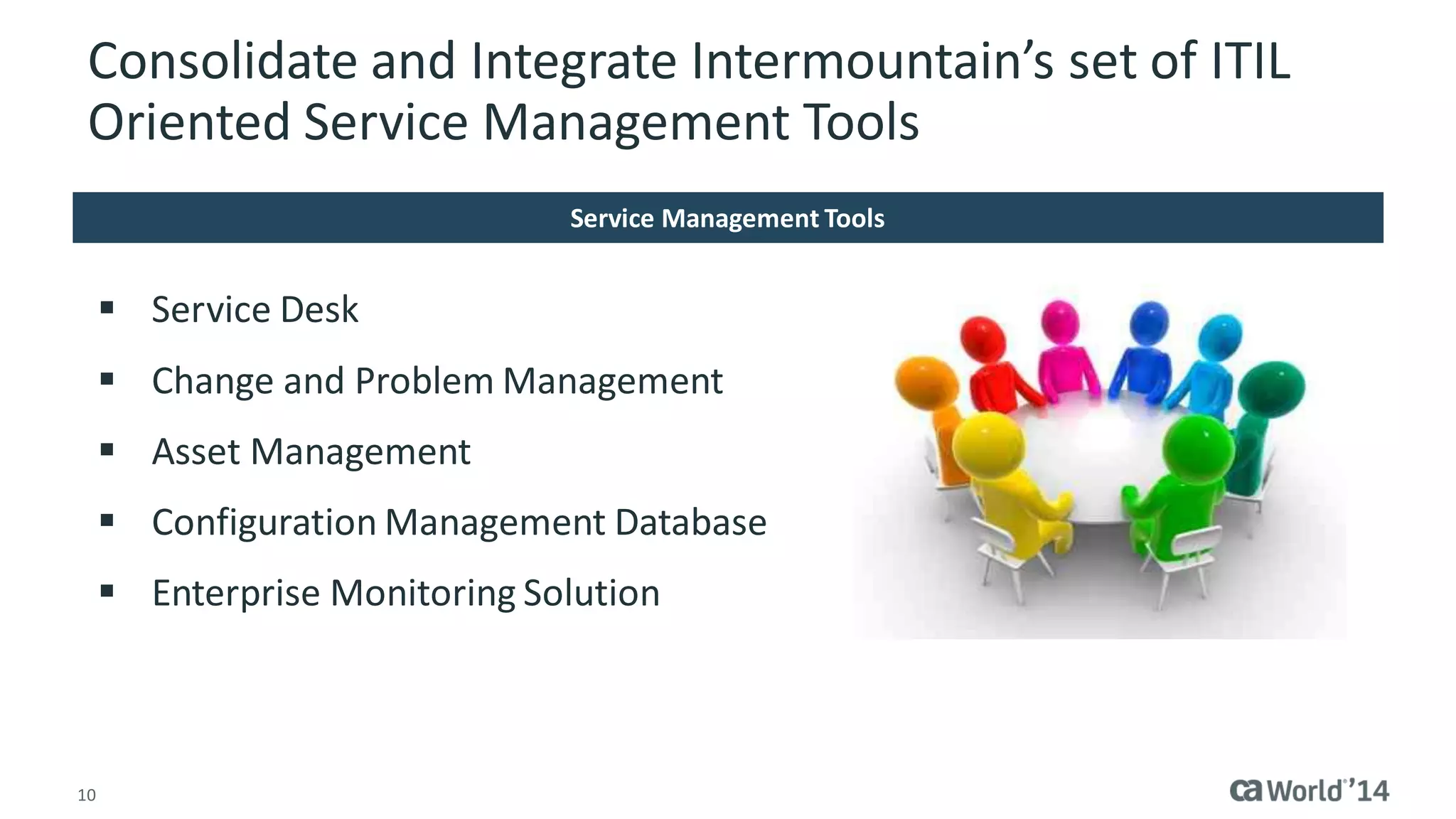
Consolidate and Integrate Intermountain’s set of ITIL Oriented Service Management Tools 
 Service Desk 
 Change and Problem Management 
 Asset Management 
 Configuration Management Database 
 Enterprise Monitoring Solution 
Service Management Tools
11
12 
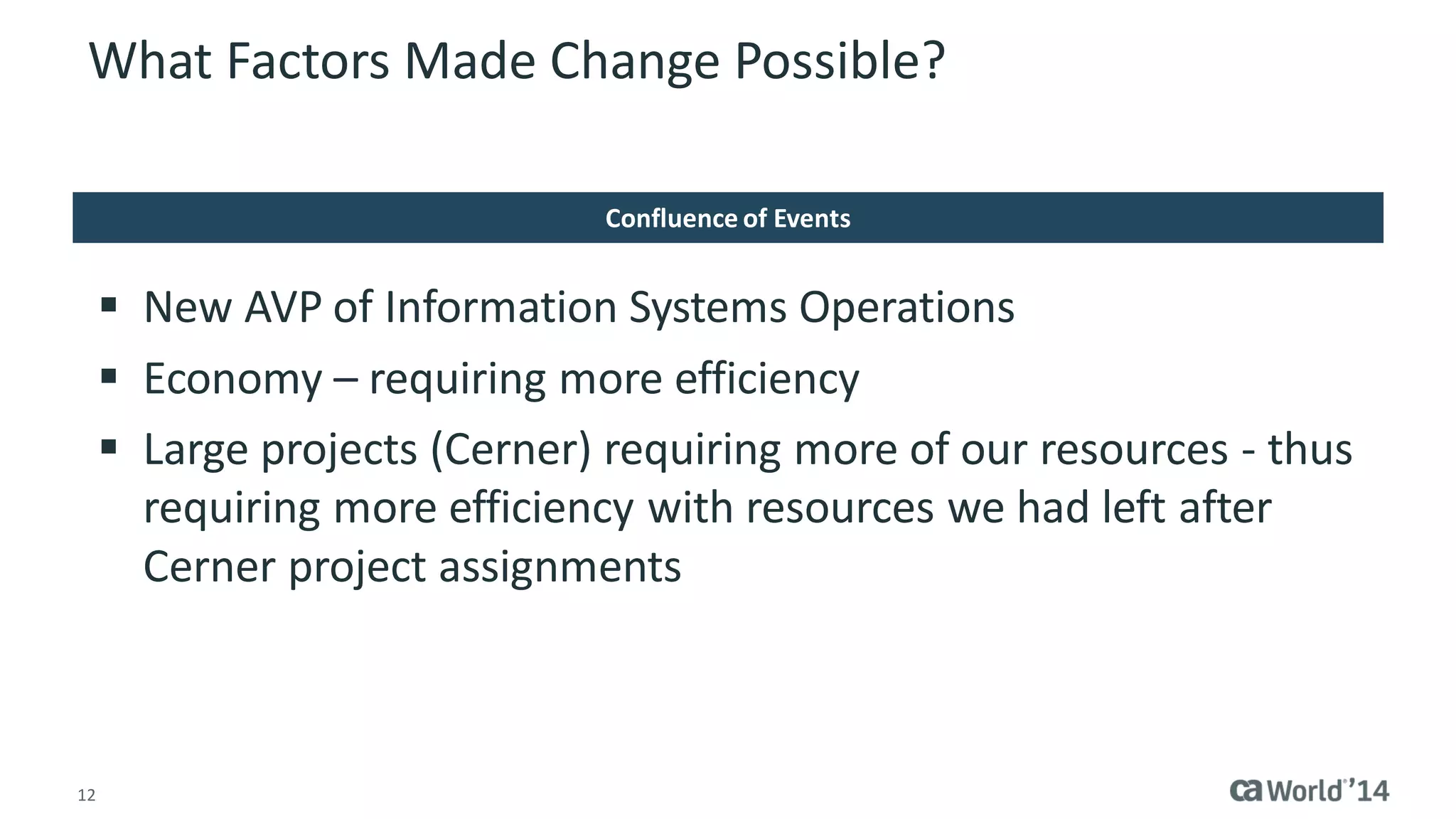
What Factors Made Change Possible? 
New AVP of Information Systems Operations 
Economy – requiring more efficiency 
Large projects (Cerner) requiring more of our resources - thus requiring more efficiency with resources we had left after Cerner project assignments 
Confluence of Events
13 
Knowledge Management 
Initial assessment of the state of knowledge found that there was not a standardized or effective method to record, manage, transfer and share the knowledge. 
Efforts to remedy leveraged ITIL and Knowledge Centered Support (KCSSM) from the Consortium for Service Innovation™
14 
Knowledge Management 
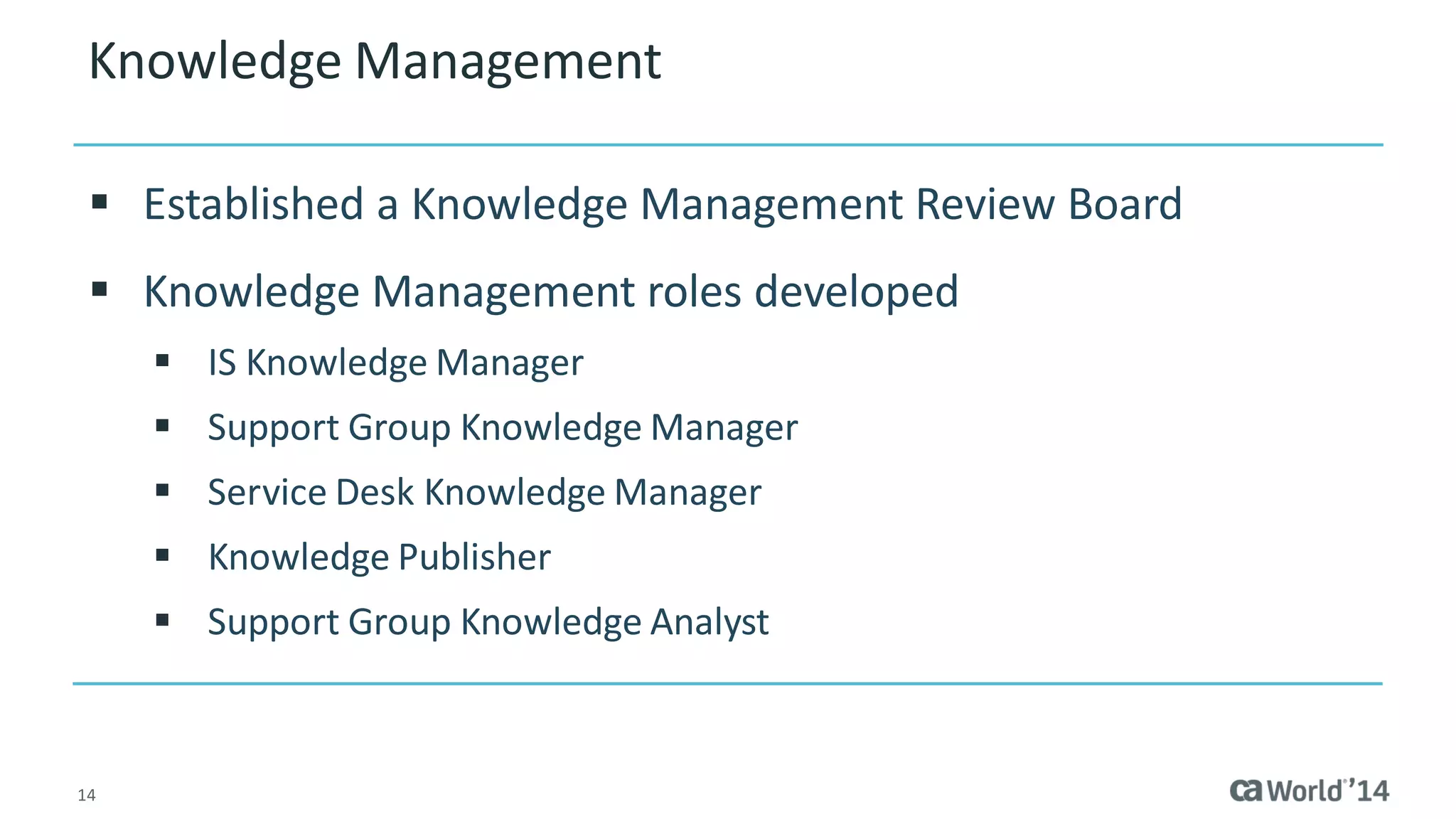
Established a Knowledge Management Review Board 
Knowledge Management roles developed 
IS Knowledge Manager 
Support Group Knowledge Manager 
Service Desk Knowledge Manager 
Knowledge Publisher 
Support Group Knowledge Analyst
15 
Problem Management 
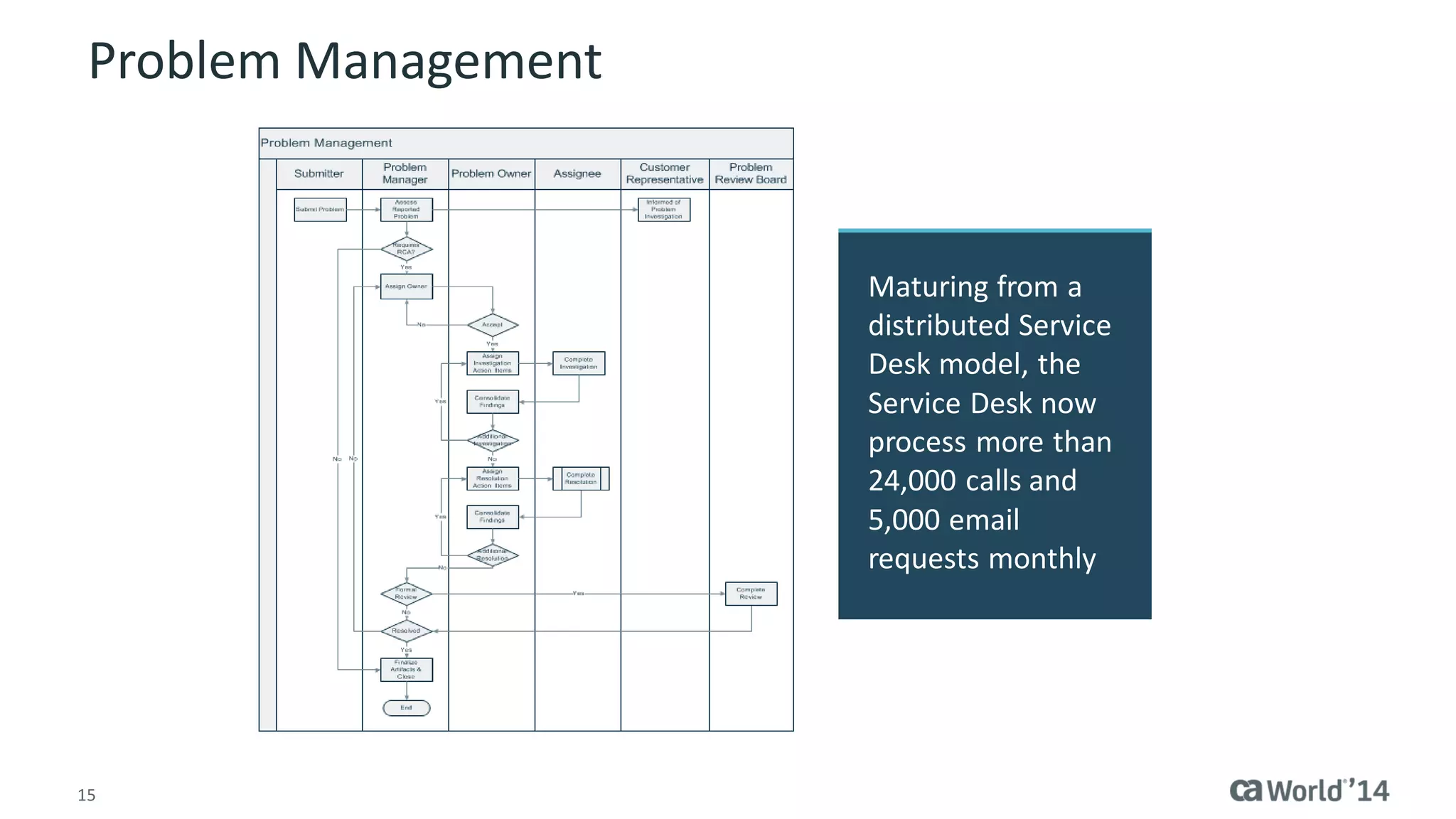
Maturing from a distributed Service Desk model, the Service Desk now process more than 24,000 calls and 5,000 email requests monthly
16 
Problem Management 
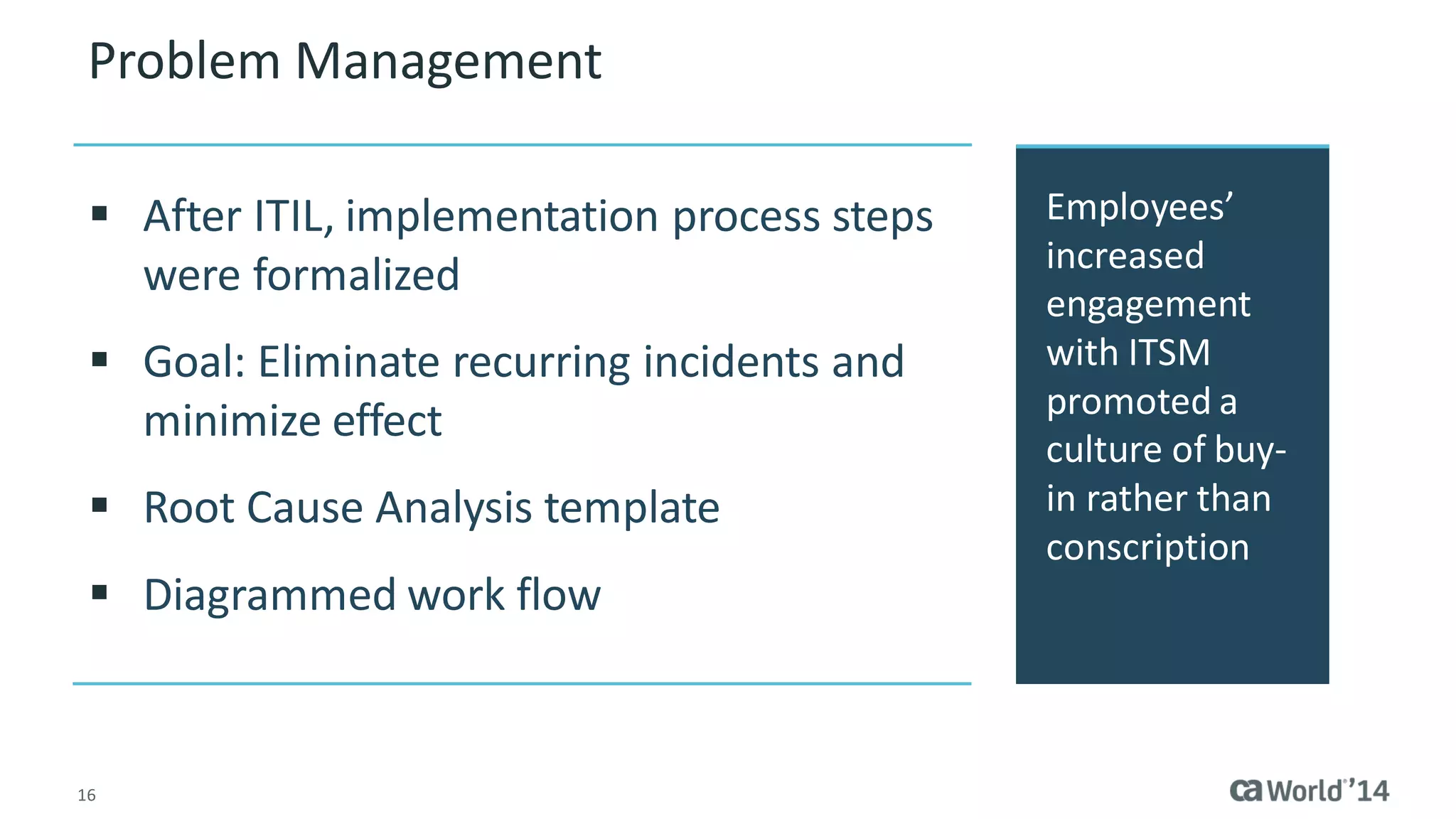
Employees’ increased engagement with ITSM promoted a culture of buy- in rather than conscription 
After ITIL, implementation process steps were formalized 
Goal: Eliminate recurring incidents and minimize effect 
Root Cause Analysis template 
Diagrammed work flow
17 
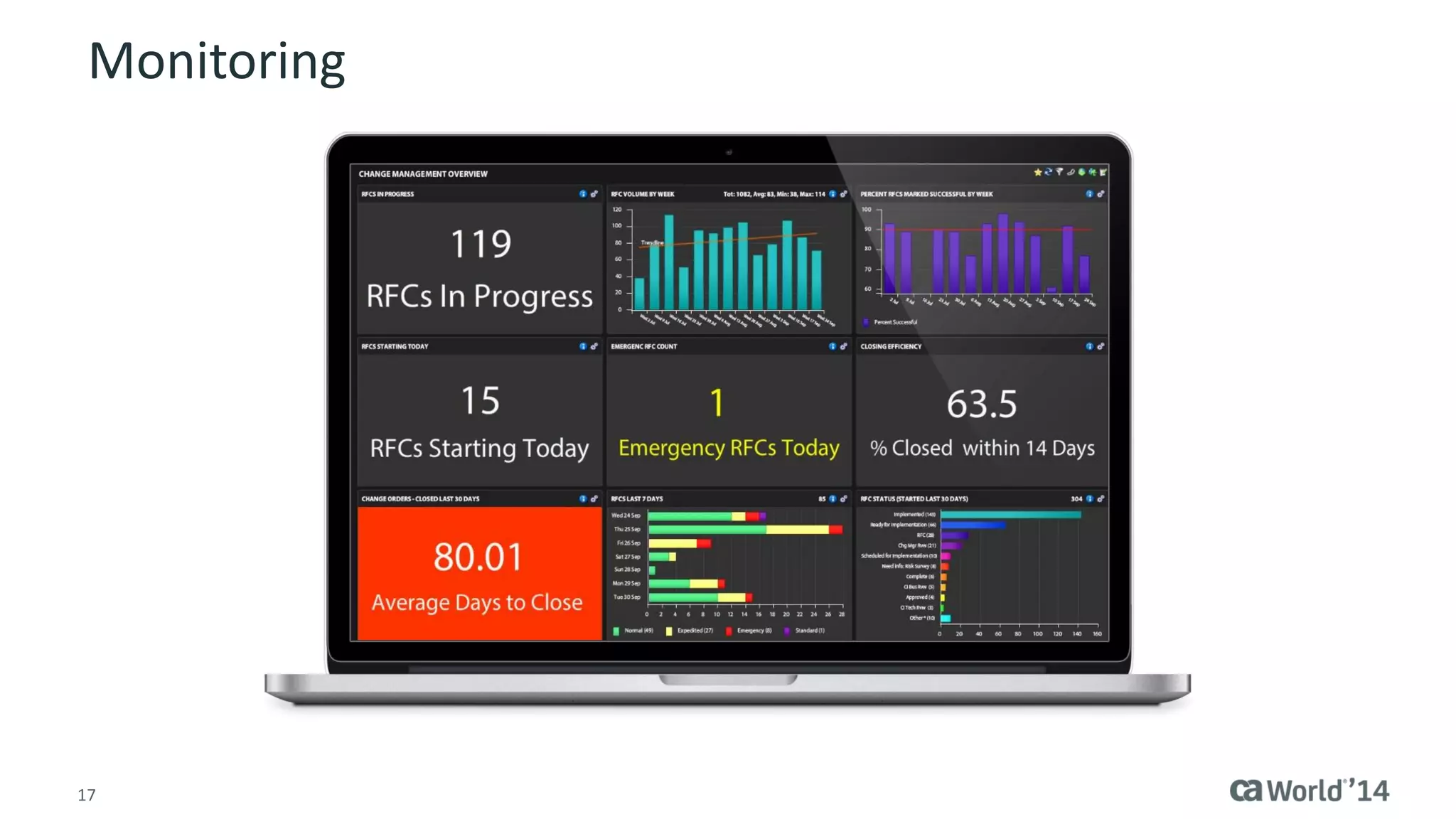
Monitoring
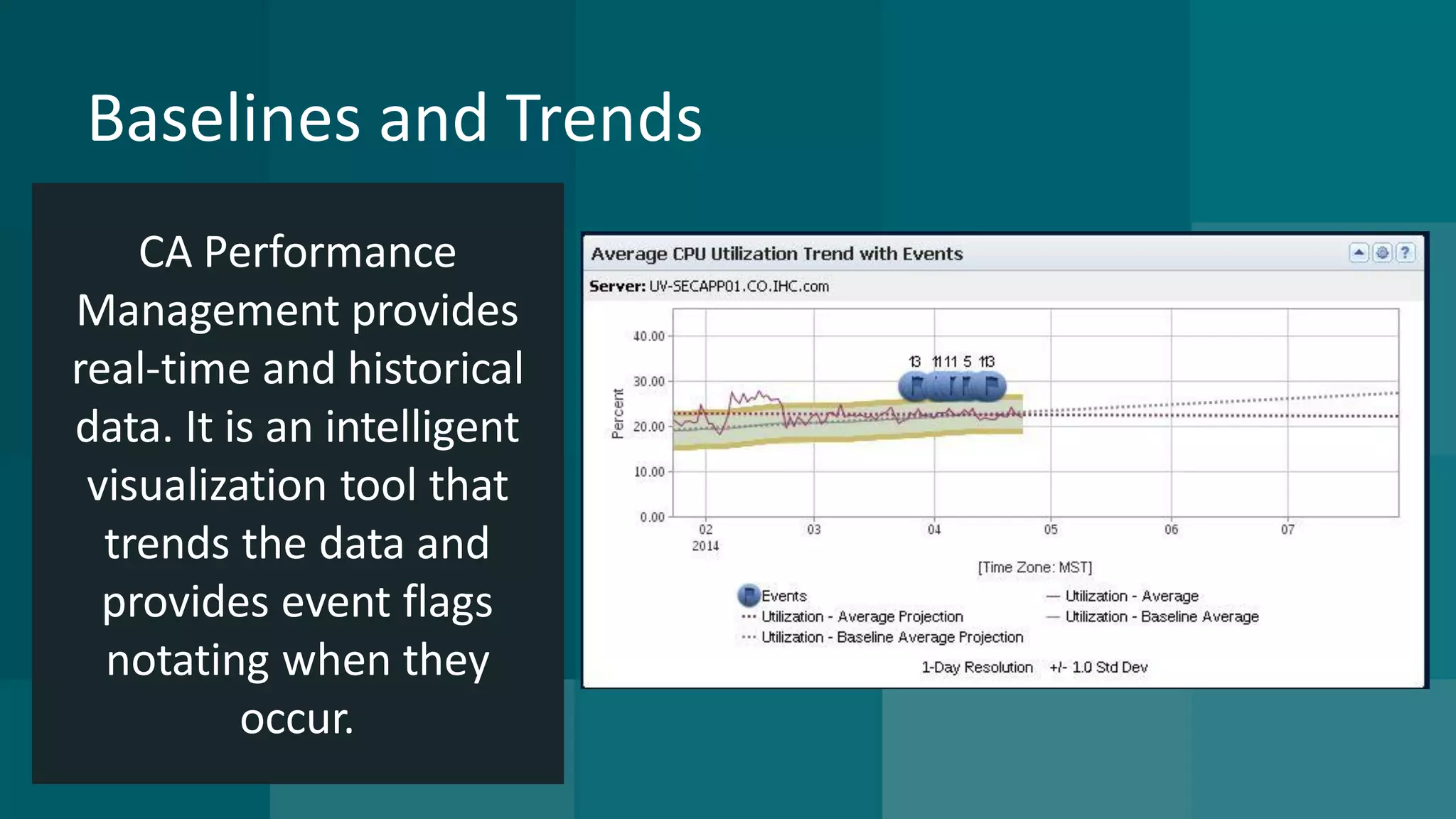
Baselines & Trends 
CA Performance Management provides real-time and historical data. It is an intelligent visualization tool that trends the data and provides event flags notating when they occur.
19 
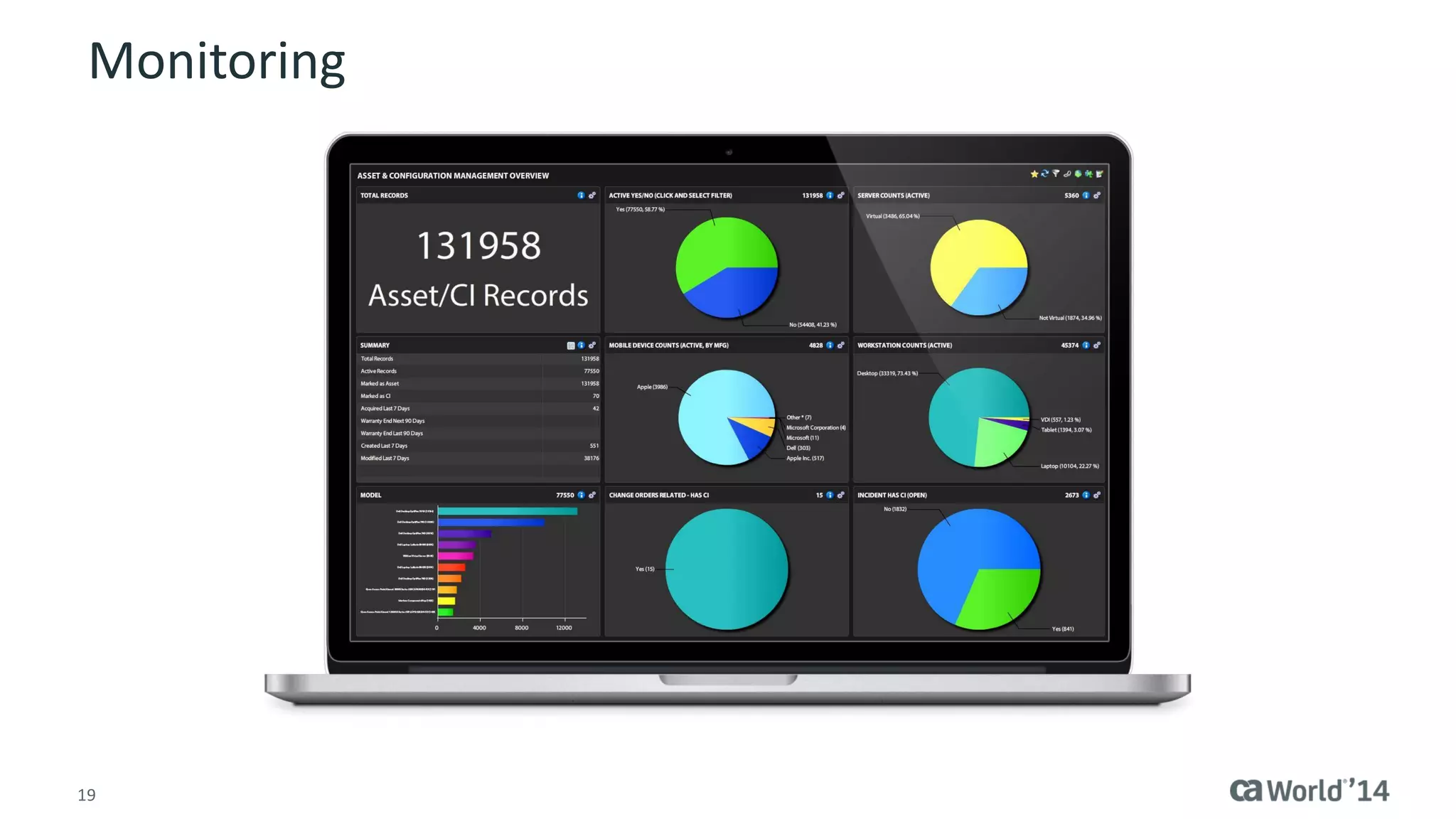
Monitoring
20 
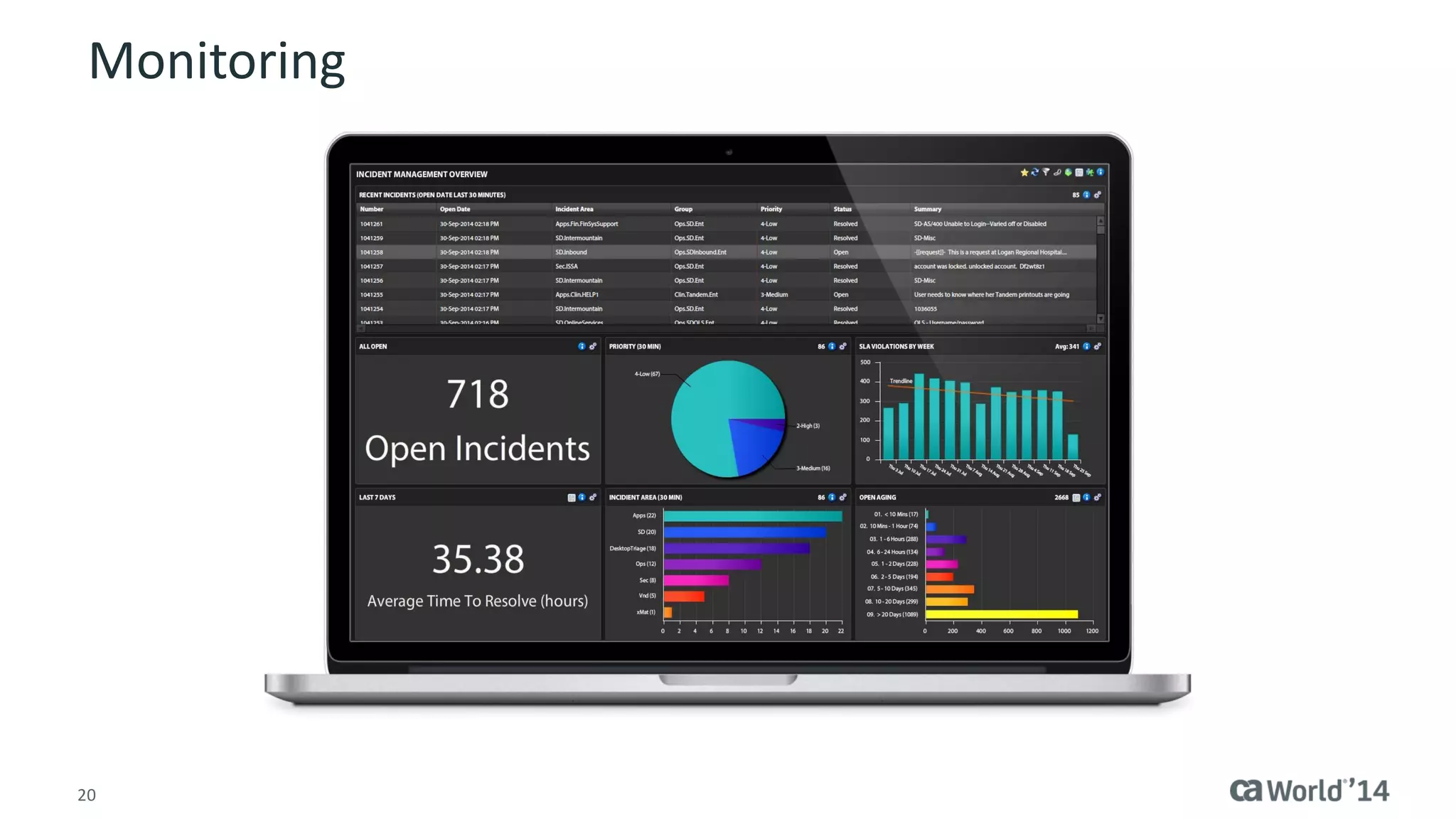
Monitoring
21 
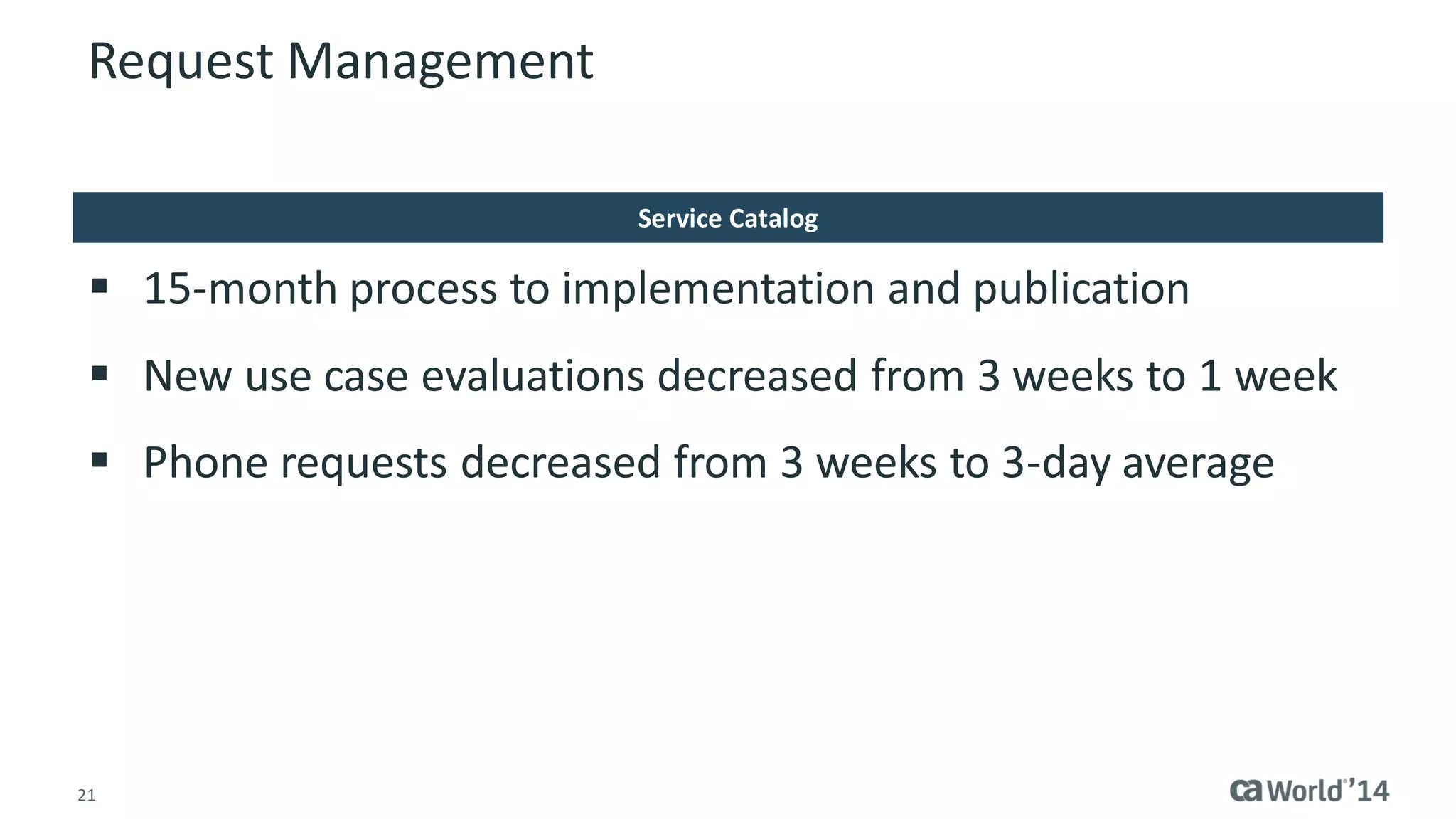
Request Management 
15-month process to implementation and publication 
New use case evaluations decreased from 3 weeks to 1 week 
Phone requests decreased from 3 weeks to 3-day average 
Service Catalog
22 
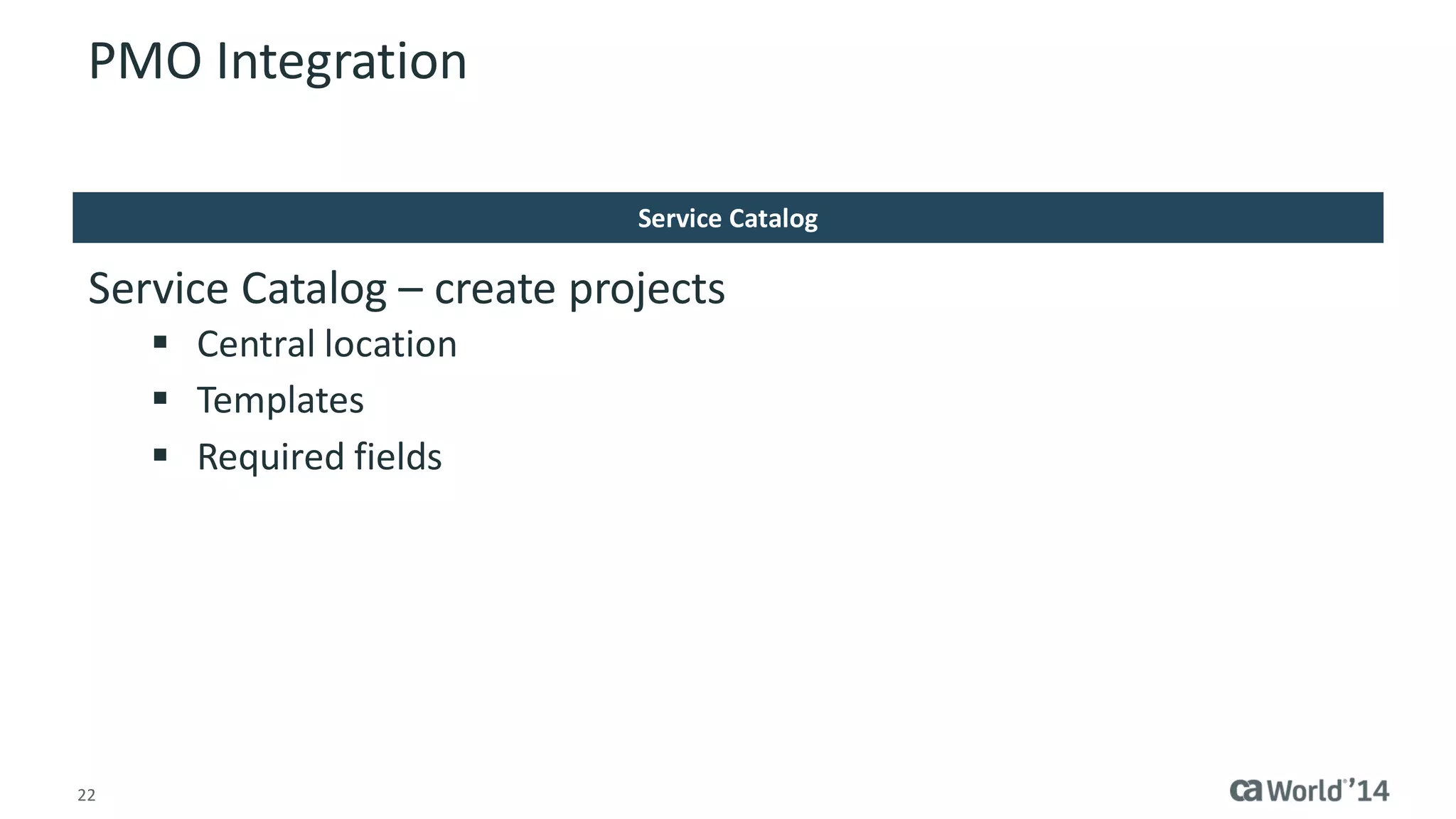
PMO Integration 
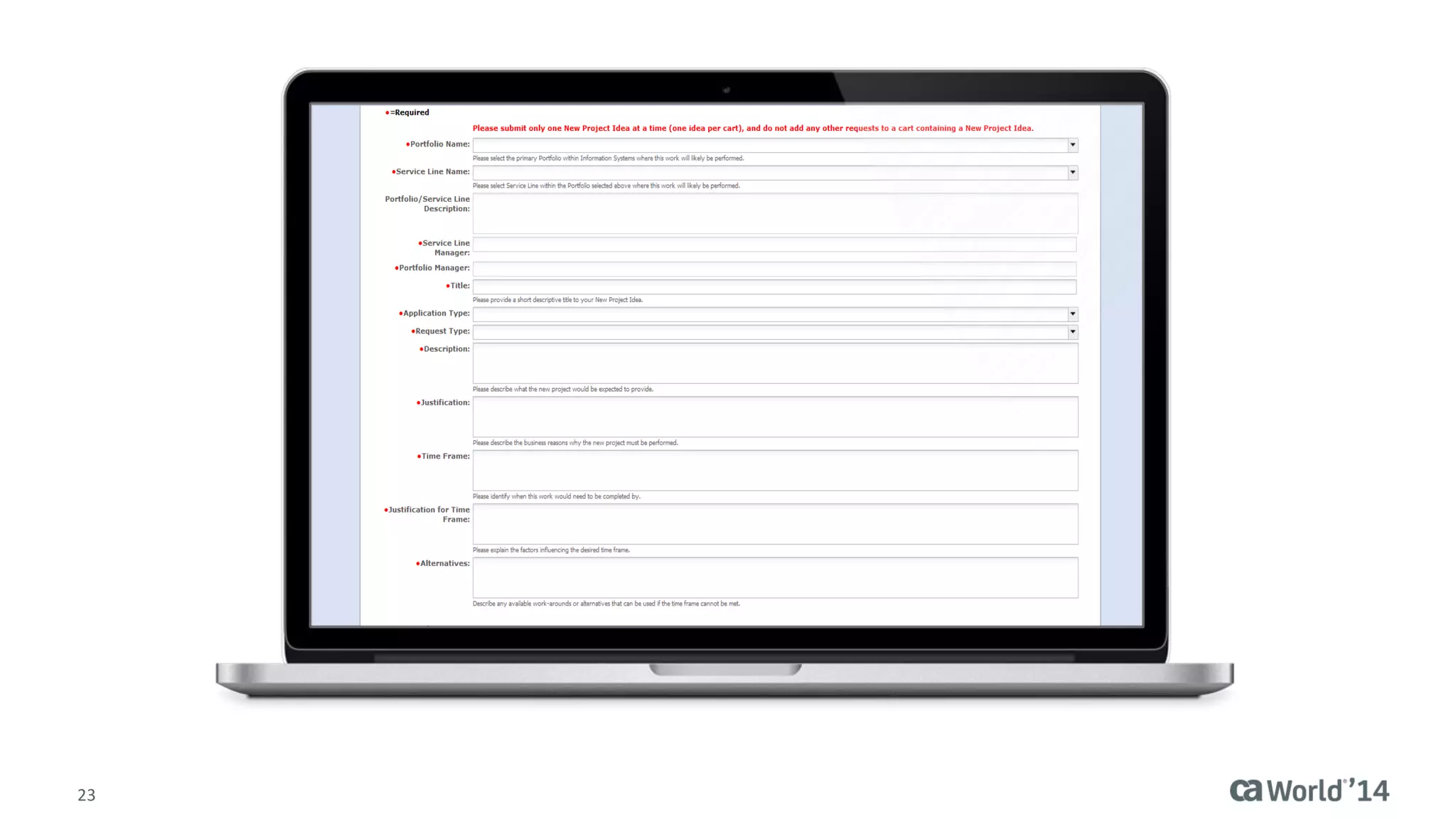
Service Catalog – create projects 
Central location 
Templates 
Required fields 
Service Catalog
23
24 
Reporting 
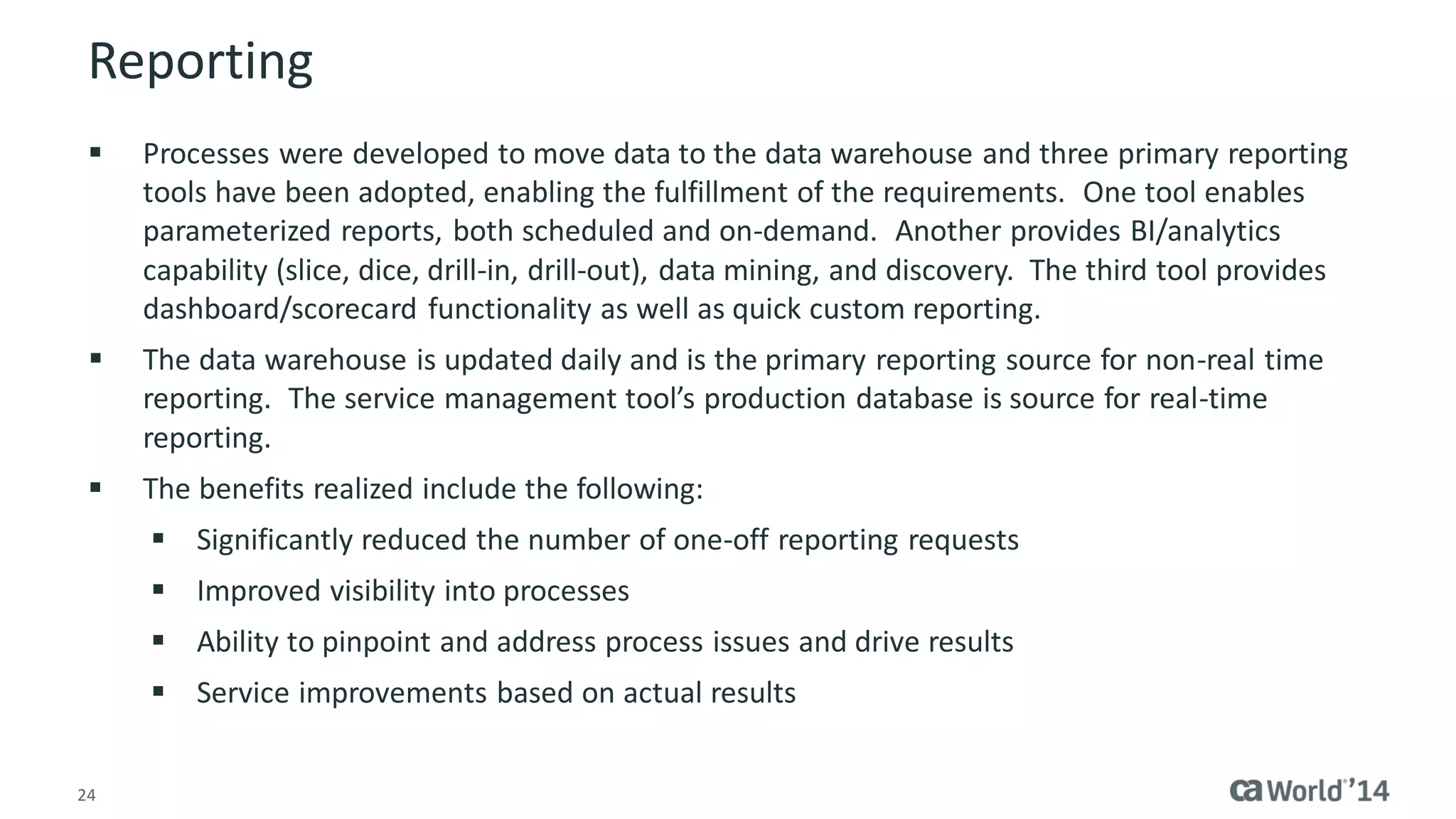
Processes were developed to move data to the data warehouse and three primary reporting tools have been adopted, enabling the fulfillment of the requirements. One tool enables parameterized reports, both scheduled and on-demand. Another provides BI/analytics capability (slice, dice, drill-in, drill-out), data mining, and discovery. The third tool provides dashboard/scorecard functionality as well as quick custom reporting. 
The data warehouse is updated daily and is the primary reporting source for non-real time reporting. The service management tool’s production database is source for real-time reporting. 
The benefits realized include the following: 
Significantly reduced the number of one-off reporting requests 
Improved visibility into processes 
Ability to pinpoint and address process issues and drive results 
Service improvements based on actual results
25
26 
Summary 
There have been many positive effects as a result of the organizational shift towards following these established processes. Some of the benefits experienced are: 
Changes are now more thoroughly communicated and more effectively executed 
Change collisions are now identified and avoided 
Status of requests can be tracked from initial request to closure resulting in fewer items falling between the cracks 
Problem review meetings are held where root cause analysis is performed resulting in fewer repeat Incidents for the same root cause 
Known errors are identified and workarounds documented for quicker resolution of Incidents 
Knowledge has been centralized allowing the support desk to improve first call resolution 
Incidents and changes have CIs attached to help in identifying trends and improving communication for scheduled changes
27 
For More Information 
To learn more about Management Cloud, please visit: http://bit.ly/1wEnPhz 
Insert appropriate screenshot and text overlay from following “More Info Graphics” slide here; ensure it links to correct page 
Management Cloud
28 
© 2014 CA. ALL RIGHTS RESERVED. 
For Informational Purposes Only 
For CA copyrighted content: 
© 2014 CA. All rights reserved. All trademarks referenced herein belong to their respective companies. 
This presentation provided at CA World 2014 is intended for information purposes only and does not form any type of warranty. Some of the specific slides with customer references relate to customer's specific use and experience of CA products and solutions so actual results may vary. 
For Customer/Partner content please note: 
Customer/Partner content provided in this presentation has not been reviewed for accuracy and is based on information provided by CA Partners and Customers. 
Terms of this Presentation

Integrated IT Service Management: From Strategy to Implementing to User Adoption

  • 1.
    Integrated IT ServiceManagement: From Strategy to Implementing to User Adoption Michael Christiansen ICT15S #CAWorld Intermountain Healthcare Sr. Application Systems Technical Analyst ca Intellicenter
  • 2.
    2 Abstract ServiceManagement is becoming increasingly pervasive as a key ingredient in the fabric of the business and IT. This session explores how Service Management must integrate with all aspects of the IT environment, including project and infrastructure management, and takes a close look at a real life example at a major healthcare organization. Michael Christiansen Intermountain Healthcare
  • 3.
    3 Agenda INTROTO INTERMOUNTAIN HEALTHCARE STATE OF THE UNION PRE-IMPLEMENTATION SUMMARY REQUIRED CHANGES SERVICE MANAGEMENT TEAM INTEGRATION WITH PMO AND INFRASTRUCTURE 1 2 3 4 5 6
  • 4.
    4 State ofthe Union Pre-Implementation Executive Support Executive support for the outlined process areas was spotty at best. Continuity Some support teams fully participated in their own brand of what they thought was best for each of the process areas where most support groups simply didn’t participate. Documentation There existed no formal process documentation for any of the identified areas except for those processes written by individual support teams for their team members.
  • 5.
  • 6.
    6 Strategy ITILis a registered trademark of AXELOS Limited. Require all employees to become ITIL™ foundation certified Instill a corporate culture with a deep focus on IT-as-a-Service Establish a full time Service Management organization Create a Change Advisory Board
  • 7.
    Intermountain Healthcare Fortunately,our AVP of Information Systems Operations understood the need to have a consolidated, integrated set of ITIL oriented Service Management tools, including an Enterprise Monitoring Solution.
  • 8.
    8 ITIL Education Unanimous executive decision to implement ITIL framework Certify 1,200 people Certify 2 trainers in house This allowed the combination of the training and vision In May, 2014 we had our 100th Foundation Class We have trained 90% of our staff - approximately 1200 people In Oct, 2013 we expanded the training to include Intermediate classes
  • 9.
    9 Requirements forSuccess New Service Management Org Managed coordination Standardize/Simplify products/services delivered Improved financial transparency Direct association of costs to consumption Increased IT operational efficiency resulting from comparing price of internally products external Change Advisory Board Procedure-driven supply chain Made of leaders from 5-6 different organizations to coordinate change Led by change manager Coordinate all change Forum for feedback Heavily uses workflow Detailed email for quick decisions New Culture Deep focus on IT as a Service (ITAAS) Standardize/Simplify products/services delivered Improved financial transparency Direct association of costs to consumption Increased IT operational efficiency resulting from comparing price of internally products external Common Nomenclature ITIL adoption Unanimous executive decision to train all IS employees at ITIL foundation level Brought training in house May 2014 100th course Trained 90% of staff  Expanded training Combined training with vision
  • 10.
    10 Consolidate andIntegrate Intermountain’s set of ITIL Oriented Service Management Tools  Service Desk  Change and Problem Management  Asset Management  Configuration Management Database  Enterprise Monitoring Solution Service Management Tools
  • 11.
  • 12.
    12 What FactorsMade Change Possible? New AVP of Information Systems Operations Economy – requiring more efficiency Large projects (Cerner) requiring more of our resources - thus requiring more efficiency with resources we had left after Cerner project assignments Confluence of Events
  • 13.
    13 Knowledge Management Initial assessment of the state of knowledge found that there was not a standardized or effective method to record, manage, transfer and share the knowledge. Efforts to remedy leveraged ITIL and Knowledge Centered Support (KCSSM) from the Consortium for Service Innovation™
  • 14.
    14 Knowledge Management Established a Knowledge Management Review Board Knowledge Management roles developed IS Knowledge Manager Support Group Knowledge Manager Service Desk Knowledge Manager Knowledge Publisher Support Group Knowledge Analyst
  • 15.
    15 Problem Management Maturing from a distributed Service Desk model, the Service Desk now process more than 24,000 calls and 5,000 email requests monthly
  • 16.
    16 Problem Management Employees’ increased engagement with ITSM promoted a culture of buy- in rather than conscription After ITIL, implementation process steps were formalized Goal: Eliminate recurring incidents and minimize effect Root Cause Analysis template Diagrammed work flow
  • 17.
  • 18.
    Baselines & Trends CA Performance Management provides real-time and historical data. It is an intelligent visualization tool that trends the data and provides event flags notating when they occur.
  • 19.
  • 20.
  • 21.
    21 Request Management 15-month process to implementation and publication New use case evaluations decreased from 3 weeks to 1 week Phone requests decreased from 3 weeks to 3-day average Service Catalog
  • 22.
    22 PMO Integration Service Catalog – create projects Central location Templates Required fields Service Catalog
  • 23.
  • 24.
    24 Reporting Processeswere developed to move data to the data warehouse and three primary reporting tools have been adopted, enabling the fulfillment of the requirements. One tool enables parameterized reports, both scheduled and on-demand. Another provides BI/analytics capability (slice, dice, drill-in, drill-out), data mining, and discovery. The third tool provides dashboard/scorecard functionality as well as quick custom reporting. The data warehouse is updated daily and is the primary reporting source for non-real time reporting. The service management tool’s production database is source for real-time reporting. The benefits realized include the following: Significantly reduced the number of one-off reporting requests Improved visibility into processes Ability to pinpoint and address process issues and drive results Service improvements based on actual results
  • 25.
  • 26.
    26 Summary Therehave been many positive effects as a result of the organizational shift towards following these established processes. Some of the benefits experienced are: Changes are now more thoroughly communicated and more effectively executed Change collisions are now identified and avoided Status of requests can be tracked from initial request to closure resulting in fewer items falling between the cracks Problem review meetings are held where root cause analysis is performed resulting in fewer repeat Incidents for the same root cause Known errors are identified and workarounds documented for quicker resolution of Incidents Knowledge has been centralized allowing the support desk to improve first call resolution Incidents and changes have CIs attached to help in identifying trends and improving communication for scheduled changes
  • 27.
    27 For MoreInformation To learn more about Management Cloud, please visit: http://bit.ly/1wEnPhz Insert appropriate screenshot and text overlay from following “More Info Graphics” slide here; ensure it links to correct page Management Cloud
  • 28.
    28 © 2014CA. ALL RIGHTS RESERVED. For Informational Purposes Only For CA copyrighted content: © 2014 CA. All rights reserved. All trademarks referenced herein belong to their respective companies. This presentation provided at CA World 2014 is intended for information purposes only and does not form any type of warranty. Some of the specific slides with customer references relate to customer's specific use and experience of CA products and solutions so actual results may vary. For Customer/Partner content please note: Customer/Partner content provided in this presentation has not been reviewed for accuracy and is based on information provided by CA Partners and Customers. Terms of this Presentation