Agenda 3 Service Lifecycle 1 Introduction to ITIL 2 Key Concept 4 Key Principles, Models, and Process 5 Questions and Answers ( Q & A)
ITIL - Motivations Top  ten concerns of IT Directors/CIO’s  (cited by “ISO20000 Toolkit”) Aligning IT strategy with business strategy (operational excellence). Meeting business and user needs. Coping with change (Pressure to Implement change fast). Dealing with senior management (Cost Cutting, and optimize IT investment and expenditure) Managing costs, budgets and resources. Keeping up with technology. Recruiting and retaining staff. Time and resource management. Infrastructure management. Maintaining skills and knowledge Introduction Concept Lifecycle  Model s Q & A
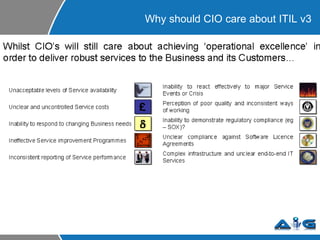
Why should CIO care about ITIL v3
What is ITIL? Best practice framework pertaining to IT Service Delivery Systematic approach to high quality IT service delivery Documented best practice for IT Service Management Provides common language with well-defined terms Developed in 1980s by what is now The Office of Government Commerce (OGC) itSMF (IT Service Management Forum) also involved in maintaining best practice documentation in ITIL itSMF is global, independent, not-for-profit forum Introduction Concept Lifecycle  Model s Q & A
What about v3? ITIL started in 80s.  40 publications! v2 came along in 2000-2002 Still Large and complex 8 Books Talks about what you should do v3 in 2007 Much simplified and rationalised to 5 books Much clearer guidance on how to provide service Easier, more modular accreditation paths Keeps tactical and operational guidance Gives more prominence to strategic ITIL guidance relevant to senior staff Aligned with ISO20000 standard for service management Introduction Concept Lifecycle  Model s Q & A
Agenda 3 Service Lifecycle 1 Introduction to ITIL Concepts 2 Key Concepts 4 Key Principles, Models, and Process 5 Questions and Answers ( Q & A) Introduction Concept Lifecycle  Model s Q &  A
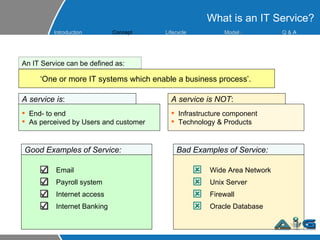
What is an IT Service? ‘ One or more IT systems which enable a business process’.  An IT Service can be defined as: A service is : End- to end As perceived by Users and customer A service is NOT : Infrastructure component Technology & Products Email  Payroll system Internet access Internet Banking Good Examples of Service:  Bad Examples of Service:  Wide Area Network Unix Server Firewall Oracle Database Introduction Concept Lifecycle  Model s Q &  A
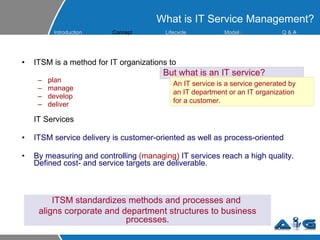
ITSM is a method for IT organizations to plan manage develop deliver IT Services ITSM service delivery is customer-oriented as well as process-oriented By measuring and controlling  (managing)  IT services reach a high quality. Defined cost- and service targets are deliverable. What is IT Service Management? ITSM standardizes methods and processes and  aligns corporate and department structures to business processes. But what is an IT service? An IT service is a service generated by  an IT department or an IT organization  for a customer. Introduction Concept Lifecycle  Model s Q &  A
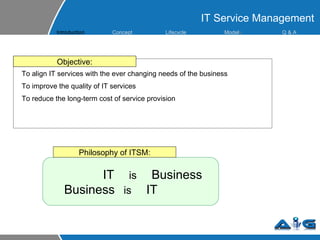
IT Service Management To align IT services with the ever changing needs of the business To improve the quality of IT services To reduce the long-term cost of service provision Objective: IT   is  Business Business   is  IT Philosophy of ITSM: Introduction Concept Lifecycle  Model s Q & A
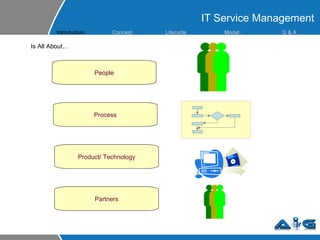
IT Service Management Is All About… People Process Product/ Technology Partners Introduction Concept Lifecycle  Model s Q & A
Benefits of IT Service Management Better Business-IT Alignment Transitioning IT from a technology focus to Service focus Process oriented approach providing consistent service quality Services that can be bench marked Better service visibility  - Service Level Agreements (SLA) Integrated, scalable framework for managing IT Services Reduced long term costs in development and delivery of IT services Reduced risk of not being able to meet business objectives The ability to absorb a high rate of changes  IT staff are provided with best practice guidance Introduction Concept Lifecycle  Model s Q &  A
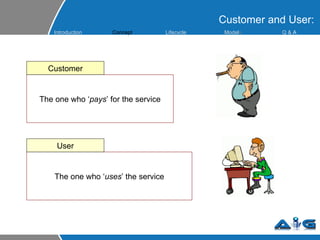
Customer and User: The one who ‘ pays ’ for the service The one who ‘ uses ’ the service Customer User Introduction Concept Lifecycle  Model s Q &  A
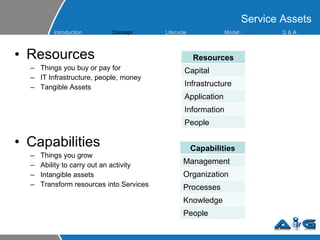
Service Assets Resources Things you buy or pay for IT Infrastructure, people, money Tangible Assets Capabilities Things you grow Ability to carry out an activity Intangible assets Transform resources into Services Resources Capital Infrastructure Application Information People Capabilities Management Organization Processes Knowledge People Introduction Concept Lifecycle  Model s Q &  A
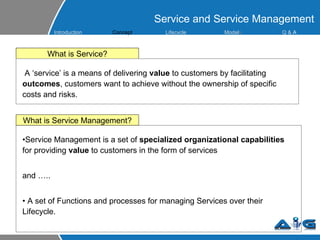
Service and Service Management Service Management is a set of  specialized organizational capabilities  for providing  value  to customers in the form of services and ….. A set of Functions and processes for managing Services over their Lifecycle. What is Service? A ‘service’ is a means of delivering  value  to customers by facilitating  outcomes , customers want to achieve without the ownership of specific costs and risks. What is Service Management? Introduction Concept Lifecycle  Model s Q &  A
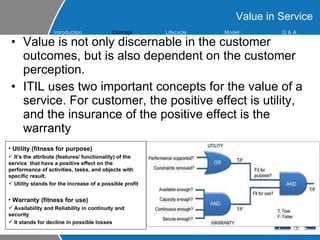
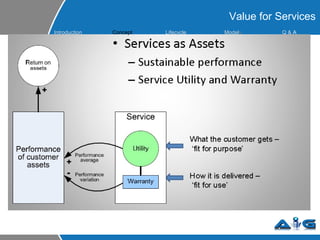
Value is not only discernable in the customer  outcomes, but is also dependent on the customer perception.  ITIL uses two important concepts for the value of a service. For customer, the positive effect is utility, and the insurance of the positive effect is the warranty  Value in Service Utility (fitness for purpose) It’s the attribute (features/ functionality) of the service  that have a positive effect on the performance of activities, tasks, and objects with specific result. Utility stands for the increase of a possible profit Warranty (fitness for use) Availability and Reliability in continuity and security It stands for decline in possible losses  Introduction Concept Lifecycle  Model s Q &  A
Value for Services Introduction Concept Lifecycle  Model s Q &  A
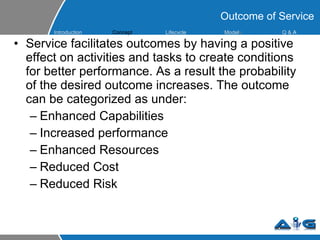
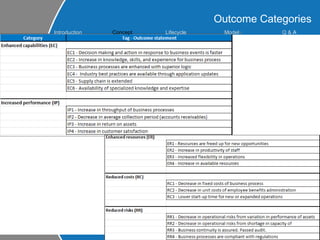
Service facilitates outcomes by having a positive effect on activities and tasks to create conditions for better performance. As a result the probability of the desired outcome increases. The outcome can be categorized as under: Enhanced Capabilities Increased performance Enhanced Resources Reduced Cost Reduced Risk Outcome of Service Introduction Concept Lifecycle  Model s Q &  A
Outcome Categories Introduction Concept Lifecycle  Model s Q &  A
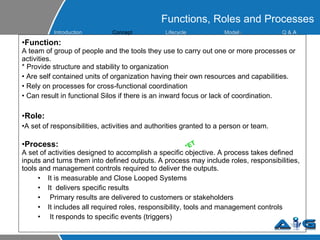
Functions, Roles and Processes Function: A team of group of people and the tools they use to carry out one or more processes or activities. * Provide structure and stability to organization Are self contained units of organization having their own resources and capabilities. Rely on processes for cross-functional coordination Can result in functional Silos if there is an inward focus or lack of coordination. Role: A set of responsibilities, activities and authorities granted to a person or team. Process: A set of activities designed to accomplish a specific objective. A process takes defined inputs and turns them into defined outputs. A process may include roles, responsibilities, tools and management controls required to deliver the outputs.  It is measurable and Close Looped Systems  It  delivers specific results Primary results are delivered to customers or stakeholders It includes all required roles, responsibility, tools and management controls It responds to specific events (triggers) *ET Introduction Concept Lifecycle  Model s Q &  A
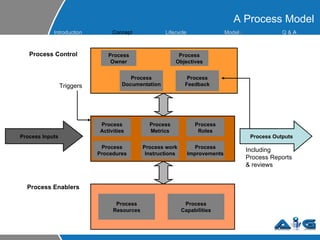
A Process Model Process Inputs Process Outputs Process Owner Process Objectives Process Documentation Process Feedback Process Activities Process Procedures Process Metrics Process work Instructions Process Roles Process Improvements Process Resources Process Capabilities Process Control Process Enablers Including Process Reports & reviews Triggers Introduction Concept Lifecycle  Model s Q &  A
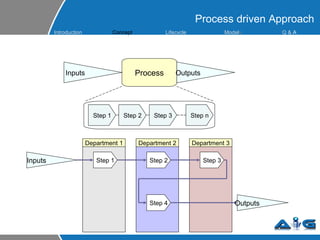
Process driven Approach Process Inputs Outputs Step 1 Step 2 Step 3 Step n Department 1 Department 2 Department 3 Step 1 Step 2 Step 3 Step 4 Outputs Inputs Introduction Concept Lifecycle  Model s Q &  A
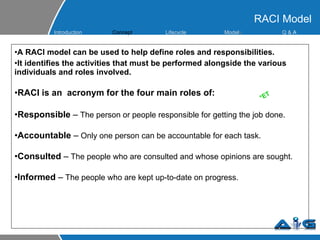
RACI Model A RACI model can be used to help define roles and responsibilities. It identifies the activities that must be performed alongside the various individuals and roles involved. RACI is an  acronym for the four main roles of: Responsible  –  The person or people responsible for getting the job done. Accountable  –  Only one person can be accountable for each task. Consulted  –  The people who are consulted and whose opinions are sought. Informed  –  The people who are kept up-to-date on progress. *ET Introduction Concept Lifecycle  Model s Q &  A
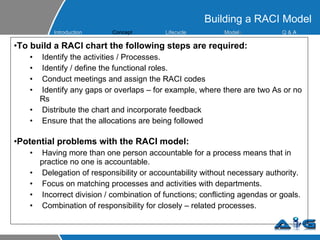
Building a RACI Model To build a RACI chart the following steps are required: Identify the activities / Processes. Identify / define the functional roles. Conduct meetings and assign the RACI codes Identify any gaps or overlaps – for example, where there are two As or no Rs Distribute the chart and incorporate feedback Ensure that the allocations are being followed Potential problems with the RACI model: Having more than one person accountable for a process means that in practice no one is accountable. Delegation of responsibility or accountability without necessary authority. Focus on matching processes and activities with departments. Incorrect division / combination of functions; conflicting agendas or goals.  Combination of responsibility for closely – related processes. Introduction Concept Lifecycle  Model s Q &  A
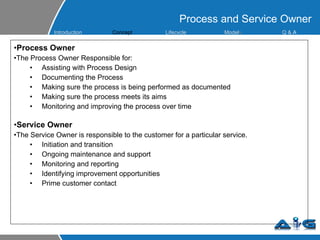
Process and Service Owner Process Owner The Process Owner Responsible for: Assisting with Process Design Documenting the Process Making sure the process is being performed as documented Making sure the process meets its aims Monitoring and improving the process over time Service Owner The Service Owner is responsible to the customer for a particular service. Initiation and transition Ongoing maintenance and support Monitoring and reporting Identifying improvement opportunities Prime customer contact Introduction Concept Lifecycle  Model s Q &  A
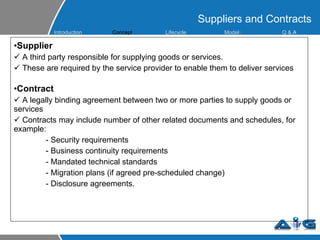
Suppliers and Contracts Supplier A third party responsible for supplying goods or services. These are required by the service provider to enable them to deliver services Contract A legally binding agreement between two or more parties to supply goods or services Contracts may include number of other related documents and schedules, for example: - Security requirements - Business continuity requirements - Mandated technical standards - Migration plans (if agreed pre-scheduled change) - Disclosure agreements. Introduction Concept Lifecycle  Model s Q &  A
Agenda 3 Service Life Cycle 1 Introduction to ITIL Concepts 2 Key Concept 4 Key Principles, Models, and Process 5 Questions and Answers ( Q & A) Introduction Concept Lifecycle  Model s Q &  A
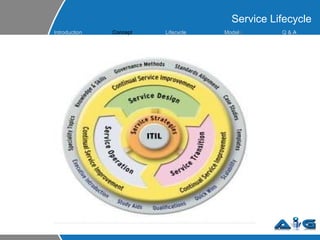
Service Lifecycle Introduction Concept Lifecycle  Model s Q &  A
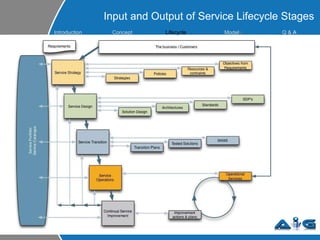
Input and Output of Service Lifecycle Stages Introduction Concept Lifecycle  Model s Q &  A
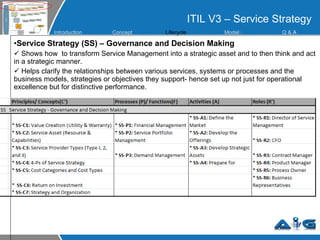
ITIL V3 – Service Strategy Service Strategy (SS) – Governance and Decision Making Shows how  to transform Service Management into a strategic asset and to then think and act in a strategic manner. Helps clarify the relationships between various services, systems or processes and the business models, strategies or objectives they support- hence set up not just for operational excellence but for distinctive performance. Introduction Concept Lifecycle  Model s Q &  A
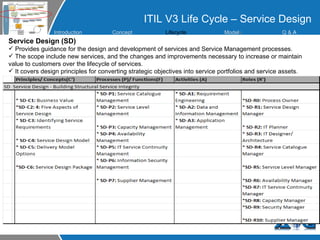
ITIL V3 Life Cycle – Service Design Service Design (SD) Provides guidance for the design and development of services and Service Management processes. The scope include new services, and the changes and improvements necessary to increase or maintain value to customers over the lifecycle of services. It covers design principles for converting strategic objectives into service portfolios and service assets. Introduction Concept Lifecycle  Model s Q &  A
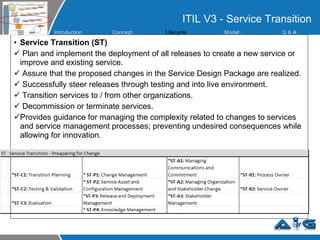
ITIL V3 - Service Transition Service Transition (ST) Plan and implement the deployment of all releases to create a new service or improve and existing service. Assure that the proposed changes in the Service Design Package are realized. Successfully steer releases through testing and into live environment. Transition services to / from other organizations. Decommission or terminate services. Provides guidance for managing the complexity related to changes to services and service management processes; preventing undesired consequences while allowing for innovation. Introduction Concept Lifecycle  Model s Q &  A
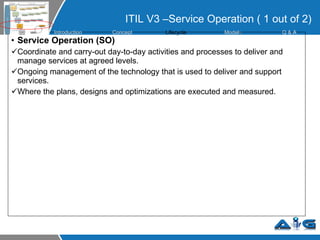
ITIL V3 –Service Operation ( 1 out of 2) Service Operation (SO) Coordinate and carry-out day-to-day activities and processes to deliver and manage services at agreed levels. Ongoing management of the technology that is used to deliver and support services. Where the plans, designs and optimizations are executed and measured. Introduction Concept Lifecycle  Model s Q &  A
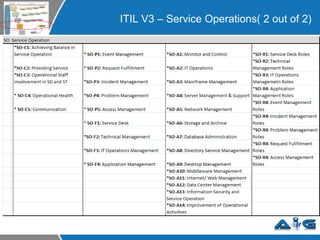
ITIL V3 – Service Operations( 2 out of 2)
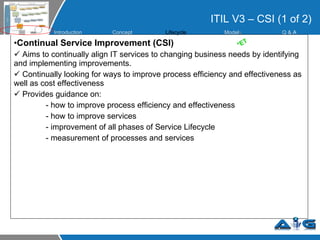
ITIL V3 – CSI (1 of 2) Continual Service Improvement (CSI)  Aims to continually align IT services to changing business needs by identifying and implementing improvements. Continually looking for ways to improve process efficiency and effectiveness as well as cost effectiveness Provides guidance on: - how to improve process efficiency and effectiveness - how to improve services - improvement of all phases of Service Lifecycle - measurement of processes and services *ET Introduction Concept Lifecycle  Model s Q &  A
ITIL V3 – CSI (2 of 2)
Agenda 3 Service Life Cycle 1 Introduction to ITIL Concepts 2 Key Concepts 4 Key Models, and Processes 5 Questions and Answers ( Q & A) Introduction Concept Lifecycle   Models Q &  A
Organization Framework, Models, and Standard of Systems and Asset Resources Capabilities Quality Management System Information Security Management System Infrastructure Management System Other Management System Assets Systems ISO 9001 ISO 27001 ISO 20000 Other relevant Auditing standards Compliance Standards ITIL Processes and Functions pertaining to IT Services Capability Maturity Model (Levels) Continual Improvement – Six Sigma Methodologies IT Framework Maturity Model Optimization methodology Organization
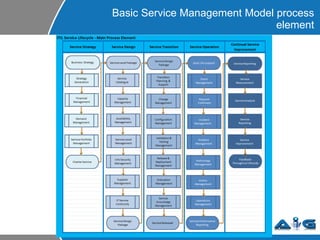
Basic Service Management Model process element
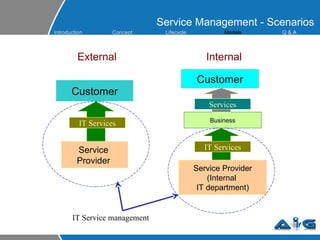
External Internal Service  Provider  Customer IT Services Service Provider (Internal  IT department) IT Services Customer Business Services IT Service management Service Management - Scenarios Introduction Concept Lifecycle  Models Q &  A
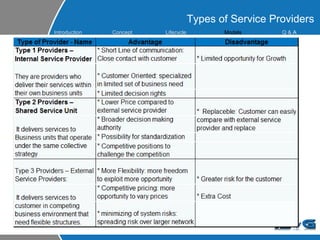
Types of Service Providers Introduction Concept Lifecycle   Models Q &  A
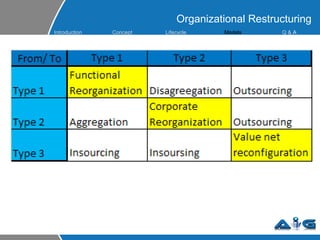
Organizational Restructuring Introduction Concept Lifecycle   Models Q &  A
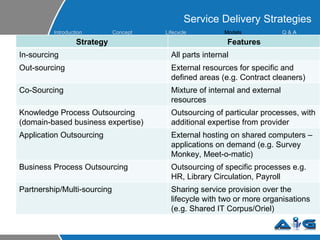
Service Delivery Strategies Strategy Features In-sourcing All parts internal Out-sourcing External resources for specific and defined areas (e.g. Contract cleaners) Co-Sourcing Mixture of internal and external resources Knowledge Process Outsourcing  (domain-based business expertise) Outsourcing of particular processes, with additional expertise from provider Application Outsourcing External hosting on shared computers – applications on demand (e.g. Survey Monkey, Meet-o-matic) Business Process Outsourcing Outsourcing of specific processes e.g. HR, Library Circulation, Payroll Partnership/Multi-sourcing Sharing service provision over the lifecycle with two or more organisations (e.g. Shared IT Corpus/Oriel) Introduction Concept Lifecycle   Models Q &  A
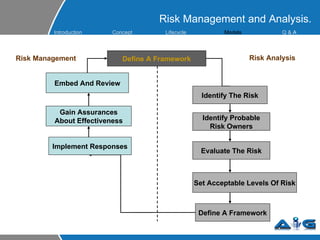
Risk Management and Analysis. Define A Framework Identify The Risk Identify Probable Risk Owners Evaluate The Risk Set Acceptable Levels Of Risk Define A Framework Implement Responses Gain Assurances About Effectiveness Embed And Review Risk Management Risk Analysis Introduction Concept Lifecycle   Models Q &  A
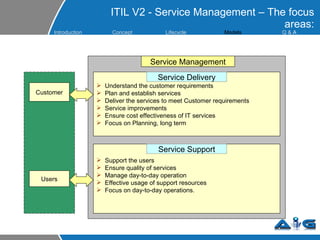
ITIL V2 - Service Management – The focus areas: Customer Users Understand the customer requirements Plan and establish services Deliver the services to meet Customer requirements Service improvements Ensure cost effectiveness of IT services Focus on Planning, long term Support the users  Ensure quality of services Manage day-to-day operation Effective usage of support resources Focus on day-to-day operations. Service Delivery Service Support Service Management Introduction Concept Lifecycle   Models Q &  A
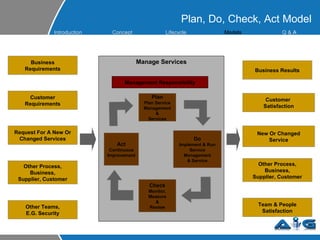
Plan, Do, Check, Act Model Business Requirements Customer Requirements Request For A New Or Changed Services Other Process, Business, Supplier, Customer Other Teams, E.G. Security Manage Services Business Results Customer  Satisfaction New Or Changed Service Management Responsibility Plan Plan Service Management & Services Act Continuous Improvement Do Implement & Run Service Management & Service Check Monitor, Measure & Review Other Process, Business, Supplier, Customer Team & People Satisfaction Introduction Concept Lifecycle   Models Q &  A
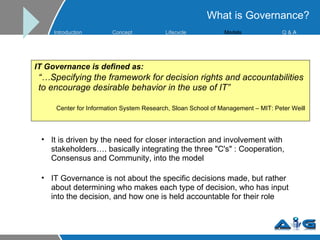
IT Governance is defined as: “… Specifying the framework for decision rights and accountabilities to encourage desirable behavior in the use of IT” Center for Information System Research, Sloan School of Management – MIT: Peter Weill It is driven by the need for closer interaction and involvement with stakeholders…. basically integrating the three "C's" : Cooperation, Consensus and Community, into the model  IT Governance is not about the specific decisions made, but rather about determining who makes each type of decision, who has input into the decision, and how one is held accountable for their role What is Governance? Introduction Concept Lifecycle   Models Q &  A
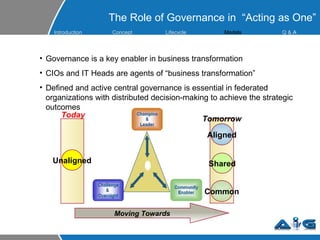
The Role of Governance in  “Acting as One” Governance is a key enabler in business transformation CIOs and IT Heads are agents of “business transformation” Defined and active central governance is essential in federated organizations with distributed decision-making to achieve the strategic outcomes Aligned Shared Common Today Tomorrow Unaligned Moving Towards Introduction Concept Lifecycle   Models Q &  A
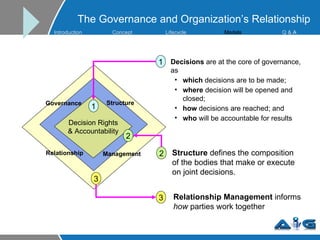
The Governance and Organization’s Relationship  Decisions  are at the core of governance, as which  decisions are to be made; where  decision will be opened and closed; how  decisions are reached; and who  will be accountable for results Structure  defines the composition of the bodies that make or execute on joint decisions .   Relationship Management  informs  how  parties work together Governance Structure Decision Rights & Accountability Relationship Management 1 2 3 1 2 3 Introduction Concept Lifecycle   Models Q &  A
Question & Answers
Thank you for your attention ! Your questions and comments are most welcome ! Introduction Concept Lifecycle   Models Q & A

ITIL V3 Overview

  • 1.
  • 2.
    Agenda 3 ServiceLifecycle 1 Introduction to ITIL 2 Key Concept 4 Key Principles, Models, and Process 5 Questions and Answers ( Q & A)
  • 3.
    ITIL - MotivationsTop ten concerns of IT Directors/CIO’s (cited by “ISO20000 Toolkit”) Aligning IT strategy with business strategy (operational excellence). Meeting business and user needs. Coping with change (Pressure to Implement change fast). Dealing with senior management (Cost Cutting, and optimize IT investment and expenditure) Managing costs, budgets and resources. Keeping up with technology. Recruiting and retaining staff. Time and resource management. Infrastructure management. Maintaining skills and knowledge Introduction Concept Lifecycle Model s Q & A
  • 4.
    Why should CIOcare about ITIL v3
  • 5.
    What is ITIL?Best practice framework pertaining to IT Service Delivery Systematic approach to high quality IT service delivery Documented best practice for IT Service Management Provides common language with well-defined terms Developed in 1980s by what is now The Office of Government Commerce (OGC) itSMF (IT Service Management Forum) also involved in maintaining best practice documentation in ITIL itSMF is global, independent, not-for-profit forum Introduction Concept Lifecycle Model s Q & A
  • 6.
    What about v3?ITIL started in 80s. 40 publications! v2 came along in 2000-2002 Still Large and complex 8 Books Talks about what you should do v3 in 2007 Much simplified and rationalised to 5 books Much clearer guidance on how to provide service Easier, more modular accreditation paths Keeps tactical and operational guidance Gives more prominence to strategic ITIL guidance relevant to senior staff Aligned with ISO20000 standard for service management Introduction Concept Lifecycle Model s Q & A
  • 7.
    Agenda 3 ServiceLifecycle 1 Introduction to ITIL Concepts 2 Key Concepts 4 Key Principles, Models, and Process 5 Questions and Answers ( Q & A) Introduction Concept Lifecycle Model s Q & A
  • 8.
    What is anIT Service? ‘ One or more IT systems which enable a business process’. An IT Service can be defined as: A service is : End- to end As perceived by Users and customer A service is NOT : Infrastructure component Technology & Products Email Payroll system Internet access Internet Banking Good Examples of Service: Bad Examples of Service: Wide Area Network Unix Server Firewall Oracle Database Introduction Concept Lifecycle Model s Q & A
  • 9.
    ITSM is amethod for IT organizations to plan manage develop deliver IT Services ITSM service delivery is customer-oriented as well as process-oriented By measuring and controlling (managing) IT services reach a high quality. Defined cost- and service targets are deliverable. What is IT Service Management? ITSM standardizes methods and processes and aligns corporate and department structures to business processes. But what is an IT service? An IT service is a service generated by an IT department or an IT organization for a customer. Introduction Concept Lifecycle Model s Q & A
  • 10.
    IT Service ManagementTo align IT services with the ever changing needs of the business To improve the quality of IT services To reduce the long-term cost of service provision Objective: IT is Business Business is IT Philosophy of ITSM: Introduction Concept Lifecycle Model s Q & A
  • 11.
    IT Service ManagementIs All About… People Process Product/ Technology Partners Introduction Concept Lifecycle Model s Q & A
  • 12.
    Benefits of ITService Management Better Business-IT Alignment Transitioning IT from a technology focus to Service focus Process oriented approach providing consistent service quality Services that can be bench marked Better service visibility - Service Level Agreements (SLA) Integrated, scalable framework for managing IT Services Reduced long term costs in development and delivery of IT services Reduced risk of not being able to meet business objectives The ability to absorb a high rate of changes IT staff are provided with best practice guidance Introduction Concept Lifecycle Model s Q & A
  • 13.
    Customer and User:The one who ‘ pays ’ for the service The one who ‘ uses ’ the service Customer User Introduction Concept Lifecycle Model s Q & A
  • 14.
    Service Assets ResourcesThings you buy or pay for IT Infrastructure, people, money Tangible Assets Capabilities Things you grow Ability to carry out an activity Intangible assets Transform resources into Services Resources Capital Infrastructure Application Information People Capabilities Management Organization Processes Knowledge People Introduction Concept Lifecycle Model s Q & A
  • 15.
    Service and ServiceManagement Service Management is a set of specialized organizational capabilities for providing value to customers in the form of services and ….. A set of Functions and processes for managing Services over their Lifecycle. What is Service? A ‘service’ is a means of delivering value to customers by facilitating outcomes , customers want to achieve without the ownership of specific costs and risks. What is Service Management? Introduction Concept Lifecycle Model s Q & A
  • 16.
    Value is notonly discernable in the customer outcomes, but is also dependent on the customer perception. ITIL uses two important concepts for the value of a service. For customer, the positive effect is utility, and the insurance of the positive effect is the warranty Value in Service Utility (fitness for purpose) It’s the attribute (features/ functionality) of the service that have a positive effect on the performance of activities, tasks, and objects with specific result. Utility stands for the increase of a possible profit Warranty (fitness for use) Availability and Reliability in continuity and security It stands for decline in possible losses Introduction Concept Lifecycle Model s Q & A
  • 17.
    Value for ServicesIntroduction Concept Lifecycle Model s Q & A
  • 18.
    Service facilitates outcomesby having a positive effect on activities and tasks to create conditions for better performance. As a result the probability of the desired outcome increases. The outcome can be categorized as under: Enhanced Capabilities Increased performance Enhanced Resources Reduced Cost Reduced Risk Outcome of Service Introduction Concept Lifecycle Model s Q & A
  • 19.
    Outcome Categories IntroductionConcept Lifecycle Model s Q & A
  • 20.
    Functions, Roles andProcesses Function: A team of group of people and the tools they use to carry out one or more processes or activities. * Provide structure and stability to organization Are self contained units of organization having their own resources and capabilities. Rely on processes for cross-functional coordination Can result in functional Silos if there is an inward focus or lack of coordination. Role: A set of responsibilities, activities and authorities granted to a person or team. Process: A set of activities designed to accomplish a specific objective. A process takes defined inputs and turns them into defined outputs. A process may include roles, responsibilities, tools and management controls required to deliver the outputs. It is measurable and Close Looped Systems It delivers specific results Primary results are delivered to customers or stakeholders It includes all required roles, responsibility, tools and management controls It responds to specific events (triggers) *ET Introduction Concept Lifecycle Model s Q & A
  • 21.
    A Process ModelProcess Inputs Process Outputs Process Owner Process Objectives Process Documentation Process Feedback Process Activities Process Procedures Process Metrics Process work Instructions Process Roles Process Improvements Process Resources Process Capabilities Process Control Process Enablers Including Process Reports & reviews Triggers Introduction Concept Lifecycle Model s Q & A
  • 22.
    Process driven ApproachProcess Inputs Outputs Step 1 Step 2 Step 3 Step n Department 1 Department 2 Department 3 Step 1 Step 2 Step 3 Step 4 Outputs Inputs Introduction Concept Lifecycle Model s Q & A
  • 23.
    RACI Model ARACI model can be used to help define roles and responsibilities. It identifies the activities that must be performed alongside the various individuals and roles involved. RACI is an acronym for the four main roles of: Responsible – The person or people responsible for getting the job done. Accountable – Only one person can be accountable for each task. Consulted – The people who are consulted and whose opinions are sought. Informed – The people who are kept up-to-date on progress. *ET Introduction Concept Lifecycle Model s Q & A
  • 24.
    Building a RACIModel To build a RACI chart the following steps are required: Identify the activities / Processes. Identify / define the functional roles. Conduct meetings and assign the RACI codes Identify any gaps or overlaps – for example, where there are two As or no Rs Distribute the chart and incorporate feedback Ensure that the allocations are being followed Potential problems with the RACI model: Having more than one person accountable for a process means that in practice no one is accountable. Delegation of responsibility or accountability without necessary authority. Focus on matching processes and activities with departments. Incorrect division / combination of functions; conflicting agendas or goals. Combination of responsibility for closely – related processes. Introduction Concept Lifecycle Model s Q & A
  • 25.
    Process and ServiceOwner Process Owner The Process Owner Responsible for: Assisting with Process Design Documenting the Process Making sure the process is being performed as documented Making sure the process meets its aims Monitoring and improving the process over time Service Owner The Service Owner is responsible to the customer for a particular service. Initiation and transition Ongoing maintenance and support Monitoring and reporting Identifying improvement opportunities Prime customer contact Introduction Concept Lifecycle Model s Q & A
  • 26.
    Suppliers and ContractsSupplier A third party responsible for supplying goods or services. These are required by the service provider to enable them to deliver services Contract A legally binding agreement between two or more parties to supply goods or services Contracts may include number of other related documents and schedules, for example: - Security requirements - Business continuity requirements - Mandated technical standards - Migration plans (if agreed pre-scheduled change) - Disclosure agreements. Introduction Concept Lifecycle Model s Q & A
  • 27.
    Agenda 3 ServiceLife Cycle 1 Introduction to ITIL Concepts 2 Key Concept 4 Key Principles, Models, and Process 5 Questions and Answers ( Q & A) Introduction Concept Lifecycle Model s Q & A
  • 28.
    Service Lifecycle IntroductionConcept Lifecycle Model s Q & A
  • 29.
    Input and Outputof Service Lifecycle Stages Introduction Concept Lifecycle Model s Q & A
  • 30.
    ITIL V3 –Service Strategy Service Strategy (SS) – Governance and Decision Making Shows how to transform Service Management into a strategic asset and to then think and act in a strategic manner. Helps clarify the relationships between various services, systems or processes and the business models, strategies or objectives they support- hence set up not just for operational excellence but for distinctive performance. Introduction Concept Lifecycle Model s Q & A
  • 31.
    ITIL V3 LifeCycle – Service Design Service Design (SD) Provides guidance for the design and development of services and Service Management processes. The scope include new services, and the changes and improvements necessary to increase or maintain value to customers over the lifecycle of services. It covers design principles for converting strategic objectives into service portfolios and service assets. Introduction Concept Lifecycle Model s Q & A
  • 32.
    ITIL V3 -Service Transition Service Transition (ST) Plan and implement the deployment of all releases to create a new service or improve and existing service. Assure that the proposed changes in the Service Design Package are realized. Successfully steer releases through testing and into live environment. Transition services to / from other organizations. Decommission or terminate services. Provides guidance for managing the complexity related to changes to services and service management processes; preventing undesired consequences while allowing for innovation. Introduction Concept Lifecycle Model s Q & A
  • 33.
    ITIL V3 –ServiceOperation ( 1 out of 2) Service Operation (SO) Coordinate and carry-out day-to-day activities and processes to deliver and manage services at agreed levels. Ongoing management of the technology that is used to deliver and support services. Where the plans, designs and optimizations are executed and measured. Introduction Concept Lifecycle Model s Q & A
  • 34.
    ITIL V3 –Service Operations( 2 out of 2)
  • 35.
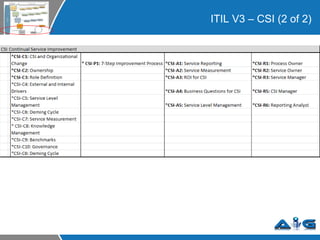
    ITIL V3 –CSI (1 of 2) Continual Service Improvement (CSI) Aims to continually align IT services to changing business needs by identifying and implementing improvements. Continually looking for ways to improve process efficiency and effectiveness as well as cost effectiveness Provides guidance on: - how to improve process efficiency and effectiveness - how to improve services - improvement of all phases of Service Lifecycle - measurement of processes and services *ET Introduction Concept Lifecycle Model s Q & A
  • 36.
    ITIL V3 –CSI (2 of 2)
  • 37.
    Agenda 3 ServiceLife Cycle 1 Introduction to ITIL Concepts 2 Key Concepts 4 Key Models, and Processes 5 Questions and Answers ( Q & A) Introduction Concept Lifecycle Models Q & A
  • 38.
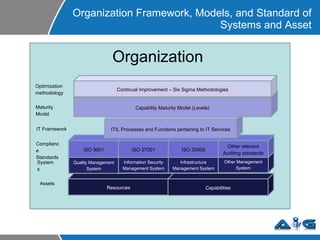
    Organization Framework, Models,and Standard of Systems and Asset Resources Capabilities Quality Management System Information Security Management System Infrastructure Management System Other Management System Assets Systems ISO 9001 ISO 27001 ISO 20000 Other relevant Auditing standards Compliance Standards ITIL Processes and Functions pertaining to IT Services Capability Maturity Model (Levels) Continual Improvement – Six Sigma Methodologies IT Framework Maturity Model Optimization methodology Organization
  • 39.
    Basic Service ManagementModel process element
  • 40.
    External Internal Service Provider Customer IT Services Service Provider (Internal IT department) IT Services Customer Business Services IT Service management Service Management - Scenarios Introduction Concept Lifecycle Models Q & A
  • 41.
    Types of ServiceProviders Introduction Concept Lifecycle Models Q & A
  • 42.
    Organizational Restructuring IntroductionConcept Lifecycle Models Q & A
  • 43.
    Service Delivery StrategiesStrategy Features In-sourcing All parts internal Out-sourcing External resources for specific and defined areas (e.g. Contract cleaners) Co-Sourcing Mixture of internal and external resources Knowledge Process Outsourcing (domain-based business expertise) Outsourcing of particular processes, with additional expertise from provider Application Outsourcing External hosting on shared computers – applications on demand (e.g. Survey Monkey, Meet-o-matic) Business Process Outsourcing Outsourcing of specific processes e.g. HR, Library Circulation, Payroll Partnership/Multi-sourcing Sharing service provision over the lifecycle with two or more organisations (e.g. Shared IT Corpus/Oriel) Introduction Concept Lifecycle Models Q & A
  • 44.
    Risk Management andAnalysis. Define A Framework Identify The Risk Identify Probable Risk Owners Evaluate The Risk Set Acceptable Levels Of Risk Define A Framework Implement Responses Gain Assurances About Effectiveness Embed And Review Risk Management Risk Analysis Introduction Concept Lifecycle Models Q & A
  • 45.
    ITIL V2 -Service Management – The focus areas: Customer Users Understand the customer requirements Plan and establish services Deliver the services to meet Customer requirements Service improvements Ensure cost effectiveness of IT services Focus on Planning, long term Support the users Ensure quality of services Manage day-to-day operation Effective usage of support resources Focus on day-to-day operations. Service Delivery Service Support Service Management Introduction Concept Lifecycle Models Q & A
  • 46.
    Plan, Do, Check,Act Model Business Requirements Customer Requirements Request For A New Or Changed Services Other Process, Business, Supplier, Customer Other Teams, E.G. Security Manage Services Business Results Customer Satisfaction New Or Changed Service Management Responsibility Plan Plan Service Management & Services Act Continuous Improvement Do Implement & Run Service Management & Service Check Monitor, Measure & Review Other Process, Business, Supplier, Customer Team & People Satisfaction Introduction Concept Lifecycle Models Q & A
  • 47.
    IT Governance isdefined as: “… Specifying the framework for decision rights and accountabilities to encourage desirable behavior in the use of IT” Center for Information System Research, Sloan School of Management – MIT: Peter Weill It is driven by the need for closer interaction and involvement with stakeholders…. basically integrating the three "C's" : Cooperation, Consensus and Community, into the model IT Governance is not about the specific decisions made, but rather about determining who makes each type of decision, who has input into the decision, and how one is held accountable for their role What is Governance? Introduction Concept Lifecycle Models Q & A
  • 48.
    The Role ofGovernance in “Acting as One” Governance is a key enabler in business transformation CIOs and IT Heads are agents of “business transformation” Defined and active central governance is essential in federated organizations with distributed decision-making to achieve the strategic outcomes Aligned Shared Common Today Tomorrow Unaligned Moving Towards Introduction Concept Lifecycle Models Q & A
  • 49.
    The Governance andOrganization’s Relationship Decisions are at the core of governance, as which decisions are to be made; where decision will be opened and closed; how decisions are reached; and who will be accountable for results Structure defines the composition of the bodies that make or execute on joint decisions . Relationship Management informs how parties work together Governance Structure Decision Rights & Accountability Relationship Management 1 2 3 1 2 3 Introduction Concept Lifecycle Models Q & A
  • 50.
  • 51.
    Thank you foryour attention ! Your questions and comments are most welcome ! Introduction Concept Lifecycle Models Q & A

Editor's Notes

  • #9 Detailed QMS Training 15th April '03 P&Q - Mumbai It is very important to establish the definition of the Service within the context of the organization. To achieve alignment with the business objectives and to partner with the business, the service should be defined considering the customer/user perspective. This is far different from the traditional IT view of treating IT systems as the IT services. This question is not as easy to answer as it may first appear, and many organizations have failed to come up with a clear definition in an IT context. IT staff often confuse a ‘service’ as perceived by the user/customer with an IT system. In many cases one ‘service’ can be made up of other ‘services’ (and so on) which are themselves made up of one or more IT systems within an overall Infrastructure including operations, networks, applications, etc. A good starting point is often to ask customers/users which IT Services they use and how those services map onto their business processes. Customers often have a greater clarity of what they believe a service to be.
  • #11 Detailed QMS Training 15th April '03 P&Q - Mumbai Organizations are increasingly dependent upon IT to satisfy their corporate aims and meet their business needs. This growing dependency leads to growing needs for quality IT services – quality that is matched to business needs and user requirements as they emerge. This is true no matter what type or size of organization, be it national government, a multinational conglomerate, a decentralized office with either a local or centralized IT provision, an outsourced service provider, or a single office environment with one person providing IT support. In each case there is the requirement to provide an economical service that is reliable, consistent and of the highest quality. The three Key objectives of Service Management are: To align it services with the current and future needs of the business/customer. To improve the quality of the IT service delivered. To reduce the long-term cost of service provision. IT Service Management is concerned with delivering and supporting IT services that are appropriate to the business requirements of the organization.
  • #12 Detailed QMS Training 15th April '03 P&Q - Mumbai Effective management of IT services should address all the Four aspects: People Process Technology ( or Products) Partners Many organizations didn’t achieve effectiveness in Service management due to increased focus on technology and lack of focus on the other two areas. Now it is apparent that to have effective IT Services in alignment with the business, there should be equal focus on all these three aspects. The People aspect in service management should adhere the roles and responsibilities ( both functional as well as process roles), skills, trainings etc. The processes within service management should align quality frameworks and global best practices.
  • #13 Detailed QMS Training 15th April '03 P&Q - Mumbai From the basic principle of ITSM, the framework is oriented towards bringing a better alignment between IT and Business. It promotes the transitioning of IT from the traditional technology and operations focus to Service focus. The Process oriented approach brought in by ITSM removes people dependencies and ensures a higher quality of service consistently. IT Services can be benchmarked in terms of quality, cost, efficiency, and satisfaction periodically. Service cost can be planned and managed effectively based on the established processes. Business and the customer gets a better service visibility of the services and the service performance on the basis of Service Level Agreements. Enhance IT management maturity level with an integrated process models. Provides a roadmap for reduced long term costs in development and delivery of IT services. Through effective, multi-level risk management measures (change, availability, continuity and security), ITSM ensures that risks of not being able to meet the business objectives are minimized. The ability to absorb a high rate of change which are necessitated by ever changing business scenarios and growth. IT staff are provided with best practice guidance to perform well in their respective roles.
  • #14 Detailed QMS Training 15th April '03 P&Q - Mumbai Traditionally, the terms customer and user are often used interchangeably. But for effective management of IT services, there is a need for distinguishing the person or persons funding the service and the people who uses the services. To avoid confusion regarding roles and terminology, the terms ‘Customer’ and ‘User’ are used throughout ITIL to differentiate between those people (generally senior managers) who commission, pay for and own the IT Services (the Customers) and those people who use the services on a day-to-day basis (the Users). Customer is the one who pays for the service. User is the one who uses he service. These need to be looked upon as roles and not as people. For example, the same person who acts as the customer for a service while he does the decision making etc, will be treated as user when he is using the same service.
  • #23 Detailed QMS Training 15th April '03 P&Q - Mumbai A process can be defined as: a connected series of actions, activities, changes etc, performed by agents with the intent of satisfying a purpose or achieving a goal. Each process has a clear objective. To reach that objective the process is broken down into a series of tasks. For each task, there will be Inputs and Outputs The output produced by a process has to conform to operational norms that are derived from business objectives. If products conform to the set norm, the process can be considered effective (because it can be repeated, measured and managed). If the activities are carried out with a minimum effort, the process can also be considered efficient . Since processes and their activities run through an organization, they should be mapped and coordinated by process managers.
  • #41 Detailed QMS Training 15th April '03 P&Q - Mumbai The IT service management context is applicable to two scenarios: a) An IT Service provider providing services to external customers b) An internal IT department providing IT services to the business and entire organization In the second case, the customers and users for IT is internal.
  • #46 Detailed QMS Training 15th April '03 P&Q - Mumbai The Service Management within ITIL is divided into two modules- Service Support Service Delivery The Service Support module focuses on the day-to-day operational processes within IT Service management covered through 5 processes and one function. Service Desk (function) Incident Management Problem management Change Management Configuration Management Release Management The Service Delivery Module focus on the Planning, long term aspects of Service management, covered through 5 processes: Service Level Management Availability Management Capacity management IT Service Continuity Management Financial Management