Getting the best out
of IT Service
Management
Francis D’Souza

1
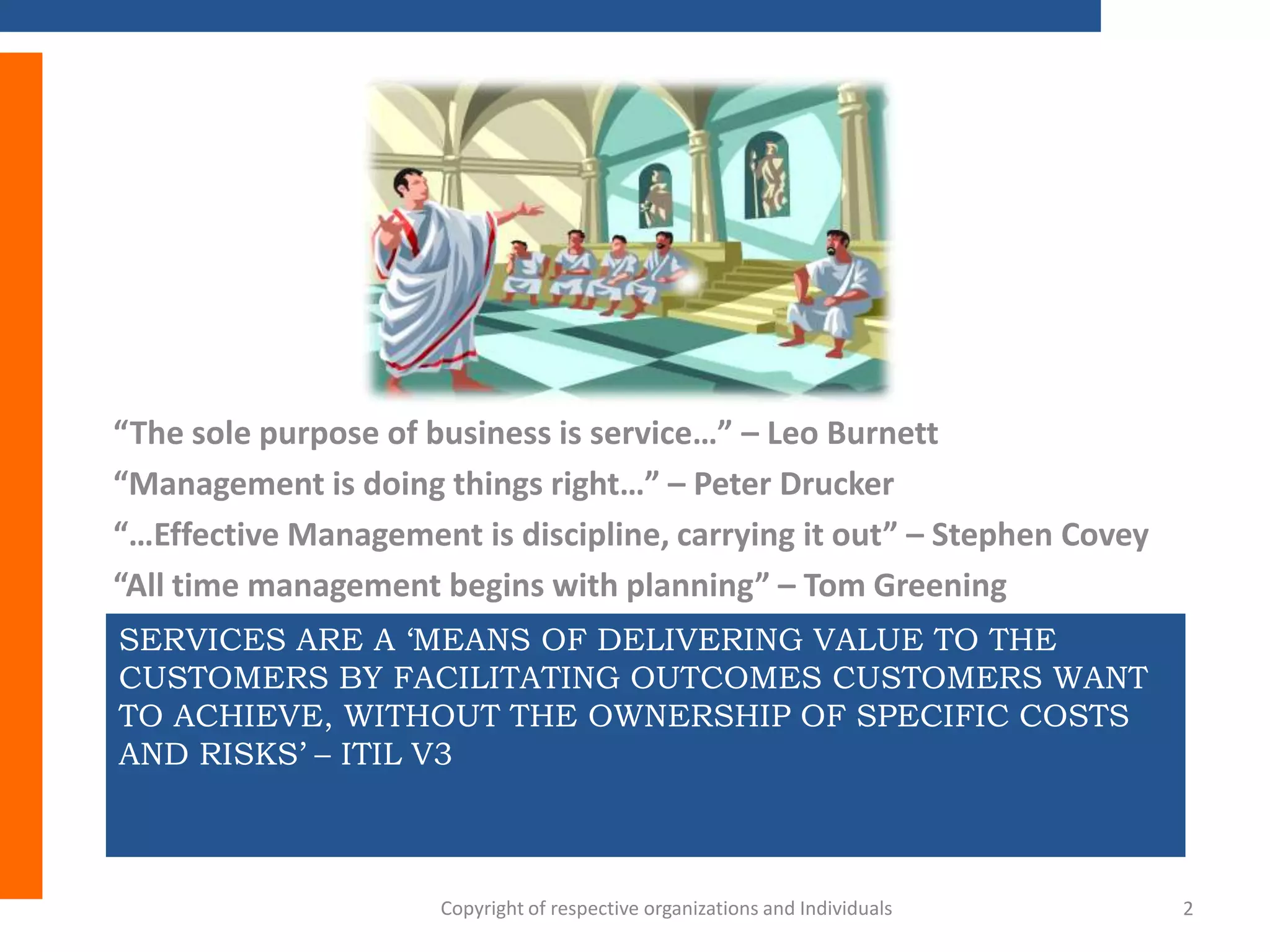
“The sole purpose of business is service…” – Leo Burnett
“Management is doing things right…” – Peter Drucker
“…Effective Management is discipline, carrying it out” – Stephen Covey
“All time management begins with planning” – Tom Greening
SERVICES ARE A ‘MEANS OF DELIVERING VALUE TO THE
CUSTOMERS BY FACILITATING OUTCOMES CUSTOMERS WANT
TO ACHIEVE, WITHOUT THE OWNERSHIP OF SPECIFIC COSTS
AND RISKS’ – ITIL V3

Copyright of respective organizations and Individuals

2
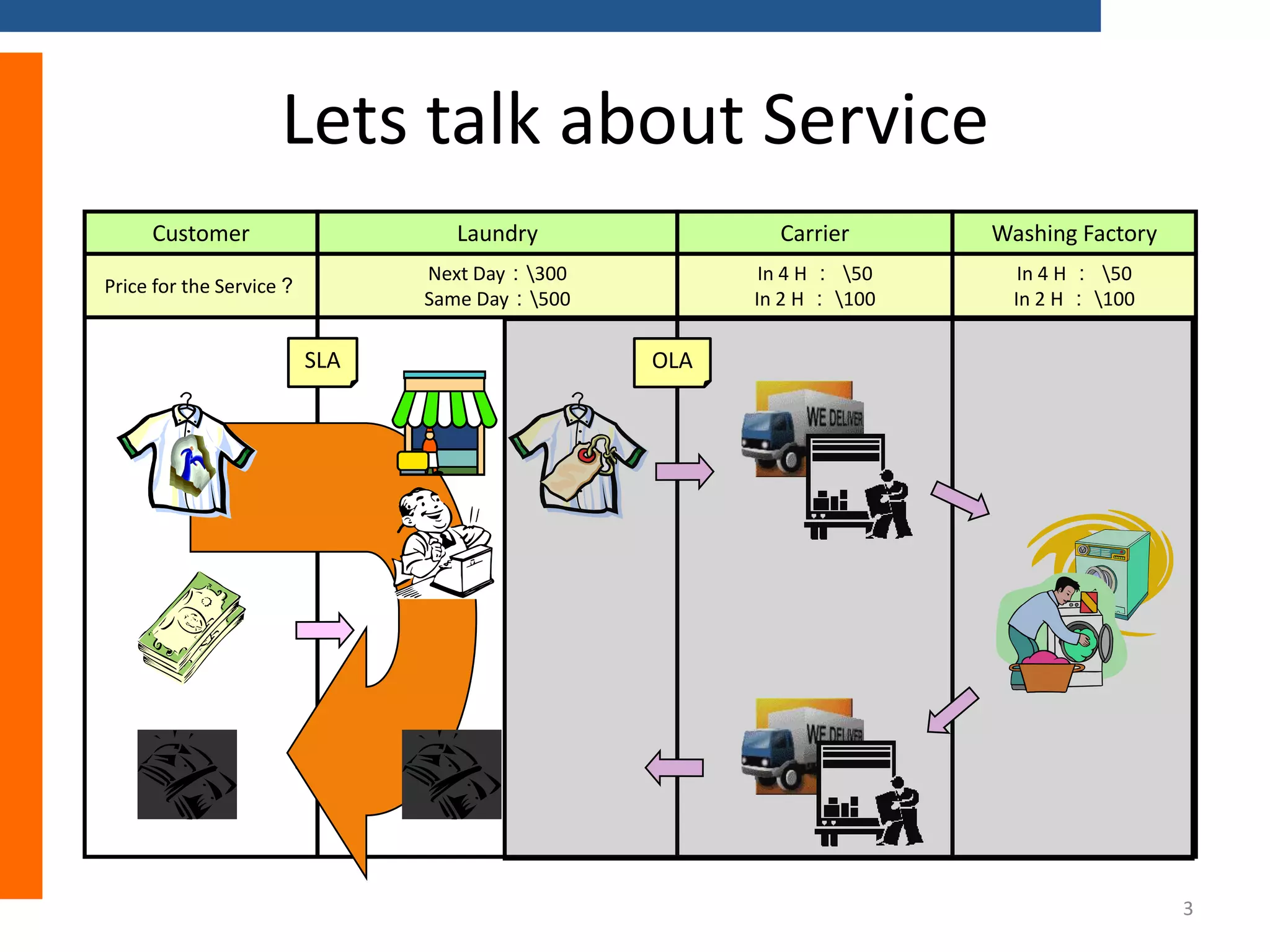
Lets talk about Service
Customer

Laundry

Carrier

Washing Factory

Price for the Service?

Next Day:300
Same Day:500

In 4 H : 50
In 2 H : 100

In 4 H : 50
In 2 H : 100

SLA

OLA

3
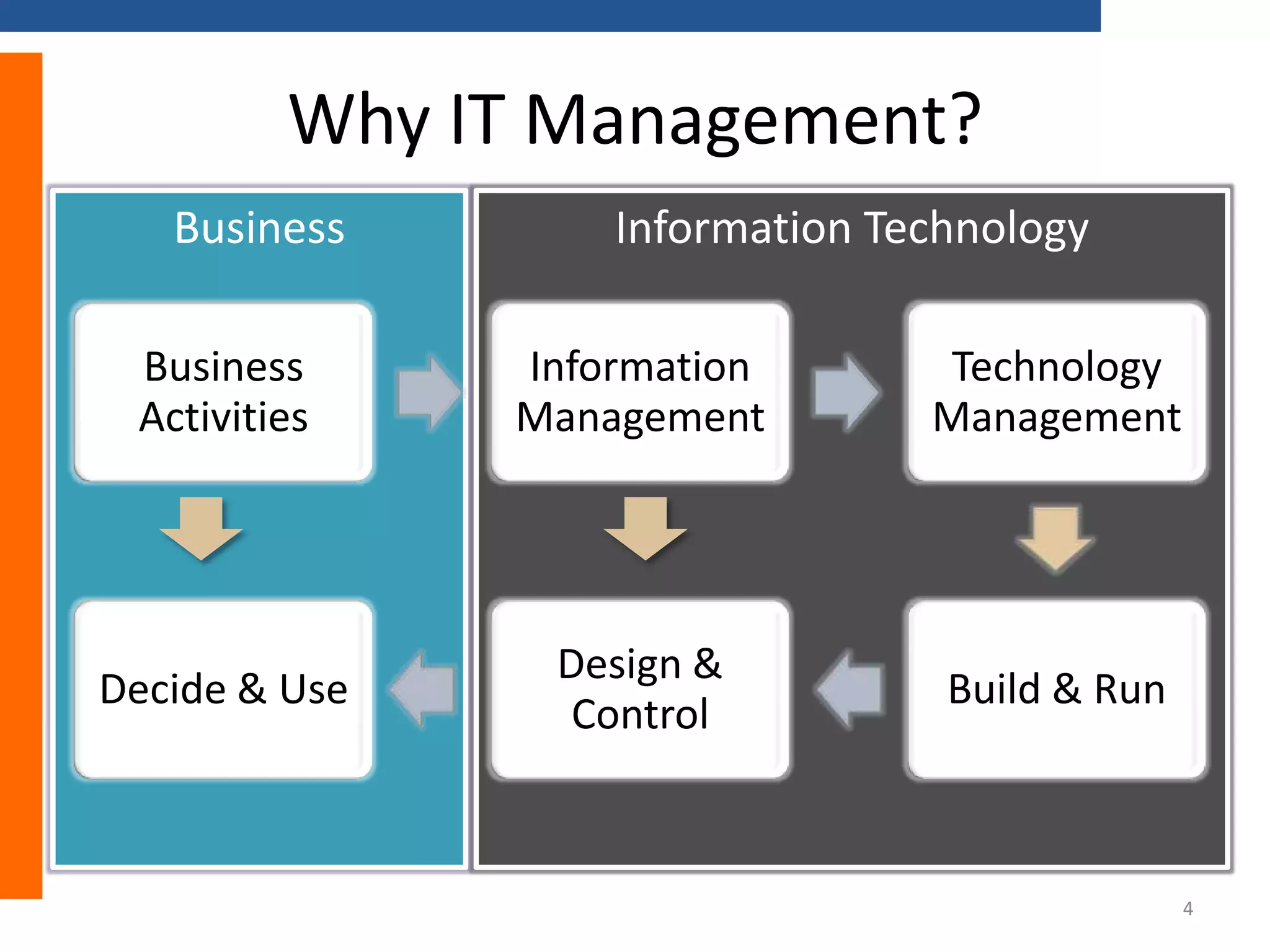
Why IT Management?
Business

Information Technology

Business
Activities

Information
Management

Technology
Management

Decide & Use

Design &
Control

Build & Run

4
From a business perspective - IT in all its forms is
probably the most expensive and powerful enabler/
disabler of business operation and performance today

Effective ITSM' - is key to 'effective IT' - is key to 'effective
Business’

5
What then is… ITSM?
“The implementation and management of quality IT services
that meet the needs of the business.” ~ ITIL
“A discipline for managing IT systems, philosophically centered
on the customer's perspective of IT's contribution to the
business. ITSM stands in deliberate contrast to technologycentered approaches to IT management and business
interaction.” ~ Wikipedia (Charlie Betz)
“Service management is a systematic method for managing
the offering, contracting and provisioning of services to
customers, at a known quality, cost and designed experience.
Service management ensures the desired results and customer
satisfaction levels are achieved cost effectively, ...” ~ USMBOK
6
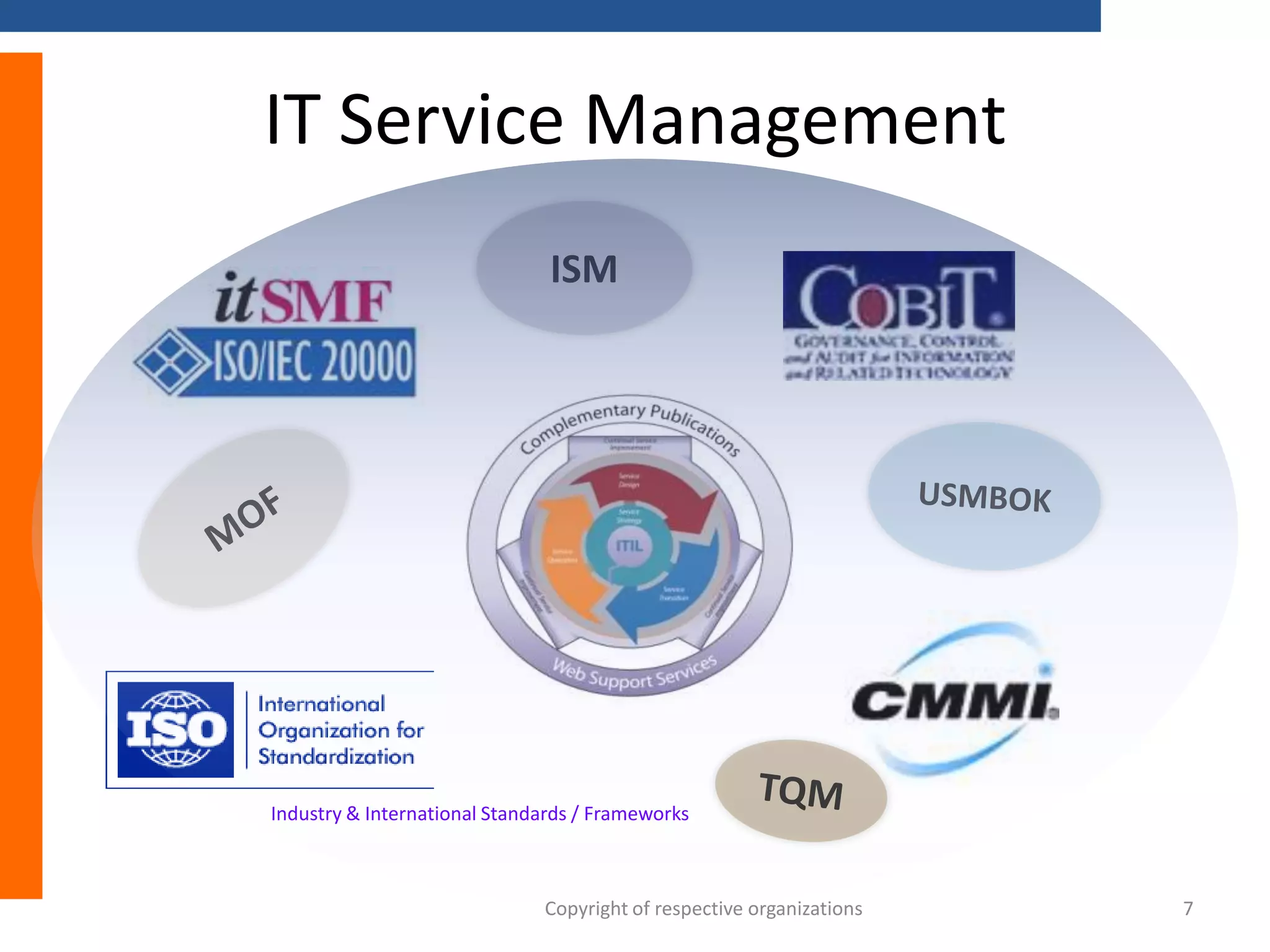
IT Service Management
ISM

Industry & International Standards / Frameworks

Copyright of respective organizations

7
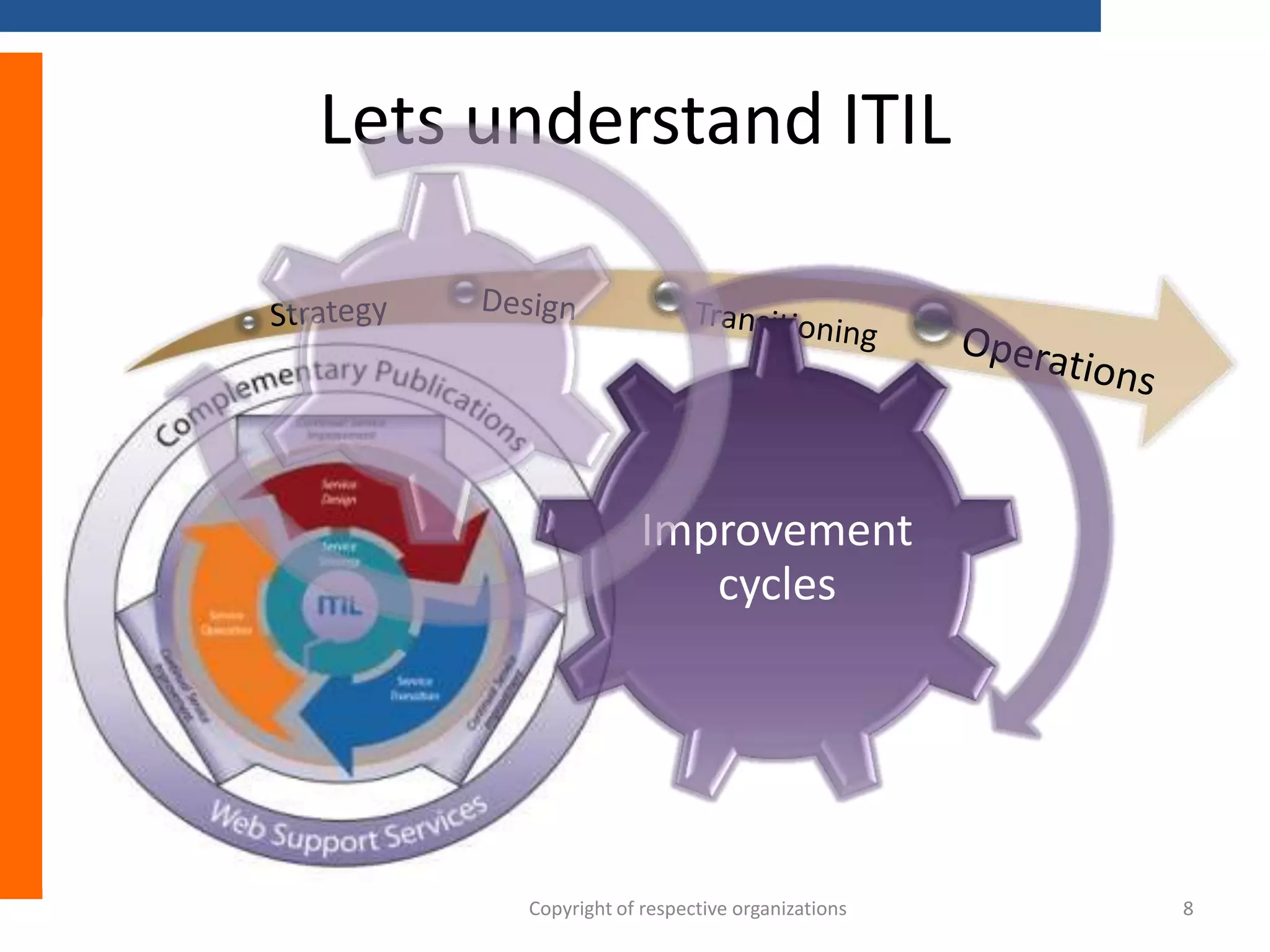
Lets understand ITIL

Improvement
cycles

Copyright of respective organizations

8
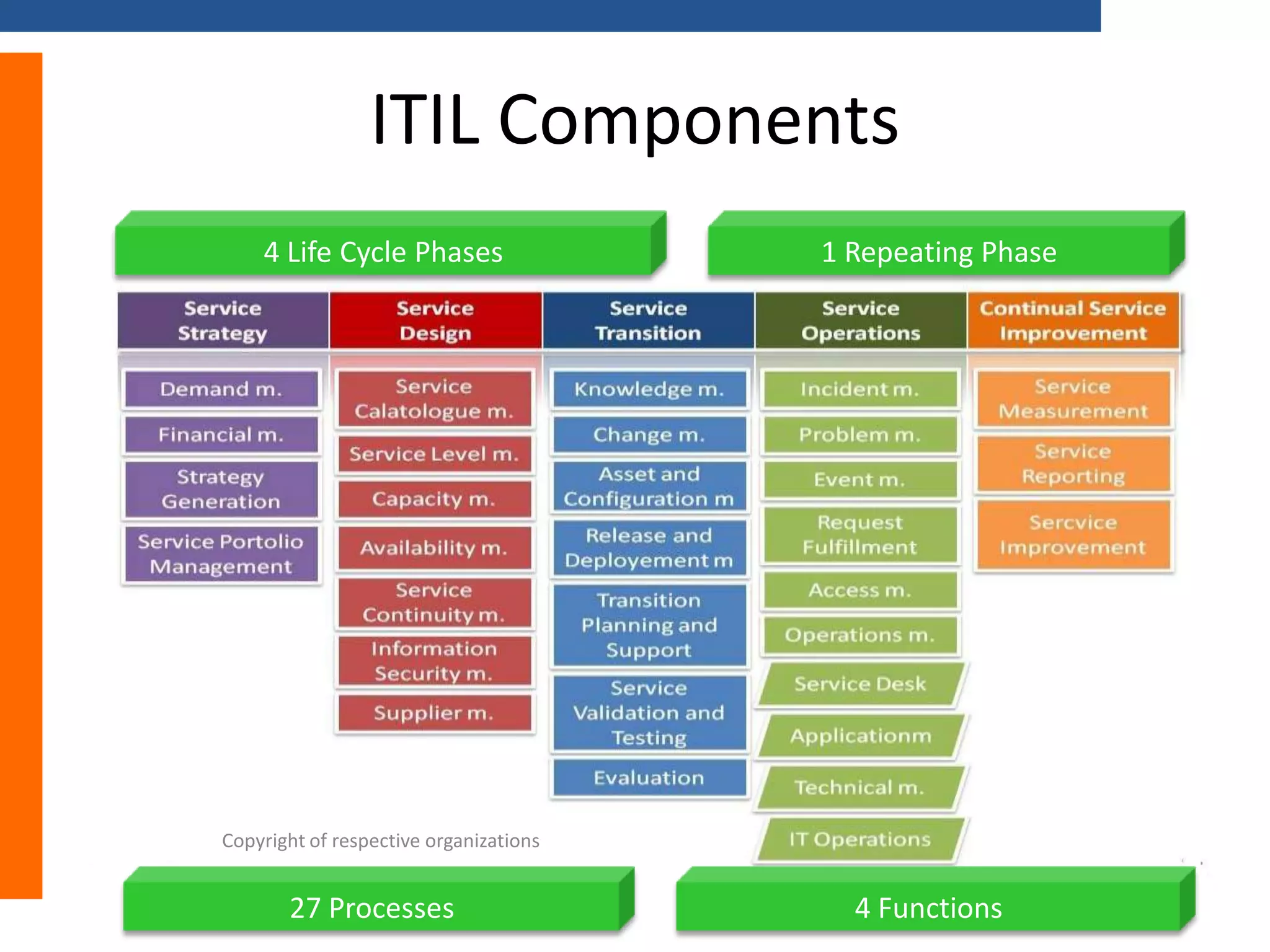
ITIL Components
4 Life Cycle Phases

1 Repeating Phase

Copyright of respective organizations

27 Processes

4 Functions

9
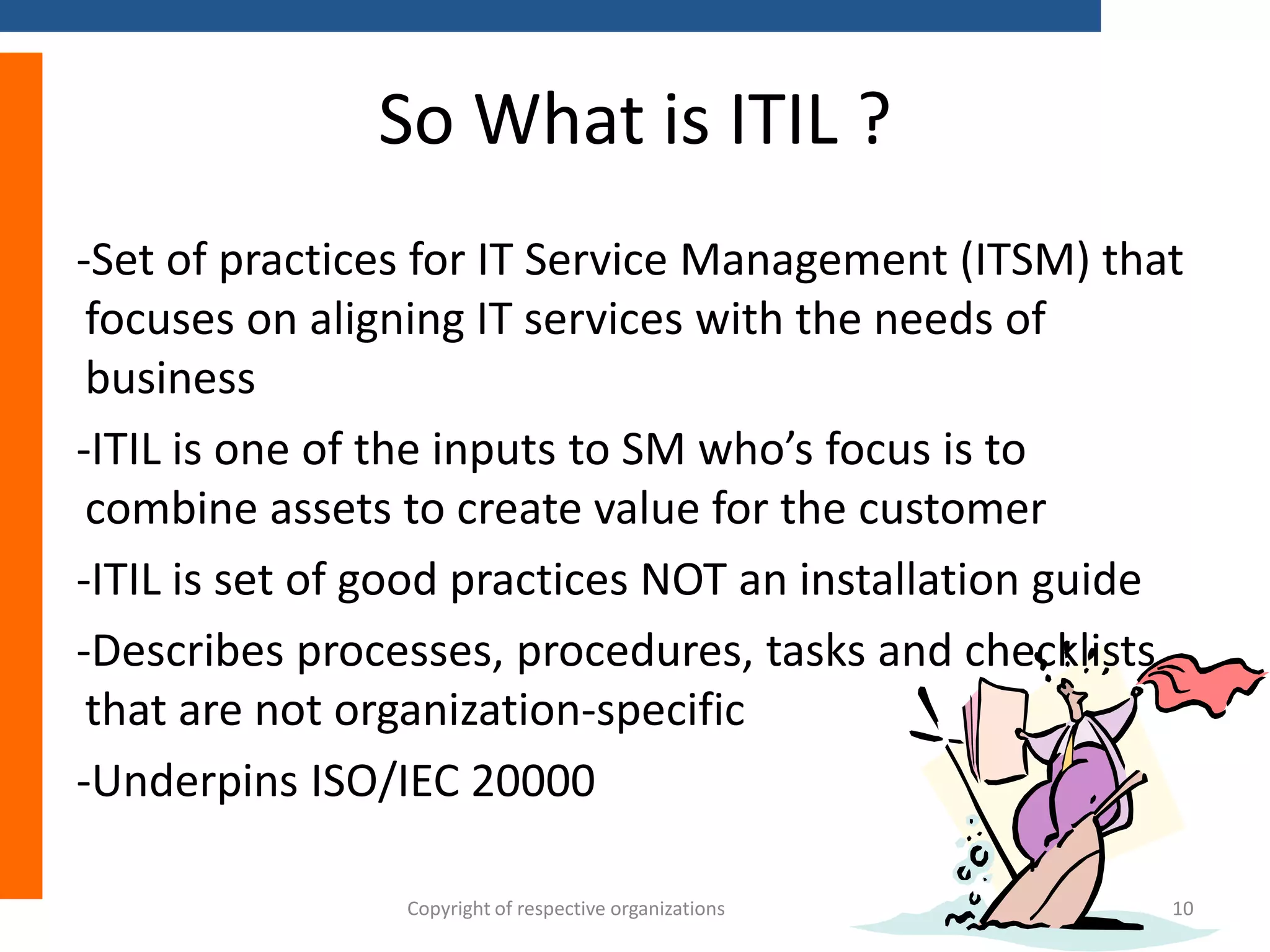
So What is ITIL ?
-Set of practices for IT Service Management (ITSM) that
focuses on aligning IT services with the needs of
business
-ITIL is one of the inputs to SM who’s focus is to
combine assets to create value for the customer
-ITIL is set of good practices NOT an installation guide
-Describes processes, procedures, tasks and checklists
that are not organization-specific
-Underpins ISO/IEC 20000
Copyright of respective organizations

10
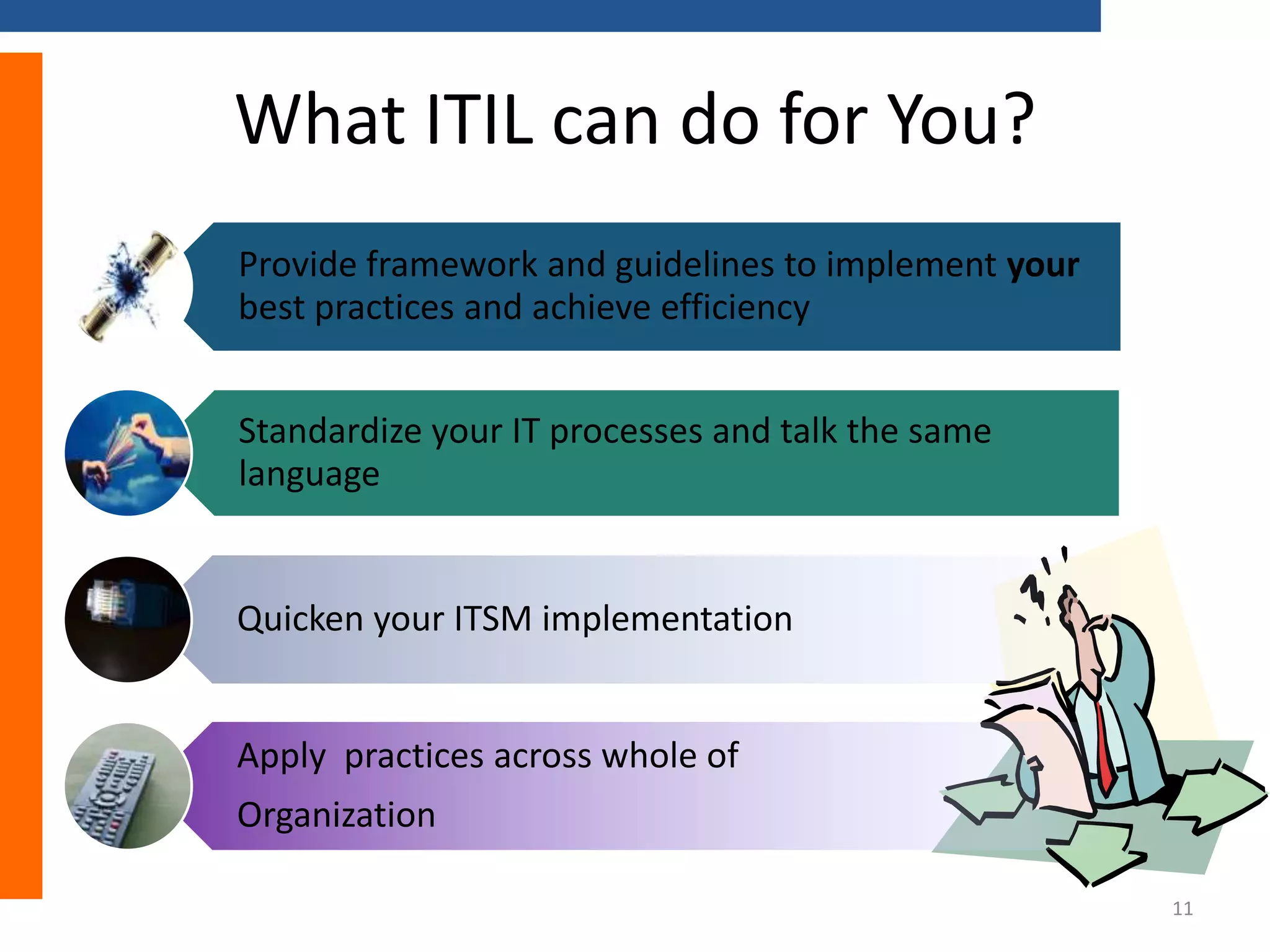
What ITIL can do for You?
Provide framework and guidelines to implement your
best practices and achieve efficiency
Standardize your IT processes and talk the same
language

Quicken your ITSM implementation

Apply practices across whole of

Organization
11
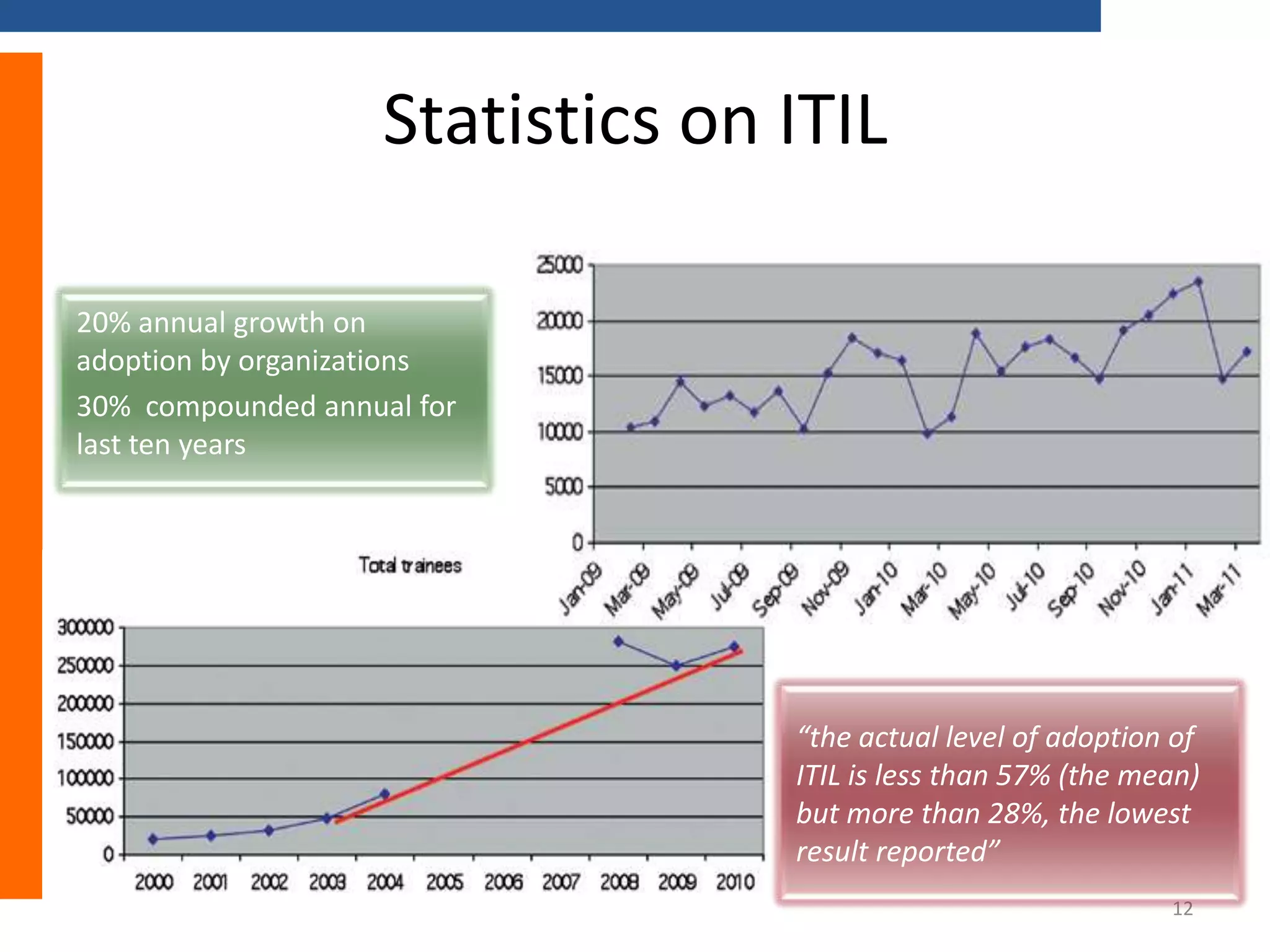
Statistics on ITIL
20% annual growth on
adoption by organizations
30% compounded annual for
last ten years

“the actual level of adoption of
ITIL is less than 57% (the mean)
but more than 28%, the lowest
result reported”
12
More Statistical responses – Why ITIL
Cost Control

Customer Satisfaction
Standardization of Service

Reduction of Downtime
Faster Response and resolution

“Interesting here that the primary focus
appears to be on cost control/damage
limitation, and not so much on ‘innovation’
and differentiating a business. It appears to
be seen very much as an operational thing
(think ITIL V2) as opposed to a strategic and
differentiating asset (think the ITIL V3
theory)”

IT workload improvements / efficiency
Business IT alignment / relationship
Monitoring IT Performance
Clear Roles and Responsibilities
Transparency
Improved Processes
13
ITIL and Process Maturity!
• As the maturity of the ITIL implementation increases, the
number of implemented processes also increases
• As the maturity increases, the challenges of implementation
decrease.
• As the maturity of ITIL implementation increases, so does the
number of realized benefits.
• Marginal returns can be observed after the implementation
reaches the defined (Level 3) maturity level.
• The perceived business-IT alignment increases as the maturity
of implementation increases

14
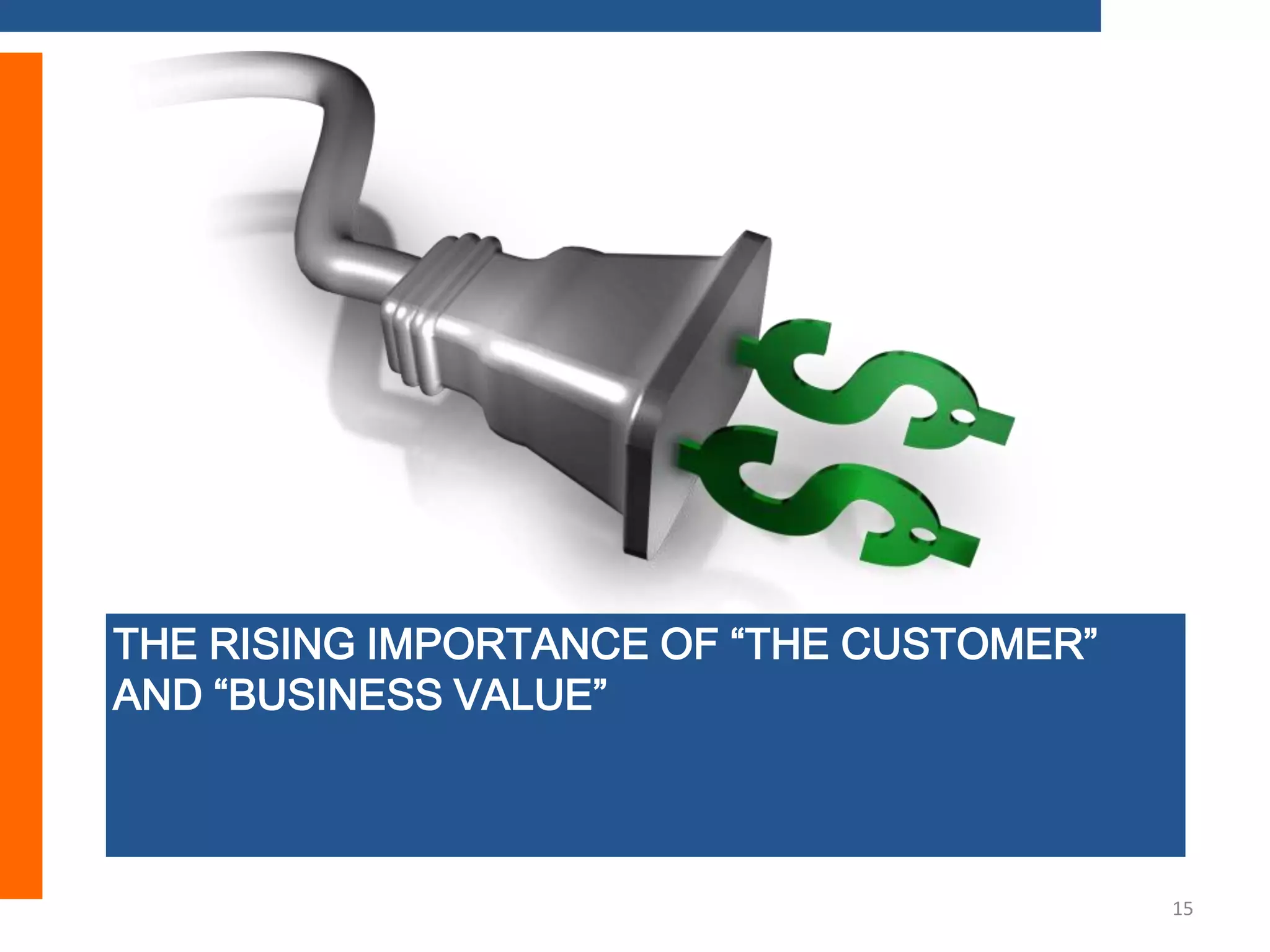
THE RISING IMPORTANCE OF “THE CUSTOMER”
AND “BUSINESS VALUE”

15
16
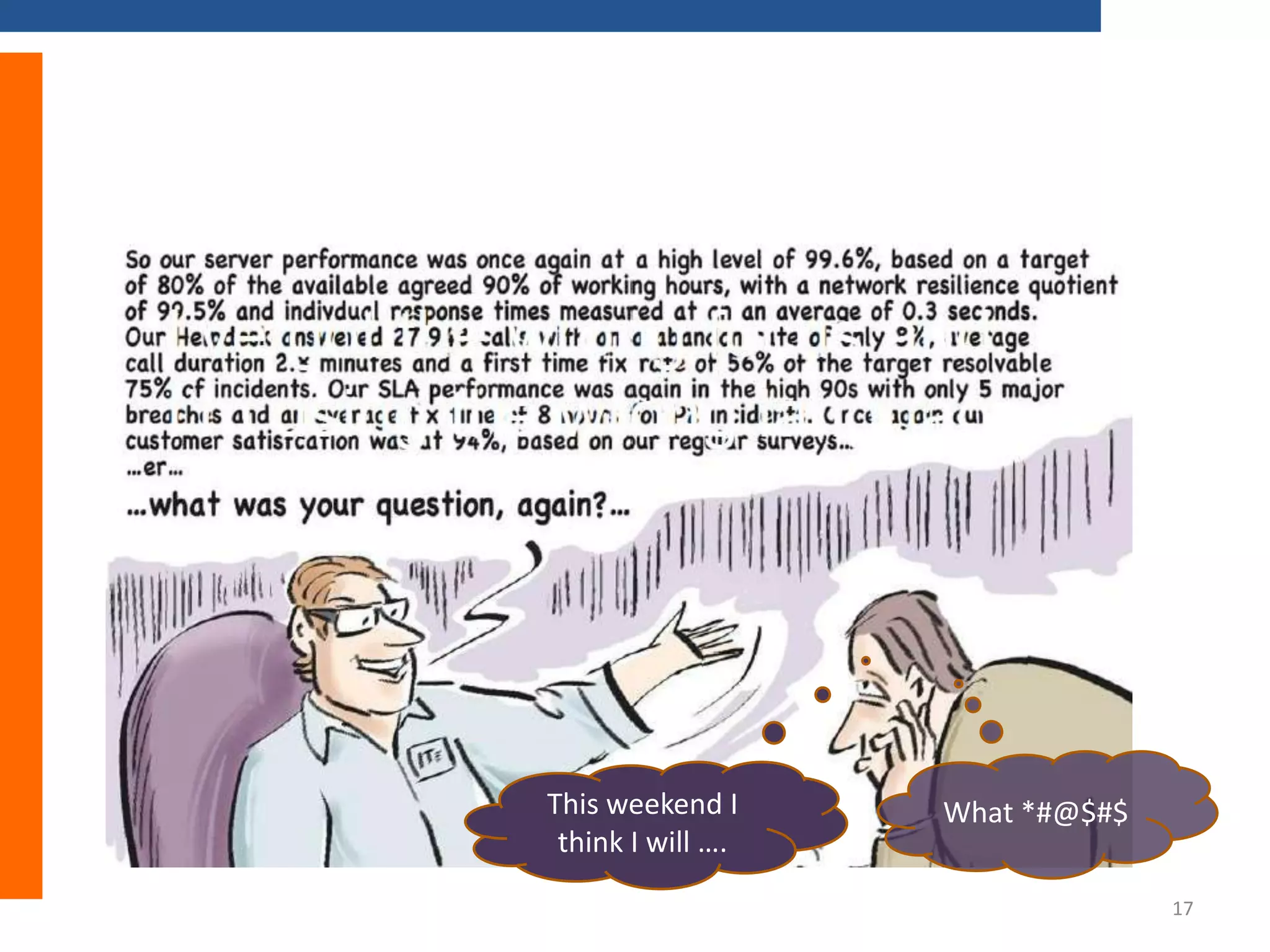
This weekend I
think I will ….

What *#@$#$
17
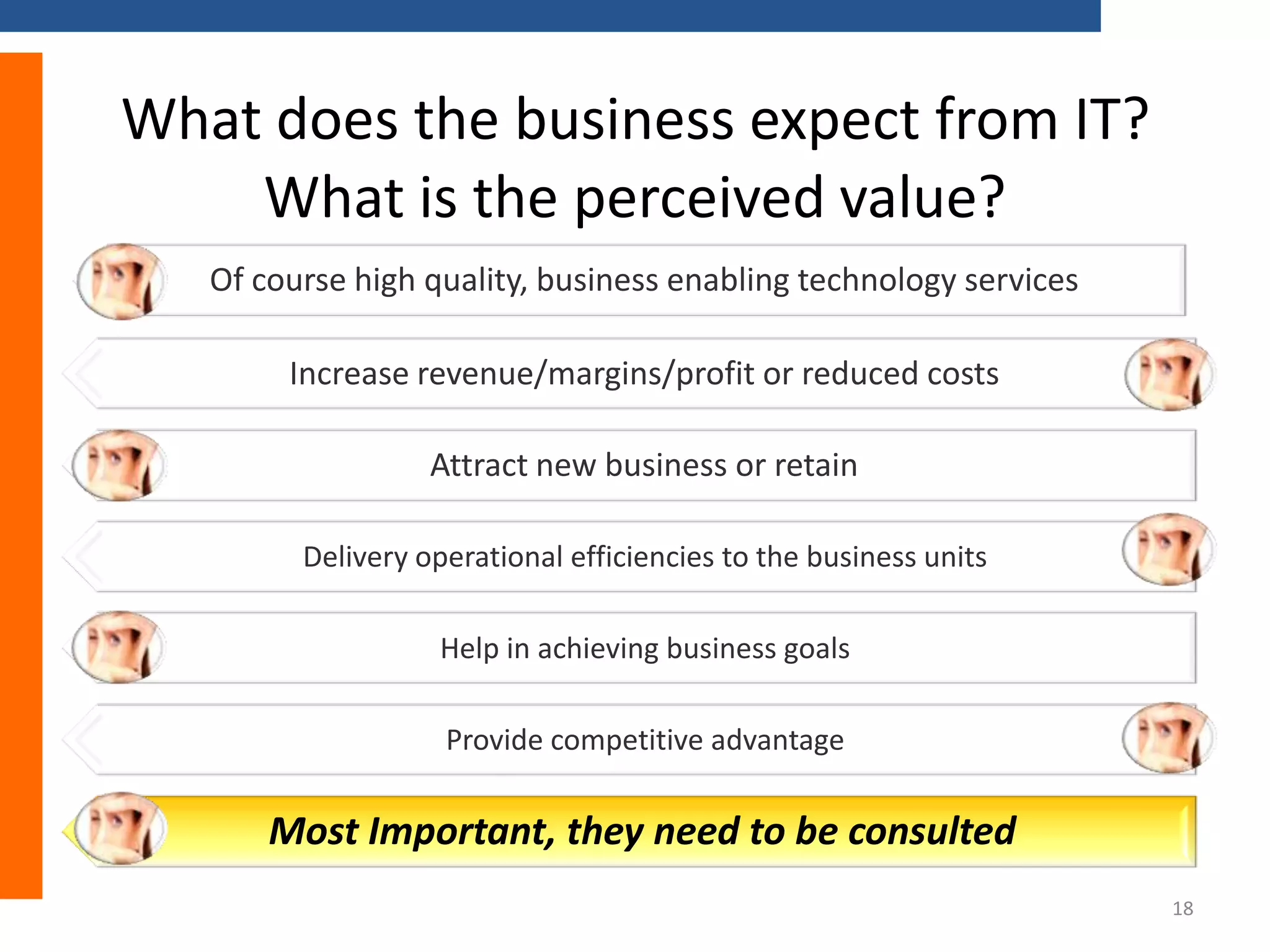
What does the business expect from IT?
What is the perceived value?
Of course high quality, business enabling technology services

Increase revenue/margins/profit or reduced costs
Attract new business or retain
Delivery operational efficiencies to the business units
Help in achieving business goals
Provide competitive advantage

Most Important, they need to be consulted
18
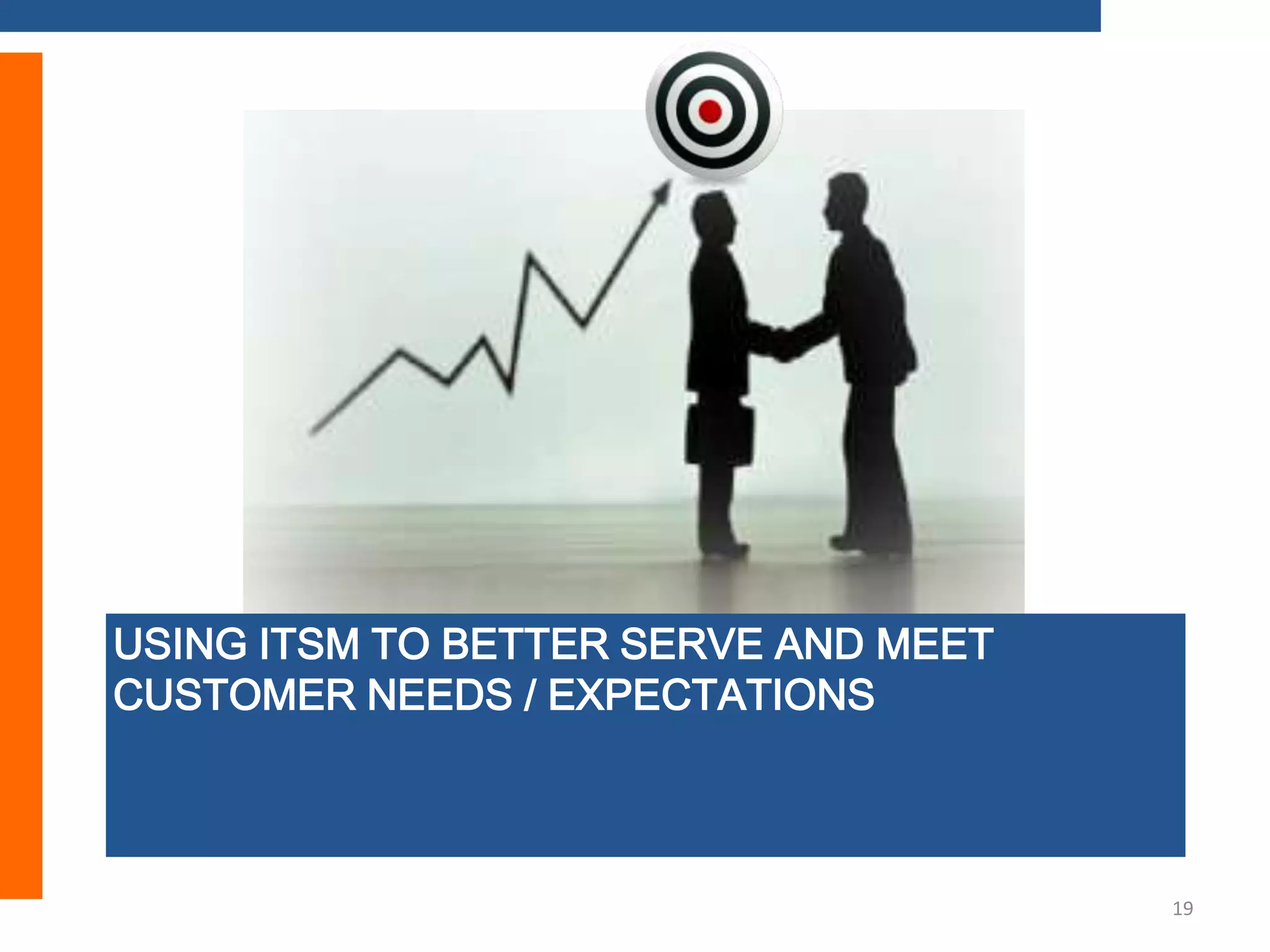
USING ITSM TO BETTER SERVE AND MEET
CUSTOMER NEEDS / EXPECTATIONS

19
Support People
and Process
Not Just
Technology
20
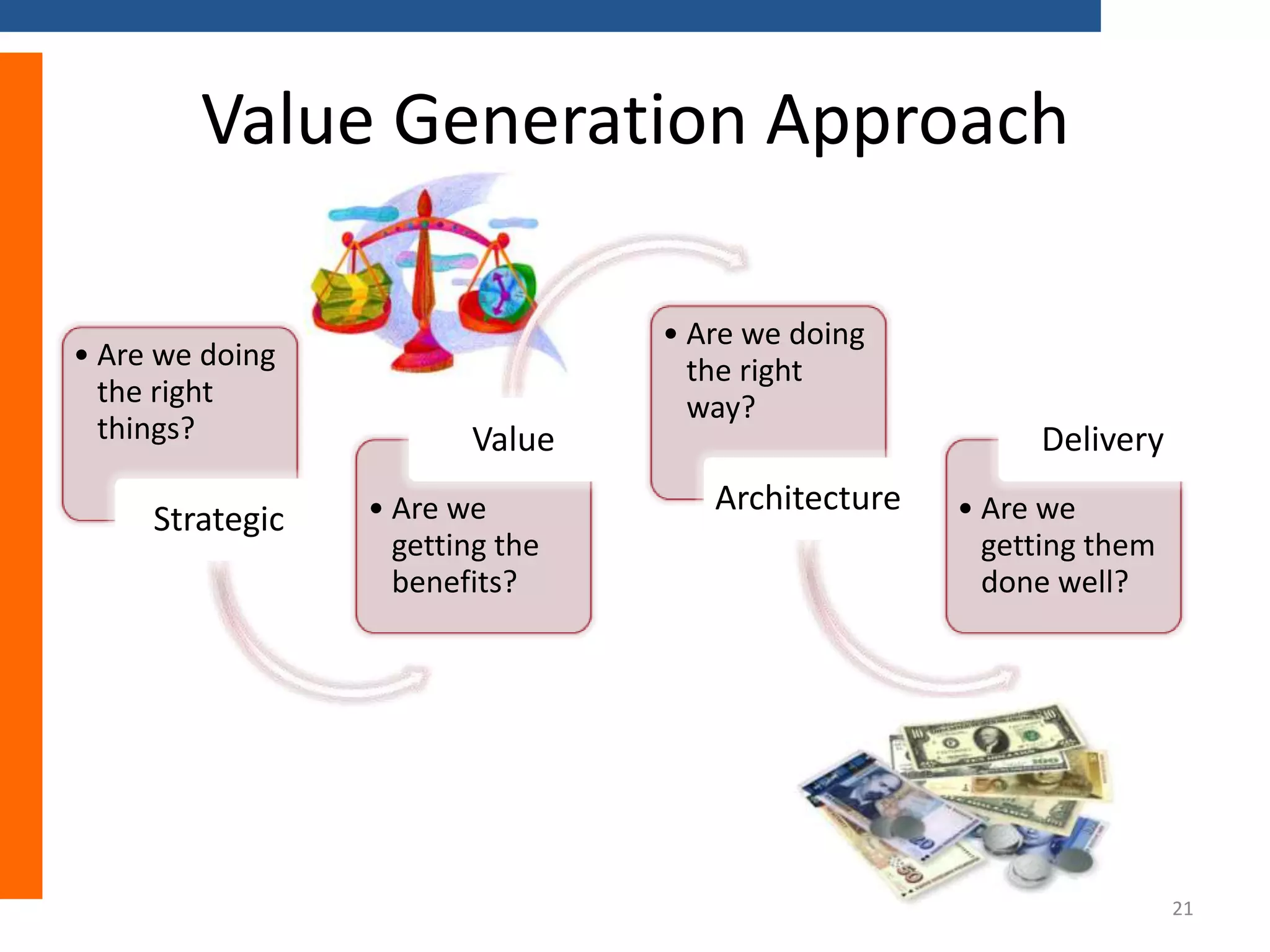
Value Generation Approach
• Are we doing
the right
things?

Strategic

Value
• Are we
getting the
benefits?

• Are we doing
the right
way?

Architecture

Delivery
• Are we
getting them
done well?

21
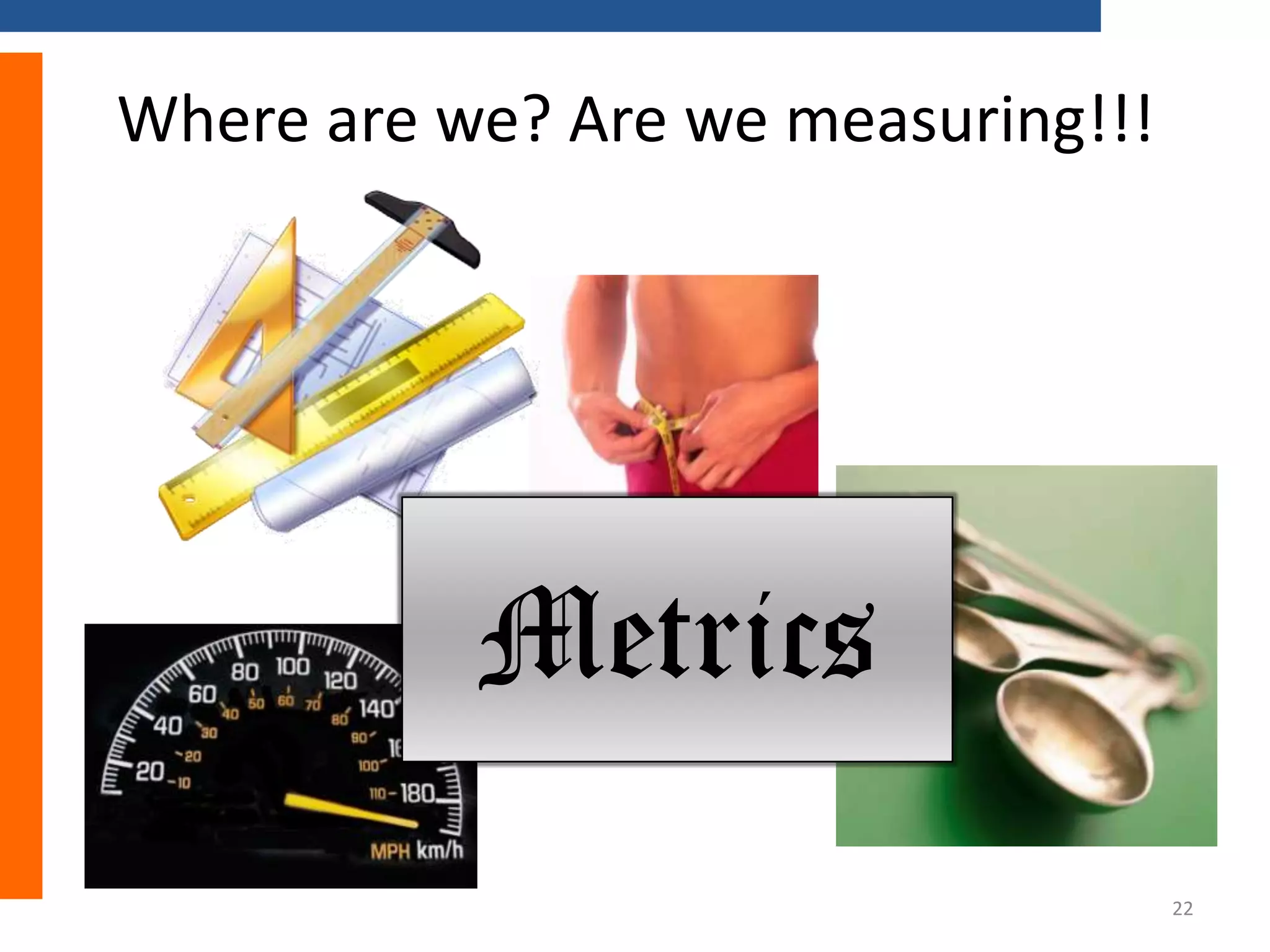
Where are we? Are we measuring!!!

Metrics
22
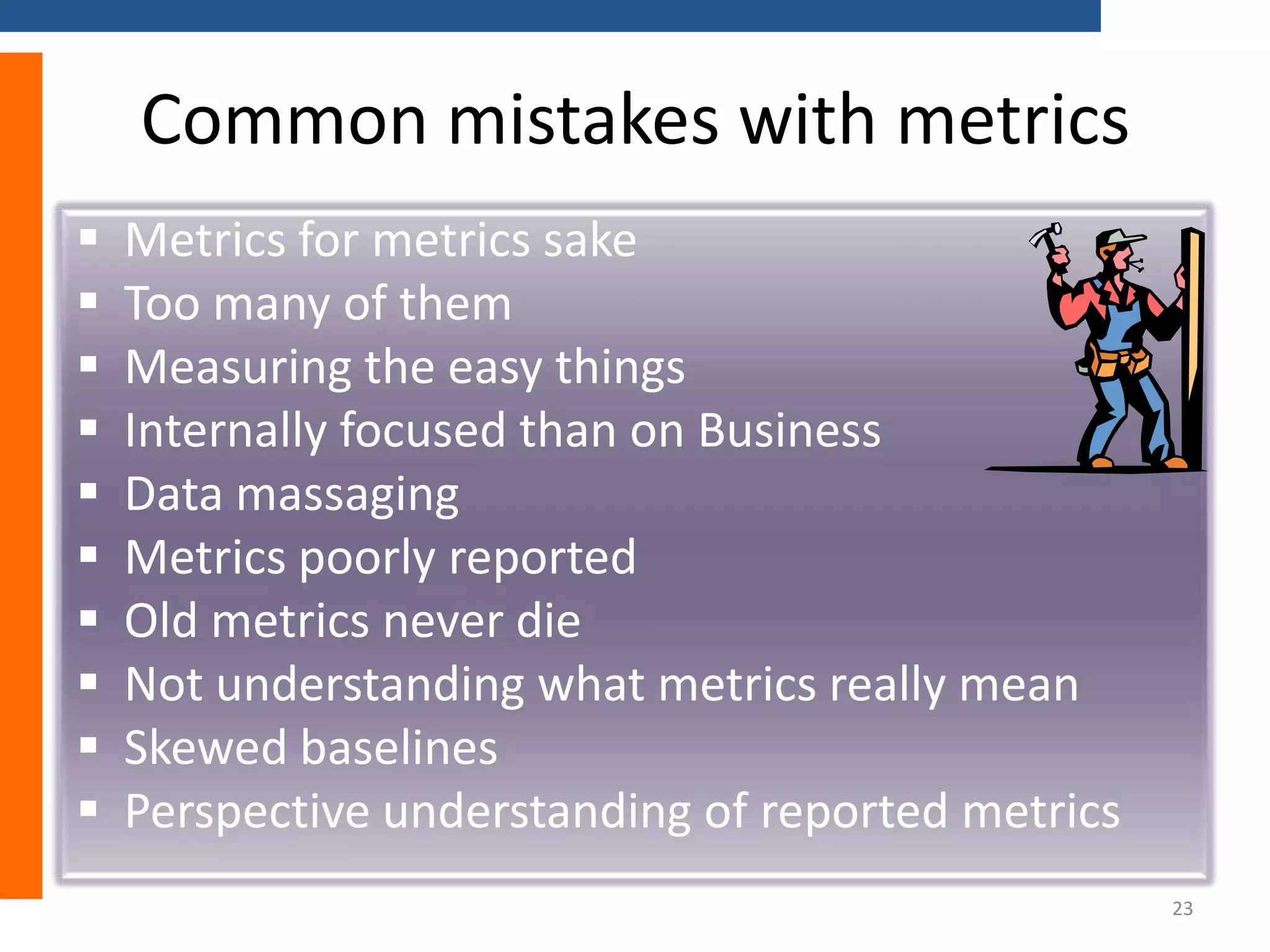
Common mistakes with metrics











Metrics for metrics sake
Too many of them
Measuring the easy things
Internally focused than on Business
Data massaging
Metrics poorly reported
Old metrics never die
Not understanding what metrics really mean
Skewed baselines
Perspective understanding of reported metrics
23
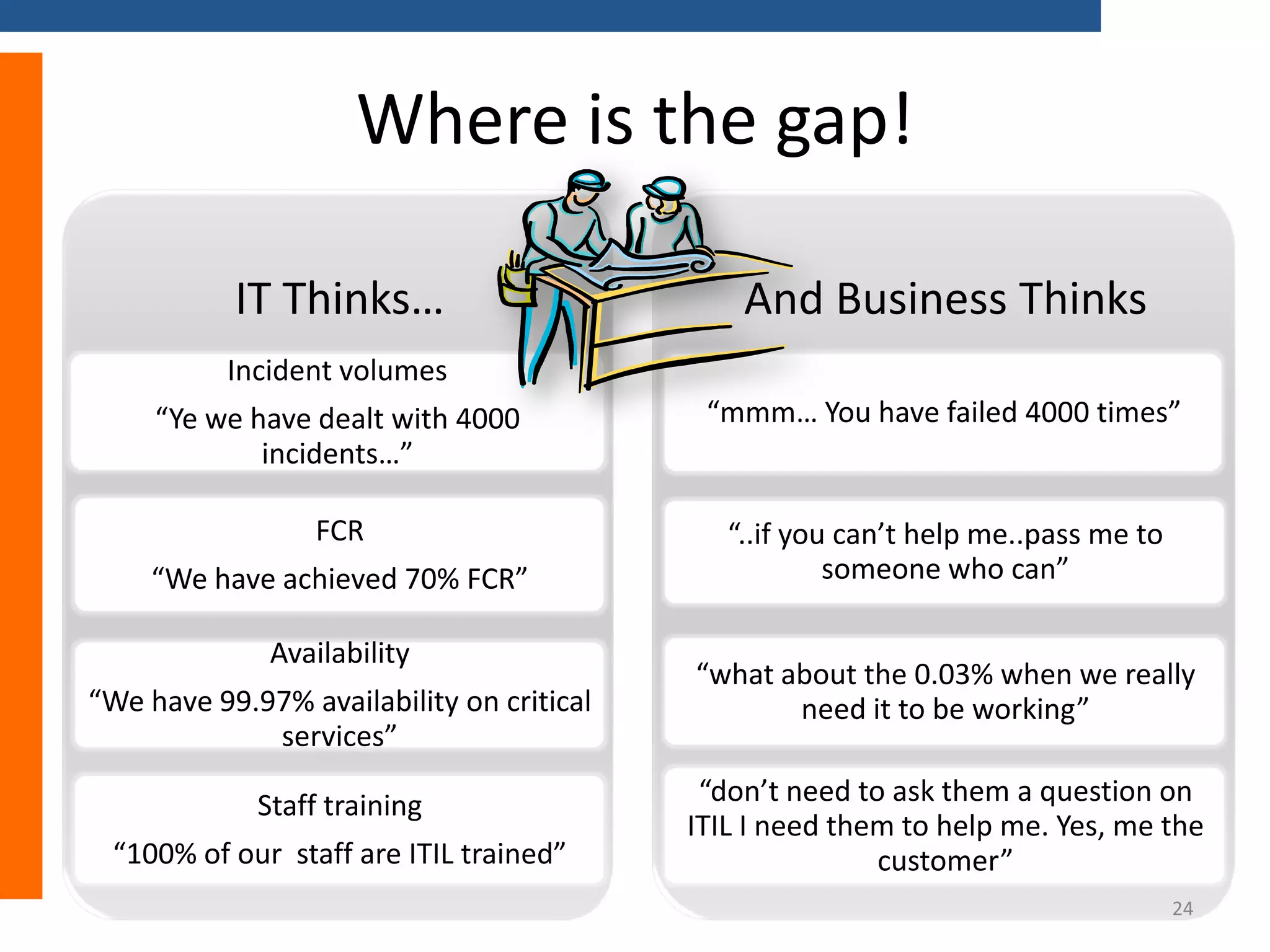
Where is the gap!
IT Thinks…

And Business Thinks

Incident volumes

“Ye we have dealt with 4000
incidents…”

“mmm… You have failed 4000 times”

FCR

“..if you can’t help me..pass me to
someone who can”

“We have achieved 70% FCR”

Availability
“We have 99.97% availability on critical
services”
Staff training
“100% of our staff are ITIL trained”

“what about the 0.03% when we really
need it to be working”
“don’t need to ask them a question on
ITIL I need them to help me. Yes, me the
customer”
24
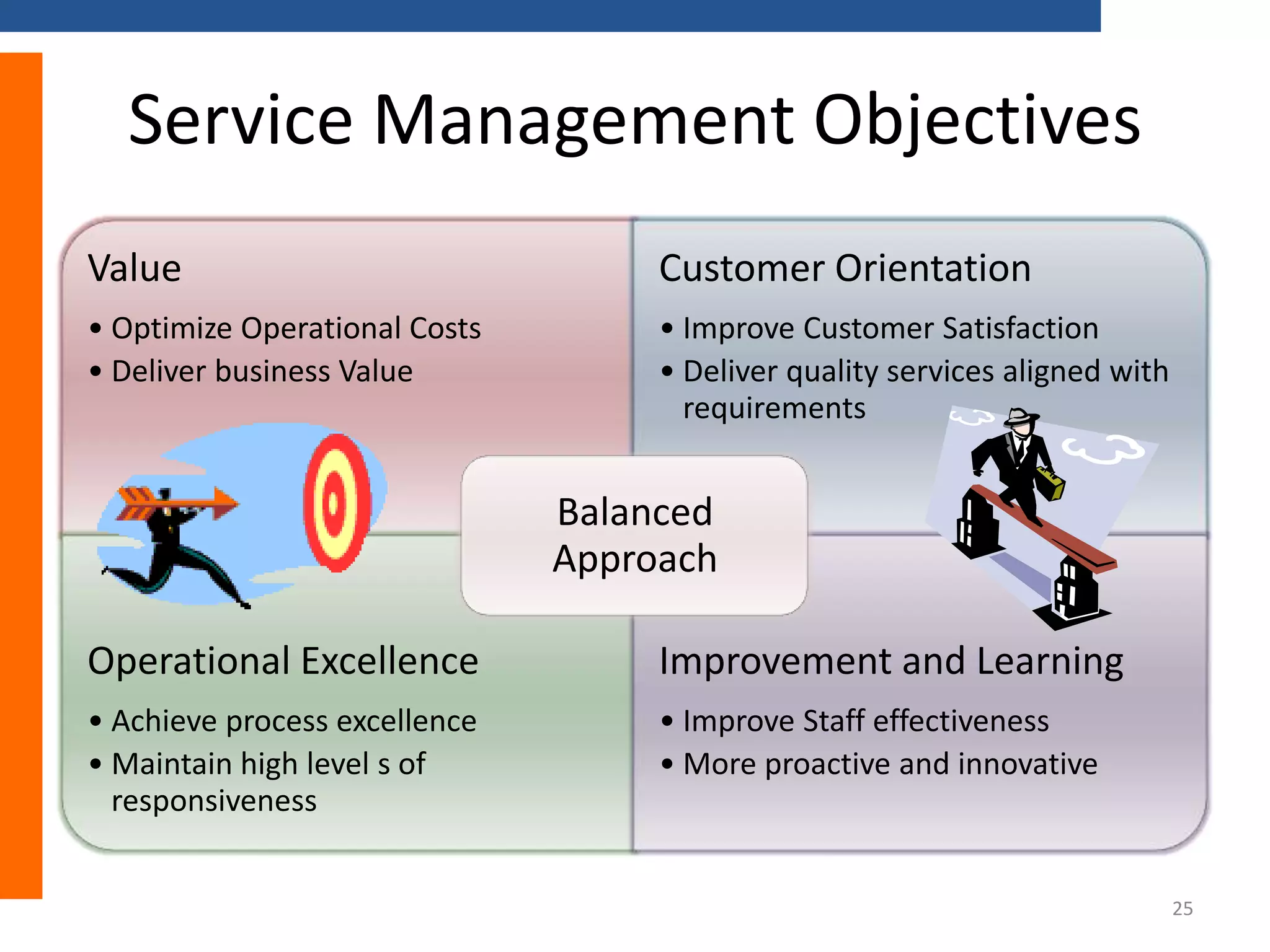
Service Management Objectives
Value

Customer Orientation

• Optimize Operational Costs
• Deliver business Value

• Improve Customer Satisfaction
• Deliver quality services aligned with
requirements

Balanced
Approach
Operational Excellence

Improvement and Learning

• Achieve process excellence
• Maintain high level s of
responsiveness

• Improve Staff effectiveness
• More proactive and innovative

25
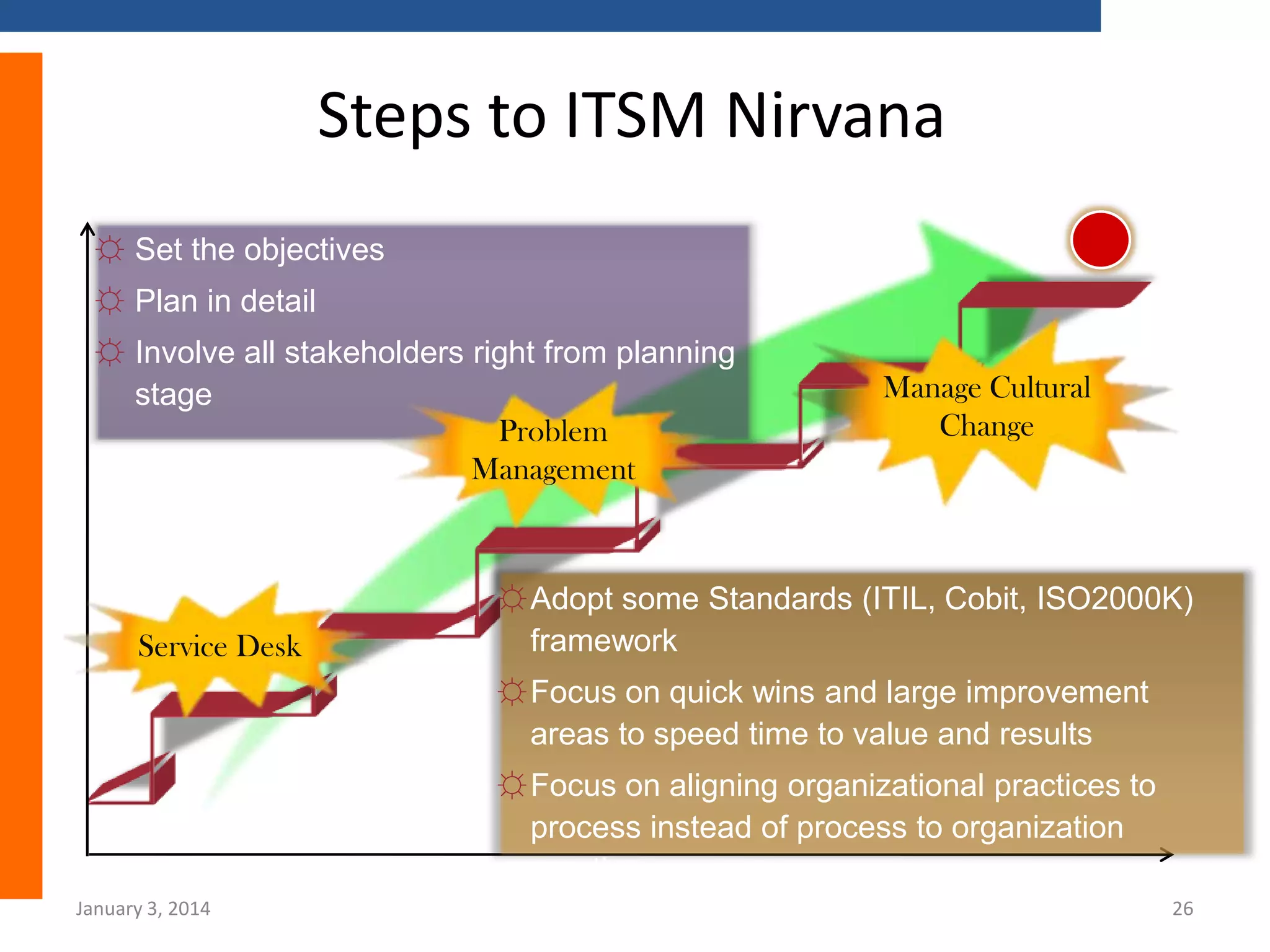
Steps to ITSM Nirvana
☼ Set the objectives
☼ Plan in detail
☼ Involve all stakeholders right from planning
stage
Problem
Management

Service Desk

.
Manage Cultural
Change

☼ Adopt some Standards (ITIL, Cobit, ISO2000K)
framework
☼ Focus on quick wins and large improvement
areas to speed time to value and results
☼ Focus on aligning organizational practices to
process instead of process to organization
practices

January 3, 2014

26
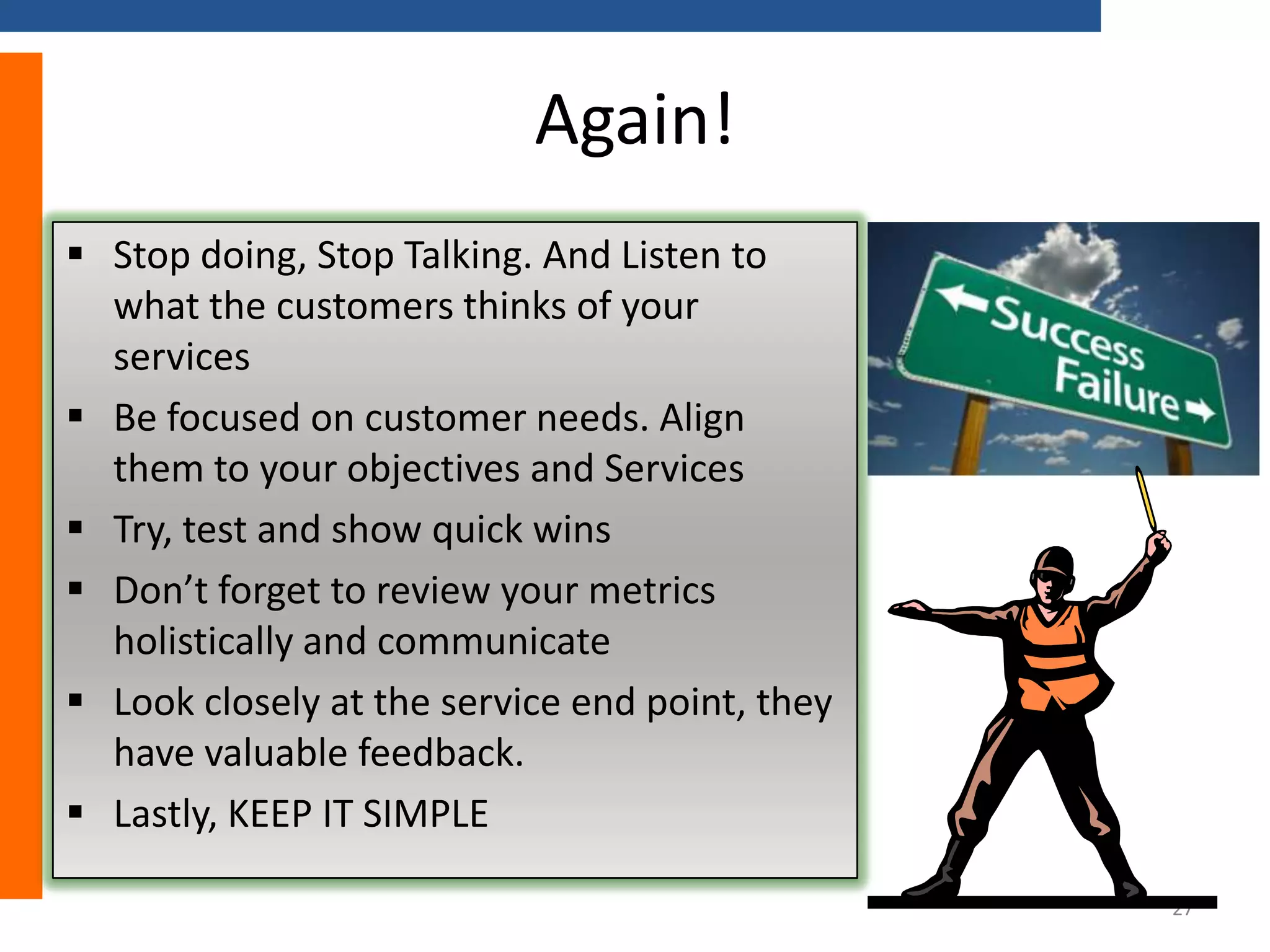
Again!
 Stop doing, Stop Talking. And Listen to
what the customers thinks of your
services
 Be focused on customer needs. Align
them to your objectives and Services
 Try, test and show quick wins
 Don’t forget to review your metrics
holistically and communicate
 Look closely at the service end point, they
have valuable feedback.
 Lastly, KEEP IT SIMPLE
27
FRANCIS D’SOUZA
http://www.linkedin.com/in/fdsouza
Francis consults, mentors and trains on IT Lifecycle Mangement.
He is currently consulting Serviceberry Technologies for IT Service
Management
28

Getting the Best Out of Service Management

  • 1.
    Getting the bestout of IT Service Management Francis D’Souza 1
  • 2.
    “The sole purposeof business is service…” – Leo Burnett “Management is doing things right…” – Peter Drucker “…Effective Management is discipline, carrying it out” – Stephen Covey “All time management begins with planning” – Tom Greening SERVICES ARE A ‘MEANS OF DELIVERING VALUE TO THE CUSTOMERS BY FACILITATING OUTCOMES CUSTOMERS WANT TO ACHIEVE, WITHOUT THE OWNERSHIP OF SPECIFIC COSTS AND RISKS’ – ITIL V3 Copyright of respective organizations and Individuals 2
  • 3.
    Lets talk aboutService Customer Laundry Carrier Washing Factory Price for the Service? Next Day:300 Same Day:500 In 4 H : 50 In 2 H : 100 In 4 H : 50 In 2 H : 100 SLA OLA 3
  • 4.
    Why IT Management? Business InformationTechnology Business Activities Information Management Technology Management Decide & Use Design & Control Build & Run 4
  • 5.
    From a businessperspective - IT in all its forms is probably the most expensive and powerful enabler/ disabler of business operation and performance today Effective ITSM' - is key to 'effective IT' - is key to 'effective Business’ 5
  • 6.
    What then is…ITSM? “The implementation and management of quality IT services that meet the needs of the business.” ~ ITIL “A discipline for managing IT systems, philosophically centered on the customer's perspective of IT's contribution to the business. ITSM stands in deliberate contrast to technologycentered approaches to IT management and business interaction.” ~ Wikipedia (Charlie Betz) “Service management is a systematic method for managing the offering, contracting and provisioning of services to customers, at a known quality, cost and designed experience. Service management ensures the desired results and customer satisfaction levels are achieved cost effectively, ...” ~ USMBOK 6
  • 7.
    IT Service Management ISM Industry& International Standards / Frameworks Copyright of respective organizations 7
  • 8.
  • 9.
    ITIL Components 4 LifeCycle Phases 1 Repeating Phase Copyright of respective organizations 27 Processes 4 Functions 9
  • 10.
    So What isITIL ? -Set of practices for IT Service Management (ITSM) that focuses on aligning IT services with the needs of business -ITIL is one of the inputs to SM who’s focus is to combine assets to create value for the customer -ITIL is set of good practices NOT an installation guide -Describes processes, procedures, tasks and checklists that are not organization-specific -Underpins ISO/IEC 20000 Copyright of respective organizations 10
  • 11.
    What ITIL cando for You? Provide framework and guidelines to implement your best practices and achieve efficiency Standardize your IT processes and talk the same language Quicken your ITSM implementation Apply practices across whole of Organization 11
  • 12.
    Statistics on ITIL 20%annual growth on adoption by organizations 30% compounded annual for last ten years “the actual level of adoption of ITIL is less than 57% (the mean) but more than 28%, the lowest result reported” 12
  • 13.
    More Statistical responses– Why ITIL Cost Control Customer Satisfaction Standardization of Service Reduction of Downtime Faster Response and resolution “Interesting here that the primary focus appears to be on cost control/damage limitation, and not so much on ‘innovation’ and differentiating a business. It appears to be seen very much as an operational thing (think ITIL V2) as opposed to a strategic and differentiating asset (think the ITIL V3 theory)” IT workload improvements / efficiency Business IT alignment / relationship Monitoring IT Performance Clear Roles and Responsibilities Transparency Improved Processes 13
  • 14.
    ITIL and ProcessMaturity! • As the maturity of the ITIL implementation increases, the number of implemented processes also increases • As the maturity increases, the challenges of implementation decrease. • As the maturity of ITIL implementation increases, so does the number of realized benefits. • Marginal returns can be observed after the implementation reaches the defined (Level 3) maturity level. • The perceived business-IT alignment increases as the maturity of implementation increases 14
  • 15.
    THE RISING IMPORTANCEOF “THE CUSTOMER” AND “BUSINESS VALUE” 15
  • 16.
  • 17.
    This weekend I thinkI will …. What *#@$#$ 17
  • 18.
    What does thebusiness expect from IT? What is the perceived value? Of course high quality, business enabling technology services Increase revenue/margins/profit or reduced costs Attract new business or retain Delivery operational efficiencies to the business units Help in achieving business goals Provide competitive advantage Most Important, they need to be consulted 18
  • 19.
    USING ITSM TOBETTER SERVE AND MEET CUSTOMER NEEDS / EXPECTATIONS 19
  • 20.
  • 21.
    Value Generation Approach •Are we doing the right things? Strategic Value • Are we getting the benefits? • Are we doing the right way? Architecture Delivery • Are we getting them done well? 21
  • 22.
    Where are we?Are we measuring!!! Metrics 22
  • 23.
    Common mistakes withmetrics           Metrics for metrics sake Too many of them Measuring the easy things Internally focused than on Business Data massaging Metrics poorly reported Old metrics never die Not understanding what metrics really mean Skewed baselines Perspective understanding of reported metrics 23
  • 24.
    Where is thegap! IT Thinks… And Business Thinks Incident volumes “Ye we have dealt with 4000 incidents…” “mmm… You have failed 4000 times” FCR “..if you can’t help me..pass me to someone who can” “We have achieved 70% FCR” Availability “We have 99.97% availability on critical services” Staff training “100% of our staff are ITIL trained” “what about the 0.03% when we really need it to be working” “don’t need to ask them a question on ITIL I need them to help me. Yes, me the customer” 24
  • 25.
    Service Management Objectives Value CustomerOrientation • Optimize Operational Costs • Deliver business Value • Improve Customer Satisfaction • Deliver quality services aligned with requirements Balanced Approach Operational Excellence Improvement and Learning • Achieve process excellence • Maintain high level s of responsiveness • Improve Staff effectiveness • More proactive and innovative 25
  • 26.
    Steps to ITSMNirvana ☼ Set the objectives ☼ Plan in detail ☼ Involve all stakeholders right from planning stage Problem Management Service Desk . Manage Cultural Change ☼ Adopt some Standards (ITIL, Cobit, ISO2000K) framework ☼ Focus on quick wins and large improvement areas to speed time to value and results ☼ Focus on aligning organizational practices to process instead of process to organization practices January 3, 2014 26
  • 27.
    Again!  Stop doing,Stop Talking. And Listen to what the customers thinks of your services  Be focused on customer needs. Align them to your objectives and Services  Try, test and show quick wins  Don’t forget to review your metrics holistically and communicate  Look closely at the service end point, they have valuable feedback.  Lastly, KEEP IT SIMPLE 27
  • 28.
    FRANCIS D’SOUZA http://www.linkedin.com/in/fdsouza Francis consults,mentors and trains on IT Lifecycle Mangement. He is currently consulting Serviceberry Technologies for IT Service Management 28