

CA Mainframe
Resource Intelligence
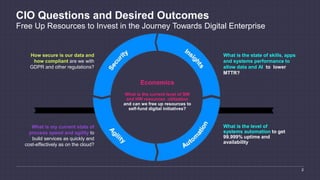
CIO Questions and Desired Outcomes
Free Up Resources to Invest in the Journey Towards Digital Enterprise
2
What is my current state of
process speed and agility to
build services as quickly and
cost-effectively as on the cloud?
What is the state of skills, apps
and systems performance to
allow data and AI to lower
MTTR?
What is the level of
systems automation to get
99.999% uptime and
availability
How secure is our data and
how compliant are we with
GDPR and other regulations?
What is the current level of SW
and HW resources utilization
and can we free up resources to
self-fund digital initiatives?
Economics
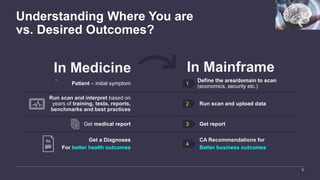
Understanding Where You are
vs. Desired Outcomes?
3
In Medicine
Patient – initial symptom
Run scan and interpret based on
years of training, tests, reports,
benchmarks and best practices
Get medical report
Get a Diagnoses
For better health outcomes
Define the area/domain to scan
(economics, security etc.)
Run scan and upload data
Get report
CA Recommendations for
Better business outcomes
1
2
3
4
In Mainframe
Rx
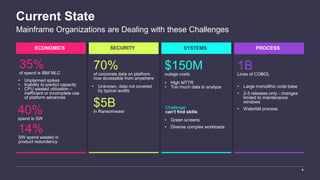
Current State
Mainframe Organizations are Dealing with these Challenges
4
ECONOMICS PROCESS
40%spend is SW
14%SW spend wasted in
product redundancy
35%of spend is IBM MLC
• Unplanned spikes
• Inability to predict capacity
• CPU wasted utilization –
inefficient or incomplete use
of platform advances
SYSTEMS
$150Moutage costs
• High MTTR
• Too much data to analyze
Challenge:
can’t find skills
• Green screens
• Diverse complex workloads
1BLines of COBOL
• Large monolithic code base
• 2-3 releases only - changes
limited to maintenance
windows
• Waterfall process
SECURITY
70%of corporate data on platform
now accessible from anywhere
$5Bin Ransomware
• Unknown, data not covered
by typical audits
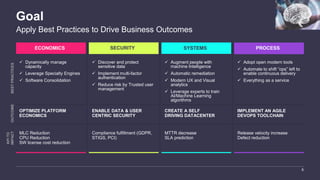
Goal
Apply Best Practices to Drive Business Outcomes
5
 Dynamically manage
capacity
 Leverage Specialty Engines
 Software Consolidation
OPTIMIZE PLATFORM
ECONOMICS
MLC Reduction
CPU Reduction
SW license cost reduction
 Adopt open modern tools
 Automate to shift “ops” left to
enable continuous delivery
 Everything as a service
IMPLEMENT AN AGILE
DEVOPS TOOLCHAIN
 Augment people with
machine Intelligence
 Automatic remediation
 Modern UX and Visual
analytics
 Leverage experts to train
AI/Machine Learning
algorithms
CREATE A SELF
DRIVING DATACENTER
MTTR decrease
SLA prediction
Release velocity increase
Defect reduction
 Discover and protect
sensitive data
 Implement multi-factor
authentication
 Reduce risk by Trusted user
management
ENABLE DATA & USER
CENTRIC SECURITY
Compliance fulfillment (GDPR,
STIGS, PCI)
BESTPRACTICESOUTCOME
KPITO
IMPACT
ECONOMICS PROCESSSYSTEMSSECURITY
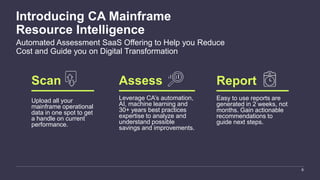
Introducing CA Mainframe
Resource Intelligence
Automated Assessment SaaS Offering to Help you Reduce
Cost and Guide you on Digital Transformation
6
Scan
Upload all your
mainframe operational
data in one spot to get
a handle on current
performance.
Assess
Leverage CA’s automation,
AI, machine learning and
30+ years best practices
expertise to analyze and
understand possible
savings and improvements.
Report
Easy to use reports are
generated in 2 weeks, not
months. Gain actionable
recommendations to
guide next steps.
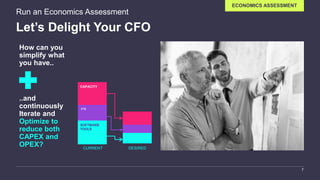
Let’s Delight Your CFO
Run an Economics Assessment
7
How can you
simplify what
you have..
..and
continuously
Iterate and
Optimize to
reduce both
CAPEX and
OPEX?
FTE
CAPACITY
CURRENT DESIRED
SOFTWARE
TOOLS
ECONOMICS ASSESSMENT
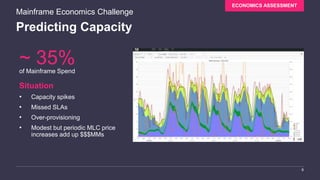
Predicting Capacity
Mainframe Economics Challenge
8
ECONOMICS ASSESSMENT
~ 35%of Mainframe Spend
Situation
• Capacity spikes
• Missed SLAs
• Over-provisioning
• Modest but periodic MLC price
increases add up $$$MMs
Under-utilization of Tools
Mainframe Economics Concern
Source: https://diginomica.com/2017/07/20/mainframe-still-matters-skills-crisis-attached/
9
ECONOMICS ASSESSMENT
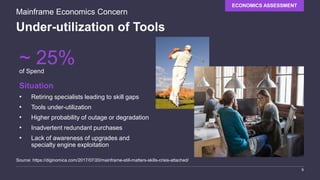
~ 25%of Spend
Situation
• Retiring specialists leading to skill gaps
• Tools under-utilization
• Higher probability of outage or degradation
• Inadvertent redundant purchases
• Lack of awareness of upgrades and
specialty engine exploitation
Software Costs
Mainframe Economics Concern
10
ECONOMICS ASSESSMENT
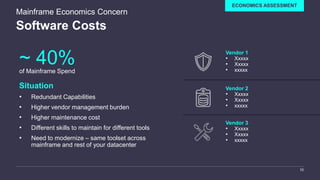
~ 40%of Mainframe Spend
Situation
• Redundant Capabilities
• Higher vendor management burden
• Higher maintenance cost
• Different skills to maintain for different tools
• Need to modernize – same toolset across
mainframe and rest of your datacenter
Vendor 1
• Xxxxx
• Xxxxx
• xxxxx
Vendor 2
• Xxxxx
• Xxxxx
• xxxxx
Vendor 3
• Xxxxx
• Xxxxx
• xxxxx
Here are the
Best Practices
to Optimize
the Platform
• Optimize capacity
• Leverage Specialty Engines
and product health-checks
• Discover all your software
ECONOMICS ASSESSMENT
See How CA
Mainframe Resource
Intelligence Works and
Delivers Economics
Assessments
CA Mainframe Resource
Intelligence Capabilities
13
Scan
Upload all your
mainframe operational
data in one spot to get
a handle on current
performance.
Assess
Leverage CA’s automation,
AI, machine learning and
30+ years best practices
expertise to analyze and
understand possible
savings and improvements.
Report
Easy to use reports are
generated in 2 weeks, not
months. Gain actionable
recommendations to
guide next steps.
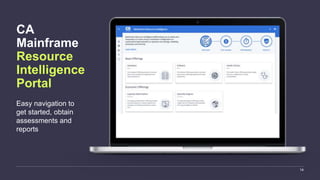
CA
Mainframe
Resource
Intelligence
Portal
Easy navigation to
get started, obtain
assessments and
reports
14
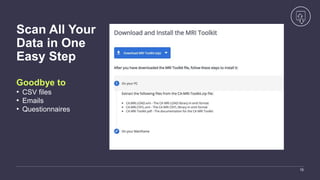
Scan All Your
Data in One
Easy Step
Goodbye to
• CSV files
• Emails
• Questionnaires
15
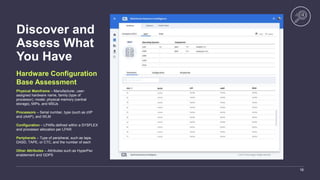
Discover and
Assess What
You Have
Hardware Configuration
Base Assessment
Physical Mainframe – Manufacturer, user-
assigned hardware name, family (type of
processor), model, physical memory (central
storage), MIPs, and MSUs
Processors – Serial number, type (such as zIIP
and zAAP), and WLM
Configuration – LPARs defined within a SYSPLEX
and processor allocation per LPAR
Peripherals – Type of peripheral, such as tape,
DASD, TAPE, or CTC, and the number of each
Other Attributes – Attributes such as HyperPav
enablement and GDPS
16
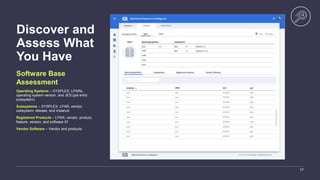
Discover and
Assess What
You Have
Software Base
Assessment
Operating Systems – SYSPLEX, LPARs,
operating system version, and JES (job entry
subsystem)
Subsystems – SYSPLEX, LPAR, vendor,
subsystem, release, and instance
Registered Products – LPAR, vendor, product,
feature, version, and software ID
Vendor Software – Vendor and products
17
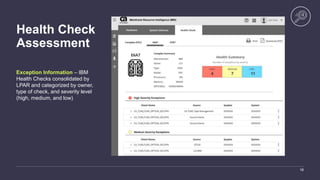
Health Check
Assessment
Exception Information – IBM
Health Checks consolidated by
LPAR and categorized by owner,
type of check, and severity level
(high, medium, and low)
18
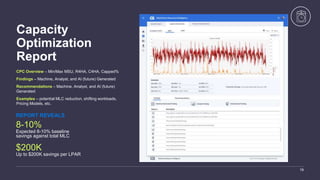
Capacity
Optimization
Report
CPC Overview – Min/Max MSU, R4HA, C4HA, Capped%
Findings – Machine, Analyst, and AI (future) Generated
Recommendations – Machine, Analyst, and AI (future)
Generated
Examples – potential MLC reduction, shifting workloads,
Pricing Models, etc.
19
REPORT REVEALS
8-10%
Expected 8-10% baseline
savings against total MLC
$200K
Up to $200K savings per LPAR
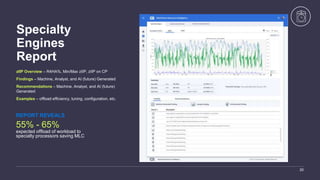
Specialty
Engines
Report
zIIP Overview – R4HA%, Min/Max zIIP, zIIP on CP
Findings – Machine, Analyst, and AI (future) Generated
Recommendations – Machine, Analyst, and AI (future)
Generated
Examples – offload efficiency, tuning, configuration, etc.
20
REPORT REVEALS
55% - 65%
expected offload of workload to
specialty processors saving MLC
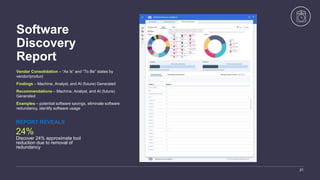
Software
Discovery
Report
Vendor Consolidation – “As Is” and “To Be” states by
vendor/product
Findings – Machine, Analyst, and AI (future) Generated
Recommendations – Machine, Analyst, and AI (future)
Generated
Examples – potential software savings, eliminate software
redundancy, identify software usage
21
REPORT REVEALS
24%
Discover 24% approximate tool
reduction due to removal of
redundancy
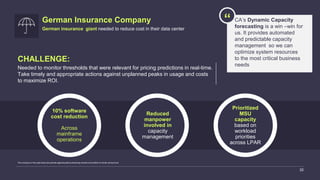
CA’s Dynamic Capacity
forecasting is a win –win for
us. It provides automated
and predictable capacity
management so we can
optimize system resources
to the most critical business
needs
CHALLENGE:
Needed to monitor thresholds that were relevant for pricing predictions in real-time.
Take timely and appropriate actions against unplanned peaks in usage and costs
to maximize ROI.
German Insurance Company
German insurance giant needed to reduce cost in their data center
22
10% software
cost reduction
Across
mainframe
operations
Reduced
manpower
involved in
capacity
management
Prioritized
MSU
capacity
based on
workload
priorities
across LPAR
The company in this case study has policies against publicly endorsing vendors and prefers to remain anonymous.
“
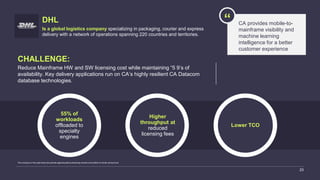
CHALLENGE:
Reduce Mainframe HW and SW licensing cost while maintaining “5 9’s of
availability. Key delivery applications run on CA’s highly resilient CA Datacom
database technologies.
DHL
Is a global logistics company specializing in packaging, courier and express
delivery with a network of operations spanning 220 countries and territories.
23
CA provides mobile-to-
mainframe visibility and
machine learning
intelligence for a better
customer experience
55% of
workloads
offloaded to
specialty
engines
Higher
throughput at
reduced
licensing fees
Lower TCO
The company in this case study has policies against publicly endorsing vendors and prefers to remain anonymous.
“
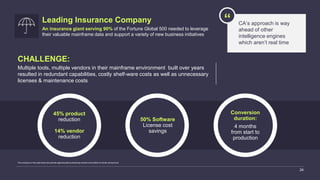
CA’s approach is way
ahead of other
intelligence engines
which aren’t real time
CHALLENGE:
Multiple tools, multiple vendors in their mainframe environment built over years
resulted in redundant capabilities, costly shelf-ware costs as well as unnecessary
licenses & maintenance costs
Leading Insurance Company
An insurance giant serving 90% of the Fortune Global 500 needed to leverage
their valuable mainframe data and support a variety of new business initiatives
24
45% product
reduction
14% vendor
reduction
50% Software
License cost
savings
Conversion
duration:
4 months
from start to
production
The company in this case study has policies against publicly endorsing vendors and prefers to remain anonymous.
“
• Tell your CA Account Director
• Tell us about your concerns and overall
business challenge
CONTACT US!
• Provide a list of your vendors, tools, & current
capacity status
• Jointly determine the type of review for maximum
near term benefit
PARTNERING FOR SUCCESS
• Get your saving assessment from CA
• Determine next steps for implementation
• Feel confident that CA’s there for you
today and tomorrow
CELEBRATE

CA Mainframe Resource Intelligence

  • 1.
  • 2.
    CIO Questions andDesired Outcomes Free Up Resources to Invest in the Journey Towards Digital Enterprise 2 What is my current state of process speed and agility to build services as quickly and cost-effectively as on the cloud? What is the state of skills, apps and systems performance to allow data and AI to lower MTTR? What is the level of systems automation to get 99.999% uptime and availability How secure is our data and how compliant are we with GDPR and other regulations? What is the current level of SW and HW resources utilization and can we free up resources to self-fund digital initiatives? Economics
  • 3.
    Understanding Where Youare vs. Desired Outcomes? 3 In Medicine Patient – initial symptom Run scan and interpret based on years of training, tests, reports, benchmarks and best practices Get medical report Get a Diagnoses For better health outcomes Define the area/domain to scan (economics, security etc.) Run scan and upload data Get report CA Recommendations for Better business outcomes 1 2 3 4 In Mainframe Rx
  • 4.
    Current State Mainframe Organizationsare Dealing with these Challenges 4 ECONOMICS PROCESS 40%spend is SW 14%SW spend wasted in product redundancy 35%of spend is IBM MLC • Unplanned spikes • Inability to predict capacity • CPU wasted utilization – inefficient or incomplete use of platform advances SYSTEMS $150Moutage costs • High MTTR • Too much data to analyze Challenge: can’t find skills • Green screens • Diverse complex workloads 1BLines of COBOL • Large monolithic code base • 2-3 releases only - changes limited to maintenance windows • Waterfall process SECURITY 70%of corporate data on platform now accessible from anywhere $5Bin Ransomware • Unknown, data not covered by typical audits
  • 5.
    Goal Apply Best Practicesto Drive Business Outcomes 5  Dynamically manage capacity  Leverage Specialty Engines  Software Consolidation OPTIMIZE PLATFORM ECONOMICS MLC Reduction CPU Reduction SW license cost reduction  Adopt open modern tools  Automate to shift “ops” left to enable continuous delivery  Everything as a service IMPLEMENT AN AGILE DEVOPS TOOLCHAIN  Augment people with machine Intelligence  Automatic remediation  Modern UX and Visual analytics  Leverage experts to train AI/Machine Learning algorithms CREATE A SELF DRIVING DATACENTER MTTR decrease SLA prediction Release velocity increase Defect reduction  Discover and protect sensitive data  Implement multi-factor authentication  Reduce risk by Trusted user management ENABLE DATA & USER CENTRIC SECURITY Compliance fulfillment (GDPR, STIGS, PCI) BESTPRACTICESOUTCOME KPITO IMPACT ECONOMICS PROCESSSYSTEMSSECURITY
  • 6.
    Introducing CA Mainframe ResourceIntelligence Automated Assessment SaaS Offering to Help you Reduce Cost and Guide you on Digital Transformation 6 Scan Upload all your mainframe operational data in one spot to get a handle on current performance. Assess Leverage CA’s automation, AI, machine learning and 30+ years best practices expertise to analyze and understand possible savings and improvements. Report Easy to use reports are generated in 2 weeks, not months. Gain actionable recommendations to guide next steps.
  • 7.
    Let’s Delight YourCFO Run an Economics Assessment 7 How can you simplify what you have.. ..and continuously Iterate and Optimize to reduce both CAPEX and OPEX? FTE CAPACITY CURRENT DESIRED SOFTWARE TOOLS ECONOMICS ASSESSMENT
  • 8.
    Predicting Capacity Mainframe EconomicsChallenge 8 ECONOMICS ASSESSMENT ~ 35%of Mainframe Spend Situation • Capacity spikes • Missed SLAs • Over-provisioning • Modest but periodic MLC price increases add up $$$MMs
  • 9.
    Under-utilization of Tools MainframeEconomics Concern Source: https://diginomica.com/2017/07/20/mainframe-still-matters-skills-crisis-attached/ 9 ECONOMICS ASSESSMENT ~ 25%of Spend Situation • Retiring specialists leading to skill gaps • Tools under-utilization • Higher probability of outage or degradation • Inadvertent redundant purchases • Lack of awareness of upgrades and specialty engine exploitation
  • 10.
    Software Costs Mainframe EconomicsConcern 10 ECONOMICS ASSESSMENT ~ 40%of Mainframe Spend Situation • Redundant Capabilities • Higher vendor management burden • Higher maintenance cost • Different skills to maintain for different tools • Need to modernize – same toolset across mainframe and rest of your datacenter Vendor 1 • Xxxxx • Xxxxx • xxxxx Vendor 2 • Xxxxx • Xxxxx • xxxxx Vendor 3 • Xxxxx • Xxxxx • xxxxx
  • 11.
    Here are the BestPractices to Optimize the Platform • Optimize capacity • Leverage Specialty Engines and product health-checks • Discover all your software ECONOMICS ASSESSMENT
  • 12.
    See How CA MainframeResource Intelligence Works and Delivers Economics Assessments
  • 13.
    CA Mainframe Resource IntelligenceCapabilities 13 Scan Upload all your mainframe operational data in one spot to get a handle on current performance. Assess Leverage CA’s automation, AI, machine learning and 30+ years best practices expertise to analyze and understand possible savings and improvements. Report Easy to use reports are generated in 2 weeks, not months. Gain actionable recommendations to guide next steps.
  • 14.
    CA Mainframe Resource Intelligence Portal Easy navigation to getstarted, obtain assessments and reports 14
  • 15.
    Scan All Your Datain One Easy Step Goodbye to • CSV files • Emails • Questionnaires 15
  • 16.
    Discover and Assess What YouHave Hardware Configuration Base Assessment Physical Mainframe – Manufacturer, user- assigned hardware name, family (type of processor), model, physical memory (central storage), MIPs, and MSUs Processors – Serial number, type (such as zIIP and zAAP), and WLM Configuration – LPARs defined within a SYSPLEX and processor allocation per LPAR Peripherals – Type of peripheral, such as tape, DASD, TAPE, or CTC, and the number of each Other Attributes – Attributes such as HyperPav enablement and GDPS 16
  • 17.
    Discover and Assess What YouHave Software Base Assessment Operating Systems – SYSPLEX, LPARs, operating system version, and JES (job entry subsystem) Subsystems – SYSPLEX, LPAR, vendor, subsystem, release, and instance Registered Products – LPAR, vendor, product, feature, version, and software ID Vendor Software – Vendor and products 17
  • 18.
    Health Check Assessment Exception Information– IBM Health Checks consolidated by LPAR and categorized by owner, type of check, and severity level (high, medium, and low) 18
  • 19.
    Capacity Optimization Report CPC Overview –Min/Max MSU, R4HA, C4HA, Capped% Findings – Machine, Analyst, and AI (future) Generated Recommendations – Machine, Analyst, and AI (future) Generated Examples – potential MLC reduction, shifting workloads, Pricing Models, etc. 19 REPORT REVEALS 8-10% Expected 8-10% baseline savings against total MLC $200K Up to $200K savings per LPAR
  • 20.
    Specialty Engines Report zIIP Overview –R4HA%, Min/Max zIIP, zIIP on CP Findings – Machine, Analyst, and AI (future) Generated Recommendations – Machine, Analyst, and AI (future) Generated Examples – offload efficiency, tuning, configuration, etc. 20 REPORT REVEALS 55% - 65% expected offload of workload to specialty processors saving MLC
  • 21.
    Software Discovery Report Vendor Consolidation –“As Is” and “To Be” states by vendor/product Findings – Machine, Analyst, and AI (future) Generated Recommendations – Machine, Analyst, and AI (future) Generated Examples – potential software savings, eliminate software redundancy, identify software usage 21 REPORT REVEALS 24% Discover 24% approximate tool reduction due to removal of redundancy
  • 22.
    CA’s Dynamic Capacity forecastingis a win –win for us. It provides automated and predictable capacity management so we can optimize system resources to the most critical business needs CHALLENGE: Needed to monitor thresholds that were relevant for pricing predictions in real-time. Take timely and appropriate actions against unplanned peaks in usage and costs to maximize ROI. German Insurance Company German insurance giant needed to reduce cost in their data center 22 10% software cost reduction Across mainframe operations Reduced manpower involved in capacity management Prioritized MSU capacity based on workload priorities across LPAR The company in this case study has policies against publicly endorsing vendors and prefers to remain anonymous. “
  • 23.
    CHALLENGE: Reduce Mainframe HWand SW licensing cost while maintaining “5 9’s of availability. Key delivery applications run on CA’s highly resilient CA Datacom database technologies. DHL Is a global logistics company specializing in packaging, courier and express delivery with a network of operations spanning 220 countries and territories. 23 CA provides mobile-to- mainframe visibility and machine learning intelligence for a better customer experience 55% of workloads offloaded to specialty engines Higher throughput at reduced licensing fees Lower TCO The company in this case study has policies against publicly endorsing vendors and prefers to remain anonymous. “
  • 24.
    CA’s approach isway ahead of other intelligence engines which aren’t real time CHALLENGE: Multiple tools, multiple vendors in their mainframe environment built over years resulted in redundant capabilities, costly shelf-ware costs as well as unnecessary licenses & maintenance costs Leading Insurance Company An insurance giant serving 90% of the Fortune Global 500 needed to leverage their valuable mainframe data and support a variety of new business initiatives 24 45% product reduction 14% vendor reduction 50% Software License cost savings Conversion duration: 4 months from start to production The company in this case study has policies against publicly endorsing vendors and prefers to remain anonymous. “
  • 25.
    • Tell yourCA Account Director • Tell us about your concerns and overall business challenge CONTACT US! • Provide a list of your vendors, tools, & current capacity status • Jointly determine the type of review for maximum near term benefit PARTNERING FOR SUCCESS • Get your saving assessment from CA • Determine next steps for implementation • Feel confident that CA’s there for you today and tomorrow CELEBRATE

Editor's Notes

  • #2 Find the low-hanging opportunities first and then tackle the more complex transformations Identify and eliminate redundant tools and shelf-ware Establish culture of proactive planning – avoid last minute surprises that lead to capacity buys Look for ways to increase productivity – by tapping new capabilities, automation Introduce modern tooling to avoid reduce reliance on specialized skills Find the low-hanging opportunities first and then tackle the more complex transformations Identify and eliminate redundant tools and shelf-ware Establish culture of proactive planning – avoid last minute surprises that lead to capacity buys Look for ways to increase productivity – by tapping new capabilities, automation Introduce modern tooling to avoid reduce reliance on specialized skills
  • #3 CIO challenge on MF – free resources now to make mainframe a viable and sustaining platform for digital transformation today and for the future. These questions apply to mainframe and any platform   What resources can I free up to fund new growth? How secure and compliant is our org. data? What is the state of systems, apps – can we guarantee 99.99 availability and a superior experience? How can we build apps as fast as those for cloud services? How do we build trust in every interaction?
  • #4 In medicine, the doctor patient gets a diagnosis and then goes for a deeper exam like an MRI scan. MRI report is based on years of best practices, clinical experience to come up with a deeper recommendation and then a prescription for better health outcomes. The same process can be applied to your MF environment.   Under the covers – we have built this as an on-prem or cloud assessment solution. Our clients can pick their MRI scan from a service catalog. All the data collected is in a data lake so over time, we can perform pt in time scans and develop benchmarks or tracking reports of performance.
  • #6 CA’s clients have succeeded on their optimization and transformation journey by taking a best practices approach to deliver 6 outcomes. We call this an MRI Customers who adopt these 15 best practices succeed with the Mainframe optimization to transformation journey – everything from dynamic workload mgmt. to Machine learning to modern agile practices. What if you had a MRI based on best practices for your IT environment
  • #7 The answer to the challenges laid out.. What if Head of MF had an automated concierge to guide him to the answers.. That’s what this assessment solution is The tool that aids and ultimately crunches the business case with intelligence of which initiatives to prioritize Offers automation - let AI, data, do heavy lifting instead of ppl… we can codify best practices into SW Time to value – today the process takes weeks.. Instead the automation drives faster time to value. Get a recommendation 2-3 weeks not months
  • #8 Find the low-hanging opportunities first and then tackle the more complex transformations Identify and eliminate redundant tools and shelf-ware Establish culture of proactive planning – avoid last minute surprises that lead to capacity buys Look for ways to increase productivity – by tapping new capabilities, automation Introduce modern tooling to avoid reduce reliance on specialized skills Find the low-hanging opportunities first and then tackle the more complex transformations Identify and eliminate redundant tools and shelf-ware Establish culture of proactive planning – avoid last minute surprises that lead to capacity buys Look for ways to increase productivity – by tapping new capabilities, automation Introduce modern tooling to avoid reduce reliance on specialized skills
  • #14 The answer to the challenges laid out.. What if Head of MF had an automated concierge to guide him to the answers.. That’s what this assessment solution is The tool that aids and ultimately crunches the business case with intelligence of which initiatives to prioritize Offers automation - let AI, data, do heavy lifting instead of ppl… we can codify best practices into SW Time to value – today the process takes weeks.. Instead the automation drives faster time to value. Get a recommendation 2-3 weeks not months
  • #23 The company in this case study has policies against publicly endorsing vendors and prefers to remain anonymous. Protect data privacy Zions Bank – CAW Presentation https://www.youtube.com/watch?v=mr9wpgjICGY&list=PLO7SodxCJyn6OXtHI1kPoLkKmfDKIxDdt&index=81 CA Data Content Discovery Customer Use Case CA Data Content Discovery scans the mainframe data infrastructure to identify the location of sensitive data, and classifies the data based on sensitivity level so the appropriate business decisions can be made to secure, encrypt, archive or delete the data identified. One of the first customers for CA DCD was a large Western US National Bank who originally purchased the solution to discover Payment Card Industry data (PCI DSS) on their mainframe – which as a bank has a lot of. They needed to meet audit and compliance requirements quickly, protect their customers highly sensitive data, and keep their operations running smoothly. In their first 100 scans, the customer surprisingly found that over 5% of their scanned datasets contained Payment Card Industry data and Personally Identifiable Information in places not expected. And once the bank knew the location of the PCI and PII data in their mainframe infrastructure, they were able to take the second action and secure it appropriately. With the initial success of the solution, the bank has since found a variety of other search uses for the tool: The customer is executing DCD in development and scanning production data to have proactive insights sooner They are currently running scans against user datasets The customer is leveraging customer classifiers with scan info that is customized to their business to find PCI/PII data The customer is automating the scans by setting up jobs in batch and scheduling them, to combine effective security and business agility Increased risk assessment through automated non-manual efforts Improved business agility by automating and scheduling scans Complete flexibility by customizing classifiers Additional Data Content Discovery Customers: EOY FY17 – 34 customers licensed, 1 installed Additional DCD customers (yet to install) Broadridge Morgan Stanley Department of Justice Department of Education Metlife Licensed EMEA DCD customers (yet to install) AXA DWP Bank Lufthansa Airplus & Technik Raiffeisen e-force GmbH
  • #24 The company in this case study has policies against publicly endorsing vendors and prefers to remain anonymous. Protect data privacy Zions Bank – CAW Presentation https://www.youtube.com/watch?v=mr9wpgjICGY&list=PLO7SodxCJyn6OXtHI1kPoLkKmfDKIxDdt&index=81 CA Data Content Discovery Customer Use Case CA Data Content Discovery scans the mainframe data infrastructure to identify the location of sensitive data, and classifies the data based on sensitivity level so the appropriate business decisions can be made to secure, encrypt, archive or delete the data identified. One of the first customers for CA DCD was a large Western US National Bank who originally purchased the solution to discover Payment Card Industry data (PCI DSS) on their mainframe – which as a bank has a lot of. They needed to meet audit and compliance requirements quickly, protect their customers highly sensitive data, and keep their operations running smoothly. In their first 100 scans, the customer surprisingly found that over 5% of their scanned datasets contained Payment Card Industry data and Personally Identifiable Information in places not expected. And once the bank knew the location of the PCI and PII data in their mainframe infrastructure, they were able to take the second action and secure it appropriately. With the initial success of the solution, the bank has since found a variety of other search uses for the tool: The customer is executing DCD in development and scanning production data to have proactive insights sooner They are currently running scans against user datasets The customer is leveraging customer classifiers with scan info that is customized to their business to find PCI/PII data The customer is automating the scans by setting up jobs in batch and scheduling them, to combine effective security and business agility Increased risk assessment through automated non-manual efforts Improved business agility by automating and scheduling scans Complete flexibility by customizing classifiers Additional Data Content Discovery Customers: EOY FY17 – 34 customers licensed, 1 installed Additional DCD customers (yet to install) Broadridge Morgan Stanley Department of Justice Department of Education Metlife Licensed EMEA DCD customers (yet to install) AXA DWP Bank Lufthansa Airplus & Technik Raiffeisen e-force GmbH
  • #25 The company in this case study has policies against publicly endorsing vendors and prefers to remain anonymous. Protect data privacy Zions Bank – CAW Presentation https://www.youtube.com/watch?v=mr9wpgjICGY&list=PLO7SodxCJyn6OXtHI1kPoLkKmfDKIxDdt&index=81 CA Data Content Discovery Customer Use Case CA Data Content Discovery scans the mainframe data infrastructure to identify the location of sensitive data, and classifies the data based on sensitivity level so the appropriate business decisions can be made to secure, encrypt, archive or delete the data identified. One of the first customers for CA DCD was a large Western US National Bank who originally purchased the solution to discover Payment Card Industry data (PCI DSS) on their mainframe – which as a bank has a lot of. They needed to meet audit and compliance requirements quickly, protect their customers highly sensitive data, and keep their operations running smoothly. In their first 100 scans, the customer surprisingly found that over 5% of their scanned datasets contained Payment Card Industry data and Personally Identifiable Information in places not expected. And once the bank knew the location of the PCI and PII data in their mainframe infrastructure, they were able to take the second action and secure it appropriately. With the initial success of the solution, the bank has since found a variety of other search uses for the tool: The customer is executing DCD in development and scanning production data to have proactive insights sooner They are currently running scans against user datasets The customer is leveraging customer classifiers with scan info that is customized to their business to find PCI/PII data The customer is automating the scans by setting up jobs in batch and scheduling them, to combine effective security and business agility Increased risk assessment through automated non-manual efforts Improved business agility by automating and scheduling scans Complete flexibility by customizing classifiers Additional Data Content Discovery Customers: EOY FY17 – 34 customers licensed, 1 installed Additional DCD customers (yet to install) Broadridge Morgan Stanley Department of Justice Department of Education Metlife Licensed EMEA DCD customers (yet to install) AXA DWP Bank Lufthansa Airplus & Technik Raiffeisen e-force GmbH