Introduction to IT Systems Management - Mukul bhalla
Agenda Organization and Policies IT Customer Relationship Mgmt IT Service Management Overview of ITIL Processes under ITIL Benefits Reasons for failure
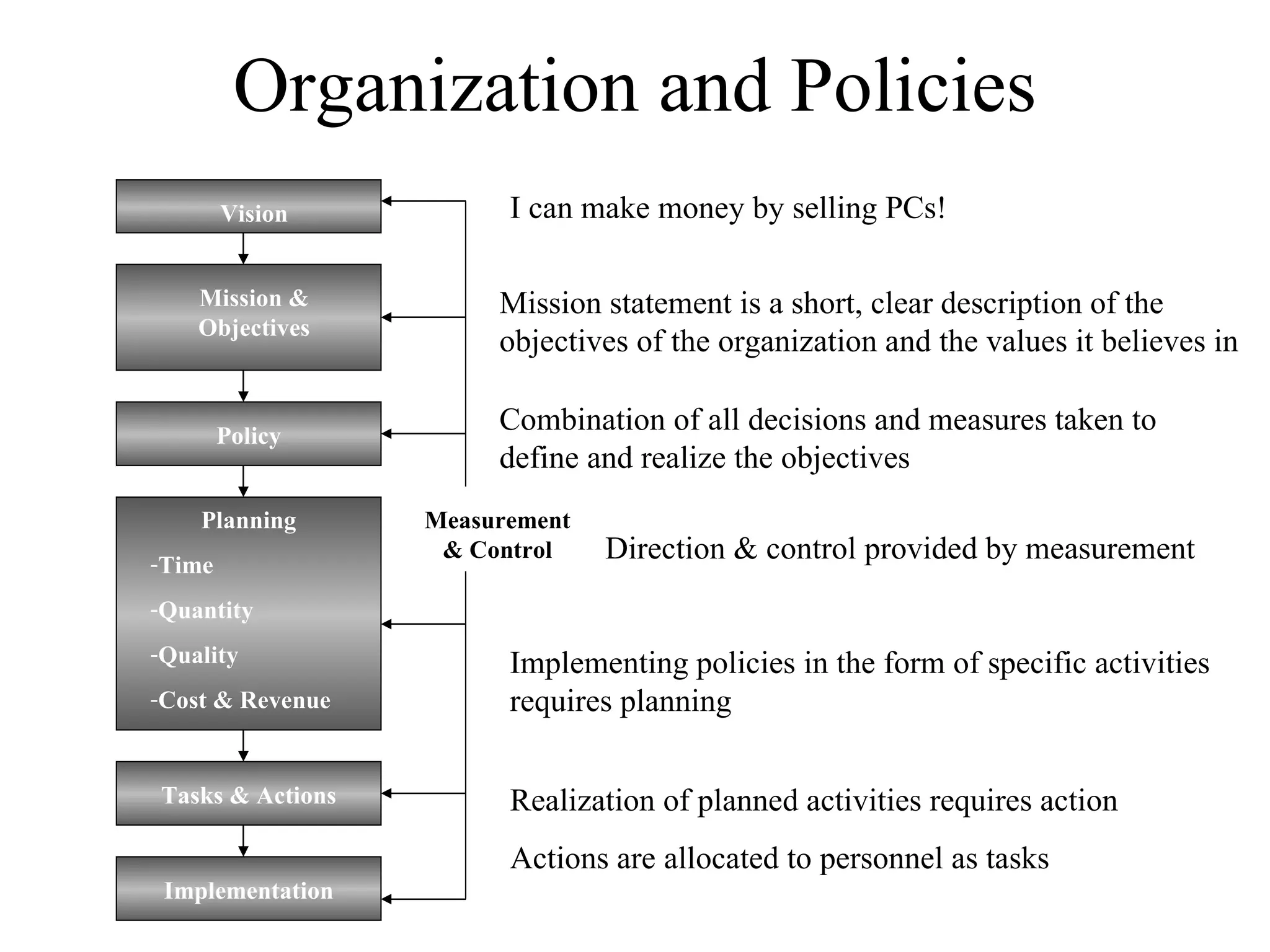
Organization and Policies Vision Vision Mission & Objectives Policy Planning Time Quantity Quality Cost & Revenue Tasks & Actions Implementation Measurement & Control I can make money by selling PCs! Mission statement is a short, clear description of the objectives of the organization and the values it believes in Combination of all decisions and measures taken to define and realize the objectives Implementing policies in the form of specific activities requires planning Realization of planned activities requires action Actions are allocated to personnel as tasks Direction & control provided by measurement
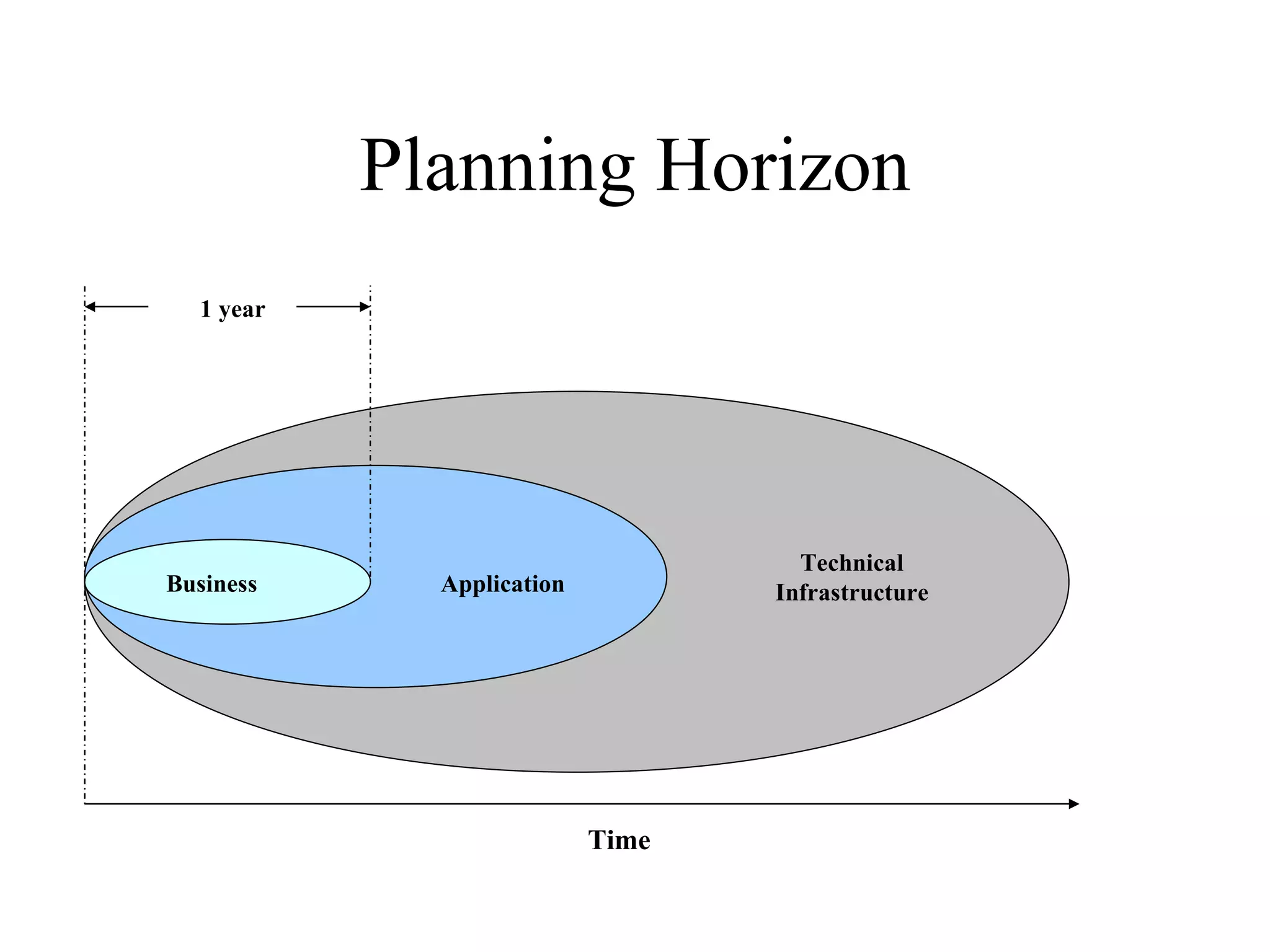
Planning Horizon Business Application Technical Infrastructure 1 year Time
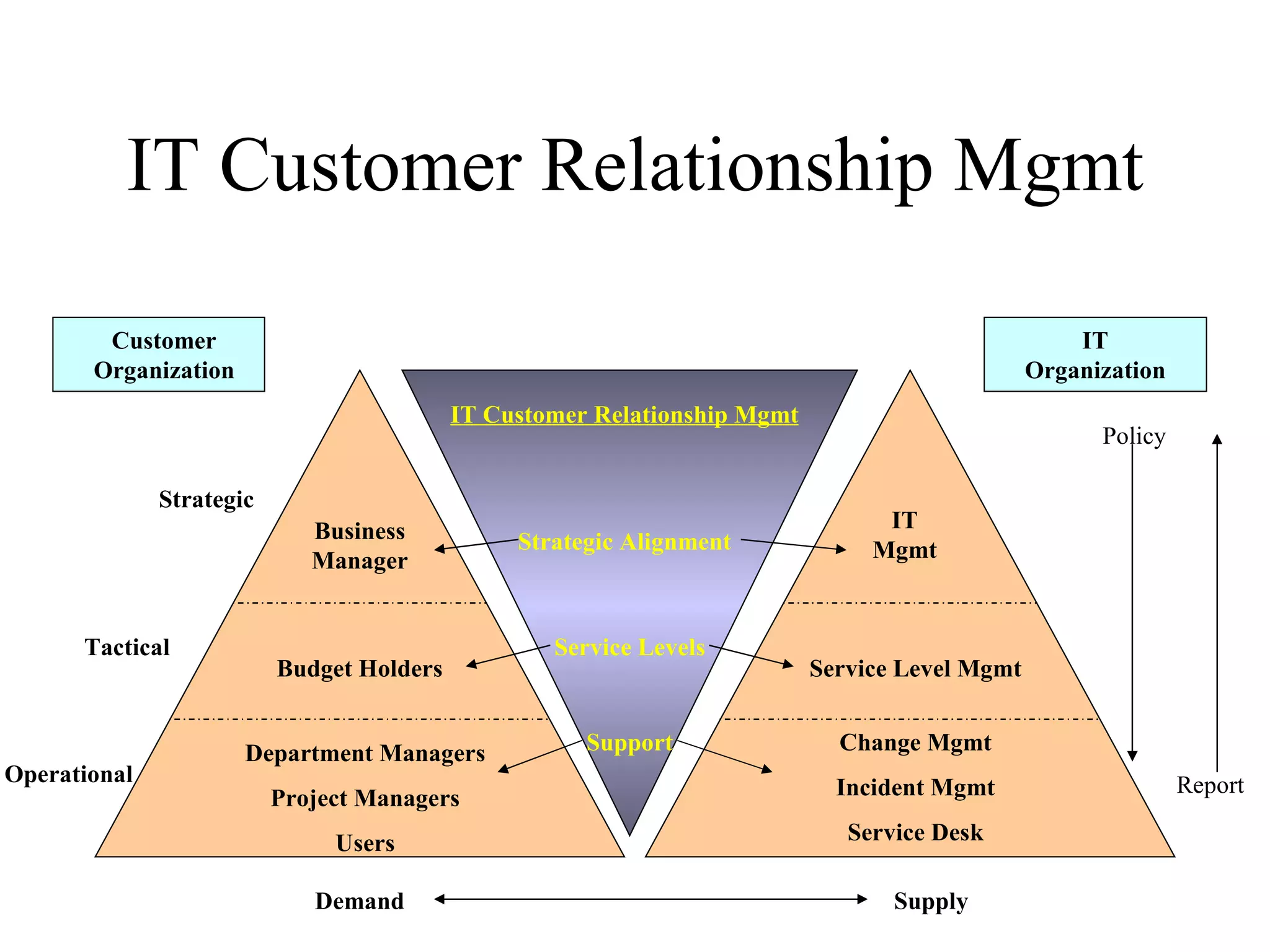
IT Customer Relationship Mgmt Demand Supply Operational Tactical Strategic Department Managers Project Managers Users Budget Holders Business Manager Change Mgmt Incident Mgmt Service Desk Service Level Mgmt IT Mgmt Customer Organization IT Organization Support Service Levels Strategic Alignment IT Customer Relationship Mgmt Policy Report
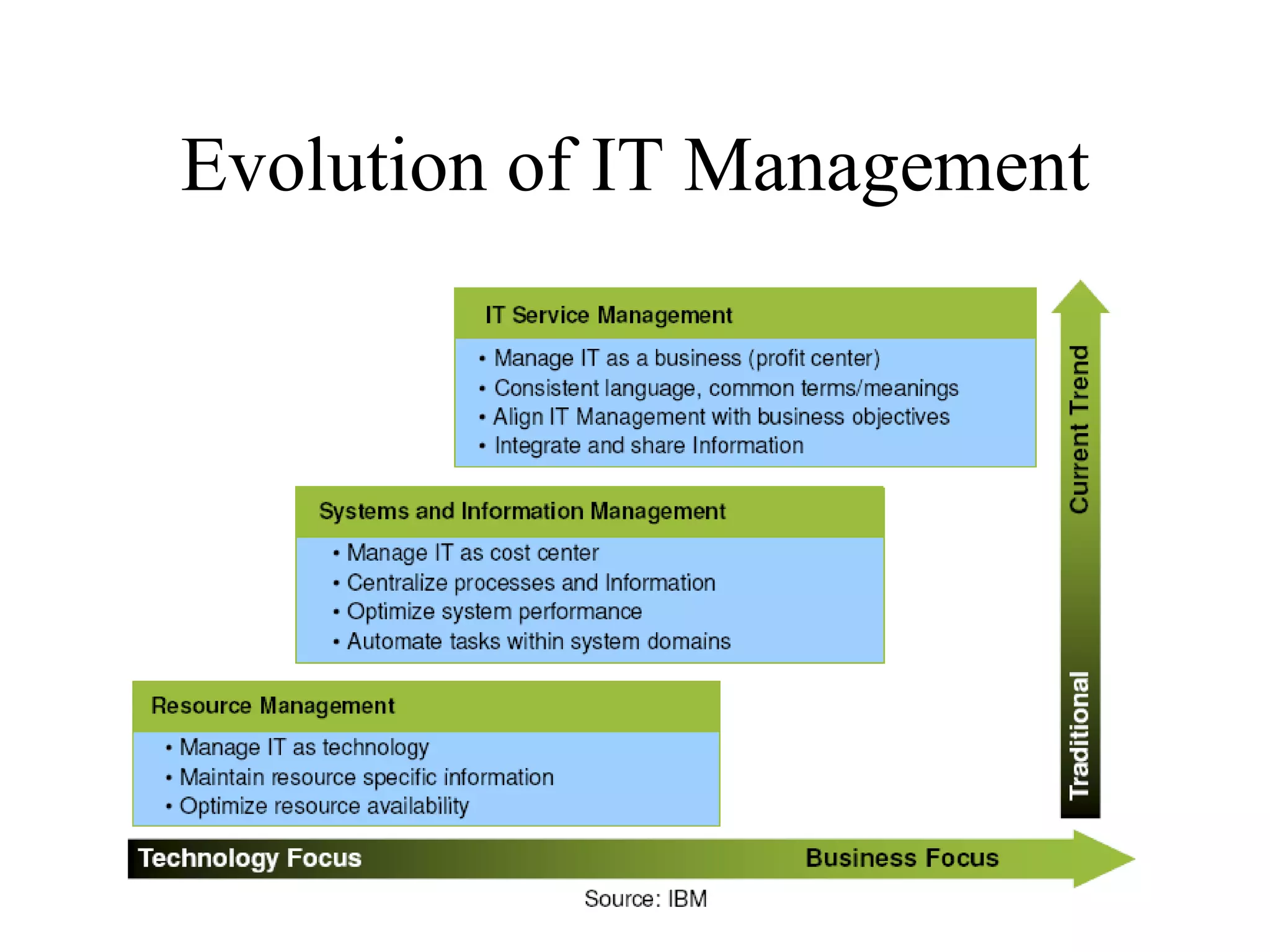
Evolution of IT Management
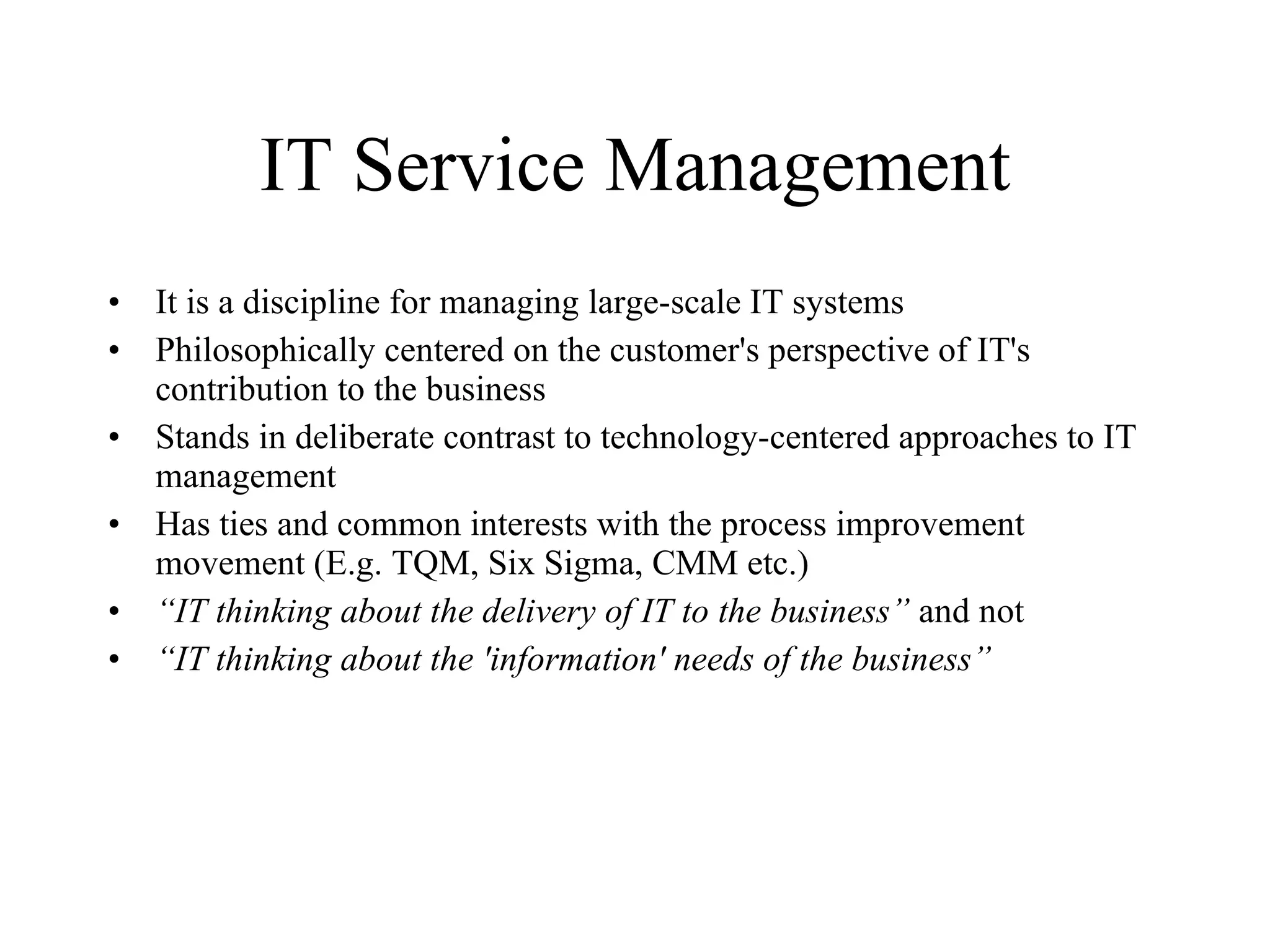
IT Service Management It is a discipline for managing large-scale IT systems Philosophically centered on the customer's perspective of IT's contribution to the business Stands in deliberate contrast to technology-centered approaches to IT management Has ties and common interests with the process improvement movement (E.g. TQM, Six Sigma, CMM etc.) “ IT thinking about the delivery of IT to the business”  and not “ IT thinking about the 'information' needs of the business”
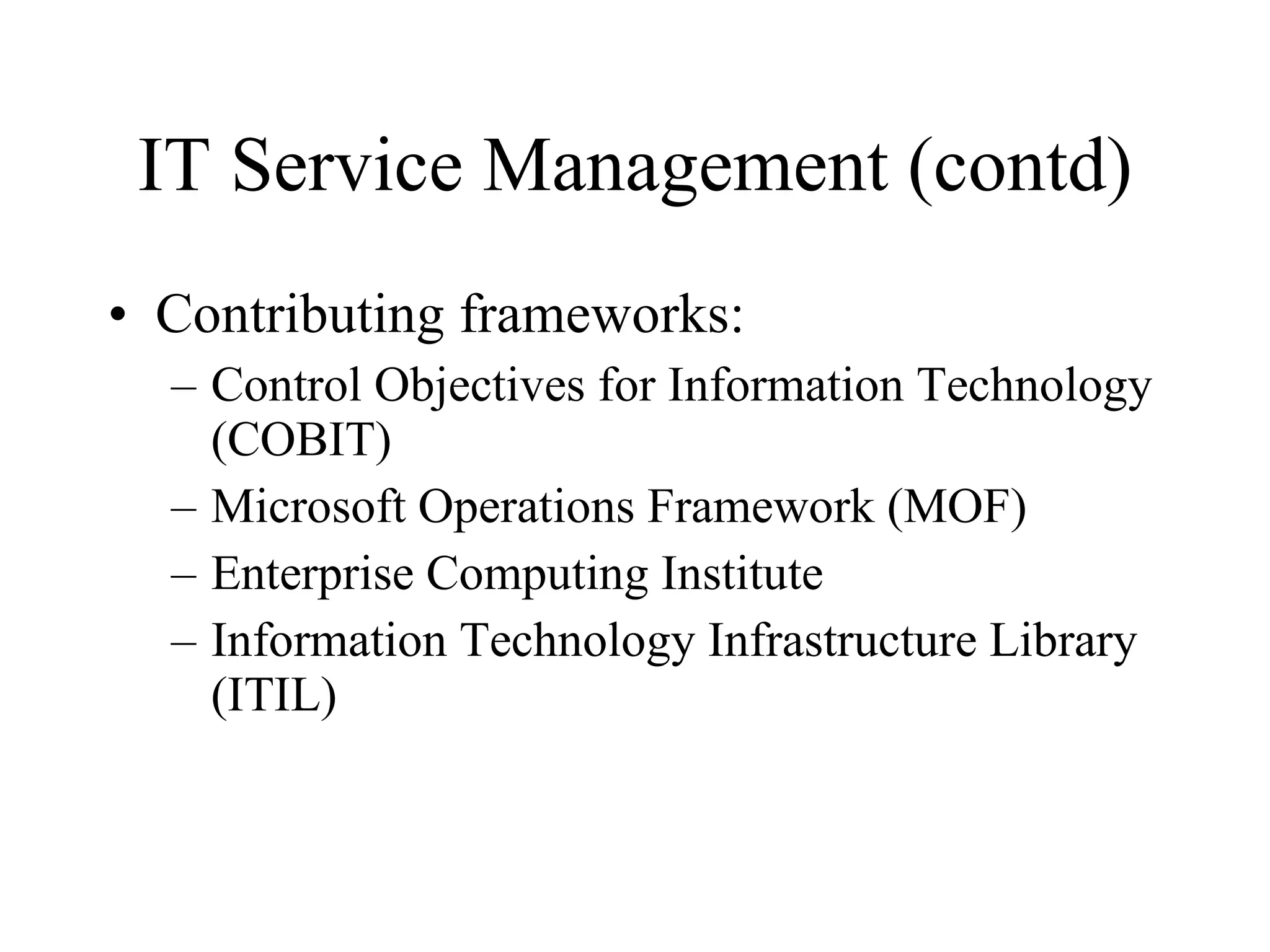
IT Service Management (contd) Contributing frameworks: Control Objectives for Information Technology (COBIT) Microsoft Operations Framework (MOF) Enterprise Computing Institute Information Technology Infrastructure Library (ITIL)
Overview of ITIL ITIL is a framework of best practice approaches intended to facilitate the delivery of high quality IT services It is published in a series of books (hence the term  Library ), each of which covers a core area within IT Management The names ITIL and IT Infrastructure Library are Registered Trade Marks of the United Kingdom's Office of Government Commerce (OGC)
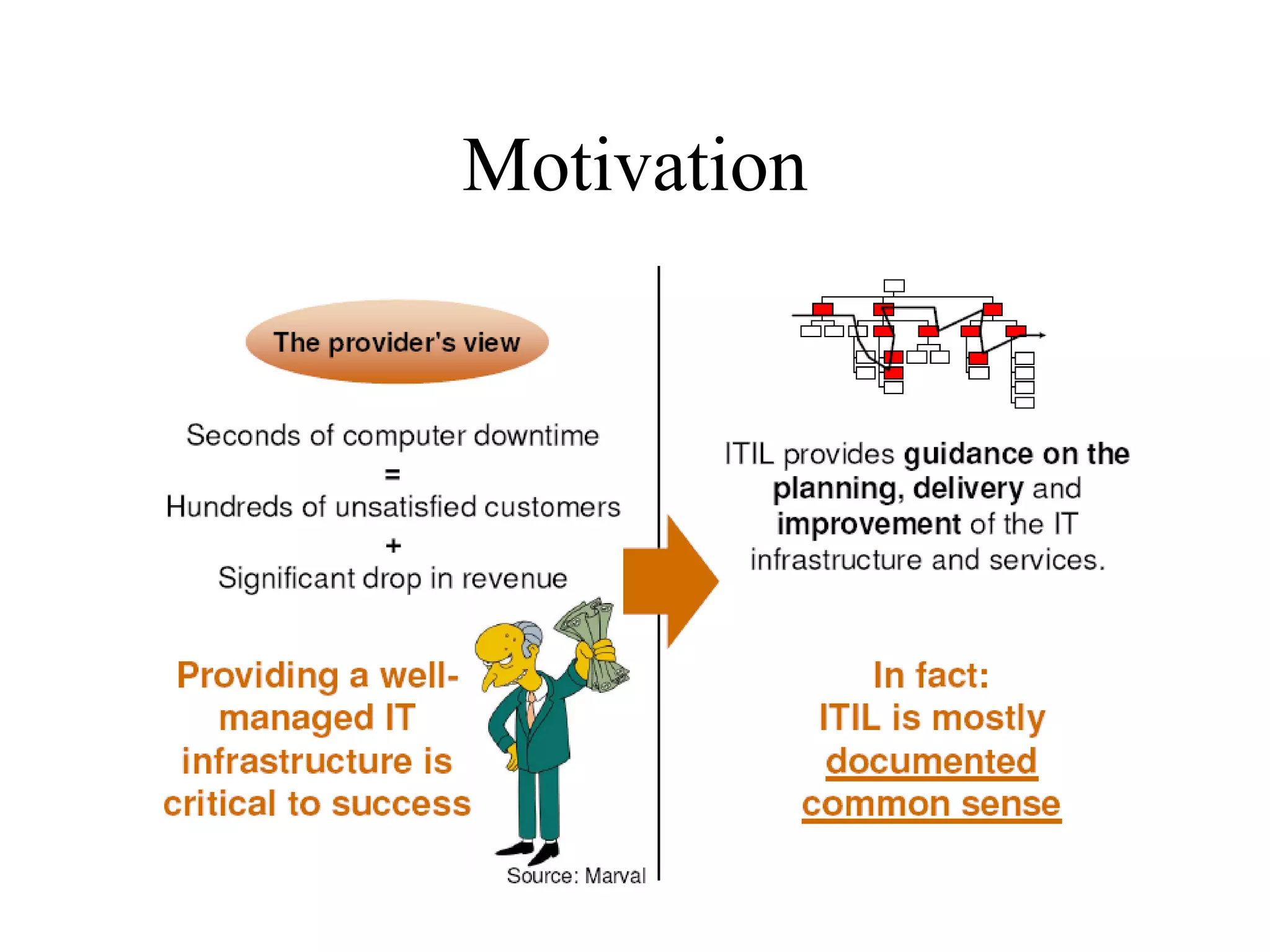
Motivation
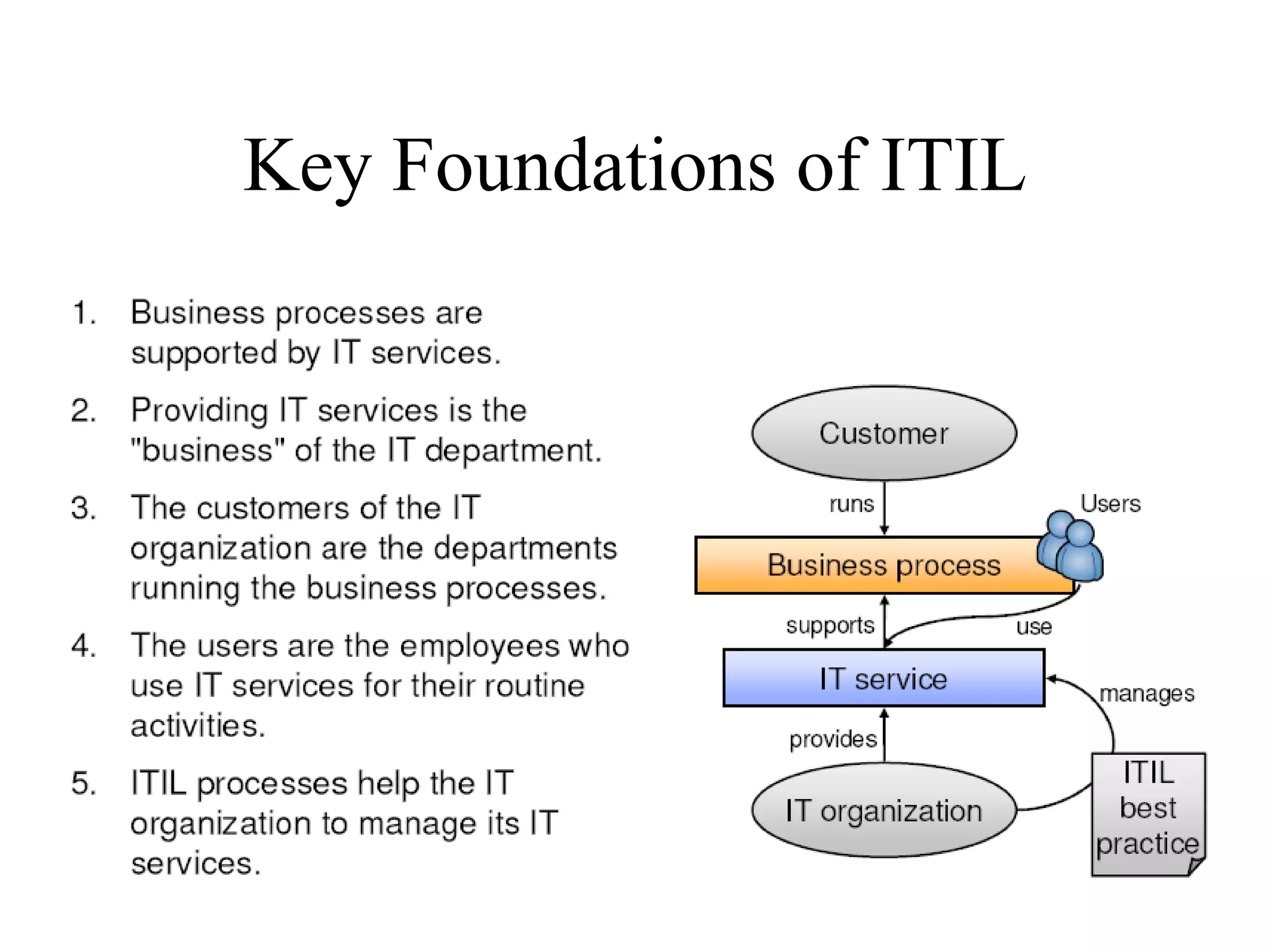
Key Foundations of ITIL
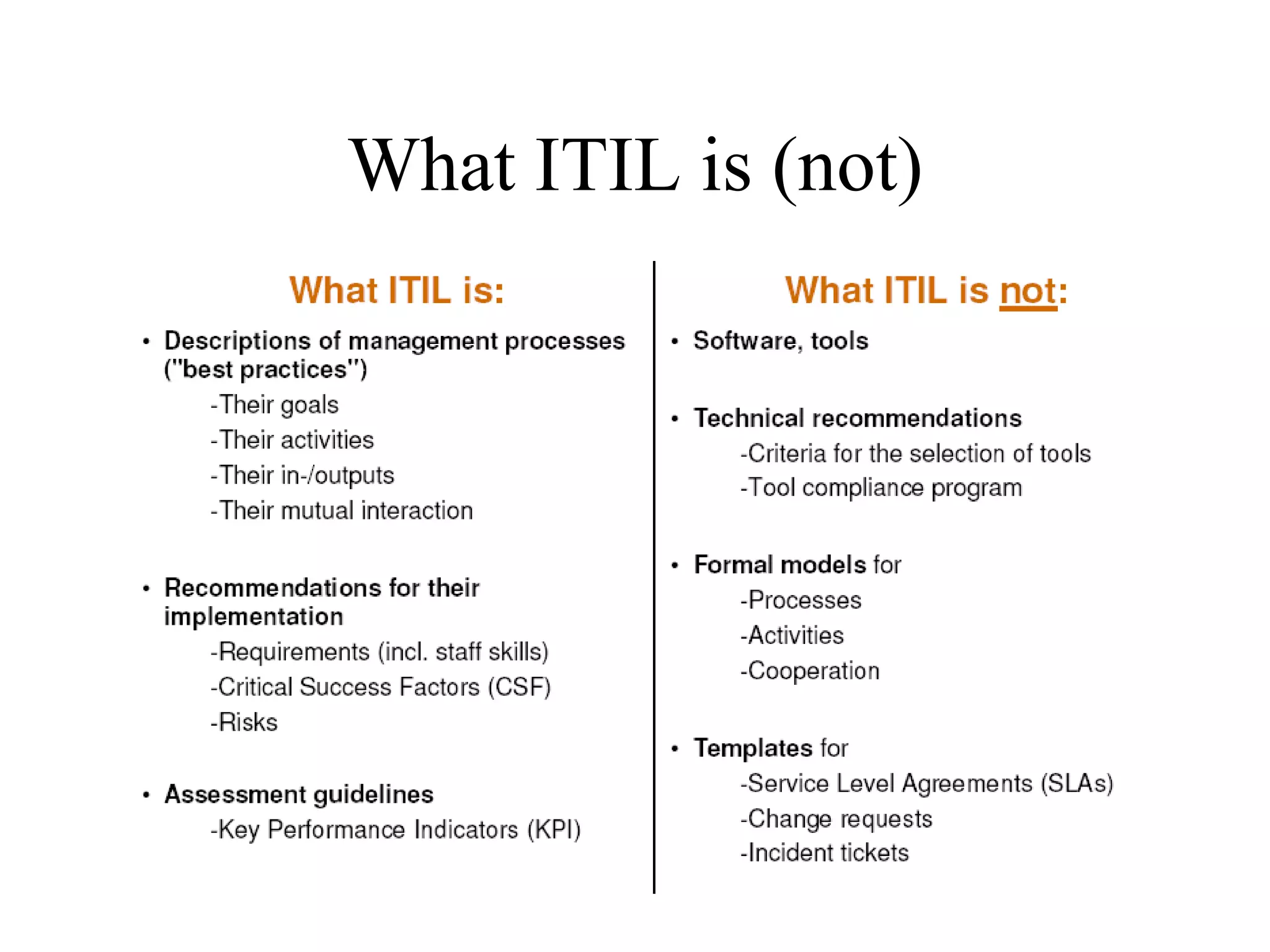
What ITIL is (not)
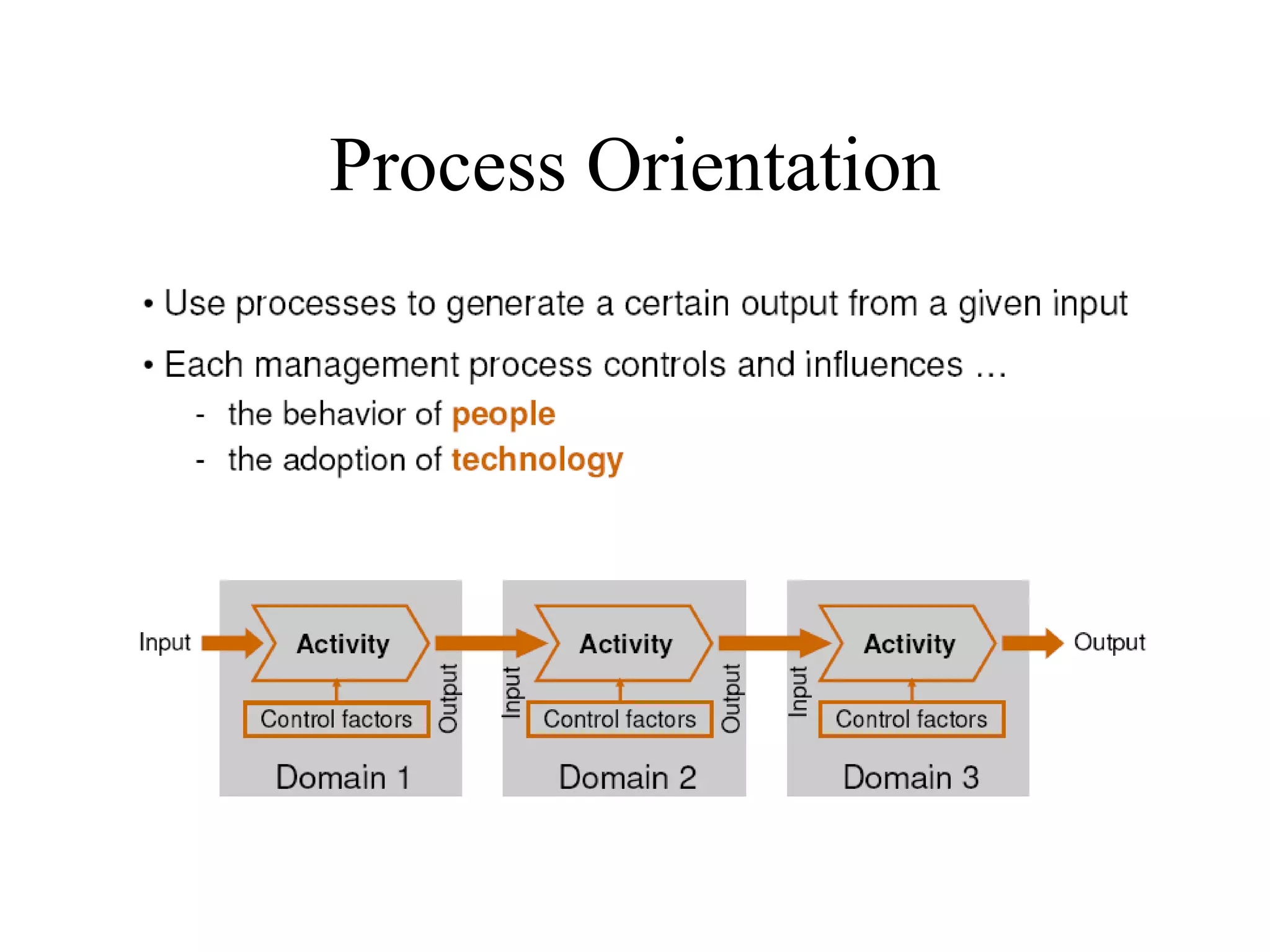
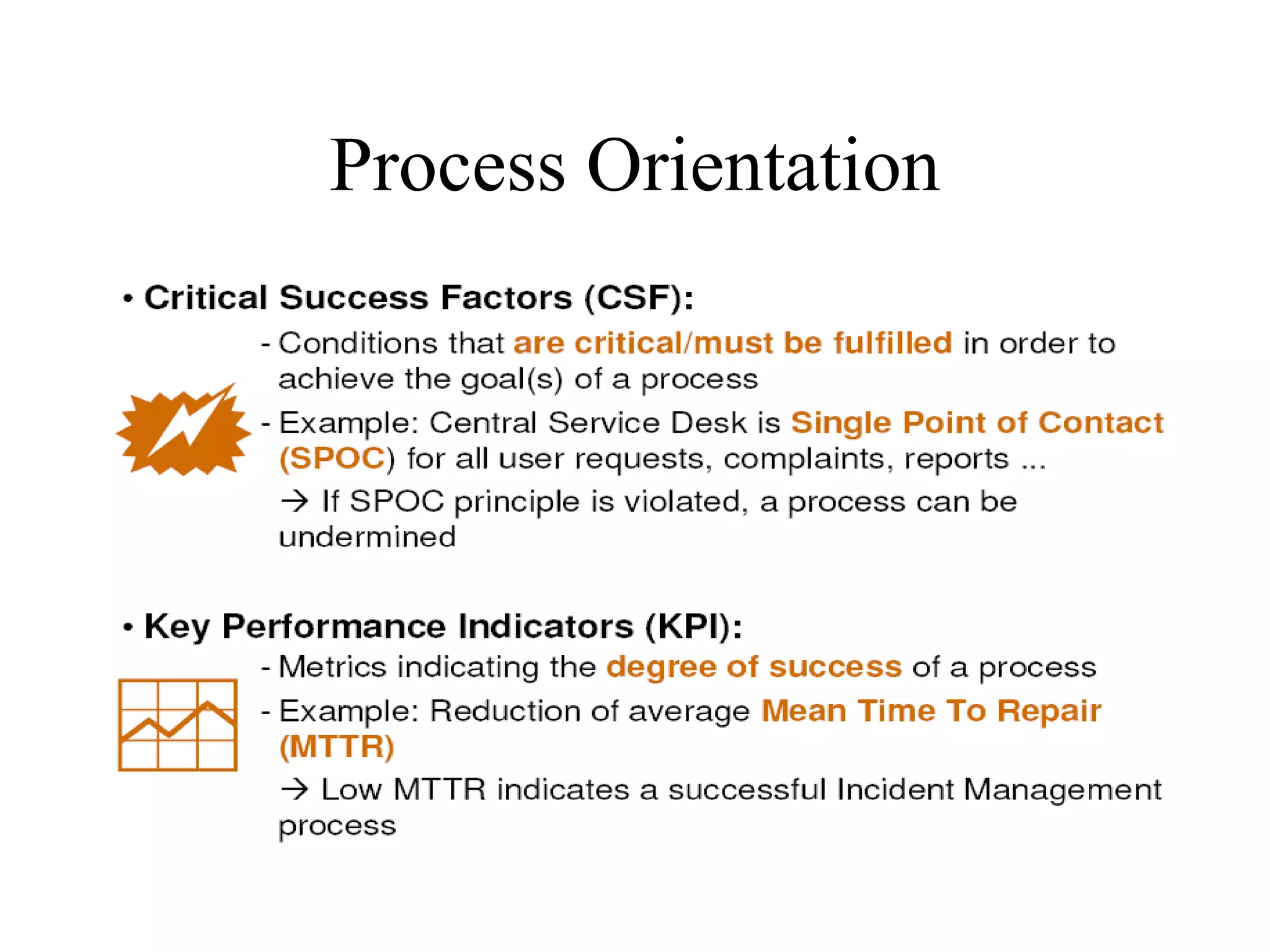
Process Orientation
Process Orientation
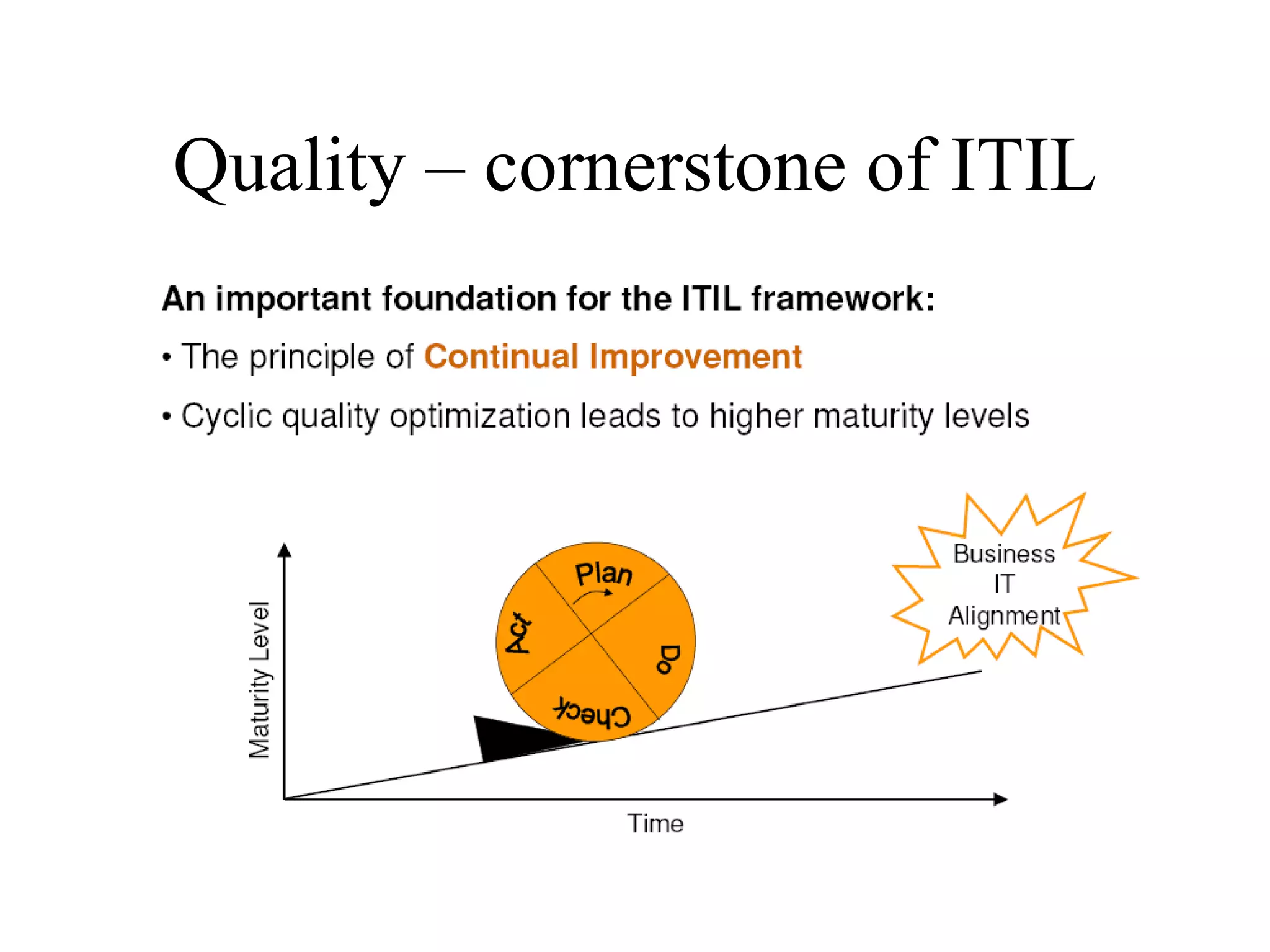
Quality – cornerstone of ITIL
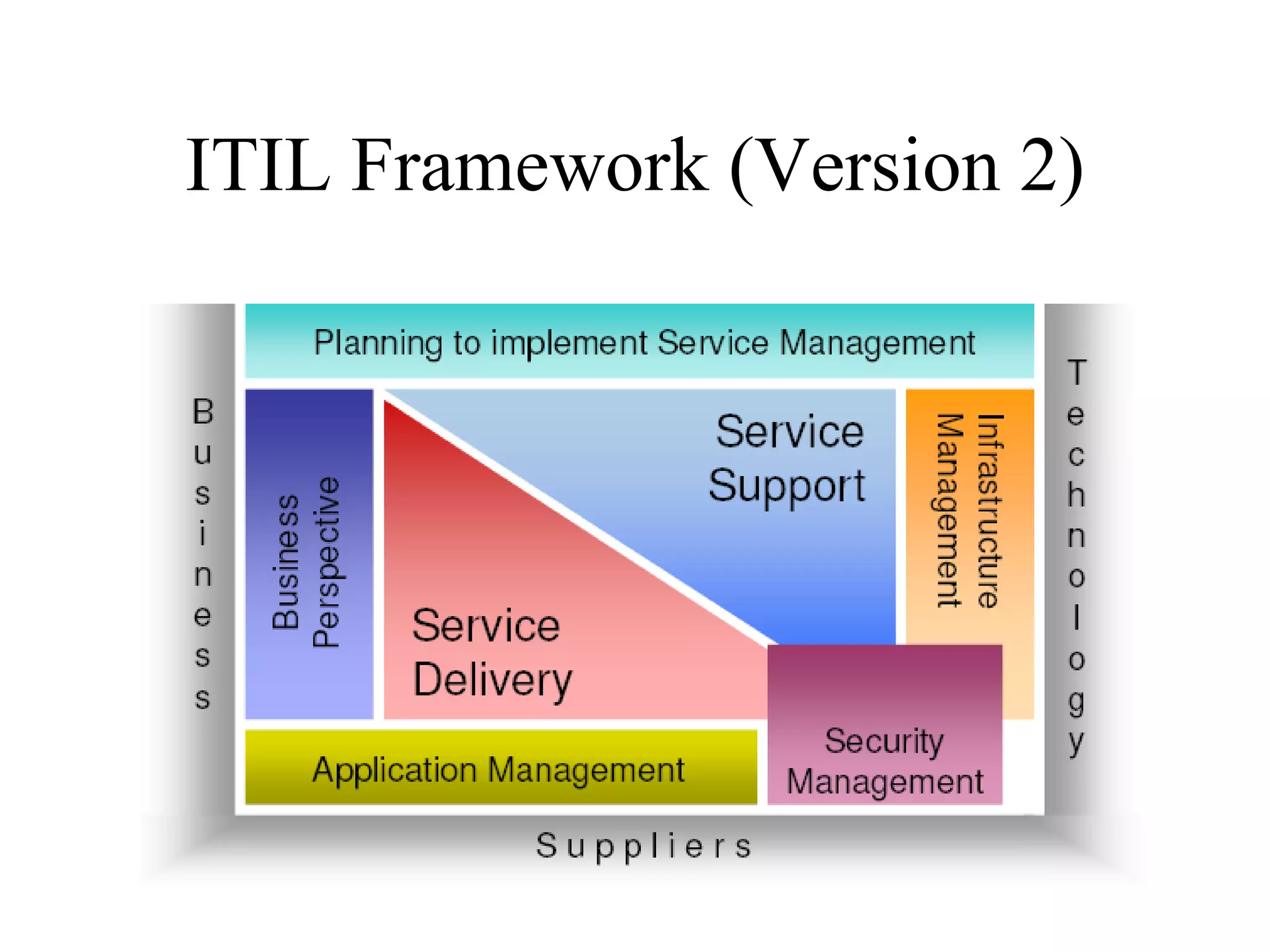
ITIL Framework (Version 2)
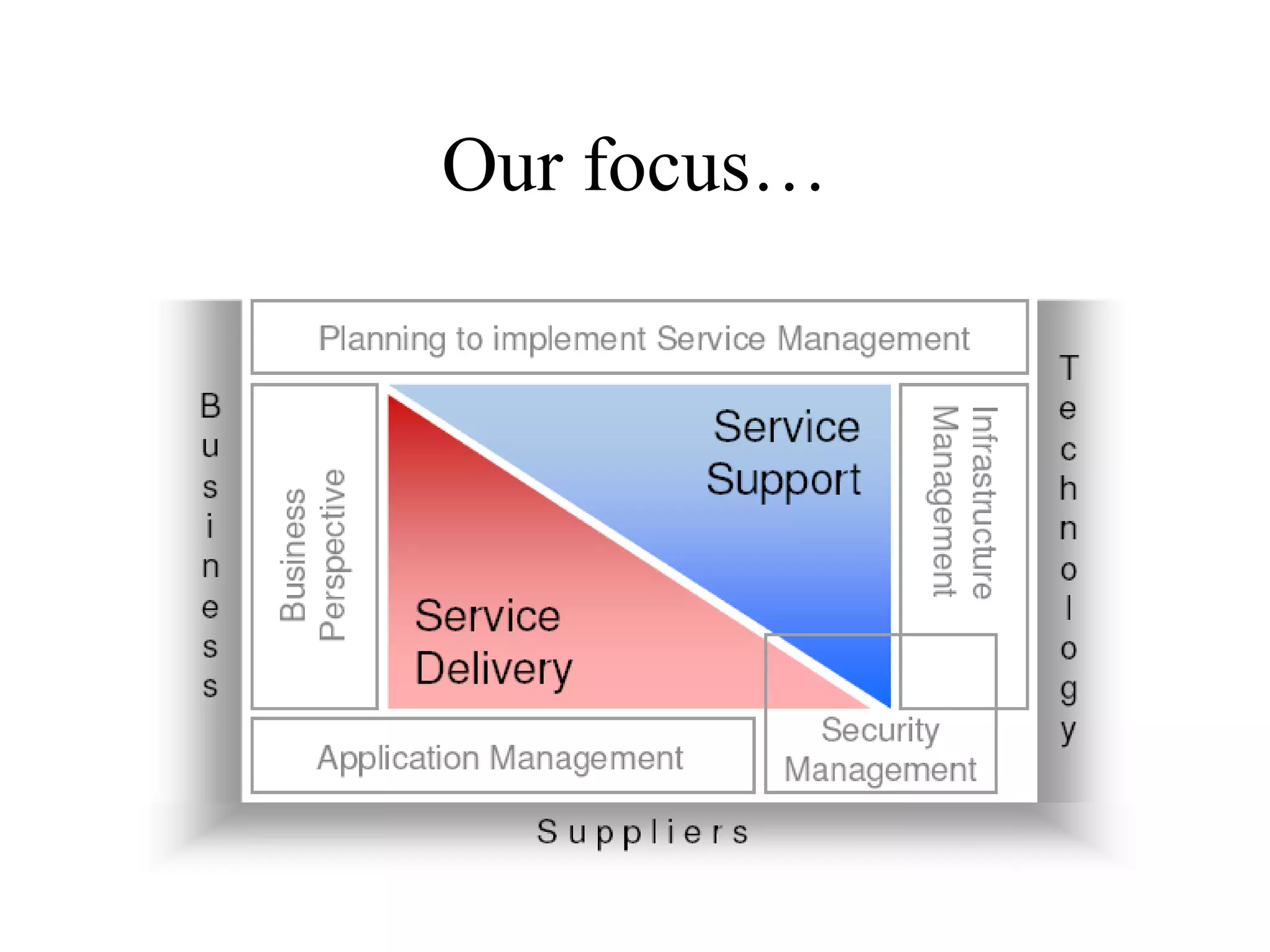
Our focus…
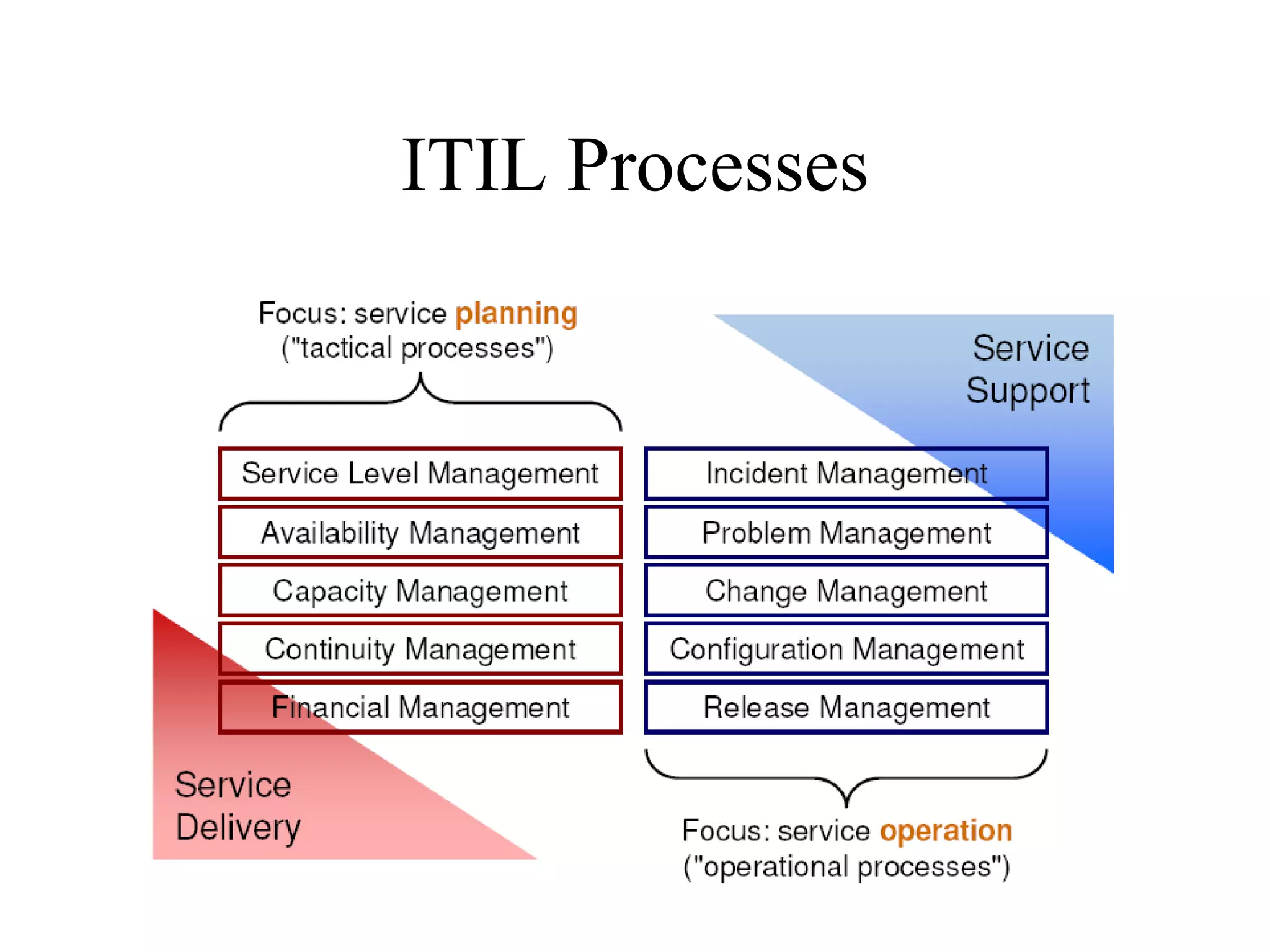
ITIL Processes
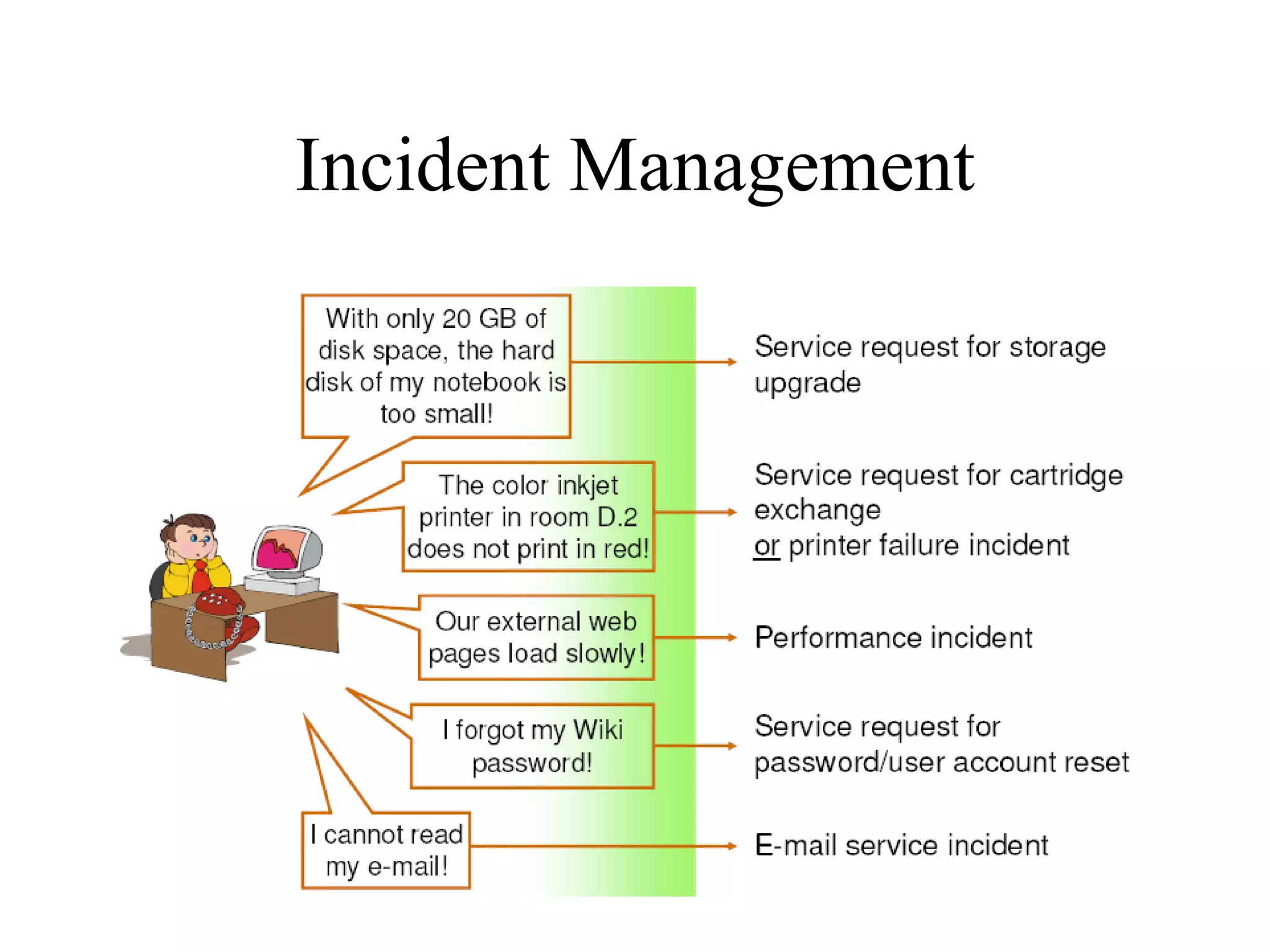
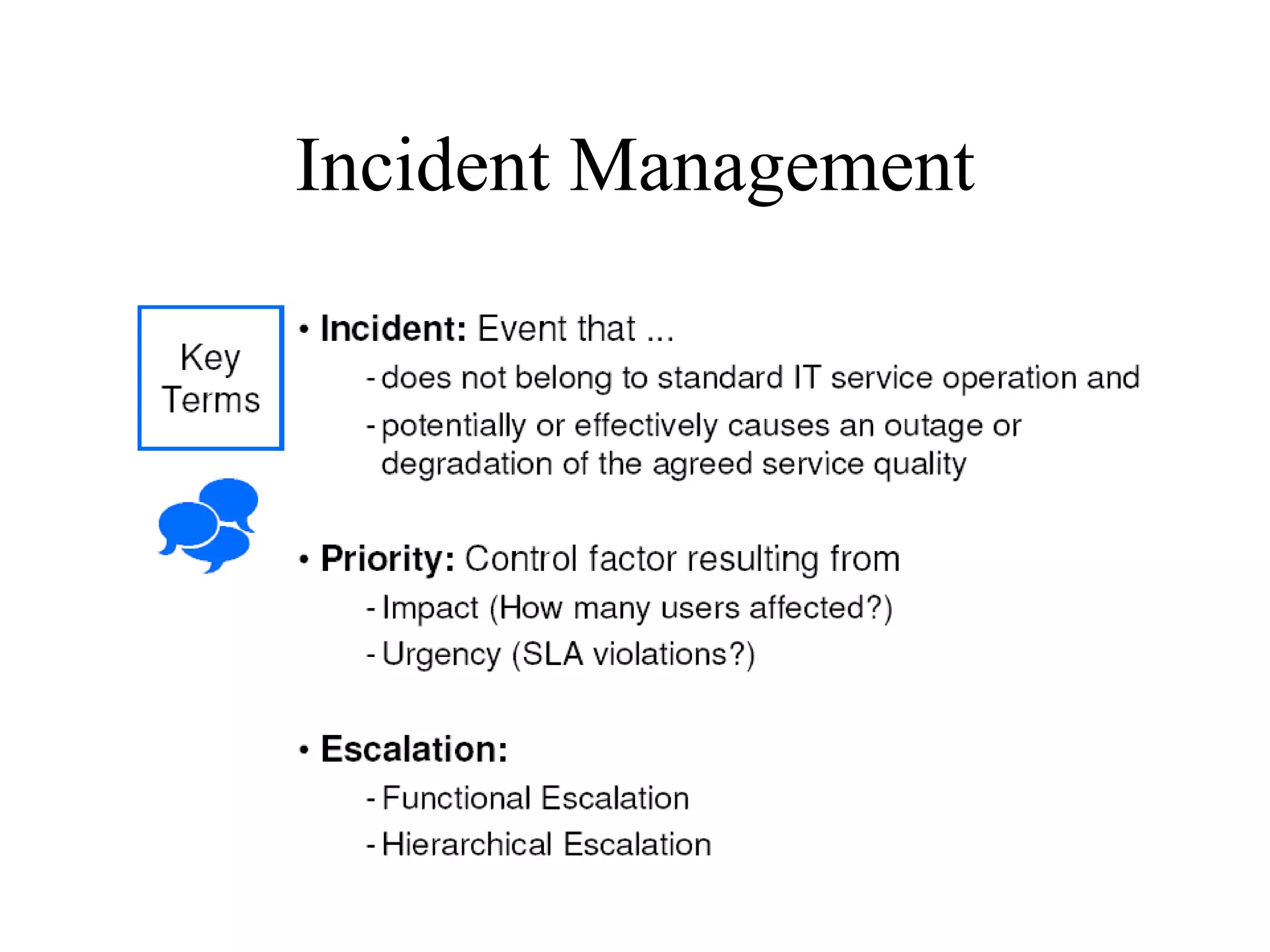
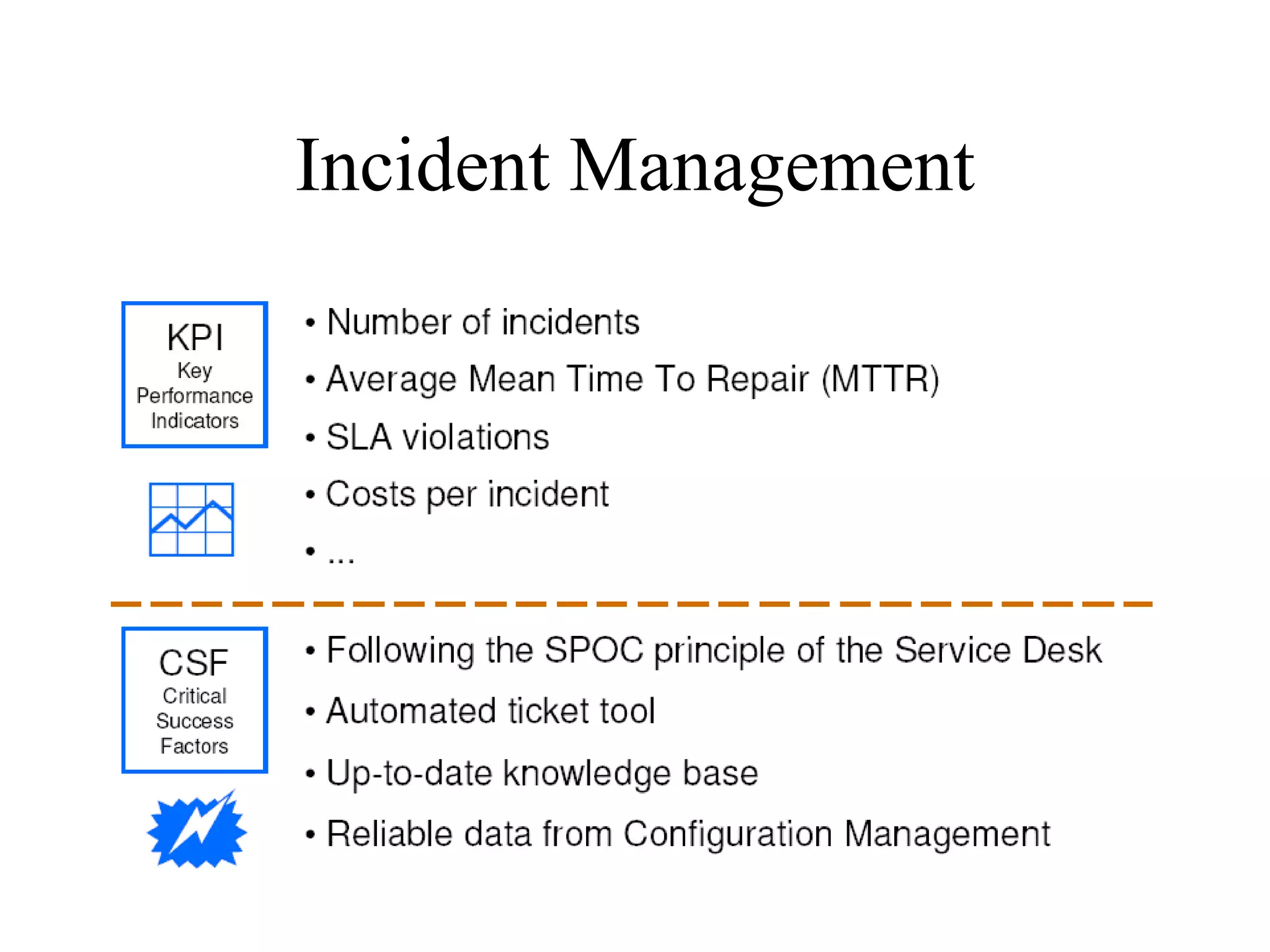
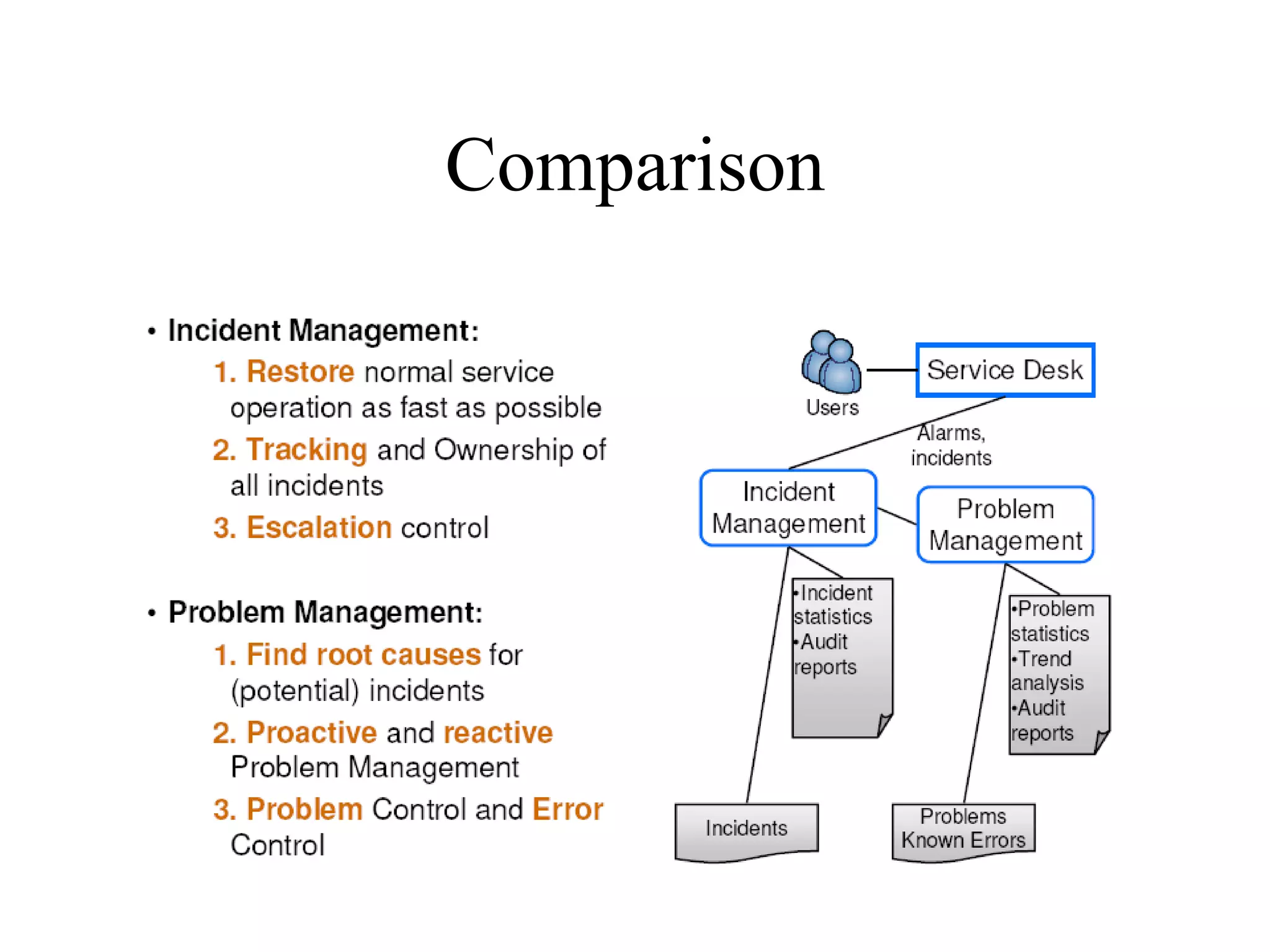
Incident Management
Incident Management
Incident Management
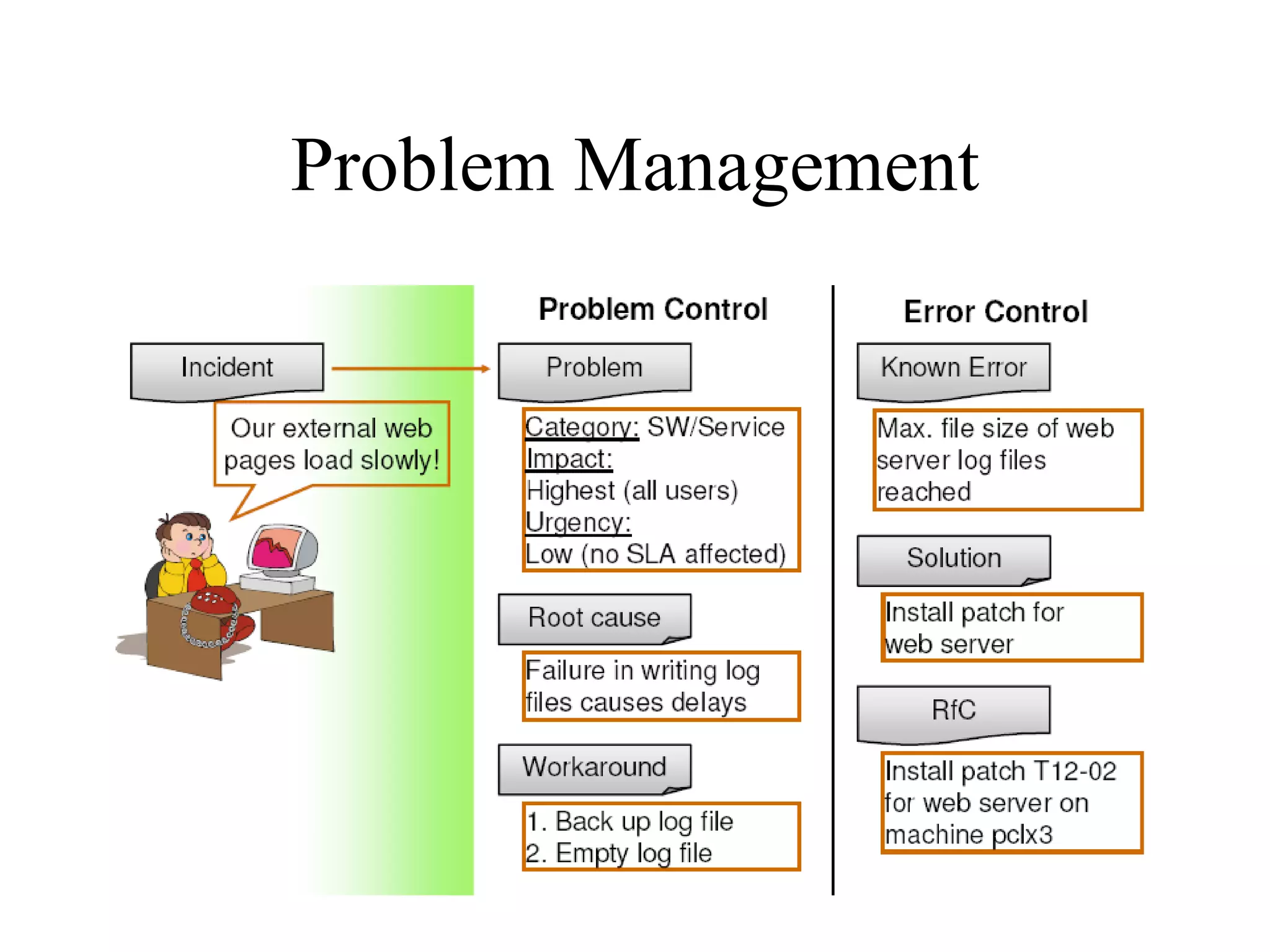
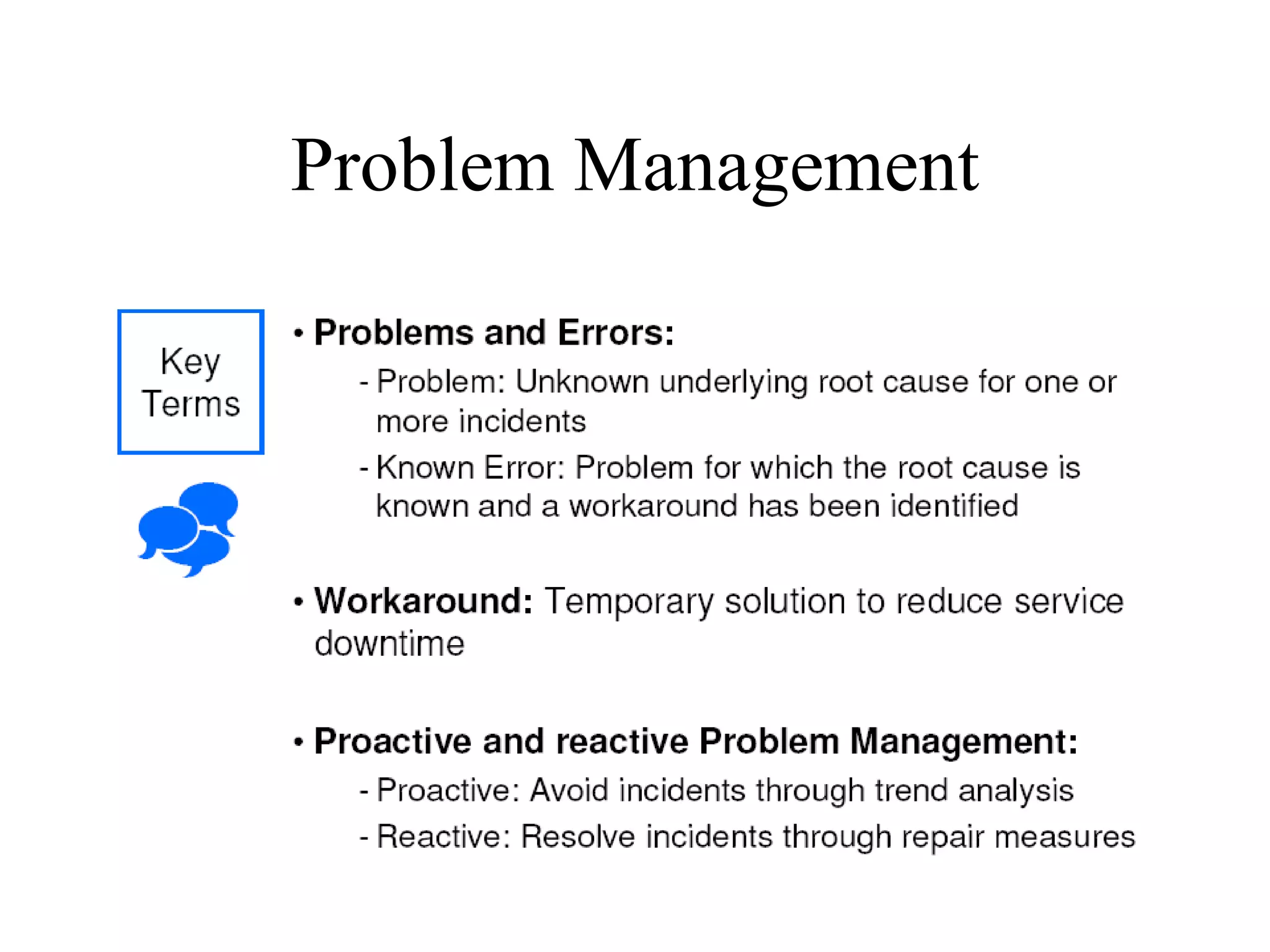
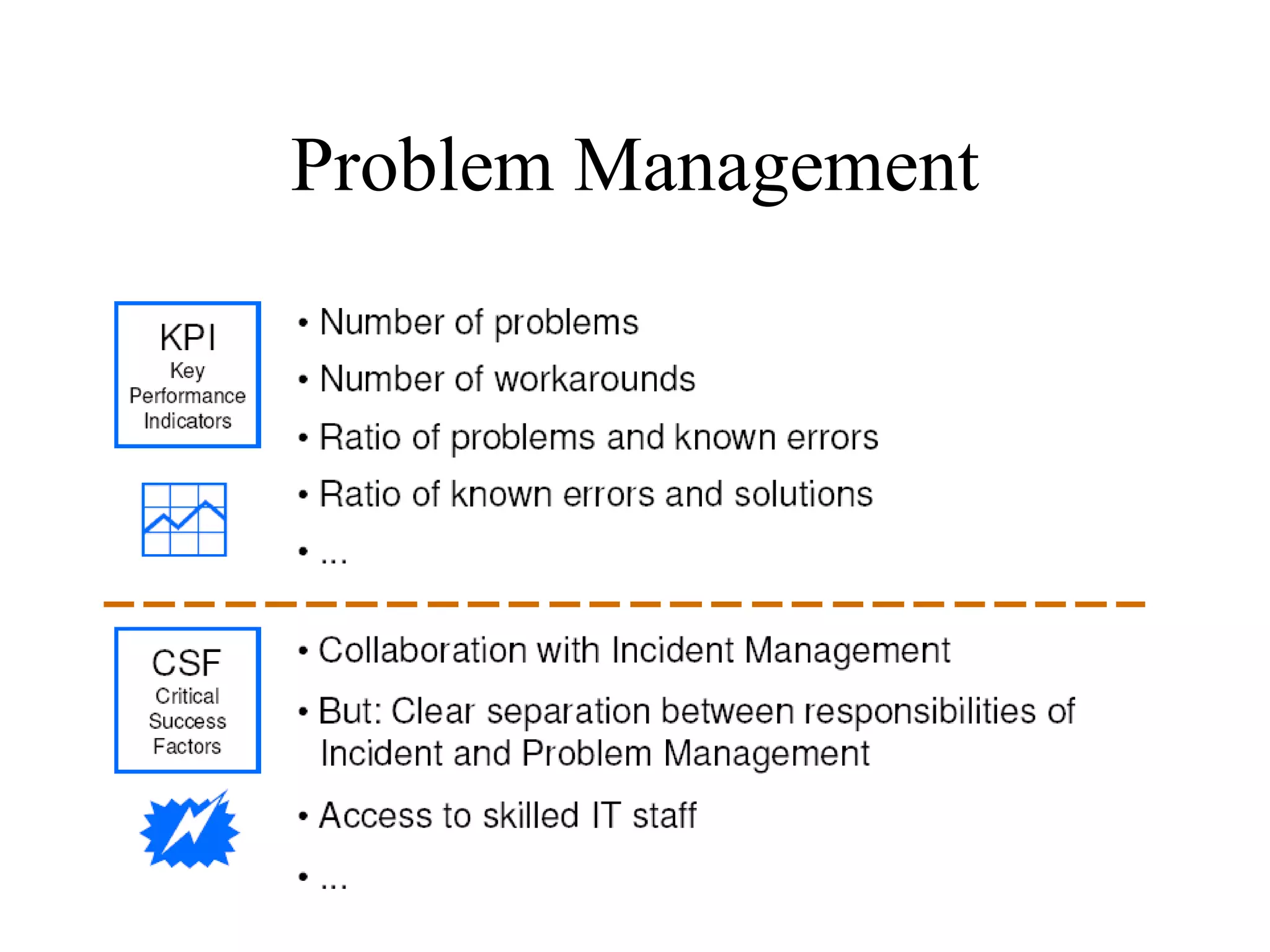
Problem Management
Problem Management
Problem Management
Comparison
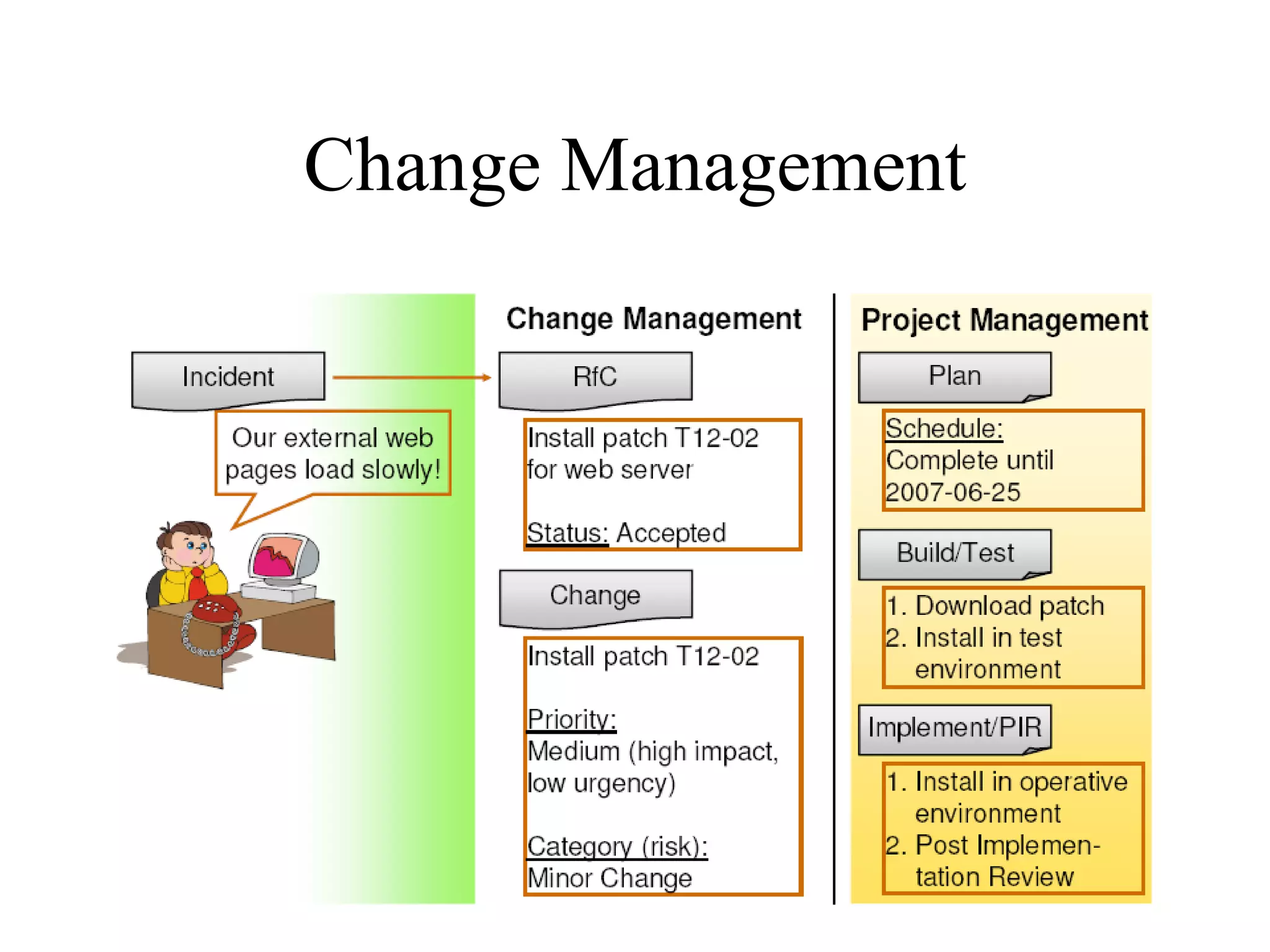
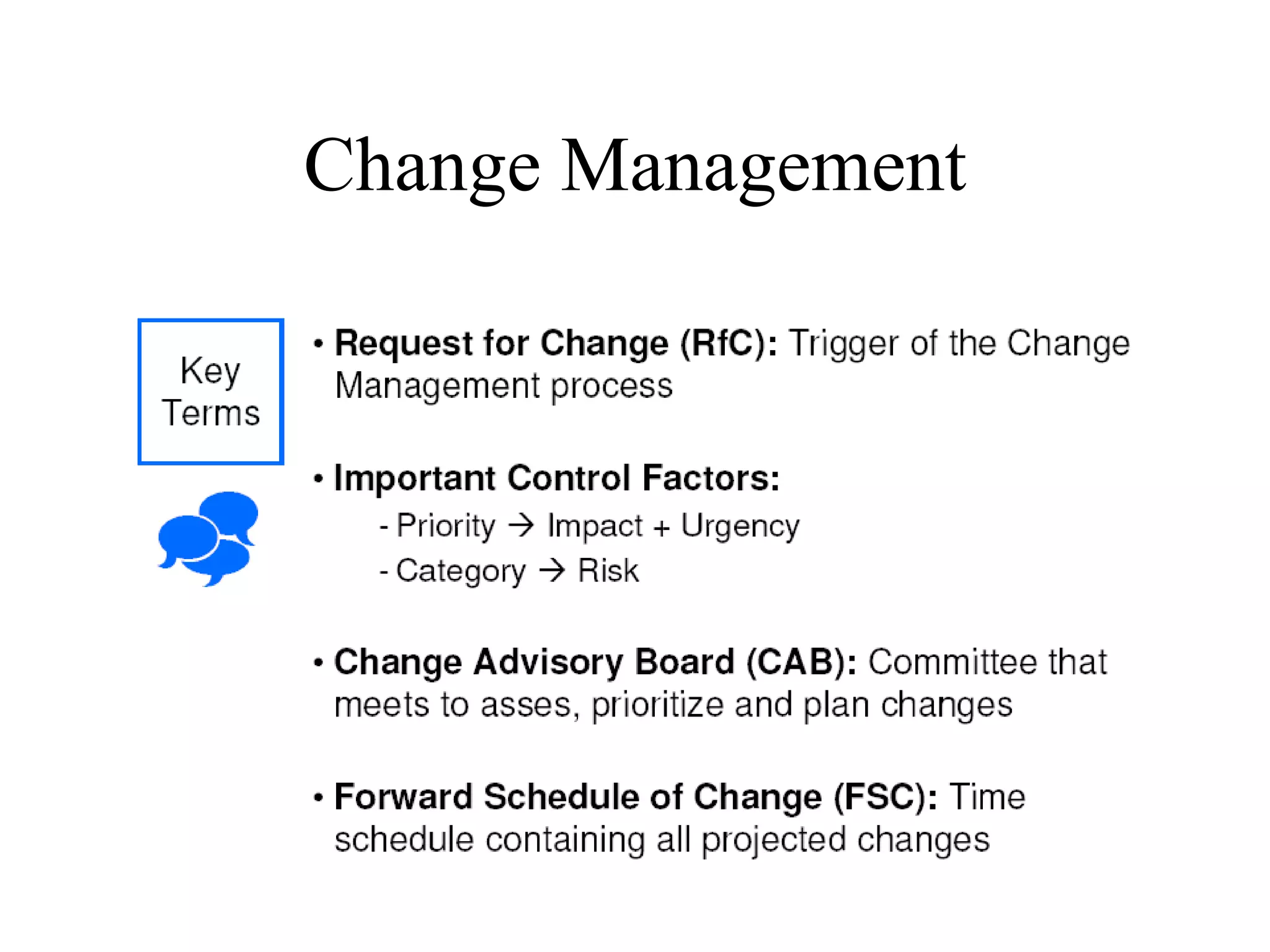
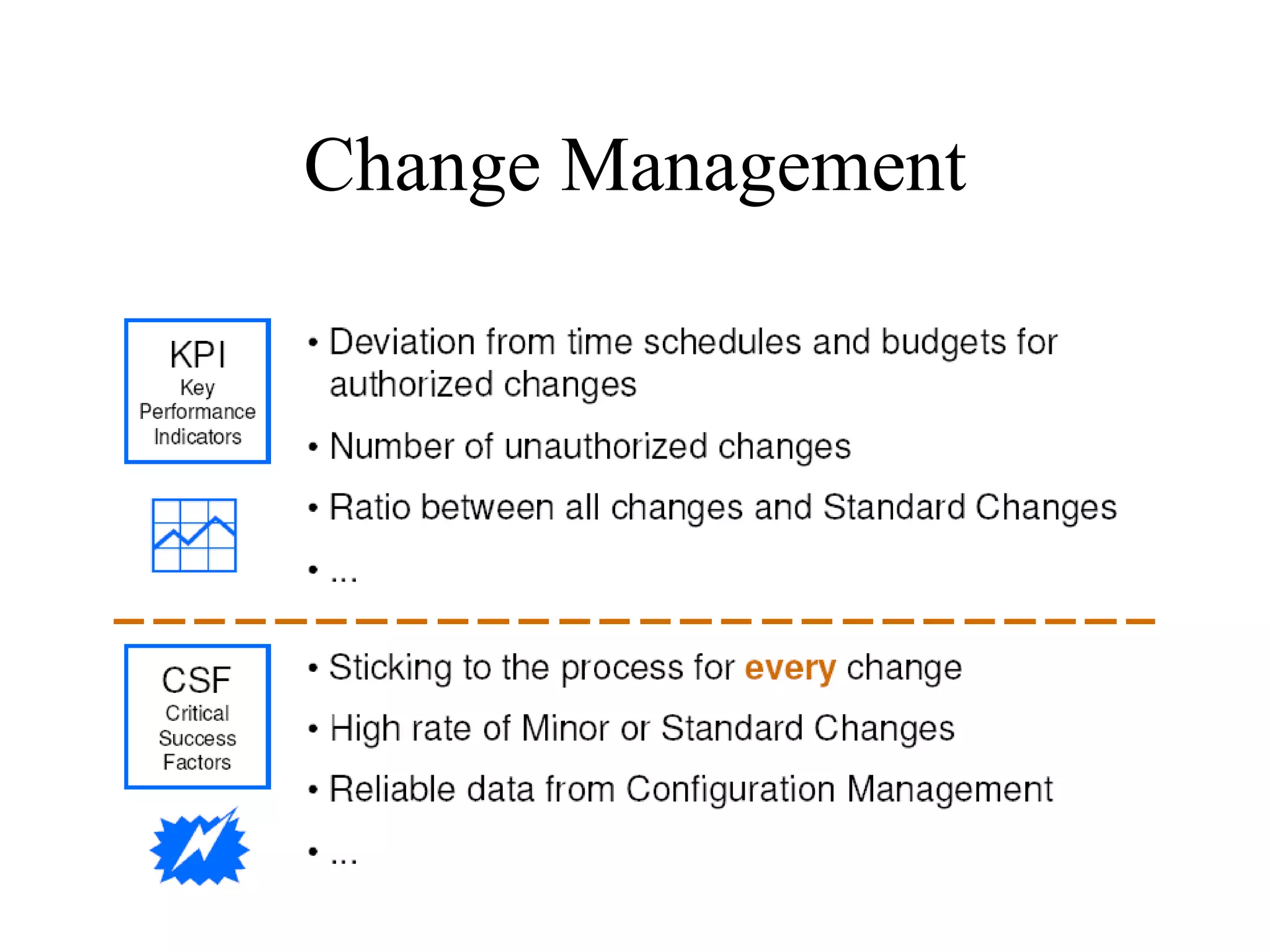
Change Management
Change Management
Change Management
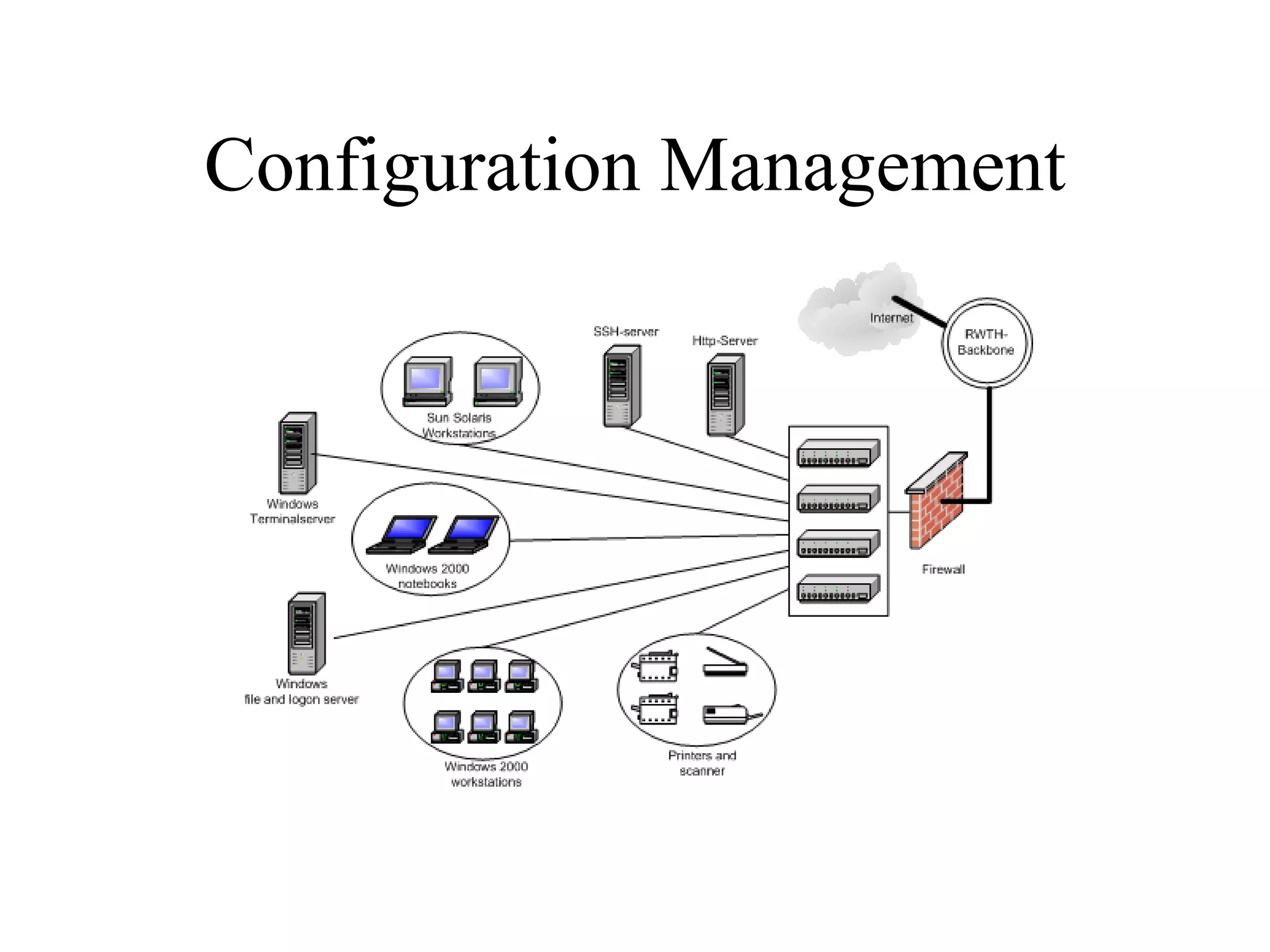
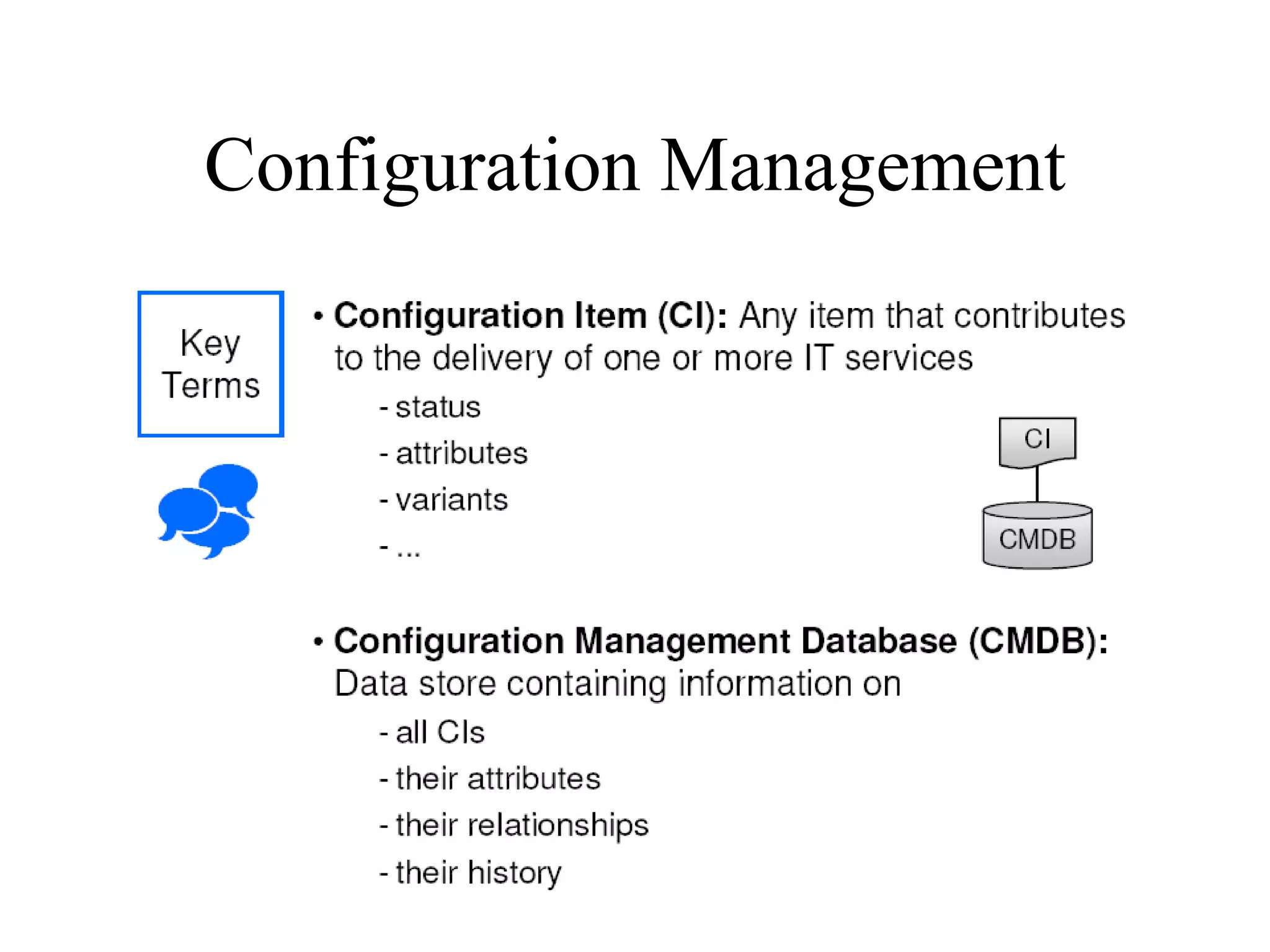
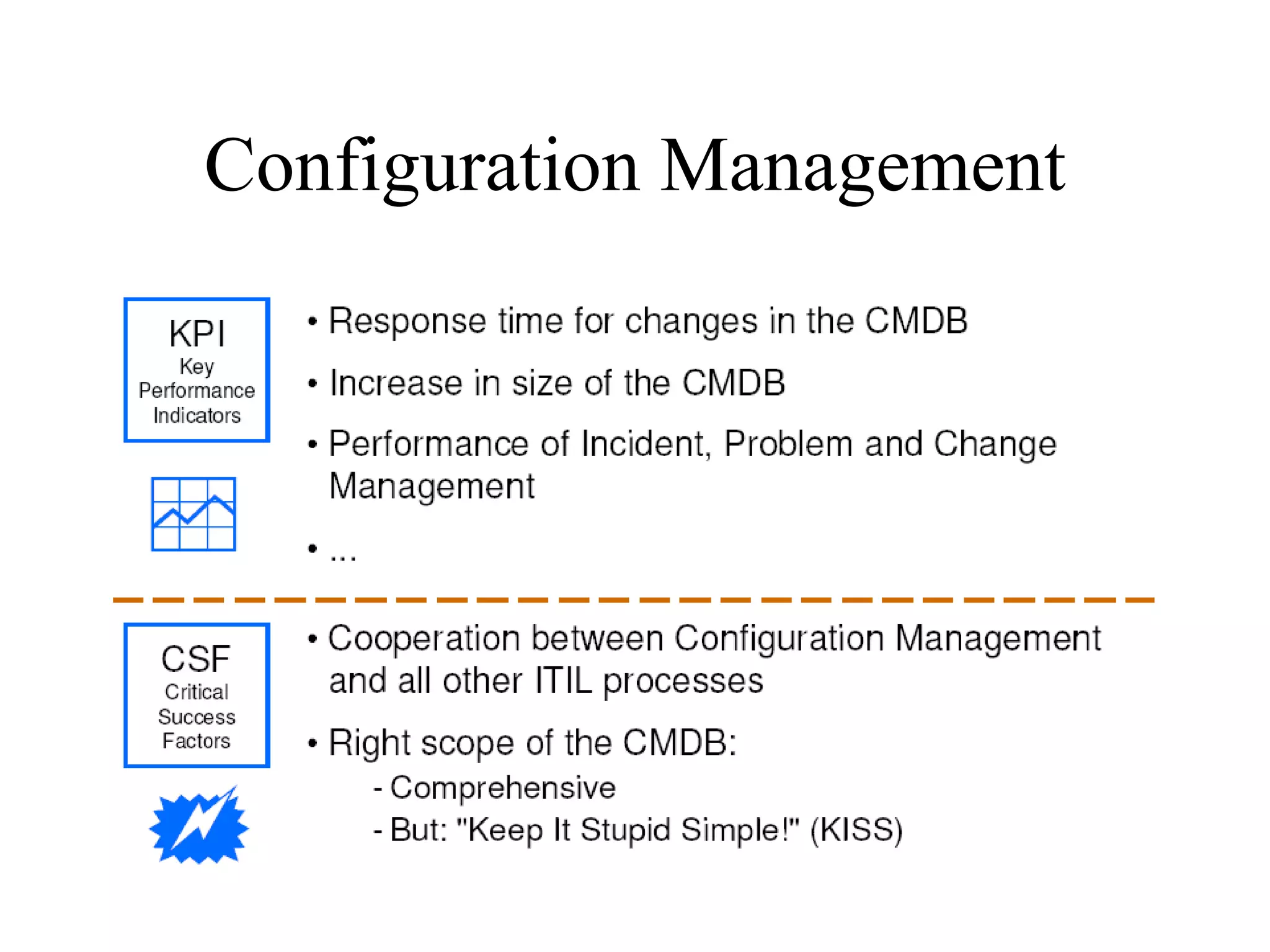
Configuration Management
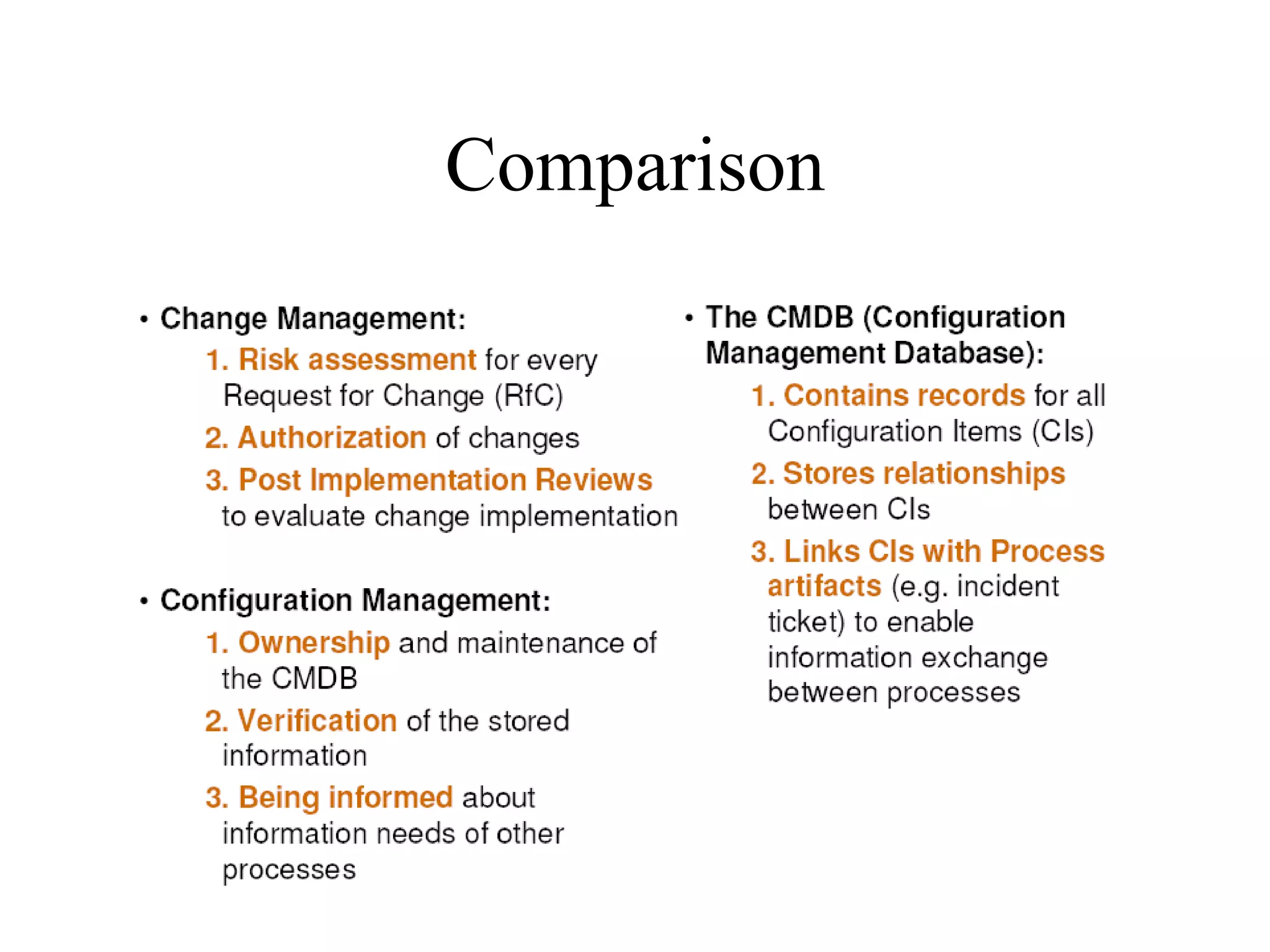
Comparison
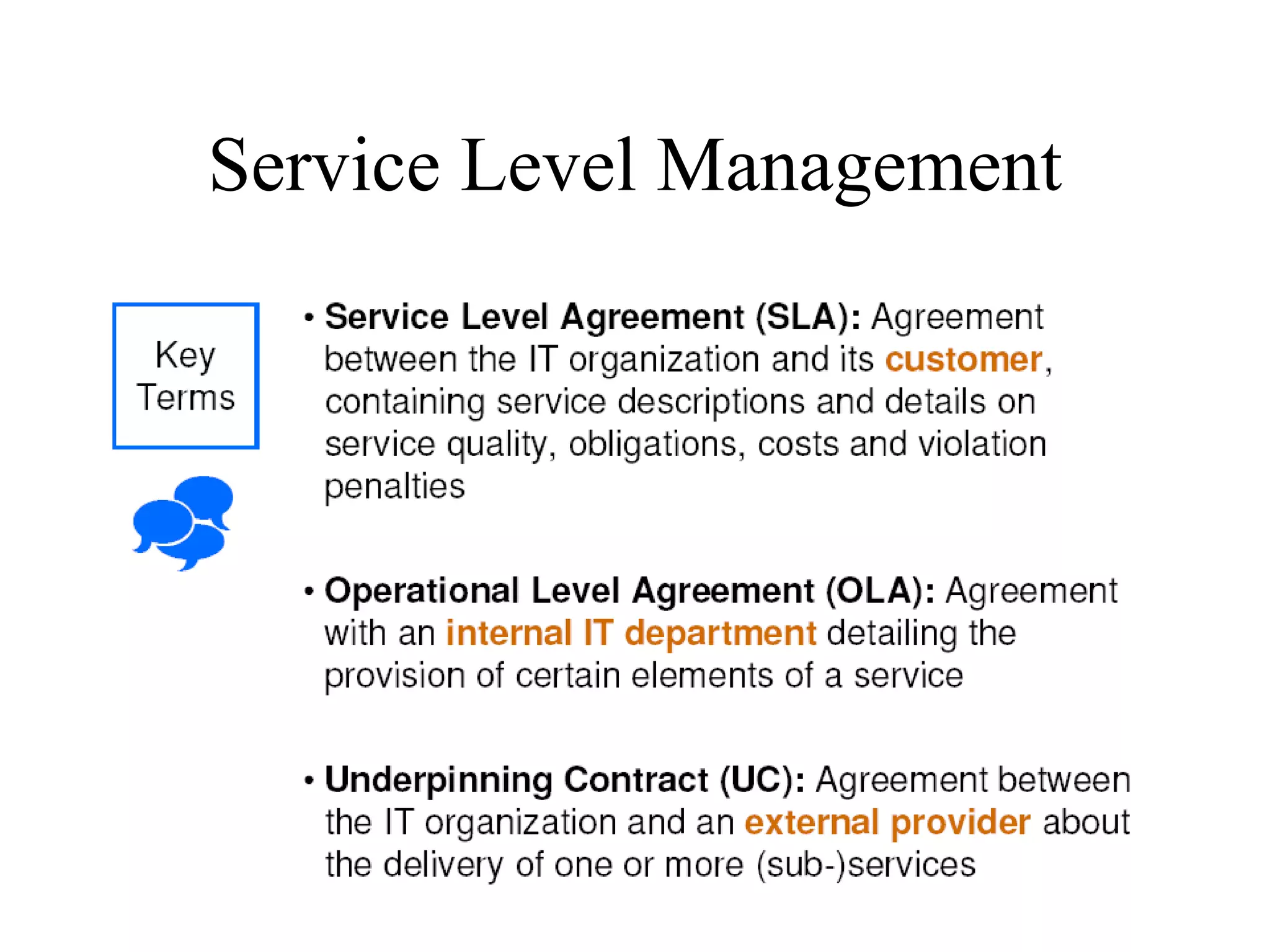
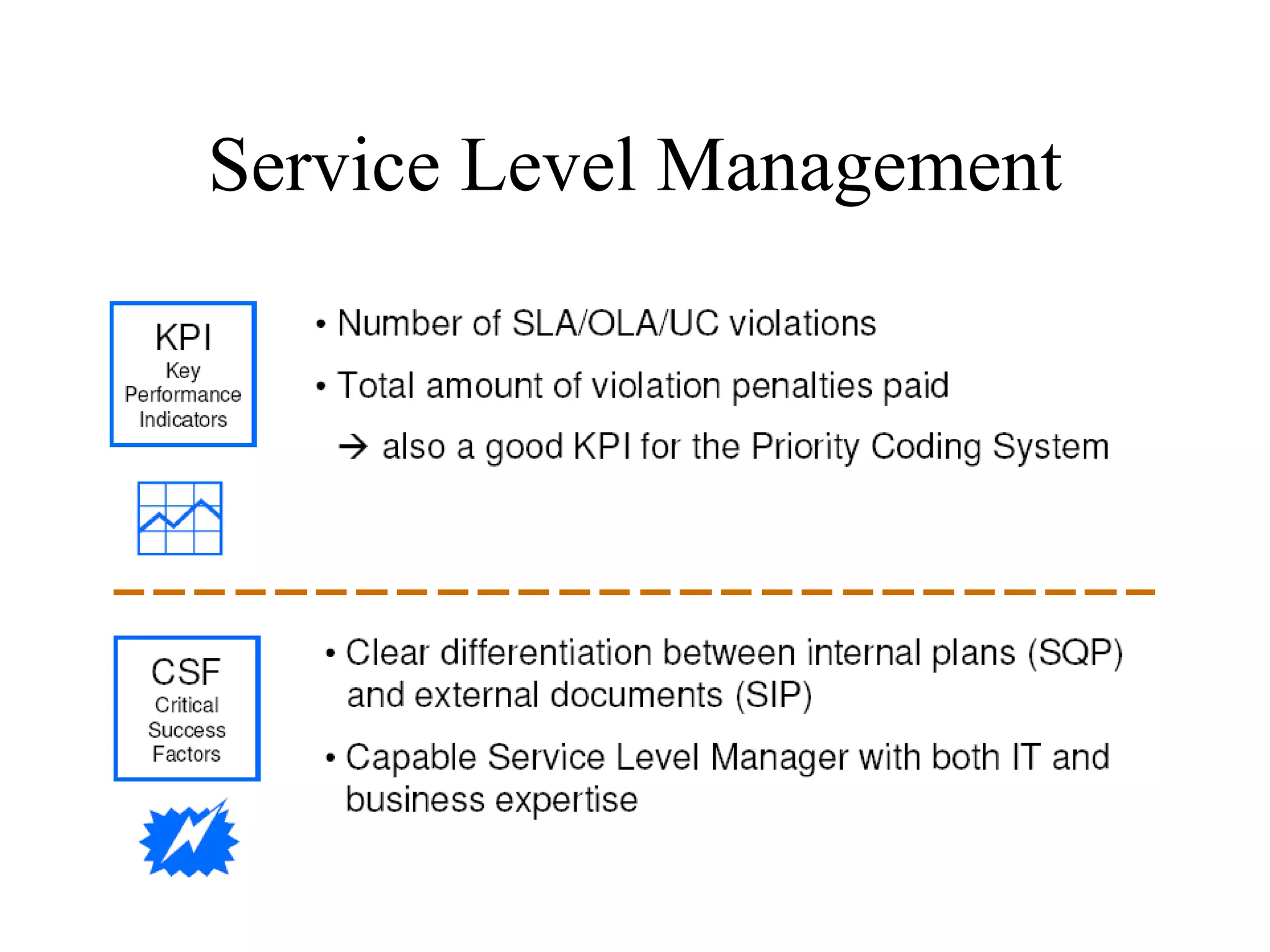
Service Level Management
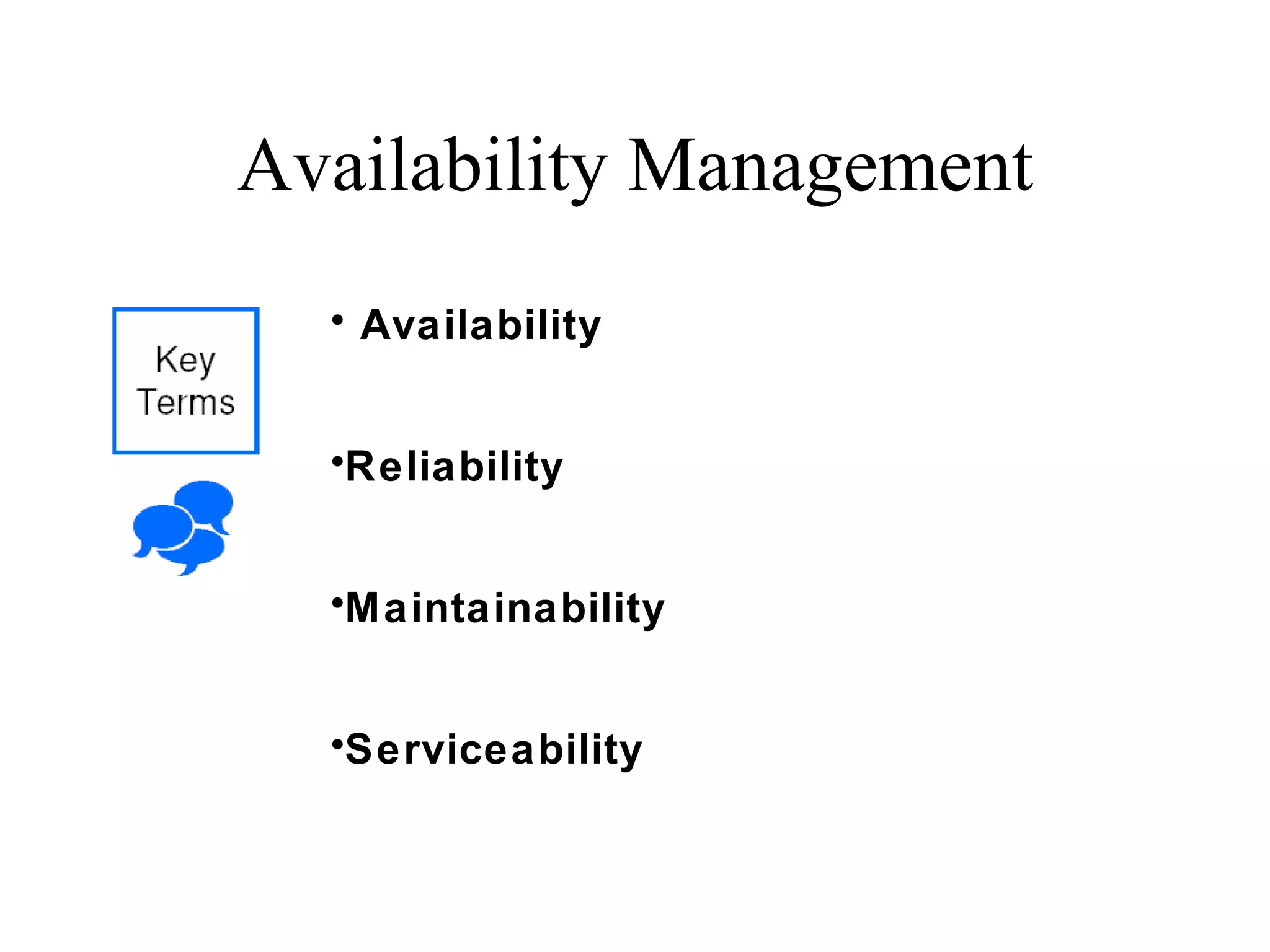
Availability Management Availability Reliability Maintainability Serviceability
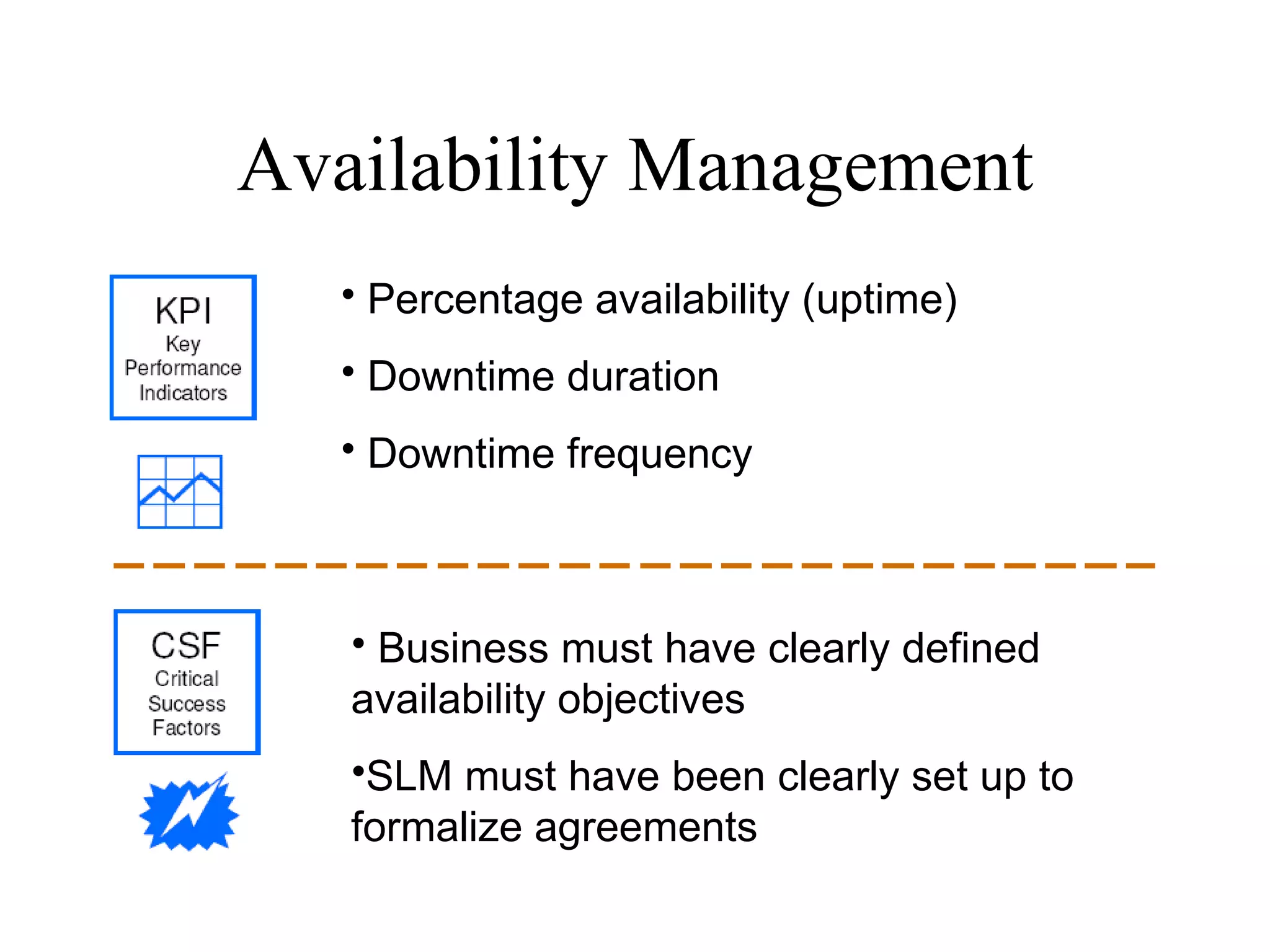
Availability Management Business must have clearly defined availability objectives SLM must have been clearly set up to formalize agreements Percentage availability (uptime) Downtime duration Downtime frequency
Capacity Management Performance Management:  Measuring, monitoring and tuning the performance of IT infrastructure components. Application Sizing:  Determining the hardware or network capacity needed to support new or modified services. Capacity Planning:  Developing capacity plan, based on CDB.
Capacity Management Accurate business forecast & expectations. Understanding of IT strategy and planning. Predictability of customer demand Technology Cost
Continuity Management Disaster:  An event that affects a service or system such that significant effort is required to restore the original performance level.
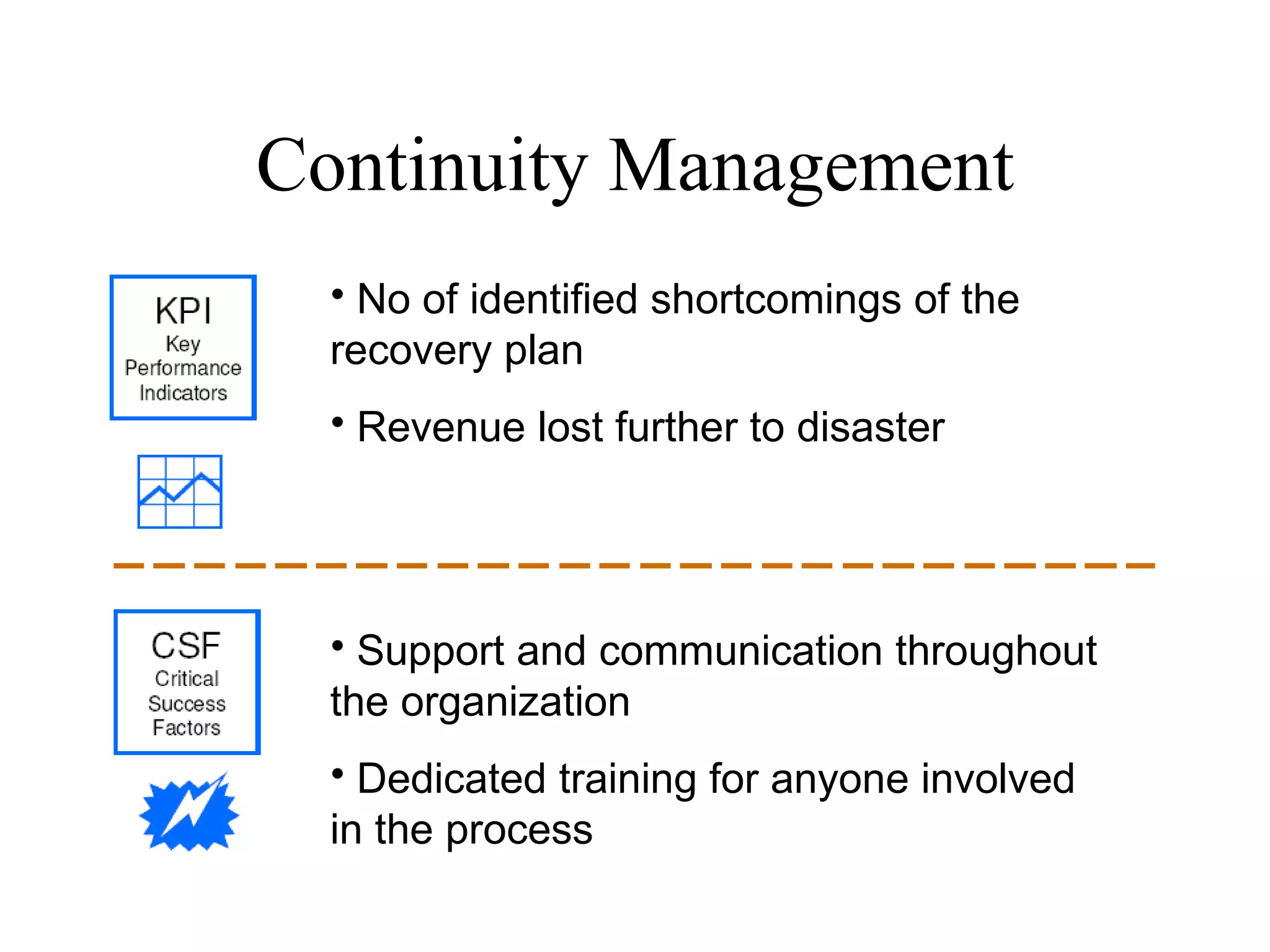
Continuity Management Support and communication throughout the organization Dedicated training for anyone involved in the process No of identified shortcomings of the recovery plan Revenue lost further to disaster
Benefits of ITIL Benefits to the customer/user: Provision of IT services becomes customer-focused Agreements about service quality improves relationship Services are described better, in customer language Quality, Availability, Reliability and Cost of services are managed better
Benefits of ITIL (contd) Benefits to the IT organization: IT organization develops clear structure More focus on corporate objectives More control of infrastructure Easier to manage changes Coherent framework for internal and external (supplier) communication Process structure provides for effective outsourcing of elements of IT service
Some Testimonials Procter & Gamble Started using ITIL in 1999 and has realized a 6% to 8% cut in operating costs.  Another ITIL project has reduced help desk calls by 10%. In four years, the company reported overall Savings of about $500 million.
Testimonials (contd) Caterpillar Embarked on a series of ITIL projects in 2000. After applying ITIL principles, the rate of achieving the target response time for incident management on Web-related services jumped from 60% to more than 90%.
Testimonials (contd) Nationwide Insurance Implementing key ITIL processes in 2001 led to a 40% reduction of its systems outages.  The company achieved a $4.3 million ROI over the next three years
Reasons for failure of ITIL implementation Lack of management commitment   Spending too much time on complicated process diagrams  Not creating work instructions  Not assigning process owners  Being too ambitious   Concentrating too much on performance   Not reviewing the entire ITIL framework
Thank you!

Itil introduction

  • 1.
    Introduction to ITSystems Management - Mukul bhalla
  • 2.
    Agenda Organization andPolicies IT Customer Relationship Mgmt IT Service Management Overview of ITIL Processes under ITIL Benefits Reasons for failure
  • 3.
    Organization and PoliciesVision Vision Mission & Objectives Policy Planning Time Quantity Quality Cost & Revenue Tasks & Actions Implementation Measurement & Control I can make money by selling PCs! Mission statement is a short, clear description of the objectives of the organization and the values it believes in Combination of all decisions and measures taken to define and realize the objectives Implementing policies in the form of specific activities requires planning Realization of planned activities requires action Actions are allocated to personnel as tasks Direction & control provided by measurement
  • 4.
    Planning Horizon BusinessApplication Technical Infrastructure 1 year Time
  • 5.
    IT Customer RelationshipMgmt Demand Supply Operational Tactical Strategic Department Managers Project Managers Users Budget Holders Business Manager Change Mgmt Incident Mgmt Service Desk Service Level Mgmt IT Mgmt Customer Organization IT Organization Support Service Levels Strategic Alignment IT Customer Relationship Mgmt Policy Report
  • 6.
    Evolution of ITManagement
  • 7.
    IT Service ManagementIt is a discipline for managing large-scale IT systems Philosophically centered on the customer's perspective of IT's contribution to the business Stands in deliberate contrast to technology-centered approaches to IT management Has ties and common interests with the process improvement movement (E.g. TQM, Six Sigma, CMM etc.) “ IT thinking about the delivery of IT to the business” and not “ IT thinking about the 'information' needs of the business”
  • 8.
    IT Service Management(contd) Contributing frameworks: Control Objectives for Information Technology (COBIT) Microsoft Operations Framework (MOF) Enterprise Computing Institute Information Technology Infrastructure Library (ITIL)
  • 9.
    Overview of ITILITIL is a framework of best practice approaches intended to facilitate the delivery of high quality IT services It is published in a series of books (hence the term Library ), each of which covers a core area within IT Management The names ITIL and IT Infrastructure Library are Registered Trade Marks of the United Kingdom's Office of Government Commerce (OGC)
  • 10.
  • 11.
  • 12.
  • 13.
  • 14.
  • 15.
  • 16.
  • 17.
  • 18.
  • 19.
  • 20.
  • 21.
  • 22.
  • 23.
  • 24.
  • 25.
  • 26.
  • 27.
  • 28.
  • 29.
  • 30.
  • 31.
  • 32.
  • 33.
  • 34.
  • 35.
    Availability Management AvailabilityReliability Maintainability Serviceability
  • 36.
    Availability Management Businessmust have clearly defined availability objectives SLM must have been clearly set up to formalize agreements Percentage availability (uptime) Downtime duration Downtime frequency
  • 37.
    Capacity Management PerformanceManagement: Measuring, monitoring and tuning the performance of IT infrastructure components. Application Sizing: Determining the hardware or network capacity needed to support new or modified services. Capacity Planning: Developing capacity plan, based on CDB.
  • 38.
    Capacity Management Accuratebusiness forecast & expectations. Understanding of IT strategy and planning. Predictability of customer demand Technology Cost
  • 39.
    Continuity Management Disaster: An event that affects a service or system such that significant effort is required to restore the original performance level.
  • 40.
    Continuity Management Supportand communication throughout the organization Dedicated training for anyone involved in the process No of identified shortcomings of the recovery plan Revenue lost further to disaster
  • 41.
    Benefits of ITILBenefits to the customer/user: Provision of IT services becomes customer-focused Agreements about service quality improves relationship Services are described better, in customer language Quality, Availability, Reliability and Cost of services are managed better
  • 42.
    Benefits of ITIL(contd) Benefits to the IT organization: IT organization develops clear structure More focus on corporate objectives More control of infrastructure Easier to manage changes Coherent framework for internal and external (supplier) communication Process structure provides for effective outsourcing of elements of IT service
  • 43.
    Some Testimonials Procter& Gamble Started using ITIL in 1999 and has realized a 6% to 8% cut in operating costs. Another ITIL project has reduced help desk calls by 10%. In four years, the company reported overall Savings of about $500 million.
  • 44.
    Testimonials (contd) CaterpillarEmbarked on a series of ITIL projects in 2000. After applying ITIL principles, the rate of achieving the target response time for incident management on Web-related services jumped from 60% to more than 90%.
  • 45.
    Testimonials (contd) NationwideInsurance Implementing key ITIL processes in 2001 led to a 40% reduction of its systems outages. The company achieved a $4.3 million ROI over the next three years
  • 46.
    Reasons for failureof ITIL implementation Lack of management commitment Spending too much time on complicated process diagrams Not creating work instructions Not assigning process owners Being too ambitious Concentrating too much on performance Not reviewing the entire ITIL framework
  • 47.