ITIL® 2011 FOUNDATION CERTIFICATION E-
               LEARNING COURSE


ITIL® Foundation Training Offered by Simplilearn.com
“ITIL® is a Registered Trade Mark of The Cabinet Office in the United Kingdom and other countries”.
"The Swirl logo™ is a Trade Mark of The Cabinet Office ".


                                                 Ver. 2.2
ITIL® 2011 Foundation Course Objectives
  2
         At the end of the course, you should be able to
             Discuss the ITIL 2011 qualification scheme
             Explain the practice of Service Management
             Describe Service Lifecycle
             Identify key principles and models of ITIL 2011
             Define generic concepts in ITIL 2011
             Discuss the processes, roles and functions in ITIL 2011
             Summarise the use of technology with ITIL 2011
             Successfully clear your ITIL 2011 foundation exam.


©Simplilearn Solutions Pvt. Ltd. 2011                                   2
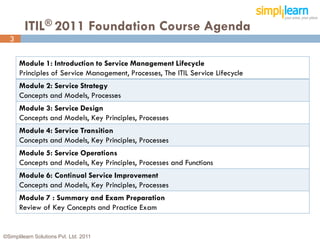
ITIL® 2011 Foundation Course Agenda
  3


      Module 1: Introduction to Service Management Lifecycle
      Principles of Service Management, Processes, The ITIL Service Lifecycle
      Module 2: Service Strategy
      Concepts and Models, Processes
      Module 3: Service Design
      Concepts and Models, Key Principles, Processes
      Module 4: Service Transition
      Concepts and Models, Key Principles, Processes
      Module 5: Service Operations
      Concepts and Models, Key Principles, Processes and Functions
      Module 6: Continual Service Improvement
      Concepts and Models, Key Principles, Processes
      Module 7 : Summary and Exam Preparation
      Review of Key Concepts and Practice Exam


©Simplilearn Solutions Pvt. Ltd. 2011                                           3
Module 1
  4


         Introduction
         To Service
         Management
         Lifecycle


©Simplilearn Solutions Pvt. Ltd. 2011   4
Lesson 1.0: What is ITIL ?
  5
         What is ITIL® ?
       A set of publications for good practices in IT service Management.

       Why ITIL ?
         • Focuses on descriptive guidance on IT Service Management that’s
           easily adapted.
         • Emphasizes Quality Management approach, standards

       ITIL® goals
          • Consistent, comprehensive, hygienic set of Best-Practice guidance
          • Platform independent discussion of processes
          • Common Language, Standardized vocabulary
          • Flexible framework, adaptable to different IT environments.


©Simplilearn Solutions Pvt. Ltd. 2011                                           5
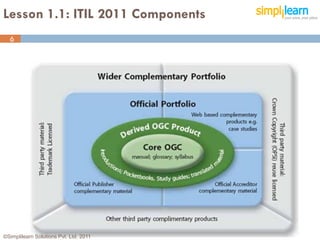
Lesson 1.1: ITIL 2011 Components
  6


©Simplilearn Solutions Pvt. Ltd. 2011   6
Lesson 1.2: ITIL Core Publications
  7


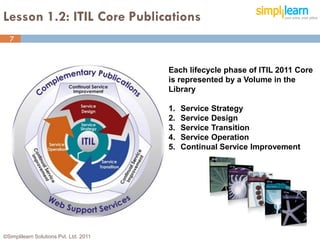
                                        Each lifecycle phase of ITIL 2011 Core
                                        is represented by a Volume in the
                                        Library

                                        1.   Service Strategy
                                        2.   Service Design
                                        3.   Service Transition
                                        4.   Service Operation
                                        5.   Continual Service Improvement


©Simplilearn Solutions Pvt. Ltd. 2011                                        7
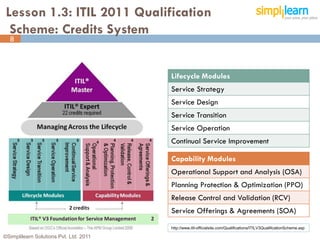
Lesson 1.3: ITIL 2011 Qualification
  Scheme: Credits System
  8


                                        Lifecycle Modules
                                        Service Strategy
                                        Service Design
                                        Service Transition
                                        Service Operation
                                        Continual Service Improvement

                                        Capability Modules
                                        Operational Support and Analysis (OSA)
                                        Planning Protection & Optimization (PPO)
                                        Release Control and Validation (RCV)
                                        Service Offerings & Agreements (SOA)

                                        http://www.itil-officialsite.com/Qualifications/ITILV3QualificationScheme.asp

©Simplilearn Solutions Pvt. Ltd. 2011                                                                                   8
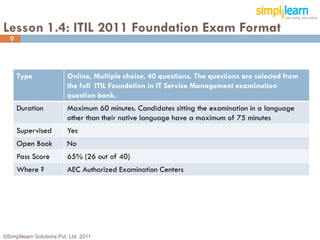
Lesson 1.4: ITIL 2011 Foundation Exam Format
  9


      Type                 Online, Multiple choice, 40 questions. The questions are selected from
                           the full ITIL Foundation in IT Service Management examination
                           question bank.
      Duration             Maximum 60 minutes. Candidates sitting the examination in a language
                           other than their native language have a maximum of 75 minutes
      Supervised           Yes
      Open Book            No
      Pass Score           65% (26 out of 40)
      Where ?              AEC Authorized Examination Centers


©Simplilearn Solutions Pvt. Ltd. 2011                                                               9
Lesson 2.0: Principles of IT Service
     10
                    Management
                    Lesson objectives
                    At the end of this lesson, you should be able to:
                    • Explain the concept of good practice

                    • Define the concepts of service, Service

                      Management, Functions, Roles &Processes, and
                      RACI
                    • The role of IT Governance across the Service
                      Lifecycle
©Simplilearn Solutions Pvt. Ltd. 2011
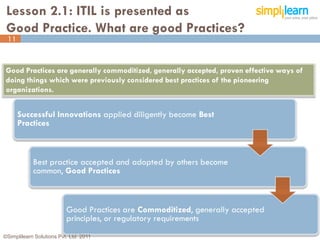
Lesson 2.1: ITIL is presented as
 Good Practice. What are good Practices?
 11


 Good Practices are generally commoditized, generally accepted, proven effective ways of
 doing things which were previously considered best practices of the pioneering
 organizations.


      Successful Innovations applied diligently become Best
      Practices


            Best practice accepted and adopted by others become
            common, Good Practices


                          Good Practices are Commoditized, generally accepted
                          principles, or regulatory requirements
©Simplilearn Solutions Pvt. Ltd. 2011                                                      11
Lesson 2.2: Why Choose Good
 practices over Proprietary ones?
 12


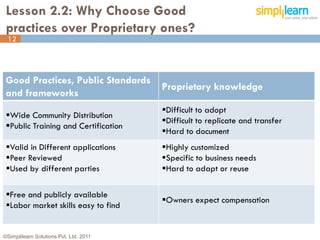
 Good Practices, Public Standards
                                        Proprietary knowledge
 and frameworks
                                        Difficult to adopt
 Wide Community Distribution
                                        Difficult to replicate and transfer
 Public Training and Certification
                                        Hard to document
 Valid in Different applications       Highly customized
 Peer Reviewed                         Specific to business needs
 Used by different parties             Hard to adapt or reuse

 Free and publicly available
                                        Owners expect compensation
 Labor market skills easy to find


©Simplilearn Solutions Pvt. Ltd. 2011                                          12
Lesson 2.3: What is a Service?
 13


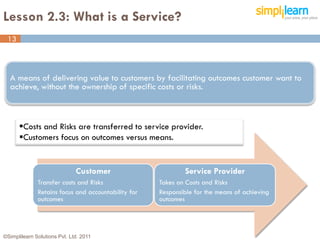
  A means of delivering value to customers by facilitating outcomes customer want to
  achieve, without the ownership of specific costs or risks.


      Costs and Risks are transferred to service provider.
      Customers focus on outcomes versus means.


                              Customer                       Service Provider
              Transfer costs and Risks               Takes on Costs and Risks
              Retains focus and accountability for   Responsible for the means of achieving
              outcomes                               outcomes


©Simplilearn Solutions Pvt. Ltd. 2011                                                         13
Lesson 2.4: What is a Service Management?
   14


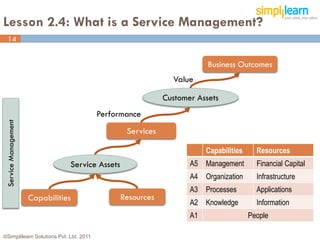
                                                                          Business Outcomes
                                                                Value

                                                              Customer Assets
                                        Performance
 Service Management


                                                   Services

                                                                          Capabilities     Resources
                                 Service Assets                      A5 Management         Financial Capital
                                                                     A4 Organization       Infrastructure
                                                                     A3 Processes          Applications
                      Capabilities                Resources
                                                                     A2 Knowledge          Information
                                                                     A1                  People

©Simplilearn Solutions Pvt. Ltd. 2011                                                                          14
Lesson 2.5: Process, Functions and Roles
 15

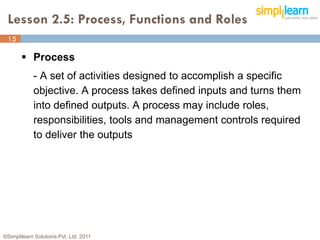
        Process
            - A set of activities designed to accomplish a specific
            objective. A process takes defined inputs and turns them
            into defined outputs. A process may include roles,
            responsibilities, tools and management controls required
            to deliver the outputs


©Simplilearn Solutions Pvt. Ltd. 2011                                  15
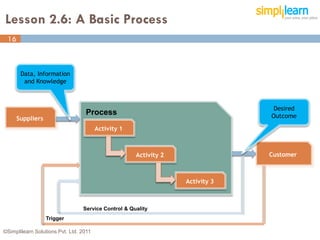
Lesson 2.6: A Basic Process
 16


       Data, Information
        and Knowledge


                                                                                Desired
                                  Process                                      Outcome
      Suppliers
                                        Activity 1


                                                     Activity 2                Customer


                                                                  Activity 3


                                 Service Control & Quality
                  Trigger
                                                                                          16
©Simplilearn Solutions Pvt. Ltd. 2011
Lesson 2.7: Process Characteristics
 17


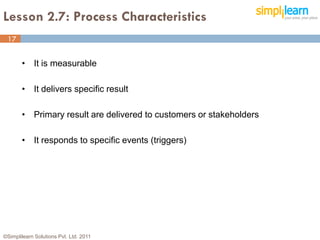
       • It is measurable

       • It delivers specific result

       • Primary result are delivered to customers or stakeholders

       • It responds to specific events (triggers)


©Simplilearn Solutions Pvt. Ltd. 2011                                17
Lesson 2.8: Functions
 18

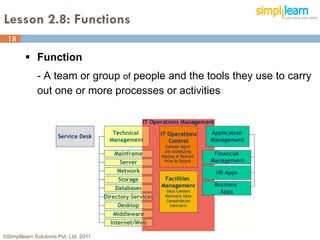
          Function
              - A team or group of people and the tools they use to carry
              out one or more processes or activities


©Simplilearn Solutions Pvt. Ltd. 2011                                   18
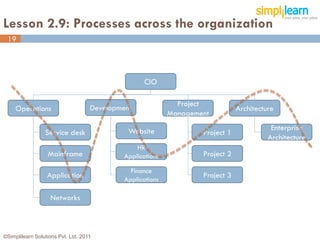
Lesson 2.9: Processes across the organization
 19


                                                    CIO

                                                              Project
     Operations                     Development                                 Architecture
                                                            Management

                                              Website                                      Enterprise
                 Service desk                                       Project 1
                                                                                          Architecture
                                                 HR
                  Mainframe                  Applications           Project 2

                                               Finance
                  Application                Applications
                                                                    Project 3

                   Networks


©Simplilearn Solutions Pvt. Ltd. 2011                                                                    19
Lesson 2.10: Service Management Roles :
Service Owner
 20

Service Owner :

The person who is accountable for the delivery of a specific IT Service. They are
responsible for continual improvement and management of change affecting Services
under their care. Example: The owner of the Payroll Service


Responsibilities:
         To act as prime Customer contact for all Service related enquiries and issues
         To ensure that the ongoing Service delivery and support meet agreed Customer
         requirements
         To identify opportunities for Service Improvements, discuss with the customer
         and to initiate changes for improvements if appropriate.
         To liaise with the appropriate Process Owners throughout the Service
         Management lifecycle
         To solicit required data, statistics and reports for analysis and to facilitate effective
         Service monitoring and performance

©Simplilearn Solutions Pvt. Ltd. 2011                                                           20
Lesson 2.11: Service Management Roles :
 Process Owner
 21


Process Owner :
The person responsible for ensuring that the process is fit for the desired
purpose and is accountable for the outputs of that process. Example: The
owner for the Availability Management Process

Responsibilities:
           Assisting with process design

           Documenting the process

           Make sure the process is being performed as documented

           Making sure process meetings it aims

           Monitoring and improving the process over time
©Simplilearn Solutions Pvt. Ltd. 2011                                         21
Lesson 2.12: Connecting with
Processes and Functions: RACI
 22

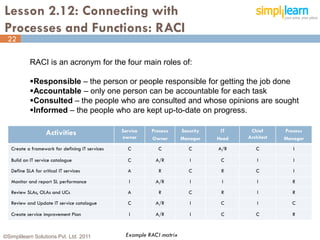
            RACI is an acronym for the four main roles of:

            Responsible – the person or people responsible for getting the job done
            Accountable – only one person can be accountable for each task
            Consulted – the people who are consulted and whose opinions are sought
            Informed – the people who are kept up-to-date on progress.

                    Activities                   Service   Process      Security    IT     Chief      Process
                                                 owner     Owner        Manager    Head   Architect   Manager
   Create a framework for defining IT services     C         C             C       A/R       C           I

   Build an IT service catalogue                   C        A/R            I        C         I          I

   Define SLA for critical IT services             A          R            C        R        C           I

   Monitor and report SL performance                I       A/R            I        I         I          R

   Review SLAs, OLAs and UCs                       A          R            C        R         I          R

   Review and Update IT service catalogue          C        A/R            I        C         I         C

   Create service improvement Plan                  I       A/R            I        C        C           R


©Simplilearn Solutions Pvt. Ltd. 2011             Example RACI matrix                                           22
Lesson 2.13: Key Terminology: Service Provider
 23

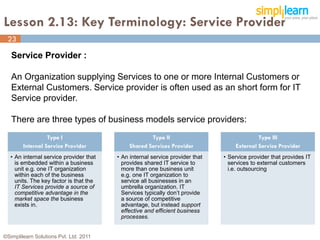
   Service Provider :

   An Organization supplying Services to one or more Internal Customers or
   External Customers. Service provider is often used as an short form for IT
   Service provider.

   There are three types of business models service providers:
                  Type I                              Type II                               Type III
        Internal Service Provider             Shared Services Provider             External Service Provider
   • An internal service provider that   • An internal service provider that   • Service provider that provides IT
     is embedded within a business         provides shared IT service to         services to external customers
     unit e.g. one IT organization         more than one business unit           i.e. outsourcing
     within each of the business           e.g. one IT organization to
     units. The key factor is that the     service all businesses in an
     IT Services provide a source of       umbrella organization. IT
     competitive advantage in the          Services typically don’t provide
     market space the business             a source of competitive
     exists in.                            advantage, but instead support
                                           effective and efficient business
                                           processes.


©Simplilearn Solutions Pvt. Ltd. 2011                                                                           23
Lesson 2.14: Key Terminology: Supplier
 24

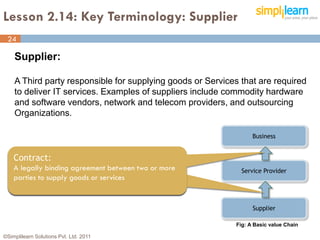
    Supplier:

    A Third party responsible for supplying goods or Services that are required
    to deliver IT services. Examples of suppliers include commodity hardware
    and software vendors, network and telecom providers, and outsourcing
    Organizations.

                                                                  Business


    Contract:
    A legally binding agreement between two or more           Service Provider
    parties to supply goods or services


                                                                  Supplier

                                                            Fig: A Basic value Chain

©Simplilearn Solutions Pvt. Ltd. 2011                                                  24
25             Lesson 3.0: The Service Lifecycle
                     Lesson objectives
                     At the end of this lesson, you should be able to:
                      Understand the value of the Service Lifecycle

                      How the processes integrate with each other,

                       throughout       the Lifecycle
                      Explain the relationship between Governance
                       and IT Service Management

©Simplilearn Solutions Pvt. Ltd. 2011
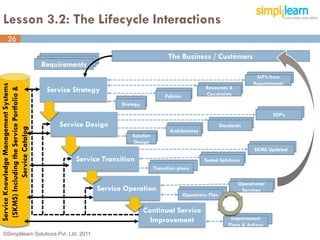
Lesson 3.2: The Lifecycle Interactions
         26

                                                                                        The Business / Customers
                                            Requirements
                                                                                                                                  SLP’s from
                                                                                                                                 Requirements
Service Knowledge Management Systems


                                                                                                           Resources &
                                             Service Strategy
 (SKMS) Including the Service Portfolio &


                                                                                       Policies            Constraints
                                                                   Strategy

                                                                                                                                         SDP’s
                                                Service Design                                                      Standards
             Service Catalog


                                                                                         Architectures
                                                                       Solution
                                                                        Design
                                                                                                                                  SKMS Updated
                                                     Service Transition                                    Tested Solutions
                                                                                  Transition plans

                                                                                                                           Operational
                                                            Service Operation                                               Services
                                                                                                  Operations Plan


                                                                              Continual Service
                                                                                Improvement                             Improvement
                                                                                                                       Plans & Actions
   ©Simplilearn Solutions Pvt. Ltd. 2011                                                                                                         26
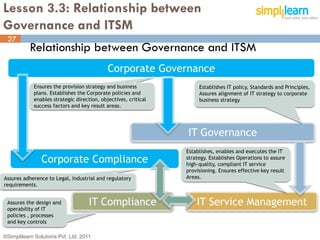
Lesson 3.3: Relationship between
Governance and ITSM
 27
           Relationship between Governance and ITSM
                                            Corporate Governance
            Ensures the provision strategy and business              Establishes IT policy, Standards and Principles,
            plans. Establishes the Corporate policies and            Assures alignment of IT strategy to corporate
            enables strategic direction, objectives, critical        business strategy
            success factors and key result areas.


                                                                IT Governance
                                                                Establishes, enables and executes the IT
                Corporate Compliance                            strategy. Establishes Operations to assure
                                                                high-quality, compliant IT service
                                                                provisioning. Ensures effective key result
Assures adherence to Legal, Industrial and regulatory           Areas.
requirements.


 Assures the design and             IT Compliance                   IT Service Management
 operability of IT
 policies , processes
 and key controls

©Simplilearn Solutions Pvt. Ltd. 2011                                                                               27
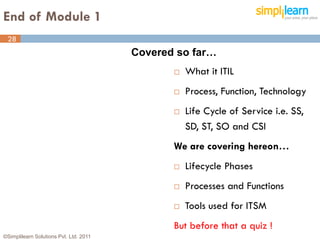
End of Module 1
 28
                                        Covered so far…
                                                  What it ITIL
                                                  Process, Function, Technology
                                                  Life Cycle of Service i.e. SS,
                                                   SD, ST, SO and CSI
                                               We are covering hereon…
                                                  Lifecycle Phases
                                                  Processes and Functions
                                                  Tools used for ITSM
                                               But before that a quiz !
©Simplilearn Solutions Pvt. Ltd. 2011                                               28
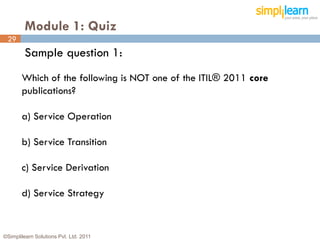
Module 1: Quiz
 29
         Sample question 1:
       Which of the following is NOT one of the ITIL® 2011 core
       publications?

       a) Service Operation

       b) Service Transition

       c) Service Derivation

       d) Service Strategy


©Simplilearn Solutions Pvt. Ltd. 2011                             29
Module 1: Quiz
 30
         Sample question 2:
          What is the RACI model used for?

          a) Documenting the roles and relationships of stakeholders in a
             process or activity

          b) Defining requirements for a new service or process

          c) Analyzing the business impact of an incident

          d) Creating a balanced scorecard showing the overall status of
          Service Management

©Simplilearn Solutions Pvt. Ltd. 2011                                       30
Module 1: Quiz
 31
         Sample question 3:
          A service owner is responsible for which of the following?

          a) Designing and documenting a Service

          b) Carrying out the Service Operations activities needed to
          support a Service

          c) Producing a balanced scorecard showing the overall status of
          all Services

          d) Recommending improvements

©Simplilearn Solutions Pvt. Ltd. 2011                                       31
Module 1: Quiz
 32
         Sample question 4:

          Which of the following statements is CORRECT?
          1. Only one person can be responsible for an activity
          2. Only one person can be accountable for an activity

          a) All of the above

          b) 1 only

          c) 2 only

          d) None of the above

©Simplilearn Solutions Pvt. Ltd. 2011                             32
Module 1: Quiz
 33
         Sample question 5:
  Which of the following statements are CORRECT about Functions?
  1. They provide structure and stability to organizations
  2. They are self-contained units with their own capabilities and resources
  3. They rely on processes for cross-functional coordination and control
  4. They are costlier to implement compared to processes

               a) 1, 2 and 3 only
               b) 1, 2 and 4 only
               c) All of the above
               d) None of the above
©Simplilearn Solutions Pvt. Ltd. 2011                                     33
Module 1: Quiz
 34
         Sample question 6:
          Which of the following is a characteristic of every process?
          1. It is measurable
          2. It is timely
          3. It delivers a specific result
          4. It responds to a specific event
          5. It delivers its primary result to a customer or stakeholder
          a) 1, 2, 3 and 4 only
          b) 1, 2, 4 and 5 only
          c) 1, 3, 4 and 5 only
          d) All of the above
©Simplilearn Solutions Pvt. Ltd. 2011                                      34
35             End of Module 1


©Simplilearn Solutions Pvt. Ltd. 2011
Module 2
 36


         Service
         Strategy


©Simplilearn Solutions Pvt. Ltd. 2011   36
37             Lesson 1: Service Strategy

          Lesson objectives
          At the end of this lesson, you should be able to:
          •  Understand the Goals and Objectives of Service
             Strategy


©Simplilearn Solutions Pvt. Ltd. 2011
Lesson 1.1: Service Strategy Objectives
 38

   Shows organization how to transform Service Management into a strategic
  asset and then think and act in a strategic manner


  Helps clarify the relationship between various services, systems or processes
  and the business models, strategies or objectives they support


  KEY ROLE: To stop and think about WHY something has to be done, before
  thinking HOW.


©Simplilearn Solutions Pvt. Ltd. 2011                                        38
Lesson 1.2: Key Strategy Questions
 39

           The objectives of service Strategy are to answer questions such as :

           • What services should we offer and to whom?
           • How do we differentiate ourselves from competing alternatives?
           • How do we truly create value for our customers?
           • How do we capture value for our stakeholders?


          Process in Service Strategy:

          • Demand management
          • Service portfolio Management, and
          • Financial management
          • Business Relationship Management


©Simplilearn Solutions Pvt. Ltd. 2011                                              39
Lesson 2.0: Key concepts of service
     40
                    strategy
                    Lesson objectives
                    At the end of this lesson, you should be able to:

                    •      Describe basics of Value Creation through
                           Services
                    •      Explain Business Case


©Simplilearn Solutions Pvt. Ltd. 2011
Lesson 2.1 Key Principles and Models
 41


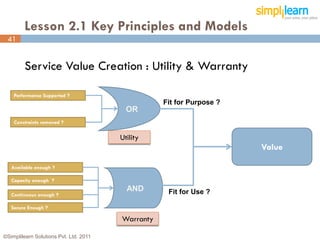
         Service Value Creation : Utility & Warranty

    Performance Supported ?
                                                   Fit for Purpose ?
                                          OR
    Constraints removed ?

                                        Utility
                                                                       Value

   Available enough ?

   Capacity enough ?
                                          AND       Fit for Use ?
   Continuous enough ?

   Secure Enough ?

                                        Warranty

©Simplilearn Solutions Pvt. Ltd. 2011                                          41
Lesson 2.2: Service Value creation:
       Utility & Warranty
 42
42

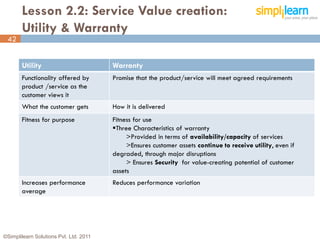
       Utility                          Warranty
       Functionality offered by         Promise that the product/service will meet agreed requirements
       product /service as the
       customer views it
       What the customer gets           How it is delivered
       Fitness for purpose              Fitness for use
                                        Three Characteristics of warranty
                                             >Provided in terms of availability/capacity of services
                                             >Ensures customer assets continue to receive utility, even if
                                        degraded, through major disruptions
                                             > Ensures Security for value-creating potential of customer
                                        assets
       Increases performance            Reduces performance variation
       average


©Simplilearn Solutions Pvt. Ltd. 2011
Lesson 2.3: Basics of Value Creation:
     Service Assets
 43
43
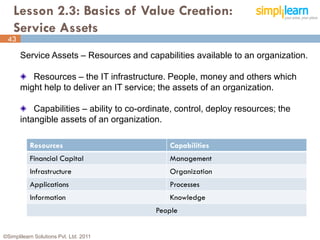
       Service Assets – Resources and capabilities available to an organization.

          Resources – the IT infrastructure. People, money and others which
       might help to deliver an IT service; the assets of an organization.

           Capabilities – ability to co-ordinate, control, deploy resources; the
       intangible assets of an organization.

           Resources                           Capabilities
           Financial Capital                   Management
           Infrastructure                      Organization
           Applications                        Processes
           Information                         Knowledge
                                           People


©Simplilearn Solutions Pvt. Ltd. 2011
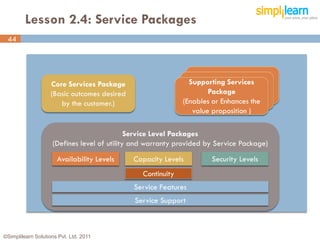
Lesson 2.4: Service Packages
 44


                    Core Services Package                      Supporting Services
                    (Basic outcomes desired                          Package
                       by the customer.)                     (Enables or Enhances the
                                                                value proposition )

                                             Service Level Packages
                    (Defines level of utility and warranty provided by Service Package)
                      Availability Levels     Capacity Levels        Security Levels
                                                Continuity
                                              Service Features
                                              Service Support


©Simplilearn Solutions Pvt. Ltd. 2011                                                     44
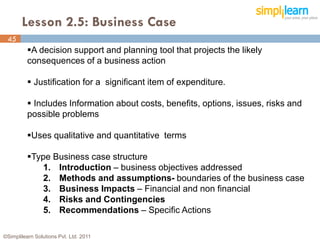
Lesson 2.5: Business Case
 45
45        A decision support and planning tool that projects the likely
          consequences of a business action

           Justification for a significant item of expenditure.

           Includes Information about costs, benefits, options, issues, risks and
          possible problems

          Uses qualitative and quantitative terms

          Type Business case structure
              1. Introduction – business objectives addressed
              2. Methods and assumptions- boundaries of the business case
              3. Business Impacts – Financial and non financial
              4. Risks and Contingencies
              5. Recommendations – Specific Actions

©Simplilearn Solutions Pvt. Ltd. 2011
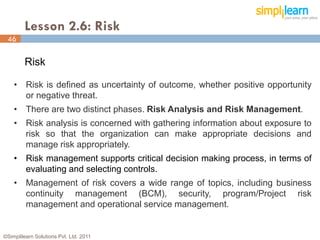
Lesson 2.6: Risk
 46

         Risk

    • Risk is defined as uncertainty of outcome, whether positive opportunity
      or negative threat.
    • There are two distinct phases. Risk Analysis and Risk Management.
    • Risk analysis is concerned with gathering information about exposure to
      risk so that the organization can make appropriate decisions and
      manage risk appropriately.
    • Risk management supports critical decision making process, in terms of
      evaluating and selecting controls.
    • Management of risk covers a wide range of topics, including business
      continuity management (BCM), security, program/Project risk
      management and operational service management.


©Simplilearn Solutions Pvt. Ltd. 2011                                       46
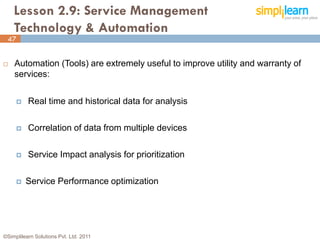
Lesson 2.9: Service Management
    Technology & Automation
 47


   Automation (Tools) are extremely useful to improve utility and warranty of
    services:


         Real time and historical data for analysis

         Correlation of data from multiple devices

         Service Impact analysis for prioritization

        Service Performance optimization


©Simplilearn Solutions Pvt. Ltd. 2011                                            47
Lesson 2.9: Service Management
    Technology & Automation
 48

   Automation of service processes helps improve the quality of service,
    reduce costs and reduce risks by reducing complexity and uncertainty, and
    by efficiently resolving trade-offs.


   Some of the areas where service management can benefit from automation
     Design and modeling

     Service catalogue

     Pattern recognition and analysis

     Classification, prioritization and routing

     Detection and monitoring

     Optimization.


©Simplilearn Solutions Pvt. Ltd. 2011                                     48
Lesson 2.9: Service Management
      Technology & Automation
 49
   Service Management Tools functionality include:


        Self Help: a web front-end offering a menu-driven range of Self-Help and
         Service Requests – with a direct interface into the back-end process-
         handling software.

        Workflow or Process Engine: should allow responsibilities, activities,
         timescales, escalation paths and alerting to be pre-defined and then
         automatically managed.

        Integrated CMS: CIs, Relationships, Records related to incidents,
         problems, KE & Change

        Discovery/Deployment technology: populate or verify CMS data, assist
         in license management, ability to deploy new software at target locations
©Simplilearn Solutions Pvt. Ltd. 2011                                             49
Lesson 2.9: Service Management
      Technology & Automation
 50


   Service Management tools functionality include (contd.)


        Remote Control: allow relevant support groups to take control of the user
         desktops
        Diagnostic scripts & utilities
        Reporting & Dashboards


©Simplilearn Solutions Pvt. Ltd. 2011                                          50
51
                    Lesson 3.0: Service Strategy
                    Process
       Lesson objectives
       At the end of this lesson, you should be able Objectives
       and basic concepts of the four processes in Service
       Strategy:
        Demand Management,

        Service Portfolio Management

        Financial Management

        Business Relationship Management
©Simplilearn Solutions Pvt. Ltd. 2011
Lesson 3.1: Demand Management: Objectives
 52

          The primary objective of Demand Management is to assist the IT
          Service Provider in understanding and influencing Customer demand
          for services and the provision of Capacity to meet these demands.


          Other objectives include:

          • Identification and analysis of Patterns of Business Activity (PBA) and
          user profiles (UP) that generate demand.

          • Utilizing techniques to influence and manage demand in such a way
          that excess capacity is reduced but the business and customer
          requirements are still satisfied.


©Simplilearn Solutions Pvt. Ltd. 2011                                                52
Lesson 3.2: Managing Demand for Services
 53


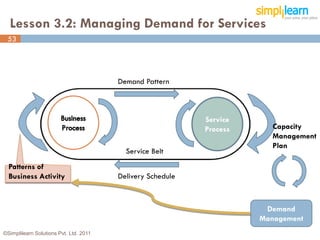
                                        Demand Pattern


                                                            Service
                                                            Process      Capacity
                                                                         Management
                                                                         Plan
                                          Service Belt
  Patterns of
  Business Activity                     Delivery Schedule


                                                                       Demand
                                                                      Management
                                                                                   53
©Simplilearn Solutions Pvt. Ltd. 2011
Lesson 3.3: PBA and UP
 54


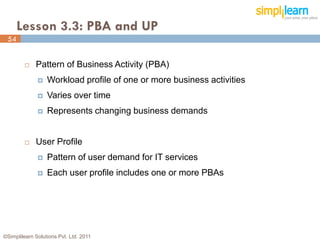
            Pattern of Business Activity (PBA)
                 Workload profile of one or more business activities
                 Varies over time
                 Represents changing business demands


            User Profile
                 Pattern of user demand for IT services
                 Each user profile includes one or more PBAs


©Simplilearn Solutions Pvt. Ltd. 2011                                   54
Lesson 3.4: What is a Service Portfolio?
 55


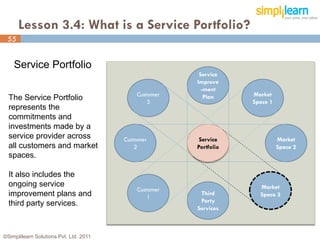
    Service Portfolio
                                                        Service
                                                       Improve
                                                         -ment
                                            Customer      Plan     Market
  The Service Portfolio                         3                  Space 1
  represents the
  commitments and
  investments made by a
  service provider across               Customer        Service              Market
  all customers and market                  2          Portfolio             Space 2
  spaces.

  It also includes the
  ongoing service                                                    Market
                                            Customer
  improvement plans and                                 Third        Space 3
                                                1
  third party services.                                 Party
                                                       Services


©Simplilearn Solutions Pvt. Ltd. 2011                                                  55
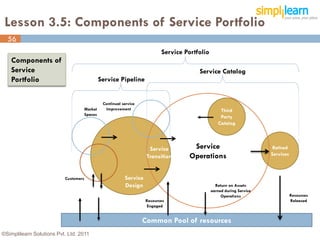
Lesson 3.5: Components of Service Portfolio
  56
                                                                            Service Portfolio
    Components of
    Service                                                                              Service Catalog
    Portfolio                                  Service Pipeline


                                                Continual service
                                      Market     Improvement                                        Third
                                      Spaces
                                                                                                    Party
                                                                                                   Catalog


                                                                      Service         Service                            Retired
                                                                     Transition      Operations                         Services


                          Customers                        Service
                                                           Design                                 Return on Assets
                                                                                                earned during Service
                                                                                                     Operations                    Resources
                                                                     Resources                                                     Released
                                                                     Engaged


                                                                    Common Pool of resources
                                                                                                                                           56
©Simplilearn Solutions Pvt. Ltd. 2011
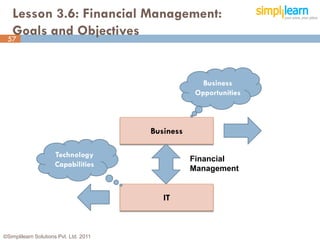
Lesson 3.6: Financial Management:
  Goals and Objectives
 57


                                                      Business
                                                    Opportunities


                                        Business

                     Technology
                                                   Financial
                     Capabilities
                                                   Management


                                           IT


©Simplilearn Solutions Pvt. Ltd. 2011                               57
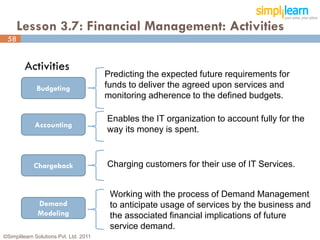
Lesson 3.7: Financial Management: Activities
 58


         Activities
                                        Predicting the expected future requirements for
              Budgeting                 funds to deliver the agreed upon services and
                                        monitoring adherence to the defined budgets.

                                        Enables the IT organization to account fully for the
             Accounting
                                        way its money is spent.


            Chargeback                  Charging customers for their use of IT Services.


                                         Working with the process of Demand Management
              Demand                     to anticipate usage of services by the business and
              Modeling                   the associated financial implications of future
                                         service demand.
©Simplilearn Solutions Pvt. Ltd. 2011                                                          58
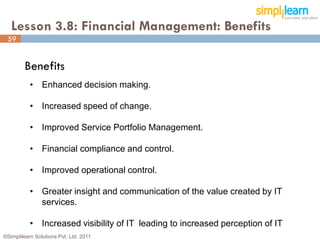
Lesson 3.8: Financial Management: Benefits
 59


         Benefits
           • Enhanced decision making.

           • Increased speed of change.

           • Improved Service Portfolio Management.

           • Financial compliance and control.

           • Improved operational control.

           • Greater insight and communication of the value created by IT
             services.

           • Increased visibility of IT leading to increased perception of IT
©Simplilearn Solutions Pvt. Ltd. 2011                                           59
Lesson 3.9: Business Relationship
      Management: Purpose
 60


           The purpose of Business Relationship Management are

           • To establish and maintain relationship between the service
             provider and customer

           • To identify customer needs and ensure that the service provider is
             able to meet these needs


©Simplilearn Solutions Pvt. Ltd. 2011                                             60
Lesson 4.0: Business Relationship Activities
 61


           Following are the two key activities

           •     Being the voice of the service provider to the customer

           •     Being the voice of the customer to the service provider


©Simplilearn Solutions Pvt. Ltd. 2011                                      61
Lesson 4.1:Business Relationship Mgmt:
 Role – Business Relationship Manager
 62

          • Responsible for the interaction and the communication with
            customers

          •     Could easily combine with the Service level Manager to create
               seamless conduit from customer to service provider capabilities
               used to ensure value


©Simplilearn Solutions Pvt. Ltd. 2011                                            62
63             End of Service Strategy Module

                  • Objectives and Key concepts of Service Strategy
                  • Service Strategy processes.


©Simplilearn Solutions Pvt. Ltd. 2011
Module 2: Quiz
 64


         Question 1:
          Which ITIL® process is responsible for drawing up a charging
          system ?

          a) Availability Management

          b) Capacity Management

          c) Financial Management for IT Services

          d) Service Level Management

©Simplilearn Solutions Pvt. Ltd. 2011                                    64
Module 2: Quiz
 65


         Question 2:
          A Service Level Package is best described as?

          a) A description of customer requirements used to negotiate a
             Service Level Agreement

          b) A defined level of utility and warranty associated with a core
          service package

          c) A description of the value that the customer wants and for
          which they are willing to pay
          d) A document showing the Service Levels achieved during an
          agreed reporting period
©Simplilearn Solutions Pvt. Ltd. 2011                                         65
Module 2: Quiz
 66


         Question 3:
           The utility of a service is best described as:

           a) Fit for design

           b) Fit for purpose

           c) Fit for function

           d) Fit for use


©Simplilearn Solutions Pvt. Ltd. 2011                       66
Module 2: Quiz
 67

         Question 4:
          The contents of a service package include:

          a) Base Service Package, Supporting Service Package, Service
             Level Package
          b) Core Service Package, Supporting Process Package, Service
             Level Package

          c) Core Service Package, Base Service Package, Service
             Support Package

          d) Core Service Package, Supporting Services Package, Service
             Level Packages
©Simplilearn Solutions Pvt. Ltd. 2011                                     67
Module 2: Quiz
 68


         Question 5:
           Setting policies and objectives is the primary concern of which of
           the following elements of the Service Lifecycle?

           a) Service Strategy

           b) Service Strategy and Continual Service Improvement

           c) Service Strategy, Service Transition and Service Operation

           d) Service Strategy, Service Design, Service Transition, Service
           Operation and Continual Service Improvement

©Simplilearn Solutions Pvt. Ltd. 2011                                           68
Module 2: Quiz
 69

      Question 6:
   Which of the following questions does guidance in Service Strategy
   help answer?
   1: What services should we offer and to whom?
   2: How do we differentiate ourselves from competing alternatives?
   3: How do we truly create value for our customers?

                a) 1 only
                b) 2 only
                c) 3 only
                d) All of the above
©Simplilearn Solutions Pvt. Ltd. 2011                                   69
Module 3
 70


         Service
         Design


©Simplilearn Solutions Pvt. Ltd. 2011   70
71             Lesson 1.0 Service Design
                    Lesson objectives
                    At the end of this lesson, you should be able to:

                    •      Understand the Goals and Objectives of
                           Service Design
                    •      Understand the Value Service Design
                           provides to the Business.


©Simplilearn Solutions Pvt. Ltd. 2011
Lesson 1.1: Service Design Objectives
 72


            To convert the strategic objectives defined during Service Strategy
             into Services and Service Portfolios.


            To use a holistic approach for design to ensure integrated end-to-
             end business related functionality and quality.


            To ensure consistent design standards and conventions are
             followed in all services and processes being designed.


©Simplilearn Solutions Pvt. Ltd. 2011                                              72
Lesson 1.2: Value to Business
 73
       Reduced Total Cost of Ownership (TCO)

       Improved quality of service

       Improved consistency of service

       Easier implementation of new or changed services

       Improved service alignment

       More effective service performance

       Improved IT governance

       More effective Service Management and IT processes

       Improved information and decision-making
©Simplilearn Solutions Pvt. Ltd. 2011                        73
74
                    Lesson 2.0: Service Design Key
                    Concepts
                    Lesson objectives
                    At the end of this lesson, you should be able to:
                    •  Understand the importance of People, Processes,
                       Products and Partners for Service Management.
                    •  Understand the five major aspects of Service
                       Design.
                    •  Explain Service Design Package

©Simplilearn Solutions Pvt. Ltd. 2011
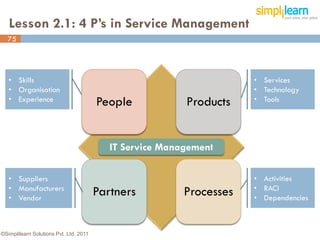
Lesson 2.1: 4 P’s in Service Management
  75


   • Skills                                                           • Services
   • Organisation                                                     • Technology
   • Experience                         People            Products    • Tools


                                           IT Service Management

   • Suppliers                                                        • Activities
   • Manufacturers                                                    • RACI
   • Vendor
                                        Partners          Processes   • Dependencies


©Simplilearn Solutions Pvt. Ltd. 2011                                                75
Lesson 2.2: Major Aspects of Service Design
 76


     New or Changed Service Solutions Design

     Service Management systems and tools design

     Technology and Management architectures design

     Processes design

     Measurement systems design


©Simplilearn Solutions Pvt. Ltd. 2011                  76
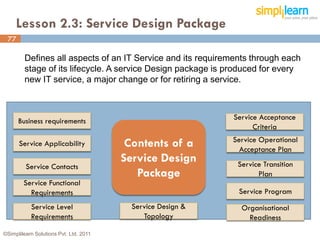
Lesson 2.3: Service Design Package
 77

         Defines all aspects of an IT Service and its requirements through each
         stage of its lifecycle. A service Design package is produced for every
         new IT service, a major change or for retiring a service.


      Business requirements                                  Service Acceptance
                                                                   Criteria
                                                             Service Operational
      Service Applicability              Contents of a         Acceptance Plan
                                        Service Design         Service Transition
         Service Contacts
                                           Package                   Plan
        Service Functional
          Requirements                                         Service Program
           Service Level                 Service Design &       Organisational
           Requirements                     Topology              Readiness
©Simplilearn Solutions Pvt. Ltd. 2011                                               77
78
                    Lesson 3.0: Service Design
                    Processes
                    Lesson objectives
                    At the end of this lesson, you should be able to:
                    •      State the Objectives and basic concepts of the following processes
                             •      Service Catalog Management
                             •      Service Level Management
                             •      Supplier Management
                             •      Capacity Management
                             •      Availability Management
                             •      IT Service Continuity Management
                             •      Information Security Management
                             •      Design Coordination
©Simplilearn Solutions Pvt. Ltd. 2011
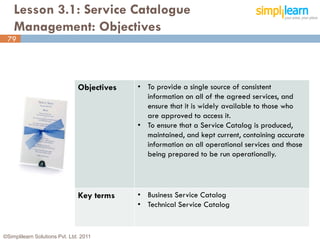
Lesson 3.1: Service Catalogue
    Management: Objectives
 79


                               Objectives   • To provide a single source of consistent
                                              information on all of the agreed services, and
                                              ensure that it is widely available to those who
                                              are approved to access it.
                                            • To ensure that a Service Catalog is produced,
                                              maintained, and kept current, containing accurate
                                              information on all operational services and those
                                              being prepared to be run operationally.


                               Key terms    • Business Service Catalog
                                            • Technical Service Catalog


©Simplilearn Solutions Pvt. Ltd. 2011                                                             79
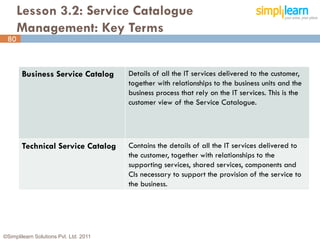
Lesson 3.2: Service Catalogue
      Management: Key Terms
 80


       Business Service Catalog         Details of all the IT services delivered to the customer,
                                        together with relationships to the business units and the
                                        business process that rely on the IT services. This is the
                                        customer view of the Service Catalogue.


       Technical Service Catalog        Contains the details of all the IT services delivered to
                                        the customer, together with relationships to the
                                        supporting services, shared services, components and
                                        CIs necessary to support the provision of the service to
                                        the business.


©Simplilearn Solutions Pvt. Ltd. 2011                                                                80
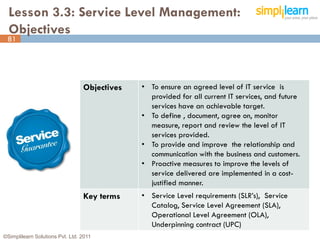
Lesson 3.3: Service Level Management:
  Objectives
 81


                                 Objectives   • To ensure an agreed level of IT service is
                                                provided for all current IT services, and future
                                                services have an achievable target.
                                              • To define , document, agree on, monitor
                                                measure, report and review the level of IT
                                                services provided.
                                              • To provide and improve the relationship and
                                                communication with the business and customers.
                                              • Proactive measures to improve the levels of
                                                service delivered are implemented in a cost-
                                                justified manner.
                                 Key terms    • Service Level requirements (SLR’s), Service
                                                Catalog, Service Level Agreement (SLA),
                                                Operational Level Agreement (OLA),
                                                Underpinning contract (UPC)
©Simplilearn Solutions Pvt. Ltd. 2011                                                              81
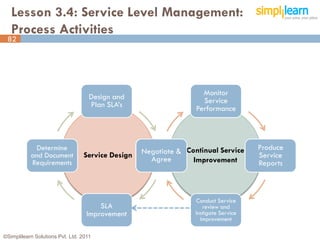
Lesson 3.4: Service Level Management:
   Process Activities
 82


                                    Design and                     Monitor
                                    Plan SLA’s                     Service
                                                                 Performance


             Determine                            Negotiate & Continual Service      Produce
                                 Service Design   Negotiate &
           and Document
                                                    Agree                            Service
           Requirements                                         Improvement          Reports


                                                                 Conduct Service
                                       SLA                          review and
                                   Improvement                   Instigate Service
                                                                   Improvement

©Simplilearn Solutions Pvt. Ltd. 2011                                                          82
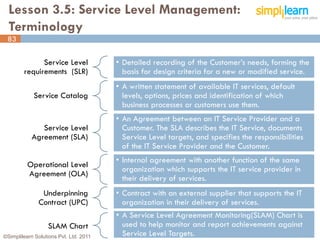
Lesson 3.5: Service Level Management:
  Terminology
 83

              Service Level             • Detailed recording of the Customer’s needs, forming the
        requirements (SLR)                basis for design criteria for a new or modified service.
                                        • A written statement of available IT services, default
            Service Catalog               levels, options, prices and identification of which
                                          business processes or customers use them.
                                        • An Agreement between an IT Service Provider and a
               Service Level              Customer. The SLA describes the IT Service, documents
            Agreement (SLA)               Service Level targets, and specifies the responsibilities
                                          of the IT Service Provider and the Customer.
                                        • Internal agreement with another function of the same
          Operational Level
                                          organization which supports the IT service provider in
          Agreement (OLA)
                                          their delivery of services.
               Underpinning             • Contract with an external supplier that supports the IT
              Contract (UPC)              organization in their delivery of services.
                                        • A Service Level Agreement Monitoring(SLAM) Chart is
                  SLAM Chart              used to help monitor and report achievements against
©Simplilearn Solutions Pvt. Ltd. 2011     Service Level Targets.                                      83
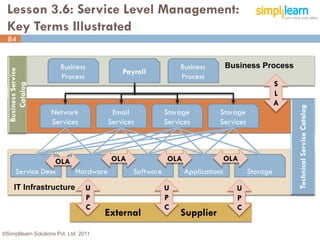
Lesson 3.6: Service Level Management:
  Key Terms Illustrated
  84


                        Business                           Business    Business Process
                                            Payroll
                        Process                            Process
                                                                                           S
                                                                                           L
                                                                                           A
                    Network              Email        Storage         Storage
                    Services            Services      Services        Services


                 OLA          OLA          OLA              OLA
     Service Desk    Hardware     Software     Applications                      Storage
    IT Infrastructure              U                  U                    U
                                   P                  P                    P
                                   C                  C                    C
                                        External           Supplier
©Simplilearn Solutions Pvt. Ltd. 2011                                                          84
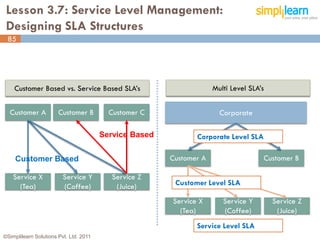
Lesson 3.7: Service Level Management:
 Designing SLA Structures
 85


    Customer Based vs. Service Based SLA’s                           Multi Level SLA’s


  Customer A           Customer B         Customer C                   Corporate

                                        Service Based          Corporate Level SLA

     Customer Based                                     Customer A                   Customer B

    Service X            Service Y         Service Z
      (Tea)              (Coffee)           (Juice)      Customer Level SLA

                                                        Service X       Service Y        Service Z
                                                          (Tea)         (Coffee)          (Juice)
                                                               Service Level SLA
©Simplilearn Solutions Pvt. Ltd. 2011                                                                85
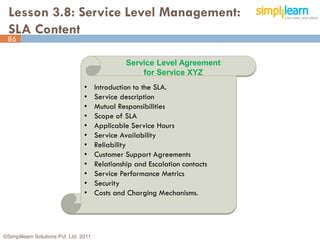
Lesson 3.8: Service Level Management:
  SLA Content
 86

                                                  Service Level Agreement
                                                      for Service XYZ
                                  •     Introduction to the SLA.
                                  •     Service description
                                  •     Mutual Responsibilities
                                  •     Scope of SLA
                                  •     Applicable Service Hours
                                  •     Service Availability
                                  •     Reliability
                                  •     Customer Support Agreements
                                  •     Relationship and Escalation contacts
                                  •     Service Performance Metrics
                                  •     Security
                                  •     Costs and Charging Mechanisms.


©Simplilearn Solutions Pvt. Ltd. 2011                                          86
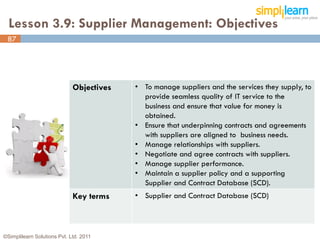
Lesson 3.9: Supplier Management: Objectives
 87


                             Objectives   • To manage suppliers and the services they supply, to
                                            provide seamless quality of IT service to the
                                            business and ensure that value for money is
                                            obtained.
                                          • Ensure that underpinning contracts and agreements
                                            with suppliers are aligned to business needs.
                                          • Manage relationships with suppliers.
                                          • Negotiate and agree contracts with suppliers.
                                          • Manage supplier performance.
                                          • Maintain a supplier policy and a supporting
                                            Supplier and Contract Database (SCD).
                             Key terms    • Supplier and Contract Database (SCD)


©Simplilearn Solutions Pvt. Ltd. 2011                                                         87
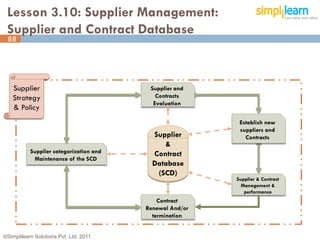
Lesson 3.10: Supplier Management:
 Supplier and Contract Database
 88


    Supplier                              Supplier and
    Strategy                                Contracts
                                           Evaluation
    & Policy
                                                           Establish new
                                                           suppliers and
                                           Supplier          Contracts
                                              &
           Supplier categorization and     Contract
            Maintenance of the SCD
                                           Database
                                            (SCD)
                                                          Supplier & Contract
                                                            Management &
                                                             performance
                                             Contract
                                         Renewal And/or
                                           termination


©Simplilearn Solutions Pvt. Ltd. 2011                                           88
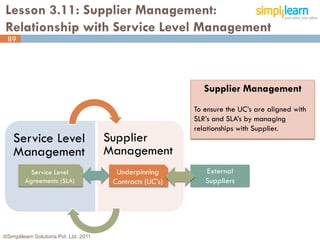
Lesson 3.11: Supplier Management:
Relationship with Service Level Management
 89


                                                               Supplier Management
                                                            To ensure the UC’s are aligned with
                                                            SLR’s and SLA’s by managing
                                                            relationships with Supplier.
    Service Level                       Supplier
    Management                          Management
           Service Level                  Underpinning         External
         Agreements (SLA)                Contracts (UC’s)      Suppliers


©Simplilearn Solutions Pvt. Ltd. 2011                                                             89
Lesson 3.12: Capacity Management:
    Objectives
 90


                             Objectives   • To ensure that cost-justifiable IT capacity in all
                                            areas of IT always exists and is matched to the
                                            current and future agreed needs of the business, in
                                            a timely manner.
                                          • Produce and maintain an appropriate and up-to-
                                            date Capacity Plan.
                                          • Provide advice and guidance to the business and IT
                                            on all capacity and performance-related issues
                                          • Ensure that service performance achievements meet
                                            or exceed all of their agreed performance targets.
                             Key terms    • Capacity plan/ CMIS
                                          • Business capacity management
                                          • Service capacity management
                                          • Resource/Component capacity management

©Simplilearn Solutions Pvt. Ltd. 2011                                                         90
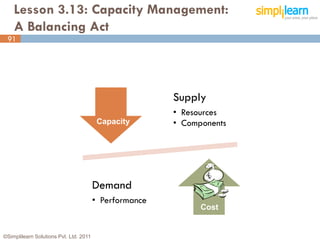
Lesson 3.13: Capacity Management:
    A Balancing Act
 91


                                                        Supply
                                                        • Resources
                                         Capacity       • Components


                                        Demand
                                        • Performance
                                                              Cost


©Simplilearn Solutions Pvt. Ltd. 2011                                  91
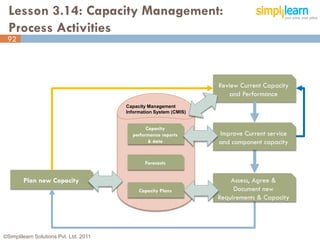
Lesson 3.14: Capacity Management:
  Process Activities
 92


                                                                    Review Current Capacity
                                                                        and Performance
                                        Capacity Management
                                        Information System (CMIS)


                                                Capacity
                                          performance reports       Improve Current service
                                                 & data             and component capacity

                                               Forecasts


        Plan new Capacity                                               Assess, Agree &
                                             Capacity Plans              Document new
                                                                    Requirements & Capacity


©Simplilearn Solutions Pvt. Ltd. 2011                                                         92
Lesson 3.15: Capacity Management:
  Sub Process
 93


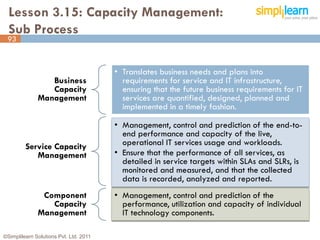
                                        • Translates business needs and plans into
                 Business                 requirements for service and IT infrastructure,
                 Capacity                 ensuring that the future business requirements for IT
              Management                  services are quantified, designed, planned and
                                          implemented in a timely fashion.

                                        • Management, control and prediction of the end-to-
                                          end performance and capacity of the live,
         Service Capacity                 operational IT services usage and workloads.
            Management                  • Ensure that the performance of all services, as
                                          detailed in service targets within SLAs and SLRs, is
                                          monitored and measured, and that the collected
                                          data is recorded, analyzed and reported.
               Component                • Management, control and prediction of the
                 Capacity                 performance, utilization and capacity of individual
              Management                  IT technology components.

©Simplilearn Solutions Pvt. Ltd. 2011                                                             93
Lesson 3.16: Availability Management
   Process: Objectives
 94


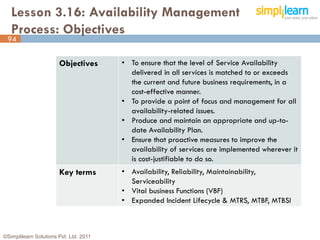
                       Objectives       • To ensure that the level of Service Availability
                                          delivered in all services is matched to or exceeds
                                          the current and future business requirements, in a
                                          cost-effective manner.
                                        • To provide a point of focus and management for all
                                          availability-related issues.
                                        • Produce and maintain an appropriate and up-to-
                                          date Availability Plan.
                                        • Ensure that proactive measures to improve the
                                          availability of services are implemented wherever it
                                          is cost-justifiable to do so.
                       Key terms        • Availability, Reliability, Maintainability,
                                          Serviceability
                                        • Vital business Functions (VBF)
                                        • Expanded Incident Lifecycle & MTRS, MTBF, MTBSI


©Simplilearn Solutions Pvt. Ltd. 2011                                                            94
Lesson 3.17: Availability Management:
   Key Terms explained
 95


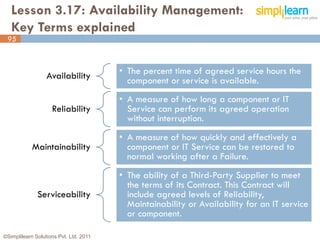
                  Availability          • The percent time of agreed service hours the
                                          component or service is available.
                                        • A measure of how long a component or IT
                    Reliability           Service can perform its agreed operation
                                          without interruption.
                                        • A measure of how quickly and effectively a
            Maintainability               component or IT Service can be restored to
                                          normal working after a Failure.
                                        • The ability of a Third-Party Supplier to meet
                                          the terms of its Contract. This Contract will
              Serviceability              include agreed levels of Reliability,
                                          Maintainability or Availability for an IT service
                                          or component.

©Simplilearn Solutions Pvt. Ltd. 2011                                                     95
Lesson 3.18: Availability Management:
  Key Terms explained..contd.
 96


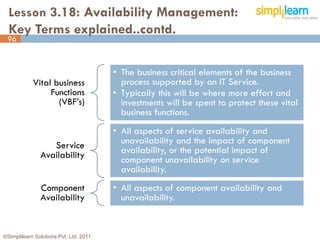
                                        • The business critical elements of the business
            Vital business                process supported by an IT Service.
                 Functions              • Typically this will be where more effort and
                   (VBF’s)                investments will be spent to protect these vital
                                          business functions.
                                        • All aspects of service availability and
                  Service                 unavailability and the impact of component
               Availability               availability, or the potential impact of
                                          component unavailability on service
                                          availability.
               Component                • All aspects of component availability and
               Availability               unavailability.


©Simplilearn Solutions Pvt. Ltd. 2011                                                        96
Lesson 3.19: Availability Management:
  Expanded Incident Lifecycle
  97


                                                                                                                                            Uptime
 Uptime


                                                                                                                                                                  Downtime
                                                                                                                                                     Incident 2
                                                                                                           Recovered
        Incident 1


                                                                 Diagnose


                                                                                      Repaired


                                                                                                                                 Restored
                                             Record
                          Detect


                                                                                                                                   Mean Time
                Time to            Time to             Time to              Time to              Time to               Time to      Between
                detect             Record             Diagnose              Repair               Recover               Restore      Failures
                                                                                                                                     (MTBF)
                                             Mean Time to Restore Service (MTRS)

                                       Mean Time to between system incidents (MTBSI)

©Simplilearn Solutions Pvt. Ltd. 2011                                                                                                                               97
Lesson 3.20: IT Service Continuity
   Management: Objectives
 98


                           Objectives   • To support the overall Business Continuity
                                          Management (BCM) process by ensuring that the
                                          required IT technical and service facilities (including
                                          computer systems, networks, applications, data
                                          repositories, telecommunications, environment,
                                          technical support and Service Desk) can be resumed
                                          within required, and agreed, business timescales.
                                        • Maintain a set of IT Service Continuity Plans and IT
                                          recovery plans that support the overall Business
                                          Continuity Plans (BCPs) of the organization.

                           Key terms    •   Business Continuity Planning (BCP)
                                        •   Business Impact Analysis (BIA)
                                        •   Business Continuity Management (BCM)
                                        •   Risk Analysis


©Simplilearn Solutions Pvt. Ltd. 2011                                                               98
Lesson 3.21: IT Service Continuity
   Management: Key Terms Explained
 99


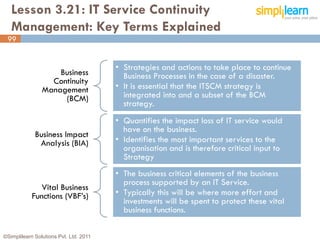
                                        • Strategies and actions to take place to continue
                    Business              Business Processes in the case of a disaster.
                  Continuity
                Management              • It is essential that the ITSCM strategy is
                     (BCM)                integrated into and a subset of the BCM
                                          strategy.
                                        • Quantifies the impact loss of IT service would
                                          have on the business.
             Business Impact
              Analysis (BIA)            • Identifies the most important services to the
                                          organisation and is therefore critical input to
                                          Strategy
                                        • The business critical elements of the business
                                          process supported by an IT Service.
               Vital Business
            Functions (VBF’s)           • Typically this will be where more effort and
                                          investments will be spent to protect these vital
                                          business functions.

©Simplilearn Solutions Pvt. Ltd. 2011                                                        99
Lesson 3.22: IT Service Continuity
  Management: Key Terms Explained..contd
100


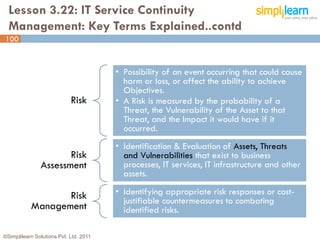
                                        • Possibility of an event occurring that could cause
                                          harm or loss, or affect the ability to achieve
                                          Objectives.
                            Risk        • A Risk is measured by the probability of a
                                          Threat, the Vulnerability of the Asset to that
                                          Threat, and the Impact it would have if it
                                          occurred.
                                        • Identification & Evaluation of Assets, Threats
                      Risk                and Vulnerabilities that exist to business
               Assessment                 processes, IT services, IT infrastructure and other
                                          assets.

                  Risk                  • Identifying appropriate risk responses or cost-
                                          justifiable countermeasures to combating
           Management                     identified risks.

©Simplilearn Solutions Pvt. Ltd. 2011                                                           100
Lesson 3.23: IT Service Continuity
  Management: Lifecycle Activities
101


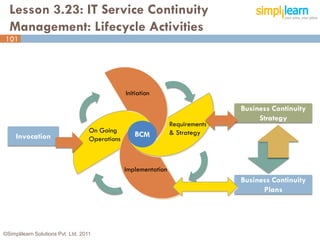
                                                 Initiation

                                                                                 Business Continuity
                                                                                      Strategy
                                                                  Requirements
                                    On Going                      & Strategy
     Invocation                     Operations


                                                 Implementation
                                                                                 Business Continuity
                                                                                       Plans


                                                                                                   101
©Simplilearn Solutions Pvt. Ltd. 2011
Lesson 3.24: Information Security
   Management: Objectives
102


                             Objectives   • To align IT security with business security and ensure
                                            that information security is effectively managed in
                                            all service and IT Service Management activities.
                                          • To protect the interests of those relying on
                                            information, and the systems and communications
                                            that deliver the information, from harm resulting
                                            from failures of availability, confidentiality and
                                            integrity.


                             Key terms    • Availability, Confidentiality, Integrity
                                          • Information Security policy
                                          • Information Security Management System (ISMS)


©Simplilearn Solutions Pvt. Ltd. 2011                                                            102
Lesson 3.25: Information Security
  Management: Key Terminology
103


                                        • Protecting information against unauthorized
             Confidentiality              access and use.
                                        • Examples: Passwords, swipe cards, firewalls
                                        • Accuracy, completeness and timeliness of services,
                                          data information, systems and physical locations.
                       Integrity
                                        • Examples: Rollback mechanisms, test procedures,
                                          audits.
                                        • The information should be accessible at any
                                          agreed time. This depends on the continuity
                  Availability            provided by the information processing systems.
                                        • Examples: UPS, resilient systems, Service desk
                                          hours


©Simplilearn Solutions Pvt. Ltd. 2011                                                       103
Lesson 3.26: Information Security
Management: Security Framework
104


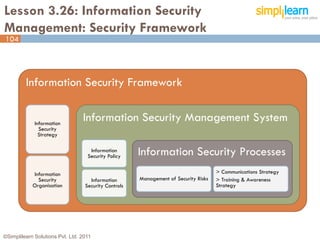
         Information Security Framework


             Information
                                 Information Security Management System
               Security
               Strategy

                                    Information
                                   Security Policy    Information Security Processes
            Information                                                              > Communications Strategy
              Security              Information       Management of Security Risks   > Training & Awareness
            Organisation          Security Controls                                  Strategy


©Simplilearn Solutions Pvt. Ltd. 2011                                                                            104
Lesson 3.27: Information Security
 Management: Security Policy
105


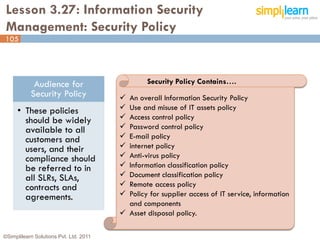
            Audience for                        Security Policy Contains….
           Security Policy               An overall Information Security Policy
      • These policies                   Use and misuse of IT assets policy
        should be widely                 Access control policy
        available to all                 Password control policy
        customers and                    E-mail policy
        users, and their                 internet policy
        compliance should                Anti-virus policy
        be referred to in                Information classification policy
        all SLRs, SLAs,                  Document classification policy
        contracts and                    Remote access policy
        agreements.                      Policy for supplier access of IT service, information
                                          and components
                                         Asset disposal policy.

©Simplilearn Solutions Pvt. Ltd. 2011                                                             105
Lesson 3.28: Information Security Mgmt:
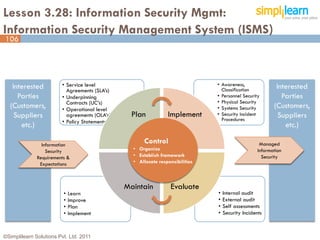
Information Security Management System (ISMS)
106


   Interested           • Service level                                        • Awareness,                Interested
                          Agreements (SLA’s)                                     Classification
     Parties            • Underpinning                                         • Personnel Security          Parties
                          Contracts (UC’s)                                     • Physical Security
  (Customers,           • Operational level                                    • Systems Security         (Customers,
    Suppliers             agreements (OLA’s)     Plan           Implement      • Security Incident          Suppliers
                        • Policy Statements                                      Procedures
      etc.)                                                                                                   etc.)

                Information
                                                     Control                                        Managed
                  Security                       • Organize                                        Information
              Requirements &                     • Establish framework                               Security
               Expectations                      • Allocate responsibilities


                                               Maintain           Evaluate
                         •   Learn                                             •   Internal audit
                         •   Improve                                           •   External audit
                         •   Plan                                              •   Self assessments
                         •   Implement                                         •   Security Incidents


©Simplilearn Solutions Pvt. Ltd. 2011                                                                              106
Lesson 3.29: Design Coordination - Objectives
107

      Design Coordination main objectives are


      • Ensuring consistent design of services

      • Coordination of all design activities across projects

      • Maintaining Governance


©Simplilearn Solutions Pvt. Ltd. 2011                           107
Lesson 3.30: Design Coordination - Governance
108

    Some aspects of the governance that Design Coordination can bring
    includes

    • Assisting and supporting each project through all the activities and
    processes

    • Maintaining policies and guidelines for service design activities

    • Planning and forecasting of the resources for future demand

    • Ensuring that all the requirements are appropriately addressed in
    service designs


©Simplilearn Solutions Pvt. Ltd. 2011                                        108
Lesson 3.31: Design Coordination - Keywords
109

      • Service Design Package


      • Service Design Policy


©Simplilearn Solutions Pvt. Ltd. 2011                  109
110             End of Module 3


©Simplilearn Solutions Pvt. Ltd. 2011
111             Service Design :Quiz


©Simplilearn Solutions Pvt. Ltd. 2011
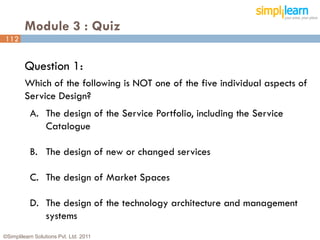
Module 3 : Quiz
112


         Question 1:
         Which of the following is NOT one of the five individual aspects of
         Service Design?
           A. The design of the Service Portfolio, including the Service
              Catalogue

           B. The design of new or changed services

           C. The design of Market Spaces

           D. The design of the technology architecture and management
              systems
©Simplilearn Solutions Pvt. Ltd. 2011                                      112
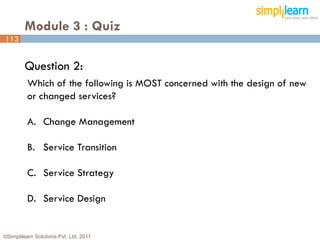
Module 3 : Quiz
113


         Question 2:
          Which of the following is MOST concerned with the design of new
          or changed services?

          A. Change Management

          B. Service Transition

          C. Service Strategy

          D. Service Design


©Simplilearn Solutions Pvt. Ltd. 2011                                   113
Module 3 : Quiz
114


         Question 3:
          Implementation of ITIL Service Management requires preparing
          and planning the effective and efficient use of:

          A. People, Process, Partners, Suppliers

          B. People, Process, Products, Technology

          C. People, Process, Products, Partners

          D. People, Products, Technology, Partners


©Simplilearn Solutions Pvt. Ltd. 2011                                    114
Module 3 : Quiz
115


         Question 4:
           What is the MAIN goal of Availability Management?

           A. To monitor and report availability of components

           B. To ensure that all targets in the Service Level Agreements
              (SLAs) are met

           C. To guarantee availability levels for services and components

           D. To ensure that service availability matches or exceeds the
              agreed needs of the business

©Simplilearn Solutions Pvt. Ltd. 2011                                        115
Module 3 : Quiz
116


         Question 5 :
          The Information Security Policy should be available to which
          groups of people?

          A. Senior business managers and all IT staff only

          B. Senior business managers, IT executives and the Information
             Security Manager only

          C. All customers, users and IT staff

          D. Information Security Management staff only
©Simplilearn Solutions Pvt. Ltd. 2011                                      116
Module 3 : Quiz
117


         Question 6 :
 Which of the following are activities that would be carried out by
 Supplier Management?

 1: Management and review of Organisational Level Agreements (OLAs)
 2: Evaluation and selection of suppliers
 3: Ongoing management of suppliers

       A. 1 and 2 only
       B. 1 and 3 only
       C. 2 and 3 only
       D. All of the above
©Simplilearn Solutions Pvt. Ltd. 2011                                 117
Module 4
118


         Service
         Transition


©Simplilearn Solutions Pvt. Ltd. 2011   118
2             Lesson 1.0: Service Transition
                    Lesson objectives
                    At the end of this lesson, you should be able to:

                    •      Understand the Goals and Objectives of
                           Service Transition
                    •      Explain What value Service Transition
                           provides to the Business

©Simplilearn Solutions Pvt. Ltd. 2011
Lesson 1.1: Service Transition Goals
120

     Assure proposed changes in the Service Design package are realized.
     Plan for and Implement the Deployment of Releases for New or Changed
    Services.
     Test Releases so as to minimize the possibility of undesirable impact to
    the Production environment.
     Retire or Archive Services.


      KEY ROLE: To move Services from Design to Operations, without impacting
      the ongoing Services


©Simplilearn Solutions Pvt. Ltd. 2011                                            3
Lesson 1.2: Service Transition Objectives
121


    •Plan and manage the resources to establish successfully a new or
    changed service into production within the predicted cost, quality and time
    estimates.

    •Ensure there is minimal unpredicted impact on the production services,
    operations and support organization.

    •Increase the customer, user and Service Management staff satisfaction
    with the Service Transition practices including deployment of the new or
    changed service, communications, release documentation, training and
    knowledge transfer.

    •Increase proper use of the services and underlying applications and
    technology solutions.


©Simplilearn Solutions Pvt. Ltd. 2011                                             4
Lesson 1.3: Value to Business
122


           • The capacity of the business to respond quickly and adequately
             to changes in the market improves.
           • Changes in the business as a result of takeovers, contracting,
             etc. are well managed.
           • More successful changes and releases for the business.
           • Better compliance of business and governing rules.
           • Less deviation between planned budgets and the actual costs
           • Better insight into the possible risks during and after the input of
             a service into production.
           • Higher productivity of customer staff
©Simplilearn Solutions Pvt. Ltd. 2011                                          122
Lesson 2.0: Service Transition: Key
      5
                    Principles and Models
                    Lesson objectives
                    At the end of this lesson, you should be able to:

                    •      Understand Configuration Item
                    •      Understand Configuration Management System


©Simplilearn Solutions Pvt. Ltd. 2011
Lesson 2.2: Configuration Item (CI)
124
124

            Anything that needs to be managed in order to deliver an IT Service.


            CI information is recorded in the Configuration Management System.


            CI information is maintained throughout its lifecycle by Configuration
            Management.


            All CIs are subject to Change Management control.


            CIs typically include
                   IT Services, hardware, software, buildings, people, and formal
                   documentation such as Process documentation and SLAs

©Simplilearn Solutions Pvt. Ltd. 2011
Lesson 2.3: Configuration Management
  System (CMS)
125
  • Information about all Configuration Items
125


          CI may be entire service, or any component
          Stored in 1 or more databases (CMDBs)


   • CMS stores attributes
          Any information about the CI that might be needed


   • CMS stores relationships
          Between CIs
          With incident, problem, change records etc.


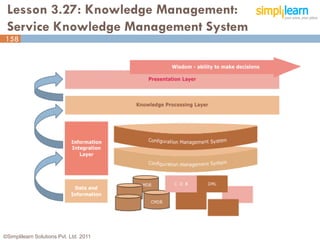
   • CMS has multiple layers
          Data sources and tools, information integration, knowledge processing
          (scorecards, dashboards etc.), presentation
©Simplilearn Solutions Pvt. Ltd. 2011
Lesson 3.0: Service Transition
    126
                    Processes
     Lesson objectives
     At the end of this lesson, you should be able to understand
     Objectives and basic concepts of the four processes in
     Service Transition:
           •   Transition, Planning and Support
           •   Change Management
           •   Service Asset and Configuration Management
           •   Release and Deployment management, And
           •   Knowledge Management
©Simplilearn Solutions Pvt. Ltd. 2011
Lesson 3.0.1: Transition, Planning and
    127
                                       Support

                    Lesson objectives
                    At the end of this lesson, you should be able to:
                    •  State the Goals, Objectives and basic
                       concepts of Transition, Planning and Support


©Simplilearn Solutions Pvt. Ltd. 2011
Lesson 3.0.2:Transition, Planning and
  Support- Goals and Objectives
128

    The Objectives of Transition, Planning and Support are

    • Successful Planning and coordination of resources
    • Ensuring common framework
    • Proper planning for aligning customer and business change projects with
    Service Transition plans


©Simplilearn Solutions Pvt. Ltd. 2011                                           128
Lesson 3.0.3:Transition, Planning and
Support Activities- Purpose
129

    The purpose of the Transition, Planning and Support activities are:

    • Planning appropriate capacity and resources
    • Provide support for the Service Transition teams and people
    • Integrity of changes with all other Service Transition processes
    • Coordination of activities across projects, suppliers and service teams


©Simplilearn Solutions Pvt. Ltd. 2011                                           129
130             Lesson 3.1: Change Management

                    Lesson objectives
                    At the end of this lesson, you should be able to:
                    •  State the Goals, Objectives and basic
                       concepts of Change Management


©Simplilearn Solutions Pvt. Ltd. 2011
Lesson 3.2: Change Management :
Goals and Objectives
131
    Goals and Objectives:
    Respond to changing business requirements

           • Respond to Business and IT requests to align Services with business
           needs.
           • Ensuring Changes are introduced in a controlled manner.
           • Optimize business risk
           • Implement changes successfully
           • Implement changes in times that meet business needs
           • Use standard processes
           • Record all changes


©Simplilearn Solutions Pvt. Ltd. 2011                                          131
Lesson 3.3: Change Management : Scope
132


         Scope

           Addition, Modification or Removal of

                  Any Service or Configuration Item or associated documentation

                  Including
                  Strategic, Tactical and Operational changes

                  Excluding
                  Business strategy and process
                  Anything documented as out of scope


©Simplilearn Solutions Pvt. Ltd. 2011                                             132
Lesson 3.4: Change Management :
Change Types
133
       Change Types
                 Normal changes
                      Types are specific to the organization
                      Type determines what assessment is required

                 Standard changes
                      Pre-authorized with an established procedure
                      Tasks are well known, documented and low risk (usually)
                      E.g replacement of faulty printer, upgrade PC etc.

                 Emergency changes
                      Business criticality means there is insufficient time for normal handling
                      Should use normal process but speeded up
                      Impact can be high, more prone to failure, Should be kept to minimum
               Remediation planning
                   Backout Plans


©Simplilearn Solutions Pvt. Ltd. 2011                                                              133
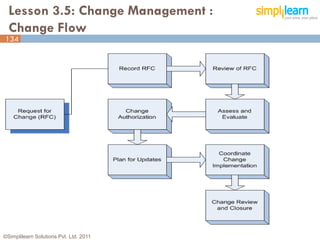
Lesson 3.5: Change Management :
  Change Flow
134


©Simplilearn Solutions Pvt. Ltd. 2011   134
Lesson 3.7: Change Management :
  Roles in Change Management
135

            Change Manager
               Ensures that process is followed
               Usually authorizes minor changes
               Coordinates and runs CAB meetings
               Produces change schedule
               Coordinates change/built/test/implementation
               Reviews/Closes Changes


©Simplilearn Solutions Pvt. Ltd. 2011                          135
Lesson 3.8: Change Management :
Change Advisory Board (CAB)
136
           Change Advisory Board (CAB)
                Supports the change manager
                Consulted on significant changes
                Business, users, application/technical support, operations, service
                 desk, capacity, service continuity, third parties …
                people who have clear understanding of business needs
                Technical specialists / consultants


           Emergency CAB (ECAB)
                Subset of the standard CAB
                Membership depends on the specific change


©Simplilearn Solutions Pvt. Ltd. 2011                                                  136
Lesson 3.9: Change Management :
   Change Metrics
137

          Change Metrics
               • Compliance
                  Reduction in unauthorized changes
                  Reduction in emergency changes

               • Effectiveness
                  Percentage of changes which met requirements
                  Reduction in disruptions, defects and re-work
                  Reduction in changes failed/backed out
                  Number of incidents attributable to changes

               • Efficiency
                  Benefits (value compared to cost)
                  Average time to implement (by urgency/priority/type)
                  Percentage accuracy in change estimates
©Simplilearn Solutions Pvt. Ltd. 2011                                    137
Lesson 3.10: Change Management :
  Key Challenges
138

         Business pressure to “just do it”

         Inaccurate and incomplete Configuration Management System

         Soiled Technical Function areas

          Misunderstanding of “Emergency” changes

         Scalability across large organizations

         Vendor/Contract Compliance

          Adhoc nature of people


©Simplilearn Solutions Pvt. Ltd. 2011                                 138
Lesson 3.11: Service Asset and
    139
                    Configuration Management
                    Lesson objectives
                    At the end of this lesson, you should be able to:
                    •  State the goals, objectives and basic concepts of
                       Service Asset and Configuration Management


©Simplilearn Solutions Pvt. Ltd. 2011
Lesson 3.12: Service Asset and
Configuration Management: Goals and Objectives
140

     The goal of SACM is to provide a logical model of the IT infrastructure
     correlating IT services and different IT components (physical, logical etc)
     needed to deliver these services

     The objective of SACM is to define and control the components of
     services and infrastructure and maintain accurate configuration records.
     This enables an organization to comply with corporate governance
     requirements, control its asset base, optimize its costs, manage change
     and release effectively, and resolve incidents and problems faster.


©Simplilearn Solutions Pvt. Ltd. 2011                                          140
Lesson 3.13: Service Asset and
Configuration Management: Basic Concepts
141
        Basic Concepts
        What is a Configuration Item (CI) ?

         Anything that needs to be managed in order to deliver an IT Service


         CI information is recorded in the Configuration Management System


         CI information is maintained throughout its lifecycle by Configuration Management


         All CIs are subject to Change Management control


         CI Types :
         CIs typically include
               •IT Services, hardware, software, buildings, people, and formal documentation such as
               Process documentation and SLAs
©Simplilearn Solutions Pvt. Ltd. 2011                                                            141
Lesson 3.13: Service Asset and
  Configuration Management: Basic Concepts
142

       Basic Concepts

            Configuration baseline
              Configuration details captured at a specific point in time. This
               captures both the structure and details of a configuration Item.
              It is used as a reference point for future Builds, Releases and
               Changes. (e.g. After major changes, disaster recovery etc).
              Typically managed through the Change Management process.


©Simplilearn Solutions Pvt. Ltd. 2011                                             142
Lesson 3.13: Service Asset and
Configuration Management: Basic Concepts: Contd..
143

       Basic Concepts
       What is a Configuration Management System (CMS) ?

         •Information about all Configuration Items
                •CI may be an entire service, or any component
                •Stored in 1 or more databases (CMDBs)
         •CMS stores attributes
                •Any information about the CI that might be needed
         •CMS stores relationships
                •Between CIs
                •With incident, problem, change records etc.
         •CMS has multiple layers
                •Data sources and tools, information integration, knowledge processing (scorecards,
                dashboards etc.), presentation


©Simplilearn Solutions Pvt. Ltd. 2011                                                             143
Lesson 3.13: Service Asset and
Configuration Management: Basic Concepts: Contd..
144

       Basic Concepts
       What is a Definitive Media Library (DML) ?

          The only source for build and distribution
          Master copies of all software assets
                In house, external software houses
                Scripts as well as code
                Management tools as well as applications
                Including licenses
          Quality checked
                Complete, correct, virus scanned ..


©Simplilearn Solutions Pvt. Ltd. 2011                      144
Lesson 3.14: Service Asset and
Configuration Mgmt..: Basic Concepts: CMDB & DML
145

       Basic Concepts
       DML and CMDB


©Simplilearn Solutions Pvt. Ltd. 2011          145
Lesson 3.16: Service Asset and Configuration Mgmt.:
Basic Concepts: Relationship between CMDB, CMS and SKMS
146


                                        SKMS   Informed Decision


                                        CMS


                                        CMDB


©Simplilearn Solutions Pvt. Ltd. 2011                              146
Lesson 3.17: Release and Deployment
    147
                    Management
                    Lesson objectives
                    At the end of this lesson, you should be able to:
                    •  State the goals, objectives and basic concepts of
                       Release and Deployment Management


©Simplilearn Solutions Pvt. Ltd. 2011
Lesson 3.18: Release and Deployment
Management: Goals
148


       • Release management is responsible for planning, scheduling, and
         controlling the movement of new or changed services, in the form
         of a release package, to both the testing and the live production
         environments
       • Deployment management is responsible for the movement of new
         or changed hardware, software, documentation, or other
         configuration items into the live production environment.


©Simplilearn Solutions Pvt. Ltd. 2011                                        148
Lesson 3.19: Release and Deployment
  Management: Objectives
149
           • Planned Release and Deployment in line to the business needs
           • Build, Install, Test and Integrate releases
                   Efficiently, successfully and on schedule.
                   With minimal impact on production services, operations, and support teams
                   Enabling new or changed services to deliver agreed service requirements

           • Control and minimize the impact of releases to the ongoing
             services
           • Transfer knowledge and skills to end users and support teams,
             leading to an effective use and support


©Simplilearn Solutions Pvt. Ltd. 2011                                                           149
Lesson 3.20: Release and Deployment
  Management: Basic Concepts: Release Policy
150
     Release Policy: The overarching strategy for Releases and was derived
     from the Service Design phase of the Service Lifecycle and typically
     includes:
     • Release Description with the unique identification, numbering and naming
       conventions.
     • The roles and responsibilities at each stage in process.
     • The expected frequency for each type of release
     • The approach for accepting and grouping changes into a release.
     • The mechanism to automate the build, installation and release distribution
       processes to improve re-use, repeatability and efficiency
     • How the configuration baseline for the release is captured and verified against
       the actual release contents, e.g. hardware, software, documentation and
       knowledge
     • Exit and entry criteria and authority for acceptance of the release into each
       Service Transition stage and into the controlled test, training, disaster recovery
       and production environments
     • Criteria and authorization to exit early life support and handover to Service
       Operations.
©Simplilearn Solutions Pvt. Ltd. 2011                                                       150
Lesson 3.21: Release and Deployment
Management: Basic Concepts: Release Unit
151


         Release unit
                      - Cls that are normally released together
                      - Typically includes sufficient components to perform a useful
                      function. For example - Fully configured desktop PC, payroll
                      applications


         Release package
                      - Single release or many related releases
                      - Can include hardware, software, utility, warranty,
                      documentation, training …


©Simplilearn Solutions Pvt. Ltd. 2011                                                  151
Lesson 3.21: Release and Deployment
Management: Basic Concepts: Release Types
152
    Release Types
           Major Release:
                  Containing large proportions of new functionalities. Also known
                  as a Major Upgrade, generally supersedes all preceding minor
                  upgrades.


            Minor Release:
                  Contains small enhancements and fixes. A Minor Upgrade or
                  release generally supersedes previous emergency fixes.


           Emergency Release:
                  Normally linked to an Emergency change.

©Simplilearn Solutions Pvt. Ltd. 2011                                               152
Lesson 3.22: Release and Deployment Mgmt.
Basic Concepts: Release and Deployment Approaches
153
        Release and Deployment Approaches


                Big bang versus phased approach

                       Phased approach can be users, locations, functionality ..


                Push versus Pull deployment


                Automated versus manual deployment


©Simplilearn Solutions Pvt. Ltd. 2011                                               153
154            Lesson 3.23: Knowledge Management
                    Lesson objectives
                    At the end of this lesson, you should be able to:
                    •  State the goals, objectives and basic concepts of
                       Knowledge Management


©Simplilearn Solutions Pvt. Ltd. 2011
Lesson 3.24: Knowledge Management:
  Goals and Objectives
155

      The goal of Knowledge Management is to Improve quality of
       management decision making by ensuring that reliable and secure
       information and data is available throughout the service lifecycle

      The objective of Knowledge Management is to ensure that the right
       information is delivered to the appropriate place or person at the right
       time to enable informed decisions.


©Simplilearn Solutions Pvt. Ltd. 2011                                         155
Lesson 3.25: Knowledge Management:
Purpose
156

    Knowledge Management is The process responsible for gathering,
    analyzing, storing and sharing knowledge and information within an
    organization.

    The primary purpose of knowledge Management is to improve
    efficiency and effectiveness by reducing the need to rediscover
    knowledge.


©Simplilearn Solutions Pvt. Ltd. 2011                                    156
Lesson 3.26: Knowledge Management:
 Basic Concepts: DIKW
157


©Simplilearn Solutions Pvt. Ltd. 2011   157
Lesson 3.27: Knowledge Management:
 Service Knowledge Management System
158


©Simplilearn Solutions Pvt. Ltd. 2011   158
Lesson 3.28: Knowledge Management: SKMS
159

   A set of tools for managing knowledge and information.

    SKMS includes CMS.

    SKMS contains all the information needed to manage the lifecycle
     of IT Services.


©Simplilearn Solutions Pvt. Ltd. 2011                                   159
160             Service Transition : Summary

                       • Goals and Objectives
                       • Service Transition processes:
                           Transition, Planning and Support
                           Change Management
                           Service Asset and Configuration Management
                           Release and Deployment Management
                           Knowledge Management


©Simplilearn Solutions Pvt. Ltd. 2011
161             Service Transition : Quiz


©Simplilearn Solutions Pvt. Ltd. 2011
Module 4: Quiz
162


         Question 1:
          Which of the following statements about a standard change is
          INCORECT ?

          a) A Standard change is a low risk change

          b) Standard changes are pre-authorized changes

          c) Standard changes are authorized by E-CAB

          d) Standard changes are only raised by Incident Management

©Simplilearn Solutions Pvt. Ltd. 2011                                    162
Module 4: Quiz
163


         Question 2:
           Which statement is the CORRECT statement about the relationship
           between CMS and SKMS ?

           a) The SKMS is a part of the CMS

           b) The CMS is a part of the SKMS

           c) There is no relationship between the CMS and SKMS

           d) The CMS and the SKMS are the same


©Simplilearn Solutions Pvt. Ltd. 2011                                    163
Module 4: Quiz
164


         Question 3:
           Whish of the following is an activity of SACM ?

           a) Account for all the Financial assets of an organization

           b) Specify the relevant attributes of CI

           c) Implement ITIL across the organization

           d) Design Service models to justify ITIL implementations


©Simplilearn Solutions Pvt. Ltd. 2011                                   164
Module 4: Quiz
165
       Question 4:
     Which of the following does Service Transition provide guidance
     on:
     1. Moving New and Changed Services to production
     2. Testing and Validation
     3. Transfer of services to and from external service provider

     a) All of the above

     b) None of the above

     c) Only 1 and 2

     d) Only 1
©Simplilearn Solutions Pvt. Ltd. 2011                                  165
Module 4: Quiz
166


         Question 5:
           Which of the following is an INCORRECT Release and
           Deployment approach?

           a) Propagate and Consolidate

           b) Push and Pull

           c) Big bang and Phased

           d) Automated and Manual


©Simplilearn Solutions Pvt. Ltd. 2011                           166
Module 4: Quiz
167

         Question 6:

     Which of the following would be stored in the DML?
     1. Copies of Purchased software
     2. Copies of Internally developed software
     3. Relevant License documentation
     4. The Change schedule

                   a) All of the above
                   b) 1 and 2 only
                   c) 3 and 4 only
                   d) 1, 2 and 3 only
©Simplilearn Solutions Pvt. Ltd. 2011                     167
Module 5
168


         Service
         Operations


©Simplilearn Solutions Pvt. Ltd. 2011   168
169             Lesson 1.0: Service Operations
                    Lesson objectives
                    At the end of this lesson, you should be able to:

                    •      Understand the Goals and Objectives of Service
                           Operations
                    •      Briefly Explain What Value Service Operations provide
                           to business
                    •      Understand Key Concepts & definitions
                    •      Understand the Role of Communication in Service
                           Operations

©Simplilearn Solutions Pvt. Ltd. 2011
Lesson 1.1: Service Operations: Objectives
170

           To coordinate and carry out the activities and processes required to
          deliver and manage services at agreed levels to business users and
          customers.


           Responsible for the ongoing management of the technology that is
          used to deliver and support services.


           Carrying out activities and Processes required to deliver and manage
          Services at agreed levels.


          KEY ROLE: How to achieve effectiveness & efficiency in Service Delivery
          so as to ensure value to business and the service provider

©Simplilearn Solutions Pvt. Ltd. 2011                                               170
Lesson 1.2: Value to Business
171


            Service Operations is where the plans, designs and optimizations
             from other ITIL lifecycle phases are executed and measured.
              • Service value is modeled in Service Strategy

              • The cost of the service is designed, predicted and validated in
                Service Design and Service Transition
              • Measures for optimization are identified in Continual Service
                Improvement


            From a customer viewpoint, Service Operation is where actual
             value is seen.


©Simplilearn Solutions Pvt. Ltd. 2011                                             171
Lesson 1.3: Role of Communication
172

          Good communication is important across all phases of the service lifecycle
           but particularly so in Service Operation
          Good communication is needed between all IT Service Management staff
           and with users/ customers / partners.
          Issues can often be mitigated or avoided through good communication .
          All communication should have:
                 - Intended purpose and/ or resultant action
                 - Clear audience, who should be involved in deciding the
         need/format
          Examples of Communications in Service Operations
                                        · Routine operational communication
                                        · Communication between shifts
                                        · Performance reporting
                                        -Communication related to emergencies
                                        · Training on new or customized processes and service designs

©Simplilearn Solutions Pvt. Ltd. 2011                                                                   172
Lesson 1.4: Events
173

      An expected or unexpected change of state of a an IT component that could negatively
      impact delivery of IT services.

      Events are typically notifications created by an IT service, Configuration Item (CI) or a
      monitoring tool.
      Event Type                 Description
      Informational              An event that does not require any action, regular operation
                                  Example: Notification that a scheduled workload has completed
      Warning                    An Event that is unusual but not an exception, requires closer
                                 monitoring.
                                  Example: A servers CPU utilization is approaching maximum
                                    performance threshold.
      Exception                  An Event signifying a service or a device is operating abnormally
                                  Example: A PC scan reveals the installation of unauthorized
                                    software.


©Simplilearn Solutions Pvt. Ltd. 2011                                                                173
Lesson 1.5: Alerts & Incidents
174

                               Alert                                       Incident
            A warning that a threshold has been             An unplanned interruption to an IT
             reached, something has changed, or               service.
             a Failure has occurred.                         A reduction in the quality of an IT
            Alerts are often created and                     service.
             managed by System Management                    Failure of an IT component that has
             tools.                                           not yet affected service, but could
            Alerts are managed by the Event                  likely disrupt service if left
             Management Process.                              unchecked. This can be raised by IT
            Objective is to notify the concerned             support teams.
             Stakeholders                                         Example: Failure of a server in a
                                                                    clustered mode.

         Relationship between Events, Alerts and Incident
         All Alerts are Events, but not all Events trigger Alerts
         All Incidents are Events, but all Events are not Incidents
©Simplilearn Solutions Pvt. Ltd. 2011                                                              174
Lesson 1.6: Service Request
175

         Service Request
             A generic description for many varying types of demands that are placed upon the
              IT Department by the users.

             Many of these requests are actually small changes – low risk, frequently occurring,
              low cost, etc.

             Their scale and frequency, low-risk nature means that they are better handled by a
              separate process, rather than being allowed to congest and obstruct the normal
              Incident and Change Management processes.

             Examples:
                A request to change a password,
                A request to install an additional software application onto a particular PC,
                A request to relocate some items of desktop equipment


©Simplilearn Solutions Pvt. Ltd. 2011                                                               175
Lesson 1.7: Problem & Workaround
176

       Problem                                      Workaround

                                                       A temporary way to restore service
           The cause of one or more incidents.         failures to a usable level. For example;
                                                        rebooting a server hang.
           The cause is not usually known at the
            time a Problem Record is created,           Used for reducing or eliminating the
            and the Problem Management                  Impact of an Incident or Problem for which
            Process is responsible for further          a full Resolution is not yet available.
            investigation.
                                                       Workarounds for Incidents that do not
           Prioritized in the same way and for         have associated Problem Records are
            same reasons as Incidents.                  documented in the Incident Record.

                                                       Workarounds for Problems are
                                                        documented in Known Error Records.


©Simplilearn Solutions Pvt. Ltd. 2011                                                              176
Lesson 1.8: Known Error (KE) and Known
Error Database (KEDB)
177

         Known Error (KE)                              Known Error Database (KEDB)

             A Problem that has a documented Root        A storage of previous knowledge of
              cause and a Workaround.                      incidents and problems
               • A known error might be raised for           • exact details of the fault and the
                   a problem whose root cause is not            symptoms that occurred
                   yet known but a workaround has            • how they were overcome
                   been identified.
                                                          Allows quicker diagnosis and resolution
             Known Errors are created and                 if Incidents/Problems recur.
              managed throughout their Lifecycle by
              Problem Management.

             Known Errors may also be identified by
              Development or Suppliers. For
              example; Application incompatibility
              reports for Windows by Microsoft
         .
©Simplilearn Solutions Pvt. Ltd. 2011                                                           177
Lesson 1.9: Impact, Urgency & Priority
178


         Impact                         A measure of the effect of an Incident, Problem or Change on
                                        Business Processes.
                                         Based on how Service levels will be affected.
         Urgency                        A measure of how long it will be until an Incident, Problem or
                                        Change has a significant Impact on the Business.
         Priority                       The relative importance of an Incident, Problem or Change.

                                        Priority is based on Impact and Urgency, and is used to identify
                                        required times for actions to be taken.
                                        • For example, the SLA may state that Priority 2 Incidents must
                                           be resolved within 12 hours.


©Simplilearn Solutions Pvt. Ltd. 2011                                                                      178
179             Lesson 2.0: Service Operations Process
                    Lesson objectives
                    At the end of this lesson, you should be able to:

                    •      State the objectives and basic concepts for Event
                           Management


©Simplilearn Solutions Pvt. Ltd. 2011
Lesson 2.1: Event Management: Objectives
180
180
       Definition
       The process responsible for monitoring Events throughout their
       Lifecycle.
       Objectives
        To detect events, make sense of them and determine the appropriate control
         action.
        Can be used as a basis for automating many routine Operations
         Management activities,
                    For example
                    - executing scripts on remote devices, or
                    - submitting jobs for processing
        It provides a way of comparing actual performance and behavior against
         design standards and SLAs.
        Provide the basis for Operational Monitoring and Control
©Simplilearn Solutions Pvt. Ltd. 2011
Lesson 2.2: Event Management: Process
Activities
181

          Process Activities
          Event occurs

          Event Detection , Filtering & Notification

          Event Significance (Type of Event)
          (Information, Warning or Exception)

          Event correlation.

          Event Response

          Event Review & Closure


©Simplilearn Solutions Pvt. Ltd. 2011                  181
Lesson 2.3: Event Management:
  Event Logging & Filtering
182


©Simplilearn Solutions Pvt. Ltd. 2011   182
Lesson 2.4: Event Management:
  Managing Exceptional Events
183


©Simplilearn Solutions Pvt. Ltd. 2011   183
Lesson 2.5: Event Management:
Managing Information & Warning Events
184


©Simplilearn Solutions Pvt. Ltd. 2011   184
Lesson 2.6: Incident Management: Objectives
185


         Definition
         The process for dealing with all incidents; this can include failures, questions or
         queries reported by the users (usually via a telephone call to the Service Desk),
         by technical staff, or automatically detected and reported by event monitoring
         tools.


         Objectives
          To restore normal service operation as quickly as possible and minimize the
           adverse impact on business operations
          To ensure that the best possible levels of service quality and availability are
           maintained, i.e. restore service within SLA’s


©Simplilearn Solutions Pvt. Ltd. 2011                                                          185
Lesson 2.7: Incident Management:
  Scope and Value to Business
186

         Scope                                           Value to Business

             Managing any disruption or                    Lower downtime to the business,
              potential disruption to live IT services       which in turn means higher
                                                             availability of the service.
             Incidents identified
                • Directly by users through the             The capability to identify business
                   service Desk                              priorities and dynamically allocate
                • Through an interface from Event            resources as necessary.
                   Management to incident
                   Management tools                         The ability to identify potential
                                                             improvements to services.
             Reported and/or logged by
              technical staff


©Simplilearn Solutions Pvt. Ltd. 2011                                                              186
Lesson 2.8: Incident Management:
Basic Concepts
187


         Time Scales                    • Timescales must be agreed for all incident handling stages.
                                                 - Depending on Priority & SLA’s
                                                 - Documented in OLA’s & UC’s
                                        • All support groups should be made fully aware of these
                                            timescales.
         Incident Models                An Incident model is predefined steps to handle a particular
                                        Incident.
                                        The incident model should include:
                                        •         The steps that should be taken to handle the incident
                                        •         The order in which these steps should be taken in.
                                        •        Responsibilities; who should do what
         Major Incident                 An Incident Model to handle Incidents of Major Impacts and great
                                        Urgency.


©Simplilearn Solutions Pvt. Ltd. 2011                                                                      187
Lesson 2.9: Incident Management:
Process Flow & Activities
188


©Simplilearn Solutions Pvt. Ltd. 2011   188
Lesson 2.10: Incident Management:
  Process Interfaces
189

                                                      Service
                                                       Level
                           •   SLA’s, OLA’s, UC’s
                                                      Manage
                                                       ment        Event          •   Service break/ degrading
                                                                  Manage              Events
        •   Performance                                            ment
                                 Capacity
            incidents
                                 Manage
        •   Incident              ment
            Workarounds
                                                                       Problem          •    Potential problems
                                                       Incident
                                                                       Manage
                                                     Management          ment
       •    Availability       Availabil
            incidents            ity
                               Manage
                                ment                                              •   RFC for resolving Incidents
                                                                  Change
                                                                                  •   Incidents from Failed
                                                                  Manage
                                                                                      Changes
                                                                   ment
                           •    CI data
                                                       SACM*
                           •    Maintain faulty CI
                                Status
                                                                  *SACM: Service Asset & Configuration Management


©Simplilearn Solutions Pvt. Ltd. 2011                                                                               189
Lesson 2.11: Problem Management: Objectives
190


         Definition
         The process responsible for managing the lifecycle of all problems.
         Problem Management seeks to identify and remove the root-cause of Incidents
         in the IT Infrastructure.


         Objectives
          To prevent problems and resulting incidents from happening and to
           eliminate recurring incidents
          To minimize the impact of incidents that cannot be prevented.


©Simplilearn Solutions Pvt. Ltd. 2011                                                  190
Lesson 2.12: Problem Management:
Scope and Value to Business
191


         Scope                                        Value to Business

             Activities required to diagnose the        Together with Incident and Change
              root cause of incidents and to              Management increases IT service
              determine the resolution to those           availability and quality.
              problems.
                                                         Reduction in downtimes and
             Responsible for ensuring that the           disruptions of Business critical
              resolution is implemented through the       systems.
              appropriate control procedures,
              especially Change Management and           Reduced expenditure on
              Release Management.                         workarounds or fixes that do not
                                                          work
             Maintain information about
              problems and the appropriate               Reduction in cost of effort in fire-
              workarounds and resolutions                 fighting or resolving repeat
                                                          incidents.

©Simplilearn Solutions Pvt. Ltd. 2011                                                            191
Lesson 2.13: Problem Management:
  Basic Concepts
192


         Reactive Problem               • Resolution of underlying cause (s)
         Management                     • The activities are similar to those of Incident
                                          Management for the logging, categorization and
                                          classification for Problems. The subsequent activities are
                                          different as this is where the actual root-cause analysis
                                          is performed and the Known Error corrected.
                                        • Covered in Service Operation
         Proactive Problem              • Prevention of future problems by analyzing Incident
         Management                       Records, and using data collected by other IT Service
                                          Management processes and external sources to identify
                                          trends or significant problems.
                                        • Generally undertaken as part of Continual Service
                                          Improvement (CSI)


©Simplilearn Solutions Pvt. Ltd. 2011                                                              192
Lesson 2.14: Problem Management:
 Process Flow: Reactive Problem Management
193


       Problem                             Problem            Problem
      detection &                       Categorization     Investigation &
       Logging                          & Prioritization      Diagnosis


                                           Problem         Workarounds &      Known
                                         Resolution &      raising Known       Error
                                           Closure          Error Records    Database


                                                             Errors from
                                        Major Problem
                                                            Development /
                                          Reviews
                                                              Suppliers

©Simplilearn Solutions Pvt. Ltd. 2011                                                   193
Lesson 2.15: Problem Management:
 Process Flow: Interfaces with Other Processes
194


                                                     Availability Management
          Change Management


                                                     Capacity Management
      Configuration Management

                                         Problem
                                        Management
        Release & Deployment                          IT Service Continuity
          Management                                      Management


                                                      Financial Management
       Service Level Management


©Simplilearn Solutions Pvt. Ltd. 2011                                          194
Lesson 2.16: Request Fulfillment Process
195

         Definition
         The processes of dealing with Service Requests from the users.

         Objectives
          To provide pre-defined pre-approved standard services to users.
          To provide users with information on available services and procedures for
           obtaining them.
          Deliver requested standard services.
          Assist IT users with general information, comments and complaints

         Basic Concepts
          Request models – Specific procedures for handling certain types of requests
                   For example; IMACS, Password resets, etc.

©Simplilearn Solutions Pvt. Ltd. 2011                                                    195
Lesson 2.17: Access Management: Objectives
196


         Definition
         The process of granting authorized users the right to use a service, while
         preventing access to non-authorized users.
         • Also referred to as Rights Management or Identity Management.
         • In practice, Access Management is the operational enforcement of the
           policies defined by Information Security Management.


         Objectives
          To grant authorized users the right to use a Service and deny access to
           unauthorized users
          To Execute policies and actions defined in Security and Availability
           Management


©Simplilearn Solutions Pvt. Ltd. 2011                                                 196
Lesson 2.18: Access Management:
 Basic Concepts
197
         Basic Concepts

    Access                              • Access refers to the level and extent of a service’s functionality
                                          or data that a user is entitled to use.
    Identity                            • The information about the user that distinguishes them as an
                                          individual, and which verifies their status within the
                                          organization.
                                        • By definition, the identity of a user is unique to that user.
    Rights                              • Also called privileges, refer to the actual settings whereby a
                                          user is provided access to a service or group of services.
                                        • Typical rights or levels of access include read, write, execute,
                                          change, delete.
    Service/ Service                    • Granting users/User groups access to similar set of services
    Groups


©Simplilearn Solutions Pvt. Ltd. 2011                                                                        197
Lesson 3.0: Service Operations:
    198
                    Functions
                    Lesson objectives
                    At the end of this lesson, you should be able to:

                    •      Explain the role, objectives and
                           organizational structures of Service desk


©Simplilearn Solutions Pvt. Ltd. 2011
Lesson 3.1: Service Desk
199

         Definition
         A Service Desk is a functional unit made up of a dedicated number of staff
         responsible for dealing with a variety of service events, often made via
         telephone calls, web interface, or automatically reported infrastructure events.
         Acts as daily Single point of contact for IT users

         Objectives
          To restore the ‘normal service’ to the users as quickly as possible.
          Operate as Level 1 for Incident Management and Request Fulfillment i.e.
           Log calls, do initial diagnosis and investigation and if possible resolve and
           close.
          Manage Incidents throughout its lifecycle, which also includes user
           communication and Technical & hierarchical escalations.
          Conducting customer/user satisfaction survey.

©Simplilearn Solutions Pvt. Ltd. 2011                                                       199
Lesson 3.1: Purpose of Service Desk
200

       Purpose of Service Desk
        Improved customer service, perception of IT and satisfaction with IT services
        Increase accessibility to IT services through a single point of contact,
         communication and information.
        Better quality and faster turnaround of customer or user IT requests
        Enhanced focus and a proactive approach to IT service provisioning.
        More meaningful management information for decision support
        Improved teamwork and communication amongst IT staff.
        A reduced negative business impact.
        Improved usage of IT Support resources and increased productivity of
         business personnel.


©Simplilearn Solutions Pvt. Ltd. 2011                                                    200
Lesson 3.2: Organization Structures
201


          Type                          Description
          1. Local                      Located physically close to the user community it serves.
          2. Centralized                Service desk is deployed at one central physical location.
          3. Virtual                    Impression of single, centralized Service desk, through the
                                        use of technology and tools to create a virtual Service
                                        desk.
          4. Follow-The-Sun             Multiple Service desks across time zones to provide 24x7
                                        service.
          5. Specialized                ‘specialist groups’ within the overall Service Desk structure,
                                        so that incidents relating to a particular IT service can be
                                        routed directly (normally via telephony selection or IVR or
                                        a web-based interface) to the specialist group.

©Simplilearn Solutions Pvt. Ltd. 2011                                                                 201
Lesson 3.3: Service Desk Function:
Organization Structures - Local
202

                                                                            Local
                                                              Aids communication and gives a
                                                               clearly visible presence
                     Local Users
                                                              Can often be inefficient and
                                                               expensive to resource due to low call
                          Service Desk                         volumes
                                (local)
                                                              Reasons for a Local service desk…
                                                                • Language and cultural or
                                                                   political differences
                                                                • Different time zones
                                                                • Specialized groups of users
                                                                • VIP/criticality status of users.
    Third Party          Application      Infrastructure
     Support              Support            Support

                                                                                                     202
©Simplilearn Solutions Pvt. Ltd. 2011
Lesson 3.4: Service Desk Function:
   Organization Structures- Centralized
203


                                                                            Centralized
     Customer               Customer            Customer
        Site 1                 Site 2              Site 3
                                                                   Local Service Desks merged into one
                                                                    or few locations.
                               Service Desk
                               (centralized)                       more efficient and cost-effective,
                                                                    allowing fewer overall staff to deal
                                                                    with a higher volume of calls.
                     Second-Line Support
                                                                   ‘local presence’ to handle physical
                                                                    support requirements, but controlled
    Third party           Application          Infrastructure
      Support              Support                Support           and deployed from the central desk.


©Simplilearn Solutions Pvt. Ltd. 2011                                                                      203
Lesson 3.5: Service Desk Function:
  Organization Structures- Virtual
204


                                                        Virtual

                                           Single Visible Service Desk which
                                            may actually be run by staff in
                                            multiple locations.

                                           Allows for ‘homeworking’, secondary
                                            support group, off-shoring or
                                            outsourcing – or any combination
                                            necessary to meet user demand.

                                           Safeguards are needed to ensure
                                            consistency and uniformity in service
                                            quality and cultural terms


©Simplilearn Solutions Pvt. Ltd. 2011                                               204
Lesson 3.6: Service Desk: Service Desk Staffing
205

         Service Desk Staffing
          Correct number and qualification at any given time, considering
               • Customer expectations and business requirements
                       e.g. call response time (SLA) , Budget
               • Number of users to support, their language and skills
               • Coverage period, out-of-hours, time zones/locations, travel time
               • Processes and procedures in place, Infrastructure for short breaks

          Minimum qualifications
               • Interpersonal skills, Business and underlying IT understanding
               • Skill sets
                       Customer and Technical emphasis, Expert
                       Typing skills

©Simplilearn Solutions Pvt. Ltd. 2011                                                 205
Lesson 3.7: Service Desk: Service Desk Metrics
206
         Service Desk Metrics
          Periodic evaluations of health, maturity, efficiency, effectiveness and any
           opportunity to improve
          Realistic and carefully chosen – total number of call is not itself good or
           bad
          Some examples:
               • First-line resolution rate
               • Average time to resolve and/or escalate an incident
               • Total costs for the period divided by total call duration minutes
               • The number of calls broken by time of day and day of week, combined with the
                 average call-time
               • Customer/User Satisfaction surveys


©Simplilearn Solutions Pvt. Ltd. 2011                                                           206
Lesson 3.8: Technical Management
207
         Role of Technical Management Function
          The groups, departments or teams that provide technical expertise and overall
           management of the IT Infrastructure
          Custodian of technical knowledge and expertise related to managing the IT
           Infrastructure.
          Provides the actual resources to support the ITSM Lifecycle.
                          - Ensures that resources are effectively trained and deployed to design,
         build, transition, operate and improve the technology required to deliver and support IT
         services.
          Objectives
           To help plan, implement and maintain a stable technical infrastructure to
            support the organization’s business Processes
                -Well designed and highly resilient, cost-effective infrastructure configuration
                 - Use of adequate technical skills to maintain the technical infrastructure and to
          speedily diagnose and resolve any technical failures that do occur.

©Simplilearn Solutions Pvt. Ltd. 2011                                                                 207
Lesson 3.9: Application Management
208
      Role of Application Management Function
       Responsible for managing applications throughout their lifecycle.
         • Custodian of technical Knowledge and expertise related to managing
            application, whether purchased or developed in-house.
         • It provides the actual resources to support the ITSM Lifecycle
         • Providing guidance to IT Operations about how best to carry out the
            ongoing operational management of applications.
         • The integration of the Application Management Lifecycle into the ITSM
            Lifecycle

       Objectives
        To helping to identify functional and manageability requirements for
         application software so as to support the organization’s business Processes.
        Assist in design and deployment of applications.
        Assist in ongoing support/maintenance/improvement of applications.
©Simplilearn Solutions Pvt. Ltd. 2011                                                   208
Lesson 3.10: IT Operations Management
   Function
209

         Role of IT Operations Management Function
          The function responsible for the ongoing management and maintenance of
           an organization ’s IT Infrastructure to ensure delivery of the agreed level of
           IT services to the business.

                Operations Control - oversees the execution and monitoring of the
                 operational activities and events in the IT Infrastructure.
                   Includes Console Management, Job Scheduling, Backup & restore,
                     Print & output Management and Maintenance activities on behalf
                     of Technical or Application Management teams.

                Facilities Management - The management of the physical IT
                 environment, typically a Data Centre or computer rooms and recovery
                 sites together with all the power and cooling equipment.

©Simplilearn Solutions Pvt. Ltd. 2011                                                       209
Lesson 3.11: IT Operations Management
  Objectives
210


         Objectives

          Maintenance of the as- is infrastructure and procedures to achieve stability
           of the organization’s day-to-day processes and activities.

          Regular scrutiny and improvements to achieve improved service at reduced
           costs, while maintaining stability.

          Swift application of operational skills to diagnose and resolve any IT
           operations failures that occur.


©Simplilearn Solutions Pvt. Ltd. 2011                                                     210
211             Service Operations : Quiz


©Simplilearn Solutions Pvt. Ltd. 2011
Module 5
212


         Question 1:
          Major Incidents require:

          A. Separate procedures

          B. Less urgency

          C. Longer timescales

          D. Less documentation


©Simplilearn Solutions Pvt. Ltd. 2011   212
Module 5
213


         Question 2:
            Which of the following should be done when closing an Incident?
            1: Check the Incident categorization and correct it if necessary
            2: Decide whether a Problem needs to be logged

                         A. 1 only

                         B. Both of the above

                         C. 2 only

                         D. None of the above
©Simplilearn Solutions Pvt. Ltd. 2011                                          213
Module 5
214


         Question 3:
         Which of the following is NOT a valid objective of Request
         Fulfillment?

         A. To provide information to users about what services are
            available and how to request them
         B. To update the Service Catalogue with services that may be
            requested through the Service Desk
         C. To provide a channel for users to request and receive standard
            services
         D. To source and deliver the components of standard services that
            have been requested
©Simplilearn Solutions Pvt. Ltd. 2011                                    214
Module 5
215


         Question 4:
          Which Functions are included in IT Operations Management?

          A. Network Management and Application Management

          B. Technical Management and Application Management

          C. IT Operations Control and Facilities Management

          D. Facilities Management and Technical Management


©Simplilearn Solutions Pvt. Ltd. 2011                                 215
Module 5
216


         Question 5:
          What is the BEST description of the purpose of Service
          Operation?

          A. To decide how IT will engage with suppliers during the Service
             Management Lifecycle
          B. To proactively prevent all outages to IT Services
          C. To design and build processes that will meet business needs
          D. To deliver and manage IT Services at agreed levels to
             business users and customers

©Simplilearn Solutions Pvt. Ltd. 2011                                      216
Module 5
217

         Question 6:
          Which of these activities would you expect to be performed by a
          Service Desk?
          1: Logging details of Incidents and service requests
          2: Providing first-line investigation and diagnosis
          3: Restoring service
          4: Diagnosing the root-cause of problems
          A. All of the above
          B. 1, 2 and 3 only
          C. 1, 2 and 4 only
          D. 2, 3 and 4 only
©Simplilearn Solutions Pvt. Ltd. 2011                                       217
218             End of Module 5


©Simplilearn Solutions Pvt. Ltd. 2011
Module 6
219


         Continual
         Service
         Improvement


©Simplilearn Solutions Pvt. Ltd. 2011   219
2             Lesson 1.0: Continual Service Improvement


                    At the end of this lesson, you should be able to:

                    •      Understand the Goals and Objectives of
                           Continual Service Improvement


©Simplilearn Solutions Pvt. Ltd. 2011
Lesson 1.1: Continual Service Improvement:
 Goals
221


       To continually align IT Services to the changing Business needs by
      identifying and implementing improvements.


       Continually be on the lookout for improvements related to process
      effectiveness and efficiency.


      To implement improvement plans in a cost-effective manner.


©Simplilearn Solutions Pvt. Ltd. 2011                                        3
Lesson 1.2: Continual Service Improvement:
  Objectives
222


    •Review analyze and recommend improvement opportunities in all the life
    cycle phases
    •To make CSI activities, fact based, CSI Reviews and analyze Service level
    achievement results
    •Identify and implement activities for improve service efficiency and
    effectiveness to improve service quality
    •Improve cost effectiveness
    •Ensure appropriate quality management methods are used to support CSI
    activities


©Simplilearn Solutions Pvt. Ltd. 2011                                        4
Lesson 1.3: Continual Service Improvement:
  Scope
223

         Scope of CSI:
         Overall health of ITSM. It takes care of entire ITSM as well as all
         dependent services.
         Alignment of the service portfolio with business needs
         After implementing and operating processes, CSI help Maturing the
         processes.
         Organization need to:
         •Review management information and trends of service delivery
         •Ensure outputs of enabling ITSM are achieving results
         •Conduct audits to access maturity of process, compliance of
         processes.
         •Conduct customer satisfaction surveys.
©Simplilearn Solutions Pvt. Ltd. 2011                                           4
Lesson 2.0: CSI – Key Principles and
      5
                   Models

                    At the end of this lesson, you should be able to:

                    •      Understand the Basic Concepts and Key Principles of
                           Continual Service Improvement
                    •      John Kotter’s eight steps for Organization
                           Transformation


©Simplilearn Solutions Pvt. Ltd. 2011
Lesson 2.1: CSI and Organizational Change
225
225

        Successful CSI requires organizational change


        Organizational change presents challenges


        Use formal approaches to address people-related issues:
                      John Kotter’s “Eight steps to transforming your organization”
                      Project Management


©Simplilearn Solutions Pvt. Ltd. 2011
Lesson 2.2: John Kotter’s 8 steps to
Organizational Transformation
226
226


         Steps                          Quotes
  1      Creating Sense of              • 50% of transformations fail in this stage.
         urgency
                                        • Without motivation, people won’t help and efforts goes nowhere
                                        • 76% of company’s management should be convinced of the need
  2      Forming a guiding              • Understand difficulties and producing change.
         coalition
                                        • Lack of effective, Strong leadership
                                        • Not a powerful coalition. Opposition eventually stops the change initiatives.
  3      Creating a Vision              • Without a sensible vision transformation effort can easily dissolve into a list
                                        of confusing, incompatible projects.
                                        • An explanation of 5 minutes should obtain reaction of “understanding” and
                                        “Interest”.
  4      Communicating Vision           • Without credible communication, and lot of it, the hearts and minds of the
                                        troops are never captured.
                                        • Make use of all communication channels.


                                                            Reference: Crown copyright OGC.
©Simplilearn Solutions Pvt. Ltd. 2011
Lesson 2.3: John Kotter’s 8 steps to
  Organizational Transformation…contd
227
227


         Steps                          Quotes
  5      Empowering others to           • Structures to underpin the vision.. And removal of barriers to change.
         act on vision
                                        • More people involved, the better the outcome.
                                        • Reward initiatives.
  6      Planning for and               • Real transformation takes time. Without quick wins too many people give up
         creating quick wins            or join the ranks of those opposing change.
                                        • Actively look for performance improvements and establish clear goals.
                                        • Communicate success.
  7      Consolidating                  • Until changes sink deeply into the culture new approaches are fragile and
         improvements and               subject to regressions.
         producing more
         change                         • In many cases worker revert to old practices.
                                        • Use credibility of quick wins to tackle even bigger problems.
  8      Institutionalize the           • Show how new approaches, behavior and attitude have helped improve
         change                         performance. Ensure selection and promotion criteria underpin the new
                                        approach.


©Simplilearn Solutions Pvt. Ltd. 2011                            Reference: Crown copyright OGC.
Lesson 2.4: Service Measurement
228
228

   The ability to predict and report service performance against targets of an
   end-to-end service is known as Service Measurement.


          Will require someone to take the individual measurements and
          combine them to provide a view of the customer experience.
          This data can be analyzed over a period of time to produce a trend.
          This data can be collected at multiple levels, (for example, CIs,
          processes, services).


©Simplilearn Solutions Pvt. Ltd. 2011
Lesson 2.5: Reasons to Monitor & Measure
229
229


©Simplilearn Solutions Pvt. Ltd. 2011
Lesson 2.5: Types of Metrics
230
230

       Technology metrics: typically components and applications For
      example
             •Performance
             •Availability
       Process metrics: Critical Success Factors (CSFs), Key Performance
      Indicators (KPIs), activity metrics for ITSM processes
       Service metrics: end-to-end service metrics (often Service metrics are
      a sum of process and technology metrics)


©Simplilearn Solutions Pvt. Ltd. 2011
Lesson 2.6: Key Definitions
231
231


       Improvement – Favorable Outcome showing a measurable increase in a
      desirable metric or a decrease in undesirable metric.
       Benefit – Gain achieved from Improvement. This is generally associated with
      ROI or VOI.
       Return on Investment (ROI) – Quantifiable monetary benefit achieved by
      expending a certain amount of money, usually expressed as a percentage.
       Value on Investment (VOI) – Non monetary benefit, such as branding,
      achieved by expending a certain amount of money.
       Baseline – Benchmark used as a reference point for later comparison.


©Simplilearn Solutions Pvt. Ltd. 2011
Deming Cycle
232
232

         Plan:
           Establish the objectives and
              processes necessary to deliver
              results in accordance with customer
              requirements and the organization's
              policies.
         Do:
           Implement the processes.
         Check:
           Monitor and measure processes and
                                                     P   D
              product against policies, objectives
              and requirements for the product       A   C
              and report the results.
         Act:
           Take actions to continually improve
              process performance.


©Simplilearn Solutions Pvt. Ltd. 2011
Lesson 2.7: Seven Step Improvement
Process- PDCA Cycle
233
233

      7 – Step Improvement Process – PDCA cycle
                                                             CHECK
          DEFINE WHAT YOU                                     ANALYZE THE
          SHOULD MEASURE                                         DATA
                                  PLAN


          DEFINE WHAT YOU                                   PRESENT AND USE
           CAN MEASURE                                         THE DATA


                                              PROCESS THE
                                                 DATA
                                         DO
                                                               IMPLEMENT
                                                              CORRECTIVE
                                                                 ACTION
            GATHER THE
            DATA – WHO,
            HOW, WHEN
                                                                 ACT

©Simplilearn Solutions Pvt. Ltd. 2011
Lesson 2.8: Continual Service
 Improvement Model
234
234


©Simplilearn Solutions Pvt. Ltd. 2011
235             CSI : Quiz


©Simplilearn Solutions Pvt. Ltd. 2011
Module 6: Quiz
236

      Question 1:
                   Which of the following does CSI provide guidance on?
                   1. How to improve process efficiency and effectiveness
                   2. How to improve services
                   3. Improvement of all phases of service lifecycle
                   4. Measurement of processes and services

                   a) 1 and 2 only

                   b) All of the above

                   c) 2 only

                   d) 1, 3 and 4 only
©Simplilearn Solutions Pvt. Ltd. 2011                                       236
Module 6: Quiz
237


         Question 2:
          Which is the first activity of the CSI model?

          a) Carry out a baseline assessment to understand the current
             situation
          b) Understand the Business Vision and Objectives

          c) Agree on priorities for Improvement

          d) Create and verify a plan


©Simplilearn Solutions Pvt. Ltd. 2011                                    237
Module 6: Quiz
238


         Question 3:
           Which of the following is NOT a metric described in CSI?

           a) Process Metric

           b) Personnel Metric

           c) Service Metrics

           d) Technology Metrics


©Simplilearn Solutions Pvt. Ltd. 2011                                 238
Module 6: Quiz
239
         Question 4:
               Which of the following are objectives of CSI?
               1. To improve process efficiency and effectiveness
               2. To improve services
               3. To improve all phases of service lifecycle except Strategy
               4. To improve International standard such as ISO 20000

               a) 1 and 2 only


               b) 2 and 4 only

               c) 1, 2 and 3 only

               d) All of the above
©Simplilearn Solutions Pvt. Ltd. 2011                                          239
Module 6: Quiz
240


         Question 5:
           Learning and Improvement is the PRIMARY concern of which of
           the following phases of service lifecycle?

           a) Continual Service Improvement

           b) Service Strategy and Service Design

           c) Service Strategy, Service Transition and Service Operation

           d) Service Strategy, Service Design, Service Transition and
           Service Operation

©Simplilearn Solutions Pvt. Ltd. 2011                                      240
241             CSI : Summary

                      Goals and Objectives of CSI
                      John Kotter’s 8 steps of Organizational Transformation
                      Service Measurement and Metrics
                      7 Step Improvement process
                      CSI Improvement Model


©Simplilearn Solutions Pvt. Ltd. 2011
ITIL 2011 Foundation Certification Exam
   Practical Tips
242
         • Read the question CAREFULLY

         • At this level of exam the obvious answer is often the correct answer (if you have
         read the question carefully!)

         • Beware of being misled by the preliminary text for the question

         • If you think there should be another choice that would be the right answer, then
         you have to choose the “most right”

         • Use strategies such as “What comes first?” or “What doesn’t belong?” to help
         with the more difficult questions

         • Where there are questions that involve multiple statements (i.e. 1, 2, 3, 4), then
         try to eliminate combinations that are immediately incorrect (based on something
         you can remember) so that the question is broken into smaller, and more
         manageable pieces.


©Simplilearn Solutions Pvt. Ltd. 2011                                                      242
ITIL 2011 Foundation Certification Exam
   Practical Tips
243
            Lets see with an example how to answer the questions.

            Sample Question

            Which of the following statements is CORRECT for ALL processes?


            a) They define functions as part of their design

            b) They should deliver value for stakeholders

            c) They are carried out by an external service provider in support of a customer

            d) They are units of organizations responsible for specific outcomes


©Simplilearn Solutions Pvt. Ltd. 2011                                                     243
ITIL 2011 Foundation Certification Exam
     Practical Tips
244

         Let us look at another example.
          Sample Question
          Which of the following statements about a Definitive Media Library (DML) are
          CORRECT?

          1. The DML can include a physical store
          2. The DML holds definitive hardware spares
          3. The DML includes master copies of controlled documentation

                       a) All of the above

                       b) 1 and 2 only

                       c) 2 and 3 only

                       d) 1 and 3 only


©Simplilearn Solutions Pvt. Ltd. 2011                                                    244

ITIL Foundation Training

  • 1.
    ITIL® 2011 FOUNDATIONCERTIFICATION E- LEARNING COURSE ITIL® Foundation Training Offered by Simplilearn.com “ITIL® is a Registered Trade Mark of The Cabinet Office in the United Kingdom and other countries”. "The Swirl logo™ is a Trade Mark of The Cabinet Office ". Ver. 2.2
  • 2.
    ITIL® 2011 FoundationCourse Objectives 2 At the end of the course, you should be able to  Discuss the ITIL 2011 qualification scheme  Explain the practice of Service Management  Describe Service Lifecycle  Identify key principles and models of ITIL 2011  Define generic concepts in ITIL 2011  Discuss the processes, roles and functions in ITIL 2011  Summarise the use of technology with ITIL 2011  Successfully clear your ITIL 2011 foundation exam. ©Simplilearn Solutions Pvt. Ltd. 2011 2
  • 3.
    ITIL® 2011 FoundationCourse Agenda 3 Module 1: Introduction to Service Management Lifecycle Principles of Service Management, Processes, The ITIL Service Lifecycle Module 2: Service Strategy Concepts and Models, Processes Module 3: Service Design Concepts and Models, Key Principles, Processes Module 4: Service Transition Concepts and Models, Key Principles, Processes Module 5: Service Operations Concepts and Models, Key Principles, Processes and Functions Module 6: Continual Service Improvement Concepts and Models, Key Principles, Processes Module 7 : Summary and Exam Preparation Review of Key Concepts and Practice Exam ©Simplilearn Solutions Pvt. Ltd. 2011 3
  • 4.
    Module 1 4 Introduction To Service Management Lifecycle ©Simplilearn Solutions Pvt. Ltd. 2011 4
  • 5.
    Lesson 1.0: Whatis ITIL ? 5 What is ITIL® ?  A set of publications for good practices in IT service Management.  Why ITIL ? • Focuses on descriptive guidance on IT Service Management that’s easily adapted. • Emphasizes Quality Management approach, standards  ITIL® goals • Consistent, comprehensive, hygienic set of Best-Practice guidance • Platform independent discussion of processes • Common Language, Standardized vocabulary • Flexible framework, adaptable to different IT environments. ©Simplilearn Solutions Pvt. Ltd. 2011 5
  • 6.
    Lesson 1.1: ITIL2011 Components 6 ©Simplilearn Solutions Pvt. Ltd. 2011 6
  • 7.
    Lesson 1.2: ITILCore Publications 7 Each lifecycle phase of ITIL 2011 Core is represented by a Volume in the Library 1. Service Strategy 2. Service Design 3. Service Transition 4. Service Operation 5. Continual Service Improvement ©Simplilearn Solutions Pvt. Ltd. 2011 7
  • 8.
    Lesson 1.3: ITIL2011 Qualification Scheme: Credits System 8 Lifecycle Modules Service Strategy Service Design Service Transition Service Operation Continual Service Improvement Capability Modules Operational Support and Analysis (OSA) Planning Protection & Optimization (PPO) Release Control and Validation (RCV) Service Offerings & Agreements (SOA) http://www.itil-officialsite.com/Qualifications/ITILV3QualificationScheme.asp ©Simplilearn Solutions Pvt. Ltd. 2011 8
  • 9.
    Lesson 1.4: ITIL2011 Foundation Exam Format 9 Type Online, Multiple choice, 40 questions. The questions are selected from the full ITIL Foundation in IT Service Management examination question bank. Duration Maximum 60 minutes. Candidates sitting the examination in a language other than their native language have a maximum of 75 minutes Supervised Yes Open Book No Pass Score 65% (26 out of 40) Where ? AEC Authorized Examination Centers ©Simplilearn Solutions Pvt. Ltd. 2011 9
  • 10.
    Lesson 2.0: Principlesof IT Service 10 Management Lesson objectives At the end of this lesson, you should be able to: • Explain the concept of good practice • Define the concepts of service, Service Management, Functions, Roles &Processes, and RACI • The role of IT Governance across the Service Lifecycle ©Simplilearn Solutions Pvt. Ltd. 2011
  • 11.
    Lesson 2.1: ITILis presented as Good Practice. What are good Practices? 11 Good Practices are generally commoditized, generally accepted, proven effective ways of doing things which were previously considered best practices of the pioneering organizations. Successful Innovations applied diligently become Best Practices Best practice accepted and adopted by others become common, Good Practices Good Practices are Commoditized, generally accepted principles, or regulatory requirements ©Simplilearn Solutions Pvt. Ltd. 2011 11
  • 12.
    Lesson 2.2: WhyChoose Good practices over Proprietary ones? 12 Good Practices, Public Standards Proprietary knowledge and frameworks Difficult to adopt Wide Community Distribution Difficult to replicate and transfer Public Training and Certification Hard to document Valid in Different applications Highly customized Peer Reviewed Specific to business needs Used by different parties Hard to adapt or reuse Free and publicly available Owners expect compensation Labor market skills easy to find ©Simplilearn Solutions Pvt. Ltd. 2011 12
  • 13.
    Lesson 2.3: Whatis a Service? 13 A means of delivering value to customers by facilitating outcomes customer want to achieve, without the ownership of specific costs or risks. Costs and Risks are transferred to service provider. Customers focus on outcomes versus means. Customer Service Provider Transfer costs and Risks Takes on Costs and Risks Retains focus and accountability for Responsible for the means of achieving outcomes outcomes ©Simplilearn Solutions Pvt. Ltd. 2011 13
  • 14.
    Lesson 2.4: Whatis a Service Management? 14 Business Outcomes Value Customer Assets Performance Service Management Services Capabilities Resources Service Assets A5 Management Financial Capital A4 Organization Infrastructure A3 Processes Applications Capabilities Resources A2 Knowledge Information A1 People ©Simplilearn Solutions Pvt. Ltd. 2011 14
  • 15.
    Lesson 2.5: Process,Functions and Roles 15  Process - A set of activities designed to accomplish a specific objective. A process takes defined inputs and turns them into defined outputs. A process may include roles, responsibilities, tools and management controls required to deliver the outputs ©Simplilearn Solutions Pvt. Ltd. 2011 15
  • 16.
    Lesson 2.6: ABasic Process 16 Data, Information and Knowledge Desired Process Outcome Suppliers Activity 1 Activity 2 Customer Activity 3 Service Control & Quality Trigger 16 ©Simplilearn Solutions Pvt. Ltd. 2011
  • 17.
    Lesson 2.7: ProcessCharacteristics 17 • It is measurable • It delivers specific result • Primary result are delivered to customers or stakeholders • It responds to specific events (triggers) ©Simplilearn Solutions Pvt. Ltd. 2011 17
  • 18.
    Lesson 2.8: Functions 18  Function - A team or group of people and the tools they use to carry out one or more processes or activities ©Simplilearn Solutions Pvt. Ltd. 2011 18
  • 19.
    Lesson 2.9: Processesacross the organization 19 CIO Project Operations Development Architecture Management Website Enterprise Service desk Project 1 Architecture HR Mainframe Applications Project 2 Finance Application Applications Project 3 Networks ©Simplilearn Solutions Pvt. Ltd. 2011 19
  • 20.
    Lesson 2.10: ServiceManagement Roles : Service Owner 20 Service Owner : The person who is accountable for the delivery of a specific IT Service. They are responsible for continual improvement and management of change affecting Services under their care. Example: The owner of the Payroll Service Responsibilities: To act as prime Customer contact for all Service related enquiries and issues To ensure that the ongoing Service delivery and support meet agreed Customer requirements To identify opportunities for Service Improvements, discuss with the customer and to initiate changes for improvements if appropriate. To liaise with the appropriate Process Owners throughout the Service Management lifecycle To solicit required data, statistics and reports for analysis and to facilitate effective Service monitoring and performance ©Simplilearn Solutions Pvt. Ltd. 2011 20
  • 21.
    Lesson 2.11: ServiceManagement Roles : Process Owner 21 Process Owner : The person responsible for ensuring that the process is fit for the desired purpose and is accountable for the outputs of that process. Example: The owner for the Availability Management Process Responsibilities:  Assisting with process design  Documenting the process  Make sure the process is being performed as documented  Making sure process meetings it aims  Monitoring and improving the process over time ©Simplilearn Solutions Pvt. Ltd. 2011 21
  • 22.
    Lesson 2.12: Connectingwith Processes and Functions: RACI 22 RACI is an acronym for the four main roles of: Responsible – the person or people responsible for getting the job done Accountable – only one person can be accountable for each task Consulted – the people who are consulted and whose opinions are sought Informed – the people who are kept up-to-date on progress. Activities Service Process Security IT Chief Process owner Owner Manager Head Architect Manager Create a framework for defining IT services C C C A/R C I Build an IT service catalogue C A/R I C I I Define SLA for critical IT services A R C R C I Monitor and report SL performance I A/R I I I R Review SLAs, OLAs and UCs A R C R I R Review and Update IT service catalogue C A/R I C I C Create service improvement Plan I A/R I C C R ©Simplilearn Solutions Pvt. Ltd. 2011 Example RACI matrix 22
  • 23.
    Lesson 2.13: KeyTerminology: Service Provider 23 Service Provider : An Organization supplying Services to one or more Internal Customers or External Customers. Service provider is often used as an short form for IT Service provider. There are three types of business models service providers: Type I Type II Type III Internal Service Provider Shared Services Provider External Service Provider • An internal service provider that • An internal service provider that • Service provider that provides IT is embedded within a business provides shared IT service to services to external customers unit e.g. one IT organization more than one business unit i.e. outsourcing within each of the business e.g. one IT organization to units. The key factor is that the service all businesses in an IT Services provide a source of umbrella organization. IT competitive advantage in the Services typically don’t provide market space the business a source of competitive exists in. advantage, but instead support effective and efficient business processes. ©Simplilearn Solutions Pvt. Ltd. 2011 23
  • 24.
    Lesson 2.14: KeyTerminology: Supplier 24 Supplier: A Third party responsible for supplying goods or Services that are required to deliver IT services. Examples of suppliers include commodity hardware and software vendors, network and telecom providers, and outsourcing Organizations. Business Contract: A legally binding agreement between two or more Service Provider parties to supply goods or services Supplier Fig: A Basic value Chain ©Simplilearn Solutions Pvt. Ltd. 2011 24
  • 25.
    25 Lesson 3.0: The Service Lifecycle Lesson objectives At the end of this lesson, you should be able to:  Understand the value of the Service Lifecycle  How the processes integrate with each other, throughout the Lifecycle  Explain the relationship between Governance and IT Service Management ©Simplilearn Solutions Pvt. Ltd. 2011
  • 26.
    Lesson 3.2: TheLifecycle Interactions 26 The Business / Customers Requirements SLP’s from Requirements Service Knowledge Management Systems Resources & Service Strategy (SKMS) Including the Service Portfolio & Policies Constraints Strategy SDP’s Service Design Standards Service Catalog Architectures Solution Design SKMS Updated Service Transition Tested Solutions Transition plans Operational Service Operation Services Operations Plan Continual Service Improvement Improvement Plans & Actions ©Simplilearn Solutions Pvt. Ltd. 2011 26
  • 27.
    Lesson 3.3: Relationshipbetween Governance and ITSM 27 Relationship between Governance and ITSM Corporate Governance Ensures the provision strategy and business Establishes IT policy, Standards and Principles, plans. Establishes the Corporate policies and Assures alignment of IT strategy to corporate enables strategic direction, objectives, critical business strategy success factors and key result areas. IT Governance Establishes, enables and executes the IT Corporate Compliance strategy. Establishes Operations to assure high-quality, compliant IT service provisioning. Ensures effective key result Assures adherence to Legal, Industrial and regulatory Areas. requirements. Assures the design and IT Compliance IT Service Management operability of IT policies , processes and key controls ©Simplilearn Solutions Pvt. Ltd. 2011 27
  • 28.
    End of Module1 28 Covered so far…  What it ITIL  Process, Function, Technology  Life Cycle of Service i.e. SS, SD, ST, SO and CSI We are covering hereon…  Lifecycle Phases  Processes and Functions  Tools used for ITSM But before that a quiz ! ©Simplilearn Solutions Pvt. Ltd. 2011 28
  • 29.
    Module 1: Quiz 29 Sample question 1: Which of the following is NOT one of the ITIL® 2011 core publications? a) Service Operation b) Service Transition c) Service Derivation d) Service Strategy ©Simplilearn Solutions Pvt. Ltd. 2011 29
  • 30.
    Module 1: Quiz 30 Sample question 2: What is the RACI model used for? a) Documenting the roles and relationships of stakeholders in a process or activity b) Defining requirements for a new service or process c) Analyzing the business impact of an incident d) Creating a balanced scorecard showing the overall status of Service Management ©Simplilearn Solutions Pvt. Ltd. 2011 30
  • 31.
    Module 1: Quiz 31 Sample question 3: A service owner is responsible for which of the following? a) Designing and documenting a Service b) Carrying out the Service Operations activities needed to support a Service c) Producing a balanced scorecard showing the overall status of all Services d) Recommending improvements ©Simplilearn Solutions Pvt. Ltd. 2011 31
  • 32.
    Module 1: Quiz 32 Sample question 4: Which of the following statements is CORRECT? 1. Only one person can be responsible for an activity 2. Only one person can be accountable for an activity a) All of the above b) 1 only c) 2 only d) None of the above ©Simplilearn Solutions Pvt. Ltd. 2011 32
  • 33.
    Module 1: Quiz 33 Sample question 5: Which of the following statements are CORRECT about Functions? 1. They provide structure and stability to organizations 2. They are self-contained units with their own capabilities and resources 3. They rely on processes for cross-functional coordination and control 4. They are costlier to implement compared to processes a) 1, 2 and 3 only b) 1, 2 and 4 only c) All of the above d) None of the above ©Simplilearn Solutions Pvt. Ltd. 2011 33
  • 34.
    Module 1: Quiz 34 Sample question 6: Which of the following is a characteristic of every process? 1. It is measurable 2. It is timely 3. It delivers a specific result 4. It responds to a specific event 5. It delivers its primary result to a customer or stakeholder a) 1, 2, 3 and 4 only b) 1, 2, 4 and 5 only c) 1, 3, 4 and 5 only d) All of the above ©Simplilearn Solutions Pvt. Ltd. 2011 34
  • 35.
    35 End of Module 1 ©Simplilearn Solutions Pvt. Ltd. 2011
  • 36.
    Module 2 36 Service Strategy ©Simplilearn Solutions Pvt. Ltd. 2011 36
  • 37.
    37 Lesson 1: Service Strategy Lesson objectives At the end of this lesson, you should be able to: • Understand the Goals and Objectives of Service Strategy ©Simplilearn Solutions Pvt. Ltd. 2011
  • 38.
    Lesson 1.1: ServiceStrategy Objectives 38  Shows organization how to transform Service Management into a strategic asset and then think and act in a strategic manner Helps clarify the relationship between various services, systems or processes and the business models, strategies or objectives they support KEY ROLE: To stop and think about WHY something has to be done, before thinking HOW. ©Simplilearn Solutions Pvt. Ltd. 2011 38
  • 39.
    Lesson 1.2: KeyStrategy Questions 39  The objectives of service Strategy are to answer questions such as : • What services should we offer and to whom? • How do we differentiate ourselves from competing alternatives? • How do we truly create value for our customers? • How do we capture value for our stakeholders?  Process in Service Strategy: • Demand management • Service portfolio Management, and • Financial management • Business Relationship Management ©Simplilearn Solutions Pvt. Ltd. 2011 39
  • 40.
    Lesson 2.0: Keyconcepts of service 40 strategy Lesson objectives At the end of this lesson, you should be able to: • Describe basics of Value Creation through Services • Explain Business Case ©Simplilearn Solutions Pvt. Ltd. 2011
  • 41.
    Lesson 2.1 KeyPrinciples and Models 41 Service Value Creation : Utility & Warranty Performance Supported ? Fit for Purpose ? OR Constraints removed ? Utility Value Available enough ? Capacity enough ? AND Fit for Use ? Continuous enough ? Secure Enough ? Warranty ©Simplilearn Solutions Pvt. Ltd. 2011 41
  • 42.
    Lesson 2.2: ServiceValue creation: Utility & Warranty 42 42 Utility Warranty Functionality offered by Promise that the product/service will meet agreed requirements product /service as the customer views it What the customer gets How it is delivered Fitness for purpose Fitness for use Three Characteristics of warranty >Provided in terms of availability/capacity of services >Ensures customer assets continue to receive utility, even if degraded, through major disruptions > Ensures Security for value-creating potential of customer assets Increases performance Reduces performance variation average ©Simplilearn Solutions Pvt. Ltd. 2011
  • 43.
    Lesson 2.3: Basicsof Value Creation: Service Assets 43 43 Service Assets – Resources and capabilities available to an organization. Resources – the IT infrastructure. People, money and others which might help to deliver an IT service; the assets of an organization. Capabilities – ability to co-ordinate, control, deploy resources; the intangible assets of an organization. Resources Capabilities Financial Capital Management Infrastructure Organization Applications Processes Information Knowledge People ©Simplilearn Solutions Pvt. Ltd. 2011
  • 44.
    Lesson 2.4: ServicePackages 44 Core Services Package Supporting Services (Basic outcomes desired Package by the customer.) (Enables or Enhances the value proposition ) Service Level Packages (Defines level of utility and warranty provided by Service Package) Availability Levels Capacity Levels Security Levels Continuity Service Features Service Support ©Simplilearn Solutions Pvt. Ltd. 2011 44
  • 45.
    Lesson 2.5: BusinessCase 45 45 A decision support and planning tool that projects the likely consequences of a business action  Justification for a significant item of expenditure.  Includes Information about costs, benefits, options, issues, risks and possible problems Uses qualitative and quantitative terms Type Business case structure 1. Introduction – business objectives addressed 2. Methods and assumptions- boundaries of the business case 3. Business Impacts – Financial and non financial 4. Risks and Contingencies 5. Recommendations – Specific Actions ©Simplilearn Solutions Pvt. Ltd. 2011
  • 46.
    Lesson 2.6: Risk 46 Risk • Risk is defined as uncertainty of outcome, whether positive opportunity or negative threat. • There are two distinct phases. Risk Analysis and Risk Management. • Risk analysis is concerned with gathering information about exposure to risk so that the organization can make appropriate decisions and manage risk appropriately. • Risk management supports critical decision making process, in terms of evaluating and selecting controls. • Management of risk covers a wide range of topics, including business continuity management (BCM), security, program/Project risk management and operational service management. ©Simplilearn Solutions Pvt. Ltd. 2011 46
  • 47.
    Lesson 2.9: ServiceManagement Technology & Automation 47  Automation (Tools) are extremely useful to improve utility and warranty of services:  Real time and historical data for analysis  Correlation of data from multiple devices  Service Impact analysis for prioritization  Service Performance optimization ©Simplilearn Solutions Pvt. Ltd. 2011 47
  • 48.
    Lesson 2.9: ServiceManagement Technology & Automation 48  Automation of service processes helps improve the quality of service, reduce costs and reduce risks by reducing complexity and uncertainty, and by efficiently resolving trade-offs.  Some of the areas where service management can benefit from automation  Design and modeling  Service catalogue  Pattern recognition and analysis  Classification, prioritization and routing  Detection and monitoring  Optimization. ©Simplilearn Solutions Pvt. Ltd. 2011 48
  • 49.
    Lesson 2.9: ServiceManagement Technology & Automation 49  Service Management Tools functionality include:  Self Help: a web front-end offering a menu-driven range of Self-Help and Service Requests – with a direct interface into the back-end process- handling software.  Workflow or Process Engine: should allow responsibilities, activities, timescales, escalation paths and alerting to be pre-defined and then automatically managed.  Integrated CMS: CIs, Relationships, Records related to incidents, problems, KE & Change  Discovery/Deployment technology: populate or verify CMS data, assist in license management, ability to deploy new software at target locations ©Simplilearn Solutions Pvt. Ltd. 2011 49
  • 50.
    Lesson 2.9: ServiceManagement Technology & Automation 50  Service Management tools functionality include (contd.)  Remote Control: allow relevant support groups to take control of the user desktops  Diagnostic scripts & utilities  Reporting & Dashboards ©Simplilearn Solutions Pvt. Ltd. 2011 50
  • 51.
    51 Lesson 3.0: Service Strategy Process Lesson objectives At the end of this lesson, you should be able Objectives and basic concepts of the four processes in Service Strategy:  Demand Management,  Service Portfolio Management  Financial Management  Business Relationship Management ©Simplilearn Solutions Pvt. Ltd. 2011
  • 52.
    Lesson 3.1: DemandManagement: Objectives 52 The primary objective of Demand Management is to assist the IT Service Provider in understanding and influencing Customer demand for services and the provision of Capacity to meet these demands. Other objectives include: • Identification and analysis of Patterns of Business Activity (PBA) and user profiles (UP) that generate demand. • Utilizing techniques to influence and manage demand in such a way that excess capacity is reduced but the business and customer requirements are still satisfied. ©Simplilearn Solutions Pvt. Ltd. 2011 52
  • 53.
    Lesson 3.2: ManagingDemand for Services 53 Demand Pattern Service Process Capacity Management Plan Service Belt Patterns of Business Activity Delivery Schedule Demand Management 53 ©Simplilearn Solutions Pvt. Ltd. 2011
  • 54.
    Lesson 3.3: PBAand UP 54  Pattern of Business Activity (PBA)  Workload profile of one or more business activities  Varies over time  Represents changing business demands  User Profile  Pattern of user demand for IT services  Each user profile includes one or more PBAs ©Simplilearn Solutions Pvt. Ltd. 2011 54
  • 55.
    Lesson 3.4: Whatis a Service Portfolio? 55 Service Portfolio Service Improve -ment Customer Plan Market The Service Portfolio 3 Space 1 represents the commitments and investments made by a service provider across Customer Service Market all customers and market 2 Portfolio Space 2 spaces. It also includes the ongoing service Market Customer improvement plans and Third Space 3 1 third party services. Party Services ©Simplilearn Solutions Pvt. Ltd. 2011 55
  • 56.
    Lesson 3.5: Componentsof Service Portfolio 56 Service Portfolio Components of Service Service Catalog Portfolio Service Pipeline Continual service Market Improvement Third Spaces Party Catalog Service Service Retired Transition Operations Services Customers Service Design Return on Assets earned during Service Operations Resources Resources Released Engaged Common Pool of resources 56 ©Simplilearn Solutions Pvt. Ltd. 2011
  • 57.
    Lesson 3.6: FinancialManagement: Goals and Objectives 57 Business Opportunities Business Technology Financial Capabilities Management IT ©Simplilearn Solutions Pvt. Ltd. 2011 57
  • 58.
    Lesson 3.7: FinancialManagement: Activities 58 Activities Predicting the expected future requirements for Budgeting funds to deliver the agreed upon services and monitoring adherence to the defined budgets. Enables the IT organization to account fully for the Accounting way its money is spent. Chargeback Charging customers for their use of IT Services. Working with the process of Demand Management Demand to anticipate usage of services by the business and Modeling the associated financial implications of future service demand. ©Simplilearn Solutions Pvt. Ltd. 2011 58
  • 59.
    Lesson 3.8: FinancialManagement: Benefits 59 Benefits • Enhanced decision making. • Increased speed of change. • Improved Service Portfolio Management. • Financial compliance and control. • Improved operational control. • Greater insight and communication of the value created by IT services. • Increased visibility of IT leading to increased perception of IT ©Simplilearn Solutions Pvt. Ltd. 2011 59
  • 60.
    Lesson 3.9: BusinessRelationship Management: Purpose 60 The purpose of Business Relationship Management are • To establish and maintain relationship between the service provider and customer • To identify customer needs and ensure that the service provider is able to meet these needs ©Simplilearn Solutions Pvt. Ltd. 2011 60
  • 61.
    Lesson 4.0: BusinessRelationship Activities 61 Following are the two key activities • Being the voice of the service provider to the customer • Being the voice of the customer to the service provider ©Simplilearn Solutions Pvt. Ltd. 2011 61
  • 62.
    Lesson 4.1:Business RelationshipMgmt: Role – Business Relationship Manager 62 • Responsible for the interaction and the communication with customers • Could easily combine with the Service level Manager to create seamless conduit from customer to service provider capabilities used to ensure value ©Simplilearn Solutions Pvt. Ltd. 2011 62
  • 63.
    63 End of Service Strategy Module • Objectives and Key concepts of Service Strategy • Service Strategy processes. ©Simplilearn Solutions Pvt. Ltd. 2011
  • 64.
    Module 2: Quiz 64 Question 1: Which ITIL® process is responsible for drawing up a charging system ? a) Availability Management b) Capacity Management c) Financial Management for IT Services d) Service Level Management ©Simplilearn Solutions Pvt. Ltd. 2011 64
  • 65.
    Module 2: Quiz 65 Question 2: A Service Level Package is best described as? a) A description of customer requirements used to negotiate a Service Level Agreement b) A defined level of utility and warranty associated with a core service package c) A description of the value that the customer wants and for which they are willing to pay d) A document showing the Service Levels achieved during an agreed reporting period ©Simplilearn Solutions Pvt. Ltd. 2011 65
  • 66.
    Module 2: Quiz 66 Question 3: The utility of a service is best described as: a) Fit for design b) Fit for purpose c) Fit for function d) Fit for use ©Simplilearn Solutions Pvt. Ltd. 2011 66
  • 67.
    Module 2: Quiz 67 Question 4: The contents of a service package include: a) Base Service Package, Supporting Service Package, Service Level Package b) Core Service Package, Supporting Process Package, Service Level Package c) Core Service Package, Base Service Package, Service Support Package d) Core Service Package, Supporting Services Package, Service Level Packages ©Simplilearn Solutions Pvt. Ltd. 2011 67
  • 68.
    Module 2: Quiz 68 Question 5: Setting policies and objectives is the primary concern of which of the following elements of the Service Lifecycle? a) Service Strategy b) Service Strategy and Continual Service Improvement c) Service Strategy, Service Transition and Service Operation d) Service Strategy, Service Design, Service Transition, Service Operation and Continual Service Improvement ©Simplilearn Solutions Pvt. Ltd. 2011 68
  • 69.
    Module 2: Quiz 69 Question 6: Which of the following questions does guidance in Service Strategy help answer? 1: What services should we offer and to whom? 2: How do we differentiate ourselves from competing alternatives? 3: How do we truly create value for our customers? a) 1 only b) 2 only c) 3 only d) All of the above ©Simplilearn Solutions Pvt. Ltd. 2011 69
  • 70.
    Module 3 70 Service Design ©Simplilearn Solutions Pvt. Ltd. 2011 70
  • 71.
    71 Lesson 1.0 Service Design Lesson objectives At the end of this lesson, you should be able to: • Understand the Goals and Objectives of Service Design • Understand the Value Service Design provides to the Business. ©Simplilearn Solutions Pvt. Ltd. 2011
  • 72.
    Lesson 1.1: ServiceDesign Objectives 72  To convert the strategic objectives defined during Service Strategy into Services and Service Portfolios.  To use a holistic approach for design to ensure integrated end-to- end business related functionality and quality.  To ensure consistent design standards and conventions are followed in all services and processes being designed. ©Simplilearn Solutions Pvt. Ltd. 2011 72
  • 73.
    Lesson 1.2: Valueto Business 73  Reduced Total Cost of Ownership (TCO)  Improved quality of service  Improved consistency of service  Easier implementation of new or changed services  Improved service alignment  More effective service performance  Improved IT governance  More effective Service Management and IT processes  Improved information and decision-making ©Simplilearn Solutions Pvt. Ltd. 2011 73
  • 74.
    74 Lesson 2.0: Service Design Key Concepts Lesson objectives At the end of this lesson, you should be able to: • Understand the importance of People, Processes, Products and Partners for Service Management. • Understand the five major aspects of Service Design. • Explain Service Design Package ©Simplilearn Solutions Pvt. Ltd. 2011
  • 75.
    Lesson 2.1: 4P’s in Service Management 75 • Skills • Services • Organisation • Technology • Experience People Products • Tools IT Service Management • Suppliers • Activities • Manufacturers • RACI • Vendor Partners Processes • Dependencies ©Simplilearn Solutions Pvt. Ltd. 2011 75
  • 76.
    Lesson 2.2: MajorAspects of Service Design 76  New or Changed Service Solutions Design  Service Management systems and tools design  Technology and Management architectures design  Processes design  Measurement systems design ©Simplilearn Solutions Pvt. Ltd. 2011 76
  • 77.
    Lesson 2.3: ServiceDesign Package 77 Defines all aspects of an IT Service and its requirements through each stage of its lifecycle. A service Design package is produced for every new IT service, a major change or for retiring a service. Business requirements Service Acceptance Criteria Service Operational Service Applicability Contents of a Acceptance Plan Service Design Service Transition Service Contacts Package Plan Service Functional Requirements Service Program Service Level Service Design & Organisational Requirements Topology Readiness ©Simplilearn Solutions Pvt. Ltd. 2011 77
  • 78.
    78 Lesson 3.0: Service Design Processes Lesson objectives At the end of this lesson, you should be able to: • State the Objectives and basic concepts of the following processes • Service Catalog Management • Service Level Management • Supplier Management • Capacity Management • Availability Management • IT Service Continuity Management • Information Security Management • Design Coordination ©Simplilearn Solutions Pvt. Ltd. 2011
  • 79.
    Lesson 3.1: ServiceCatalogue Management: Objectives 79 Objectives • To provide a single source of consistent information on all of the agreed services, and ensure that it is widely available to those who are approved to access it. • To ensure that a Service Catalog is produced, maintained, and kept current, containing accurate information on all operational services and those being prepared to be run operationally. Key terms • Business Service Catalog • Technical Service Catalog ©Simplilearn Solutions Pvt. Ltd. 2011 79
  • 80.
    Lesson 3.2: ServiceCatalogue Management: Key Terms 80 Business Service Catalog Details of all the IT services delivered to the customer, together with relationships to the business units and the business process that rely on the IT services. This is the customer view of the Service Catalogue. Technical Service Catalog Contains the details of all the IT services delivered to the customer, together with relationships to the supporting services, shared services, components and CIs necessary to support the provision of the service to the business. ©Simplilearn Solutions Pvt. Ltd. 2011 80
  • 81.
    Lesson 3.3: ServiceLevel Management: Objectives 81 Objectives • To ensure an agreed level of IT service is provided for all current IT services, and future services have an achievable target. • To define , document, agree on, monitor measure, report and review the level of IT services provided. • To provide and improve the relationship and communication with the business and customers. • Proactive measures to improve the levels of service delivered are implemented in a cost- justified manner. Key terms • Service Level requirements (SLR’s), Service Catalog, Service Level Agreement (SLA), Operational Level Agreement (OLA), Underpinning contract (UPC) ©Simplilearn Solutions Pvt. Ltd. 2011 81
  • 82.
    Lesson 3.4: ServiceLevel Management: Process Activities 82 Design and Monitor Plan SLA’s Service Performance Determine Negotiate & Continual Service Produce Service Design Negotiate & and Document Agree Service Requirements Improvement Reports Conduct Service SLA review and Improvement Instigate Service Improvement ©Simplilearn Solutions Pvt. Ltd. 2011 82
  • 83.
    Lesson 3.5: ServiceLevel Management: Terminology 83 Service Level • Detailed recording of the Customer’s needs, forming the requirements (SLR) basis for design criteria for a new or modified service. • A written statement of available IT services, default Service Catalog levels, options, prices and identification of which business processes or customers use them. • An Agreement between an IT Service Provider and a Service Level Customer. The SLA describes the IT Service, documents Agreement (SLA) Service Level targets, and specifies the responsibilities of the IT Service Provider and the Customer. • Internal agreement with another function of the same Operational Level organization which supports the IT service provider in Agreement (OLA) their delivery of services. Underpinning • Contract with an external supplier that supports the IT Contract (UPC) organization in their delivery of services. • A Service Level Agreement Monitoring(SLAM) Chart is SLAM Chart used to help monitor and report achievements against ©Simplilearn Solutions Pvt. Ltd. 2011 Service Level Targets. 83
  • 84.
    Lesson 3.6: ServiceLevel Management: Key Terms Illustrated 84 Business Business Business Process Payroll Process Process S L A Network Email Storage Storage Services Services Services Services OLA OLA OLA OLA Service Desk Hardware Software Applications Storage IT Infrastructure U U U P P P C C C External Supplier ©Simplilearn Solutions Pvt. Ltd. 2011 84
  • 85.
    Lesson 3.7: ServiceLevel Management: Designing SLA Structures 85 Customer Based vs. Service Based SLA’s Multi Level SLA’s Customer A Customer B Customer C Corporate Service Based Corporate Level SLA Customer Based Customer A Customer B Service X Service Y Service Z (Tea) (Coffee) (Juice) Customer Level SLA Service X Service Y Service Z (Tea) (Coffee) (Juice) Service Level SLA ©Simplilearn Solutions Pvt. Ltd. 2011 85
  • 86.
    Lesson 3.8: ServiceLevel Management: SLA Content 86 Service Level Agreement for Service XYZ • Introduction to the SLA. • Service description • Mutual Responsibilities • Scope of SLA • Applicable Service Hours • Service Availability • Reliability • Customer Support Agreements • Relationship and Escalation contacts • Service Performance Metrics • Security • Costs and Charging Mechanisms. ©Simplilearn Solutions Pvt. Ltd. 2011 86
  • 87.
    Lesson 3.9: SupplierManagement: Objectives 87 Objectives • To manage suppliers and the services they supply, to provide seamless quality of IT service to the business and ensure that value for money is obtained. • Ensure that underpinning contracts and agreements with suppliers are aligned to business needs. • Manage relationships with suppliers. • Negotiate and agree contracts with suppliers. • Manage supplier performance. • Maintain a supplier policy and a supporting Supplier and Contract Database (SCD). Key terms • Supplier and Contract Database (SCD) ©Simplilearn Solutions Pvt. Ltd. 2011 87
  • 88.
    Lesson 3.10: SupplierManagement: Supplier and Contract Database 88 Supplier Supplier and Strategy Contracts Evaluation & Policy Establish new suppliers and Supplier Contracts & Supplier categorization and Contract Maintenance of the SCD Database (SCD) Supplier & Contract Management & performance Contract Renewal And/or termination ©Simplilearn Solutions Pvt. Ltd. 2011 88
  • 89.
    Lesson 3.11: SupplierManagement: Relationship with Service Level Management 89 Supplier Management To ensure the UC’s are aligned with SLR’s and SLA’s by managing relationships with Supplier. Service Level Supplier Management Management Service Level Underpinning External Agreements (SLA) Contracts (UC’s) Suppliers ©Simplilearn Solutions Pvt. Ltd. 2011 89
  • 90.
    Lesson 3.12: CapacityManagement: Objectives 90 Objectives • To ensure that cost-justifiable IT capacity in all areas of IT always exists and is matched to the current and future agreed needs of the business, in a timely manner. • Produce and maintain an appropriate and up-to- date Capacity Plan. • Provide advice and guidance to the business and IT on all capacity and performance-related issues • Ensure that service performance achievements meet or exceed all of their agreed performance targets. Key terms • Capacity plan/ CMIS • Business capacity management • Service capacity management • Resource/Component capacity management ©Simplilearn Solutions Pvt. Ltd. 2011 90
  • 91.
    Lesson 3.13: CapacityManagement: A Balancing Act 91 Supply • Resources Capacity • Components Demand • Performance Cost ©Simplilearn Solutions Pvt. Ltd. 2011 91
  • 92.
    Lesson 3.14: CapacityManagement: Process Activities 92 Review Current Capacity and Performance Capacity Management Information System (CMIS) Capacity performance reports Improve Current service & data and component capacity Forecasts Plan new Capacity Assess, Agree & Capacity Plans Document new Requirements & Capacity ©Simplilearn Solutions Pvt. Ltd. 2011 92
  • 93.
    Lesson 3.15: CapacityManagement: Sub Process 93 • Translates business needs and plans into Business requirements for service and IT infrastructure, Capacity ensuring that the future business requirements for IT Management services are quantified, designed, planned and implemented in a timely fashion. • Management, control and prediction of the end-to- end performance and capacity of the live, Service Capacity operational IT services usage and workloads. Management • Ensure that the performance of all services, as detailed in service targets within SLAs and SLRs, is monitored and measured, and that the collected data is recorded, analyzed and reported. Component • Management, control and prediction of the Capacity performance, utilization and capacity of individual Management IT technology components. ©Simplilearn Solutions Pvt. Ltd. 2011 93
  • 94.
    Lesson 3.16: AvailabilityManagement Process: Objectives 94 Objectives • To ensure that the level of Service Availability delivered in all services is matched to or exceeds the current and future business requirements, in a cost-effective manner. • To provide a point of focus and management for all availability-related issues. • Produce and maintain an appropriate and up-to- date Availability Plan. • Ensure that proactive measures to improve the availability of services are implemented wherever it is cost-justifiable to do so. Key terms • Availability, Reliability, Maintainability, Serviceability • Vital business Functions (VBF) • Expanded Incident Lifecycle & MTRS, MTBF, MTBSI ©Simplilearn Solutions Pvt. Ltd. 2011 94
  • 95.
    Lesson 3.17: AvailabilityManagement: Key Terms explained 95 Availability • The percent time of agreed service hours the component or service is available. • A measure of how long a component or IT Reliability Service can perform its agreed operation without interruption. • A measure of how quickly and effectively a Maintainability component or IT Service can be restored to normal working after a Failure. • The ability of a Third-Party Supplier to meet the terms of its Contract. This Contract will Serviceability include agreed levels of Reliability, Maintainability or Availability for an IT service or component. ©Simplilearn Solutions Pvt. Ltd. 2011 95
  • 96.
    Lesson 3.18: AvailabilityManagement: Key Terms explained..contd. 96 • The business critical elements of the business Vital business process supported by an IT Service. Functions • Typically this will be where more effort and (VBF’s) investments will be spent to protect these vital business functions. • All aspects of service availability and Service unavailability and the impact of component Availability availability, or the potential impact of component unavailability on service availability. Component • All aspects of component availability and Availability unavailability. ©Simplilearn Solutions Pvt. Ltd. 2011 96
  • 97.
    Lesson 3.19: AvailabilityManagement: Expanded Incident Lifecycle 97 Uptime Uptime Downtime Incident 2 Recovered Incident 1 Diagnose Repaired Restored Record Detect Mean Time Time to Time to Time to Time to Time to Time to Between detect Record Diagnose Repair Recover Restore Failures (MTBF) Mean Time to Restore Service (MTRS) Mean Time to between system incidents (MTBSI) ©Simplilearn Solutions Pvt. Ltd. 2011 97
  • 98.
    Lesson 3.20: ITService Continuity Management: Objectives 98 Objectives • To support the overall Business Continuity Management (BCM) process by ensuring that the required IT technical and service facilities (including computer systems, networks, applications, data repositories, telecommunications, environment, technical support and Service Desk) can be resumed within required, and agreed, business timescales. • Maintain a set of IT Service Continuity Plans and IT recovery plans that support the overall Business Continuity Plans (BCPs) of the organization. Key terms • Business Continuity Planning (BCP) • Business Impact Analysis (BIA) • Business Continuity Management (BCM) • Risk Analysis ©Simplilearn Solutions Pvt. Ltd. 2011 98
  • 99.
    Lesson 3.21: ITService Continuity Management: Key Terms Explained 99 • Strategies and actions to take place to continue Business Business Processes in the case of a disaster. Continuity Management • It is essential that the ITSCM strategy is (BCM) integrated into and a subset of the BCM strategy. • Quantifies the impact loss of IT service would have on the business. Business Impact Analysis (BIA) • Identifies the most important services to the organisation and is therefore critical input to Strategy • The business critical elements of the business process supported by an IT Service. Vital Business Functions (VBF’s) • Typically this will be where more effort and investments will be spent to protect these vital business functions. ©Simplilearn Solutions Pvt. Ltd. 2011 99
  • 100.
    Lesson 3.22: ITService Continuity Management: Key Terms Explained..contd 100 • Possibility of an event occurring that could cause harm or loss, or affect the ability to achieve Objectives. Risk • A Risk is measured by the probability of a Threat, the Vulnerability of the Asset to that Threat, and the Impact it would have if it occurred. • Identification & Evaluation of Assets, Threats Risk and Vulnerabilities that exist to business Assessment processes, IT services, IT infrastructure and other assets. Risk • Identifying appropriate risk responses or cost- justifiable countermeasures to combating Management identified risks. ©Simplilearn Solutions Pvt. Ltd. 2011 100
  • 101.
    Lesson 3.23: ITService Continuity Management: Lifecycle Activities 101 Initiation Business Continuity Strategy Requirements On Going & Strategy Invocation Operations Implementation Business Continuity Plans 101 ©Simplilearn Solutions Pvt. Ltd. 2011
  • 102.
    Lesson 3.24: InformationSecurity Management: Objectives 102 Objectives • To align IT security with business security and ensure that information security is effectively managed in all service and IT Service Management activities. • To protect the interests of those relying on information, and the systems and communications that deliver the information, from harm resulting from failures of availability, confidentiality and integrity. Key terms • Availability, Confidentiality, Integrity • Information Security policy • Information Security Management System (ISMS) ©Simplilearn Solutions Pvt. Ltd. 2011 102
  • 103.
    Lesson 3.25: InformationSecurity Management: Key Terminology 103 • Protecting information against unauthorized Confidentiality access and use. • Examples: Passwords, swipe cards, firewalls • Accuracy, completeness and timeliness of services, data information, systems and physical locations. Integrity • Examples: Rollback mechanisms, test procedures, audits. • The information should be accessible at any agreed time. This depends on the continuity Availability provided by the information processing systems. • Examples: UPS, resilient systems, Service desk hours ©Simplilearn Solutions Pvt. Ltd. 2011 103
  • 104.
    Lesson 3.26: InformationSecurity Management: Security Framework 104 Information Security Framework Information Information Security Management System Security Strategy Information Security Policy Information Security Processes Information > Communications Strategy Security Information Management of Security Risks > Training & Awareness Organisation Security Controls Strategy ©Simplilearn Solutions Pvt. Ltd. 2011 104
  • 105.
    Lesson 3.27: InformationSecurity Management: Security Policy 105 Audience for Security Policy Contains…. Security Policy  An overall Information Security Policy • These policies  Use and misuse of IT assets policy should be widely  Access control policy available to all  Password control policy customers and  E-mail policy users, and their  internet policy compliance should  Anti-virus policy be referred to in  Information classification policy all SLRs, SLAs,  Document classification policy contracts and  Remote access policy agreements.  Policy for supplier access of IT service, information and components  Asset disposal policy. ©Simplilearn Solutions Pvt. Ltd. 2011 105
  • 106.
    Lesson 3.28: InformationSecurity Mgmt: Information Security Management System (ISMS) 106 Interested • Service level • Awareness, Interested Agreements (SLA’s) Classification Parties • Underpinning • Personnel Security Parties Contracts (UC’s) • Physical Security (Customers, • Operational level • Systems Security (Customers, Suppliers agreements (OLA’s) Plan Implement • Security Incident Suppliers • Policy Statements Procedures etc.) etc.) Information Control Managed Security • Organize Information Requirements & • Establish framework Security Expectations • Allocate responsibilities Maintain Evaluate • Learn • Internal audit • Improve • External audit • Plan • Self assessments • Implement • Security Incidents ©Simplilearn Solutions Pvt. Ltd. 2011 106
  • 107.
    Lesson 3.29: DesignCoordination - Objectives 107 Design Coordination main objectives are • Ensuring consistent design of services • Coordination of all design activities across projects • Maintaining Governance ©Simplilearn Solutions Pvt. Ltd. 2011 107
  • 108.
    Lesson 3.30: DesignCoordination - Governance 108 Some aspects of the governance that Design Coordination can bring includes • Assisting and supporting each project through all the activities and processes • Maintaining policies and guidelines for service design activities • Planning and forecasting of the resources for future demand • Ensuring that all the requirements are appropriately addressed in service designs ©Simplilearn Solutions Pvt. Ltd. 2011 108
  • 109.
    Lesson 3.31: DesignCoordination - Keywords 109 • Service Design Package • Service Design Policy ©Simplilearn Solutions Pvt. Ltd. 2011 109
  • 110.
    110 End of Module 3 ©Simplilearn Solutions Pvt. Ltd. 2011
  • 111.
    111 Service Design :Quiz ©Simplilearn Solutions Pvt. Ltd. 2011
  • 112.
    Module 3 :Quiz 112 Question 1: Which of the following is NOT one of the five individual aspects of Service Design? A. The design of the Service Portfolio, including the Service Catalogue B. The design of new or changed services C. The design of Market Spaces D. The design of the technology architecture and management systems ©Simplilearn Solutions Pvt. Ltd. 2011 112
  • 113.
    Module 3 :Quiz 113 Question 2: Which of the following is MOST concerned with the design of new or changed services? A. Change Management B. Service Transition C. Service Strategy D. Service Design ©Simplilearn Solutions Pvt. Ltd. 2011 113
  • 114.
    Module 3 :Quiz 114 Question 3: Implementation of ITIL Service Management requires preparing and planning the effective and efficient use of: A. People, Process, Partners, Suppliers B. People, Process, Products, Technology C. People, Process, Products, Partners D. People, Products, Technology, Partners ©Simplilearn Solutions Pvt. Ltd. 2011 114
  • 115.
    Module 3 :Quiz 115 Question 4: What is the MAIN goal of Availability Management? A. To monitor and report availability of components B. To ensure that all targets in the Service Level Agreements (SLAs) are met C. To guarantee availability levels for services and components D. To ensure that service availability matches or exceeds the agreed needs of the business ©Simplilearn Solutions Pvt. Ltd. 2011 115
  • 116.
    Module 3 :Quiz 116 Question 5 : The Information Security Policy should be available to which groups of people? A. Senior business managers and all IT staff only B. Senior business managers, IT executives and the Information Security Manager only C. All customers, users and IT staff D. Information Security Management staff only ©Simplilearn Solutions Pvt. Ltd. 2011 116
  • 117.
    Module 3 :Quiz 117 Question 6 : Which of the following are activities that would be carried out by Supplier Management? 1: Management and review of Organisational Level Agreements (OLAs) 2: Evaluation and selection of suppliers 3: Ongoing management of suppliers A. 1 and 2 only B. 1 and 3 only C. 2 and 3 only D. All of the above ©Simplilearn Solutions Pvt. Ltd. 2011 117
  • 118.
    Module 4 118 Service Transition ©Simplilearn Solutions Pvt. Ltd. 2011 118
  • 119.
    2 Lesson 1.0: Service Transition Lesson objectives At the end of this lesson, you should be able to: • Understand the Goals and Objectives of Service Transition • Explain What value Service Transition provides to the Business ©Simplilearn Solutions Pvt. Ltd. 2011
  • 120.
    Lesson 1.1: ServiceTransition Goals 120  Assure proposed changes in the Service Design package are realized.  Plan for and Implement the Deployment of Releases for New or Changed Services.  Test Releases so as to minimize the possibility of undesirable impact to the Production environment.  Retire or Archive Services. KEY ROLE: To move Services from Design to Operations, without impacting the ongoing Services ©Simplilearn Solutions Pvt. Ltd. 2011 3
  • 121.
    Lesson 1.2: ServiceTransition Objectives 121 •Plan and manage the resources to establish successfully a new or changed service into production within the predicted cost, quality and time estimates. •Ensure there is minimal unpredicted impact on the production services, operations and support organization. •Increase the customer, user and Service Management staff satisfaction with the Service Transition practices including deployment of the new or changed service, communications, release documentation, training and knowledge transfer. •Increase proper use of the services and underlying applications and technology solutions. ©Simplilearn Solutions Pvt. Ltd. 2011 4
  • 122.
    Lesson 1.3: Valueto Business 122 • The capacity of the business to respond quickly and adequately to changes in the market improves. • Changes in the business as a result of takeovers, contracting, etc. are well managed. • More successful changes and releases for the business. • Better compliance of business and governing rules. • Less deviation between planned budgets and the actual costs • Better insight into the possible risks during and after the input of a service into production. • Higher productivity of customer staff ©Simplilearn Solutions Pvt. Ltd. 2011 122
  • 123.
    Lesson 2.0: ServiceTransition: Key 5 Principles and Models Lesson objectives At the end of this lesson, you should be able to: • Understand Configuration Item • Understand Configuration Management System ©Simplilearn Solutions Pvt. Ltd. 2011
  • 124.
    Lesson 2.2: ConfigurationItem (CI) 124 124 Anything that needs to be managed in order to deliver an IT Service. CI information is recorded in the Configuration Management System. CI information is maintained throughout its lifecycle by Configuration Management. All CIs are subject to Change Management control. CIs typically include IT Services, hardware, software, buildings, people, and formal documentation such as Process documentation and SLAs ©Simplilearn Solutions Pvt. Ltd. 2011
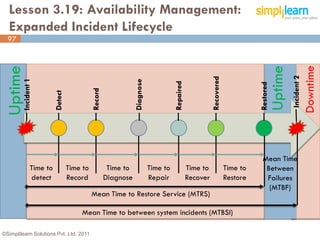
  • 125.
    Lesson 2.3: ConfigurationManagement System (CMS) 125 • Information about all Configuration Items 125 CI may be entire service, or any component Stored in 1 or more databases (CMDBs) • CMS stores attributes Any information about the CI that might be needed • CMS stores relationships Between CIs With incident, problem, change records etc. • CMS has multiple layers Data sources and tools, information integration, knowledge processing (scorecards, dashboards etc.), presentation ©Simplilearn Solutions Pvt. Ltd. 2011
  • 126.
    Lesson 3.0: ServiceTransition 126 Processes Lesson objectives At the end of this lesson, you should be able to understand Objectives and basic concepts of the four processes in Service Transition: • Transition, Planning and Support • Change Management • Service Asset and Configuration Management • Release and Deployment management, And • Knowledge Management ©Simplilearn Solutions Pvt. Ltd. 2011
  • 127.
    Lesson 3.0.1: Transition,Planning and 127 Support Lesson objectives At the end of this lesson, you should be able to: • State the Goals, Objectives and basic concepts of Transition, Planning and Support ©Simplilearn Solutions Pvt. Ltd. 2011
  • 128.
    Lesson 3.0.2:Transition, Planningand Support- Goals and Objectives 128 The Objectives of Transition, Planning and Support are • Successful Planning and coordination of resources • Ensuring common framework • Proper planning for aligning customer and business change projects with Service Transition plans ©Simplilearn Solutions Pvt. Ltd. 2011 128
  • 129.
    Lesson 3.0.3:Transition, Planningand Support Activities- Purpose 129 The purpose of the Transition, Planning and Support activities are: • Planning appropriate capacity and resources • Provide support for the Service Transition teams and people • Integrity of changes with all other Service Transition processes • Coordination of activities across projects, suppliers and service teams ©Simplilearn Solutions Pvt. Ltd. 2011 129
  • 130.
    130 Lesson 3.1: Change Management Lesson objectives At the end of this lesson, you should be able to: • State the Goals, Objectives and basic concepts of Change Management ©Simplilearn Solutions Pvt. Ltd. 2011
  • 131.
    Lesson 3.2: ChangeManagement : Goals and Objectives 131 Goals and Objectives: Respond to changing business requirements • Respond to Business and IT requests to align Services with business needs. • Ensuring Changes are introduced in a controlled manner. • Optimize business risk • Implement changes successfully • Implement changes in times that meet business needs • Use standard processes • Record all changes ©Simplilearn Solutions Pvt. Ltd. 2011 131
  • 132.
    Lesson 3.3: ChangeManagement : Scope 132 Scope Addition, Modification or Removal of Any Service or Configuration Item or associated documentation Including Strategic, Tactical and Operational changes Excluding Business strategy and process Anything documented as out of scope ©Simplilearn Solutions Pvt. Ltd. 2011 132
  • 133.
    Lesson 3.4: ChangeManagement : Change Types 133 Change Types  Normal changes  Types are specific to the organization  Type determines what assessment is required  Standard changes  Pre-authorized with an established procedure  Tasks are well known, documented and low risk (usually)  E.g replacement of faulty printer, upgrade PC etc.  Emergency changes  Business criticality means there is insufficient time for normal handling  Should use normal process but speeded up  Impact can be high, more prone to failure, Should be kept to minimum Remediation planning  Backout Plans ©Simplilearn Solutions Pvt. Ltd. 2011 133
  • 134.
    Lesson 3.5: ChangeManagement : Change Flow 134 ©Simplilearn Solutions Pvt. Ltd. 2011 134
  • 135.
    Lesson 3.7: ChangeManagement : Roles in Change Management 135  Change Manager  Ensures that process is followed  Usually authorizes minor changes  Coordinates and runs CAB meetings  Produces change schedule  Coordinates change/built/test/implementation  Reviews/Closes Changes ©Simplilearn Solutions Pvt. Ltd. 2011 135
  • 136.
    Lesson 3.8: ChangeManagement : Change Advisory Board (CAB) 136  Change Advisory Board (CAB)  Supports the change manager  Consulted on significant changes  Business, users, application/technical support, operations, service desk, capacity, service continuity, third parties …  people who have clear understanding of business needs  Technical specialists / consultants  Emergency CAB (ECAB)  Subset of the standard CAB  Membership depends on the specific change ©Simplilearn Solutions Pvt. Ltd. 2011 136
  • 137.
    Lesson 3.9: ChangeManagement : Change Metrics 137 Change Metrics • Compliance Reduction in unauthorized changes Reduction in emergency changes • Effectiveness Percentage of changes which met requirements Reduction in disruptions, defects and re-work Reduction in changes failed/backed out Number of incidents attributable to changes • Efficiency Benefits (value compared to cost) Average time to implement (by urgency/priority/type) Percentage accuracy in change estimates ©Simplilearn Solutions Pvt. Ltd. 2011 137
  • 138.
    Lesson 3.10: ChangeManagement : Key Challenges 138 Business pressure to “just do it” Inaccurate and incomplete Configuration Management System Soiled Technical Function areas  Misunderstanding of “Emergency” changes Scalability across large organizations Vendor/Contract Compliance  Adhoc nature of people ©Simplilearn Solutions Pvt. Ltd. 2011 138
  • 139.
    Lesson 3.11: ServiceAsset and 139 Configuration Management Lesson objectives At the end of this lesson, you should be able to: • State the goals, objectives and basic concepts of Service Asset and Configuration Management ©Simplilearn Solutions Pvt. Ltd. 2011
  • 140.
    Lesson 3.12: ServiceAsset and Configuration Management: Goals and Objectives 140 The goal of SACM is to provide a logical model of the IT infrastructure correlating IT services and different IT components (physical, logical etc) needed to deliver these services The objective of SACM is to define and control the components of services and infrastructure and maintain accurate configuration records. This enables an organization to comply with corporate governance requirements, control its asset base, optimize its costs, manage change and release effectively, and resolve incidents and problems faster. ©Simplilearn Solutions Pvt. Ltd. 2011 140
  • 141.
    Lesson 3.13: ServiceAsset and Configuration Management: Basic Concepts 141 Basic Concepts What is a Configuration Item (CI) ? Anything that needs to be managed in order to deliver an IT Service CI information is recorded in the Configuration Management System CI information is maintained throughout its lifecycle by Configuration Management All CIs are subject to Change Management control CI Types : CIs typically include •IT Services, hardware, software, buildings, people, and formal documentation such as Process documentation and SLAs ©Simplilearn Solutions Pvt. Ltd. 2011 141
  • 142.
    Lesson 3.13: ServiceAsset and Configuration Management: Basic Concepts 142 Basic Concepts  Configuration baseline  Configuration details captured at a specific point in time. This captures both the structure and details of a configuration Item.  It is used as a reference point for future Builds, Releases and Changes. (e.g. After major changes, disaster recovery etc).  Typically managed through the Change Management process. ©Simplilearn Solutions Pvt. Ltd. 2011 142
  • 143.
    Lesson 3.13: ServiceAsset and Configuration Management: Basic Concepts: Contd.. 143 Basic Concepts What is a Configuration Management System (CMS) ? •Information about all Configuration Items •CI may be an entire service, or any component •Stored in 1 or more databases (CMDBs) •CMS stores attributes •Any information about the CI that might be needed •CMS stores relationships •Between CIs •With incident, problem, change records etc. •CMS has multiple layers •Data sources and tools, information integration, knowledge processing (scorecards, dashboards etc.), presentation ©Simplilearn Solutions Pvt. Ltd. 2011 143
  • 144.
    Lesson 3.13: ServiceAsset and Configuration Management: Basic Concepts: Contd.. 144 Basic Concepts What is a Definitive Media Library (DML) ? The only source for build and distribution Master copies of all software assets In house, external software houses Scripts as well as code Management tools as well as applications Including licenses Quality checked Complete, correct, virus scanned .. ©Simplilearn Solutions Pvt. Ltd. 2011 144
  • 145.
    Lesson 3.14: ServiceAsset and Configuration Mgmt..: Basic Concepts: CMDB & DML 145 Basic Concepts DML and CMDB ©Simplilearn Solutions Pvt. Ltd. 2011 145
  • 146.
    Lesson 3.16: ServiceAsset and Configuration Mgmt.: Basic Concepts: Relationship between CMDB, CMS and SKMS 146 SKMS Informed Decision CMS CMDB ©Simplilearn Solutions Pvt. Ltd. 2011 146
  • 147.
    Lesson 3.17: Releaseand Deployment 147 Management Lesson objectives At the end of this lesson, you should be able to: • State the goals, objectives and basic concepts of Release and Deployment Management ©Simplilearn Solutions Pvt. Ltd. 2011
  • 148.
    Lesson 3.18: Releaseand Deployment Management: Goals 148 • Release management is responsible for planning, scheduling, and controlling the movement of new or changed services, in the form of a release package, to both the testing and the live production environments • Deployment management is responsible for the movement of new or changed hardware, software, documentation, or other configuration items into the live production environment. ©Simplilearn Solutions Pvt. Ltd. 2011 148
  • 149.
    Lesson 3.19: Releaseand Deployment Management: Objectives 149 • Planned Release and Deployment in line to the business needs • Build, Install, Test and Integrate releases  Efficiently, successfully and on schedule.  With minimal impact on production services, operations, and support teams  Enabling new or changed services to deliver agreed service requirements • Control and minimize the impact of releases to the ongoing services • Transfer knowledge and skills to end users and support teams, leading to an effective use and support ©Simplilearn Solutions Pvt. Ltd. 2011 149
  • 150.
    Lesson 3.20: Releaseand Deployment Management: Basic Concepts: Release Policy 150 Release Policy: The overarching strategy for Releases and was derived from the Service Design phase of the Service Lifecycle and typically includes: • Release Description with the unique identification, numbering and naming conventions. • The roles and responsibilities at each stage in process. • The expected frequency for each type of release • The approach for accepting and grouping changes into a release. • The mechanism to automate the build, installation and release distribution processes to improve re-use, repeatability and efficiency • How the configuration baseline for the release is captured and verified against the actual release contents, e.g. hardware, software, documentation and knowledge • Exit and entry criteria and authority for acceptance of the release into each Service Transition stage and into the controlled test, training, disaster recovery and production environments • Criteria and authorization to exit early life support and handover to Service Operations. ©Simplilearn Solutions Pvt. Ltd. 2011 150
  • 151.
    Lesson 3.21: Releaseand Deployment Management: Basic Concepts: Release Unit 151 Release unit - Cls that are normally released together - Typically includes sufficient components to perform a useful function. For example - Fully configured desktop PC, payroll applications Release package - Single release or many related releases - Can include hardware, software, utility, warranty, documentation, training … ©Simplilearn Solutions Pvt. Ltd. 2011 151
  • 152.
    Lesson 3.21: Releaseand Deployment Management: Basic Concepts: Release Types 152 Release Types Major Release: Containing large proportions of new functionalities. Also known as a Major Upgrade, generally supersedes all preceding minor upgrades. Minor Release: Contains small enhancements and fixes. A Minor Upgrade or release generally supersedes previous emergency fixes. Emergency Release: Normally linked to an Emergency change. ©Simplilearn Solutions Pvt. Ltd. 2011 152
  • 153.
    Lesson 3.22: Releaseand Deployment Mgmt. Basic Concepts: Release and Deployment Approaches 153 Release and Deployment Approaches  Big bang versus phased approach  Phased approach can be users, locations, functionality ..  Push versus Pull deployment  Automated versus manual deployment ©Simplilearn Solutions Pvt. Ltd. 2011 153
  • 154.
    154 Lesson 3.23: Knowledge Management Lesson objectives At the end of this lesson, you should be able to: • State the goals, objectives and basic concepts of Knowledge Management ©Simplilearn Solutions Pvt. Ltd. 2011
  • 155.
    Lesson 3.24: KnowledgeManagement: Goals and Objectives 155  The goal of Knowledge Management is to Improve quality of management decision making by ensuring that reliable and secure information and data is available throughout the service lifecycle  The objective of Knowledge Management is to ensure that the right information is delivered to the appropriate place or person at the right time to enable informed decisions. ©Simplilearn Solutions Pvt. Ltd. 2011 155
  • 156.
    Lesson 3.25: KnowledgeManagement: Purpose 156 Knowledge Management is The process responsible for gathering, analyzing, storing and sharing knowledge and information within an organization. The primary purpose of knowledge Management is to improve efficiency and effectiveness by reducing the need to rediscover knowledge. ©Simplilearn Solutions Pvt. Ltd. 2011 156
  • 157.
    Lesson 3.26: KnowledgeManagement: Basic Concepts: DIKW 157 ©Simplilearn Solutions Pvt. Ltd. 2011 157
  • 158.
    Lesson 3.27: KnowledgeManagement: Service Knowledge Management System 158 ©Simplilearn Solutions Pvt. Ltd. 2011 158
  • 159.
    Lesson 3.28: KnowledgeManagement: SKMS 159 A set of tools for managing knowledge and information.  SKMS includes CMS.  SKMS contains all the information needed to manage the lifecycle of IT Services. ©Simplilearn Solutions Pvt. Ltd. 2011 159
  • 160.
    160 Service Transition : Summary • Goals and Objectives • Service Transition processes: Transition, Planning and Support Change Management Service Asset and Configuration Management Release and Deployment Management Knowledge Management ©Simplilearn Solutions Pvt. Ltd. 2011
  • 161.
    161 Service Transition : Quiz ©Simplilearn Solutions Pvt. Ltd. 2011
  • 162.
    Module 4: Quiz 162 Question 1: Which of the following statements about a standard change is INCORECT ? a) A Standard change is a low risk change b) Standard changes are pre-authorized changes c) Standard changes are authorized by E-CAB d) Standard changes are only raised by Incident Management ©Simplilearn Solutions Pvt. Ltd. 2011 162
  • 163.
    Module 4: Quiz 163 Question 2: Which statement is the CORRECT statement about the relationship between CMS and SKMS ? a) The SKMS is a part of the CMS b) The CMS is a part of the SKMS c) There is no relationship between the CMS and SKMS d) The CMS and the SKMS are the same ©Simplilearn Solutions Pvt. Ltd. 2011 163
  • 164.
    Module 4: Quiz 164 Question 3: Whish of the following is an activity of SACM ? a) Account for all the Financial assets of an organization b) Specify the relevant attributes of CI c) Implement ITIL across the organization d) Design Service models to justify ITIL implementations ©Simplilearn Solutions Pvt. Ltd. 2011 164
  • 165.
    Module 4: Quiz 165 Question 4: Which of the following does Service Transition provide guidance on: 1. Moving New and Changed Services to production 2. Testing and Validation 3. Transfer of services to and from external service provider a) All of the above b) None of the above c) Only 1 and 2 d) Only 1 ©Simplilearn Solutions Pvt. Ltd. 2011 165
  • 166.
    Module 4: Quiz 166 Question 5: Which of the following is an INCORRECT Release and Deployment approach? a) Propagate and Consolidate b) Push and Pull c) Big bang and Phased d) Automated and Manual ©Simplilearn Solutions Pvt. Ltd. 2011 166
  • 167.
    Module 4: Quiz 167 Question 6: Which of the following would be stored in the DML? 1. Copies of Purchased software 2. Copies of Internally developed software 3. Relevant License documentation 4. The Change schedule a) All of the above b) 1 and 2 only c) 3 and 4 only d) 1, 2 and 3 only ©Simplilearn Solutions Pvt. Ltd. 2011 167
  • 168.
    Module 5 168 Service Operations ©Simplilearn Solutions Pvt. Ltd. 2011 168
  • 169.
    169 Lesson 1.0: Service Operations Lesson objectives At the end of this lesson, you should be able to: • Understand the Goals and Objectives of Service Operations • Briefly Explain What Value Service Operations provide to business • Understand Key Concepts & definitions • Understand the Role of Communication in Service Operations ©Simplilearn Solutions Pvt. Ltd. 2011
  • 170.
    Lesson 1.1: ServiceOperations: Objectives 170  To coordinate and carry out the activities and processes required to deliver and manage services at agreed levels to business users and customers.  Responsible for the ongoing management of the technology that is used to deliver and support services.  Carrying out activities and Processes required to deliver and manage Services at agreed levels. KEY ROLE: How to achieve effectiveness & efficiency in Service Delivery so as to ensure value to business and the service provider ©Simplilearn Solutions Pvt. Ltd. 2011 170
  • 171.
    Lesson 1.2: Valueto Business 171  Service Operations is where the plans, designs and optimizations from other ITIL lifecycle phases are executed and measured. • Service value is modeled in Service Strategy • The cost of the service is designed, predicted and validated in Service Design and Service Transition • Measures for optimization are identified in Continual Service Improvement  From a customer viewpoint, Service Operation is where actual value is seen. ©Simplilearn Solutions Pvt. Ltd. 2011 171
  • 172.
    Lesson 1.3: Roleof Communication 172  Good communication is important across all phases of the service lifecycle but particularly so in Service Operation  Good communication is needed between all IT Service Management staff and with users/ customers / partners.  Issues can often be mitigated or avoided through good communication .  All communication should have: - Intended purpose and/ or resultant action - Clear audience, who should be involved in deciding the need/format  Examples of Communications in Service Operations · Routine operational communication · Communication between shifts · Performance reporting -Communication related to emergencies · Training on new or customized processes and service designs ©Simplilearn Solutions Pvt. Ltd. 2011 172
  • 173.
    Lesson 1.4: Events 173 An expected or unexpected change of state of a an IT component that could negatively impact delivery of IT services. Events are typically notifications created by an IT service, Configuration Item (CI) or a monitoring tool. Event Type Description Informational An event that does not require any action, regular operation  Example: Notification that a scheduled workload has completed Warning An Event that is unusual but not an exception, requires closer monitoring.  Example: A servers CPU utilization is approaching maximum performance threshold. Exception An Event signifying a service or a device is operating abnormally  Example: A PC scan reveals the installation of unauthorized software. ©Simplilearn Solutions Pvt. Ltd. 2011 173
  • 174.
    Lesson 1.5: Alerts& Incidents 174 Alert Incident  A warning that a threshold has been  An unplanned interruption to an IT reached, something has changed, or service. a Failure has occurred.  A reduction in the quality of an IT  Alerts are often created and service. managed by System Management  Failure of an IT component that has tools. not yet affected service, but could  Alerts are managed by the Event likely disrupt service if left Management Process. unchecked. This can be raised by IT  Objective is to notify the concerned support teams. Stakeholders  Example: Failure of a server in a clustered mode. Relationship between Events, Alerts and Incident All Alerts are Events, but not all Events trigger Alerts All Incidents are Events, but all Events are not Incidents ©Simplilearn Solutions Pvt. Ltd. 2011 174
  • 175.
    Lesson 1.6: ServiceRequest 175 Service Request  A generic description for many varying types of demands that are placed upon the IT Department by the users.  Many of these requests are actually small changes – low risk, frequently occurring, low cost, etc.  Their scale and frequency, low-risk nature means that they are better handled by a separate process, rather than being allowed to congest and obstruct the normal Incident and Change Management processes.  Examples:  A request to change a password,  A request to install an additional software application onto a particular PC,  A request to relocate some items of desktop equipment ©Simplilearn Solutions Pvt. Ltd. 2011 175
  • 176.
    Lesson 1.7: Problem& Workaround 176 Problem Workaround  A temporary way to restore service  The cause of one or more incidents. failures to a usable level. For example; rebooting a server hang.  The cause is not usually known at the time a Problem Record is created,  Used for reducing or eliminating the and the Problem Management Impact of an Incident or Problem for which Process is responsible for further a full Resolution is not yet available. investigation.  Workarounds for Incidents that do not  Prioritized in the same way and for have associated Problem Records are same reasons as Incidents. documented in the Incident Record.  Workarounds for Problems are documented in Known Error Records. ©Simplilearn Solutions Pvt. Ltd. 2011 176
  • 177.
    Lesson 1.8: KnownError (KE) and Known Error Database (KEDB) 177 Known Error (KE) Known Error Database (KEDB)  A Problem that has a documented Root  A storage of previous knowledge of cause and a Workaround. incidents and problems • A known error might be raised for • exact details of the fault and the a problem whose root cause is not symptoms that occurred yet known but a workaround has • how they were overcome been identified.  Allows quicker diagnosis and resolution  Known Errors are created and if Incidents/Problems recur. managed throughout their Lifecycle by Problem Management.  Known Errors may also be identified by Development or Suppliers. For example; Application incompatibility reports for Windows by Microsoft . ©Simplilearn Solutions Pvt. Ltd. 2011 177
  • 178.
    Lesson 1.9: Impact,Urgency & Priority 178 Impact A measure of the effect of an Incident, Problem or Change on Business Processes.  Based on how Service levels will be affected. Urgency A measure of how long it will be until an Incident, Problem or Change has a significant Impact on the Business. Priority The relative importance of an Incident, Problem or Change. Priority is based on Impact and Urgency, and is used to identify required times for actions to be taken. • For example, the SLA may state that Priority 2 Incidents must be resolved within 12 hours. ©Simplilearn Solutions Pvt. Ltd. 2011 178
  • 179.
    179 Lesson 2.0: Service Operations Process Lesson objectives At the end of this lesson, you should be able to: • State the objectives and basic concepts for Event Management ©Simplilearn Solutions Pvt. Ltd. 2011
  • 180.
    Lesson 2.1: EventManagement: Objectives 180 180 Definition The process responsible for monitoring Events throughout their Lifecycle. Objectives  To detect events, make sense of them and determine the appropriate control action.  Can be used as a basis for automating many routine Operations Management activities, For example - executing scripts on remote devices, or - submitting jobs for processing  It provides a way of comparing actual performance and behavior against design standards and SLAs.  Provide the basis for Operational Monitoring and Control ©Simplilearn Solutions Pvt. Ltd. 2011
  • 181.
    Lesson 2.2: EventManagement: Process Activities 181 Process Activities Event occurs Event Detection , Filtering & Notification Event Significance (Type of Event) (Information, Warning or Exception) Event correlation. Event Response Event Review & Closure ©Simplilearn Solutions Pvt. Ltd. 2011 181
  • 182.
    Lesson 2.3: EventManagement: Event Logging & Filtering 182 ©Simplilearn Solutions Pvt. Ltd. 2011 182
  • 183.
    Lesson 2.4: EventManagement: Managing Exceptional Events 183 ©Simplilearn Solutions Pvt. Ltd. 2011 183
  • 184.
    Lesson 2.5: EventManagement: Managing Information & Warning Events 184 ©Simplilearn Solutions Pvt. Ltd. 2011 184
  • 185.
    Lesson 2.6: IncidentManagement: Objectives 185 Definition The process for dealing with all incidents; this can include failures, questions or queries reported by the users (usually via a telephone call to the Service Desk), by technical staff, or automatically detected and reported by event monitoring tools. Objectives  To restore normal service operation as quickly as possible and minimize the adverse impact on business operations  To ensure that the best possible levels of service quality and availability are maintained, i.e. restore service within SLA’s ©Simplilearn Solutions Pvt. Ltd. 2011 185
  • 186.
    Lesson 2.7: IncidentManagement: Scope and Value to Business 186 Scope Value to Business  Managing any disruption or  Lower downtime to the business, potential disruption to live IT services which in turn means higher availability of the service.  Incidents identified • Directly by users through the  The capability to identify business service Desk priorities and dynamically allocate • Through an interface from Event resources as necessary. Management to incident Management tools  The ability to identify potential improvements to services.  Reported and/or logged by technical staff ©Simplilearn Solutions Pvt. Ltd. 2011 186
  • 187.
    Lesson 2.8: IncidentManagement: Basic Concepts 187 Time Scales • Timescales must be agreed for all incident handling stages. - Depending on Priority & SLA’s - Documented in OLA’s & UC’s • All support groups should be made fully aware of these timescales. Incident Models An Incident model is predefined steps to handle a particular Incident. The incident model should include: • The steps that should be taken to handle the incident • The order in which these steps should be taken in. • Responsibilities; who should do what Major Incident An Incident Model to handle Incidents of Major Impacts and great Urgency. ©Simplilearn Solutions Pvt. Ltd. 2011 187
  • 188.
    Lesson 2.9: IncidentManagement: Process Flow & Activities 188 ©Simplilearn Solutions Pvt. Ltd. 2011 188
  • 189.
    Lesson 2.10: IncidentManagement: Process Interfaces 189 Service Level • SLA’s, OLA’s, UC’s Manage ment Event • Service break/ degrading Manage Events • Performance ment Capacity incidents Manage • Incident ment Workarounds Problem • Potential problems Incident Manage Management ment • Availability Availabil incidents ity Manage ment • RFC for resolving Incidents Change • Incidents from Failed Manage Changes ment • CI data SACM* • Maintain faulty CI Status *SACM: Service Asset & Configuration Management ©Simplilearn Solutions Pvt. Ltd. 2011 189
  • 190.
    Lesson 2.11: ProblemManagement: Objectives 190 Definition The process responsible for managing the lifecycle of all problems. Problem Management seeks to identify and remove the root-cause of Incidents in the IT Infrastructure. Objectives  To prevent problems and resulting incidents from happening and to eliminate recurring incidents  To minimize the impact of incidents that cannot be prevented. ©Simplilearn Solutions Pvt. Ltd. 2011 190
  • 191.
    Lesson 2.12: ProblemManagement: Scope and Value to Business 191 Scope Value to Business  Activities required to diagnose the  Together with Incident and Change root cause of incidents and to Management increases IT service determine the resolution to those availability and quality. problems.  Reduction in downtimes and  Responsible for ensuring that the disruptions of Business critical resolution is implemented through the systems. appropriate control procedures, especially Change Management and  Reduced expenditure on Release Management. workarounds or fixes that do not work  Maintain information about problems and the appropriate  Reduction in cost of effort in fire- workarounds and resolutions fighting or resolving repeat incidents. ©Simplilearn Solutions Pvt. Ltd. 2011 191
  • 192.
    Lesson 2.13: ProblemManagement: Basic Concepts 192 Reactive Problem • Resolution of underlying cause (s) Management • The activities are similar to those of Incident Management for the logging, categorization and classification for Problems. The subsequent activities are different as this is where the actual root-cause analysis is performed and the Known Error corrected. • Covered in Service Operation Proactive Problem • Prevention of future problems by analyzing Incident Management Records, and using data collected by other IT Service Management processes and external sources to identify trends or significant problems. • Generally undertaken as part of Continual Service Improvement (CSI) ©Simplilearn Solutions Pvt. Ltd. 2011 192
  • 193.
    Lesson 2.14: ProblemManagement: Process Flow: Reactive Problem Management 193 Problem Problem Problem detection & Categorization Investigation & Logging & Prioritization Diagnosis Problem Workarounds & Known Resolution & raising Known Error Closure Error Records Database Errors from Major Problem Development / Reviews Suppliers ©Simplilearn Solutions Pvt. Ltd. 2011 193
  • 194.
    Lesson 2.15: ProblemManagement: Process Flow: Interfaces with Other Processes 194 Availability Management Change Management Capacity Management Configuration Management Problem Management Release & Deployment IT Service Continuity Management Management Financial Management Service Level Management ©Simplilearn Solutions Pvt. Ltd. 2011 194
  • 195.
    Lesson 2.16: RequestFulfillment Process 195 Definition The processes of dealing with Service Requests from the users. Objectives  To provide pre-defined pre-approved standard services to users.  To provide users with information on available services and procedures for obtaining them.  Deliver requested standard services.  Assist IT users with general information, comments and complaints Basic Concepts  Request models – Specific procedures for handling certain types of requests For example; IMACS, Password resets, etc. ©Simplilearn Solutions Pvt. Ltd. 2011 195
  • 196.
    Lesson 2.17: AccessManagement: Objectives 196 Definition The process of granting authorized users the right to use a service, while preventing access to non-authorized users. • Also referred to as Rights Management or Identity Management. • In practice, Access Management is the operational enforcement of the policies defined by Information Security Management. Objectives  To grant authorized users the right to use a Service and deny access to unauthorized users  To Execute policies and actions defined in Security and Availability Management ©Simplilearn Solutions Pvt. Ltd. 2011 196
  • 197.
    Lesson 2.18: AccessManagement: Basic Concepts 197 Basic Concepts Access • Access refers to the level and extent of a service’s functionality or data that a user is entitled to use. Identity • The information about the user that distinguishes them as an individual, and which verifies their status within the organization. • By definition, the identity of a user is unique to that user. Rights • Also called privileges, refer to the actual settings whereby a user is provided access to a service or group of services. • Typical rights or levels of access include read, write, execute, change, delete. Service/ Service • Granting users/User groups access to similar set of services Groups ©Simplilearn Solutions Pvt. Ltd. 2011 197
  • 198.
    Lesson 3.0: ServiceOperations: 198 Functions Lesson objectives At the end of this lesson, you should be able to: • Explain the role, objectives and organizational structures of Service desk ©Simplilearn Solutions Pvt. Ltd. 2011
  • 199.
    Lesson 3.1: ServiceDesk 199 Definition A Service Desk is a functional unit made up of a dedicated number of staff responsible for dealing with a variety of service events, often made via telephone calls, web interface, or automatically reported infrastructure events. Acts as daily Single point of contact for IT users Objectives  To restore the ‘normal service’ to the users as quickly as possible.  Operate as Level 1 for Incident Management and Request Fulfillment i.e. Log calls, do initial diagnosis and investigation and if possible resolve and close.  Manage Incidents throughout its lifecycle, which also includes user communication and Technical & hierarchical escalations.  Conducting customer/user satisfaction survey. ©Simplilearn Solutions Pvt. Ltd. 2011 199
  • 200.
    Lesson 3.1: Purposeof Service Desk 200 Purpose of Service Desk  Improved customer service, perception of IT and satisfaction with IT services  Increase accessibility to IT services through a single point of contact, communication and information.  Better quality and faster turnaround of customer or user IT requests  Enhanced focus and a proactive approach to IT service provisioning.  More meaningful management information for decision support  Improved teamwork and communication amongst IT staff.  A reduced negative business impact.  Improved usage of IT Support resources and increased productivity of business personnel. ©Simplilearn Solutions Pvt. Ltd. 2011 200
  • 201.
    Lesson 3.2: OrganizationStructures 201 Type Description 1. Local Located physically close to the user community it serves. 2. Centralized Service desk is deployed at one central physical location. 3. Virtual Impression of single, centralized Service desk, through the use of technology and tools to create a virtual Service desk. 4. Follow-The-Sun Multiple Service desks across time zones to provide 24x7 service. 5. Specialized ‘specialist groups’ within the overall Service Desk structure, so that incidents relating to a particular IT service can be routed directly (normally via telephony selection or IVR or a web-based interface) to the specialist group. ©Simplilearn Solutions Pvt. Ltd. 2011 201
  • 202.
    Lesson 3.3: ServiceDesk Function: Organization Structures - Local 202 Local  Aids communication and gives a clearly visible presence Local Users  Can often be inefficient and expensive to resource due to low call Service Desk volumes (local)  Reasons for a Local service desk… • Language and cultural or political differences • Different time zones • Specialized groups of users • VIP/criticality status of users. Third Party Application Infrastructure Support Support Support 202 ©Simplilearn Solutions Pvt. Ltd. 2011
  • 203.
    Lesson 3.4: ServiceDesk Function: Organization Structures- Centralized 203 Centralized Customer Customer Customer Site 1 Site 2 Site 3  Local Service Desks merged into one or few locations. Service Desk (centralized)  more efficient and cost-effective, allowing fewer overall staff to deal with a higher volume of calls. Second-Line Support  ‘local presence’ to handle physical support requirements, but controlled Third party Application Infrastructure Support Support Support and deployed from the central desk. ©Simplilearn Solutions Pvt. Ltd. 2011 203
  • 204.
    Lesson 3.5: ServiceDesk Function: Organization Structures- Virtual 204 Virtual  Single Visible Service Desk which may actually be run by staff in multiple locations.  Allows for ‘homeworking’, secondary support group, off-shoring or outsourcing – or any combination necessary to meet user demand.  Safeguards are needed to ensure consistency and uniformity in service quality and cultural terms ©Simplilearn Solutions Pvt. Ltd. 2011 204
  • 205.
    Lesson 3.6: ServiceDesk: Service Desk Staffing 205 Service Desk Staffing  Correct number and qualification at any given time, considering • Customer expectations and business requirements  e.g. call response time (SLA) , Budget • Number of users to support, their language and skills • Coverage period, out-of-hours, time zones/locations, travel time • Processes and procedures in place, Infrastructure for short breaks  Minimum qualifications • Interpersonal skills, Business and underlying IT understanding • Skill sets  Customer and Technical emphasis, Expert  Typing skills ©Simplilearn Solutions Pvt. Ltd. 2011 205
  • 206.
    Lesson 3.7: ServiceDesk: Service Desk Metrics 206 Service Desk Metrics  Periodic evaluations of health, maturity, efficiency, effectiveness and any opportunity to improve  Realistic and carefully chosen – total number of call is not itself good or bad  Some examples: • First-line resolution rate • Average time to resolve and/or escalate an incident • Total costs for the period divided by total call duration minutes • The number of calls broken by time of day and day of week, combined with the average call-time • Customer/User Satisfaction surveys ©Simplilearn Solutions Pvt. Ltd. 2011 206
  • 207.
    Lesson 3.8: TechnicalManagement 207 Role of Technical Management Function  The groups, departments or teams that provide technical expertise and overall management of the IT Infrastructure  Custodian of technical knowledge and expertise related to managing the IT Infrastructure.  Provides the actual resources to support the ITSM Lifecycle. - Ensures that resources are effectively trained and deployed to design, build, transition, operate and improve the technology required to deliver and support IT services. Objectives  To help plan, implement and maintain a stable technical infrastructure to support the organization’s business Processes -Well designed and highly resilient, cost-effective infrastructure configuration - Use of adequate technical skills to maintain the technical infrastructure and to speedily diagnose and resolve any technical failures that do occur. ©Simplilearn Solutions Pvt. Ltd. 2011 207
  • 208.
    Lesson 3.9: ApplicationManagement 208 Role of Application Management Function  Responsible for managing applications throughout their lifecycle. • Custodian of technical Knowledge and expertise related to managing application, whether purchased or developed in-house. • It provides the actual resources to support the ITSM Lifecycle • Providing guidance to IT Operations about how best to carry out the ongoing operational management of applications. • The integration of the Application Management Lifecycle into the ITSM Lifecycle Objectives  To helping to identify functional and manageability requirements for application software so as to support the organization’s business Processes.  Assist in design and deployment of applications.  Assist in ongoing support/maintenance/improvement of applications. ©Simplilearn Solutions Pvt. Ltd. 2011 208
  • 209.
    Lesson 3.10: ITOperations Management Function 209 Role of IT Operations Management Function  The function responsible for the ongoing management and maintenance of an organization ’s IT Infrastructure to ensure delivery of the agreed level of IT services to the business.  Operations Control - oversees the execution and monitoring of the operational activities and events in the IT Infrastructure.  Includes Console Management, Job Scheduling, Backup & restore, Print & output Management and Maintenance activities on behalf of Technical or Application Management teams.  Facilities Management - The management of the physical IT environment, typically a Data Centre or computer rooms and recovery sites together with all the power and cooling equipment. ©Simplilearn Solutions Pvt. Ltd. 2011 209
  • 210.
    Lesson 3.11: ITOperations Management Objectives 210 Objectives  Maintenance of the as- is infrastructure and procedures to achieve stability of the organization’s day-to-day processes and activities.  Regular scrutiny and improvements to achieve improved service at reduced costs, while maintaining stability.  Swift application of operational skills to diagnose and resolve any IT operations failures that occur. ©Simplilearn Solutions Pvt. Ltd. 2011 210
  • 211.
    211 Service Operations : Quiz ©Simplilearn Solutions Pvt. Ltd. 2011
  • 212.
    Module 5 212 Question 1: Major Incidents require: A. Separate procedures B. Less urgency C. Longer timescales D. Less documentation ©Simplilearn Solutions Pvt. Ltd. 2011 212
  • 213.
    Module 5 213 Question 2: Which of the following should be done when closing an Incident? 1: Check the Incident categorization and correct it if necessary 2: Decide whether a Problem needs to be logged A. 1 only B. Both of the above C. 2 only D. None of the above ©Simplilearn Solutions Pvt. Ltd. 2011 213
  • 214.
    Module 5 214 Question 3: Which of the following is NOT a valid objective of Request Fulfillment? A. To provide information to users about what services are available and how to request them B. To update the Service Catalogue with services that may be requested through the Service Desk C. To provide a channel for users to request and receive standard services D. To source and deliver the components of standard services that have been requested ©Simplilearn Solutions Pvt. Ltd. 2011 214
  • 215.
    Module 5 215 Question 4: Which Functions are included in IT Operations Management? A. Network Management and Application Management B. Technical Management and Application Management C. IT Operations Control and Facilities Management D. Facilities Management and Technical Management ©Simplilearn Solutions Pvt. Ltd. 2011 215
  • 216.
    Module 5 216 Question 5: What is the BEST description of the purpose of Service Operation? A. To decide how IT will engage with suppliers during the Service Management Lifecycle B. To proactively prevent all outages to IT Services C. To design and build processes that will meet business needs D. To deliver and manage IT Services at agreed levels to business users and customers ©Simplilearn Solutions Pvt. Ltd. 2011 216
  • 217.
    Module 5 217 Question 6: Which of these activities would you expect to be performed by a Service Desk? 1: Logging details of Incidents and service requests 2: Providing first-line investigation and diagnosis 3: Restoring service 4: Diagnosing the root-cause of problems A. All of the above B. 1, 2 and 3 only C. 1, 2 and 4 only D. 2, 3 and 4 only ©Simplilearn Solutions Pvt. Ltd. 2011 217
  • 218.
    218 End of Module 5 ©Simplilearn Solutions Pvt. Ltd. 2011
  • 219.
    Module 6 219 Continual Service Improvement ©Simplilearn Solutions Pvt. Ltd. 2011 219
  • 220.
    2 Lesson 1.0: Continual Service Improvement At the end of this lesson, you should be able to: • Understand the Goals and Objectives of Continual Service Improvement ©Simplilearn Solutions Pvt. Ltd. 2011
  • 221.
    Lesson 1.1: ContinualService Improvement: Goals 221  To continually align IT Services to the changing Business needs by identifying and implementing improvements.  Continually be on the lookout for improvements related to process effectiveness and efficiency. To implement improvement plans in a cost-effective manner. ©Simplilearn Solutions Pvt. Ltd. 2011 3
  • 222.
    Lesson 1.2: ContinualService Improvement: Objectives 222 •Review analyze and recommend improvement opportunities in all the life cycle phases •To make CSI activities, fact based, CSI Reviews and analyze Service level achievement results •Identify and implement activities for improve service efficiency and effectiveness to improve service quality •Improve cost effectiveness •Ensure appropriate quality management methods are used to support CSI activities ©Simplilearn Solutions Pvt. Ltd. 2011 4
  • 223.
    Lesson 1.3: ContinualService Improvement: Scope 223 Scope of CSI: Overall health of ITSM. It takes care of entire ITSM as well as all dependent services. Alignment of the service portfolio with business needs After implementing and operating processes, CSI help Maturing the processes. Organization need to: •Review management information and trends of service delivery •Ensure outputs of enabling ITSM are achieving results •Conduct audits to access maturity of process, compliance of processes. •Conduct customer satisfaction surveys. ©Simplilearn Solutions Pvt. Ltd. 2011 4
  • 224.
    Lesson 2.0: CSI– Key Principles and 5 Models At the end of this lesson, you should be able to: • Understand the Basic Concepts and Key Principles of Continual Service Improvement • John Kotter’s eight steps for Organization Transformation ©Simplilearn Solutions Pvt. Ltd. 2011
  • 225.
    Lesson 2.1: CSIand Organizational Change 225 225  Successful CSI requires organizational change  Organizational change presents challenges  Use formal approaches to address people-related issues:  John Kotter’s “Eight steps to transforming your organization”  Project Management ©Simplilearn Solutions Pvt. Ltd. 2011
  • 226.
    Lesson 2.2: JohnKotter’s 8 steps to Organizational Transformation 226 226 Steps Quotes 1 Creating Sense of • 50% of transformations fail in this stage. urgency • Without motivation, people won’t help and efforts goes nowhere • 76% of company’s management should be convinced of the need 2 Forming a guiding • Understand difficulties and producing change. coalition • Lack of effective, Strong leadership • Not a powerful coalition. Opposition eventually stops the change initiatives. 3 Creating a Vision • Without a sensible vision transformation effort can easily dissolve into a list of confusing, incompatible projects. • An explanation of 5 minutes should obtain reaction of “understanding” and “Interest”. 4 Communicating Vision • Without credible communication, and lot of it, the hearts and minds of the troops are never captured. • Make use of all communication channels. Reference: Crown copyright OGC. ©Simplilearn Solutions Pvt. Ltd. 2011
  • 227.
    Lesson 2.3: JohnKotter’s 8 steps to Organizational Transformation…contd 227 227 Steps Quotes 5 Empowering others to • Structures to underpin the vision.. And removal of barriers to change. act on vision • More people involved, the better the outcome. • Reward initiatives. 6 Planning for and • Real transformation takes time. Without quick wins too many people give up creating quick wins or join the ranks of those opposing change. • Actively look for performance improvements and establish clear goals. • Communicate success. 7 Consolidating • Until changes sink deeply into the culture new approaches are fragile and improvements and subject to regressions. producing more change • In many cases worker revert to old practices. • Use credibility of quick wins to tackle even bigger problems. 8 Institutionalize the • Show how new approaches, behavior and attitude have helped improve change performance. Ensure selection and promotion criteria underpin the new approach. ©Simplilearn Solutions Pvt. Ltd. 2011 Reference: Crown copyright OGC.
  • 228.
    Lesson 2.4: ServiceMeasurement 228 228 The ability to predict and report service performance against targets of an end-to-end service is known as Service Measurement. Will require someone to take the individual measurements and combine them to provide a view of the customer experience. This data can be analyzed over a period of time to produce a trend. This data can be collected at multiple levels, (for example, CIs, processes, services). ©Simplilearn Solutions Pvt. Ltd. 2011
  • 229.
    Lesson 2.5: Reasonsto Monitor & Measure 229 229 ©Simplilearn Solutions Pvt. Ltd. 2011
  • 230.
    Lesson 2.5: Typesof Metrics 230 230  Technology metrics: typically components and applications For example •Performance •Availability  Process metrics: Critical Success Factors (CSFs), Key Performance Indicators (KPIs), activity metrics for ITSM processes  Service metrics: end-to-end service metrics (often Service metrics are a sum of process and technology metrics) ©Simplilearn Solutions Pvt. Ltd. 2011
  • 231.
    Lesson 2.6: KeyDefinitions 231 231  Improvement – Favorable Outcome showing a measurable increase in a desirable metric or a decrease in undesirable metric.  Benefit – Gain achieved from Improvement. This is generally associated with ROI or VOI.  Return on Investment (ROI) – Quantifiable monetary benefit achieved by expending a certain amount of money, usually expressed as a percentage.  Value on Investment (VOI) – Non monetary benefit, such as branding, achieved by expending a certain amount of money.  Baseline – Benchmark used as a reference point for later comparison. ©Simplilearn Solutions Pvt. Ltd. 2011
  • 232.
    Deming Cycle 232 232  Plan:  Establish the objectives and processes necessary to deliver results in accordance with customer requirements and the organization's policies.  Do:  Implement the processes.  Check:  Monitor and measure processes and P D product against policies, objectives and requirements for the product A C and report the results.  Act:  Take actions to continually improve process performance. ©Simplilearn Solutions Pvt. Ltd. 2011
  • 233.
    Lesson 2.7: SevenStep Improvement Process- PDCA Cycle 233 233 7 – Step Improvement Process – PDCA cycle CHECK DEFINE WHAT YOU ANALYZE THE SHOULD MEASURE DATA PLAN DEFINE WHAT YOU PRESENT AND USE CAN MEASURE THE DATA PROCESS THE DATA DO IMPLEMENT CORRECTIVE ACTION GATHER THE DATA – WHO, HOW, WHEN ACT ©Simplilearn Solutions Pvt. Ltd. 2011
  • 234.
    Lesson 2.8: ContinualService Improvement Model 234 234 ©Simplilearn Solutions Pvt. Ltd. 2011
  • 235.
    235 CSI : Quiz ©Simplilearn Solutions Pvt. Ltd. 2011
  • 236.
    Module 6: Quiz 236 Question 1: Which of the following does CSI provide guidance on? 1. How to improve process efficiency and effectiveness 2. How to improve services 3. Improvement of all phases of service lifecycle 4. Measurement of processes and services a) 1 and 2 only b) All of the above c) 2 only d) 1, 3 and 4 only ©Simplilearn Solutions Pvt. Ltd. 2011 236
  • 237.
    Module 6: Quiz 237 Question 2: Which is the first activity of the CSI model? a) Carry out a baseline assessment to understand the current situation b) Understand the Business Vision and Objectives c) Agree on priorities for Improvement d) Create and verify a plan ©Simplilearn Solutions Pvt. Ltd. 2011 237
  • 238.
    Module 6: Quiz 238 Question 3: Which of the following is NOT a metric described in CSI? a) Process Metric b) Personnel Metric c) Service Metrics d) Technology Metrics ©Simplilearn Solutions Pvt. Ltd. 2011 238
  • 239.
    Module 6: Quiz 239 Question 4: Which of the following are objectives of CSI? 1. To improve process efficiency and effectiveness 2. To improve services 3. To improve all phases of service lifecycle except Strategy 4. To improve International standard such as ISO 20000 a) 1 and 2 only b) 2 and 4 only c) 1, 2 and 3 only d) All of the above ©Simplilearn Solutions Pvt. Ltd. 2011 239
  • 240.
    Module 6: Quiz 240 Question 5: Learning and Improvement is the PRIMARY concern of which of the following phases of service lifecycle? a) Continual Service Improvement b) Service Strategy and Service Design c) Service Strategy, Service Transition and Service Operation d) Service Strategy, Service Design, Service Transition and Service Operation ©Simplilearn Solutions Pvt. Ltd. 2011 240
  • 241.
    241 CSI : Summary  Goals and Objectives of CSI  John Kotter’s 8 steps of Organizational Transformation  Service Measurement and Metrics  7 Step Improvement process  CSI Improvement Model ©Simplilearn Solutions Pvt. Ltd. 2011
  • 242.
    ITIL 2011 FoundationCertification Exam Practical Tips 242 • Read the question CAREFULLY • At this level of exam the obvious answer is often the correct answer (if you have read the question carefully!) • Beware of being misled by the preliminary text for the question • If you think there should be another choice that would be the right answer, then you have to choose the “most right” • Use strategies such as “What comes first?” or “What doesn’t belong?” to help with the more difficult questions • Where there are questions that involve multiple statements (i.e. 1, 2, 3, 4), then try to eliminate combinations that are immediately incorrect (based on something you can remember) so that the question is broken into smaller, and more manageable pieces. ©Simplilearn Solutions Pvt. Ltd. 2011 242
  • 243.
    ITIL 2011 FoundationCertification Exam Practical Tips 243 Lets see with an example how to answer the questions. Sample Question Which of the following statements is CORRECT for ALL processes? a) They define functions as part of their design b) They should deliver value for stakeholders c) They are carried out by an external service provider in support of a customer d) They are units of organizations responsible for specific outcomes ©Simplilearn Solutions Pvt. Ltd. 2011 243
  • 244.
    ITIL 2011 FoundationCertification Exam Practical Tips 244 Let us look at another example. Sample Question Which of the following statements about a Definitive Media Library (DML) are CORRECT? 1. The DML can include a physical store 2. The DML holds definitive hardware spares 3. The DML includes master copies of controlled documentation a) All of the above b) 1 and 2 only c) 2 and 3 only d) 1 and 3 only ©Simplilearn Solutions Pvt. Ltd. 2011 244