ITIL
TRAINING
AGENDA
Introduction to ITIL
Key Concepts and Terminology
Service Lifecycle Stages
Service Strategy
Service Design
Service Transition
Service Operation
Continual Service Improvement
Q&A Session
DEFINITION OF ITIL
ITIL (Information Technology Infrastructure Library) is a set of best practices and
guidelines for IT service management (ITSM)
ITIL provides a framework for managing IT services, covering processes, procedures,
and tasks to improve efficiency, effectiveness, and customer satisfaction
ITIL provide the directions to the organization and its people utilizing the IT for
Changings, Transforming, Developing the business
History of ITIL
1980s: ITIL was developed by the UK government’s Central Computer and Telecommunications Agency (CCTA). Its goal
was to improve IT service efficiency and quality for public and private organizations by standardizing practices.
1990s: ITIL gained widespread adoption, especially in Europe, as organizations realized the benefits of standardized IT
service management.
2001 (ITIL Version 2): ITIL was revised to focus on specific ITSM processes and service support. This version saw
global adoption as organizations sought more structured approaches to IT service management.
2007 (ITIL Version 3): This version introduced the concept of the Service Lifecycle, emphasizing the full lifecycle of IT
services from strategy to continual improvement. It was a more holistic approach that incorporated feedback and the
importance of service delivery throughout its entire life.
2019 (ITIL 4): The latest version, ITIL 4, was released to reflect modern technologies like Agile, DevOps, and Lean. ITIL
4 provides a more flexible, adaptable approach to ITSM, focusing on co-creation of value through IT services,
collaboration, and continuous improvement.
WHY ITIL IS IMPORTANT?
• Alignment of IT with Business Goals
• Improved Service Quality
• Improving project delivery success.
• Offering maximum value to customers.
• Enhancing resources and capabilities.
• Planning processes with specific goals in mind.
• Clearly defines roles for each task.
• Monitor, measure and optimize service provider performance.
• It helps to control IT investment and budget.
Overall, ITIL aims to improve service quality, reduce costs, and enhance customer satisfaction by promoting a
structured approach to managing IT services.
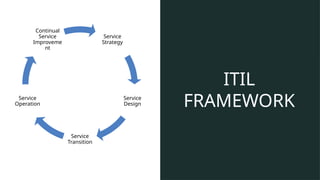
ITIL
FRAMEWORK
Service
Strategy
Service
Design
Service
Transition
Service
Operation
Continual
Service
Improveme
nt
WHY SERVICE STRATEGY
• Alignment with Business Goals: Ensures that IT services are not just reactive but
actively contribute to the business’s growth and strategic objectives.
• Value Delivery: Focuses on understanding and delivering value to the customer
through services, ensuring that IT investments yield positive business outcomes.
• Cost Optimization: Helps the organization manage its IT resources efficiently,
balancing service quality with costs to provide a sustainable business model.
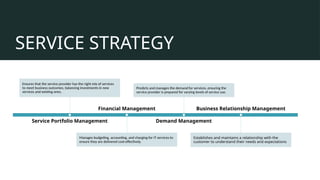
SERVICE STRATEGY
Service Portfolio Management
Ensures that the service provider has the right mix of services
to meet business outcomes, balancing investments in new
services and existing ones.
Financial Management
Manages budgeting, accounting, and charging for IT services to
ensure they are delivered cost-effectively.
Demand Management
Predicts and manages the demand for services, ensuring the
service provider is prepared for varying levels of service use.
Business Relationship Management
Establishes and maintains a relationship with the
customer to understand their needs and expectations
WHY SERVICE DESIGN
• Alignment with Business Needs: Ensures that IT services are designed to meet the
specific requirements of the business and its customers.
• Risk Reduction: By considering factors like capacity, availability, and security during
the design phase, organizations can minimize risks associated with service delivery.
• Cost Efficiency: Effective service design can lead to more efficient resource usage,
reducing unnecessary costs in the long term.
• Improved Customer Satisfaction: Well-designed services that meet customer needs
lead to higher satisfaction levels and better user experiences.
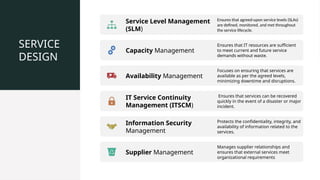
SERVICE
DESIGN
Service Level Management
(SLM)
Ensures that agreed-upon service levels (SLAs)
are defined, monitored, and met throughout
the service lifecycle.
Capacity Management
Ensures that IT resources are sufficient
to meet current and future service
demands without waste.
Availability Management
Focuses on ensuring that services are
available as per the agreed levels,
minimizing downtime and disruptions.
IT Service Continuity
Management (ITSCM)
Ensures that services can be recovered
quickly in the event of a disaster or major
incident.
Information Security
Management
Protects the confidentiality, integrity, and
availability of information related to the
services.
Supplier Management
Manages supplier relationships and
ensures that external services meet
organizational requirements
WHY SERVICE TRANSITION
• Risk Mitigation: Reduces potential service disruptions.
• Efficient Change Management: Streamlines assessment and implementation of changes.
• Service Readiness: Ensures readiness of services for deployment.
• Minimized Downtime: Decreases service interruptions during transitions.
• Knowledge Transfer: Prepares support teams with essential information.
• Alignment with Business Needs: Ensures services meet organizational requirements.
• Improved Communication: Enhances coordination among stakeholders.
• Documentation: Provides records for compliance and audits.
• Continuous Improvement: Facilitates learning for better future transitions.
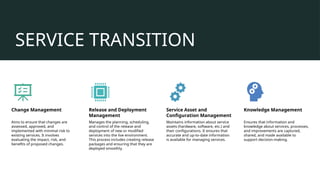
SERVICE TRANSITION
Change Management
Aims to ensure that changes are
assessed, approved, and
implemented with minimal risk to
existing services. It involves
evaluating the impact, risk, and
benefits of proposed changes.
Release and Deployment
Management
Manages the planning, scheduling,
and control of the release and
deployment of new or modified
services into the live environment.
This process includes creating release
packages and ensuring that they are
deployed smoothly.
Service Asset and
Configuration Management
Maintains information about service
assets (hardware, software, etc.) and
their configurations. It ensures that
accurate and up-to-date information
is available for managing services.
Knowledge Management
Ensures that information and
knowledge about services, processes,
and improvements are captured,
shared, and made available to
support decision-making.
WHY SERVICE OPERATION
• Operational Efficiency: Ensures that IT services are managed efficiently, reducing waste and
optimizing resource usage.
• User Satisfaction: By effectively managing incidents and requests, organizations can enhance user
experience and satisfaction.
• Service Stability: Through proactive problem management, organizations can improve service
stability and reduce the frequency of incidents.
• Compliance and Security: Ensures that access to IT services is managed securely, protecting
sensitive information and complying with regulations.
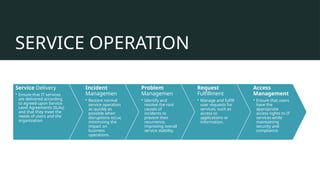
SERVICE OPERATION
Service Delivery
• Ensure that IT services
are delivered according
to agreed-upon Service
Level Agreements (SLAs)
and that they meet the
needs of users and the
organization.
Incident
Managemen
• Restore normal
service operation
as quickly as
possible when
disruptions occur,
minimizing the
impact on
business
operations.
Problem
Managemen
• Identify and
resolve the root
causes of
incidents to
prevent their
recurrence,
improving overall
service stability.
Request
Fulfillment
• Manage and fulfill
user requests for
services, such as
access to
applications or
information.
Access
Management
• Ensure that users
have the
appropriate
access rights to IT
services while
maintaining
security and
compliance.
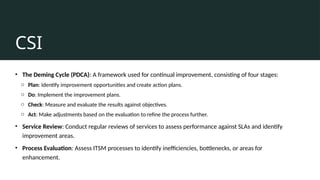
CSI
• The Deming Cycle (PDCA): A framework used for continual improvement, consisting of four stages:
o Plan: Identify improvement opportunities and create action plans.
o Do: Implement the improvement plans.
o Check: Measure and evaluate the results against objectives.
o Act: Make adjustments based on the evaluation to refine the process further.
• Service Review: Conduct regular reviews of services to assess performance against SLAs and identify
improvement areas.
• Process Evaluation: Assess ITSM processes to identify inefficiencies, bottlenecks, or areas for
enhancement.
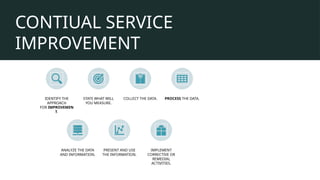
CONTIUAL SERVICE
IMPROVEMENT
IDENTIFY THE
APPROACH
FOR IMPROVEMEN
T.
STATE WHAT WILL
YOU MEASURE.
COLLECT THE DATA. PROCESS THE DATA.
ANALYZE THE DATA
AND INFORMATION.
PRESENT AND USE
THE INFORMATION.
IMPLEMENT
CORRECTIVE OR
REMEDIAL
ACTIVITIES.
Q&A
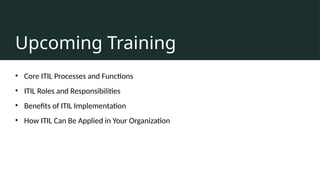
Upcoming Training
• Core ITIL Processes and Functions
• ITIL Roles and Responsibilities
• Benefits of ITIL Implementation
• How ITIL Can Be Applied in Your Organization
Thank You
Presented by: Rakshika
B

ITIL BASICS AND COMPLETE PROCESS UNDERSTANDING

  • 1.
  • 2.
    AGENDA Introduction to ITIL KeyConcepts and Terminology Service Lifecycle Stages Service Strategy Service Design Service Transition Service Operation Continual Service Improvement Q&A Session
  • 3.
    DEFINITION OF ITIL ITIL(Information Technology Infrastructure Library) is a set of best practices and guidelines for IT service management (ITSM) ITIL provides a framework for managing IT services, covering processes, procedures, and tasks to improve efficiency, effectiveness, and customer satisfaction ITIL provide the directions to the organization and its people utilizing the IT for Changings, Transforming, Developing the business
  • 4.
    History of ITIL 1980s:ITIL was developed by the UK government’s Central Computer and Telecommunications Agency (CCTA). Its goal was to improve IT service efficiency and quality for public and private organizations by standardizing practices. 1990s: ITIL gained widespread adoption, especially in Europe, as organizations realized the benefits of standardized IT service management. 2001 (ITIL Version 2): ITIL was revised to focus on specific ITSM processes and service support. This version saw global adoption as organizations sought more structured approaches to IT service management. 2007 (ITIL Version 3): This version introduced the concept of the Service Lifecycle, emphasizing the full lifecycle of IT services from strategy to continual improvement. It was a more holistic approach that incorporated feedback and the importance of service delivery throughout its entire life. 2019 (ITIL 4): The latest version, ITIL 4, was released to reflect modern technologies like Agile, DevOps, and Lean. ITIL 4 provides a more flexible, adaptable approach to ITSM, focusing on co-creation of value through IT services, collaboration, and continuous improvement.
  • 5.
    WHY ITIL ISIMPORTANT? • Alignment of IT with Business Goals • Improved Service Quality • Improving project delivery success. • Offering maximum value to customers. • Enhancing resources and capabilities. • Planning processes with specific goals in mind. • Clearly defines roles for each task. • Monitor, measure and optimize service provider performance. • It helps to control IT investment and budget. Overall, ITIL aims to improve service quality, reduce costs, and enhance customer satisfaction by promoting a structured approach to managing IT services.
  • 6.
  • 7.
    WHY SERVICE STRATEGY •Alignment with Business Goals: Ensures that IT services are not just reactive but actively contribute to the business’s growth and strategic objectives. • Value Delivery: Focuses on understanding and delivering value to the customer through services, ensuring that IT investments yield positive business outcomes. • Cost Optimization: Helps the organization manage its IT resources efficiently, balancing service quality with costs to provide a sustainable business model.
  • 8.
    SERVICE STRATEGY Service PortfolioManagement Ensures that the service provider has the right mix of services to meet business outcomes, balancing investments in new services and existing ones. Financial Management Manages budgeting, accounting, and charging for IT services to ensure they are delivered cost-effectively. Demand Management Predicts and manages the demand for services, ensuring the service provider is prepared for varying levels of service use. Business Relationship Management Establishes and maintains a relationship with the customer to understand their needs and expectations
  • 9.
    WHY SERVICE DESIGN •Alignment with Business Needs: Ensures that IT services are designed to meet the specific requirements of the business and its customers. • Risk Reduction: By considering factors like capacity, availability, and security during the design phase, organizations can minimize risks associated with service delivery. • Cost Efficiency: Effective service design can lead to more efficient resource usage, reducing unnecessary costs in the long term. • Improved Customer Satisfaction: Well-designed services that meet customer needs lead to higher satisfaction levels and better user experiences.
  • 10.
    SERVICE DESIGN Service Level Management (SLM) Ensuresthat agreed-upon service levels (SLAs) are defined, monitored, and met throughout the service lifecycle. Capacity Management Ensures that IT resources are sufficient to meet current and future service demands without waste. Availability Management Focuses on ensuring that services are available as per the agreed levels, minimizing downtime and disruptions. IT Service Continuity Management (ITSCM) Ensures that services can be recovered quickly in the event of a disaster or major incident. Information Security Management Protects the confidentiality, integrity, and availability of information related to the services. Supplier Management Manages supplier relationships and ensures that external services meet organizational requirements
  • 11.
    WHY SERVICE TRANSITION •Risk Mitigation: Reduces potential service disruptions. • Efficient Change Management: Streamlines assessment and implementation of changes. • Service Readiness: Ensures readiness of services for deployment. • Minimized Downtime: Decreases service interruptions during transitions. • Knowledge Transfer: Prepares support teams with essential information. • Alignment with Business Needs: Ensures services meet organizational requirements. • Improved Communication: Enhances coordination among stakeholders. • Documentation: Provides records for compliance and audits. • Continuous Improvement: Facilitates learning for better future transitions.
  • 12.
    SERVICE TRANSITION Change Management Aimsto ensure that changes are assessed, approved, and implemented with minimal risk to existing services. It involves evaluating the impact, risk, and benefits of proposed changes. Release and Deployment Management Manages the planning, scheduling, and control of the release and deployment of new or modified services into the live environment. This process includes creating release packages and ensuring that they are deployed smoothly. Service Asset and Configuration Management Maintains information about service assets (hardware, software, etc.) and their configurations. It ensures that accurate and up-to-date information is available for managing services. Knowledge Management Ensures that information and knowledge about services, processes, and improvements are captured, shared, and made available to support decision-making.
  • 13.
    WHY SERVICE OPERATION •Operational Efficiency: Ensures that IT services are managed efficiently, reducing waste and optimizing resource usage. • User Satisfaction: By effectively managing incidents and requests, organizations can enhance user experience and satisfaction. • Service Stability: Through proactive problem management, organizations can improve service stability and reduce the frequency of incidents. • Compliance and Security: Ensures that access to IT services is managed securely, protecting sensitive information and complying with regulations.
  • 14.
    SERVICE OPERATION Service Delivery •Ensure that IT services are delivered according to agreed-upon Service Level Agreements (SLAs) and that they meet the needs of users and the organization. Incident Managemen • Restore normal service operation as quickly as possible when disruptions occur, minimizing the impact on business operations. Problem Managemen • Identify and resolve the root causes of incidents to prevent their recurrence, improving overall service stability. Request Fulfillment • Manage and fulfill user requests for services, such as access to applications or information. Access Management • Ensure that users have the appropriate access rights to IT services while maintaining security and compliance.
  • 15.
    CSI • The DemingCycle (PDCA): A framework used for continual improvement, consisting of four stages: o Plan: Identify improvement opportunities and create action plans. o Do: Implement the improvement plans. o Check: Measure and evaluate the results against objectives. o Act: Make adjustments based on the evaluation to refine the process further. • Service Review: Conduct regular reviews of services to assess performance against SLAs and identify improvement areas. • Process Evaluation: Assess ITSM processes to identify inefficiencies, bottlenecks, or areas for enhancement.
  • 16.
    CONTIUAL SERVICE IMPROVEMENT IDENTIFY THE APPROACH FORIMPROVEMEN T. STATE WHAT WILL YOU MEASURE. COLLECT THE DATA. PROCESS THE DATA. ANALYZE THE DATA AND INFORMATION. PRESENT AND USE THE INFORMATION. IMPLEMENT CORRECTIVE OR REMEDIAL ACTIVITIES.
  • 17.
  • 18.
    Upcoming Training • CoreITIL Processes and Functions • ITIL Roles and Responsibilities • Benefits of ITIL Implementation • How ITIL Can Be Applied in Your Organization
  • 19.