IT Service Management Process Kadhar Masthan Cognizant Technology Solutions
Agenda Why IT Service Delivery Process? QuickCase IT Service Management Standards & Frameworks Process Implementation Approach Values & Benefits Q & A … .. and all within 45 minutes so I’ll request you to listen quickly
Transforming Service Management 93% of business management recognized that IT is important to delivering the organization’s strategy - ITGI Survey
InfraRemote  Managed Service Provider Delivers a higher level of managed IT services  Smartest and most cost-effective  in delivering ebusiness, security, and disaster recovery and business continuity. Provide Network and Systems Management Services QuickCase – InfraRemote’s Situation ** InfraRemote is used to illustrate a scenario and does not represents any organization
Customer’s of InfraRemote QuickCase – InfraRemote’s Situation Business Services are in high threat Service Level Agreements are not met consistently Customer Support is very poor Performance and Availability Metrics are not available Operation team takes more time to fix the issues “ My downtime cost is increasing. I need always-on 24 X 7 services”
InfraRemote’s Employees QuickCase – InfraRemote’s Situation Not able to meet the SLA’s and OLA’s No process and standards are defined in the environment No clear communication from senior management Spend more time in the blame game More frustration and always “re-invent” the wheel “ I don’t have bandwidth to support the core business activities  - all my time is spent in resolving day-to-day issues”
QuickCase – InfraRemote’s Situation InfraRemote’s C-suite Executives “ My customers always want 99.999% availability, 24 X 7!” Customers and Employee’s are not receiving the maximum benefit from IT Not able to optimize supply and delivery of IT services ROI is not met on the IT expenditures No strategic direction for IT Not able to set the IT objectives and measure the performance
Missing Pieces in the Puzzle IT Risks IT Control IT Cost People Process &  Metrics Business  Aligned IT Values
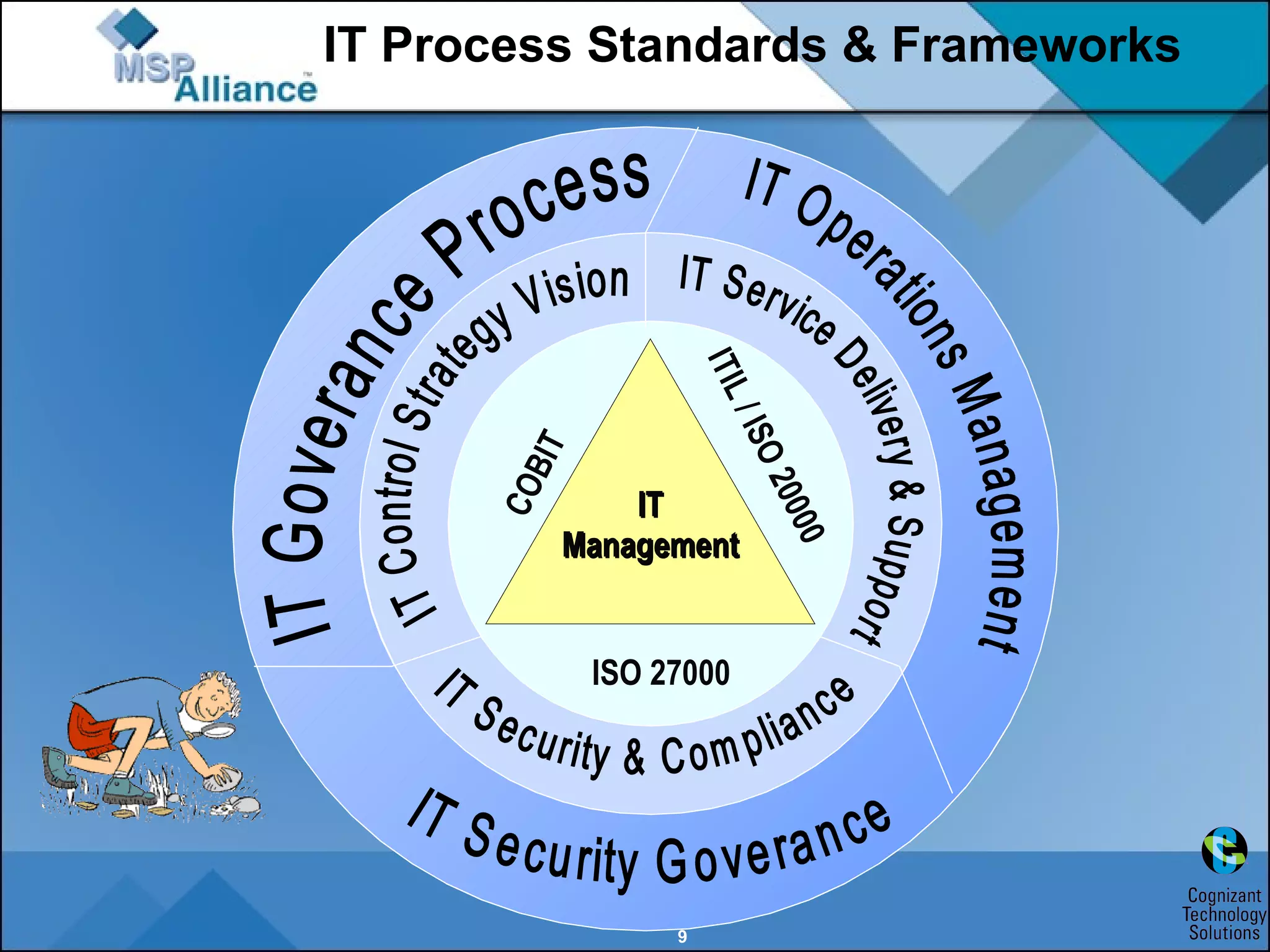
IT Process Standards & Frameworks ITIL / ISO 20000 ISO 27000 IT Service Delivery & Support IT Operations Management IT Goverance Process IT Security Goverance IT Control Strategy Vision IT Security & Compliance IT Management COBIT
IT Service Excellence - Approach In-House Processes Code of Practice (PD0005) BS 15000 / ISO 20000 ITIL  Best Practices IT Service Management  Excellence in Action Business & IT  Objectives Business Values  & Benefits People Process Technology IT Governance & Security Objectives
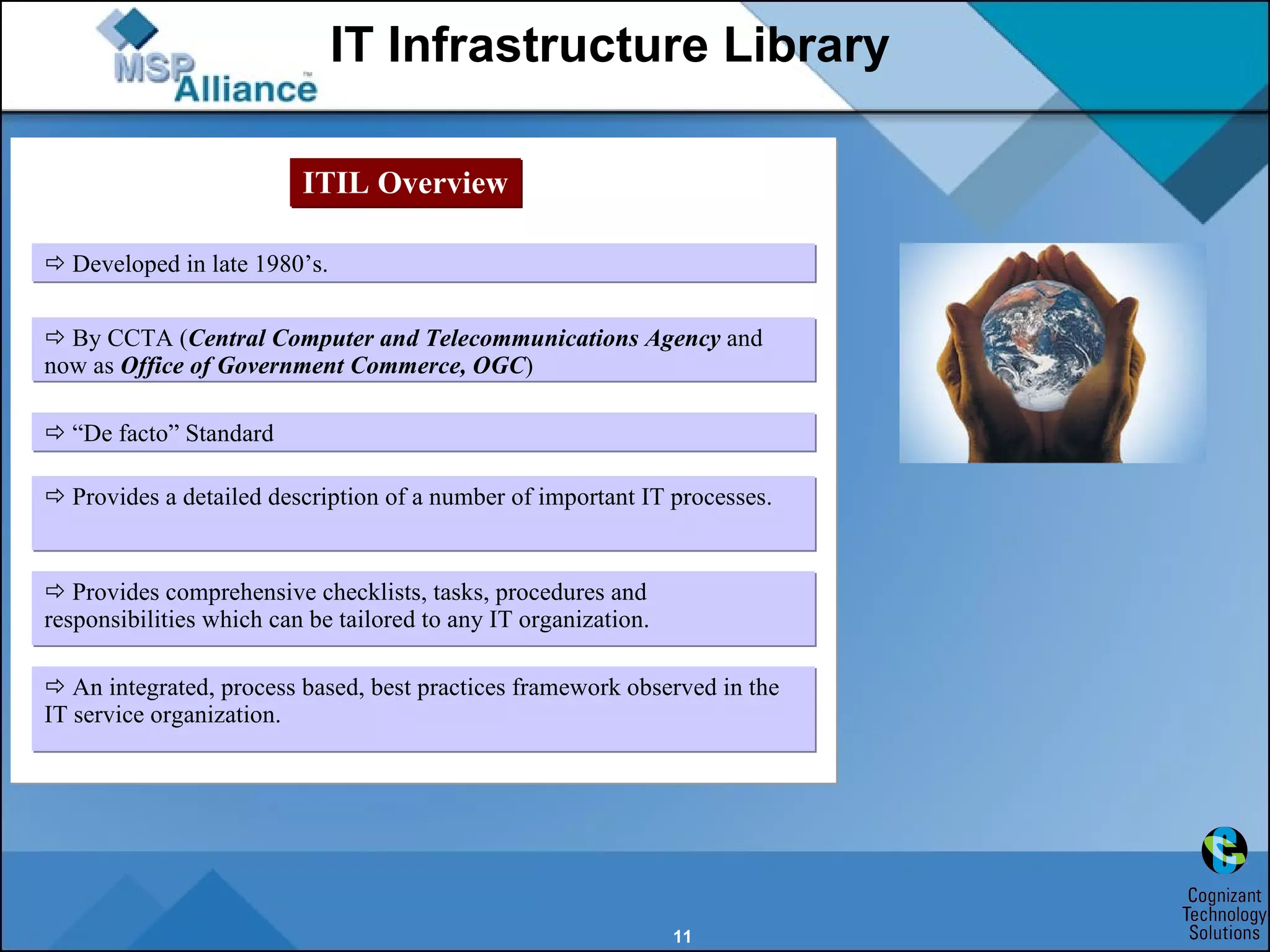
IT Infrastructure Library Developed in late 1980’s. By CCTA ( Central Computer and Telecommunications Agency  and now as  Office of Government Commerce, OGC ) Provides a detailed description of a number of important IT processes. Provides comprehensive checklists, tasks, procedures and responsibilities which can be tailored to any IT organization. “ De facto” Standard An integrated, process based, best practices framework observed in the IT service organization. ITIL Overview
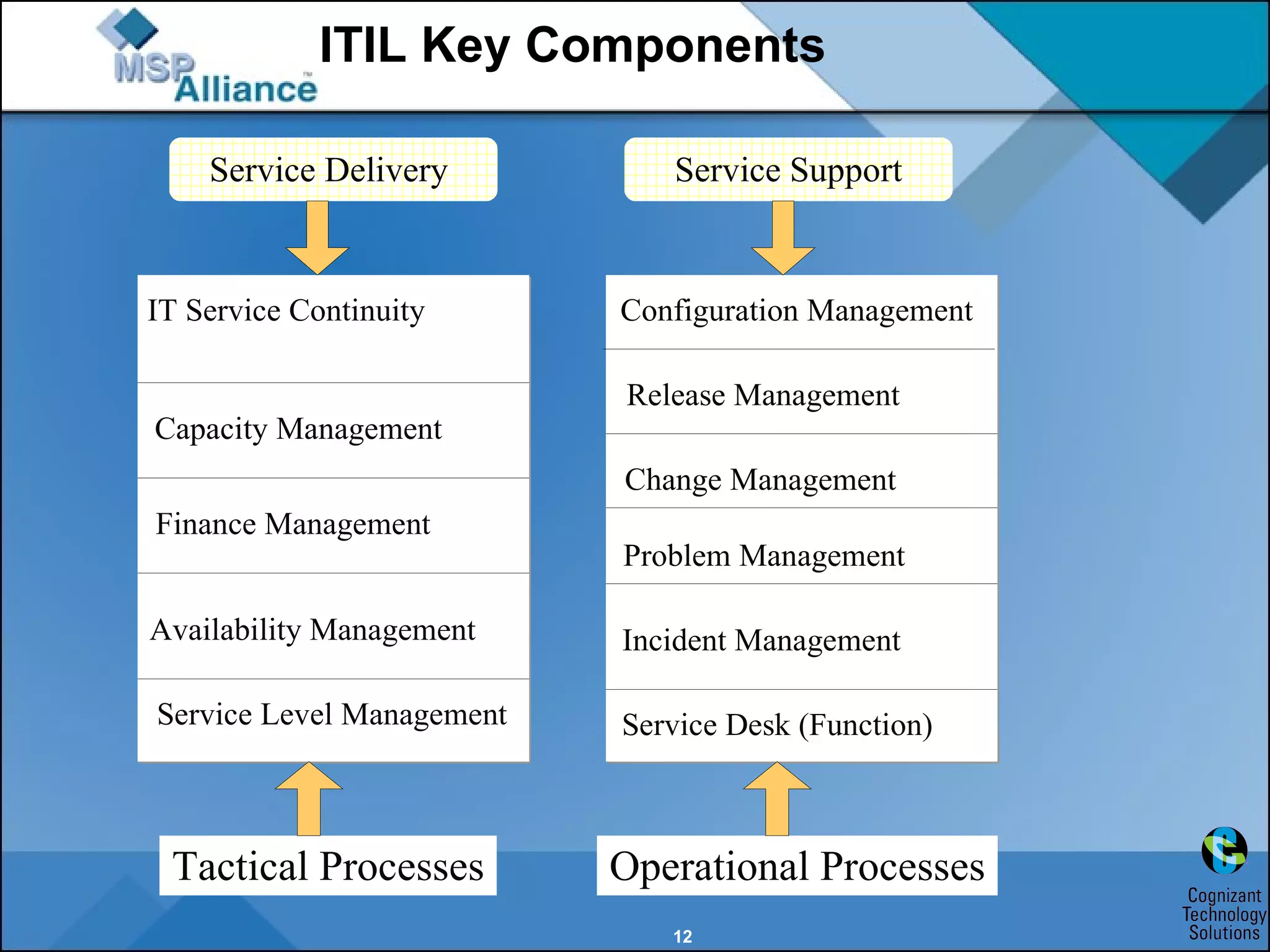
ITIL Key Components Service Level Management Availability Management Capacity Management IT Service Continuity Finance Management Tactical Processes Service Desk (Function) Incident Management Change Management Release Management Problem Management Operational Processes Configuration Management Service Delivery  Service Support
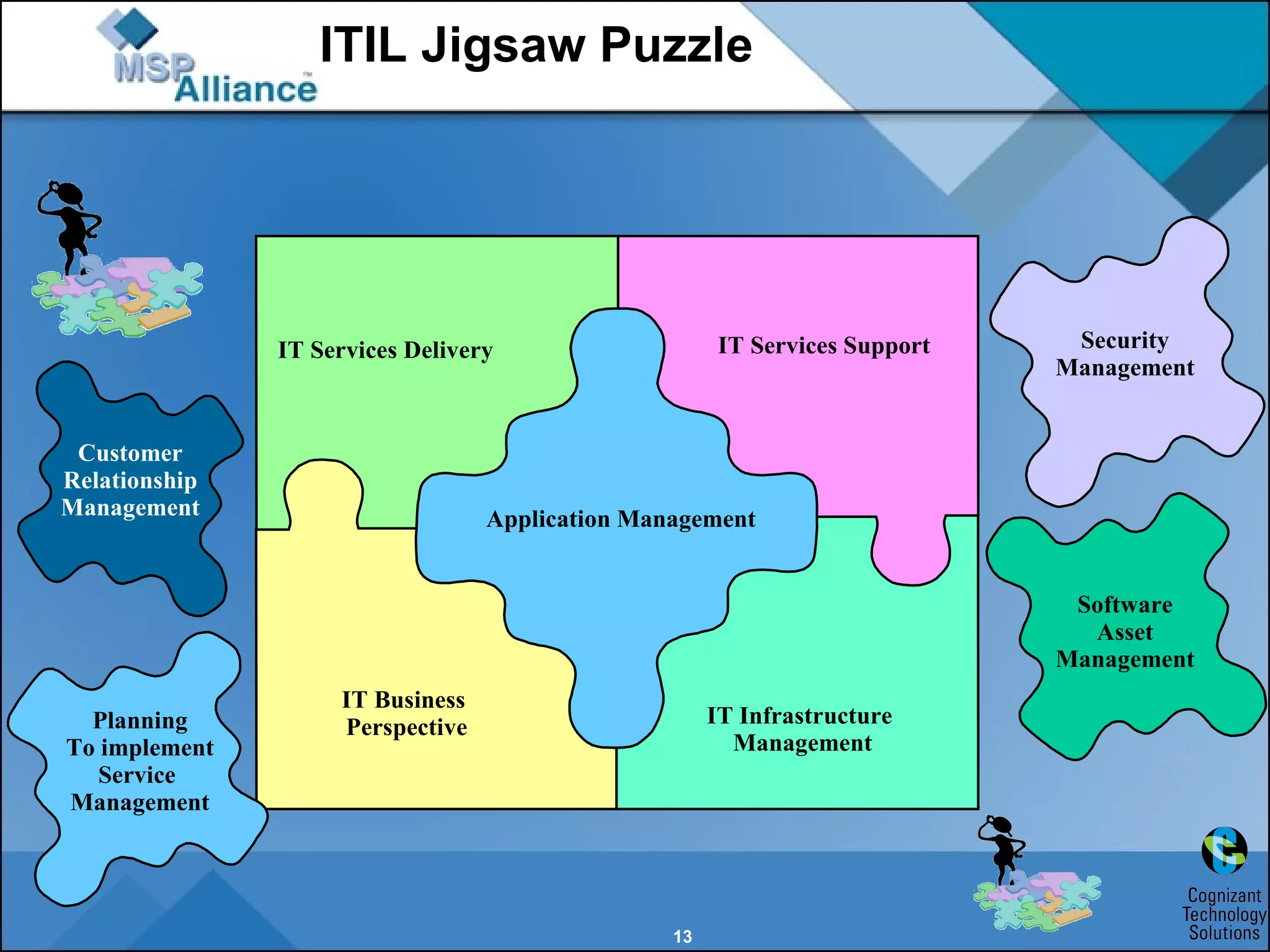
ITIL Jigsaw Puzzle IT Services Delivery IT Business  Perspective IT Infrastructure  Management IT Services Support Application Management Customer Relationship Management Security Management Planning To implement Service  Management Software Asset Management
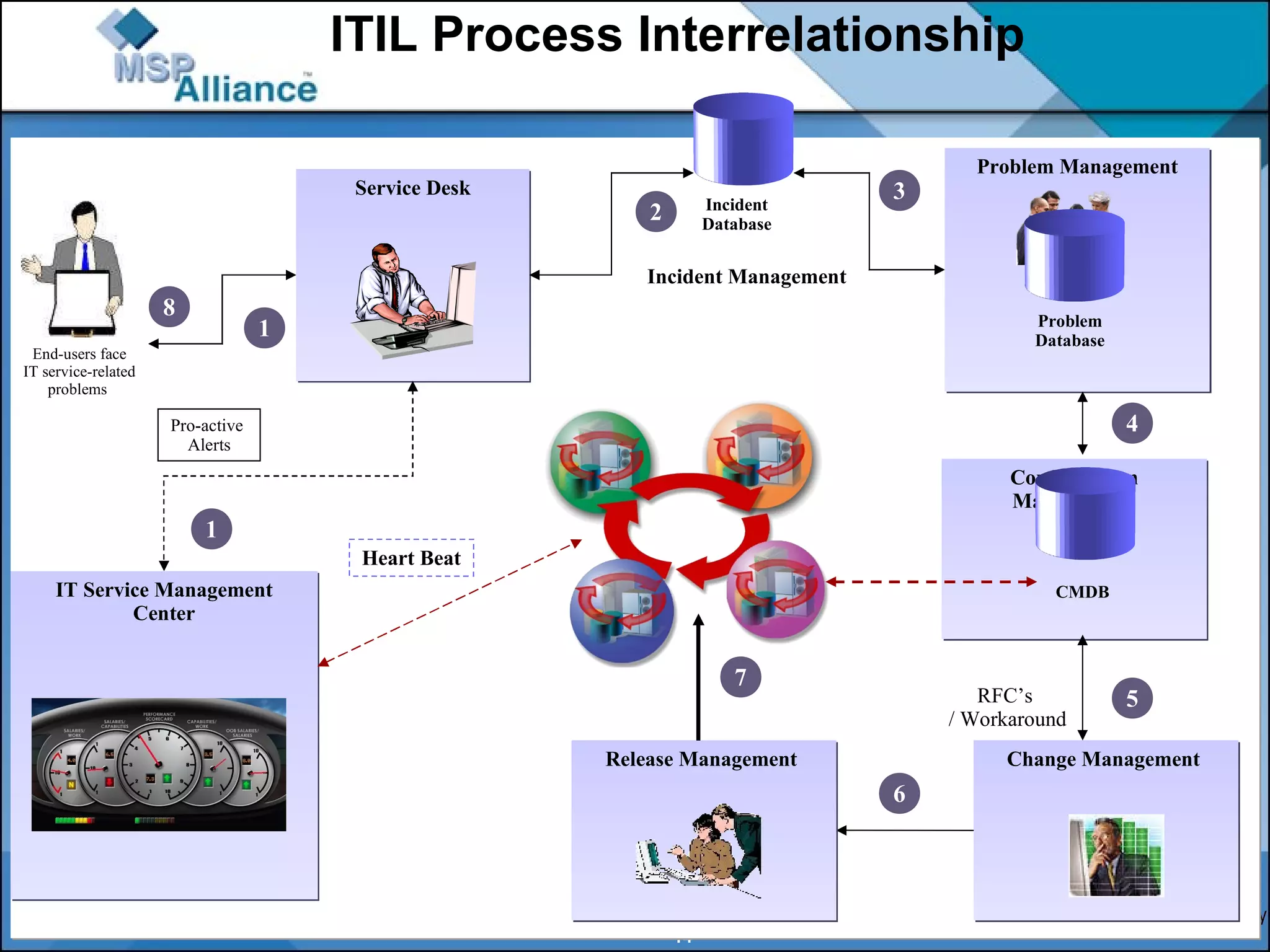
ITIL Process Interrelationship Configuration Management  Change Management  Problem Management End-users face IT service-related problems  Service Desk Incident Management IT Service Management Center Pro-active  Alerts 2 3 4 1 5 6 8 Incident Database CMDB 1 Release Management  RFC’s  / Workaround Problem Database Heart Beat 6 7
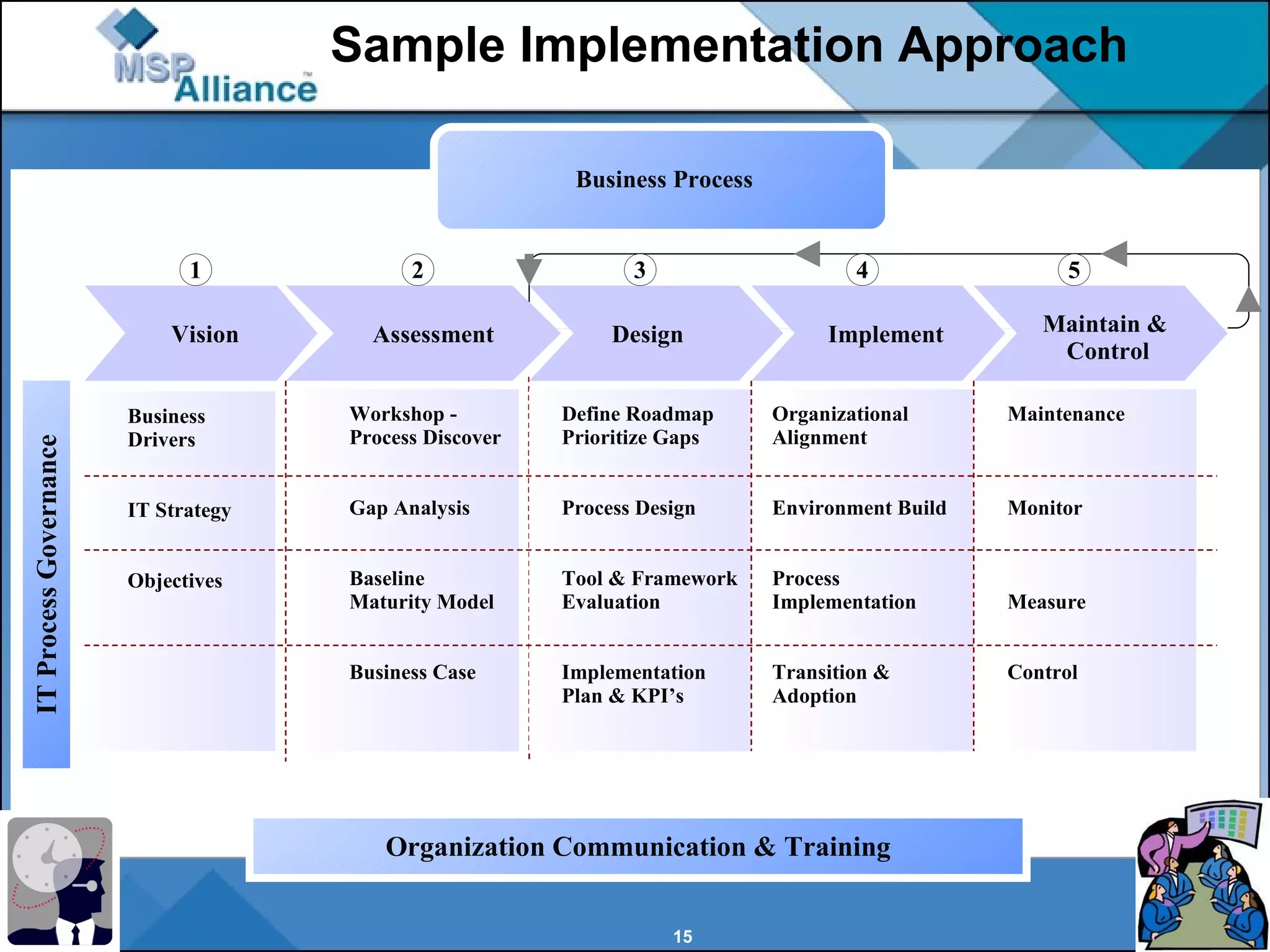
Sample Implementation Approach Business Process IT Process Governance Organization Communication & Training 1 2 3 4 5 Business  Drivers IT Strategy Objectives Vision Workshop -  Process Discover Gap Analysis Baseline  Maturity Model Business Case Assessment Define Roadmap Prioritize Gaps Process Design Tool & Framework Evaluation Implementation  Plan & KPI’s Design Organizational  Alignment Environment Build Process  Implementation Transition &  Adoption Implement Maintenance Monitor Measure Control Maintain &  Control
ISO/IEC 27001:2005 - (BS 7799) Standard for an Information Security Management System Information Security Management System (ISMS)  is a systematic approach to managing sensitive company information, ensuring it remains both secure and available ISO/IEC 27001:2005  instructs you how to apply  ISO/IEC 17799  and how to build, operate, maintain and improve an ISMS. ISO/IEC 17799:2005 ISO/IEC 27001:2005 ISMS Code of Practice Define Control  Objectives Implement ISMS Do Check Act Plan ISMS
ISO 20000 / BS 15000 Integrated framework for delivering and managing IT services to the customer. ISO 20000 is the first global standard on IT service management ‘ IT Service Management System’ (ITSMS) framework sets out a systematic approach to managing the IT services delivered to customers (internal or external).  The standard is based on the best practice foundation of the IT Infrastructure Library (ITIL). Key Components ISO/IEC 20000-1:2005 IT Service Management Specification  ISO/IEC 20000-2:2005 IT Service Management Code of practice Key Differences Sets the standards that service management processes should aim for Objectively tests that best practices really have been adopted.
ISO 20000 – Certification Roadmap Understand  Specification &  Standards Define  ITSM Policy Organization Buy-in Awareness  Programs & Trainings Identify auditing firm Plan Coordination of  IT Service Management  Processes Manage IT Service  Delivery teams Implementation  of procedures Budget Allocation Define Roles  & Responsibilities Implement Define SIP SIP for  Improvement Process Perform  Improvements Continuous external audit Act Process  Baseline Perform Internal  Audits Reviews at  planned intervals  Check Implement  Measurement &  Monitor Process Pre-Audit  Review Pre  Assessment Process  Review Achieve  Certification Initial  Assessment Assessment
COBIT – IT Governance Framework COBIT - Control Objectives for Information and related Technology Consists of linking business goals to IT goals, providing metrics and identifying the associated responsibilities of business and IT process owners. COBIT supports IT governance by providing a framework to ensure that: IT is aligned with the business IT enables the business and maximizes benefits IT resources are used responsibly IT risks are managed appropriately ISACA and IT Governance Institute Business orientation is the main theme of COBIT COBIT provides the guidance to IT Governance 10% used by IT Population **(ITGI 2006 Global Report) & awareness of COBIT is 27%.
COBIT – IT Governance Framework Process Domains Information IT Resources Data Applications Technology Facility Efficiency Effectiveness Confidentiality Planning  &  Organizations Control Activities Control Activities Control Activities Acquisitions  &  Implementations Delivery  &  Support Monitoring  &  Evaluate Integrity Availability Compliance Reliability Key Performance Indicators Key Goal Indicators Business What you need What you get?
ITIL, ISO 20000, COBIT & BS7799 (Where this will lead) ITIL COBIT IT Service Management  & Delivery Process ISO 27000 Governance  Model ISO 20000 Strong Service Management Framework Process  &  Metrics Technology IT Controls IT Risks Business  & IT Integration Business Orientation Service Process Definition Service Delivery &  Support Improves & Controls Quality Customer Focus Effective Service Management IT  Security Compliance Business Continuity Plan
Values & Benefits Service Provider Customers & Users IT  Management Business Management Business  Innovation Business & IT  Alignment IT Governance IT Performance  aligned  with organization SLA  Based Delivery Secured IT &  Availability Improved  Service Quality Reduced  Service Cost Enhanced Delivery
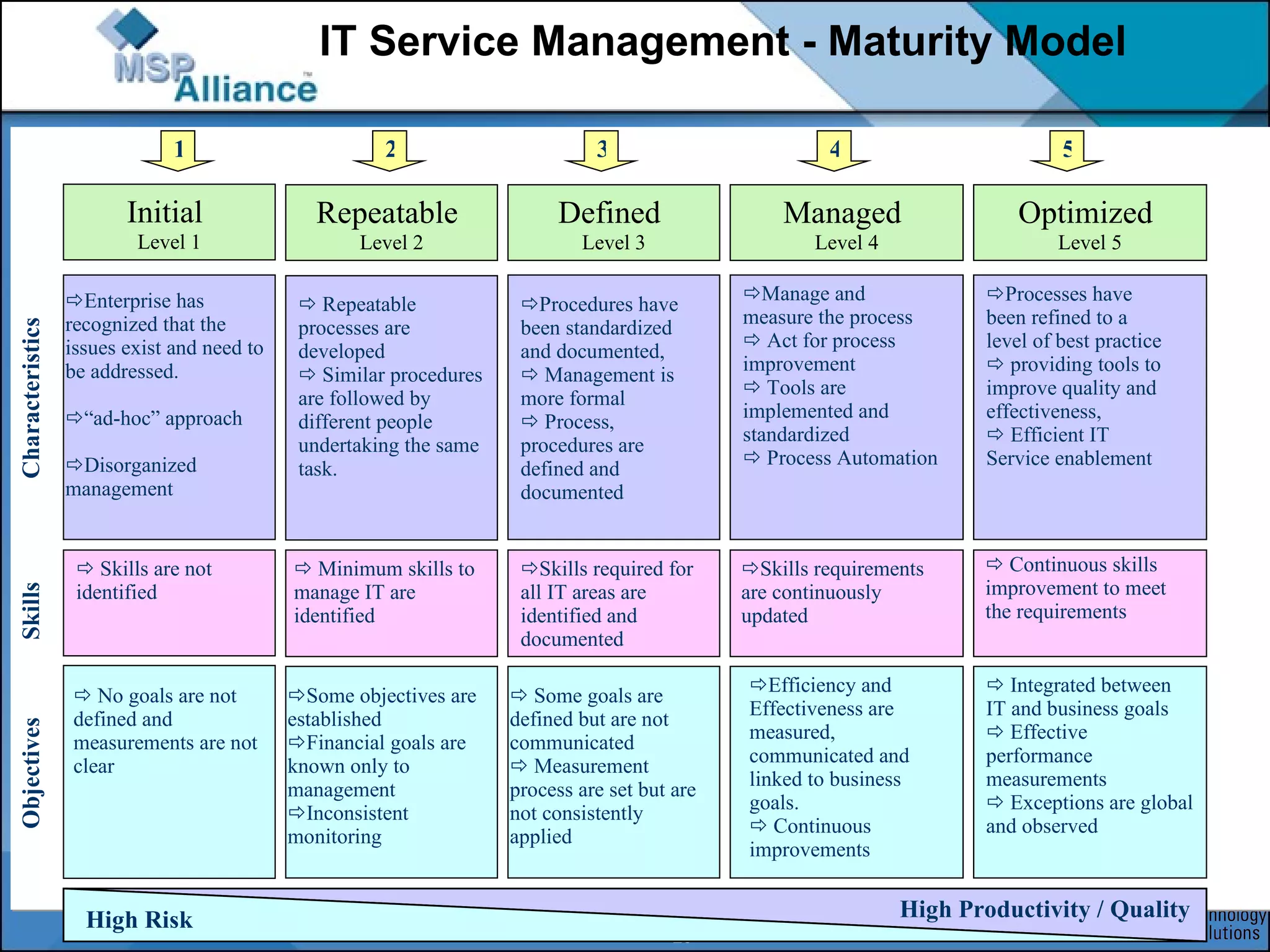
IT Service Management - Maturity Model Initial   Level 1 Enterprise has recognized that the issues exist and need to be addressed. “ ad-hoc” approach Disorganized management Skills are not identified No goals are not defined and measurements are not clear Repeatable   Level 2 Minimum skills to manage IT are identified Some objectives are established Financial goals are known only to management Inconsistent monitoring Repeatable processes are developed Similar procedures are followed by different people undertaking the same task. Defined   Level 3 Skills required for all IT areas are identified and documented Some goals are defined but are not communicated  Measurement process are set but are not consistently applied  Procedures have been standardized and documented, Management is more formal  Process, procedures are defined and documented Managed   Level 4 Skills requirements are continuously updated Efficiency and Effectiveness are measured, communicated and linked to business goals. Continuous improvements Manage and measure the process Act for process improvement Tools are implemented and standardized Process Automation Optimized   Level 5 Continuous skills improvement to meet the requirements Integrated between IT and business goals Effective performance measurements Exceptions are global and observed Processes have been refined to a level of best practice providing tools to improve quality and effectiveness, Efficient IT Service enablement Objectives Skills Characteristics High Risk High Productivity / Quality 1 2 3 4 5
Quick Tips Baseline your current Service Level Management and processes around the IT services Focus on IT Service Management - improving IT support, operational processes, defining services, and implementing and improving service-level management. Identify the current model, spec-out the processes required based on the organization requirement. Don’t let organizational structure or culture inhibit your ability to move toward ITSM.  Performance evaluation must be based on defined framework (BSC, COBIT, IS 20000)  & focus on new metrics and quality Ensure continuous, interactive planning between the business, IT ops and the users.
Implementation Challenges Each framework has it’s own edge Less focus on People and Technology Lack in implementation techniques Lack of Management Involvement and Support Being too ambitious and parallel implementation with shotgun, big-bang approach IT does not understand the business objectives Processes and Best Practices are not built overnight; they require time and continued commitment.
For any questions or further details, Please contact  [email_address]

Msp It Goverance And Service Delivery Process

  • 1.
    IT Service ManagementProcess Kadhar Masthan Cognizant Technology Solutions
  • 2.
    Agenda Why ITService Delivery Process? QuickCase IT Service Management Standards & Frameworks Process Implementation Approach Values & Benefits Q & A … .. and all within 45 minutes so I’ll request you to listen quickly
  • 3.
    Transforming Service Management93% of business management recognized that IT is important to delivering the organization’s strategy - ITGI Survey
  • 4.
    InfraRemote ManagedService Provider Delivers a higher level of managed IT services Smartest and most cost-effective in delivering ebusiness, security, and disaster recovery and business continuity. Provide Network and Systems Management Services QuickCase – InfraRemote’s Situation ** InfraRemote is used to illustrate a scenario and does not represents any organization
  • 5.
    Customer’s of InfraRemoteQuickCase – InfraRemote’s Situation Business Services are in high threat Service Level Agreements are not met consistently Customer Support is very poor Performance and Availability Metrics are not available Operation team takes more time to fix the issues “ My downtime cost is increasing. I need always-on 24 X 7 services”
  • 6.
    InfraRemote’s Employees QuickCase– InfraRemote’s Situation Not able to meet the SLA’s and OLA’s No process and standards are defined in the environment No clear communication from senior management Spend more time in the blame game More frustration and always “re-invent” the wheel “ I don’t have bandwidth to support the core business activities - all my time is spent in resolving day-to-day issues”
  • 7.
    QuickCase – InfraRemote’sSituation InfraRemote’s C-suite Executives “ My customers always want 99.999% availability, 24 X 7!” Customers and Employee’s are not receiving the maximum benefit from IT Not able to optimize supply and delivery of IT services ROI is not met on the IT expenditures No strategic direction for IT Not able to set the IT objectives and measure the performance
  • 8.
    Missing Pieces inthe Puzzle IT Risks IT Control IT Cost People Process & Metrics Business Aligned IT Values
  • 9.
    IT Process Standards& Frameworks ITIL / ISO 20000 ISO 27000 IT Service Delivery & Support IT Operations Management IT Goverance Process IT Security Goverance IT Control Strategy Vision IT Security & Compliance IT Management COBIT
  • 10.
    IT Service Excellence- Approach In-House Processes Code of Practice (PD0005) BS 15000 / ISO 20000 ITIL Best Practices IT Service Management Excellence in Action Business & IT Objectives Business Values & Benefits People Process Technology IT Governance & Security Objectives
  • 11.
    IT Infrastructure LibraryDeveloped in late 1980’s. By CCTA ( Central Computer and Telecommunications Agency and now as Office of Government Commerce, OGC ) Provides a detailed description of a number of important IT processes. Provides comprehensive checklists, tasks, procedures and responsibilities which can be tailored to any IT organization. “ De facto” Standard An integrated, process based, best practices framework observed in the IT service organization. ITIL Overview
  • 12.
    ITIL Key ComponentsService Level Management Availability Management Capacity Management IT Service Continuity Finance Management Tactical Processes Service Desk (Function) Incident Management Change Management Release Management Problem Management Operational Processes Configuration Management Service Delivery Service Support
  • 13.
    ITIL Jigsaw PuzzleIT Services Delivery IT Business Perspective IT Infrastructure Management IT Services Support Application Management Customer Relationship Management Security Management Planning To implement Service Management Software Asset Management
  • 14.
    ITIL Process InterrelationshipConfiguration Management Change Management Problem Management End-users face IT service-related problems Service Desk Incident Management IT Service Management Center Pro-active Alerts 2 3 4 1 5 6 8 Incident Database CMDB 1 Release Management RFC’s / Workaround Problem Database Heart Beat 6 7
  • 15.
    Sample Implementation ApproachBusiness Process IT Process Governance Organization Communication & Training 1 2 3 4 5 Business Drivers IT Strategy Objectives Vision Workshop - Process Discover Gap Analysis Baseline Maturity Model Business Case Assessment Define Roadmap Prioritize Gaps Process Design Tool & Framework Evaluation Implementation Plan & KPI’s Design Organizational Alignment Environment Build Process Implementation Transition & Adoption Implement Maintenance Monitor Measure Control Maintain & Control
  • 16.
    ISO/IEC 27001:2005 -(BS 7799) Standard for an Information Security Management System Information Security Management System (ISMS) is a systematic approach to managing sensitive company information, ensuring it remains both secure and available ISO/IEC 27001:2005 instructs you how to apply ISO/IEC 17799 and how to build, operate, maintain and improve an ISMS. ISO/IEC 17799:2005 ISO/IEC 27001:2005 ISMS Code of Practice Define Control Objectives Implement ISMS Do Check Act Plan ISMS
  • 17.
    ISO 20000 /BS 15000 Integrated framework for delivering and managing IT services to the customer. ISO 20000 is the first global standard on IT service management ‘ IT Service Management System’ (ITSMS) framework sets out a systematic approach to managing the IT services delivered to customers (internal or external). The standard is based on the best practice foundation of the IT Infrastructure Library (ITIL). Key Components ISO/IEC 20000-1:2005 IT Service Management Specification ISO/IEC 20000-2:2005 IT Service Management Code of practice Key Differences Sets the standards that service management processes should aim for Objectively tests that best practices really have been adopted.
  • 18.
    ISO 20000 –Certification Roadmap Understand Specification & Standards Define ITSM Policy Organization Buy-in Awareness Programs & Trainings Identify auditing firm Plan Coordination of IT Service Management Processes Manage IT Service Delivery teams Implementation of procedures Budget Allocation Define Roles & Responsibilities Implement Define SIP SIP for Improvement Process Perform Improvements Continuous external audit Act Process Baseline Perform Internal Audits Reviews at planned intervals Check Implement Measurement & Monitor Process Pre-Audit Review Pre Assessment Process Review Achieve Certification Initial Assessment Assessment
  • 19.
    COBIT – ITGovernance Framework COBIT - Control Objectives for Information and related Technology Consists of linking business goals to IT goals, providing metrics and identifying the associated responsibilities of business and IT process owners. COBIT supports IT governance by providing a framework to ensure that: IT is aligned with the business IT enables the business and maximizes benefits IT resources are used responsibly IT risks are managed appropriately ISACA and IT Governance Institute Business orientation is the main theme of COBIT COBIT provides the guidance to IT Governance 10% used by IT Population **(ITGI 2006 Global Report) & awareness of COBIT is 27%.
  • 20.
    COBIT – ITGovernance Framework Process Domains Information IT Resources Data Applications Technology Facility Efficiency Effectiveness Confidentiality Planning & Organizations Control Activities Control Activities Control Activities Acquisitions & Implementations Delivery & Support Monitoring & Evaluate Integrity Availability Compliance Reliability Key Performance Indicators Key Goal Indicators Business What you need What you get?
  • 21.
    ITIL, ISO 20000,COBIT & BS7799 (Where this will lead) ITIL COBIT IT Service Management & Delivery Process ISO 27000 Governance Model ISO 20000 Strong Service Management Framework Process & Metrics Technology IT Controls IT Risks Business & IT Integration Business Orientation Service Process Definition Service Delivery & Support Improves & Controls Quality Customer Focus Effective Service Management IT Security Compliance Business Continuity Plan
  • 22.
    Values & BenefitsService Provider Customers & Users IT Management Business Management Business Innovation Business & IT Alignment IT Governance IT Performance aligned with organization SLA Based Delivery Secured IT & Availability Improved Service Quality Reduced Service Cost Enhanced Delivery
  • 23.
    IT Service Management- Maturity Model Initial Level 1 Enterprise has recognized that the issues exist and need to be addressed. “ ad-hoc” approach Disorganized management Skills are not identified No goals are not defined and measurements are not clear Repeatable Level 2 Minimum skills to manage IT are identified Some objectives are established Financial goals are known only to management Inconsistent monitoring Repeatable processes are developed Similar procedures are followed by different people undertaking the same task. Defined Level 3 Skills required for all IT areas are identified and documented Some goals are defined but are not communicated Measurement process are set but are not consistently applied Procedures have been standardized and documented, Management is more formal Process, procedures are defined and documented Managed Level 4 Skills requirements are continuously updated Efficiency and Effectiveness are measured, communicated and linked to business goals. Continuous improvements Manage and measure the process Act for process improvement Tools are implemented and standardized Process Automation Optimized Level 5 Continuous skills improvement to meet the requirements Integrated between IT and business goals Effective performance measurements Exceptions are global and observed Processes have been refined to a level of best practice providing tools to improve quality and effectiveness, Efficient IT Service enablement Objectives Skills Characteristics High Risk High Productivity / Quality 1 2 3 4 5
  • 24.
    Quick Tips Baselineyour current Service Level Management and processes around the IT services Focus on IT Service Management - improving IT support, operational processes, defining services, and implementing and improving service-level management. Identify the current model, spec-out the processes required based on the organization requirement. Don’t let organizational structure or culture inhibit your ability to move toward ITSM. Performance evaluation must be based on defined framework (BSC, COBIT, IS 20000) & focus on new metrics and quality Ensure continuous, interactive planning between the business, IT ops and the users.
  • 25.
    Implementation Challenges Eachframework has it’s own edge Less focus on People and Technology Lack in implementation techniques Lack of Management Involvement and Support Being too ambitious and parallel implementation with shotgun, big-bang approach IT does not understand the business objectives Processes and Best Practices are not built overnight; they require time and continued commitment.
  • 26.
    For any questionsor further details, Please contact [email_address]