Topic 1 | Part 2 The Study of Religion
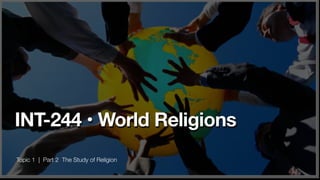
INT-244 • World Religions
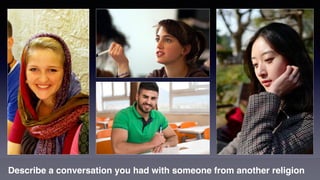
Describe a conversation you had with someone from another religion
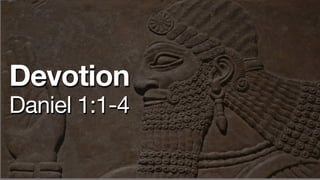
Devotion
Daniel 1:1-4
[In 586 BC] Nebuchadnezzar the king of
Babylon came to Jerusalem and besieged it.
And the Lord gave Jehoiakim king of Judah into
his hand, with some of the vessels of the house
of God. And he brought them back to Babylon,
to the house of his god, and placed the vessels
in the treasury of his god.


(Dan 1:1–2 ESV)
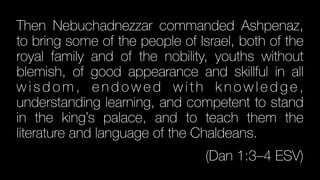
Then Nebuchadnezzar commanded Ashpenaz,
to bring some of the people of Israel, both of the
royal family and of the nobility, youths without
blemish, of good appearance and skillful in all
w i s d o m , e n d o w e d w i t h k n o w l e d g e ,
understanding learning, and competent to stand
in the king’s palace, and to teach them the
literature and language of the Chaldeans.


(Dan 1:3–4 ESV)
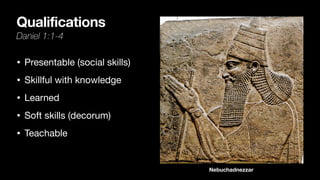
Qualifications
Daniel 1:1-4
• Presentable (social skills)

• Skillful with knowledge

• Learned

• Soft skills (decorum)

• Teachable
Nebuchadnezzar
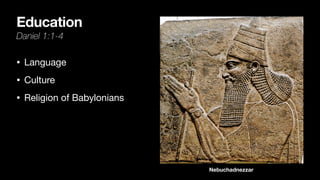
Education
Daniel 1:1-4
• Language

• Culture

• Religion of Babylonians
Nebuchadnezzar
Prayer Requests
Sign-Up Sheets
• Bible Devotions


• Class Presentation
Class Projects
1. Interview someone from another
religion or visit a place of
worship (25 pts)

2. Report on a religious object,
text, ritual, holiday, or religious
person (25 pts)
Due April 3 (please don’t wait)
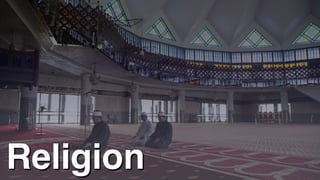
Religion
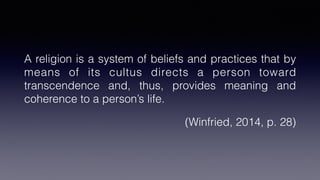
A religion is a system of beliefs and practices that by
means of its cultus directs a person toward
transcendence and, thus, provides meaning and
coherence to a person’s life.


(Winfried, 2014, p. 28)
A religion is a system of beliefs and practices that by
means of its cultus directs a person toward
transcendence and, thus, provides meaning and
coherence to a person’s life (Winfried, 2014, p. 28).


What’s the difference between a religion and


(a) ideology (b) philosophy of life?
Religion v. Philosophy
• Ultimate issues


• Sacred Rituals & Practices


• Sacred people, places & things
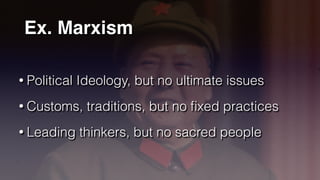
Ex. Marxism
• Political Ideology, but no ultimate issues


• Customs, traditions, but no
fi
xed practices


• Leading thinkers, but no sacred people
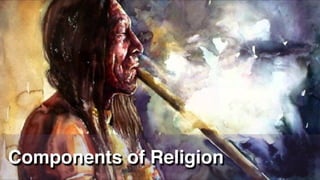
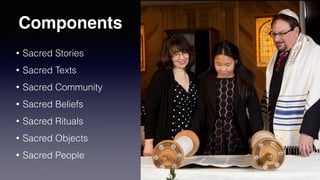
Components of Religion
Components
• Sacred Stories


• Sacred Texts


• Sacred Community


• Sacred Beliefs


• Sacred Rituals


• Sacred Objects


• Sacred People
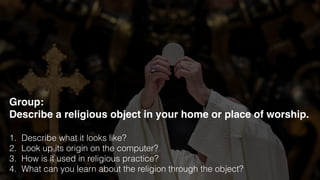
Group:
Describe a religious object in your home or place of worship.
1. Describe what it looks like?


2. Look up its origin on the computer?


3. How is it used in religious practice?


4. What can you learn about the religion through the object?
Al Shlosha (Musyca Choir)
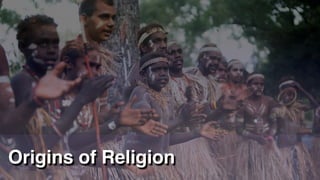
Origins of Religion
Two Theories
1. Evolution of Religion


2. Original Monotheism
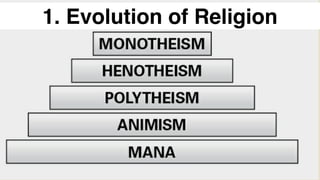
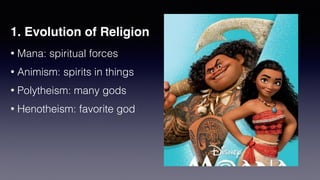
1. Evolution of Religion
• Mana: spiritual forces
1. Evolution of Religion
• Mana: spiritual forces


• Animism: spirits in things
1. Evolution of Religion
• Mana: spiritual forces


• Animism: spirits in things


• Polytheism: many gods
1. Evolution of Religion
• Mana: spiritual forces


• Animism: spirits in things


• Polytheism: many gods


• Henotheism: favorite god
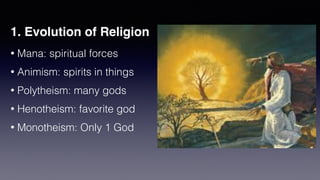
1. Evolution of Religion
• Mana: spiritual forces


• Animism: spirits in things


• Polytheism: many gods


• Henotheism: favorite god


• Monotheism: Only 1 God
What are some problems with
The Theory of Evolution of Religion?
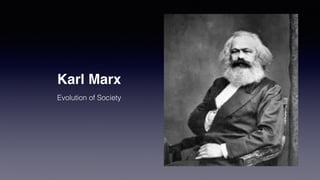
Karl Marx
Evolution of Society
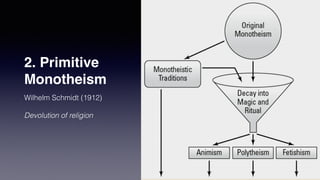
2. Primitive
Monotheism
Wilhelm Schmidt (1912)


Devolution of religion
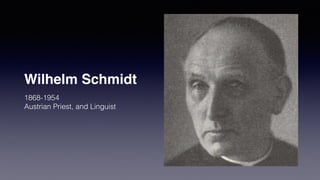
Wilhelm Schmidt
1868-1954


Austrian Priest, and Linguist
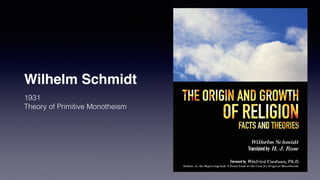
Wilhelm Schmidt
1931


Theory of Primitive Monotheism
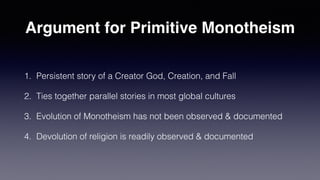
Argument for Primitive Monotheism
1. Persistent story of a Creator God, Creation, and Fall


2. Ties together parallel stories in most global cultures


3. Evolution of Monotheism has not been observed & documented


4. Devolution of religion is readily observed & documented
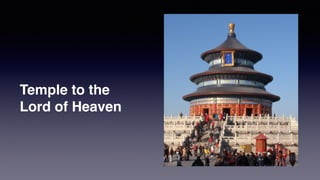
Temple to the
Lord of Heaven
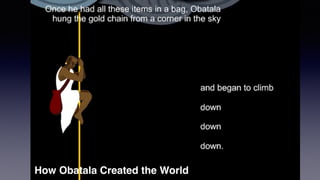
How Obatala Created the World
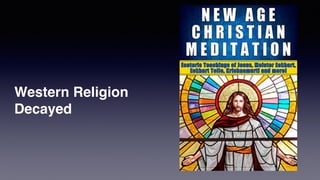
Western Religion
Decayed
Christian Approach to
World Religions
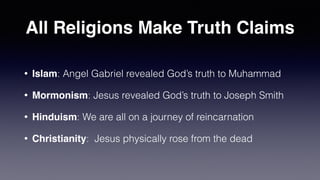
All Religions Make Truth Claims
• Islam: Angel Gabriel revealed God’s truth to Muhammad


• Mormonism: Jesus revealed God’s truth to Joseph Smith


• Hinduism: We are all on a journey of reincarnation


• Christianity: Jesus physically rose from the dead
Christian Worldview claims that
there can only be one truth
Wonder Woman 84
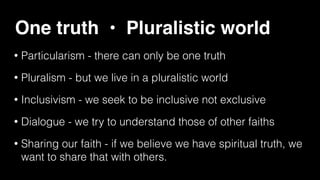
One truth • Pluralistic world
• Particularism - there can only be one truth


• Pluralism - but we live in a pluralistic world


• Inclusivism - we seek to be inclusive not exclusive


• Dialogue - we try to understand those of other faiths


• Sharing our faith - if we believe we have spiritual truth, we
want to share that with others.
Group:
What are some techniques you’ve found to live with the tension of
Believing some particular truths in a pluralistic world?

INT-244 Topic 1 Part 2

  • 1.
    Topic 1 |Part 2 The Study of Religion INT-244 • World Religions
  • 2.
    Describe a conversationyou had with someone from another religion
  • 3.
  • 4.
    [In 586 BC]Nebuchadnezzar the king of Babylon came to Jerusalem and besieged it. And the Lord gave Jehoiakim king of Judah into his hand, with some of the vessels of the house of God. And he brought them back to Babylon, to the house of his god, and placed the vessels in the treasury of his god. (Dan 1:1–2 ESV)
  • 5.
    Then Nebuchadnezzar commandedAshpenaz, to bring some of the people of Israel, both of the royal family and of the nobility, youths without blemish, of good appearance and skillful in all w i s d o m , e n d o w e d w i t h k n o w l e d g e , understanding learning, and competent to stand in the king’s palace, and to teach them the literature and language of the Chaldeans. (Dan 1:3–4 ESV)
  • 6.
    Qualifications Daniel 1:1-4 • Presentable(social skills) • Skillful with knowledge • Learned • Soft skills (decorum) • Teachable Nebuchadnezzar
  • 7.
    Education Daniel 1:1-4 • Language •Culture • Religion of Babylonians Nebuchadnezzar
  • 8.
  • 9.
    Sign-Up Sheets • BibleDevotions • Class Presentation
  • 10.
    Class Projects 1. Interviewsomeone from another religion or visit a place of worship (25 pts) 2. Report on a religious object, text, ritual, holiday, or religious person (25 pts) Due April 3 (please don’t wait)
  • 11.
  • 12.
    A religion isa system of beliefs and practices that by means of its cultus directs a person toward transcendence and, thus, provides meaning and coherence to a person’s life. (Winfried, 2014, p. 28)
  • 13.
    A religion isa system of beliefs and practices that by means of its cultus directs a person toward transcendence and, thus, provides meaning and coherence to a person’s life (Winfried, 2014, p. 28). What’s the difference between a religion and (a) ideology (b) philosophy of life?
  • 14.
    Religion v. Philosophy •Ultimate issues • Sacred Rituals & Practices • Sacred people, places & things
  • 15.
    Ex. Marxism • PoliticalIdeology, but no ultimate issues • Customs, traditions, but no fi xed practices • Leading thinkers, but no sacred people
  • 16.
  • 17.
    Components • Sacred Stories •Sacred Texts • Sacred Community • Sacred Beliefs • Sacred Rituals • Sacred Objects • Sacred People
  • 18.
    Group: Describe a religiousobject in your home or place of worship. 1. Describe what it looks like? 2. Look up its origin on the computer? 3. How is it used in religious practice? 4. What can you learn about the religion through the object?
  • 19.
  • 20.
  • 21.
    Two Theories 1. Evolutionof Religion 2. Original Monotheism
  • 22.
  • 23.
    1. Evolution ofReligion • Mana: spiritual forces
  • 24.
    1. Evolution ofReligion • Mana: spiritual forces • Animism: spirits in things
  • 25.
    1. Evolution ofReligion • Mana: spiritual forces • Animism: spirits in things • Polytheism: many gods
  • 26.
    1. Evolution ofReligion • Mana: spiritual forces • Animism: spirits in things • Polytheism: many gods • Henotheism: favorite god
  • 27.
    1. Evolution ofReligion • Mana: spiritual forces • Animism: spirits in things • Polytheism: many gods • Henotheism: favorite god • Monotheism: Only 1 God
  • 28.
    What are someproblems with The Theory of Evolution of Religion?
  • 29.
  • 30.
    2. Primitive Monotheism Wilhelm Schmidt(1912) Devolution of religion
  • 31.
  • 32.
    Wilhelm Schmidt 1931 Theory ofPrimitive Monotheism
  • 33.
    Argument for PrimitiveMonotheism 1. Persistent story of a Creator God, Creation, and Fall 2. Ties together parallel stories in most global cultures 3. Evolution of Monotheism has not been observed & documented 4. Devolution of religion is readily observed & documented
  • 34.
  • 36.
  • 37.
  • 38.
  • 39.
    All Religions MakeTruth Claims • Islam: Angel Gabriel revealed God’s truth to Muhammad • Mormonism: Jesus revealed God’s truth to Joseph Smith • Hinduism: We are all on a journey of reincarnation • Christianity: Jesus physically rose from the dead
  • 40.
    Christian Worldview claimsthat there can only be one truth
  • 41.
  • 42.
    One truth •Pluralistic world • Particularism - there can only be one truth • Pluralism - but we live in a pluralistic world • Inclusivism - we seek to be inclusive not exclusive • Dialogue - we try to understand those of other faiths • Sharing our faith - if we believe we have spiritual truth, we want to share that with others.
  • 43.
    Group: What are sometechniques you’ve found to live with the tension of Believing some particular truths in a pluralistic world?