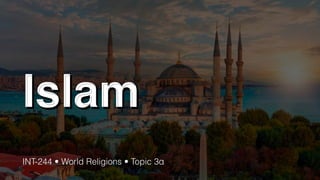
Islam
INT-244 • World Religions • Topic 3α
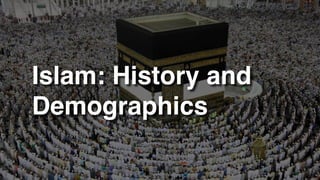
Islam: History and
Demographics
Demographics
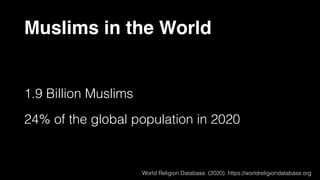
Muslims in the World
1.9 Billion Muslims
24% of the global population in 2020
World Religion Database. (2020). https://worldreligiondatabase.org
World Religions
Christianity 2.5 billion 32%
Islam 1.9 billion 24%
Hinduism 1.1 billion 14%
Buddhism 533 million 7%
Chinese Folk 466 million 6%
World Religion Database. (2020). https://worldreligiondatabase.org
Muslims in the World
1.9 billion Muslims Worldwide
4.45 million Muslims in United States
50k - 60k Muslims in Arizona
2020 US Census Bureau
https://cronkitenews.azpbs.org/2016/08/15/arizona-muslims-one-perception-many-faces/
50,000 - 60,000 in Arizona
https://cronkitenews.azpbs.org/2016/08/15/arizona-muslims-one-perception-many-faces/
Muslims in the World
20% in Middle East
62% in Asia-Paci
fi
c
10% in Europe making up 5% of population
https://worldreligiondatabase-org
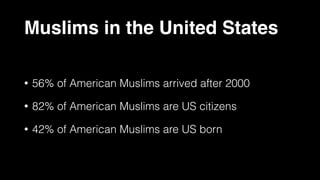
Muslims in the United States
• 56% of American Muslims arrived after 2000
• 82% of American Muslims are US citizens
• 42% of American Muslims are US born
https://www.allied-media.com/AM/
US. Department of State, April 2001
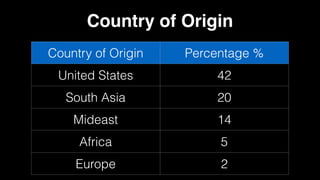
Country of Origin Percentage %
United States 42
South Asia 20
Mideast 14
Africa 5
Europe 2
Country of Origin
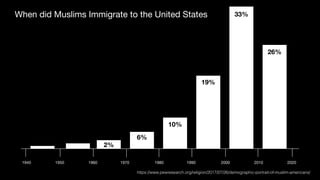
6%
10%
19%
33%
26%
2%
1970 1980 1990 2000 2010 2020
1960
1950
1940
When did Muslims Immigrate to the United States
https://www.pewresearch.org/religion/2017/07/26/demographic-portrait-of-muslim-americans/
What can you say about the Muslim
community in the United States?
What can you say about the Muslim
community in the United States?
• Muslim Americans are no longer foreign immigrants
• Muslim Americans are established Americans
• Muslim American Culture values learning and hard work
• Muslim Americans are upwardly mobile
History of Islam
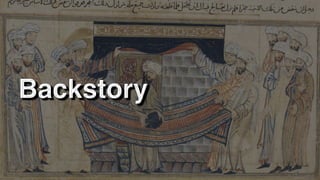
Backstory
The Arab People
[Isaac] grew and was weaned. And Abraham made a great feast on the
day that Isaac was weaned. But Sarah saw [Ishmael] the son of Hagar the
Egyptian, whom she had borne to Abraham, laughing. So she said to
Abraham, “Cast out this slave woman with her son, for the son of this
slave woman shall not be heir with my son Isaac.” (Gen 21:8-11 ESV)
20
And the thing was very displeasing to Abraham on account of his son. But
God said to Abraham, “Be not displeased because of [Ishmael] because
of your slave woman. Whatever Sarah says to you, do as she tells you, for
through Isaac shall your o
ff
spring be named. And I will make a nation of
[Ishmael] also because he is your o
ff
spring.” (Gen 21:11-13 ESV)
21
So Abraham rose early in the morning and took bread and a skin of water
and gave it to Hagar, putting it on her shoulder, along with [Ishmael] and
sent her away. And she departed and wandered in the wilderness of
Beersheba. (Gen 21:14 ESV)
22
When the water in the skin was gone, she put [Ishmael] under one of the
bushes. Then she went and sat down opposite him a good way o
ff
, about
the distance of a bowshot, for she said, “Let me not look on the death of
the child.” And as she sat opposite him, she lifted up her voice and wept.
(Gen 21:15-17 ESV)
23
And God heard the voice of the boy, and the angel of God called to
Hagar from heaven and said to her, “What troubles you, Hagar? Fear not,
for God has heard the voice of [Ishmael] where he is. Up! Lift up [Ishmael],
and hold him fast with your hand, for I will make him into a great nation.”
(Gen 21:17-18 ESV)
24
Then God opened her eyes, and she saw a well of water. And she went
and
fi
lled the skin with water and gave [Ishmael] a drink. And God was
with the boy, and he grew up. He lived in the wilderness and became an
expert with the bow. He lived in the wilderness of Paran, and his mother
took a wife for him from the land of Egypt. (Gen 21:19-21 ESV)
25
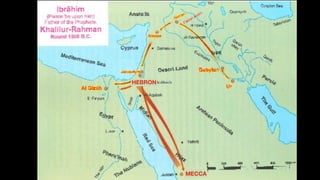
HEBRON
MECCA
Prequel of Islam
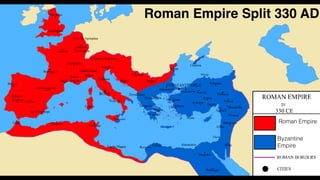
Roman Empire Split 330 AD
Roman Empire
Byzantine
Empire
Arab Tribes
Persian Empire
Byzantine
Ethiopia
C
B
A
D e
e
e
e
e
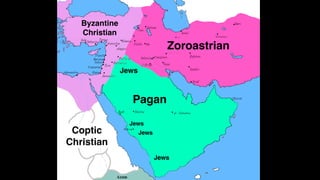
Pagan
Zoroastrian
Byzantine
Christian
Coptic
Christian
Jews
Jews
Jews
Jews
Pagan
Zoroastrian
Byzantine
Coptic Jews
Jews
Jews
Jews
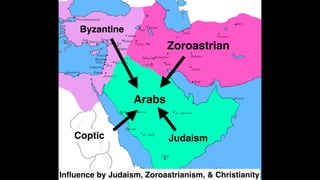
Arabs
Zoroastrian
Byzantine
Coptic Judaism
In
fl
uence by Judaism, Zoroastrianism, & Christianity
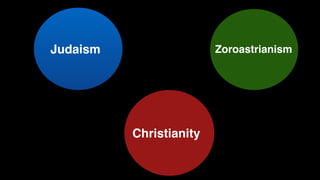
Islam grew out of conversation
between three religions
Judaism
Christianity
Zoroastrianism
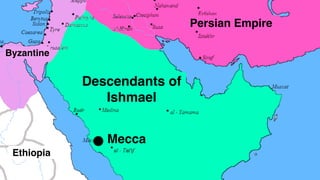
Descendants of
Ishmael
Persian Empire
Byzantine
Ethiopia
Descendants of
Ishmael
Persian Empire
Byzantine
Ethiopia
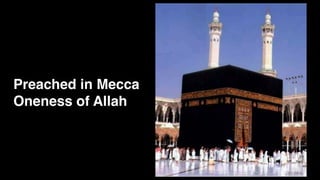
Mecca
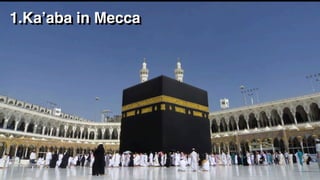
Ka’aba
Ka’aba = Cube
• Meteorite
• Venerated as divine by Arabs
• Mecca, Arab holy site
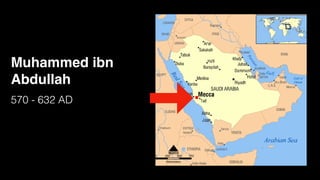
Life of Muhammed
Muhammed ibn
Abdullah
570 - 632 AD
Muhammed’s Upbringing
• 570 AD Born in Mecca
• Hashemite Arab Tribe
• Family were possibly Zoroastrians
Muhammed’s Upbringing
• Father (Abdullah) died before he was born
• Mother (Amina) died when he was a child
• Uncle (Abu Talib) raised Muhammad
Khadija
Married in 595 AD
She died in 619 (after 25 years)
43
ʿAʾishah
Married Muhammad after
Koran says she was 6 years old (!)
Father Abu Bakr, close associate.
44
Muhammed’s Life
• Two Sons who died
• Four daughters were his heirs
• Became a camel driver in Mecca
• Watered camels for pilgrims to Ka’aba
• Became very religious (what religion?)
Cave of Hira
610 AD
The Night of Power
Muhammed’s Revelation 610 AD
• Prayed and meditated in Cave of Hira
• Received revelation from Angel Gavriel (Gabriel)
• Laylat al-Qadr (Night of Power)
• Angel commanded: “Recite!”
• But Muhammed was illiterate
Preached in Mecca
Oneness of Allah
Proclamation: There is only One God, and he is Allah
49
‘Allah = Arabic for God
‫אלה‬ = Aramaic in Book of Daniel
Hegira
622 AD
Flight to Medina
Year One
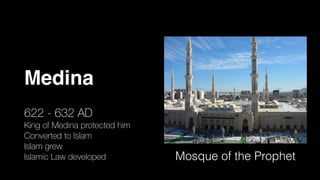
Medina
622 - 632 AD
King of Medina protected him
Converted to Islam
Islam grew
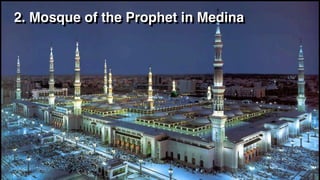
Islamic Law developed Mosque of the Prophet
Sharia Law
Established in Medina Sharia Law
"the clear, well-trodden path to water”
Religious Civil Laws
Mosque of the Prophet
Different Origins
Judaism — developed as a religion of exiles
Christianity — developed as counter-culture religion
Islam — developed as a State Religion
Different Origins
Judaism — Practices as refugees in exile
Christianity — Beliefs of those in opposition to the State
Islam — State Religion with civil and religious laws
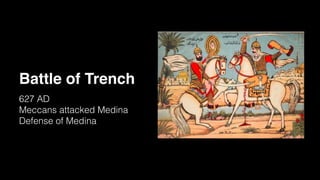
Battle of Trench
627 AD
Meccans attacked Medina
Defense of Medina
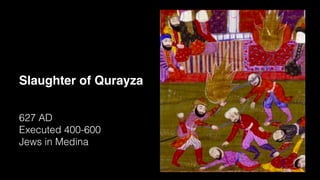
Slaughter of Qurayza
627 AD
Executed 400-600
Jews in Medina
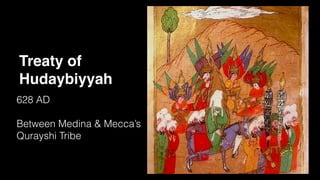
Treaty of
Hudaybiyyah
628 AD
Between Medina & Mecca’s
Qurayshi Tribe
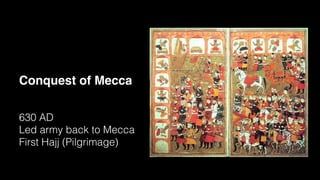
Conquest of Mecca
630 AD
Led army back to Mecca
First Hajj (Pilgrimage)
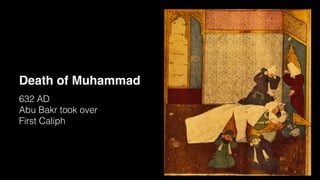
Death of Muhammad
632 AD
Abu Bakr took over
First Caliph
Spread of Islam
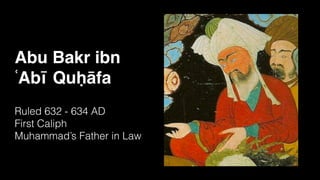
Abu Bakr ibn
ʿAbī Quḥāfa
Ruled 632 - 634 AD
First Caliph
Muhammad’s Father in Law
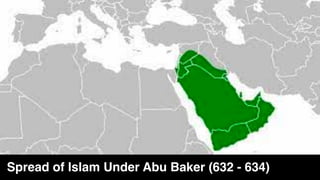
Spread of Islam Under Abu Baker (632 - 634)
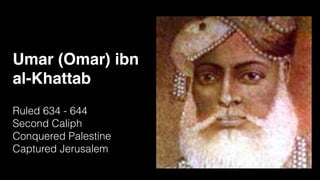
Umar (Omar) ibn
al-Khattab
Ruled 634 - 644
Second Caliph
Conquered Palestine
Captured Jerusalem
Spread of Islam Under Umar (634-644)
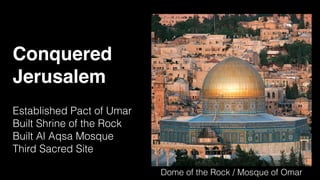
Conquered
Jerusalem
Established Pact of Umar
Built Shrine of the Rock
Built Al Aqsa Mosque
Third Sacred Site
Dome of the Rock / Mosque of Omar
The Pact of Umar
Pact of Omar (644 AD)
1. Protects Dhimmis (non-Muslims)
2. Prohibits rebuilding churches/synagogues
3. Prohibits Churches/Synagogues higher than mosques
4. Requires Dhimmis to pay Jizya
5. Prohibits evangelism or trying to convert a Muslim to Christianity
6. Prohibits public religious celebrations
Pact of Omar (644 AD)
7. Prohibits public displays of crosses
8. Prohibits loud sounds (ex. Calls to worship)
9. Prohibits stopping someone from converting to Islam
10. Prohibits dressing like or imitating Muslims
11. Requires Dhimmis rise in presence of Muslim
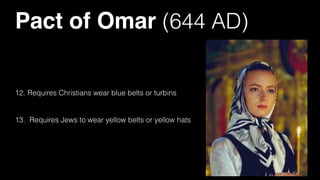
Pact of Omar (644 AD)
12. Requires Christians wear blue belts or turbins
13. Requires Jews to wear yellow belts or yellow hats
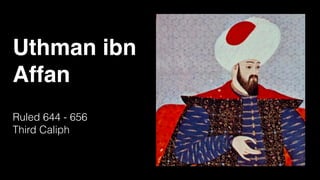
Uthman ibn
Affan
Ruled 644 - 656
Third Caliph
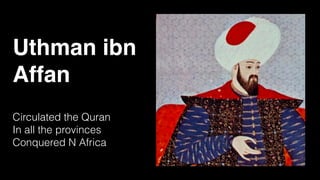
Uthman ibn
Affan
Circulated the Quran
In all the provinces
Conquered N Africa
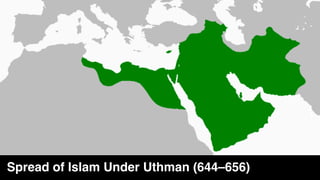
Spread of Islam Under Uthman (644–656)
Ali ibn
Abi Talib
b. 599
Ruled 656 - 661
Fourth Caliph
Caliph Ali
Son-in-law of Muhammed
Claimed heir by lineage
Claimed only true heir
Martyred
January 27, 661 AD
Grand Mosque in
Kufa, Iraq (Babylon)
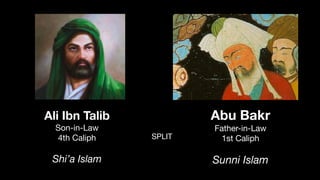
Ali Ibn Talib
Son-in-Law
4th Caliph
Shi’a Islam
Abu Bakr
Father-in-Law
1st Caliph
Sunni Islam
SPLIT
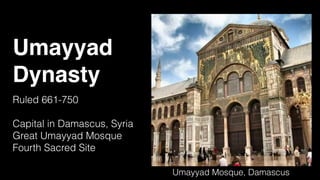
Umayyad
Dynasty
Ruled 661-750
Capital in Damascus, Syria
Great Umayyad Mosque
Fourth Sacred Site
Umayyad Mosque, Damascus
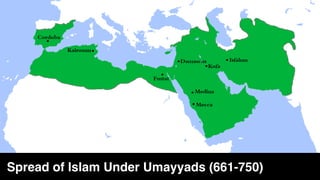
Spread of Islam Under Umayyads (661-750)
The Golden Age
Abbasid Dynasty
Ruled 750-1249
Capital in Baghdad, Iraq
Golden Age of Islam
Baghdad
Golden Age of Islam
How did Islam Spread (632 - 750)
Christians, Zoroastrians, and Jews CHOICE
1. Submit to the Pact of Omar
2. Become Dhimmis (subjects) and pay the Jizya (tax) or
3. Convert to Islam or
4. Be Killed
How do we talk about the
spread of Islam?
Islamic Contributions
• Math: Algebra, Geometry
• Science: Medicine, Astronomy
• Culture and Trade with the East
• Medicine: surgery, medicines
Islamic Contributions
Literature: Preservation of Greek
manuscripts including the Bible
Islamic Contributions to Europe
Rice, sugar cane, Egyptian
Cotton, hemp, oranges,
lemons, melons, pistachios,
apricots, syrups
Coffee!
Clark, 2017, The Story of Europe
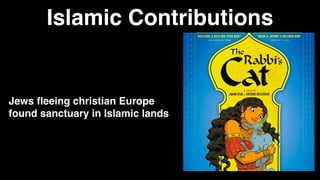
Islamic Contributions
Jews
fl
eeing christian Europe
found sanctuary in Islamic lands
Modern History of Islam
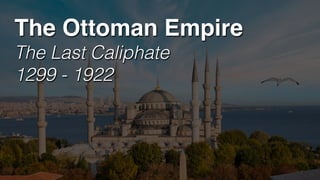
The Ottoman Empire
The Last Caliphate
1299 - 1922
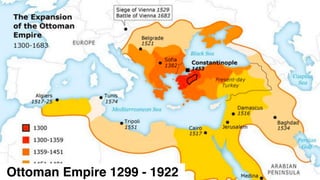
Ottoman Empire 1299 - 1922
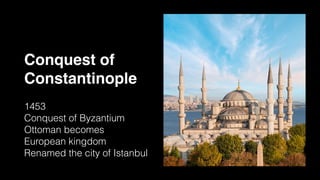
Conquest of
Constantinople
1453
Conquest of Byzantium
Ottoman becomes
European kingdom
Renamed the city of Istanbul
Battle of Vienna
1683
Deepest point in Europe
Invention of
Croissant
Austrian Bakers
Celebrate Repulsion of Islam
Birth of Cafe’s
Coffee houses spread in
Austria and then France
Modernization of Islamic World
1918 - 1950s
Decline of Ottoman Empire Before WWI
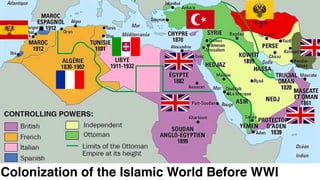
Colonization of the Islamic World Before WWI
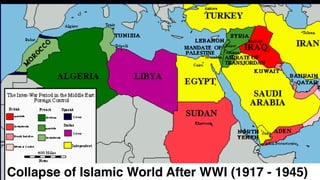
Collapse of Islamic World After WWI (1917 - 1945)
Modernization of Islamic World
Women’s Freedom
Westernization of the Islamic World
• Women’s rights
• Modern movies, radio, and TV
• Rock and Popular Music
• Democratic, Secular Government
• Western Dress and culture
Rise of Modern Arab Nationalism
• Secular National Identities that was not religious
• Secular Governments
• Political alliances with Soviet Union or America
• Dictatorships repressing Islamic extremism
Political Polarization
• Global Cold War
• Pressure to align with either USSR or USA
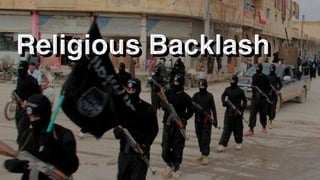
Religious Backlash
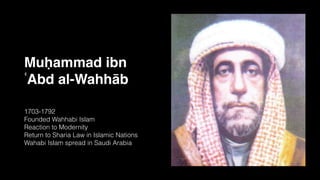
Muḥammad ibn
ʿAbd al-Wahhāb
1703-1792
Founded Wahhabi Islam
Reaction to Modernity
Return to Sharia Law in Islamic Nations
Wahabi Islam spread in Saudi Arabia
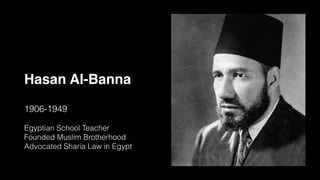
Hasan Al-Banna
1906-1949
Egyptian School Teacher
Founded Muslim Brotherhood
Advocated Sharia Law in Egypt
Ayatollah Khomeini
1902 - 1989
Shi’a Religious Leader
1979 Came to power in Iran
Established Sharia Law
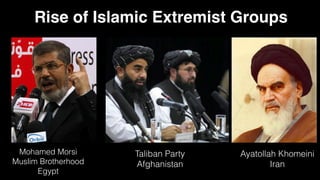
Mohamed Morsi
Muslim Brotherhood
Egypt
Taliban Party
Afghanistan
Ayatollah Khomeini
Iran
Rise of Islamic Extremist Groups
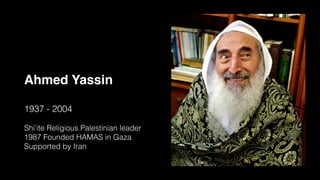
Ahmed Yassin
1937 - 2004
Shi’ite Religious Palestinian leader
1987 Founded HAMAS in Gaza
Supported by Iran
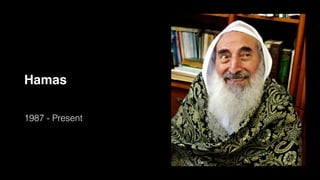
Hamas
1987 - Present
Rise of Islamic Extremism
1. Reaction to Western Culture
2. Reaction to Secular Governments
3. Reaction to Dictators in Arab Countries
4. Advocated Sharia Law in all Islamic Nations
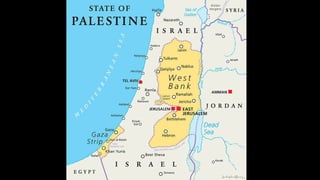
Origins of the War with Gaza
Timeline of the Conflict
1948 - Israel declares independence.
1948 - Arab armies invaded Israel. Arab inhabitants were displaced and became refugees.
1964 - Arab refugees united and called themselves PALESTINIANS
1967 - Six-Day War, Arab armies invaded Israel. Israel captured the West Bank & Gaza, occupying.
1995 - Israel recognized Independent Palestine. Westbank and Gaza become self-governed but occupied.
2005 - Israel withdrew from the GAZA strip. Gaza became an independent, unoccupied country.
2007 - Hamas took over GAZA and launched repeated attacks on Israel.
2007 - present — HAMAS repeatedly attacks Israel, refusing negotiation, swearing to annihilate Israel
2023 - Hamas launched attack, killing 900 civilians & kidnapping 150 civilians funded by and supported by Iran.
120
Latest in Israel-Gaza Conflict
• Saturday, October 7 — Hamas militants from Gaza invaded Southern Israel
5,000 rockets
fi
red into Israel, including Tel Aviv & Jerusalem
260 Israelis killed at a Rock Concert in S Israel
150 Israeli civilians kidnapped and taken back to Gaza
900 Israelis killed, almost all civilians
121
What are their claims?
• Israel occupies Jerusalem, 3rd Holy Site
• Israel occupies Palestine and oppresses Palestinians
• Israel normalized relationships with Arab countries
Egypt, Jordan, Morocco, Sudan, United Arab Emirates, and working on
Saudi Arabia.
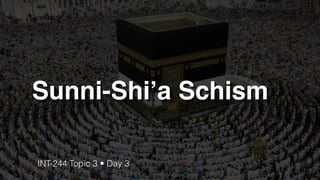
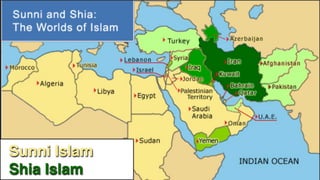
Sunni-Shi’a Schism
INT-244 Topic 3 • Day 3
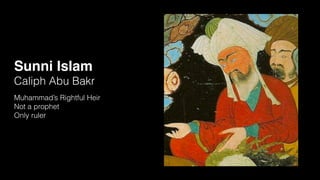
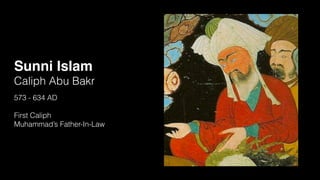
Sunni Islam
Caliph Abu Bakr
573 - 634 AD
First Caliph
Muhammad’s Father-In-Law
Sunni Islam
Caliph Abu Bakr
Muhammad’s Rightful Heir
Not a prophet
Only ruler
Shi’a Ali
Ali ibn Talib
600 - 661 AD
Muhammad’s Son-in-Law
Fourth Caliph
Rightful Heir by Marriage
A Prophet and religious leader
Schism
Shia’t Ali — “Followers of Ali"
Sunni — “The Way”
Sunni Islam
Shia Islam
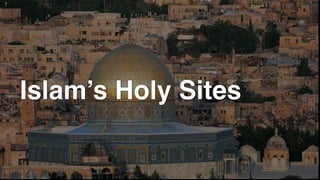
Islam’s Holy Sites
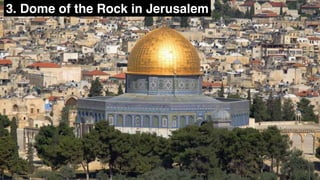
Jerusalem: Dome of the Rock
Medina: Mosque of the Prophet
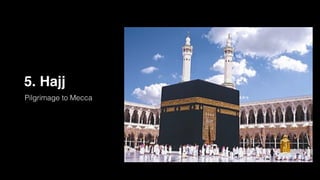
Mecca: The Ka’aba
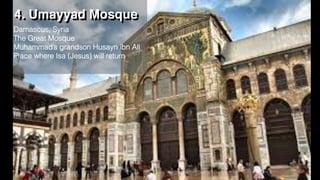
Damascus: Umayyad Mosque
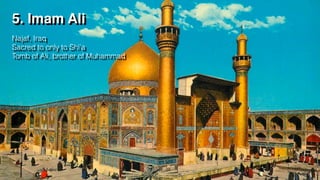
Najaf, Iraq: Imam Ali
1.Ka’aba in Mecca
2. Mosque of the Prophet in Medina
3. Dome of the Rock in Jerusalem
4. Umayyad Mosque
Damascus, Syria
The Great Mosque
Muhammad’s grandson Husayn ibn Ali
Place where Isa (Jesus) will return
5. Imam Ali
Najaf, Iraq
Sacred to only to Shi’a
Tomb of Ali, brother of Muhammad
The Quran
Quran
Abu Bakr began editing
Begun 632 AD
Finalized 656 AD
Means recitation
Quran Estab. Arabic written language
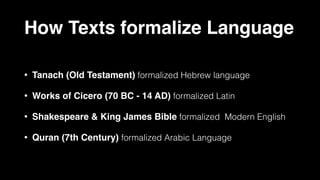
How Texts formalize Language
• Tanach (Old Testament) formalized Hebrew language
• Works of Cicero (70 BC - 14 AD) formalized Latin
• Shakespeare & King James Bible formalized Modern English
• Quran (7th Century) formalized Arabic Language
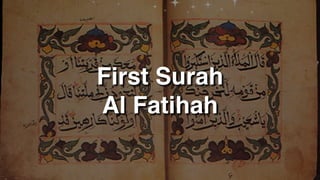
First Surah
Al Fatihah
Beliefs & Practices
Islam
Beliefs Practices Duties
Five Pillars
Six Articles of Faith Divine Duties
Belief: Six Articles of Faith
Six Articles of Faith
1. Belief in One God
2. Belief in Angels
3. Belief in the Prophets
4. Belief in the Resurrection and Final Judgment
5. Belief in the Holy Books
6. Belief in Divine Decree
1. Belief in One God
Allah, who is indivisible, incomparable
to men or women, not begotten, and
not a trinity
2. Belief in Angels
• Angels created from light
• Angels have no free will
• Angels created for task or purpose
• Jin created from
fi
re
• Jin have free will
• Bad Jin follow Satan
• Good Jin operate in the world
3. Belief in the Prophets
God sent men & women prophets
including Abraham, Moses, Isa (Jesus),
and His last prophet, Muhammad.
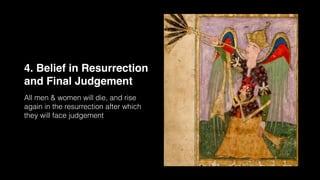
4. Belief in Resurrection
and Final Judgement
All men & women will die, and rise
again in the resurrection after which
they will face judgement
End Times
• Signs of the End times: Immorality, crime, callousness
• Coming of the Mahdi (Guided One)
• Unite Muslims
• Isa will return & rule
• Satan will be killed
• Resurrection of the Dead
• Day of Judgement
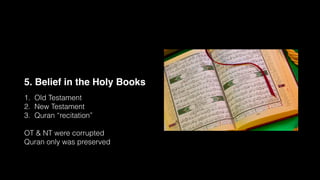
5. Belief in the Holy Books
1. Old Testament
2. New Testament
3. Quran “recitation”
OT & NT were corrupted
Quran only was preserved
6. Belief in the Divine Decree
Allah ordained certain things in life
All things happen according to the Will
of Allah. Men and women’s duty is to
accept His will.
Inshallah
“If God Wills It”
Said when making plans
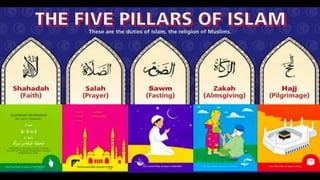
Practice: Five Pillars of Islam
1. Shahada
Confession
There is no God but Allah
and Muhammad is his
prophet.
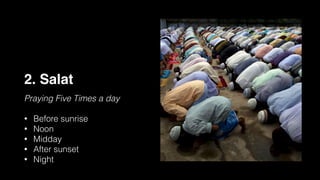
2. Salat
Praying Five Times a day
• Before sunrise
• Noon
• Midday
• After sunset
• Night
Great Mosque in Istanbul
Minaret (Beacon)
Adhan (Call to worship)
Allahu akbar Allah is great
Ashadu an la ilaha illa llah I bear witness there is no god but Allah
Ashadu ‘Anna Muhmmadan rasulu illah I bear witness that Muhammad is Allah’s prophet
Chayya ‘ala s-salah Hasten to prayer!
Chayya ‘ala I-falah Hasten to salvation
As-salatu khayrun mina n’nawa prayer is better than sleep
Allahu ‘akbar Allah is great
la ilaha illa llah. There is no god but Allah
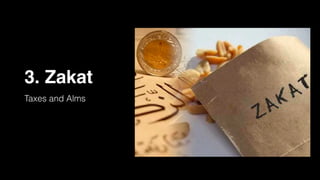
3. Zakat
Taxes and Alms
4. Sawm
Fast of Ramadan
Ramadan
• Eve. Wed. March 22 - Eve. Fri. April 21, 2023
• When ‘Allah gave Muhammad 1st Chapter of Qu’ran
• Fast, and Restraint (ex. No movies, dance, intimacy)
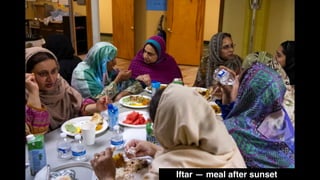
Iftar — meal after sunset
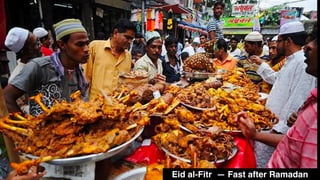
Eid al-Fitr — Fast after Ramadan
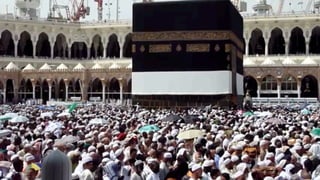
5. Hajj
Pilgrimage to Mecca
Duties: The Responsibilities of a Muslim
The Duties of a Muslim
1. Duty to Parents: Honoring family and parents
2. Duty to Others
3. Duty to Neighbor
4. Duty to Society: Justice
5. Duty to the Earth: Care for the Earth
6. Duty to Animals: Care for Animals
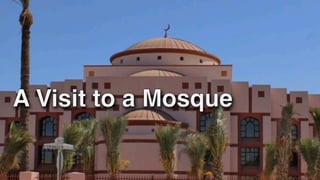
A Visit to a Mosque
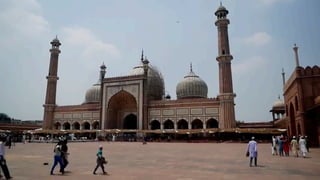
The Masjid (Mosque)
• Community Center
• Place of worship
• Place to give Zakat (charity)
• Place of learning (study)
• Market Place (books, Islamic materials)
172
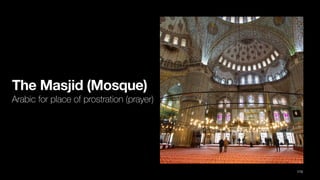
The Masjid (Mosque)
Arabic for place of prostration (prayer)
173
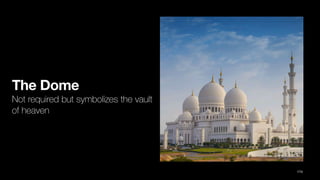
The Dome
Not required but symbolizes the vault
of heaven
174
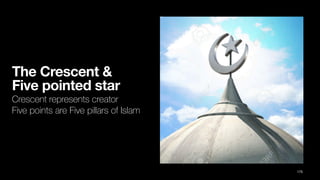
The Crescent &
Five pointed star
Crescent represents creator
Five points are Five pillars of Islam
175
The Minaret
Towers to call worshippers to prayer
176
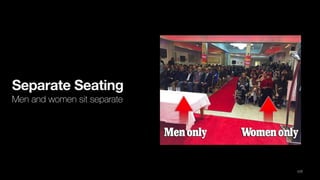
Separate Seating
Men and women sit separate
177
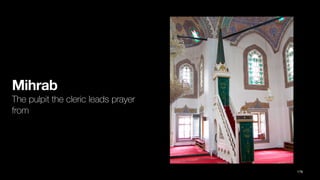
Mihrab
The niche in the eastern wall of the
Mosque (pointing toward Mecca)
where the congregation faces
178
Mihrab
The pulpit the cleric leads prayer
from
179
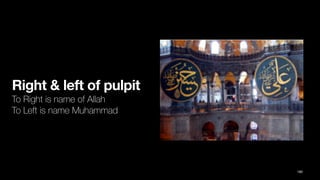
Right & left of pulpit
To Right is name of Allah
To Left is name Muhammad
180
40 Men Quorum
Must be at least 40 men present
181
Assamualaikum
AT end of prayer they say
“Assamualaikum” (Peace be to you).
Look to right and left to remind the angel
to record their deeds
Right angel records good deeds
Left angel records bad deeds
182
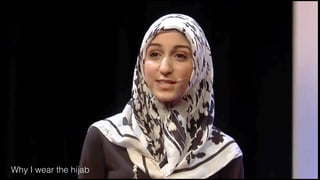
Women’s Headcoverings
Women’s head coverings
• Misunderstood as symbols of oppression
• Became a symbol of ethnic pride
Why I wear the hijab
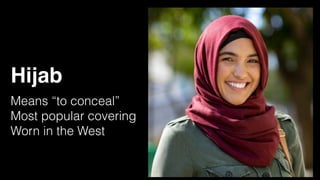
Hijab
Means “to conceal”
Most popular covering
Worn in the West
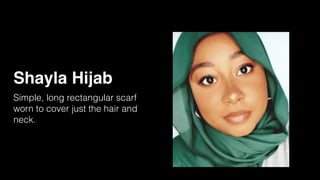
Shayla Hijab
Simple, long rectangular scarf
worn to cover just the hair and
neck.
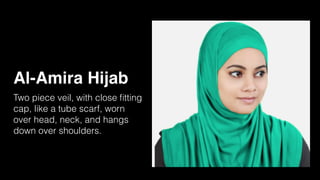
Al-Amira Hijab
Two piece veil, with close
fi
tting
cap, like a tube scarf, worn
over head, neck, and hangs
down over shoulders.
Khimar
Long cape-like veil hanging
down to the waist, covering up
the hair neck shoulders, and
only shows the face.
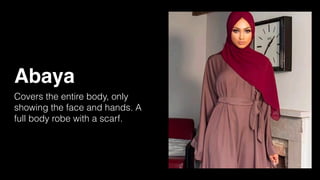
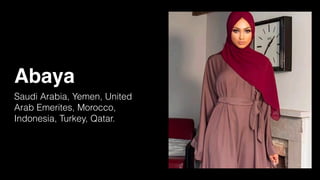
Abaya
Covers the entire body, only
showing the face and hands. A
full body robe with a scarf.
Abaya
Saudi Arabia, Yemen, United
Arab Emerites, Morocco,
Indonesia, Turkey, Qatar.
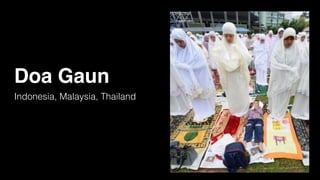
Doa Gaun
Long, round, intricately embroidered
cotton veils, slip over the heads, tied in
the back with a ribbon. Worn primarily
during prayer.
Shows the entire face
Doa Gaun
Indonesia, Malaysia, Thailand
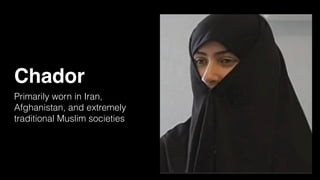
Chador
Iran
Covers everything but face
Usually black, not colored
Chador
Primarily worn in Iran,
Afghanistan, and extremely
traditional Muslim societies
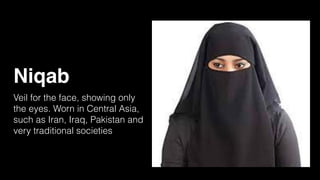
Niqab
Veil for the face, showing only
the eyes. Worn in Central Asia,
such as Iran, Iraq, Pakistan and
very traditional societies
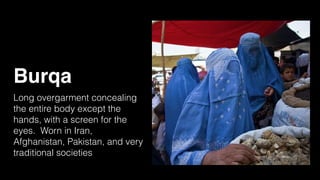
Burqa
Long overgarment concealing
the entire body except the
hands, with a screen for the
eyes. Worn in Iran,
Afghanistan, Pakistan, and very
traditional societies
Birqini
Europe
Modern version of Burka
Swimsuit
Men & Women in Islam
Women in Islam
1. Men & women were created “from one soul” (Surah 4:1)
200
Women & Marriage
1. Men & women were created “from one soul” (Surah 4:1)
2. God created all things in pairs (Surah 51:49)
201
Women & Marriage
1. Men & women were created “from one soul” (Surah 4:1)
2. God created all things in pairs (Surah 51:49)
3. Men & women will be rewarded in paradise (Surah 3:195)
202
Women & Marriage
1. Men & women were created “from one soul” (Surah 4:1)
2. God created all things in pairs (Surah 51:49)
3. Men & women will be rewarded in paradise (Surah 3:195)
4. Men should treat women respectfully with kindness (Surah 4:19)
203
Women & Marriage
1. Men & women were created “from one soul” (Surah 4:1)
2. God created all things in pairs (Surah 51:49)
3. Men & women will be rewarded in paradise (Surah 3:195)
4. Men should treat women respectfully with kindness (Surah 4:19)
5. Husbands are leaders in marriage. Women are not inferior (Surah 4:34)
204
Women & Marriage
1. Men & women were created “from one soul” (Surah 4:1)
2. God created all things in pairs (Surah 51:49)
3. Men & women will be rewarded in paradise (Surah 3:195)
4. Men should treat women respectfully with kindness (Surah 4:19)
5. Husbands are leaders in marriage. Women are not inferior (Surah 4:34)
6. Women dress modestly outside. No command to be completely veiled.
205
Women & Marriage
1. Men & women were created “from one soul” (Surah 4:1)
2. God created all things in pairs (Surah 51:49)
3. Men & women will be rewarded in paradise (Surah 3:195)
4. Men should treat women respectfully with kindness (Surah 4:19)
5. Husbands are leaders in marriage. Women are not inferior (Surah 4:34)
6. Women dress modestly outside. No command to be completely veiled.
7. Men can marry up to 4 wives & must treat them fairly & equally (Surah 4:3)
206
Women & Marriage
1. Men & women were created “from one soul” (Surah 4:1)
2. God created all things in pairs (Surah 51:49)
3. Men & women will be rewarded in paradise (Surah 3:195)
4. Men should treat women respectfully with kindness (Surah 4:19)
5. Husbands are leaders in marriage. Women are not inferior (Surah 4:34)
6. Women dress modestly outside. No command to be completely veiled.
7. Men can marry up to 4 wives & must treat them fairly & equally (Surah 4:3)
8. Muslim men may marry Jewish or Christian wives, but not pagan (Surah 2:221)
207
Women & Marriage
1. Men & women were created “from one soul” (Surah 4:1)
2. God created all things in pairs (Surah 51:49)
3. Men & women will be rewarded in paradise (Surah 3:195)
4. Men should treat women respectfully with kindness (Surah 4:19)
5. Husbands are leaders in marriage. Women are not inferior (Surah 4:34)
6. Women dress modestly outside. No command to be completely veiled.
7. Men can marry up to 4 wives & must treat them fairly & equally (Surah 4:3)
8. Muslim men may marry Jewish or Christian wives, but not pagan (Surah 2:221)
9. Women are unclean during their period (Surah 2:222)
208
Women & Marriage
1. Men & women were created “from one soul” (Surah 4:1)
2. God created all things in pairs (Surah 51:49)
3. Men & women will be rewarded in paradise (Surah 3:195)
4. Men should treat women respectfully with kindness (Surah 4:19)
5. Husbands are leaders in marriage. Women are not inferior (Surah 4:34)
6. Women dress modestly outside. No command to be completely veiled.
7. Men can marry up to 4 wives & must treat them fairly & equally (Surah 4:3)
8. Muslim men may marry Jewish or Christian wives, but not pagan (Surah 2:221)
9. Women are unclean during their period (Surah 2:222)
10.Adultery requires public punishment (Surah 4:15-18)
209
Women & Marriage
1. Men & women were created “from one soul” (Surah 4:1)
2. God created all things in pairs (Surah 51:49)
3. Men & women will be rewarded in paradise (Surah 3:195)
4. Men should treat women respectfully with kindness (Surah 4:19)
5. Husbands are leaders in marriage. Women are not inferior (Surah 4:34)
6. Women dress modestly outside. No command to be completely veiled.
7. Men can marry up to 4 wives & must treat them fairly & equally (Surah 4:3)
8. Muslim men may marry Jewish or Christian wives, but not pagan (Surah 2:221)
9. Women are unclean during their period (Surah 2:222)
10.Adultery requires public punishment (Surah 4:15-18)
11.Divorce is permitted, but only after attempt to reconcile (Surah 226:242)
210
Women & Marriage
1. Men & women were created “from one soul” (Surah 4:1)
2. God created all things in pairs (Surah 51:49)
3. Men & women will be rewarded in paradise (Surah 3:195)
4. Men should treat women respectfully with kindness (Surah 4:19)
5. Husbands are leaders in marriage. Women are not inferior (Surah 4:34)
6. Women dress modestly outside. No command to be completely veiled.
7. Men can marry up to 4 wives & must treat them fairly & equally (Surah 4:3)
8. Muslim men may marry Jewish or Christian wives, but not pagan (Surah 2:221)
9. Women are unclean during their period (Surah 2:222)
10.Adultery requires public punishment (Surah 4:15-18)
11.Divorce is permitted, but only after attempt to reconcile (Surah 226:242)
12.At death, estate divided up: husband receives ½ wife. Wife receives ¼ of husband’s (Surah 4:7-12)
211
Gender Norms in Islam
1. Men should touch a woman who is not his wife
212
Gender Norms in Islam
1. Men should touch a woman who is not his wife
2. Men & women should dress modestly
213
Gender Norms in Islam
1. Men should touch a woman who is not his wife
2. Men & women should dress modestly
3. Men often wear a head covering after they completed the Hajj
214
Gender Norms in Islam
1. Men should touch a woman who is not his wife
2. Men & women should dress modestly
3. Men often wear a head covering after they completed the Hajj
4. Men often wear head coverings during prayer
215
Gender Norms in Islam
1. Men should touch a woman who is not his wife
2. Men & women should dress modestly
3. Men often wear a head covering after they completed the Hajj
4. Men often wear head coverings during prayer
5. Men and women are separated in school and in the Mosque
216
Gender Norms in Islam
1. Men should touch a woman who is not his wife
2. Men & women should dress modestly
3. Men often wear a head covering after they completed the Hajj
4. Men often wear head coverings during prayer
5. Men and women are separated in school and in the Mosque
6. Men and women are expected to be married early
217
Cultural Values
• Learning and Study
• Restraint (not indulgent)
• High power distance
Cultural Values
• Male dominate (women subordinate roles)
• Collectivist (not individual)
• High Uncertainty avoidance
Cultural Values
• Giving to charity
• Modesty and conservative dress
• Hospitality and generosity
• Respect all religion and tradition
Sensitivities
• Israel and their occupation of the territories
• Palestinians and autonomy
• Dietary restrictions
• Social interaction of men with women
• Modest dress (especially women)
Sensitivities
• Movies, music, celebration (ex. Alcohol)
• Avoid depictions of Muhammed
• Never criticize Muhammed or the Quran
• Don’t put the Quran on the
fl
oor!
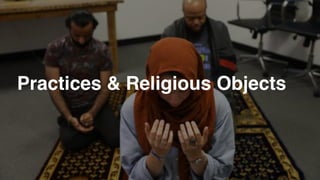
Practices & Religious Objects
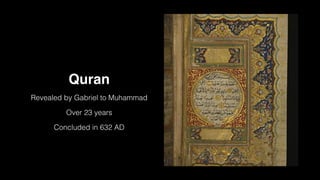
Quran
Revealed by Gabriel to Muhammad
Over 23 years
Concluded in 632 AD
Quran
Means Recitation
Read Aloud
Read in Arabic
Memorized
Quran
114 Surahs (Chapters)
Each chapter has Ayat (Verses)
Begins with Bismillah
“In the name of Allah”
Ordered in size, not chronology
1. In the Name of Allah the Entirely Merciful, the Especially Merciful.
2. [All] praise is [due] to Allah, Lord of the worlds -
3. The Entirely Merciful, the Especially Merciful,
4. Sovereign of the Day of Recompense.
5. It is You we worship and You we ask for help
6. Guide us to the straight path-
7. The path of those upon whom You have bestowed favor, not of those
who have evoked [Your] anger or of those who are astray.
Quran 1:1–7
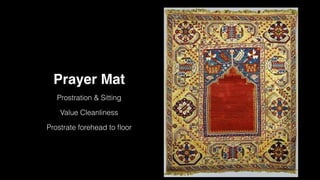
Prayer Mat
Prostration & Sitting
Value Cleanliness
Prostrate forehead to
fl
oor
Prayer Beads
Misbaha
99 small beads (or)
33 large Beads
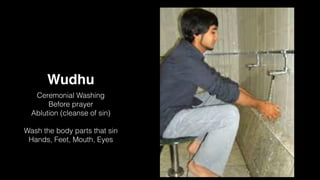
Wudhu
Ceremonial Washing
Before prayer
Ablution (cleanse of sin)
Wash the body parts that sin
Hands, Feet, Mouth, Eyes
Branches
Worldatlas.com
Sunni Islam
• 89 - 90% of Muslims
• Abu Bakr Siddique Caliph
• Await the Mahdi, true successor
• Imam is only a religious leader
• Followers do not need intermediary
Shi’a Islam
• 200 Million followers
• Iran, Iraq, Yemen, and Syria
• Ali ibn Talib was divine successor
• Imam religious & community leader
• Imam decides meaning of Quran
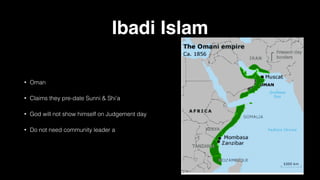
Ibadi Islam
• Oman
• Claims they pre-date Sunni & Shi’a
• God will not show himself on Judgement day
• Do not need community leader a
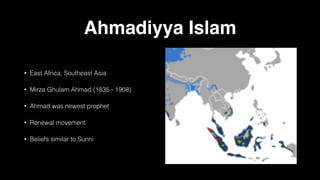
Ahmadiyya Islam
• East Africa, Southeast Asia
• Mirza Ghulam Ahmad (1835 - 1908)
• Ahmad was newest prophet
• Renewal movement
• Beliefs similar to Sunni
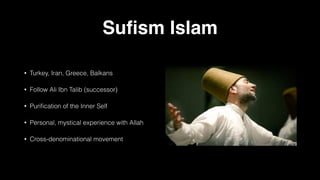
Su
fi
sm Islam
• Turkey, Iran, Greece, Balkans
• Follow Ali Ibn Talib (successor)
• Puri
fi
cation of the Inner Self
• Personal, mystical experience with Allah
• Cross-denominational movement
Bahai
• Persia in 1844
• Taught God would send a new prophet
The Bab (1819 - 1850)
Bahai
• Baha’ullah claimed to be that prophet.
• In 1863 declared he was the new prophet
• Was thrown in jail
Baha’ullah. (1817-1892)
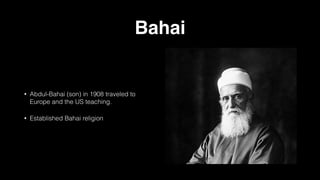
Bahai
• Abdul-Bahai (son) in 1908 traveled to
Europe and the US teaching.
• Established Bahai religion
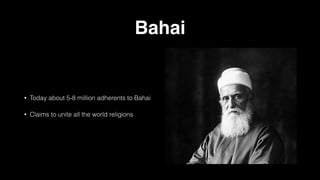
Bahai
• Today about 5-8 million adherents to Bahai
• Claims to unite all the world religions
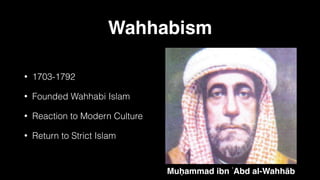
Wahhabism
• 1703-1792
• Founded Wahhabi Islam
• Reaction to Modern Culture
• Return to Strict Islam
Muḥammad ibn ʿAbd al-Wahhāb
Wahhabi Islam
Spreads in Saudi Arabia
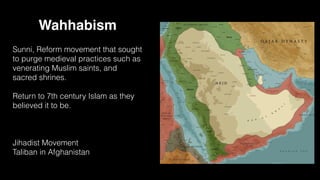
Wahhabism
Sunni, Reform movement that sought
to purge medieval practices such as
venerating Muslim saints, and
sacred shrines.
Return to 7th century Islam as they
believed it to be.
Jihadist Movement
Taliban in Afghanistan
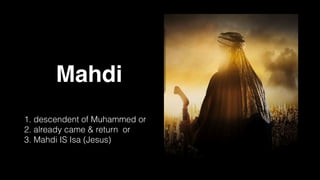
The Mahdi
Mahdi
Warrior Messiah
Appear at the end of time
Destroy enemies of Islam
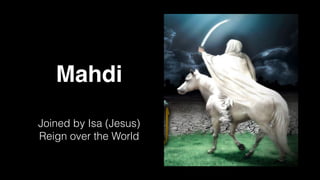
Mahdi
Joined by Isa (Jesus)
Reign over the World
Mahdi
1. descendent of Muhammed or
2. already came & return or
3. Mahdi IS Isa (Jesus)
The Hadith
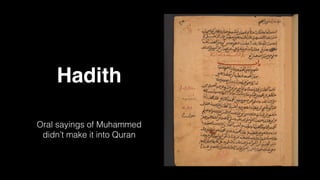
Hadith
Oral sayings of Muhammed
didn’t make it into Quran
Hadith
1.Sahih Bukhari,
2.Sahih Muslim, and
3.Sunan Abu Dawud.
The Muslim-American
Experience
Discrimination
Workplace
Market place
Conversation
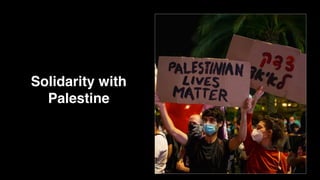
Solidarity with
Palestine
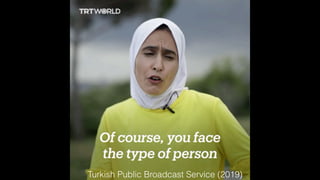
Turkish Public Broadcast Service (2019)
What are ways we
can be sensitive?
What are ways we
can explain the
gospel?

INT-244 Topic 3a Islam

  • 1.
    Islam INT-244 • WorldReligions • Topic 3α
  • 2.
  • 3.
  • 4.
    Muslims in theWorld 1.9 Billion Muslims 24% of the global population in 2020 World Religion Database. (2020). https://worldreligiondatabase.org
  • 5.
    World Religions Christianity 2.5billion 32% Islam 1.9 billion 24% Hinduism 1.1 billion 14% Buddhism 533 million 7% Chinese Folk 466 million 6% World Religion Database. (2020). https://worldreligiondatabase.org
  • 6.
    Muslims in theWorld 1.9 billion Muslims Worldwide 4.45 million Muslims in United States 50k - 60k Muslims in Arizona 2020 US Census Bureau https://cronkitenews.azpbs.org/2016/08/15/arizona-muslims-one-perception-many-faces/
  • 7.
    50,000 - 60,000in Arizona https://cronkitenews.azpbs.org/2016/08/15/arizona-muslims-one-perception-many-faces/
  • 8.
    Muslims in theWorld 20% in Middle East 62% in Asia-Paci fi c 10% in Europe making up 5% of population https://worldreligiondatabase-org
  • 9.
    Muslims in theUnited States • 56% of American Muslims arrived after 2000 • 82% of American Muslims are US citizens • 42% of American Muslims are US born
  • 10.
  • 11.
    US. Department ofState, April 2001
  • 12.
    Country of OriginPercentage % United States 42 South Asia 20 Mideast 14 Africa 5 Europe 2 Country of Origin
  • 13.
    6% 10% 19% 33% 26% 2% 1970 1980 19902000 2010 2020 1960 1950 1940 When did Muslims Immigrate to the United States https://www.pewresearch.org/religion/2017/07/26/demographic-portrait-of-muslim-americans/
  • 15.
    What can yousay about the Muslim community in the United States?
  • 16.
    What can yousay about the Muslim community in the United States? • Muslim Americans are no longer foreign immigrants • Muslim Americans are established Americans • Muslim American Culture values learning and hard work • Muslim Americans are upwardly mobile
  • 17.
  • 18.
  • 19.
  • 20.
    [Isaac] grew andwas weaned. And Abraham made a great feast on the day that Isaac was weaned. But Sarah saw [Ishmael] the son of Hagar the Egyptian, whom she had borne to Abraham, laughing. So she said to Abraham, “Cast out this slave woman with her son, for the son of this slave woman shall not be heir with my son Isaac.” (Gen 21:8-11 ESV) 20
  • 21.
    And the thingwas very displeasing to Abraham on account of his son. But God said to Abraham, “Be not displeased because of [Ishmael] because of your slave woman. Whatever Sarah says to you, do as she tells you, for through Isaac shall your o ff spring be named. And I will make a nation of [Ishmael] also because he is your o ff spring.” (Gen 21:11-13 ESV) 21
  • 22.
    So Abraham roseearly in the morning and took bread and a skin of water and gave it to Hagar, putting it on her shoulder, along with [Ishmael] and sent her away. And she departed and wandered in the wilderness of Beersheba. (Gen 21:14 ESV) 22
  • 23.
    When the waterin the skin was gone, she put [Ishmael] under one of the bushes. Then she went and sat down opposite him a good way o ff , about the distance of a bowshot, for she said, “Let me not look on the death of the child.” And as she sat opposite him, she lifted up her voice and wept. (Gen 21:15-17 ESV) 23
  • 24.
    And God heardthe voice of the boy, and the angel of God called to Hagar from heaven and said to her, “What troubles you, Hagar? Fear not, for God has heard the voice of [Ishmael] where he is. Up! Lift up [Ishmael], and hold him fast with your hand, for I will make him into a great nation.” (Gen 21:17-18 ESV) 24
  • 25.
    Then God openedher eyes, and she saw a well of water. And she went and fi lled the skin with water and gave [Ishmael] a drink. And God was with the boy, and he grew up. He lived in the wilderness and became an expert with the bow. He lived in the wilderness of Paran, and his mother took a wife for him from the land of Egypt. (Gen 21:19-21 ESV) 25
  • 26.
  • 27.
  • 28.
    Roman Empire Split330 AD Roman Empire Byzantine Empire
  • 29.
  • 30.
  • 31.
  • 32.
  • 33.
    Arabs Zoroastrian Byzantine Coptic Judaism In fl uence byJudaism, Zoroastrianism, & Christianity
  • 34.
    Islam grew outof conversation between three religions
  • 35.
  • 36.
  • 37.
  • 38.
    Ka’aba Ka’aba = Cube •Meteorite • Venerated as divine by Arabs • Mecca, Arab holy site
  • 39.
  • 40.
  • 41.
    Muhammed’s Upbringing • 570AD Born in Mecca • Hashemite Arab Tribe • Family were possibly Zoroastrians
  • 42.
    Muhammed’s Upbringing • Father(Abdullah) died before he was born • Mother (Amina) died when he was a child • Uncle (Abu Talib) raised Muhammad
  • 43.
    Khadija Married in 595AD She died in 619 (after 25 years) 43
  • 44.
    ʿAʾishah Married Muhammad after Koransays she was 6 years old (!) Father Abu Bakr, close associate. 44
  • 45.
    Muhammed’s Life • TwoSons who died • Four daughters were his heirs • Became a camel driver in Mecca • Watered camels for pilgrims to Ka’aba • Became very religious (what religion?)
  • 46.
    Cave of Hira 610AD The Night of Power
  • 47.
    Muhammed’s Revelation 610AD • Prayed and meditated in Cave of Hira • Received revelation from Angel Gavriel (Gabriel) • Laylat al-Qadr (Night of Power) • Angel commanded: “Recite!” • But Muhammed was illiterate
  • 48.
  • 49.
    Proclamation: There isonly One God, and he is Allah 49
  • 50.
    ‘Allah = Arabicfor God ‫אלה‬ = Aramaic in Book of Daniel
  • 51.
    Hegira 622 AD Flight toMedina Year One
  • 52.
    Medina 622 - 632AD King of Medina protected him Converted to Islam Islam grew Islamic Law developed Mosque of the Prophet
  • 53.
    Sharia Law Established inMedina Sharia Law "the clear, well-trodden path to water” Religious Civil Laws Mosque of the Prophet
  • 54.
    Different Origins Judaism —developed as a religion of exiles Christianity — developed as counter-culture religion Islam — developed as a State Religion
  • 55.
    Different Origins Judaism —Practices as refugees in exile Christianity — Beliefs of those in opposition to the State Islam — State Religion with civil and religious laws
  • 56.
    Battle of Trench 627AD Meccans attacked Medina Defense of Medina
  • 57.
    Slaughter of Qurayza 627AD Executed 400-600 Jews in Medina
  • 58.
    Treaty of Hudaybiyyah 628 AD BetweenMedina & Mecca’s Qurayshi Tribe
  • 59.
    Conquest of Mecca 630AD Led army back to Mecca First Hajj (Pilgrimage)
  • 60.
    Death of Muhammad 632AD Abu Bakr took over First Caliph
  • 62.
  • 63.
    Abu Bakr ibn ʿAbīQuḥāfa Ruled 632 - 634 AD First Caliph Muhammad’s Father in Law
  • 64.
    Spread of IslamUnder Abu Baker (632 - 634)
  • 65.
    Umar (Omar) ibn al-Khattab Ruled634 - 644 Second Caliph Conquered Palestine Captured Jerusalem
  • 66.
    Spread of IslamUnder Umar (634-644)
  • 67.
    Conquered Jerusalem Established Pact ofUmar Built Shrine of the Rock Built Al Aqsa Mosque Third Sacred Site Dome of the Rock / Mosque of Omar
  • 68.
  • 69.
    Pact of Omar(644 AD) 1. Protects Dhimmis (non-Muslims) 2. Prohibits rebuilding churches/synagogues 3. Prohibits Churches/Synagogues higher than mosques 4. Requires Dhimmis to pay Jizya 5. Prohibits evangelism or trying to convert a Muslim to Christianity 6. Prohibits public religious celebrations
  • 70.
    Pact of Omar(644 AD) 7. Prohibits public displays of crosses 8. Prohibits loud sounds (ex. Calls to worship) 9. Prohibits stopping someone from converting to Islam 10. Prohibits dressing like or imitating Muslims 11. Requires Dhimmis rise in presence of Muslim
  • 71.
    Pact of Omar(644 AD) 12. Requires Christians wear blue belts or turbins 13. Requires Jews to wear yellow belts or yellow hats
  • 72.
    Uthman ibn Affan Ruled 644- 656 Third Caliph
  • 73.
    Uthman ibn Affan Circulated theQuran In all the provinces Conquered N Africa
  • 74.
    Spread of IslamUnder Uthman (644–656)
  • 75.
    Ali ibn Abi Talib b.599 Ruled 656 - 661 Fourth Caliph
  • 76.
    Caliph Ali Son-in-law ofMuhammed Claimed heir by lineage Claimed only true heir
  • 77.
    Martyred January 27, 661AD Grand Mosque in Kufa, Iraq (Babylon)
  • 78.
    Ali Ibn Talib Son-in-Law 4thCaliph Shi’a Islam Abu Bakr Father-in-Law 1st Caliph Sunni Islam SPLIT
  • 79.
    Umayyad Dynasty Ruled 661-750 Capital inDamascus, Syria Great Umayyad Mosque Fourth Sacred Site Umayyad Mosque, Damascus
  • 80.
    Spread of IslamUnder Umayyads (661-750)
  • 81.
  • 82.
    Abbasid Dynasty Ruled 750-1249 Capitalin Baghdad, Iraq Golden Age of Islam Baghdad
  • 83.
  • 84.
    How did IslamSpread (632 - 750) Christians, Zoroastrians, and Jews CHOICE 1. Submit to the Pact of Omar 2. Become Dhimmis (subjects) and pay the Jizya (tax) or 3. Convert to Islam or 4. Be Killed
  • 85.
    How do wetalk about the spread of Islam?
  • 86.
    Islamic Contributions • Math:Algebra, Geometry • Science: Medicine, Astronomy • Culture and Trade with the East • Medicine: surgery, medicines
  • 87.
    Islamic Contributions Literature: Preservationof Greek manuscripts including the Bible
  • 88.
    Islamic Contributions toEurope Rice, sugar cane, Egyptian Cotton, hemp, oranges, lemons, melons, pistachios, apricots, syrups
  • 89.
  • 90.
    Clark, 2017, TheStory of Europe
  • 91.
    Islamic Contributions Jews fl eeing christianEurope found sanctuary in Islamic lands
  • 93.
  • 94.
    The Ottoman Empire TheLast Caliphate 1299 - 1922
  • 95.
  • 96.
    Conquest of Constantinople 1453 Conquest ofByzantium Ottoman becomes European kingdom Renamed the city of Istanbul
  • 97.
  • 98.
  • 99.
    Birth of Cafe’s Coffeehouses spread in Austria and then France
  • 100.
    Modernization of IslamicWorld 1918 - 1950s
  • 101.
    Decline of OttomanEmpire Before WWI
  • 102.
    Colonization of theIslamic World Before WWI
  • 103.
    Collapse of IslamicWorld After WWI (1917 - 1945)
  • 104.
  • 105.
  • 106.
    Westernization of theIslamic World • Women’s rights • Modern movies, radio, and TV • Rock and Popular Music • Democratic, Secular Government • Western Dress and culture
  • 107.
    Rise of ModernArab Nationalism • Secular National Identities that was not religious • Secular Governments • Political alliances with Soviet Union or America • Dictatorships repressing Islamic extremism
  • 108.
    Political Polarization • GlobalCold War • Pressure to align with either USSR or USA
  • 109.
  • 110.
    Muḥammad ibn ʿAbd al-Wahhāb 1703-1792 FoundedWahhabi Islam Reaction to Modernity Return to Sharia Law in Islamic Nations Wahabi Islam spread in Saudi Arabia
  • 111.
    Hasan Al-Banna 1906-1949 Egyptian SchoolTeacher Founded Muslim Brotherhood Advocated Sharia Law in Egypt
  • 112.
    Ayatollah Khomeini 1902 -1989 Shi’a Religious Leader 1979 Came to power in Iran Established Sharia Law
  • 113.
    Mohamed Morsi Muslim Brotherhood Egypt TalibanParty Afghanistan Ayatollah Khomeini Iran Rise of Islamic Extremist Groups
  • 114.
    Ahmed Yassin 1937 -2004 Shi’ite Religious Palestinian leader 1987 Founded HAMAS in Gaza Supported by Iran
  • 115.
  • 116.
    Rise of IslamicExtremism 1. Reaction to Western Culture 2. Reaction to Secular Governments 3. Reaction to Dictators in Arab Countries 4. Advocated Sharia Law in all Islamic Nations
  • 117.
    Origins of theWar with Gaza
  • 120.
    Timeline of theConflict 1948 - Israel declares independence. 1948 - Arab armies invaded Israel. Arab inhabitants were displaced and became refugees. 1964 - Arab refugees united and called themselves PALESTINIANS 1967 - Six-Day War, Arab armies invaded Israel. Israel captured the West Bank & Gaza, occupying. 1995 - Israel recognized Independent Palestine. Westbank and Gaza become self-governed but occupied. 2005 - Israel withdrew from the GAZA strip. Gaza became an independent, unoccupied country. 2007 - Hamas took over GAZA and launched repeated attacks on Israel. 2007 - present — HAMAS repeatedly attacks Israel, refusing negotiation, swearing to annihilate Israel 2023 - Hamas launched attack, killing 900 civilians & kidnapping 150 civilians funded by and supported by Iran. 120
  • 121.
    Latest in Israel-GazaConflict • Saturday, October 7 — Hamas militants from Gaza invaded Southern Israel 5,000 rockets fi red into Israel, including Tel Aviv & Jerusalem 260 Israelis killed at a Rock Concert in S Israel 150 Israeli civilians kidnapped and taken back to Gaza 900 Israelis killed, almost all civilians 121
  • 122.
    What are theirclaims? • Israel occupies Jerusalem, 3rd Holy Site • Israel occupies Palestine and oppresses Palestinians • Israel normalized relationships with Arab countries Egypt, Jordan, Morocco, Sudan, United Arab Emirates, and working on Saudi Arabia.
  • 123.
  • 124.
    Sunni Islam Caliph AbuBakr 573 - 634 AD First Caliph Muhammad’s Father-In-Law
  • 125.
    Sunni Islam Caliph AbuBakr Muhammad’s Rightful Heir Not a prophet Only ruler
  • 126.
    Shi’a Ali Ali ibnTalib 600 - 661 AD Muhammad’s Son-in-Law Fourth Caliph Rightful Heir by Marriage A Prophet and religious leader
  • 127.
    Schism Shia’t Ali —“Followers of Ali" Sunni — “The Way”
  • 128.
  • 129.
  • 130.
    Jerusalem: Dome ofthe Rock Medina: Mosque of the Prophet Mecca: The Ka’aba Damascus: Umayyad Mosque Najaf, Iraq: Imam Ali
  • 131.
  • 132.
    2. Mosque ofthe Prophet in Medina
  • 133.
    3. Dome ofthe Rock in Jerusalem
  • 134.
    4. Umayyad Mosque Damascus,Syria The Great Mosque Muhammad’s grandson Husayn ibn Ali Place where Isa (Jesus) will return
  • 135.
    5. Imam Ali Najaf,Iraq Sacred to only to Shi’a Tomb of Ali, brother of Muhammad
  • 136.
  • 137.
    Quran Abu Bakr beganediting Begun 632 AD Finalized 656 AD Means recitation
  • 138.
    Quran Estab. Arabicwritten language
  • 139.
    How Texts formalizeLanguage • Tanach (Old Testament) formalized Hebrew language • Works of Cicero (70 BC - 14 AD) formalized Latin • Shakespeare & King James Bible formalized Modern English • Quran (7th Century) formalized Arabic Language
  • 140.
  • 141.
  • 142.
    Islam Beliefs Practices Duties FivePillars Six Articles of Faith Divine Duties
  • 143.
  • 144.
    Six Articles ofFaith 1. Belief in One God 2. Belief in Angels 3. Belief in the Prophets 4. Belief in the Resurrection and Final Judgment 5. Belief in the Holy Books 6. Belief in Divine Decree
  • 145.
    1. Belief inOne God Allah, who is indivisible, incomparable to men or women, not begotten, and not a trinity
  • 146.
    2. Belief inAngels • Angels created from light • Angels have no free will • Angels created for task or purpose • Jin created from fi re • Jin have free will • Bad Jin follow Satan • Good Jin operate in the world
  • 147.
    3. Belief inthe Prophets God sent men & women prophets including Abraham, Moses, Isa (Jesus), and His last prophet, Muhammad.
  • 148.
    4. Belief inResurrection and Final Judgement All men & women will die, and rise again in the resurrection after which they will face judgement
  • 149.
    End Times • Signsof the End times: Immorality, crime, callousness • Coming of the Mahdi (Guided One) • Unite Muslims • Isa will return & rule • Satan will be killed • Resurrection of the Dead • Day of Judgement
  • 150.
    5. Belief inthe Holy Books 1. Old Testament 2. New Testament 3. Quran “recitation” OT & NT were corrupted Quran only was preserved
  • 151.
    6. Belief inthe Divine Decree Allah ordained certain things in life All things happen according to the Will of Allah. Men and women’s duty is to accept His will.
  • 152.
    Inshallah “If God WillsIt” Said when making plans
  • 153.
  • 155.
    1. Shahada Confession There isno God but Allah and Muhammad is his prophet.
  • 157.
    2. Salat Praying FiveTimes a day • Before sunrise • Noon • Midday • After sunset • Night
  • 158.
    Great Mosque inIstanbul Minaret (Beacon)
  • 159.
    Adhan (Call toworship) Allahu akbar Allah is great Ashadu an la ilaha illa llah I bear witness there is no god but Allah Ashadu ‘Anna Muhmmadan rasulu illah I bear witness that Muhammad is Allah’s prophet Chayya ‘ala s-salah Hasten to prayer! Chayya ‘ala I-falah Hasten to salvation As-salatu khayrun mina n’nawa prayer is better than sleep Allahu ‘akbar Allah is great la ilaha illa llah. There is no god but Allah
  • 161.
  • 162.
  • 163.
    Ramadan • Eve. Wed.March 22 - Eve. Fri. April 21, 2023 • When ‘Allah gave Muhammad 1st Chapter of Qu’ran • Fast, and Restraint (ex. No movies, dance, intimacy)
  • 164.
    Iftar — mealafter sunset
  • 165.
    Eid al-Fitr —Fast after Ramadan
  • 166.
  • 168.
  • 169.
    The Duties ofa Muslim 1. Duty to Parents: Honoring family and parents 2. Duty to Others 3. Duty to Neighbor 4. Duty to Society: Justice 5. Duty to the Earth: Care for the Earth 6. Duty to Animals: Care for Animals
  • 170.
    A Visit toa Mosque
  • 172.
    The Masjid (Mosque) •Community Center • Place of worship • Place to give Zakat (charity) • Place of learning (study) • Market Place (books, Islamic materials) 172
  • 173.
    The Masjid (Mosque) Arabicfor place of prostration (prayer) 173
  • 174.
    The Dome Not requiredbut symbolizes the vault of heaven 174
  • 175.
    The Crescent & Fivepointed star Crescent represents creator Five points are Five pillars of Islam 175
  • 176.
    The Minaret Towers tocall worshippers to prayer 176
  • 177.
    Separate Seating Men andwomen sit separate 177
  • 178.
    Mihrab The niche inthe eastern wall of the Mosque (pointing toward Mecca) where the congregation faces 178
  • 179.
    Mihrab The pulpit thecleric leads prayer from 179
  • 180.
    Right & leftof pulpit To Right is name of Allah To Left is name Muhammad 180
  • 181.
    40 Men Quorum Mustbe at least 40 men present 181
  • 182.
    Assamualaikum AT end ofprayer they say “Assamualaikum” (Peace be to you). Look to right and left to remind the angel to record their deeds Right angel records good deeds Left angel records bad deeds 182
  • 183.
  • 184.
    Women’s head coverings •Misunderstood as symbols of oppression • Became a symbol of ethnic pride
  • 185.
    Why I wearthe hijab
  • 186.
    Hijab Means “to conceal” Mostpopular covering Worn in the West
  • 187.
    Shayla Hijab Simple, longrectangular scarf worn to cover just the hair and neck.
  • 188.
    Al-Amira Hijab Two pieceveil, with close fi tting cap, like a tube scarf, worn over head, neck, and hangs down over shoulders.
  • 189.
    Khimar Long cape-like veilhanging down to the waist, covering up the hair neck shoulders, and only shows the face.
  • 190.
    Abaya Covers the entirebody, only showing the face and hands. A full body robe with a scarf.
  • 191.
    Abaya Saudi Arabia, Yemen,United Arab Emerites, Morocco, Indonesia, Turkey, Qatar.
  • 192.
    Doa Gaun Long, round,intricately embroidered cotton veils, slip over the heads, tied in the back with a ribbon. Worn primarily during prayer. Shows the entire face
  • 193.
  • 194.
    Chador Iran Covers everything butface Usually black, not colored
  • 195.
    Chador Primarily worn inIran, Afghanistan, and extremely traditional Muslim societies
  • 196.
    Niqab Veil for theface, showing only the eyes. Worn in Central Asia, such as Iran, Iraq, Pakistan and very traditional societies
  • 197.
    Burqa Long overgarment concealing theentire body except the hands, with a screen for the eyes. Worn in Iran, Afghanistan, Pakistan, and very traditional societies
  • 198.
  • 199.
    Men & Womenin Islam
  • 200.
    Women in Islam 1.Men & women were created “from one soul” (Surah 4:1) 200
  • 201.
    Women & Marriage 1.Men & women were created “from one soul” (Surah 4:1) 2. God created all things in pairs (Surah 51:49) 201
  • 202.
    Women & Marriage 1.Men & women were created “from one soul” (Surah 4:1) 2. God created all things in pairs (Surah 51:49) 3. Men & women will be rewarded in paradise (Surah 3:195) 202
  • 203.
    Women & Marriage 1.Men & women were created “from one soul” (Surah 4:1) 2. God created all things in pairs (Surah 51:49) 3. Men & women will be rewarded in paradise (Surah 3:195) 4. Men should treat women respectfully with kindness (Surah 4:19) 203
  • 204.
    Women & Marriage 1.Men & women were created “from one soul” (Surah 4:1) 2. God created all things in pairs (Surah 51:49) 3. Men & women will be rewarded in paradise (Surah 3:195) 4. Men should treat women respectfully with kindness (Surah 4:19) 5. Husbands are leaders in marriage. Women are not inferior (Surah 4:34) 204
  • 205.
    Women & Marriage 1.Men & women were created “from one soul” (Surah 4:1) 2. God created all things in pairs (Surah 51:49) 3. Men & women will be rewarded in paradise (Surah 3:195) 4. Men should treat women respectfully with kindness (Surah 4:19) 5. Husbands are leaders in marriage. Women are not inferior (Surah 4:34) 6. Women dress modestly outside. No command to be completely veiled. 205
  • 206.
    Women & Marriage 1.Men & women were created “from one soul” (Surah 4:1) 2. God created all things in pairs (Surah 51:49) 3. Men & women will be rewarded in paradise (Surah 3:195) 4. Men should treat women respectfully with kindness (Surah 4:19) 5. Husbands are leaders in marriage. Women are not inferior (Surah 4:34) 6. Women dress modestly outside. No command to be completely veiled. 7. Men can marry up to 4 wives & must treat them fairly & equally (Surah 4:3) 206
  • 207.
    Women & Marriage 1.Men & women were created “from one soul” (Surah 4:1) 2. God created all things in pairs (Surah 51:49) 3. Men & women will be rewarded in paradise (Surah 3:195) 4. Men should treat women respectfully with kindness (Surah 4:19) 5. Husbands are leaders in marriage. Women are not inferior (Surah 4:34) 6. Women dress modestly outside. No command to be completely veiled. 7. Men can marry up to 4 wives & must treat them fairly & equally (Surah 4:3) 8. Muslim men may marry Jewish or Christian wives, but not pagan (Surah 2:221) 207
  • 208.
    Women & Marriage 1.Men & women were created “from one soul” (Surah 4:1) 2. God created all things in pairs (Surah 51:49) 3. Men & women will be rewarded in paradise (Surah 3:195) 4. Men should treat women respectfully with kindness (Surah 4:19) 5. Husbands are leaders in marriage. Women are not inferior (Surah 4:34) 6. Women dress modestly outside. No command to be completely veiled. 7. Men can marry up to 4 wives & must treat them fairly & equally (Surah 4:3) 8. Muslim men may marry Jewish or Christian wives, but not pagan (Surah 2:221) 9. Women are unclean during their period (Surah 2:222) 208
  • 209.
    Women & Marriage 1.Men & women were created “from one soul” (Surah 4:1) 2. God created all things in pairs (Surah 51:49) 3. Men & women will be rewarded in paradise (Surah 3:195) 4. Men should treat women respectfully with kindness (Surah 4:19) 5. Husbands are leaders in marriage. Women are not inferior (Surah 4:34) 6. Women dress modestly outside. No command to be completely veiled. 7. Men can marry up to 4 wives & must treat them fairly & equally (Surah 4:3) 8. Muslim men may marry Jewish or Christian wives, but not pagan (Surah 2:221) 9. Women are unclean during their period (Surah 2:222) 10.Adultery requires public punishment (Surah 4:15-18) 209
  • 210.
    Women & Marriage 1.Men & women were created “from one soul” (Surah 4:1) 2. God created all things in pairs (Surah 51:49) 3. Men & women will be rewarded in paradise (Surah 3:195) 4. Men should treat women respectfully with kindness (Surah 4:19) 5. Husbands are leaders in marriage. Women are not inferior (Surah 4:34) 6. Women dress modestly outside. No command to be completely veiled. 7. Men can marry up to 4 wives & must treat them fairly & equally (Surah 4:3) 8. Muslim men may marry Jewish or Christian wives, but not pagan (Surah 2:221) 9. Women are unclean during their period (Surah 2:222) 10.Adultery requires public punishment (Surah 4:15-18) 11.Divorce is permitted, but only after attempt to reconcile (Surah 226:242) 210
  • 211.
    Women & Marriage 1.Men & women were created “from one soul” (Surah 4:1) 2. God created all things in pairs (Surah 51:49) 3. Men & women will be rewarded in paradise (Surah 3:195) 4. Men should treat women respectfully with kindness (Surah 4:19) 5. Husbands are leaders in marriage. Women are not inferior (Surah 4:34) 6. Women dress modestly outside. No command to be completely veiled. 7. Men can marry up to 4 wives & must treat them fairly & equally (Surah 4:3) 8. Muslim men may marry Jewish or Christian wives, but not pagan (Surah 2:221) 9. Women are unclean during their period (Surah 2:222) 10.Adultery requires public punishment (Surah 4:15-18) 11.Divorce is permitted, but only after attempt to reconcile (Surah 226:242) 12.At death, estate divided up: husband receives ½ wife. Wife receives ¼ of husband’s (Surah 4:7-12) 211
  • 212.
    Gender Norms inIslam 1. Men should touch a woman who is not his wife 212
  • 213.
    Gender Norms inIslam 1. Men should touch a woman who is not his wife 2. Men & women should dress modestly 213
  • 214.
    Gender Norms inIslam 1. Men should touch a woman who is not his wife 2. Men & women should dress modestly 3. Men often wear a head covering after they completed the Hajj 214
  • 215.
    Gender Norms inIslam 1. Men should touch a woman who is not his wife 2. Men & women should dress modestly 3. Men often wear a head covering after they completed the Hajj 4. Men often wear head coverings during prayer 215
  • 216.
    Gender Norms inIslam 1. Men should touch a woman who is not his wife 2. Men & women should dress modestly 3. Men often wear a head covering after they completed the Hajj 4. Men often wear head coverings during prayer 5. Men and women are separated in school and in the Mosque 216
  • 217.
    Gender Norms inIslam 1. Men should touch a woman who is not his wife 2. Men & women should dress modestly 3. Men often wear a head covering after they completed the Hajj 4. Men often wear head coverings during prayer 5. Men and women are separated in school and in the Mosque 6. Men and women are expected to be married early 217
  • 218.
    Cultural Values • Learningand Study • Restraint (not indulgent) • High power distance
  • 219.
    Cultural Values • Maledominate (women subordinate roles) • Collectivist (not individual) • High Uncertainty avoidance
  • 220.
    Cultural Values • Givingto charity • Modesty and conservative dress • Hospitality and generosity • Respect all religion and tradition
  • 221.
    Sensitivities • Israel andtheir occupation of the territories • Palestinians and autonomy • Dietary restrictions • Social interaction of men with women • Modest dress (especially women)
  • 222.
    Sensitivities • Movies, music,celebration (ex. Alcohol) • Avoid depictions of Muhammed • Never criticize Muhammed or the Quran • Don’t put the Quran on the fl oor!
  • 223.
  • 224.
    Quran Revealed by Gabrielto Muhammad Over 23 years Concluded in 632 AD
  • 225.
  • 226.
    Quran 114 Surahs (Chapters) Eachchapter has Ayat (Verses) Begins with Bismillah “In the name of Allah” Ordered in size, not chronology
  • 227.
    1. In theName of Allah the Entirely Merciful, the Especially Merciful. 2. [All] praise is [due] to Allah, Lord of the worlds - 3. The Entirely Merciful, the Especially Merciful, 4. Sovereign of the Day of Recompense. 5. It is You we worship and You we ask for help 6. Guide us to the straight path- 7. The path of those upon whom You have bestowed favor, not of those who have evoked [Your] anger or of those who are astray. Quran 1:1–7
  • 228.
    Prayer Mat Prostration &Sitting Value Cleanliness Prostrate forehead to fl oor
  • 229.
    Prayer Beads Misbaha 99 smallbeads (or) 33 large Beads
  • 230.
    Wudhu Ceremonial Washing Before prayer Ablution(cleanse of sin) Wash the body parts that sin Hands, Feet, Mouth, Eyes
  • 231.
  • 232.
  • 233.
    Sunni Islam • 89- 90% of Muslims • Abu Bakr Siddique Caliph • Await the Mahdi, true successor • Imam is only a religious leader • Followers do not need intermediary
  • 234.
    Shi’a Islam • 200Million followers • Iran, Iraq, Yemen, and Syria • Ali ibn Talib was divine successor • Imam religious & community leader • Imam decides meaning of Quran
  • 235.
    Ibadi Islam • Oman •Claims they pre-date Sunni & Shi’a • God will not show himself on Judgement day • Do not need community leader a
  • 236.
    Ahmadiyya Islam • EastAfrica, Southeast Asia • Mirza Ghulam Ahmad (1835 - 1908) • Ahmad was newest prophet • Renewal movement • Beliefs similar to Sunni
  • 237.
    Su fi sm Islam • Turkey,Iran, Greece, Balkans • Follow Ali Ibn Talib (successor) • Puri fi cation of the Inner Self • Personal, mystical experience with Allah • Cross-denominational movement
  • 238.
    Bahai • Persia in1844 • Taught God would send a new prophet The Bab (1819 - 1850)
  • 239.
    Bahai • Baha’ullah claimedto be that prophet. • In 1863 declared he was the new prophet • Was thrown in jail Baha’ullah. (1817-1892)
  • 240.
    Bahai • Abdul-Bahai (son)in 1908 traveled to Europe and the US teaching. • Established Bahai religion
  • 241.
    Bahai • Today about5-8 million adherents to Bahai • Claims to unite all the world religions
  • 242.
    Wahhabism • 1703-1792 • FoundedWahhabi Islam • Reaction to Modern Culture • Return to Strict Islam Muḥammad ibn ʿAbd al-Wahhāb
  • 243.
  • 244.
    Wahhabism Sunni, Reform movementthat sought to purge medieval practices such as venerating Muslim saints, and sacred shrines. Return to 7th century Islam as they believed it to be. Jihadist Movement Taliban in Afghanistan
  • 245.
  • 246.
    Mahdi Warrior Messiah Appear atthe end of time Destroy enemies of Islam
  • 247.
    Mahdi Joined by Isa(Jesus) Reign over the World
  • 248.
    Mahdi 1. descendent ofMuhammed or 2. already came & return or 3. Mahdi IS Isa (Jesus)
  • 249.
  • 250.
    Hadith Oral sayings ofMuhammed didn’t make it into Quran
  • 251.
  • 252.
  • 253.
  • 254.
  • 255.
  • 256.
    What are wayswe can be sensitive?
  • 257.
    What are wayswe can explain the gospel?