Religion
Religion is…• A difficult concept to define
• A system of beliefs & practices that seeks to order
life in terms of culturally perceived priorities
• Often includes an established set of symbols,
rituals, and sacred texts that explain the origin of
life, the universe, or the meaning of life.
Overview of Five Major Religions
• TED Talk
Classification of Religion
Examples of Universalizing and
Ethnic Religions
Example of an Ethnic Religion:
Judaism
• At its most basic, a Jew is anyone born of a Jewish
mother. Though a person can convert to Judaism, it
is a complex process that has traditionally been
discouraged.
• Sex and the City clip - Charlotte wants to
convert
Examples of orthodox and
syncretic religions
• Syncretism
– The merging of different religions
– Umbanda, a religion practiced in parts of Brazil, blends elements of
Catholicism with a reverence for the souls of native people, wise
men, and historical Brazilian figures
– One view of Sikhism is that it is a syncretism of Hinduism
(particularly the Bhakti movement) and Islam (particularly Sufism)
• Orthodox
– Adhering to the accepted or traditional faith
– Christianity, Judaism, Hinduism, and Islam have orthodox strains
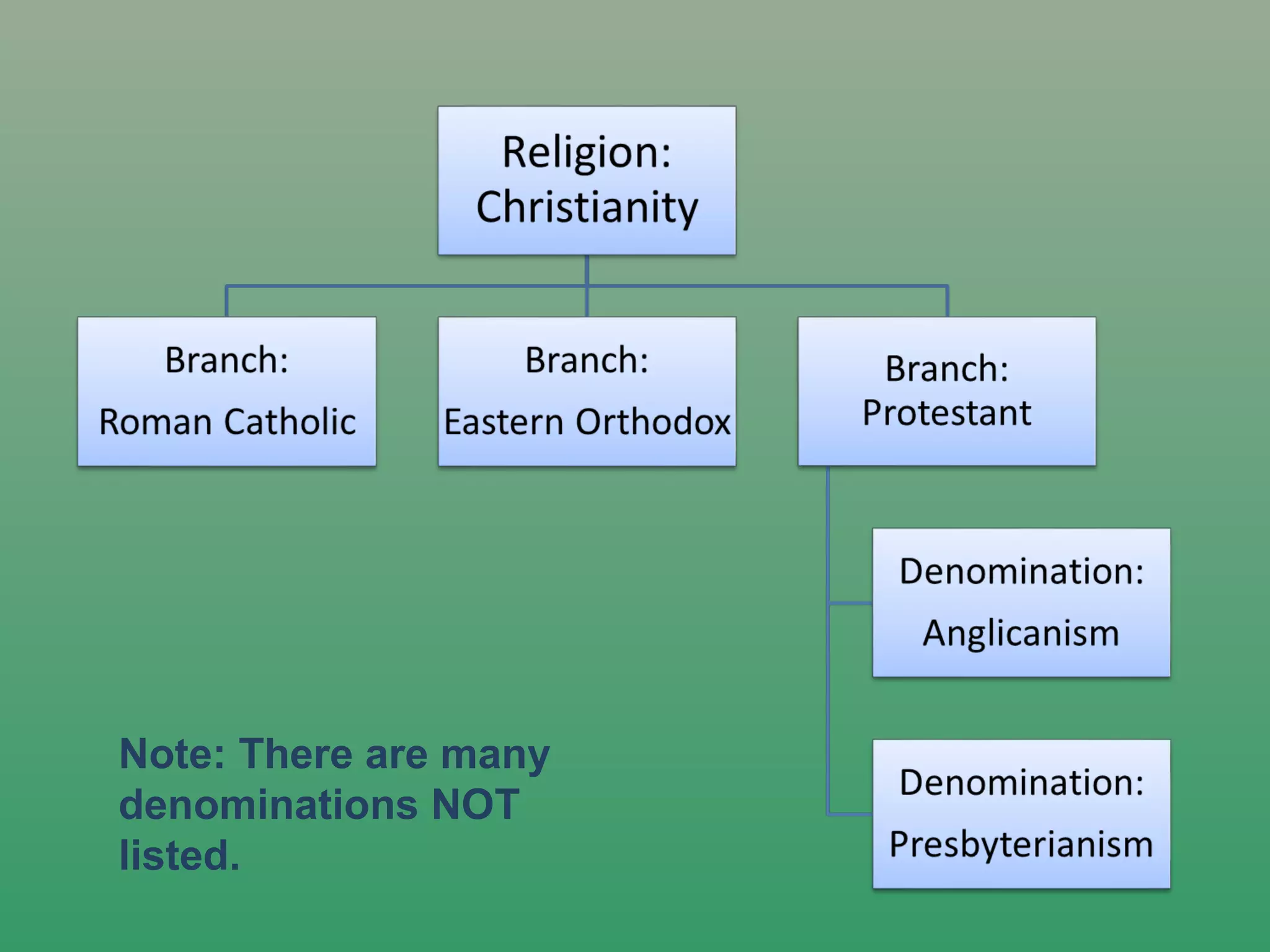
Note: There are many
denominations NOT
listed.
Cultural Hearths
• Zoroastrianism – Persia
• Hinduism & Buddhism – South Asia
(India/Nepal)
• Judaism & Christianity – Eastern
Mediterranean
• Islam – Arabian Peninsula
• Shinto – Japan
Reminder:
Cultural hearth is
where ideas,
innovations, or
cultures first
emerge
Diffusion of 3 Major Religions
Spread of Religions
• Diffusion of major world religions video
• As you watch, pay attention to cultural
hearths and diffusion.
• What slowed or sped up the diffusion of
the major religions?
Look @ that __________________ map projection.
How is the map (presented at this scale) an
incomplete representation of the geography of
religion?
• The map doesn’t show small areas where
other religions dominate.
• The map masks much “diversity” and
“variation” in religions.
• The map overgeneralizes.
Adherents to Major
World Religions
Religion Number of
Adherents
Percent of Total
Global Adherents
Christianity 2.1 billion 41.79%
Islam 1.34 billion 26.67%
Hinduism 950 million 18.91%
Buddhism 347 million 6.9%
Traditional
beliefs
250 million 4.97%
Sikhism 24 million 0.48%
Judaism 13 million 0.26%
Read the article regarding
the use of the hijab, or
head scarf, in Iran.
Answer the questions
regarding religious
clothing on the sheet
provided.
Orthodoxy vs. Fundamentalism
• Fundamentalism:
– movement to return to the founding principles of the
religion, which can include literal interpretation of sacred
texts
– Often attempts to follow the ways of the religious founder
closely
– Can be intolerant of other religions
– Can be intolerant of fellow believers who are not following
the “proper” ways.
• Orthodoxy: Also a desire to return to the founding
principles of a religion; however, many who consider
themselves orthodox are tolerant of other beliefs.
Fundamentalist vs. Extremist
• Why do People become Religious Extremists?
• Read the handout called “Religious
Fundamentalism.”
• Answer the questions at the end of the
article.
Indigenous Religions
Yellow: Widely diffused
traditional, indigenous
beliefs
Green: Traditional,
indigenous beliefs exist in
pockets
Orange: Widely diffused
Chinese indigenous religion
Red: Widely diffused
Shintoism
Look @ that __________________ map projection.
Indigenous Religions
• Indigenous
religions
– Local in scope
– Usually have a
reverence for nature
– Passed down through
family units and
groups (tribes) of
indigenous peoples.
– No central tenet can
be ascribed to all
indigenous religions.
Shamanism
• Shamanism
– A community faith in
which people follow
their shaman
– The shaman is a
• religious leader
• teacher
• healer
• visionary
– Shamanist faiths are
small and
comparatively
isolated.
The Rise of Secularism
• Secular: indifference to or rejection of
organized religious affiliation & ideas, non-
religious
Read the article regarding
the Pew Research Study on
religion in the U.S.
On a sheet of paper,
describe the growth of
secularism in the United
States.
•What are the causes?
•Why is it reflected in the
younger generation?
•How has increasing
diversity impacted
Christianity in the U.S.?
Secularization – another view
• Does Science Argue for or Against God?
• Discussion:
– In your opinion, have scientific ideas reduced the
number of religious followers?

APHG Unit 3: Religion Intro

  • 1.
  • 2.
    Religion is…• Adifficult concept to define • A system of beliefs & practices that seeks to order life in terms of culturally perceived priorities • Often includes an established set of symbols, rituals, and sacred texts that explain the origin of life, the universe, or the meaning of life.
  • 3.
    Overview of FiveMajor Religions • TED Talk
  • 4.
  • 5.
    Examples of Universalizingand Ethnic Religions
  • 6.
    Example of anEthnic Religion: Judaism • At its most basic, a Jew is anyone born of a Jewish mother. Though a person can convert to Judaism, it is a complex process that has traditionally been discouraged. • Sex and the City clip - Charlotte wants to convert
  • 7.
    Examples of orthodoxand syncretic religions • Syncretism – The merging of different religions – Umbanda, a religion practiced in parts of Brazil, blends elements of Catholicism with a reverence for the souls of native people, wise men, and historical Brazilian figures – One view of Sikhism is that it is a syncretism of Hinduism (particularly the Bhakti movement) and Islam (particularly Sufism) • Orthodox – Adhering to the accepted or traditional faith – Christianity, Judaism, Hinduism, and Islam have orthodox strains
  • 9.
    Note: There aremany denominations NOT listed.
  • 11.
    Cultural Hearths • Zoroastrianism– Persia • Hinduism & Buddhism – South Asia (India/Nepal) • Judaism & Christianity – Eastern Mediterranean • Islam – Arabian Peninsula • Shinto – Japan Reminder: Cultural hearth is where ideas, innovations, or cultures first emerge
  • 12.
    Diffusion of 3Major Religions
  • 13.
    Spread of Religions •Diffusion of major world religions video • As you watch, pay attention to cultural hearths and diffusion. • What slowed or sped up the diffusion of the major religions?
  • 14.
    Look @ that__________________ map projection.
  • 15.
    How is themap (presented at this scale) an incomplete representation of the geography of religion? • The map doesn’t show small areas where other religions dominate. • The map masks much “diversity” and “variation” in religions. • The map overgeneralizes.
  • 16.
    Adherents to Major WorldReligions Religion Number of Adherents Percent of Total Global Adherents Christianity 2.1 billion 41.79% Islam 1.34 billion 26.67% Hinduism 950 million 18.91% Buddhism 347 million 6.9% Traditional beliefs 250 million 4.97% Sikhism 24 million 0.48% Judaism 13 million 0.26%
  • 18.
    Read the articleregarding the use of the hijab, or head scarf, in Iran. Answer the questions regarding religious clothing on the sheet provided.
  • 19.
    Orthodoxy vs. Fundamentalism •Fundamentalism: – movement to return to the founding principles of the religion, which can include literal interpretation of sacred texts – Often attempts to follow the ways of the religious founder closely – Can be intolerant of other religions – Can be intolerant of fellow believers who are not following the “proper” ways. • Orthodoxy: Also a desire to return to the founding principles of a religion; however, many who consider themselves orthodox are tolerant of other beliefs.
  • 20.
    Fundamentalist vs. Extremist •Why do People become Religious Extremists? • Read the handout called “Religious Fundamentalism.” • Answer the questions at the end of the article.
  • 21.
    Indigenous Religions Yellow: Widelydiffused traditional, indigenous beliefs Green: Traditional, indigenous beliefs exist in pockets Orange: Widely diffused Chinese indigenous religion Red: Widely diffused Shintoism Look @ that __________________ map projection.
  • 22.
    Indigenous Religions • Indigenous religions –Local in scope – Usually have a reverence for nature – Passed down through family units and groups (tribes) of indigenous peoples. – No central tenet can be ascribed to all indigenous religions.
  • 23.
    Shamanism • Shamanism – Acommunity faith in which people follow their shaman – The shaman is a • religious leader • teacher • healer • visionary – Shamanist faiths are small and comparatively isolated.
  • 24.
    The Rise ofSecularism • Secular: indifference to or rejection of organized religious affiliation & ideas, non- religious
  • 25.
    Read the articleregarding the Pew Research Study on religion in the U.S. On a sheet of paper, describe the growth of secularism in the United States. •What are the causes? •Why is it reflected in the younger generation? •How has increasing diversity impacted Christianity in the U.S.?
  • 26.
    Secularization – anotherview • Does Science Argue for or Against God? • Discussion: – In your opinion, have scientific ideas reduced the number of religious followers?