Culture Quiz
1
Essay Feedback
• Good job using the resources!
• Please remember to write a thesis sentence in next essay.
• Please use the template and headings
• The next essay is essentially a quiz on general Hinduism
• Cite Scripture in the reflection part.
In this essay, I will introduce Hinduism, introduce the three main
Hindu deities, describe India’s caste system, discuss a Christian
church in India, discuss barriers a Hindu faces in considering the
gospel, and compare four key Hindu beliefs with Christiian beliefs
3
Citation
(Lastname, date, location)
Citation
“Hinduism is the oldest religion in the world, originating in Central Asia and
the Indus Valley, still practiced in the present day” (Mark, 2020, para. 1).
References
Mark, Joshua. (2020 June 8). Hinduism in World History Encyclopedia.
https://www.worldhistory.org/hinduism/
Citation
“For God so loved the world” (John 3:16, ESV).
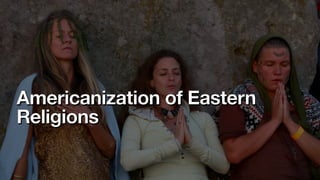
Americanization of Eastern
Religions
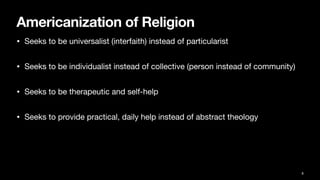
Americanization of Religion
• Seeks to be universalist (interfaith) instead of particularist
• Seeks to be individualist instead of collective (person instead of community)
• Seeks to be therapeutic and self-help
• Seeks to provide practical, daily help instead of abstract theology
8
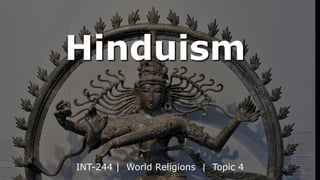
Hinduism
INT-244 | World Religions | Topic 4
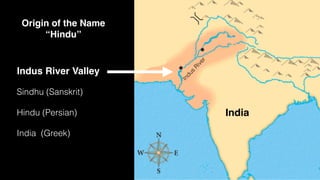
Origin of the Name
Indus River Valley
Sindhu (Sanskrit)
Hindu (Persian)
India (Greek)
India
I
n
d
u
s
R
i
v
e
r
Origin of the Name
“Hindu”
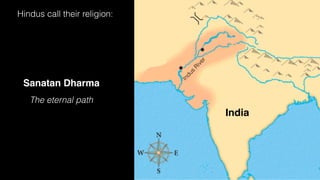
Sanatan Dharma
The eternal path
India
I
n
d
u
s
R
i
v
e
r
Hindus call their religion:
Demographics
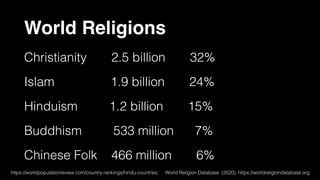
World Religions
Christianity 2.5 billion 32%
Islam 1.9 billion 24%
Hinduism 1.2 billion 15%
Buddhism 533 million 7%
Chinese Folk 466 million 6%
https://worldpopulationreview.com/country-rankings/hindu-countries; World Religion Database. (2020). https://worldreligiondatabase.org
Demographics
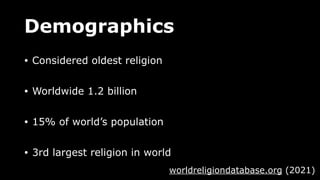
• Considered oldest religion
• Worldwide 1.2 billion
• 15% of world’s population
• 3rd largest religion in world
worldreligiondatabase.org (2021)
Demographics
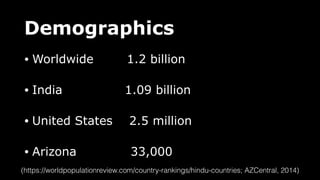
• Worldwide 1.2 billion
• India 1.09 billion
• United States 2.5 million
• Arizona 33,000
(https://worldpopulationreview.com/country-rankings/hindu-countries; AZCentral, 2014)
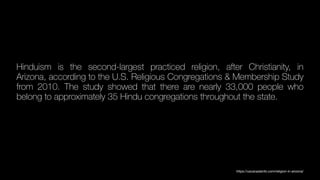
Hinduism is the second-largest practiced religion, after Christianity, in
Arizona, according to the U.S. Religious Congregations & Membership Study
from 2010. The study showed that there are nearly 33,000 people who
belong to approximately 35 Hindu congregations throughout the state.
https://uscanadainfo.com/religion-in-arizona/
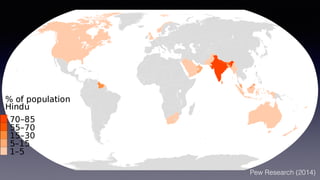
Pew Research (2014)
Pew Research (2014)
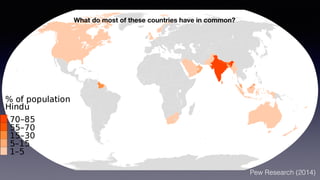
What do most of these countries have in common?
Pew Research (2014)
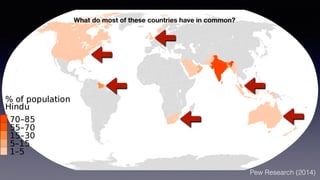
What do most of these countries have in common?
Indians are a diaspora people.
“According to the Minister of External A
ff
airs, There are 29 million non-resident Indians
living outside of India comprising the largest diaspora people-group…Every year 2.5
million Indians emigrate out of India”
"Population of Overseas Indians". mea.gov.in. Ministry of External A
ff
airs, Government of India. 2023-02-15.
History
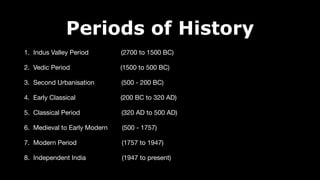
Periods of History
1. Indus Valley Period (2700 to 1500 BC)
2. Vedic Period (1500 to 500 BC)
3. Second Urbanisation (500 - 200 BC)
4. Early Classical (200 BC to 320 AD)
5. Classical Period (320 AD to 500 AD)
6. Medieval to Early Modern (500 - 1757)
7. Modern Period (1757 to 1947)
8. Independent India (1947 to present)
Periods of History
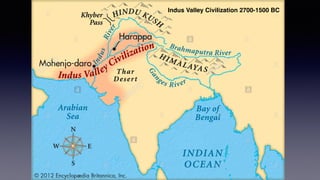
1. Indus Valley Period (2700 to 1500 BC)
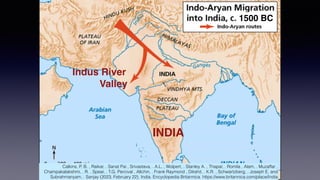
Indus Valley Civilization 2700-1500 BC
Calkins, P. B. , Raikar, . Sanat Pai , Srivastava, . A.L. , Wolpert, . Stanley A. , Thapar, . Romila , Alam, . Muzaffar ,
Champakalakshmi, . R. , Spear, . T.G. Percival , Allchin, . Frank Raymond , Dikshit, . K.R. , Schwartzberg, . Joseph E. and
Subrahmanyam, . Sanjay (2023, February 22). India. Encyclopedia Britannica. https://www.britannica.com/place/India
1500 BC
Indus River
Valley
INDIA
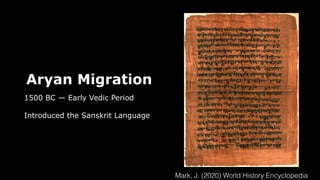
Aryan Migration
1500 BC — Early Vedic Period
Introduced the Sanskrit Language
Mark, J. (2020) World History Encyclopedia
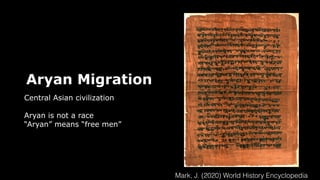
Aryan Migration
Central Asian civilization
Aryan is not a race
“Aryan” means “free men”
Mark, J. (2020) World History Encyclopedia
Periods of History
1. Indus Valley Period (2700 to 1500 BC)
2. Vedic Period (1500 to 500 BC)
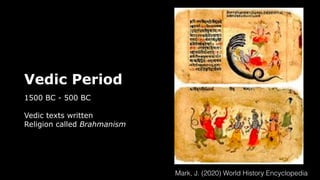
Vedic Period
1500 BC - 500 BC
Vedic texts written
Religion called Brahmanism
Mark, J. (2020) World History Encyclopedia
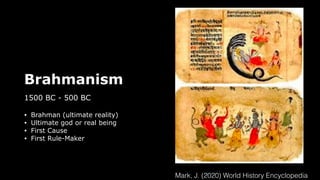
Brahmanism
1500 BC - 500 BC
• Brahman (ultimate reality)
• Ultimate god or real being
• First Cause
• First Rule-Maker
Mark, J. (2020) World History Encyclopedia
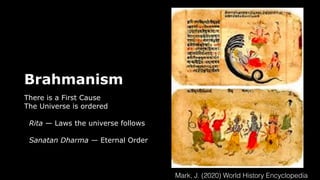
Brahmanism
There is a First Cause
The Universe is ordered
Rita — Laws the universe follows
Sanatan Dharma — Eternal Order
Mark, J. (2020) World History Encyclopedia
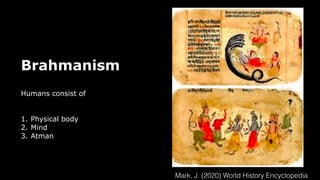
Brahmanism
Humans consist of
1. Physical body
2. Mind
3. Atman
Mark, J. (2020) World History Encyclopedia
Brahmanism
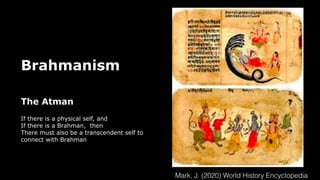
The Atman
If there is a physical self, and
If there is a Brahman, then
There must also be a transcendent self to
connect with Brahman
Mark, J. (2020) World History Encyclopedia
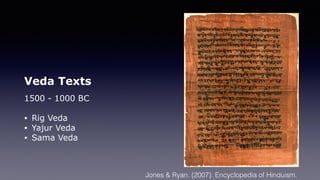
Veda Texts
1500 - 1000 BC
• Rig Veda
• Yajur Veda
• Sama Veda
Jones & Ryan. (2007). Encyclopedia of Hinduism.
Upanishad Texts
1000 - 400 BC
Mostly Philosophy
Describes: Order of the Universe
Jones & Ryan. (2007). Encyclopedia of Hinduism.
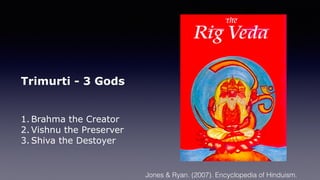
Trimurti - 3 Gods
1. Brahma the Creator
2. Vishnu the Preserver
3. Shiva the Destoyer
Jones & Ryan. (2007). Encyclopedia of Hinduism.
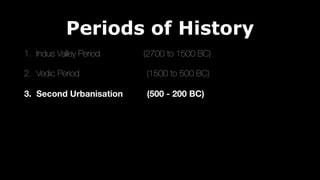
Periods of History
1. Indus Valley Period (2700 to 1500 BC)
2. Vedic Period (1500 to 500 BC)
3. Second Urbanisation (500 - 200 BC)
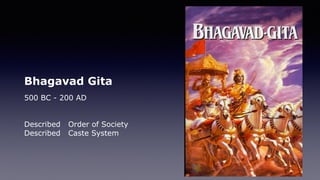
Bhagavad Gita
500 BC - 200 AD
Described Order of Society
Described Caste System
Periods of History
1. Indus Valley Period (2700 to 1500 BC)
2. Vedic Period (1500 to 500 BC)
3. Second Urbanisation (500 - 200 BC)
4. Early Classical (200 BC to 320 AD)
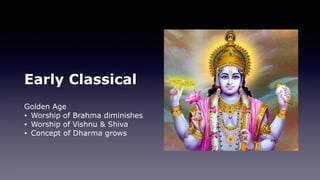
Early Classical
Golden Age
• Worship of Brahma diminishes
• Worship of Vishnu & Shiva
• Concept of Dharma grows
Early Classical
Golden Age
• Worship of Brahma diminishes
• Worship of Vishnu & Shiva
• Concept of Dharma grows
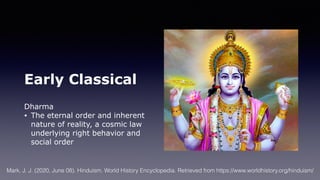
Early Classical
Dharma
• The eternal order and inherent
nature of reality, a cosmic law
underlying right behavior and
social order
Mark, J. J. (2020, June 08). Hinduism. World History Encyclopedia. Retrieved from https://www.worldhistory.org/hinduism/
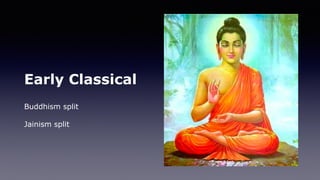
Buddhism split
Jainism split
Early Classical
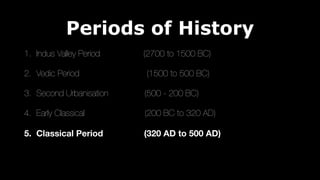
Periods of History
1. Indus Valley Period (2700 to 1500 BC)
2. Vedic Period (1500 to 500 BC)
3. Second Urbanisation (500 - 200 BC)
4. Early Classical (200 BC to 320 AD)
5. Classical Period (320 AD to 500 AD)
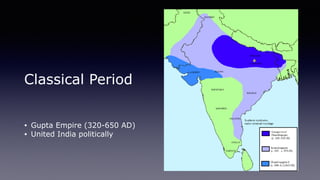
Classical Period
• Gupta Empire (320-650 AD)
• United India politically
Periods of History
1. Indus Valley Period (2700 to 1500 BC)
2. Vedic Period (1500 to 500 BC)
3. Second Urbanisation (500 - 200 BC)
4. Early Classical (200 BC to 320 AD)
5. Classical Period (320 AD to 500 AD)
6. Medieval to Early Modern (500 - 1757)
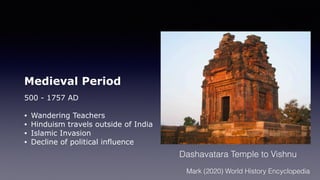
Medieval Period
500 - 1757 AD
• Wandering Teachers
• Hinduism travels outside of India
• Islamic Invasion
• Decline of political influence
Dashavatara Temple to Vishnu
Mark (2020) World History Encyclopedia
Periods of History
1. Indus Valley Period (2700 to 1500 BC)
2. Vedic Period (1500 to 500 BC)
3. Second Urbanisation (500 - 200 BC)
4. Early Classical (200 BC to 320 AD)
5. Classical Period (320 AD to 500 AD)
6. Medieval to Early Modern (500 - 1757)
7. Modern Period (1757 - 1947)
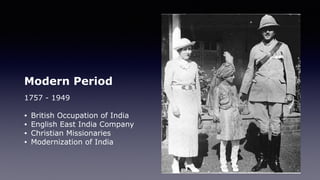
Modern Period
1757 - 1949
• British Occupation of India
• English East India Company
• Christian Missionaries
• Modernization of India
Periods of History
1. Indus Valley Period (2700 to 1500 BC)
2. Vedic Period (1500 to 500 BC)
3. Second Urbanisation (500 - 200 BC)
4. Early Classical (200 BC to 320 AD)
5. Classical Period (320 AD to 500 AD)
6. Medieval to Early Modern (500 - 1757)
7. Modern Period (1757 - 1947)
8. Independent India (1947 - Present)
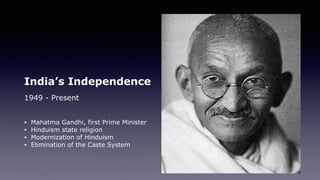
India’s Independence
1949 - Present
• Mahatma Gandhi, first Prime Minister
• Hinduism state religion
• Modernization of Hinduism
• Elimination of the Caste System
Beliefs
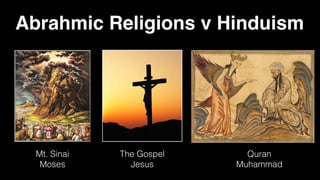
Abrahmic Religions v Hinduism
Mt. Sinai
Moses
The Gospel
Jesus
Quran
Muhammad
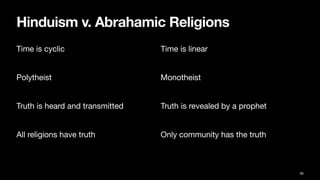
Hinduism v. Abrahamic Religions
Time is cyclic
Polytheist
Truth is heard and transmitted
All religions have truth
56
Time is linear
Monotheist
Truth is revealed by a prophet
Only community has the truth
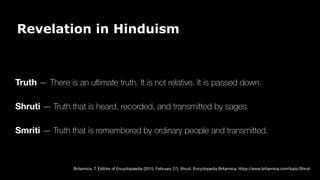
Revelation in Hinduism
Truth — There is an ultimate truth. It is not relative. It is passed down.
Shruti — Truth that is heard, recorded, and transmitted by sages
Smriti — Truth that is remembered by ordinary people and transmitted.
Britannica, T. Editors of Encyclopaedia (2015, February 27). Shruti. Encyclopedia Britannica. https://www.britannica.com/topic/Shruti
Universe is Cyclic
• Humans go through cycles of reincarnation
• Universe is endlessly cyclic
Seven Beliefs
1. Brahman
2. Atman
3. Karma
4. Moksha
5. Yuga Cycle
6. Dharma
7. The Vedas
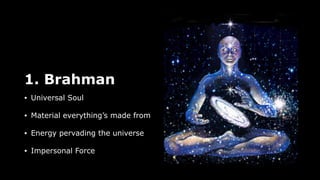
1. Brahman
• Universal Soul
• Material everything’s made from
• Energy pervading the universe
• Impersonal Force
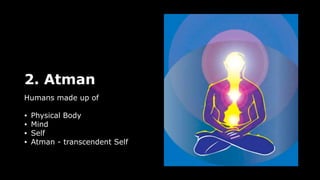
2. Atman
Humans made up of
• Physical Body
• Mind
• Self
• Atman - transcendent Self
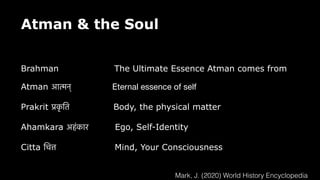
Atman & the Soul
Brahman The Ultimate Essence Atman comes from
Atman आ
त्म
न् Eternal essence of self
Prakrit
प्र
क
ृ
ति
Body, the physical matter
Ahamkara अहंकार Ego, Self-Identity
Citta
चि
त्त
Mind, Your Consciousness
Mark, J. (2020) World History Encyclopedia
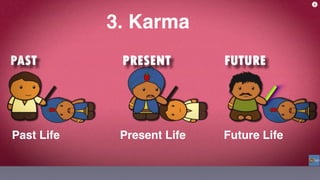
3. Karma
Cosmic Justice
Good and bad actions impact:
• Society
• Us later in life
• Us in the next life
Past Life Present Life Future Life
3. Karma
1. What do you agree with?
2. What do you disagree with?
3. What is a bridge to explain the gospel to a Hindu?
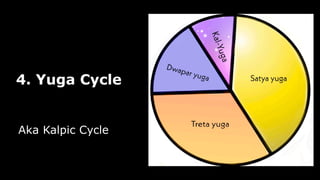
4. Yuga Cycle
Aka Kalpic Cycle
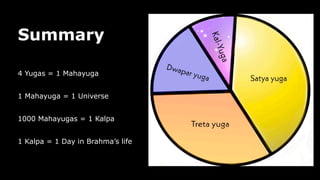
Summary
4 Yugas = 1 Mahayuga
1 Mahayuga = 1 Universe
1000 Mahayugas = 1 Kalpa
1 Kalpa = 1 Day in Brahma’s life
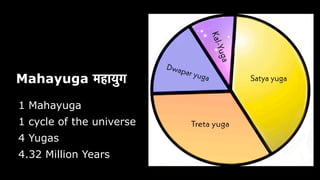
Mahayuga महायुग
1 Mahayuga
1 cycle of the universe
4 Yugas
4.32 Million Years
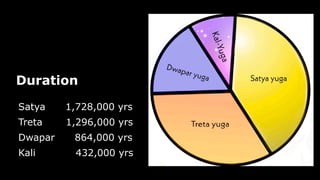
Duration
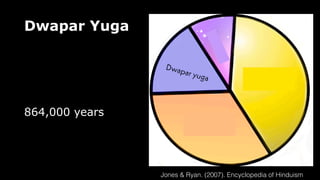
Satya 1,728,000 yrs
Treta 1,296,000 yrs
Dwapar 864,000 yrs
Kali 432,000 yrs
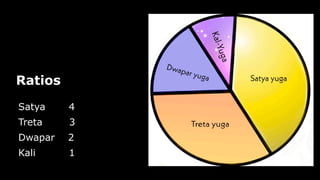
Ratios
Satya 4
Treta 3
Dwapar 2
Kali 1
Satya Yuga
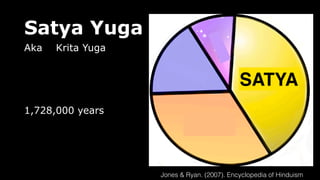
Aka Krita Yuga
1,728,000 years
Jones & Ryan. (2007). Encyclopedia of Hinduism
SATYA
Satya Yuga
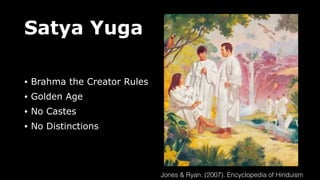
• Brahma the Creator Rules
• Golden Age
• No Castes
• No Distinctions
Jones & Ryan. (2007). Encyclopedia of Hinduism
Satya Yuga
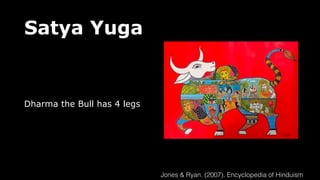
Dharma the Bull has 4 legs
Jones & Ryan. (2007). Encyclopedia of Hinduism
Treta Yuga
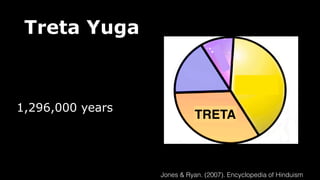
1,296,000 years
Jones & Ryan. (2007). Encyclopedia of Hinduism
TRETA
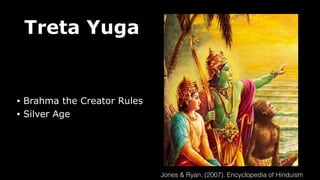
Treta Yuga
• Brahma the Creator Rules
• Silver Age
Jones & Ryan. (2007). Encyclopedia of Hinduism
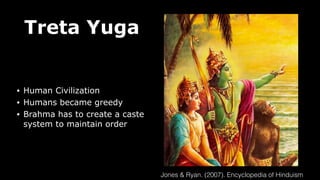
Treta Yuga
• Human Civilization
• Humans became greedy
• Brahma has to create a caste
system to maintain order
Jones & Ryan. (2007). Encyclopedia of Hinduism
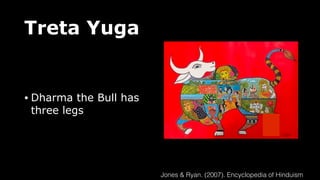
Treta Yuga
• Dharma the Bull has
three legs
Jones & Ryan. (2007). Encyclopedia of Hinduism
Dwapar Yuga
864,000 years
Jones & Ryan. (2007). Encyclopedia of Hinduism
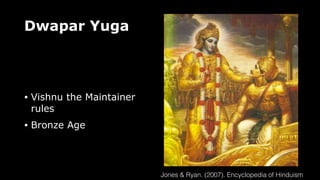
Dwapar Yuga
• Vishnu the Maintainer
rules
• Bronze Age
Jones & Ryan. (2007). Encyclopedia of Hinduism
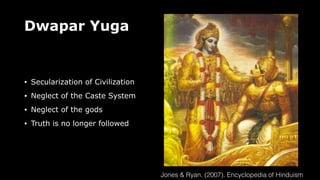
Dwapar Yuga
• Secularization of Civilization
• Neglect of the Caste System
• Neglect of the gods
• Truth is no longer followed
Jones & Ryan. (2007). Encyclopedia of Hinduism
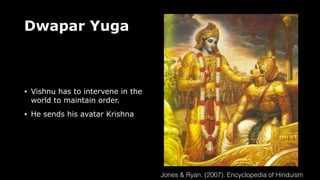
Dwapar Yuga
• Vishnu has to intervene in the
world to maintain order.
• He sends his avatar Krishna
Jones & Ryan. (2007). Encyclopedia of Hinduism
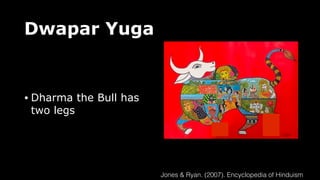
Dwapar Yuga
• Dharma the Bull has
two legs
Jones & Ryan. (2007). Encyclopedia of Hinduism
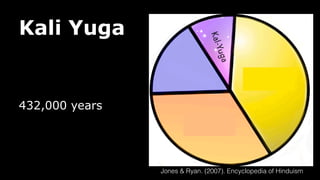
Kali Yuga
432,000 years
Jones & Ryan. (2007). Encyclopedia of Hinduism
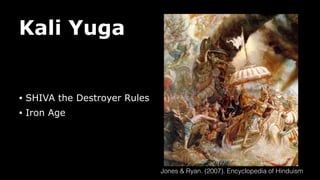
Kali Yuga
• SHIVA the Destroyer Rules
• Iron Age
Jones & Ryan. (2007). Encyclopedia of Hinduism
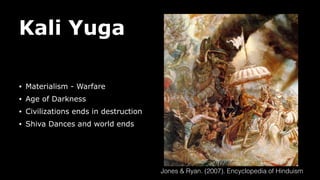
Kali Yuga
• Materialism - Warfare
• Age of Darkness
• Civilizations ends in destruction
• Shiva Dances and world ends
Jones & Ryan. (2007). Encyclopedia of Hinduism
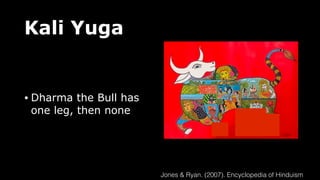
Kali Yuga
• Dharma the Bull has
one leg, then none
Jones & Ryan. (2007). Encyclopedia of Hinduism
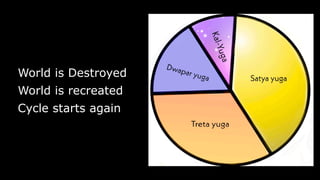
World is Destroyed
World is recreated
Cycle starts again
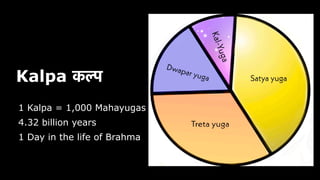
Kalpa क
ल्प
1 Kalpa = 1,000 Mahayugas
4.32 billion years
1 Day in the life of Brahma
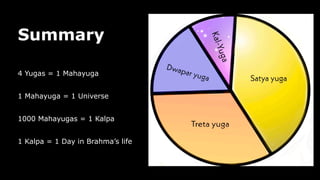
Summary
4 Yugas = 1 Mahayuga
1 Mahayuga = 1 Universe
1000 Mahayugas = 1 Kalpa
1 Kalpa = 1 Day in Brahma’s life
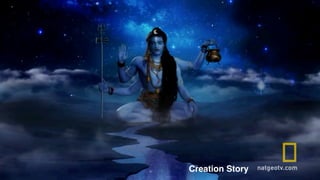
Creation Story
1. What do you agree with?
2. What do you disagree with?
3. What is a bridge to explain the gospel to a Hindu?
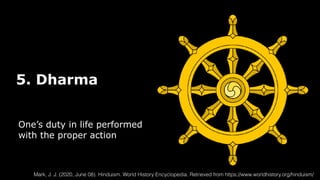
5. Dharma
One’s duty in life performed
with the proper action
Mark, J. J. (2020, June 08). Hinduism. World History Encyclopedia. Retrieved from https://www.worldhistory.org/hinduism/
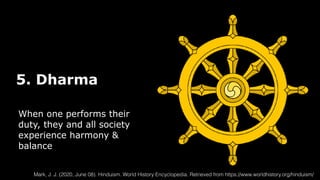
5. Dharma
When one performs their
duty, they and all society
experience harmony &
balance
Mark, J. J. (2020, June 08). Hinduism. World History Encyclopedia. Retrieved from https://www.worldhistory.org/hinduism/
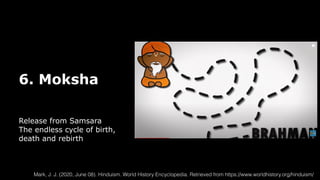
6. Moksha
Release from Samsara
The endless cycle of birth,
death and rebirth
Mark, J. J. (2020, June 08). Hinduism. World History Encyclopedia. Retrieved from https://www.worldhistory.org/hinduism/
Samsara
Endless cycle of birth-life-death-rebirth
Mark, J. J. (2020, June 08). Hinduism. World History Encyclopedia. Retrieved from https://www.worldhistory.org/hinduism/
Moksha (release)
How do we achieve Moksha?
Mark, J. J. (2020, June 08). Hinduism. World History Encyclopedia. Retrieved from https://www.worldhistory.org/hinduism/
3 Goals to achieve Moksha
1. Dharma — Perform one’s duty in life
2. Artha — Acquire material wealth in life
3. Kama — Experience Love, sexuality, Pleasure
Mark, J. J. (2020, June 08). Hinduism. World History Encyclopedia. Retrieved from https://www.worldhistory.org/hinduism/
3 Helps & Hinderances
1. Sattva — wisdom, goodness, detachment
2. Rajas — passionate intensity, aggression
3. Tamas — darkness, confusion, helplessness
7. Vedas
The sacred texts of Hinduism
Seven Beliefs
1. Brahman
2. Atman
3. Karma
4. Moksha
5. Yuga cycle
6. Dharma
7. The Vedas
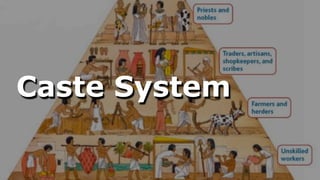
Caste System
Caste
Born into a caste because of Karma (divine
justice), as the result of your actions in a previous
life. It is your Dharma (duty) to ful
fi
ll the role you
were born into.
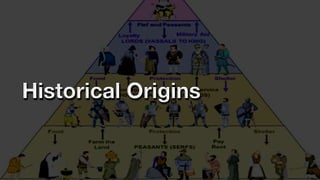
Historical Origins
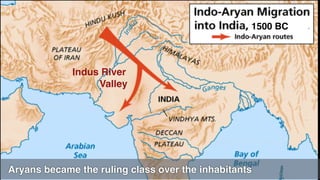
1500 BC
Indus River
Valley
Aryans became the ruling class over the inhabitants
Caste System in History
• Aryan Invasion
• Castes created based on skills & abilities
• 5th Century BC laws fixed the castes by ancestry
• Rule #1 - Brahmins are Lord of Castes
• Rule #2 - Hindus cannot change caste
Caste System in History
• 400 AD — Dalit (outcaste) emerged
• Possibly in response to Buddhism’s revolt
Britannica, T. Editors of Encyclopaedia (2022, October 27). untouchable. Encyclopedia Britannica. https://www.britannica.com/topic/untouchable
Caste System in History
• British exploited castes (1757 - 1930s)
• British established laws protecting (1930s - 1947)
• Gandhi ended caste system (1947)
• Castes continue as social discrimination
(KING 5 News)_
Seattle becomes
fi
rst city to outlaw caste discrimination
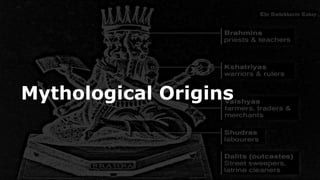
Mythological Origins
11 When they divided Brahma how many portions did they make?
What do they call his mouth, his arms? What do they call his thighs and feet?
12 The Brahmin was his mouth, both his arms was the Rājanya made.
His thighs became the Vaiśya, from his feet the Śūdra was produced.
Rig Veda 10:90 https://www.sacred-texts.com/hin/rigveda/rv10090.htm
Creation Myth in the Rig Veda
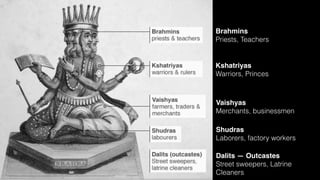
Brahmins
Priests, Teachers
Kshatriyas
Warriors, Princes
Vaishyas
Merchants, businessmen
Shudras
Laborers, factory workers
Dalits — Outcastes
Street sweepers, Latrine
Cleaners
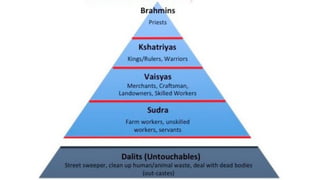
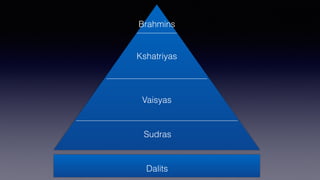
Brahmins
Kshatriyas
Vaisyas
Sudras
Dalits
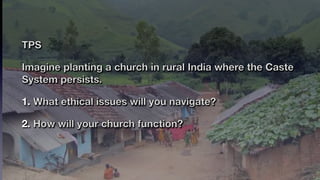
TPS
Imagine planting a church in rural India where the Caste
System persists.
1. What ethical issues will you navigate?
2. How will your church function?
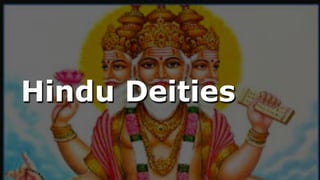
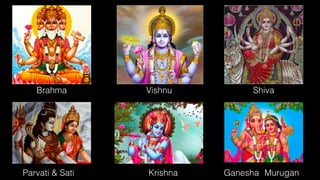
Hindu Deities
Brahma Vishnu Shiva
Krishna Ganesha Murugan
Parvati & Sati
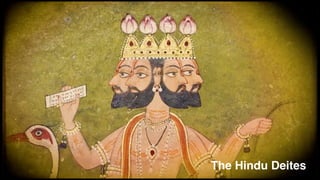
The Hindu Deites
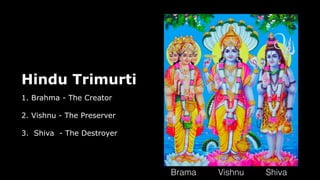
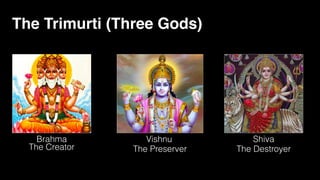
Hindu Trimurti
1. Brahma - The Creator
2. Vishnu - The Preserver
3. Shiva - The Destroyer
Brama Vishnu Shiva
Brahma Vishnu Shiva
The Trimurti (Three Gods)
The Creator The Preserver The Destroyer
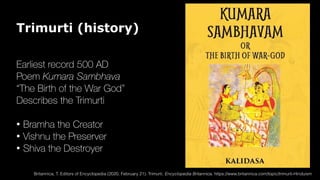
Trimurti (history)
Earliest record 500 AD
Poem Kumara Sambhava
“The Birth of the War God”
Describes the Trimurti
• Bramha the Creator
• Vishnu the Preserver
• Shiva the Destroyer
Britannica, T. Editors of Encyclopedia (2020, February 21). Trimurti. Encyclopedia Britannica. https://www.britannica.com/topic/trimurti-Hinduism
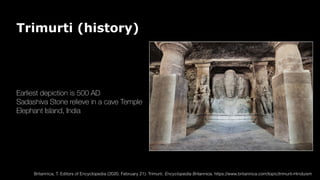
Trimurti (history)
Earliest depiction is 500 AD
Sadashiva Stone relieve in a cave Temple
Elephant Island, India
Britannica, T. Editors of Encyclopedia (2020, February 21). Trimurti. Encyclopedia Britannica. https://www.britannica.com/topic/trimurti-Hinduism
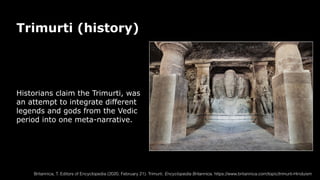
Trimurti (history)
Historians claim the Trimurti, was
an attempt to integrate different
legends and gods from the Vedic
period into one meta-narrative.
Britannica, T. Editors of Encyclopedia (2020, February 21). Trimurti. Encyclopedia Britannica. https://www.britannica.com/topic/trimurti-Hinduism
Tell the Story of the Gods
Brahma https://www.worldhistory.org/Brahma/
Vishnu https://www.worldhistory.org/Vishnu/
Shiva https://www.worldhistory.org/shiva/
Krishna https://www.worldhistory.org/Krishna/
Ganesha https://www.worldhistory.org/Ganesha/
Murugan https://www.newworldencyclopedia.org/entry/Murugan
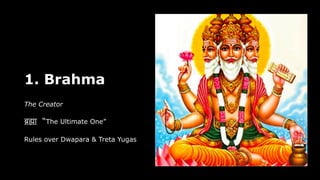
1. Brahma
The Creator
ब्र
ह्मा
“The Ultimate One”
Rules over Dwapara & Treta Yugas
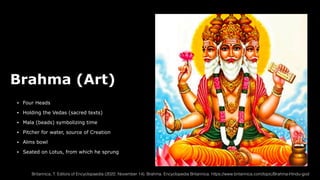
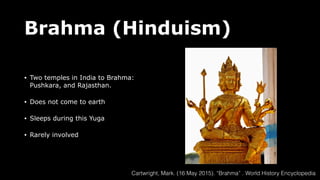
Brahma (Art)
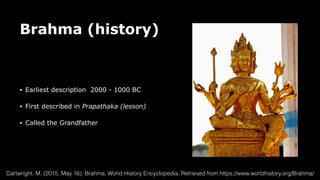
• Four Heads
• Holding the Vedas (sacred texts)
• Mala (beads) symbolizing time
• Pitcher for water, source of Creation
• Alms bowl
• Seated on Lotus, from which he sprung
Britannica, T. Editors of Encyclopaedia (2022, November 14). Brahma. Encyclopedia Britannica. https://www.britannica.com/topic/Brahma-Hindu-god
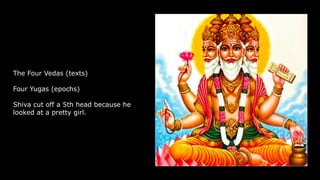
The Four Vedas (texts)
Four Yugas (epochs)
Shiva cut off a 5th head because he
looked at a pretty girl.
Brahma (history)
• Earliest description 2000 - 1000 BC
• First described in Prapathaka (lesson)
• Called the Grandfather
Cartwright, M. (2015, May 16). Brahma. World History Encyclopedia. Retrieved from https://www.worldhistory.org/Brahma/
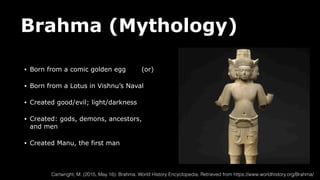
Brahma (Mythology)
• Born from a comic golden egg (or)
• Born from a Lotus in Vishnu’s Naval
• Created good/evil; light/darkness
• Created: gods, demons, ancestors,
and men
• Created Manu, the first man
Cartwright, M. (2015, May 16). Brahma. World History Encyclopedia. Retrieved from https://www.worldhistory.org/Brahma/
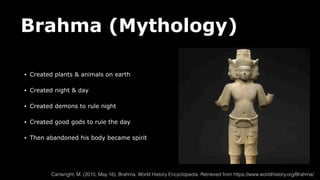
Brahma (Mythology)
• Created plants & animals on earth
• Created night & day
• Created demons to rule night
• Created good gods to rule the day
• Then abandoned his body became spirit
Cartwright, M. (2015, May 16). Brahma. World History Encyclopedia. Retrieved from https://www.worldhistory.org/Brahma/
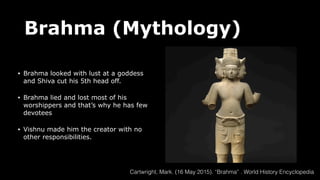
Brahma (Mythology)
• Brahma looked with lust at a goddess
and Shiva cut his 5th head off.
• Brahma lied and lost most of his
worshippers and that’s why he has few
devotees
• Vishnu made him the creator with no
other responsibilities.
Cartwright, Mark. (16 May 2015). “Brahma” . World History Encyclopedia
Brahma (Hinduism)
• Two temples in India to Brahma:
Pushkara, and Rajasthan.
• Does not come to earth
• Sleeps during this Yuga
• Rarely involved
Cartwright, Mark. (16 May 2015). “Brahma” . World History Encyclopedia
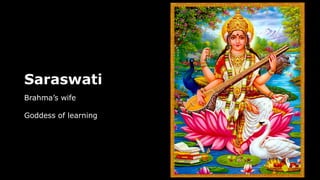
Saraswati
Brahma’s wife
Goddess of learning
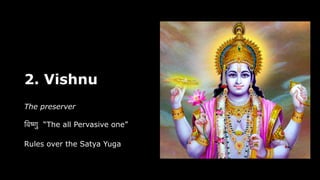
2. Vishnu
The preserver
वि
ष्णु
“The all Pervasive one”
Rules over the Satya Yuga
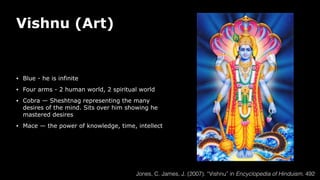
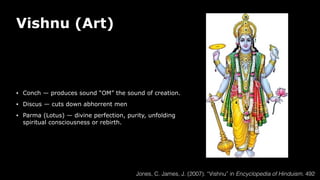
Vishnu (Art)
• Blue - he is infinite
• Four arms - 2 human world, 2 spiritual world
• Cobra — Sheshtnag representing the many
desires of the mind. Sits over him showing he
mastered desires
• Mace — the power of knowledge, time, intellect
Jones, C. James, J. (2007). “Vishnu” in Encyclopedia of Hinduism. 492
Vishnu (Art)
• Conch — produces sound “OM” the sound of creation.
• Discus — cuts down abhorrent men
• Parma (Lotus) — divine perfection, purity, unfolding
spiritual consciousness or rebirth.
Jones, C. James, J. (2007). “Vishnu” in Encyclopedia of Hinduism. 492
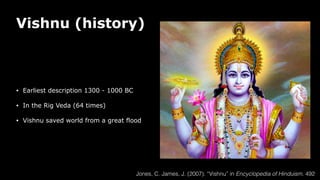
Vishnu (history)
• Earliest description 1300 - 1000 BC
• In the Rig Veda (64 times)
• Vishnu saved world from a great flood
Jones, C. James, J. (2007). “Vishnu” in Encyclopedia of Hinduism. 492
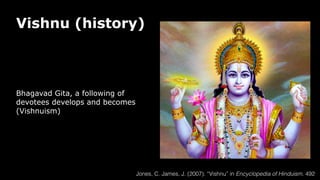
Vishnu (history)
Bhagavad Gita, a following of
devotees develops and becomes
(Vishnuism)
Jones, C. James, J. (2007). “Vishnu” in Encyclopedia of Hinduism. 492
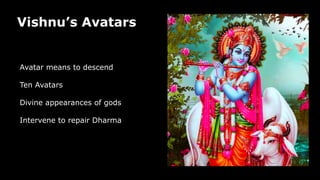
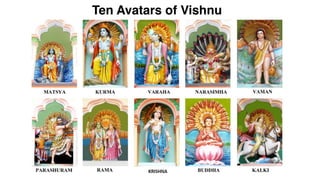
Vishnu’s Avatars
Avatar means to descend
Ten Avatars
Divine appearances of gods
Intervene to repair Dharma
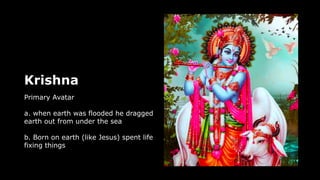
Krishna
Primary Avatar
a. when earth was flooded he dragged
earth out from under the sea
b. Born on earth (like Jesus) spent life
fixing things
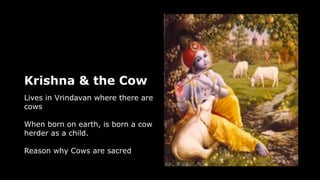
Krishna & the Cow
Lives in Vrindavan where there are
cows
When born on earth, is born a cow
herder as a child.
Reason why Cows are sacred
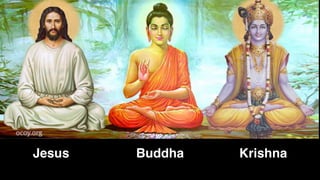
Jesus Buddha Krishna
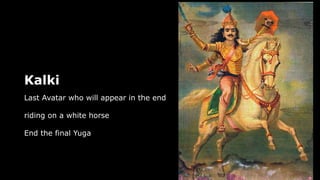
Kalki
Last Avatar who will appear in the end
riding on a white horse
End the final Yuga
Ten Avatars of Vishnu
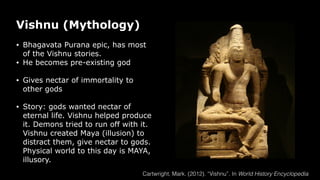
Vishnu (Mythology)
• Bhagavata Purana epic, has most
of the Vishnu stories.
• He becomes pre-existing god
• Gives nectar of immortality to
other gods
• Story: gods wanted nectar of
eternal life. Vishnu helped produce
it. Demons tried to run off with it.
Vishnu created Maya (illusion) to
distract them, give nectar to gods.
Physical world to this day is MAYA,
illusory.
Cartwright, Mark. (2012). “Vishnu”. In World History Encyclopedia
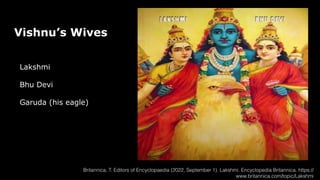
Vishnu’s Wives
Lakshmi
Bhu Devi
Garuda (his eagle)
Britannica, T. Editors of Encyclopaedia (2022, September 1). Lakshmi. Encyclopedia Britannica. https://
www.britannica.com/topic/Lakshmi
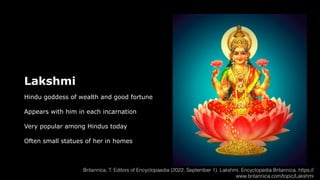
Lakshmi
Hindu goddess of wealth and good fortune
Appears with him in each incarnation
Very popular among Hindus today
Often small statues of her in homes
Britannica, T. Editors of Encyclopaedia (2022, September 1). Lakshmi. Encyclopedia Britannica. https://
www.britannica.com/topic/Lakshmi
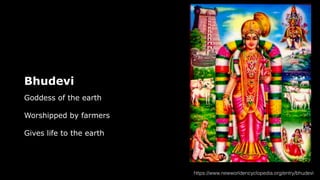
Bhudevi
Goddess of the earth
Worshipped by farmers
Gives life to the earth
https://www.newworldencyclopedia.org/entry/bhudevi
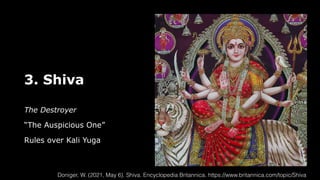
3. Shiva
The Destroyer
“The Auspicious One”
Rules over Kali Yuga
Doniger, W. (2021, May 6). Shiva. Encyclopedia Britannica. https://www.britannica.com/topic/Shiva
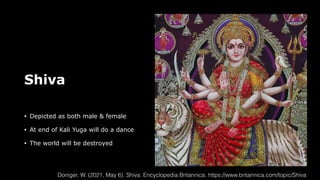
Shiva
• Depicted as both male & female
• At end of Kali Yuga will do a dance
• The world will be destroyed
Doniger, W. (2021, May 6). Shiva. Encyclopedia Britannica. https://www.britannica.com/topic/Shiva
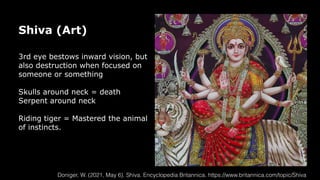
Shiva (Art)
3rd eye bestows inward vision, but
also destruction when focused on
someone or something
Skulls around neck = death
Serpent around neck
Riding tiger = Mastered the animal
of instincts.
Doniger, W. (2021, May 6). Shiva. Encyclopedia Britannica. https://www.britannica.com/topic/Shiva
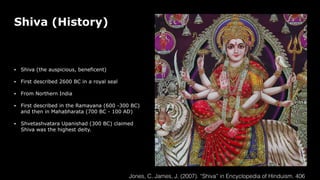
Shiva (History)
• Shiva (the auspicious, beneficent)
• First described 2600 BC in a royal seal
• From Northern India
• First described in the Ramayana (600 -300 BC)
and then in Mahabharata (700 BC - 100 AD)
• Shvetashvatara Upanishad (300 BC) claimed
Shiva was the highest deity.
Jones, C. James, J. (2007). “Shiva” in Encyclopedia of Hinduism. 406
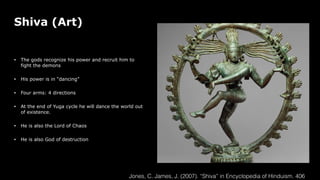
Shiva (Art)
• The gods recognize his power and recruit him to
fight the demons
• His power is in “dancing”
• Four arms: 4 directions
• At the end of Yuga cycle he will dance the world out
of existence.
• He is also the Lord of Chaos
• He is also God of destruction
Jones, C. James, J. (2007). “Shiva” in Encyclopedia of Hinduism. 406
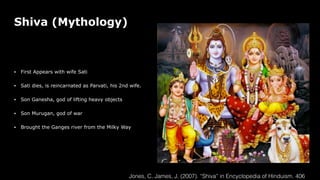
Shiva (Mythology)
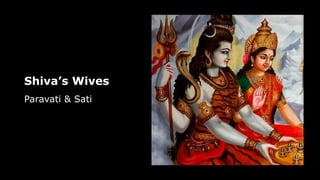
• First Appears with wife Sati
• Sati dies, is reincarnated as Parvati, his 2nd wife.
• Son Ganesha, god of lifting heavy objects
• Son Murugan, god of war
• Brought the Ganges river from the Milky Way
Jones, C. James, J. (2007). “Shiva” in Encyclopedia of Hinduism. 406
Shiva’s Wives
Paravati & Sati
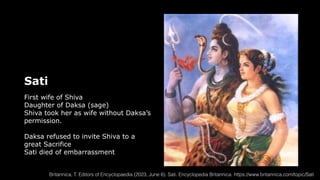
Sati
First wife of Shiva
Daughter of Daksa (sage)
Shiva took her as wife without Daksa’s
permission.
Daksa refused to invite Shiva to a
great Sacrifice
Sati died of embarrassment
Britannica, T. Editors of Encyclopaedia (2023, June 6). Sati. Encyclopedia Britannica. https://www.britannica.com/topic/Sati
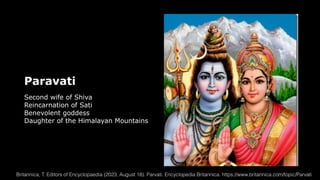
Paravati
Second wife of Shiva
Reincarnation of Sati
Benevolent goddess
Daughter of the Himalayan Mountains
Britannica, T. Editors of Encyclopaedia (2023, August 18). Parvati. Encyclopedia Britannica. https://www.britannica.com/topic/Parvati
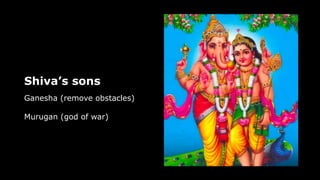
Shiva’s sons
Ganesha (remove obstacles)
Murugan (god of war)
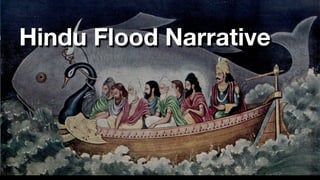
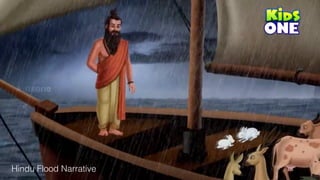
Hindu Flood Narrative
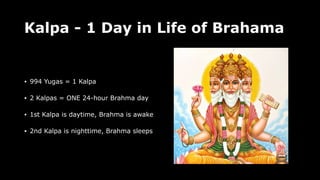
Kalpa - 1 Day in Life of Brahama
• 994 Yugas = 1 Kalpa
• 2 Kalpas = ONE 24-hour Brahma day
• 1st Kalpa is daytime, Brahma is awake
• 2nd Kalpa is nighttime, Brahma sleeps
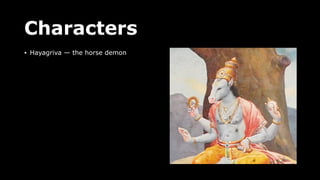
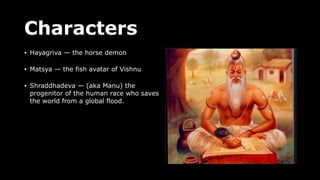
Characters
• Hayagriva — the horse demon
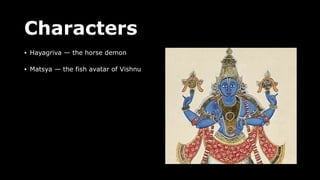
Characters
• Hayagriva — the horse demon
• Matsya — the fish avatar of Vishnu
Characters
• Hayagriva — the horse demon
• Matsya — the fish avatar of Vishnu
• Shraddhadeva — (aka Manu) the
progenitor of the human race who saves
the world from a global flood.
Hindu Flood Narrative
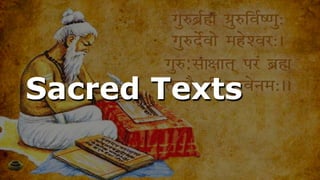
Sacred Texts
Sacred Texts
• Four Vedas
• Thirteen Upanishads
• Great Sanskrit Epochs
• Eighteen Puranas
The Sacred Texts
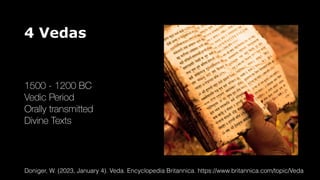
4 Vedas
1500 - 1200 BC
Vedic Period
Orally transmitted
Divine Texts
Doniger, W. (2023, January 4). Veda. Encyclopedia Britannica. https://www.britannica.com/topic/Veda
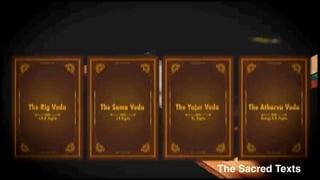
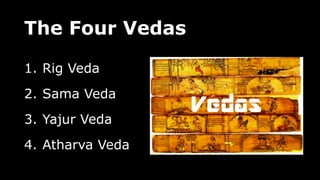
The Four Vedas
1. Rig Veda
2. Sama Veda
3. Yajur Veda
4. Atharva Veda
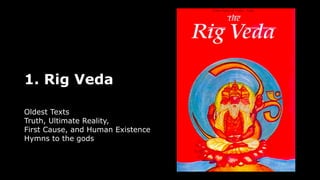
1. Rig Veda
Oldest Texts
Truth, Ultimate Reality,
First Cause, and Human Existence
Hymns to the gods
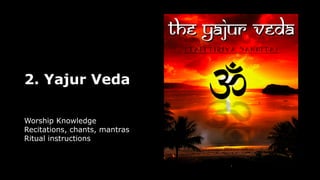
2. Yajur Veda
Worship Knowledge
Recitations, chants, mantras
Ritual instructions
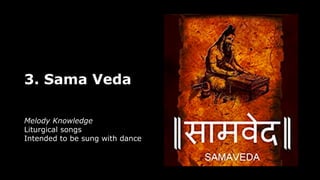
3. Sama Veda
Melody Knowledge
Liturgical songs
Intended to be sung with dance
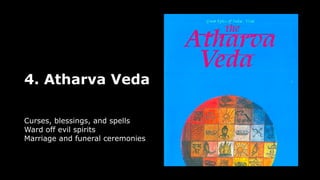
4. Atharva Veda
Curses, blessings, and spells
Ward off evil spirits
Marriage and funeral ceremonies
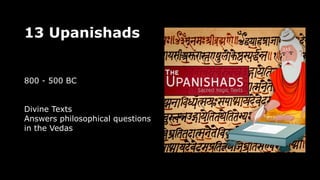
13 Upanishads
800 - 500 BC
Divine Texts
Answers philosophical questions
in the Vedas
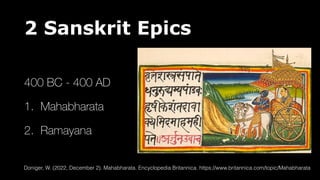
2 Sanskrit Epics
400 BC - 400 AD
1. Mahabharata
2. Ramayana
Doniger, W. (2022, December 2). Mahabharata. Encyclopedia Britannica. https://www.britannica.com/topic/Mahabharata
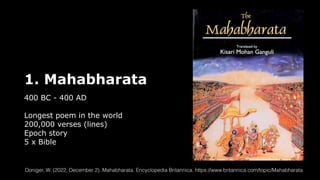
1. Mahabharata
400 BC - 400 AD
Longest poem in the world
200,000 verses (lines)
Epoch story
5 x Bible
Doniger, W. (2022, December 2). Mahabharata. Encyclopedia Britannica. https://www.britannica.com/topic/Mahabharata
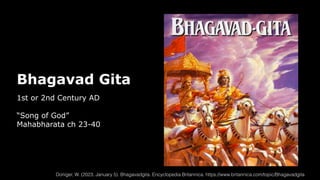
Bhagavad Gita
1st or 2nd Century AD
“Song of God”
Mahabharata ch 23-40
Doniger, W. (2023, January 5). Bhagavadgita. Encyclopedia Britannica. https://www.britannica.com/topic/Bhagavadgita
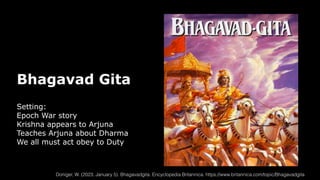
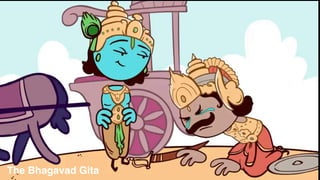
Bhagavad Gita
Setting:
Epoch War story
Krishna appears to Arjuna
Teaches Arjuna about Dharma
We all must act obey to Duty
Doniger, W. (2023, January 5). Bhagavadgita. Encyclopedia Britannica. https://www.britannica.com/topic/Bhagavadgita
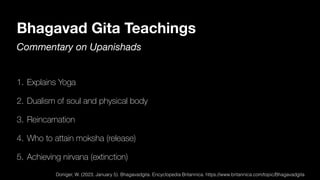
Bhagavad Gita Teachings
Commentary on Upanishads
1. Explains Yoga
2. Dualism of soul and physical body
3. Reincarnation
4. Who to attain moksha (release)
5. Achieving nirvana (extinction)
Doniger, W. (2023, January 5). Bhagavadgita. Encyclopedia Britannica. https://www.britannica.com/topic/Bhagavadgita
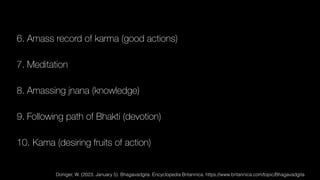
6. Amass record of karma (good actions)
7. Meditation
8. Amassing jnana (knowledge)
9. Following path of Bhakti (devotion)
10. Kama (desiring fruits of action)
Doniger, W. (2023, January 5). Bhagavadgita. Encyclopedia Britannica. https://www.britannica.com/topic/Bhagavadgita
The Bhagavad Gita
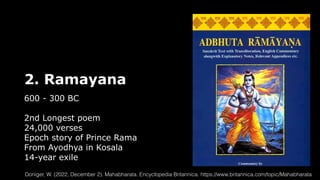
2. Ramayana
600 - 300 BC
2nd Longest poem
24,000 verses
Epoch story of Prince Rama
From Ayodhya in Kosala
14-year exile
Doniger, W. (2022, December 2). Mahabharata. Encyclopedia Britannica. https://www.britannica.com/topic/Mahabharata
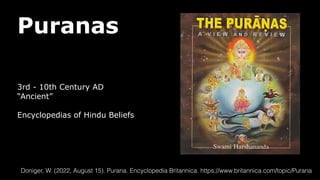
Puranas
3rd - 10th Century AD
“Ancient”
Encyclopedias of Hindu Beliefs
Doniger, W. (2022, August 15). Purana. Encyclopedia Britannica. https://www.britannica.com/topic/Purana
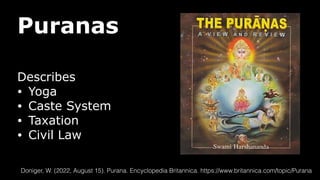
Puranas
Describes
• Yoga
• Caste System
• Taxation
• Civil Law
Doniger, W. (2022, August 15). Purana. Encyclopedia Britannica. https://www.britannica.com/topic/Purana
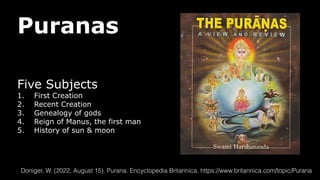
Puranas
Five Subjects
1. First Creation
2. Recent Creation
3. Genealogy of gods
4. Reign of Manus, the first man
5. History of sun & moon
Doniger, W. (2022, August 15). Purana. Encyclopedia Britannica. https://www.britannica.com/topic/Purana
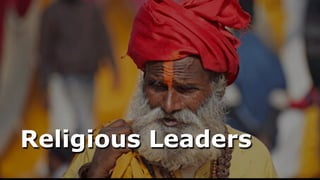
Religious Leaders
Terms for Religious leaders
• Swami
• Guru
• Maharishi
• Yogi
• Pundit or Punjaris
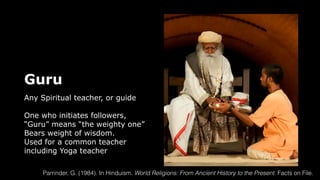
Guru
Any Spiritual teacher, or guide
One who initiates followers,
“Guru” means “the weighty one”
Bears weight of wisdom.
Used for a common teacher
including Yoga teacher
Parrinder, G. (1984). In Hinduism. World Religions: From Ancient History to the Present. Facts on File.
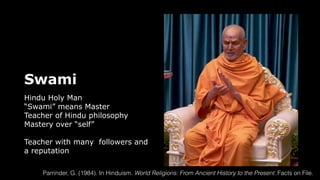
Swami
Hindu Holy Man
“Swami” means Master
Teacher of Hindu philosophy
Mastery over “self”
Teacher with many followers and
a reputation
Parrinder, G. (1984). In Hinduism. World Religions: From Ancient History to the Present. Facts on File.
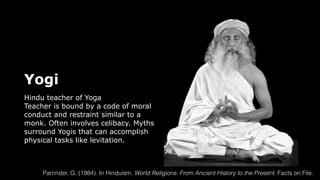
Yogi
Hindu teacher of Yoga
Teacher is bound by a code of moral
conduct and restraint similar to a
monk. Often involves celibacy. Myths
surround Yogis that can accomplish
physical tasks like levitation.
Parrinder, G. (1984). In Hinduism. World Religions: From Ancient History to the Present. Facts on File.
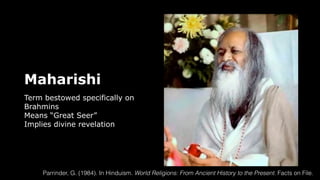
Maharishi
Term bestowed specifically on
Brahmins
Means “Great Seer”
Implies divine revelation
Parrinder, G. (1984). In Hinduism. World Religions: From Ancient History to the Present. Facts on File.
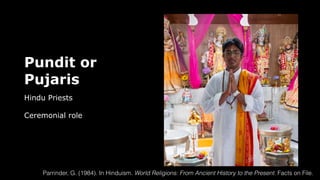
Pundit or
Pujaris
Hindu Priests
Ceremonial role
Parrinder, G. (1984). In Hinduism. World Religions: From Ancient History to the Present. Facts on File.
Practices
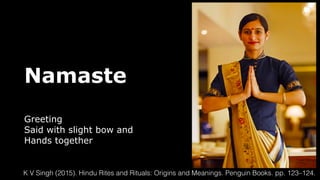
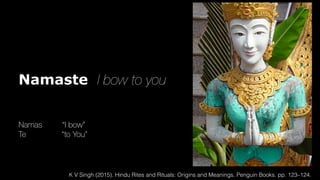
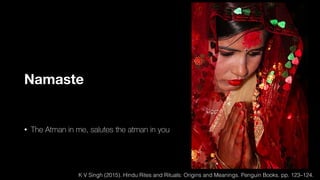
Namaste
Greeting
Said with slight bow and
Hands together
K V Singh (2015). Hindu Rites and Rituals: Origins and Meanings. Penguin Books. pp. 123–124.
Namaste I bow to you
Namas “I bow”
Te “to You”
K V Singh (2015). Hindu Rites and Rituals: Origins and Meanings. Penguin Books. pp. 123–124.
Namaste
• The Atman in me, salutes the atman in you
K V Singh (2015). Hindu Rites and Rituals: Origins and Meanings. Penguin Books. pp. 123–124.
Yoga
History
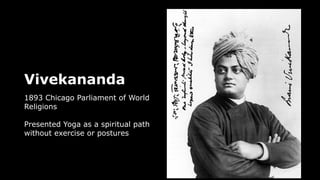
Vivekananda
1893 Chicago Parliament of World
Religions
Presented Yoga as a spiritual path
without exercise or postures
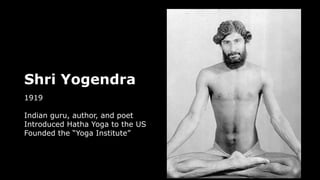
Shri Yogendra
1919
Indian guru, author, and poet
Introduced Hatha Yoga to the US
Founded the “Yoga Institute”
Yoga Institute
1919
Bear Mountain, New York
About 1 hr north of NYC
Drew students and taught Hatha
Yoga.
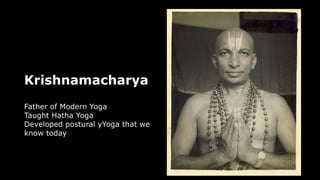
Krishnamacharya
Father of Modern Yoga
Taught Hatha Yoga
Developed postural yYoga that we
know today
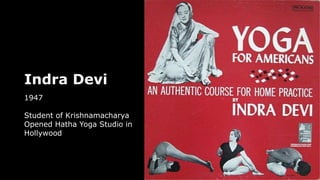
Indra Devi
1947
Student of Krishnamacharya
Opened Hatha Yoga Studio in
Hollywood
Types of Yoga
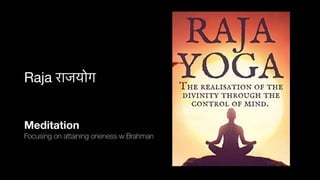
Raja राजयोग
Meditation
Focusing on attaining oneness w Brahman
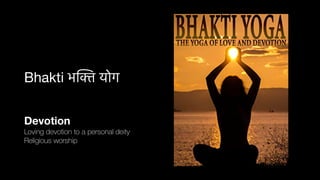
Bhakti भ
क्ति
योग
Devotion
Loving devotion to a personal deity
Religious worship
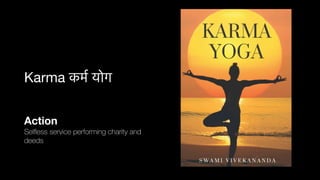
Karma क
र्म
योग
Action
Sel
fl
ess service performing charity and
deeds
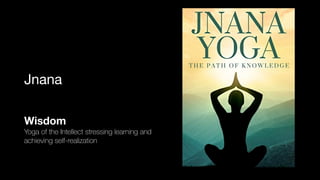
Jnana
Wisdom
Yoga of the Intellect stressing learning and
achieving self-realization
Vegetarianism
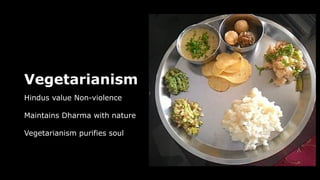
Vegetarianism
Hindus value Non-violence
Maintains Dharma with nature
Vegetarianism purifies soul
Why are cows sacred
1. Because most Hindus are vegetarian therefore depend on milk
2. Because cows are like a mothers who gives life
3. Because cows are associated with mother goddesses
4. Because were sacred in the Vedas
5. Because Krishna, when he was on earth, was a cattle herder
Why is the cow sacred?
The Chakras
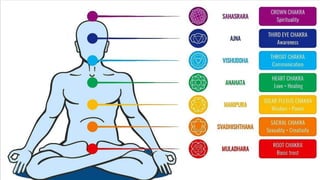
Chakra
The seven focal points on the body that align with the centers
of energy, and are the focus of meditation
Britannica, T. Editors of Encyclopaedia (2022, November 14). chakra. Encyclopedia Britannica. https://
www.britannica.com/topic/chakra
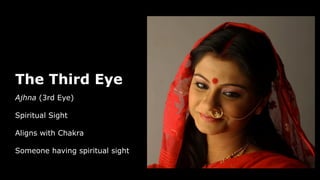
The Third Eye
Ajhna (3rd Eye)
Spiritual Sight
Aligns with Chakra
Someone having spiritual sight
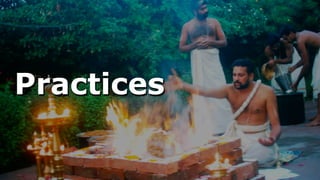
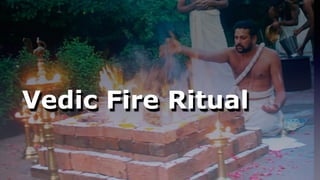
Vedic Fire Ritual
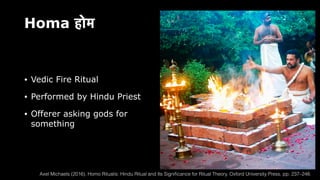
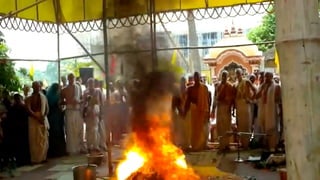
Homa होम
• Vedic Fire Ritual
• Performed by Hindu Priest
• Offerer asking gods for
something
Axel Michaels (2016). Homo Ritualis: Hindu Ritual and Its Signi
fi
cance for Ritual Theory. Oxford University Press. pp. 237–248.
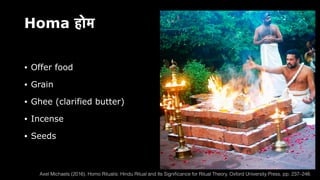
Homa होम
• Offer food
• Grain
• Ghee (clarified butter)
• Incense
• Seeds
Axel Michaels (2016). Homo Ritualis: Hindu Ritual and Its Signi
fi
cance for Ritual Theory. Oxford University Press. pp. 237–248.
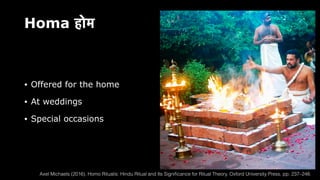
Homa होम
• Offered for the home
• At weddings
• Special occasions
Axel Michaels (2016). Homo Ritualis: Hindu Ritual and Its Signi
fi
cance for Ritual Theory. Oxford University Press. pp. 237–248.
Hindu
Holidays
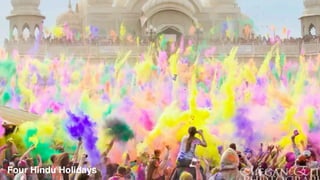
Four Hindu Holidays
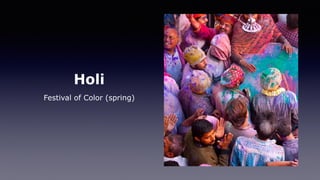
Holi
Festival of Color (spring)
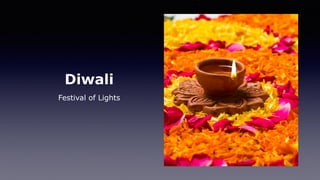
Diwali
Festival of Lights
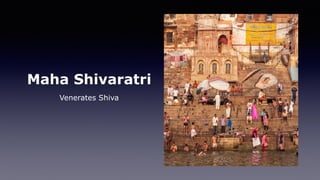
Maha Shivaratri
Venerates Shiva
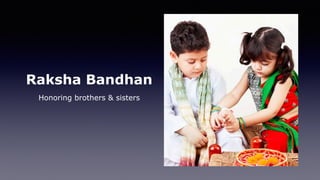
Raksha Bandhan
Honoring brothers & sisters
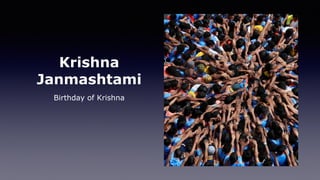
Krishna
Janmashtami
Birthday of Krishna
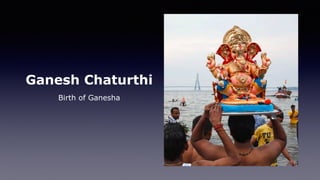
Ganesh Chaturthi
Birth of Ganesha
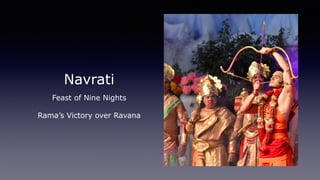
Navrati
Feast of Nine Nights
Rama’s Victory over Ravana
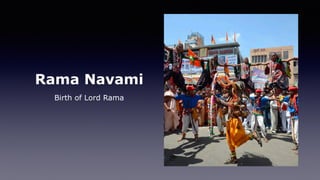
Rama Navami
Birth of Lord Rama
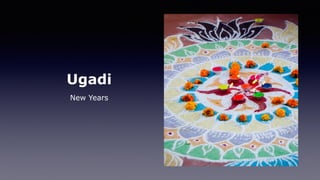
Ugadi
New Years
Branches
Four Branches
1. Vaishnavas
2. Shaivas
3. Smartas
4. Shaktas
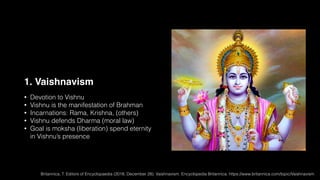
1. Vaishnavism
• Devotion to Vishnu
• Vishnu is the manifestation of Brahman
• Incarnations: Rama, Krishna, (others)
• Vishnu defends Dharma (moral law)
• Goal is moksha (liberation) spend eternity
in Vishnu’s presence
Britannica, T. Editors of Encyclopaedia (2018, December 28). Vaishnavism. Encyclopedia Britannica. https://www.britannica.com/topic/Vaishnavism
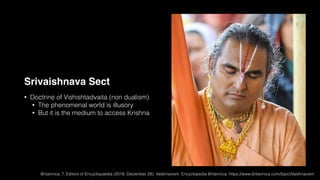
Srivaishnava Sect
• Doctrine of Vishishtadvaita (non dualism)
• The phenomenal world is illusory
• But it is the medium to access Krishna
Britannica, T. Editors of Encyclopaedia (2018, December 28). Vaishnavism. Encyclopedia Britannica. https://www.britannica.com/topic/Vaishnavism
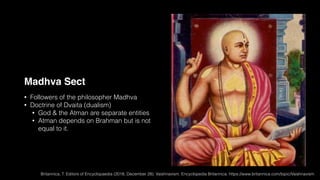
Madhva Sect
• Followers of the philosopher Madhva
• Doctrine of Dvaita (dualism)
• God & the Atman are separate entities
• Atman depends on Brahman but is not
equal to it.
Britannica, T. Editors of Encyclopaedia (2018, December 28). Vaishnavism. Encyclopedia Britannica. https://www.britannica.com/topic/Vaishnavism
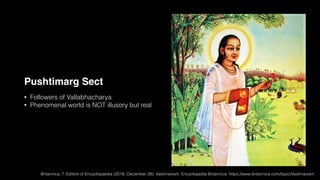
Pushtimarg Sect
• Followers of Vallabhacharya
• Phenomenal world is NOT illusory but real
Britannica, T. Editors of Encyclopaedia (2018, December 28). Vaishnavism. Encyclopedia Britannica. https://www.britannica.com/topic/Vaishnavism
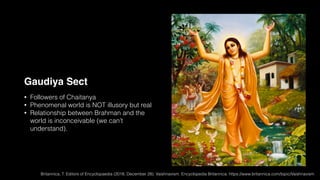
Gaudiya Sect
• Followers of Chaitanya
• Phenomenal world is NOT illusory but real
• Relationship between Brahman and the
world is inconceivable (we can’t
understand).
Britannica, T. Editors of Encyclopaedia (2018, December 28). Vaishnavism. Encyclopedia Britannica. https://www.britannica.com/topic/Vaishnavism
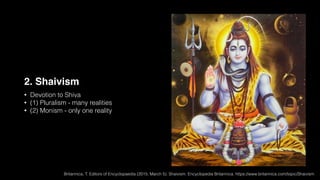
2. Shaivism
• Devotion to Shiva
• (1) Pluralism - many realities
• (2) Monism - only one reality
Britannica, T. Editors of Encyclopaedia (2015, March 5). Shaivism. Encyclopedia Britannica. https://www.britannica.com/topic/Shaivism
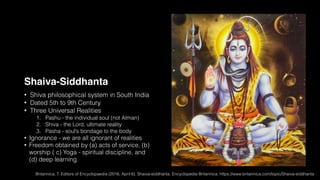
Shaiva-Siddhanta
• Shiva philosophical system in South India
• Dated 5th to 9th Century
• Three Universal Realities
1. Pashu - the individual soul (not Atman)
2. Shiva - the Lord, ultimate reality
3. Pasha - soul’s bondage to the body
• Ignorance - we are all ignorant of realities
• Freedom obtained by (a) acts of service, (b)
worship ( c) Yoga - spiritual discipline, and
(d) deep learning.
Britannica, T. Editors of Encyclopaedia (2016, April 6). Shaiva-siddhanta. Encyclopedia Britannica. https://www.britannica.com/topic/Shaiva-siddhanta
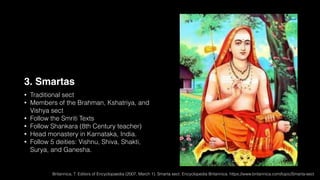
3. Smartas
• Traditional sect
• Members of the Brahman, Kshatriya, and
Vishya sect
• Follow the Smriti Texts
• Follow Shankara (8th Century teacher)
• Head monastery in Karnataka, India.
• Follow 5 deities: Vishnu, Shiva, Shakti,
Surya, and Ganesha.
Britannica, T. Editors of Encyclopaedia (2007, March 1). Smarta sect. Encyclopedia Britannica. https://www.britannica.com/topic/Smarta-sect
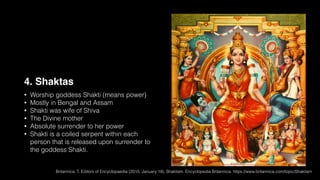
4. Shaktas
• Worship goddess Shakti (means power)
• Mostly in Bengal and Assam
• Shakti was wife of Shiva
• The Divine mother
• Absolute surrender to her power
• Shakti is a coiled serpent within each
person that is released upon surrender to
the goddess Shakti.
Britannica, T. Editors of Encyclopaedia (2015, January 19). Shaktism. Encyclopedia Britannica. https://www.britannica.com/topic/Shaktism
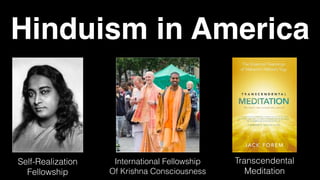
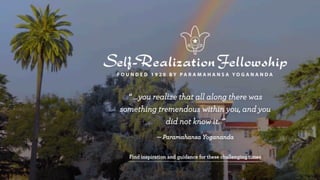
Self-Realization
Fellowship
International Fellowship
Of Krishna Consciousness
Hinduism in America
Transcendental
Meditation
Transcendental
Meditation
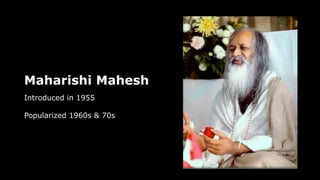
Maharishi Mahesh
Introduced in 1955
Popularized 1960s & 70s
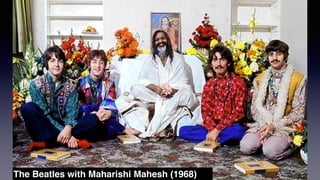
The Beatles with Maharishi Mahesh (1968)
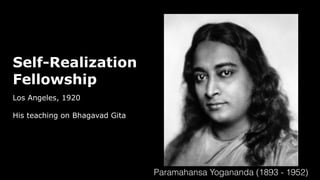
Self-Realization
Fellowship
Los Angeles, 1920
His teaching on Bhagavad Gita
Paramahansa Yogananda (1893 - 1952)
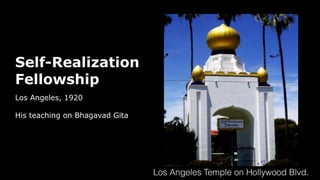
Self-Realization
Fellowship
Los Angeles, 1920
His teaching on Bhagavad Gita
Los Angeles Temple on Hollywood Blvd.
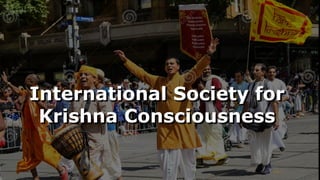
International Society for
Krishna Consciousness
ISKS
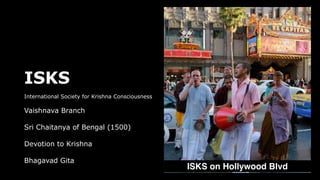
International Society for Krishna Consciousness
Vaishnava Branch
Sri Chaitanya of Bengal (1500)
Devotion to Krishna
Bhagavad Gita
ISKS on Hollywood Blvd
ISKS
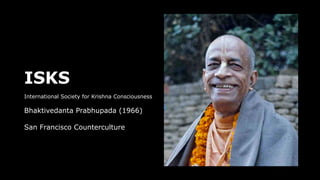
International Society for Krishna Consciousness
Bhaktivedanta Prabhupada (1966)
San Francisco Counterculture
ISKS
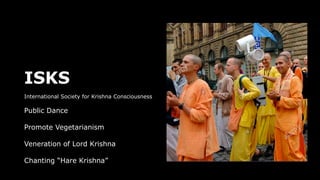
International Society for Krishna Consciousness
Public Dance
Promote Vegetarianism
Veneration of Lord Krishna
Chanting “Hare Krishna”
My Sweet Lord (George Harrison, 1969)
Hindu Adoptions of
Christian Narratives
Jesus in India
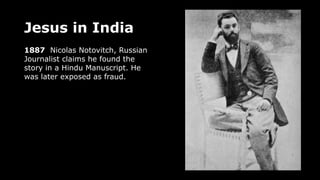
1887 Nicolas Notovitch, Russian
Journalist claims he found the
story in a Hindu Manuscript. He
was later exposed as fraud.
Jesus in India
1887 Nicolas Notovitch
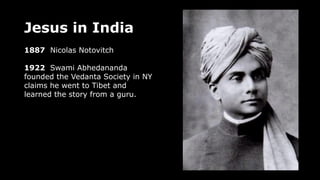
1922 Swami Abhedananda
founded the Vedanta Society in NY
claims he went to Tibet and
learned the story from a guru.
Jesus in India
1887 Nicolas Notovitch
1922 Swami Abhedananda
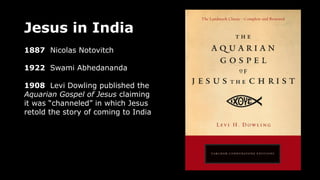
1908 Levi Dowling published the
Aquarian Gospel of Jesus claiming
it was “channeled” in which Jesus
retold the story of coming to India
Jesus in India
1887 Nicolas Notovitch
1922 Swami Abhedananda
1908 Levi Dowling
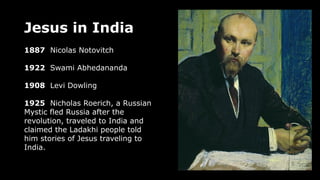
1925 Nicholas Roerich, a Russian
Mystic fled Russia after the
revolution, traveled to India and
claimed the Ladakhi people told
him stories of Jesus traveling to
India.
Jesus in India
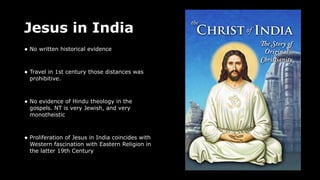
• No written historical evidence
• Travel in 1st century those distances was
prohibitive.
• No evidence of Hindu theology in the
gospels. NT is very Jewish, and very
monotheistic
• Proliferation of Jesus in India coincides with
Western fascination with Eastern Religion in
the latter 19th Century
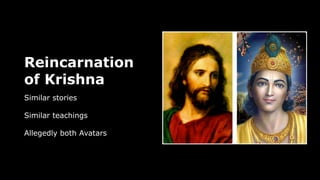
Reincarnation
of Krishna
Similar stories
Similar teachings
Allegedly both Avatars

INT-244 World Religions Topic 4 Hinduism

  • 1.
  • 2.
    Essay Feedback • Goodjob using the resources! • Please remember to write a thesis sentence in next essay. • Please use the template and headings • The next essay is essentially a quiz on general Hinduism • Cite Scripture in the reflection part.
  • 3.
    In this essay,I will introduce Hinduism, introduce the three main Hindu deities, describe India’s caste system, discuss a Christian church in India, discuss barriers a Hindu faces in considering the gospel, and compare four key Hindu beliefs with Christiian beliefs 3
  • 4.
  • 5.
    Citation “Hinduism is theoldest religion in the world, originating in Central Asia and the Indus Valley, still practiced in the present day” (Mark, 2020, para. 1). References Mark, Joshua. (2020 June 8). Hinduism in World History Encyclopedia. https://www.worldhistory.org/hinduism/
  • 6.
    Citation “For God soloved the world” (John 3:16, ESV).
  • 7.
  • 8.
    Americanization of Religion •Seeks to be universalist (interfaith) instead of particularist • Seeks to be individualist instead of collective (person instead of community) • Seeks to be therapeutic and self-help • Seeks to provide practical, daily help instead of abstract theology 8
  • 9.
    Hinduism INT-244 | WorldReligions | Topic 4
  • 10.
  • 11.
    Indus River Valley Sindhu(Sanskrit) Hindu (Persian) India (Greek) India I n d u s R i v e r Origin of the Name “Hindu”
  • 12.
    Sanatan Dharma The eternalpath India I n d u s R i v e r Hindus call their religion:
  • 13.
  • 14.
    World Religions Christianity 2.5billion 32% Islam 1.9 billion 24% Hinduism 1.2 billion 15% Buddhism 533 million 7% Chinese Folk 466 million 6% https://worldpopulationreview.com/country-rankings/hindu-countries; World Religion Database. (2020). https://worldreligiondatabase.org
  • 15.
    Demographics • Considered oldestreligion • Worldwide 1.2 billion • 15% of world’s population • 3rd largest religion in world worldreligiondatabase.org (2021)
  • 16.
    Demographics • Worldwide 1.2billion • India 1.09 billion • United States 2.5 million • Arizona 33,000 (https://worldpopulationreview.com/country-rankings/hindu-countries; AZCentral, 2014)
  • 17.
    Hinduism is thesecond-largest practiced religion, after Christianity, in Arizona, according to the U.S. Religious Congregations & Membership Study from 2010. The study showed that there are nearly 33,000 people who belong to approximately 35 Hindu congregations throughout the state. https://uscanadainfo.com/religion-in-arizona/
  • 18.
  • 19.
    Pew Research (2014) Whatdo most of these countries have in common?
  • 20.
    Pew Research (2014) Whatdo most of these countries have in common?
  • 21.
    Indians are adiaspora people. “According to the Minister of External A ff airs, There are 29 million non-resident Indians living outside of India comprising the largest diaspora people-group…Every year 2.5 million Indians emigrate out of India” "Population of Overseas Indians". mea.gov.in. Ministry of External A ff airs, Government of India. 2023-02-15.
  • 22.
  • 23.
    Periods of History 1.Indus Valley Period (2700 to 1500 BC) 2. Vedic Period (1500 to 500 BC) 3. Second Urbanisation (500 - 200 BC) 4. Early Classical (200 BC to 320 AD) 5. Classical Period (320 AD to 500 AD) 6. Medieval to Early Modern (500 - 1757) 7. Modern Period (1757 to 1947) 8. Independent India (1947 to present)
  • 24.
    Periods of History 1.Indus Valley Period (2700 to 1500 BC)
  • 25.
  • 26.
    Calkins, P. B., Raikar, . Sanat Pai , Srivastava, . A.L. , Wolpert, . Stanley A. , Thapar, . Romila , Alam, . Muzaffar , Champakalakshmi, . R. , Spear, . T.G. Percival , Allchin, . Frank Raymond , Dikshit, . K.R. , Schwartzberg, . Joseph E. and Subrahmanyam, . Sanjay (2023, February 22). India. Encyclopedia Britannica. https://www.britannica.com/place/India 1500 BC Indus River Valley INDIA
  • 27.
    Aryan Migration 1500 BC— Early Vedic Period Introduced the Sanskrit Language Mark, J. (2020) World History Encyclopedia
  • 28.
    Aryan Migration Central Asiancivilization Aryan is not a race “Aryan” means “free men” Mark, J. (2020) World History Encyclopedia
  • 29.
    Periods of History 1.Indus Valley Period (2700 to 1500 BC) 2. Vedic Period (1500 to 500 BC)
  • 30.
    Vedic Period 1500 BC- 500 BC Vedic texts written Religion called Brahmanism Mark, J. (2020) World History Encyclopedia
  • 31.
    Brahmanism 1500 BC -500 BC • Brahman (ultimate reality) • Ultimate god or real being • First Cause • First Rule-Maker Mark, J. (2020) World History Encyclopedia
  • 32.
    Brahmanism There is aFirst Cause The Universe is ordered Rita — Laws the universe follows Sanatan Dharma — Eternal Order Mark, J. (2020) World History Encyclopedia
  • 33.
    Brahmanism Humans consist of 1.Physical body 2. Mind 3. Atman Mark, J. (2020) World History Encyclopedia
  • 34.
    Brahmanism The Atman If thereis a physical self, and If there is a Brahman, then There must also be a transcendent self to connect with Brahman Mark, J. (2020) World History Encyclopedia
  • 35.
    Veda Texts 1500 -1000 BC • Rig Veda • Yajur Veda • Sama Veda Jones & Ryan. (2007). Encyclopedia of Hinduism.
  • 36.
    Upanishad Texts 1000 -400 BC Mostly Philosophy Describes: Order of the Universe Jones & Ryan. (2007). Encyclopedia of Hinduism.
  • 37.
    Trimurti - 3Gods 1. Brahma the Creator 2. Vishnu the Preserver 3. Shiva the Destoyer Jones & Ryan. (2007). Encyclopedia of Hinduism.
  • 38.
    Periods of History 1.Indus Valley Period (2700 to 1500 BC) 2. Vedic Period (1500 to 500 BC) 3. Second Urbanisation (500 - 200 BC)
  • 39.
    Bhagavad Gita 500 BC- 200 AD Described Order of Society Described Caste System
  • 40.
    Periods of History 1.Indus Valley Period (2700 to 1500 BC) 2. Vedic Period (1500 to 500 BC) 3. Second Urbanisation (500 - 200 BC) 4. Early Classical (200 BC to 320 AD)
  • 41.
    Early Classical Golden Age •Worship of Brahma diminishes • Worship of Vishnu & Shiva • Concept of Dharma grows
  • 42.
    Early Classical Golden Age •Worship of Brahma diminishes • Worship of Vishnu & Shiva • Concept of Dharma grows
  • 43.
    Early Classical Dharma • Theeternal order and inherent nature of reality, a cosmic law underlying right behavior and social order Mark, J. J. (2020, June 08). Hinduism. World History Encyclopedia. Retrieved from https://www.worldhistory.org/hinduism/
  • 44.
  • 45.
    Periods of History 1.Indus Valley Period (2700 to 1500 BC) 2. Vedic Period (1500 to 500 BC) 3. Second Urbanisation (500 - 200 BC) 4. Early Classical (200 BC to 320 AD) 5. Classical Period (320 AD to 500 AD)
  • 46.
    Classical Period • GuptaEmpire (320-650 AD) • United India politically
  • 47.
    Periods of History 1.Indus Valley Period (2700 to 1500 BC) 2. Vedic Period (1500 to 500 BC) 3. Second Urbanisation (500 - 200 BC) 4. Early Classical (200 BC to 320 AD) 5. Classical Period (320 AD to 500 AD) 6. Medieval to Early Modern (500 - 1757)
  • 48.
    Medieval Period 500 -1757 AD • Wandering Teachers • Hinduism travels outside of India • Islamic Invasion • Decline of political influence Dashavatara Temple to Vishnu Mark (2020) World History Encyclopedia
  • 49.
    Periods of History 1.Indus Valley Period (2700 to 1500 BC) 2. Vedic Period (1500 to 500 BC) 3. Second Urbanisation (500 - 200 BC) 4. Early Classical (200 BC to 320 AD) 5. Classical Period (320 AD to 500 AD) 6. Medieval to Early Modern (500 - 1757) 7. Modern Period (1757 - 1947)
  • 50.
    Modern Period 1757 -1949 • British Occupation of India • English East India Company • Christian Missionaries • Modernization of India
  • 51.
    Periods of History 1.Indus Valley Period (2700 to 1500 BC) 2. Vedic Period (1500 to 500 BC) 3. Second Urbanisation (500 - 200 BC) 4. Early Classical (200 BC to 320 AD) 5. Classical Period (320 AD to 500 AD) 6. Medieval to Early Modern (500 - 1757) 7. Modern Period (1757 - 1947) 8. Independent India (1947 - Present)
  • 52.
    India’s Independence 1949 -Present • Mahatma Gandhi, first Prime Minister • Hinduism state religion • Modernization of Hinduism • Elimination of the Caste System
  • 54.
  • 55.
    Abrahmic Religions vHinduism Mt. Sinai Moses The Gospel Jesus Quran Muhammad
  • 56.
    Hinduism v. AbrahamicReligions Time is cyclic Polytheist Truth is heard and transmitted All religions have truth 56 Time is linear Monotheist Truth is revealed by a prophet Only community has the truth
  • 57.
    Revelation in Hinduism Truth— There is an ultimate truth. It is not relative. It is passed down. Shruti — Truth that is heard, recorded, and transmitted by sages Smriti — Truth that is remembered by ordinary people and transmitted. Britannica, T. Editors of Encyclopaedia (2015, February 27). Shruti. Encyclopedia Britannica. https://www.britannica.com/topic/Shruti
  • 58.
    Universe is Cyclic •Humans go through cycles of reincarnation • Universe is endlessly cyclic
  • 59.
    Seven Beliefs 1. Brahman 2.Atman 3. Karma 4. Moksha 5. Yuga Cycle 6. Dharma 7. The Vedas
  • 60.
    1. Brahman • UniversalSoul • Material everything’s made from • Energy pervading the universe • Impersonal Force
  • 61.
    2. Atman Humans madeup of • Physical Body • Mind • Self • Atman - transcendent Self
  • 62.
    Atman & theSoul Brahman The Ultimate Essence Atman comes from Atman आ त्म न् Eternal essence of self Prakrit प्र क ृ ति Body, the physical matter Ahamkara अहंकार Ego, Self-Identity Citta चि त्त Mind, Your Consciousness Mark, J. (2020) World History Encyclopedia
  • 63.
    3. Karma Cosmic Justice Goodand bad actions impact: • Society • Us later in life • Us in the next life
  • 64.
    Past Life PresentLife Future Life 3. Karma
  • 65.
    1. What doyou agree with? 2. What do you disagree with? 3. What is a bridge to explain the gospel to a Hindu?
  • 66.
    4. Yuga Cycle AkaKalpic Cycle
  • 67.
    Summary 4 Yugas =1 Mahayuga 1 Mahayuga = 1 Universe 1000 Mahayugas = 1 Kalpa 1 Kalpa = 1 Day in Brahma’s life
  • 68.
    Mahayuga महायुग 1 Mahayuga 1cycle of the universe 4 Yugas 4.32 Million Years
  • 69.
    Duration Satya 1,728,000 yrs Treta1,296,000 yrs Dwapar 864,000 yrs Kali 432,000 yrs
  • 70.
  • 71.
    Satya Yuga Aka KritaYuga 1,728,000 years Jones & Ryan. (2007). Encyclopedia of Hinduism SATYA
  • 72.
    Satya Yuga • Brahmathe Creator Rules • Golden Age • No Castes • No Distinctions Jones & Ryan. (2007). Encyclopedia of Hinduism
  • 73.
    Satya Yuga Dharma theBull has 4 legs Jones & Ryan. (2007). Encyclopedia of Hinduism
  • 74.
    Treta Yuga 1,296,000 years Jones& Ryan. (2007). Encyclopedia of Hinduism TRETA
  • 75.
    Treta Yuga • Brahmathe Creator Rules • Silver Age Jones & Ryan. (2007). Encyclopedia of Hinduism
  • 76.
    Treta Yuga • HumanCivilization • Humans became greedy • Brahma has to create a caste system to maintain order Jones & Ryan. (2007). Encyclopedia of Hinduism
  • 77.
    Treta Yuga • Dharmathe Bull has three legs Jones & Ryan. (2007). Encyclopedia of Hinduism
  • 78.
    Dwapar Yuga 864,000 years Jones& Ryan. (2007). Encyclopedia of Hinduism
  • 79.
    Dwapar Yuga • Vishnuthe Maintainer rules • Bronze Age Jones & Ryan. (2007). Encyclopedia of Hinduism
  • 80.
    Dwapar Yuga • Secularizationof Civilization • Neglect of the Caste System • Neglect of the gods • Truth is no longer followed Jones & Ryan. (2007). Encyclopedia of Hinduism
  • 81.
    Dwapar Yuga • Vishnuhas to intervene in the world to maintain order. • He sends his avatar Krishna Jones & Ryan. (2007). Encyclopedia of Hinduism
  • 82.
    Dwapar Yuga • Dharmathe Bull has two legs Jones & Ryan. (2007). Encyclopedia of Hinduism
  • 83.
    Kali Yuga 432,000 years Jones& Ryan. (2007). Encyclopedia of Hinduism
  • 84.
    Kali Yuga • SHIVAthe Destroyer Rules • Iron Age Jones & Ryan. (2007). Encyclopedia of Hinduism
  • 85.
    Kali Yuga • Materialism- Warfare • Age of Darkness • Civilizations ends in destruction • Shiva Dances and world ends Jones & Ryan. (2007). Encyclopedia of Hinduism
  • 86.
    Kali Yuga • Dharmathe Bull has one leg, then none Jones & Ryan. (2007). Encyclopedia of Hinduism
  • 87.
    World is Destroyed Worldis recreated Cycle starts again
  • 88.
    Kalpa क ल्प 1 Kalpa= 1,000 Mahayugas 4.32 billion years 1 Day in the life of Brahma
  • 89.
    Summary 4 Yugas =1 Mahayuga 1 Mahayuga = 1 Universe 1000 Mahayugas = 1 Kalpa 1 Kalpa = 1 Day in Brahma’s life
  • 90.
  • 91.
    1. What doyou agree with? 2. What do you disagree with? 3. What is a bridge to explain the gospel to a Hindu?
  • 92.
    5. Dharma One’s dutyin life performed with the proper action Mark, J. J. (2020, June 08). Hinduism. World History Encyclopedia. Retrieved from https://www.worldhistory.org/hinduism/
  • 93.
    5. Dharma When oneperforms their duty, they and all society experience harmony & balance Mark, J. J. (2020, June 08). Hinduism. World History Encyclopedia. Retrieved from https://www.worldhistory.org/hinduism/
  • 94.
    6. Moksha Release fromSamsara The endless cycle of birth, death and rebirth Mark, J. J. (2020, June 08). Hinduism. World History Encyclopedia. Retrieved from https://www.worldhistory.org/hinduism/
  • 95.
    Samsara Endless cycle ofbirth-life-death-rebirth Mark, J. J. (2020, June 08). Hinduism. World History Encyclopedia. Retrieved from https://www.worldhistory.org/hinduism/
  • 96.
    Moksha (release) How dowe achieve Moksha? Mark, J. J. (2020, June 08). Hinduism. World History Encyclopedia. Retrieved from https://www.worldhistory.org/hinduism/
  • 97.
    3 Goals toachieve Moksha 1. Dharma — Perform one’s duty in life 2. Artha — Acquire material wealth in life 3. Kama — Experience Love, sexuality, Pleasure Mark, J. J. (2020, June 08). Hinduism. World History Encyclopedia. Retrieved from https://www.worldhistory.org/hinduism/
  • 98.
    3 Helps &Hinderances 1. Sattva — wisdom, goodness, detachment 2. Rajas — passionate intensity, aggression 3. Tamas — darkness, confusion, helplessness
  • 99.
    7. Vedas The sacredtexts of Hinduism
  • 100.
    Seven Beliefs 1. Brahman 2.Atman 3. Karma 4. Moksha 5. Yuga cycle 6. Dharma 7. The Vedas
  • 101.
  • 102.
    Caste Born into acaste because of Karma (divine justice), as the result of your actions in a previous life. It is your Dharma (duty) to ful fi ll the role you were born into.
  • 103.
  • 104.
    1500 BC Indus River Valley Aryansbecame the ruling class over the inhabitants
  • 105.
    Caste System inHistory • Aryan Invasion • Castes created based on skills & abilities • 5th Century BC laws fixed the castes by ancestry • Rule #1 - Brahmins are Lord of Castes • Rule #2 - Hindus cannot change caste
  • 106.
    Caste System inHistory • 400 AD — Dalit (outcaste) emerged • Possibly in response to Buddhism’s revolt Britannica, T. Editors of Encyclopaedia (2022, October 27). untouchable. Encyclopedia Britannica. https://www.britannica.com/topic/untouchable
  • 107.
    Caste System inHistory • British exploited castes (1757 - 1930s) • British established laws protecting (1930s - 1947) • Gandhi ended caste system (1947) • Castes continue as social discrimination
  • 108.
    (KING 5 News)_ Seattlebecomes fi rst city to outlaw caste discrimination
  • 109.
  • 110.
    11 When theydivided Brahma how many portions did they make? What do they call his mouth, his arms? What do they call his thighs and feet? 12 The Brahmin was his mouth, both his arms was the Rājanya made. His thighs became the Vaiśya, from his feet the Śūdra was produced. Rig Veda 10:90 https://www.sacred-texts.com/hin/rigveda/rv10090.htm Creation Myth in the Rig Veda
  • 111.
    Brahmins Priests, Teachers Kshatriyas Warriors, Princes Vaishyas Merchants,businessmen Shudras Laborers, factory workers Dalits — Outcastes Street sweepers, Latrine Cleaners
  • 113.
  • 114.
    TPS Imagine planting achurch in rural India where the Caste System persists. 1. What ethical issues will you navigate? 2. How will your church function?
  • 115.
  • 116.
    Brahma Vishnu Shiva KrishnaGanesha Murugan Parvati & Sati
  • 117.
  • 118.
    Hindu Trimurti 1. Brahma- The Creator 2. Vishnu - The Preserver 3. Shiva - The Destroyer Brama Vishnu Shiva
  • 119.
    Brahma Vishnu Shiva TheTrimurti (Three Gods) The Creator The Preserver The Destroyer
  • 120.
    Trimurti (history) Earliest record500 AD Poem Kumara Sambhava “The Birth of the War God” Describes the Trimurti • Bramha the Creator • Vishnu the Preserver • Shiva the Destroyer Britannica, T. Editors of Encyclopedia (2020, February 21). Trimurti. Encyclopedia Britannica. https://www.britannica.com/topic/trimurti-Hinduism
  • 121.
    Trimurti (history) Earliest depictionis 500 AD Sadashiva Stone relieve in a cave Temple Elephant Island, India Britannica, T. Editors of Encyclopedia (2020, February 21). Trimurti. Encyclopedia Britannica. https://www.britannica.com/topic/trimurti-Hinduism
  • 122.
    Trimurti (history) Historians claimthe Trimurti, was an attempt to integrate different legends and gods from the Vedic period into one meta-narrative. Britannica, T. Editors of Encyclopedia (2020, February 21). Trimurti. Encyclopedia Britannica. https://www.britannica.com/topic/trimurti-Hinduism
  • 123.
    Tell the Storyof the Gods Brahma https://www.worldhistory.org/Brahma/ Vishnu https://www.worldhistory.org/Vishnu/ Shiva https://www.worldhistory.org/shiva/ Krishna https://www.worldhistory.org/Krishna/ Ganesha https://www.worldhistory.org/Ganesha/ Murugan https://www.newworldencyclopedia.org/entry/Murugan
  • 124.
    1. Brahma The Creator ब्र ह्मा “TheUltimate One” Rules over Dwapara & Treta Yugas
  • 125.
    Brahma (Art) • FourHeads • Holding the Vedas (sacred texts) • Mala (beads) symbolizing time • Pitcher for water, source of Creation • Alms bowl • Seated on Lotus, from which he sprung Britannica, T. Editors of Encyclopaedia (2022, November 14). Brahma. Encyclopedia Britannica. https://www.britannica.com/topic/Brahma-Hindu-god
  • 126.
    The Four Vedas(texts) Four Yugas (epochs) Shiva cut off a 5th head because he looked at a pretty girl.
  • 127.
    Brahma (history) • Earliestdescription 2000 - 1000 BC • First described in Prapathaka (lesson) • Called the Grandfather Cartwright, M. (2015, May 16). Brahma. World History Encyclopedia. Retrieved from https://www.worldhistory.org/Brahma/
  • 128.
    Brahma (Mythology) • Bornfrom a comic golden egg (or) • Born from a Lotus in Vishnu’s Naval • Created good/evil; light/darkness • Created: gods, demons, ancestors, and men • Created Manu, the first man Cartwright, M. (2015, May 16). Brahma. World History Encyclopedia. Retrieved from https://www.worldhistory.org/Brahma/
  • 129.
    Brahma (Mythology) • Createdplants & animals on earth • Created night & day • Created demons to rule night • Created good gods to rule the day • Then abandoned his body became spirit Cartwright, M. (2015, May 16). Brahma. World History Encyclopedia. Retrieved from https://www.worldhistory.org/Brahma/
  • 130.
    Brahma (Mythology) • Brahmalooked with lust at a goddess and Shiva cut his 5th head off. • Brahma lied and lost most of his worshippers and that’s why he has few devotees • Vishnu made him the creator with no other responsibilities. Cartwright, Mark. (16 May 2015). “Brahma” . World History Encyclopedia
  • 131.
    Brahma (Hinduism) • Twotemples in India to Brahma: Pushkara, and Rajasthan. • Does not come to earth • Sleeps during this Yuga • Rarely involved Cartwright, Mark. (16 May 2015). “Brahma” . World History Encyclopedia
  • 132.
  • 133.
    2. Vishnu The preserver वि ष्णु “Theall Pervasive one” Rules over the Satya Yuga
  • 134.
    Vishnu (Art) • Blue- he is infinite • Four arms - 2 human world, 2 spiritual world • Cobra — Sheshtnag representing the many desires of the mind. Sits over him showing he mastered desires • Mace — the power of knowledge, time, intellect Jones, C. James, J. (2007). “Vishnu” in Encyclopedia of Hinduism. 492
  • 135.
    Vishnu (Art) • Conch— produces sound “OM” the sound of creation. • Discus — cuts down abhorrent men • Parma (Lotus) — divine perfection, purity, unfolding spiritual consciousness or rebirth. Jones, C. James, J. (2007). “Vishnu” in Encyclopedia of Hinduism. 492
  • 136.
    Vishnu (history) • Earliestdescription 1300 - 1000 BC • In the Rig Veda (64 times) • Vishnu saved world from a great flood Jones, C. James, J. (2007). “Vishnu” in Encyclopedia of Hinduism. 492
  • 137.
    Vishnu (history) Bhagavad Gita,a following of devotees develops and becomes (Vishnuism) Jones, C. James, J. (2007). “Vishnu” in Encyclopedia of Hinduism. 492
  • 138.
    Vishnu’s Avatars Avatar meansto descend Ten Avatars Divine appearances of gods Intervene to repair Dharma
  • 139.
    Krishna Primary Avatar a. whenearth was flooded he dragged earth out from under the sea b. Born on earth (like Jesus) spent life fixing things
  • 140.
    Krishna & theCow Lives in Vrindavan where there are cows When born on earth, is born a cow herder as a child. Reason why Cows are sacred
  • 142.
  • 143.
    Kalki Last Avatar whowill appear in the end riding on a white horse End the final Yuga
  • 144.
  • 145.
    Vishnu (Mythology) • BhagavataPurana epic, has most of the Vishnu stories. • He becomes pre-existing god • Gives nectar of immortality to other gods • Story: gods wanted nectar of eternal life. Vishnu helped produce it. Demons tried to run off with it. Vishnu created Maya (illusion) to distract them, give nectar to gods. Physical world to this day is MAYA, illusory. Cartwright, Mark. (2012). “Vishnu”. In World History Encyclopedia
  • 146.
    Vishnu’s Wives Lakshmi Bhu Devi Garuda(his eagle) Britannica, T. Editors of Encyclopaedia (2022, September 1). Lakshmi. Encyclopedia Britannica. https:// www.britannica.com/topic/Lakshmi
  • 147.
    Lakshmi Hindu goddess ofwealth and good fortune Appears with him in each incarnation Very popular among Hindus today Often small statues of her in homes Britannica, T. Editors of Encyclopaedia (2022, September 1). Lakshmi. Encyclopedia Britannica. https:// www.britannica.com/topic/Lakshmi
  • 148.
    Bhudevi Goddess of theearth Worshipped by farmers Gives life to the earth https://www.newworldencyclopedia.org/entry/bhudevi
  • 149.
    3. Shiva The Destroyer “TheAuspicious One” Rules over Kali Yuga Doniger, W. (2021, May 6). Shiva. Encyclopedia Britannica. https://www.britannica.com/topic/Shiva
  • 150.
    Shiva • Depicted asboth male & female • At end of Kali Yuga will do a dance • The world will be destroyed Doniger, W. (2021, May 6). Shiva. Encyclopedia Britannica. https://www.britannica.com/topic/Shiva
  • 151.
    Shiva (Art) 3rd eyebestows inward vision, but also destruction when focused on someone or something Skulls around neck = death Serpent around neck Riding tiger = Mastered the animal of instincts. Doniger, W. (2021, May 6). Shiva. Encyclopedia Britannica. https://www.britannica.com/topic/Shiva
  • 152.
    Shiva (History) • Shiva(the auspicious, beneficent) • First described 2600 BC in a royal seal • From Northern India • First described in the Ramayana (600 -300 BC) and then in Mahabharata (700 BC - 100 AD) • Shvetashvatara Upanishad (300 BC) claimed Shiva was the highest deity. Jones, C. James, J. (2007). “Shiva” in Encyclopedia of Hinduism. 406
  • 153.
    Shiva (Art) • Thegods recognize his power and recruit him to fight the demons • His power is in “dancing” • Four arms: 4 directions • At the end of Yuga cycle he will dance the world out of existence. • He is also the Lord of Chaos • He is also God of destruction Jones, C. James, J. (2007). “Shiva” in Encyclopedia of Hinduism. 406
  • 154.
    Shiva (Mythology) • FirstAppears with wife Sati • Sati dies, is reincarnated as Parvati, his 2nd wife. • Son Ganesha, god of lifting heavy objects • Son Murugan, god of war • Brought the Ganges river from the Milky Way Jones, C. James, J. (2007). “Shiva” in Encyclopedia of Hinduism. 406
  • 155.
  • 156.
    Sati First wife ofShiva Daughter of Daksa (sage) Shiva took her as wife without Daksa’s permission. Daksa refused to invite Shiva to a great Sacrifice Sati died of embarrassment Britannica, T. Editors of Encyclopaedia (2023, June 6). Sati. Encyclopedia Britannica. https://www.britannica.com/topic/Sati
  • 157.
    Paravati Second wife ofShiva Reincarnation of Sati Benevolent goddess Daughter of the Himalayan Mountains Britannica, T. Editors of Encyclopaedia (2023, August 18). Parvati. Encyclopedia Britannica. https://www.britannica.com/topic/Parvati
  • 158.
    Shiva’s sons Ganesha (removeobstacles) Murugan (god of war)
  • 159.
  • 160.
    Kalpa - 1Day in Life of Brahama • 994 Yugas = 1 Kalpa • 2 Kalpas = ONE 24-hour Brahma day • 1st Kalpa is daytime, Brahma is awake • 2nd Kalpa is nighttime, Brahma sleeps
  • 161.
  • 162.
    Characters • Hayagriva —the horse demon • Matsya — the fish avatar of Vishnu
  • 163.
    Characters • Hayagriva —the horse demon • Matsya — the fish avatar of Vishnu • Shraddhadeva — (aka Manu) the progenitor of the human race who saves the world from a global flood.
  • 164.
  • 165.
  • 166.
    Sacred Texts • FourVedas • Thirteen Upanishads • Great Sanskrit Epochs • Eighteen Puranas
  • 167.
  • 168.
    4 Vedas 1500 -1200 BC Vedic Period Orally transmitted Divine Texts Doniger, W. (2023, January 4). Veda. Encyclopedia Britannica. https://www.britannica.com/topic/Veda
  • 169.
    The Four Vedas 1.Rig Veda 2. Sama Veda 3. Yajur Veda 4. Atharva Veda
  • 170.
    1. Rig Veda OldestTexts Truth, Ultimate Reality, First Cause, and Human Existence Hymns to the gods
  • 171.
    2. Yajur Veda WorshipKnowledge Recitations, chants, mantras Ritual instructions
  • 172.
    3. Sama Veda MelodyKnowledge Liturgical songs Intended to be sung with dance
  • 173.
    4. Atharva Veda Curses,blessings, and spells Ward off evil spirits Marriage and funeral ceremonies
  • 174.
    13 Upanishads 800 -500 BC Divine Texts Answers philosophical questions in the Vedas
  • 175.
    2 Sanskrit Epics 400BC - 400 AD 1. Mahabharata 2. Ramayana Doniger, W. (2022, December 2). Mahabharata. Encyclopedia Britannica. https://www.britannica.com/topic/Mahabharata
  • 176.
    1. Mahabharata 400 BC- 400 AD Longest poem in the world 200,000 verses (lines) Epoch story 5 x Bible Doniger, W. (2022, December 2). Mahabharata. Encyclopedia Britannica. https://www.britannica.com/topic/Mahabharata
  • 177.
    Bhagavad Gita 1st or2nd Century AD “Song of God” Mahabharata ch 23-40 Doniger, W. (2023, January 5). Bhagavadgita. Encyclopedia Britannica. https://www.britannica.com/topic/Bhagavadgita
  • 178.
    Bhagavad Gita Setting: Epoch Warstory Krishna appears to Arjuna Teaches Arjuna about Dharma We all must act obey to Duty Doniger, W. (2023, January 5). Bhagavadgita. Encyclopedia Britannica. https://www.britannica.com/topic/Bhagavadgita
  • 179.
    Bhagavad Gita Teachings Commentaryon Upanishads 1. Explains Yoga 2. Dualism of soul and physical body 3. Reincarnation 4. Who to attain moksha (release) 5. Achieving nirvana (extinction) Doniger, W. (2023, January 5). Bhagavadgita. Encyclopedia Britannica. https://www.britannica.com/topic/Bhagavadgita
  • 180.
    6. Amass recordof karma (good actions) 7. Meditation 8. Amassing jnana (knowledge) 9. Following path of Bhakti (devotion) 10. Kama (desiring fruits of action) Doniger, W. (2023, January 5). Bhagavadgita. Encyclopedia Britannica. https://www.britannica.com/topic/Bhagavadgita
  • 181.
  • 182.
    2. Ramayana 600 -300 BC 2nd Longest poem 24,000 verses Epoch story of Prince Rama From Ayodhya in Kosala 14-year exile Doniger, W. (2022, December 2). Mahabharata. Encyclopedia Britannica. https://www.britannica.com/topic/Mahabharata
  • 183.
    Puranas 3rd - 10thCentury AD “Ancient” Encyclopedias of Hindu Beliefs Doniger, W. (2022, August 15). Purana. Encyclopedia Britannica. https://www.britannica.com/topic/Purana
  • 184.
    Puranas Describes • Yoga • CasteSystem • Taxation • Civil Law Doniger, W. (2022, August 15). Purana. Encyclopedia Britannica. https://www.britannica.com/topic/Purana
  • 185.
    Puranas Five Subjects 1. FirstCreation 2. Recent Creation 3. Genealogy of gods 4. Reign of Manus, the first man 5. History of sun & moon Doniger, W. (2022, August 15). Purana. Encyclopedia Britannica. https://www.britannica.com/topic/Purana
  • 186.
  • 187.
    Terms for Religiousleaders • Swami • Guru • Maharishi • Yogi • Pundit or Punjaris
  • 188.
    Guru Any Spiritual teacher,or guide One who initiates followers, “Guru” means “the weighty one” Bears weight of wisdom. Used for a common teacher including Yoga teacher Parrinder, G. (1984). In Hinduism. World Religions: From Ancient History to the Present. Facts on File.
  • 189.
    Swami Hindu Holy Man “Swami”means Master Teacher of Hindu philosophy Mastery over “self” Teacher with many followers and a reputation Parrinder, G. (1984). In Hinduism. World Religions: From Ancient History to the Present. Facts on File.
  • 190.
    Yogi Hindu teacher ofYoga Teacher is bound by a code of moral conduct and restraint similar to a monk. Often involves celibacy. Myths surround Yogis that can accomplish physical tasks like levitation. Parrinder, G. (1984). In Hinduism. World Religions: From Ancient History to the Present. Facts on File.
  • 191.
    Maharishi Term bestowed specificallyon Brahmins Means “Great Seer” Implies divine revelation Parrinder, G. (1984). In Hinduism. World Religions: From Ancient History to the Present. Facts on File.
  • 192.
    Pundit or Pujaris Hindu Priests Ceremonialrole Parrinder, G. (1984). In Hinduism. World Religions: From Ancient History to the Present. Facts on File.
  • 193.
  • 194.
    Namaste Greeting Said with slightbow and Hands together K V Singh (2015). Hindu Rites and Rituals: Origins and Meanings. Penguin Books. pp. 123–124.
  • 195.
    Namaste I bowto you Namas “I bow” Te “to You” K V Singh (2015). Hindu Rites and Rituals: Origins and Meanings. Penguin Books. pp. 123–124.
  • 196.
    Namaste • The Atmanin me, salutes the atman in you K V Singh (2015). Hindu Rites and Rituals: Origins and Meanings. Penguin Books. pp. 123–124.
  • 197.
  • 198.
  • 199.
    Vivekananda 1893 Chicago Parliamentof World Religions Presented Yoga as a spiritual path without exercise or postures
  • 200.
    Shri Yogendra 1919 Indian guru,author, and poet Introduced Hatha Yoga to the US Founded the “Yoga Institute”
  • 201.
    Yoga Institute 1919 Bear Mountain,New York About 1 hr north of NYC Drew students and taught Hatha Yoga.
  • 202.
    Krishnamacharya Father of ModernYoga Taught Hatha Yoga Developed postural yYoga that we know today
  • 203.
    Indra Devi 1947 Student ofKrishnamacharya Opened Hatha Yoga Studio in Hollywood
  • 204.
  • 205.
  • 206.
  • 207.
  • 208.
    Jnana Wisdom Yoga of theIntellect stressing learning and achieving self-realization
  • 209.
  • 210.
    Vegetarianism Hindus value Non-violence MaintainsDharma with nature Vegetarianism purifies soul
  • 211.
    Why are cowssacred 1. Because most Hindus are vegetarian therefore depend on milk 2. Because cows are like a mothers who gives life 3. Because cows are associated with mother goddesses 4. Because were sacred in the Vedas 5. Because Krishna, when he was on earth, was a cattle herder
  • 212.
    Why is thecow sacred?
  • 213.
  • 214.
    Chakra The seven focalpoints on the body that align with the centers of energy, and are the focus of meditation Britannica, T. Editors of Encyclopaedia (2022, November 14). chakra. Encyclopedia Britannica. https:// www.britannica.com/topic/chakra
  • 216.
    The Third Eye Ajhna(3rd Eye) Spiritual Sight Aligns with Chakra Someone having spiritual sight
  • 217.
  • 218.
    Homa होम • VedicFire Ritual • Performed by Hindu Priest • Offerer asking gods for something Axel Michaels (2016). Homo Ritualis: Hindu Ritual and Its Signi fi cance for Ritual Theory. Oxford University Press. pp. 237–248.
  • 219.
    Homa होम • Offerfood • Grain • Ghee (clarified butter) • Incense • Seeds Axel Michaels (2016). Homo Ritualis: Hindu Ritual and Its Signi fi cance for Ritual Theory. Oxford University Press. pp. 237–248.
  • 220.
    Homa होम • Offeredfor the home • At weddings • Special occasions Axel Michaels (2016). Homo Ritualis: Hindu Ritual and Its Signi fi cance for Ritual Theory. Oxford University Press. pp. 237–248.
  • 222.
  • 223.
  • 224.
  • 225.
  • 227.
  • 228.
  • 229.
  • 230.
  • 231.
    Navrati Feast of NineNights Rama’s Victory over Ravana
  • 232.
  • 233.
  • 234.
  • 235.
    Four Branches 1. Vaishnavas 2.Shaivas 3. Smartas 4. Shaktas
  • 236.
    1. Vaishnavism • Devotionto Vishnu • Vishnu is the manifestation of Brahman • Incarnations: Rama, Krishna, (others) • Vishnu defends Dharma (moral law) • Goal is moksha (liberation) spend eternity in Vishnu’s presence Britannica, T. Editors of Encyclopaedia (2018, December 28). Vaishnavism. Encyclopedia Britannica. https://www.britannica.com/topic/Vaishnavism
  • 237.
    Srivaishnava Sect • Doctrineof Vishishtadvaita (non dualism) • The phenomenal world is illusory • But it is the medium to access Krishna Britannica, T. Editors of Encyclopaedia (2018, December 28). Vaishnavism. Encyclopedia Britannica. https://www.britannica.com/topic/Vaishnavism
  • 238.
    Madhva Sect • Followersof the philosopher Madhva • Doctrine of Dvaita (dualism) • God & the Atman are separate entities • Atman depends on Brahman but is not equal to it. Britannica, T. Editors of Encyclopaedia (2018, December 28). Vaishnavism. Encyclopedia Britannica. https://www.britannica.com/topic/Vaishnavism
  • 239.
    Pushtimarg Sect • Followersof Vallabhacharya • Phenomenal world is NOT illusory but real Britannica, T. Editors of Encyclopaedia (2018, December 28). Vaishnavism. Encyclopedia Britannica. https://www.britannica.com/topic/Vaishnavism
  • 240.
    Gaudiya Sect • Followersof Chaitanya • Phenomenal world is NOT illusory but real • Relationship between Brahman and the world is inconceivable (we can’t understand). Britannica, T. Editors of Encyclopaedia (2018, December 28). Vaishnavism. Encyclopedia Britannica. https://www.britannica.com/topic/Vaishnavism
  • 241.
    2. Shaivism • Devotionto Shiva • (1) Pluralism - many realities • (2) Monism - only one reality Britannica, T. Editors of Encyclopaedia (2015, March 5). Shaivism. Encyclopedia Britannica. https://www.britannica.com/topic/Shaivism
  • 242.
    Shaiva-Siddhanta • Shiva philosophicalsystem in South India • Dated 5th to 9th Century • Three Universal Realities 1. Pashu - the individual soul (not Atman) 2. Shiva - the Lord, ultimate reality 3. Pasha - soul’s bondage to the body • Ignorance - we are all ignorant of realities • Freedom obtained by (a) acts of service, (b) worship ( c) Yoga - spiritual discipline, and (d) deep learning. Britannica, T. Editors of Encyclopaedia (2016, April 6). Shaiva-siddhanta. Encyclopedia Britannica. https://www.britannica.com/topic/Shaiva-siddhanta
  • 243.
    3. Smartas • Traditionalsect • Members of the Brahman, Kshatriya, and Vishya sect • Follow the Smriti Texts • Follow Shankara (8th Century teacher) • Head monastery in Karnataka, India. • Follow 5 deities: Vishnu, Shiva, Shakti, Surya, and Ganesha. Britannica, T. Editors of Encyclopaedia (2007, March 1). Smarta sect. Encyclopedia Britannica. https://www.britannica.com/topic/Smarta-sect
  • 244.
    4. Shaktas • Worshipgoddess Shakti (means power) • Mostly in Bengal and Assam • Shakti was wife of Shiva • The Divine mother • Absolute surrender to her power • Shakti is a coiled serpent within each person that is released upon surrender to the goddess Shakti. Britannica, T. Editors of Encyclopaedia (2015, January 19). Shaktism. Encyclopedia Britannica. https://www.britannica.com/topic/Shaktism
  • 245.
    Self-Realization Fellowship International Fellowship Of KrishnaConsciousness Hinduism in America Transcendental Meditation
  • 246.
  • 247.
    Maharishi Mahesh Introduced in1955 Popularized 1960s & 70s
  • 248.
    The Beatles withMaharishi Mahesh (1968)
  • 251.
    Self-Realization Fellowship Los Angeles, 1920 Histeaching on Bhagavad Gita Paramahansa Yogananda (1893 - 1952)
  • 252.
    Self-Realization Fellowship Los Angeles, 1920 Histeaching on Bhagavad Gita Los Angeles Temple on Hollywood Blvd.
  • 253.
  • 254.
    ISKS International Society forKrishna Consciousness Vaishnava Branch Sri Chaitanya of Bengal (1500) Devotion to Krishna Bhagavad Gita ISKS on Hollywood Blvd
  • 255.
    ISKS International Society forKrishna Consciousness Bhaktivedanta Prabhupada (1966) San Francisco Counterculture
  • 256.
    ISKS International Society forKrishna Consciousness Public Dance Promote Vegetarianism Veneration of Lord Krishna Chanting “Hare Krishna”
  • 257.
    My Sweet Lord(George Harrison, 1969)
  • 258.
  • 259.
    Jesus in India 1887Nicolas Notovitch, Russian Journalist claims he found the story in a Hindu Manuscript. He was later exposed as fraud.
  • 260.
    Jesus in India 1887Nicolas Notovitch 1922 Swami Abhedananda founded the Vedanta Society in NY claims he went to Tibet and learned the story from a guru.
  • 261.
    Jesus in India 1887Nicolas Notovitch 1922 Swami Abhedananda 1908 Levi Dowling published the Aquarian Gospel of Jesus claiming it was “channeled” in which Jesus retold the story of coming to India
  • 262.
    Jesus in India 1887Nicolas Notovitch 1922 Swami Abhedananda 1908 Levi Dowling 1925 Nicholas Roerich, a Russian Mystic fled Russia after the revolution, traveled to India and claimed the Ladakhi people told him stories of Jesus traveling to India.
  • 263.
    Jesus in India •No written historical evidence • Travel in 1st century those distances was prohibitive. • No evidence of Hindu theology in the gospels. NT is very Jewish, and very monotheistic • Proliferation of Jesus in India coincides with Western fascination with Eastern Religion in the latter 19th Century
  • 264.
    Reincarnation of Krishna Similar stories Similarteachings Allegedly both Avatars