World Religions
Week Four
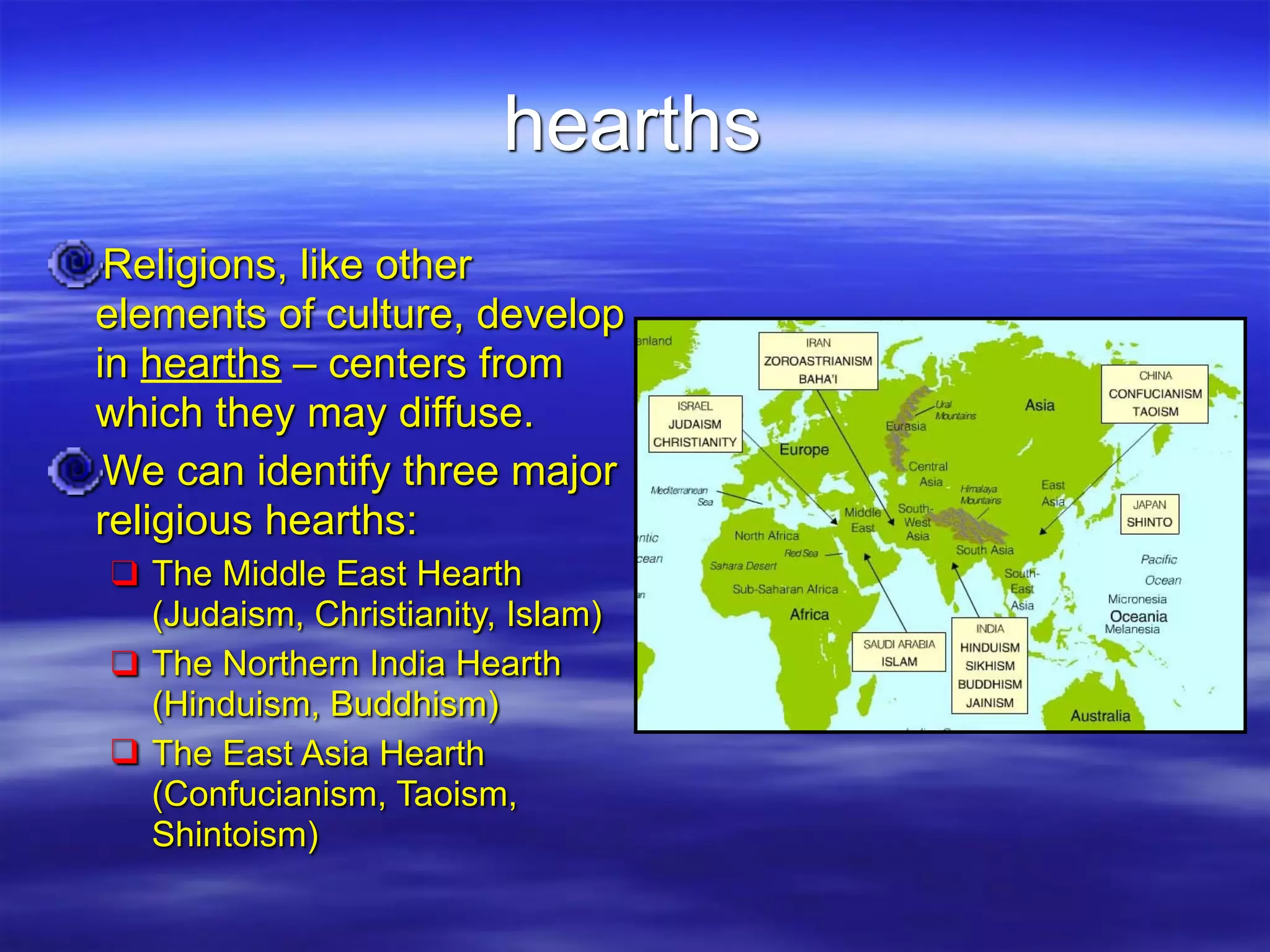
hearths
Religions, like other
elements of culture, develop
in hearths – centers from
which they may diffuse.
We can identify three major
religious hearths:
❑ The Middle East Hearth
(Judaism, Christianity, Islam)
❑ The Northern India Hearth
(Hinduism, Buddhism)
❑ The East Asia Hearth
(Confucianism, Taoism,
Shintoism)
Confucianism
▪ Origins
– Founder
– Date
– World Area
▪ Texts/ Major Docs.
▪ Major Beliefs
▪ Ceremonies / Rituals
▪ China
– K’ung Fu-tzu
– 551-479 BC
– Eastern Asia (although officially
ended in 1911)
▪ Analects of Confucius (4 Books), 5
Classics
▪ Cultivating virtue, jen (humantarian
attitude), li (proper relationships, ex.
6 relationships), value of education,
proper behavior (often blended with
Taoism or Buddhism), ancestor
worship
▪ 4 life passages (birth, maturity,
marriage, death)
the east asia hearth: confucianism
Confucianism is not precisely a religion – it’s more
of an ethical system.
Virtually everyone in East Asia and much of
Southeast Asia can be considered Confucian, since
Confucius’s teachings are fundamental to the
culture of the region.
East Asian faiths are not exclusive; a person can
be Buddhist, Confucian, Taoist, and Shinto
simultaneously.
confucianism: origins and
development
Kung Fu-Tse (“Confucius,” born Kung Ch’iu) 551-479
BCE
❑ Confucius was a philosopher and a teacher; at the age of 50
he became a government official. He retired after five
years, and spent the rest of his life teaching.
❑ Some basic concepts:
o The importance of Li (“correct behavior”)
o The five basic relationships
▪ Father to son (kindness; filial piety)
▪ Elder brother to younger brother (gentility; humility)
▪ Husband to wife (righteousness; obedience)
▪ Elder to junior (consideration; deference)
▪ Ruler to subject (benevolence; loyalty)
❑ In 136 BCE Confucians placed in charge of national
education, administration, civil service. Remained in charge
until 1905 CE.
▪ Cardinal virtue: jen (or ren)
translated as "love," "goodness,"
"humanity," and "human-
heartedness."
▪ Golden Rule: Do not do to others
what you do not want done to
yourself .
Fileal Piety
▪ Origins
– Founder
– Date
– World Area
▪ Texts/ Major Docs.
▪ Major Beliefs
▪ Ceremonies / Rituals
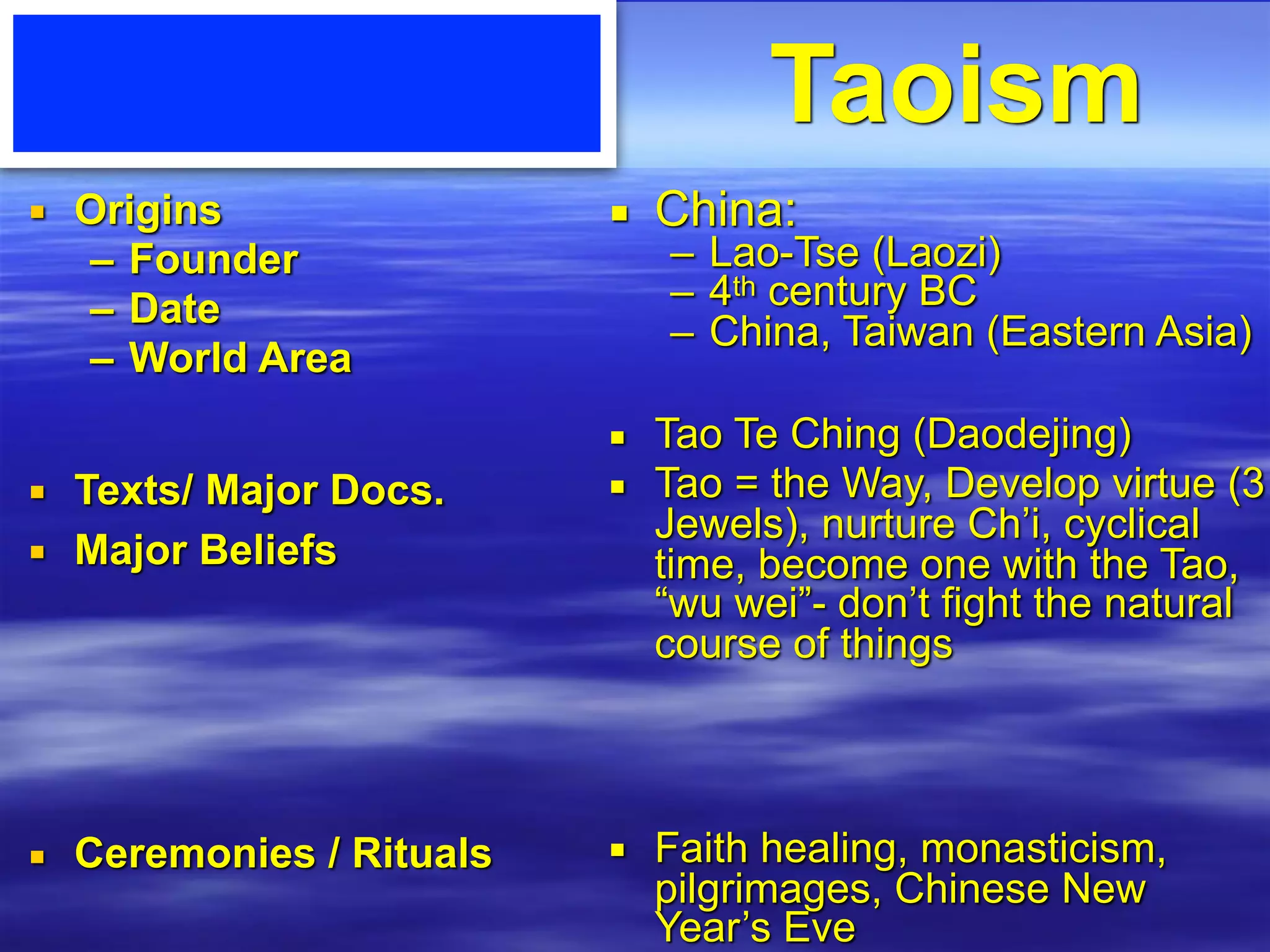
Taoism
▪ China:
– Lao-Tse (Laozi)
– 4th century BC
– China, Taiwan (Eastern Asia)
▪ Tao Te Ching (Daodejing)
▪ Tao = the Way, Develop virtue (3
Jewels), nurture Ch’i, cyclical
time, become one with the Tao,
“wu wei”- don’t fight the natural
course of things
▪ Faith healing, monasticism,
pilgrimages, Chinese New
Year’s Eve
▪ "Be still like a mountain and
flow like a great river." Lao Tse
▪ Tai Ch’I
▪ Yin/ Yang: Yin, the darker
element, is passive, dark,
feminine, downward-seeking,
and corresponds to the night;
yang, the brighter element, is
active, light, masculine,
upward-seeking and
corresponds to the day.
▪ Sun Tzu- The Art of War
– Exemplifies both Taoist and
Confucian principles
▪ Feng Shui
The Taoist Sage
the east asia hearth: taoism
Taoism, like Confucianism, is more of an
ethical system than a religion – although
some Taoist sects have strongly religious
overtones.
As with Confucianism, virtually everyone
in East Asia and much of Southeast Asia
can be considered Taoist, since those
beliefs are part of the culture.
taoism: origins and development
Lao-tzu (570-490 BCE)
❑ Philosopher, court librarian in Henan, at the end of his life
he despaired of people, went into exile; but before leaving
he was persuaded to write down his philosophy – the Tao-
te Ching (“the way and its power”).
❑ For several hundred years, Taoists compete with
Confucianists (and others) as philosophers and advisors.
❑ With the coming of Buddhism to China (c. 100 CE),
begins to merge and blend.
❑ Development of numerous sects – from esoteric
philosophy to magical; interests in alchemy and
immortality.
❑ Persecution after the Communist revolution in 1949, but
repression eased by the 1990s.
basic beliefs of taoism
The “3 Jewels”: Compassion, moderation, humility
Society and its rules aren’t important; people should
follow “the way” (tao).
The tao cannot be controlled or understood.
To be in harmony with the tao, “do nothing” – do
nothing unnatural, don’t strive, don’t be clever.
Life is fundamentally good.
Like Confucianism, recommends a kind of idealized
feudalism – everyone has a place, everyone stays in
their place.
▪ Japan
– Founder = Yamato Clan (?)
– 500 BC
– Japan
▪ No major texts
▪ Shin tao (the way of the gods)
▪ Benign Kami (deities) in natural
objects and features, guardians,
ethical code of Confucianism,
ancestor worship, 4 Affirmations,
pacifism
▪ Sacred natural spaces, shrine
ceremonies of cleaning,
seasonal celebrations
▪ Origins
– Founder
– Date
– World Area
▪ Texts/ Major Docs.
▪ Major Beliefs
▪ Ceremonies / Rituals
Shintoism
the east asia hearth: shinto
Shinto (or kami no michi, “the way of the gods”) is
the traditional ethnic, polytheistic religion of Japan.
It is difficult to say exactly how many Shintoists
there are; virtually all Japanese participate in
Shinto activities from time to time, but only about
3% consider Shinto their sole or primary faith.
As with other East Asian religions, Shinto is not
exclusive – one can be a Buddhist, Confucianist,
Taoist and Shinto simultaneously.
shinto: origins and development
Until c. 500 CE and the arrival of Buddhism in Japan,
Shinto had no name; it was the beliefs of the Japanese.
By 800 CE Shinto had combined with Buddhism;
Buddhist priests were placed in charge of Shinto shrines,
and Shinto almost disappeared.
Beginning in the 18th Century, Shinto was revived as a
part of rising nationalism; Shinto became the State
religion under the Emperor Meiji. The Emperor was
regarded as divine, and the Japanese superior to other
people.
After Japan’s defeat in the Second World War, State
Shinto ended; the Emperor renounced divinity.
Today there are at least two dozen major Shinto schools,
more than a dozen Shinto sects, and perhaps a hundred
Shinto-related “New Religions.”
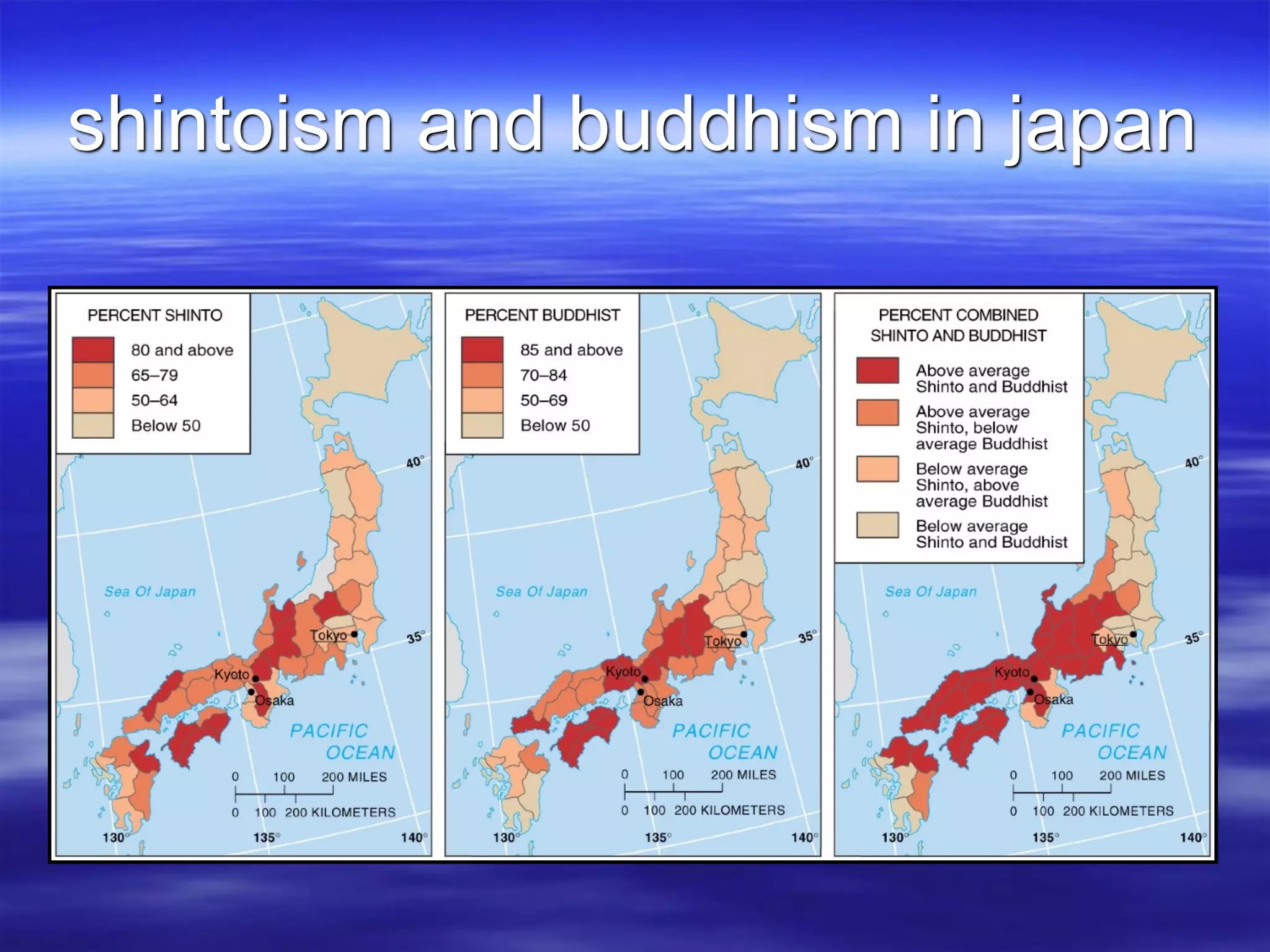
shintoism and buddhism in japan
▪ "Four Affirmations":
– Tradition and the family: The
family is seen as the main
mechanism by which traditions
are preserved. Their main
celebrations relate to birth and
marriage.
– Love of nature: Nature is sacred;
to be in contact with nature is to
be close to the Gods. Natural
objects are worshipped as sacred
spirits.
– Physical cleanliness: Followers of
Shinto take baths, wash their
hands, and rinse out their mouth
often.
– "Matsuri": The worship and honor
given to the Kami and ancestral
spirits.
▪ New York
– Founder = Joseph Smith
– 1829
– Western USA
▪ The Book of Mormon, The Pearl
of Great Price, Doctrines and
Covenants
▪ Salvation through baptism, can
become Gods, Restoration of
church through Mormons,
Continuing Revelation
▪ Mormon Tabernacle. Celestial
Marriage missionary service,
baptismal succession,
▪ Origins
– Founder
– Date
– World Area
▪ Texts/ Major Docs.
▪ Major Beliefs
▪ Ceremonies / Rituals
Mormonism
▪ New York
– Joseph Smith was a
Mormonism
▪ New York
– Joseph Smith was a
▪ New York
– Joseph Smith was a
▪ Japan
– Founder = Yamato Clan (?)
– 500 BC
– Japan
▪ No major texts
▪ Shin tao (the way of the gods)
▪ Benign Kami (deities) in natural
objects and features, guardians,
ethical code of Confucianism, ancestor
worship, 4 Affirmations, pacifism
▪ Sacred natural spaces, shrine
ceremonies of cleaning, seasonal
celebrations
▪ Origins
– Founder
– Date
– World Area
▪ Texts/ Major Docs.
▪ Major Beliefs
▪ Ceremonies / Rituals
▪ Japan
– Founder = Charles Tase Russell
– 18170
– New York
▪ Bible
▪ Jesus is not God. Gnosticism
▪ No Blood Transfusions, No
Holidays, No Pledge or military
service
▪ Origins
– Founder
– Date
– World Area
▪ Texts/ Major Docs.
▪ Major Beliefs
▪ Ceremonies / Rituals
Jehovah’s
Witness
Charles Tase Russell
Russell began to develop his own prophetic system
with his second book in 1889’s The Time is at
Hand, in which he claimed that 1872 not only
marked the beginning of the seventh millennium
since the creation of the world, but that it was this
chronological event that precipitated Christ’s
invisible return in October of 1874.
God’s judgment of the world began in 1878
(beginning with the “nominal church”), Russell
concluded, and would end in 1914 when God would
destroy the governmental “Gentile kingdoms” and
give authority over the world to the true Church.
Jehovah's Witnesses believe that Jesus Christ began
to rule in heaven as king of God's kingdom in
October 1914, and that Satan was subsequently
ousted from heaven to the earth
Beliefs: Jesus is Michael the
archangel. Not God.
only 144,000 go to heaven.
Everyone else just dies.
GNOSTICISM - Physical is evil,
Spiritual is Good.
Therefore God is Spirit, not human.
Cultural Landscape
of religion
▪ Hinduism
– frequent festivals and feasts, countless shrines and
temples, holy animals, distinctive garb
▪ Buddhism
– Pagodas, sculptural images of Buddha, bell shaped
structures over burial mounds
▪ Judaism
– Distinctive manner of dress (Orthodox), Hebrew language,
cemeteries
▪ Christianity
– Cathedrals, most churches have steeples, some have
bells, public festivals and rituals, Holy days, cemeteries
▪ Islam
– Manner of dress- especially women, public festivals,
rituals, Holy days, mosques, minarets, public loudspeakers
for prayer
Religion and Conflict
▪ Fundamentalism
– Often linked to extremism (especially with exclusive
religious ideas) and far right wing politics
▪ Liberation theology
– Willingness to link religion and political struggles for freedom
and equality- thus friction with government (Catholics and
Buddhists)
▪ Boundaries
– Interfaith
▪ When religious boundaries of sharply defined geographic areas
– Africa- Islamic north, Christian or Animist south
– South Asia- Kashmir
– Intrafaith
▪ Between sects of a religion
– Iran-Iraq
– Northern Ireland
– Switzerland
Religion and Conflict
Religious conflicts may arise for many reasons:
❑ Conflicts between traditional religious values and new ideas.
o Hinduism (caste and ideas of equality).
o Russian Orthodox (e.g. the community of Old Believers)
❑ Conflicts between governments and religious beliefs, values or
communities.
o Disestablishment of the California Missions, Dissolution of the English
monasteries, etc.
o Communist states and religious communities.
❑ Conflicts between different interpretations of a religion.
o Northern Ireland (Catholic vs. Protestant)
o Afghanistan (Sunni [Taliban] vs. Shia)
❑ Conflicts between different religions.
o Christians vs. Muslims (the Crusades 1095-1270 CE).
o Hindus vs. Muslims (Kashmir, etc.)
o Jews vs. Muslims (Palestine).
conflict in Northern Ireland:

polarization
Sources: http://www.hyperhistory.org/index.php?
option=displaypage&Itemid=676&op=page&printpage=Y; http://www.awesomestories.com/
assets/distribution-of-protestants-in-ireland-1861-and-1991
the world’s religions: other faiths
Animistic faiths
❑ Tribal and native religions found in parts of the Americas, Africa,
Australia, Asia.
❑ Declining numbers as universal religions (mostly Christianity and
Islam) expand.
Voudon (voodoo)
❑ Syncretism, blending traditional African polytheistic faiths and
Christianity.
❑ Found throughout the Americas in former slave-holding regions
(with different practices in different areas), and parts of Africa.
Modern pagans
❑ Revived or re-created faiths (or even made up), based (mostly) on
pre-Christian belief systems.
❑ Found mostly in highly educated, urban, largely secular areas.
Christianity and Division
Religion and Science
Pantheism or Panentheism
Deism
Theism
Atheism

World religions Part four

  • 1.
  • 2.
    hearths Religions, like other elementsof culture, develop in hearths – centers from which they may diffuse. We can identify three major religious hearths: ❑ The Middle East Hearth (Judaism, Christianity, Islam) ❑ The Northern India Hearth (Hinduism, Buddhism) ❑ The East Asia Hearth (Confucianism, Taoism, Shintoism)
  • 3.
    Confucianism ▪ Origins – Founder –Date – World Area ▪ Texts/ Major Docs. ▪ Major Beliefs ▪ Ceremonies / Rituals ▪ China – K’ung Fu-tzu – 551-479 BC – Eastern Asia (although officially ended in 1911) ▪ Analects of Confucius (4 Books), 5 Classics ▪ Cultivating virtue, jen (humantarian attitude), li (proper relationships, ex. 6 relationships), value of education, proper behavior (often blended with Taoism or Buddhism), ancestor worship ▪ 4 life passages (birth, maturity, marriage, death)
  • 4.
    the east asiahearth: confucianism Confucianism is not precisely a religion – it’s more of an ethical system. Virtually everyone in East Asia and much of Southeast Asia can be considered Confucian, since Confucius’s teachings are fundamental to the culture of the region. East Asian faiths are not exclusive; a person can be Buddhist, Confucian, Taoist, and Shinto simultaneously.
  • 5.
    confucianism: origins and development KungFu-Tse (“Confucius,” born Kung Ch’iu) 551-479 BCE ❑ Confucius was a philosopher and a teacher; at the age of 50 he became a government official. He retired after five years, and spent the rest of his life teaching. ❑ Some basic concepts: o The importance of Li (“correct behavior”) o The five basic relationships ▪ Father to son (kindness; filial piety) ▪ Elder brother to younger brother (gentility; humility) ▪ Husband to wife (righteousness; obedience) ▪ Elder to junior (consideration; deference) ▪ Ruler to subject (benevolence; loyalty) ❑ In 136 BCE Confucians placed in charge of national education, administration, civil service. Remained in charge until 1905 CE.
  • 6.
    ▪ Cardinal virtue:jen (or ren) translated as "love," "goodness," "humanity," and "human- heartedness." ▪ Golden Rule: Do not do to others what you do not want done to yourself .
  • 9.
  • 11.
    ▪ Origins – Founder –Date – World Area ▪ Texts/ Major Docs. ▪ Major Beliefs ▪ Ceremonies / Rituals Taoism ▪ China: – Lao-Tse (Laozi) – 4th century BC – China, Taiwan (Eastern Asia) ▪ Tao Te Ching (Daodejing) ▪ Tao = the Way, Develop virtue (3 Jewels), nurture Ch’i, cyclical time, become one with the Tao, “wu wei”- don’t fight the natural course of things ▪ Faith healing, monasticism, pilgrimages, Chinese New Year’s Eve
  • 12.
    ▪ "Be stilllike a mountain and flow like a great river." Lao Tse ▪ Tai Ch’I ▪ Yin/ Yang: Yin, the darker element, is passive, dark, feminine, downward-seeking, and corresponds to the night; yang, the brighter element, is active, light, masculine, upward-seeking and corresponds to the day. ▪ Sun Tzu- The Art of War – Exemplifies both Taoist and Confucian principles ▪ Feng Shui The Taoist Sage
  • 13.
    the east asiahearth: taoism Taoism, like Confucianism, is more of an ethical system than a religion – although some Taoist sects have strongly religious overtones. As with Confucianism, virtually everyone in East Asia and much of Southeast Asia can be considered Taoist, since those beliefs are part of the culture.
  • 14.
    taoism: origins anddevelopment Lao-tzu (570-490 BCE) ❑ Philosopher, court librarian in Henan, at the end of his life he despaired of people, went into exile; but before leaving he was persuaded to write down his philosophy – the Tao- te Ching (“the way and its power”). ❑ For several hundred years, Taoists compete with Confucianists (and others) as philosophers and advisors. ❑ With the coming of Buddhism to China (c. 100 CE), begins to merge and blend. ❑ Development of numerous sects – from esoteric philosophy to magical; interests in alchemy and immortality. ❑ Persecution after the Communist revolution in 1949, but repression eased by the 1990s.
  • 15.
    basic beliefs oftaoism The “3 Jewels”: Compassion, moderation, humility Society and its rules aren’t important; people should follow “the way” (tao). The tao cannot be controlled or understood. To be in harmony with the tao, “do nothing” – do nothing unnatural, don’t strive, don’t be clever. Life is fundamentally good. Like Confucianism, recommends a kind of idealized feudalism – everyone has a place, everyone stays in their place.
  • 20.
    ▪ Japan – Founder= Yamato Clan (?) – 500 BC – Japan ▪ No major texts ▪ Shin tao (the way of the gods) ▪ Benign Kami (deities) in natural objects and features, guardians, ethical code of Confucianism, ancestor worship, 4 Affirmations, pacifism ▪ Sacred natural spaces, shrine ceremonies of cleaning, seasonal celebrations ▪ Origins – Founder – Date – World Area ▪ Texts/ Major Docs. ▪ Major Beliefs ▪ Ceremonies / Rituals Shintoism
  • 21.
    the east asiahearth: shinto Shinto (or kami no michi, “the way of the gods”) is the traditional ethnic, polytheistic religion of Japan. It is difficult to say exactly how many Shintoists there are; virtually all Japanese participate in Shinto activities from time to time, but only about 3% consider Shinto their sole or primary faith. As with other East Asian religions, Shinto is not exclusive – one can be a Buddhist, Confucianist, Taoist and Shinto simultaneously.
  • 22.
    shinto: origins anddevelopment Until c. 500 CE and the arrival of Buddhism in Japan, Shinto had no name; it was the beliefs of the Japanese. By 800 CE Shinto had combined with Buddhism; Buddhist priests were placed in charge of Shinto shrines, and Shinto almost disappeared. Beginning in the 18th Century, Shinto was revived as a part of rising nationalism; Shinto became the State religion under the Emperor Meiji. The Emperor was regarded as divine, and the Japanese superior to other people. After Japan’s defeat in the Second World War, State Shinto ended; the Emperor renounced divinity. Today there are at least two dozen major Shinto schools, more than a dozen Shinto sects, and perhaps a hundred Shinto-related “New Religions.”
  • 23.
  • 24.
    ▪ "Four Affirmations": –Tradition and the family: The family is seen as the main mechanism by which traditions are preserved. Their main celebrations relate to birth and marriage. – Love of nature: Nature is sacred; to be in contact with nature is to be close to the Gods. Natural objects are worshipped as sacred spirits. – Physical cleanliness: Followers of Shinto take baths, wash their hands, and rinse out their mouth often. – "Matsuri": The worship and honor given to the Kami and ancestral spirits.
  • 25.
    ▪ New York –Founder = Joseph Smith – 1829 – Western USA ▪ The Book of Mormon, The Pearl of Great Price, Doctrines and Covenants ▪ Salvation through baptism, can become Gods, Restoration of church through Mormons, Continuing Revelation ▪ Mormon Tabernacle. Celestial Marriage missionary service, baptismal succession, ▪ Origins – Founder – Date – World Area ▪ Texts/ Major Docs. ▪ Major Beliefs ▪ Ceremonies / Rituals Mormonism
  • 31.
    ▪ New York –Joseph Smith was a Mormonism
  • 32.
    ▪ New York –Joseph Smith was a
  • 33.
    ▪ New York –Joseph Smith was a
  • 34.
    ▪ Japan – Founder= Yamato Clan (?) – 500 BC – Japan ▪ No major texts ▪ Shin tao (the way of the gods) ▪ Benign Kami (deities) in natural objects and features, guardians, ethical code of Confucianism, ancestor worship, 4 Affirmations, pacifism ▪ Sacred natural spaces, shrine ceremonies of cleaning, seasonal celebrations ▪ Origins – Founder – Date – World Area ▪ Texts/ Major Docs. ▪ Major Beliefs ▪ Ceremonies / Rituals
  • 41.
    ▪ Japan – Founder= Charles Tase Russell – 18170 – New York ▪ Bible ▪ Jesus is not God. Gnosticism ▪ No Blood Transfusions, No Holidays, No Pledge or military service ▪ Origins – Founder – Date – World Area ▪ Texts/ Major Docs. ▪ Major Beliefs ▪ Ceremonies / Rituals Jehovah’s Witness
  • 42.
    Charles Tase Russell Russellbegan to develop his own prophetic system with his second book in 1889’s The Time is at Hand, in which he claimed that 1872 not only marked the beginning of the seventh millennium since the creation of the world, but that it was this chronological event that precipitated Christ’s invisible return in October of 1874. God’s judgment of the world began in 1878 (beginning with the “nominal church”), Russell concluded, and would end in 1914 when God would destroy the governmental “Gentile kingdoms” and give authority over the world to the true Church. Jehovah's Witnesses believe that Jesus Christ began to rule in heaven as king of God's kingdom in October 1914, and that Satan was subsequently ousted from heaven to the earth
  • 43.
    Beliefs: Jesus isMichael the archangel. Not God. only 144,000 go to heaven. Everyone else just dies. GNOSTICISM - Physical is evil, Spiritual is Good. Therefore God is Spirit, not human.
  • 44.
    Cultural Landscape of religion ▪Hinduism – frequent festivals and feasts, countless shrines and temples, holy animals, distinctive garb ▪ Buddhism – Pagodas, sculptural images of Buddha, bell shaped structures over burial mounds ▪ Judaism – Distinctive manner of dress (Orthodox), Hebrew language, cemeteries ▪ Christianity – Cathedrals, most churches have steeples, some have bells, public festivals and rituals, Holy days, cemeteries ▪ Islam – Manner of dress- especially women, public festivals, rituals, Holy days, mosques, minarets, public loudspeakers for prayer
  • 45.
    Religion and Conflict ▪Fundamentalism – Often linked to extremism (especially with exclusive religious ideas) and far right wing politics ▪ Liberation theology – Willingness to link religion and political struggles for freedom and equality- thus friction with government (Catholics and Buddhists) ▪ Boundaries – Interfaith ▪ When religious boundaries of sharply defined geographic areas – Africa- Islamic north, Christian or Animist south – South Asia- Kashmir – Intrafaith ▪ Between sects of a religion – Iran-Iraq – Northern Ireland – Switzerland
  • 46.
    Religion and Conflict Religiousconflicts may arise for many reasons: ❑ Conflicts between traditional religious values and new ideas. o Hinduism (caste and ideas of equality). o Russian Orthodox (e.g. the community of Old Believers) ❑ Conflicts between governments and religious beliefs, values or communities. o Disestablishment of the California Missions, Dissolution of the English monasteries, etc. o Communist states and religious communities. ❑ Conflicts between different interpretations of a religion. o Northern Ireland (Catholic vs. Protestant) o Afghanistan (Sunni [Taliban] vs. Shia) ❑ Conflicts between different religions. o Christians vs. Muslims (the Crusades 1095-1270 CE). o Hindus vs. Muslims (Kashmir, etc.) o Jews vs. Muslims (Palestine).
  • 47.
    conflict in NorthernIreland:
 polarization Sources: http://www.hyperhistory.org/index.php? option=displaypage&Itemid=676&op=page&printpage=Y; http://www.awesomestories.com/ assets/distribution-of-protestants-in-ireland-1861-and-1991
  • 48.
    the world’s religions:other faiths Animistic faiths ❑ Tribal and native religions found in parts of the Americas, Africa, Australia, Asia. ❑ Declining numbers as universal religions (mostly Christianity and Islam) expand. Voudon (voodoo) ❑ Syncretism, blending traditional African polytheistic faiths and Christianity. ❑ Found throughout the Americas in former slave-holding regions (with different practices in different areas), and parts of Africa. Modern pagans ❑ Revived or re-created faiths (or even made up), based (mostly) on pre-Christian belief systems. ❑ Found mostly in highly educated, urban, largely secular areas.
  • 49.
  • 50.
  • 51.
  • 52.
  • 53.
  • 54.