SANTERIA
MORGAN CRITES
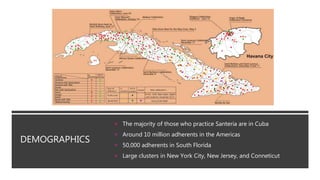
DEMOGRAPHICS
 The majority of those who practice Santeria are in Cuba
 Around 10 million adherents in the Americas
 50,000 adherents in South Florida
 Large clusters in New York City, New Jersey, and Conneticut
DEVELOPMENT OF SANTERIA
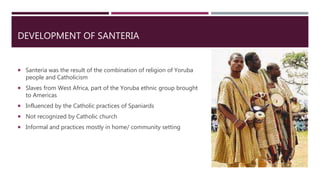
 Santeria was the result of the combination of religion of Yoruba
people and Catholicism
 Slaves from West Africa, part of the Yoruba ethnic group brought
to Americas
 Influenced by the Catholic practices of Spaniards
 Not recognized by Catholic church
 Informal and practices mostly in home/ community setting
BELIEFS
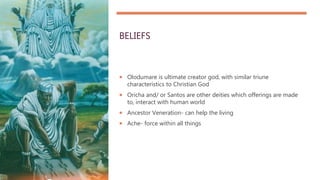
 Olodumare is ultimate creator god, with similar triune
characteristics to Christian God
 Oricha and/ or Santos are other deities which offerings are made
to, interact with human world
 Ancestor Veneration- can help the living
 Ache- force within all things
RELIGIOUS TEXTS IN SANTERIA
 There is no holy book used in Santeria
 The religion relies on oral tradition
 There are creation myths connected with each orisha
 Orishas are each created to represent a specific need or area of the world to reside over, and come to
the world in human form to perform heroic tasks
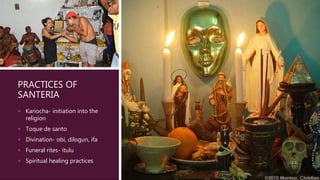
PRACTICES OF
SANTERIA
 Kariocha- initiation into the
religion
 Toque de santo
 Divination- obi, dilogun, ifa
 Funeral rites- itulu
 Spiritual healing practices
CONNECTING TO CHRISTIANITY- SPIRITUAL HEALING
 Affirm: Christianity’s belief in an all-powerful God allows us to pray for healing from him and trust God
will protect us
 Differ: Individuals contacting the spirit world and many deities for help. In Christianity we rely on Christ
alone who has already died for our sins. We also are able to understand sin exists and therefore sickness,
and recognize healing is a physical issue where we must care for each other medically.
BRIDGING TO CHRISTIANITY
 In Santeria, many followers are drawn to the human and fallible nature of Orishas. The humanity of these
deities can make an individual feel as if they are understood by the gods they worship and therefore can
be better helped.
 In relation to this, we can point to the humanity of God in Jesus Christ. While Jesus lived a sinless life, he
lived in the human world and therefore understands are struggles and wishes to help us. Jesus loves us
unconditionally, so we do not have to fear Him seeing our true selves, as he understands we are
imperfect and died for us anyway.
 “For I am sure that neither death nor life, nor angels nor rulers, nor things present nor things to come,
nor powers, nor height nor depth, nor anything else in all creation, will be able to separate us from the
love of God in Jesus Christ our Lord” - Romans 8:38-39
REFERENCES
 Loue S. (2014) Santería. In: Leeming D.A. (eds) Encyclopedia of Psychology and Religion. Springer,
Boston, MA. https://doi.org/10.1007/978-1-4614-6086-2_832
 Mark, J. J. (2021, October 06). Orisha. World History Encyclopedia. Retrieved from
https://www.worldhistory.org/Orisha/
 Emma Gobin and Géraldine Morel, "Ethnography and Religious Anthropology of Cuba: Historical and
Bibliographical Landmarks", Anthropology Workshops [Online], 38 | 2013, posted on July 08, 2013,
accessed on December 09, 2021. URL: http://journals.openedition.org/ateliers/9447; DOI:
https://doi.org/10.4000/ateliers.9447

INT-244 Topic 7 Santeria

  • 1.
  • 2.
    DEMOGRAPHICS  The majorityof those who practice Santeria are in Cuba  Around 10 million adherents in the Americas  50,000 adherents in South Florida  Large clusters in New York City, New Jersey, and Conneticut
  • 3.
    DEVELOPMENT OF SANTERIA Santeria was the result of the combination of religion of Yoruba people and Catholicism  Slaves from West Africa, part of the Yoruba ethnic group brought to Americas  Influenced by the Catholic practices of Spaniards  Not recognized by Catholic church  Informal and practices mostly in home/ community setting
  • 4.
    BELIEFS  Olodumare isultimate creator god, with similar triune characteristics to Christian God  Oricha and/ or Santos are other deities which offerings are made to, interact with human world  Ancestor Veneration- can help the living  Ache- force within all things
  • 5.
    RELIGIOUS TEXTS INSANTERIA  There is no holy book used in Santeria  The religion relies on oral tradition  There are creation myths connected with each orisha  Orishas are each created to represent a specific need or area of the world to reside over, and come to the world in human form to perform heroic tasks
  • 6.
    PRACTICES OF SANTERIA  Kariocha-initiation into the religion  Toque de santo  Divination- obi, dilogun, ifa  Funeral rites- itulu  Spiritual healing practices
  • 7.
    CONNECTING TO CHRISTIANITY-SPIRITUAL HEALING  Affirm: Christianity’s belief in an all-powerful God allows us to pray for healing from him and trust God will protect us  Differ: Individuals contacting the spirit world and many deities for help. In Christianity we rely on Christ alone who has already died for our sins. We also are able to understand sin exists and therefore sickness, and recognize healing is a physical issue where we must care for each other medically.
  • 8.
    BRIDGING TO CHRISTIANITY In Santeria, many followers are drawn to the human and fallible nature of Orishas. The humanity of these deities can make an individual feel as if they are understood by the gods they worship and therefore can be better helped.  In relation to this, we can point to the humanity of God in Jesus Christ. While Jesus lived a sinless life, he lived in the human world and therefore understands are struggles and wishes to help us. Jesus loves us unconditionally, so we do not have to fear Him seeing our true selves, as he understands we are imperfect and died for us anyway.  “For I am sure that neither death nor life, nor angels nor rulers, nor things present nor things to come, nor powers, nor height nor depth, nor anything else in all creation, will be able to separate us from the love of God in Jesus Christ our Lord” - Romans 8:38-39
  • 9.
    REFERENCES  Loue S.(2014) Santería. In: Leeming D.A. (eds) Encyclopedia of Psychology and Religion. Springer, Boston, MA. https://doi.org/10.1007/978-1-4614-6086-2_832  Mark, J. J. (2021, October 06). Orisha. World History Encyclopedia. Retrieved from https://www.worldhistory.org/Orisha/  Emma Gobin and Géraldine Morel, "Ethnography and Religious Anthropology of Cuba: Historical and Bibliographical Landmarks", Anthropology Workshops [Online], 38 | 2013, posted on July 08, 2013, accessed on December 09, 2021. URL: http://journals.openedition.org/ateliers/9447; DOI: https://doi.org/10.4000/ateliers.9447