INT-244 • World Religions
When Daniel took INT-244
[In 586 BC] Nebuchadnezzar the king of
Babylon came to Jerusalem and besieged it.
And the Lord gave Jehoiakim king of Judah into
his hand, with some of the vessels of the house
of God. And he brought them back to Babylon,
to the house of his god, and placed the vessels
in the treasury of his god.
(Dan 1:1–2 ESV)
Then Nebuchadnezzar commanded Ashpenaz,
to bring some of the people of Israel, both of the
royal family and of the nobility, youths without
blemish, of good appearance and skillful in all
w i s d o m , e n d o w e d w i t h k n o w l e d g e ,
understanding learning, and competent to stand
in the king’s palace, and to teach them the
literature and language of the Chaldeans.
(Dan 1:3–4 ESV)
Qualifications
Daniel 1:1-4
• Presentable (social skills)
• Skillful with knowledge
• Learned
• Soft skills (decorum)
• Teachable
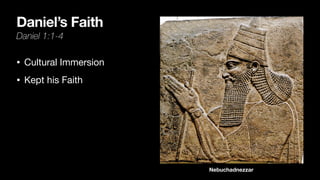
Nebuchadnezzar
Education
Daniel 1:1-4
• Language
• Culture
• Religion of Babylonians
Nebuchadnezzar
Daniel’s Faith
Daniel 1:1-4
• Cultural Immersion
• Kept his Faith
Nebuchadnezzar
Studying Religion
INT-244 World Religions • Topic 1b
Identity, Culture, Worldview, Religion
We encounter people not religions
We encouter people’s
1. Identity
2. Identity Status
3. Culture
4. Worldview
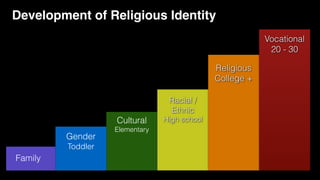
Family
Gender
Toddler
Cultural
Elementary
Racial /
Ethnic
High school
Religious
College +
Vocational
20 - 30
Development of Religious Identity
Self-Identity
• Family Identity
• Gender/Sexual Identity
• Ethnic Identity
• Racial Identity
• Religious Identity
• Political Identity
• Vocational Identity
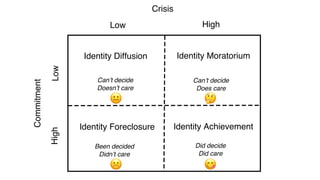
2. Identity Statuses
James Marcia
Identity Diffusion Identity Moratorium
Identity Foreclosure Identity Achievement
Low High
Low
High
Crisis
Commitment
Can’t decide
Doesn’t care
Can’t decide
Does care
Been decided
Didn’t care
Did decide
Did care
😐 🤔
☹ 😋
b. Identity Moratorium
3. Culture
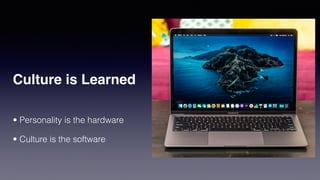
Culture is Learned
• Personality is the hardware
• Culture is the software
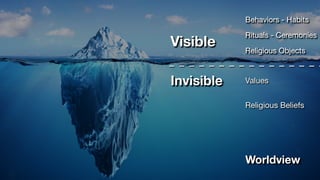
Cultural Iceberg
Behaviors - Habits
Rituals - Ceremonies
Religious Objects
Values
Religious Beliefs
Worldview
Visible
Invisible
Values
Religious Beliefs
Worldview
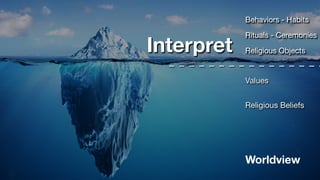
Interpret
Behaviors - Habits
Rituals - Ceremonies
Religious Objects
Values
Religious Beliefs
Worldview
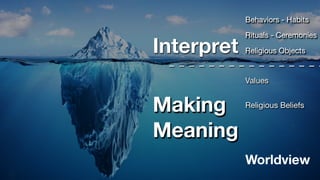
Interpret
Making
Meaning
Behaviors - Habits
Rituals - Ceremonies
Religious Objects
4. Worldview
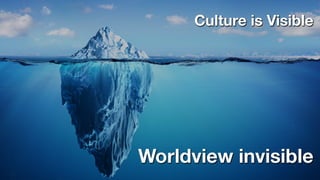
Culture is Visible
Worldview invisible
Definition of Worldview
Worldview is a foundational set of assumptions to which
one commits that serves as a framework for understanding
and interpreting reality and deeply shapes one’s behavior.
(Waddel & Jibben, 2021, “What in the World is Worldview?”)
Describing Worldview
Two ways to describe a worldview
A. Elements (assumptions)
B. Metanarrative (story)
(Waddel & Jibben, 2021, “What in the World is Worldview?”)
What’s the meta narrative
What’s the worldview?
Two ways to describe a worldview
A. Elements (assumptions)
B. Metanarrative (story)
(Waddel & Jibben, 2021, “What in the World is Worldview?”)
Worldview is described as a story
Metanarrative
Metanarrative
An overarching account or interpretation of
events and circumstances that provides a
pattern or structure for people’s beliefs and
gives meaning to their experiences.
https://www.oxfordlearnersdictionaries.com/us/de
fi
nition/english/metanarrative
Chapters of the Christian
Worldview Metanarrative
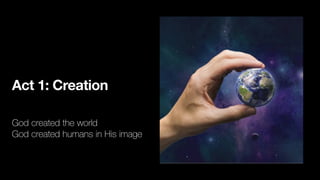
Act 1: Creation
God created the world
God created humans in His image
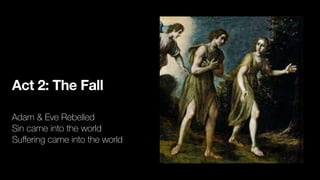
Act 2: The Fall
Adam & Eve Rebelled
Sin came into the world
Su
ff
ering came into the world
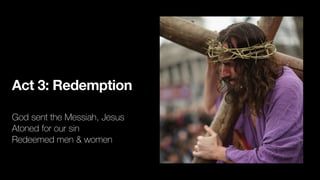
Act 3: Redemption
God sent the Messiah, Jesus
Atoned for our sin
Redeemed men & women
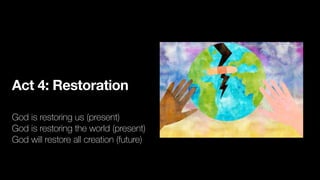
Act 4: Restoration
God is restoring us (present)
God is restoring the world (present)
God will restore all creation (future)
What is the Metanarrative in Moana?
Describing religion
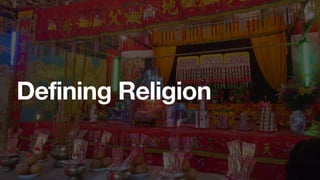
Defining Religion
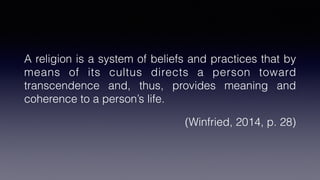
A religion is a system of beliefs and practices that by
means of its cultus directs a person toward
transcendence and, thus, provides meaning and
coherence to a person’s life.
(Winfried, 2014, p. 28)
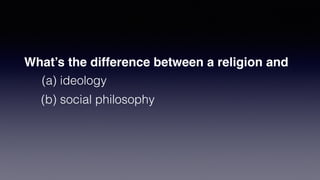
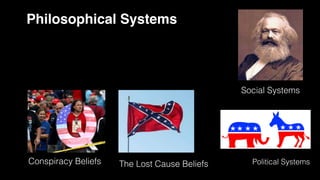
What’s the difference between a religion and
(a) ideology
(b) social philosophy
Political Systems
Social Systems
The Lost Cause Beliefs
Conspiracy Beliefs
Philosophical Systems
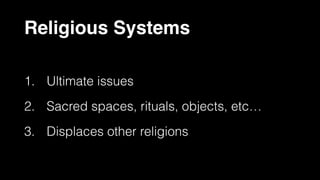
Religious Systems
1. Ultimate issues
2. Sacred spaces, rituals, objects, etc…
3. Displaces other religions
Components of Religion
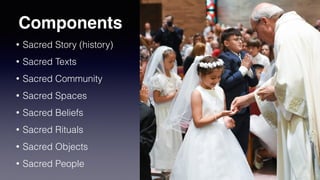
Components
• Sacred Story (history)
• Sacred Texts
• Sacred Community
• Sacred Spaces
• Sacred Beliefs
• Sacred Rituals
• Sacred Objects
• Sacred People
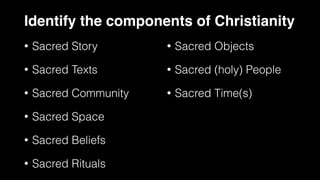
Identify the components of Christianity
• Sacred Story
• Sacred Texts
• Sacred Community
• Sacred Space
• Sacred Beliefs
• Sacred Rituals
• Sacred Objects
• Sacred (holy) People
• Sacred Time(s)
Origins of Religion
Two Theories
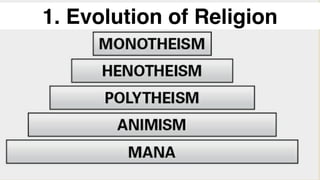
1. Evolution of Religion
2. Original Monotheism
1. Evolution of Religion
• Mana: spiritual forces
1. Evolution of Religion
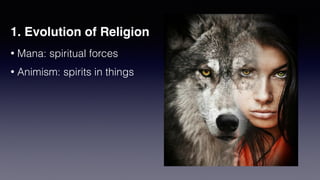
• Mana: spiritual forces
• Animism: spirits in things
1. Evolution of Religion
• Mana: spiritual forces
• Animism: spirits in things
• Polytheism: many gods
1. Evolution of Religion
• Mana: spiritual forces
• Animism: spirits in things
• Polytheism: many gods
• Henotheism: favorite god
1. Evolution of Religion
• Mana: spiritual forces
• Animism: spirits in things
• Polytheism: many gods
• Henotheism: favorite god
• Monotheism: Only 1 God
What might be some problems with
The Theory of Evolution of Religion?
1. Evolution of Religion
• Mana: spiritual forces
• Animism: spirits in things
• Polytheism: many gods
• Henotheism: favorite god
• Monotheism: Only 1 God
• Secularism: No God
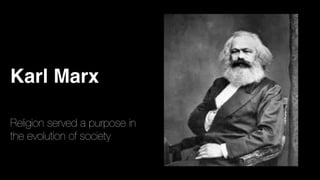
Karl Marx
Religion served a purpose in
the evolution of society
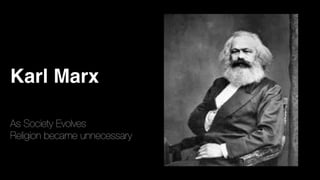
Karl Marx
As Society Evolves
Religion became unnecessary
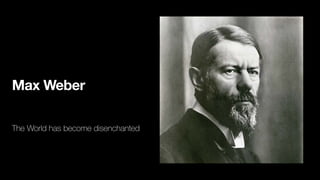
Max Weber
The World has become disenchanted
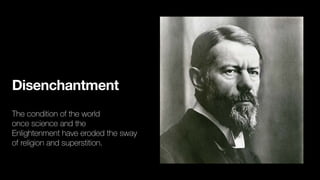
Disenchantment
The condition of the world
once science and the
Enlightenment have eroded the sway
of religion and superstition.
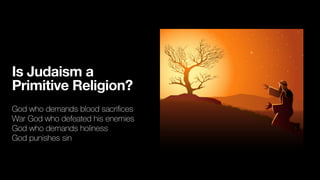
Is Judaism a
Primitive Religion?
God who demands blood sacri
fi
ces
War God who defeated his enemies
God who demands holiness
God punishes sin
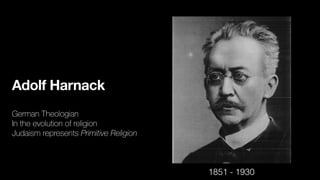
Adolf Harnack
German Theologian
In the evolution of religion
Judaism represents Primitive Religion
1851 - 1930
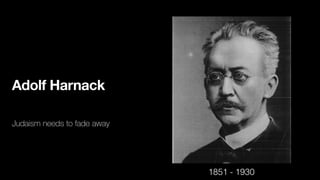
Adolf Harnack
Judaism needs to fade away
1851 - 1930
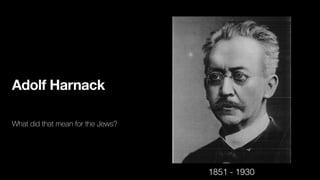
Adolf Harnack
What did that mean for the Jews?
1851 - 1930
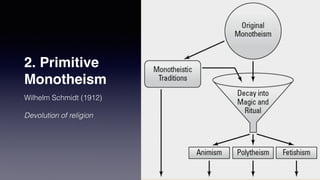
2. Primitive
Monotheism
Wilhelm Schmidt (1912)
Devolution of religion
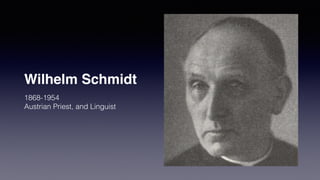
Wilhelm Schmidt
1868-1954
Austrian Priest, and Linguist
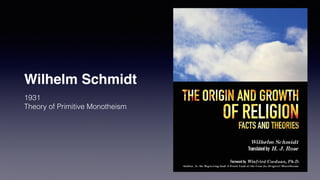
Wilhelm Schmidt
1931
Theory of Primitive Monotheism
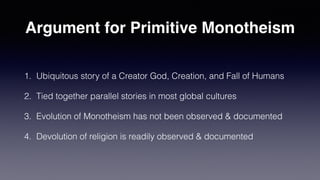
Argument for Primitive Monotheism
1. Ubiquitous story of a Creator God, Creation, and Fall of Humans
2. Tied together parallel stories in most global cultures
3. Evolution of Monotheism has not been observed & documented
4. Devolution of religion is readily observed & documented
Ubiquitous story of pre-existent
creator
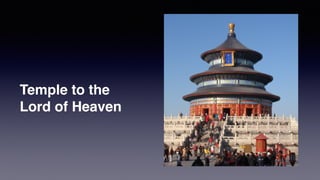
Temple to the
Lord of Heaven
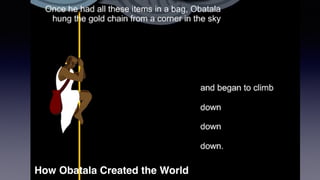
Ubiquitous story of a creation
story (and even a flood)
How Obatala Created the World
Religion is devolving, not evolving
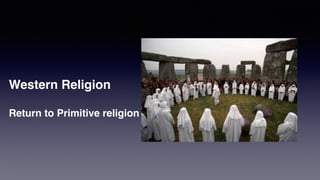
Western Religion
Return to Primitive religion

INT-244 Topic 1b Study of Religions