INT-450 • Cultural Anthropology • Topic 2a
Reading Social Scientific Studies
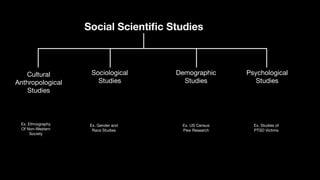
Social Scienti
fi
c Studies
Cultural
Anthropological
Studies
Sociological
Studies
Demographic
Studies
Psychological
Studies
Ex. Ethnography
Of Non-Western
Society
Ex. Gender and
Race Studies
Ex. US Census
Pew Research
Ex. Studies of
PTSD Victims
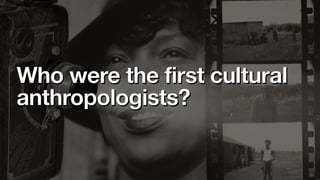
Who were the first cultural
anthropologists?
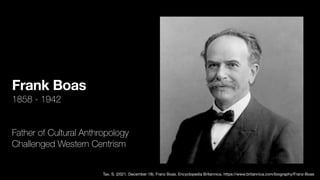
Frank Boas
1858 - 1942
Father of Cultural Anthropology
Challenged Western Centrism
Tax, S. (2021, December 18). Franz Boas. Encyclopedia Britannica. https://www.britannica.com/biography/Franz-Boas

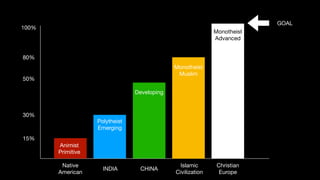
Classical Approach to Culture
Cultures all begin as primitive animist
Societies develop along a
fi
xed path
Developed cultures look like Western Culture
Western Culture became the benchmark
Animist
Primitive
Polytheist
Emerging
Developing
Native
American
INDIA CHINA
Islamic
Civilization
Christian
Europe
Monotheist
Muslim
Monotheist
Advanced
100%
80%
50%
30%
15%
GOAL
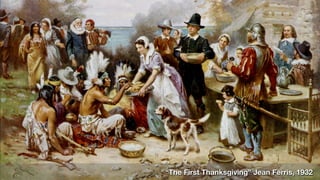
“The First Thanksgiving” Jean Ferris, 1932
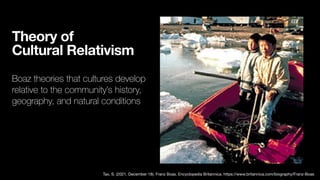
Theory of
Cultural Relativism
Boaz theories that cultures develop
relative to the community’s history,
geography, and natural conditions
Tax, S. (2021, December 18). Franz Boas. Encyclopedia Britannica. https://www.britannica.com/biography/Franz-Boas
Cultural Relativism
The view that various cultural practices and beliefs are best
understood in relation to their entire context.
(Howell & Paris, 2019, 56)
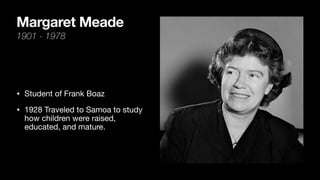
Margaret Meade
1901 - 1978
• Student of Frank Boaz
• 1928 Traveled to Samoa to study
how children were raised,
educated, and mature.
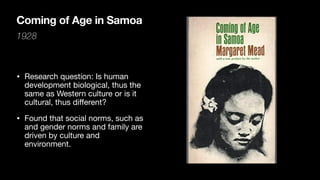
Coming of Age in Samoa
1928
• Research question: Is human
development biological, thus the
same as Western culture or is it
cultural, thus di
ff
erent?
• Found that social norms, such as
and gender norms and family are
driven by culture and
environment.
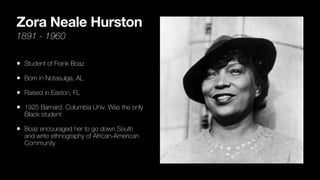
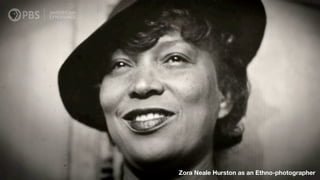
Zora Neale Hurston
1891 - 1960
• Student of Frank Boaz
• Born in Notasulga, AL
• Raised in Easton, FL
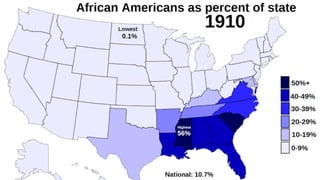
• 1925 Barnard, Columbia Univ. Was the only
Black student
• Boaz encouraged her to go down South
and write ethnography of African-American
Community
Zora Neale Hurston as an Ethno-photographer
Why do we need social
scientific studies?
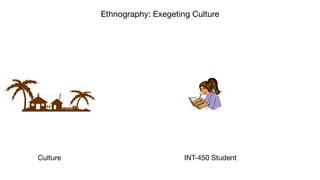
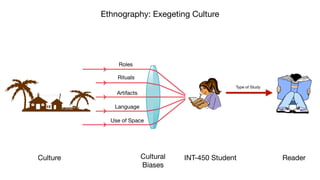
Ethnography: Exegeting Culture
Culture INT-450 Student
Ethnography: Exegeting Culture
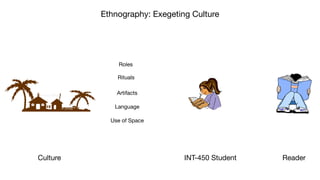
Culture Reader
Roles
Rituals
Artifacts
Use of Space
Language
INT-450 Student
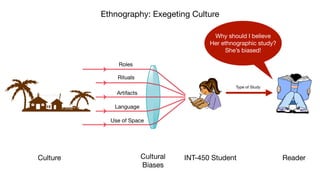
Ethnography: Exegeting Culture
Culture Reader
Cultural
Biases
Type of Study
Roles
Rituals
Artifacts
Use of Space
Language
INT-450 Student
Ethnography: Exegeting Culture
Culture Reader
Cultural
Biases
Type of Study
Roles
Rituals
Artifacts
Use of Space
Language
Why should I believe
Her ethnographic study?
She’s biased!
INT-450 Student
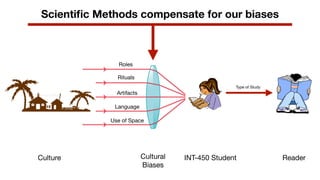
Scienti
fi
c Methods compensate for our biases
Culture Reader
Cultural
Biases
Type of Study
Roles
Rituals
Artifacts
Use of Space
Language
INT-450 Student
What are the types of studies?
1. Quantitative Study
• 100’s to 1,000’s participants
• Funded by big institutions
• Studies many topics
• Survey type Data
Examples
• Barna Research
• Pew Research
• Gallup poll
• Lifeway Research
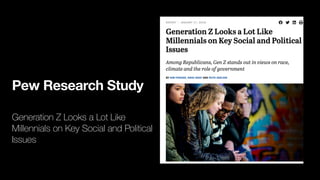
Pew Research Study
Generation Z Looks a Lot Like
Millennials on Key Social and Political
Issues
Quantitative Studies
What can a quantitative study tell us?
What does a quantitative study miss?
2. Qualititative Study
• Less than 100 participants
• Focused on a narrow topic
• Small research team
• Studies few topics in depth
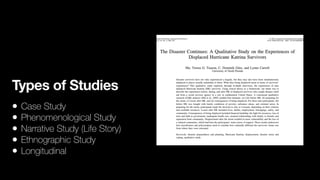
Types of Studies
• Case Study
• Phenomenological Study
• Narrative Study (Life Story)
• Ethnographic Study
• Longitudinal
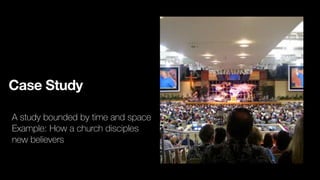
Case Study
A study bounded by time and space
Example: How a church disciples
new believers
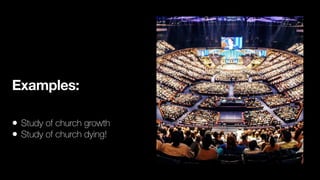
Examples:
• Study of church growth
• Study of church dying!
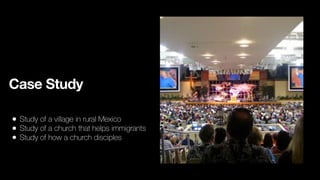
Case Study
• Study of a village in rural Mexico
• Study of a church that helps immigrants
• Study of how a church disciples
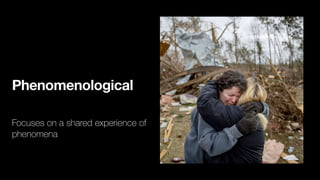
Phenomenological
Focuses on a shared experience of
phenomena
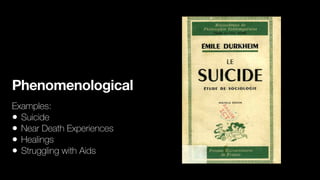
Phenomenological
Examples:
• Suicide
• Near Death Experiences
• Healings
• Struggling with Aids
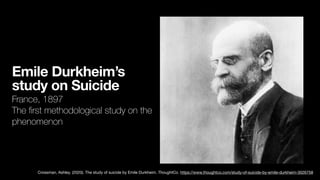
Emile Durkheim’s
study on Suicide
France, 1897
The
fi
rst methodological study on the
phenomenon
Crossman, Ashley. (2020). The study of suicide by Emile Durkheim. ThoughtCo. https://www.thoughtco.com/study-of-suicide-by-emile-durkheim-3026758
Four Types of Suicide
1. Egoist — prolonged sense of not belonging
2. Altruistic — Overwhelmed (i.e. burned out)
3. Anomic — Moral confusion, lack of purpose
4. Fatalistic — Feeling choked, sti
fl
ed, oppressed.
Crossman, Ashley. (2020). The study of suicide by Emile Durkheim. ThoughtCo. https://www.thoughtco.com/study-of-suicide-by-emile-durkheim-3026758
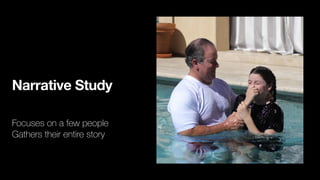
Narrative Study
Focuses on a few people
Gathers their entire story
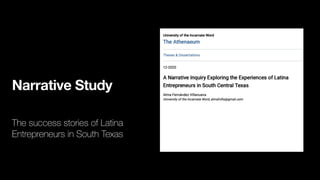
Narrative Study
The success stories of Latina
Entrepreneurs in South Texas
Narrative Study
Stories of how 12 Muslim College
Students at GCU embraced Jesus
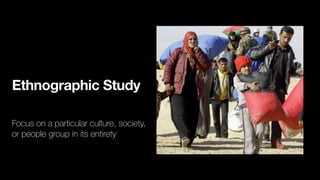
Ethnographic Study
Focus on a particular culture, society,
or people group in its entirety
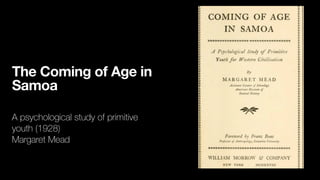
The Coming of Age in
Samoa
A psychological study of primitive
youth (1928)
Margaret Mead
The Rebbe’s Army
Inside the world of Chabad
Sue Fishko
f
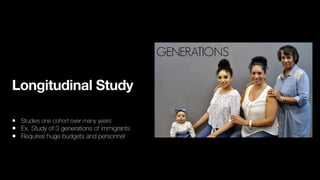
Longitudinal Study
• Studies one cohort over many years
• Ex. Study of 3 generations of immigrants
• Requires huge budgets and personnel
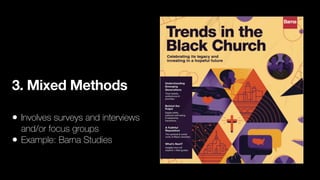
3. Mixed Methods
• Involves surveys and interviews
and/or focus groups
• Example: Barna Studies
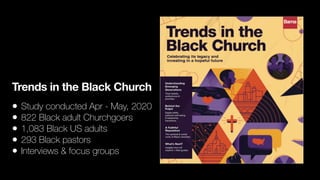
Trends in the Black Church
• Study conducted Apr - May, 2020
• 822 Black adult Churchgoers
• 1,083 Black US adults
• 293 Black pastors
• Interviews & focus groups
How to do we read Studies?
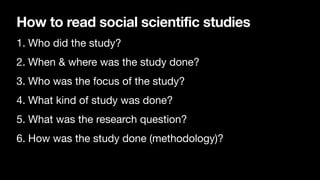
How to read social scientific studies
1. Who did the study?
Which study would you trust?
Climate change in the
Arctic: An Inuity Reality
Duane Smith
Published in Green Our World
Vol. XLIV, No. 2, 2007
UN Environmental Programme
Study of the effect of oil
drilling on Alaskan Sea Life
Conducted by Exxon Mobil
In Alaska North Slope
On September, 2018
Who did the study?
• For pro
fi
t company (ex. P
fi
zer)
• Government organization (ex. Pew)
• Non-pro
fi
t religious organization (ex. Barna)
• Non-pro
fi
t advocacy (ex. Environmental group)
• Academic Institution (ex. USC)
How to read social scientific studies
1. Who did the study?
2. When & where was the study done?
When/Where was the
study conducted?
• April - May, 2009?
• United States
How to read social scientific studies
1. Who did the study?
2. When & where was the study done?
3. Who was the focus of the study?
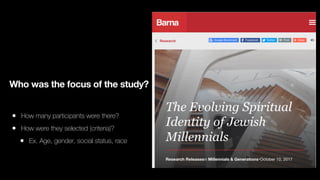
Who was the focus of the study?
• How many participants were there?
• How were they selected (criteria)?
• Ex. Age, gender, social status, race
How to read social scientific studies
1. Who did the study?
2. When & where was the study done?
3. Who was the focus of the study?
4. What kind of study was done?
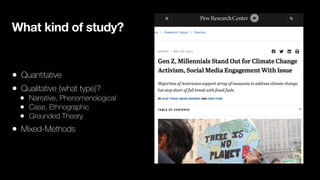
What kind of study?
• Quantitative
• Qualitative (what type)?
• Narrative, Phenomenological
• Case, Ethnographic
• Grounded Theory
• Mixed-Methods
How to read social scientific studies
1. Who did the study?
2. When & where was the study done?
3. Who was the focus of the study?
4. What kind of study was done?
5. What was the research question?
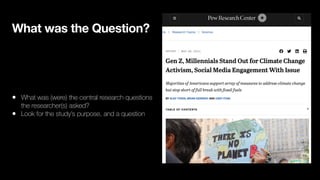
What was the Question?
• What was (were) the central research questions
the researcher(s) asked?
• Look for the study’s purpose, and a question
How to read social scientific studies
1. Who did the study?
2. When & where was the study done?
3. Who was the focus of the study?
4. What kind of study was done?
5. What was the research question?
6. How was the study done (methodology)?
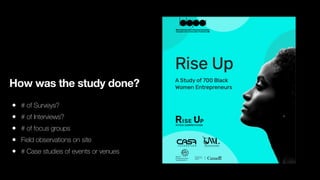
How was the study done?
• # of Surveys?
• # of Interviews?
• # of focus groups
• Field observations on site
• # Case studies of events or venues
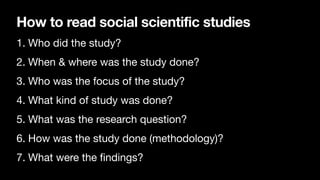
How to read social scientific studies
1. Who did the study?
2. When & where was the study done?
3. Who was the focus of the study?
4. What kind of study was done?
5. What was the research question?
6. How was the study done (methodology)?
7. What were the
fi
ndings?
How to read social scientific studies
1. Who did the study?
2. When & where was the study done?
3. Who was the focus of the study?
4. What kind of study was done?
5. What was the research question?
6. How was the study done (methodology)?
7. What were the
fi
ndings?
8. What are the implications for ministry to this group?
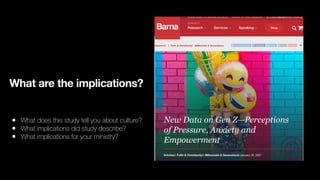
What are the implications?
• What does this study tell you about culture?
• What implications did study describe?
• What implications for your ministry?
Where do I start?
Where do I start
1. Abstract — one paragraph summary of he study
2. Introduction or Executive summary — Usually summarizes the study and its
fi
ndings.
Where do I start
1. Abstract
2. Introduction or Executive summary
3. Read the table of contents or scan the headings
Where do I start
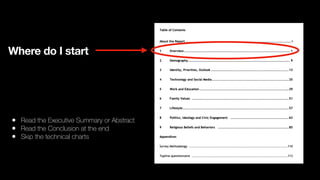
• Read the Executive Summary or Abstract
• Read the Conclusion at the end
• Skip the technical charts
Where do I start
1. Abstract
2. Introduction or Executive summary
3. Table of Contents or Headings
4. Findings— are described in one section after the methodology
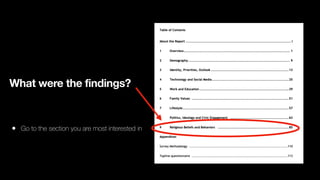
What were the findings?
• Go to the section you are most interested in
Where do I start
1. Abstract
2. Introduction or Executive summary
3. Table of Contents or Headings
4. Findings
5. Implications — at the very end in the conclusion or just before
Where do I start
1. Abstract
2. Introduction or Executive summary
3. Table of Contents or Headings
4. Findings
5. Implications
6. Answer the questions — who, when, where, what, how, why…
Where do I start
1. Abstract
2. Introduction or Executive summary
3. Table of Contents or Headings
4. Findings
5. Implications
6. Answer the questions
7. Write your report — summarize the study concisely, and directly.
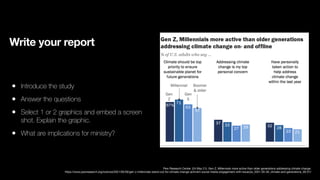
Write your report
• Introduce the study
• Answer the questions
• Select 1 or 2 graphics and embed a screen
shot. Explain the graphic.
• What are implications for ministry?
Pew Research Center. (24 May 21). Gen Z, Millennials more active than older generations addressing climate change.
https://www.pewresearch.org/science/2021/05/26/gen-z-millennials-stand-out-for-climate-change-activism-social-media-engagement-with-issue/ps_2021-05-26_climate-and-generations_00-01/
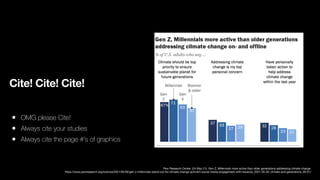
Cite! Cite! Cite!
• OMG please Cite!
• Always cite your studies
• Always cite the page #’s of graphics
Pew Research Center. (24 May 21). Gen Z, Millennials more active than older generations addressing climate change.
https://www.pewresearch.org/science/2021/05/26/gen-z-millennials-stand-out-for-climate-change-activism-social-media-engagement-with-issue/ps_2021-05-26_climate-and-generations_00-01/
Oh yeah, did I say “cite!” ?
Be sure to properly cite the report and any supporting sources you consult
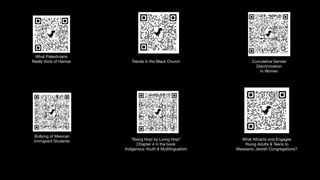
What Palestinians
Really think of Hamas Trends in the Black Church Cumulative Gender
Discrimination
In Women
Bullying of Mexican
Immigrant Students “Being Hopi by Living Hopi”
Chapter 4 in the book
Indigenous Youth & Multilingualism
What Attracts and Engages
Young Adults & Teens to
Messianic Jewish Congregations?
Let’s Find a Study
Go to the GCU Library Journal Database and Search for Studies in our area of research

INT-450 Topic 2a Reading Social Scientific Studies.pdf

  • 1.
    INT-450 • CulturalAnthropology • Topic 2a Reading Social Scientific Studies
  • 2.
    Social Scienti fi c Studies Cultural Anthropological Studies Sociological Studies Demographic Studies Psychological Studies Ex.Ethnography Of Non-Western Society Ex. Gender and Race Studies Ex. US Census Pew Research Ex. Studies of PTSD Victims
  • 3.
    Who were thefirst cultural anthropologists?
  • 4.
    Frank Boas 1858 -1942 Father of Cultural Anthropology Challenged Western Centrism Tax, S. (2021, December 18). Franz Boas. Encyclopedia Britannica. https://www.britannica.com/biography/Franz-Boas
  • 5.
    Classical Approach toCulture Cultures all begin as primitive animist Societies develop along a fi xed path Developed cultures look like Western Culture Western Culture became the benchmark
  • 7.
  • 8.
  • 9.
    Theory of Cultural Relativism Boaztheories that cultures develop relative to the community’s history, geography, and natural conditions Tax, S. (2021, December 18). Franz Boas. Encyclopedia Britannica. https://www.britannica.com/biography/Franz-Boas
  • 10.
    Cultural Relativism The viewthat various cultural practices and beliefs are best understood in relation to their entire context. (Howell & Paris, 2019, 56)
  • 11.
    Margaret Meade 1901 -1978 • Student of Frank Boaz • 1928 Traveled to Samoa to study how children were raised, educated, and mature.
  • 12.
    Coming of Agein Samoa 1928 • Research question: Is human development biological, thus the same as Western culture or is it cultural, thus di ff erent? • Found that social norms, such as and gender norms and family are driven by culture and environment.
  • 13.
    Zora Neale Hurston 1891- 1960 • Student of Frank Boaz • Born in Notasulga, AL • Raised in Easton, FL • 1925 Barnard, Columbia Univ. Was the only Black student • Boaz encouraged her to go down South and write ethnography of African-American Community
  • 15.
    Zora Neale Hurstonas an Ethno-photographer
  • 16.
    Why do weneed social scientific studies?
  • 17.
  • 18.
    Ethnography: Exegeting Culture CultureReader Roles Rituals Artifacts Use of Space Language INT-450 Student
  • 19.
    Ethnography: Exegeting Culture CultureReader Cultural Biases Type of Study Roles Rituals Artifacts Use of Space Language INT-450 Student
  • 20.
    Ethnography: Exegeting Culture CultureReader Cultural Biases Type of Study Roles Rituals Artifacts Use of Space Language Why should I believe Her ethnographic study? She’s biased! INT-450 Student
  • 21.
    Scienti fi c Methods compensatefor our biases Culture Reader Cultural Biases Type of Study Roles Rituals Artifacts Use of Space Language INT-450 Student
  • 22.
    What are thetypes of studies?
  • 23.
    1. Quantitative Study •100’s to 1,000’s participants • Funded by big institutions • Studies many topics • Survey type Data
  • 24.
    Examples • Barna Research •Pew Research • Gallup poll • Lifeway Research
  • 25.
    Pew Research Study GenerationZ Looks a Lot Like Millennials on Key Social and Political Issues
  • 26.
    Quantitative Studies What cana quantitative study tell us? What does a quantitative study miss?
  • 27.
    2. Qualititative Study •Less than 100 participants • Focused on a narrow topic • Small research team • Studies few topics in depth
  • 28.
    Types of Studies •Case Study • Phenomenological Study • Narrative Study (Life Story) • Ethnographic Study • Longitudinal
  • 29.
    Case Study A studybounded by time and space Example: How a church disciples new believers
  • 30.
    Examples: • Study ofchurch growth • Study of church dying!
  • 31.
    Case Study • Studyof a village in rural Mexico • Study of a church that helps immigrants • Study of how a church disciples
  • 32.
    Phenomenological Focuses on ashared experience of phenomena
  • 33.
    Phenomenological Examples: • Suicide • NearDeath Experiences • Healings • Struggling with Aids
  • 34.
    Emile Durkheim’s study onSuicide France, 1897 The fi rst methodological study on the phenomenon Crossman, Ashley. (2020). The study of suicide by Emile Durkheim. ThoughtCo. https://www.thoughtco.com/study-of-suicide-by-emile-durkheim-3026758
  • 35.
    Four Types ofSuicide 1. Egoist — prolonged sense of not belonging 2. Altruistic — Overwhelmed (i.e. burned out) 3. Anomic — Moral confusion, lack of purpose 4. Fatalistic — Feeling choked, sti fl ed, oppressed. Crossman, Ashley. (2020). The study of suicide by Emile Durkheim. ThoughtCo. https://www.thoughtco.com/study-of-suicide-by-emile-durkheim-3026758
  • 36.
    Narrative Study Focuses ona few people Gathers their entire story
  • 37.
    Narrative Study The successstories of Latina Entrepreneurs in South Texas
  • 38.
    Narrative Study Stories ofhow 12 Muslim College Students at GCU embraced Jesus
  • 39.
    Ethnographic Study Focus ona particular culture, society, or people group in its entirety
  • 40.
    The Coming ofAge in Samoa A psychological study of primitive youth (1928) Margaret Mead
  • 41.
    The Rebbe’s Army Insidethe world of Chabad Sue Fishko f
  • 42.
    Longitudinal Study • Studiesone cohort over many years • Ex. Study of 3 generations of immigrants • Requires huge budgets and personnel
  • 43.
    3. Mixed Methods •Involves surveys and interviews and/or focus groups • Example: Barna Studies
  • 44.
    Trends in theBlack Church • Study conducted Apr - May, 2020 • 822 Black adult Churchgoers • 1,083 Black US adults • 293 Black pastors • Interviews & focus groups
  • 45.
    How to dowe read Studies?
  • 46.
    How to readsocial scientific studies 1. Who did the study?
  • 47.
  • 48.
    Climate change inthe Arctic: An Inuity Reality Duane Smith Published in Green Our World Vol. XLIV, No. 2, 2007 UN Environmental Programme
  • 49.
    Study of theeffect of oil drilling on Alaskan Sea Life Conducted by Exxon Mobil In Alaska North Slope On September, 2018
  • 50.
    Who did thestudy? • For pro fi t company (ex. P fi zer) • Government organization (ex. Pew) • Non-pro fi t religious organization (ex. Barna) • Non-pro fi t advocacy (ex. Environmental group) • Academic Institution (ex. USC)
  • 51.
    How to readsocial scientific studies 1. Who did the study? 2. When & where was the study done?
  • 52.
    When/Where was the studyconducted? • April - May, 2009? • United States
  • 53.
    How to readsocial scientific studies 1. Who did the study? 2. When & where was the study done? 3. Who was the focus of the study?
  • 54.
    Who was thefocus of the study? • How many participants were there? • How were they selected (criteria)? • Ex. Age, gender, social status, race
  • 55.
    How to readsocial scientific studies 1. Who did the study? 2. When & where was the study done? 3. Who was the focus of the study? 4. What kind of study was done?
  • 56.
    What kind ofstudy? • Quantitative • Qualitative (what type)? • Narrative, Phenomenological • Case, Ethnographic • Grounded Theory • Mixed-Methods
  • 57.
    How to readsocial scientific studies 1. Who did the study? 2. When & where was the study done? 3. Who was the focus of the study? 4. What kind of study was done? 5. What was the research question?
  • 58.
    What was theQuestion? • What was (were) the central research questions the researcher(s) asked? • Look for the study’s purpose, and a question
  • 59.
    How to readsocial scientific studies 1. Who did the study? 2. When & where was the study done? 3. Who was the focus of the study? 4. What kind of study was done? 5. What was the research question? 6. How was the study done (methodology)?
  • 60.
    How was thestudy done? • # of Surveys? • # of Interviews? • # of focus groups • Field observations on site • # Case studies of events or venues
  • 61.
    How to readsocial scientific studies 1. Who did the study? 2. When & where was the study done? 3. Who was the focus of the study? 4. What kind of study was done? 5. What was the research question? 6. How was the study done (methodology)? 7. What were the fi ndings?
  • 62.
    How to readsocial scientific studies 1. Who did the study? 2. When & where was the study done? 3. Who was the focus of the study? 4. What kind of study was done? 5. What was the research question? 6. How was the study done (methodology)? 7. What were the fi ndings? 8. What are the implications for ministry to this group?
  • 63.
    What are theimplications? • What does this study tell you about culture? • What implications did study describe? • What implications for your ministry?
  • 64.
    Where do Istart?
  • 65.
    Where do Istart 1. Abstract — one paragraph summary of he study 2. Introduction or Executive summary — Usually summarizes the study and its fi ndings.
  • 66.
    Where do Istart 1. Abstract 2. Introduction or Executive summary 3. Read the table of contents or scan the headings
  • 67.
    Where do Istart • Read the Executive Summary or Abstract • Read the Conclusion at the end • Skip the technical charts
  • 68.
    Where do Istart 1. Abstract 2. Introduction or Executive summary 3. Table of Contents or Headings 4. Findings— are described in one section after the methodology
  • 69.
    What were thefindings? • Go to the section you are most interested in
  • 70.
    Where do Istart 1. Abstract 2. Introduction or Executive summary 3. Table of Contents or Headings 4. Findings 5. Implications — at the very end in the conclusion or just before
  • 71.
    Where do Istart 1. Abstract 2. Introduction or Executive summary 3. Table of Contents or Headings 4. Findings 5. Implications 6. Answer the questions — who, when, where, what, how, why…
  • 72.
    Where do Istart 1. Abstract 2. Introduction or Executive summary 3. Table of Contents or Headings 4. Findings 5. Implications 6. Answer the questions 7. Write your report — summarize the study concisely, and directly.
  • 73.
    Write your report •Introduce the study • Answer the questions • Select 1 or 2 graphics and embed a screen shot. Explain the graphic. • What are implications for ministry? Pew Research Center. (24 May 21). Gen Z, Millennials more active than older generations addressing climate change. https://www.pewresearch.org/science/2021/05/26/gen-z-millennials-stand-out-for-climate-change-activism-social-media-engagement-with-issue/ps_2021-05-26_climate-and-generations_00-01/
  • 74.
    Cite! Cite! Cite! •OMG please Cite! • Always cite your studies • Always cite the page #’s of graphics Pew Research Center. (24 May 21). Gen Z, Millennials more active than older generations addressing climate change. https://www.pewresearch.org/science/2021/05/26/gen-z-millennials-stand-out-for-climate-change-activism-social-media-engagement-with-issue/ps_2021-05-26_climate-and-generations_00-01/
  • 75.
    Oh yeah, didI say “cite!” ? Be sure to properly cite the report and any supporting sources you consult
  • 76.
    What Palestinians Really thinkof Hamas Trends in the Black Church Cumulative Gender Discrimination In Women Bullying of Mexican Immigrant Students “Being Hopi by Living Hopi” Chapter 4 in the book Indigenous Youth & Multilingualism What Attracts and Engages Young Adults & Teens to Messianic Jewish Congregations?
  • 77.
    Let’s Find aStudy Go to the GCU Library Journal Database and Search for Studies in our area of research