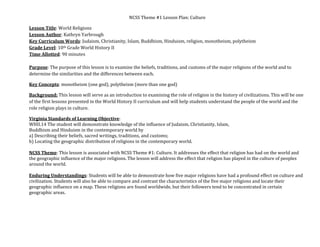
NCSS Theme #1 Lesson Plan: Culture 
Lesson Title: World Religions 
Lesson Author: Kathryn Yarbrough 
Key Curriculum Words: Judaism, Christianity, Islam, Buddhism, Hinduism, religion, monotheism, polytheism 
Grade Level: 10th Grade World History II 
Time Allotted: 90 minutes 
 
Purpose: The purpose of this lesson is to examine the beliefs, traditions, and customs of the major religions of the world and to 
determine the similarities and the differences between each.  
Key Concepts: monotheism (one god), polytheism (more than one god) 
Background: This lesson will serve as an introduction to examining the role of religion in the history of civilizations. This will be one 
of the first lessons presented in the World History II curriculum and will help students understand the people of the world and the 
role religion plays in culture.  
Virginia Standards of Learning Objective:  
WHII.14 The student will demonstrate knowledge of the influence of Judaism, Christianity, Islam, 
Buddhism and Hinduism in the contemporary world by 
a) Describing their beliefs, sacred writings, traditions, and customs; 
b) Locating the geographic distribution of religions in the contemporary world. 
 
NCSS Theme: This lesson is associated with NCSS Theme #1: Culture. It addresses the effect that religion has had on the world and 
the geographic influence of the major religions. The lesson will address the effect that religion has played in the culture of peoples 
around the world.  
 
Enduring Understandings: Students will be able to demonstrate how five major religions have had a profound effect on culture and 
civilization. Students will also be able to compare and contrast the characteristics of the five major religions and locate their 
geographic influence on a map. These religions are found worldwide, but their followers tend to be concentrated in certain 
geographic areas. 
 
Facts/Concepts: 
Christianity 
• Monotheism 
• Jesus as Son of God 
• Life after death 
• New Testament—Life and teachings of Jesus 
• Establishment of Christian doctrine by early church councils 
Islam 
• Monotheism 
• Muhammad the prophet 
• Koran 
• Five Pillars of Islam 
• Mecca and Medina 
Buddhism 
• Founder—Siddhartha Gautama (Buddha) 
• Four Noble Truths 
• Eightfold Path to Enlightenment 
• Spread of Buddhism from India to China and other parts of Asia, resulting from Asoka’s missionaries and their writings 
Hinduism 
• Many forms of one deity 
• Caste system 
• Reincarnation 
• Karma—Future reincarnation based on present behavior 
Judaism 
• Monotheism 
• Ten Commandments of moral and religious conduct 
• Torah—Written record and beliefs of Hebrews 
 
Geographical distribution of world’s major religions  
• Hinduism—Concentrated in India 
• Judaism—Concentrated in Israel and North America  
• Buddhism—Concentrated in East and Southeast Asia 
• Christianity —Concentrated in Europe, North and South America 
• Islam—Concentrated in the Middle East, Africa, and Asia 


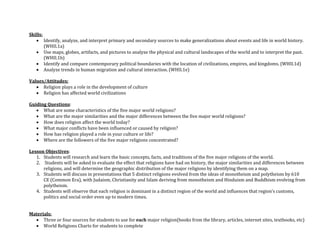
Skills:  
• Identify, analyze, and interpret primary and secondary sources to make generalizations about events and life in world history.  
(WHII.1a) 
• Use maps, globes, artifacts, and pictures to analyze the physical and cultural landscapes of the world and to interpret the past. 
(WHII.1b) 
• Identify and compare contemporary political boundaries with the location of civilizations, empires, and kingdoms. (WHII.1d) 
• Analyze trends in human migration and cultural interaction. (WHII.1e) 
 
Values/Attitudes:  
• Religion plays a role in the development of culture 
• Religion has affected world civilizations 
 
Guiding Questions: 
• What are some characteristics of the five major world religions? 
• What are the major similarities and the major differences between the five major world religions? 
• How does religion affect the world today? 
• What major conflicts have been influenced or caused by religion? 
• How has religion played a role in your culture or life? 
• Where are the followers of the five major religions concentrated? 
 
Lesson Objectives:  
1. Students will research and learn the basic concepts, facts, and traditions of the five major religions of the world. 
2.  Students will be asked to evaluate the effect that religions have had on history, the major similarities and differences between 
religions, and will determine the geographic distribution of the major religions by identifying them on a map.  
3. Students will discuss in presentations that 5 distinct religions evolved from the ideas of monotheism and polytheism by 610 
CE (Common Era), with Judaism, Christianity and Islam deriving from monotheism and Hinduism and Buddhism evolving from 
polytheism.  
4. Students will observe that each religion is dominant in a distinct region of the world and influences that region’s customs, 
politics and social order even up to modern times. 
 
 
Materials:  
• Three or four sources for students to use for each major religion(books from the library, articles, internet sites, textbooks, etc)  
• World Religions Charts for students to complete 
•
•
•
•
•
•

World Religions Map for students to complete 
Posterboard 
Overhead projector  
Transparencies 
Markers to write on transparencies 
Powerpoint capability 

 
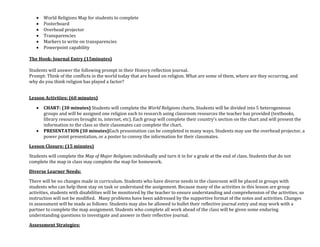
The Hook: Journal Entry (15minutes) 
 
Students will answer the following prompt in their History reflection journal. 
Prompt: Think of the conflicts in the world today that are based on religion. What are some of them, where are they occurring, and 
why do you think religion has played a factor?  
 
Lesson Activities: (60 minutes)                                                                             
•

•

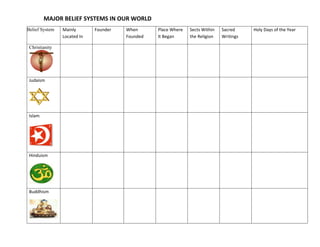
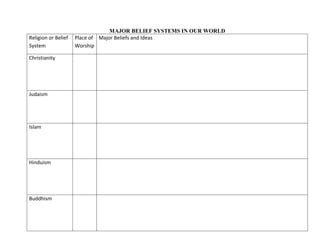
CHART: (30 minutes) Students will complete the World Religions charts. Students will be divided into 5 heterogeneous 
groups and will be assigned one religion each to research using classroom resources the teacher has provided (textbooks, 
library resources brought in, internet, etc). Each group will complete their country’s section on the chart and will present the 
information to the class so their classmates can complete the chart.  
PRESENTATION (30 minutes)Each presentation can be completed in many ways. Students may use the overhead projector, a 
power point presentation, or a poster to convey the information for their classmates.  

Lesson Closure: (15 minutes)                                                                                 
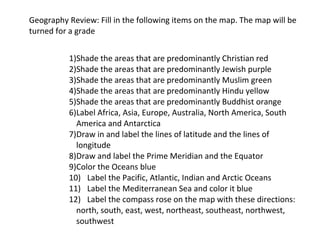
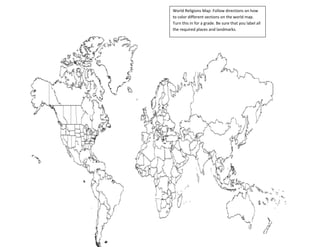
Students will complete the Map of Major Religions individually and turn it in for a grade at the end of class. Students that do not 
complete the map in class may complete the map for homework. 
Diverse Learner Needs:  
There will be no changes made in curriculum. Students who have diverse needs in the classroom will be placed in groups with 
students who can help them stay on task or understand the assignment. Because many of the activities in this lesson are group 
activities, students with disabilities will be monitored by the teacher to ensure understanding and comprehension of the activities, so 
instruction will not be modified.   Many problems have been addressed by the supportive format of the notes and activities. Changes 
in assessment will be made as follows: Students may also be allowed to bullet their reflective journal entry and may work with a 
partner to complete the map assignment. Students who complete all work ahead of the class will be given some enduring 
understanding questions to investigate and answer in their reflective journal.  
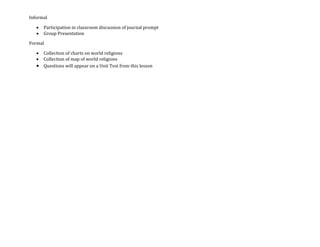
Assessment Strategies: 
Informal 
•
•

Participation in classroom discussion of journal prompt 
Group Presentation 

Formal   
•
•

Collection of charts on world religions 
Collection of map of world religions                
• Questions will appear on a Unit Test from this lesson 
MAJOR BELIEF SYSTEMS IN OUR WORLD 
Mainly 
Located In 


Christianity

Founder


Belief System

When 
Founded 

Place Where 
It Began 

Sects Within 
the Religion 


Judaism 


Islam 

 
Hinduism 


Buddhism 


Sacred 
Writings 

Holy Days of the Year
MAJOR BELIEF SYSTEMS IN OUR WORLD
Religion or Belief  Place of  Major Beliefs and Ideas
System 
Worship 
Christianity 


Judaism  


Islam 


Hinduism 


Buddhism 


Geography Review: Fill in the following items on the map. The map will be 
turned for a grade 
 
1)Shade the areas that are predominantly Christian red 
2)Shade the areas that are predominantly Jewish purple 
3)Shade the areas that are predominantly Muslim green 
4)Shade the areas that are predominantly Hindu yellow 
5)Shade the areas that are predominantly Buddhist orange 
6)Label Africa, Asia, Europe, Australia, North America, South 
America and Antarctica 
7)Draw in and label the lines of latitude and the lines of 
longitude 
8)Draw and label the Prime Meridian and the Equator 
9)Color the Oceans blue 
10) Label the Pacific, Atlantic, Indian and Arctic Oceans 
11) Label the Mediterranean Sea and color it blue 
12) Label the compass rose on the map with these directions: 
north, south, east, west, northeast, southeast, northwest, 
southwest 
World Religions Map: Follow directions on how 
to color different sections on the world map. 
Turn this in for a grade. Be sure that you label all 
the required places and landmarks. 

World religions