Lesson 1: Understanding
the Nature of Religion
By: Ms. Jo Marie Nel C. Garcia
Understanding Beliefs and
Worldviews
Worldview – a collection of beliefs about life and
the universe being held by people.
Social environment and upbringing are critical in
the development of a religious life.
Belief in god or gods is found in almost all
religions.
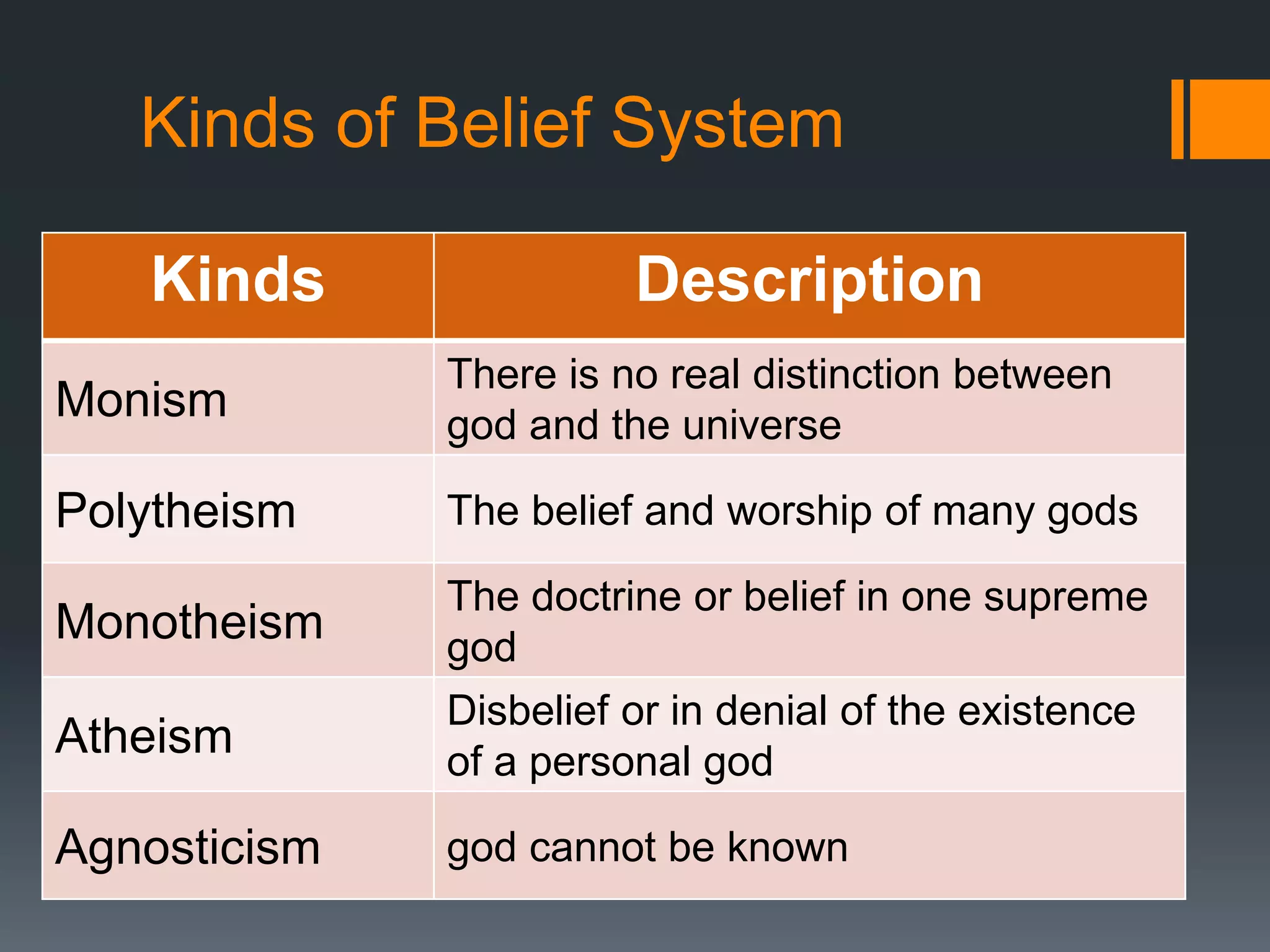
Kinds of Belief System
Kinds Description
Monism
There is no real distinction between
god and the universe
Polytheism The belief and worship of many gods
Monotheism
The doctrine or belief in one supreme
god
Atheism
Disbelief or in denial of the existence
of a personal god
Agnosticism god cannot be known
Theism – is a belief in the existence of one
god viewed as the creative source of the
human race and the world who transcends
yet is immanent in the world.
Monotheistic religions claim that there is
only one God who could have designed
and created the universe or may have
directed all events that led to the creation
of everything. There is one supreme God
who is both personal and moral, and who
seeks a total and unqualified response
from humans. (Judaism, Christianity and
Islam)
Polytheistic religions that were
common among early people
recognize many principal gods among
whom no one is supreme. These
include the ancient religions of Egypt,
Greece, and Rome wherein people
worship a multitude of personal gods.
Agnostics deny the possibility for man
to acquire knowledge of the existence
of God.
Monism asserts that there is no
genuine distinction between God and
the universe. Two implications arise
from this belief:
1.That God is dwelling in the universe
as part of it
2.The universe does not exist at all
as a reality but only as
manifestation of God.
Atheists deny the existence of God.
Definition of Religion
Religion– an organized system of beliefs, ceremonies,
and rules used to worship a god or group of gods.
Latin word “religio” – something done with overanxious or
scrupulous attention to detail
Latin verb “religare” – to tie together or to bind fast.
In its original sense, the word refers to the expression of
proper piety (devotion/respect), that is, binding to god.
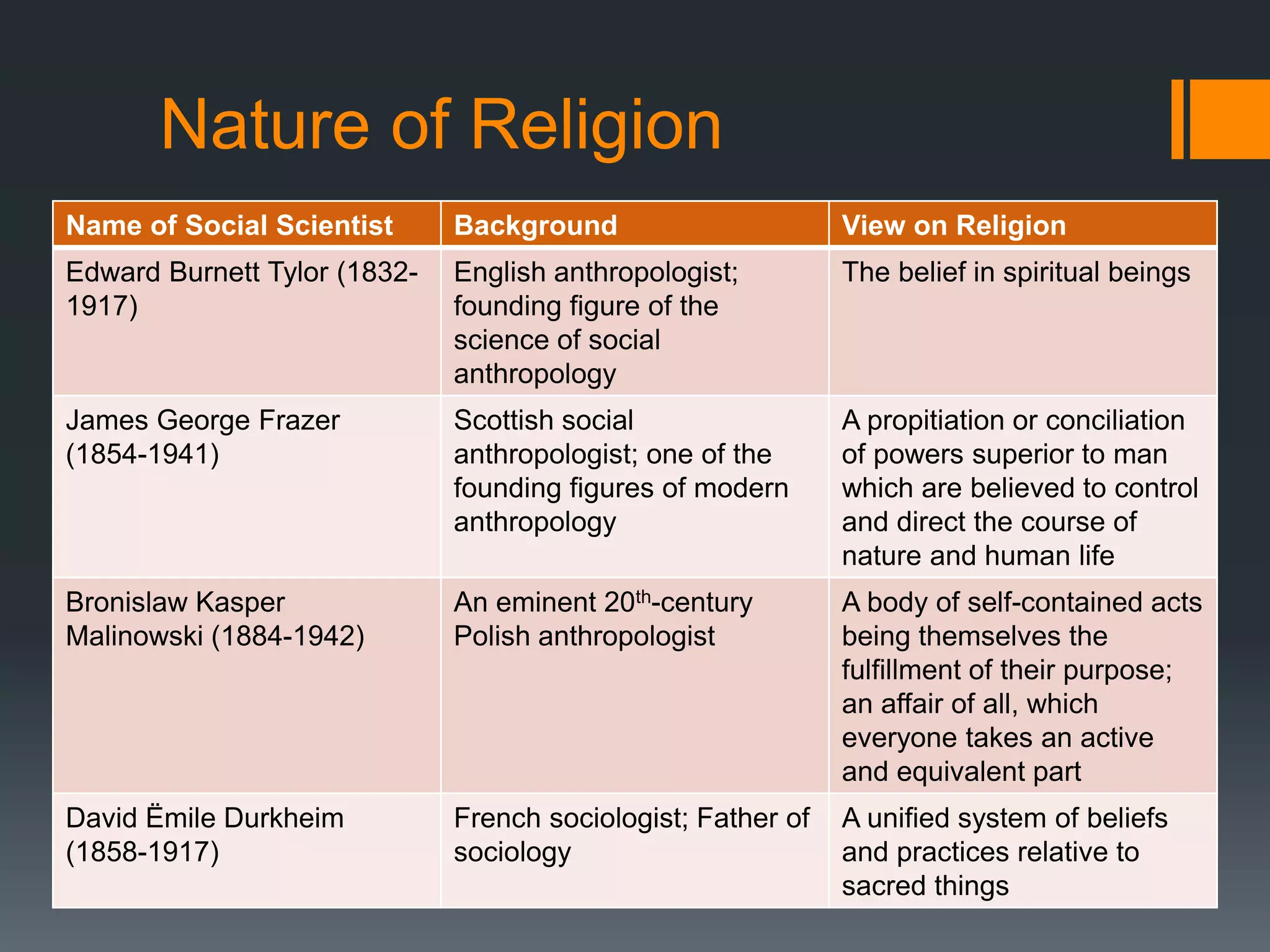
Nature of Religion
Name of Social Scientist Background View on Religion
Edward Burnett Tylor (1832-
1917)
English anthropologist;
founding figure of the
science of social
anthropology
The belief in spiritual beings
James George Frazer
(1854-1941)
Scottish social
anthropologist; one of the
founding figures of modern
anthropology
A propitiation or conciliation
of powers superior to man
which are believed to control
and direct the course of
nature and human life
Bronislaw Kasper
Malinowski (1884-1942)
An eminent 20th-century
Polish anthropologist
A body of self-contained acts
being themselves the
fulfillment of their purpose;
an affair of all, which
everyone takes an active
and equivalent part
David Ëmile Durkheim
(1858-1917)
French sociologist; Father of
sociology
A unified system of beliefs
and practices relative to
sacred things
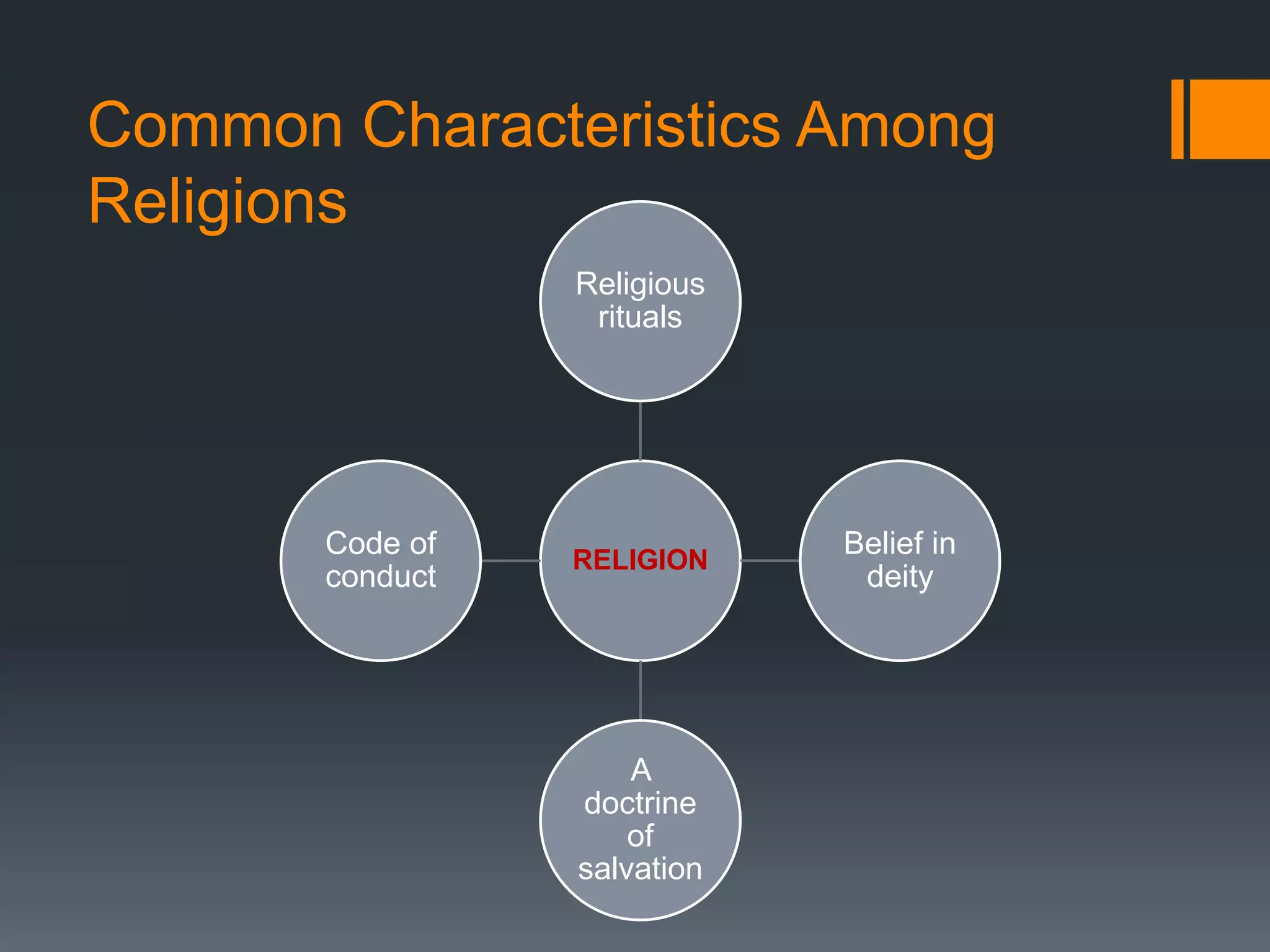
Common Characteristics Among
Religions
RELIGION
Religious
rituals
Belief in
deity
A
doctrine
of
salvation
Code of
conduct
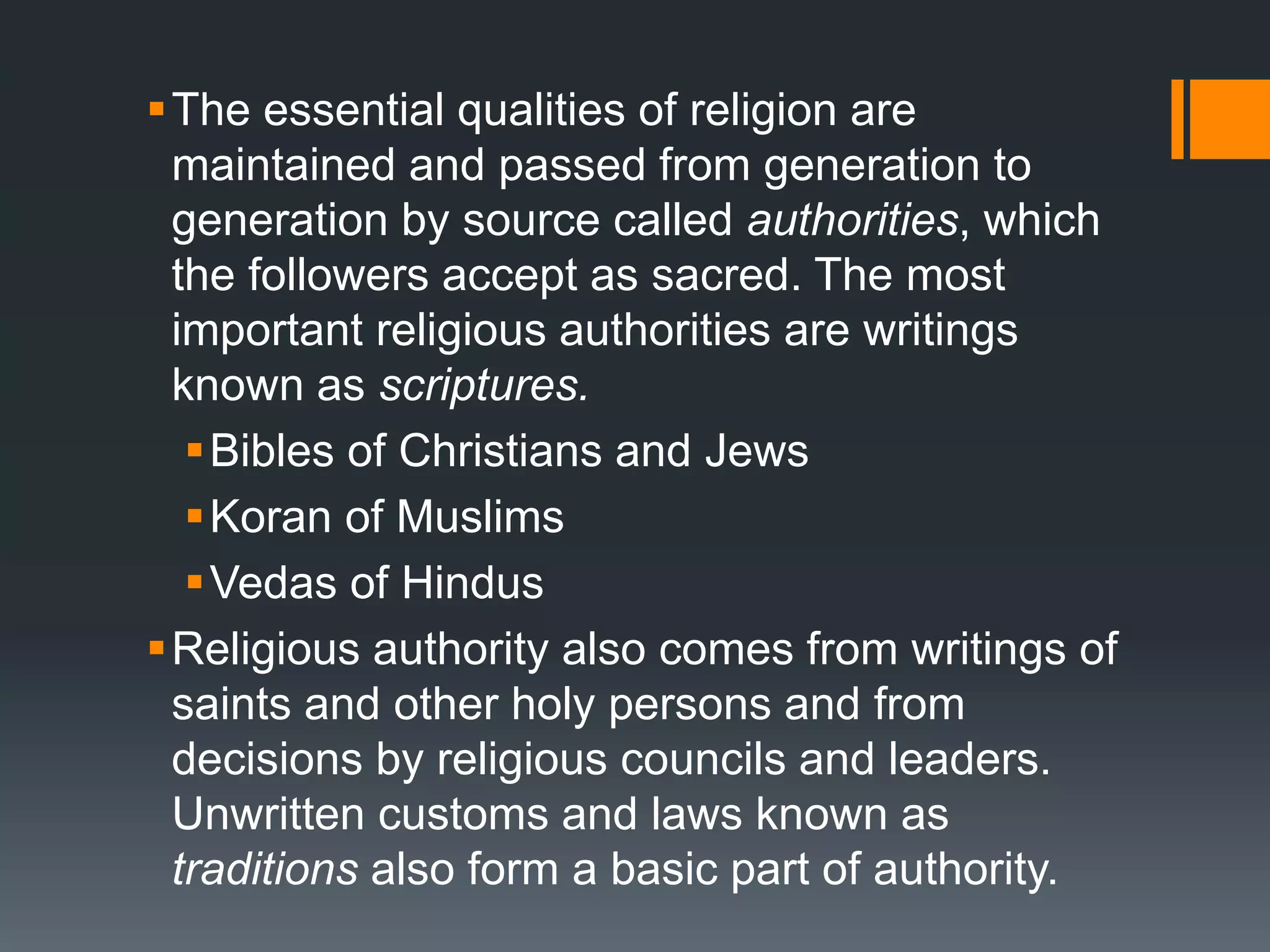
The essential qualities of religion are
maintained and passed from generation to
generation by source called authorities, which
the followers accept as sacred. The most
important religious authorities are writings
known as scriptures.
Bibles of Christians and Jews
Koran of Muslims
Vedas of Hindus
Religious authority also comes from writings of
saints and other holy persons and from
decisions by religious councils and leaders.
Unwritten customs and laws known as
traditions also form a basic part of authority.
1. Belief in deity
Three philosophical views:
Atheists believe that no deity exists.
Theists believe in deity or deities.
Agnostics say that the existence of
deity cannot be proved or disproved.
2. A Doctrine of Salvation
It is based on the belief that people
are in some danger from which they
must be saved.
Major religions like Christianity, Islam,
Buddhism and Hinduism tress that
salvation is the highest goal of the
faithful and one that all followers
should try to achieve.
3. A Code of Conduct
Is a set of moral teachings and values
that all religions have in some form.
Such a code or ethics tells believers
how to conduct their lives.
It instructs them how to act toward the
deity and toward one another.
4. Religious Rituals
These include the acts and ceremonies by which
believers appeal to and serve God, deities and
other sacred powers.
The performance of a ritual is often called a service.
The most common ritual is prayer or for some Asian
religions, meditation.
Many religions have rituals intended to purify the
body. Some have pilgrimages.
Rituals commemorate events in the history of
religions and mark important events in a person’s
life.
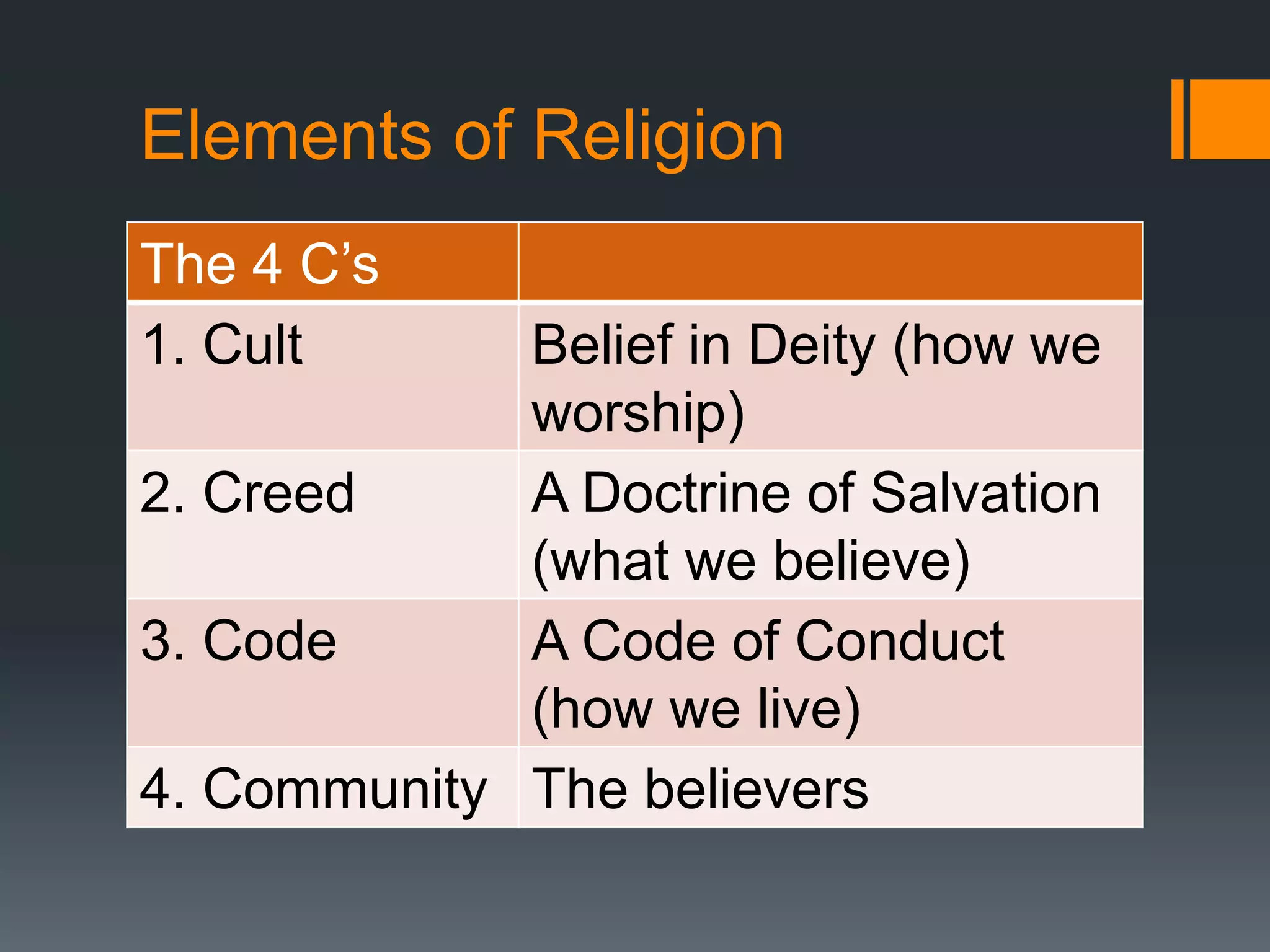
Elements of Religion
The 4 C’s
1. Cult Belief in Deity (how we
worship)
2. Creed A Doctrine of Salvation
(what we believe)
3. Code A Code of Conduct
(how we live)
4. Community The believers
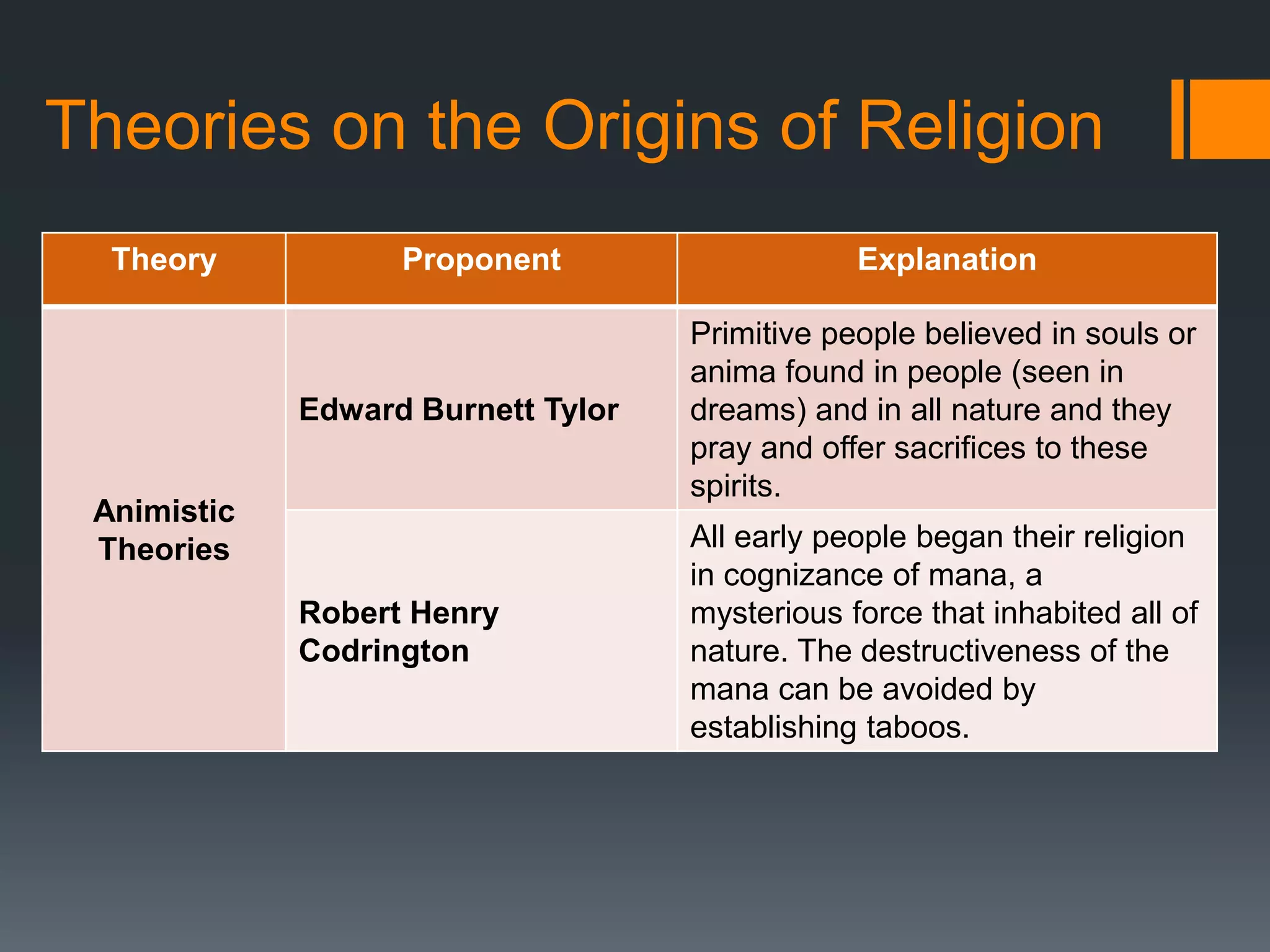
Theories on the Origins of Religion
Theory Proponent Explanation
Animistic
Theories
Edward Burnett Tylor
Primitive people believed in souls or
anima found in people (seen in
dreams) and in all nature and they
pray and offer sacrifices to these
spirits.
Robert Henry
Codrington
All early people began their religion
in cognizance of mana, a
mysterious force that inhabited all of
nature. The destructiveness of the
mana can be avoided by
establishing taboos.
Theories on the Origins of Religion
Theory Proponent Explanation
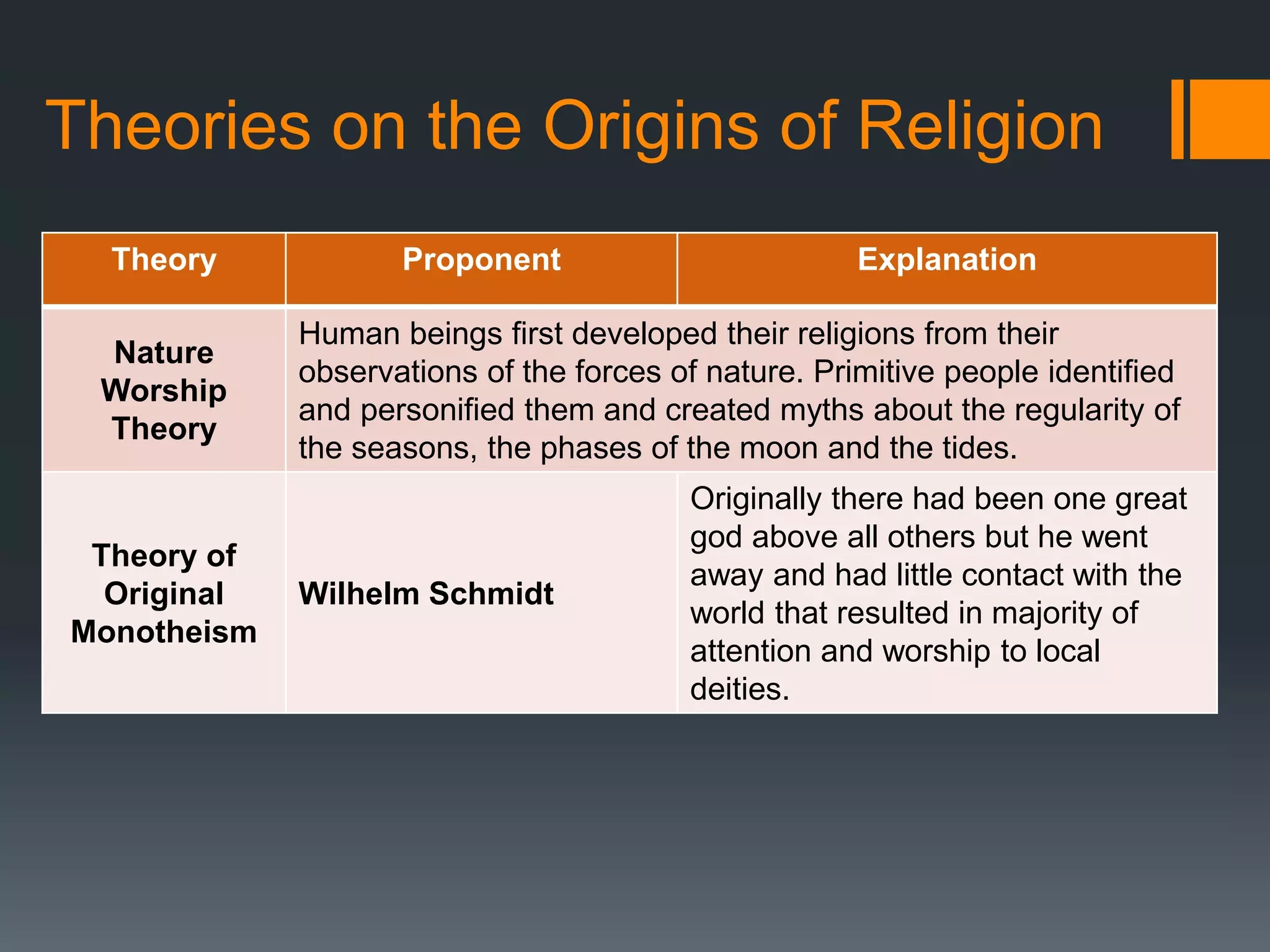
Nature
Worship
Theory
Human beings first developed their religions from their
observations of the forces of nature. Primitive people identified
and personified them and created myths about the regularity of
the seasons, the phases of the moon and the tides.
Theory of
Original
Monotheism
Wilhelm Schmidt
Originally there had been one great
god above all others but he went
away and had little contact with the
world that resulted in majority of
attention and worship to local
deities.
Theories on the Origins of Religion
Theory Proponent Explanation
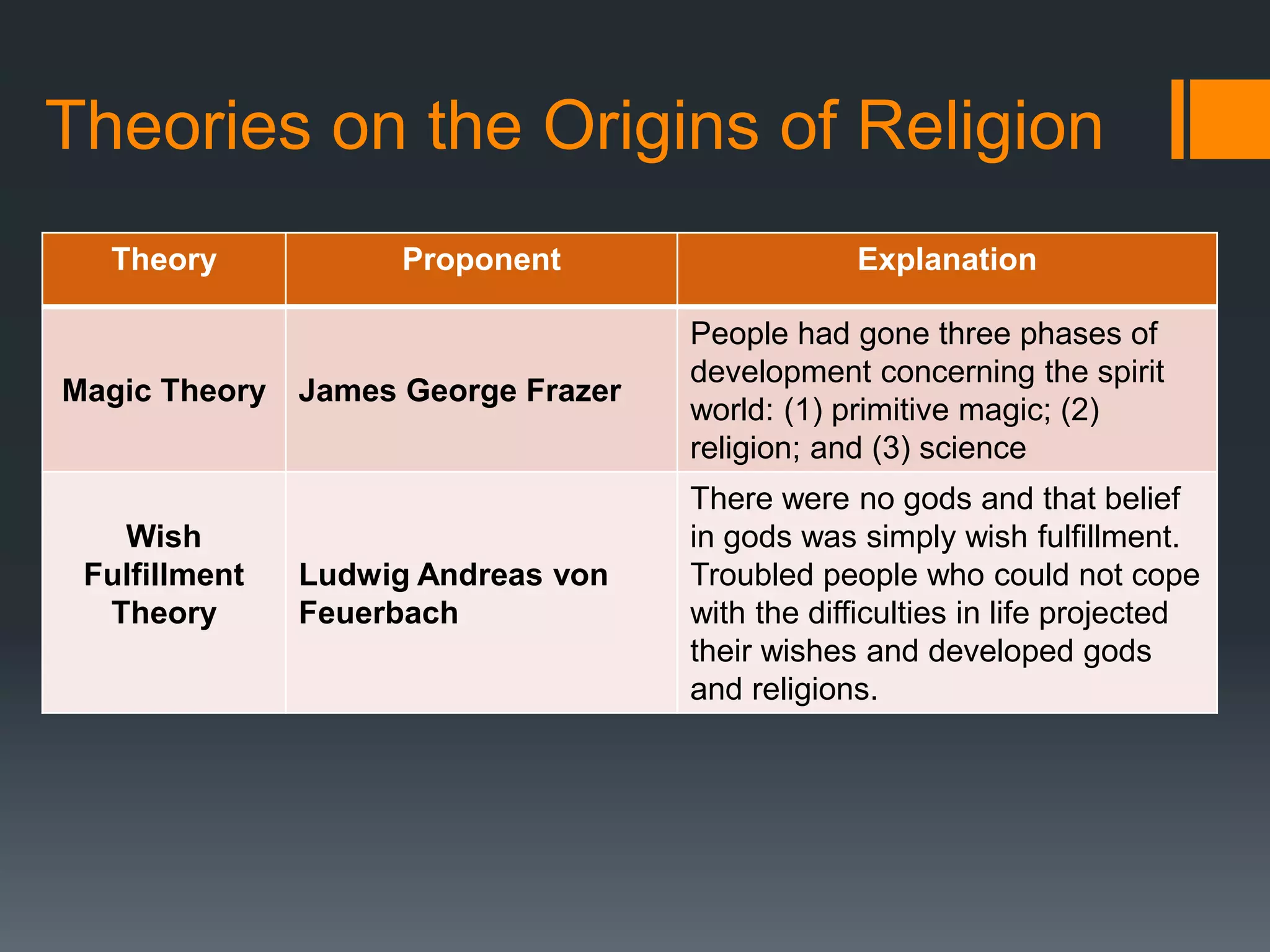
Magic Theory James George Frazer
People had gone three phases of
development concerning the spirit
world: (1) primitive magic; (2)
religion; and (3) science
Wish
Fulfillment
Theory
Ludwig Andreas von
Feuerbach
There were no gods and that belief
in gods was simply wish fulfillment.
Troubled people who could not cope
with the difficulties in life projected
their wishes and developed gods
and religions.
Theories on the Origins of Religion
Theory Proponent Explanation
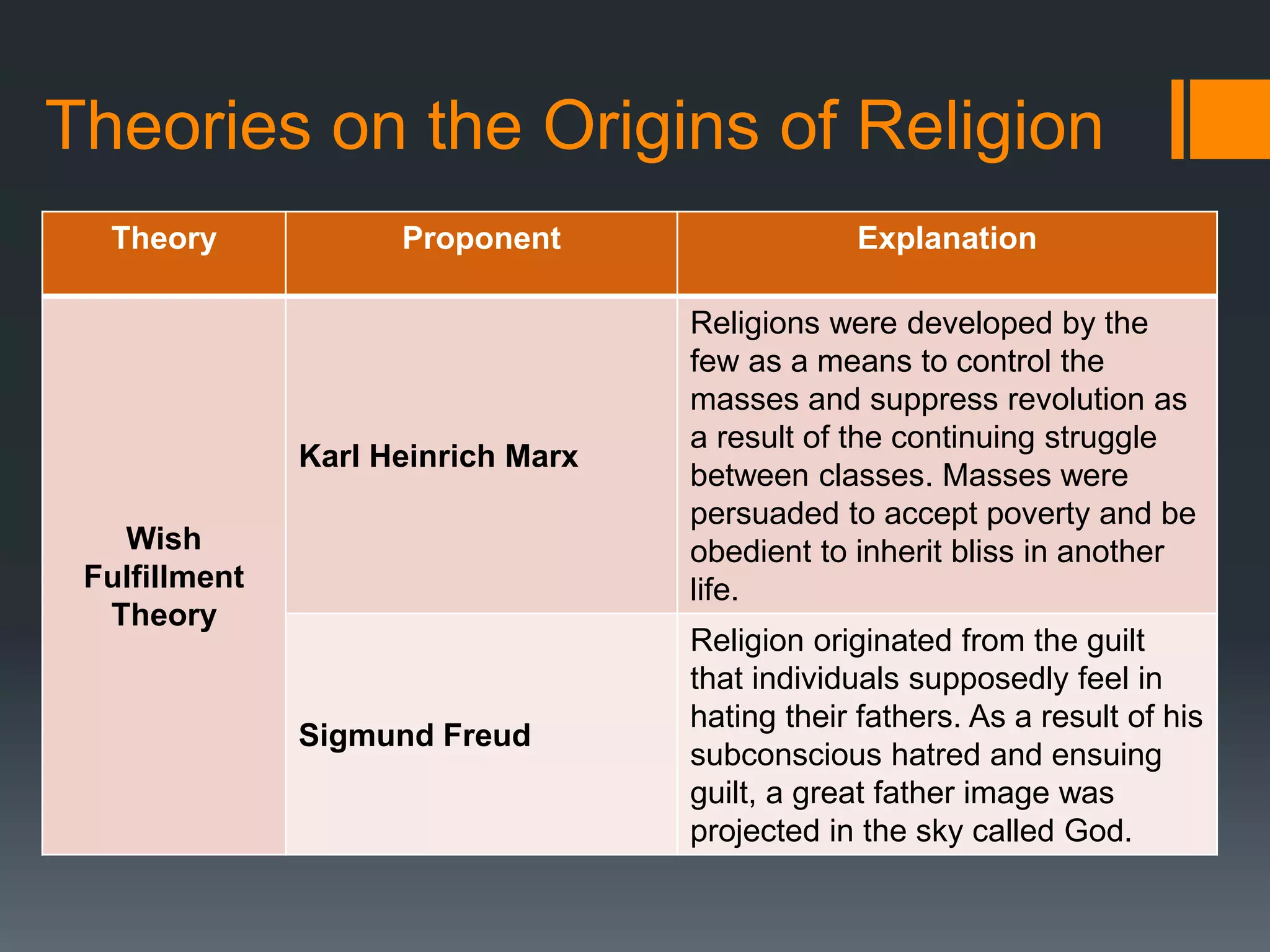
Wish
Fulfillment
Theory
Karl Heinrich Marx
Religions were developed by the
few as a means to control the
masses and suppress revolution as
a result of the continuing struggle
between classes. Masses were
persuaded to accept poverty and be
obedient to inherit bliss in another
life.
Sigmund Freud
Religion originated from the guilt
that individuals supposedly feel in
hating their fathers. As a result of his
subconscious hatred and ensuing
guilt, a great father image was
projected in the sky called God.
Exploring Spirituality
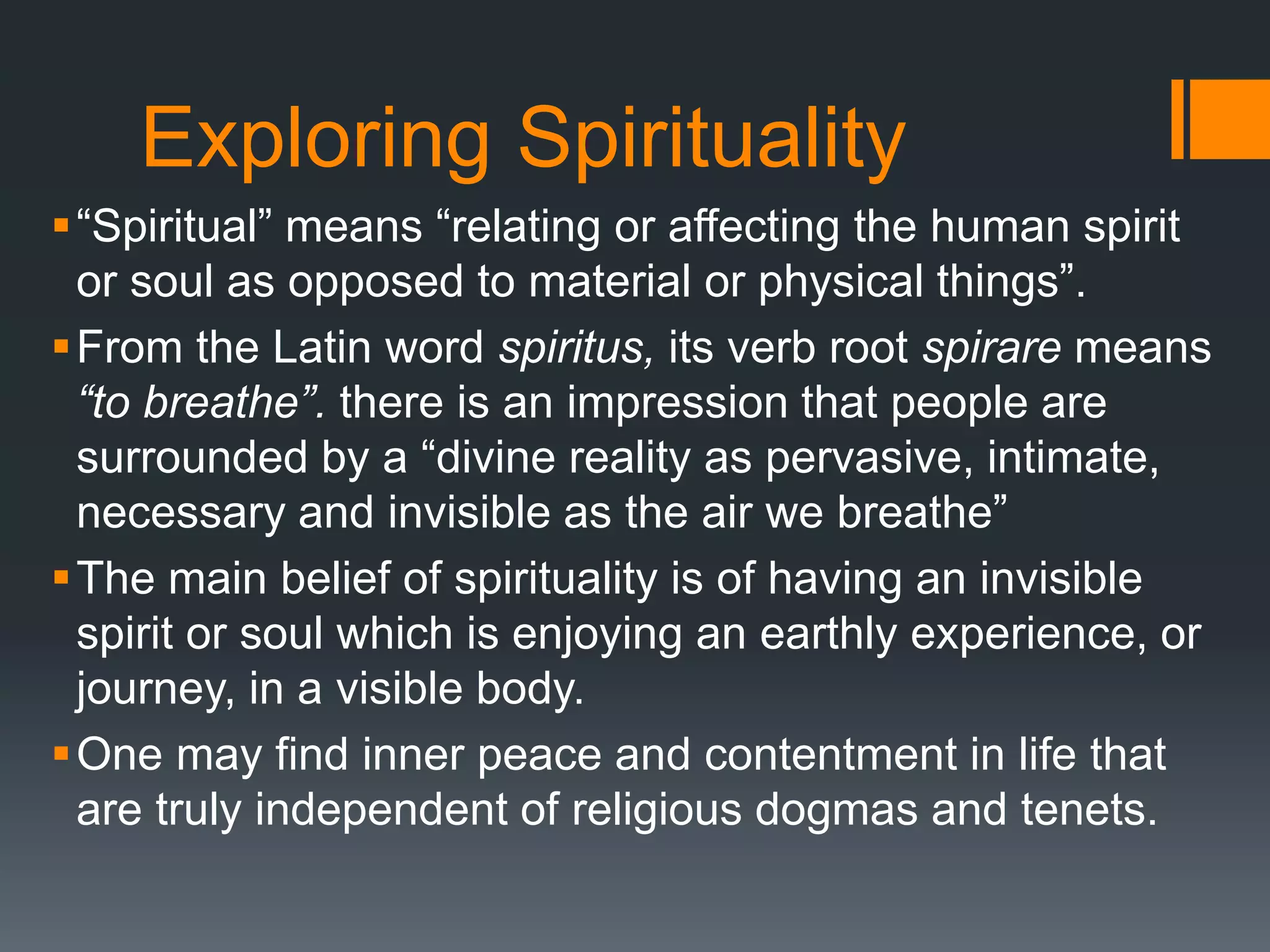
“Spiritual” means “relating or affecting the human spirit
or soul as opposed to material or physical things”.
From the Latin word spiritus, its verb root spirare means
“to breathe”. there is an impression that people are
surrounded by a “divine reality as pervasive, intimate,
necessary and invisible as the air we breathe”
The main belief of spirituality is of having an invisible
spirit or soul which is enjoying an earthly experience, or
journey, in a visible body.
One may find inner peace and contentment in life that
are truly independent of religious dogmas and tenets.
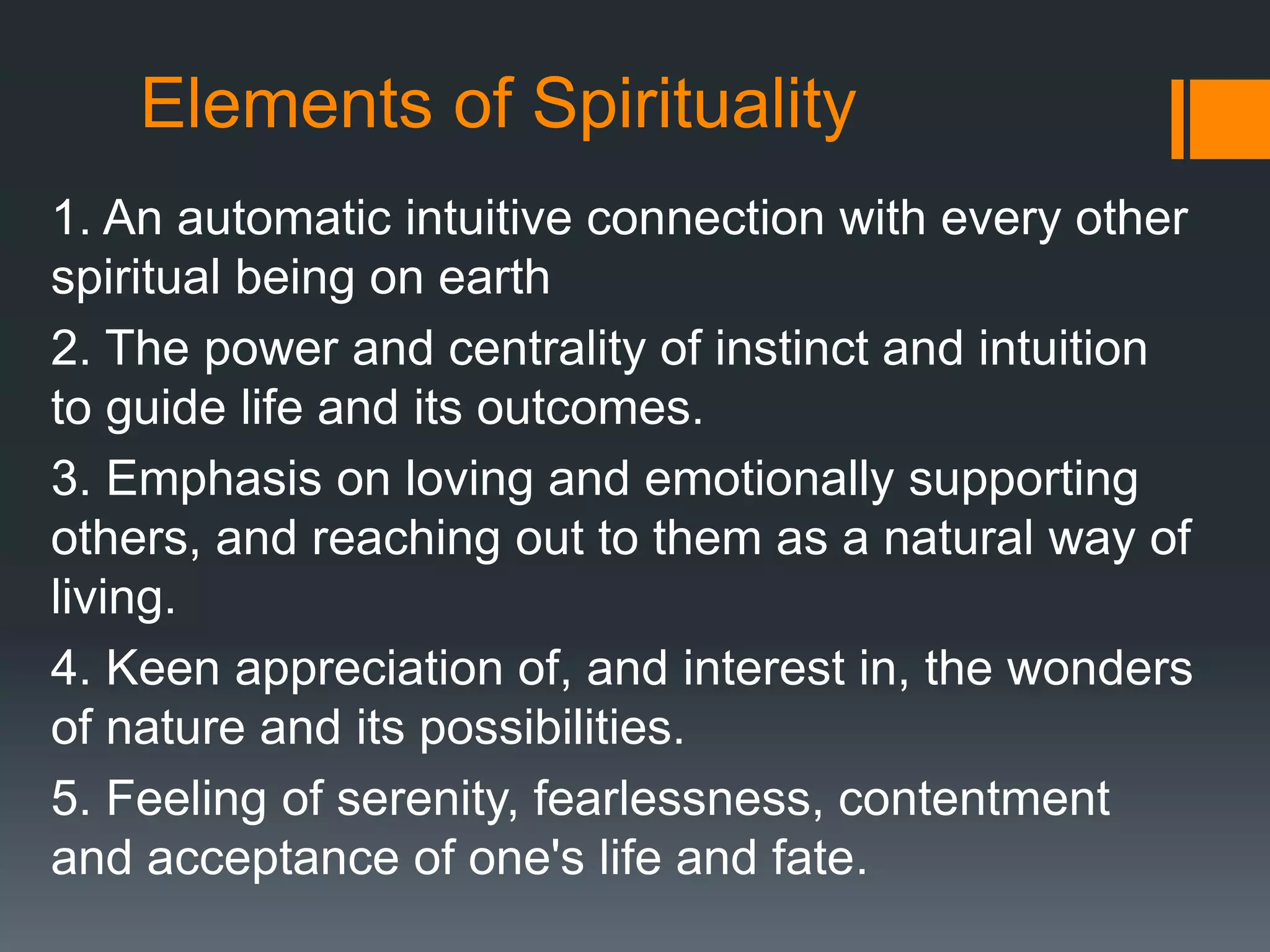
Elements of Spirituality
1. An automatic intuitive connection with every other
spiritual being on earth
2. The power and centrality of instinct and intuition
to guide life and its outcomes.
3. Emphasis on loving and emotionally supporting
others, and reaching out to them as a natural way of
living.
4. Keen appreciation of, and interest in, the wonders
of nature and its possibilities.
5. Feeling of serenity, fearlessness, contentment
and acceptance of one's life and fate.
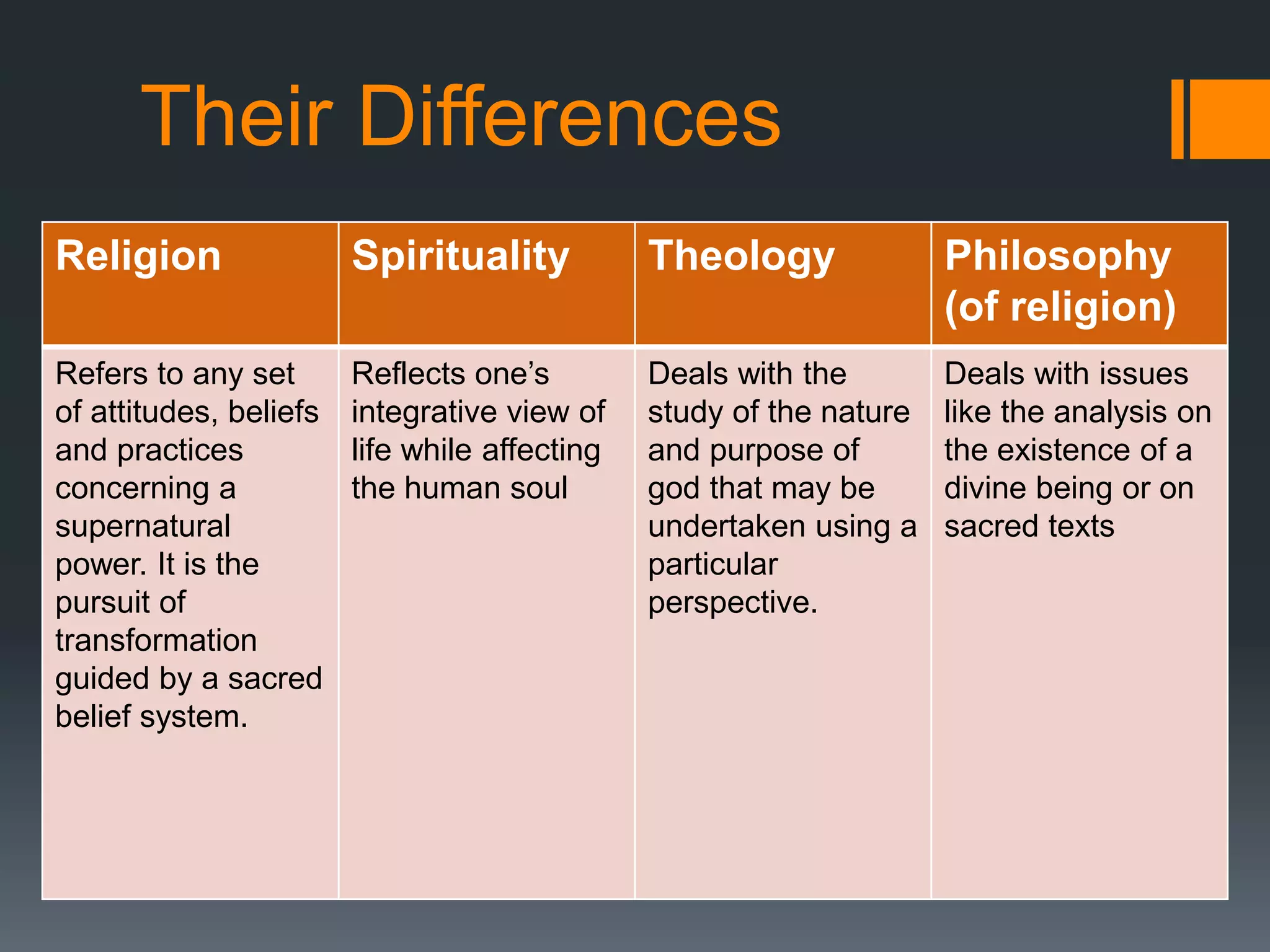
Their Differences
Religion Spirituality Theology Philosophy
(of religion)
Refers to any set
of attitudes, beliefs
and practices
concerning a
supernatural
power. It is the
pursuit of
transformation
guided by a sacred
belief system.
Reflects one’s
integrative view of
life while affecting
the human soul
Deals with the
study of the nature
and purpose of
god that may be
undertaken using a
particular
perspective.
Deals with issues
like the analysis on
the existence of a
divine being or on
sacred texts
For your reflection:
1. Do you agree that the universe
is designed and created by a
single divine being or God?
Explain your answer.
2. How can you lead a spiritual
life? Cite at least 3 examples.
Enrichment Activity:
Write a two-page essay on the topic
“Religion: What Does It Mean to Me?”
guided by the following questions:
1. What different values have your
religion instilled in you?
2. What various guiding principles
which may have been influenced
by your religion do you adhere to
in your life?

Lesson 1 understanding the nature of religion

  • 1.
    Lesson 1: Understanding theNature of Religion By: Ms. Jo Marie Nel C. Garcia
  • 2.
    Understanding Beliefs and Worldviews Worldview– a collection of beliefs about life and the universe being held by people. Social environment and upbringing are critical in the development of a religious life. Belief in god or gods is found in almost all religions.
  • 3.
    Kinds of BeliefSystem Kinds Description Monism There is no real distinction between god and the universe Polytheism The belief and worship of many gods Monotheism The doctrine or belief in one supreme god Atheism Disbelief or in denial of the existence of a personal god Agnosticism god cannot be known
  • 4.
    Theism – isa belief in the existence of one god viewed as the creative source of the human race and the world who transcends yet is immanent in the world. Monotheistic religions claim that there is only one God who could have designed and created the universe or may have directed all events that led to the creation of everything. There is one supreme God who is both personal and moral, and who seeks a total and unqualified response from humans. (Judaism, Christianity and Islam)
  • 5.
    Polytheistic religions thatwere common among early people recognize many principal gods among whom no one is supreme. These include the ancient religions of Egypt, Greece, and Rome wherein people worship a multitude of personal gods. Agnostics deny the possibility for man to acquire knowledge of the existence of God.
  • 6.
    Monism asserts thatthere is no genuine distinction between God and the universe. Two implications arise from this belief: 1.That God is dwelling in the universe as part of it 2.The universe does not exist at all as a reality but only as manifestation of God. Atheists deny the existence of God.
  • 7.
    Definition of Religion Religion–an organized system of beliefs, ceremonies, and rules used to worship a god or group of gods. Latin word “religio” – something done with overanxious or scrupulous attention to detail Latin verb “religare” – to tie together or to bind fast. In its original sense, the word refers to the expression of proper piety (devotion/respect), that is, binding to god.
  • 8.
    Nature of Religion Nameof Social Scientist Background View on Religion Edward Burnett Tylor (1832- 1917) English anthropologist; founding figure of the science of social anthropology The belief in spiritual beings James George Frazer (1854-1941) Scottish social anthropologist; one of the founding figures of modern anthropology A propitiation or conciliation of powers superior to man which are believed to control and direct the course of nature and human life Bronislaw Kasper Malinowski (1884-1942) An eminent 20th-century Polish anthropologist A body of self-contained acts being themselves the fulfillment of their purpose; an affair of all, which everyone takes an active and equivalent part David Ëmile Durkheim (1858-1917) French sociologist; Father of sociology A unified system of beliefs and practices relative to sacred things
  • 9.
    Common Characteristics Among Religions RELIGION Religious rituals Beliefin deity A doctrine of salvation Code of conduct
  • 10.
    The essential qualitiesof religion are maintained and passed from generation to generation by source called authorities, which the followers accept as sacred. The most important religious authorities are writings known as scriptures. Bibles of Christians and Jews Koran of Muslims Vedas of Hindus Religious authority also comes from writings of saints and other holy persons and from decisions by religious councils and leaders. Unwritten customs and laws known as traditions also form a basic part of authority.
  • 11.
    1. Belief indeity Three philosophical views: Atheists believe that no deity exists. Theists believe in deity or deities. Agnostics say that the existence of deity cannot be proved or disproved.
  • 12.
    2. A Doctrineof Salvation It is based on the belief that people are in some danger from which they must be saved. Major religions like Christianity, Islam, Buddhism and Hinduism tress that salvation is the highest goal of the faithful and one that all followers should try to achieve.
  • 13.
    3. A Codeof Conduct Is a set of moral teachings and values that all religions have in some form. Such a code or ethics tells believers how to conduct their lives. It instructs them how to act toward the deity and toward one another.
  • 14.
    4. Religious Rituals Theseinclude the acts and ceremonies by which believers appeal to and serve God, deities and other sacred powers. The performance of a ritual is often called a service. The most common ritual is prayer or for some Asian religions, meditation. Many religions have rituals intended to purify the body. Some have pilgrimages. Rituals commemorate events in the history of religions and mark important events in a person’s life.
  • 15.
    Elements of Religion The4 C’s 1. Cult Belief in Deity (how we worship) 2. Creed A Doctrine of Salvation (what we believe) 3. Code A Code of Conduct (how we live) 4. Community The believers
  • 16.
    Theories on theOrigins of Religion Theory Proponent Explanation Animistic Theories Edward Burnett Tylor Primitive people believed in souls or anima found in people (seen in dreams) and in all nature and they pray and offer sacrifices to these spirits. Robert Henry Codrington All early people began their religion in cognizance of mana, a mysterious force that inhabited all of nature. The destructiveness of the mana can be avoided by establishing taboos.
  • 17.
    Theories on theOrigins of Religion Theory Proponent Explanation Nature Worship Theory Human beings first developed their religions from their observations of the forces of nature. Primitive people identified and personified them and created myths about the regularity of the seasons, the phases of the moon and the tides. Theory of Original Monotheism Wilhelm Schmidt Originally there had been one great god above all others but he went away and had little contact with the world that resulted in majority of attention and worship to local deities.
  • 18.
    Theories on theOrigins of Religion Theory Proponent Explanation Magic Theory James George Frazer People had gone three phases of development concerning the spirit world: (1) primitive magic; (2) religion; and (3) science Wish Fulfillment Theory Ludwig Andreas von Feuerbach There were no gods and that belief in gods was simply wish fulfillment. Troubled people who could not cope with the difficulties in life projected their wishes and developed gods and religions.
  • 19.
    Theories on theOrigins of Religion Theory Proponent Explanation Wish Fulfillment Theory Karl Heinrich Marx Religions were developed by the few as a means to control the masses and suppress revolution as a result of the continuing struggle between classes. Masses were persuaded to accept poverty and be obedient to inherit bliss in another life. Sigmund Freud Religion originated from the guilt that individuals supposedly feel in hating their fathers. As a result of his subconscious hatred and ensuing guilt, a great father image was projected in the sky called God.
  • 20.
    Exploring Spirituality “Spiritual” means“relating or affecting the human spirit or soul as opposed to material or physical things”. From the Latin word spiritus, its verb root spirare means “to breathe”. there is an impression that people are surrounded by a “divine reality as pervasive, intimate, necessary and invisible as the air we breathe” The main belief of spirituality is of having an invisible spirit or soul which is enjoying an earthly experience, or journey, in a visible body. One may find inner peace and contentment in life that are truly independent of religious dogmas and tenets.
  • 21.
    Elements of Spirituality 1.An automatic intuitive connection with every other spiritual being on earth 2. The power and centrality of instinct and intuition to guide life and its outcomes. 3. Emphasis on loving and emotionally supporting others, and reaching out to them as a natural way of living. 4. Keen appreciation of, and interest in, the wonders of nature and its possibilities. 5. Feeling of serenity, fearlessness, contentment and acceptance of one's life and fate.
  • 22.
    Their Differences Religion SpiritualityTheology Philosophy (of religion) Refers to any set of attitudes, beliefs and practices concerning a supernatural power. It is the pursuit of transformation guided by a sacred belief system. Reflects one’s integrative view of life while affecting the human soul Deals with the study of the nature and purpose of god that may be undertaken using a particular perspective. Deals with issues like the analysis on the existence of a divine being or on sacred texts
  • 23.
    For your reflection: 1.Do you agree that the universe is designed and created by a single divine being or God? Explain your answer. 2. How can you lead a spiritual life? Cite at least 3 examples.
  • 24.
    Enrichment Activity: Write atwo-page essay on the topic “Religion: What Does It Mean to Me?” guided by the following questions: 1. What different values have your religion instilled in you? 2. What various guiding principles which may have been influenced by your religion do you adhere to in your life?