Let x = the measure of the smaller angle
Then the measure of the larger angle is x + 40
We know: x + (x + 40) = 180
2x + 40 = 180
2x = 140
x = 70
Therefore, the measures of the angles are:
Smaller angle: 70°
Larger angle: 70° + 40° = 110°
Essential Questions
How doyou identify and use perpendicular lines?
How do you identify and use angle relationships?
Where you’ll see this:
Health, physics, paper folding, navigation
Vocabulary
1. Ray: Partof a line that begins at an endpoint and goes on forever in
one direction
2. Opposite Rays:
3. Angle:
4. Vertex:
5. Degrees:
6. Complementary Angles:
7. Supplementary Angles:
5.
Vocabulary
1. Ray: Partof a line that begins at an endpoint and goes on forever in
one direction
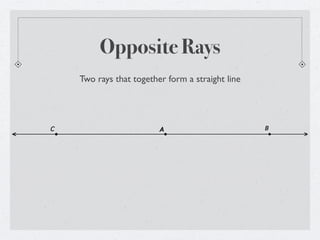
2. Opposite Rays: Two rays that together form a straight line
3. Angle:
4. Vertex:
5. Degrees:
6. Complementary Angles:
7. Supplementary Angles:
6.
Vocabulary
1. Ray: Partof a line that begins at an endpoint and goes on forever in
one direction
2. Opposite Rays: Two rays that together form a straight line
3. Angle: A figure made up of two rays that share an endpoint
4. Vertex:
5. Degrees:
6. Complementary Angles:
7. Supplementary Angles:
7.
Vocabulary
1. Ray: Partof a line that begins at an endpoint and goes on forever in
one direction
2. Opposite Rays: Two rays that together form a straight line
3. Angle: A figure made up of two rays that share an endpoint
4. Vertex: The point that is shared by the rays of an angle
5. Degrees:
6. Complementary Angles:
7. Supplementary Angles:
8.
Vocabulary
1. Ray: Partof a line that begins at an endpoint and goes on forever in
one direction
2. Opposite Rays: Two rays that together form a straight line
3. Angle: A figure made up of two rays that share an endpoint
4. Vertex: The point that is shared by the rays of an angle
5. Degrees: The size measurement of an angle
6. Complementary Angles:
7. Supplementary Angles:
9.
Vocabulary
1. Ray: Partof a line that begins at an endpoint and goes on forever in
one direction
2. Opposite Rays: Two rays that together form a straight line
3. Angle: A figure made up of two rays that share an endpoint
4. Vertex: The point that is shared by the rays of an angle
5. Degrees: The size measurement of an angle
6. Complementary Angles: Two angles that add up to 90 degrees
7. Supplementary Angles:
10.
Vocabulary
1. Ray: Partof a line that begins at an endpoint and goes on forever in
one direction
2. Opposite Rays: Two rays that together form a straight line
3. Angle: A figure made up of two rays that share an endpoint
4. Vertex: The point that is shared by the rays of an angle
5. Degrees: The size measurement of an angle
6. Complementary Angles: Two angles that add up to 90 degrees
7. Supplementary Angles: Two angles that add up to 180 degrees
Vocabulary
8. Adjacent Angles:Two angles that share a side and vertex but no other
points
9. Congruent Angles:
10. Perpendicular Lines:
11. Vertical Angles:
12. Bisector of an Angle:
13.
Vocabulary
8. Adjacent Angles:Two angles that share a side and vertex but no other
points
9. Congruent Angles: Two or more angles with the same measure
10. Perpendicular Lines:
11. Vertical Angles:
12. Bisector of an Angle:
14.
Vocabulary
8. Adjacent Angles:Two angles that share a side and vertex but no other
points
9. Congruent Angles: Two or more angles with the same measure
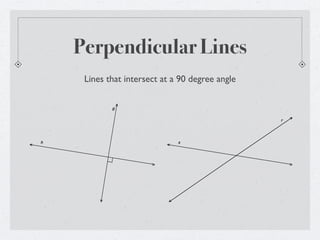
10. Perpendicular Lines: Lines that intersect at a 90 degree angle
11. Vertical Angles:
12. Bisector of an Angle:
15.
Vocabulary
8. Adjacent Angles:Two angles that share a side and vertex but no other
points
9. Congruent Angles: Two or more angles with the same measure
10. Perpendicular Lines: Lines that intersect at a 90 degree angle
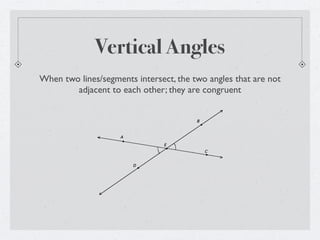
11. Vertical Angles: When two lines/segments intersect, the two angles that
are not adjacent to each other; they are congruent
12. Bisector of an Angle:
16.
Vocabulary
8. Adjacent Angles:Two angles that share a side and vertex but no other
points
9. Congruent Angles: Two or more angles with the same measure
10. Perpendicular Lines: Lines that intersect at a 90 degree angle
11. Vertical Angles: When two lines/segments intersect, the two angles that
are not adjacent to each other; they are congruent
12. Bisector of an Angle: A ray that divides an angle into two equal angles
17.
Ray
Part of aline that begins at an endpoint and goes on forever in one
direction
18.
Ray
Part of aline that begins at an endpoint and goes on forever in one
direction
A B
Perpendicular Lines
Lines that intersect at a 90 degree angle
g
r
h s
perpendicular
39.
Perpendicular Lines
Lines that intersect at a 90 degree angle
g
r
h s
perpendicular
NOT perpendicular
40.
Vertical Angles
When twolines/segments intersect, the two angles that are not
adjacent to each other; they are congruent
41.
Vertical Angles
When twolines/segments intersect, the two angles that are not
adjacent to each other; they are congruent
B
A
E
C
D
42.
Vertical Angles
When twolines/segments intersect, the two angles that are not
adjacent to each other; they are congruent
B
A
E
C
D
43.
Vertical Angles
When twolines/segments intersect, the two angles that are not
adjacent to each other; they are congruent
B
A
E
C
D
44.
Bisector of anAngle
A ray that divides an angle into two equal angles
45.
Bisector of anAngle
A ray that divides an angle into two equal angles
N
A
D
46.
Bisector of anAngle
A ray that divides an angle into two equal angles
N
E
A
D
47.
Example 1
The largerof the two supplementary angles measures 40° more than
the smaller. Find the measure of each angle.
48.
Example 1
The largerof the two supplementary angles measures 40° more than
the smaller. Find the measure of each angle.
Smaller angle:
49.
Example 1
The largerof the two supplementary angles measures 40° more than
the smaller. Find the measure of each angle.
Smaller angle: Larger angle:
50.
Example 1
The largerof the two supplementary angles measures 40° more than
the smaller. Find the measure of each angle.
Smaller angle: x Larger angle:
51.
Example 1
The largerof the two supplementary angles measures 40° more than
the smaller. Find the measure of each angle.
Smaller angle: x Larger angle: x + 40
52.
Example 1
The largerof the two supplementary angles measures 40° more than
the smaller. Find the measure of each angle.
Smaller angle: x Larger angle: x + 40
x + x + 40 =180
53.
Example 1
The largerof the two supplementary angles measures 40° more than
the smaller. Find the measure of each angle.
Smaller angle: x Larger angle: x + 40
x + x + 40 =180
2x + 40 =180
54.
Example 1
The largerof the two supplementary angles measures 40° more than
the smaller. Find the measure of each angle.
Smaller angle: x Larger angle: x + 40
x + x + 40 =180
2x + 40 =180
−40 −40
55.
Example 1
The largerof the two supplementary angles measures 40° more than
the smaller. Find the measure of each angle.
Smaller angle: x Larger angle: x + 40
x + x + 40 =180
2x + 40 =180
−40 −40
2x =140
56.
Example 1
The largerof the two supplementary angles measures 40° more than
the smaller. Find the measure of each angle.
Smaller angle: x Larger angle: x + 40
x + x + 40 =180
2x + 40 =180
−40 −40
2x =140
2 2
57.
Example 1
The largerof the two supplementary angles measures 40° more than
the smaller. Find the measure of each angle.
Smaller angle: x Larger angle: x + 40
x + x + 40 =180
2x + 40 =180
−40 −40
2x =140
2 2
x = 70
58.
Example 1
The largerof the two supplementary angles measures 40° more than
the smaller. Find the measure of each angle.
Smaller angle: x Larger angle: x + 40
x + x + 40 =180 70 + 40
2x + 40 =180
−40 −40
2x =140
2 2
x = 70
59.
Example 1
The largerof the two supplementary angles measures 40° more than
the smaller. Find the measure of each angle.
Smaller angle: x Larger angle: x + 40
x + x + 40 =180 70 + 40 =110
2x + 40 =180
−40 −40
2x =140
2 2
x = 70
60.
Example 1
The largerof the two supplementary angles measures 40° more than
the smaller. Find the measure of each angle.
Smaller angle: x Larger angle: x + 40
x + x + 40 =180 70 + 40 =110
2x + 40 =180
−40 −40
2x =140 The angles are 70° and 110°
2 2
x = 70
61.
Example 2
Draw thefigure where AD and CB intersect at Q. EF bisects ∠AQC.
m∠AQE = 40°. Find m∠BQD.
62.
Example 2
Draw the figure where AD and CB intersect at Q. EF bisects ∠AQC.
m∠AQE = 40°. Find m∠BQD.
A
B
m∠AQE = 4 0°
E
F
Q
C
D
63.
Example 2
Draw the figure where AD and CB intersect at Q. EF bisects ∠AQC.
m∠AQE = 40°. Find m∠BQD.
A
B m∠FQD = 40°
m∠AQE = 4 0°
E
F
Q
C
D
64.
Example 2
Draw the figure where AD and CB intersect at Q. EF bisects ∠AQC.
m∠AQE = 40°. Find m∠BQD.
A
B m∠FQD = 40° (vertical angles)
m∠AQE = 4 0°
E
F
Q
C
D
65.
Example 2
Draw the figure where AD and CB intersect at Q. EF bisects ∠AQC.
m∠AQE = 40°. Find m∠BQD.
A
B m∠FQD = 40° (vertical angles)
m∠AQE = 4 0°
E
F
Q
C
D
66.
Example 2
Draw the figure where AD and CB intersect at Q. EF bisects ∠AQC.
m∠AQE = 40°. Find m∠BQD.
A
B m∠FQD = 40° (vertical angles)
m∠AQE = 4 0° m∠EQC = 40°
E
F
Q
C
D
67.
Example 2
Draw the figure where AD and CB intersect at Q. EF bisects ∠AQC.
m∠AQE = 40°. Find m∠BQD.
A
B m∠FQD = 40° (vertical angles)
m∠AQE = 4 0° m∠EQC = 40° (angle bisector)
E
F
Q
C
D
68.
Example 2
Draw the figure where AD and CB intersect at Q. EF bisects ∠AQC.
m∠AQE = 40°. Find m∠BQD.
A
B m∠FQD = 40° (vertical angles)
m∠AQE = 4 0° m∠EQC = 40° (angle bisector)
E
F
Q
C
D
69.
Example 2
Draw the figure where AD and CB intersect at Q. EF bisects ∠AQC.
m∠AQE = 40°. Find m∠BQD.
A
B m∠FQD = 40° (vertical angles)
m∠AQE = 4 0° m∠EQC = 40° (angle bisector)
E
m∠BQF = 40°
F
Q
C
D
70.
Example 2
Draw the figure where AD and CB intersect at Q. EF bisects ∠AQC.
m∠AQE = 40°. Find m∠BQD.
A
B m∠FQD = 40° (vertical angles)
m∠AQE = 4 0° m∠EQC = 40° (angle bisector)
E
m∠BQF = 40° (vertical angles)
F
Q
C
D
71.
Example 2
Draw the figure where AD and CB intersect at Q. EF bisects ∠AQC.
m∠AQE = 40°. Find m∠BQD.
A
B m∠FQD = 40° (vertical angles)
m∠AQE = 4 0° m∠EQC = 40° (angle bisector)
E
m∠BQF = 40° (vertical angles)
F
Q
C
D
72.
Example 2
Draw the figure where AD and CB intersect at Q. EF bisects ∠AQC.
m∠AQE = 40°. Find m∠BQD.
A
B m∠FQD = 40° (vertical angles)
m∠AQE = 4 0° m∠EQC = 40° (angle bisector)
E
m∠BQF = 40° (vertical angles)
F
Q
m∠BQD = m∠BQF + m∠FQD
C
D
73.
Example 2
Draw the figure where AD and CB intersect at Q. EF bisects ∠AQC.
m∠AQE = 40°. Find m∠BQD.
A
B m∠FQD = 40° (vertical angles)
m∠AQE = 4 0° m∠EQC = 40° (angle bisector)
E
m∠BQF = 40° (vertical angles)
F
Q
m∠BQD = m∠BQF + m∠FQD
C
= 40° + 40° = 80°
D
74.
Example 2
Draw the figure where AD and CB intersect at Q. EF bisects ∠AQC.
m∠AQE = 40°. Find m∠BQD.
A
B m∠FQD = 40° (vertical angles)
m∠AQE = 4 0° m∠EQC = 40° (angle bisector)
E
m∠BQF = 40° (vertical angles)
F
Q
m∠BQD = m∠BQF + m∠FQD
C
= 40° + 40° = 80°
D
m∠BQD = 80°
75.
Example 3
If m∠A= 20°, m∠B = 60°, and m∠C = 100°, are angles A, B, and C
supplementary angles? Explain.
76.
Example 3
If m∠A= 20°, m∠B = 60°, and m∠C = 100°, are angles A, B, and C
supplementary angles? Explain.
20° + 60° +100° =180°?
77.
Example 3
If m∠A = 20°, m∠B = 60°, and m∠C = 100°, are angles A, B, and C
supplementary angles? Explain.
20° + 60° +100° =180°?
Yes. Since the sum of the three angles is 180°, they are supplementary.
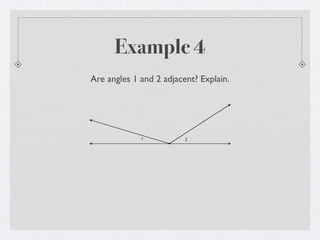
Example 4
Are angles 1 and 2 adjacent? Explain.
1 2
These are not adjacent. In order to be adjacent, the two angles must
share both the vertex and a side.
Example 5
Are ∠AEB and∠CED vertical angles? Explain.
B
A
E C
D
There are no vertical angles here, as none of the angles are formed by
segments intersecting at any place other than the endpoints