Geometry
           Concepts

           Point
           Line Ray
           Line segment
           Ray
           Angles
           Parallel Lines
           Triangles
           Quadrilaterals
           Parallelograms
           Area
           Circles
           Volume
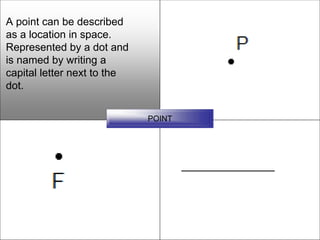
A point can be described
as a location in space.
Represented by a dot and
is named by writing a
capital letter next to the
dot.


                             POINT
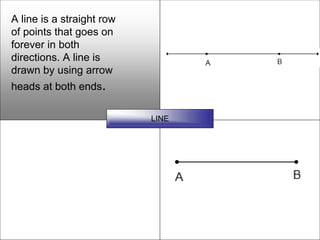
A line is a straight row
of points that goes on
forever in both
directions. A line is
drawn by using arrow
heads at both ends.

                           LINE
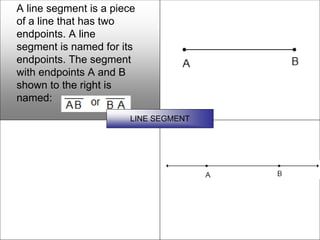
A line segment is a piece
of a line that has two
endpoints. A line
segment is named for its
endpoints. The segment
with endpoints A and B
shown to the right is
named:
                       LINE SEGMENT
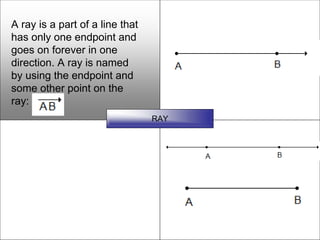
A ray is a part of a line that
has only one endpoint and
goes on forever in one
direction. A ray is named
by using the endpoint and
some other point on the
ray:
                                 RAY
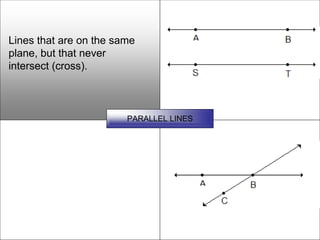
Lines that are on the same
plane, but that never
intersect (cross).


                        PARALLEL LINES
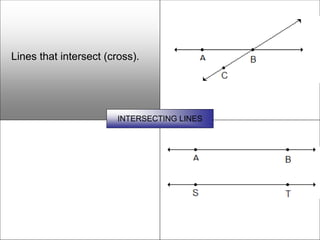
Lines that intersect (cross).


                        INTERSECTING LINES
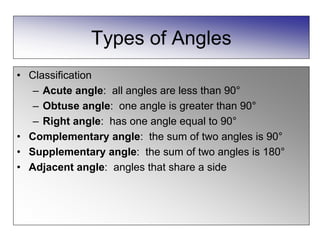
Types of Angles
• Classification
   – Acute angle: all angles are less than 90°
   – Obtuse angle: one angle is greater than 90°
   – Right angle: has one angle equal to 90°
• Complementary angle: the sum of two angles is 90°
• Supplementary angle: the sum of two angles is 180°
• Adjacent angle: angles that share a side
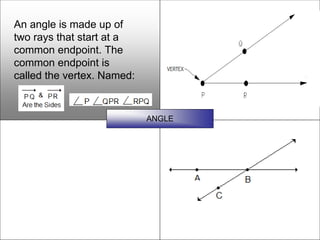
An angle is made up of
two rays that start at a
common endpoint. The
common endpoint is
called the vertex. Named:


                            ANGLE
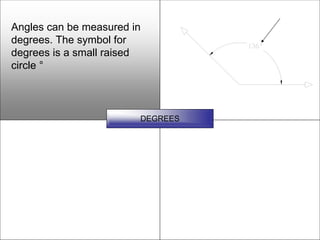
Angles can be measured in
degrees. The symbol for
degrees is a small raised
circle °


                        DEGREES
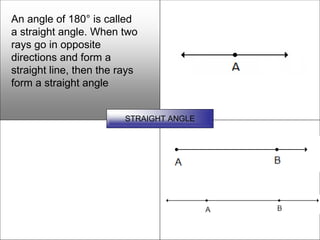
An angle of 180° is called
a straight angle. When two
rays go in opposite
directions and form a
straight line, then the rays
form a straight angle


                         STRAIGHT ANGLE
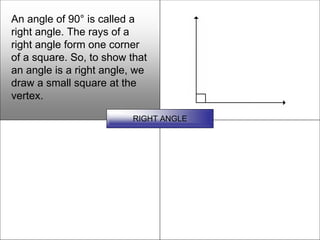
An angle of 90° is called a
right angle. The rays of a
right angle form one corner
of a square. So, to show that
an angle is a right angle, we
draw a small square at the
vertex.

                         RIGHT ANGLE
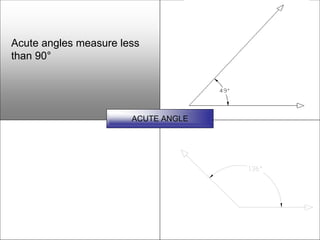
Acute angles measure less
than 90°


                       ACUTE ANGLE
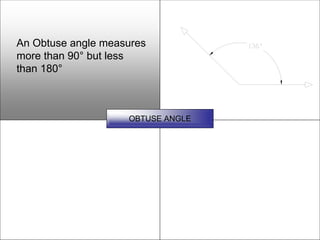
An Obtuse angle measures
more than 90° but less
than 180°


                    OBTUSE ANGLE
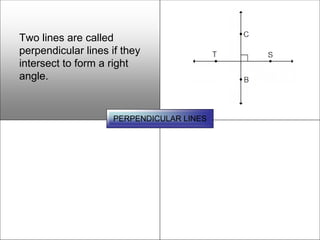
Two lines are called
perpendicular lines if they
intersect to form a right
angle.


                    PERPENDICULAR LINES
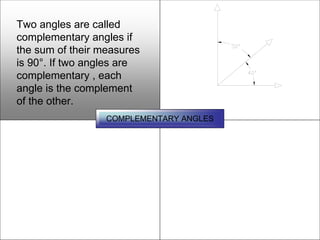
Two angles are called
complementary angles if
the sum of their measures
is 90°. If two angles are
complementary , each
angle is the complement
of the other.
                  COMPLEMENTARY ANGLES
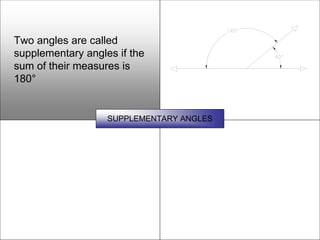
Two angles are called
supplementary angles if the
sum of their measures is
180°


                   SUPPLEMENTARY ANGLES
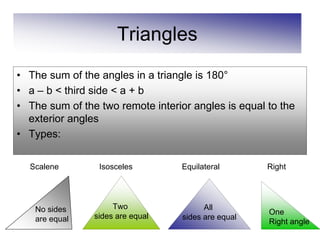
Triangles
• The sum of the angles in a triangle is 180°
• a – b < third side < a + b
• The sum of the two remote interior angles is equal to the
  exterior angles
• Types:

  Scalene        Isosceles         Equilateral       Right


   No sides          Two                 All
                                                     One
   are equal    sides are equal    sides are equal
                                                     Right angle
Polygons
• The sum of the interior angles: (n - 2)(180°)
• Classified by number of sides (n)
   – Triangle (3)
   – Quadrilateral (4)
   – Pentagon (5)
   – Hexagon (6)
   – Heptagon (7)
   – Octagon (8)
   – Nonagon (9)
   – Decagon (10)
• Regular Polygon: all sides are congruent
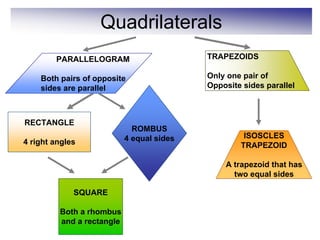
Quadrilaterals
        PARALLELOGRAM                      TRAPEZOIDS

    Both pairs of opposite                 Only one pair of
    sides are parallel                     Opposite sides parallel


RECTANGLE
                             ROMBUS
                           4 equal sides            ISOSCLES
4 right angles                                     TRAPEZOID

                                               A trapezoid that has
                                                 two equal sides

             SQUARE

         Both a rhombus
         and a rectangle
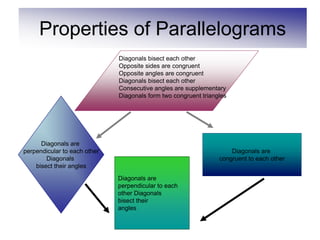
Properties of Parallelograms
                              Diagonals bisect each other
                              Opposite sides are congruent
                              Opposite angles are congruent
                              Diagonals bisect each other
                              Consecutive angles are supplementary
                              Diagonals form two congruent triangles


      Diagonals are
perpendicular to each other                                          Diagonals are
        Diagonals                                                congruent to each other
    bisect their angles
                              Diagonals are
                              perpendicular to each
                              other Diagonals
                              bisect their
                              angles
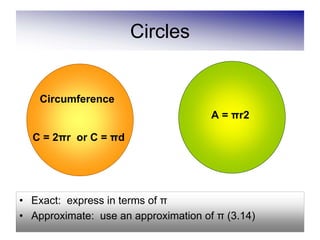
Circles


    Circumference
                                      A = πr2

  C = 2πr or C = πd


• Exact: express in terms of π
• Approximate: use an approximation of π (3.14)

Clil.geometry presentation-

  • 1.
    Geometry Concepts Point Line Ray Line segment Ray Angles Parallel Lines Triangles Quadrilaterals Parallelograms Area Circles Volume
  • 2.
    A point canbe described as a location in space. Represented by a dot and is named by writing a capital letter next to the dot. POINT
  • 3.
    A line isa straight row of points that goes on forever in both directions. A line is drawn by using arrow heads at both ends. LINE
  • 4.
    A line segmentis a piece of a line that has two endpoints. A line segment is named for its endpoints. The segment with endpoints A and B shown to the right is named: LINE SEGMENT
  • 5.
    A ray isa part of a line that has only one endpoint and goes on forever in one direction. A ray is named by using the endpoint and some other point on the ray: RAY
  • 6.
    Lines that areon the same plane, but that never intersect (cross). PARALLEL LINES
  • 7.
    Lines that intersect(cross). INTERSECTING LINES
  • 8.
    Types of Angles •Classification – Acute angle: all angles are less than 90° – Obtuse angle: one angle is greater than 90° – Right angle: has one angle equal to 90° • Complementary angle: the sum of two angles is 90° • Supplementary angle: the sum of two angles is 180° • Adjacent angle: angles that share a side
  • 9.
    An angle ismade up of two rays that start at a common endpoint. The common endpoint is called the vertex. Named: ANGLE
  • 10.
    Angles can bemeasured in degrees. The symbol for degrees is a small raised circle ° DEGREES
  • 11.
    An angle of180° is called a straight angle. When two rays go in opposite directions and form a straight line, then the rays form a straight angle STRAIGHT ANGLE
  • 12.
    An angle of90° is called a right angle. The rays of a right angle form one corner of a square. So, to show that an angle is a right angle, we draw a small square at the vertex. RIGHT ANGLE
  • 13.
    Acute angles measureless than 90° ACUTE ANGLE
  • 14.
    An Obtuse anglemeasures more than 90° but less than 180° OBTUSE ANGLE
  • 15.
    Two lines arecalled perpendicular lines if they intersect to form a right angle. PERPENDICULAR LINES
  • 16.
    Two angles arecalled complementary angles if the sum of their measures is 90°. If two angles are complementary , each angle is the complement of the other. COMPLEMENTARY ANGLES
  • 17.
    Two angles arecalled supplementary angles if the sum of their measures is 180° SUPPLEMENTARY ANGLES
  • 18.
    Triangles • The sumof the angles in a triangle is 180° • a – b < third side < a + b • The sum of the two remote interior angles is equal to the exterior angles • Types: Scalene Isosceles Equilateral Right No sides Two All One are equal sides are equal sides are equal Right angle
  • 19.
    Polygons • The sumof the interior angles: (n - 2)(180°) • Classified by number of sides (n) – Triangle (3) – Quadrilateral (4) – Pentagon (5) – Hexagon (6) – Heptagon (7) – Octagon (8) – Nonagon (9) – Decagon (10) • Regular Polygon: all sides are congruent
  • 20.
    Quadrilaterals PARALLELOGRAM TRAPEZOIDS Both pairs of opposite Only one pair of sides are parallel Opposite sides parallel RECTANGLE ROMBUS 4 equal sides ISOSCLES 4 right angles TRAPEZOID A trapezoid that has two equal sides SQUARE Both a rhombus and a rectangle
  • 21.
    Properties of Parallelograms Diagonals bisect each other Opposite sides are congruent Opposite angles are congruent Diagonals bisect each other Consecutive angles are supplementary Diagonals form two congruent triangles Diagonals are perpendicular to each other Diagonals are Diagonals congruent to each other bisect their angles Diagonals are perpendicular to each other Diagonals bisect their angles
  • 22.
    Circles Circumference A = πr2 C = 2πr or C = πd • Exact: express in terms of π • Approximate: use an approximation of π (3.14)