
Geometry
                                                                        Lesson 3


                                                                                 Tennessee
                                                                               Adult Education


This curriculum was written with funding of the Tennessee Department of Labor and Workforce Development and may not be reproduced in any way without written permission. ©
What is Geometry?
•It is the branch of mathematics that deals with
lines, points, curves, angles, surfaces, and solids.
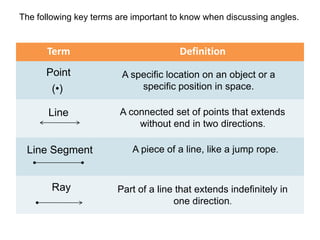
The following key terms are important to know when discussing angles.


      Term                             Definition
      Point              A specific location on an object or a
        (•)                  specific position in space.

       Line             A connected set of points that extends
                            without end in two directions.

 Line Segment              A piece of a line, like a jump rope.


        Ray             Part of a line that extends indefinitely in
                                      one direction.
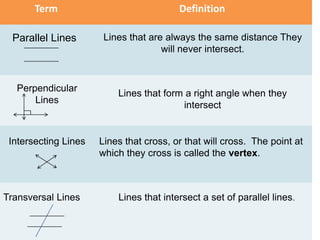
Term                              Definition

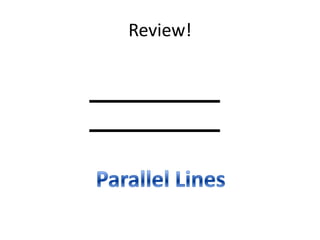
  Parallel Lines       Lines that are always the same distance They
                                     will never intersect.


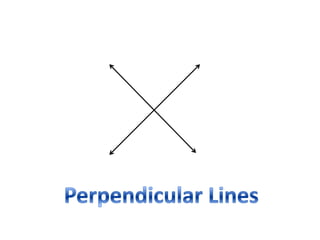
   Perpendicular
                          Lines that form a right angle when they
       Lines
                                         intersect


 Intersecting Lines   Lines that cross, or that will cross. The point at
                      which they cross is called the vertex.


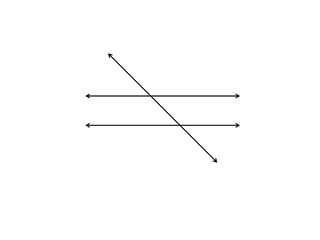
Transversal Lines         Lines that intersect a set of parallel lines.
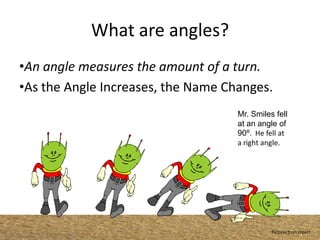
What are angles?
•An angle measures the amount of a turn.
•As the Angle Increases, the Name Changes.
                                    Mr. Smiles fell
                                    at an angle of
                                    90⁰. He fell at
                                    a right angle.


                                              Pictures from clipart
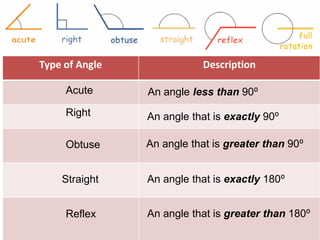
Type of Angle              Description

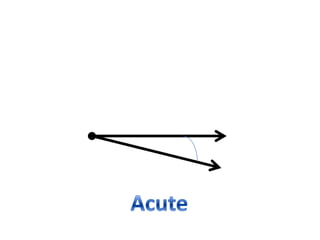
     Acute      An angle less than 90⁰
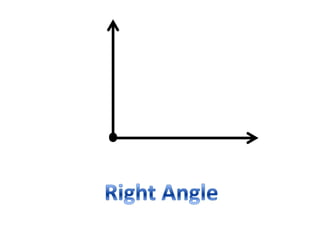
     Right      An angle that is exactly 90⁰

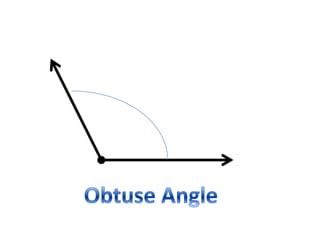
     Obtuse     An angle that is greater than 90⁰


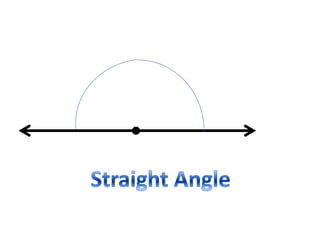
    Straight    An angle that is exactly 180⁰


     Reflex     An angle that is greater than 180⁰
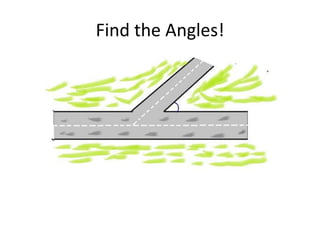
Find the Angles!
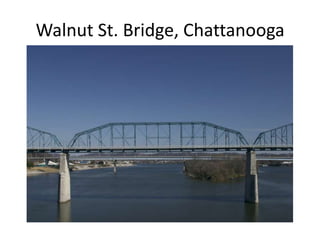
Walnut St. Bridge, Chattanooga
Review!
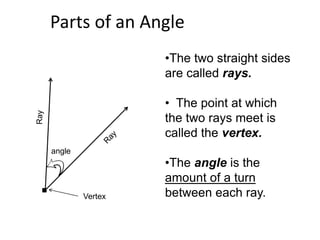
Parts of an Angle
                       •The two straight sides
                       are called rays.

                       • The point at which
Ray


                       the two rays meet is
                       called the vertex.
      angle
                       •The angle is the
                       amount of a turn
·             Vertex   between each ray.
Naming Angles
•There are two main ways to name angles:
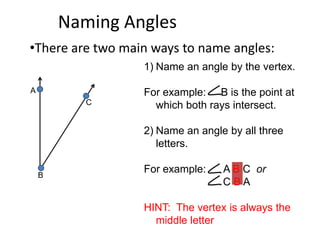
                  1) Name an angle by the vertex.

A                 For example: B is the point at
           C        which both rays intersect.

                  2) Name an angle by all three
                     letters.

    B
                  For example:    A B C or
                                  CBA

                  HINT: The vertex is always the
                    middle letter
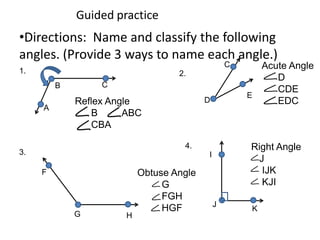
Guided practice
•Directions: Name and classify the following
angles. (Provide 3 ways to name each angle.)
                                                  C     Acute Angle
1.                                 2.
                                                           D
         B        C
                                                           CDE
                                                      E
             Reflex Angle                 D                EDC
     A
                B      ABC
                CBA

                                    4.                Right Angle
3.                                        I
                                                       J
     F                     Obtuse Angle                 IJK
                                G                       KJI
                                FGH
                                              J
                                HGF                    K
             G         H
Supplementary Angles
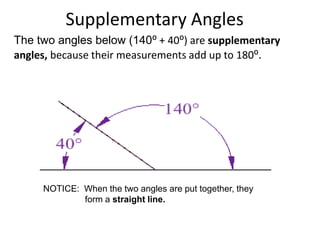
The two angles below (140⁰ + 40⁰) are supplementary
angles, because their measurements add up to 180⁰.


     NOTICE: When the two angles are put together, they
             form a straight line.
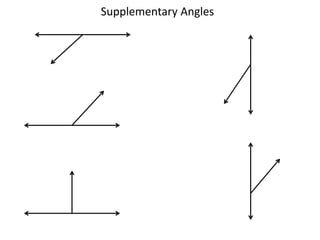
Supplementary Angles
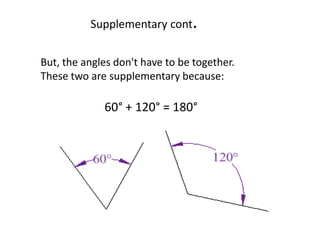
Supplementary cont.


But, the angles don't have to be together.
These two are supplementary because:

             60° + 120° = 180°
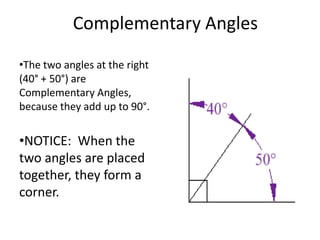
Complementary Angles

•The two angles at the right
(40° + 50°) are
Complementary Angles,
because they add up to 90°.


•NOTICE: When the
two angles are placed
together, they form a
corner.
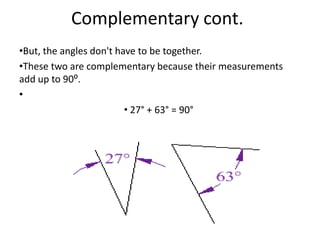
Complementary cont.
•But, the angles don't have to be together.
•These two are complementary because their measurements
add up to 90⁰.
•
                         • 27° + 63° = 90°
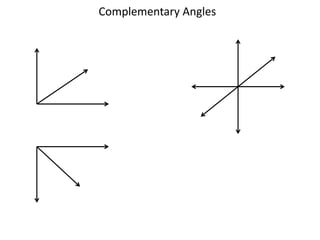
Complementary Angles
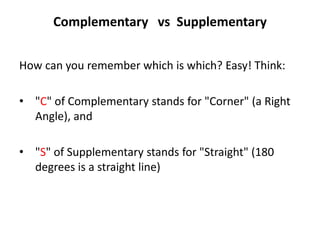
Complementary vs Supplementary


How can you remember which is which? Easy! Think:

• "C" of Complementary stands for "Corner" (a Right
  Angle), and

• "S" of Supplementary stands for "Straight" (180
  degrees is a straight line)
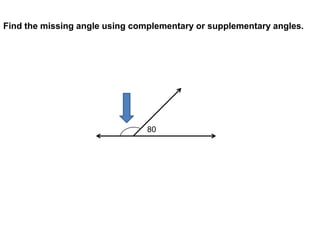
Find the missing angle using complementary or supplementary angles.


                                80
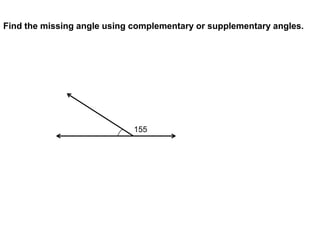
Find the missing angle using complementary or supplementary angles.


                             155
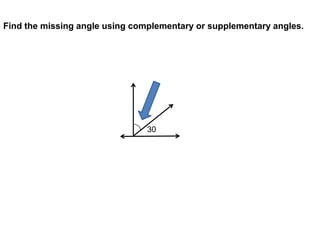
Find the missing angle using complementary or supplementary angles.


                                30
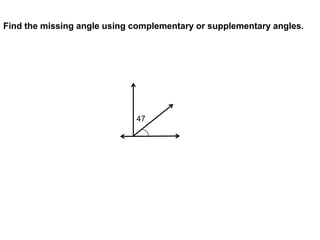
Find the missing angle using complementary or supplementary angles.


                             47
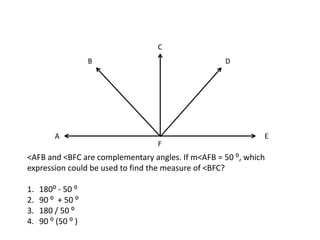
C
                    B                              D


         A                                                   E
                                  F
<AFB and <BFC are complementary angles. If m<AFB = 50 ⁰, which
expression could be used to find the measure of <BFC?

1.   180⁰ - 50 ⁰
2.   90 ⁰ + 50 ⁰
3.   180 / 50 ⁰
4.   90 ⁰ (50 ⁰ )
Guided Practice
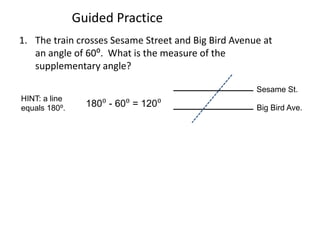
1. The train crosses Sesame Street and Big Bird Avenue at
   an angle of 60⁰. What is the measure of the
   supplementary angle?

                                                     Sesame St.
HINT: a line
equals 180⁰.     180⁰ - 60⁰ = 120⁰                   Big Bird Ave.
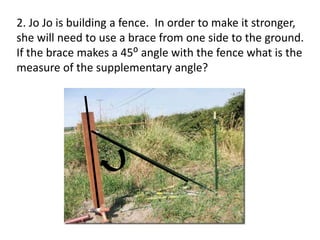
2. Jo Jo is building a fence. In order to make it stronger,
she will need to use a brace from one side to the ground.
If the brace makes a 45⁰ angle with the fence what is the
measure of the supplementary angle?
Angles Formed by A Transversal
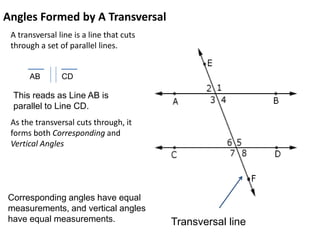
 A transversal line is a line that cuts
 through a set of parallel lines.


      AB        CD

 This reads as Line AB is
 parallel to Line CD.
 As the transversal cuts through, it
 forms both Corresponding and
 Vertical Angles


Corresponding angles have equal
measurements, and vertical angles
have equal measurements.                  Transversal line
Corresponding Angles

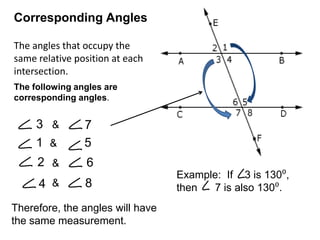
The angles that occupy the
same relative position at each
intersection.
The following angles are
corresponding angles.


     3 &        7
     1 &        5
     2 &        6
                                  Example: If 3 is 130⁰,
     4 &        8                 then  7 is also 130⁰.
Therefore, the angles will have
the same measurement.
Vertical Angles
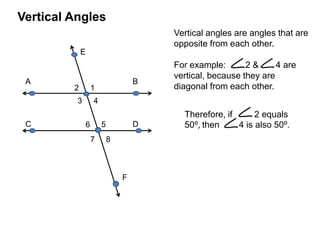
                                      Vertical angles are angles that are
                                      opposite from each other.
             E
                                      For example:       2&      4 are
                                      vertical, because they are
 A                                B
         2        1                   diagonal from each other.
          3       4
                                        Therefore, if      2 equals
 C            6       5           D     50⁰, then     4 is also 50⁰.
                  7       8


                              F
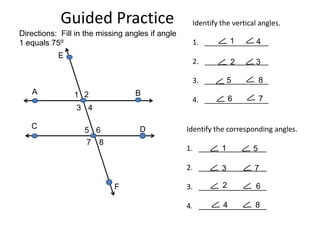
Guided Practice                        Identify the vertical angles.
Directions: Fill in the missing angles if angle
1 equals 75⁰                                                1      4
                                                   1. ________________
           E
                                                   2. ________________
                                                            2      3

                                                                   8
                                                   3. ________________
                                                            5
   A            1 2               B
                                                            6       7
                                                   4. ________________
                 3 4

   C                                D             Identify the corresponding angles.
                   5 6
                    7   8
                                                  1. _________________
                                                           1       5

                                                  2. _________________
                                                           3       7

                            F                              2       6
                                                  3. _________________

                                                           4       8
                                                  4. _________________
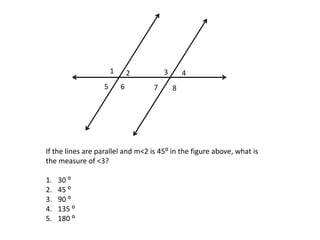
1       2        3       4
                  5       6        7       8


If the lines are parallel and m<2 is 45⁰ in the figure above, what is
the measure of <3?

1.   30 ⁰
2.   45 ⁰
3.   90 ⁰
4.   135 ⁰
5.   180 ⁰
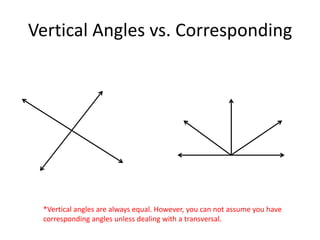
Vertical Angles vs. Corresponding


 *Vertical angles are always equal. However, you can not assume you have
 corresponding angles unless dealing with a transversal.
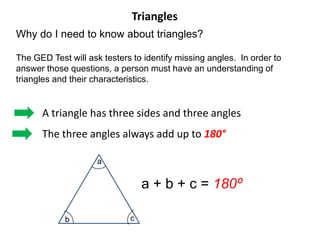
Triangles
Why do I need to know about triangles?

The GED Test will ask testers to identify missing angles. In order to
answer those questions, a person must have an understanding of
triangles and their characteristics.


      A triangle has three sides and three angles
      The three angles always add up to 180°

                     a


                                 a + b + c = 180⁰

            b                c
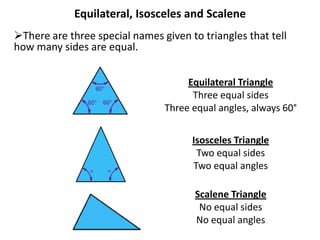
Equilateral, Isosceles and Scalene
There are three special names given to triangles that tell
how many sides are equal.


                                     Equilateral Triangle
                                      Three equal sides
                                Three equal angles, always 60°


                                      Isosceles Triangle
                                       Two equal sides
                                      Two equal angles

                                       Scalene Triangle
                                        No equal sides
                                       No equal angles
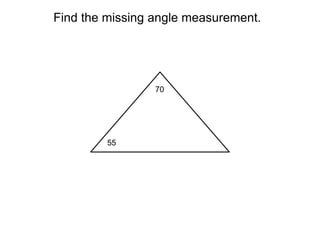
Find the missing angle measurement.


                 70


         55
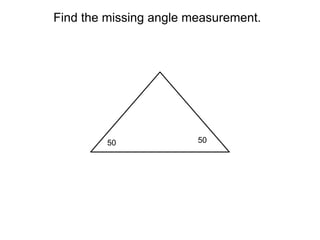
Find the missing angle measurement.


         50             50
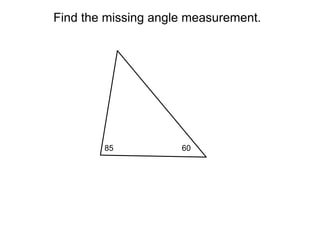
Find the missing angle measurement.


        85           60

3 Geometry Angles

  • 1.
    Geometry Lesson 3 Tennessee Adult Education This curriculum was written with funding of the Tennessee Department of Labor and Workforce Development and may not be reproduced in any way without written permission. ©
  • 2.
    What is Geometry? •Itis the branch of mathematics that deals with lines, points, curves, angles, surfaces, and solids.
  • 3.
    The following keyterms are important to know when discussing angles. Term Definition Point A specific location on an object or a (•) specific position in space. Line A connected set of points that extends without end in two directions. Line Segment A piece of a line, like a jump rope. Ray Part of a line that extends indefinitely in one direction.
  • 4.
    Term Definition Parallel Lines Lines that are always the same distance They will never intersect. Perpendicular Lines that form a right angle when they Lines intersect Intersecting Lines Lines that cross, or that will cross. The point at which they cross is called the vertex. Transversal Lines Lines that intersect a set of parallel lines.
  • 5.
    What are angles? •Anangle measures the amount of a turn. •As the Angle Increases, the Name Changes. Mr. Smiles fell at an angle of 90⁰. He fell at a right angle. Pictures from clipart
  • 6.
    Type of Angle Description Acute An angle less than 90⁰ Right An angle that is exactly 90⁰ Obtuse An angle that is greater than 90⁰ Straight An angle that is exactly 180⁰ Reflex An angle that is greater than 180⁰
  • 7.
  • 12.
    Walnut St. Bridge,Chattanooga
  • 14.
  • 20.
    Parts of anAngle •The two straight sides are called rays. • The point at which Ray the two rays meet is called the vertex. angle •The angle is the amount of a turn · Vertex between each ray.
  • 21.
    Naming Angles •There aretwo main ways to name angles: 1) Name an angle by the vertex. A For example: B is the point at C which both rays intersect. 2) Name an angle by all three letters. B For example: A B C or CBA HINT: The vertex is always the middle letter
  • 22.
    Guided practice •Directions: Nameand classify the following angles. (Provide 3 ways to name each angle.) C Acute Angle 1. 2. D B C CDE E Reflex Angle D EDC A B ABC CBA 4. Right Angle 3. I J F Obtuse Angle IJK G KJI FGH J HGF K G H
  • 23.
    Supplementary Angles The twoangles below (140⁰ + 40⁰) are supplementary angles, because their measurements add up to 180⁰. NOTICE: When the two angles are put together, they form a straight line.
  • 24.
  • 25.
    Supplementary cont. But, theangles don't have to be together. These two are supplementary because: 60° + 120° = 180°
  • 26.
    Complementary Angles •The twoangles at the right (40° + 50°) are Complementary Angles, because they add up to 90°. •NOTICE: When the two angles are placed together, they form a corner.
  • 27.
    Complementary cont. •But, theangles don't have to be together. •These two are complementary because their measurements add up to 90⁰. • • 27° + 63° = 90°
  • 28.
  • 29.
    Complementary vs Supplementary Howcan you remember which is which? Easy! Think: • "C" of Complementary stands for "Corner" (a Right Angle), and • "S" of Supplementary stands for "Straight" (180 degrees is a straight line)
  • 30.
    Find the missingangle using complementary or supplementary angles. 80
  • 31.
    Find the missingangle using complementary or supplementary angles. 155
  • 32.
    Find the missingangle using complementary or supplementary angles. 30
  • 33.
    Find the missingangle using complementary or supplementary angles. 47
  • 34.
    C B D A E F <AFB and <BFC are complementary angles. If m<AFB = 50 ⁰, which expression could be used to find the measure of <BFC? 1. 180⁰ - 50 ⁰ 2. 90 ⁰ + 50 ⁰ 3. 180 / 50 ⁰ 4. 90 ⁰ (50 ⁰ )
  • 35.
    Guided Practice 1. Thetrain crosses Sesame Street and Big Bird Avenue at an angle of 60⁰. What is the measure of the supplementary angle? Sesame St. HINT: a line equals 180⁰. 180⁰ - 60⁰ = 120⁰ Big Bird Ave.
  • 36.
    2. Jo Jois building a fence. In order to make it stronger, she will need to use a brace from one side to the ground. If the brace makes a 45⁰ angle with the fence what is the measure of the supplementary angle?
  • 38.
    Angles Formed byA Transversal A transversal line is a line that cuts through a set of parallel lines. AB CD This reads as Line AB is parallel to Line CD. As the transversal cuts through, it forms both Corresponding and Vertical Angles Corresponding angles have equal measurements, and vertical angles have equal measurements. Transversal line
  • 39.
    Corresponding Angles The anglesthat occupy the same relative position at each intersection. The following angles are corresponding angles. 3 & 7 1 & 5 2 & 6 Example: If 3 is 130⁰, 4 & 8 then 7 is also 130⁰. Therefore, the angles will have the same measurement.
  • 40.
    Vertical Angles Vertical angles are angles that are opposite from each other. E For example: 2& 4 are vertical, because they are A B 2 1 diagonal from each other. 3 4 Therefore, if 2 equals C 6 5 D 50⁰, then 4 is also 50⁰. 7 8 F
  • 41.
    Guided Practice Identify the vertical angles. Directions: Fill in the missing angles if angle 1 equals 75⁰ 1 4 1. ________________ E 2. ________________ 2 3 8 3. ________________ 5 A 1 2 B 6 7 4. ________________ 3 4 C D Identify the corresponding angles. 5 6 7 8 1. _________________ 1 5 2. _________________ 3 7 F 2 6 3. _________________ 4 8 4. _________________
  • 42.
    1 2 3 4 5 6 7 8 If the lines are parallel and m<2 is 45⁰ in the figure above, what is the measure of <3? 1. 30 ⁰ 2. 45 ⁰ 3. 90 ⁰ 4. 135 ⁰ 5. 180 ⁰
  • 43.
    Vertical Angles vs.Corresponding *Vertical angles are always equal. However, you can not assume you have corresponding angles unless dealing with a transversal.
  • 44.
    Triangles Why do Ineed to know about triangles? The GED Test will ask testers to identify missing angles. In order to answer those questions, a person must have an understanding of triangles and their characteristics. A triangle has three sides and three angles The three angles always add up to 180° a a + b + c = 180⁰ b c
  • 45.
    Equilateral, Isosceles andScalene There are three special names given to triangles that tell how many sides are equal. Equilateral Triangle Three equal sides Three equal angles, always 60° Isosceles Triangle Two equal sides Two equal angles Scalene Triangle No equal sides No equal angles
  • 46.
    Find the missingangle measurement. 70 55
  • 47.
    Find the missingangle measurement. 50 50
  • 48.
    Find the missingangle measurement. 85 60