MATHS
CHAPTER – 3
CLASS – VIII
UNDERSTANDING
QUADRILATERALS
PRESENT BY –
ISHANT KUMAR
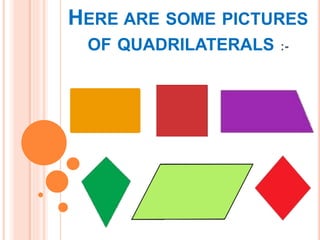
HERE ARE SOME PICTURES
OF QUADRILATERALS :-
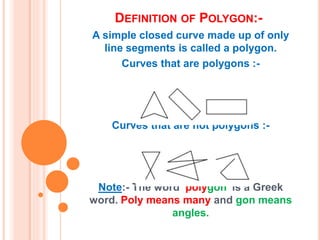
DEFINITION OF POLYGON:-
A simple closed curve made up of only
line segments is called a polygon.
Curves that are polygons :-
Curves that are not polygons :-
Note:- The word ‘polygon’ is a Greek
word. Poly means many and gon means
angles.
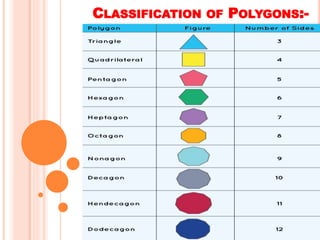
CLASSIFICATION OF POLYGONS:-
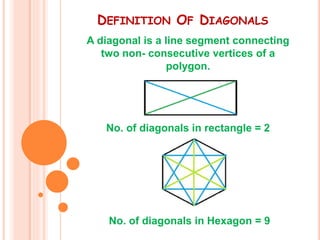
DEFINITION OF DIAGONALS
A diagonal is a line segment connecting
two non- consecutive vertices of a
polygon.
No. of diagonals in rectangle = 2
No. of diagonals in Hexagon = 9
INTERIOR AND EXTERIOR :-
INTERIOR – THE INSIDE PART OF THE POLYGON.
EXTERIOR – THE OUTSIDE PART OF THE POLYGON.
CONVEX AND CONCAVE POLYGON:-
Convex Polygons :- Polygons that are
convex have no portions of their diagonals
in the exterior.
Concave Polygon :- Polygons that are
concave have portions of their diagonals in
the exterior.
REGULAR AND IRREGULAR POLYGON :-
Regular Polygon :- A regular polygon is
both ‘ equiangular ’ and ‘ equilateral ’. For
example, a square has sides of equal length
and equal angles of equal measure.
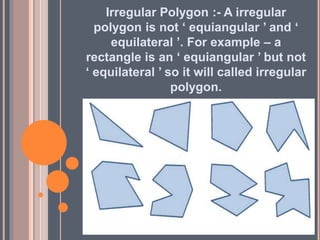
Irregular Polygon :- A irregular
polygon is not ‘ equiangular ’ and ‘
equilateral ’. For example – a
rectangle is an ‘ equiangular ’ but not
‘ equilateral ’ so it will called irregular
polygon.
ANGLE SUM PROPERTY
INTRODUCTION :-
We have studied the Angle Sum
Property of Triangle in previous classes..
PROPERTY OF INTERIOR ANGLE :-
Consider a quadrilateral ABCD.
Divide it by two triangles by diagonal AC.
We have seen in the pervious slide that sum of all
angles in a triangle measure 180 degree by the
Angle Sum Property of it.
There were two triangles that we have seen
in the ABCD quadrilateral.
One triangle was ADC and other was ABC.
So, we know that All Angle Sum Measures of
one triangle is 180 degree.
Then two All Angle Sum Measures will be 360
degree.
WE OBSEREVE THAT :-
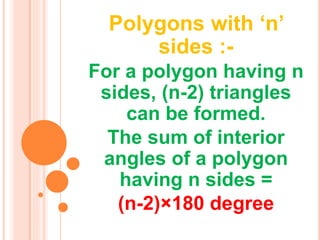
Polygons with ‘n’
sides :-
For a polygon having n
sides, (n-2) triangles
can be formed.
The sum of interior
angles of a polygon
having n sides =
(n-2)×180 degree
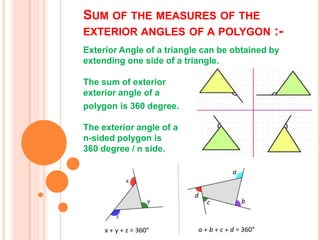
SUM OF THE MEASURES OF THE
EXTERIOR ANGLES OF A POLYGON :-
Exterior Angle of a triangle can be obtained by
extending one side of a triangle.
The sum of exterior
exterior angle of a
polygon is 360 degree.
The exterior angle of a
n-sided polygon is
360 degree / n side.
KINDS OF QUADRILATERALS :-
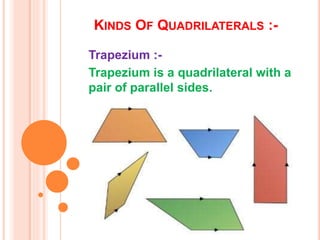
Trapezium :-
Trapezium is a quadrilateral with a
pair of parallel sides.
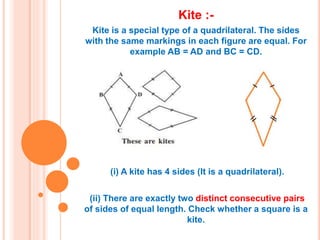
Kite :-
Kite is a special type of a quadrilateral. The sides
with the same markings in each figure are equal. For
example AB = AD and BC = CD.
(i) A kite has 4 sides (It is a quadrilateral).
(ii) There are exactly two distinct consecutive pairs
of sides of equal length. Check whether a square is a
kite.
PARALLELOGRAM :-
A parallelogram is a
quadrilateral whose opposite
sides are parallel.
ELEMENTS OF A PARALLELOGRAM :-
AB and DC, are opposite sides. AD and BC form
another pair of opposite sides. ∠A and ∠C are a pair
of opposite angles; another pair of opposite angles
would be ∠B and ∠D. AB and BC are adjacent sides.
This means, one of the sides starts where the other
ends. AB and BC are adjacent sides. This means, one
of the sides starts where the other ends. ∠A and ∠B
are adjacent angles. They are at the ends of the same
side. ∠B and ∠C are also adjacent.
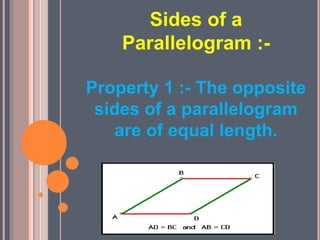
Sides of a
Parallelogram :-
Property 1 :- The opposite
sides of a parallelogram
are of equal length.
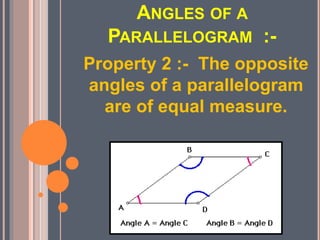
ANGLES OF A
PARALLELOGRAM :-
Property 2 :- The opposite
angles of a parallelogram
are of equal measure.
Property 3 :- The
adjacent angles in a
parallelogram are
supplementary.
DIAGONALS OF A
PARALLELOGRAM :-
Property 4 :- The
diagonals of a
parallelogram bisect
each other.
DIFFERENCE BETWEEN
INTERSECTION AND BISECTION :-
Intersection :- Intersect means crossing or touching a
line in any ratio.
Bisection :- Bisect means cutting or touching lines in
equal ratio.
SOME SPECIAL PARALLELOGRAMS :-
Rhombus :-
A rhombus is a quadrilateral with sides of
equal length. So, a rhombus has all the
properties of a parallelogram and also that
of a kite.
Property : The diagonals of a rhombus are
perpendicular bisectors of one another.
RECTANGLE
A rectangle is a parallelogram with equal angles.
Each angle of a rectangle is a right angle. So, a
rectangle is a parallelogram in which every angle is
a right angle. Being a parallelogram, the rectangle
has opposite sides of equal length and its diagonals
bisect each other.
Property: The diagonals of a rectangle are of equal
length.
This is easy to justify. If ABCD is a rectangle, then
looking at triangles ABC and ABD separately, we
have –
∆ ABC ≅ ∆ ABD
This is because AB = AB (Common)
BC = AD ( Opposite Sides )
m ∠A = m ∠B = 90° ( Opposite Angles )
The congruency follows by SAS criterion.
Thus AC = BD
and in a rectangle the diagonals, besides being equal
in length bisect each other.
SQUARE :-
A square is a rectangle with equal sides.
A square has all the properties of a rectangle
with an additional requirement that all the sides
have equal length.
The square, like the rectangle, has diagonals of
equal length.
BELT is a square, BE = EL = LT = TB
∠B, ∠E, ∠L, ∠T are right angles.
BL = ET and BL is perpendicular ET
OB = OL and OE = OT.
In a square the diagonals.
(i) bisect one another (square
being a parallelogram)
(ii) are of equal length (square
being a rectangle) and
(iii) are perpendicular to one
another.
Hence, we get the following
property.
Property: The diagonals of a
square are perpendicular
bisectors of each other.
Maths

Maths

  • 1.
    MATHS CHAPTER – 3 CLASS– VIII UNDERSTANDING QUADRILATERALS PRESENT BY – ISHANT KUMAR
  • 2.
    HERE ARE SOMEPICTURES OF QUADRILATERALS :-
  • 3.
    DEFINITION OF POLYGON:- Asimple closed curve made up of only line segments is called a polygon. Curves that are polygons :- Curves that are not polygons :- Note:- The word ‘polygon’ is a Greek word. Poly means many and gon means angles.
  • 4.
  • 5.
    DEFINITION OF DIAGONALS Adiagonal is a line segment connecting two non- consecutive vertices of a polygon. No. of diagonals in rectangle = 2 No. of diagonals in Hexagon = 9
  • 6.
    INTERIOR AND EXTERIOR:- INTERIOR – THE INSIDE PART OF THE POLYGON. EXTERIOR – THE OUTSIDE PART OF THE POLYGON.
  • 7.
    CONVEX AND CONCAVEPOLYGON:- Convex Polygons :- Polygons that are convex have no portions of their diagonals in the exterior. Concave Polygon :- Polygons that are concave have portions of their diagonals in the exterior.
  • 8.
    REGULAR AND IRREGULARPOLYGON :- Regular Polygon :- A regular polygon is both ‘ equiangular ’ and ‘ equilateral ’. For example, a square has sides of equal length and equal angles of equal measure.
  • 9.
    Irregular Polygon :-A irregular polygon is not ‘ equiangular ’ and ‘ equilateral ’. For example – a rectangle is an ‘ equiangular ’ but not ‘ equilateral ’ so it will called irregular polygon.
  • 10.
    ANGLE SUM PROPERTY INTRODUCTION:- We have studied the Angle Sum Property of Triangle in previous classes..
  • 11.
    PROPERTY OF INTERIORANGLE :- Consider a quadrilateral ABCD. Divide it by two triangles by diagonal AC. We have seen in the pervious slide that sum of all angles in a triangle measure 180 degree by the Angle Sum Property of it.
  • 12.
    There were twotriangles that we have seen in the ABCD quadrilateral. One triangle was ADC and other was ABC. So, we know that All Angle Sum Measures of one triangle is 180 degree. Then two All Angle Sum Measures will be 360 degree. WE OBSEREVE THAT :-
  • 14.
    Polygons with ‘n’ sides:- For a polygon having n sides, (n-2) triangles can be formed. The sum of interior angles of a polygon having n sides = (n-2)×180 degree
  • 15.
    SUM OF THEMEASURES OF THE EXTERIOR ANGLES OF A POLYGON :- Exterior Angle of a triangle can be obtained by extending one side of a triangle. The sum of exterior exterior angle of a polygon is 360 degree. The exterior angle of a n-sided polygon is 360 degree / n side.
  • 16.
    KINDS OF QUADRILATERALS:- Trapezium :- Trapezium is a quadrilateral with a pair of parallel sides.
  • 17.
    Kite :- Kite isa special type of a quadrilateral. The sides with the same markings in each figure are equal. For example AB = AD and BC = CD. (i) A kite has 4 sides (It is a quadrilateral). (ii) There are exactly two distinct consecutive pairs of sides of equal length. Check whether a square is a kite.
  • 18.
    PARALLELOGRAM :- A parallelogramis a quadrilateral whose opposite sides are parallel.
  • 19.
    ELEMENTS OF APARALLELOGRAM :- AB and DC, are opposite sides. AD and BC form another pair of opposite sides. ∠A and ∠C are a pair of opposite angles; another pair of opposite angles would be ∠B and ∠D. AB and BC are adjacent sides. This means, one of the sides starts where the other ends. AB and BC are adjacent sides. This means, one of the sides starts where the other ends. ∠A and ∠B are adjacent angles. They are at the ends of the same side. ∠B and ∠C are also adjacent.
  • 20.
    Sides of a Parallelogram:- Property 1 :- The opposite sides of a parallelogram are of equal length.
  • 21.
    ANGLES OF A PARALLELOGRAM:- Property 2 :- The opposite angles of a parallelogram are of equal measure.
  • 22.
    Property 3 :-The adjacent angles in a parallelogram are supplementary.
  • 23.
    DIAGONALS OF A PARALLELOGRAM:- Property 4 :- The diagonals of a parallelogram bisect each other.
  • 24.
    DIFFERENCE BETWEEN INTERSECTION ANDBISECTION :- Intersection :- Intersect means crossing or touching a line in any ratio. Bisection :- Bisect means cutting or touching lines in equal ratio.
  • 25.
    SOME SPECIAL PARALLELOGRAMS:- Rhombus :- A rhombus is a quadrilateral with sides of equal length. So, a rhombus has all the properties of a parallelogram and also that of a kite. Property : The diagonals of a rhombus are perpendicular bisectors of one another.
  • 26.
    RECTANGLE A rectangle isa parallelogram with equal angles. Each angle of a rectangle is a right angle. So, a rectangle is a parallelogram in which every angle is a right angle. Being a parallelogram, the rectangle has opposite sides of equal length and its diagonals bisect each other. Property: The diagonals of a rectangle are of equal length.
  • 27.
    This is easyto justify. If ABCD is a rectangle, then looking at triangles ABC and ABD separately, we have – ∆ ABC ≅ ∆ ABD This is because AB = AB (Common) BC = AD ( Opposite Sides ) m ∠A = m ∠B = 90° ( Opposite Angles ) The congruency follows by SAS criterion. Thus AC = BD and in a rectangle the diagonals, besides being equal in length bisect each other.
  • 28.
    SQUARE :- A squareis a rectangle with equal sides. A square has all the properties of a rectangle with an additional requirement that all the sides have equal length. The square, like the rectangle, has diagonals of equal length. BELT is a square, BE = EL = LT = TB ∠B, ∠E, ∠L, ∠T are right angles. BL = ET and BL is perpendicular ET OB = OL and OE = OT.
  • 29.
    In a squarethe diagonals. (i) bisect one another (square being a parallelogram) (ii) are of equal length (square being a rectangle) and (iii) are perpendicular to one another. Hence, we get the following property. Property: The diagonals of a square are perpendicular bisectors of each other.