Theoretical Foundation for Instructional Technology Maram M. kalantan
What is learning? According to  Reiser & Demposey (2007) “learning is defined as a persisting change in human performance or performance potential’’ (p. 37). Learning is outcome of experience and interaction with the world. Learning is an individual process. Learning is Characterized by processes shared  by affecting the members of team. Reiser & Demposey (2007)
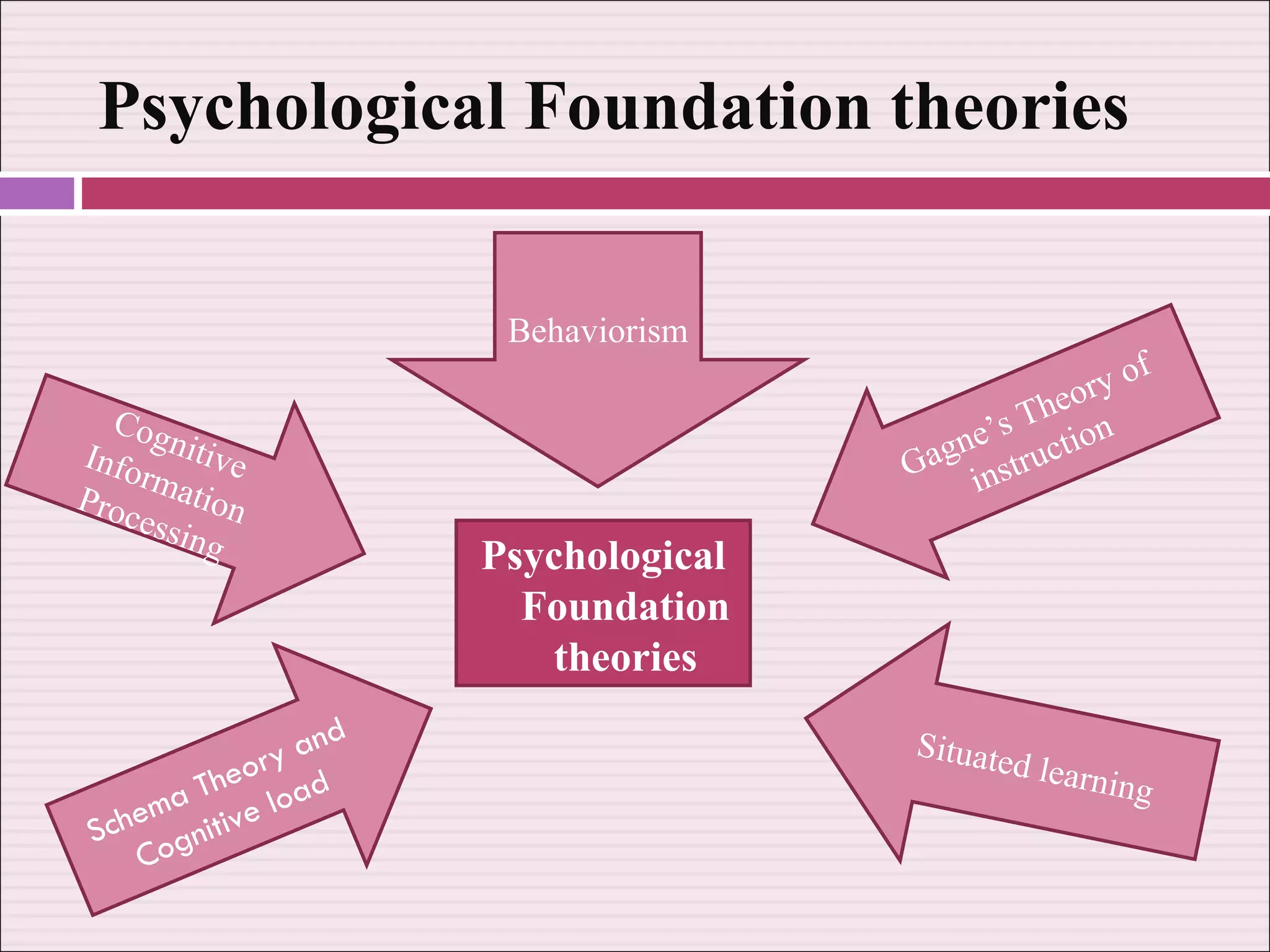
Psychological Foundation theories Psychological Foundation theories Cognitive Information Processing Schema Theory and Cognitive load Situated learning Gagne’s Theory of instruction Behaviorism
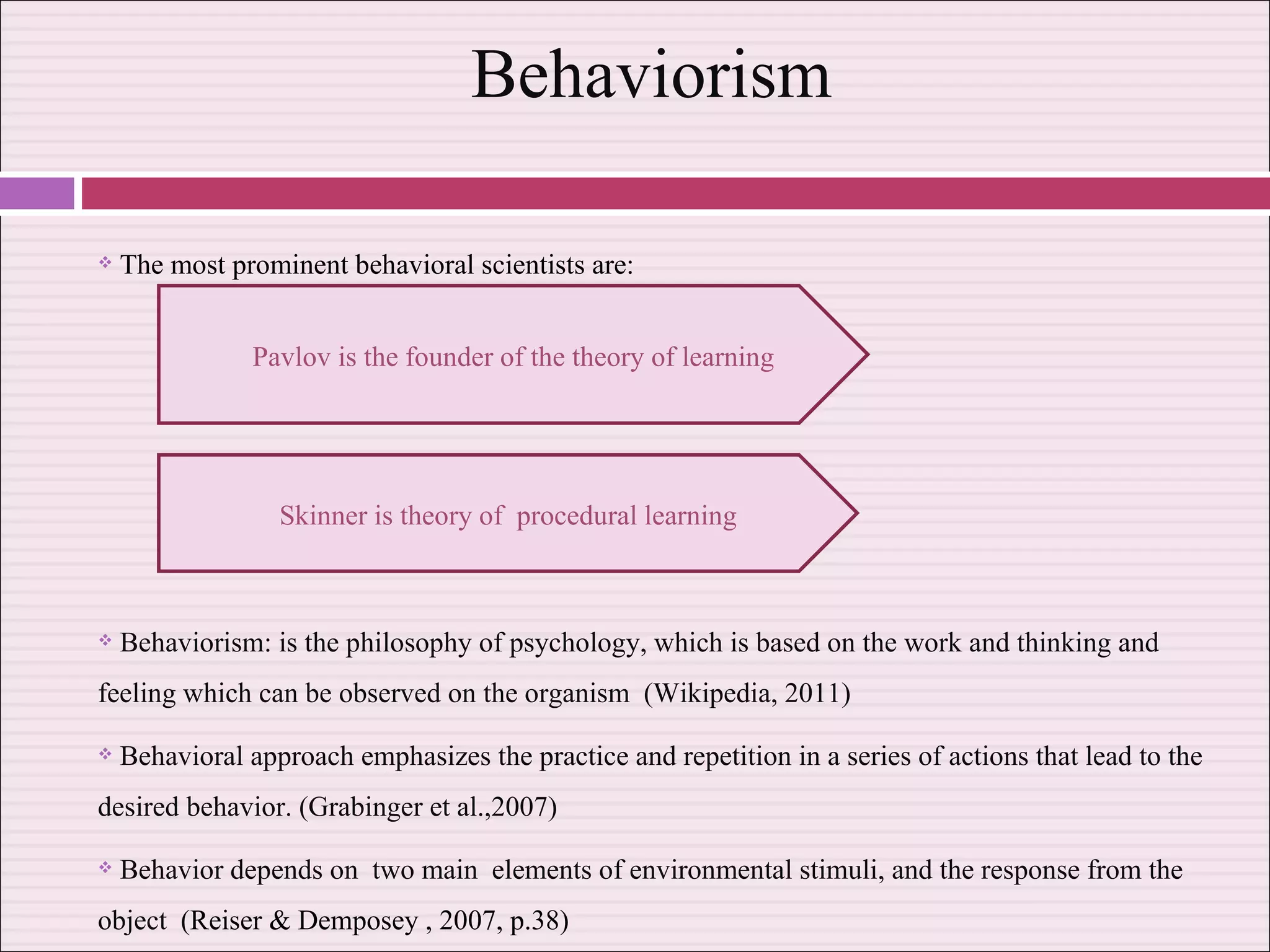
Behaviorism The most prominent behavioral scientists are:  Behaviorism: is the philosophy of psychology, which is based on the work and thinking and feeling which can be observed on the organism  (Wikipedia, 2011) Behavioral approach emphasizes the practice and repetition in a series of actions that lead to the desired behavior. (Grabinger et al.,2007) Behavior depends on  two main  elements of environmental stimuli, and the response from the object  ( Reiser & Demposey , 2007, p.38) Pavlov is the founder of the theory of learning Skinner is theory of  procedural learning
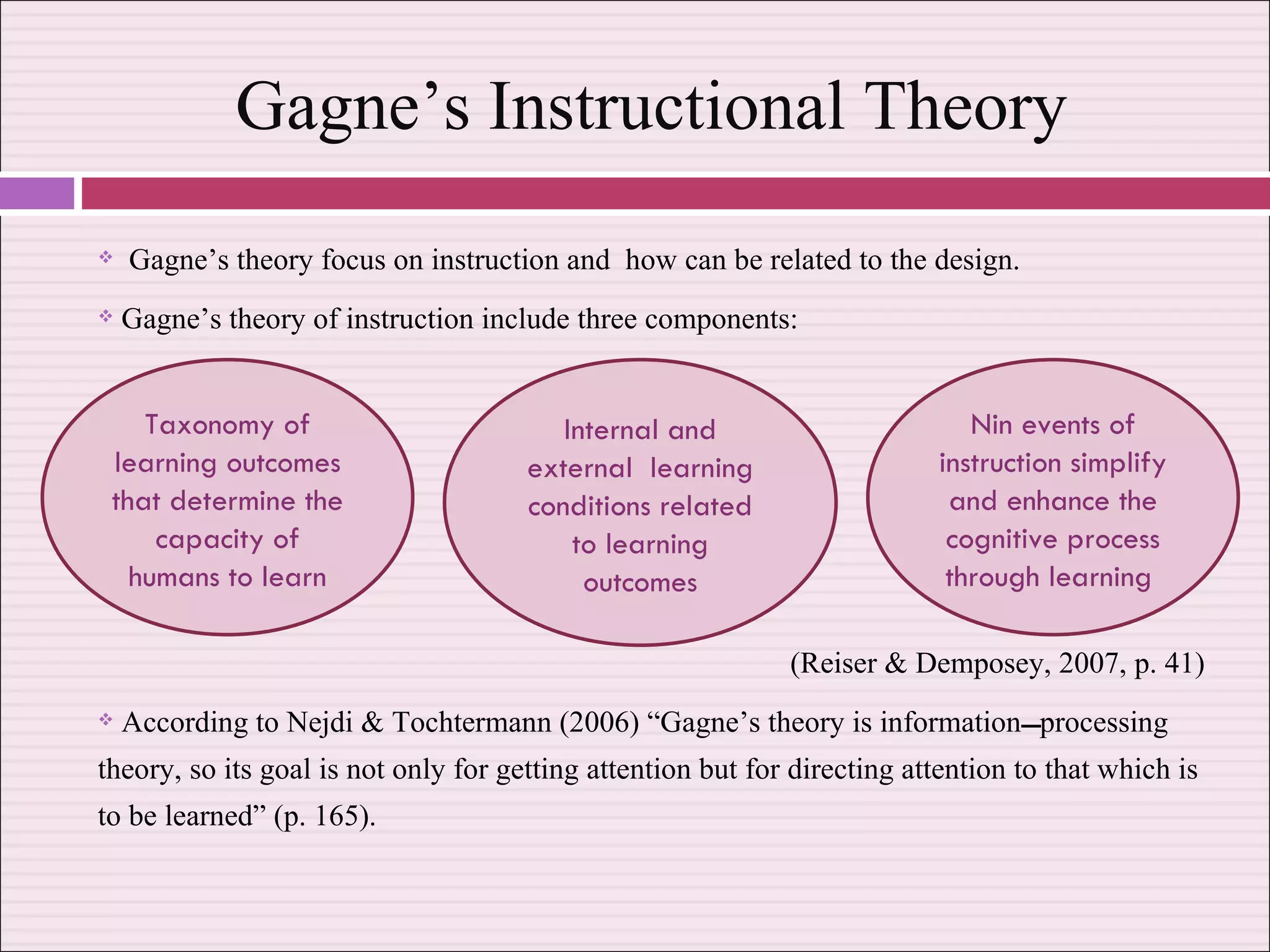
Gagne’s Instructional Theory Gagne’s theory focus on instruction and  how can be related to the design. Gagne’s theory of instruction include three components: (Reiser & Demposey, 2007, p. 41) According to Nejdi & Tochtermann (2006) “Gagne’s theory is information ـــ processing theory, so its goal is not only for getting attention but for directing attention to that which is to be learned” (p. 165). Taxonomy of learning outcomes that determine the capacity of humans to learn Internal and external  learning conditions related to learning outcomes Nin events of instruction simplify and enhance the cognitive process through learning
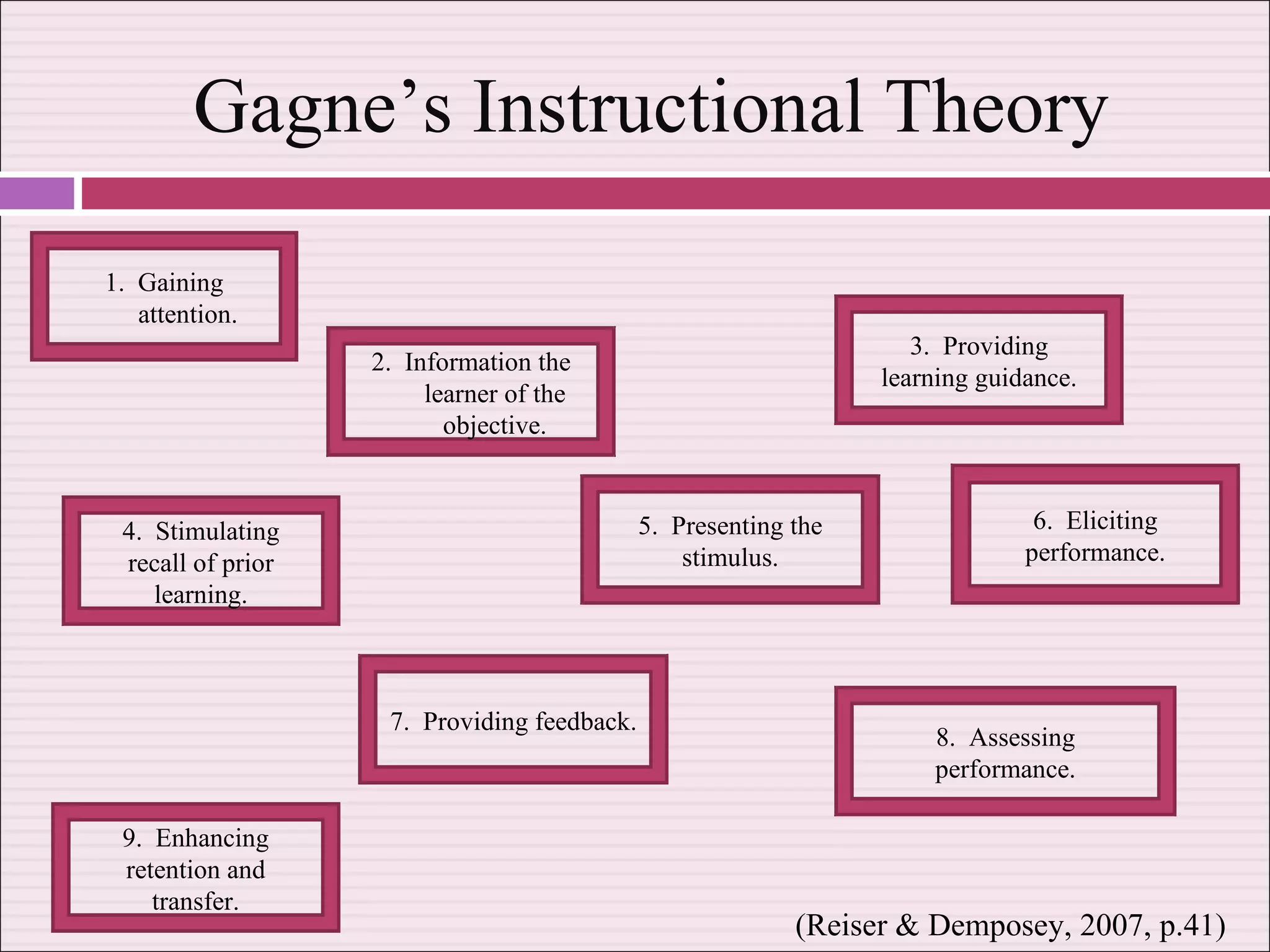
Gagne’s Instructional Theory 2.  Information the learner of the objective. 1.  Gaining attention. 3.  Providing learning guidance. 5.  Presenting the stimulus. 6.  Eliciting performance. 8.  Assessing performance. 9.  Enhancing retention and transfer. 4.  Stimulating recall of prior learning. 7.  Providing feedback. (Reiser & Demposey, 2007, p.41)
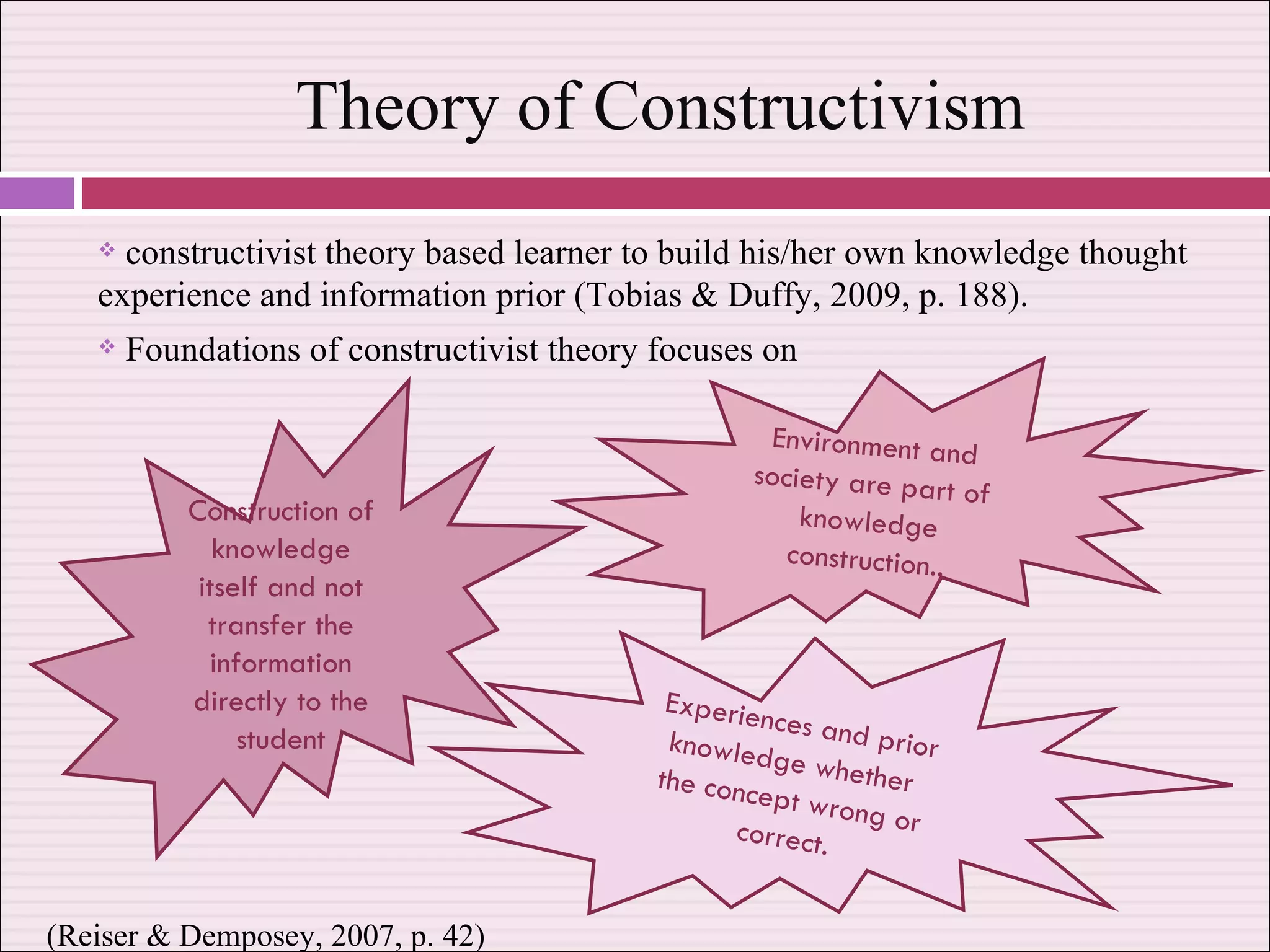
Theory of Constructivism constructivist theory based learner to build his/her own knowledge thought experience and information prior (Tobias & Duffy, 2009, p. 188). Foundations of constructivist theory focuses on Construction of knowledge itself and not transfer the information directly to the student Environment and society are part of knowledge construction.. Experiences and prior knowledge whether  the concept wrong or correct. (Reiser & Demposey, 2007, p. 42)
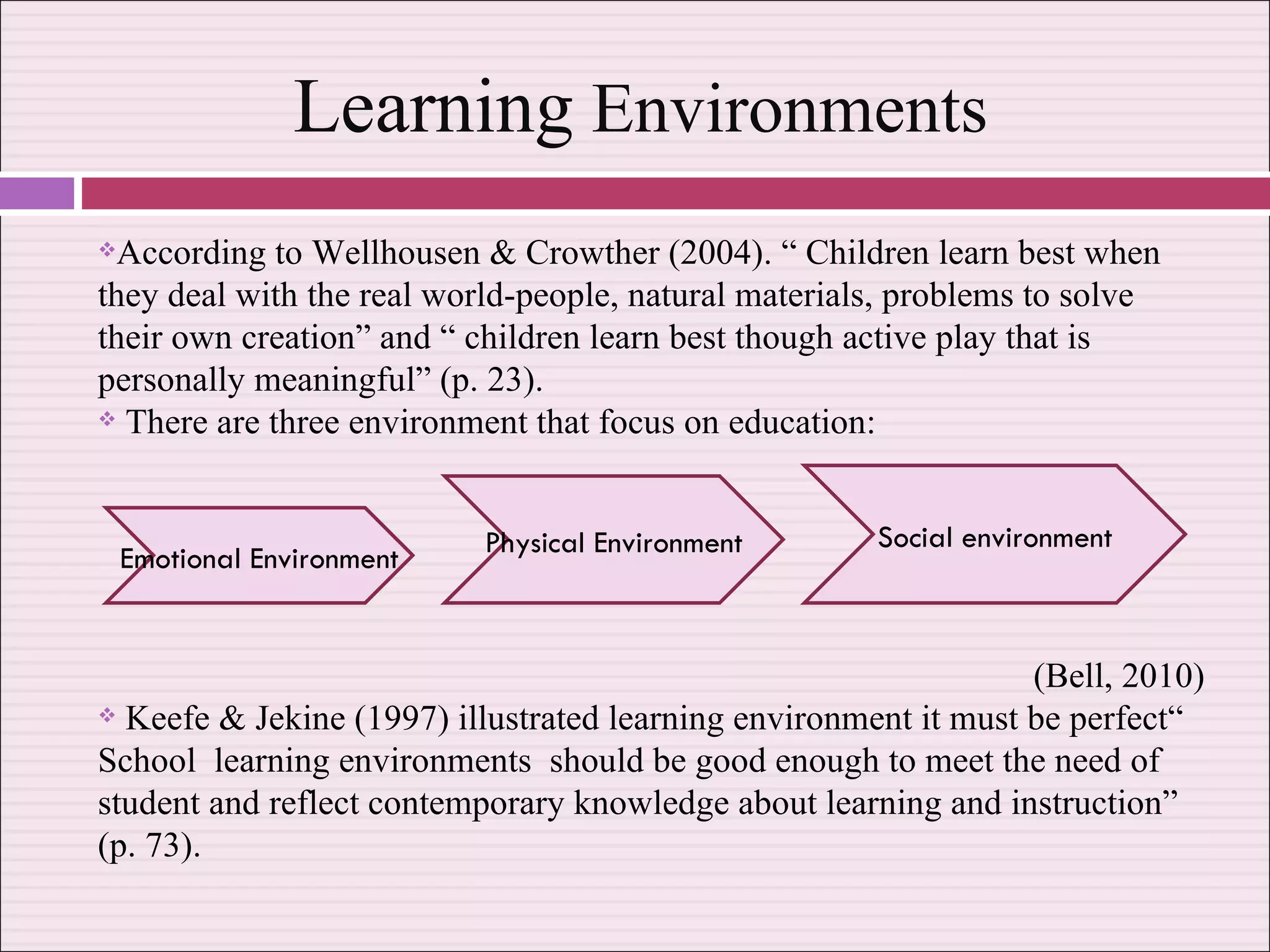
Learning  Environments According to Wellhousen & Crowther (2004). “ Children learn best when they deal with the real world-people, natural materials, problems to solve their own creation” and “ children learn best though active play that is personally meaningful” (p. 23). There are three environment that focus on education:  (Bell, 2010) Keefe & Jekine (1997) illustrated learning environment it must be perfect“ School  learning environments  should be good enough to meet the need of student and reflect contemporary knowledge about learning and instruction” (p. 73). Emotional Environment Physical Environment Social environment
Learning Environments Learning environments in the past is limited to some simple educational tools were face to face called traditional education. As for now, it has evolved in environments technical education to become more effective and successful (e.g., smart electronic blackboard, internet … ect) it is possible education through online called distance Learning. wikipedia (2011) define of distance Learning “ is afield of  education that focuses on teaching methods and technology with the aim  of delivering teaching,  often on individual basis, to students who are not physically present in traditional education setting such as a class room.
My Philosophical Beliefs Of Learning Environments  Learning environment in the perspective of personal  as umbrella, subdivided into several environments such as the traditional learning environment that is face to face user simple tools in education, Environment of the introduction and integration of technology in education that used the technology and educational media and multiple sources of information. Learning environment electronics, it be more independent and self-reliance and direct interaction without the limits of time or place called distance learning. The learning environment is the place where the learner feels comfortable safety and support both the means and technical devices to allow the learner’s individual learning opportunities and learning in groups.  This environment create activity, cooperation, schema,  innovation, access to the concepts themselves.  This  environment is an integrated environment in terms of learner and teacher.
References Bell, A. (2010). Dialogue on learning : Creating a learning-centered environment. Retrieved from  http://www.dialogueonlearning.tc3.edu Grabinger, S., Aplin, C., & Ponnappa-Brenner, G. (2007).  Instructional Design for Sociocultual Learning  Environments.  Retrieved from  http://www.ascilite.org.au/ Nejdi, W., & Tochtermann, K. (Eds.). (2006).  Innovative approaches for learning  and knowledge  sharing.  Retrieved from   http://books.google.com/ Reiser, R.A., & Dempsey, J.V. (2007).  Trends and Issues in Instructional design and  technology (2  Edition). upper saddle River, New Jersey: Merrill  Prentice Hall. Tobias, S., & Duffy, T.M. ( 2009).  Constructivist Instruction: Success or Failure? .  Retrieved from  http://books.google.com Wellhousen, K., & Crowther, I. (2004).  Creating Effective learning Environment.  Retrieved from  http://books.google.com Wikimedia foundation, Inc. (2011).  Wikipedia, the free encyclopedia, Behaviorism.  Retrieved from  http://en.wikipedia.org/wiki/Behaviorism /

Instructional technology

  • 1.
    Theoretical Foundation forInstructional Technology Maram M. kalantan
  • 2.
    What is learning?According to Reiser & Demposey (2007) “learning is defined as a persisting change in human performance or performance potential’’ (p. 37). Learning is outcome of experience and interaction with the world. Learning is an individual process. Learning is Characterized by processes shared by affecting the members of team. Reiser & Demposey (2007)
  • 3.
    Psychological Foundation theoriesPsychological Foundation theories Cognitive Information Processing Schema Theory and Cognitive load Situated learning Gagne’s Theory of instruction Behaviorism
  • 4.
    Behaviorism The mostprominent behavioral scientists are: Behaviorism: is the philosophy of psychology, which is based on the work and thinking and feeling which can be observed on the organism (Wikipedia, 2011) Behavioral approach emphasizes the practice and repetition in a series of actions that lead to the desired behavior. (Grabinger et al.,2007) Behavior depends on two main elements of environmental stimuli, and the response from the object ( Reiser & Demposey , 2007, p.38) Pavlov is the founder of the theory of learning Skinner is theory of procedural learning
  • 5.
    Gagne’s Instructional TheoryGagne’s theory focus on instruction and how can be related to the design. Gagne’s theory of instruction include three components: (Reiser & Demposey, 2007, p. 41) According to Nejdi & Tochtermann (2006) “Gagne’s theory is information ـــ processing theory, so its goal is not only for getting attention but for directing attention to that which is to be learned” (p. 165). Taxonomy of learning outcomes that determine the capacity of humans to learn Internal and external learning conditions related to learning outcomes Nin events of instruction simplify and enhance the cognitive process through learning
  • 6.
    Gagne’s Instructional Theory2. Information the learner of the objective. 1. Gaining attention. 3. Providing learning guidance. 5. Presenting the stimulus. 6. Eliciting performance. 8. Assessing performance. 9. Enhancing retention and transfer. 4. Stimulating recall of prior learning. 7. Providing feedback. (Reiser & Demposey, 2007, p.41)
  • 7.
    Theory of Constructivismconstructivist theory based learner to build his/her own knowledge thought experience and information prior (Tobias & Duffy, 2009, p. 188). Foundations of constructivist theory focuses on Construction of knowledge itself and not transfer the information directly to the student Environment and society are part of knowledge construction.. Experiences and prior knowledge whether the concept wrong or correct. (Reiser & Demposey, 2007, p. 42)
  • 8.
    Learning EnvironmentsAccording to Wellhousen & Crowther (2004). “ Children learn best when they deal with the real world-people, natural materials, problems to solve their own creation” and “ children learn best though active play that is personally meaningful” (p. 23). There are three environment that focus on education: (Bell, 2010) Keefe & Jekine (1997) illustrated learning environment it must be perfect“ School learning environments should be good enough to meet the need of student and reflect contemporary knowledge about learning and instruction” (p. 73). Emotional Environment Physical Environment Social environment
  • 9.
    Learning Environments Learningenvironments in the past is limited to some simple educational tools were face to face called traditional education. As for now, it has evolved in environments technical education to become more effective and successful (e.g., smart electronic blackboard, internet … ect) it is possible education through online called distance Learning. wikipedia (2011) define of distance Learning “ is afield of education that focuses on teaching methods and technology with the aim of delivering teaching, often on individual basis, to students who are not physically present in traditional education setting such as a class room.
  • 10.
    My Philosophical BeliefsOf Learning Environments Learning environment in the perspective of personal as umbrella, subdivided into several environments such as the traditional learning environment that is face to face user simple tools in education, Environment of the introduction and integration of technology in education that used the technology and educational media and multiple sources of information. Learning environment electronics, it be more independent and self-reliance and direct interaction without the limits of time or place called distance learning. The learning environment is the place where the learner feels comfortable safety and support both the means and technical devices to allow the learner’s individual learning opportunities and learning in groups. This environment create activity, cooperation, schema, innovation, access to the concepts themselves. This environment is an integrated environment in terms of learner and teacher.
  • 11.
    References Bell, A.(2010). Dialogue on learning : Creating a learning-centered environment. Retrieved from http://www.dialogueonlearning.tc3.edu Grabinger, S., Aplin, C., & Ponnappa-Brenner, G. (2007). Instructional Design for Sociocultual Learning Environments. Retrieved from http://www.ascilite.org.au/ Nejdi, W., & Tochtermann, K. (Eds.). (2006). Innovative approaches for learning and knowledge sharing. Retrieved from http://books.google.com/ Reiser, R.A., & Dempsey, J.V. (2007). Trends and Issues in Instructional design and technology (2 Edition). upper saddle River, New Jersey: Merrill Prentice Hall. Tobias, S., & Duffy, T.M. ( 2009). Constructivist Instruction: Success or Failure? . Retrieved from http://books.google.com Wellhousen, K., & Crowther, I. (2004). Creating Effective learning Environment. Retrieved from http://books.google.com Wikimedia foundation, Inc. (2011). Wikipedia, the free encyclopedia, Behaviorism. Retrieved from http://en.wikipedia.org/wiki/Behaviorism /