Learning Theories & The Net Generation
Knowledge is specific content Learners are empty vessels to be filled with knowledge
Knowledge is created Learning is a collaborative social endeavor
A Paradigm Shift Tools for Supporting Individuals Tools for Supporting Relationships
Motivation?  Relevance? Authenticity? Turned off to school Focused on passing the next test Not excited by the classroom No application to life after school Discouraged from following their own interests From an article by Roger Shank, Engines for Education http://www.engines4ed.org/hyperbook/nodes/NODE-44-pg.html
1 st  Year College Student Knowledge = gradual accumulation of right answers acquired through effort and obedience to the instructor  Role of the instructor is to TEACH them Right answers for everything exist Focused on passing the next test Turned off to school Discouraged from  following their own interests No application to life after school Where did this thinking come from?
Traditional Classroom Prescribed Curriculum Chalkboards Desks in rows Books and worksheets Paper & pencil Focus on the front (teacher) Read, take notes Study as an individual Take tests to measure learning
Behaviorism Current educational system built on the beliefs of Behaviorism  Conditioning—Pavlov, Skinner Stimulus-Reinforcement-Consequences Antecedent Stimulus that prompts behavior Behavior Action that follows stimulus Consequence Response that follows behavior
Assumptions Learning = behavior change Learning = related to changes in the environment Learning demonstrated as response to external stimulus Learning contingent on reinforcement All species interact with environment in the same way
In Education Observable and measurable outcomes (learning objectives) conditions  under which the behavior is to take place task(s)  learner to perform series of actions  learner is to be able to carry out to indicate understanding  actions described using  verb that denotes some observable behavior criterion  defines acceptable level of performance
Linear Approach Original model Updated model Bloom’s Taxonomy
In Education Reinforcements Tangible rewards Consequences Interval of rewards/consequences Mastery Learning Sequencing of instruction Use of cues, prompts, practice
Roles Instructor Teacher-centered Determines desired behavior Develops environmental conditions to elicit behavior Learner Passive recipient Memorization, regurgitation emphasized
Activities Reading ,  review , and  analysis  of provided text and materials Individual work  submitted  directly to  instructor  for review Structured assignments  directly linked to learning objectives.  Little or no  cohort discussion.
Cognitivism Learning = change in knowledge stored in memory Learning results when information is stored in  memory  in organized, meaningful manner  Developing  schema Making connections to prior knowledge Metacognition—what & how learned
In Education Present information to help learners  attend to ,  encode  and  retrieve  information Mental planning Goal-setting Organization strategies
Activities Explanations Demonstrations Examples/non-examples  Advance Organizers Graphic organizers/diagrams Practice  Feedback
Roles Instructor Teacher-centered with student input Help learners memorize information Organize information Connect to prior knowledge Learner Learners motivated when event, object, or experience conflicts with what already know
Constructivism Learning = creating meaning from experience Knowledge cannot be “transmitted”  Learners must create own meanings based on individual experiences and interactions Authentic context Relevant to student’s experience
In Education Emphasis on interaction, reflection & collaboration Learners need  opportunity to define for themselves goals and objectives  for the course Focus more on process and interaction , less on what is specifically to be accomplished Outcomes defined more in terms of a new common perspective  rather than particular tasks/actions that individuals able to perform Assumes learners  motivated by common interest  in problem or issue
Activities Application of principles—case studies and projects  Open-ended assignments linked to changing learning objectives  Assignments reflect "real world" conditions and requirements
Roles Instructor Facilitator, Guide, Coach, Mentor Co-learner Learner Active participant—explore information & environment Make connections—make own meaning Apply knowledge in personally meaningful contexts
Connectivism Recent Theory- developed by George Siemens Behaviorism, cognitivism, & constructivism developed in a time when learning was not impacted by/through technology  Internet & speed new information being discovered and documented Knowing how to find information is becoming more important than knowing the information
Acquiring 21st century skills such as  higher level thinking ,  stronger communication abilities , and  collaborative learning   will encourage student engagement and increase academic achievement (Department of Education, 2002)
Generational Experiences Video games PC Email CDs Individualist Generation X Web Cell phone IM MP3s Online communities Net Gen Baby  Boomers TV generation Typewriters Telephone Memos Family focus
Immigrant or Native Do you turn to the Internet first or second for information? Do you use a manual to learn a program, or is it intuitive. Do you print out your e-mail, or have your secretary print it out? Do you need to print out a document in order to edit it? Do you call people into your office to see an interesting website rather than sending the link via e-mail? Do you make the “Did you get my e-mail?” phone call?
Digital Natives Ctrl + Alt + Del is as basic as ABC They have never been able to find the “return” key Computers have always fit in their backpacks They have always had a personal identification number Photographs have always been processed in an hour or less Bert and Ernie are old enough to be their parents Gas has always been unleaded Rogaine has always been available for the follicularly challenged --Beloit College, 2003, 2004
Faces of the Future
The Net Generation Born in or after  1982 Gravitate toward  group activity 8 out of 10 say  “it’s cool to be smart” Focused on  grades  and  performance Busy with  extracurricular activities Identify with  parents ’ values; feel close to parents Respectful of  social conventions  and  institutions Fascination with  new technologies Racially and ethnically  diverse ― Howe & Strauss, 2003
Today’s learners Digital  Connected Experiential Immediate Social
Net gen learning preferences Teams, peer-to-peer Engagement & experience Visual & kinesthetic Things that matter
What can you do? Make learning interactive & experiential  Consider peer-to-peer approaches Utilize real-world applications Emphasize information literacy in courses Encourage reflection Incorporate collaborative learning  Use informal learning opportunities Create opportunities for synthesis
Decide what’s important  Technology does not drive choices Learning outcomes drive choices Knowledge construction Interactivity Relevance Authentic contexts Adaptation :  It is not about whether you are a digital native but whether you can adapt to those whose style does not match your own –  Dede, 2005
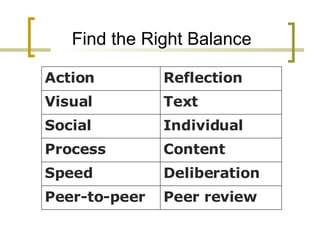
Find the Right Balance Action Reflection Visual Text Social Individual Process Content Speed Deliberation Peer-to-peer Peer review

Learning Theories & The Net Generation

  • 1.
    Learning Theories &The Net Generation
  • 2.
    Knowledge is specificcontent Learners are empty vessels to be filled with knowledge
  • 3.
    Knowledge is createdLearning is a collaborative social endeavor
  • 4.
    A Paradigm ShiftTools for Supporting Individuals Tools for Supporting Relationships
  • 5.
    Motivation? Relevance?Authenticity? Turned off to school Focused on passing the next test Not excited by the classroom No application to life after school Discouraged from following their own interests From an article by Roger Shank, Engines for Education http://www.engines4ed.org/hyperbook/nodes/NODE-44-pg.html
  • 6.
    1 st Year College Student Knowledge = gradual accumulation of right answers acquired through effort and obedience to the instructor Role of the instructor is to TEACH them Right answers for everything exist Focused on passing the next test Turned off to school Discouraged from following their own interests No application to life after school Where did this thinking come from?
  • 7.
    Traditional Classroom PrescribedCurriculum Chalkboards Desks in rows Books and worksheets Paper & pencil Focus on the front (teacher) Read, take notes Study as an individual Take tests to measure learning
  • 8.
    Behaviorism Current educationalsystem built on the beliefs of Behaviorism Conditioning—Pavlov, Skinner Stimulus-Reinforcement-Consequences Antecedent Stimulus that prompts behavior Behavior Action that follows stimulus Consequence Response that follows behavior
  • 9.
    Assumptions Learning =behavior change Learning = related to changes in the environment Learning demonstrated as response to external stimulus Learning contingent on reinforcement All species interact with environment in the same way
  • 10.
    In Education Observableand measurable outcomes (learning objectives) conditions under which the behavior is to take place task(s) learner to perform series of actions learner is to be able to carry out to indicate understanding actions described using verb that denotes some observable behavior criterion defines acceptable level of performance
  • 11.
    Linear Approach Originalmodel Updated model Bloom’s Taxonomy
  • 12.
    In Education ReinforcementsTangible rewards Consequences Interval of rewards/consequences Mastery Learning Sequencing of instruction Use of cues, prompts, practice
  • 13.
    Roles Instructor Teacher-centeredDetermines desired behavior Develops environmental conditions to elicit behavior Learner Passive recipient Memorization, regurgitation emphasized
  • 14.
    Activities Reading , review , and analysis of provided text and materials Individual work submitted directly to instructor for review Structured assignments directly linked to learning objectives. Little or no cohort discussion.
  • 15.
    Cognitivism Learning =change in knowledge stored in memory Learning results when information is stored in memory in organized, meaningful manner Developing schema Making connections to prior knowledge Metacognition—what & how learned
  • 16.
    In Education Presentinformation to help learners attend to , encode and retrieve information Mental planning Goal-setting Organization strategies
  • 17.
    Activities Explanations DemonstrationsExamples/non-examples Advance Organizers Graphic organizers/diagrams Practice Feedback
  • 18.
    Roles Instructor Teacher-centeredwith student input Help learners memorize information Organize information Connect to prior knowledge Learner Learners motivated when event, object, or experience conflicts with what already know
  • 19.
    Constructivism Learning =creating meaning from experience Knowledge cannot be “transmitted” Learners must create own meanings based on individual experiences and interactions Authentic context Relevant to student’s experience
  • 20.
    In Education Emphasison interaction, reflection & collaboration Learners need opportunity to define for themselves goals and objectives for the course Focus more on process and interaction , less on what is specifically to be accomplished Outcomes defined more in terms of a new common perspective rather than particular tasks/actions that individuals able to perform Assumes learners motivated by common interest in problem or issue
  • 21.
    Activities Application ofprinciples—case studies and projects Open-ended assignments linked to changing learning objectives Assignments reflect "real world" conditions and requirements
  • 22.
    Roles Instructor Facilitator,Guide, Coach, Mentor Co-learner Learner Active participant—explore information & environment Make connections—make own meaning Apply knowledge in personally meaningful contexts
  • 23.
    Connectivism Recent Theory-developed by George Siemens Behaviorism, cognitivism, & constructivism developed in a time when learning was not impacted by/through technology Internet & speed new information being discovered and documented Knowing how to find information is becoming more important than knowing the information
  • 24.
    Acquiring 21st centuryskills such as higher level thinking , stronger communication abilities , and collaborative learning will encourage student engagement and increase academic achievement (Department of Education, 2002)
  • 25.
    Generational Experiences Videogames PC Email CDs Individualist Generation X Web Cell phone IM MP3s Online communities Net Gen Baby Boomers TV generation Typewriters Telephone Memos Family focus
  • 26.
    Immigrant or NativeDo you turn to the Internet first or second for information? Do you use a manual to learn a program, or is it intuitive. Do you print out your e-mail, or have your secretary print it out? Do you need to print out a document in order to edit it? Do you call people into your office to see an interesting website rather than sending the link via e-mail? Do you make the “Did you get my e-mail?” phone call?
  • 27.
    Digital Natives Ctrl+ Alt + Del is as basic as ABC They have never been able to find the “return” key Computers have always fit in their backpacks They have always had a personal identification number Photographs have always been processed in an hour or less Bert and Ernie are old enough to be their parents Gas has always been unleaded Rogaine has always been available for the follicularly challenged --Beloit College, 2003, 2004
  • 28.
  • 29.
    The Net GenerationBorn in or after 1982 Gravitate toward group activity 8 out of 10 say “it’s cool to be smart” Focused on grades and performance Busy with extracurricular activities Identify with parents ’ values; feel close to parents Respectful of social conventions and institutions Fascination with new technologies Racially and ethnically diverse ― Howe & Strauss, 2003
  • 30.
    Today’s learners Digital Connected Experiential Immediate Social
  • 31.
    Net gen learningpreferences Teams, peer-to-peer Engagement & experience Visual & kinesthetic Things that matter
  • 32.
    What can youdo? Make learning interactive & experiential Consider peer-to-peer approaches Utilize real-world applications Emphasize information literacy in courses Encourage reflection Incorporate collaborative learning Use informal learning opportunities Create opportunities for synthesis
  • 33.
    Decide what’s important Technology does not drive choices Learning outcomes drive choices Knowledge construction Interactivity Relevance Authentic contexts Adaptation : It is not about whether you are a digital native but whether you can adapt to those whose style does not match your own – Dede, 2005
  • 34.
    Find the RightBalance Action Reflection Visual Text Social Individual Process Content Speed Deliberation Peer-to-peer Peer review