
Robert SimsFebruary 14, 2011Assignment TwoINST 5131Theoretical FoundationsForInstructional Technology
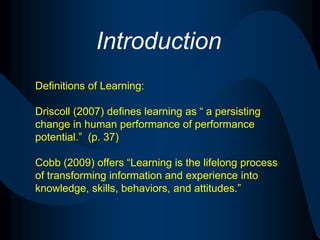
IntroductionDefinitions of Learning:Driscoll (2007) defines learning as “ a persisting change in human performance of performance potential.”  (p. 37)Cobb (2009) offers “Learning is the lifelong process of transforming information and experience into knowledge, skills, behaviors, and attitudes.”
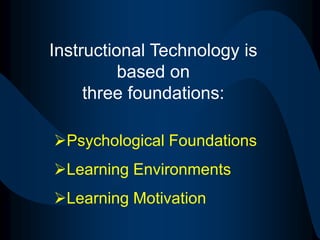
Instructional Technology is based on three foundations:Psychological Foundations
Learning Environments
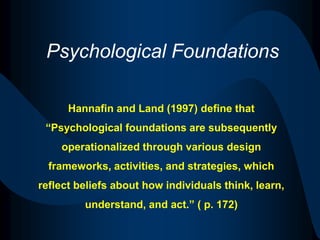
Learning MotivationPsychological FoundationsHannafin and Land (1997) define that “Psychological foundations are subsequently operationalized through various design frameworks, activities, and strategies, which reflect beliefs about how individuals think, learn, understand, and act.” ( p. 172)
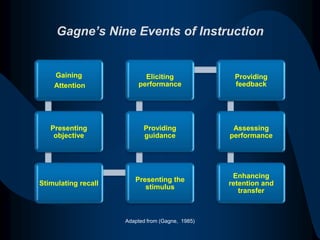
Gagne’s Nine Events of InstructionAdapted from (Gagne,  1985)
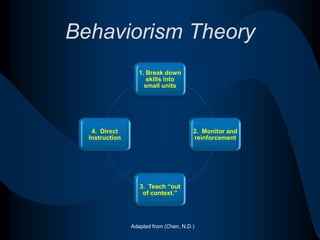
Behaviorism TheoryAdapted from (Chen, N.D.)
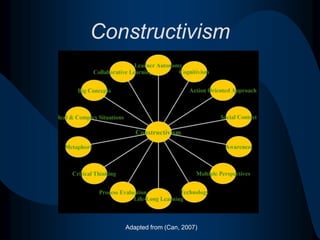
ConstructivismAdapted from (Can, 2007)
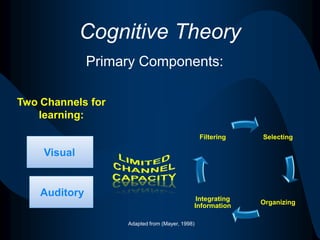
Cognitive TheoryPrimary Components:Two Channels for learning:LimitedChannelCapacityVisualAuditoryAdapted from (Mayer, 1998)
Personal foundational Epistemology In my teaching experience, I incorporate sections of each psychological arena presented here in order to provide a quality education for my students.  My primary foundation is based on Gagne’s Nine Events of Instruction.  Each part of my curriculum is built upon an objective previously learned.  Tasks are broken down into as many smaller tasks in order to bring the learner to a level of achievement.
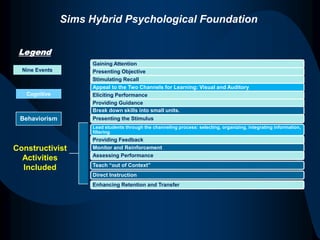
Sims Hybrid Psychological FoundationLegendNine Events CognitiveBehaviorismConstructivist Activities Included
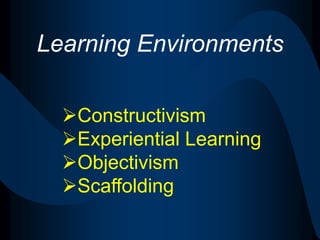
Learning EnvironmentsConstructivism
Experiential Learning
Objectivism
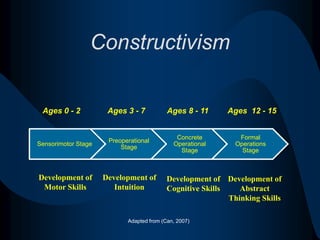
ScaffoldingConstructivismAges 0 - 2Ages 8 - 11Ages  12 - 15Ages 3 - 7Development of Motor SkillsDevelopment of IntuitionDevelopment of Cognitive Skills Development of Abstract Thinking SkillsAdapted from (Can, 2007)
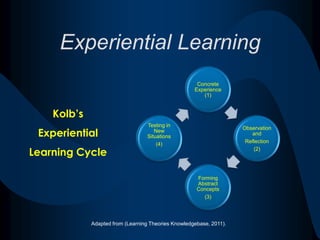
Experiential LearningKolb’s Experiential  Learning CycleAdapted from (Learning Theories Knowledgebase, 2011).
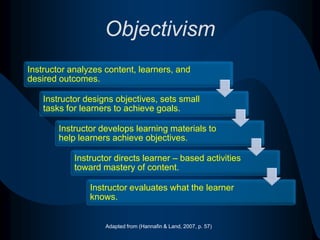
ObjectivismAdapted from (Hannafin& Land, 2007, p. 57)
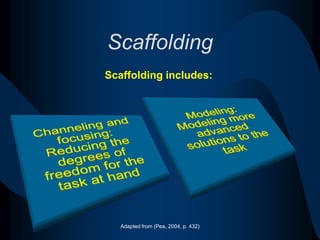
ScaffoldingScaffolding includes:Adapted from (Pea, 2004, p. 432)
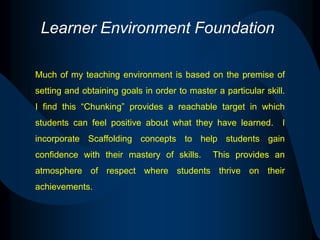
Learner Environment FoundationMuch of my teaching environment is based on the premise of setting and obtaining goals in order to master a particular skill.  I find this “Chunking” provides a reachable target in which students can feel positive about what they have learned.  I incorporate Scaffolding concepts to help students gain confidence with their mastery of skills.  This provides an atmosphere of respect where students thrive on their achievements.
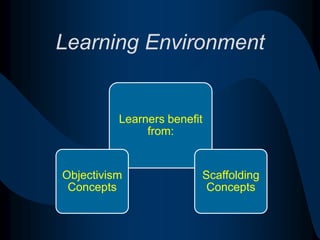
Learning Environment
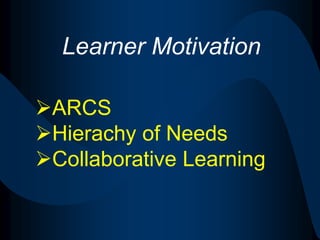
Learner MotivationARCS
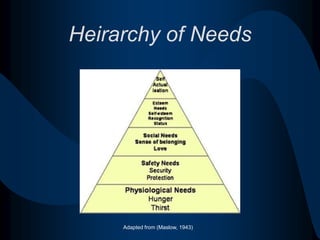
Hierachy of Needs
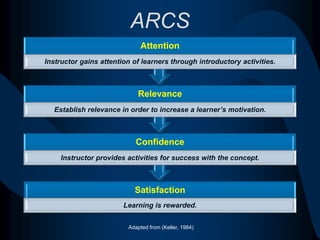
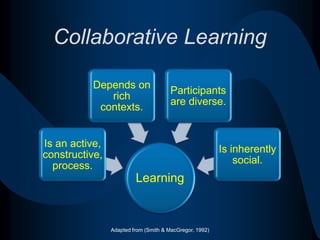
Collaborative LearningARCSAdapted from (Keller, 1984)
Heirarchy of NeedsAdapted from (Maslow, 1943)

Assignment 2 presentation