Foundations and FrameworkIn the Instructional Technology FieldVidesha SethiUniversity of Houston – Clear Lake1
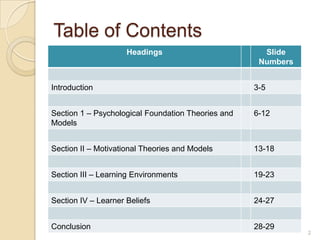
Table of Contents2
What is Learning and Instruction?Learning:A result of internal cognitive processes occurring within the learner.
The encoding which occurs from organization, integration, and translation of information.
Driscoll (2005) states, “it is a persisting change in human performance or performance potential” (p. 9).Instruction:It is the organizing and sequencing of information for the learner.
It is the presentation and provision of examples, practice, and feedback.
Driscoll (2005) states, “it is any deliberate arrangement of events to facilitate a learner’s acquisition of some goal” (p. 23).Note:  Being presented with information does not always cause learning to occur; and the learning of information does not always result in the need for instruction.Driscoll, M. P. (2005). Psychology of learning for instruction (3rd ed.). Boston, MA: Pearson Education, Inc.3
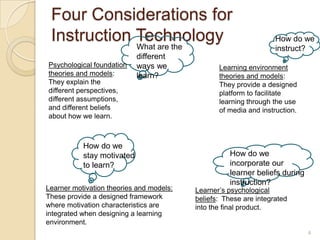
Four Considerations for Instruction TechnologyHow do we instruct?What are the different ways we learn?Psychological foundation theories and models:  They explain the different perspectives, different assumptions, and different beliefs about how we learn.Learning environment theories and models:  They provide a designed platform to facilitate learning through the use of media and instruction. How do we stay motivated to learn?How do we incorporate our learner beliefs during instruction?Learner motivation theories and models:  These provide a designed framework where motivation characteristics are integrated when designing a learning environment.Learner’s psychological beliefs:  These are integrated into the final product.4
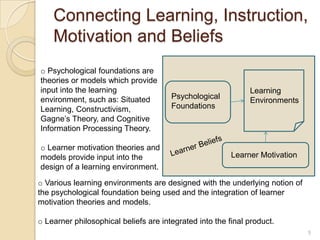
Connecting Learning, Instruction, Motivation and BeliefsPsychological foundations are theories or models which provide input into the learning environment, such as: Situated Learning, Constructivism, Gagne’s Theory, and Cognitive Information Processing Theory.
 Learner motivation theories and models provide input into the design of a learning environment.Learning EnvironmentsPsychological FoundationsLearner BeliefsLearner MotivationVarious learning environments are designed with the underlying notion of the psychological foundation being used and the integration of learner motivation theories and models.
 Learner philosophical beliefs are integrated into the final product. 5
Section 1:  Psychological Foundation Theories and Models Constructivism
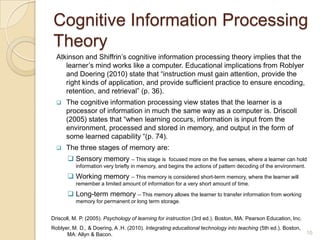
 Cognitive Information Processing Theory
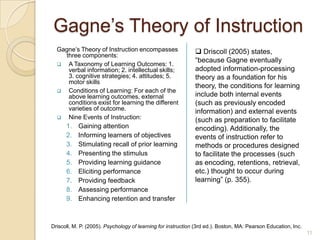
 Gagne’s Theory of Instruction
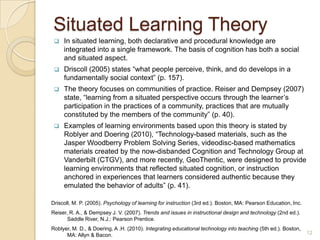
 Situated Learning Theory6
Constructivism The learner is the active constructor of knowledge.
 Instructional technologist provide both a realistic or authentic learning environment which is complex in order to facilitate the above learning outcomes.
 Constructivism has greatly influenced instructional designers; Reiser and Dempsey (2007) declare that it “attempts to create learning situations that promote the engagement or immersion of learners in practice fields…and fields of practice” (p. 46).
 Anglin (1995) describes “the concept of constructionism (now called constructivism) was first proposed by Bruner in the mid-1960s and builds on earlier ideas of Piaget. Basically, it holds that the learner rather than the teacher are more important than instruction that originates from the teacher” (p. 41).
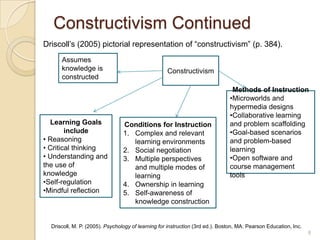
  See next slide for a pictorial depiction for constructivism which includes the following components: Learning Goals, Conditions for Instruction, and Methods of Instruction.Anglin G. J. (1995). Instructional technology: Past, present, and future( 2nd ed.). Westport, CT: Libraries Unlimited.Reiser, R. A., & Dempsey J. V. (2007). Trends and issues in instructional design and technology(2nd ed.). Saddle River, N.J.: Pearson Prentice.7
Constructivism ContinuedDriscoll’s (2005) pictorial representation of “constructivism” (p. 384).Assumes knowledge is constructedConstructivismMethods of InstructionMicroworlds and hypermedia designs
Collaborative learning and problem scaffolding
Goal-based scenarios and problem-based learning
Open software and course management toolsLearning Goals include Reasoning
 Critical thinking
 Understanding and the use of knowledge
Self-regulation
Mindful reflectionConditions for InstructionComplex and relevant learning environmentsSocial negotiationMultiple perspectives and multiple modes of learningOwnership in learningSelf-awareness of knowledge constructionDriscoll, M. P. (2005). Psychology of learning for instruction (3rd ed.). Boston, MA: Pearson Education, Inc.8
Constructivism ContinuedThe incorporation of constructivism has greatly affected instructional activities and the instructional system design process. As a result, a new discipline has emerged called learning sciences.According to Reiser and Dempsey (2007), “learning sciences are the convergence of design of activity systems, cognition, and sociocultural context” (p. 47). The learning environment relies upon constructivist cognitive discipline. They are complex learning environments which offer learners an authentic platform for learning. Learning sciences also uses concepts and practices from computer science.

Foundations and framework

  • 1.
    Foundations and FrameworkInthe Instructional Technology FieldVidesha SethiUniversity of Houston – Clear Lake1
  • 2.
  • 3.
    What is Learningand Instruction?Learning:A result of internal cognitive processes occurring within the learner.
  • 4.
    The encoding whichoccurs from organization, integration, and translation of information.
  • 5.
    Driscoll (2005) states,“it is a persisting change in human performance or performance potential” (p. 9).Instruction:It is the organizing and sequencing of information for the learner.
  • 6.
    It is thepresentation and provision of examples, practice, and feedback.
  • 7.
    Driscoll (2005) states,“it is any deliberate arrangement of events to facilitate a learner’s acquisition of some goal” (p. 23).Note: Being presented with information does not always cause learning to occur; and the learning of information does not always result in the need for instruction.Driscoll, M. P. (2005). Psychology of learning for instruction (3rd ed.). Boston, MA: Pearson Education, Inc.3
  • 8.
    Four Considerations forInstruction TechnologyHow do we instruct?What are the different ways we learn?Psychological foundation theories and models: They explain the different perspectives, different assumptions, and different beliefs about how we learn.Learning environment theories and models: They provide a designed platform to facilitate learning through the use of media and instruction. How do we stay motivated to learn?How do we incorporate our learner beliefs during instruction?Learner motivation theories and models: These provide a designed framework where motivation characteristics are integrated when designing a learning environment.Learner’s psychological beliefs: These are integrated into the final product.4
  • 9.
    Connecting Learning, Instruction,Motivation and BeliefsPsychological foundations are theories or models which provide input into the learning environment, such as: Situated Learning, Constructivism, Gagne’s Theory, and Cognitive Information Processing Theory.
  • 10.
    Learner motivationtheories and models provide input into the design of a learning environment.Learning EnvironmentsPsychological FoundationsLearner BeliefsLearner MotivationVarious learning environments are designed with the underlying notion of the psychological foundation being used and the integration of learner motivation theories and models.
  • 11.
    Learner philosophicalbeliefs are integrated into the final product. 5
  • 12.
    Section 1: Psychological Foundation Theories and Models Constructivism
  • 13.
    Cognitive InformationProcessing Theory
  • 14.
    Gagne’s Theoryof Instruction
  • 15.
  • 16.
    Constructivism The learneris the active constructor of knowledge.
  • 17.
    Instructional technologistprovide both a realistic or authentic learning environment which is complex in order to facilitate the above learning outcomes.
  • 18.
    Constructivism hasgreatly influenced instructional designers; Reiser and Dempsey (2007) declare that it “attempts to create learning situations that promote the engagement or immersion of learners in practice fields…and fields of practice” (p. 46).
  • 19.
    Anglin (1995)describes “the concept of constructionism (now called constructivism) was first proposed by Bruner in the mid-1960s and builds on earlier ideas of Piaget. Basically, it holds that the learner rather than the teacher are more important than instruction that originates from the teacher” (p. 41).
  • 20.
    Seenext slide for a pictorial depiction for constructivism which includes the following components: Learning Goals, Conditions for Instruction, and Methods of Instruction.Anglin G. J. (1995). Instructional technology: Past, present, and future( 2nd ed.). Westport, CT: Libraries Unlimited.Reiser, R. A., & Dempsey J. V. (2007). Trends and issues in instructional design and technology(2nd ed.). Saddle River, N.J.: Pearson Prentice.7
  • 21.
    Constructivism ContinuedDriscoll’s (2005)pictorial representation of “constructivism” (p. 384).Assumes knowledge is constructedConstructivismMethods of InstructionMicroworlds and hypermedia designs
  • 22.
    Collaborative learning andproblem scaffolding
  • 23.
    Goal-based scenarios andproblem-based learning
  • 24.
    Open software andcourse management toolsLearning Goals include Reasoning
  • 25.
  • 26.
    Understanding andthe use of knowledge
  • 27.
  • 28.
    Mindful reflectionConditions forInstructionComplex and relevant learning environmentsSocial negotiationMultiple perspectives and multiple modes of learningOwnership in learningSelf-awareness of knowledge constructionDriscoll, M. P. (2005). Psychology of learning for instruction (3rd ed.). Boston, MA: Pearson Education, Inc.8
  • 29.
    Constructivism ContinuedThe incorporationof constructivism has greatly affected instructional activities and the instructional system design process. As a result, a new discipline has emerged called learning sciences.According to Reiser and Dempsey (2007), “learning sciences are the convergence of design of activity systems, cognition, and sociocultural context” (p. 47). The learning environment relies upon constructivist cognitive discipline. They are complex learning environments which offer learners an authentic platform for learning. Learning sciences also uses concepts and practices from computer science.

Editor's Notes

  • #2 Welcome everyone! This presentation will assist you in conceptualizing the theoretical underpinnings of the instructional technology field. At great length, I will discuss the psychological foundation theories or models which provide the different perspectives of learning into the design of a learning environment. In addition, learning motivation theories or models which also provide input into the design of the learning environment will be discussed. Various learning environments will be described. Finally, information on learner beliefs which encompass the final product will also be shared.
  • #3 The table of contents indicates three slides which portray a brief introduction to the topic; these slides will cover the definitions of several key concepts in order to have a basis of understanding prior to discussing the theories and models that have put into practice.
  • #4 Part of foundation and frameworks in the instructional technology field is the basic understanding of the terms, learning and instruction. Though we inherently understand or know what each of these terms already mean, it is important to convey them in the language that is used by psychologists, theorists, educators, and those in the instructional technology field. The definition of learning focuses more on cognition and the benefits of the outcome. The definition of instruction does not focus on the concept of “teaching” as one would think, but instead it discussed on the sequence of information/events and relevance to instruction.
  • #5 This presentation focuses on four aspects. 1. Psychological foundation theories and models. 2. Learning environment theories and models. 3. Learner motivation theories and models. 4. Learner’s psychological beliefs on learning. Please do not mistaken the questions contained in the clouds as not being pertinent information. The way that theories, models, and learning environments arise are because of researcher questions, which cause further investigation and a hypothesis being stated and tested. Observations are made during this inquiry, and propositions are formulated, which actually become the basis of theories. For example, a question which may cause you to investigate the underlying reasons or verify its validity would be: “why does the sun rise in the east and set in the west?” You should already have some possible answers to this question, but it in order to validate these answers, you should conduct research on viable subjects in the astronomy field such as: cause of day and night, the sun’s role in our solar system, earth’s rotation, etc. in order to find the answer. And, after research, you will discover that the sun does not really rise or set. It is the earth’s 24 hour rotation on its axis which causes this affect. Thus, the validity of this question is being tested throughout the process of testing your answers, and out of investigations.
  • #6 The key to this pictorial depiction is the emphasis on “design”. That is the actual “design of the learning environment” should incorporate a foundation of psychological theories/models and motivational theories/models. Why is that so? This is to ensure that the design of the learning environment is based upon time tested theories and models which indicate a more successful outcome. Thus, the processes used to create the learning environment are systematic, rather than haphazard. A trend in instructional design is to look at noninstructional interventions, and not just instructional interventions. It is important to realize the beliefs of the target audience that will be utilizing the learning environment.
  • #7 Section I focuses on 4 different psychological foundation theories or models. Once again, theories are derived from questions, and this process is very similar to the scientific method. Let’s go ahead and review these theories. Constructivism theory will be discussed in greater length due to the fact that its popularity has risen from the innovation of the personal computer. The reason for this is because the learner can become the owner or controller of learning via this platform, in comparison to classroom instructor-led learning. Next, the cognitive information processing theory, Gagne’s theory, and situated learning will be discussed; these theories, as well as other theories not mentioned in this presentation are relevant in the field per application to certain learning environments. Today, even two or more psychological theories/models can also describe how learning occurs in instructional environments being used today. For example, a hybrid class contains both classroom instructor-led sessions as well as an online interface when class is not in session.
  • #8 The key to understanding constructivism is that learning is occurring inside the learner and is continuously being built, like building blocks in construction. The learner takes ownership of his/her learning; and self-regulates it. Authentic environments which are portrayed in learning environments can facilitate this type of learning. Thus, this theory focuses on problem-solving. The learning outcome of each learner is dependent upon how he/she built up to the solution; thus solutions will vary. In constructivism, the role of the learner is magnified; he/she is vested in the learning environment with regards to inherently designing his/her own learning. The popularity of providing a learning environment based upon constructivism in the instructional technology fields has stemmed from innovations in technology media and equipment. A learner using a personal computer can easily become more autonomous in his/her learning in conjunction with the use of media which supports the constructivism philosophy.
  • #9 This slide provides you on the various components that are related to the constructivism philosophy. The trend in Instructional Technology is to continue to provide learning environments which support constructivism. The innovations in technology, in particular the personal computer, has become an ideal platform in delivering constructivism based learning applications. Learning goals support development of the learner being autonomous or taking full ownership in learning. In fact, the actual design of the learning environment is “the learner actually designing it for his/her own learning”, rather than it being rigid in limited learning outcomes. The conditions for instruction facilitate the learning process; the focus is usually problem-solving being done on the platform.
  • #10 Extensive research in the constructivism philosophy has led to the creation of the learning sciences discipline. Learning sciences converge design activities, cognition, and sociocultural context. Design research is the merging of both research and design. This allows designers to formalize feedback and adjustment while learning is occurring. This information is relevant to instructional technology, especially for constructivist learning environments that are used in academics. In following the model, learning can be adjusted based upon collected data from the outcome of learning tasks. The model is iterative to produce this adjusted learning trajectory. Due to the fact that the design process begins with a “thought experiment”, it allows the instructional designer to test various ways to commence learning. Based upon test results, the learning environment is rich with technology application, complex in design, authentic in context, and can solve instructional problems.
  • #11 Cognitive Information Processing Theory advocates that learning is conducted in the mind in a similar fashion as to how a computer operates. Information/instruction serves as an input, further processed internally in the learner, and the output is the learning outcome. There are three types of learning which occur: sensory memory, working memory, and long-term memory. Sensory memory focuses on the five senses; and information is held very briefly. One example is the flashing that occurs when one opens up a training simulation or application on the computer. This flash of the visual image will reside in the brain for only for a few seconds; and brings attention to the learner. An example of working memory is when there is only a short-term use for the information being learned; for example, being given a temporary code or password to type into the logon screen of a learning environment; thus the brain only stores it for less than a minute. And, finally long-term memory is the transfer of information from working memory which needs to be stored in the brain for long-term. An, example of this type of memory is always knowing the sequence of steps on the computer which one needs to take in order to search for online articles from a library database. For the instructional technology field, these stages of memory become relevant with the selection and employment of instructional media.
  • #12 Gagne presents a comprehensive theory which outlines the various learning outcomes, from verbal to motor skills. He further elaborates conditions for learning in order for these outcomes to take fruition. Gagne’s theory remains as a foundation in instructional design practices. Gagne’s additional contribution is that the learner benefits from a hierarchical organization of instruction; where subordinate skills are taught prior to higher level skills. This is one of the key characteristics in instructional design models.
  • #13 Some of the key themes presented in the Situated Learning Theory is the focus on authentic learning, learning in a social context, and learning environments which foster learning through a community. The learning community members have various levels of skills; learning occurs through collaboration, teamwork, leveraging from experts in the community, and learning outcomes are achieved both individually and via community interactions. Many organizations have created knowledge management databases, which allows this type of learning to occur for its employees. In these platforms, employees can derive best practices, network with other professionals, hold discussions on projects, and publish findings in order to educate others.
  • #14 In Section II, several motivational models are mentioned. The goal is for instructional designers to create a learning environment which will motivate learning. In order to accomplish this goal, they rely on past theories or models, and even studies in classroom learning which can serve as input into designing the instructional system. The first works of Alschulur and Brophy will be mentioned first in this section, because the principles that they derived served as a foundation for the ARCS and Time-Continuum models. The ARCS and Time-Continuum models are holistic models. In other words, these two models provide a whole system of beliefs rather than only individual motivational components. Furthermore, these models are often compared in the instructional technology field.
  • #15 Achievement motivation characteristics were founded by Alschuler’s study of the role of teachers and children in classrooms. The major finding is to not make instruction more appealing, but to raise the stakes in the motive which entice the learner to become more motivated. Achievement motivation is systematic; thus it contains a sequence of steps which are addressed in a workshop setting for both students and teachers. These workshops address specific strategies advocated for each step of achieving motivation in the n-Ach sequence of steps. Alschuler’s book, “Teaching Achievement Motivation” is written for educators in order to address the child that shows the attitude of “I don’t care” in the classroom. The achievement motivation sequence of steps have provided foundation information to developers of the ARCS and Time-Continuum models about specific motivational characteristics and strategies which will facilitate learning in the classroom. In order to acknowledge the importance of Alschuler’s work in the instructional technology field, an instructor can develop the N-Ach motives in learners by using the advocated instructional strategies within the model. Presently, since instructional designers are looking for ways to ensure that a learning environment motivates learning; they are less concerned with specific motivational characteristics as in Alschuler’s work . As a result, this improvement in the field has led matching motivational requirements while designing the instructional system at the same time in order to ensure a holistic approach is being taken.
  • #16 Brophy receives credit for his work in studying motivation in the classroom also. His model advocates a set of principles and strategies in order for motivate both learners and the motivator. The model can be used as a checklist during the planning of curriculum. The principles are applied and tested for validity; thus Brophy’s work is mentioned with the ARCS and Time-Continuum model. Another contribution in the instructional technology field from Brophy’s work has been on disposition or state with regard to a student’s motivation in learning. With other researchers of motivation, Brophy also distinguishes intrinsic verses extrinsic motivation in his model. Finally, the instructional technology field has improved from earlier time periods in seeing motivation as less elusive and more static…which has resulted in a learning environment that has been automated in addressing motivation in learning, but is not completely precise in addressing what causes someone to learn.
  • #17 Wlodkowski derived the time-continuum model by addressing six major motivational factors which are divided before, during and after instruction. The model is prescriptive, and comes in the form of a handbook for developing instruction. Wlodkowski’s model has been compared in detail with the ARCS model; the ARCS model uses a problem-solving approach and is integrated well with the instructional systems design process in the field. Wlodkowski’s model is well published in the field because it is considered holistic. Just like the ARCS model, Wlodkowski’s model provides guidance for application of motivational tactics, but the instructor must be judicial in deciding what instructional strategies or methods should be represented in instruction; thus these models are heuristic also.
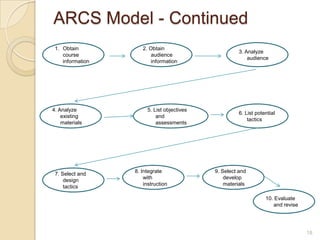
  • #18 The ARCS model is a systematic model which can be fully integrated into the creation/design of an instructional platform. There are four conditions for motivation. The ARCs model also represents four principles, and 10 steps employed to motivate student learning. The application of the model occurs when following these ten steps (see next slide for the 10 steps). The model follows a problem-solving approach and supports learner self-regulation in learning. One trend is to utilize the model in performing human resources functions, such as human performance. Another area of interest is the intrinsic characteristics of motivation in the learner with the extrinsic characteristics of motivation provided by computing technologies in terms of hardware. There are issues in efficiency of applying this model to instructional design, because it is a time consuming process. Thus, the field’s professionals will need to conduct further research and studies in all motivational theories/models that are being applied to designing a learning environment.
  • #19 This slide represents the ten steps in the ARCS motivational model. The process is systematic, but time-consuming for instructional designers to implement.
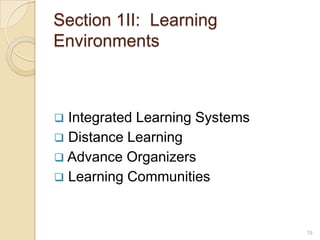
  • #20 Learning environments have changed drastically due to computing technologies. Computing technologies have provided both hardware and software which can provide a framework in the delivery of learning environments. Historically, a teacher in the classroom would decide when and how to integrate audio-visuals and other technologies into the curriculum. But now, instructional technologist must be knowledgeable about how to design instruction, what media should be used, and what is the best way to learn the concepts for a particular subject. Section III presents four types of learning environments.
  • #21 Integrated Learning Systems is a type of learning platform that is used inprimarily academics. These are complete instructional systems which are computer based. The future intention is to develop these systems to a complex level such that they eliminate the need for teachers delivering instruction. These systems are based upon constructivism, and there are many online applications which are being utilized by students. Due to the fact that they follow a constructivist approach, students “explore” these applications rather than learn by skill practice.
  • #22 Distance learning has gained much popularity and exposure in the United States due to the use of computing technologies which provide a vehicle for delivering instruction. Distance learning is also referred to online or e-learning. Distance learning education closes the gap of learners geographically spread out around the globe by using an online interface which provides access to the learning environment. Distance learning research and studies are still being conducted today, and researchers continue to publish best practices with regard to the design of a distance learning platform. Though computing technologies provide an efficient way of delivering instruction, this does not eliminate the risks of completely relying on the integrity of networks, service providers, viruses, server performance, etc.
  • #23 Advance organizers are used to provide introductory material to the learner in order for him/her to create meaning of learning in a particular subject matter later. The advantage of having advance organizers is that they can reduce the cognitive load for learner so that he/she can construct meaning of the instruction. These types of organizers can aid those with special needs. In the instructional technology field, it is important to address the needs of the target audience in various ways such that the learning environment supports various skill levels of learning.
  • #24 Learning communities are types of learning environments which support learning through a community members. Learning communities contain learners with distributed levels of learning; for example, a novice can learn from an expert. This type of learning environment encourages networking, collaboration, sharing of best practices, teamwork, and partnering with organizations. Many organizations utilize learning environments which are based upon learning communities for the learning development of their employees. For instructional technology, it is important to recognize the value of learning received from these types of platforms especially when employees are training for new roles, and improving their level of performance.
  • #25 Section IV discusses learner beliefs. Different from learner motivation, learner beliefs are taken into account for learner attitudes and values in learning. In general, most learners do have an idea of their level of curiosity, success/failure rate, luck, effort, and ability in subjects which are presented to them. For instructional technologists, it is relevant to take these factors into consideration and try to measure learner beliefs before, during, and after instruction. This will allow the field’s professionals to make changes to the learning platform, instruction delivery, and other components which affect learner beliefs.
  • #26 At the basic level of expressing a foundation theory, one can see that learner beliefs are encompassed on the various ways learning can occur in relation to the theory. If we see learner beliefs as characteristics of learners, then we can begin viewing them as the learner’s attitude or what the learner values. Usually, learners do know to some degree whether they can learn the information being instructed to them. Learner beliefs include curiosity, effort, ability, luck, and assessing success and failure result. Bandura’s self-efficacy model comprises of four principles which addresses the learner’s expectancy of success based upon their capabilities.
  • #27 Anglin has restated six revised design guidelines (from Simonson in 1979) in utilizing instructional media in the field which addresses learner attitudes and values. The purpose of these guidelines is to facilitate learner attitude change or formulation. Many of these guidelines support the constructivism philosophy in suggesting an authentic learning environment, gaining useful information in a credible context, involving the learner in the design of his/her own learning of information,encouraging learner participation, and advocating the use of media-rich instruction. In the field, professional can gauge learner beliefs by taking a closer look at similar characteristics in the target audience.
  • #29 If we look in detail at the scope of activities involved in designing a learning platform today; we can then only appreciate the historical contributions made by past researchers and their studies. These studies led to the derivation of psychological and motivational theories that serve as the foundations and frameworks of the field. A learning environment’s effectiveness and robustness can today be been raised considerably higher baseline than in previous time periods. Today, learning platforms are enriched with the use of computing technologies; they are versatile in offering learners a mechanism to self-regulate and take ownership of their own learning. Instructional technologists can measure human performance improvement with regard to both instructional and noninstructional interventions.
  • #30 It is important to state certain limitations in the scope of the instructional technologists work. There is high dependency for the use of computing technologies; unfortunately, problems do arise. Instructional technology cannot be a success as a solo effort; there is a high dependency for team effort, and input should be solicited from many stake holders. The rapid change in technology is another factor that affects the field; thus it is important for those in the field to strategically look ahead to the future needs in the field. The field is still evolving, and research/studies being conducted during this time period will assist in changing the scope of responsibilities of the instructional technologist. This concludes the presentation. Thank you for your time.